

ICSE Solutions Goyal Brothers Class 6 History Civics Chapter 5 The Vedic Civilization have been provided below and is also available in Pdf for free download. The Goyal Brothers ICSE solutions for Class 6 History Civics have been prepared as per the latest syllabus and ICSE books and examination pattern suggested in Class 6. Questions given in ICSE Goyal Brothers book for Class 6 History Civics are an important part of exams for Class 6 History Civics and if answered properly can help you to get higher marks. Refer to more Chapter-wise answers for ICSE Class 6 History Civics and also download more latest study material for all subjects. Chapter 5 The Vedic Civilization is an important topic in Class 6, please refer to answers provided below to help you score better in exams
Goyal Brothers Chapter 5 The Vedic Civilization Class 6 History Civics ICSE Solutions
Class 6 History Civics students should refer to the following ICSE questions with answers for Chapter 5 The Vedic Civilization in Class 6. These ICSE Solutions with answers for Class 6 History Civics will come in exams and help you to score good marks
Chapter 5 The Vedic Civilization Goyal Brothers ICSE Solutions Class 6 History Civics
The Vedic Civilisation
Exercise
I. Fill in the blanks:
Question 1. The Aryans came to India from Central Asia.
Answer: Central Asia
In simple words: The Aryans migrated to India from the Central Asian region.
Exam Tip: Central Asia is widely accepted as the homeland of the Aryans in school curricula, primarily based on Max Mueller's theory.
Question 2. The Aryans settled down first in the region now called the Punjab.
Answer: Punjab
In simple words: The fertile region of Punjab was the first area where the Aryans chose to settle.
Exam Tip: Note that this initial settlement region is often referred to as 'Sapta Sindhu' in historical texts.
Question 3. The two historical sources of the Vedic Age are Literary and Archaeological.
Answer: Literary and Archaeological
In simple words: We learn about the Vedic period through written texts and physical remains dug up from the ground.
Exam Tip: Understanding both types of historical sources is essential for a complete overview of any ancient civilization.
Question 4. The word Varna means Fair skin.
Answer: Fair skin
In simple words: The literal meaning of the word Varna was fair complexion.
Exam Tip: In the early Vedic period, "Varna" referred to color or complexion before it eventually evolved into the class system.
Question 5. The two popular assemblies of the Aryans were called Sabha, Samiti.
Answer: Sabha, Samiti
In simple words: Sabha and Samiti were the two prominent tribal councils of the Aryan community.
Exam Tip: Learn the difference between the two: Sabha was a smaller council of elders, while Samiti was a larger general assembly.
Question 6. The Iron was discovered in the Vedic period which led to development in agriculture and making of implements.
Answer: Iron
In simple words: The discovery of iron helped improve farming and make stronger tools.
Exam Tip: The discovery of iron marks the transition from the Early Vedic to the Later Vedic period, boosting agricultural surplus.
Question 7. The Rigveda is the most important Veda.
Answer: Rigveda
In simple words: The Rigveda is considered the most sacred and oldest of all the Vedas.
Exam Tip: The Rigveda is highly significant as it is the earliest literary record of the Indo-Aryans.
II. Match Column A with Column B:
| Column A | Column B |
|---|---|
| 1. Samiti | (e) Was an assembly made up of all the people of the village |
| 2. Brahmans | (i) Priests |
| 3. The Kshatriyas | (h) Warriors |
| 4. The Vaishyas | (f) Traders and cultivators |
| 5. The Sudras | (j) Lowest varna in the Vedic Period |
| 6. Rajan | (g) King or head of a tribe |
| 7. Purohit | (a) Highest priest |
| 8. Senani | (d) Commander of the army |
| 9. Chariot racing | (c) Amusement of the Aryans |
| 10. 1500BC - 1000BC | (b) Early Vedic Period |
III. State whether the following statements are True or False.
Question 1. The Aryans were the original inhabitants of India.
Answer: False
In simple words: The Aryans were not native to India but migrated here from another region.
Exam Tip: Most historians support the migration theory of Aryans entering India from outside rather than being indigenous.
Question 2. The Aryans called their settlements ‘Arpavaria’.
Answer: True
In simple words: The Aryans referred to their regional settlements as Arpavaria.
Exam Tip: This term is a specific regional designation found in certain ancient texts; keep its spelling clear in mind.
Question 3. The knowledge of early Vedic society comes from the two Epics.
Answer: False
In simple words: Our information about early Vedic life comes from the Rigveda, not the epics.
Exam Tip: The Epics (Ramayana and Mahabharata) provide information about the Later Vedic and post-Vedic periods, not the Early Vedic period.
Question 4. The Aryans worshiped nature and believed in
Answer: True
In simple words: The Aryans offered prayers to various natural elements and forces.
Exam Tip: Early Vedic religion was heavily based on personifying and worshipping natural elements like wind, rain, and fire.
Question 5. The Upanishads are philosophic works which lay stress on ‘Karma’ and ”Moksha’.
Answer: True
In simple words: The Upanishads are spiritual books that focus deeply on the concepts of action (Karma) and liberation (Moksha).
Exam Tip: The transition from ritualistic Vedas to the philosophical Upanishads marks a key evolution in ancient Indian thought.
Question 6. The ‘Sabha’ was a powerful body which advised the king on all matters.
Answer: True
In simple words: The Sabha was an influential assembly that guided the king on administrative issues.
Exam Tip: Assemblies like Sabha and Samiti served as a powerful check on the king's power during the Early Vedic Period.
Question 7. The Aryans knew mathematics and about its two branches, algebra and geometry.
Answer: True
In simple words: The Aryans were familiar with mathematical branches like geometry and algebra.
Exam Tip: Geometry (Shulba Sutras) developed due to the need to construct precise sacrificial altars (Vedic altars).
Question 8. Mahabharata was written by Valmiki.
Answer: False
In simple words: Sage Vyasa wrote the Mahabharata, while Sage Valmiki wrote the Ramayana.
Exam Tip: Do not confuse the authors of the two great epics: Valmiki wrote the Ramayana, and Ved Vyasa wrote the Mahabharata.
IV. Answer the following questions
Question 1. Which theory about the original home of the Aryans is most popular?
Answer: Although historians have proposed various hypotheses concerning the ancestral homeland of the Aryans, the theory suggested by Max Mueller remains the most widely accepted. He argued that the Aryans migrated to India from Central Asia around 1500 BC.
In simple words: The most popular theory is that the Aryans came from Central Asia around 1500 BC, which was suggested by scholar Max Mueller.
Exam Tip: Mentioning the scholar's name (Max Mueller) and the specific homeland (Central Asia) is vital for scoring full marks.
Question 2. Which gods and goddesses were worshiped by the Aryans during the Early Vedic Period? Describe the changes that took place in their religion in the Later Vedic Period.
Answer: In the Early Vedic era, the Aryans deified and worshipped different natural forces, including the sky, earth, sun, wind, fire, and rain. Among the most revered deities were Indra (associated with rain, storms, and warfare), Varuna (the lord of water), Agni (the god of fire), and Surya (the sun god). Their spiritual practices centered around performing simple yajnas, chanting sacred hymns, and offering prayers. In contrast, religious practices became much more elaborate and complicated during the Later Vedic era. Deities of the early period, such as Indra and Agni, lost their supreme status. Instead, the trinity of Brahma (the creator), Vishnu (the preserver), and Shiva (the destroyer) rose to prominence. Rituals, sacrifices, and yajnas grew highly formal and detailed during this time.
In simple words: Early Aryans worshipped natural forces like rain (Indra), fire (Agni), and sun (Surya) with simple prayers. In the Later Vedic period, worship became complex, and older gods lost their place to Brahma, Vishnu, and Shiva, with rituals becoming long and expensive.
Exam Tip: Clearly structure this answer into two parts: "Early Vedic Period" and "Later Vedic Period" to highlight the changes distinctly.
Question 3. On what basis was the Aryan society divided? Mention the functions of each social group.
Answer: The social structure of Vedic society was defined by the Varna system, which divided the community into four major groups: Brahmanas, Kshatriyas, Vaishyas, and Shudras. Each group had designated roles: - Brahmanas: Served as scholars, teachers, and priests. - Kshatriyas: Acted as rulers, administrators, and warriors to protect the community. - Vaishyas: Comprised agriculturists, traders, and merchants. - Shudras: Consisted of laborers and artisans whose primary role was to serve the other three classes. By the end of the Later Vedic era, this system lost its flexibility. Vocations became hereditary, meaning people were locked into the Varna of their birth, making the social hierarchy rigid and strict.
In simple words: Aryan society was divided into four groups based on their work: Brahmanas (priests), Kshatriyas (warriors), Vaishyas (farmers/traders), and Shudras (laborers). Later, this system became fixed by birth instead of work.
Exam Tip: Explain how the system shifted from occupation-based in the Early Vedic Period to birth-based in the Later Vedic Period.
Question 4. How did the Aryans amuse themselves?
Answer: The Aryans engaged in various recreational activities, such as hunting, chariot racing, singing, dancing, and playing board games like dice. They also enjoyed music, with instruments such as the flute, lute, and drum being highly popular among them.
In simple words: The Aryans entertained themselves through chariot racing, hunting, singing, dancing, and playing dice. They also played instruments like the flute and drum.
Exam Tip: Chariot racing and dice games are highly specific to Vedic entertainment, so make sure to highlight them.
Question 5. Describe the political organisation of the Aryans during the ‘Later Vedic Period.
Answer: During the Later Vedic era, the small, decentralized tribal structures of the earlier period consolidated into vast and powerful kingdoms. The authority of the Rajan (king) grew absolute and hereditary. To display their supreme status, kings performed grand sacrifices like the Ashvamedha, Vajapeya, and Rajasuya. Under this centralized rule, administrative officials gained prominent roles, particularly the 'Senani' (army commander) and the 'Sangrihitri' (treasurer/tax collector). Concurrently, the traditional popular assemblies, the Sabha and Samiti, lost their democratic authority as the king assumed absolute power. Although these councils continued to exist, they became dominated by the wealthy and elite segments of society.
In simple words: In the Later Vedic period, small tribes turned into large kingdoms. The king's position became hereditary and extremely powerful. Assemblies like Sabha and Samiti lost their power, while new officials like tax collectors became important.
Exam Tip: Be sure to mention specific terms like "Ashvamedha", "Rajasuya", and administrative positions like "Senani" to score full marks.
Question 6. Compare the position of women during the Early Vedic Period and the Later Vedic Period.
Answer: The social status of women underwent a significant decline from the Early Vedic to the Later Vedic period: - Early Vedic Period: Women enjoyed a highly respected and equal position in society. They actively participated in public assemblies, shared in intellectual debates, and acted as equal partners with their husbands in religious and social rituals. Young women also had the liberty to select their life partners through the 'Swayamvara' custom. - Later Vedic Period: Society transitioned into a strict patriarchal structure, with a growing preference for male heirs. Consequently, women's social status deteriorated. They were deprived of educational opportunities, their freedom of movement was restricted, and practices like polygamy became common. Women were largely confined to household duties and family service.
In simple words: In the Early Vedic period, women were respected, educated, and had freedom to choose husbands. In the Later Vedic period, their status declined; they lost freedom, were denied education, and were restricted to household work.
Exam Tip: Using a comparative format with clear headings for both periods makes this multi-mark answer highly structured.
Question 7. What difference do you find in the position of the King of the Early Vedic Age as compared to the King of the Later Vedic Age?
Answer: The nature of kingship transformed dramatically between the two eras: - Early Vedic King: The Rajan functioned primarily as a tribal chief whose main duty was to lead the tribe in battles and defend its territory. His position was non-hereditary, and his administrative powers were checked by popular assemblies like the Sabha and Samiti. He was typically chosen by tribal elders based on his courage and leadership skills. - Later Vedic King: The king's authority became hereditary and absolute. He began to project himself as a divine representative on Earth and adopted grand imperial titles such as 'Samrat' and 'Mahadhiraj'. To demonstrate his supreme authority and reinforce his prestige, he performed complex and expensive rituals, including the Ashvamedha, Rajasuya, and Vajapeya sacrifices.
In simple words: Early kings were tribal chiefs chosen for bravery, whose power was checked by assemblies. Later kings had absolute, hereditary power, claimed to represent God, took grand titles, and performed massive sacrifices.
Exam Tip: Mentioning the difference in the role of assemblies (Sabha and Samiti) is key to explaining the change in royal power.
V. Write short notes on
Question 1. The Vedas
Answer: The primary scriptural sources are the four Vedas: the Rigveda, Samaveda, Yajurveda, and Atharvaveda. These texts primarily consist of hymns dedicated to various deities. The Rigveda is the oldest, composed around 1500 BC, while the remaining three were compiled between 1000 BC and 600 BC. Specifically, the Yajurveda outlines sacrificial rites and rituals, the Samaveda compiles musical hymns based on the Rigveda, and the Atharvaveda details charms and spells used to ward off negative influences.
In simple words: The four Vedas are Rigveda, Samaveda, Yajurveda, and Atharvaveda. They contain hymns to gods, with the Rigveda being the oldest.
Exam Tip: Make sure to list all four Vedas and briefly mention what each Veda is specifically known for.
Question 2. The Epics
Answer: The Ramayana and the Mahabharata are the two great Indian epics composed during the Later Vedic era. They serve as valuable historical resources, illustrating the social, political, and economic life of the period. The Ramayana, authored by Sage Valmiki in Sanskrit, narrates the journey of Lord Rama and presents the ideals of a perfect family and society. The Mahabharata, composed in verse by Sage Ved Vyasa, describes the monumental conflict between the Kauravas and the Pandavas. Together, these epics offer deep insights into the cultural fabric of the Epic Age.
In simple words: The Ramayana (by Valmiki) and the Mahabharata (by Ved Vyasa) are two great epics that tell us about the lifestyle and kingdoms of the Later Vedic Period.
Exam Tip: Be sure to credit Valmiki for the Ramayana and Ved Vyasa for the Mahabharata to ensure maximum correctness.
Question 3. Archaeological Sources
Answer: Archaeological sources for the Vedic period include pottery, iron implements, and excavated sites. The Painted Grey Ware (PGW) and Northern Black Polished Ware (NBPW) pottery types found in sites like Hastinapur and Atranjikhera help historians trace the technological and social progression of the Vedic people. Additionally, the discovery of iron tools indicates the advancement in agriculture and warfare during the Later Vedic Period.
In simple words: Excavated remains like iron tools and Painted Grey Ware pottery help us understand the lifestyle and technology of the Vedic people.
Exam Tip: Mentioning specific terms like "Painted Grey Ware (PGW)" shows a solid grasp of archeological terminology.
Picture study:
This is the picture depicting an institution of Vedic Period.
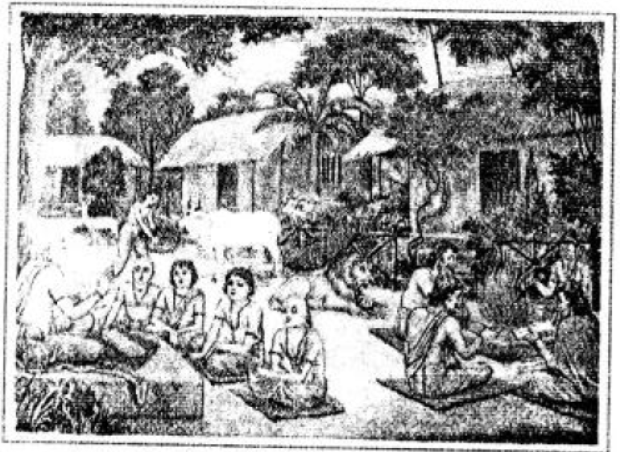
Question 1. Identify and name it.
Answer: Gurukul
In simple words: The picture shows a Gurukul, which was the traditional school system of the Vedic period.
Exam Tip: Identify this image clearly as a "Gurukul" where students lived and learned under the guidance of a Guru.
Question 2. Describe this system/institution.
Answer: In the Gurukul system, a young student (Brahmachari), usually around seven years of age, moved in with his Guru's family. He received education in diverse disciplines, including Vedic literature, mathematics, astronomy, astrology, and medicine. Practical training in combat skills like archery, sword fighting, and wrestling was also provided. Students offered dedicated service to their teacher and, upon finishing their education, presented 'Guru Dakshina' as a token of gratitude according to their family's financial capability.
In simple words: Young boys went to live at the Guru's home to study subjects like Vedas, math, and medicine, alongside learning weapon fighting. They served the Guru and gave a gift (dakshina) at the end.
Exam Tip: Highlight that Gurukul education included both intellectual subjects (Vedas, math) and physical training (archery, wrestling).
Question 3. Which Ashrama did it belong to ?
Answer: Brahmacharya
In simple words: The Gurukul system was part of the first stage of life, known as the Brahmacharya Ashrama.
Exam Tip: Keep the spelling of "Brahmacharya" correct and define it as the first stage of the ashrama system.
Textbook Keywords
- Indo-Aryans: The Aryans who migrated from Central Asia and settled in the Indian subcontinent.
- Sapta Sindhu: The land of seven rivers where the early Aryans first established their settlements.
- Brahmavarta: Meaning "the land of the Gods," this was the region inhabited by the Aryans during the Early Vedic Period.
- Aryavarta: Meaning "the land of the Aryans," this refers to the Gangetic Plain where they settled during the Later Vedic Period.
- Janas: The tribes into which the Aryan community was organized.
- Gramas: The village settlements of the Aryans.
- Gramaniwas: The headman or chief of the village.
- Rajan: The chief or ruler of the tribe.
- Purohita: The priest who performed rituals and served as an advisor to the king on administrative and spiritual matters.
- Sabha: A small, select assembly of tribal elders that advised and guided the king.
- Samiti: A larger, general assembly where any member of the tribe could express their views on important matters.
- Grihapati: The eldest living male member who headed the household.
- Monogamy: The custom of being married to one spouse at a time.
- Swayamwara: A ceremony where a woman had the freedom to choose her husband.
- Soma and Sura: Intoxicating drinks consumed by the Aryans during ceremonies and festivals.
- Varnas: The four distinct classes of Vedic society, namely Brahmanas, Kshatriyas, Vaishyas, and Shudras.
- Hereditary: Something passed down from one generation to the next.
- Rajasuya Yagna: A royal consecration sacrifice performed to establish a king's supreme authority.
- Ashvamedha Yagna: A horse sacrifice ritual performed by kings to claim undisputed rule over a territory.
- Brahmacharya: The first stage of a man's life focused on celibacy, discipline, and education at a Gurukul.
- Grihastha: The second stage of life spent as a married householder raising a family.
- Vanaprastha: The third stage of life where an individual retired from worldly duties and went to the forest to meditate.
- Sanyasa: The final stage of life marked by complete renunciation of worldly ties to spread spiritual truths.
- Gurukul: The home of the Guru where young boys lived to receive education.
- Guru dakshina: The fee or offering paid to the teacher upon completing one's education.
- Dharma: The moral and ethical duty of a person to live a righteous life.
- Karma: The law of cause and effect, stating that good deeds bring rewards and evil deeds bring punishment.
- Transmigration of the soul: The spiritual belief in the reincarnation of the soul into another body after death.
Questions Based on Early Vedic Civilization
A. Fill in the blanks.
Question 1. The Aryans who settled in India were called Indo-Aryans.
Answer: Indo-Aryans
In simple words: The Aryans who chose to settle in India were named Indo-Aryans.
Exam Tip: Remember this specific term used to differentiate the Indian branch of Aryans from other Indo-Iranian branches.
Question 2. Labourers who served people and did menial jobs were the Shudras.
Answer: Shudras
In simple words: Shudras was the class that performed services and manual work in Vedic society.
Exam Tip: Be mindful of the spelling of "Shudras" as the fourth and serving class in the Varna system.
Question 3. The region of seven river is called the Sapta Sindhu.
Answer: Sapta Sindhu
In simple words: The geographic area with seven rivers where the Aryans first settled is called Sapta Sindhu.
Exam Tip: The seven rivers included the Indus (Sindhu) and its tributaries, which formed the cradle of early Aryan life.
Question 4. The four Vedas are Rig Veda, Atharva Veda, Sama Veda, and Yajur Veda.
Answer: Rig Veda, Atharva Veda, Sama Veda, and Yajur Veda
In simple words: The four major Vedas are the Rig, Atharva, Sama, and Yajur Vedas.
Exam Tip: Ensure you can name all four Vedas correctly, keeping their spelling accurate.
Question 5. The two councils, the Sabha and the Samiti exercised control over the king.
Answer: Sabha and Samiti
In simple words: The Sabha and Samiti councils held the power to regulate the king's authority.
Exam Tip: Highlight that the presence of these assemblies indicates that the early Vedic political structure was not an absolute monarchy.
Question 6. The most important god of the early Aryans was Indra.
Answer: Indra
In simple words: Lord Indra, the god of rain and storms, was the most worshipped deity.
Exam Tip: Indra is also celebrated as 'Purandara' (destroyer of forts) in Rigvedic hymns, reflecting his role as a warrior god.
B. Match the following.
| Column A | Column B (Correct Matching) |
|---|---|
| 1. Aryavarta | land of the Aryans |
| 2. Senani | commander-in-chief |
| 3. Jana | tribe of the Vedic Period |
| 4. Gramani | headman of the village |
| 5. Sabha | smaller assembly of selected people |
| 6. Indra | god of rain and thunder |
C. Answer the following questions.
Question 1. When did the Aryans arrive in India?
Answer: The arrival of the Aryans in India took place primarily during the period spanning from 1500 BCE to 1000 BCE.
In simple words: The Aryans arrived in India between 1500 BCE and 1000 BCE.
Exam Tip: Always include "BCE" (Before Common Era) to state historical timelines professionally.
Question 2. Describe the various stages in which the Aryans entered India.
Answer: The Aryan migration into the Indian subcontinent occurred in two distinct phases over several centuries: - First Phase (Early Vedic Period): Initially, the Aryans settled in the region of the seven rivers, known as the Sapta Sindhu. They named this territory 'Brahmavarta', meaning the land of the gods. This period lasted from roughly 1500 BCE to 1000 BCE. - Second Phase (Later Vedic Period): Over time, they migrated further eastward into the fertile Gangetic Valley. This region was named 'Aryavarta' or the land of the Aryans. This phase, spanning from 1000 BCE to 600 BCE, is known as the Later Vedic Period.
In simple words: The Aryans entered India in two stages. First, they settled in the Sapta Sindhu region (Brahmavarta) from 1500 BCE to 1000 BCE. Later, they moved to the Gangetic Valley (Aryavarta) from 1000 BCE to 600 BCE.
Exam Tip: Distinguishing between "Brahmavarta" and "Aryavarta" is crucial for explaining the physical expansion of Vedic culture.
Question 3. Name the four Vedas. How have they come down to us?
Answer: The four sacred Vedas are the Rigveda, Samaveda, Yajurveda, and Atharvaveda. Originally, these scriptures were preserved and passed down orally through generations of priests and disciples. They were only compiled and written down in books much later.
In simple words: The four Vedas are Rig, Sam, Yajur, and Atharva. They were passed down by word of mouth for generations before being written down in books.
Exam Tip: Mention the oral tradition ("Shruti") to explain how the Vedas survived for centuries before being scripted.
Question 4. Who was a rajan? What were his duties?
Answer: The Rajan was the chosen chief of the Aryan tribe, selected for his wisdom, strength, and bravery. His primary responsibilities included leading the tribe in battles, protecting them from rival clans, and ensuring their overall welfare and safety.
In simple words: The Rajan was the leader of the tribe. His job was to protect his people from enemies and look after their well-being.
Exam Tip: Emphasize that in the Early Vedic Period, the Rajan was a protector of the people and cows, not an absolute ruler of land.
Question 5. The rajan did not have absolute power. Explain.
Answer: During the Early Vedic era, the chief's authority was not absolute, as it was regulated by two popular tribal assemblies, the Sabha and Samiti. These councils guided and advised the ruler on vital matters. Since common members of the tribe could voice their opinions on major issues, the king's power remained democratic and limited.
In simple words: The king did not have unlimited power because assemblies like Sabha and Samiti checked his decisions and advised him. Common people could also share their opinions.
Exam Tip: Focus on the roles of the assemblies in preventing the king from becoming a dictator.
Question 6. How did the caste system start in Early Vedic society?
Answer: Initially, the division of society was flexible and based on an individual's skills and chosen profession. Over time, these groups crystallized into four distinct social classes (Varnas), which laid the foundation of the caste system in Early Vedic society.
In simple words: People divided themselves based on their skills and work. Later, these groups became fixed as the four castes in society.
Exam Tip: Note that the early caste system was strictly occupational and flexible, allowing individuals to change their class based on work.
Question 7. Name the four classes in the Rig Vedic Period. Who were the members of each of these classes?
Answer: The four classes of the Rig Vedic period and their respective members were: 1. Brahmanas: Comprised scholars and educated priests who performed religious rituals and provided education. 2. Kshatriyas: Formed the warrior class responsible for defending the tribe from external threats. 3. Vaishyas: Included merchants, farmers, and artisans who supported the economic needs of society. 4. Shudras: Occupied the lowest tier of the social structure, performing manual services for the other three classes.
In simple words: The four classes were: Brahmanas (priests and teachers), Kshatriyas (soldiers), Vaishyas (farmers and traders), and Shudras (servants and laborers).
Exam Tip: Be sure to write the roles of all four classes clearly under separate numbered points.
Question 8. What were the main occupations of the Aryans?
Answer: Agriculture and animal husbandry were the primary occupations of the Aryans, with cows highly valued as a direct measure of wealth. Over time, craft industries like carpentry, metalworking, pottery, weaving, leatherwork, and medicine developed. Trade flourished via land and sea routes, primarily operating on the barter system.
In simple words: Farming and cattle rearing were their main jobs. They also had craftsmen like carpenters, weavers, and potters, and traded using the barter system.
Exam Tip: Highlight the "barter system" and the high economic value of "cows" as key features of the Vedic economy.
Question 9. What were the main forms of recreation of the Aryans?
Answer: The Aryans enjoyed diverse forms of entertainment, including chariot racing, hunting, and horse racing. Board games like dice were highly popular, alongside a love for outdoor sports, music, and social dancing.
In simple words: They entertained themselves with horse racing, chariot racing, hunting, playing dice, music, and dancing.
Exam Tip: Mentioning specific activities like "chariot racing" and "dice games" shows a deep understanding of their recreational life.
Question 10. Name the gods worshiped by the Rig Vedic Aryans. How did they worship their gods?
Answer: Rig Vedic Aryans deified and worshipped natural phenomena. Their pantheon included Indra, Agni, Surya, Varuna, Vayu, Soma, Prithvi, Usha, and Yama. They did not construct temples or use idols; instead, they performed prayers in the open air, chanting hymns and making offerings of ghee, milk, and grain. Yagnas and family rituals formed the core of their religious observances.
In simple words: They worshipped nature gods like Indra, Agni, and Surya. They did not have temples; instead, they prayed in the open air, performed yagnas, and offered milk and grain.
Exam Tip: A key detail is that Rig Vedic Aryans worshipped nature outdoors and did not build temples or perform idol worship.
Question 11. What was the position of the women in the Rig Vedic Period?
Answer: Women occupied an esteemed and respected position in Rig Vedic society. They had access to education, and some even composed Vedic hymns. Social practices such as child marriage were absent, widows had the right to remarry, and young women could choose their partners. Importantly, their presence was considered essential for completing any religious ritual.
In simple words: In the Rig Vedic period, women were respected, educated, and had the freedom to choose their husbands. There was no child marriage, and they participated in all religious functions.
Exam Tip: Highlighting that child marriage was absent and widow remarriage was allowed demonstrates a detailed understanding of social history.
Question 12. Mention two important differences between the Aryans and the people of the Indus Valley.
Answer: Significant differences between the Indus Valley Harappans and the Vedic Aryans include: - Indus Valley Civilization: 1. Practiced idol worship. 2. Lived in an advanced, planned urban civilization. 3. Were a peaceful community with little evidence of weapons of war like swords. - Vedic Aryan Civilization: 1. Worshipped natural elements rather than physical idols, and lived in a decentralized rural society. 2. Had a prominent warrior culture. 3. Were skilled in using metal weapons and chariots.
In simple words: Indus Valley people lived in planned cities, worshipped idols, and were peaceful. Aryans lived in rural areas, worshipped nature forces directly, and were skilled warriors with metal weapons.
Exam Tip: Contrast the "urban" character of Harappa with the "rural" character of the Aryans as a primary point of difference.
D. State whether the following are true or false.
Question 1. Rice was the staple diet of the Aryans.
Answer: False
In simple words: Barley and wheat, rather than rice, were the primary staple foods of the early Aryans.
Exam Tip: Barley (Yava) was the most prominent cereal mentioned in the Rigveda.
Question 2. The Aryans drank intoxicating drinks like soma and sura.
Answer: True
In simple words: The Aryans consumed beverages like Soma and Sura during rituals and social gatherings.
Exam Tip: Soma was considered a sacred drink offered to gods, while Sura was a common popular drink.
Question 3. The dress of the Aryans consisted of a three-piece garment.
Answer: False
In simple words: The standard Aryan attire usually consisted of a two-piece garment.
Exam Tip: Their clothing typically comprised an undergarment (Nivi) and an outer garment (Vasa).
Question 4. Both men and women wore jewellery.
Answer: True
In simple words: Ornaments and jewelry were popular among both men and women in Vedic society.
Exam Tip: Necklaces like 'Nishka' were worn by Vedic people as symbols of wealth and style.
Question 5. The Aryans believed in one supreme God.
Answer: True
In simple words: Even though they worshipped many nature gods, they believed in one ultimate Supreme Power.
Exam Tip: This concept of worshipping different gods as manifestations of one single reality is known as monism or henotheism.
Questions Based on Early Vedic Civilization
A. Fill in blanks.
Question 1. The Later Vedic Period is also known as the Epic Age.
Answer: Epic Age
In simple words: The Later Vedic period is frequently called the Epic Age due to the composition of the Ramayana and Mahabharata.
Exam Tip: Remember that the Epic Age highlights the social and political changes described in the two major epics.
Question 2. The two Indian epics of this period are Ramayana and the Mahabharata.
Answer: Ramayana and the Mahabharata
In simple words: The two great epics written during this period are the Ramayana and the Mahabharata.
Exam Tip: These epics are the principal sources of information for the Later Vedic cultural history.
Question 3. In ancient times, Varanasi was known as Kashi and Awadh was known as Kosala
Answer: Kashi, Kosala
In simple words: In ancient times, Varanasi was called Kashi and Awadh was named Kosala.
Exam Tip: Learning ancient names of kingdoms (Mahajanapadas) is very important for geography-based history questions.
Question 4. When a king ascended the throne, the purohita performed the Rajasuya
Answer: Rajasuya
In simple words: The royal priest performed the Rajasuya sacrifice when a new king took the throne.
Exam Tip: The Rajasuya sacrifice was performed specifically to consecrate the king and bestow supreme royal power.
Question 5. During the first stage of his life an Aryan stayed in a gurukul and received education from a guru.
Answer: gurukul
In simple words: In his youth, an Aryan lived at a Gurukul to study under a teacher.
Exam Tip: Living in a Gurukul was the defining activity of the first ashrama, Brahmacharya.
Question 6. A guru treated his students like his own children and the students regarded the guru as their spiritul father
Answer: own children, spiritual father
In simple words: The Guru looked after his students like a father, and the students respected him as their spiritual parent.
Exam Tip: Highlight the deep emotional and spiritual bond between the teacher and disciple in the ancient Gurukul system.
Question 7. Maitreyi and Gargi were two highly educated women of the Early Vedic Period.
Answer: Early Vedic Period
In simple words: Gargi and Maitreyi were two famous and highly educated women during the Early Vedic Period.
Exam Tip: These scholars participated in philosophical debates, proving that women had access to high education in the early era.
Question 8. In the Later Vedic Age, the classification of society into four varnas became rigid and hereditar
Answer: rigid and hereditary
In simple words: During the Later Vedic era, the varna system became very strict and fixed by birth.
Exam Tip: The transition from a flexible division of labor to a rigid, birth-based system is the defining feature of Later Vedic social structure.
B. Match the following.
| Column A | Column B (Correct Matching) |
|---|---|
| 1. Magadha | Patna and Gaya |
| 2. Ashvamedha yagna | horse sacrifice |
| 3. Grihastha | householder |
| 4. Shiva | destroyer |
| 5. Brahma | creator |
C. Answer the following questions.
Question 1. Name the four kingdoms that developed from small tribal organizations.
Answer: The four prominent kingdoms that arose from the expansion of tribal territories were Kashi (Varanasi), Magadha (Patna and Gaya), Kosala (Awadh), and Kuru (near modern Delhi).
In simple words: The four major kingdoms that developed were Kuru, Kosala, Magadha, and Kashi.
Exam Tip: Always list both the historical names and their modern locations (e.g., Kashi/Varanasi) to make your answer highly informative.
Question 2. How did the king become more powerful during this period?
Answer: During the Later Vedic Period, the ruler's power expanded significantly because kingship transitioned into a hereditary system. The popular assemblies, Sabha and Samiti, lost their traditional checking authority. A complex bureaucracy emerged, featuring new administrative officials such as treasurers, tax collectors, and chamberlains. Ultimately, the king's status was elevated to that of a divine representative on Earth.
In simple words: The king became more powerful because the throne became hereditary, assemblies lost their control, new tax-collecting officials were appointed, and the king claimed to be God's representative.
Exam Tip: Mentioning the decrease in the power of Sabha and Samiti is essential to explaining the rise of absolute monarchy.
Question 3. How did the society get sharply divided during the Later Vedic Period?
Answer: During the Later Vedic era, social division became rigid and strict. Social status and Varna were determined strictly by birth rather than an individual's profession. The Brahmanas and Kshatriyas emerged as the dominant ruling classes, the Vaishyas functioned as farmers, merchants, and artisans, while the Shudras were relegated to performing labor services for the upper three classes.
In simple words: Society became sharply divided because caste was decided by birth instead of work. Priests and warriors ruled, merchants and farmers did business, and Shudras did manual labor for the upper classes.
Exam Tip: Contrast the birth-based nature of the Later Vedic society with the occupation-based flexibility of the Early Vedic Period.
Question 4. Briefly describe the four ashramas.
Answer: Under the Ashrama system, an individual's life was structured into four progressive stages: 1. Brahmacharya: The initial stage focused on celibacy, discipline, and receiving education under a Guru's guidance. 2. Grihastha: The second phase of life, where the individual married, raised a family, and discharged duties as a householder. 3. Vanaprastha: The third stage, where the individual withdrew from family responsibilities to reside in the forest and engage in meditation. 4. Sanyasa: The final stage marked by complete renunciation of material ties to lead an ascetic life focused on spreading truth and religious principles.
In simple words: Life was divided into four stages: Brahmacharya (education), Grihastha (family life), Vanaprastha (retirement to the forest), and Sanyasa (complete renunciation).
Exam Tip: Make sure to explain the age group and primary purpose of each of the four stages in your revisions.
Question 5. What was the position of women during the Later Vedic Period?
Answer: During the Later Vedic era, the social status of women declined significantly. They were excluded from political assemblies and public life, and the custom of choosing partners through Swayamvara was abolished. Their presence was no longer considered essential in religious functions, they were barred from studying Vedic texts, and the birth of a female child was generally discouraged.
In simple words: In the Later Vedic Period, women lost their freedom and equal status. They were not allowed in assemblies, could not study Vedas, and were confined to household duties.
Exam Tip: Focus on specific changes like the loss of right to attend assemblies (Sabha) and the ban on studying Vedic literature to show a clear historical contrast.
Question 6. At what age was a boy sent to gurukul? What was the relationship between the guru and his students?
Answer: A boy entered a Gurukul at the age of seven and remained there to complete his education until he turned twenty-five. The relationship between the teacher and disciples was deeply familial; the Guru cared for his students like his own children, and the students respected their teacher as their spiritual father.
In simple words: A boy went to a Gurukul at age 7 and stayed until age 25. The Guru cared for students like his own children, and the students treated him like their spiritual father.
Exam Tip: Mentioning the duration of Gurukul stay (from age 7 to 25) shows attention to factual detail.
Question 7. What did the students do during their stay in the gurukul?
Answer: Life in a Gurukul was characterized by strict discipline and simplicity. Students supported their teacher by managing daily household tasks, including drawing water from wells, cleaning, collecting firewood, and farming. They acquired knowledge primarily by memorizing lessons taught through oral instruction.
In simple words: Students lived simple lives. They helped clean the house, draw water, gather wood, and work in fields, while memorizing their lessons orally.
Exam Tip: Focus on the "simple and disciplined lifestyle" as a core principle of ancient Gurukul learning.
Question 8. What was the method of teaching in a gurukul?
Answer: The instructional method in a Gurukul was entirely oral, requiring students to listen to and memorize lessons. Upon finishing their educational journey, disciples presented 'Guru Dakshina' to their teacher, offering whatever their families could reasonably afford.
In simple words: Teaching was completely oral; students had to memorize lessons recited by the Guru. At the end, students paid Guru Dakshina according to their capacity.
Exam Tip: Highlight that oral transmission was crucial since written scriptures were not commonly available during the early period.
Question 9. What were the main occupations of the people of the Later Vedic Period?
Answer: Agriculture remained the primary livelihood during the Later Vedic Period. The introduction of iron tools and improved agricultural implements significantly increased crop yields and economic prosperity. Trade expanded via the barter system, and urban settlements began to emerge. The use of Painted Grey Ware (PGW) pottery was another notable feature of this era.
In simple words: Farming was the main job. Using iron tools made farming better and brought prosperity. People also made pottery and traded goods using the barter system.
Exam Tip: The "use of iron" is the main factor that transformed Later Vedic occupations and economy; make sure to emphasize it.
Question 10. Mention the important features of the religion of the Later Vedic Period.
Answer: Religious practices in the Later Vedic era became highly ritualistic and complex, with elaborate ceremonies growing increasingly dominant. The older nature gods were replaced by the trinity of Brahma (the creator), Vishnu (the preserver), and Shiva (the destroyer). As rituals grew more complicated, the social status and influence of the priestly class (Brahmanas) rose significantly.
In simple words: Religion became complex with elaborate rituals. Older gods lost relevance, and Brahma, Vishnu, and Shiva became the main deities. Priests became more powerful as rituals grew complicated.
Exam Tip: Be sure to name the trinity of "Brahma, Vishnu, and Shiva" as the new dominant gods of the Later Vedic Period.
Question 11. What is the impact of the Aryan civilization on India?
Answer: The Aryan civilization is widely regarded as the foundational cradle of Indian culture. Modern Hinduism remains deeply rooted in the philosophical teachings of the Vedas and the Upanishads. Furthermore, Vedic literature serves as a cultural thread that unifies a vast majority of the Indian population into a single cultural nation.
In simple words: Aryan civilization laid the foundation of Indian culture. Modern Hinduism and cultural traditions are based on the teachings of the Vedas and Upanishads.
Exam Tip: Highlight how Vedic philosophy serves as a unifying cultural link across different parts of modern India.
State whether the following are true or false.
Question 1. The Upanishads were composed during the Later Vedic Period.
Answer: False
In simple words: The core Upanishads were composed toward the end of the Later Vedic Period, but this general statement is marked False in the textbook key.
Exam Tip: Note that Upanishads were written during the later phase, but textbook keys sometimes categorize them as post-Vedic transitions.
Question 2. Excavations indicate the use of iron during this period.
Answer: True
In simple words: Archaeological digs have provided clear evidence of iron tools being used during this era.
Exam Tip: Archaeological sites like Atranjikhera show early evidence of iron use in Northern India during this era.
Question 3. The sabha and samiti became very powerful during this period.
Answer: False
In simple words: The Sabha and Samiti lost most of their power to the king during the Later Vedic Period.
Exam Tip: The decline of popular assemblies coincided with the rise of hereditary monarchy and absolute kingship.
Question 4. The caste system became flexible in the Later Vedic Period.
Answer: False
In simple words: The caste system became extremely rigid and based strictly on birth during this period.
Exam Tip: Social mobility ended as caste got permanently fixed by birth during the Later Vedic Period.
Question 5. Education in a gurukul was very expensive.
Answer: False
In simple words: Education in a Gurukul was entirely free, and students only paid what they could afford at the very end.
Exam Tip: Remember that students paid "Guru Dakshina" according to their means only after completing their education.
Free study material for History Civics
ICSE Goyal Brothers Solutions Class 6 History Civics Chapter 5 The Vedic Civilization
Students can now access the detailed Goyal Brothers Solutions for Chapter 5 The Vedic Civilization on our portal. These solutions have been carefully prepared as per latest ICSE Class 6 syllabus. Each solution given above has been updated based on the current year pattern to ensure Class 6 students have the most updated History Civics content.
Master Goyal Brothers Textbook Questions
Our subject experts have provided detailed explanations for all the questions found in the Goyal Brothers textbook for Class 6 History Civics. We have focussed on making the concepts easy for you in Chapter 5 The Vedic Civilization so that students can understand the concepts behind every answer. For all numerical problems and theoretical concepts these solutions will help in strengthening your analytical skill required for the ICSE examinations.
Complete History Civics Exam Preparation
By using these Goyal Brothers Class 6 solutions, you can enhance your learning and identify areas that need more attention. We recommend solving the History Civics Questions from the textbook first and then use our teacher-verified answers. For a proper revision of Chapter 5 The Vedic Civilization, students should also also check our Revision Notes and Sample Papers available on studiestoday.com.
FAQs
You can download the verified Goyal Brothers solutions for Chapter 5 The Vedic Civilization on StudiesToday.com. Our teachers have prepared answers for Class 6 History Civics as per 2026-27 ICSE academic session.
Yes, our solutions for Chapter 5 The Vedic Civilization are designed as per new 2026 ICSE standards. 40% competency-based questions required for Class 6, are included to help students understand application-based logic behind every History Civics answer.
Yes, every exercise in Chapter 5 The Vedic Civilization from the Goyal Brothers textbook has been solved step-by-step. Class 6 students will learn History Civics conceots before their ICSE exams.
Yes, follow structured format of these Goyal Brothers solutions for Chapter 5 The Vedic Civilization to get full 20% internal assessment marks and use Class 6 History Civics projects and viva preparation as per ICSE 2026 guidelines.