

ICSE Solutions Goyal Brothers Class 7 History Civics Chapter 13 Directive Principles Of State Policy have been provided below and is also available in Pdf for free download. The Goyal Brothers ICSE solutions for Class 7 History Civics have been prepared as per the latest syllabus and ICSE books and examination pattern suggested in Class 7. Questions given in ICSE Goyal Brothers book for Class 7 History Civics are an important part of exams for Class 7 History Civics and if answered properly can help you to get higher marks. Refer to more Chapter-wise answers for ICSE Class 7 History Civics and also download more latest study material for all subjects. Chapter 13 Directive Principles Of State Policy is an important topic in Class 7, please refer to answers provided below to help you score better in exams
Goyal Brothers Chapter 13 Directive Principles Of State Policy Class 7 History Civics ICSE Solutions
Class 7 History Civics students should refer to the following ICSE questions with answers for Chapter 13 Directive Principles Of State Policy in Class 7. These ICSE Solutions with answers for Class 7 History Civics will come in exams and help you to score good marks
Chapter 13 Directive Principles Of State Policy Goyal Brothers ICSE Solutions Class 7 History Civics
Important Words
- Welfare state: A welfare state refers to a nation that ensures its citizens have a healthy quality of life, equal access to opportunities, steady employment, and a fair distribution of resources, thereby guaranteeing social and economic justice.
- Directive Principles of State Policy: These are constitutional guidelines designed to assist governments in formulating and executing policies aimed at the welfare and development of the public.
- Special needs: This term refers to the unique requirements of individuals who face mental or physical challenges.
I. Time To Learn
Fill in the blanks:
Question 1. Directive Principles are given in part IV of the Constitution of India.
Answer: Part IV
In simple words: The Directive Principles are located in Part IV of the Indian Constitution.
Exam Tip: Remember that Part IV is the specific section containing these guidelines. Do not confuse it with Part III, which details Fundamental Rights.
Question 2. The state shall endeavour to provide employment to every individual, is a Directive Principle concerned with Economic Equality.
Answer: Economic Equality
In simple words: The government's effort to provide jobs to everyone is aimed at creating economic balance.
Exam Tip: Associating employment opportunities with economic equality is a common exam concept; make sure to link jobs directly with economic fairness.
Question 3. The state shall work for the separation of the executive and judicial powers, is a Directive Principle concerned with administration.
Answer: administration
In simple words: Separating the courts from the law-enforcing bodies is done to ensure better and fairer governance.
Exam Tip: The separation of powers is a key pillar of administrative reforms mentioned under these constitutional guidelines.
Question 4. Uniform system of civil and criminal laws in the country, is a Directive Principle under the law and justice.
Answer: law and justice
In simple words: Having a single, uniform set of laws for the entire country falls under the category of legal fairness.
Exam Tip: A uniform civil code is a frequently discussed topic under the category of law and justice in civics exams.
Question 5. There should be prohibition as to the use of intoxicating drinks and other drugs, is a Directive Principle concerned with principles relating to social equality and educational upliftment.
Answer: principles relating to social equality and educational upliftment
In simple words: Banning harmful drinks and drugs is a guideline intended to improve society and help people grow.
Exam Tip: Be ready to explain how social reform and educational progress are directly connected to banning intoxicants in society.
II. Match the contents of Column A with those of Column B:
| Column A | Column B |
|---|---|
| 1. Directive Principles | (c) are non-justiciable. |
| 2. The judiciary | (d) should be separated from executive. |
| 3. Children up to the age of 14 | (a) should be given free and compulsory education. |
| 4. Code of conduct | (b) should be common and uniform for all sections of the society. |
III. Tick mark (✓) the correct statements and cross mark (X) the wrong ones:
Question 1. That the institution of the Panchayati Raj is one of the Directive Principles related to Economic Equality.
X
Answer: False
In simple words: Panchayati Raj is related to local self-governance, not economic fairness.
Exam Tip: Panchayati Raj is classified under Gandhian Principles of decentralized governance rather than economic equality.
Question 2. That the state shall protect ancient monuments, is one of the Directive Principles pertaining to Social Equality and Educational Uplift.
X
Answer: False
In simple words: Protecting monuments belongs to the category of protecting historical heritage, not social equality.
Exam Tip: Safeguarding heritage and monuments is a separate administrative and cultural directive in the Constitution.
Question 3. That the state shall ensure equal pay for equal work, is one of the Directive Principles relating to Economic Equality.
X
Answer: True
In simple words: This statement is actually true; equal pay for the same work is indeed a step toward economic equality.
Exam Tip: Pay equity is a vital component of economic justice, making this statement conceptually true despite common exam traps.
Question 4. That the state shall always favour and encourage international peace and security through diplomatic channels, is a Directive Principle of administrative importance.
X
Answer: False
In simple words: Promoting international peace is categorized as a principle for international relations, not local administration.
Exam Tip: Keep global peace principles separate from domestic administrative guidelines during revisions.
Question 5. Directive Principles get protection from the law courts
X
Answer: False
In simple words: Since these principles are non-justiciable, courts cannot protect or enforce them.
Exam Tip: The inability of courts to enforce these principles is their defining characteristic. Make sure to remember this key difference.
IV. Answer the following questions:
Question 1. What are “Directive Principles”? Why can Directive Principles not be ignored by a government even though they are not justiciable?
Answer: Directive Principles of State Policy are constitutional guidelines directed at both union and state governments. Their primary goal is to encourage policies that uplift the citizens' quality of life. Implementing these concepts helps build a true welfare state where liberty, fairness, and equal rights are guaranteed to all. Unlike Fundamental Rights, they are non-justiciable, meaning citizens cannot approach a court of law to demand their enforcement if the state fails to implement them. While they lack legal backing and judicial remedies, they hold immense moral weight and serve as the ethical foundation for governance.
In simple words: These are guidelines for the government to make good laws. Although citizens cannot sue the government to enforce them, they are important because they protect the welfare of the people.
Exam Tip: Be sure to use terms like "non-justiciable" and "welfare state" to secure maximum marks on this question.
Question 2. Why are Directive Principles important? Mention any five Directive Principles.
Answer: The significance of the Directive Principles lies in their objective to foster socio-economic environments that allow people to enjoy a prosperous life. They strive to establish a robust social and economic democracy within a caring welfare state. The five major categories of Directive Principles are: 1. Guidelines focused on bringing about economic fairness. 2. Guidelines aimed at improving education and fostering social parity. 3. Guidelines concerning administrative operations, legal frameworks, and justice. 4. Guidelines dedicated to maintaining global peace and security. 5. Miscellaneous principles.
In simple words: These principles are important because they help people live a better life by creating fair economic conditions.
Exam Tip: Memorizing the five main classifications of Directive Principles is an excellent way to score full marks on essay-type questions.
Question 3. Which Directive Principles relate to the establishment of a socialist society?
Answer: The guidelines that focus on achieving economic equality are key to laying the foundation of a socialist society.
In simple words: Principles that try to make everyone financially equal are related to building a socialist society.
Exam Tip: Link the term "socialist society" with "economic equality" to write a clear and concise answer.
Question 4. Which directive Principle concerns the Scheduled Castes and Scheduled Tribes?
Answer: Measures like reserved positions in public employment, seat reservations in legislative bodies, and academic fee waivers are enacted by the Indian government to protect and uplift the Scheduled Tribes and Scheduled Castes.
In simple words: Job reservations, legislative seat reservations, and school fee discounts are provided to help these communities grow.
Exam Tip: Mentioning government policies like educational fee concessions and legislative reservations will show a strong understanding of social welfare.
Question 5. How do the Directive Principles of State Policy seek to promote internationalism?
Answer: To foster global cooperation and internationalism, the state is encouraged to manage its foreign relations in a manner that builds warm, harmonious bonds with other nations. Additionally, the government must work toward promoting respect for international treaties and laws, while consistently supporting global peace and security using diplomatic means.
In simple words: The government tries to maintain friendly relations with other countries and respects international rules to promote peace.
Exam Tip: Highlight "friendly relations" and "respect for international law" as the two core pillars of internationalism in this context.
Question 6. What is the difference between the Fundamental Rights and the Directive Principles of State Policy?
Answer: The key distinctions between Fundamental Rights and Directive Principles include: Fundamental Rights: 1. These rights can be legally enforced through courts. If a citizen's right is infringed upon, they have the right to seek justice from the Supreme Court, High Courts, or other judicial bodies. 2. They aim to establish a framework for political democracy. 3. Certain rights can be temporarily put on hold or suspended during a national emergency. Directive Principles of State Policy: 1. They are non-justiciable and carry no legal remedies. Consequently, citizens cannot approach courts to enforce their implementation. 2. Their primary goal is to ensure social and economic democracy. 3. These principles remain active and cannot be suspended at any time.
In simple words: You can go to court if your Fundamental Rights are taken away, but you cannot do that for Directive Principles. Fundamental Rights protect political freedom, while Directive Principles aim for social and economic fairness.
Exam Tip: Presenting this answer in a neat comparative table will make it easier for the examiner to read and grade.
V. Write short notes on the following:
Question 1. Principles relating to economic equality.
Answer: These guidelines aim to create a socialist framework: 1. The state must actively work to minimize wealth and income gaps so that resources do not accumulate among a tiny group of individuals. 2. Gender discrimination in career opportunities and academic access must be eliminated, ensuring that male and female employees receive equal compensation for the same work. 3. Working environments in offices, factories, and mills must be safe and humane to protect laborers from undue hardships. Furthermore, the state must take strong measures to prevent the moral and physical exploitation of minors and infants.
In simple words: The government tries to reduce wealth gaps, ensures men and women get equal pay for equal work, and protects workers and children from being exploited.
Exam Tip: Be sure to include the protection of child labor as part of the economic equality framework in your answers.
Question 2. Principles pertaining to social equality and educational uplift.
Answer: Often called Gandhian Principles, these guidelines emphasize: 1. Guaranteeing free, mandatory schooling to every child until they reach 14 years of age. 2. Making free healthcare services accessible to all segments of the population. 3. Eradicating the exploitation of Scheduled Tribes, Scheduled Castes, and any other economically or socially marginalized communities. 4. Restricting and banning the consumption of alcoholic beverages, harmful intoxicants, and narcotics. 5. Formulating, to the extent possible, a unified and consistent civil code of conduct applicable to all members of society.
In simple words: These principles focus on providing free schooling for children up to 14, free medical help, banning harmful drinks like alcohol, and protecting backward classes from being treated unfairly.
Exam Tip: The term "Gandhian Principles" is highly appreciated by evaluators when writing about social and educational upliftment.
Question 3. Directive Principles help in the success of a democratic government?
Answer: These principles play a vital role in democratic governance because they guide the state to establish social and economic fairness in every aspect of life, despite having limited financial resources. Many of these recommendations have been put into practice with great success. In reality, no ruling administration can choose to ignore these directions because they represent the voice and will of the public while reflecting the core tenets of our Constitution's Preamble.
In simple words: These principles help democracy succeed by guiding the government to make life fair for everyone. Since they reflect what the people want, the government cannot ignore them.
Exam Tip: Highlight that these principles act as a "mirror of public opinion" to explain their political relevance in a democratic system.
Additional Questions
A. Fill in the blanks:
Question 1. The guidelines which all governments are expected to follow for the welfare of the people are known as Directive Principles of State Policy.
Answer: Directive Principles of State Policy
In simple words: The constitutional guidelines for public welfare are called Directive Principles.
Exam Tip: Always write the full name "Directive Principles of State Policy" rather than abbreviations to maintain clarity in descriptive exams.
Question 2. The Directive Principles contain a list of important and basic economic and social rights which the farmers of the Constitution wanted every Indian to enjoy.
Answer: economic and social
In simple words: These guidelines include fundamental social and financial rights intended for every citizen.
Exam Tip: Remember that these principles aim for economic and social justice, which complements the political rights provided by Fundamental Rights.
Question 3. To establish economic equality in the country, the government is directed to ensure a fair and equaldistribution of the wealth and material resources of the country.
Answer: wealth, material resources
In simple words: To bring financial equality, the state must ensure that natural resources and wealth are shared fairly.
Exam Tip: The fair distribution of resources is a core point under economic directives. Be ready to explain it clearly.
Question 4. The government is directed to promote cottage industries in villages and prohibit the slaughter of cows and other cattle according to the Gandhian principles.
Answer: cottage, slaughter
In simple words: Banning cow slaughter and promoting local village crafts are important Gandhian guidelines.
Exam Tip: Promoting cottage industries is a key Gandhian directive aimed at making villages self-reliant.
Question 5. Free and compulsory education for all children between 6 and 14 years has been made a Fundamental Right.
Answer: education
In simple words: Free schooling for children aged 6 to 14 is now protected as a fundamental right.
Exam Tip: Note the shift of free education from being a Directive Principle to becoming a Fundamental Right under Article 21A.
B. Match the following:
| Column A | Column B |
|---|---|
| 1. Instructions to the government | (c) Directive Principles of State Policy |
| 2. Adequate means of livelihood for all citizens | (e) Principles promoting economic equality |
| 3. Establish village panchayats | (d) Gandhian Principles |
| 4. Promote international peace and security | (b) General Principles |
| 5. Free legal aid to needy citizens | (a) Promotion of justice |
C. Choose the correct answer:
Question 1. After 200 years of foreign rule, the Indian economy was strong/stable/ruined.
Answer: ruined
In simple words: Long colonial rule left India's economy in a very weak and broken state.
Exam Tip: Use economic devastation as the primary reason why a welfare state could not be established immediately in 1949.
Question 2. The Directive Principles can be classified into three/ four/five
Answer: three
In simple words: These principles are grouped into three main categories.
Exam Tip: Remember the three divisions: Economic Equality, Gandhian Principles, and General Principles.
Question 3. Some of the ideas of R. Ambedkar/Jawaharlal Nehru/Mahatma Gandhi were included as Directive Principles.
Answer: Mahatma Gandhi
In simple words: Many of Mahatma Gandhi's social and moral ideals are included in these principles.
Exam Tip: Mahatma Gandhi's visions of rural empowerment and moral welfare strongly influenced the drafting of these principles.
Question 4. One of the Gandhian Principles/General Principles/ Principles promoting economic equality directs the government to prevent the consumption of liquor.
Answer: Gandhian Principles
In simple words: Restricting alcohol consumption is part of the Gandhian goals for social and health improvement.
Exam Tip: Prohibition of intoxicating substances is a distinct welfare objective under the Gandhian model of social development.
Question 5. The Directive Principles ask the government to provide free legal aid/economic help/housing.
Answer: free legal aid
In simple words: The guidelines state that poor citizens should receive legal help without any cost.
Exam Tip: Free legal aid ensures that justice is not denied to any citizen due to economic challenges.
D. State whether the following are true or false:
Question 1. The farmers of our Constitution had a dream of a welfare state.
Answer: True
In simple words: Yes, the creators of our Constitution strongly desired to make India a welfare state.
Exam Tip: Establishing a welfare state was the ultimate goal behind the inclusion of the Directive Principles.
Question 2. The provision of free and compulsory education to all children up to the age of 14 is a General Principle.
Answer: False
In simple words: Providing basic education is considered a Social and Educational Upliftment Principle, not a general one.
Exam Tip: Education and healthcare guidelines are grouped under the category of social and educational upliftment.
Question 3. The Fundamental Rights and Directive Principles of State Policy do not have the same purpose.
Answer: False
In simple words: This statement is false because both sets of rules have the same goal - to ensure the development and well-being of citizens.
Exam Tip: While their methods are different, both sections are designed to work together to protect the welfare and liberty of citizens.
Question 4. If you are deprived of your Fundamental Rights, you
Answer: True
In simple words: Yes, citizens can take legal action if their fundamental freedoms are violated.
Exam Tip: Fundamental Rights are legally enforceable, making them distinct from the non-justiciable Directive Principles.
Question 5. can go to the High Court or the Supreme Court to seek protection and enforcement of your rights.
Answer: True
In simple words: You can directly approach the highest courts in the land if your basic rights are taken away.
Exam Tip: Under Article 32 and Article 226, the Supreme Court and High Courts have the power to protect citizens' Fundamental Rights.
Question 6. India has achieved the goal of a Welfare State.
Answer: False
In simple words: Although many steps have been taken, India is still working toward becoming a complete welfare state.
Exam Tip: Becoming a welfare state is a continuous process. Remember that the goal is yet to be fully achieved due to ongoing development needs.
E. Answer the following questions in one or two words/ sentences:
Question 1. Define a welfare state?
Answer: A welfare state is a nation that guarantees its citizens equal opportunities, stable employment, a healthy quality of life, and a fair sharing of resources, ensuring both economic and social justice.
In simple words: A welfare state is a country that takes care of the health, jobs, and financial fairness of all its citizens.
Exam Tip: Ensure you mention "social and economic justice" in your definition to secure full marks.
Question 2. What are Directive Principles of State Policy?
Answer: These are key recommendations and guidelines set in the Constitution that central, state, and municipal authorities should keep in mind when designing and executing programs aimed at public welfare.
In simple words: These are constitutional guidelines that help the government make policies for the welfare of the people.
Exam Tip: Remember to state that these principles act as instructions for all levels of government: central, state, and local.
Question 3. Mention the categories into which Directive Principles can be, classified.
Answer: These principles are divided into three broad areas: 1. Directives designed to foster economic equality. 2. Directives reflecting Gandhian concepts for economic and social development. 3. General principles.
In simple words: These principles are classified into three groups: economic equality, Gandhian ideas, and general principles.
Exam Tip: Clearly list these three categories during exams to show a structured understanding of constitutional classification.
Question 4. Mention any one Directive Principle that seeks to promote economic equality between men and women.
Answer: One key guideline is the requirement to provide equal pay to both male and female employees who perform the same tasks.
In simple words: Men and women must get paid the same amount of money for doing the same job.
Exam Tip: Use the term "equal pay for equal work" as it is the exact constitutional terminology used for gender economic parity.
Question 5. What is the significance of the Right to Education Act of 2009?
Answer: This historic legislation established free and mandatory schooling as a Fundamental Right for all Indian children aged 6 to 14. Additionally, it mandates that private educational institutions reserve a quarter of their available seats for children from economically disadvantaged backgrounds.
In simple words: This law makes free education a basic right for children from 6 to 14 years old and reserves 25% of seats in private schools for poor kids.
Exam Tip: Mentioning the age group (6 to 14 years) and the 25% seat reservation is crucial for securing full marks on this question.
Question 6. Why can you not seek justice in a court of law if the government does not give you a job?
Answer: Since these principles are non-justiciable, they do not carry legal enforceability. Therefore, you cannot file a lawsuit if the state fails to provide employment or fair compensation.
In simple words: Because these guidelines are not enforceable by courts, you cannot sue the government if you do not get a job.
Exam Tip: The term "non-justiciable" is the legal explanation for why courts cannot intervene in these matters. Make sure to use it.
F. Answer the following questions briefly:
Question 1. Why did the farmers of the Constitution not establish a welfare state in India in 1949? What steps did they take to help future governments to achieve the goal of a welfare state?
Answer: The architects of the Constitution aspired to build a welfare state that would guarantee proper living standards, equal rights, full employment, and fair wealth sharing. However, they could not realize this vision immediately in 1949 because the nation had just emerged from two centuries of devastating foreign rule, which left the economy in ruins. To assist future administrations in achieving this goal gradually, they incorporated these strategic guidelines into the Constitution.
In simple words: In 1949, India was poor because of 200 years of British rule, so a welfare state could not be made immediately. To help future governments, the makers of the Constitution wrote down Directive Principles for them to follow.
Exam Tip: Focus on the economic damage caused by colonial rule to explain the delay in establishing a welfare state.
Question 2. State one Directive Principle with regard to each of the following: (a) wealth and material resources (b) weaker sections of society (c) foreign affairs.
Answer: The constitutional guidelines for each of these areas are: (a) National resources: Ensuring a balanced and fair sharing of the country's wealth and assets so that they benefit the entire community. (b) Vulnerable communities: Guaranteeing a basic living wage for all workers so they can afford essential life needs. (c) Global relations: Actively supporting international security and peace while maintaining honorable, fair ties with other nations.
In simple words: (a) Wealth must be shared fairly for the good of all. (b) Workers should get a living wage. (c) The country should maintain peaceful and friendly relations with other nations.
Exam Tip: Be sure to structure your answer under the three subheadings (a, b, and c) to make it clear and easy to read.
Question 3. Mention two Directive Principles with reference to each of the following: (a) Development of villages (b) Health
Answer: The constitutional guidelines in these areas focus on: (a) Rural progress: Setting up local village panchayats and updating farming and livestock practices. (b) Public health: Elevating dietary standards and general health levels while restricting the use of alcohol and addictive drugs.
In simple words: (a) Creating village panchayats and improving farming methods. (b) Improving nutrition levels and banning harmful drugs and alcohol.
Exam Tip: Mentioning both administrative steps (like setting up panchayats) and lifestyle steps (like banning alcohol) is important for a complete answer.
Question 4. Mention the category under which the following principles are classified: (a) a decent standard of living and leisure (b) prevention of the slaughter of cows and other cattle (c) protection of the environment.
Answer: These guidelines are categorized as follows: (a) Economic fairness and equality. (b) Gandhian directives. (c) General constitutional principles.
In simple words: (a) Economic equality. (b) Gandhian principles. (c) General principles.
Exam Tip: This classification shows how the principles are divided. Memorize this structure for objective-type questions.
Question 5. Compare and contrast the Fundamental Rights and Directive Principles of State Policy.
Answer: Fundamental Rights can be directly enforced by courts, allowing citizens to seek legal remedies if their rights are violated. On the other hand, Directive Principles are non-justiciable; they serve as moral guidelines for the state and do not allow citizens to take legal action if the government fails to provide specific benefits like employment.
In simple words: Fundamental Rights are legally protected, so you can go to court if they are violated. Directive Principles are moral instructions for the government, so you cannot sue if they are not provided.
Exam Tip: Presenting this answer as a clear comparison of "justiciable" vs "non-justiciable" is the best way to secure full marks.
Question 6. Briefly discuss the efforts made by various governments to implement the Directive Principles of State Policy.
Answer: Over the years, consecutive governments have taken key measures to implement these directives. These include establishing free, mandatory schooling for children between 6 and 14 years old, launching welfare initiatives for marginalized communities like Scheduled Castes and Scheduled Tribes, executing job creation programs, and enacting legislation that mandates equal pay for equal work regardless of gender.
In simple words: Governments have made schooling free for kids, started welfare programs for poor communities, introduced employment plans, and made laws for equal pay for men and women.
Exam Tip: Using real-world examples like the "Right to Education Act" or "Equal Pay laws" will make your answer much stronger.
G. Picture Study:
This is the picture of the Father of our Nation, who championed the cause of the poor and downtrodden people in India.
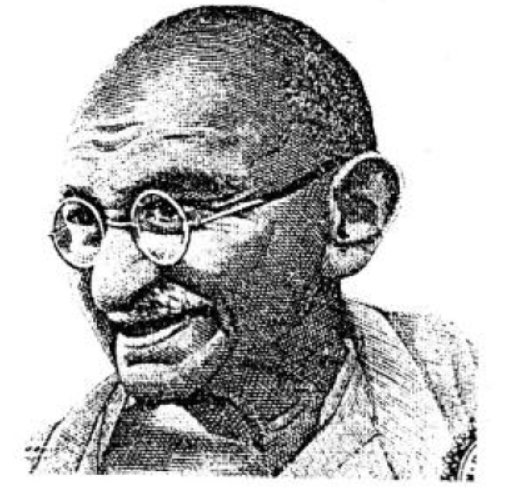
Question 1. Identify the person in the picture.
Answer: The individual shown in the image is Mahatma Gandhi, the Father of our Nation.
In simple words: The person in the photo is Mahatma Gandhi.
Exam Tip: Ensure you write Mahatma Gandhi's name clearly as the recognized leader of our national movement.
Question 2. Mention any two of his ideas that were included in the Directive Principles of State Policy.
Answer: Two key Gandhian concepts integrated into these guidelines are: 1. Establishing free and mandatory schooling for all minors until they turn 14. 2. Fostering and supporting rural cottage industries.
In simple words: Mahatma Gandhi's ideas like promoting village-based cottage industries and providing schooling for children are included here.
Exam Tip: Remember that village-level development and small-scale industries are core components of Gandhian principles.
Question 3. What does the term Directive Principles of State Policy mean?
Answer: These represent essential recommendations and guidelines that all legislative and administrative bodies should implement when planning policies and welfare programs for the citizens.
In simple words: These are guidelines written in the Constitution that governments should follow to make laws for the welfare of the public.
Exam Tip: Use the phrase "guidelines for policy formulation" to provide a precise, textbook-aligned answer.
Question 4. Mention one important difference between Fundamental Rights and Directive Principles.
Answer: A major distinction is that Fundamental Rights are legally enforceable (justiciable), giving individuals the power to approach a court of law to defend their rights. Conversely, Directive Principles are non-justiciable, meaning citizens cannot sue the state if they are denied certain benefits, such as equal wages or guaranteed employment.
In simple words: You can go to court if your Fundamental Rights are taken away, but you cannot do that for Directive Principles.
Exam Tip: "Justiciability" is the main difference between these two sets of principles. Be sure to focus on this concept.
Free study material for History Civics
ICSE Goyal Brothers Solutions Class 7 History Civics Chapter 13 Directive Principles Of State Policy
Students can now access the detailed Goyal Brothers Solutions for Chapter 13 Directive Principles Of State Policy on our portal. These solutions have been carefully prepared as per latest ICSE Class 7 syllabus. Each solution given above has been updated based on the current year pattern to ensure Class 7 students have the most updated History Civics content.
Master Goyal Brothers Textbook Questions
Our subject experts have provided detailed explanations for all the questions found in the Goyal Brothers textbook for Class 7 History Civics. We have focussed on making the concepts easy for you in Chapter 13 Directive Principles Of State Policy so that students can understand the concepts behind every answer. For all numerical problems and theoretical concepts these solutions will help in strengthening your analytical skill required for the ICSE examinations.
Complete History Civics Exam Preparation
By using these Goyal Brothers Class 7 solutions, you can enhance your learning and identify areas that need more attention. We recommend solving the History Civics Questions from the textbook first and then use our teacher-verified answers. For a proper revision of Chapter 13 Directive Principles Of State Policy, students should also also check our Revision Notes and Sample Papers available on studiestoday.com.
FAQs
You can download the verified Goyal Brothers solutions for Chapter 13 Directive Principles Of State Policy on StudiesToday.com. Our teachers have prepared answers for Class 7 History Civics as per 2026-27 ICSE academic session.
Yes, our solutions for Chapter 13 Directive Principles Of State Policy are designed as per new 2026 ICSE standards. 40% competency-based questions required for Class 7, are included to help students understand application-based logic behind every History Civics answer.
Yes, every exercise in Chapter 13 Directive Principles Of State Policy from the Goyal Brothers textbook has been solved step-by-step. Class 7 students will learn History Civics conceots before their ICSE exams.
Yes, follow structured format of these Goyal Brothers solutions for Chapter 13 Directive Principles Of State Policy to get full 20% internal assessment marks and use Class 7 History Civics projects and viva preparation as per ICSE 2026 guidelines.