

ICSE Solutions Goyal Brothers Class 7 History Civics Chapter 2 Rise And Spread Of Islam have been provided below and is also available in Pdf for free download. The Goyal Brothers ICSE solutions for Class 7 History Civics have been prepared as per the latest syllabus and ICSE books and examination pattern suggested in Class 7. Questions given in ICSE Goyal Brothers book for Class 7 History Civics are an important part of exams for Class 7 History Civics and if answered properly can help you to get higher marks. Refer to more Chapter-wise answers for ICSE Class 7 History Civics and also download more latest study material for all subjects. Chapter 2 Rise And Spread Of Islam is an important topic in Class 7, please refer to answers provided below to help you score better in exams
Goyal Brothers Chapter 2 Rise And Spread Of Islam Class 7 History Civics ICSE Solutions
Class 7 History Civics students should refer to the following ICSE questions with answers for Chapter 2 Rise And Spread Of Islam in Class 7. These ICSE Solutions with answers for Class 7 History Civics will come in exams and help you to score good marks
Chapter 2 Rise And Spread Of Islam Goyal Brothers ICSE Solutions Class 7 History Civics
Important Words
- Mecca: A town in Arabia where Prophet Muhammad was born, which serves as a highly holy place for Muslims.
- Medina: The Arabian town to which Prophet Muhammad and his followers moved in 622 CE.
- Hijrat: The historic journey and departure of Prophet Muhammad from Mecca to Medina in 622 CE.
- Hijri: The Islamic calendar, which starts from the year of the Hijrat (622 CE).
- Abu Bakr: A close friend and loyal follower of Prophet Muhammad, who became the first successor after the Prophet's death.
- Khalifa (Caliph): A title meaning the "successor of the Prophet," used for the supreme leader of the Muslim community in medieval times.
- Alberuni: A famous Muslim scholar who traveled to India with Mahmud of Ghazni. His book offers a detailed account of Indian culture, science, and philosophy.
Time To Learn
I. Fill in the blanks:
Question 1. Prophet Muhammad was born at Mecca in AD 570.
Answer: Mecca.
In simple words: Prophet Muhammad was born in the town of Mecca.
Exam Tip: Note that his year of birth, 570 AD, is an essential historical fact to remember.
Question 2. Muslims worship only one God Allah.
Answer: Allah.
In simple words: Muslims believe in and worship only one God, whose name is Allah.
Exam Tip: This monotheistic belief is the most fundamental concept of the Islamic faith.
Question 3. Muhammad preached against idol worship.
Answer: idol.
In simple words: Muhammad taught his followers not to worship statues or idols.
Exam Tip: Focus on the word 'idol' as it represents what he opposed during his early preaching in Mecca.
Question 4. Prophet Muhammad’s successors were known as Caliphs or Khalifas.
Answer: Caliphs or Khalifas.
In simple words: The leaders who succeeded Muhammad were called Caliphs or Khalifas.
Exam Tip: Caliphs were considered both the spiritual and political heads of the early Islamic empire.
Question 5. The greatest king of Abbasid dynasty was Harun-Al-Rashid.
Answer: Harun-Al-Rashid.
In simple words: Harun-Al-Rashid was the most famous and powerful king of the Abbasid dynasty.
Exam Tip: His reign in Baghdad is celebrated as the peak of the Islamic Golden Age.
II. Match Column A with Column B:
| Column A | Column B |
|---|---|
| 1. Mecca | (a) Alms |
| 2. Quran | (b) Death of Prophet |
| 3. Zakaat | (c) First year of Muslim calendar |
| 4. AD 632 | (d) Birthplace of Prophet |
| 5. AD 622 | (e) Holy book of Islam |
Answer:
1. Mecca - (d) Birthplace of Prophet.
2. Quran - (e) Holy book of Islam.
3. Zakaat - (a) Alms.
4. AD 632 - (b) Death of Prophet.
5. AD 622 - (c) First year of Muslim calendar.
In simple words: This list matches key religious terms, holy cities, and important dates with their correct meanings or events.
Exam Tip: Be sure to associate 622 AD with the Hijrat, which marks the start of the Islamic calendar.
III. State whether the following statements are True or False:
Question 1. Muhammad was born at Medina.
Answer: False.
In simple words: This is false because Muhammad was born in the city of Mecca, not Medina.
Exam Tip: Mecca was his birthplace, while Medina was the city he migrated to in 622 CE.
Question 2. He shifted from Mecca to Medina in AD 615.
Answer: False.
In simple words: This is false because he migrated from Mecca to Medina in 622 AD, not 615 AD.
Exam Tip: The migration took place in 622 AD, which is a highly vital date as it starts the Hijri calendar.
Question 3. A Muslim should not worship an idol.
Answer: True.
In simple words: Yes, Islam strictly forbids worshiping any statues, figures, or idols.
Exam Tip: Monotheism and the complete rejection of idol worship are core principles of Islam.
Question 4. Abu Bakr was the last Khalifa.
Answer: False.
In simple words: This is false because Abu Bakr was the very first Caliph, not the last one.
Exam Tip: Abu Bakr succeeded the Prophet as the first Caliph, while Ali was the fourth and last of the Rightly Guided Caliphs.
Question 5. The Ottoman Turks Captured Constantinople in AD 1480.
Answer: False.
In simple words: This is false because the Ottoman Turks captured Constantinople in the year 1453.
Exam Tip: The conquest of Constantinople in 1453 CE is a major historical turning point that marked the end of the Byzantine Empire.
IV. Answer the following questions briefly:
Question 1. Discuss the early life of Muhammad.
Answer: Until middle age, Prophet Muhammad worked as a successful trader. In 610 AD, he had a deep spiritual experience and became a prophet. He declared himself the messenger of Allah, whose message of peace he began to spread. He spoke out against worshiping idols. At that time, Arabia was run by many tribes who worshiped multiple gods and made animal sacrifices. Because these tribes did not like his teachings, Muhammad and his followers had to leave Mecca and move to Medina in 622 AD. This journey is known as the Hijrat.
In simple words: Muhammad was a trader who became a prophet in 610 AD. He preached against idol worship, which angered local Arab tribes, forcing him to move to Medina in 622 AD (the Hijrat).
Exam Tip: Be sure to write about his transition from a trader to a prophet (610 AD) and explain the significance of the Hijrat (622 AD).
Question 2. Describe the teachings of Muhammad.
Answer: The main teachings of Prophet Muhammad include:
1. There is only one God (Allah), who is all-powerful, wise, and merciful.
2. Worshipping idols is forbidden and should be avoided by everyone.
3. The Quran is a holy, divine book whose authority cannot be questioned.
4. Believers who do good go to heaven, while wrongdoers go to hell.
5. All humans are equal, and no one is superior or inferior to another.
6. Every Muslim must perform five duties: Kalma, Namaz, Zakat, Ramzan, and Haj.
7. One must treat servants and slaves with kindness and mercy.
8. Women must be treated kindly, and they should observe modest covering (purdah).
9. Everyone must avoid drinking alcohol and gambling, while showing respect for elders and practicing justice.
In simple words: Muhammad taught that God is one, all people are equal, and idol worship is wrong. He also taught his followers to pray daily, help the poor, treat women kindly, and avoid drinking or gambling.
Exam Tip: Memorize at least five main teachings, especially the belief in one God, equality of humans, and the five pillars of Islam.
Question 3. What are the five main religious obligations of Islam.
Answer: A Muslim must follow five main religious duties, known as the Five Pillars of Islam:
1. Shahada (Declaration of Faith): Believing and repeating that "There is no God but Allah, and Muhammad is His Prophet."
2. Salat (Prayer): Praying five times every day, and joining Friday afternoon prayers in a mosque.
3. Zakat (Charity): Giving alms to help the poor as a duty to Allah.
4. Sawm (Fasting): Fasting from sunrise to sunset during Ramadan, the ninth month of the Islamic calendar.
5. Haj (Pilgrimage): Traveling to Mecca once in a lifetime, if a person is healthy and can afford it. This pilgrimage is called Haj.
In simple words: The five duties are Shahada (belief in one God), Salat (praying 5 times a day), Zakat (giving charity), Sawm (fasting during Ramadan), and Haj (traveling to Mecca).
Exam Tip: Memorize both the Arabic names and the English translations for all five pillars of Islam, as they are essential for exams.
Question 4. Discuss the spread of Islamic civilisation after the passing away of Prophet Muhammad.
Answer: After Prophet Muhammad passed away, his successors became known as Caliphs (Khalifas). They served as the political and religious leaders of the Muslim world. The first four Caliphs were Abu Bakr, Umar, Usman, and Ali. In less than a hundred years, these Caliphs and their armies expanded widely, conquering countries like Iran, Syria, Egypt, Central Asia, North Africa, and Spain.
In simple words: After Muhammad died, leaders called Caliphs took charge. The first four Caliphs built a strong army and expanded the empire across the Middle East, North Africa, and Spain in just 100 years.
Exam Tip: Name the first four Caliphs (Abu Bakr, Umar, Usman, and Ali) and some of the key regions they conquered (like Persia, North Africa, and Spain).
Question 5. Describe the main contributions of the Umayyads and the Abbasids.
Answer:
Contributions of the Umayyad Dynasty:
1. They shifted the capital city of the empire to Damascus in Syria.
2. They expanded their borders to reach India, China, North Africa, and Spain.
3. They made Arabic the official language of government.
4. They introduced and used a standardized Arabic currency.
5. They built solid public roads and created fast postal routes.
Contributions of the Abbasid Dynasty:
1. They established their capital at Baghdad, close to the ancient city of Ctesiphon.
2. They reorganized the army and offices to let people from Iraq and Persia participate, rather than just Arab tribes.
3. They supported religious institutions and gave generous aid to writers, scientists, and scholars.
4. They kept up the beautiful court styles and grand architecture introduced by the Umayyads.
In simple words: The Umayyads moved the capital to Damascus, made Arabic the official language, and built roads. The Abbasids moved the capital to Baghdad, promoted education and science, and supported talented scholars.
Exam Tip: Be sure to write separate points for the Umayyads and the Abbasids, noting their respective capitals (Damascus and Baghdad).
Additional Questions
(Rise and Spread of Islam)
A. Fill in the blanks:
Question 1. Prophet Muhammad, the founder of Islam, was born in Mecca in the year __________.
Answer: 570 ce.
In simple words: Prophet Muhammad, who started Islam, was born in Mecca in the year 570 CE.
Exam Tip: Always write '570 ce' to clearly state his birth year.
Question 2. Muhammad forbade __________ worship and stressed the importance of God and __________ behaviour.
Answer: idol, kind.
In simple words: Muhammad banned worshiping idols and taught that people must believe in God and treat others kindly.
Exam Tip: Remember both key terms 'idol' and 'kind' for this blank.
Question 3. The two holy places of the Muslims are __________ and __________.
Answer: Mecca and Medina.
In simple words: The two most sacred cities in Islam are Mecca and Medina.
Exam Tip: These cities are highly important because of their direct association with the life of Prophet Muhammad.
Question 4. Muhammad was succeeded by __________, who was known as Caliph.
Answer: Abu Bakr.
In simple words: Abu Bakr became the first leader (Caliph) of the Muslims after Muhammad passed away.
Exam Tip: Abu Bakr was the first of the 'Rightly Guided Caliphs' in Islamic history.
Question 5. The first Arab expedition to India took place in __________ under the leadership of __________.
Answer: 712 ce, Muhammad bin Qasim.
In simple words: The first Arab invasion of India happened in 712 CE, led by Muhammad bin Qasim.
Exam Tip: He conquered the province of Sindh, marking the first major Arab footprint in India.
B. Match the following:
Question. Match the following:
| Column A | Column B |
|---|---|
| 1. Mecca | (a) magnificent Arab civilization |
| 2. Hijri | (b) fasting |
| 3. Abbasid Caliphs | (c) repository of the cultural heritage of the ancient world |
| 4. Ramzan | (d) pilgrimage |
| 5. Baghdad | (e) Muslim calendar |
Answer:
1. Mecca - (d) pilgrimage.
2. Hijri - (e) Muslim calendar.
3. Abbasid Caliphs - (a) magnificent Arab civilization.
4. Ramzan - (b) fasting.
5. Baghdad - (c) repository of the cultural heritage of the ancient world.
In simple words: This list matches Islamic cities, calendars, and dynasties with their correct descriptions or roles.
Exam Tip: Remember that Baghdad grew into a world-famous center of learning and translation during the Abbasid era.
C. Choose the correct answer:
Question 1. What did Muhammad work as when he was a young man?
(a) trader
(b) farmer
(c) craftsman
(d) None of the options
Answer: (a) trader
In simple words: As a young man, Muhammad worked as a merchant and trader.
Exam Tip: He worked for a wealthy businesswoman named Khadija, whom he later married.
Question 2. How were the Arabs divided during Muhammad's time?
(a) kingdoms
(b) tribes
(c) empires
(d) None of the options
Answer: (b) tribes
In simple words: Before Islam united them, people in Arabia were split into many different tribes.
Exam Tip: These tribes were independent, had their own customs, and often fought each other before the rise of Islam.
Question 3. How many times a day must Muslims pray?
(a) four
(b) five
(c) six
(d) None of the options
Answer: (b) five
In simple words: Praying five times a day (Salat) is a daily duty for every Muslim.
Exam Tip: This daily prayer is one of the five primary duties (Pillars) in Islam.
Question 4. To which city did the Abbasid Caliphs shift their capital?
(a) Medina
(b) Mecca
(c) Baghdad
(d) None of the options
Answer: (c) Baghdad
In simple words: The Abbasids moved their capital city from Damascus to Baghdad in Iraq.
Exam Tip: Moving the capital to Baghdad allowed the Abbasids to build a prosperous and culturally diverse empire.
Question 5. On which coast of India did Arab traders establish their first trade settlements?
(a) eastern
(b) western
(c) southern
(d) None of the options
Answer: (b) western coast of India
In simple words: Arab merchants set up their trading ports on the western coast of India (such as Malabar).
Exam Tip: These settlements on the western coast helped spread Islamic ideas to southern India through trade.
D. State whether the following are true or false:
Question 1. The Medieval Period in India stretches from the 8th century CE to the 16th century.
Answer: False.
In simple words: This is false because the Medieval Period in India actually lasted until the 18th century CE.
Exam Tip: The Indian Medieval Period is historically classified as lasting from the 8th century to the beginning of the 18th century (around 1707 AD).
Question 2. Before the rise of Islam, the Arabs practised idol worship.
Answer: True.
In simple words: Yes, before adopting Islam, people in Arabia worshiped many different idols and gods.
Exam Tip: These idols were kept inside the Kaaba temple in Mecca before Prophet Muhammad's teachings.
Question 3. The Arab empire under the Abbasid Caliphs was one of the most powerful and enlightened regions in the world.
Answer: True.
In simple words: Yes, under the Abbasids, the empire was very wealthy, stable, and became a center of science and education.
Exam Tip: This era is famously known as the Islamic Golden Age, centered in Baghdad.
Question 4. The occupation of Sind ended with the death of Muhammad bin Qasim.
Answer: True.
In simple words: Yes, according to your textbook, the Arab control of Sindh ended when Muhammad bin Qasim passed away.
Exam Tip: This is the specific factual answer provided in your curriculum; keep it in mind for exams.
Question 5. In the 9th century ce, the power of the Caliphs declined.
Answer: True.
In simple words: Yes, by the 800s, the Caliphs lost their political strength and the empire began to break apart.
Exam Tip: The decline of the central Caliphate allowed independent Turkish governors to set up their own states.
E. Answer the following questions in one or two words/ sentences:
Question 1. Where was Prophet Muhammad born?
Answer: Prophet Muhammad was born in the holy city of Mecca in Arabia.
In simple words: He was born in Mecca.
Exam Tip: He was born in the year 570 CE in the city of Mecca.
Question 2. What important event took place in Muhammad’s life around 610 ce?
Answer: When he was around forty years old, Muhammad received his first vision from God, who gave him the holy message to share with Mecca. He declared that Allah was the sole God and that he was His Prophet, which marked the birth of Islam.
In simple words: At age forty, Muhammad had a vision where God gave him a holy message. He then started preaching that there is only one God, starting Islam.
Exam Tip: Note that 610 CE is the year he became a prophet and began his spiritual mission.
Question 3. What does the term Hijrat mean?
Answer: The term Hijrat refers to the historical journey of Prophet Muhammad when he moved from Mecca to Medina in 622 CE.
In simple words: Hijrat means the journey when Muhammad and his followers moved from Mecca to Medina in 622 CE.
Exam Tip: This emigration in 622 CE marks the beginning of the Islamic Hijri calendar.
Question 4. What title did Abu Bakr assume after he succeeded Prophet Muhammad?
Answer: After succeeding the Prophet, Abu Bakr took the title of Caliph (Khalifa).
In simple words: He took the title of Caliph, which means successor.
Exam Tip: Caliph means 'successor' to the Prophet and represents both religious and political leadership.
Question 5. Under whose reign did the Arabs achieve their greatest heights of intellectual and cultural excellence?
Answer: The Arab civilization reached its highest level of science and learning under the rule of the Abbasid Caliphs.
In simple words: The Arabs achieved great progress in science and culture under the Abbasid rulers.
Exam Tip: This era, based in Baghdad, is recognized as the Golden Age of Islam.
Question 6. Why was the House of Wisdom established?
Answer: The House of Wisdom was built in Baghdad because Islamic teachings encouraged learning. It was used to translate the important books of ancient civilizations (like Greece, India, Persia, and China) into Arabic.
In simple words: It was built in Baghdad as a center of study, where ancient books from Greece, India, and Persia were translated into Arabic.
Exam Tip: State that its primary purpose was the translation of ancient world wisdom (Greek, Indian, Persian) into Arabic.
Question 7. Which Arab city became the preserve of the rich cultural heritage of the ancient world?
Answer: The city of Baghdad grew into the main storehouse and keeper of the ancient world's rich culture.
In simple words: Baghdad became the main city that kept and protected the ancient world's culture and books.
Exam Tip: This city became a major hub of science, translation, and culture under the Abbasids.
Question 8. What were the chief items of export and import in India’s trade relations with the Arabs?
Answer: During their trade, India's main exports to the Arabs were pepper, muslin, and indigo. In return, India's main imports were fine Arabian horses and luxury goods.
In simple words: India sold spices, cloth, and indigo to the Arabs, and bought back luxury goods and fine Arabian horses.
Exam Tip: Remember to name 'pepper' and 'muslin' as key exports, and 'Arabian horses' as the major import.
Question 9. Why were the Indians not receptive to Arab learning and civilization during this period?
Answer: Indian scholars were isolated and rejected outside cultural influences. They believed that no other nation had proper knowledge of science. Because of this closed view, they did not accept or learn from the rich Arabic culture and scientific developments.
In simple words: Indians back then wanted to keep to themselves and believed only they knew science, so they refused to learn from Arab culture.
Exam Tip: Use the term 'spirit of exclusiveness' to describe this isolationist attitude of medieval Indian society.
Question 10.Name any one independent state established by the Turks in Central Asia.
Answer: Two independent kingdoms established by Turkish rulers in Central Asia were Ghazni and Ghor.
In simple words: Two independent Turkish states in Central Asia were Ghazni and Ghor.
Exam Tip: You only need to name one; Ghazni is the most prominent example.
F. Answer the following questions briefly:
Question 1. Why did Muhammad shift from Mecca to Medina? Discuss the events that followed this move.
Answer: Muhammad banned idol worship and preached the value of kind behavior. His teachings angered the wealthy merchants and leaders of Mecca, forcing him and his followers to leave the city. In 622 CE, they moved to the town of Medina. This historic journey is called the Hijrat, which marks the start of the Islamic calendar. After this move, Medina welcomed Muhammad as their leader, helping him establish the first Islamic state.
In simple words: Muhammad was forced to flee Mecca because his teachings against idol worship angered the rich merchants. This move to Medina in 622 CE is called the Hijrat, where he built a strong following and established Islam.
Exam Tip: Name his opposition to idol worship as the main cause, and note that his journey is known as the Hijrat.
Question 2. State the main principles of Islam.
Answer: The primary principles of Islam are:
1. Believing in one God (Allah) and that Muhammad is His Prophet. Muslims must face toward Mecca and pray five times a day.
2. Fasting from sunrise to sunset during the holy month of Ramzan.
3. Helping the poor and needy by giving a portion of one's earnings as charity (Zakat).
4. Making a pilgrimage (Haj) to Mecca at least once in a lifetime, if affordable.
In simple words: The main principles are belief in one God, praying 5 times daily facing Mecca, fasting during Ramzan, giving charity to the poor, and visiting Mecca once in a lifetime.
Exam Tip: List these four core principles, which represent the load-bearing duties (Pillars) of Islam.
Question 3. The greatest intellectual and cultural excellence was seen during the reign of the Abbasid Caliphs. Discuss.
Answer: The Abbasids moved their capital city from Damascus to Baghdad. Over the next 150 years, their empire became one of the most powerful, rich, and educated regions in the world. Following the Prophet's advice to seek knowledge, they collected and learned from other cultures. One Caliph set up the famous House of Wisdom in Baghdad. Here, they translated important scientific books from Greece, India, Persia, and Egypt into Arabic, making Baghdad a great protector of ancient knowledge.
In simple words: The Abbasids moved to Baghdad and turned their empire into a center of learning. They built the House of Wisdom to translate ancient Greek, Indian, and Persian books into Arabic, preserving world culture.
Exam Tip: Explain the importance of shifting the capital to Baghdad and mention the creation of the 'House of Wisdom' to score full marks.
Question 4. What knowledge did the Arabs gather from (a) Indian and (b) various other ancient civilizations?
Answer: (a) Knowledge from India:
The Arabs learned a lot from ancient Indian civilization. They studied and absorbed Indian knowledge of mathematics, medicine, astronomy, philosophy, and government administration, which greatly enriched their own culture.
(b) Knowledge from other civilizations:
Arab scholars learned and brought together important skills from different cultures:
1. From the Chinese: They learned how to make paper, how to make glass, and how to use the magnetic compass for sea travel.
2. From the Greeks: They studied advanced mathematics and geometry.
3. From the Persians: They learned about astronomy and stars.
In simple words: The Arabs learned math, medicine, and astronomy from India. From the Chinese, they learned how to make paper and compasses, from the Greeks they learned geometry, and from the Persians they learned astronomy.
Exam Tip: List specific contributions from each culture (like paper-making from the Chinese and math/medicine from the Indians) to write an excellent answer.
G. Picture study
This is a picture of a mosque where Muslims go to pray.
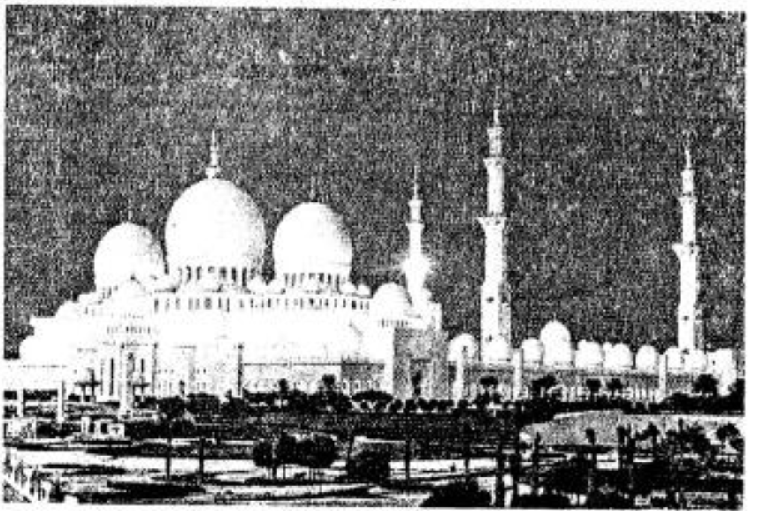
Question 1. Name (a) their religion (b) their holy book and (c) the founder of their religion.
Answer: For Muslims:
(a) Their religion is Islam.
(b) Their sacred book is the Quran.
(c) The founder of their religion is Prophet Muhammad.
In simple words: The religion is Islam, the holy book is the Quran, and the founder is Prophet Muhammad.
Exam Tip: Always capitalize proper nouns like 'Islam' and 'Prophet Muhammad' correctly in exams.
Question 2. Name the two holy places of the Muslim.
Answer: Two holy cities in Islam are Mecca and Medina.
In simple words: The two holy places are Mecca and Medina.
Exam Tip: These cities are located in modern-day Saudi Arabia and are linked with the birth and journey (Hijrat) of the Prophet.
Question 3. Why does the Muslim calendar begin from the year 622 ce?
Answer: In 622 CE, Muhammad and his small group of followers had to flee from Mecca to Medina to escape threats. This famous journey is called the Hijrat. Because this movement marked the birth of the first united Muslim community, the Islamic calendar (Hijri) begins from this very year.
In simple words: The calendar starts from 622 CE because that was the year of the Hijrat, when Muhammad moved to Medina to escape danger and start the Muslim community.
Exam Tip: Be sure to name the migration as the 'Hijrat' and specify the destination city as 'Medina.'
Question 4. Mention any four important principles of the religion.
Answer: Four important principles of Islam are:
1. Believing in one God (Allah) and that Muhammad is His Prophet.
2. Praying five times every day.
3. Giving a portion of one's wealth to help the poor and needy (charity).
4. Traveling on a pilgrimage (Haj) to Mecca once in a lifetime, if possible.
In simple words: Four main principles are believing in one God, praying 5 times daily, giving charity to the poor, and traveling to Mecca once in a lifetime.
Exam Tip: These principles are identical to the Pillars of Islam; listing them clearly will earn you full marks.
Question 5. Briefly describe the role of Abu Bakr in the spread of the this religion.
Answer: Abu Bakr successfully gathered and turned the Arab tribes into a disciplined, powerful army. Under his and his successors' leadership, these highly motivated armies swept across different countries and continents to spread the message of Islam. They conquered vast new lands, expanding the Islamic empire over Syria, Iran, Central Asia, Egypt, North Africa, and Spain.
In simple words: Abu Bakr built a highly disciplined and strong Arab army. He and the leaders after him used this army to expand the empire and spread Islam across North Africa, Spain, and Central Asia.
Exam Tip: Focus on how Abu Bakr unified the Arab tribes into a single, organized military force to successfully spread the empire.
Free study material for History Civics
ICSE Goyal Brothers Solutions Class 7 History Civics Chapter 2 Rise And Spread Of Islam
Students can now access the detailed Goyal Brothers Solutions for Chapter 2 Rise And Spread Of Islam on our portal. These solutions have been carefully prepared as per latest ICSE Class 7 syllabus. Each solution given above has been updated based on the current year pattern to ensure Class 7 students have the most updated History Civics content.
Master Goyal Brothers Textbook Questions
Our subject experts have provided detailed explanations for all the questions found in the Goyal Brothers textbook for Class 7 History Civics. We have focussed on making the concepts easy for you in Chapter 2 Rise And Spread Of Islam so that students can understand the concepts behind every answer. For all numerical problems and theoretical concepts these solutions will help in strengthening your analytical skill required for the ICSE examinations.
Complete History Civics Exam Preparation
By using these Goyal Brothers Class 7 solutions, you can enhance your learning and identify areas that need more attention. We recommend solving the History Civics Questions from the textbook first and then use our teacher-verified answers. For a proper revision of Chapter 2 Rise And Spread Of Islam, students should also also check our Revision Notes and Sample Papers available on studiestoday.com.
FAQs
You can download the verified Goyal Brothers solutions for Chapter 2 Rise And Spread Of Islam on StudiesToday.com. Our teachers have prepared answers for Class 7 History Civics as per 2026-27 ICSE academic session.
Yes, our solutions for Chapter 2 Rise And Spread Of Islam are designed as per new 2026 ICSE standards. 40% competency-based questions required for Class 7, are included to help students understand application-based logic behind every History Civics answer.
Yes, every exercise in Chapter 2 Rise And Spread Of Islam from the Goyal Brothers textbook has been solved step-by-step. Class 7 students will learn History Civics conceots before their ICSE exams.
Yes, follow structured format of these Goyal Brothers solutions for Chapter 2 Rise And Spread Of Islam to get full 20% internal assessment marks and use Class 7 History Civics projects and viva preparation as per ICSE 2026 guidelines.