

ICSE Solutions Focus On Class 8 History Civics Chapter 5 Traders To Rulers Ii have been provided below and is also available in Pdf for free download. The Focus On ICSE solutions for Class 8 History Civics have been prepared as per the latest syllabus and ICSE books and examination pattern suggested in Class 8. Questions given in ICSE Focus On book for Class 8 History Civics are an important part of exams for Class 8 History Civics and if answered properly can help you to get higher marks. Refer to more Chapter-wise answers for ICSE Class 8 History Civics and also download more latest study material for all subjects. Chapter 5 Traders To Rulers Ii is an important topic in Class 8, please refer to answers provided below to help you score better in exams
Focus On Chapter 5 Traders To Rulers Ii Class 8 History Civics ICSE Solutions
Class 8 History Civics students should refer to the following ICSE questions with answers for Chapter 5 Traders To Rulers Ii in Class 8. These ICSE Solutions with answers for Class 8 History Civics will come in exams and help you to score good marks
Chapter 5 Traders To Rulers Ii Focus On ICSE Solutions Class 8 History Civics
Traders to Rulers (II)
I. Fill in the blanks
Question 1. The British had to face the challenge of the rulers of ______ and ______ , ______ after the conquest of Bengal.
Answer: Hyderabad, Mysore, and the Marathas
In simple words: After the British took over Bengal, they had to fight strong local rulers in Hyderabad, Mysore, and the Maratha land.
Exam Tip: Remember these three major Indian powers that challenged British rule in the late 18th century.
Question 2. The new Nizam of Hyderabad, ______ initially had cordial relations with the English.
Answer: Salabat Jung
In simple words: A ruler of Hyderabad named Salabat Jung was friendly with the British at first.
Exam Tip: Note how relations between Hyderabad and the British changed under different rulers.
Question 3. ______ made the Nizam of Hyderabad enter the ______ system.
Answer: Lord Wellesley, Subsidiary Alliance
In simple words: Lord Wellesley forced the ruler of Hyderabad to join a special military agreement called the Subsidiary Alliance.
Exam Tip: The Subsidiary Alliance was a key tool used by the British to take control of Indian kingdoms without direct war.
Question 4. The English fought ______ wars with rulers of Mysore, known as ______ wars.
Answer: four, Anglo-Mysore
In simple words: The British fought four different wars against the rulers of Mysore to take over their land.
Exam Tip: These conflicts took place between 1767 and 1799, ending with the death of Tipu Sultan.
Question 5. It took the British ______ years to defeat the Marathas in ______ Anglo-Maratha wars.
Answer: 43, three
In simple words: It took the British 43 years and three big wars to finally beat the strong Maratha rulers.
Exam Tip: Remember that the Anglo-Maratha wars spanned from 1775 to 1818.
Question 6. Lord Dalhousie annexed ______ on basis of ______ .
Answer: Awadh, misgovernance
In simple words: Lord Dalhousie took over the kingdom of Awadh by claiming that its rulers were running it very badly.
Exam Tip: Awadh was annexed in 1856, and this unjust takeover was a major cause of the Revolt of 1857.
II. Match the contents of Column A and Column B
Question. Match the contents of Column A with Column B:
| Column A | Column B |
|---|---|
| 1. 1767-69 | (a) Regulating Act passed |
| 2. 1773 | (b) British expansion under Lord Dalhousie |
| 3. 1803 | (c) Punjab annexed to British Empire |
| 4. 1845 | (d) First Anglo-Sikh War |
| 5. 1849 | (e) First Anglo-Mysore War |
| 6. 1848-1856 | (f) Treaty of Bassein |
Answer:
The correctly matched table is given below:
| Column A | Column B |
|---|---|
| 1. 1767-69 | (e) First Anglo-Mysore War |
| 2. 1773 | (a) Regulating Act passed |
| 3. 1803 | (f) Treaty of Bassein |
| 4. 1845 | (d) First Anglo-Sikh War |
| 5. 1849 | (c) Punjab annexed to British Empire |
| 6. 1848-1856 | (b) British expansion under Lord Dalhousie |
In simple words: This table links important years in Indian history to key events like wars, treaties, laws, and British takeovers.
Exam Tip: Memorizing timelines of major acts (like the 1773 Regulating Act) and treaty years (like 1803 Bassein) is highly useful for matching questions.
III. State whether the following statements are True or False
Question 1. The Subsidiary Alliance system was started by Lord Cornwallis.
Answer: False
In simple words: This statement is false because Lord Wellesley, not Lord Cornwallis, introduced the Subsidiary Alliance system.
Exam Tip: Be sure to associate Lord Wellesley with the Subsidiary Alliance and Lord Dalhousie with the Doctrine of Lapse.
Question 2. The capture of the port of Mahe by the British led to the Second Anglo-Mysore War in 1780
Answer: True
In simple words: This statement is true. When the British took over Mahe, it angered Hyder Ali and started the second war.
Exam Tip: Mahe was a French-controlled port under the protection of Mysore, which is why its capture triggered the war.
Question 3. Tipu won a great battle against his three enemies, the English, Nizam and the Marathas in 1792
Answer: False
In simple words: This statement is incorrect. In 1792, Tipu Sultan lost the war against these three joined forces.
Exam Tip: In 1792, Tipu was defeated and had to sign the Treaty of Seringapatam, which cost him half his kingdom.
Question 4. The war of succession among the Marathas in 1772 gave a chance to the English to interfere in Maratha politics.
Answer: True
In simple words: This statement is correct. When Maratha leaders fought over who would rule, the British used the chance to step in.
Exam Tip: Family fights and succession disputes in Indian royal courts were the primary entry points for British intervention.
Question 5. The Second Anglo-Maratha war was fought when Lord Wellesley was the Governor General of India.
Answer: True
In simple words: This statement is correct. Lord Wellesley was indeed the leader of the British in India during this war.
Exam Tip: Lord Wellesley's aggressive policies directly led to conflicts with the Maratha chiefs Scindia and Bhonsle.
Question 6. Jhansi and Nagpur were annexed under the pretext of misgovernance.
Answer: False
In simple words: This statement is false. Jhansi and Nagpur were taken over because of the Doctrine of Lapse, not misgovernance.
Exam Tip: Awadh was the main state annexed due to claims of bad ruling, while Jhansi and Nagpur lacked natural male heirs.
IV. Answer the following questions
Question 1. What were the results of the First Anglo-Mysore War?
Answer: The Marathas, the Nizam, and the British joined hands to attack Mysore. However, Hyder Ali successfully made peace with the Marathas and the Nizam. This left the British fighting alone. Despite a few early difficulties, Hyder Ali won the war. In 1769, he made the British sign a peace agreement. Both sides promised to defend each other if a third kingdom attacked them.
In simple words: Hyder Ali defeated the British in the first war. They signed a treaty in 1769 to help each other in future wars.
Exam Tip: Mention the Treaty of Madras signed in 1769 and its mutual defense clause to score full marks.
Question 2. How did the British force win the Third Anglo-Mysore War?
Answer: During this war, which lasted from 1790 to 1792, the British Company secured help from the Marathas and the Nizam of Hyderabad. Together, these three forces defeated Tipu Sultan. He was forced to sign the Treaty of Seringapatam in 1792. Under this agreement, Tipu had to give away half of his land. This territory was divided among the three victors. He also had to pay a huge war fine of Rs. 3.3 crore and hand over two of his sons as prisoners.
In simple words: The British joined with the Marathas and the Nizam to beat Tipu. He had to give up half his land and pay Rs. 3.3 crore.
Exam Tip: Remember that the Treaty of Seringapatam was signed in 1792, and specify the heavy penalty of Rs. 3.3 crore to gain full points.
Question 3. What were the causes of the Fourth Anglo-Mysore War? What were its results?
Answer: The peace from the earlier treaty did not last long. Lord Wellesley, the British Governor-General, pressured Tipu Sultan to accept the Subsidiary Alliance. However, Tipu refused to sign it and asked the French for help. This made the British worry that French soldiers would arrive in India to support Mysore. Consequently, the British attacked Tipu in 1799. The Nizam joined the British forces, while the Marathas chose not to take sides. The expected French assistance never arrived. Tipu was defeated and lost his life in battle on May 4, 1799.
In simple words: Tipu refused to join the Subsidiary Alliance and asked the French for help. The British attacked and killed him in 1799.
Exam Tip: Emphasize Lord Wellesley's pressure on Tipu to join the Subsidiary Alliance as the primary trigger for the war.
Question 4. Name the four different centres of Maratha power.
Answer: The four main locations of Maratha power and their leaders were:
- The Bhonsles based in Nagpur
- The Scindias situated in Gwalior
- The Peshwas located in Pune
- The Holkars based in Indore
In simple words: The Maratha chiefs ruled from Nagpur, Gwalior, Pune, and Indore.
Exam Tip: Clearly pair each of the four Maratha families with their respective capitals to score full points.
Question 5. What were the causes and results of the First Anglo-Maratha War? When was it fought?
Answer: The war was fought from 1775 to 1782. In 1772, after Peshwa Madhav Rao I passed away, a dispute over the throne broke out between Raghoba and Madhav Rao II. The British backed Raghoba, while the Marathas, led by Nana Phadnavis, supported Madhav Rao II. This led to a seven-year conflict with no clear winner. In 1782, both sides signed the Treaty of Salbai to end the war. Under this treaty, Madhav Rao II became the recognized Peshwa, and the British gained Salsette. This agreement brought peace between the two sides for the next 20 years.
In simple words: The British supported Raghoba for the throne, leading to a long war. The Treaty of Salbai ended it in 1782, bringing 20 years of peace.
Exam Tip: Make sure to mention the Treaty of Salbai in 1782 as the concluding event that settled the dispute.
Question 6. Who was the Governor-General of India during the Second Anglo-Maratha War? What was the significance of this battle?
Answer: During this war, Lord Wellesley was the Governor-General. In 1803, Baji Rao II signed a Subsidiary Alliance called the Treaty of Bassein with the British. This allowed the British to place him on the throne at Pune and push out the Holkar forces. However, Maratha leaders Scindia and Bhonsle refused to join the alliance and declared war. The British defeated them both. They were forced to sign the Subsidiary Alliance and give up key lands like Ahmednagar, Broach, Cuttack, and Balasore. This conflict seriously weakened Maratha power and influence.
In simple words: Lord Wellesley led the British. They forced the Maratha chiefs Scindia and Bhonsle to sign alliances and surrender large territories.
Exam Tip: Mention the Treaty of Bassein signed in 1803 as it is the key turning point that split the Maratha chiefs.
Question 7. Why was the Third Anglo-Maratha War fought? What were its results?
Answer: This war took place between 1817 and 1818. The Maratha chiefs felt deeply insulted by the Subsidiary Alliance they had to sign with the British. Peshwa Baji Rao II started plotting to unite the Maratha leaders against the British. Lord Hastings, the British Governor-General, discovered these plans and forced Baji Rao II to sign the Treaty of Pune in 1817. Under this treaty, the Peshwa gave up Konkan and surrendered his leadership of the Marathas. Meanwhile, Scindia was forced to sign the Treaty of Gwalior to assist the British against the Pindaris. In a final bid for independence, Baji Rao II attacked the British Residency in Pune in 1817. After two years of fighting, the Marathas lost. The British took over most of their lands, removed the hereditary post of the Peshwa, and established absolute control over India.
In simple words: The Marathas rebelled to regain their freedom but were defeated. The British ended the Peshwa's office and took total control of India.
Exam Tip: Note that the office of Peshwa was abolished as a result of this war, which marked the complete end of Maratha sovereignty.
Question 8. State very briefly why the Marathas failed against the British.
Answer: The Marathas fell behind the British in wealth, military systems, statecraft, and command. Their government was divided and feudal. Instead of a single nation, it was a loose union of different families like the Holkars, Bhonsles, and Scindias. The Marathas did not pay attention to military scouting, while the British had an excellent spy network. There was also no shared sense of nationalism among the Marathas. Their internal rivalries and betrayals hurt their common interests. Finally, they lacked capable leaders in their later years and remained deeply unorganized.
In simple words: The Marathas lost because they fought among themselves, lacked unity, and had weaker weapons and poorer spying systems than the British.
Exam Tip: Point out the lack of unity and the superior British military intelligence system as the primary causes of Maratha failure.
Question 9. Explain the doctrine of Lapse. Name the other methods used by Lord Dalhousie to expand the British power in India.
Answer: Under this rule, if the king of a dependent state died without a biological son, his territory automatically became British land. This policy refused to accept adopted sons as legal heirs. The British used this rule to take over Satara, Jaitpur, Baghat, Udaipur, Sambalpur, Jhansi, and Nagpur. Lord Dalhousie also used other tactics to expand his power: he conquered Punjab through direct war, and took over Awadh by accusing its leaders of bad governance.
In simple words: The Doctrine of Lapse said if a king had no natural son, the British took his land. Dalhousie also used war and charges of bad ruling to take other states.
Exam Tip: List the three main expansion methods used by Lord Dalhousie: the Doctrine of Lapse, direct war (e.g., Punjab), and claims of misgovernance (e.g., Awadh).
V. Word Hunt
Question. Given below is a grid. Look for names of places which Dalhousie annexed. You have to look vertically, horizontally and diagonally. In total there are 8 places. After you have found out these places, write down why these were annexed.
| N | J | H | A | N | S | I | P | S | U |
| A | S | A | T | A | R | A | O | I | D |
| G | B | E | L | A | R | L | O | N | A |
| P | E | O | L | X | A | I | N | D | I |
| U | N | L | L | P | W | U | A | P | P |
| R | E | D | E | A | W | A | D | H | U |
| S | A | M | B | H | A | L | P | U | R |
Answer:
The eight places found in the word grid and the reasons they were taken over are:
1. Satara - Annexed because the king died without a natural son under the Doctrine of Lapse.
2. Jhansi - Annexed because the ruler left no biological heir under the Doctrine of Lapse.
3. Nagpur - Taken over because there was no natural male heir to the throne under the Doctrine of Lapse.
4. Sambalpur - Absorbed into British territory because of the lack of a natural son under the Doctrine of Lapse.
5. Udaipur - Annexed under the Doctrine of Lapse rules.
6. Jaitpur - Taken over since the ruler died without leaving a natural son under the Doctrine of Lapse.
7. Baghat - Annexed due to the lack of a biological heir under the Doctrine of Lapse.
8. Awadh - Taken over by Lord Dalhousie on the pretext of bad administration and ruling (misgovernance).
In simple words: Lord Dalhousie annexed Jhansi, Satara, Nagpur, Sambalpur, Udaipur, Jaitpur, and Baghat under the Doctrine of Lapse, and Awadh for bad governance.
Exam Tip: Always distinguish between the states annexed under the Doctrine of Lapse and Awadh, which was annexed solely on charges of misgovernance.
VI. Picture Study
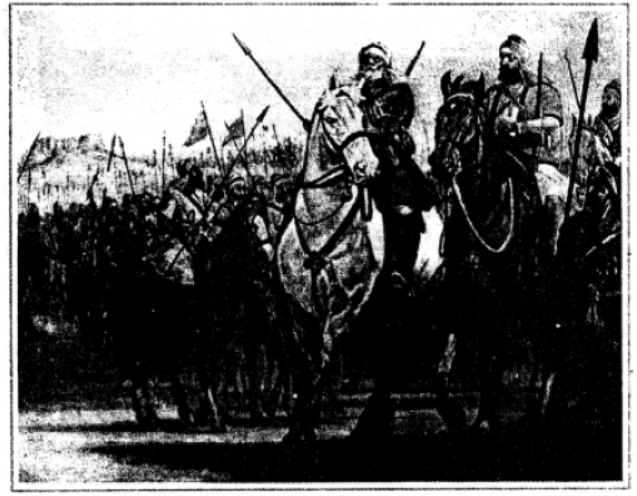
Question 1. What was the political condition of Punjab after the death of Maharaja Ranjit Singh?
Answer: Following the death of Maharaja Ranjit Singh, Punjab faced a period of great political confusion and weakness. For six years, different leaders fought against each other to claim the throne.
In simple words: After Ranjit Singh died, Punjab became politically weak as different rulers fought for the throne.
Exam Tip: Emphasize that the lack of a strong successor and constant power struggles made Punjab easy for the British to invade.
Question 2. When was the first Anglo-Sikh war fought?
Answer: The first war between the British and the Sikhs began in December 1845.
In simple words: The first war took place in December 1845.
Exam Tip: Note the exact month and year (December 1845) to ensure you secure full marks on short-answer questions.
Question 3. What were the causes and results of the First Anglo-Sikh War?
Answer: Maharani Jindan Kaur, who was the mother of Ranjit Singh's young son, encouraged the Sikh army (Khalsa) to fight the British. This triggered the war. The Sikhs were defeated and had to sign the Treaty of Lahore in 1846. As a result, they surrendered a large amount of land and were forced to keep a British officer (Resident) at their court.
In simple words: Maharani Jindan Kaur led the Sikhs to war, but they lost. They signed a treaty in 1846, giving up land to the British.
Exam Tip: Be sure to mention the Treaty of Lahore (1846) and the introduction of a British Resident as the major consequences of the war.
Additional Questions
Rise of British Power in Bengal
A. Fill the in the blanks
Question 1. ______ , ______ and ______ became the headquarters of the British settlements in the southern, western and eastern regions, respectively.
Answer: Madras, Bombay, and Calcutta
In simple words: Madras, Bombay, and Calcutta were the three main centers of British power in India.
Exam Tip: Memorize these three cities as they were the three presidency capitals of British India.
Question 2. In 1717, the Mughal emperor granted the United East India Company the right to carry on duty-free trade in ______ , ______ and ______ .
Answer: Bengal, Bihar, and Orissa
In simple words: The Mughal king let the British trade without paying taxes in Bengal, Bihar, and Orissa.
Exam Tip: The year of this trade permission was 1717, which gave the British a massive economic advantage.
Question 3. The French East India Company was established in ______ .
Answer: 1664 C.E.
In simple words: The French trading company was formed in the year 1664.
Exam Tip: 1664 C.E. is the exact year of establishment of the French East India Company.
Question 4. The British and the French fought the ______ Wars in India to establish their monopoly in trade.
Answer: Carnatic
In simple words: The British and French fought the Carnatic Wars to decide who would control all trade in India.
Exam Tip: There were three Carnatic Wars, which established British trade supremacy over the French.
Question 5. Bengal in the 18th century was the ______ and the most ______ province in India.
Answer: richest, fertile
In simple words: In the 1700s, Bengal was the wealthiest and best farming region in India.
Exam Tip: Bengal's massive wealth is the reason why the British were so keen to take it over first.
Question 6. In 1757 ______ recovered Calcutta which had been captured by ______ in 1756.
Answer: Robert Clive, Siraj-ud-Daulah
In simple words: In 1757, Robert Clive took Calcutta back from the Nawab of Bengal, Siraj-ud-Daulah.
Exam Tip: This event occurred right before the famous Battle of Plassey in 1757.
Question 7. Mir Jafar was deposed because he was unable to meet the demands of the ______ .
Answer: British
In simple words: The British removed Mir Jafar from power because he could not give them all the money they wanted.
Exam Tip: Mir Jafar was replaced by his son-in-law, Mir Qasim, as the Nawab of Bengal.
Question 8. In 1765, Awadh was returned to ______ but ______ and ______ were taken away and given to ______ .
Answer: Shuja-ud-Daulah, Kora, Allahabad, Shah Alam II
In simple words: The British gave Awadh back to Shuja-ud-Daulah but kept Kora and Allahabad to give to the Mughal emperor, Shah Alam II.
Exam Tip: This arrangement was made under the Treaty of Allahabad in 1765 after the Battle of Buxar.
Question 9. Shah Alam II granted the Company the ______ of Bengal, Bihar and Orissa in ______ .
Answer: Diwani, 1765
In simple words: In 1765, the Mughal emperor gave the British the right to collect all land taxes in Bengal, Bihar, and Orissa.
Exam Tip: Getting the Diwani rights in 1765 made the East India Company the financial master of East India.
Question 10. ______ deposed and pensioned off the Nawab of Bengal and brought Bengal under the direct, and ______ control of the Company.
Answer: Warren Hastings, complete
In simple words: Warren Hastings removed the Nawab of Bengal, gave him a pension, and put the region under direct British rule.
Exam Tip: This action ended the Dual System of government in Bengal, which had been set up by Robert Clive.
B. Match the following
Question. Match the following items of Column A with Column B:
| Column A | Column B |
|---|---|
| 1. Carnatic Wars | (a) Warren Hastings |
| 2. Farman | (b) duty-free trade |
| 3. Robert Clive | (c) reconquered Calcutta |
| 4. Battle of Plassey | (d) Siraj-ud-Daulah |
| 5. Battle of Buxar | (e) Anglo-French rivalry |
| 6. Governor of Bengal | (f) Mir Qasim |
Answer:
The correctly matched table is given below:
| Column A | Column B |
|---|---|
| 1. Carnatic Wars | (e) Anglo-French rivalry |
| 2. Farman | (b) duty-free trade |
| 3. Battle of Plassey | (d) Siraj-ud-Daulah |
| 4. Robert Clive | (c) reconquered Calcutta |
| 5. Battle of Buxar | (f) Mir Qasim |
| 6. Governor of Bengal | (a) Warren Hastings |
In simple words: This table links major historical events, people, and laws in Bengal and South India to their correct outcomes or partners.
Exam Tip: Be sure to connect the Battle of Plassey with Siraj-ud-Daulah and the Battle of Buxar with Mir Qasim as these are common historical pairings.
C.Choose the correct answer
Question 1. The English East India Company was established in the year 1600/1700/1800 CE.
(a) 1600 CE
(b) 1700 CE
(c) 1800 CE
(d) None of the options
Answer: (a) 1600 CE
In simple words: The English East India Company was set up in the year 1600.
Exam Tip: The company received its royal charter from Queen Elizabeth I on December 31, 1600.
Question 2. The English East India Company set up its first factory in Surat/Agra/Broach.
(a) Surat
(b) Agra
(c) Broach
(d) None of the options
Answer: (a) Surat
In simple words: The British built their first trading post or factory in the city of Surat.
Exam Tip: Surat was a major Mughal port on the west coast, making it the perfect location for initial British trade.
Free study material for History Civics
ICSE Focus On Solutions Class 8 History Civics Chapter 5 Traders To Rulers Ii
Students can now access the detailed Focus On Solutions for Chapter 5 Traders To Rulers Ii on our portal. These solutions have been carefully prepared as per latest ICSE Class 8 syllabus. Each solution given above has been updated based on the current year pattern to ensure Class 8 students have the most updated History Civics content.
Master Focus On Textbook Questions
Our subject experts have provided detailed explanations for all the questions found in the Focus On textbook for Class 8 History Civics. We have focussed on making the concepts easy for you in Chapter 5 Traders To Rulers Ii so that students can understand the concepts behind every answer. For all numerical problems and theoretical concepts these solutions will help in strengthening your analytical skill required for the ICSE examinations.
Complete History Civics Exam Preparation
By using these Focus On Class 8 solutions, you can enhance your learning and identify areas that need more attention. We recommend solving the History Civics Questions from the textbook first and then use our teacher-verified answers. For a proper revision of Chapter 5 Traders To Rulers Ii, students should also also check our Revision Notes and Sample Papers available on studiestoday.com.
FAQs
You can download the verified Focus On solutions for Chapter 5 Traders To Rulers Ii on StudiesToday.com. Our teachers have prepared answers for Class 8 History Civics as per 2026-27 ICSE academic session.
Yes, our solutions for Chapter 5 Traders To Rulers Ii are designed as per new 2026 ICSE standards. 40% competency-based questions required for Class 8, are included to help students understand application-based logic behind every History Civics answer.
Yes, every exercise in Chapter 5 Traders To Rulers Ii from the Focus On textbook has been solved step-by-step. Class 8 students will learn History Civics conceots before their ICSE exams.
Yes, follow structured format of these Focus On solutions for Chapter 5 Traders To Rulers Ii to get full 20% internal assessment marks and use Class 8 History Civics projects and viva preparation as per ICSE 2026 guidelines.