

ICSE Solutions Voyage Class 7 Geography Chapter 15 Africa Climate Natural Vegetation Wildlife Minerals have been provided below and is also available in Pdf for free download. The Voyage ICSE solutions for Class 7 Geography have been prepared as per the latest syllabus and ICSE books and examination pattern suggested in Class 7. Questions given in ICSE Voyage book for Class 7 Geography are an important part of exams for Class 7 Geography and if answered properly can help you to get higher marks. Refer to more Chapter-wise answers for ICSE Class 7 Geography and also download more latest study material for all subjects. Chapter 15 Africa Climate Natural Vegetation Wildlife Minerals is an important topic in Class 7, please refer to answers provided below to help you score better in exams
Voyage Chapter 15 Africa Climate Natural Vegetation Wildlife Minerals Class 7 Geography ICSE Solutions
Class 7 Geography students should refer to the following ICSE questions with answers for Chapter 15 Africa Climate Natural Vegetation Wildlife Minerals in Class 7. These ICSE Solutions with answers for Class 7 Geography will come in exams and help you to score good marks
Chapter 15 Africa Climate Natural Vegetation Wildlife Minerals Voyage ICSE Solutions Class 7 Geography
Think and Answer
Question. The northern and southern parts of Africa have opposite seasons at any time of the year. Why ?
Answer: Most of Africa sits between the tropics. This is why most of the land stays warm or hot. But some places get more rain and moisture than others. A very interesting thing about Africa's weather is that the top and bottom halves have opposite seasons. This means that when the north has summer, the south has winter.
In simple words: Because Africa is so big and sits on the equator, the north and south halves always have opposite seasons.
Exam Tip: To get full marks, make sure to state that when the northern part has summer, the southern part has winter.
Discuss
Question. Discuss how the location of Africa has affected the climate of the country.
Answer: Because most of Africa lies in the tropics, it stays hot all year long. There is very little difference between summer and winter temperatures.
In simple words: Most of Africa is close to the middle of the Earth, so it stays hot all year.
Exam Tip: Focus on how being in the tropics keeps the temperature high with very little change between seasons.
Values and Life Skills
Africa rainforests are one of the densest forests on earth. A large number of trees grow in a relatively small area because the region receives a lot of rain and sunshine, both importance for the growth of plants. Human being also fourish when they get the right conditions.
Question. Can you enlist a few factors that affect the growth of human beings ? What factors adversely affect the growth of people in an area ?
Answer: Good factors for human growth:
1. Eating a healthy, balanced diet with good food.
2. Having clean clinics, hospitals, and toilets.
3. Living in a comfortable climate or temperature.
Bad factors that hurt human growth:
1. Eating poor or unhealthy food.
2. Living in dirty, unhygienic conditions.
3. Having dirty or unsafe drinking water.
4. Not knowing how to stay healthy.
In simple words: People need good food, clean water, and safe homes to grow well. Bad food and dirty water will stop them from growing.
Exam Tip: Be sure to address both parts of the question: list the positive factors first, and then list the negative factors.
Exercises
A. Write True or False. Correct the false statements.
Question 1. Nights are very hot in the Sahara Desert.
Answer: False. Nights are actually very cold in the Sahara Desert.
In simple words: This is false. The Sahara Desert gets very cold at night.
Exam Tip: Deserts have clear skies, which makes all the day's heat escape quickly into space at night, making it very cold.
Question 2. The cold Canaries Current washes the north-west coast of Africa ?
Answer: True.
In simple words: This is true. The cold Canaries ocean current flows past the north-west side of Africa.
Exam Tip: Remember that cold currents generally make the adjacent land cooler and drier.
Question 3. Savannah is another name for the Sudan type of climate.
Answer: True.
In simple words: This is true. The Savannah is also called the Sudan climate.
Exam Tip: Both 'Savannah' and 'Sudan type' refer to the tropical wet-and-dry climate.
Question 4. Temperate grasslands have dry, tall grasses.
Answer: False. Temperate grasslands are covered in green, short grasses.
In simple words: This is false. Temperate grasslands have short, green grass.
Exam Tip: Unlike hot savannahs that have tall, coarse grass, temperate grasslands have shorter and softer grass.
Question 5. The Kalahari Desert is located in north Africa.
Answer: False. The Kalahari Desert is situated in the south-central part of Africa.
In simple words: This is false. The Kalahari Desert is in the bottom half of Africa, not the north.
Exam Tip: The Sahara Desert is in the north, while the Kalahari is in south-central Africa. Do not confuse the two.
B. Give geographical reasons
Question 1. The equatorial region has dense forests.
Answer: The equatorial area has very thick forests because the trees grow to different heights. This creates three different layers of plants:
1. **The top layer (Emergent layer):** This layer has giant trees that stand high above the rest. They have large crowns shaped like mushrooms. These tall trees get plenty of rain and sunlight.
2. **The middle layer (Canopy layer):** This is a thick, green roof made by the tops of trees about 20 to 30 meters high. Vines and other climbing plants bind these branches tightly together.
3. **The bottom layer (Understorey):** This layer gets very little light and stays quite dark. It has small plants like ferns, shrubs, and orchids.
The forest ground is covered in rotting leaves, twigs, and fallen fruit. Because it is so dark down there, few small plants can grow, making the forest floor very dark and thick.
In simple words: These forests are very thick and dark because different trees grow to different heights, blocking the sunlight from reaching the ground.
Exam Tip: Name the three layers (emergent, canopy, and understorey) to show you understand how the forest is structured.
Question 2. The grasses of the savannah and the veldt are different.
Answer: The veldts are temperate grasslands in South Africa. The grass here is short, soft, and green. This is different from the tall, rough grass of the savannahs. You can also find willow and poplar trees growing on the hills nearby.
In simple words: Veldt grass is short, soft, and green, while savannah grass is tall and rough.
Exam Tip: Contrast the two: veldt has short, soft grass, while savannah has tall, coarse grass.
Question 3. Plants in the Sahara are thorny and dry.
Answer: Desert plants in the Sahara are dry and have thorns. They have thick, waxy stems that hold water. Their long, thin roots grow deep into the ground to find water.
In simple words: Sahara plants have thorns, waxy stems, and very deep roots to help them find and save water in the dry sand.
Exam Tip: List three key features: thorny leaves (to reduce water loss), waxy stems (to store water), and long roots (to reach deep water).
Question 4. Not much wildlife is found in the Mediterranean region ofAfrica.
Answer: There is very little wildlife in this area because the Mediterranean forests are small. Also, people have cleared away most of the original plants, leaving very little natural habitat for animals.
In simple words: There are few wild animals here because humans have cut down most of the forests.
Exam Tip: Explain that human activities like clearing forests have destroyed the habitats of wild animals.
C. Answer the following questions in brief
Question 1. Most ofAfrica is hot. Why ?
Answer: A very large portion of the African continent lies between the tropics. Because of this location, most areas stay warm or hot throughout the year. However, rain and moisture levels still differ from place to place.
In simple words: Africa is hot because most of it is located in the middle part of the Earth, close to the equator.
Exam Tip: Explain that the location of Africa between the tropics is the main reason for its hot climate.
Question 2. What factors influence the climate of Africa ?
Answer: The weather in Africa is shaped by several things. These include its distance from the equator, the balance of land and sea, ocean currents, and the height of the land.
In simple words: Africa's climate is shaped by its size, nearby ocean currents, height above sea level, and how close it is to the equator.
Exam Tip: List the four main factors clearly: latitude, proximity to sea, ocean currents, and altitude.
Question 3. Name a cold and a warm current that affect the climate of Africa.
Answer: The cold Canaries Current washes the north-west coast of Africa, while the cold Benguela Current washes the shores of south-west Africa and has a cooling influence on the adjacent land. Winds blowing over these cold currents become cold and do not pick up moisture.
In simple words: The cold Canaries and Benguela ocean currents cool down the land nearby and make the air dry.
Exam Tip: Winds blowing over cold currents are cool and dry, which is why deserts often form near these coasts.
Question 4. What are 4 o’clock showers ? In which climatic region of Africa do they occur ?
Answer: These rains happen in the hot lowlands near the equator, like the Congo Basin, the Gulf of Guinea, and the coast of Kenya. Here, temperatures stay around \( 27^{\circ}\text{C} \) all year, and it rains heavily. Because the hot sun heats the ground every morning, lots of water evaporates. By afternoon, this damp air cools down, turns into clouds, and falls as heavy rain. Since this rain falls almost every day around 4 PM, people call them "4 o'clock showers".
In simple words: In hot areas near the equator, water evaporates in the morning heat and falls back as heavy rain almost every afternoon around 4 o'clock.
Exam Tip: Explain the process of convectional rainfall: morning heating leads to evaporation, which cools and condenses into afternoon rain.
Question 5. Which region is called an open air zoo ? Why ?
Answer: The Savannah, or tropical wet-and-dry grassland, is known as an 'open-air zoo'. This region has giant grassy plains with tall, rough grass. Huge numbers of plant-eating animals like zebras, giraffes, and elephants live here. They are hunted by meat-eating animals like lions, leopards, and cheetahs. Because so many wild animals live together in the open, it is called an open-air zoo.
In simple words: The Savannah is called an open-air zoo because a huge variety of wild animals live freely on its wide, grassy plains.
Exam Tip: Name both plant-eating (herbivores) and meat-eating (carnivores) animals to show the balance of wildlife in the Savannah.
D. Answer the following questions in one or two paragraphs
Question 1. Describe the three-tier forest of the equatorial region.
Answer: The equatorial region is covered in very thick forests where trees grow to different heights. This forms three distinct green layers:
1. **The Emergent Layer:** This is the top layer, made of giant trees that rise above the forest. Their tops look like huge mushrooms. They receive the most sun and rain.
2. **The Canopy Layer:** Below the emergents, tree tops about 20 to 30 meters high form a thick, solid roof. This layer blocks out most of the sunlight. Creepers and vines bind these branches tightly together.
3. **The Understorey:** This bottom layer stays very dark because the canopy blocks the light. Only small plants like ferns, shrubs, and orchids grow here.
The ground is covered in rotting leaves and fallen branches. These forests have valuable hardwood trees that are excellent for making furniture. However, because different species grow mixed together rather than in single groups, logging them is very difficult.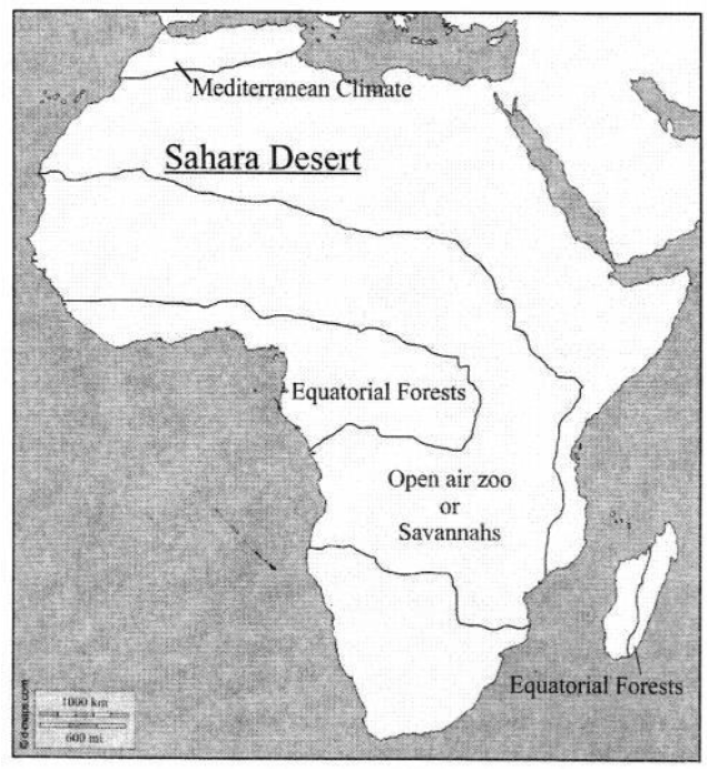
In simple words: Equatorial forests have three layers of trees that block out sunlight. They contain valuable wood, but logging is hard because different trees grow mixed together.
Exam Tip: Describe each layer clearly (emergent, canopy, understorey) and mention why logging is difficult (lack of pure stands).
Question 2. Give examples of herbivorous and carnivorous animals found in the savannah grasslands.
Answer: Many plant-eating animals, like elephants, zebras, giraffes, and deer, live in these grasslands. You can also find many meat-eating predators, such as lions, leopards, and cheetahs, hunting there.
In simple words: Grass-eating animals like zebras and giraffes, and meat-eating animals like lions and cheetahs, live in the Savannah.
Exam Tip: Make sure to classify the animals into two groups: herbivores (plant-eaters) and carnivores (meat-eaters).
Question 3. Identify the hot deserts of Africa and briefly describe the climatic conditions in terms of temperature and rainfall.
Answer: Africa's main hot deserts are the Sahara in the north and the Kalahari in south-central Africa. These regions are very dry with almost no rain. Summers stay extremely hot, while winters are cool. Because there are no clouds in the sky and the soil is very sandy, the temperature drops rapidly at night, creating a wide range between day and night temperatures.
In simple words: The Sahara in the north and the Kalahari in the south are Africa's main deserts. They are very dry, hot by day, and cold by night.
Exam Tip: Identify both deserts (Sahara and Kalahari) and explain how sandy soil and clear skies cause extreme daily temperature changes.
Question 4. Why is the camel called ‘the ship of the desert’ ?
Answer: The camel is called the 'ship of the desert' because of these special traits:
1. It helps transport people and goods across wide, sandy areas.
2. It can store extra fat inside its hump for energy.
3. It has wide, soft feet that stop it from sinking into the soft sand.
4. It has long eyelashes and two sets of eyelids to keep blowing sand out of its eyes.
5. It is able to close its nose completely during strong sandstorms.
In simple words: Camels are built to survive the hot, sandy desert. They have padded feet, humps to store fat, and eyelids that block out blowing sand.
Exam Tip: List at least three physical adaptations (like padded feet, humps, or slit-like nostrils) to write a complete answer.
Question 5. Describe the Mediterranean climate.
Answer: This climate is found along the north-western coast of Africa and a tiny patch in the south-western tip of South Africa. It features hot, sunny, and completely dry summers. Winters, however, stay mild and rainy because wet westerly winds shift over these areas.
In simple words: Mediterranean areas have hot, dry, sunny summers and mild, rainy winters.
Exam Tip: The key feature of a Mediterranean climate is dry summers and wet winters, brought by the westerly winds.
E. In the outline map of Africa given here, mark the features and answer the questions
Question 1. Colour dark green the area where equatorial forests are found. What difficulties were faced by the explorers because of rivers and natural vegetation of the region ?
Answer: Since the equator divides Africa in half, most of the continent is located within the tropics, making it the warmest continent on Earth.
Early travelers found it very hard to explore Africa for several reasons:
* **Extreme Deserts:** In the north, the massive Sahara Desert was nearly impossible to cross because of its intense heat and lack of water.
* **Steep Plateau Land:** High, rolling plateaus made it difficult to travel from the coast into the deeper interior.
* **Rough Rivers:** African rivers have many steep waterfalls and rapids, which meant boats could not easily navigate them.
* **Thick Jungles:** The dense, swampy equatorial rainforests were filled with disease-carrying tsetse flies and toxic insects, which turned back many explorers.
In simple words: Explorers found Africa hard to travel through because of its boiling deserts, high plateaus, rough rivers with waterfalls, and thick jungles filled with disease-carrying flies.
Exam Tip: List at least three barriers to exploration: the Sahara desert, the waterfalls on rivers, and the tsetse flies in the rainforests.
Question 2. Mark the area that is called an ‘open air zoo’. Name thevegetation of this region.
Answer: These wide plains are covered in tall, rough grass and are known as the Savannahs or tropical grasslands. Different kinds of grasses, like tall elephant grass, grow here. You can also see scattered acacia and baobab trees growing among the grassy fields.
In simple words: This grassy area is the Savannah, which has tall elephant grass and scattered baobab and acacia trees.
Exam Tip: When describing Savannah vegetation, mention 'tall, coarse grass', 'elephant grass', and trees like 'acacia' and 'baobab'.
Question 3. Mark the Sahara Desert. Name a plant that best survives in the climate of this region. What are the characteristic features of this plant that help it survive ?
Answer: Plants in this dry region have special features to survive hot, dry summers:
* They grow long roots to find water deep underground.
* Their leaves are small and covered in wax to stop water from escaping.
* They have thick, cork-like bark to protect themselves from heat.
Examples of trees with these features are olive, cork oak, and fig trees.
In simple words: Desert plants survive the dry heat by growing long roots, having waxy leaves, and developing thick bark.
Exam Tip: Be ready to list three survival features: long roots, waxy leaves, and thick spongy bark.
Question 4. Mark the area north of the Atlas Mountains where the Mediterranean climate is found. Which crops does this climate support ?
Answer: The area north of the Atlas Mountains has a Mediterranean climate. This region supports trees with long roots and waxy leaves, like olive, cork oak, and fig. It is also famous for growing orchards of citrus fruits, such as lemons, oranges, and grapes.
In simple words: This sunny region is perfect for growing grapes, olives, figs, and citrus fruits like oranges and lemons.
Exam Tip: The Mediterranean climate is highly suitable for citrus fruits (oranges, lemons) and olive cultivation.
F. Picture study
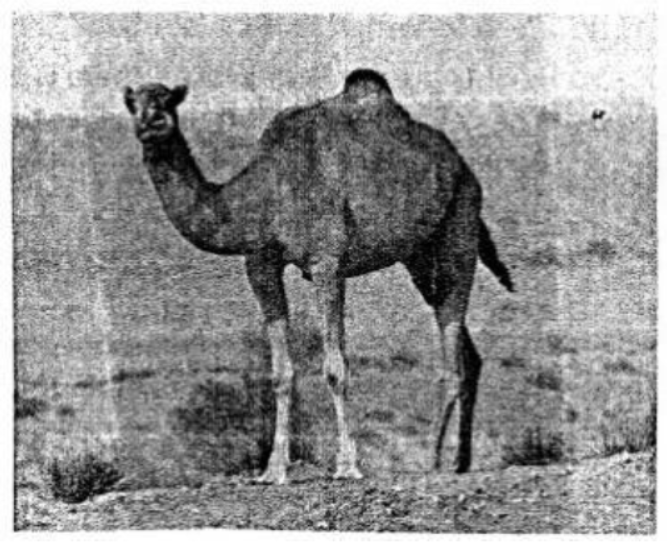
Question 1. What kind of climate is experienced in the region shown in the picture ?
Answer: This is a hot desert climate, like the Sahara or the Kalahari. These dry regions get almost no rain. Summers are very hot, while winters are cool. Because the soil is sandy and the sky has no clouds, the temperature changes drastically between day and night.
In simple words: This is a dry desert climate, which is very hot during the day and cold at night, with almost no rain.
Exam Tip: Mention that deserts have a "large diurnal range of temperature"—meaning a big difference between day and night temperatures.
Question 2. What kind of vegetation grows in such a climate ?
Answer: Only tough, drought-resistant plants can grow here. These plants have long roots to reach deep water, thick waxy skins to store moisture, and thorns instead of leaves to prevent water loss. Examples include cactus, thorny scrub, and date palms in wet oases.
In simple words: Only tough plants like cactus and thorny bushes can grow here because they are good at saving water.
Exam Tip: Focus on adaptations: thick waxy stems to store water and long roots to reach deep underground moisture.
Question 3. Fill in the blanks : The animal seen in the picture is often referred to as the _____ of the _____
Answer: The camel shown in the picture is widely known as the **ship** of the **desert**.
In simple words: The camel is called the ship of the desert.
Exam Tip: The camel gets this name because it is the primary mode of transport across the sandy desert.
Free study material for Geography
ICSE Voyage Solutions Class 7 Geography Chapter 15 Africa Climate Natural Vegetation Wildlife Minerals
Students can now access the detailed Voyage Solutions for Chapter 15 Africa Climate Natural Vegetation Wildlife Minerals on our portal. These solutions have been carefully prepared as per latest ICSE Class 7 syllabus. Each solution given above has been updated based on the current year pattern to ensure Class 7 students have the most updated Geography content.
Master Voyage Textbook Questions
Our subject experts have provided detailed explanations for all the questions found in the Voyage textbook for Class 7 Geography. We have focussed on making the concepts easy for you in Chapter 15 Africa Climate Natural Vegetation Wildlife Minerals so that students can understand the concepts behind every answer. For all numerical problems and theoretical concepts these solutions will help in strengthening your analytical skill required for the ICSE examinations.
Complete Geography Exam Preparation
By using these Voyage Class 7 solutions, you can enhance your learning and identify areas that need more attention. We recommend solving the Geography Questions from the textbook first and then use our teacher-verified answers. For a proper revision of Chapter 15 Africa Climate Natural Vegetation Wildlife Minerals, students should also also check our Revision Notes and Sample Papers available on studiestoday.com.
FAQs
You can download the verified Voyage solutions for Chapter 15 Africa Climate Natural Vegetation Wildlife Minerals on StudiesToday.com. Our teachers have prepared answers for Class 7 Geography as per 2026-27 ICSE academic session.
Yes, our solutions for Chapter 15 Africa Climate Natural Vegetation Wildlife Minerals are designed as per new 2026 ICSE standards. 40% competency-based questions required for Class 7, are included to help students understand application-based logic behind every Geography answer.
Yes, every exercise in Chapter 15 Africa Climate Natural Vegetation Wildlife Minerals from the Voyage textbook has been solved step-by-step. Class 7 students will learn Geography conceots before their ICSE exams.
Yes, follow structured format of these Voyage solutions for Chapter 15 Africa Climate Natural Vegetation Wildlife Minerals to get full 20% internal assessment marks and use Class 7 Geography projects and viva preparation as per ICSE 2026 guidelines.