

ICSE Solutions Voyage Class 7 Geography Chapter 8 Weathering And Soil have been provided below and is also available in Pdf for free download. The Voyage ICSE solutions for Class 7 Geography have been prepared as per the latest syllabus and ICSE books and examination pattern suggested in Class 7. Questions given in ICSE Voyage book for Class 7 Geography are an important part of exams for Class 7 Geography and if answered properly can help you to get higher marks. Refer to more Chapter-wise answers for ICSE Class 7 Geography and also download more latest study material for all subjects. Chapter 8 Weathering And Soil is an important topic in Class 7, please refer to answers provided below to help you score better in exams
Voyage Chapter 8 Weathering And Soil Class 7 Geography ICSE Solutions
Class 7 Geography students should refer to the following ICSE questions with answers for Chapter 8 Weathering And Soil in Class 7. These ICSE Solutions with answers for Class 7 Geography will come in exams and help you to score good marks
Chapter 8 Weathering And Soil Voyage ICSE Solutions Class 7 Geography
Question. From encycopaedias and the Internet, find out the different types of soil found in India. Discuss the importance of these soils for crops cultivated in our country. You should form groups in class for this activity.
Answer: Six main kinds of soil are found in India:
1. Alluvial Soils - These form when rivers drop mud and sand. They have lots of plant food and are very good for growing crops. They are located in the Great Northern plain, the lower parts of Narmada and Tapti rivers, and Northern Gujarat. Every year, new soil is added here.
2. Black Soils - These soils come from old volcanic rocks and melted lava. Most of this soil is in the Deccan area. This includes parts of Maharashtra, Chhattisgarh, Madhya Pradesh, Gujarat, Andhra Pradesh, and Tamil Nadu. This soil has lime, iron, magnesium, and potash. But it does not have enough phosphorus, nitrogen, or plant material.
3. Red Soils - These soils come from the breaking down of very old rocks in the Deccan Plateau. They look red because they contain iron. If there is less iron, the soil looks yellow or brown. This soil covers almost all of Tamil Nadu, Andhra Pradesh, Chhattisgarh, Karnataka, Maharashtra, and parts of Odisha.
4. Laterite Soils - These soils form when heavy rain washes away nutrients. They are found on top of hills and high lands. You can see them in Kerala, Tamil Nadu, Maharashtra, Chhattisgarh, and the hills of Odisha and Assam.
5. Mountain Soils - These soils form when old leaves and forest plants pile up over time. They are found in the snowy Himalayan area. They change depending on how high the mountain is. People grow tea in these places if they get plenty of rain.
6. Desert Soils - In the dry desert areas of Rajasthan, the soil is not fully formed. Because water dries up fast and it rarely rains, the soil holds a lot of salt. This salt makes a hard layer on top. This soil is sandy and lacks plant material.
In simple words: India has six main soil types. Each type is found in a different place and is good for growing different crops.
Exam Tip: Learn the areas where each soil type is found and remember that alluvial soil is the most fertile type.
Think and Answer
Question. Soil formation is an important benefit of weathering. How is it important for mankind ?
Answer: The making of soil is very useful for humans in these ways:
1. It serves as a home for many plants and tiny creatures.
2. It acts as a storage place for water and plant food.
3. It is the base for all food chains across the earth.
4. It holds plant roots firmly in the ground.
In simple words: Soil is crucial for humans because it grows our food, holds water, and gives a home to plants and animals.
Exam Tip: Remember that soil is the starting point of life on land because it supports plants, which feed all other living things.
Values and Life Skills
Question. People have used various farming methods to increase food production. However, in the process, they have stripped soil of nutrients, leading to its degradation. Can you suggest some ways by which we can reduce soil degradation ?
Answer: We can stop soil damage by practicing farming along the slopes, making step fields, planting crops in strips, building small soil walls, planting more trees, changing crops each year, letting the land rest, and managing where animals eat.
In simple words: We can keep the soil healthy and rich by using clever farming methods and planting more trees.
Exam Tip: Knowing key soil saving methods like tree planting (afforestation) and step farming (terrace farming) is very important for exams.
A. Match the column
Question. Match the column
| Column A | Column B |
|---|---|
| 1. Granular disintegration | (i) causes feldspar to become a powdery mass |
| 2. Oxidation | (ii) is common in deserts |
| 3. Carbonation | (iii) is the simplest form of chemical weathering |
| 4. Hydration | (iv) mainly affects limestone regions |
| 5. Solution | (v) results in the rusting of iron |
Answer:
| Column A | Column B |
|---|---|
| 1. Granular disintegration | (ii) is common in deserts |
| 2. Oxidation | (v) results in the rusting of iron |
| 3. Carbonation | (iv) mainly affects limestone regions |
| 4. Hydration | (i) causes feldspar to become a powdery mass |
| 5. Solution | (iii) is the simplest form of chemical weathering |
In simple words: This match-up connects different types of weathering with how they work or where they happen.Exam Tip: Remember that chemical weathering involves water and gases (like oxidation forming rust), while physical weathering like granular disintegration happens due to dry desert heat.
B. Distinguish between each of the following pairs
Question 1. Degradation and aggradation
Answer:
Degradation - This is the process where rock and soil are washed or blown away from the ground, which makes the land level lower.
Aggradation - This is the process where the loose rock and soil that were washed away get piled up in low areas like lakes, valleys, and seas, filling them up.
In simple words: Degradation means wearing down high land, while aggradation means filling up low land with the broken pieces.
Exam Tip: Think of degradation as "subtracting" or lowering the ground, and aggradation as "adding" or building up the ground.
Question 2. Weathering and erosion
Answer:
Weathering - This is the way rocks on the ground crack, break, and crumble because of weather like rain, frost, and heat.
Erosion - This is the movement of those broken rock pieces to new places by things like flowing water, wind, and ice.
In simple words: Weathering breaks the rocks into smaller pieces right where they are, while erosion carries those pieces away to another place.
Exam Tip: Remember: weathering is about "breaking in place" (static), while erosion is about "moving away" (active).
Question 3. Granular disintegration and exfoliation
Answer:
Granular disintegration - This is a type of weathering where small grains of rock get loose and fall away, making the rock surface look rough and full of tiny holes.
Exfoliation - This happens when the outer skin of large, round rocks peels off in thin layers. It is caused by the rock heating up and stretching during the day, then cooling down and shrinking at night.
In simple words: Granular disintegration breaks a rock down grain by grain, while exfoliation makes the outer layers of a rock peel off like an onion skin.
Exam Tip: Exfoliation is often called "onion skin weathering" because of the way the layers peel off. Keep this picture in mind!
Question 4. Hydration and solution
Answer:
Hydration - This happens when water joins chemically with the minerals inside a rock. For example, minerals like feldspar and potash take in water and turn into a soft powder, which makes them easy to wash away.
Solution - This is an easy type of chemical weathering where some minerals melt directly into water when rain falls or a river runs over the rocks. The minerals dissolve and wash away, causing the rock to fall apart.
In simple words: Hydration chemically changes rock minerals by making them absorb water, while solution simply dissolves minerals like sugar in water.
Exam Tip: Remember that hydration turns solid minerals into a weak powder, while solution completely dissolves them away.
Question 5. Soil erosion and soil conservation
Answer:
Soil erosion - This means the washing or blowing away of the top layers of soil by forces like flowing water and strong wind.
Soil conservation - This means taking care of the soil to protect it from being washed away or losing its richness because of cut-down trees, too much grazing, or heavy rains.
In simple words: Soil erosion is when soil is lost or blown away, while soil conservation is when we protect the soil and keep it healthy.
Exam Tip: Be ready to explain how human activities like cutting down forests cause soil erosion, and how planting trees helps in soil conservation.
C. Give geographical reasons
Question 1. Temperature changes result in physical weathering.
Answer: During the day, heat makes the rocks stretch, and during the cold night, they shrink. This constant movement cracks and breaks the rocks. In cooler parts of the world, water freezes inside rock cracks and splits them open.
In simple words: Daily hot and cold weather makes rocks expand and shrink until they crack and break apart.
Exam Tip: Remember to mention both "expansion during the day" and "contraction at night" when explaining physical weathering.
Question 2. Gases in the atmosphere affect weathering.
Answer: The minerals inside rocks can react with gases and wetness in the air. For example, when oxygen mixes with the iron in a rock, it creates rust, which weakens the rock and makes it crumble.
In simple words: Air and dampness chemically react with rocks, like how oxygen turns iron to weak rust.
Exam Tip: Iron-rich rocks turning red or yellow because of rust (oxidation) is a classic example of chemical weathering by gases.
Question 3. Human activities affect weathering.
Answer: People speed up the breaking of rocks when they dig mines, cut down forests, build tunnels and roads, or plow fields for farming.
In simple words: Humans break down rocks and soil through work like mining, road building, and farming.
Exam Tip: These human actions are called "biological weathering" or "man-made physical weathering." Name at least three examples in your answer.
Question 4. Soil is a very important resource.
Answer: Soil is highly valuable because humans need it to produce food, materials for clothes, and shelter. Also, it takes thousands of years to create even a very thin layer of new soil.
In simple words: Soil gives us our basic needs like food and clothes, but it takes thousands of years to form.
Exam Tip: Explain that soil is practically a "non-renewable resource" on a human timescale because of how slowly it forms.
Question 5. There is a need for soil conservation.
Answer: We must protect our soil because humans rely on it, either directly or indirectly, to get their basic needs like food, clothes, and homes.
In simple words: We must keep our soil safe because our survival and basic needs depend entirely on it.
Exam Tip: Emphasize that because we depend on soil for nearly everything we eat and wear, saving it is vital for our future.
D. Answer the following questions in brief
Question 1. Name any four agents of erosion.
Answer: The four main forces that cause erosion are:
1. Flowing water (like rivers and rain)
2. Wind
3. Glaciers (large moving ice sheets)
4. Ocean waves
Human actions like cutting down forests, overgrazing, and poor farming can also speed up this loss.
In simple words: Water, wind, glaciers, and waves are the main natural forces that carry away soil and rocks.
Exam Tip: Water and wind are the most common agents of soil erosion that you should always mention first.
Question 2. List any three factors that affect weathering.
Answer: The main factors that control how rocks weather are:
1. The local weather and climate (like heat and rain)
2. The types of minerals inside the rock
3. The physical shape and structure of the rock
4. How much of the rock is bare and open to the air
In simple words: Weathering is affected by the climate, the type of rock, and how much of it is exposed.
Exam Tip: Climate is the most important factor because it determines whether physical or chemical weathering will happen.
Question 3. In which regions of the world is ‘frost action’ the common form of weathering?
Answer: Frost action is a very common type of weathering in temperate latitudes and cold mountain regions where temperatures often rise and fall around freezing point.
In simple words: Frost action happens in cool regions where water frequently freezes and melts inside rock cracks.
Exam Tip: Remember that "frost action" requires temperatures to cycle above and below 0 degrees Celsius so water can freeze and melt repeatedly.
Question 4. Which is the most important effect of weathering?
Answer: The two most significant results of weathering are soil erosion and landslides.
In simple words: Weathering causes rocks to break down, which leads directly to soil loss and landslides.
Exam Tip: Soil formation is a positive effect of weathering, while landslides and soil erosion are destructive effects.
Question 5. What are the components of topsoil?
Answer: The top layer of soil, called topsoil, is made of sand, tiny silt particles, fine clay, and rich decayed organic matter (humus).
In simple words: Topsoil is a mix of sand, silt, clay, and decayed plants that makes soil fertile.
Exam Tip: Humus is the key component that gives topsoil its dark color and makes it highly fertile for growing plants.
Question 6. Name the various methods of conserving soil.
Answer: The primary ways to protect soil are planting new trees, growing crops in strips, farming on step-like terraces, plowing along slopes, building small mud walls, rotating different crops, letting fields rest, and limiting where farm animals graze.
In simple words: We can protect soil by using smart farming practices, planting trees, and managing grazing animals.
Exam Tip: Be ready to name at least four distinct soil conservation methods in a short-answer question.
Question 7. Distinguish between contour tilling and contour bunding.
Answer:
Contour Tilling - In this practice, farmers plow along the natural curves of the hill rather than straight up and down. This prevents rainwater from rushing down the slope and carrying away the soil. Instead, the plowed ridges hold the water and let it soak into the ground.
Contour Bunding - This method protects soil by constructing small walls or mud embankments along the natural curves of the slope. These barriers keep rainwater from running off too quickly and taking the topsoil with it.
In simple words: Contour tilling is plowing in curves across a hill, while contour bunding is building low mud walls along those curves to stop water.
Exam Tip: Remember that "tilling" is about plowing patterns, while "bunding" is about building physical barriers like walls.
Question 8. What do you understand by controlled grazing ?
Answer: Controlled grazing is an easy way to protect soil by limiting where and how long livestock feed on grasslands. When animals eat too much in one area, they pull up grass by the roots, leaving the bare soil open to wind and rain. Also, their heavy hooves break up the soil structure. To prevent this, we can fence off specific grazing fields and rotate the animals.
In simple words: Controlled grazing means putting fences around fields so cows and sheep do not eat all the grass and ruin the soil.
Exam Tip: Explain how overgrazing exposes bare soil, making it easy for wind and water to wash it away.
E. Answer the following questions in one or two paragraphs
Question 1. What is gradation? Describe the two processes involved in gradation.
Answer: Gradation means the natural leveling of the earth's surface by moving forces like rivers, winds, and waves. While earth movements push mountains up, gradation works to smooth things out. It includes two opposite processes:
1. Degradation - This is the wearing down of high lands and mountains by weather and erosion.
2. Aggradation - This is the building up of low areas like valleys and lakes by dumping the sand and mud that was carried away.
In simple words: Gradation is how the earth's surface gets flattened out over time. It wears down high hills and fills up low valleys.
Exam Tip: Remember: Gradation = Degradation (cutting down) + Aggradation (piling up). Using this formula will help you remember the concept easily.
Question 2. Describe the process that leads to exfoliation.
Answer: Exfoliation is the peeling away of the outer skin of large, round rocks in thin layers. This happens because the sun heats up the rock's outer surface during the day, making it expand. At night, the outer surface cools down and shrinks. Since the inner part of the rock stays at the same temperature, this daily stretching and squeezing causes the outer layer to split and peel off.
In simple words: The hot sun and cold night air make the outside of a rock expand and shrink until it peels off like onion skin.
Exam Tip: Exfoliation is a physical weathering process that is highly common in hot deserts because of the extreme difference between day and night temperatures.
Question 3. Discuss the role of water in the process of chemical weathering.
Answer: Water is essential for chemical weathering. When rain falls through the air, it mixes with carbon dioxide to make a weak carbonic acid. This acid attacks the minerals inside rocks. Some minerals, like feldspar, soak up water and turn into a crumbly powder. Other highly soluble minerals, like rock salt and gypsum, dissolve completely in rainwater and wash away, causing the remaining rock to crumble.
In simple words: Rainwater mixes with gases to form weak acids that dissolve rock minerals or turn them into soft powder.
Exam Tip: Be sure to explain how rainwater acts as a solvent and how it combines with carbon dioxide to form carbonic acid.
Question 4. How do animals and plants assist in weathering?
Answer: Both plants and animals play a part in weathering. When plants die and decay, they release organic acids. These acids mix with rainwater and chemically break down rock minerals. At the same time, small animals like earthworms, ants, rabbits, and rats dig tunnels through the ground. This loosens the soil and cracks open the rocks below.
In simple words: Rotting plants make acids that dissolve rocks, while digging animals break up rocks and soil by making tunnels.
Exam Tip: This type of weathering is called biological weathering because it is caused by living things (plants and animals).
Question 5. What is meant by the terms ‘soil erosion’ and ‘soil conservation’?
Answer: Soil erosion is the stripping away of the topsoil by forces such as wind and flowing water. It happens in two primary ways:
- Sheet erosion - where heavy rain washes away a thin, flat layer of topsoil over a wide area.
- Gully erosion - where rainwater carves deep, narrow channels or ditches into slopes.
Erosion also destroys soil fertility, making the land barren. It is often triggered by cutting down forests, overgrazing, and poor farming.
Soil conservation means protecting the soil from being lost or ruined. This is done by planting grass, shrubs, and trees on slopes, limiting animal grazing, and using protective farming methods like building mud walls, terrace farming, and circular plowing.
In simple words: Soil erosion is when wind and rain take away topsoil (either in flat sheets or deep ditches), while soil conservation is when we protect soil using smart farming and tree planting.
Exam Tip: Be ready to clearly distinguish between sheet erosion (flat washing) and gully erosion (channel cutting) in your exam.
Question 6. Why is soil conservation important ? Give three reasons.
Answer: Saving our soil is vital for three main reasons:
1. Soil is a complex living system made of minerals, water, helpful microbes, earthworms, and decayed organic matter.
2. Humans rely on it completely, both directly and indirectly, to produce food, clothes, and materials for homes.
3. Soil is extremely slow to form, taking thousands of years to create just a thin layer, so we cannot replace it quickly if it is lost.
In simple words: Soil is full of life, gives us our basic needs, and takes thousands of years to grow back, so we must save it.
Exam Tip: When listing reasons, clearly highlight its slow formation rate and our absolute dependence on it for food.
Question 7. Explain any two methods of soil conservation briefly.
Answer:
1. Contour Tilling - In this practice, farmers plow along the natural curves of the hill rather than straight up and down. This prevents rainwater from rushing down the slope and carrying away the soil. Instead, the plowed ridges hold the water and let it soak into the ground.
2. Terrace Farming - This involves cutting wide, flat steps into steep mountainsides to grow crops. Because these steps are flat, rainwater cannot speed down the hill, which stops soil erosion and helps the crops absorb water.
In simple words: Contour tilling plows in curves around hills, while terrace farming cuts flat steps into slopes to slow down running water.
Exam Tip: Be sure to highlight how both of these methods physically slow down rainwater, which is the main cause of soil loss on hills.
Question. Make a chart for your classroom showing the causes of different types of weathering.
Answer: This is a classroom activity to be done by yourself or in small groups.
In simple words: This is a project for you to create in class.
Exam Tip: For your chart, divide weathering into physical, chemical, and biological types, listing examples of each.
Question. Form pairs or groups of three or four students and discuss, with examples, how we depend directly and indirectly on soil.
Answer: This discussion can be carried out with your classmates and your teacher's guidance.
In simple words: This is a discussion to have in your classroom.
Exam Tip: Direct dependence includes crops we eat; indirect dependence includes clothes (like cotton) or animals that feed on grass grown in soil.
H. Picture Study
The photograph shows a farming method that helps in controlling soil erosion.
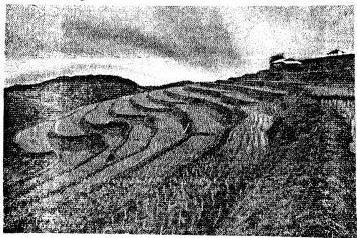
Question 1. What is this farming method called ?
Answer: This farming practice is known as terrace farming.
In simple words: This step-like farming method on hills is called terrace farming.
Exam Tip: Terrace farming is easily recognized by its step-like cuts on mountain slopes.
Question 2. Mention any two other methods that help in controlling soil erosion.
Answer: Two other ways to stop soil erosion are building mud walls and plowing the fields in circles.
In simple words: We can also stop erosion by building mud barriers and plowing in circular patterns.
Exam Tip: Adding methods like "contour bunding" (mud walls) and "circular plowing" will give you excellent alternative examples for exams.
Free study material for Geography
ICSE Voyage Solutions Class 7 Geography Chapter 8 Weathering And Soil
Students can now access the detailed Voyage Solutions for Chapter 8 Weathering And Soil on our portal. These solutions have been carefully prepared as per latest ICSE Class 7 syllabus. Each solution given above has been updated based on the current year pattern to ensure Class 7 students have the most updated Geography content.
Master Voyage Textbook Questions
Our subject experts have provided detailed explanations for all the questions found in the Voyage textbook for Class 7 Geography. We have focussed on making the concepts easy for you in Chapter 8 Weathering And Soil so that students can understand the concepts behind every answer. For all numerical problems and theoretical concepts these solutions will help in strengthening your analytical skill required for the ICSE examinations.
Complete Geography Exam Preparation
By using these Voyage Class 7 solutions, you can enhance your learning and identify areas that need more attention. We recommend solving the Geography Questions from the textbook first and then use our teacher-verified answers. For a proper revision of Chapter 8 Weathering And Soil, students should also also check our Revision Notes and Sample Papers available on studiestoday.com.
FAQs
You can download the verified Voyage solutions for Chapter 8 Weathering And Soil on StudiesToday.com. Our teachers have prepared answers for Class 7 Geography as per 2026-27 ICSE academic session.
Yes, our solutions for Chapter 8 Weathering And Soil are designed as per new 2026 ICSE standards. 40% competency-based questions required for Class 7, are included to help students understand application-based logic behind every Geography answer.
Yes, every exercise in Chapter 8 Weathering And Soil from the Voyage textbook has been solved step-by-step. Class 7 students will learn Geography conceots before their ICSE exams.
Yes, follow structured format of these Voyage solutions for Chapter 8 Weathering And Soil to get full 20% internal assessment marks and use Class 7 Geography projects and viva preparation as per ICSE 2026 guidelines.