

ICSE Solutions Oxford Class 7 History Civics Chapter 10 Jahangir Shah Jahan Aurangzeb have been provided below and is also available in Pdf for free download. The Oxford ICSE solutions for Class 7 History Civics have been prepared as per the latest syllabus and ICSE books and examination pattern suggested in Class 7. Questions given in ICSE Oxford book for Class 7 History Civics are an important part of exams for Class 7 History Civics and if answered properly can help you to get higher marks. Refer to more Chapter-wise answers for ICSE Class 7 History Civics and also download more latest study material for all subjects. Chapter 10 Jahangir Shah Jahan Aurangzeb is an important topic in Class 7, please refer to answers provided below to help you score better in exams
Oxford Chapter 10 Jahangir Shah Jahan Aurangzeb Class 7 History Civics ICSE Solutions
Class 7 History Civics students should refer to the following ICSE questions with answers for Chapter 10 Jahangir Shah Jahan Aurangzeb in Class 7. These ICSE Solutions with answers for Class 7 History Civics will come in exams and help you to score good marks
Chapter 10 Jahangir Shah Jahan Aurangzeb Oxford ICSE Solutions Class 7 History Civics
A. Fill in the blanks :
Question 1. Nur Jahan became the ________ ruler of the Mughal empire.
Answer: virtual
In simple words: Nur Jahan was the real person in charge of running the empire.
Exam Tip: Remember that Nur Jahan handled most of the state affairs while Jahangir was the emperor.
Question 2. During the final years of Jahangir’s reign, there was a power struggle between ________ and ________.
Answer: Nur Jahan and Shah Jahan
In simple words: Nur Jahan and Shah Jahan fought for power when Jahangir was old.
Exam Tip: Be sure to spell both historical names correctly in your exam.
Question 3. Shah Jahan’s reign is often referred to as the ________ of the Mughal empire.
Answer: Golden Age
In simple words: Shah Jahan's rule is called the most successful and peaceful time of the empire.
Exam Tip: The term "Golden Age" is highly important because of the magnificent architecture built during this time.
Question 4. Aurangzeb spent the first half of his reign in the ________ and the second half in the ________.
Answer: North, Deccan
In simple words: Aurangzeb ruled from the north first, and then moved to the south.
Exam Tip: Write "North" and "Deccan" in the correct order to get full marks.
Question 5. Aurangzeb spent the last ________ years of his reign fighting against the ________ and the Sultanates of ________ and ________.
Answer: twenty six, Marathas, Bijapur, Golconda
In simple words: Aurangzeb spent twenty-six years fighting in the south against the Marathas, Bijapur, and Golconda.
Exam Tip: Make sure to memorize all three opposing powers in the Deccan region.
B. Match the following :
Question 1. Match the following:
| Column A | Column B |
|---|---|
| 1. Salim | (a) son of Jahangir |
| 2. Khusrau | (b) wife of Shah Jahan |
| 3. Nur Jahan | (c) red sandstone |
| 4. Taj Mahal | (d) son of Akbar |
| 5. Mumtaz Mahal | (e) wife of Jahangir |
| 6. Red Fort | (f) white marble |
Answer:
1. Salim - (d) son of Akbar
2. Khusrau - (a) son of Jahangir
3. Nur Jahan - (e) wife of Jahangir
4. Taj Mahal - (f) white marble
5. Mumtaz Mahal - (b) wife of Shah Jahan
6. Red Fort - (c) red sandstone
In simple words: Match the historical figures, buildings, and materials correctly with their descriptions.
Exam Tip: Be careful with names like Salim and Khusrau, and recall which wife matches which emperor.
C. Choose the correct answer :
Question 1. The foundations laid by ________ were so strong that Jahangir did not have any major problems maintaining the empire.
(a) Akbar
(b) Babur
(c) Humayun
Answer: (a) Akbar
In simple words: Akbar built such a strong base for the empire that Jahangir easily kept it going.
Exam Tip: Remember that Akbar ruled for a long time and set up a solid system of government before Jahangir.
Question 2. Shah Jahan built the magnificent ________ in the memory of his wife Mumtaz Mahal.
(a) Agra Fort
(b) Taj Mahal
(c) Red Fort
Answer: (b) Taj Mahal
In simple words: Shah Jahan made the Taj Mahal to remember his wife, Mumtaz Mahal, after she died.
Exam Tip: The Taj Mahal is famous worldwide and is made entirely of white marble.
Question 3. Shah Jahan built a new city called ________.
(a) Fatehpur Sikri
(b) Daulatabad
(c) Shahjahanabad
Answer: (c) Shahjahanabad
In simple words: Shah Jahan created a new city and named it Shahjahanabad after himself.
Exam Tip: Do not confuse Fatehpur Sikri (built by Akbar) with Shahjahanabad (built by Shah Jahan).
Question 4. Aurangzeb’s reign can be roughly divided into ________ periods.
(a) four
(b) three
(c) two
Answer: (c) two
In simple words: We can divide the time Aurangzeb ruled into two main parts.
Exam Tip: These two periods correspond to his time in the North and his time in the Deccan.
Question 5. One of the most serious challenges faced by Aurangzeb came from the ________ in the Deccan.
(a) Sikhs
(b) Marathas
(c) Rajputs
Answer: (b) Marathas
In simple words: The Marathas in the south gave Aurangzeb the hardest time during his rule.
Exam Tip: Note the word "Deccan" in the question, which specifically points to the Marathas rather than northern powers like the Sikhs.
D. State whether the following are true or false :
Question 1. Jahangir defeated the Rana of Mewar.
Answer: True
In simple words: Jahangir did beat the ruler of Mewar in battle.
Exam Tip: This victory helped Jahangir secure control over Rajputana, which Akbar had tried to do.
Question 2. Jahangir is said to have installed a chain of justice.
Answer: True
In simple words: Jahangir set up a special golden chain that people could pull to ask him for help.
Exam Tip: Remember that this chain had sixty bells and was connected directly to his palace.
Question 3. The Peacock Throne was taken to Persia by Nadir Shah.
Answer: True
In simple words: A Persian invader named Nadir Shah took away the famous royal throne.
Exam Tip: Keep in mind the year was 1739 CE when this historical event happened.
Question 4. The Jama Masjid is said to be the most perfect of Jahangir’s buildings.
Answer: False. The Jama Masjid is actually considered one of the finest monuments built by Shah Jahan, not Jahangir.
In simple words: This is false because Shah Jahan built the Jama Masjid, not Jahangir.
Exam Tip: When correcting false statements, always provide the right historical figure associated with the building.
E. Answer the following questions in one or two words/ sentences :
Question 1. Why did Jahangir not face any major problems in maintaining his large empire?
Answer: The strong base created by Akbar made it easy for Jahangir to run his kingdom. He did not face big troubles because of this solid setup.
In simple words: Jahangir had an easy time because Akbar had already built a very strong empire.
Exam Tip: Mention Akbar's system of governance as the main reason why Jahangir ruled peacefully.
Question 2. Name Jahangir’s son who rebelled against him.
Answer: His oldest son, Prince Khusrau, rose up against him.
In simple words: Jahangir's eldest son, named Khusrau, fought against his own father.
Exam Tip: Remember to name Khusrau clearly, as he was Jahangir's eldest son.
Question 3. Why is Shah Jahan known as the Engineer King?
Answer: Shah Jahan got this title because he loved building grand structures. Under his rule, many beautiful buildings were put up that people still admire today. Great examples of these include the lovely Taj Mahal in Agra, the Moti Masjid in Agra Fort, and the grand Jama Masjid in Delhi.
In simple words: Shah Jahan built amazing monuments like the Taj Mahal and Jama Masjid, so people call him the Engineer King.
Exam Tip: List at least two key monuments like the Taj Mahal and Jama Masjid to support your answer.
Question 4. Which fort did Shah Jahan build in the new city of Shahjahanabad?
Answer: He constructed the Red Fort.
In simple words: Shah Jahan built the Red Fort in his new city.
Exam Tip: The Red Fort is made of red sandstone, which is a key detail to remember.
Question 5. Who succeeded Shah Jahan as the Mughal emperor?
Answer: Aurangzeb, who was his third son, became the next emperor.
In simple words: His third son, Aurangzeb, took over the throne after him.
Exam Tip: Be sure to mention that Aurangzeb was the third son of Shah Jahan.
Question 6. State any one major cause of the decline of the Mughal empire.
Answer: The empire lost too much wealth on army wars and on making grand buildings. This empty treasury hurt their power.
In simple words: Spending too much money on wars and huge buildings made the empire poor and weak.
Exam Tip: Focus on the financial drain caused by military campaigns and construction projects as a key reason.
Question 7. What was the nature of Aurangzeb’s Rajput policy in the early years of his reign?
Answer: At the start of his rule, Aurangzeb copied Akbar by staying friendly with the Rajputs. He gave their leaders top military ranks and worked to keep them on his side.
In simple words: Early on, Aurangzeb was friendly to the Rajputs and gave them high jobs to get their help.
Exam Tip: Explain that he initially gave them high mansabs (ranks) to win their loyalty, just like Akbar did.
Question 8. What were the objectives of Aurangzeb’s Deccan policy?
Answer: Aurangzeb aimed to break the rising strength of the Marathas. These fighters were brave and refused to bow down to him. Since the southern region was also large and rich, he wanted to bring it under his rule.
In simple words: Aurangzeb wanted to stop the Marathas and take control of the wealthy southern lands.
Exam Tip: Mention two main goals: defeating the Marathas and taking over the wealthy southern kingdoms.
Question 9. Why did the annexation of Bijapur and Golconda prove harmful for the Mughal empire?
Answer: Taking over these lands made the empire too huge to manage easily. It also put the Mughals face-to-face with the Maratha forces.
In simple words: The empire grew too big to run, and it brought the Mughals into a direct fight with the Marathas.
Exam Tip: Point out the two key issues: administration of an overly large empire and direct conflict with the Marathas.
F. Answer the following questions briefly :
Question 1. Jahangir fulfilled Akbar’s unrealized imperial dreams by conquering Mewar. Explain.
Answer: Jahangir ordered an army to march against Rana Amar Singh of Mewar. This ruler, following in the footsteps of his father Rana Pratap Singh, had declined to accept Mughal rule. When the Mewar ruler was beaten, he swore loyalty to Jahangir, who behaved very kindly towards him. Jahangir let the Rana keep his lands and made his son, Karan, a high officer in the royal army. This surrender proved the supreme power of the Mughals in Rajputana and ended the final major Rajput opposition.
In simple words: Jahangir defeated Mewar, which Akbar could not do. He then treated the defeated ruler with respect and made peace.
Exam Tip: Mention how Jahangir treated Rana Amar Singh with respect and gave his son a military role, which helped secure long-term loyalty.
Question 2. To what extent were Jahangir’s Deccan campaigns successful?
Answer: Jahangir ordered an attack led by Prince Khurram, who succeeded in winning back the Ahmadnagar fort. This victory earned the prince the grand title of Shah Jahan (Ruler of the World). But the fighting went on, and before Jahangir's rule came to an end, Ahmadnagar won back its freedom and broke away from Mughal power.
In simple words: The campaign started well when Prince Khurram won a key fort, but in the end, Ahmadnagar got its freedom back.
Exam Tip: Clarify that while Prince Khurram initially captured Ahmadnagar Fort, the campaign was not a permanent success because Ahmadnagar rebelled later.
Question 3. What qualities did Nur Jahan possess to make her worthy of her name?
Answer: Her name means 'Light of the World', and she truly lived up to it. She was smart, highly educated, elegant, and beautiful. On top of that, she wrote lovely poetry and designed unique styles of clothes and jewelry. She was also a brave and capable leader who assisted Jahangir in running the state affairs.
In simple words: Nur Jahan was beautiful, highly educated, creative with designs, and helped the emperor make important decisions.
Exam Tip: Mention her artistic talents (poetry and design) along with her strong political and administrative skills.
Question 4. Nur Jahan was very ambitious and eventually became the power behind the throne. Explain.
Answer: Because of her strong drive, Nur Jahan quickly took control of the kingdom's decisions. The emperor asked for her advice on all state matters. Over time, Jahangir stepped away from running the country due to his reliance on alcohol and opium, leaving the work to her. The royal mints even stamped coins with both of their names together. She used her high status to place her family members - including her father and brother - into key government jobs. She also arranged for her niece, Mumtaz Mahal, to marry Prince Khurram, who later became Shah Jahan.
In simple words: Nur Jahan ruled the empire because Jahangir was sick and weak. She put her relatives in high jobs and even put her name on coins.
Exam Tip: Key points to mention include: joint coins, Jahangir's health issues, and how she promoted her own family to key administrative roles.
Question 5. Shah Jahan’s reign was an age of splendour and cultural brilliance. In this context, discuss:
(a) Taj Mahal
(b) Red Fort
Answer:
(a) Taj Mahal: It took over two decades to finish building the Taj Mahal, costing around ten million rupees back then. Built using clean white marble, it features beautiful designs made from fine stones and detailed screens. This eight-sided building has a magnificent dome and four elegant minarets, all placed inside a lovely garden.
(b) Red Fort: This structure was built using red sandstone. Inside its walls lie several beautiful halls. The Diwan-i-Khas is the most famous of these, featuring a ceiling made of silver. Its marble walls are decorated with real gold and colorful stones.
In simple words: The Taj Mahal was built with white marble over 20 years, and the Red Fort was made of red sandstone with a silver ceiling inside.
Exam Tip: Specify key materials (white marble for the Taj Mahal, red sandstone for the Red Fort) and notable internal structures like the Diwan-i-Khas.
Question 6. Why did Aurangzeb’s Deccan campaign against the Marathas prove to be a ruinous misadventure? What were the long-term consequences of this campaign?
Answer: The wars in the South turned out to be a huge disaster, showing a clear lack of smart planning. Naturally distrustful, the emperor did not have faith in his own family or court members. He treated his officers like puppets, controlling every small detail of their work. Furthermore, treating his people differently based on their religion made him highly unpopular. Though he was very stubborn and worked hard for what he believed was right, his actions backfired. On his deathbed, he admitted his failures in letters to his son, writing that he had not done right by his nation or people. By the early 1800s, the once-mighty Mughal empire fell apart. The rulers lost their strength, and their giant kingdom was reduced to a tiny area surrounding Delhi.
In simple words: Fighting in the south for too long ruined the army and the treasury. This eventually caused the huge Mughal empire to break down and shrink.
Exam Tip: Be sure to connect Aurangzeb's long stay in the Deccan with the eventual collapse and shrinking of the Mughal empire.
Question 7. Why did Aurangzeb fail as a ruler?
Answer: Even though Aurangzeb had good personal habits, he was not successful as an emperor. He failed to copy his ancestors' open-minded attitude toward other faiths and alliances. Instead of making allies, he turned the Rajputs, Sikhs, and Marathas into enemies. His deep-seated distrust of others bothered his ministers, and his unfair treatment of non-Muslim subjects lost him the love of his people.
In simple words: Aurangzeb failed because he was suspicious of everyone and did not treat people of other religions fairly, which made many groups fight against him.
Exam Tip: Mention his lack of religious tolerance and his conflict with the Rajputs, Sikhs, and Marathas as the core reasons for his failure.
Question 8. Briefly explain the negative aspects of Shah Jahan’s reign that eventually led to the decline of the Mughal empire.
Answer: Despite continuing the peaceful approach toward different faiths and Rajput allies, his rule had deep underlying issues:
1. Huge sums of money were lost on military wars in Central Asia and Kandahar, as well as on constructing massive monuments.
2. The government placed much higher taxes on poor farmers to refill the royal accounts.
3. A French traveler named Bernier noted that many farming areas were ruined and abandoned, hurting the empire's farming economy.
4. Unsuccessful military wars showed that the Mughal army was no longer as strong as before.
5. The government system became too big and suffered from widespread bribery and dishonesty.
In simple words: Although Shah Jahan's reign looked grand, his expensive wars and building projects dried up the treasury, while heavy taxes ruined farming and corruption grew in the government.
Exam Tip: Be sure to mention the financial drain from grand buildings and failed wars, along with Bernier's observations on the suffering of farmers.
G. Picture study :
This is a picture of a 17th century-CE monument, built in red sandstone by a Mughal emperor.
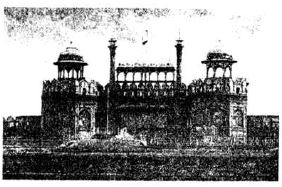
Question 1. Identify the monument.
Answer: It is the Red Fort.
In simple words: The picture shows the Red Fort.
Exam Tip: This monument is easily recognized by its red sandstone walls and classic Mughal arches.
Question 2. Where is it located?
Answer: It is found in Old Delhi.
In simple words: The Red Fort is in Old Delhi.
Exam Tip: Remember to specify "Old Delhi" rather than just "Delhi" for full accuracy.
Question 3. Who built this monuments?
Answer: The monument was constructed by Shah Jahan.
In simple words: Emperor Shah Jahan built it.
Exam Tip: Shah Jahan is famous for constructing major monuments like this and the Taj Mahal.
Question 4. Name two important buildings inside this monument.
Answer: Two key structures inside the fort are the Diwan-i-Khas and the Diwan-i-Aam.
In simple words: The two key halls inside are the Diwan-i-Khas and the Diwan-i-Aam.
Exam Tip: Knowing the names of these halls is essential for questions about the inside of the Red Fort.
Question 5. Mention its important features.
Answer: Some of the key features are:
- The Diwan-i-Khas stands out the most. It has a silver ceiling and marble walls decorated with gold and rare gems.
- The Diwan-i-Aam housed the famous Peacock Throne of Shah Jahan. This throne had a roof held up by twelve pillars of emerald, decorated with jeweled peacocks. It took seven years to make and was stolen by Nadir Shah of Persia in 1739 CE.
In simple words: The Diwan-i-Khas has a silver ceiling, and the Diwan-i-Aam had the beautiful Peacock Throne, which was later taken to Persia.
Exam Tip: Be sure to write about the luxury of the Diwan-i-Khas (silver and marble) and mention the fate of the Peacock Throne in 1739.
Other Important Questions
Question 1. What role did Nur Jahan play in the administrative affairs of the empire?
Answer: She acted as the real authority in the background. The emperor took her advice on every government matter. Over time, she became the de facto ruler of the entire kingdom.
In simple words: Nur Jahan made almost all the big decisions because the emperor trusted her with everything.
Exam Tip: Use the term "power behind the throne" or "virtual ruler" to describe her role accurately.
Question 2. How did Aurangzeb come to power?
Answer: With assistance from his brother Murad, Aurangzeb defeated and killed his rival brother Dara. After that, he locked up his father inside the Agra Fort and seized the crown.
In simple words: Aurangzeb teamed up with his brother to defeat his other brother Dara, then locked up his father to take the throne.
Exam Tip: Outline the two key steps: the defeat of Dara Shikoh (with Murad's help) and the imprisonment of Shah Jahan at Agra Fort.
Question 3. When and where Jahangir give permission to set up trading posts to English East India Company?
Answer: The emperor allowed the British merchants to establish their trade stations in 1618 AD at Broach and Surat.
In simple words: Jahangir allowed the English company to open trading centers at Surat and Broach in 1618.
Exam Tip: Make sure you memorize both locations (Surat and Broach) and the year 1618 AD.
Question 4. Give reason to show Jahangir was a great lover of justice?
Answer: The emperor cared deeply about his subjects and wanted to ensure they were treated fairly. To help them, he set up a golden 'chain of justice' equipped with sixty bells, stretching from his palace to the Yamuna riverbank. Anyone could pull this chain to get his attention, and Jahangir would hear their problems himself to solve them.
In simple words: Jahangir hung a golden chain with 60 bells outside his palace so anyone who needed help could ring it, and he would help them personally.
Exam Tip: Always describe the physical details of the "chain of justice" (gold, sixty bells, and location near the Yamuna river) when explaining this answer.
Free study material for History Civics
ICSE Oxford Solutions Class 7 History Civics Chapter 10 Jahangir Shah Jahan Aurangzeb
Students can now access the detailed Oxford Solutions for Chapter 10 Jahangir Shah Jahan Aurangzeb on our portal. These solutions have been carefully prepared as per latest ICSE Class 7 syllabus. Each solution given above has been updated based on the current year pattern to ensure Class 7 students have the most updated History Civics content.
Master Oxford Textbook Questions
Our subject experts have provided detailed explanations for all the questions found in the Oxford textbook for Class 7 History Civics. We have focussed on making the concepts easy for you in Chapter 10 Jahangir Shah Jahan Aurangzeb so that students can understand the concepts behind every answer. For all numerical problems and theoretical concepts these solutions will help in strengthening your analytical skill required for the ICSE examinations.
Complete History Civics Exam Preparation
By using these Oxford Class 7 solutions, you can enhance your learning and identify areas that need more attention. We recommend solving the History Civics Questions from the textbook first and then use our teacher-verified answers. For a proper revision of Chapter 10 Jahangir Shah Jahan Aurangzeb, students should also also check our Revision Notes and Sample Papers available on studiestoday.com.
FAQs
You can download the verified Oxford solutions for Chapter 10 Jahangir Shah Jahan Aurangzeb on StudiesToday.com. Our teachers have prepared answers for Class 7 History Civics as per 2026-27 ICSE academic session.
Yes, our solutions for Chapter 10 Jahangir Shah Jahan Aurangzeb are designed as per new 2026 ICSE standards. 40% competency-based questions required for Class 7, are included to help students understand application-based logic behind every History Civics answer.
Yes, every exercise in Chapter 10 Jahangir Shah Jahan Aurangzeb from the Oxford textbook has been solved step-by-step. Class 7 students will learn History Civics conceots before their ICSE exams.
Yes, follow structured format of these Oxford solutions for Chapter 10 Jahangir Shah Jahan Aurangzeb to get full 20% internal assessment marks and use Class 7 History Civics projects and viva preparation as per ICSE 2026 guidelines.