

ICSE Solutions Selina Concise Class 6 Mathematics Chapter 32 Perimeter and Area of Plane Figures have been provided below and is also available in Pdf for free download. The Selina Concise ICSE solutions for Class 6 Mathematics have been prepared as per the latest syllabus and ICSE books and examination pattern suggested in Class 6. Questions given in ICSE Selina Concise book for Class 6 Mathematics are an important part of exams for Class 6 Mathematics and if answered properly can help you to get higher marks. Refer to more Chapter-wise answers for ICSE Class 6 Mathematics and also download more latest study material for all subjects. Chapter 32 Perimeter and Area of Plane Figures is an important topic in Class 6, please refer to answers provided below to help you score better in exams
Selina Concise Chapter 32 Perimeter and Area of Plane Figures Class 6 Mathematics ICSE Solutions
Class 6 Mathematics students should refer to the following ICSE questions with answers for Chapter 32 Perimeter and Area of Plane Figures in Class 6. These ICSE Solutions with answers for Class 6 Mathematics will come in exams and help you to score good marks
Chapter 32 Perimeter and Area of Plane Figures Selina Concise ICSE Solutions Class 6 Mathematics
Important Points
- Perimeter: This is the total length around the outer edge of any closed shape.
- Perimeter of a triangle = Sum of all three sides
- Perimeter of a rectangle = \( 2 \times (\text{length} + \text{breadth}) \)
- Perimeter of a square = \( 4 \times \text{side} \)
- Area: This is the amount of flat surface that a closed shape covers.
- Area of a rectangle = \( \text{length} \times \text{breadth} \)
- Area of a square = \( \text{side}^2 \)
- Units of measurement:
- We measure perimeter in standard units like millimeters (mm), centimeters (cm), or meters (m).
- We measure area in square units such as square mm, square cm, or square meters.
Exercise 32(A)
Question 1. What do you understand by a plane closed figure?
Answer: A closed plane figure is any flat shape that is completely surrounded by straight or curved lines. It has no open gaps. Examples include rectangles, circles, and other fully closed shapes.
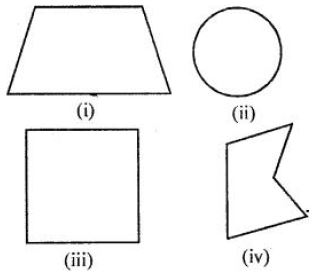
In simple words: A closed shape is a flat drawing where the boundary lines go all the way around without any breaks.
Exam Tip: Remember that a closed figure can be made of straight lines, curves, or both, as long as it has no openings.
Question 2. The interior of a figure is called region of the figure. Is this statement true ?
Answer: No. The region of a closed figure is the interior area combined with its surrounding boundary line.
In simple words: The region means the entire inside space plus the outline of the shape.
Exam Tip: For definitions, make sure to state that the region is the union of the interior and the boundary.
Question 3. Find the perimeter of each of the following closed figures :
Answer:
(i) To find the perimeter of the given figure, we add the lengths of all its outer sides: \( \text{Perimeter} = AB + BE + EF + FH + HG + GD + DC + CA \)
\( \text{Perimeter} = 15\text{ cm} + 25\text{ cm} + 10\text{ cm} + 5\text{ cm} + 15\text{ cm} + 25\text{ cm} + 10\text{ cm} + 5\text{ cm} \)
\( \text{Perimeter} = 110\text{ cm} \)
(ii) To find the perimeter of this figure, we sum up all its outer boundaries: \( \text{Perimeter} = AB + BF + FE + EH + HG + GD + DC + CA \)
\( \text{Perimeter} = 20\text{ cm} + 4\text{ cm} + 8\text{ cm} + 20\text{ cm} + 4\text{ cm} + 20\text{ cm} + 8\text{ cm} + 4\text{ cm} \)
\( \text{Perimeter} = 88\text{ cm} \)
In simple words: To find the perimeter, just add up the lengths of all the outer lines of the shape.
Exam Tip: Be careful not to miss any side when adding them up. Trace the boundary with your pencil to make sure you count every single segment.
Question 4. Find the perimeter of a rectangle whose:
(i) length = 40 cm and breadth = 35 cm
(ii) length = 10 m and breadth = 8 m
(iii) length = 8 m and breadth = 80 cm
(iv) length = 3.6 m and breadth = 2.4 m
Answer:
(i) Given: length = 40 cm, breadth = 35 cm
Using the formula for the perimeter of a rectangle:
\( \text{Perimeter} = 2 \times (\text{length} + \text{breadth}) \)
\( \text{Perimeter} = 2 \times (40\text{ cm} + 35\text{ cm}) \)
\( \text{Perimeter} = 2 \times 75\text{ cm} = 150\text{ cm} = 1.5\text{ m} \)
(ii) Given: length = 10 m, breadth = 8 m
\( \text{Perimeter} = 2 \times (\text{length} + \text{breadth}) \)
\( \text{Perimeter} = 2 \times (10\text{ m} + 8\text{ m}) \)
\( \text{Perimeter} = 2 \times 18\text{ m} = 36\text{ m} \)
(iii) Given: length = 8 m, breadth = 80 cm
First, convert breadth into meters: \( 80\text{ cm} = \frac{80}{100}\text{ m} = 0.8\text{ m} \)
\( \text{Perimeter} = 2 \times (\text{length} + \text{breadth}) \)
\( \text{Perimeter} = 2 \times (8\text{ m} + 0.8\text{ m}) \)
\( \text{Perimeter} = 2 \times 8.8\text{ m} = 17.6\text{ m} \)
(iv) Given: length = 3.6 m, breadth = 2.4 m
\( \text{Perimeter} = 2 \times (\text{length} + \text{breadth}) \)
\( \text{Perimeter} = 2 \times (3.6\text{ m} + 2.4\text{ m}) \)
\( \text{Perimeter} = 2 \times 6\text{ m} = 12\text{ m} \)
In simple words: To find the perimeter of a rectangle, add the length and breadth together, and then multiply the result by 2. Always make sure both numbers are in the same unit first.
Exam Tip: Never add meters and centimeters directly. Always convert them to the same unit before starting your calculation to avoid losing easy marks.
Question 5. If P denotes perimeter of a rectangle, l denotes its length and b denotes its breadth, find :
(i) l, if P = 38cm and b = 7cm
(ii) b, if P = 3.2m and l = 100 cm
(iii) P, if l = 2 m and b = 75cm
Answer:
(i) We know that:
\( l = \frac{P}{2} - b \)
Substituting the values:
\( l = \frac{38}{2} - 7 \)
\( l = 19 - 7 = 12\text{ cm} \)
(ii) First, convert length to meters: \( l = 100\text{ cm} = 1\text{ m} \)
We know that:
\( b = \frac{P}{2} - l \)
Substituting the values:
\( b = \frac{3.2}{2} - 1 \)
\( b = 1.6 - 1 = 0.6\text{ m} \) (or \( 60\text{ cm} \))
(iii) First, convert breadth to meters: \( b = 75\text{ cm} = 0.75\text{ m} \)
We know that:
\( P = 2 \times (l + b) \)
Substituting the values:
\( P = 2 \times (2 + 0.75) \)
\( P = 2 \times 2.75 = 5.5\text{ m} \)
In simple words: You can find a missing side of a rectangle by dividing the perimeter by 2 and then subtracting the side you already know.
Exam Tip: Clearly write down the formula \( l = \frac{P}{2} - b \) or \( b = \frac{P}{2} - l \) before substituting values to get step-wise marks.
Question 6. Find the perimeter of a square whose each side is 1.6 m.
Answer: Given: side of the square = 1.6 m
The formula for the perimeter of a square is:
\( \text{Perimeter} = 4 \times \text{side} \)
\( \text{Perimeter} = 4 \times 1.6\text{ m} = 6.4\text{ m} \)
In simple words: Since a square has four equal sides, you just multiply the length of one side by 4 to get the total perimeter.
Exam Tip: Always state the formula \( \text{Perimeter} = 4 \times \text{side} \) and include the correct unit (m) in your final answer.
Question 7. Find the side of the square whose perimeter is 5 m.
Answer: Given: perimeter of the square = 5 m
The formula to find the side of a square from its perimeter is:
\( \text{Side} = \frac{\text{Perimeter}}{4} \)
\( \text{Side} = \frac{5}{4}\text{ m} = 1.25\text{ m} \)
In simple words: To find the side of a square when you know the total boundary, just divide the perimeter by 4.
Exam Tip: Don't leave your answer as a fraction like \( \frac{5}{4} \). Convert it into a clean decimal (1.25 m) for full marks.
Question 8. A square field has each side 70 m whereas a rectangular field has length = 50 m and breadth = 40 m. Which of the two fields has greater perimeter and by how much?
Answer: First, let us find the perimeter of the square field:
\( \text{Perimeter of square} = 4 \times \text{side} = 4 \times 70\text{ m} = 280\text{ m} \)
Next, let us calculate the perimeter of the rectangular field:
\( \text{Perimeter of rectangle} = 2 \times (\text{length} + \text{breadth}) \)
\( \text{Perimeter of rectangle} = 2 \times (50\text{ m} + 40\text{ m}) = 2 \times 90\text{ m} = 180\text{ m} \)
Comparing the two values:
\( 280\text{ m} > 180\text{ m} \)
So, the square field has a larger perimeter.
The difference between them is:
\( 280\text{ m} - 180\text{ m} = 100\text{ m} \)
Thus, the square field's perimeter is greater by 100 m.
In simple words: Find the boundary length of both shapes. Then, subtract the smaller number from the larger one to see which is bigger and by how much.
Exam Tip: Write down final concluding statements clearly, specifying both "which shape" has the larger perimeter and the exact difference (100 m).
Question 9. A rectangular field has length = 160m and breadth = 120 m. Find :
(i) the perimeter of the field.
(ii) the length of fence required to enclose the field.
(iii) the cost of fencing the field at the rate of Rs. 80 per metre.
Answer:
(i) Given: length = 160 m, breadth = 120 m
\( \text{Perimeter} = 2 \times (\text{length} + \text{breadth}) \)
\( \text{Perimeter} = 2 \times (160\text{ m} + 120\text{ m}) \)
\( \text{Perimeter} = 2 \times 280\text{ m} = 560\text{ m} \)
(ii) The length of fence needed to cover the field is equal to its total perimeter:
\( \text{Length of fence} = 560\text{ m} \)
(iii) Given: rate of fencing = Rs. 80 per meter
\( \text{Total cost} = \text{Length of fence} \times \text{Rate} \)
\( \text{Total cost} = 560\text{ m} \times \text{Rs. } 80 = \text{Rs. } 44,800 \)
In simple words: The length of fencing needed is just the perimeter of the field. To find the cost, multiply this total length by the price for one meter.
Exam Tip: Remember that "length of fence" always means perimeter. Use Rs. as the unit for cost calculations.
Question 10. Each side of a square plot of land is 55 m. Find the cost of fencing the plot at the rate of Rs. 32 per metre.
Answer: Given: side of the square plot = 55 m
First, let us find the perimeter of the square plot:
\( \text{Perimeter} = 4 \times \text{side} = 4 \times 55\text{ m} = 220\text{ m} \)
Thus, the length of fencing needed is 220 m.
Given: rate of fencing = Rs. 32 per meter
\( \text{Total cost} = \text{Perimeter} \times \text{Rate} \)
\( \text{Total cost} = 220 \times 32 = \text{Rs. } 7,040 \)
In simple words: Find the distance around the square plot by multiplying the side by 4. Then, multiply this total distance by Rs. 32 to get the total cost.
Exam Tip: Be careful with basic multiplication. Double-check your calculation for \( 220 \times 32 \) to avoid calculation errors.
Question 11. Each side of a square field is 70 m. How much distance will a boy walk in order to make ?
(i) one complete round of this field ?
(ii) 8 complete rounds of this field ?
Answer:
(i) The distance covered in one complete round is equal to the perimeter of the square field:
\( \text{Perimeter} = 4 \times \text{side} = 4 \times 70\text{ m} = 280\text{ m} \)
So, the boy walks 280 m in one round.
(ii) The distance covered in 8 complete rounds is:
\( \text{Distance in 8 rounds} = 8 \times \text{Perimeter} \)
\( \text{Distance in 8 rounds} = 8 \times 280\text{ m} = 2240\text{ m} \)
In simple words: Going around the field once is the perimeter. To find the distance for 8 rounds, just multiply that single-round distance by 8.
Exam Tip: Clearly show the steps for both parts separately and state the units (meters) in your answers.
Question 12. A school playground is rectangular in shape with length = 120 m and breadth = 90 m. Some school boys run along the boundary of the play-ground and make 15 complete rounds in 45 minutes. How much distance they run during this period.
Answer: Given: length of the ground = 120 m, breadth = 90 m
First, let us find the perimeter of the rectangular playground:
\( \text{Perimeter} = 2 \times (\text{length} + \text{breadth}) \)
\( \text{Perimeter} = 2 \times (120\text{ m} + 90\text{ m}) = 2 \times 210\text{ m} = 420\text{ m} \)
This means the boys cover 420 m in one single round.
Since they complete 15 rounds:
\( \text{Total distance covered} = 15 \times \text{Perimeter} \)
\( \text{Total distance covered} = 15 \times 420\text{ m} = 6300\text{ m} \)
In simple words: Find the distance around the ground once. Then, multiply that number by 15 since they ran 15 rounds in total.
Exam Tip: The time given (45 minutes) is extra information and is not needed to solve the problem. Do not get confused by it.
Question 13. Mohit makes 8 full rounds of a rectangular field with length = 120 m and breadth = 75 m. John makes 10 full rounds of a square field with each side 100 m. Find who covers larger distance and by how much?
Answer: Let us calculate the distance covered by Mohit first:
For the rectangular field, length = 120 m and breadth = 75 m.
\( \text{Perimeter} = 2 \times (\text{length} + \text{breadth}) = 2 \times (120\text{ m} + 75\text{ m}) = 2 \times 195\text{ m} = 390\text{ m} \)
Since Mohit runs 8 rounds:
\( \text{Distance covered by Mohit} = 8 \times 390\text{ m} = 3120\text{ m} \)
Now, let us calculate the distance covered by John:
For the square field, side = 100 m.
\( \text{Perimeter} = 4 \times \text{side} = 4 \times 100\text{ m} = 400\text{ m} \)
Since John runs 10 rounds:
\( \text{Distance covered by John} = 10 \times 400\text{ m} = 4000\text{ m} \)
Comparing the two distances:
John covers more distance because \( 4000\text{ m} > 3120\text{ m} \).
The difference is:
\( 4000\text{ m} - 3120\text{ m} = 880\text{ m} \)
So, John covers a larger distance by 880 m.
In simple words: Find the total distance both boys ran by multiplying their field's perimeter by their number of rounds. Then compare the two results to see who ran further.
Exam Tip: Write down the separate calculations for both Mohit and John clearly, so the examiner can follow your steps easily.
Question 14. The length of a rectangle is twice of its breadth. If its perimeter is 60 cm, find its length.
Answer: Let the breadth of the rectangle be \( x\text{ cm} \).
Therefore, the length will be \( 2x\text{ cm} \).
The formula for perimeter is:
\( \text{Perimeter} = 2 \times (\text{length} + \text{breadth}) \)
Given that the perimeter is 60 cm:
\( 60 = 2 \times (2x + x) \)
\( 60 = 2 \times 3x \)
\( 60 = 6x \)
\( x = \frac{60}{6} = 10\text{ cm} \)
So, the breadth is 10 cm.
The length is:
\( \text{Length} = 2x = 2 \times 10 = 20\text{ cm} \)
In simple words: Since length is twice the breadth, use algebra. Set breadth as x, so length is 2x. Add them together, multiply by 2, and set it equal to 60 to solve for x.
Exam Tip: Always read the question carefully at the end to make sure you answer what was asked. The question asks for "length", not "breadth" or "x", so do not stop at \( x = 10 \).
Question 15. Find the perimeter of :
(i) an equilateral triangle of side 9.8 cm.
(ii) an isosceles triangle with each equal side = 13 cm and the third side = 10 cm.
(iii) a regular pentagon of side 8.2 cm.
(iv) a regular hexagon of side 6.5 cm.
Answer:
(i) For an equilateral triangle, all three sides are equal:
\( \text{Perimeter} = 3 \times \text{side} = 3 \times 9.8\text{ cm} = 29.4\text{ cm} \)
(ii) For an isosceles triangle, two sides are equal:
\( \text{Perimeter} = 13\text{ cm} + 13\text{ cm} + 10\text{ cm} = 36\text{ cm} \)
(iii) A regular pentagon has 5 equal sides:
\( \text{Perimeter} = 5 \times \text{side} = 5 \times 8.2\text{ cm} = 41\text{ cm} \)
(iv) A regular hexagon has 6 equal sides:
\( \text{Perimeter} = 6 \times \text{side} = 6 \times 6.5\text{ cm} = 39\text{ cm} \)
In simple words: For any shape with equal sides, you can find the perimeter by multiplying the length of one side by the total number of sides.
Exam Tip: Remember the names of regular polygons: a pentagon has 5 sides and a hexagon has 6 sides. Memorize these to solve such questions quickly.
Question 16. An equilateral triangle and a square has equal perimeter. If side of the triangle is 9.6 cm ; what is the length of the side of the square ?
Answer: Given: side of the equilateral triangle = 9.6 cm
Let us find the perimeter of the triangle first:
\( \text{Perimeter of triangle} = 3 \times \text{side} = 3 \times 9.6\text{ cm} = 28.8\text{ cm} \)
Since the perimeter of the square is equal to the perimeter of the triangle:
\( \text{Perimeter of square} = 28.8\text{ cm} \)
We can find the side of the square using:
\( \text{Side of square} = \frac{\text{Perimeter}}{4} \)
\( \text{Side of square} = \frac{28.8}{4} = 7.2\text{ cm} \)
In simple words: First, find the total perimeter of the triangle. Since the square has the same perimeter, divide that number by 4 to get the square's side length.
Exam Tip: State clearly that the perimeter of the square equals the perimeter of the triangle before doing the division step.
Question 17. A rectangle with length = 18 cm and breadth = 12 cm has same perimeter as that of a regular pentagon. Find the side of the pentagon.
Answer: Given: length of rectangle = 18 cm, breadth = 12 cm
Let us find the perimeter of the rectangle:
\( \text{Perimeter of rectangle} = 2 \times (\text{length} + \text{breadth}) \)
\( \text{Perimeter of rectangle} = 2 \times (18\text{ cm} + 12\text{ cm}) = 2 \times 30\text{ cm} = 60\text{ cm} \)
Since the regular pentagon has the same perimeter:
\( \text{Perimeter of pentagon} = 60\text{ cm} \)
A regular pentagon has 5 equal sides, so:
\( 5 \times \text{side} = 60\text{ cm} \)
\( \text{side} = \frac{60}{5} = 12\text{ cm} \)
In simple words: Calculate the perimeter of the rectangle. Since the pentagon has 5 equal sides and the same perimeter, divide that result by 5 to find one side.
Exam Tip: Remember to write the final answer with proper units (cm) to avoid minor deductions.
Question 18. A regular pentagon of each side 12 cm has same perimeter as that of a regular hexagon. Find the length of each side of the hexagon.
Answer: Given: side of the regular pentagon = 12 cm
Let us calculate the perimeter of the pentagon first:
\( \text{Perimeter of pentagon} = 5 \times \text{side} = 5 \times 12\text{ cm} = 60\text{ cm} \)
Since the regular hexagon has the same perimeter:
\( \text{Perimeter of hexagon} = 60\text{ cm} \)
A regular hexagon has 6 equal sides, so:
\( 6 \times \text{side of hexagon} = 60\text{ cm} \)
\( \text{side of hexagon} = \frac{60}{6} = 10\text{ cm} \)
In simple words: Multiply the pentagon's side by 5 to find its perimeter. Then divide this total by 6 to find the side length of the hexagon.
Exam Tip: Equating perimeters of different shapes is a common exam theme. Solve step-by-step by showing both perimeters explicitly.
Question 19. Each side of a square is 45 cm and a rectangle has length 50 cm. If the perimeters of both (square and rectangle) are same, find the breadth of the rectangle.
Answer: Given: side of the square = 45 cm
First, let us calculate the perimeter of the square:
\( \text{Perimeter of square} = 4 \times \text{side} = 4 \times 45\text{ cm} = 180\text{ cm} \)
Since the rectangle has the same perimeter:
\( \text{Perimeter of rectangle} = 180\text{ cm} \)
We are given that the length of the rectangle is 50 cm. Let its breadth be \( b \).
The formula for the breadth is:
\( b = \frac{\text{Perimeter}}{2} - \text{length} \)
\( b = \frac{180}{2} - 50 \)
\( b = 90 - 50 = 40\text{ cm} \)
In simple words: Find the square's perimeter. Then, divide it by 2 and subtract the rectangle's length to find its breadth.
Exam Tip: You can also use the standard formula \( 2(l + b) = 180 \) and substitute \( l = 50 \) to solve for \( b \). Both methods are perfectly correct.
Question 20. A wire is bent in the form of an equilateral triangle of each side 20 cm. If the same wire is bent in the form of a square, find the side of the square.
Answer: Given: side of the equilateral triangle = 20 cm
The total length of the wire is equal to the perimeter of the triangle:
\( \text{Perimeter of triangle} = 3 \times \text{side} = 3 \times 20\text{ cm} = 60\text{ cm} \)
When the same wire is bent into a square, the perimeter of the square will be equal to the length of the wire:
\( \text{Perimeter of square} = 60\text{ cm} \)
Since a square has 4 equal sides:
\( \text{Side of square} = \frac{\text{Perimeter}}{4} = \frac{60}{4} = 15\text{ cm} \)
In simple words: The total length of the wire does not change. Find its length from the triangle, then divide that length by 4 to get the side of the square.
Exam Tip: Remember that bending a wire into different shapes keeps the perimeter constant. This is a very useful concept in geometry.
Exercise 32(B)
Question 1. Find the area of a rectangle whose :
(i) length = 15 cm breadth = 6.4 cm
(ii) Length = 8.5 m breadth = 5 m
(iii) Length = 3.6 m breadth = 90 cm
(iv) Length = 24 cm breadth =180 mm
Answer:
(i) Given: length = 15 cm, breadth = 6.4 cm
\( \text{Area} = \text{length} \times \text{breadth} \)
\( \text{Area} = 15\text{ cm} \times 6.4\text{ cm} = 96\text{ cm}^2 \)
(ii) Given: length = 8.5 m, breadth = 5 m
\( \text{Area} = \text{length} \times \text{breadth} \)
\( \text{Area} = 8.5\text{ m} \times 5\text{ m} = 42.5\text{ m}^2 \)
(iii) Given: length = 3.6 m, breadth = 90 cm
First, convert the breadth to meters: \( 90\text{ cm} = \frac{90}{100}\text{ m} = 0.9\text{ m} \)
\( \text{Area} = \text{length} \times \text{breadth} \)
\( \text{Area} = 3.6\text{ m} \times 0.9\text{ m} = 3.24\text{ m}^2 \)
(iv) Given: length = 24 cm, breadth = 180 mm
First, convert the breadth to centimeters: \( 180\text{ mm} = \frac{180}{10}\text{ cm} = 18\text{ cm} \)
\( \text{Area} = \text{length} \times \text{breadth} \)
\( \text{Area} = 24\text{ cm} \times 18\text{ cm} = 432\text{ cm}^2 \)
In simple words: To find the area, multiply the length by the breadth. Always convert them to the same units before multiplying.
Exam Tip: Area is always measured in square units (like \( \text{cm}^2 \) or \( \text{m}^2 \)). Never forget to write the square exponent in the unit.
Question 2. Find the area of a square, whose each side is :
(i) 7.2 cm
(ii) 4.5 m
(iii) 4.1 cm
Answer:
(i) Given: side = 7.2 cm
\( \text{Area of square} = \text{side} \times \text{side} \)
\( \text{Area} = 7.2\text{ cm} \times 7.2\text{ cm} = 51.84\text{ cm}^2 \)
(ii) Given: side = 4.5 m
\( \text{Area of square} = \text{side} \times \text{side} \)
\( \text{Area} = 4.5\text{ m} \times 4.5\text{ m} = 20.25\text{ m}^2 \)
(iii) Given: side = 4.1 cm
\( \text{Area of square} = \text{side} \times \text{side} \)
\( \text{Area} = 4.1\text{ cm} \times 4.1\text{ cm} = 16.81\text{ cm}^2 \)
In simple words: To find the area of a square, multiply the length of its side by itself.
Exam Tip: Be precise when multiplying decimals. Make sure to place the decimal point in the correct spot in your final answer.
Question 3. If A denotes area of a rectangle, l represents its length and b represents its breadth, find :
(i) l, if A = 48 cm² and b = 6 cm
(ii) b, if A = 88 m² and l = 8m
Answer:
(i) We know that:
\( l = \frac{A}{b} \)
Substituting the values:
\( l = \frac{48}{6} = 8\text{ cm} \)
(ii) We know that:
\( b = \frac{A}{l} \)
Substituting the values:
\( b = \frac{88}{8} = 11\text{ m} \)
In simple words: To find a missing side of a rectangle when you know the area, just divide the area by the other side.
Exam Tip: Always show the formula \( A = l \times b \) and how you rearrange it to get full conceptual marks.
Question 4. Each side of a square is 3.6 cm; find its
(i) perimeter
(ii) area.
Answer: Given: side of the square = 3.6 cm
(i) To find the perimeter:
\( \text{Perimeter} = 4 \times \text{side} = 4 \times 3.6\text{ cm} = 14.4\text{ cm} \)
(ii) To find the area:
\( \text{Area} = \text{side} \times \text{side} = 3.6\text{ cm} \times 3.6\text{ cm} = 12.96\text{ cm}^2 \)
In simple words: Multiply the side by 4 to get the perimeter. Multiply the side by itself to get the area.
Exam Tip: Note the difference between the units: perimeter is in cm, while area is in \( \text{cm}^2 \). Putting the wrong units can cost marks.
Question 5. The perimeter of a square is 60 m, find :
(i) its each side and its area
(ii) its new area obtained on increasing
(iii) each of its sides by 2 m.
Answer:
(i) Given: perimeter of the square = 60 m
\( \text{Side of square} = \frac{\text{Perimeter}}{4} = \frac{60}{4} = 15\text{ m} \)
\( \text{Area of square} = \text{side} \times \text{side} = 15\text{ m} \times 15\text{ m} = 225\text{ m}^2 \)
(ii) and (iii) If each side is increased by 2 m:
\( \text{New side} = 15\text{ m} + 2\text{ m} = 17\text{ m} \)
\( \text{New area} = \text{New side} \times \text{New side} = 17\text{ m} \times 17\text{ m} = 289\text{ m}^2 \)
In simple words: First, divide the perimeter by 4 to find the original side, and multiply it by itself to find the area. Then, add 2 m to the side to get the new side, and multiply it by itself to get the new area.
Exam Tip: When calculating the new area, make sure to add 2 m to the side first, and then square it. Do not add 2 to the area directly!
Question 6. Each side of a square is 7 m. If its each side be increased by 3 m, what will be the increase in its area.
Answer: Given: original side of the square = 7 m
First, let us find the original area:
\( \text{Original area} = 7\text{ m} \times 7\text{ m} = 49\text{ m}^2 \)
Now, the side is increased by 3 m:
\( \text{New side} = 7\text{ m} + 3\text{ m} = 10\text{ m} \)
\( \text{New area} = 10\text{ m} \times 10\text{ m} = 100\text{ m}^2 \)
Let us find the increase in area:
\( \text{Increase in area} = \text{New area} - \text{Original area} \)
\( \text{Increase in area} = 100\text{ m}^2 - 49\text{ m}^2 = 51\text{ m}^2 \)
In simple words: Find the area before and after adding 3 m to the side. Then subtract the old area from the new area to see how much it grew.
Exam Tip: Be sure to write "Increase in area" at the final step, as finding only the new area is incomplete.
Question 7. The perimeter of a square field is numerically equal to its area. Find each side of the square.
Answer: Let the side of the square be \( a \) units.
According to the question, the numerical value of its perimeter is equal to its area:
\( 4a = a^2 \)
Dividing both sides by \( a \) (since side \( a \neq 0 \)):
\( 4 = a \)
Thus, each side of the square is 4 units.
In simple words: Write out the formula for perimeter (4 times the side) and area (side times side). Set them equal to each other, and you will see that the side must be 4.
Exam Tip: Since no specific unit of length (like m or cm) is mentioned in the question, write "units" as your unit in the final answer.
Question 8. A rectangular piece of paper has area = 24 cm² and length = 5 cm. Find its perimeter.
Answer: Given: area = 24 \( \text{cm}^2 \), length = 5 cm
First, let us find the breadth of the rectangle:
\( \text{Breadth} = \frac{\text{Area}}{\text{Length}} = \frac{24}{5} = 4.8\text{ cm} \)
Now, we can find the perimeter:
\( \text{Perimeter} = 2 \times (\text{length} + \text{breadth}) \)
\( \text{Perimeter} = 2 \times (5\text{ cm} + 4.8\text{ cm}) \)
\( \text{Perimeter} = 2 \times 9.8\text{ cm} = 19.6\text{ cm} \)
In simple words: Use the area and length to find the breadth first. Once you have the breadth, use the perimeter formula to get the final answer.
Exam Tip: Do not round off the breadth \( 4.8\text{ cm} \) to a whole number. Carry the exact decimal through to the perimeter calculation.
Question 9. Find the perimeter of a rectangle whose area = 2600 m² and breadth = 50 m.
Answer: Given: area = 2600 \( \text{m}^2 \), breadth = 50 m
First, let us calculate the length of the rectangle:
\( \text{Length} = \frac{\text{Area}}{\text{Breadth}} = \frac{2600}{50} = 52\text{ m} \)
Now, we can calculate its perimeter:
\( \text{Perimeter} = 2 \times (\text{length} + \text{breadth}) \)
\( \text{Perimeter} = 2 \times (52\text{ m} + 50\text{ m}) \)
\( \text{Perimeter} = 2 \times 102 = 204\text{ m} \)
In simple words: Divide the area by the breadth to get the length. Then, add the length and breadth and multiply by 2 to get the perimeter.
Exam Tip: Keep your calculations neat. Canceling the zeros when dividing \( \frac{2600}{50} \) makes the division much easier.
Question 10. What will happen to the area of a rectangle, if its length and breadth both are trebled?
Answer: Let the original length of the rectangle be \( l \) and the original breadth be \( b \).
Therefore, the original area is:
\( A_1 = l \times b \)
If both dimensions are trebled:
\( \text{New length} = 3l \)
\( \text{New breadth} = 3b \)
The new area will be:
\( A_2 = \text{New length} \times \text{New breadth} = 3l \times 3b = 9 \times (l \times b) = 9 A_1 \)
Hence, the area of the new rectangle will become 9 times the original area.
In simple words: Since both the length and the width are multiplied by 3, the total area is multiplied by \( 3 \times 3 \), which makes it 9 times larger.
Exam Tip: Use variables like \( l \) and \( b \) to prove this mathematically rather than just guessing or using specific numbers.
Question 11. Length of a rectangle is 30 m and its breadth is 20 m. Find the increase in its area if its length is increased by 10 m and its breadth is doubled.
Answer: Given: original length = 30 m, original breadth = 20 m
Let us find the original area:
\( \text{Original area} = 30\text{ m} \times 20\text{ m} = 600\text{ m}^2 \)
Now, let us find the new dimensions:
\( \text{New length} = 30\text{ m} + 10\text{ m} = 40\text{ m} \)
\( \text{New breadth} = 20\text{ m} \times 2 = 40\text{ m} \)
Let us calculate the new area:
\( \text{New area} = 40\text{ m} \times 40\text{ m} = 1600\text{ m}^2 \)
Now, we find the increase in area:
\( \text{Increase in area} = 1600\text{ m}^2 - 600\text{ m}^2 = 1000\text{ m}^2 \)
In simple words: Find the area at the start. Then, calculate the new dimensions, find the new area, and subtract the old area from it.
Exam Tip: Pay close attention to the wording: "increased by 10 m" means addition, while "doubled" means multiplication by 2.
Question 12. The side of a square field is 16 m. What will be increase in its area, if:
(i) each of its sides is increased by 4 m
(ii) each of its sides is doubled.
Answer: Given: original side of the square = 16 m
First, find the original area:
\( \text{Original area} = 16\text{ m} \times 16\text{ m} = 256\text{ m}^2 \)
(i) If each side is increased by 4 m:
\( \text{New side} = 16\text{ m} + 4\text{ m} = 20\text{ m} \)
\( \text{New area} = 20\text{ m} \times 20\text{ m} = 400\text{ m}^2 \)
\( \text{Increase in area} = 400\text{ m}^2 - 256\text{ m}^2 = 144\text{ m}^2 \)
(ii) If each side is doubled:
\( \text{New side} = 16\text{ m} \times 2 = 32\text{ m} \)
\( \text{New area} = 32\text{ m} \times 32\text{ m} = 1024\text{ m}^2 \)
\( \text{Increase in area} = 1024\text{ m}^2 - 256\text{ m}^2 = 768\text{ m}^2 \)
In simple words: For both parts, find the new side length and calculate the new area. Then, subtract the original area of 256 square meters to find the growth.
Exam Tip: Keep your calculations distinct for part (i) and part (ii). Always subtract the original area (256) to find the "increase".
Question 13. Each rectangular tile is 40 cm long and 30 cm wide. How many tiles will be required to cover the floor of a room with length = 4.8 m and breadth = 2.4 m.
Answer: Let us find the area of the floor and the tiles in square meters:
\( \text{Area of the floor} = 4.8\text{ m} \times 2.4\text{ m} = 11.52\text{ m}^2 \)
\( \text{Area of each tile} = 0.4\text{ m} \times 0.3\text{ m} = 0.12\text{ m}^2 \)
The number of tiles needed is:
\( \text{Number of tiles} = \frac{\text{Area of the floor}}{\text{Area of each tile}} \)
\( \text{Number of tiles} = \frac{11.52}{0.12} = 96 \)
In simple words: Convert the tile's size to meters, then find its area. Divide the floor's total area by the tile's area to find how many tiles you need.
Exam Tip: To avoid calculation errors, you can work in centimeters instead of meters. Multiply the room dimensions by 100 first, find both areas in \( \text{cm}^2 \), and then divide.
Question 14. Each side of a square tile is 60 cm. How many tiles will be required to cover the floor of a hall with length = 50 m and breadth = 36 m.
Answer: First, let us convert the side of the square tile into meters:
\( \text{Side of tile} = 60\text{ cm} = 0.6\text{ m} \)
\( \text{Area of each square tile} = 0.6\text{ m} \times 0.6\text{ m} = 0.36\text{ m}^2 \)
Now, let us calculate the area of the hall's floor:
\( \text{Area of the floor} = 50\text{ m} \times 36\text{ m} = 1800\text{ m}^2 \)
The number of tiles required is:
\( \text{Number of tiles} = \frac{\text{Area of the floor}}{\text{Area of each tile}} \)
\( \text{Number of tiles} = \frac{1800}{0.36} = 5000 \)
In simple words: Convert the tile's size to meters, then find its area. Divide the floor's total area by the tile's area to find how many tiles you need.
Exam Tip: Be comfortable with dividing by decimals. You can rewrite \( \frac{1800}{0.36} \) as \( \frac{180000}{36} \) to make the division simple.
Question 15. The perimeter of a square plot = 360 m. Find :
(i) its area.
(ii) cost of fencing its boundary at the rate of Rs. 40 per metre.
(iii) cost of levelling the plot at Rs. 60 per square metre.
Answer: Given: perimeter of the square plot = 360 m
(i) First, let us find the side of the square plot:
\( \text{Side of square} = \frac{\text{Perimeter}}{4} = \frac{360}{4} = 90\text{ m} \)
Now, find its area:
\( \text{Area} = 90\text{ m} \times 90\text{ m} = 8100\text{ m}^2 \)
(ii) Fencing is done along the boundary, which is the perimeter of 360 m:
\( \text{Cost of fencing} = 360\text{ m} \times \text{Rs. } 40 = \text{Rs. } 14,400 \)
(iii) Levelling is done on the flat surface, which is the area of 8100 \( \text{m}^2 \):
\( \text{Cost of levelling} = 8100\text{ m}^2 \times \text{Rs. } 60 = \text{Rs. } 4,86,000 \)
In simple words: Remember that fencing is put around the boundary (perimeter), while levelling is done across the whole flat ground (area).
Exam Tip: Never confuse area and perimeter when calculating costs. Fencing always uses the perimeter, and levelling/flooring always uses the area.
Question 16. The perimeter of a rectangular field is 500 m and its length = 150 m. Find:
(i) its breadth,
(ii) its area.
(iii) cost of ploughing the field at the rate of Rs. 1.20 per square metre.
Answer: Given: perimeter = 500 m, length = 150 m
(i) We know that:
\( \text{Breadth} = \frac{\text{Perimeter}}{2} - \text{length} \)
\( \text{Breadth} = \frac{500}{2} - 150 \)
\( \text{Breadth} = 250 - 150 = 100\text{ m} \)
(ii) To find the area of the rectangular field:
\( \text{Area} = \text{length} \times \text{breadth} \)
\( \text{Area} = 150\text{ m} \times 100\text{ m} = 15,000\text{ m}^2 \)
(iii) Given: rate of ploughing = Rs. 1.20 per square meter
\( \text{Cost of ploughing} = \text{Area} \times \text{Rate} \)
\( \text{Cost of ploughing} = 15000\text{ m}^2 \times \text{Rs. } 1.20 = \text{Rs. } 18,000 \)
In simple words: First find the breadth using the perimeter. Then find the area by multiplying length and breadth. Finally, multiply the area by Rs. 1.20 to find the cost of ploughing.
Exam Tip: Show every step of your work clearly, especially the conversion from perimeter to breadth, as each step carries marks.
Question 17. The cost of flooring a hall of Rs. 64 per square metre is Rs. 2,048. If the breadth of the hall is 5m, find :
(i) its length.
(ii) its perimeter.
(iii) cost of fixing a border of very small width along its boundary at the rate of Rs. 60 per square metre.
Answer:
Given:
\( \text{Total cost of flooring} = \text{Rs. } 2,048 \)
\( \text{Rate of flooring} = \text{Rs. } 64\text{ per square meter} \)
We can find the area of the hall first:
\( \text{Area of the hall} = \frac{\text{Total cost}}{\text{Rate}} = \frac{2048}{64} = 32\text{ m}^2 \)
(i) We know that \( \text{Area} = \text{length} \times \text{breadth} \).
Given breadth = 5 m:
\( \text{length} \times 5 = 32 \)
\( \text{length} = \frac{32}{5} = 6.4\text{ m} \)
(ii) Now, let us calculate the perimeter of the hall:
\( \text{Perimeter} = 2 \times (\text{length} + \text{breadth}) \)
\( \text{Perimeter} = 2 \times (6.4\text{ m} + 5\text{ m}) = 2 \times 11.4\text{ m} = 22.8\text{ m} \)
(iii) Given rate of fixing the border = Rs. 60 per square meter:
\( \text{Cost of fixing the border} = \text{Area of the hall} \times \text{Rate} \)
\( \text{Cost of fixing the border} = 32 \times 60 = \text{Rs. } 1,920 \)
In simple words: Use the total flooring cost to find the room's area. Then, use the breadth to find the length and perimeter. Finally, calculate the border cost as given.
Exam Tip: Be careful with the units in this multi-step word problem. Keep track of when you are dealing with area (\( \text{m}^2 \)) versus length (m).
Question 18. The length of a rectangle is three times its breadth. If the area of the rectangle is 1875 sq. cm, find its perimeter.
Answer: Let the breadth of the rectangle be \( x\text{ cm} \).
According to the question, the length is three times the breadth, so:
\( \text{Length} = 3x\text{ cm} \)
We know that:
\( \text{Area} = \text{length} \times \text{breadth} \)
Given that the area is 1875 sq. cm:
\( 1875 = 3x \times x \)
\( 1875 = 3x^2 \)
\( x^2 = \frac{1875}{3} = 625 \)
\( x = \sqrt{625} = 25\text{ cm} \)
So, the breadth of the rectangle is 25 cm.
The length of the rectangle is:
\( \text{Length} = 3x = 3 \times 25 = 75\text{ cm} \)
Now, let us calculate the perimeter:
\( \text{Perimeter} = 2 \times (\text{length} + \text{breadth}) \)
\( \text{Perimeter} = 2 \times (75\text{ cm} + 25\text{ cm}) \)
\( \text{Perimeter} = 2 \times 100\text{ cm} = 200\text{ cm} \)
In simple words: Use algebra to set breadth as x and length as 3x. Multiply them to get the area and solve for x. Once you find the sides, add them and multiply by 2 to get the perimeter.
Exam Tip: Knowing squares of numbers up to 30 helps a lot. Recognizing that \( 25^2 = 625 \) saves valuable time during exams.
Free study material for Mathematics
ICSE Selina Concise Solutions Class 6 Mathematics Chapter 32 Perimeter and Area of Plane Figures
Students can now access the detailed Selina Concise Solutions for Chapter 32 Perimeter and Area of Plane Figures on our portal. These solutions have been carefully prepared as per latest ICSE Class 6 syllabus. Each solution given above has been updated based on the current year pattern to ensure Class 6 students have the most updated Mathematics content.
Master Selina Concise Textbook Questions
Our subject experts have provided detailed explanations for all the questions found in the Selina Concise textbook for Class 6 Mathematics. We have focussed on making the concepts easy for you in Chapter 32 Perimeter and Area of Plane Figures so that students can understand the concepts behind every answer. For all numerical problems and theoretical concepts these solutions will help in strengthening your analytical skill required for the ICSE examinations.
Complete Mathematics Exam Preparation
By using these Selina Concise Class 6 solutions, you can enhance your learning and identify areas that need more attention. We recommend solving the Mathematics Questions from the textbook first and then use our teacher-verified answers. For a proper revision of Chapter 32 Perimeter and Area of Plane Figures, students should also also check our Revision Notes and Sample Papers available on studiestoday.com.
FAQs
You can download the verified Selina Concise solutions for Chapter 32 Perimeter and Area of Plane Figures on StudiesToday.com. Our teachers have prepared answers for Class 6 Mathematics as per 2026-27 ICSE academic session.
Yes, our solutions for Chapter 32 Perimeter and Area of Plane Figures are designed as per new 2026 ICSE standards. 40% competency-based questions required for Class 6, are included to help students understand application-based logic behind every Mathematics answer.
Yes, every exercise in Chapter 32 Perimeter and Area of Plane Figures from the Selina Concise textbook has been solved step-by-step. Class 6 students will learn Mathematics conceots before their ICSE exams.
Yes, follow structured format of these Selina Concise solutions for Chapter 32 Perimeter and Area of Plane Figures to get full 20% internal assessment marks and use Class 6 Mathematics projects and viva preparation as per ICSE 2026 guidelines.