

ICSE Solutions Selina Concise Class 7 Mathematics Chapter 18 Recognition of Solids Representing 3 D in 2 D have been provided below and is also available in Pdf for free download. The Selina Concise ICSE solutions for Class 7 Mathematics have been prepared as per the latest syllabus and ICSE books and examination pattern suggested in Class 7. Questions given in ICSE Selina Concise book for Class 7 Mathematics are an important part of exams for Class 7 Mathematics and if answered properly can help you to get higher marks. Refer to more Chapter-wise answers for ICSE Class 7 Mathematics and also download more latest study material for all subjects. Chapter 18 Recognition of Solids Representing 3 D in 2 D is an important topic in Class 7, please refer to answers provided below to help you score better in exams
Selina Concise Chapter 18 Recognition of Solids Representing 3 D in 2 D Class 7 Mathematics ICSE Solutions
Class 7 Mathematics students should refer to the following ICSE questions with answers for Chapter 18 Recognition of Solids Representing 3 D in 2 D in Class 7. These ICSE Solutions with answers for Class 7 Mathematics will come in exams and help you to score good marks
Chapter 18 Recognition of Solids Representing 3 D in 2 D Selina Concise ICSE Solutions Class 7 Mathematics
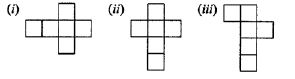
Question 1. Identify the nets which can be used to form cubes

Answer: Out of the given options, only (ii), (iii), and (v) can form a cube when folded.
In simple words: A net is a flat shape that you can fold up to make a 3D box. Only shapes (ii), (iii), and (v) can fold perfectly into a closed box with six sides.
Exam Tip: Remember that a cube net must always have exactly six squares. To check if a net works, try to mentally fold it and make sure no two squares overlap.
Question 2. Draw at least three different nets for making cube.
Answer: Here are three different flat nets that can be folded to form a cube:
In simple words: There are multiple ways to lay out six connected squares so that they can be folded into a perfect cube without any overlapping faces.
Exam Tip: Try to remember at least two or three common layouts of a cube net, as drawing different nets is a frequent exam question.
Question 3. The figure, given below, shows shadows of some 3D objects, when seen under the lamp of an overhead projector : In each case, name the object.
(i) A square
(ii) A rectangle
(iii) A triangle
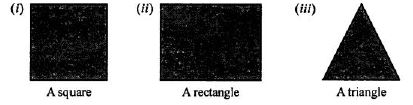
Answer: The three-dimensional shapes corresponding to the given shadows are:
(i) A Cube
(ii) A Cuboid
(iii) A Cone
In simple words: When a light is positioned above these solid figures, the 2D shapes of their shadows are a square, a rectangle, and a triangle respectively.
Exam Tip: A single 3D object can cast different shadows depending on the angle of the light source. For example, a cylinder can cast a circular shadow from one end or a rectangular shadow from the side.
Question 4. Using Euler’s formula, find the values of a, b, c and d.
| Faces | \( a \) | 5 | 20 | 6 |
|---|---|---|---|---|
| Vertices | 6 | \( b \) | 12 | \( d \) |
| Edges | 12 | 9 | \( c \) | 12 |
Answer: According to Euler's formula, the relation between the number of faces (\( F \)), vertices (\( V \)), and edges (\( E \)) of a solid is:
\( F + V - E = 2 \)
Let us solve for each missing value:
(i) For the first column: \( F = a \), \( V = 6 \), and \( E = 12 \)
Using Euler's formula:
\( a + 6 - 12 = 2 \)
\( a - 6 = 2 \)
\( a = 2 + 6 = 8 \)
(ii) For the second column: \( F = 5 \), \( V = b \), and \( E = 9 \)
Using Euler's formula:
\( 5 + b - 9 = 2 \)
\( b - 4 = 2 \)
\( b = 2 + 4 = 6 \)
(iii) For the third column: \( F = 20 \), \( V = 12 \), and \( E = c \)
Using Euler's formula:
\( 20 + 12 - c = 2 \)
\( 32 - c = 2 \)
\( c = 32 - 2 = 30 \)
(iv) For the fourth column: \( F = 6 \), \( V = d \), and \( E = 12 \)
Using Euler's formula:
\( 6 + d - 12 = 2 \)
\( d - 6 = 2 \)
\( d = 2 + 6 = 8 \)
So, the values are: \( a = 8 \), \( b = 6 \), \( c = 30 \), and \( d = 8 \).
In simple words: Euler's rule says that adding the number of faces and corners of a solid shape, and then subtracting its straight edges, always equals 2. We use this math rule to calculate each of the missing numbers.
Exam Tip: Always write down the general formula \( F + V - E = 2 \) before substituting the given values to score full steps marks in exams.
Question 5. Dice are cubes with dot or dots on each face. Opposite faces of a die always have a total of seven on them. Below are given two nets to make dice (cube), the numbers inserted in each square indicate the number of dots in it. Insert suitable numbers in each blank so that numbers in opposite faces of the die have a total of seven dots.

Answer: To ensure the opposite faces of each die add up to 7, the missing squares should be filled with numbers as shown below:
(i) In the first net:
- The top-most face with 1 is opposite the bottom-most face with 6 (since \( 1 + 6 = 7 \)).
- The face with 2 is opposite the face with 5 (since \( 2 + 5 = 7 \)).
- The face with 3 is opposite the face with 4 (since \( 3 + 4 = 7 \)).
(ii) In the second net:
- The face with 1 is opposite the face with 6 (since \( 1 + 6 = 7 \)).
- The face with 2 is opposite the face with 5 (since \( 2 + 5 = 7 \)).
- The face with 3 is opposite the face with 4 (since \( 3 + 4 = 7 \)).

In simple words: A real die always has opposite sides adding up to 7. By pairing 1 with 6, 2 with 5, and 3 with 4, we fill in the blanks so that the faces fold into a proper die.
Exam Tip: To find opposite faces in a 1-4-1 net, skip one square in a row. The top and bottom wings will always fold to face each other.
Question 6. The following figures represent nets of some solids. Name the solids
Answer: The solids corresponding to the given nets are:
(i) Cube
(ii) Cuboid
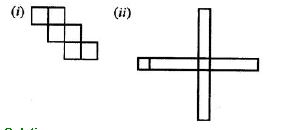
In simple words: The first net has six equal square faces, so folding it creates a cube. The second net has rectangular faces, which fold to form a cuboid.
Exam Tip: Look at the individual shapes making up the net. If all faces are equal squares, it represents a cube. If some or all faces are rectangles, it represents a cuboid.
Question 7. Draw a map of your class room using proper scale and symbols for different objects.
Answer: An illustrative floor plan of a classroom is shown below, drawn using suitable symbols and a clear map key:
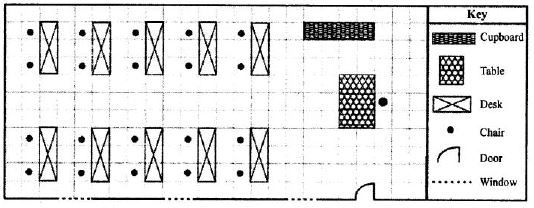
In simple words: This map is a flat, top-down view of a classroom. It uses a key to show where the main door, window panes, cupboard, tables, desks, and student chairs are located.
Exam Tip: When drawing a map, always include a 'Key' or 'Legend' on one side. This is highly valued by examiners as it makes the symbols on your map clear and easy to read.
Question 8. Draw a map of your school compound using proper scale and symbols for various features like play ground, main building, garden, etc.
Answer: A representative layout of a school compound, showing the main school building, playground, garden, and other core areas, is detailed below:
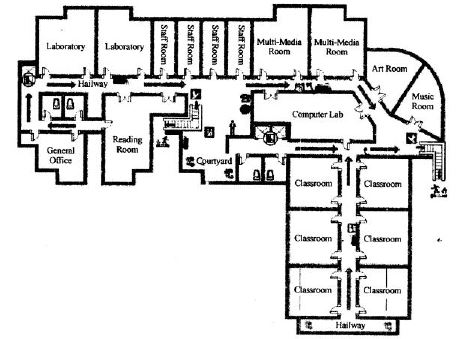
In simple words: This map shows the layout of the entire school campus from above. It has the school building on the left, a large play field on the right, and garden and parking areas at the bottom.
Exam Tip: For complex campus maps, focus on drawing major zones clearly using basic shapes like rectangles, and label each area distinctly to keep the map clean and legible.
Question 9. In the map of India, the distance between two cities is 13.8 cm. Taking scale : 1 cm = 12 km, find the actual distance between these two cities.
Answer: We are given the following values:
- Scale of the map: \( 1\text{ cm} = 12\text{ km} \)
- Distance measured on the map: \( 13.8\text{ cm} \)
To calculate the real-world distance, we multiply the map distance by the scale conversion factor:
\( \text{Actual distance} = 13.8 \times 12\text{ km} \)
\( \text{Actual distance} = 165.6\text{ km} \)
Thus, the actual distance between the two cities is \( 165.6\text{ km} \).
In simple words: On this map, every 1 centimeter stands for 12 kilometers in real life. Since the two cities are 13.8 centimeters apart on the paper, we multiply 13.8 by 12 to find that they are actually 165.6 kilometers apart.
Exam Tip: Always state the formula or ratio used for conversion (e.g., \( \text{Actual Distance} = \text{Map Distance} \times \text{Scale Value} \)) to show your step-by-step calculation clearly.
Free study material for Mathematics
ICSE Selina Concise Solutions Class 7 Mathematics Chapter 18 Recognition of Solids Representing 3 D in 2 D
Students can now access the detailed Selina Concise Solutions for Chapter 18 Recognition of Solids Representing 3 D in 2 D on our portal. These solutions have been carefully prepared as per latest ICSE Class 7 syllabus. Each solution given above has been updated based on the current year pattern to ensure Class 7 students have the most updated Mathematics content.
Master Selina Concise Textbook Questions
Our subject experts have provided detailed explanations for all the questions found in the Selina Concise textbook for Class 7 Mathematics. We have focussed on making the concepts easy for you in Chapter 18 Recognition of Solids Representing 3 D in 2 D so that students can understand the concepts behind every answer. For all numerical problems and theoretical concepts these solutions will help in strengthening your analytical skill required for the ICSE examinations.
Complete Mathematics Exam Preparation
By using these Selina Concise Class 7 solutions, you can enhance your learning and identify areas that need more attention. We recommend solving the Mathematics Questions from the textbook first and then use our teacher-verified answers. For a proper revision of Chapter 18 Recognition of Solids Representing 3 D in 2 D, students should also also check our Revision Notes and Sample Papers available on studiestoday.com.
FAQs
You can download the verified Selina Concise solutions for Chapter 18 Recognition of Solids Representing 3 D in 2 D on StudiesToday.com. Our teachers have prepared answers for Class 7 Mathematics as per 2026-27 ICSE academic session.
Yes, our solutions for Chapter 18 Recognition of Solids Representing 3 D in 2 D are designed as per new 2026 ICSE standards. 40% competency-based questions required for Class 7, are included to help students understand application-based logic behind every Mathematics answer.
Yes, every exercise in Chapter 18 Recognition of Solids Representing 3 D in 2 D from the Selina Concise textbook has been solved step-by-step. Class 7 students will learn Mathematics conceots before their ICSE exams.
Yes, follow structured format of these Selina Concise solutions for Chapter 18 Recognition of Solids Representing 3 D in 2 D to get full 20% internal assessment marks and use Class 7 Mathematics projects and viva preparation as per ICSE 2026 guidelines.