

ICSE Solutions Selina Concise Class 7 Mathematics Chapter 2 Rational Numbers have been provided below and is also available in Pdf for free download. The Selina Concise ICSE solutions for Class 7 Mathematics have been prepared as per the latest syllabus and ICSE books and examination pattern suggested in Class 7. Questions given in ICSE Selina Concise book for Class 7 Mathematics are an important part of exams for Class 7 Mathematics and if answered properly can help you to get higher marks. Refer to more Chapter-wise answers for ICSE Class 7 Mathematics and also download more latest study material for all subjects. Chapter 2 Rational Numbers is an important topic in Class 7, please refer to answers provided below to help you score better in exams
Selina Concise Chapter 2 Rational Numbers Class 7 Mathematics ICSE Solutions
Class 7 Mathematics students should refer to the following ICSE questions with answers for Chapter 2 Rational Numbers in Class 7. These ICSE Solutions with answers for Class 7 Mathematics will come in exams and help you to score good marks
Chapter 2 Rational Numbers Selina Concise ICSE Solutions Class 7 Mathematics
Exercise 2(A)
Question 1. Write down a rational number whose numerator is the largest number of two digits and denominator is the smallest number of four digits.
Answer:
The largest two-digit number is 99.
The smallest four-digit number is 1000.
Using 99 as the numerator and 1000 as the denominator, we get the rational number:
\( \frac{99}{1000} \)
In simple words: Put the biggest two-digit number (99) on top, and the smallest four-digit number (1000) on the bottom to get \( \frac{99}{1000} \).
Exam Tip: Read the question carefully to identify the correct place for the numerator (top) and denominator (bottom).
Question 2. Write the numerator of each of the following rational numbers:
(i) \( \frac{-125}{127} \)
(ii) \( \frac{37}{-137} \)
(iii) \( \frac{-85}{93} \)
(iv) 2
(v) 0
Answer:
(i) The numerator is \( -125 \).
(ii) The numerator is \( 37 \).
(iii) The numerator is \( -85 \).
(iv) Since 2 can be written as \( \frac{2}{1} \), the numerator is 2.
(v) Since 0 can be written as \( \frac{0}{1} \), the numerator is 0.
In simple words: The numerator is the top part of the fraction. If the number is a whole number, that number itself is the numerator.
Exam Tip: Remember that any integer \( a \) can be represented as \( \frac{a}{1} \), meaning the integer itself is the numerator.
Question 3. Write the denominator of each of the following rational numbers:
(i) \( \frac{7}{-15} \)
(ii) \( \frac{-18}{29} \)
(iii) \( \frac{-3}{4} \)
(iv) -7
(v) 0
Answer:
(i) The denominator is \( -15 \).
(ii) The denominator is 29.
(iii) The denominator is 4.
(iv) Since -7 can be written as \( \frac{-7}{1} \), the denominator is 1.
(v) Since 0 can be written as \( \frac{0}{1} \), the denominator is 1.
In simple words: The denominator is the number at the bottom. If there is no bottom number, the denominator is 1.
Exam Tip: A whole number (like 0 or -7) always has an implicit denominator of 1, never 0.
Question 4. Write down a rational number numerator (-5) x (-4) and denominator (28 - 27) x (8 - 5).
Answer:
First, find the value of the numerator:
\( (-5) \times (-4) = 20 \)
Next, find the value of the denominator:
\( (28 - 27) \times (8 - 5) = 1 \times 3 = 3 \)
Combining these, the rational number is:
\( \frac{20}{3} \)
In simple words: Work out the multiplication for the top and bottom separately. The final fraction is \( \frac{20}{3} \).
Exam Tip: Keep track of positive and negative signs. Multiplying two negative numbers always results in a positive number.
Question 5. (i) \( \frac{-15}{1} \) in integer form is ......... .
Answer: \( -15 \)
In simple words: Any number divided by 1 stays the same, so this is just \( -15 \).
Exam Tip: Fractions with a denominator of 1 can be written directly as integers.
Question 5. (ii) \( \frac{23}{-1} \) in integer form is ......... .
Answer: \( -23 \)
In simple words: Dividing a positive number by -1 changes its sign to negative.
Exam Tip: Moving the negative sign to the numerator makes it easy to simplify the fraction to a negative integer.
Question 5. (iii) If \( 18 = \frac{18}{a} \), then \( a = \) ......... .
Answer: 1
In simple words: For a fraction to equal its top number, the bottom number must be 1.
Exam Tip: Cross-multiply to solve the equation: \( 18a = 18 \), which simplifies directly to \( a = 1 \).
Question 5. (iv) If \( -57 = \frac{57}{a} \), then \( a = \) ......... .
Answer: \( -1 \)
In simple words: A positive number divided by a negative number gives a negative result, so \( a \) must be -1.
Exam Tip: Rearrange the equation to \( a = \frac{57}{-57} \), which quickly shows that \( a = -1 \).
Question 6. Separate positive and negative rational numbers from the following :
\( \frac{-3}{5} \), \( \frac{3}{-5} \), \( \frac{-3}{-5} \), \( \frac{3}{5} \), 0, \( \frac{-13}{-3} \), \( \frac{15}{-8} \), \( \frac{-15}{8} \)
Answer:
Positive rational numbers have the same sign on both the numerator and the denominator:
\( \frac{-3}{-5} \) (which equals \( \frac{3}{5} \)), \( \frac{3}{5} \), and \( \frac{-13}{-3} \) (which equals \( \frac{13}{3} \))
Negative rational numbers have opposite signs on the numerator and denominator:
\( \frac{-3}{5} \), \( \frac{3}{-5} \), \( \frac{15}{-8} \), and \( \frac{-15}{8} \)
Note: The number 0 is neither positive nor negative.
In simple words: Fractions with two minus signs or no minus signs are positive. Fractions with only one minus sign are negative. Zero is neutral.
Exam Tip: Double negative signs in a fraction like \( \frac{-a}{-b} \) cancel out to yield a positive rational number.
Question 7. (i) Find three rational numbers equivalent to \( \frac{3}{5} \)
Answer:
Multiply both the numerator and denominator by 2, 3, and 4:
\( \frac{3 \times 2}{5 \times 2} = \frac{6}{10} \)
\( \frac{3 \times 3}{5 \times 3} = \frac{9}{15} \)
\( \frac{3 \times 4}{5 \times 4} = \frac{12}{20} \)
Thus, three equivalent rational numbers are \( \frac{6}{10} \), \( \frac{9}{15} \), and \( \frac{12}{20} \).
In simple words: Multiply the top and bottom of the fraction by the same numbers to find equal fractions.
Exam Tip: To find equivalent rational numbers, multiply or divide the numerator and denominator by any non-zero integer.
Question 7. (ii) Find three rational numbers equivalent to \( \frac{4}{-7} \)
Answer:
Multiply both the numerator and denominator by 2, 3, and 4:
\( \frac{4 \times 2}{-7 \times 2} = \frac{8}{-14} \)
\( \frac{4 \times 3}{-7 \times 3} = \frac{12}{-21} \)
\( \frac{4 \times 4}{-7 \times 4} = \frac{16}{-28} \)
Thus, three equivalent rational numbers are \( \frac{8}{-14} \), \( \frac{12}{-21} \), and \( \frac{16}{-28} \).
In simple words: Multiply top and bottom by 2, 3, and 4 to get three equal fractions.
Exam Tip: Maintain the position of the negative sign in the denominator as given in the problem.
Question 7. (iii) Find three rational numbers equivalent to \( \frac{-5}{9} \)
Answer:
Multiply both the numerator and denominator by 2, 3, and 4:
\( \frac{-5 \times 2}{9 \times 2} = \frac{-10}{18} \)
\( \frac{-5 \times 3}{9 \times 3} = \frac{-15}{27} \)
\( \frac{-5 \times 4}{9 \times 4} = \frac{-20}{36} \)
Thus, three equivalent rational numbers are \( \frac{-10}{18} \), \( \frac{-15}{27} \), and \( \frac{-20}{36} \).
In simple words: Keep the negative sign on top and scale both numbers up.
Exam Tip: Keep the negative sign in the numerator while scaling up the fraction.
Question 7. (iv) Find three rational numbers equivalent to \( \frac{8}{-15} \)
Answer:
Multiply both the numerator and denominator by 2, 3, and 4:
\( \frac{8 \times 2}{-15 \times 2} = \frac{16}{-30} \)
\( \frac{8 \times 3}{-15 \times 3} = \frac{24}{-45} \)
\( \frac{8 \times 4}{-15 \times 4} = \frac{32}{-60} \)
Thus, three equivalent rational numbers are \( \frac{16}{-30} \), \( \frac{24}{-45} \), and \( \frac{32}{-60} \).
In simple words: Multiply the top and bottom by the same numbers to find the new fractions.
Exam Tip: Using small integers like 2, 3, and 4 is the fastest way to compute equivalent rational numbers.
Question 8. (i) -3
Answer: This is a rational number because it can be written in fractional form as \( \frac{-3}{1} \).
In simple words: It is a rational number since we can write it with a bottom number of 1.
Exam Tip: All integers are rational numbers because they can be expressed with a denominator of 1.
Question 8. (ii) 0
Answer: This is a rational number because we can write it as \( \frac{0}{1} \).
In simple words: It is a rational number since we can write it as a fraction with 1 on the bottom.
Exam Tip: Zero is a rational number since its denominator is a non-zero integer.
Question 8. (iii) \( \frac{0}{4} \)
Answer: This is a rational number. The numerator is 0 and the denominator is 4, which is not zero.
In simple words: Having 0 on top is completely fine, so this is a rational number.
Exam Tip: A rational number can have a numerator of zero as long as the denominator is not zero.
Question 8. (iv) \( \frac{8}{0} \)
Answer: This is not a rational number because the denominator is zero.
In simple words: Division by zero is not defined, so this cannot be a rational number.
Exam Tip: By definition, a rational number \( \frac{p}{q} \) must have a denominator \( q \neq 0 \).
Question 8. (v) \( \frac{0}{0} \)
Answer: This is not a rational number because the denominator is zero.
In simple words: Since the bottom number is zero, it cannot be a rational number.
Exam Tip: Any expression with zero in the denominator is mathematically undefined.
Question 9. (i) Express 5 as a rational number with denominator 7
Answer:
Multiply the numerator and denominator of \( \frac{5}{1} \) by 7:
\( \frac{5 \times 7}{1 \times 7} = \frac{35}{7} \)
In simple words: Multiply 5 by 7 to get the top number 35, and put 7 on the bottom.
Exam Tip: To convert any integer to a fraction with a specific denominator, multiply the integer by that denominator to find the new numerator.
Question 9. (ii) Express -8 as a rational number with denominator 7
Answer:
Multiply the numerator and denominator of \( \frac{-8}{1} \) by 7:
\( \frac{-8 \times 7}{1 \times 7} = \frac{-56}{7} \)
In simple words: Multiply -8 by 7 to get -56 on top, and put 7 at the bottom.
Exam Tip: Make sure to keep the negative sign on the numerator after scaling the fraction.
Question 9. (iii) Express 0 as a rational number with denominator 7
Answer:
Multiply the numerator and denominator of \( \frac{0}{1} \) by 7:
\( \frac{0 \times 7}{1 \times 7} = \frac{0}{7} \)
In simple words: Multiplying zero by any number is still zero, so the fraction is \( \frac{0}{7} \).
Exam Tip: Zero can be written with any non-zero denominator and its value remains zero.
Question 9. (iv) Express -16 as a rational number with denominator 7
Answer:
Multiply the numerator and denominator of \( \frac{-16}{1} \) by 7:
\( \frac{-16 \times 7}{1 \times 7} = \frac{-112}{7} \)
In simple words: Multiply -16 by 7 to get -112 on top, with 7 on the bottom.
Exam Tip: Double-check your multiplication for larger numbers like 16 to avoid simple errors.
Question 9. (v) Express 7 as a rational number with denominator 7
Answer:
Multiply the numerator and denominator of \( \frac{7}{1} \) by 7:
\( \frac{7 \times 7}{1 \times 7} = \frac{49}{7} \)
In simple words: Multiply 7 by 7 to get 49 on top, with 7 at the bottom.
Exam Tip: The fraction \( \frac{49}{7} \) simplifies back to 7, which verifies that your answer is correct.
Question 10. (i) Express \( \frac{3}{5} \) as a rational number with denominator 20
Answer:
Since \( 20 \div 5 = 4 \), multiply both the numerator and the denominator by 4:
\( \frac{3 \times 4}{5 \times 4} = \frac{12}{20} \)
In simple words: Multiply the top and bottom of the fraction by 4.
Exam Tip: Divide the target denominator by the original denominator to find the multiplier.
Question 10. (ii) Express \( \frac{3}{5} \) as a rational number with denominator -20
Answer:
Since \( -20 \div 5 = -4 \), multiply both the numerator and the denominator by -4:
\( \frac{3 \times -4}{5 \times -4} = \frac{-12}{-20} \)
In simple words: Multiply the top and bottom of the fraction by -4.
Exam Tip: Multiplying by a negative number changes the signs of both the numerator and the denominator.
Question 10. (iii) Express \( \frac{3}{5} \) as a rational number with denominator 45
Answer:
Since \( 45 \div 5 = 9 \), multiply both the numerator and the denominator by 9:
\( \frac{3 \times 9}{5 \times 9} = \frac{27}{45} \)
In simple words: Multiply the top and bottom of the fraction by 9.
Exam Tip: Finding the correct factor is key to scaling fractions accurately.
Question 10. (iv) Express \( \frac{3}{5} \) as a rational number with denominator 25
Answer:
Since \( 25 \div 5 = 5 \), multiply both the numerator and the denominator by 5:
\( \frac{3 \times 5}{5 \times 5} = \frac{15}{25} \)
In simple words: Multiply the top and bottom of the fraction by 5.
Exam Tip: Practice multiplying simple fractions to improve speed during exams.
Question 10. (v) Express \( \frac{3}{5} \) as a rational number with denominator -35
Answer:
Since \( -35 \div 5 = -7 \), multiply both the numerator and the denominator by -7:
\( \frac{3 \times -7}{5 \times -7} = \frac{-21}{-35} \)
In simple words: Multiply the top and bottom of the fraction by -7.
Exam Tip: Double-check the sign of the product when multiplying positive and negative integers.
Question 11. (i) Express \( \frac{4}{7} \) as a rational number with numerator 12
Answer:
Since \( 12 \div 4 = 3 \), multiply both the numerator and the denominator by 3:
\( \frac{4 \times 3}{7 \times 3} = \frac{12}{21} \)
In simple words: Multiply the top and bottom of the fraction by 3.
Exam Tip: Divide the desired numerator by the original numerator to get the multiplication factor.
Question 11. (ii) Express \( \frac{4}{7} \) as a rational number with numerator -12
Answer:
Since \( -12 \div 4 = -3 \), multiply both the numerator and the denominator by -3:
\( \frac{4 \times -3}{7 \times -3} = \frac{-12}{-21} \)
In simple words: Multiply the top and bottom of the fraction by -3.
Exam Tip: Ensure that both the numerator and denominator receive the same negative sign.
Question 11. (iii) Express \( \frac{4}{7} \) as a rational number with numerator -16
Answer:
Since \( -16 \div 4 = -4 \), multiply both the numerator and the denominator by -4:
\( \frac{4 \times -4}{7 \times -4} = \frac{-16}{-28} \)
In simple words: Multiply the top and bottom of the fraction by -4.
Exam Tip: Scaling by a negative multiplier gives a fraction where both numerator and denominator have negative signs.
Question 11. (iv) Express \( \frac{4}{7} \) as a rational number with numerator -20
Answer:
Since \( -20 \div 4 = -5 \), multiply both the numerator and the denominator by -5:
\( \frac{4 \times -5}{7 \times -5} = \frac{-20}{-35} \)
In simple words: Multiply the top and bottom of the fraction by -5.
Exam Tip: Always multiply the denominator by the exact same negative number as the numerator.
Question 11. (v) Express \( \frac{4}{7} \) as a rational number with numerator 20
Answer:
Since \( 20 \div 4 = 5 \), multiply both the numerator and the denominator by 5:
\( \frac{4 \times 5}{7 \times 5} = \frac{20}{35} \)
In simple words: Multiply the top and bottom of the fraction by 5.
Exam Tip: Quick verification: reducing \( \frac{20}{35} \) by dividing by 5 should yield \( \frac{4}{7} \).
Question 12. (i) Find x, such that \( \frac{-2}{3} = \frac{6}{x} \)
Answer:
We solve by cross-multiplying:
\( \frac{-2}{3} = \frac{6}{x} \)
\( \implies -2 \times x = 6 \times 3 \)
\( \implies -2x = 18 \)
\( \implies x = \frac{18}{-2} \)
\( \implies x = -9 \)
In simple words: Cross-multiply and solve for \( x \) to find that \( x = -9 \).
Exam Tip: Keep track of the negative sign while dividing to ensure the final value of x has the correct sign.
Question 12. (ii) Find x, such that \( \frac{7}{-4} = \frac{x}{8} \)
Answer:
We solve by cross-multiplying:
\( \frac{7}{-4} = \frac{x}{8} \)
\( \implies -4 \times x = 7 \times 8 \)
\( \implies -4x = 56 \)
\( \implies x = \frac{56}{-4} \)
\( \implies x = -14 \)
In simple words: Cross-multiply the numbers and solve for \( x \) to get -14.
Exam Tip: Remember that cross-multiplying connects the top of one fraction to the bottom of the other.
Question 12. (iii) Find x, such that \( \frac{3}{7} = \frac{x}{-35} \)
Answer:
We solve by cross-multiplying:
\( \frac{3}{7} = \frac{x}{-35} \)
\( \implies 7 \times x = 3 \times (-35) \)
\( \implies 7x = -105 \)
\( \implies x = \frac{-105}{7} \)
\( \implies x = -15 \)
In simple words: Cross-multiply the terms and solve for \( x \) to get -15.
Exam Tip: A positive times a negative results in a negative, so \( 3 \times (-35) \) is \( -105 \).
Question 12. (iv) Find x, such that \( \frac{-48}{x} = 6 \)
Answer:
We write 6 as \( \frac{6}{1} \) and cross-multiply:
\( \frac{-48}{x} = \frac{6}{1} \)
\( \implies 6 \times x = -48 \times 1 \)
\( \implies 6x = -48 \)
\( \implies x = \frac{-48}{6} \)
\( \implies x = -8 \)
In simple words: Write 6 as a fraction over 1, cross-multiply, and solve to get \( x = -8 \).
Exam Tip: Write any whole number with a denominator of 1 before cross-multiplying to avoid silly mistakes.
Question 12. (v) Find x, such that \( \frac{36}{x} = 3 \)
Answer:
We write 3 as \( \frac{3}{1} \) and cross-multiply:
\( \frac{36}{x} = \frac{3}{1} \)
\( \implies 3 \times x = 36 \times 1 \)
\( \implies 3x = 36 \)
\( \implies x = \frac{36}{3} \)
\( \implies x = 12 \)
In simple words: Express 3 as \( \frac{3}{1} \), cross-multiply, and solve for \( x \) to get 12.
Exam Tip: Simplify the final division step carefully to get the correct integer value.
Question 12. (vi) Find x, such that \( \frac{-27}{x} = 9 \)
Answer:
We write 9 as \( \frac{9}{1} \) and cross-multiply:
\( \frac{-27}{x} = \frac{9}{1} \)
\( \implies 9 \times x = -27 \times 1 \)
\( \implies 9x = -27 \)
\( \implies x = \frac{-27}{9} \)
\( \implies x = -3 \)
In simple words: Write 9 as \( \frac{9}{1} \), cross-multiply, and solve to get \( x = -3 \).
Exam Tip: Ensure the negative sign carries through to the final answer when dividing a negative number by a positive one.
Question 13. (i) Express \( \frac{12}{15} \) to the lowest terms
Answer:
Find the HCF of 12 and 15, which is 3. Divide both terms by 3:
\( \frac{12 \div 3}{15 \div 3} = \frac{4}{5} \)
In simple words: Divide the top and bottom numbers by their highest common factor, 3, to simplify the fraction.
Exam Tip: Identifying the Highest Common Factor (HCF) is the most direct way to reduce a fraction to its simplest form.
Question 13. (ii) Express \( \frac{-120}{144} \) to the lowest terms
Answer:
Find the HCF of 120 and 144, which is 24. Divide both terms by 24:
\( \frac{-120 \div 24}{144 \div 24} = \frac{-5}{6} \)
In simple words: Divide both numbers by 24 to get the simplest fraction, \( \frac{-5}{6} \).
Exam Tip: If the HCF is hard to find at once, you can simplify by dividing by smaller common factors step-by-step.
Question 13. (iii) Express \( \frac{-48}{-72} \) to the lowest terms
Answer:
First, cancel the negative signs to get \( \frac{48}{72} \). The HCF of 48 and 72 is 24. Divide both terms by 24:
\( \frac{-48 \div 24}{-72 \div 24} = \frac{2}{3} \)
In simple words: Remove the negative signs and divide top and bottom by 24 to get \( \frac{2}{3} \).
Exam Tip: Cancelling negative signs in both numerator and denominator yields a positive rational number.
Question 13. (iv) Express \( \frac{14}{-56} \) to the lowest terms
Answer:
Find the HCF of 14 and 56, which is 14. Divide both terms by 14:
\( \frac{14 \div 14}{-56 \div 14} = \frac{1}{-4} = \frac{-1}{4} \)
In simple words: Divide top and bottom by 14, and keep the negative sign with the numerator to make it standard.
Exam Tip: In standard form, a negative sign should be placed on the numerator rather than the denominator.
Question 14. (i) Express \( \frac{-7}{-8} \) in the standard form.
Answer:
Standard form requires a positive denominator. Since both numerator and denominator are negative, they cancel out:
\( \frac{-7}{-8} = \frac{7}{8} \)
In simple words: Since there are negative signs on both the top and bottom, they cancel out to become positive.
Exam Tip: If both signs are negative, the simplified rational number is positive.
Question 14. (ii) Express \( \frac{5}{-12} \) in the standard form.
Answer:
To make the denominator positive, multiply both the numerator and the denominator by -1 (or simply move the negative sign to the numerator):
\( \frac{5}{-12} = \frac{-5}{12} \)
In simple words: Move the minus sign from the bottom to the top.
Exam Tip: A rational number is only in standard form when its denominator is positive.
Question 14. (iii) Express \( \frac{-7}{-20} \) in the standard form.
Answer:
Cancel the negative signs on the numerator and denominator:
\( \frac{-7}{-20} = \frac{7}{20} \)
In simple words: The negative signs cancel each other out, giving \( \frac{7}{20} \).
Exam Tip: Check if the numbers can be simplified further by dividing by any common factors.
Question 14. (iv) Express \( \frac{4}{-9} \) in the standard form.
Answer:
Move the negative sign to the numerator to make the denominator positive:
\( \frac{4}{-9} = \frac{-4}{9} \)
In simple words: Shift the minus sign to the top part of the fraction.
Exam Tip: A positive numerator with a negative denominator is equivalent to a negative numerator with a positive denominator.
Exercise 2(B)
Question 1. (i) Mark \( \frac{3}{4} \) and \( -\frac{1}{4} \) on a number line.
Answer:
Draw a number line and divide the space between 0 and 1, and 0 and -1, into 4 equal parts. Each mark represents \( \frac{1}{4} \). Plot \( \frac{3}{4} \) to the right of 0 and \( -\frac{1}{4} \) to the left of 0:
In simple words: Divide the spaces between numbers into 4 equal sections. Put red dots at 3/4 on the right and -1/4 on the left.
Exam Tip: Use a ruler to make sure the divisions are equally spaced on your number line.
Question 1. (ii) Mark \( \frac{2}{5} \) and \( \frac{-3}{5} \) on a number line.
Answer:
Draw a number line and divide each integer unit into 5 equal parts. Each division represents \( \frac{1}{5} \). Plot \( \frac{2}{5} \) on the positive side and \( \frac{-3}{5} \) on the negative side:
In simple words: Divide the line into 5 equal parts between each whole number. Put a red dot at -3/5 and another at 2/5.
Exam Tip: Since both fractions share a denominator of 5, the spacing of all subdivisions should be identical.
Question 1. (iii) Mark \( \frac{5}{6} \) and \( -\frac{2}{3} \) on a number line.
Answer:
Convert \( -\frac{2}{3} \) to have a common denominator of 6, which gives \( -\frac{4}{6} \). Divide each integer unit on the number line into 6 equal parts. Plot \( \frac{5}{6} \) to the right of 0 and \( -\frac{4}{6} \) (or \( -\frac{2}{3} \)) to the left of 0:
In simple words: Write \( -\frac{2}{3} \) as \( -\frac{4}{6} \). Divide the units into 6 parts and put red dots at -4/6 and 5/6.
Exam Tip: Convert different denominators to a common denominator before plotting them on a single number line.
Question 1. (iv) Mark \( \frac{2}{5} \) and \( -\frac{4}{5} \) on a number line.
Answer:
Divide each integer unit into 5 equal parts. Plot \( \frac{2}{5} \) on the right of 0 and \( -\frac{4}{5} \) on the left of 0:
In simple words: Make 5 divisions between each whole number. Put a red dot at -4/5 and 2/5.
Exam Tip: Be sure to count each mark starting from 0 to make sure your coordinates are placed correctly.
Question 1. (v) Mark \( \frac{1}{4} \) and \( -\frac{5}{4} \) on a number line.
Answer:
Since \( -\frac{5}{4} \) is less than -1, we extend the number line to -2. Divide each integer unit into 4 equal parts. Plot \( \frac{1}{4} \) on the right of 0 and \( -\frac{5}{4} \) (which is 5 divisions to the left) of 0:
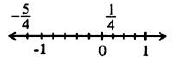
In simple words: Since -5/4 is past -1, draw the line to -2. Put red dots at -5/4 and 1/4.
Exam Tip: If the numerator's absolute value is larger than the denominator, the fraction is improper and will sit beyond the -1 to 1 range.
Question 2. (i) Compare \( \frac{3}{5} \) and \( \frac{5}{7} \)
Answer:
Find a common denominator by taking the LCM of 5 and 7, which is 35:
\( \frac{3}{5} = \frac{3 \times 7}{5 \times 7} = \frac{21}{35} \)
\( \frac{5}{7} = \frac{5 \times 5}{7 \times 5} = \frac{25}{35} \)
Since \( 25 > 21 \), we have:
\( \frac{25}{35} > \frac{21}{35} \)
\( \implies \frac{5}{7} > \frac{3}{5} \)
In simple words: Convert both fractions so they have 35 at the bottom. Since 25 is bigger than 21, \( \frac{5}{7} \) is larger.
Exam Tip: Cross-multiplication is a quick alternative way to compare: \( 3 \times 7 = 21 \) and \( 5 \times 5 = 25 \); since \( 21 < 25 \), then \( \frac{3}{5} < \frac{5}{7} \).
Question 2. (ii) Compare \( \frac{-7}{2} \) and \( \frac{5}{2} \)
Answer:
Any positive number is greater than any negative number. Since \( \frac{5}{2} \) is positive and \( \frac{-7}{2} \) is negative, we have:
\( \frac{5}{2} > \frac{-7}{2} \)
In simple words: A positive number is always bigger than a negative number.
Exam Tip: You do not need to find a common denominator when comparing a positive number and a negative number.
Question 2. (iii) Compare -3 and \( 2 \frac{3}{4} \)
Answer:
The mixed fraction \( 2 \frac{3}{4} \) (which is \( \frac{11}{4} \)) is positive, while -3 is negative. Since any positive rational number is greater than any negative one, we get:
\( 2 \frac{3}{4} > -3 \)
In simple words: Positive numbers are always greater than negative ones.
Exam Tip: Mixed numbers are always positive unless they have a leading minus sign, making them easy to compare against negative integers.
Question 2. (iv) Compare \( -1 \frac{1}{2} \) and 0
Answer:
The mixed number \( -1 \frac{1}{2} \) (which is \( -\frac{3}{2} \)) is a negative number. Since zero is always greater than any negative rational number, we have:
\( 0 > -1 \frac{1}{2} \)
In simple words: Zero is always bigger than any negative number.
Exam Tip: On a horizontal number line, numbers to the right are always greater. Since 0 is to the right of all negative numbers, it is larger.
Question 2. (v) Compare 0 and \( \frac{3}{4} \)
Answer:
The fraction \( \frac{3}{4} \) is a positive rational number. Since any positive number is greater than zero, we have:
\( \frac{3}{4} > 0 \)
In simple words: Positive fractions are always bigger than zero.
Exam Tip: Remember that any fraction with a positive numerator and denominator is greater than zero.
Question 2. (vi) Compare 3 and -1
Answer:
Since 3 is a positive integer and -1 is a negative integer, 3 is greater than -1:
\( 3 > -1 \)
In simple words: Positive numbers are always greater than negative numbers.
Exam Tip: A positive number is always to the right of a negative number on a standard number line, making it larger.
Question 3. Compare:
(i) \( -\frac{1}{4} \) and 0
(ii) \( \frac{1}{4} \) and 0
(iii) \( -\frac{3}{8} \) and \( \frac{2}{5} \)
(iv) \( \frac{-5}{8} \) and \( \frac{7}{-12} \)
(v) \( \frac{5}{-9} \) and \( \frac{-5}{-9} \)
(vi) \( \frac{-7}{8} \) and \( \frac{5}{-6} \)
(vii) \( \frac{2}{7} \) and \( \frac{-3}{-8} \)
(viii) \( \frac{-5}{8} \) and \( \frac{7}{-12} \)
Answer:
(i) Here, \( -\frac{1}{4} \) is a negative rational number. Any negative number is always smaller than 0.
\( \therefore -\frac{1}{4} < 0 \)
(ii) Here, \( \frac{1}{4} \) is a positive rational number. Every positive number is always bigger than 0.
\( \therefore \frac{1}{4} > 0 \)
(iii) Let us cross-multiply to compare \( -\frac{3}{8} \) and \( \frac{2}{5} \):
\( -3 \times 5 = -15 \)
\( 2 \times 8 = 16 \)
Since \( -15 < 16 \), we have:
\( \therefore -\frac{3}{8} < \frac{2}{5} \)
(iv) First, rewrite \( \frac{7}{-12} \) with a positive denominator as \( \frac{-7}{12} \).
Now cross-multiply to compare \( \frac{-5}{8} \) and \( \frac{-7}{12} \):
\( -5 \times 12 = -60 \)
\( -7 \times 8 = -56 \)
Since \( -60 < -56 \), we have:
\( \therefore \frac{-5}{8} < \frac{7}{-12} \)
(v) First, rewrite the given numbers with positive denominators as \( \frac{-5}{9} \) and \( \frac{5}{9} \).
Comparing the numerators, we see that \( -5 < 5 \).
\( \dots \frac{5}{-9} < \frac{-5}{-9} \)
(vi) Rewrite \( \frac{5}{-6} \) with a positive denominator as \( \frac{-5}{6} \).
Now cross-multiply to compare \( \frac{-7}{8} \) and \( \frac{-5}{6} \):
\( -7 \times 6 = -42 \)
\( -5 \times 8 = -40 \)
Since \( -42 < -40 \), we have:
\( \therefore \frac{-7}{8} < \frac{5}{-6} \)
(vii) First, simplify \( \frac{-3}{-8} \) to \( \frac{3}{8} \).
Now cross-multiply to compare \( \frac{2}{7} \) and \( \frac{3}{8} \):
\( 2 \times 8 = 16 \)
\( 3 \times 7 = 21 \)
Since \( 16 < 21 \), we have:
\( \dots \frac{2}{7} < \frac{-3}{-8} \)
(viii) First, rewrite \( \frac{7}{-12} \) with a positive denominator as \( \frac{-7}{12} \).
Now cross-multiply to compare \( \frac{-5}{8} \) and \( \frac{-7}{12} \):
\( -5 \times 12 = -60 \)
\( -7 \times 8 = -56 \)
Since \( -60 < -56 \), we have:
\( \therefore \frac{-5}{8} < \frac{7}{-12} \)
In simple words: To compare two fractions, first make sure their denominators are positive. Then, cross-multiply the top of each fraction with the bottom of the other. Compare the two resulting numbers to see which fraction is larger.
Exam Tip: Always convert negative denominators to positive before cross-multiplying, otherwise your inequality sign might end up reversed.
Question 4. Arrange the given rational numbers in ascending order:
(i) \( \frac{7}{10}, \frac{-11}{-30} \text{ and } \frac{5}{-15} \)
(ii) \( \frac{4}{-9}, \frac{-5}{12} \text{ and } \frac{2}{-3} \)
Answer:
(i) First, rewrite each fraction so that the denominators are positive:
\( \frac{7}{10} \), \( \frac{11}{30} \), and \( \frac{-5}{15} \)
Now, find the LCM of the denominators \( 10 \), \( 30 \), and \( 15 \), which is \( 30 \).
Let us make the denominators equal to \( 30 \):
\( \frac{7}{10} = \frac{7 \times 3}{10 \times 3} = \frac{21}{30} \)
\( \frac{11}{30} \)
\( \frac{-5}{15} = \frac{-5 \times 2}{15 \times 2} = \frac{-10}{30} \)
Now, compare the numerators:
\( -10 < 11 < 21 \)
This gives:
\( \frac{-10}{30} < \frac{11}{30} < \frac{21}{30} \)
Replacing them with the original fractions:
\( \implies \frac{5}{-15} < \frac{-11}{-30} < \frac{7}{10} \)
(ii) First, rewrite the given fractions with positive denominators:
\( \frac{-4}{9} \), \( \frac{-5}{12} \), and \( \frac{-2}{3} \)
Now, find the LCM of the denominators \( 9 \), \( 12 \), and \( 3 \), which is \( 36 \).
Let us write each fraction with the denominator \( 36 \):
\( \frac{-4}{9} = \frac{-4 \times 4}{9 \times 4} = \frac{-16}{36} \)
\( \frac{-5}{12} = \frac{-5 \times 3}{12 \times 3} = \frac{-15}{36} \)
\( \frac{-2}{3} = \frac{-2 \times 12}{3 \times 12} = \frac{-24}{36} \)
Now, compare the numerators:
\( -24 < -16 < -15 \)
This gives:
\( \frac{-24}{36} < \frac{-16}{36} < \frac{-15}{36} \)
Replacing them with the original fractions:
\( \implies \frac{2}{-3} < \frac{4}{-9} < \frac{-5}{12} \)
In simple words: To arrange fractions from smallest to largest, first make their bottom numbers positive. Next, find a common bottom number using LCM. Change all fractions to have this common bottom number, compare their top numbers, and arrange them.
Exam Tip: Keep in mind that for negative numbers, the one with the larger absolute value is actually smaller (for example, -24 is smaller than -15).
Question 5. Arrange the given rational numbers in descending order:
(i) \( \frac{5}{8}, \frac{13}{-16} \text{ and } \frac{-7}{12} \)
(ii) \( \frac{3}{-10}, \frac{-13}{30} \text{ and } \frac{8}{-20} \)
Answer:
(i) First, rewrite the given fractions with positive denominators:
\( \frac{5}{8} \), \( \frac{-13}{16} \), and \( \frac{-7}{12} \)
Now, find the LCM of the denominators \( 8 \), \( 16 \), and \( 12 \), which is \( 48 \).
Let us rewrite each fraction with the denominator \( 48 \):
\( \frac{5}{8} = \frac{5 \times 6}{8 \times 6} = \frac{30}{48} \)
\( \frac{-13}{16} = \frac{-13 \times 3}{16 \times 3} = \frac{-39}{48} \)
\( \frac{-7}{12} = \frac{-7 \times 4}{12 \times 4} = \frac{-28}{48} \)
Comparing the numerators from largest to smallest:
\( 30 > -28 > -39 \)
This gives:
\( \frac{30}{48} > \frac{-28}{48} > \frac{-39}{48} \)
Replacing them with the original fractions:
\( \implies \frac{5}{8} > \frac{-7}{12} > \frac{13}{-16} \)
(ii) First, rewrite the given fractions with positive denominators:
\( \frac{-3}{10} \), \( \frac{-13}{30} \), and \( \frac{-8}{20} \)
Now, find the LCM of the denominators \( 10 \), \( 30 \), and \( 20 \), which is \( 60 \).
Let us rewrite each fraction with the denominator \( 60 \):
\( \frac{-3}{10} = \frac{-3 \times 6}{10 \times 6} = \frac{-18}{60} \)
\( \frac{-13}{30} = \frac{-13 \times 2}{30 \times 2} = \frac{-26}{60} \)
\( \frac{-8}{20} = \frac{-8 \times 3}{20 \times 3} = \frac{-24}{60} \)
Comparing the numerators from largest to smallest:
\( -18 > -24 > -26 \)
This gives:
\( \frac{-18}{60} > \frac{-24}{60} > \frac{-26}{60} \)
Replacing them with the original fractions:
\( \implies \frac{3}{-10} > \frac{8}{-20} > \frac{-13}{30} \)
In simple words: To arrange fractions from largest to smallest, make their denominators positive and find their LCM. Convert each fraction to have this common denominator, compare the top numbers, and list them in decreasing order.
Exam Tip: Be careful when ordering negative fractions - a smaller absolute value means a larger negative number (for example, -18 is larger than -24).
Question 6. Fill in the blanks:
(i) \( \frac{5}{8} \) and \( \frac{3}{10} \) are on the .......... side of zero.
(ii) \( -\frac{5}{8} \) and \( \frac{3}{10} \) are on the .......... sides of zero.
(iii) \( -\frac{5}{8} \) and \( -\frac{3}{10} \) are on the .......... side of zero.
(iv) \( \frac{5}{8} \) and \( -\frac{3}{10} \) are on the .......... sides of zero.
Answer:
(i) \( \frac{5}{8} \) and \( \frac{3}{10} \) are on the right side of zero.
(ii) \( -\frac{5}{8} \) and \( \frac{3}{10} \) are on the opposite sides of zero.
(iii) \( -\frac{5}{8} \) and \( -\frac{3}{10} \) are on the same/left side of zero.
(iv) \( \frac{5}{8} \) and \( -\frac{3}{10} \) are on the opposite sides of zero.
In simple words: Positive numbers are always on the right side of zero, while negative numbers are always on the left. If we have two numbers with the same sign, they are on the same side. If they have different signs, they are on opposite sides.
Exam Tip: Remember that zero is the center point on a number line, separating the positive numbers on the right from the negative numbers on the left.
Exercise 2(C)
Question 1. Add:
(i) \( \frac{7}{5} \) and \( \frac{2}{5} \)
(ii) \( \frac{-4}{9} \) and \( \frac{2}{9} \)
(iii) \( \frac{5}{-12} \) and \( \frac{1}{12} \)
(iv) \( \frac{4}{-15} \) and \( \frac{-7}{-15} \)
(v) \( \frac{-7}{25} \) and \( \frac{9}{-25} \)
(vi) \( \frac{-7}{26} \) and \( \frac{7}{-26} \)
Answer:
(i) Since the denominators are the same, we add the numerators directly:
\( \frac{7}{5} + \frac{2}{5} = \frac{7 + 2}{5} = \frac{9}{5} \)
(ii) Since the denominators are the same, we add the numerators directly:
\( \frac{-4}{9} + \frac{2}{9} = \frac{-4 + 2}{9} = \frac{-2}{9} \)
(iii) First, write \( \frac{5}{-12} \) with a positive denominator as \( \frac{-5}{12} \):
\( \frac{-5}{12} + \frac{1}{12} = \frac{-5 + 1}{12} = \frac{-4}{12} = -\frac{1}{3} \)
(iv) First, rewrite the fractions with positive denominators:
\( \frac{4}{-15} = \frac{-4}{15} \) and \( \frac{-7}{-15} = \frac{7}{15} \)
Now, add them together:
\( \frac{-4}{15} + \frac{7}{15} = \frac{-4 + 7}{15} = \frac{3}{15} = \frac{1}{5} \)
(v) First, write \( \frac{9}{-25} \) with a positive denominator as \( \frac{-9}{25} \):
\( \frac{-7}{25} + \frac{-9}{25} = \frac{-7 + (-9)}{25} = \frac{-16}{25} \)
(vi) First, write \( \frac{7}{-26} \) with a positive denominator as \( \frac{-7}{26} \):
\( \frac{-7}{26} + \frac{-7}{26} = \frac{-7 + (-7)}{26} = \frac{-14}{26} = -\frac{7}{13} \)
In simple words: To add fractions that have the same bottom number, first make sure the bottom numbers are positive. Then, simply add the top numbers together and keep the bottom number the same. Simplify your final fraction if you can.
Exam Tip: Always check if your final fraction can be simplified to its lowest terms to secure full marks.
Question 2. Add:
(i) \( \frac{-2}{5} \) and \( \frac{3}{7} \)
(ii) \( \frac{-5}{6} \) and \( \frac{4}{9} \)
(iii) \( -3 \) and \( \frac{2}{3} \)
(iv) \( \frac{-5}{9} \) and \( \frac{7}{18} \)
(v) \( \frac{-7}{24} \) and \( \frac{-5}{48} \)
(vi) \( \frac{1}{-18} \) and \( \frac{5}{-27} \)
(vii) \( \frac{-9}{25} \) and \( \frac{1}{-75} \)
(viii) \( \frac{13}{-16} \) and \( \frac{-11}{24} \)
(ix) \( \frac{-9}{-16} \) and \( \frac{-11}{8} \)
Answer:
(i) The denominators are \( 5 \) and \( 7 \). Their LCM is \( 35 \).
\( \frac{-2}{5} + \frac{3}{7} = \frac{-2 \times 7}{5 \times 7} + \frac{3 \times 5}{7 \times 5} \)
\( = \frac{-14}{35} + \frac{15}{35} = \frac{-14 + 15}{35} = \frac{1}{35} \)
(ii) The denominators are \( 6 \) and \( 9 \). Their LCM is \( 36 \).
\( \frac{-5}{6} + \frac{4}{9} = \frac{-5 \times 6}{6 \times 6} + \frac{4 \times 4}{9 \times 4} \)
\( = \frac{-30}{36} + \frac{16}{36} = \frac{-30 + 16}{36} = \frac{-14}{36} = -\frac{7}{18} \)
(iii) Write \( -3 \) as a fraction \( \frac{-3}{1} \). The LCM of \( 1 \) and \( 3 \) is \( 3 \).
\( \frac{-3}{1} + \frac{2}{3} = \frac{-3 \times 3}{1 \times 3} + \frac{2 \times 1}{3 \times 1} \)
\( = \frac{-9}{3} + \frac{2}{3} = \frac{-9 + 2}{3} = \frac{-7}{3} \)
(iv) The denominators are \( 9 \) and \( 18 \). Their LCM is \( 18 \).
\( \frac{-5}{9} + \frac{7}{18} = \frac{-5 \times 2}{9 \times 2} + \frac{7 \times 1}{18 \times 1} \)
\( = \frac{-10}{18} + \frac{7}{18} = \frac{-10 + 7}{18} = \frac{-3}{18} = -\frac{1}{6} \)
(v) The denominators are \( 24 \) and \( 48 \). Their LCM is \( 48 \).
\( \frac{-7}{24} + \frac{-5}{48} = \frac{-7 \times 2}{24 \times 2} + \frac{-5 \times 1}{48 \times 1} \)
\( = \frac{-14}{48} + \frac{-5}{48} = \frac{-14 + (-5)}{48} = \frac{-19}{48} \)
(vi) Rewrite the fractions with positive denominators:
\( \frac{1}{-18} = \frac{-1}{18} \) and \( \frac{5}{-27} = \frac{-5}{27} \)
The LCM of \( 18 \) and \( 27 \) is \( 54 \).
\( \frac{-1}{18} + \frac{-5}{27} = \frac{-1 \times 3}{18 \times 3} + \frac{-5 \times 2}{27 \times 2} \)
\( = \frac{-3}{54} + \frac{-10}{54} = \frac{-3 + (-10)}{54} = \frac{-13}{54} \)
(vii) Rewrite \( \frac{1}{-75} \) with a positive denominator as \( \frac{-1}{75} \).
The LCM of \( 25 \) and \( 75 \) is \( 75 \).
\( \frac{-9}{25} + \frac{-1}{75} = \frac{-9 \times 3}{25 \times 3} + \frac{-1 \times 1}{75 \times 1} \)
\( = \frac{-27}{75} + \frac{-1}{75} = \frac{-27 + (-1)}{75} = \frac{-28}{75} \)
(viii) Rewrite the first fraction with a positive denominator as \( \frac{-13}{16} \).
The LCM of \( 16 \) and \( 24 \) is \( 48 \).
\( \frac{-13}{16} + \frac{-11}{24} = \frac{-13 \times 3}{16 \times 3} + \frac{-11 \times 2}{24 \times 2} \)
\( = \frac{-39}{48} + \frac{-22}{48} = \frac{-39 + (-22)}{48} = \frac{-61}{48} \)
(ix) Simplify \( \frac{-9}{-16} \) to \( \frac{9}{16} \).
The LCM of \( 16 \) and \( 8 \) is \( 16 \).
\( \frac{9}{16} + \frac{-11}{8} = \frac{9 \times 1}{16 \times 1} + \frac{-11 \times 2}{8 \times 2} \)
\( = \frac{9}{16} + \frac{-22}{16} = \frac{9 + (-22)}{16} = \frac{-13}{16} \)
In simple words: When adding fractions with different bottom numbers, first make their bottom numbers positive. Next, find the LCM to make the bottom numbers the same. Change the top numbers accordingly, add them, and keep the common bottom number.
Exam Tip: Always make sure to write negative signs in the numerator rather than the denominator before starting to find the LCM.
Question 3. Evaluate:
(i) \( \frac{-2}{5} + \frac{3}{5} + \frac{-1}{5} \)
(ii) \( \frac{-8}{9} + \frac{4}{9} + \frac{-2}{9} \)
(iii) \( \frac{5}{-24} + \frac{-1}{8} + \frac{3}{16} \)
(iv) \( \frac{-7}{6} + \frac{4}{-15} + \frac{-4}{-30} \)
(v) \( -2 + \frac{2}{5} + \frac{-2}{15} \)
(vi) \( \frac{-11}{12} + \frac{5}{16} + \frac{-3}{8} \)
Answer:
(i) Since the denominators are already the same, we add the numerators directly:
\( \frac{-2 + 3 - 1}{5} = \frac{0}{5} = 0 \)
(ii) Since the denominators are already the same, we add the numerators directly:
\( \frac{-8 + 4 - 2}{9} = \frac{-6}{9} = -\frac{2}{3} \)
(iii) Rewrite \( \frac{5}{-24} \) with a positive denominator as \( \frac{-5}{24} \).
The LCM of \( 24 \), \( 8 \), and \( 16 \) is \( 48 \).
Let us rewrite each fraction with the denominator \( 48 \):
\( \frac{-5}{24} + \frac{-1}{8} + \frac{3}{16} = \frac{-5 \times 2}{24 \times 2} + \frac{-1 \times 6}{8 \times 6} + \frac{3 \times 3}{16 \times 3} \)
\( = \frac{-10}{48} + \frac{-6}{48} + \frac{9}{48} \)
\( = \frac{-10 - 6 + 9}{48} = \frac{-7}{48} \)
(iv) Rewrite the fractions with positive denominators first:
\( \frac{4}{-15} = \frac{-4}{15} \) and \( \frac{-4}{-30} = \frac{4}{30} \)
The LCM of \( 6 \), \( 15 \), and \( 30 \) is \( 30 \).
Let us rewrite each fraction with the denominator \( 30 \):
\( \frac{-7}{6} + \frac{-4}{15} + \frac{4}{30} = \frac{-7 \times 5}{6 \times 5} + \frac{-4 \times 2}{15 \times 2} + \frac{4 \times 1}{30 \times 1} \)
\( = \frac{-35}{30} + \frac{-8}{30} + \frac{4}{30} \)
\( = \frac{-35 - 8 + 4}{30} = \frac{-39}{30} = -\frac{13}{10} \)
(v) Write \( -2 \) as \( \frac{-2}{1} \).
The LCM of \( 1 \), \( 5 \), and \( 15 \) is \( 15 \).
Let us rewrite each fraction with the denominator \( 15 \):
\( \frac{-2}{1} + \frac{2}{5} + \frac{-2}{15} = \frac{-2 \times 15}{1 \times 15} + \frac{2 \times 3}{5 \times 3} + \frac{-2 \times 1}{15 \times 1} \)
\( = \frac{-30}{15} + \frac{6}{15} + \frac{-2}{15} \)
\( = \frac{-30 + 6 - 2}{15} = \frac{-26}{15} \)
(vi) The LCM of \( 12 \), \( 16 \), and \( 8 \) is \( 48 \).
Let us rewrite each fraction with the denominator \( 48 \):
\( \frac{-11}{12} + \frac{5}{16} + \frac{-3}{8} = \frac{-11 \times 4}{12 \times 4} + \frac{5 \times 3}{16 \times 3} + \frac{-3 \times 6}{8 \times 6} \)
\( = \frac{-44}{48} + \frac{15}{48} + \frac{-18}{48} \)
\( = \frac{-44 + 15 - 18}{48} = \frac{-47}{48} \)
In simple words: To evaluate expressions with multiple fractions, first ensure all denominators are positive. Find their LCM to make a single common bottom number. Change the top numbers, perform the addition or subtraction, and then simplify the final fraction.
Exam Tip: Work through calculations step-by-step to avoid simple sign mistakes, and always try to reduce your final fraction to its simplest form.
Question 4. Evaluate:
(i) \( -\frac{11}{18} + \frac{-3}{9} + \frac{2}{-3} \)
(ii) \( \frac{-9}{4} + \frac{13}{3} + \frac{25}{6} \)
(iii) \( -5 + \frac{5}{-8} + \frac{-5}{-12} \)
(iv) \( -\frac{2}{3} + \frac{5}{2} + 2 \)
(v) \( 5 + \frac{-3}{4} + \frac{-5}{8} \)
Answer:
(i) First, rewrite with positive denominators:
\( = \frac{-11}{18} + \frac{-3}{9} + \frac{-2}{3} \)
The least common multiple of 18, 9, and 3 is 18:
\( = \frac{-11 \times 1}{18 \times 1} + \frac{-3 \times 2}{9 \times 2} + \frac{-2 \times 6}{3 \times 6} \)
\( = \frac{-11}{18} + \frac{-6}{18} + \frac{-12}{18} \)
\( = \frac{-11 - 6 - 12}{18} \)
\( = \frac{-29}{18} \)
(ii) The least common multiple of 4, 3, and 6 is 24:
\( = \frac{-9 \times 6}{4 \times 6} + \frac{13 \times 8}{3 \times 8} + \frac{25 \times 4}{6 \times 4} \)
\( = \frac{-54}{24} + \frac{104}{24} + \frac{100}{24} \)
\( = \frac{-54 + 104 + 100}{24} \)
\( = \frac{150}{24} \)
Simplifying by dividing the numerator and denominator by 6:
\( = \frac{25}{6} \)
(iii) Rewrite with positive denominators and simplify the double negative:
\( = \frac{-5}{1} + \frac{-5}{8} + \frac{5}{12} \)
The least common multiple of 1, 8, and 12 is 24:
\( = \frac{-5 \times 24}{1 \times 24} + \frac{-5 \times 3}{8 \times 3} + \frac{5 \times 2}{12 \times 2} \)
\( = \frac{-120}{24} + \frac{-15}{24} + \frac{10}{24} \)
\( = \frac{-120 - 15 + 10}{24} \)
\( = \frac{-125}{24} \)
(iv) Write the whole number as a fraction:
\( = \frac{-2}{3} + \frac{5}{2} + \frac{2}{1} \)
The least common multiple of 3, 2, and 1 is 6:
\( = \frac{-2 \times 2}{3 \times 2} + \frac{5 \times 3}{2 \times 3} + \frac{2 \times 6}{1 \times 6} \)
\( = \frac{-4}{6} + \frac{15}{6} + \frac{12}{6} \)
\( = \frac{-4 + 15 + 12}{6} \)
\( = \frac{23}{6} \)
(v) Write the whole number as a fraction:
\( = \frac{5}{1} + \frac{-3}{4} + \frac{-5}{8} \)
The least common multiple of 1, 4, and 8 is 8:
\( = \frac{5 \times 8}{1 \times 8} + \frac{-3 \times 2}{4 \times 2} + \frac{-5 \times 1}{8 \times 1} \)
\( = \frac{40}{8} + \frac{-6}{8} + \frac{-5}{8} \)
\( = \frac{40 - 6 - 5}{8} \)
\( = \frac{29}{8} \)
In simple words: To add these fractions, first make sure the bottom numbers are positive. Next, find a common bottom number, make all fractions match it, and then add or subtract the top numbers.
Exam Tip: Remember to always write negative signs in the numerator instead of the denominator before you find the LCM. This helps avoid calculation errors.
Question 5. Subtract:
(i) \( \frac{2}{9} \) from \( \frac{5}{9} \)
(ii) \( \frac{-6}{11} \) from \( \frac{-3}{-11} \)
(iii) \( \frac{-2}{15} \) from \( \frac{-8}{15} \)
(iv) \( \frac{11}{18} \) from \( \frac{-5}{18} \)
(v) \( \frac{-4}{11} \) from \( -2 \)
Answer:
(i) \( \frac{5}{9} - \frac{2}{9} = \frac{5 - 2}{9} = \frac{3}{9} \)
Simplifying the fraction:
\( = \frac{1}{3} \)
(ii) First, rewrite \( \frac{-3}{-11} \) as \( \frac{3}{11} \):
\( \frac{3}{11} - \left(\frac{-6}{11}\right) = \frac{3}{11} + \frac{6}{11} \)
\( = \frac{3 + 6}{11} = \frac{9}{11} \)
(iii) \( \frac{-8}{15} - \left(\frac{-2}{15}\right) = \frac{-8}{15} + \frac{2}{15} \)
\( = \frac{-8 + 2}{15} = \frac{-6}{15} \)
Simplifying the fraction:
\( = \frac{-2}{5} \)
(iv) \( \frac{-5}{18} - \frac{11}{18} = \frac{-5 - 11}{18} \)
\( = \frac{-16}{18} \)
Simplifying the fraction:
\( = \frac{-8}{9} \)
(v) Write \( -2 \) as \( \frac{-2}{1} \):
\( \frac{-2}{1} - \left(\frac{-4}{11}\right) = \frac{-2}{1} + \frac{4}{11} \)
Make the denominators equal:
\( = \frac{-2 \times 11}{1 \times 11} + \frac{4}{11} \)
\( = \frac{-22}{11} + \frac{4}{11} \)
\( = \frac{-22 + 4}{11} = \frac{-18}{11} \)
In simple words: Subtracting \(A\) from \(B\) means we calculate \(B - A\). Always write the second term first, change subtraction of a negative number into addition, and simplify your final answer.
Exam Tip: Be very careful when you see "subtract A from B." It always means you need to write B first, like this: \( B - A \). Swapping the order is a very common mistake.
Question 6. Subtract:
(i) \( -\frac{3}{10} \) from \( \frac{1}{5} \)
(ii) \( \frac{-6}{25} \) from \( \frac{-8}{5} \)
(iii) \( \frac{-7}{4} \) from \( -2 \)
(iv) \( \frac{-16}{21} \) from \( 1 \)
(v) \( \frac{-8}{15} \) from \( 0 \)
(vi) \( 0 \) from \( \frac{-3}{8} \)
(vii) \( -2 \) from \( \frac{-3}{10} \)
(viii) \( \frac{5}{8} \) from \( \frac{-5}{16} \)
(ix) \( 4 \) from \( -\frac{3}{13} \)
Answer:
(i) \( \frac{1}{5} - \left(-\frac{3}{10}\right) = \frac{1}{5} + \frac{3}{10} \)
Find the common denominator of 10:
\( = \frac{1 \times 2}{5 \times 2} + \frac{3}{10} = \frac{2}{10} + \frac{3}{10} \)
\( = \frac{2 + 3}{10} = \frac{5}{10} \)
Simplifying the fraction:
\( = \frac{1}{2} \)
(ii) \( \frac{-8}{5} - \left(\frac{-6}{25}\right) = \frac{-8}{5} + \frac{6}{25} \)
Find the common denominator of 25:
\( = \frac{-8 \times 5}{5 \times 5} + \frac{6}{25} = \frac{-40}{25} + \frac{6}{25} \)
\( = \frac{-40 + 6}{25} = \frac{-34}{25} \)
(iii) \( -2 - \left(\frac{-7}{4}\right) = \frac{-2}{1} + \frac{7}{4} \)
Find the common denominator of 4:
\( = \frac{-2 \times 4}{1 \times 4} + \frac{7}{4} = \frac{-8}{4} + \frac{7}{4} \)
\( = \frac{-8 + 7}{4} = \frac{-1}{4} \)
(iv) \( 1 - \left(\frac{-16}{21}\right) = \frac{1}{1} + \frac{16}{21} \)
Find the common denominator of 21:
\( = \frac{1 \times 21 + 16}{21} = \frac{21 + 16}{21} = \frac{37}{21} \)
(v) \( 0 - \left(\frac{-8}{15}\right) = 0 + \frac{8}{15} = \frac{8}{15} \)
(vi) \( \frac{-3}{8} - 0 = \frac{-3}{8} \)
(vii) \( \frac{-3}{10} - (-2) = \frac{-3}{10} + \frac{2}{1} \)
Find the common denominator of 10:
\( = \frac{-3 + 2 \times 10}{10} = \frac{-3 + 20}{10} = \frac{17}{10} \)
(viii) \( \frac{-5}{16} - \frac{5}{8} \)
Find the common denominator of 16:
\( = \frac{-5}{16} - \frac{5 \times 2}{8 \times 2} = \frac{-5}{16} - \frac{10}{16} \)
\( = \frac{-5 - 10}{16} = \frac{-15}{16} \)
(ix) \( -\frac{3}{13} - 4 = \frac{-3}{13} - \frac{4}{1} \)
Find the common denominator of 13:
\( = \frac{-3 - 4 \times 13}{13} = \frac{-3 - 52}{13} = \frac{-55}{13} \)
In simple words: Subtracting a negative fraction turns it into addition. When the bottom numbers are different, we make them the same by using their common multiple.
Exam Tip: Always check if your final fraction can be simplified to lower terms. Reducing fractions to their simplest form helps prevent loss of marks.
Question 7. The sum of two rational numbers is \( \frac{11}{24} \). If one of them is \( \frac{3}{8} \), find the other.
Answer: Let the missing rational number be \( x \).
The sum of the two numbers is given as \( \frac{11}{24} \).
We know that one of these numbers is \( \frac{3}{8} \).
According to the problem statement:
\( \frac{3}{8} + x = \frac{11}{24} \)
\( \implies x = \frac{11}{24} - \frac{3}{8} \)
Make the denominators equal by finding the common multiple of 24:
\( x = \frac{11}{24} - \frac{3 \times 3}{8 \times 3} \)
\( x = \frac{11}{24} - \frac{9}{24} \)
\( x = \frac{11 - 9}{24} \)
\( x = \frac{2}{24} \)
Simplifying the fraction:
\( x = \frac{1}{12} \)
So, the other rational number is \( \frac{1}{12} \).
In simple words: If you know the total of two numbers and one of the numbers, you can find the other number by subtracting the known one from the total.
Exam Tip: Set up a simple equation with a variable like \( x \). This makes it easy to see which number needs to be subtracted from which.
Question 8. The sum of two rational numbers is \( \frac{-7}{12} \). If one of them is \( \frac{13}{24} \), find the other.
Answer: Let the unknown rational number be \( x \).
The sum of the two numbers is \( \frac{-7}{12} \).
One of the numbers is given as \( \frac{13}{24} \).
Therefore, we can write:
\( \frac{13}{24} + x = \frac{-7}{12} \)
\( \implies x = \frac{-7}{12} - \frac{13}{24} \)
To solve this, we make the denominators equal:
\( x = \frac{-7 \times 2}{12 \times 2} - \frac{13}{24} \)
\( x = \frac{-14}{24} - \frac{13}{24} \)
\( x = \frac{-14 - 13}{24} \)
\( x = \frac{-27}{24} \)
Reducing this fraction by dividing both terms by 3:
\( x = \frac{-9}{8} \)
Thus, the other number is \( \frac{-9}{8} \).
In simple words: To find the missing number, take the total sum and subtract the number you already know. Simplify the fraction at the end by dividing.
Exam Tip: Keep a close eye on negative signs. When you subtract a positive number from a negative number, the result becomes more negative.
Question 9. The sum of two rational numbers is -4. If one of them is \( -\frac{13}{12} \), find the other.
Answer: Let the other rational number be \( x \).
We are given that the sum of the two numbers is \( -4 \).
One of the numbers is \( -\frac{13}{12} \).
So, we can write:
\( -\frac{13}{12} + x = -4 \)
\( \implies x = -4 - \left(-\frac{13}{12}\right) \)
\( x = -4 + \frac{13}{12} \)
\( x = \frac{-4}{1} + \frac{13}{12} \)
Expressing with a common denominator:
\( x = \frac{-4 \times 12 + 13}{12} \)
\( x = \frac{-48 + 13}{12} \)
\( x = \frac{-35}{12} \)
Hence, the other number is \( \frac{-35}{12} \).
In simple words: When you subtract a negative fraction, it becomes addition. Turn the whole number into a fraction, find a common denominator, and combine them.
Exam Tip: Write integers like \( -4 \) as \( \frac{-4}{1} \) to avoid confusion when finding the common denominator.
Question 10. What should be added to \( -\frac{3}{16} \) to get \( \frac{11}{24} \)?
Answer: Let the number to be added be \( x \).
According to the problem statement:
\( -\frac{3}{16} + x = \frac{11}{24} \)
\( \implies x = \frac{11}{24} - \left(-\frac{3}{16}\right) \)
\( x = \frac{11}{24} + \frac{3}{16} \)
The LCM of 24 and 16 is 48:
\( x = \frac{11 \times 2}{24 \times 2} + \frac{3 \times 3}{16 \times 3} \)
\( x = \frac{22}{48} + \frac{9}{48} \)
\( x = \frac{22 + 9}{48} \)
\( x = \frac{31}{48} \)
So, the required number is \( \frac{31}{48} \).
In simple words: To find what to add to a first number to reach a target, subtract the first number from that target.
Exam Tip: Be careful with finding the LCM of larger numbers like 24 and 16. Using prime factorization or common multiples will help you find 48 quickly.
Question 11. What should be added to \( \frac{-3}{5} \) to get 2?
Answer: Let the required number to be added be \( x \).
Based on the question, we can set up the equation:
\( \frac{-3}{5} + x = 2 \)
\( \implies x = 2 - \left(\frac{-3}{5}\right) \)
\( x = 2 + \frac{3}{5} \)
\( x = \frac{2 \times 5 + 3}{5} \)
\( x = \frac{10 + 3}{5} \)
\( x = \frac{13}{5} \)
Thus, the required number is \( \frac{13}{5} \).
In simple words: To find the missing amount, take the target number and subtract the starting number. Here, subtracting a negative number changes it into simple addition.
Exam Tip: When adding a whole number and a fraction like \( 2 + \frac{3}{5} \), you can quickly write it as a mixed fraction \( 2\frac{3}{5} \) and then convert to \( \frac{13}{5} \).
Question 12. What should be subtracted from \( \frac{-4}{5} \) to get 1?
Answer: Let the number to be subtracted be \( x \).
According to the problem:
\( \frac{-4}{5} - x = 1 \)
\( \implies \frac{-4}{5} - 1 = x \)
\( \implies x = \frac{-4}{5} - \frac{1}{1} \)
\( x = \frac{-4 - 1 \times 5}{5} \)
\( x = \frac{-4 - 5}{5} \)
\( x = \frac{-9}{5} \)
So, the required number is \( \frac{-9}{5} \).
In simple words: If you want to know what to take away from a number to reach a result, subtract that result from your starting number.
Exam Tip: Make sure you set up the subtraction order correctly. "Subtracted from A" means the equation starts with \( A - x \), not \( x - A \).
Question 13. The sum of two numbers is \( -\frac{6}{5} \). If one of them is -2, find the other.
Answer: Let the other number be \( x \).
We know that the sum of these two numbers is \( -\frac{6}{5} \).
One of the numbers is given as \( -2 \).
Therefore:
\( -2 + x = -\frac{6}{5} \)
\( \implies x = -\frac{6}{5} - (-2) \)
\( x = -\frac{6}{5} + 2 \)
\( x = \frac{-6 + 2 \times 5}{5} \)
\( x = \frac{-6 + 10}{5} \)
\( x = \frac{4}{5} \)
So, the other number is \( \frac{4}{5} \).
In simple words: Subtract the known number from the total sum. Subtracting negative two is the same as adding two to the fraction.
Exam Tip: Double-check the sign of your final answer. Here, since \( 10 \) is larger than \( -6 \), the final result must be positive.
Question 14. What should be added to \( \frac{-7}{12} \) to get \( \frac{3}{8} \)?
Answer: Let the number to be added be \( x \).
From the given statement:
\( \frac{-7}{12} + x = \frac{3}{8} \)
\( \implies x = \frac{3}{8} - \left(\frac{-7}{12}\right) \)
\( x = \frac{3}{8} + \frac{7}{12} \)
Finding the LCM of 8 and 12, which is 24:
\( x = \frac{3 \times 3}{8 \times 3} + \frac{7 \times 2}{12 \times 2} \)
\( x = \frac{9}{24} + \frac{14}{24} \)
\( x = \frac{9 + 14}{24} \)
\( x = \frac{23}{24} \)
Hence, the required number is \( \frac{23}{24} \).
In simple words: Subtract the starting number from the target number to find what needs to be added. Convert both fractions so they have the same bottom number before adding.
Exam Tip: Be very neat when multiplying the numerators and denominators to get a common denominator. A single arithmetic slip here will lose you full marks.
Question 15. What should be subtracted from \( \frac{5}{9} \) to get \( \frac{9}{5} \)?
Answer: Let the required number be \( x \).
According to the given condition:
\( \frac{5}{9} - x = \frac{9}{5} \)
\( \implies \frac{5}{9} - \frac{9}{5} = x \)
\( \implies x = \frac{5 \times 5 - 9 \times 9}{45} \) (Since the LCM of 9 and 5 is 45)
\( x = \frac{25 - 81}{45} \)
\( x = -\frac{56}{45} \)
Thus, the required number is \( -\frac{56}{45} \).
In simple words: To find what to subtract, take your starting fraction and subtract the final result from it. Find the common denominator and then subtract the top numbers.
Exam Tip: Since 5 and 9 are co-prime, their LCM is simply their product, which is 45. Cross-multiplication is a quick way to find the numerator here.
Exercise 2 (D)
Question 1. Evaluate:
(i) \( \frac{5}{4} \times \frac{3}{7} \)
(ii) \( \frac{2}{3} \times -\frac{6}{7} \)
(iii) \( \left(\frac{-12}{5}\right) \times \left(\frac{10}{-3}\right) \)
(iv) \( \frac{-45}{39} \times \frac{-13}{15} \)
(v) \( 3\frac{1}{8} \times \left(-2\frac{2}{5}\right) \)
(vi) \( 2\frac{14}{25} \times \left(\frac{-5}{16}\right) \)
(vii) \( \left(\frac{-8}{9}\right) \times \left(\frac{-3}{16}\right) \)
(viii) \( \left(\frac{5}{-27}\right) \times \left(\frac{-9}{20}\right) \)
Answer:
(i) \( \frac{5}{4} \times \frac{3}{7} = \frac{5 \times 3}{4 \times 7} = \frac{15}{28} \)
(ii) \( \frac{2}{3} \times -\frac{6}{7} = \frac{2 \times -6}{3 \times 7} \)
Simplifying the terms:
\( = \frac{2 \times -2}{1 \times 7} = -\frac{4}{7} \)
(iii) \( \left(\frac{-12}{5}\right) \times \left(\frac{10}{-3}\right) = \frac{-12 \times 10}{5 \times -3} \)
Simplifying the terms:
\( = 4 \times 2 = 8 \)
(iv) \( \frac{-45}{39} \times \frac{-13}{15} = \frac{-45 \times -13}{39 \times 15} \)
Simplifying the terms:
\( = \frac{-3 \times -1}{3 \times 1} = \frac{3}{3} = 1 \)
(v) \( 3\frac{1}{8} \times \left(-2\frac{2}{5}\right) \)
Convert the mixed numbers into improper fractions:
\( = \frac{25}{8} \times \left(-\frac{12}{5}\right) \)
Simplifying by canceling common factors:
\( = \frac{5 \times -3}{2 \times 1} = -\frac{15}{2} \)
(vi) \( 2\frac{14}{25} \times \left(\frac{-5}{16}\right) \)
Convert the mixed fraction:
\( = \frac{64}{25} \times \left(\frac{-5}{16}\right) \)
Simplifying:
\( = \frac{4 \times -1}{5 \times 1} = -\frac{4}{5} \)
(vii) \( \left(\frac{-8}{9}\right) \times \left(\frac{-3}{16}\right) = \frac{-8 \times -3}{9 \times 16} \)
Simplifying:
\( = \frac{-1 \times -1}{3 \times 2} = \frac{1}{6} \)
(viii) \( \left(\frac{5}{-27}\right) \times \left(\frac{-9}{20}\right) = \frac{5 \times -9}{-27 \times 20} \)
Simplifying:
\( = \frac{1 \times 1}{3 \times 4} = \frac{1}{12} \)
In simple words: To multiply fractions, multiply the top numbers together and the bottom numbers together. You can make it simpler by dividing top and bottom numbers by any common factors first.
Exam Tip: Always cross-cancel common factors before multiplying the numerators and denominators. This keeps the numbers small and prevents calculation errors.
Question 2. Multiply:
(i) \( \frac{3}{25} \) and \( \frac{4}{5} \)
(ii) \( 1\frac{1}{8} \) and \( 10\frac{2}{3} \)
(iii) \( 6\frac{2}{3} \) and \( \frac{-3}{8} \)
(iv) \( \frac{-13}{15} \) and \( \frac{-25}{26} \)
(v) \( 1\frac{1}{6} \) and \( 18 \)
(vi) \( 2\frac{1}{14} \) and \( -7 \)
(vii) \( 5\frac{1}{8} \) and \( -16 \)
(viii) \( 35 \) and \( \frac{-18}{25} \)
(ix) \( 6\frac{2}{3} \) and \( -\frac{3}{8} \)
(x) \( 3\frac{3}{5} \) and \( -10 \)
(xi) \( \frac{27}{28} \) and \( -14 \)
(xii) \( -24 \) and \( \frac{5}{16} \)
Answer:
(i) \( \frac{3}{25} \times \frac{4}{5} = \frac{3 \times 4}{25 \times 5} = \frac{12}{125} \)
(ii) \( 1\frac{1}{8} \times 10\frac{2}{3} \)
Convert mixed numbers to improper fractions:
\( = \frac{9}{8} \times \frac{32}{3} \)
Simplify by dividing:
\( = 3 \times 4 = 12 \)
(iii) \( 6\frac{2}{3} \times \frac{-3}{8} \)
Convert to improper fractions:
\( = \frac{20}{3} \times \frac{-3}{8} \)
Simplify:
\( = \frac{5 \times -1}{1 \times 2} = -\frac{5}{2} = -2\frac{1}{2} \)
(iv) \( \frac{-13}{15} \times \frac{-25}{26} = \frac{-13 \times -25}{15 \times 26} \)
Simplify:
\( = \frac{-1 \times -5}{3 \times 2} = \frac{5}{6} \)
(v) \( 1\frac{1}{6} \times 18 \)
Convert to an improper fraction:
\( = \frac{7}{6} \times 18 \)
Simplify:
\( = 7 \times 3 = 21 \)
(vi) \( 2\frac{1}{14} \times -7 \)
Convert to an improper fraction:
\( = \frac{29}{14} \times (-7) \)
Simplify:
\( = \frac{29 \times -1}{2} = -\frac{29}{2} = -14\frac{1}{2} \)
(vii) \( 5\frac{1}{8} \times -16 \)
Convert to an improper fraction:
\( = \frac{41}{8} \times (-16) \)
Simplify:
\( = 41 \times -2 = -82 \)
(viii) \( 35 \times \frac{-18}{25} = \frac{35 \times -18}{25} \)
Simplify by dividing 35 and 25 by 5:
\( = \frac{7 \times -18}{5} = \frac{-126}{5} = -25\frac{1}{5} \)
(ix) \( 6\frac{2}{3} \times -\frac{3}{8} \)
Convert to improper fractions:
\( = \frac{20}{3} \times \left(-\frac{3}{8}\right) \)
Simplify:
\( = \frac{5 \times -1}{1 \times 2} = -\frac{5}{2} = -2\frac{1}{2} \)
(x) \( 3\frac{3}{5} \times -10 \)
Convert to an improper fraction:
\( = \frac{18}{5} \times (-10) \)
Simplify:
\( = 18 \times -2 = -36 \)
(xi) \( \frac{27}{28} \times -14 \)
Simplify by canceling 14 from 28:
\( = \frac{27 \times -1}{2} = -\frac{27}{2} = -13\frac{1}{2} \)
(xii) \( -24 \times \frac{5}{16} \)
Simplify by dividing -24 and 16 by 8:
\( = \frac{-3 \times 5}{2} = -\frac{15}{2} = -7\frac{1}{2} \)
In simple words: First change mixed numbers into top-heavy fractions. Put integers over 1 if needed. Then, cancel any common factors between the top and bottom before multiplying.
Exam Tip: If the starting question contains mixed numbers, it is best practice to write your final answer as a mixed number as well.
Question 3. Evaluate:
(i) \( \left(-6 \times \frac{5}{18}\right) - \left(-4\frac{2}{9}\right) \)
(ii) \( \left(\frac{7}{8} \times \frac{8}{7}\right) + \left(-\frac{5}{9}\right) \times \left(\frac{6}{-25}\right) \)
(iii) \( \left(\frac{11}{-9} \times \frac{21}{44}\right) + \left(-\frac{5}{9}\right) \times \left(\frac{63}{-100}\right) \)
(iv) \( \left(\frac{-5}{9} \times \frac{6}{-25}\right) + \left(\frac{24}{21} \times \frac{7}{8}\right) \)
(v) \( \left(\frac{-35}{39} \times \frac{-13}{7}\right) - \left(\frac{7}{90} \times \frac{-18}{14}\right) \)
(vi) \( \left(\frac{-4}{5} \times \frac{3}{2}\right) + \left(\frac{9}{-5} \times \frac{10}{3}\right) - \left(\frac{-3}{2} \times \frac{-1}{4}\right) \)
Answer:
(i) First, simplify the product inside the first brackets:
\( -6 \times \frac{5}{18} = -1 \times \frac{5}{3} = -\frac{5}{3} \)
Next, change the mixed fraction into an improper fraction:
\( -4\frac{2}{9} = -\frac{4 \times 9 + 2}{9} = -\frac{38}{9} \)
Now, subtract the second fraction from the first:
\( -\frac{5}{3} - \left(-\frac{38}{9}\right) = -\frac{5}{3} + \frac{38}{9} \)
Find the LCM of 3 and 9, which is 9. Rewrite the fractions:
\( \frac{-5 \times 3}{3 \times 3} + \frac{38 \times 1}{9 \times 1} = \frac{-15 + 38}{9} = \frac{23}{9} \)
Convert this improper fraction back to a mixed fraction:
\( \frac{23}{9} = 2\frac{5}{9} \)
(ii) First, calculate the value inside the first brackets:
\( \frac{7}{8} \times \frac{8}{7} = 1 \)
Next, calculate the product on the right side:
\( \frac{-5}{9} \times \frac{6}{-25} = \frac{1 \times 2}{3 \times 5} = \frac{2}{15} \)
Now, add these two results together:
\( 1 + \frac{2}{15} = \frac{15 + 2}{15} = \frac{17}{15} = 1\frac{2}{15} \)
(iii) First, multiply the numbers inside the first brackets:
\( \frac{11}{-9} \times \frac{21}{44} = -\frac{1 \times 7}{3 \times 4} = -\frac{7}{12} \)
Next, multiply the numbers on the right side:
\( \frac{-5}{9} \times \frac{63}{-100} = \frac{-5 \times 63}{9 \times -100} = \frac{1 \times 7}{1 \times 20} = \frac{7}{20} \)
Now, add the two values together:
\( -\frac{7}{12} + \frac{7}{20} \)
The LCM of 12 and 20 is 60. Adjust the fractions to have this denominator:
\( -\frac{7 \times 5}{12 \times 5} + \frac{7 \times 3}{20 \times 3} = -\frac{35}{60} + \frac{21}{60} \)
Combine the terms:
\( \frac{-35 + 21}{60} = \frac{-14}{60} = -\frac{7}{30} \)
(iv) First, solve the multiplication on the left side:
\( \frac{-5}{9} \times \frac{6}{-25} = \frac{-5 \times 6}{9 \times -25} = \frac{30}{225} = \frac{2}{15} \)
Next, solve the multiplication inside the second brackets:
\( \frac{24}{21} \times \frac{7}{8} = \frac{3 \times 1}{3 \times 1} = 1 \)
Now, add these two simplified values:
\( \frac{2}{15} + 1 = \frac{2 + 15}{15} = \frac{17}{15} = 1\frac{2}{15} \)
(v) First, calculate the product inside the first brackets:
\( \frac{-35}{39} \times \frac{-13}{7} = \frac{-5 \times -1}{3 \times 1} = \frac{5}{3} \)
Next, find the product inside the second brackets:
\( \frac{7}{90} \times \frac{-18}{14} = \frac{1 \times -1}{5 \times 2} = \frac{-1}{10} \)
Subtract the second result from the first result:
\( \frac{5}{3} - \left(\frac{-1}{10}\right) = \frac{5}{3} + \frac{1}{10} \)
Find the LCM of 3 and 10, which is 30:
\( \frac{5 \times 10}{3 \times 10} + \frac{1 \times 3}{10 \times 3} = \frac{50 + 3}{30} = \frac{53}{30} = 1\frac{23}{30} \)
(vi) First, calculate the value inside the first set of brackets:
\( \frac{-4}{5} \times \frac{3}{2} = \frac{-2 \times 3}{5 \times 1} = -\frac{6}{5} \)
Next, calculate the product inside the second set of brackets:
\( \frac{9}{-5} \times \frac{10}{3} = \frac{3 \times 2}{-1 \times 1} = -6 \)
Then, find the product inside the third set of brackets:
\( \frac{-3}{2} \times \frac{-1}{4} = \frac{3}{8} \)
Combine all the results as shown in the expression:
\( -\frac{6}{5} + (-6) - \frac{3}{8} = -\frac{6}{5} - \frac{6}{1} - \frac{3}{8} \)
The LCM of 5, 1, and 8 is 40. Rewrite the fractions with 40 as the denominator:
\( \frac{-6 \times 8}{5 \times 8} - \frac{6 \times 40}{1 \times 40} - \frac{3 \times 5}{8 \times 5} = \frac{-48 - 240 - 15}{40} \)
Simplify the numerator:
\( \frac{-288 - 15}{40} = -\frac{303}{40} = -7\frac{23}{40} \)
In simple words: When evaluating these expressions, work out the multiplication inside each bracket first. After that, find a common bottom number to add or subtract the remaining fractions.
Exam Tip: Always make sure to simplify fractions by cancelling out common factors first. This keeps the numbers smaller and makes finding the common denominator much easier.
Question 4. Find the cost of \( 3\frac{1}{2} \) m cloth, if one metre cloth costs Rs. \( 325\frac{1}{2} \).
Answer:
The price of a single metre of cloth is Rs. \( 325\frac{1}{2} \). We can write this mixed fraction as an improper fraction:
\( \text{Price per metre} = \text{Rs. } \frac{2 \times 325 + 1}{2} = \text{Rs. } \frac{651}{2} \)
The length of the cloth to be bought is \( 3\frac{1}{2} \) m. Converting this mixed fraction gives:
\( \text{Length of cloth} = \frac{2 \times 3 + 1}{2} = \frac{7}{2} \text{ m} \)
To find the total price of the cloth, we multiply the price of one metre by the total length of the cloth:
\( \text{Total Cost} = \text{Rs. } \left(\frac{651}{2} \times \frac{7}{2}\right) \)
\( = \text{Rs. } \frac{651 \times 7}{2 \times 2} \)
\( = \text{Rs. } \frac{4557}{4} \)
Converting this improper fraction back to a mixed fraction:
\( \text{Total Cost} = \text{Rs. } 1139\frac{1}{4} \)
In simple words: Find the total price by multiplying the price of one metre of cloth by how many metres you buy. Convert mixed fractions to simple ones before multiplying.
Exam Tip: Be careful when changing mixed fractions into improper fractions - any small multiplication mistake there will make the final product wrong.
Question 5. A bus is moving with a speed of \( 65\frac{1}{2} \) km per hour. How much distance will it cover in \( 1\frac{1}{3} \) hours.
Answer:
The bus travels at a rate of \( 65\frac{1}{2} \) km every hour. Let's write this speed as an improper fraction:
\( \text{Speed} = 65\frac{1}{2} \text{ km/h} = \frac{2 \times 65 + 1}{2} = \frac{131}{2} \text{ km/h} \)
The total travel duration is \( 1\frac{1}{3} \) hours. Convert this time into an improper fraction:
\( \text{Time taken} = 1\frac{1}{3} \text{ hours} = \frac{3 \times 1 + 1}{3} = \frac{4}{3} \text{ hours} \)
To find the total distance, we multiply the speed of the bus by the time taken:
\( \text{Distance covered} = \text{Speed} \times \text{Time} \)
\( = \frac{131}{2} \times \frac{4}{3} \)
Simplify the multiplication by dividing both the numerator and denominator by 2:
\( = \frac{131 \times 2}{1 \times 3} = \frac{262}{3} \text{ km} \)
Converting this back into a mixed fraction gives:
\( \text{Distance covered} = 87\frac{1}{3} \text{ km} \)
In simple words: To find how far the bus travels, multiply its speed by the time it has been driving. Convert both numbers to top-heavy fractions first.
Exam Tip: Remember the formula Distance = Speed * Time. Keep the units like km and hours clear throughout your steps to avoid confusion.
Question 6. Divide:
(i) \( \frac{15}{28} \) by \( \frac{3}{4} \)
(ii) \( \frac{-20}{9} \) by \( \frac{-5}{9} \)
(iii) \( \frac{16}{-5} \) by \( \frac{-8}{7} \)
(iv) \( -7 \) by \( \frac{-14}{5} \)
(v) \( -14 \) by \( \frac{7}{-2} \)
(vi) \( \frac{-22}{9} \) by \( \frac{11}{18} \)
(vii) \( 35 \) by \( \frac{-7}{9} \)
(viii) \( \frac{21}{44} \) by \( -\frac{11}{9} \)
Answer:
To divide by a fraction, multiply by its reciprocal (the flipped fraction).
(i) \( \frac{15}{28} \div \frac{3}{4} = \frac{15}{28} \times \frac{4}{3} \)
Simplify by cancelling common factors:
\( = \frac{5}{7} \times \frac{1}{1} = \frac{5}{7} \)
(ii) \( \frac{-20}{9} \div \frac{-5}{9} = \frac{-20}{9} \times \frac{9}{-5} \)
Cancel the common terms:
\( = \frac{-4}{1} \times \frac{1}{-1} = 4 \)
(iii) \( \frac{16}{-5} \div \frac{-8}{7} = \frac{16}{-5} \times \frac{7}{-8} \)
Simplify the fractions:
\( = \frac{2}{-5} \times \frac{7}{-1} = \frac{14}{5} = 2\frac{4}{5} \)
(iv) \( -7 \div \frac{-14}{5} = -7 \times \frac{5}{-14} \)
Simplify:
\( = -1 \times \frac{5}{-2} = \frac{5}{2} = 2\frac{1}{2} \)
(v) \( -14 \div \frac{7}{-2} = -14 \times \frac{-2}{7} \)
Simplify:
\( = -2 \times (-2) = 4 \)
(vi) \( \frac{-22}{9} \div \frac{11}{18} = \frac{-22}{9} \times \frac{18}{11} \)
Simplify:
\( = \frac{-2}{1} \times \frac{2}{1} = -4 \)
(vii) \( 35 \div \frac{-7}{9} = 35 \times \frac{9}{-7} \)
Simplify:
\( = 5 \times \frac{9}{-1} = -45 \)
(viii) \( \frac{21}{44} \div \left(-\frac{11}{9}\right) = \frac{21}{44} \times \left(-\frac{9}{11}\right) \)
Multiply the terms:
\( = \frac{21 \times (-9)}{44 \times 11} = -\frac{189}{484} \)
In simple words: To divide one fraction by another, flip the second fraction upside down and multiply them together. Simplify the numbers before multiplying to make it easier.
Exam Tip: Be extra careful with negative signs when flipping fractions. A negative divided by a negative always gives a positive result.
Question 7. Evaluate:
(i) \( 3\frac{5}{12} + 1\frac{2}{3} \)
(ii) \( 3\frac{5}{12} - 1\frac{2}{3} \)
(iii) \( \left(3\frac{5}{12} + 1\frac{2}{3}\right) \div \left(3\frac{5}{12} - 1\frac{2}{3}\right) \)
Answer:
First, let's convert the mixed fractions to improper fractions:
\( 3\frac{5}{12} = \frac{12 \times 3 + 5}{12} = \frac{41}{12} \)
\( 1\frac{2}{3} = \frac{3 \times 1 + 2}{3} = \frac{5}{3} \)
(i) Find the sum:
\( \frac{41}{12} + \frac{5}{3} \)
The LCM of 12 and 3 is 12. Adjust the second fraction:
\( = \frac{41}{12} + \frac{5 \times 4}{3 \times 4} = \frac{41 + 20}{12} = \frac{61}{12} = 5\frac{1}{12} \)
(ii) Find the difference:
\( \frac{41}{12} - \frac{5}{3} \)
Use the same common denominator of 12:
\( = \frac{41}{12} - \frac{20}{12} = \frac{41 - 20}{12} = \frac{21}{12} \)
Simplify the fraction by dividing both numerator and denominator by 3:
\( = \frac{7}{4} = 1\frac{3}{4} \)
(iii) Find the quotient of the sum and the difference:
\( \left(3\frac{5}{12} + 1\frac{2}{3}\right) \div \left(3\frac{5}{12} - 1\frac{2}{3}\right) \)
Substitute the improper fraction values from parts (i) and (ii):
\( = \frac{61}{12} \div \frac{21}{12} \)
Flip the divisor to multiply:
\( = \frac{61}{12} \times \frac{12}{21} \)
Cancel out the 12 from both the numerator and the denominator:
\( = \frac{61}{21} = 2\frac{19}{21} \)
In simple words: First change the mixed numbers into improper fractions. Once you have the answers for the addition and subtraction parts, divide the first result by the second one.
Exam Tip: For part (iii), use the unsimplified improper fractions from parts (i) and (ii). This makes it very easy to cancel out the denominators directly during division.
Question 8. The product of two numbers is 14. If one of the numbers is \( \frac{-8}{7} \), find the other.
Answer:
The multiplication result of the two numbers is given as 14. We also know that one of these numbers is \( \frac{-8}{7} \).
Let us assume the second number is \( x \). This means:
\( x \times \left(\frac{-8}{7}\right) = 14 \)
To find the second number, we divide 14 by \( \frac{-8}{7} \):
\( x = 14 \div \left(\frac{-8}{7}\right) \)
Multiply 14 by the reciprocal of the fraction:
\( x = 14 \times \left(\frac{7}{-8}\right) \)
Simplify by dividing 14 and -8 by 2:
\( x = \frac{7 \times 7}{-4} = \frac{49}{-4} = -\frac{49}{4} \)
Convert this into a mixed fraction:
\( x = -12\frac{1}{4} \)
In simple words: If you know the total after multiplying two numbers, you can find the missing number by dividing the total by the number you already have.
Exam Tip: Never forget to write the negative sign in your final answer. When you divide a positive number by a negative number, the result is always negative.
Question 9. The cost of 11 pens is Rs. \( 3\frac{2}{3} \). Find the cost of one pen.
Answer:
The price of 11 pens is Rs. \( 3\frac{2}{3} \). Convert this mixed fraction into an improper fraction:
\( \text{Cost of 11 pens} = \text{Rs. } \frac{3 \times 3 + 2}{3} = \text{Rs. } \frac{11}{3} \)
To find the cost of a single pen, we divide the total cost by the number of pens:
\( \text{Cost of 1 pen} = \text{Rs. } \left(\frac{11}{3} \div 11\right) \)
Multiply by the reciprocal of 11:
\( = \text{Rs. } \left(\frac{11}{3} \times \frac{1}{11}\right) \)
Cancel out the common factor of 11 from the numerator and denominator:
\( = \text{Rs. } \frac{1}{3} \)
In simple words: Find the price of one pen by dividing the total cost of all the pens by how many pens there are.
Exam Tip: Always state your final answer clearly with the correct units, which in this case is Rupees (Rs.).
Question 10. If 6 identical articles can be bought for Rs. \( 2\frac{6}{17} \). Find the cost of each article.
Answer:
The price for 6 identical items is Rs. \( 2\frac{6}{17} \). First, write this cost as an improper fraction:
\( \text{Cost of 6 articles} = \text{Rs. } \frac{2 \times 17 + 6}{17} = \text{Rs. } \frac{40}{17} \)
To find the price of a single item, we divide this amount by 6:
\( \text{Cost of each article} = \text{Rs. } \left(\frac{40}{17} \div 6\right) \)
Multiply by the reciprocal of 6:
\( = \text{Rs. } \left(\frac{40}{17} \times \frac{1}{6}\right) \)
Simplify the fraction by dividing 40 and 6 by their common factor of 2:
\( = \text{Rs. } \frac{20 \times 1}{17 \times 3} = \text{Rs. } \frac{20}{51} \)
In simple words: If you know the price of several items, divide that total cost by the number of items to find how much one item costs.
Exam Tip: Look out for common factors like 2 during multiplication to reduce the fraction to its simplest terms before writing the final answer.
Question 11. By what number should \( \frac{-3}{8} \) be multiplied so that the product is \( \frac{-9}{16} \)?
Answer:
Let us assume the multiplier is \( x \).
Since multiplying \( \frac{-3}{8} \) by \( x \) gives \( \frac{-9}{16} \), we can write:
\( \frac{-3}{8} \times x = \frac{-9}{16} \)
To find the value of \( x \), we divide the product by the first fraction:
\( x = \frac{-9}{16} \div \left(\frac{-3}{8}\right) \)
Multiply by the reciprocal of the divisor:
\( x = \frac{-9}{16} \times \frac{8}{-3} \)
Simplify by cancelling common terms:
\( x = \frac{-3 \times 1}{2 \times -1} = \frac{-3}{-2} = \frac{3}{2} \)
Convert this improper fraction into a mixed fraction:
\( x = 1\frac{1}{2} \)
In simple words: To find the missing multiplier, take the final product and divide it by the fraction you already know.
Exam Tip: Remember that multiplying or dividing two negative numbers always results in a positive number.
Question 12. By what number should \( \frac{-5}{7} \) be divided so that the result is \( \frac{-15}{28} \)?
Answer:
Let the unknown divisor be \( x \).
According to the question, dividing \( \frac{-5}{7} \) by \( x \) results in \( \frac{-15}{28} \):
\( \frac{-5}{7} \div x = \frac{-15}{28} \)
This can be rewritten as:
\( \frac{-5}{7} \times \frac{1}{x} = \frac{-15}{28} \)
To find \( x \), divide \( \frac{-5}{7} \) by \( \frac{-15}{28} \):
\( x = \frac{-5}{7} \div \left(\frac{-15}{28}\right) \)
Multiply by the reciprocal:
\( x = \frac{-5}{7} \times \frac{28}{-15} \)
Simplify by cancelling the common terms:
\( x = \frac{-1 \times 4}{1 \times -3} = \frac{-4}{-3} = \frac{4}{3} \)
Converting to a mixed fraction:
\( x = 1\frac{1}{3} \)
In simple words: When you need to find what number divides another to get a certain result, you can find it by dividing the starting number by that result.
Exam Tip: Be very careful when setting up division equations, as swapping the order of division by accident is a very common mistake.
Question 13. Evaluate: \( \left(\frac{32}{15} + \frac{8}{5}\right) \div \left(\frac{32}{15} - \frac{8}{5}\right) \)
Answer:
First, find the sum inside the first set of brackets:
\( \frac{32}{15} + \frac{8}{5} \)
The LCM of 15 and 5 is 15. Rewrite the fractions with 15 as the common denominator:
\( = \frac{32 \times 1}{15 \times 1} + \frac{8 \times 3}{5 \times 3} = \frac{32 + 24}{15} = \frac{56}{15} \)
Next, find the difference inside the second set of brackets:
\( \frac{32}{15} - \frac{8}{5} \)
Using the same common denominator:
\( = \frac{32 - 24}{15} = \frac{8}{15} \)
Now, divide the first result by the second result:
\( \frac{56}{15} \div \frac{8}{15} \)
Multiply by the reciprocal of the divisor:
\( = \frac{56}{15} \times \frac{15}{8} \)
Cancel out the 15 from both the numerator and the denominator, and simplify:
\( = \frac{56}{8} = 7 \)
In simple words: Solve the addition and subtraction inside the brackets separately first. Once you have both answers, divide the first fraction by the second one to get the final whole number.
Exam Tip: Working out each bracket systematically on different lines helps prevent sign and arithmetic errors.
Question 14. Seven equal pieces are made out of a rope of \( 21\frac{5}{7} \) m. Find the length of each piece.
Answer:
The total length of the rope is \( 21\frac{5}{7} \) m. We can convert this mixed fraction into an improper fraction:
\( \text{Total length} = \frac{21 \times 7 + 5}{7} = \frac{147 + 5}{7} = \frac{152}{7} \text{ m} \)
Since the rope is divided into 7 pieces of equal length, the length of each piece is:
\( \text{Length of each piece} = \frac{152}{7} \div 7 \)
Multiply by the reciprocal of 7:
\( = \frac{152}{7} \times \frac{1}{7} = \frac{152}{49} \text{ m} \)
Convert this back to a mixed fraction:
\( = 3\frac{5}{49} \text{ m} \)
In simple words: Find the length of each single piece of rope by dividing the total length of the rope by the number of pieces.
Exam Tip: Do not forget to include the unit of measurement (m) in your final answer to score full marks.
Exercise 2(E)
Question 1. Evaluate:
(i) \( \frac{-2}{3} + \frac{3}{4} \)
(ii) \( \frac{7}{-27} + \frac{11}{18} \)
(iii) \( \frac{-3}{8} + \frac{-5}{12} \)
(iv) \( \frac{9}{-16} + \frac{-5}{-12} \)
(v) \( \frac{-5}{9} + \frac{-7}{12} + \frac{11}{18} \)
(vi) \( \frac{7}{-26} + \frac{16}{39} \)
(vii) \( -\frac{2}{3} - \left(\frac{-5}{7}\right) \)
(viii) \( -\frac{5}{7} - \left(-\frac{3}{8}\right) \)
(ix) \( \frac{7}{26} + 2 + \frac{-11}{13} \)
(x) \( -1 + \frac{2}{-3} + \frac{5}{6} \)
Answer:
(i) \( \frac{-2}{3} + \frac{3}{4} \)
The LCM of 3 and 4 is 12:
\( = \frac{-2 \times 4}{3 \times 4} + \frac{3 \times 3}{4 \times 3} = \frac{-8 + 9}{12} = \frac{1}{12} \)
(ii) \( \frac{7}{-27} + \frac{11}{18} = -\frac{7}{27} + \frac{11}{18} \)
The LCM of 27 and 18 is 54:
\( = \frac{-7 \times 2}{27 \times 2} + \frac{11 \times 3}{18 \times 3} = \frac{-14 + 33}{54} = \frac{19}{54} \)
(iii) \( \frac{-3}{8} + \frac{-5}{12} \)
The LCM of 8 and 12 is 24:
\( = \frac{-3 \times 3}{8 \times 3} + \frac{-5 \times 2}{12 \times 2} = \frac{-9 - 10}{24} = \frac{-19}{24} \)
(iv) \( \frac{9}{-16} + \frac{-5}{-12} = -\frac{9}{16} + \frac{5}{12} \)
The LCM of 16 and 12 is 48:
\( = \frac{-9 \times 3}{16 \times 3} + \frac{5 \times 4}{12 \times 4} = \frac{-27 + 20}{48} = \frac{-7}{48} \)
(v) \( \frac{-5}{9} + \frac{-7}{12} + \frac{11}{18} \)
The LCM of 9, 12, and 18 is 36:
\( = \frac{-5 \times 4}{9 \times 4} + \frac{-7 \times 3}{12 \times 3} + \frac{11 \times 2}{18 \times 2} = \frac{-20 - 21 + 22}{36} = \frac{-41 + 22}{36} = \frac{-19}{36} \)
(vi) \( \frac{7}{-26} + \frac{16}{39} = -\frac{7}{26} + \frac{16}{39} \)
The LCM of 26 and 39 is 78:
\( = \frac{-7 \times 3}{26 \times 3} + \frac{16 \times 2}{39 \times 2} = \frac{-21 + 32}{78} = \frac{11}{78} \)
(vii) \( -\frac{2}{3} - \left(\frac{-5}{7}\right) = -\frac{2}{3} + \frac{5}{7} \)
The LCM of 3 and 7 is 21:
\( = \frac{-2 \times 7}{3 \times 7} + \frac{5 \times 3}{7 \times 3} = \frac{-14 + 15}{21} = \frac{1}{21} \)
(viii) \( -\frac{5}{7} - \left(-\frac{3}{8}\right) = -\frac{5}{7} + \frac{3}{8} \)
The LCM of 7 and 8 is 56:
\( = \frac{-5 \times 8}{7 \times 8} + \frac{3 \times 7}{8 \times 7} = \frac{-40 + 21}{56} = \frac{-19}{56} \)
(ix) \( \frac{7}{26} + 2 + \frac{-11}{13} = \frac{7}{26} + \frac{2}{1} - \frac{11}{13} \)
The LCM of 26, 1, and 13 is 26:
\( = \frac{7 \times 1}{26 \times 1} + \frac{2 \times 26}{1 \times 26} - \frac{11 \times 2}{13 \times 2} = \frac{7 + 52 - 22}{26} = \frac{59 - 22}{26} = \frac{37}{26} = 1\frac{11}{26} \)
(x) \( -1 + \frac{2}{-3} + \frac{5}{6} = -1 - \frac{2}{3} + \frac{5}{6} = \frac{-1}{1} - \frac{2}{3} + \frac{5}{6} \)
The LCM of 1, 3, and 6 is 6:
\( = \frac{-1 \times 6}{1 \times 6} - \frac{2 \times 2}{3 \times 2} + \frac{5 \times 1}{6 \times 1} = \frac{-6 - 4 + 5}{6} = \frac{-10 + 5}{6} = -\frac{5}{6} \)
In simple words: When adding or subtracting fractions, find a common bottom number (LCM) for all of them first. After converting each fraction, combine the top numbers and simplify.
Exam Tip: Always write down the steps of finding the LCM using division or prime factorisation - this is very important for showing your working clearly.
Question 2. The sum of two rational numbers is \( \frac{-3}{8} \). If one of them is \( \frac{3}{16} \), find the other.
Answer: We are given that the sum of two numbers is \( \frac{-3}{8} \). One of these numbers is \( \frac{3}{16} \). To find the second number, we subtract the first number from the total sum:
Second number = \( \frac{-3}{8} - \frac{3}{16} \)
Let us find the Least Common Multiple (L.C.M.) of the denominators 8 and 16. By prime factorization, we find:
L.C.M. of 8 and 16 = \( 2 \times 2 \times 2 \times 2 = 16 \)
Now, we make the denominators equal:
\( = \frac{-3 \times 2}{8 \times 2} - \frac{3 \times 1}{16 \times 1} \)
\( = \frac{-6}{16} - \frac{3}{16} \)
\( = \frac{-6 - 3}{16} \)
\( = \frac{-9}{16} \)
Thus, the other number is \( \frac{-9}{16} \).
In simple words: To find the missing number, take the total sum and subtract the number you know. Make the bottom numbers the same by using their LCM, then subtract the top numbers.
Exam Tip: When subtracting rational numbers, always find the L.C.M. of the denominators first to make them equal before you subtract the numerators.
Question 3. The sum of two rational numbers is -5. If one of them is \( \frac{-52}{25} \), find the other.
Answer: The total of both numbers is given as -5. One of the numbers is \( \frac{-52}{25} \). To obtain the other number, we subtract the known number from the total sum:
Second number = \( -5 - \left( \frac{-52}{25} \right) \)
Since subtracting a negative number is the same as adding, this becomes:
\( = -5 + \frac{52}{25} \)
Write -5 as a fraction with a denominator of 25:
\( = \frac{-5 \times 25}{1 \times 25} + \frac{52 \times 1}{25 \times 1} \)
\( = \frac{-125}{25} + \frac{52}{25} \)
Combine the numerators over the common denominator:
\( = \frac{-125 + 52}{25} \)
\( = \frac{-77}{25} \)
Therefore, the other number is \( \frac{-77}{25} \).
In simple words: Subtract the known fraction from the total sum. Since subtracting a negative fraction is like adding it, find a common denominator of 25 and then simplify.
Exam Tip: Be careful with signs. Remember that subtracting a negative number turns into addition: \( - ( -x ) = +x \).
Question 4. What rational number should be added to \( -\frac{3}{16} \) to get \( \frac{11}{24} \)?
Answer: We want to find a number that, when added to \( -\frac{3}{16} \), gives a total of \( \frac{11}{24} \). Let the required number be \( x \). This means:
\( -\frac{3}{16} + x = \frac{11}{24} \)
To find \( x \), we subtract the given number from the final total:
\( x = \frac{11}{24} - \left( -\frac{3}{16} \right) \)
This simplifies to:
\( \implies x = \frac{11}{24} + \frac{3}{16} \)
Now, find the L.C.M. of the denominators 24 and 16. By division method:
L.C.M. of 16 and 24 = \( 2 \times 2 \times 2 \times 2 \times 3 = 48 \)
Convert both fractions to have a denominator of 48:
\( = \frac{11 \times 2}{24 \times 2} + \frac{3 \times 3}{16 \times 3} \)
\( = \frac{22}{48} + \frac{9}{48} \)
Add the numerators together:
\( = \frac{22 + 9}{48} \)
\( = \frac{31}{48} \)
So, the number that should be added is \( \frac{31}{48} \).
In simple words: To find what to add, subtract the starting number from the target number. Change the double negative into a plus, find the LCM, and add the fractions.
Exam Tip: Whenever you see "what should be added to A to get B", the formula is always \( B - A \). Write this down first to avoid any sign confusion.
Question 5. What rational number should be added to \( -\frac{3}{5} \) to get 2?
Answer: Let the needed number be \( y \). According to the problem:
\( -\frac{3}{5} + y = 2 \)
To find \( y \), we subtract \( -\frac{3}{5} \) from 2:
\( y = 2 - \left( -\frac{3}{5} \right) \)
Subtracting a negative number becomes addition:
\( \implies y = 2 + \frac{3}{5} \)
Express 2 as a fraction with a denominator of 5:
\( = \frac{2 \times 5}{1 \times 5} + \frac{3 \times 1}{5 \times 1} \)
\( = \frac{10}{5} + \frac{3}{5} \)
Combine the numerators:
\( = \frac{10 + 3}{5} \)
\( = \frac{13}{5} \)
We can also write this improper fraction as a mixed number:
\( = 2 \frac{3}{5} \)
Thus, the required number is \( \frac{13}{5} \) (or \( 2 \frac{3}{5} \)).
In simple words: Subtract the starting fraction from 2. This turns into addition. Turn 2 into \( \frac{10}{5} \) so both parts have the same bottom number, then add them up.
Exam Tip: Convert your final improper fraction into a mixed fraction if the question or textbook solutions usually prefer it. Both \( \frac{13}{5} \) and \( 2 \frac{3}{5} \) represent the same value.
Question 6. What rational number should be subtracted from \( -\frac{5}{12} \) to get \( \frac{5}{24} \)?
Answer: Let the number to be subtracted be \( x \). According to the question:
\( -\frac{5}{12} - x = \frac{5}{24} \)
To solve for \( x \), we can rearrange the equation:
\( x = -\frac{5}{12} - \frac{5}{24} \)
Now, let us find the L.C.M. of the denominators 12 and 24:
L.C.M. of 12 and 24 = 24
Make the denominators equal to 24:
\( \implies x = \frac{-5 \times 2}{12 \times 2} - \frac{5 \times 1}{24 \times 1} \)
\( \implies x = \frac{-10 - 5}{24} \)
\( \implies x = \frac{-15}{24} \)
Simplify this fraction by dividing both the top and bottom by 3:
\( = -\frac{5}{8} \)
Therefore, the required number is \( -\frac{5}{8} \).
In simple words: To find what to subtract, take the starting number and subtract the target number from it. Use 24 as the common denominator, combine the parts, and then reduce the final fraction to its simplest form.
Exam Tip: When asked "what should be subtracted from A to get B", write the equation as \( A - x = B \), which simplifies to \( x = A - B \). Always reduce your final fraction to its simplest terms.
Question 7. What rational number should be subtracted from \( \frac{5}{8} \) to get \( \frac{8}{5} \)?
Answer: Let the number we need to subtract be \( a \). The problem gives the equation:
\( \frac{5}{8} - a = \frac{8}{5} \)
Rearranging to find \( a \):
\( a = \frac{5}{8} - \frac{8}{5} \)
Find the L.C.M. of the denominators 8 and 5:
L.C.M. of 8 and 5 = 40
Now, convert both fractions to have a common denominator of 40:
\( \implies a = \frac{5 \times 5}{8 \times 5} - \frac{8 \times 8}{5 \times 8} \)
\( \implies a = \frac{25 - 64}{40} \)
\( \implies a = -\frac{39}{40} \)
Thus, the required number is \( -\frac{39}{40} \).
In simple words: To find the number, subtract \( \frac{8}{5} \) from \( \frac{5}{8} \). Change the bottom numbers to 40, subtract the numerators, and you get the negative answer.
Exam Tip: When subtracting a larger fraction from a smaller fraction, your final result will always be negative. Be careful with the sign of your numerator.
Question 8. Evaluate:
(i) \( \left( \frac{7}{8} \times \frac{24}{21} \right) + \left( \frac{-5}{9} \times \frac{6}{-25} \right) \)
(ii) \( \left( \frac{8}{15} \times \frac{-25}{16} \right) + \left( \frac{-18}{35} \times \frac{5}{6} \right) \)
(iii) \( \left( \frac{18}{33} \times \frac{-22}{27} \right) - \left( \frac{13}{25} \times \frac{-75}{26} \right) \)
(iv) \( \left( \frac{-13}{7} \times \frac{-35}{39} \right) - \left( \frac{-7}{45} \times \frac{9}{14} \right) \)
Answer:
(i) First, solve the products inside each set of parentheses:
Left term:
\( \frac{7}{8} \times \frac{24}{21} = \frac{7 \times 24}{8 \times 21} \)
Since \( 24 \div 8 = 3 \) and \( 21 \div 7 = 3 \):
\( = \frac{1 \times 3}{1 \times 3} = \frac{3}{3} = 1 \)
Right term:
\( \frac{-5}{9} \times \frac{6}{-25} = \frac{-5 \times 6}{9 \times (-25)} \)
Dividing out common factors:
\( = \frac{1 \times 2}{3 \times 5} = \frac{2}{15} \)
Now, add the simplified terms together:
\( 1 + \frac{2}{15} = \frac{15}{15} + \frac{2}{15} = \frac{17}{15} = 1 \frac{2}{15} \)
(ii) Let us simplify each bracket:
Left term:
\( \frac{8}{15} \times \frac{-25}{16} = \frac{8 \times (-25)}{15 \times 16} \)
Simplify the common factors:
\( = \frac{1 \times (-5)}{3 \times 2} = \frac{-5}{6} \)
Right term:
\( \frac{-18}{35} \times \frac{5}{6} = \frac{-18 \times 5}{35 \times 6} \)
Simplify the common factors:
\( = \frac{-3 \times 1}{7 \times 1} = \frac{-3}{7} \)
Now, add these two fractions:
\( \frac{-5}{6} + \left( \frac{-3}{7} \right) = \frac{-5}{6} - \frac{3}{7} \)
Using the L.C.M. of 6 and 7, which is 42, we get:
\( \implies \frac{-5 \times 7}{6 \times 7} - \frac{3 \times 6}{7 \times 6} \)
\( \implies \frac{-35 - 18}{42} = \frac{-53}{42} = -1 \frac{11}{42} \)
(iii) Solve the two parts separately:
Left term:
\( \frac{18}{33} \times \frac{-22}{27} = \frac{18 \times (-22)}{33 \times 27} \)
Reduce the fractions:
\( = \frac{2 \times (-2)}{3 \times 3} = \frac{-4}{9} \)
Right term:
\( \frac{13}{25} \times \frac{-75}{26} = \frac{13 \times (-75)}{25 \times 26} \)
Reduce the fractions:
\( = \frac{1 \times (-3)}{1 \times 2} = \frac{-3}{2} \)
Now, subtract the second result from the first:
\( \frac{-4}{9} - \left( \frac{-3}{2} \right) = \frac{-4}{9} + \frac{3}{2} \)
The L.C.M. of 9 and 2 is 18:
\( \implies \frac{-4 \times 2}{9 \times 2} + \frac{3 \times 9}{2 \times 9} \)
\( \implies \frac{-8 + 27}{18} = \frac{19}{18} = 1 \frac{1}{18} \)
(iv) Find the value of each bracketed product:
Left term:
\( \frac{-13}{7} \times \frac{-35}{39} = \frac{-13 \times (-35)}{7 \times 39} \)
Simplify the terms (note that two negative signs multiply to positive):
\( = \frac{-1 \times (-5)}{1 \times 3} = \frac{5}{3} \)
Right term:
\( \frac{-7}{45} \times \frac{9}{14} = \frac{-7 \times 9}{45 \times 14} \)
Simplify the terms:
\( = \frac{-1 \times 1}{5 \times 2} = \frac{-1}{10} \)
Now, subtract the second product from the first:
\( \frac{5}{3} - \left( \frac{-1}{10} \right) = \frac{5}{3} + \frac{1}{10} \)
The L.C.M. of 3 and 10 is 30:
\( \implies \frac{5 \times 10}{3 \times 10} + \frac{1 \times 3}{10 \times 3} \)
\( \implies \frac{50 + 3}{30} = \frac{53}{30} = 1 \frac{23}{30} \)
In simple words: For each sub-part, multiply the fractions inside the brackets first by simplifying any common numbers. Once you have the two simpler fractions, find a common denominator to add or subtract them.
Exam Tip: Cross-cancelling common factors inside parentheses before multiplying will make the numbers much smaller and easier to manage when you add or subtract them later.
Question 9. The product of two rational numbers is 24. If one of them is \( -\frac{36}{11} \), find the other.
Answer: We are given that multiplying two numbers yields a product of 24. One of the numbers is \( -\frac{36}{11} \). To find the other number, we divide the total product by the known number:
Second number = \( 24 \div \left( -\frac{36}{11} \right) \)
To divide by a fraction, multiply by its reciprocal:
\( = 24 \times \left( -\frac{11}{36} \right) \)
Simplify by dividing 24 and 36 by their greatest common divisor, 12:
\( = 2 \times \left( -\frac{11}{3} \right) \)
\( = -\frac{22}{3} \)
Thus, the other number is \( -\frac{22}{3} \) (or \( -7 \frac{1}{3} \)).
In simple words: To find the missing number, divide 24 by the fraction you know. This is done by flipping the fraction upside down and multiplying, then simplifying the numbers.
Exam Tip: Remember that dividing by a fraction is the same as multiplying by its reciprocal. Don't forget to keep the negative sign in your final answer.
Question 10. By what rational number should we multiply \( \frac{20}{-9} \), so that the product may be \( \frac{-5}{9} \)?
Answer: Let the multiplying factor be \( k \). The problem states:
\( \frac{20}{-9} \times k = \frac{-5}{9} \)
To solve for \( k \), divide the final product by the initial number:
\( k = \frac{-5}{9} \div \left( \frac{20}{-9} \right) \)
We turn division into multiplication by taking the reciprocal of the divisor:
\( \implies k = \frac{-5}{9} \times \left( \frac{-9}{20} \right) \)
Since the negative signs cancel out, and 9 in both numerator and denominator cancel out, we are left with:
\( = \frac{5}{20} \)
Simplify this fraction by dividing both parts by 5:
\( = \frac{1}{4} \)
Therefore, the required number is \( \frac{1}{4} \).
In simple words: Divide the final product by the starting fraction. Flip the second fraction to multiply, cancel out the 9s and the negative signs, then reduce \( \frac{5}{20} \) to \( \frac{1}{4} \).
Exam Tip: Keep track of the signs during multiplication. Two negative fractions multiplied together will always produce a positive product.
Free study material for Mathematics
ICSE Selina Concise Solutions Class 7 Mathematics Chapter 2 Rational Numbers
Students can now access the detailed Selina Concise Solutions for Chapter 2 Rational Numbers on our portal. These solutions have been carefully prepared as per latest ICSE Class 7 syllabus. Each solution given above has been updated based on the current year pattern to ensure Class 7 students have the most updated Mathematics content.
Master Selina Concise Textbook Questions
Our subject experts have provided detailed explanations for all the questions found in the Selina Concise textbook for Class 7 Mathematics. We have focussed on making the concepts easy for you in Chapter 2 Rational Numbers so that students can understand the concepts behind every answer. For all numerical problems and theoretical concepts these solutions will help in strengthening your analytical skill required for the ICSE examinations.
Complete Mathematics Exam Preparation
By using these Selina Concise Class 7 solutions, you can enhance your learning and identify areas that need more attention. We recommend solving the Mathematics Questions from the textbook first and then use our teacher-verified answers. For a proper revision of Chapter 2 Rational Numbers, students should also also check our Revision Notes and Sample Papers available on studiestoday.com.
FAQs
You can download the verified Selina Concise solutions for Chapter 2 Rational Numbers on StudiesToday.com. Our teachers have prepared answers for Class 7 Mathematics as per 2026-27 ICSE academic session.
Yes, our solutions for Chapter 2 Rational Numbers are designed as per new 2026 ICSE standards. 40% competency-based questions required for Class 7, are included to help students understand application-based logic behind every Mathematics answer.
Yes, every exercise in Chapter 2 Rational Numbers from the Selina Concise textbook has been solved step-by-step. Class 7 students will learn Mathematics conceots before their ICSE exams.
Yes, follow structured format of these Selina Concise solutions for Chapter 2 Rational Numbers to get full 20% internal assessment marks and use Class 7 Mathematics projects and viva preparation as per ICSE 2026 guidelines.