

ICSE Solutions Selina Concise Class 8 Mathematics Chapter 6 Sets have been provided below and is also available in Pdf for free download. The Selina Concise ICSE solutions for Class 8 Mathematics have been prepared as per the latest syllabus and ICSE books and examination pattern suggested in Class 8. Questions given in ICSE Selina Concise book for Class 8 Mathematics are an important part of exams for Class 8 Mathematics and if answered properly can help you to get higher marks. Refer to more Chapter-wise answers for ICSE Class 8 Mathematics and also download more latest study material for all subjects. Chapter 6 Sets is an important topic in Class 8, please refer to answers provided below to help you score better in exams
Selina Concise Chapter 6 Sets Class 8 Mathematics ICSE Solutions
Class 8 Mathematics students should refer to the following ICSE questions with answers for Chapter 6 Sets in Class 8. These ICSE Solutions with answers for Class 8 Mathematics will come in exams and help you to score good marks
Chapter 6 Sets Selina Concise ICSE Solutions Class 8 Mathematics
Exercise 6(A)
Question 1. Write the following sets in roster (Tabular) form :
(i) \( A_1 = \{x : 2x + 3 = 11\} \)
(ii) \( A_2 = \{x : x^2 - 4x - 5 = 0\} \)
(iii) \( A_3 = \{x : x \in Z, -3 \le x < 4\} \)
(iv) \( A_4 = \{x : x \text{ is a two digit number and sum of digits of } x \text{ is } 7\} \)
(v) \( A_5 = \{x : x = 4n, n \in W \text{ and } n < 4\} \)
(vi) \( A_6 = \{x : x = \frac{n}{n+2}; n \in N \text{ and } n > 5\} \)
Answer:
(i) We are given the equation \( 2x + 3 = 11 \).
Subtracting 3 from both sides gives:
\( 2x = 11 - 3 \)
\( 2x = 8 \)
Dividing both sides by 2:
\( x = \frac{8}{2} \)
\( x = 4 \)
Therefore, the roster form is:
\( A_1 = \{4\} \)
(ii) We are given the quadratic equation \( x^2 - 4x - 5 = 0 \).
Factoring the quadratic expression:
\( x^2 - 5x + x - 5 = 0 \)
\( x(x - 5) + 1(x - 5) = 0 \)
\( (x - 5)(x + 1) = 0 \)
This gives:
\( x - 5 = 0 \) or \( x + 1 = 0 \)
\( x = 5 \) or \( x = -1 \)
Therefore, the roster form is:
\( A_2 = \{5, -1\} \)
(iii) We need to list the integers \( x \) that satisfy \( -3 \le x < 4 \).
These integers are \( -3, -2, -1, 0, 1, 2, 3 \).
Therefore, the roster form is:
\( A_3 = \{-3, -2, -1, 0, 1, 2, 3\} \)
(iv) We need to find two-digit numbers where the sum of the digits is equal to 7.
These numbers are:
16 (since \( 1 + 6 = 7 \))
25 (since \( 2 + 5 = 7 \))
34 (since \( 3 + 4 = 7 \))
43 (since \( 4 + 3 = 7 \))
52 (since \( 5 + 2 = 7 \))
61 (since \( 6 + 1 = 7 \))
70 (since \( 7 + 0 = 7 \))
Therefore, the roster form is:
\( A_4 = \{16, 25, 34, 43, 52, 61, 70\} \)
(v) We are given \( x = 4n \), where \( n \) is a whole number and \( n < 4 \).
The whole numbers less than 4 are \( n = 0, 1, 2, 3 \).
Let us calculate \( x \) for each value:
For \( n = 0 \), \( x = 4 \times 0 = 0 \)
For \( n = 1 \), \( x = 4 \times 1 = 4 \)
For \( n = 2 \), \( x = 4 \times 2 = 8 \)
For \( n = 3 \), \( x = 4 \times 3 = 12 \)
Therefore, the roster form is:
\( A_5 = \{0, 4, 8, 12\} \)
(vi) We are given \( x = \frac{n}{n+2} \), where \( n \) is a natural number and \( n > 5 \).
The natural numbers greater than 5 are \( n = 6, 7, 8, 9, \dots \)
Let us calculate \( x \) for these values:
For \( n = 6 \), \( x = \frac{6}{6+2} = \frac{6}{8} = \frac{3}{4} \)
For \( n = 7 \), \( x = \frac{7}{7+2} = \frac{7}{9} \)
For \( n = 8 \), \( x = \frac{8}{8+2} = \frac{8}{10} = \frac{4}{5} \)
For \( n = 9 \), \( x = \frac{9}{9+2} = \frac{9}{11} \)
Therefore, the roster form is:
\( A_6 = \{\frac{3}{4}, \frac{7}{9}, \frac{4}{5}, \frac{9}{11}, \dots\} \)
In simple words: Roster form means writing down all the members of a set inside curly brackets, separated by commas. We just solve the rules given for each set to find these members.
Exam Tip: Be careful with the type of numbers specified, such as whole numbers (which start from 0) or natural numbers (which start from 1).
Question 2. Write the following sets in set-builder (Rule Method) form :
(i) \( B_1 = \{6, 9, 12, 15, \dots\} \)
(ii) \( B_2 = \{11, 13, 17, 19\} \)
(iii) \( B_3 = \{\frac{1}{3}, \frac{3}{5}, \frac{5}{7}, \frac{7}{9}, \frac{9}{11}, \dots\} \)
(iv) \( B_4 = \{8, 27, 64, 125, 216\} \)
(v) \( B_5 = \{-5, -4, -3, -2, -1\} \)
(vi) \( B_6 = \{\dots, -6, -3, 0, 3, 6, \dots\} \)
Answer:
(i) The numbers in the set are multiples of 3 starting from 6.
This can be written as \( 3n + 3 \) for \( n = 1, 2, 3, \dots \)
So, the set-builder form is:
\( B_1 = \{x : x = 3n + 3; n \in N\} \)
(ii) The elements in this set are prime numbers that lie between 10 and 20.
So, the set-builder form is:
\( B_2 = \{x : x \text{ is a prime number between 10 and 20}\} \)
(iii) We can see that the numerator is \( n \) and the denominator is \( n + 2 \), where the value of \( n \) represents consecutive odd natural numbers.
So, the set-builder form is:
\( B_3 = \{x : x = \frac{n}{n+2}, \text{ where } n \text{ is an odd natural number}\} \)
(iv) These numbers are the cubes of consecutive integers from 2 to 6:
\( 2^3 = 8, 3^3 = 27, 4^3 = 64, 5^3 = 125, 6^3 = 216 \).
So, the set-builder form is:
\( B_4 = \{x : x = n^3; n \in N \text{ and } 2 \le n \le 6\} \)
(v) These are consecutive negative integers starting from -5 up to -1.
So, the set-builder form is:
\( B_5 = \{x : x \in Z, -5 \le x \le -1\} \)
(vi) This set consists of all integers that are multiples of 3.
So, the set-builder form is:
\( B_6 = \{x : x = 3n, n \in Z\} \)
In simple words: Set-builder form means writing down a common rule or property that describes all the elements of the set instead of listing them one by one.
Exam Tip: When writing in set-builder form, always specify the domain of the variable (like integers, natural numbers, or whole numbers) to avoid losing marks.
Question 3.
(i) Is {1, 2, 4, 16, 64} = {x : x is a factor of 32} ? Give reason.
(ii) Is {x : x is a factor of 27} ≠ {3, 9, 27, 54} ? Give reason.
(iii) Write the set of even factors of 124.
(iv) Write the set of odd factors of 72.
(v) Write the set of prime factors of 3234.
(vi) Is {x : x2 – 7x + 12 = 0} = {3, 4} ?
(vii) Is {x : x2 – 5x – 6 = 0} = {2, 3} ?
Answer:
(i) No, the two sets are not equal.
The factors of 32 are 1, 2, 4, 8, 16, and 32.
In the given set, the number 64 is present, but 64 is not a factor of 32.
(ii) Yes, the two sets are unequal.
The factors of 27 are 1, 3, 9, and 27.
The second set includes 54, which is not a factor of 27. Therefore, the statement that they are not equal is correct.
(iii) Let us find all the factors of 124:
\( 1 \times 124 = 124 \)
\( 2 \times 62 = 124 \)
\( 4 \times 31 = 124 \)
The complete list of factors of 124 is 1, 2, 4, 31, 62, and 124.
Filtering for even factors, we get:
Set of even factors = \( \{2, 4, 62, 124\} \)
(iv) Let us find all the factors of 72:
\( 1 \times 72 = 72 \)
\( 2 \times 36 = 72 \)
\( 3 \times 24 = 72 \)
\( 4 \times 18 = 72 \)
\( 6 \times 12 = 72 \)
\( 8 \times 9 = 72 \)
The complete list of factors of 72 is 1, 2, 3, 4, 6, 8, 9, 12, 18, 24, 36, and 72.
Filtering for odd factors, we get:
Set of odd factors = \( \{1, 3, 9\} \)
(v) Let us perform the prime factorization of 3234:
Dividing by prime numbers sequentially:
\( 3234 \div 2 = 1617 \)
\( 1617 \div 3 = 539 \)
\( 539 \div 7 = 77 \)
\( 77 \div 7 = 11 \)
\( 11 \div 11 = 1 \)
Thus, the prime factorization is \( 3234 = 2 \times 3 \times 7 \times 7 \times 11 \).
So, the distinct prime factors are 2, 3, 7, and 11.
Set of prime factors = \( \{2, 3, 7, 11\} \)
(vi) Solving the equation \( x^2 - 7x + 12 = 0 \):
Splitting the middle term:
\( x^2 - 4x - 3x + 12 = 0 \)
\( x(x - 4) - 3(x - 4) = 0 \)
\( (x - 4)(x - 3) = 0 \)
This gives either \( x = 4 \) or \( x = 3 \).
Thus, the set \( \{x : x^2 - 7x + 12 = 0\} \) is indeed equal to \( \{3, 4\} \).
Therefore, the statement is true.
(vii) Solving the equation \( x^2 - 5x - 6 = 0 \):
Splitting the middle term:
\( x^2 - 6x + x - 6 = 0 \)
\( x(x - 6) + 1(x - 6) = 0 \)
\( (x - 6)(x + 1) = 0 \)
This gives either \( x = 6 \) or \( x = -1 \).
The resulting set is \( \{-1, 6\} \), which is different from \( \{2, 3\} \).
Therefore, the statement is not true.
In simple words: To check if two sets are the same, they must have exactly the same elements. If even one element is different or missing, the sets are not equal.
Exam Tip: Don't forget that prime factors must only include prime numbers, so composite factors like 9 or 54 should never be included in prime factor sets.
Question 4. Write the following sets in Roster form :
(i) The set of letters in the word ‘MEERUT’.
(ii) The set of letters in the word ‘UNIVERSAL’.
(iii) A = {x : x = y + 3, y ∈ N and y > 3}
(iv) B = {p : p ∈ W and p2 < 20}
(v) C = {x : x is composite number and 5 ≤ x ≤ 21}
Answer:
(i) The letters in the word "MEERUT" are M, E, E, R, U, T. Since we write each unique letter only once in a set:
Set of letters = \( \{m, e, r, u, t\} \)
(ii) The letters in "UNIVERSAL" are U, N, I, V, E, R, S, A, L. All these letters are unique:
Set of letters = \( \{u, n, i, v, e, r, s, a, l\} \)
(iii) Given the rule \( x = y + 3 \), where \( y \) is a natural number and \( y > 3 \).
The values of \( y \) are 4, 5, 6, 7, 8, ...
Let us calculate \( x \) for each:
When \( y = 4 \), \( x = 4 + 3 = 7 \)
When \( y = 5 \), \( x = 5 + 3 = 8 \)
When \( y = 6 \), \( x = 6 + 3 = 9 \)
When \( y = 7 \), \( x = 7 + 3 = 10 \), and so on.
Thus, the roster form is:
\( A = \{7, 8, 9, 10, \dots\} \)
(iv) Given that \( p \) is a whole number and \( p^2 < 20 \).
The whole numbers are 0, 1, 2, 3, ...
Testing the squares:
If \( p = 0 \), \( 0^2 = 0 < 20 \)
If \( p = 1 \), \( 1^2 = 1 < 20 \)
If \( p = 2 \), \( 2^2 = 4 < 20 \)
If \( p = 3 \), \( 3^2 = 9 < 20 \)
If \( p = 4 \), \( 4^2 = 16 < 20 \)
If \( p = 5 \), \( 5^2 = 25 \), which is not less than 20.
Thus, the elements of the set are 0, 1, 2, 3, and 4.
So, the roster form is:
\( B = \{0, 1, 2, 3, 4\} \)
(v) We are looking for composite numbers \( x \) that lie in the range \( 5 \le x \le 21 \).
The integers in this range are 5, 6, 7, 8, 9, 10, 11, 12, 13, 14, 15, 16, 17, 18, 19, 20, 21.
Out of these, the composite numbers (numbers greater than 1 with more than two factors) are:
6, 8, 9, 10, 12, 14, 15, 16, 18, 20, 21.
Thus, the roster form is:
\( C = \{6, 8, 9, 10, 12, 14, 15, 16, 18, 20, 21\} \)
In simple words: When writing a set in roster form, make sure to list each unique member once and only once. Even if a letter appears multiple times in a word, write it just one time inside the curly brackets.
Exam Tip: Remember that composite numbers are positive integers greater than 1 that are not prime. Don't forget to include numbers like 9, 15, and 21, which are odd but still composite.
Question 5. List the elements of the following sets :
(i) {x : x2 – 2x – 3 = 0}
(ii) {x : x = 2y + 5; y ∈ N and 2 ≤ y < 6}
(iii) {x : x is a factor of 24}
(iv) {x : x ∈ Z and x2 ≤ 4}
(v) {x : 3x – 2 ≤ 10, x ∈ N}
(vi) {x : 4 – 2x > -6, x ∈ Z}
Answer:
(i) We need to solve the equation \( x^2 - 2x - 3 = 0 \).
Factoring the expression:
\( x^2 - 3x + x - 3 = 0 \)
\( x(x - 3) + 1(x - 3) = 0 \)
\( (x + 1)(x - 3) = 0 \)
This gives:
\( x = -1 \) or \( x = 3 \)
So, the elements of the set are -1 and 3.
(ii) We are given \( x = 2y + 5 \), where \( y \) is a natural number and \( 2 \le y < 6 \).
The possible values for \( y \) are 2, 3, 4, 5.
Let us find \( x \) for each:
For \( y = 2 \), \( x = 2(2) + 5 = 9 \)
For \( y = 3 \), \( x = 2(3) + 5 = 11 \)
For \( y = 4 \), \( x = 2(4) + 5 = 13 \)
For \( y = 5 \), \( x = 2(5) + 5 = 15 \)
Thus, the elements of the set are 9, 11, 13, and 15.
(iii) We need to list the factors of 24:
\( 24 = 1 \times 24 \)
\( 24 = 2 \times 12 \)
\( 24 = 3 \times 8 \)
\( 24 = 4 \times 6 \)
The factors are 1, 2, 3, 4, 6, 8, 12, and 24.
So, the elements of the set are 1, 2, 3, 4, 6, 8, 12, and 24.
(iv) Here, \( x \) is an integer and \( x^2 \le 4 \).
Taking the square root of both sides gives \( -2 \le x \le 2 \).
Since \( x \) is an integer, the values are -2, -1, 0, 1, and 2.
So, the elements are -2, -1, 0, 1, and 2.
(v) We are given the inequality \( 3x - 2 \le 10 \) for a natural number \( x \).
Solving the inequality:
\( 3x \le 10 + 2 \)
\( 3x \le 12 \)
\( x \le 4 \)
Since \( x \) must be a natural number, the values are 1, 2, 3, and 4.
So, the elements are 1, 2, 3, and 4.
(vi) We are given the inequality \( 4 - 2x > -6 \) where \( x \) is an integer.
Solving the inequality:
Subtracting 4 from both sides:
\( -2x > -10 \)
Dividing by -2 (and reversing the inequality sign):
\( x < 5 \)
Since \( x \) is any integer less than 5, the values are \( 4, 3, 2, 1, 0, -1, -2, \dots \)
So, the elements of the set are \( \dots, -2, -1, 0, 1, 2, 3, 4 \).
In simple words: Listing the elements of a set means finding all the specific numbers or items that fit the given rule, then writing them out clearly.
Exam Tip: Remember that when you divide or multiply an inequality by a negative number, the direction of the inequality sign must be flipped.
Exercise 6(B)
Question 1. Find the cardinal number of the following sets :
(i) A1 = {–2, –1, 1, 3, 5}
(ii) A2 = {x : x ∈ N and 3 ≤ x < 7}
(iii) A3 = {p : p ∈ W and 2p – 3 < 8}
(iv) A4 = {b : b ∈ Z and -7 < 3b – 1 ≤ 2}
Answer:
(i) The given set is \( A_1 = \{-2, -1, 1, 3, 5\} \).
Counting the number of distinct elements, we find there are 5 elements.
Thus, the cardinal number of set \( A_1 \) is 5.
(ii) The set \( A_2 = \{x : x \in N \text{ and } 3 \le x < 7\} \).
The natural numbers that satisfy this condition are 3, 4, 5, and 6.
So, in roster form: \( A_2 = \{3, 4, 5, 6\} \).
This set contains 4 elements.
Thus, the cardinal number of set \( A_2 \) is 4.
(iii) The set \( A_3 = \{p : p \in W \text{ and } 2p - 3 < 8\} \).
Let us solve the inequality:
\( 2p < 8 + 3 \)
\( 2p < 11 \)
\( p < 5.5 \)
Since \( p \) must be a whole number, the possible values are 0, 1, 2, 3, 4, and 5.
So, in roster form: \( A_3 = \{0, 1, 2, 3, 4, 5\} \).
This set contains 6 elements.
Thus, the cardinal number of set \( A_3 \) is 6.
(iv) The set \( A_4 = \{b : b \in Z \text{ and } -7 < 3b - 1 \le 2\} \).
Let us solve the double inequality:
First, for \( -7 < 3b - 1 \):
\( -7 + 1 < 3b \)
\( -6 < 3b \)
\( -2 < b \)
Next, for \( 3b - 1 \le 2 \):
\( 3b \le 2 + 1 \)
\( 3b \le 3 \)
\( b \le 1 \)
Combining these two results:
\( -2 < b \le 1 \)
Since \( b \) must be an integer, the values are -1, 0, and 1.
So, in roster form: \( A_4 = \{-1, 0, 1\} \).
This set contains 3 elements.
Thus, the cardinal number of set \( A_4 \) is 3.
In simple words: The cardinal number of a set is just a count of how many distinct elements are inside that set. We write it as n(A).
Exam Tip: Always convert set-builder form to roster form first. This makes it much easier to count the elements accurately without making mistakes.
Question 2. If P = {P : P is a letter in the word “PERMANENT”}. Find n (P).
Answer:
The letters in the word "PERMANENT" are P, E, R, M, A, N, E, N, T.
Listing only the unique letters to write the set in roster form:
\( P = \{p, e, r, m, a, n, t\} \)
Counting these distinct letters, we get 7 elements.
Thus, \( n(P) = 7 \).
In simple words: To find n(P), we just count how many different letters are in the word. We do not count the repeated letters twice.
Exam Tip: In questions asking for n(P), always write the set in roster form first to ensure you have successfully removed all duplicate elements.
Question 3. State, which of the following sets are finite and which are infinite :
(i) A = {x : x ∈ Z and x < 10}
(ii) B = {x : x ∈ W and 5x – 3 ≤ 20}
(iii) P = {y : y = 3x – 2, x ∈ N & x > 5}
(iv) M = {r : r = 3/n; n ∈ W and 6 < n ≤ 15}
Answer:
(i) For the set \( A = \{x : x \in Z \text{ and } x < 10\} \):
The integers less than 10 go on forever in the negative direction:
\( A = \{9, 8, 7, 6, 5, 4, 3, 2, 1, 0, -1, -2, -3, \dots\} \)
Since there is no end to these elements, the set is infinite.
(ii) For the set \( B = \{x : x \in W \text{ and } 5x - 3 \le 20\} \):
Solving the inequality:
\( 5x \le 20 + 3 \)
\( 5x \le 23 \)
\( x \le 4.6 \)
Since \( x \) is a whole number, the possible elements are 0, 1, 2, 3, and 4.
So, \( B = \{0, 1, 2, 3, 4\} \).
Since we can count all the elements, the set is finite.
(iii) For the set \( P = \{y : y = 3x - 2, x \in N \text{ and } x > 5\} \):
The natural numbers greater than 5 are 6, 7, 8, 9, ...
Let us calculate \( y \) for these values:
When \( x = 6 \), \( y = 3(6) - 2 = 16 \)
When \( x = 7 \), \( y = 3(7) - 2 = 19 \)
When \( x = 8 \), \( y = 3(8) - 2 = 22 \)
When \( x = 9 \), \( y = 3(9) - 2 = 25 \), and so on.
Thus, the set in roster form is \( P = \{16, 19, 22, 25, \dots\} \).
Since these values continue endlessly, the set is infinite.
(iv) For the set \( M = \{r : r = \frac{3}{n}; n \in W \text{ and } 6 < n \le 15\} \):
Since \( n \) is a whole number and \( 6 < n \le 15 \), the values of \( n \) are 7, 8, 9, 10, 11, 12, 13, 14, and 15.
Calculating \( r \) for each value:
\( M = \{\frac{3}{7}, \frac{3}{8}, \frac{3}{9}, \frac{3}{10}, \frac{3}{11}, \frac{3}{12}, \frac{3}{13}, \frac{3}{14}, \frac{3}{15}\} \)
This set contains exactly 9 elements.
Since the number of elements is limited and countable, the set is finite.
In simple words: A finite set has a limited number of elements that we can finish counting. An infinite set has elements that go on forever, so we can never finish counting them.
Exam Tip: Look out for symbols like "..." at the end of a set in roster form - this is a key indicator that a set is infinite.
Question 4. Find, which of the following sets are singleton sets :
(i) The set of points of intersection of two non-parallel st. lines in the same plane
(ii) A = {x : 7x – 3 = 11}
(iii) B = {y : 2y + 1 < 3 and y ∈ W}
Answer:
(i) Two straight lines in the same plane that are not parallel will intersect at exactly one single point.
Since there is only one element in this set, it is a singleton set.
(ii) We solve the given equation \( 7x - 3 = 11 \):
\( 7x = 11 + 3 \)
\( 7x = 14 \)
\( x = 2 \)
So, the set is \( A = \{2\} \).
Since this set contains only one element, it is a singleton set.
(iii) Let us solve the given inequality \( 2y + 1 < 3 \):
\( 2y < 3 - 1 \)
\( 2y < 2 \)
\( y < 1 \)
Since \( y \) must be a whole number, the only value is 0.
So, the set is \( B = \{0\} \).
Since this set has only one element, it is a singleton set.
In simple words: A singleton set (or unit set) is any set that has exactly one member inside it. All three of these sets have just one member.
Exam Tip: Even if the only element in a set is 0, like in set B, it still counts as one element, making it a singleton set and not an empty set.
Question 5. Find, which of the following sets are empty :
(i) The set of points of intersection of two parallel lines.
(ii) A = {x : x ∈ N and 5 < x ≤ 6}
(iii) B = {x : x2 + 4 = 0, x ∈ N}
(iv) C = {even numbers between 6 & 10}
(v) D = {prime numbers between 7 & 11}
Answer:
(i) Parallel lines in a plane run in the same direction and never cross each other.
Thus, they have no point of intersection.
This means the set has no elements, so it is an empty set.
(ii) For the set \( A = \{x : x \in N \text{ and } 5 < x \le 6\} \):
The only natural number that is greater than 5 and less than or equal to 6 is 6.
So, the set is \( A = \{6\} \).
Since this set has an element, it is not an empty set.
(iii) For the set \( B = \{x : x^2 + 4 = 0, x \in N\} \):
Solving the equation:
\( x^2 = -4 \)
\( x = \sqrt{-4} \)
Since the square root of a negative number is not a real number, there is no natural number that satisfies this equation.
So, the set has no elements, \( B = \{\} \).
Thus, it is an empty set.
(iv) For the set \( C = \{\text{even numbers between 6 and 10}\} \):
The numbers between 6 and 10 are 7, 8, and 9.
Among these, the only even number is 8.
So, the set is \( C = \{8\} \).
Since it has an element, it is not an empty set.
(v) For the set \( D = \{\text{prime numbers between 7 and 11}\} \):
The integers between 7 and 11 are 8, 9, and 10.
None of these integers are prime (8 and 10 are even, 9 is divisible by 3).
So, there are no prime numbers in this range, which means \( D = \{\} \).
Thus, it is an empty set.
In simple words: An empty set (or null set) is a set that has absolutely no elements inside it. We write it using empty curly brackets {}.
Exam Tip: Be careful with boundaries in intervals. If a set-builder rule uses "<" instead of "≤", the boundary numbers are not included in the set.
Question 6.
(i) Are the sets \( A = \{4, 5, 6\} \) and \( B = \{x : x^2 - 5x - 6 = 0\} \) disjoint?
(ii) Are the sets \( A = \{b, c, d, e\} \) and \( B = \{x : x \text{ is a letter in the word 'MASTER'}\} \) joint?
Answer:
(i) Let's find the elements of set \( B \) by solving the given quadratic equation:
\( x^2 - 5x - 6 = 0 \)
\( \implies x^2 - 6x + x - 6 = 0 \)
\( \implies x(x - 6) + 1(x - 6) = 0 \)
\( \implies (x - 6)(x + 1) = 0 \)
Therefore, \( x = 6 \) or \( x = -1 \).
So, set \( B = \{6, -1\} \).
Since \( A \cap B = \{6\} \), the sets are not disjoint because they share a common element, which is \( 6 \).
(ii) Writing set \( B \) in roster form:
\( B = \{m, a, s, t, e, r\} \).
Comparing with set \( A = \{b, c, d, e\} \), we see that the letter 'e' is common to both sets (i.e., \( A \cap B = \{e\} \)). Since they share at least one element, they are joint sets.
In simple words: For the first part, solving the equation shows that both sets contain the number 6, so they are not disjoint. For the second part, listing the letters of 'MASTER' shows both sets contain 'e', meaning they are joint.
Exam Tip: Always convert set-builder notation to roster form first to clearly identify common elements before deciding if sets are joint or disjoint.
Question 7. State, whether the following pairs of sets are equivalent or not:
(i) \( A = \{x : x \in \mathbb{N} \text{ and } 11 \ge 2x - 1\} \) and \( B = \{y : y \in \mathbb{W} \text{ and } 3 \le y \le 9\} \)
(ii) Set of integers and set of natural numbers.
(iii) Set of whole numbers and set of multiples of 3.
(iv) \( P = \{5, 6, 7, 8\} \) and \( M = \{x : x \in \mathbb{W} \text{ and } x \le 4\} \)
Answer:
(i) For set \( A \):
\( 11 \ge 2x - 1 \)
\( \implies 11 + 1 \ge 2x \)
\( \implies 12 \ge 2x \)
\( \implies 6 \ge x \)
Since \( x \) is a natural number, \( A = \{1, 2, 3, 4, 5, 6\} \), meaning \( n(A) = 6 \).
For set \( B \):
Since \( y \) is a whole number with \( 3 \le y \le 9 \), \( B = \{3, 4, 5, 6, 7, 8, 9\} \), meaning \( n(B) = 7 \).
Since \( n(A) \neq n(B) \times \), these sets are not equivalent.
(ii) The set of integers has an infinite number of elements, and the set of natural numbers also contains infinitely many elements. Since both sets are infinite, they are equivalent.
(iii) The set of whole numbers is infinite, and the set of multiples of 3 is also infinite. Because both sets possess an infinite number of elements, they are equivalent.
(iv) For set \( P \):
\( P = \{5, 6, 7, 8\} \), so \( n(P) = 4 \).
For set \( M \):
\( M = \{x : x \in \mathbb{W} \text{ and } x \le 4\} = \{0, 1, 2, 3, 4\} \), so \( n(M) = 5 \).
Since \( n(P) \neq n(M) \), sets \( P \) and \( M \) are not equivalent.
In simple words: Sets are equivalent if they have the exact same count of items. By listing out the elements or checking if they both go on forever (infinite), we can determine if their sizes match.
Exam Tip: Remember that "equivalent sets" only require the same count of elements (cardinality), whereas "equal sets" require the exact same elements.
Question 8. State, whether the following pairs of sets are equal or not:
(i) \( A = \{2, 4, 6, 8\} \) and \( B = \{2n : n \in \mathbb{N} \text{ and } n < 5\} \)
(ii) \( M = \{x : x \in \mathbb{W} \text{ and } x + 3 < 8\} \) and \( N = \{y : y = 2n - 1, n \in \mathbb{N} \text{ and } n < 5\} \)
(iii) \( E = \{x : x^2 + 8x - 9 = 0\} \) and \( F = \{1, -9\} \)
(iv) \( A = \{x : x \in \mathbb{N}, x < 3\} \) and \( B = \{y : y^2 - 3y + 2 = 0\} \)
Answer:
(i) Set \( A = \{2, 4, 6, 8\} \). For set \( B \), since \( n \in \mathbb{N} \) and \( n < 5 \), \( n \) can be \( 1, 2, 3, 4 \):
- For \( n = 1 \): \( 2n = 2(1) = 2 \)
- For \( n = 2 \): \( 2n = 2(2) = 4 \)
- For \( n = 3 \): \( 2n = 2(3) = 6 \)
- For \( n = 4 \): \( 2n = 2(4) = 8 \)
Thus, \( B = \{2, 4, 6, 8\} \). Since both sets consist of identical elements, they are equal.
(ii) For set \( M \):
\( x + 3 < 8 \)
\( \implies x < 5 \)
Since \( x \in \mathbb{W} \), we get \( M = \{0, 1, 2, 3, 4\} \).
For set \( N \), with \( n \in \{1, 2, 3, 4\} \):
- For \( n = 1 \): \( y = 2(1) - 1 = 1 \)
- For \( n = 2 \): \( y = 2(2) - 1 = 3 \)
- For \( n = 3 \): \( y = 2(3) - 1 = 5 \)
- For \( n = 4 \): \( y = 2(4) - 1 = 7 \)
Thus, \( N = \{1, 3, 5, 7\} \). The elements of \( M \) and \( N \) are not identical, so they are not equal.
(iii) For set \( E \), solving the quadratic equation:
\( x^2 + 8x - 9 = 0 \)
\( \implies x^2 + 9x - x - 9 = 0 \)
\( \implies x(x + 9) - 1(x + 9) = 0 \)
\( \implies (x - 1)(x + 9) = 0 \)
This gives \( x = 1 \) or \( x = -9 \). Thus, \( E = \{-9, 1\} \). Since set \( F = \{1, -9\} \) has the same elements, sets \( E \) and \( F \) are equal.
(iv) For set \( A \), since \( x \in \mathbb{N} \) and \( x < 3 \), we have \( A = \{1, 2\} \).
For set \( B \), solving the quadratic equation:
\( y^2 - 3y + 2 = 0 \)
\( \implies y^2 - 2y - y + 2 = 0 \)
\( \implies y(y - 2) - 1(y - 2) = 0 \)
\( \implies (y - 2)(y - 1) = 0 \)
Thus, \( y = 2 \) or \( y = 1 \), which gives \( B = \{1, 2\} \). Since both sets contain the same elements, they are equal.
In simple words: Two sets are equal only if they contain the exact same list of elements. Solve any formulas first to list the actual elements of each set and compare them.
Exam Tip: Remember that the order of elements inside a set does not matter. Thus, {1, -9} is equal to {-9, 1}.
Question 9. State whether each of the following sets is a finite set or an infinite set:
(i) The set of multiples of 8.
(ii) The set of integers less than 10.
(iii) The set of whole numbers less than 12.
(iv) \( \{x : x = 3n - 2, n \in \mathbb{W}, n \le 8\} \)
(v) \( \{x : x = 3n - 2, n \in \mathbb{Z}, n \le 8\} \)
(vi) \( \left\{x : x = \frac{n-2}{n+1}, n \in \mathbb{W}\right\} \)
Answer:
(i) Multiples of 8 are \( \{8, 16, 24, 32, \dots\} \). This list goes on indefinitely, making it an **infinite set**.
(ii) Integers below 10 are \( \{9, 8, 7, 6, 5, 4, 3, 2, 1, 0, -1, -2, \dots\} \). Since the values extend without limit in the negative direction, this is an **infinite set**.
(iii) Whole numbers less than 12 are \( \{0, 1, 2, 3, 4, 5, 6, 7, 8, 9, 10, 11\} \). Since we can count all the elements, it is a **finite set**.
(iv) For \( n \in \mathbb{W} \) with \( n \le 8 \), \( n \) can be any value in \( \{0, 1, 2, 3, 4, 5, 6, 7, 8\} \). Finding \( 3n - 2 \) for each gives \( \{-2, 1, 4, 7, 10, 13, 16, 19, 22\} \). Since the set has a limited count of elements, it is a **finite set**.
(v) Since \( n \) is any integer less than or equal to 8, it can be negative without limit. This produces elements like \( \{22, 19, 16, 13, 10, 7, 4, 1, -2, -5, \dots\} \), meaning it is an **infinite set**.
(vi) Since \( n \in \mathbb{W} \), there are infinitely many whole numbers we can substitute into \( \frac{n-2}{n+1} \). This yields elements like \( \left{-2, -\frac{1}{2}, 0, \frac{1}{4}, \frac{2}{5}, \dots\right\} \), which is an **infinite set**.
In simple words: A finite set has a fixed count of elements that you can finish counting. An infinite set goes on forever without ending.
Exam Tip: Pay close attention to the number system specified (like whole numbers \( \mathbb{W} \) vs integers \( \mathbb{Z} \)), as they determine if a condition like \( n \le 8 \) yields a finite or infinite set of values.
Question 10. Answer, whether the following statements are true or false. Give reasons.
(i) The set of even natural numbers less than 21 and the set of odd natural numbers less than 21 are equivalent sets.
(ii) If \( E = \{\text{factors of } 16\} \) and \( F = \{\text{factors of } 20\} \), then \( E = F \).
(iii) The set \( A = \{\text{integers less than } 20\} \) is a finite set.
(iv) If \( A = \{x : x \text{ is an even prime number}\} \), then set \( A \) is empty.
(v) The set of odd prime numbers is the empty set.
(vi) The set of squares of integers and the set of whole numbers are equal sets.
(vii) If \( n(P) = n(M) \), then \( P \leftrightarrow M \).
(viii) If set \( P = \text{set } M \), then \( n(P) = n(M) \).
(ix) \( n(A) = n(B) \implies A = B \).
Answer:
(i) **True**. The even natural numbers less than 21 are \( \{2, 4, 6, 8, 10, 12, 14, 16, 18, 20\} \), giving a cardinal number of \( 10 \). The odd natural numbers less than 21 are \( \{1, 3, 5, 7, 9, 11, 13, 15, 17, 19\} \), which also has a cardinal number of \( 10 \). Because both sets have the same count of elements, they are equivalent.
(ii) **False**. Listing the factors: \( E = \{1, 2, 4, 8, 16\} \) and \( F = \{1, 2, 4, 5, 10, 20\} \). The elements are not identical, meaning the sets are not equal.
(iii) **False**. The set \( A = \{19, 18, 17, 16, \dots, 0, -1, -2, \dots\} \) goes on forever in the negative direction, meaning it is an infinite set.
(iv) **False**. The only even prime number is \( 2 \), so \( A = \{2\} \). Since it contains one element, it is not an empty set.
(v) **False**. The odd prime numbers are \( \{3, 5, 7, 11, \dots\} \), so the set contains elements and is not empty.
(vi) **False**. The set of squares of integers is \( \{0, 1, 4, 9, 16, 25, \dots\} \) whereas the set of whole numbers is \( \{0, 1, 2, 3, 4, 5, \dots\} \). Since the elements are not identical, they are not equal.
(vii) **True**. When two sets have the exact same number of elements, they are defined as equivalent, which is written as \( P \leftrightarrow M \).
(viii) **True**. Equal sets contain the exact same elements, so they must have the same quantity of elements.
(ix) **False**. Having the same number of elements ensures they are equivalent, but it does not guarantee that the elements themselves are identical.
In simple words: Match the rules of sets to decide if statements are True or False. Equal sets need identical members, while equivalent sets only need to be the same size.
Exam Tip: Be sure not to confuse equivalence (\( \leftrightarrow \)) with equality (\( = \)). Equal sets are always equivalent, but equivalent sets are not always equal.
Exercise 6(C)
Question 1. Find all the subsets of each of the following sets:
(i) \( A = \{5, 7\} \)
(ii) \( B = \{a, b, c\} \)
(iii) \( C = \{x : x \in \mathbb{W}, x \le 2\} \)
(iv) \( \{p : p \text{ is a letter in the word 'poor'}\} \)
Answer:
(i) For \( A = \{5, 7\} \), the subsets are:
\( \emptyset \), \( \{5\} \), \( \{7\} \), and \( \{5, 7\} \).
(ii) For \( B = \{a, b, c\} \), the subsets are:
\( \emptyset \), \( \{a\} \), \( \{b\} \), \( \{c\} \), \( \{a, b\} \), \( \{b, c\} \), \( \{a, c\} \), and \( \{a, b, c\} \).
(iii) First, write \( C \) in roster form. Since \( x \in \mathbb{W} \) and \( x \le 2 \), we have \( C = \{0, 1, 2\} \). The subsets are:
\( \emptyset \), \( \{0\} \), \( \{1\} \), \( \{2\} \), \( \{0, 1\} \), \( \{1, 2\} \), \( \{0, 2\} \), and \( \{0, 1, 2\} \).
(iv) Let the set of letters in 'poor' be \( P \). Since repeating letters are written only once in a set, \( P = \{p, o, r\} \). The subsets are:
\( \emptyset \), \( \{p\} \), \( \{o\} \), \( \{r\} \), \( \{p, o\} \), \( \{o, r\} \), \( \{p, r\} \), and \( \{p, o, r\} \).
In simple words: Subsets of a set include the empty set (represented by \( \emptyset \)), each element on its own, all combinations of elements, and the entire set itself.
Exam Tip: Always remember that the empty set \( \emptyset \) is a subset of every set, and every set is a subset of itself.
Question 2. If C is the set of letters in the word "cooler", find:
(i) Set C
(ii) \( n(C) \)
(iii) Number of its subsets
(iv) Number of its proper subsets.
Answer:
(i) In set notation, we list only distinct letters. Thus, \( C = \{c, o, l, e, r\} \).
(ii) The total count of elements in \( C \) is \( n(C) = 5 \).
(iii) The formula for the total number of subsets is \( 2^n \). Since \( n = 5 \):
Number of subsets = \( 2^5 = 32 \).
(iv) The formula for the number of proper subsets is \( 2^n - 1 \). Since \( n = 5 \):
Number of proper subsets = \( 2^5 - 1 = 32 - 1 = 31 \).
In simple words: First write down the unique letters of "cooler" to find there are 5 letters. Use \( 2^5 \) to get 32 subsets, and subtract 1 to get 31 proper subsets.
Exam Tip: Be careful not to count duplicate letters in words like "cooler". Listing 'o' twice is a very common error that will throw off all subsequent calculations.
Question 3. If \( T = \{x : x \text{ is a letter in the word 'TEETH'}\} \), find all its subsets.
Answer:
First, we identify the distinct letters in 'TEETH'. The unique letters are 't', 'e', and 'h'.
Thus, the set in roster form is \( T = \{t, e, h\} \).
The subsets of set \( T \) are:
\( \emptyset \), \( \{t\} \), \( \{e\} \), \( \{h\} \), \( \{t, e\} \), \( \{t, h\} \), \( \{e, h\} \), and \( \{t, e, h\} \).
In simple words: Eliminate the repeating letters to get the set \( \{t, e, h\} \). Then list all individual elements and their combinations, including the empty set.
Exam Tip: Ensure that the list of subsets contains exactly \( 2^n \) subsets, which in this case is \( 2^3 = 8 \) subsets.
Question 4. Given the universal set \( U = \{-7, -3, -1, 0, 5, 6, 8, 9\} \), find:
(i) \( A = \{x : x < 2\} \)
(ii) \( B = \{x : -4 < x < 6\} \)
Answer:
(i) Looking at the universal set, the elements that are strictly less than 2 are \( -7, -3, -1, \text{ and } 0 \).
Therefore, \( A = \{-7, -3, -1, 0\} \).
(ii) From the universal set, the numbers that lie between \( -4 \) and \( 6 \) (excluding \( -4 \) and \( 6 \)) are \( -3, -1, 0, \text{ and } 5 \).
Therefore, \( B = \{-3, -1, 0, 5\} \).
In simple words: To find these sets, search the given universal set for only those numbers that satisfy the specified inequalities.
Exam Tip: When given a universal set, your final answer sets can only contain elements that are already present inside that universal set.
Question 5. Given the universal set \( U = \{x : x \in \mathbb{N} \text{ and } x < 20\} \), find:
(i) \( A = \{x : x = 3p, p \in \mathbb{N}\} \)
(ii) \( B = \{y : y = 2n + 3, n \in \mathbb{N}\} \)
(iii) \( C = \{x : x \text{ is divisible by } 4\} \)
Answer:
First, we express the Universal set in roster form:
\( U = \{1, 2, 3, 4, 5, 6, 7, 8, 9, 10, 11, 12, 13, 14, 15, 16, 17, 18, 19\} \).
(i) For \( A = \{x : x = 3p, p \in \mathbb{N}\} \):
- For \( p = 1 \): \( x = 3(1) = 3 \)
- For \( p = 2 \): \( x = 3(2) = 6 \)
- For \( p = 3 \): \( x = 3(3) = 9 \)
- For \( p = 4 \): \( x = 3(4) = 12 \)
- For \( p = 5 \): \( x = 3(5) = 15 \)
- For \( p = 6 \): \( x = 3(6) = 18 \)
Any further values of \( p \) will result in \( x \ge 20 \rangle \), which lies outside the universal set.
Thus, \( A = \{3, 6, 9, 12, 15, 18\} \).
(ii) For \( B = \{y : y = 2n + 3, n \in \mathbb{N}\} \):
- For \( n = 1 \): \( y = 2(1) + 3 = 5 \)
- For \( n = 2 \): \( y = 2(2) + 3 = 7 \)
- For \( n = 3 \): \( y = 2(3) + 3 = 9 \)
- For \( n = 4 \): \( y = 2(4) + 3 = 11 \)
- For \( n = 5 \): \( y = 2(5) + 3 = 13 \)
- For \( n = 6 \): \( y = 2(6) + 3 = 15 \)
- For \( n = 7 \): \( y = 2(7) + 3 = 17 \)
- For \( n = 8 \): \( y = 2(8) + 3 = 19 \)
Any further values of \( n \) will result in \( y \ge 21 \), which lies outside the universal set.
Thus, \( B = \{5, 7, 9, 11, 13, 15, 17, 19\} \).
(iii) For \( C = \{x : x \text{ is divisible by } 4\} \):
Looking at the elements in \( U \), the numbers divisible by 4 are 4, 8, 12, and 16.
Thus, \( C = \{4, 8, 12, 16\} \).
In simple words: Write out all natural numbers from 1 to 19 as the main list. Then find the subsets by calculating multiples of 3, calculating \( 2n + 3 \), and finding multiples of 4 that fit inside this main list.
Exam Tip: Be mindful of boundary conditions. For instance, the universal set goes up to 19 because \( x < 20 \), so do not include 20 or any higher numbers in your subsets.
Question 6. Find the proper subsets of \( \{x : x^2 - 9x - 10 = 0\} \).
Answer:
First, we solve the quadratic equation to find the elements of the set:
\( x^2 - 9x - 10 = 0 \)
\( \implies x^2 - 10x + x - 10 = 0 \)
\( \implies x(x - 10) + 1(x - 10) = 0 \)
\( \implies (x - 10)(x + 1) = 0 \)
Therefore, \( x = 10 \) or \( x = -1 \).
The given set in roster form is \( \{-1, 10\} \).
A proper subset of a set is any subset except the set itself. Thus, the proper subsets are:
\( \emptyset \), \( \{-1\} \), and \( \{10\} \).
In simple words: First, solve the quadratic equation to find that the set contains \( -1 \) and \( 10 \). Then, list all subsets except for the original set itself.
Exam Tip: A proper subset cannot be equal to the original set. Hence, the original set itself is never listed as a proper subset, though the empty set \( \emptyset \) is always included.
Question 7. Given, \( A = \{\text{Triangles}\} \), \( B = \{\text{Isosceles triangles}\} \), \( C = \{\text{Equilateral triangles}\} \). State whether the following are true or false. Give reasons.
(i) \( A \subseteq B \)
(ii) \( B \subseteq A \)
(iii) \( C \subseteq B \)
(iv) \( B \subset A \)
(v) \( C \subseteq A \)
(vi) \( C \subseteq B \subseteq A \)
Answer:
(i) **False**. Every triangle is not necessarily an isosceles triangle (for example, scalene triangles exist). Hence, \( A \) is not a subset of \( B \).
(ii) **True**. Since all isosceles triangles are triangles, every element of \( B \) is also in \( A \). Thus, \( B \subseteq A \).
(iii) **True**. Every equilateral triangle has three equal sides, which means it also satisfies the condition of having at least two equal sides (isosceles). Thus, \( C \subseteq B \).
(iv) **True**. Every isosceles triangle is a triangle, and there are other types of triangles in \( A \). This makes \( B \) a proper subset of \( A \).
(v) **True**. Every equilateral triangle is a triangle, so \( C \subseteq A \).
(vi) **True**. Since every equilateral triangle is isosceles, and every isosceles triangle is a triangle, the chain of subset containment \( C \subseteq B \subseteq A \) is correct.
In simple words: Equilateral triangles are a special type of isosceles triangles, which in turn are a special type of triangles in general. Use these relationships to check if one group completely fits inside another.
Exam Tip: Remember the geometric property that all equilateral triangles are isosceles triangles, but the reverse is not true.
Question 8. Given, \( A = \{\text{Quadrilaterals}\} \), \( B = \{\text{Rectangles}\} \), \( C = \{\text{Squares}\} \), \( D = \{\text{Rhombuses}\} \). State, giving reasons, whether the following are true or false:
(i) \( B \subset C \)
(ii) \( D \subset B \)
(iii) \( C \subseteq B \subseteq A \)
(iv) \( D \subset A \)
(v) \( B \supseteq C \)
(vi) \( A \supseteq B \supseteq D \)
Answer:
(i) **False**. Not every rectangle is a square, because a rectangle does not require all four sides to be equal.
(ii) **False**. A rhombus is not necessarily a rectangle, because a rhombus does not need to have interior angles of \( 90^\circ \).
(iii) **True**. Since every square is a rectangle, and every rectangle is a four-sided quadrilateral, the subset containment relation \( C \subseteq B \subseteq A \) is correct.
(iv) **True**. Since a rhombus is a four-sided figure, it is a quadrilateral, so \( D \subset A \).
(v) **True**. Every square is a rectangle, meaning set \( B \) contains all elements of set \( C \) (\( B \supseteq C \)).
(vi) **False**. Because a rhombus is not necessarily a rectangle, the relation \( B \supseteq D \) is incorrect, making the entire statement false.
In simple words: Remember the geometric rules of shapes. For example, all squares are rectangles, but not all rectangles are squares. Use these properties to decide if one set contains another.
Exam Tip: Pay attention to the subset and superset symbols. \( B \supseteq C \) means \( B \) contains \( C \), which is true because every square is a rectangle.
Question 9. Given the universal set \( U = \{x : x \in \mathbb{N}, 10 \le x \le 35\} \), with \( A = \{x \in \mathbb{N} : x \le 16\} \) and \( B = \{x : x > 29\} \). Find:
(i) \( A' \)
(ii) \( B' \)
Answer:
First, list the elements of the universal set:
\( U = \{10, 11, 12, 13, 14, 15, \dots, 34, 35\} \).
Next, list the elements of set \( A \):
\( A = \{10, 11, 12, 13, 14, 15, 16\} \).
List the elements of set \( B \):
\( B = \{30, 31, 32, 33, 34, 35\} \).
(i) The complement \( A' \) consists of all elements in \( U \) that are not in \( A \):
\( A' = \{17, 18, 19, 20, 21, 22, \dots, 33, 34, 35\} \)
In set-builder notation: \( A' = \{x : x \in \mathbb{N}, 17 \le x \le 35\} \).
(ii) The complement \( B' \) consists of all elements in \( U \) that are not in \( B \):
\( B' = \{10, 11, 12, 13, 14, 15, \dots, 29\} \)
In set-builder notation: \( B' = \{x : x \in \mathbb{N}, 10 \le x \le 29\} \).
In simple words: The complement of a set contains all the elements in the universal set that are left out of that set.
Exam Tip: When writing complements, always double-check the bounds of the universal set so that you do not accidentally include numbers outside of it.
Question 10. Given the universal set \( U = \{x : x \in \mathbb{Z}, -6 < x \le 6\} \), and sets \( N = \{n : n \text{ is a non-negative number}\} \) and \( P = \{x : x \text{ is a non-positive number}\} \). Find:
(i) \( N' \)
(ii) \( P' \)
Answer:
First, we express the universal set in roster form:
\( U = \{-5, -4, -3, -2, -1, 0, 1, 2, 3, 4, 5, 6\} \).
Next, we write set \( N \) (non-negative numbers inside \( U \), which includes zero and positive integers):
\( N = \{0, 1, 2, 3, 4, 5, 6\} \).
We write set \( P \) (non-positive numbers inside \( U \), which includes zero and negative integers):
\( P = \{-5, -4, -3, -2, -1, 0\} \).
(i) The complement \( N' \) contains all elements of \( U \) that are not in \( N \) (the negative numbers):
\( N' = \{-5, -4, -3, -2, -1\} \).
(ii) The complement \( P' \) contains all elements of \( U \) that are not in \( P \) (the positive numbers):
\( P' = \{1, 2, 3, 4, 5, 6\} \).
In simple words: Non-negative numbers are zero and up, so their complement consists of only the negative numbers. Non-positive numbers are zero and down, so their complement consists of only the positive numbers.
Exam Tip: Remember that zero is neither positive nor negative, but it is considered both non-negative and non-positive. Hence, zero belongs to both sets \( N \) and \( P \), but does not belong to either of their complements.
Question 11. Let \( M = \{\text{letters of the word REAL}\} \) and \( N = \{\text{letters of the word LARE}\} \). Write sets \( M \) and \( N \) in roster form and then state whether:
(i) \( M \subseteq N \) is true.
(ii) \( N \subseteq M \) is true.
(iii) \( M = N \) is true.
Answer:
In roster form, the sets are:
\( M = \{R, E, A, L\} \)
\( N = \{L, A, R, E\} \).
(i) **Yes**. Since every element in \( M \) is also present in \( N \), the statement \( M \subseteq N \) is true.
(ii) **Yes**. Since every element in \( N \) is also present in \( M \), the statement \( N \subseteq M \) is true.
(iii) **Yes**. Since both sets contain the exact same elements, \( M = N \) is true.
In simple words: Both words have the exact same four letters, just in a different order. This means each set is a subset of the other, and the two sets are completely equal.
Exam Tip: When two sets are subsets of each other (\( M \subseteq N \) and \( N \subseteq M \)), it mathematically proves that the two sets are equal (\( M = N \)).
Question 12. Write two sets \( A \) and \( B \) such that \( A \subseteq B \) and \( B \subseteq A \). State the relationship between sets \( A \) and \( B \).
Answer:
Let us define two sets using letters of anagrams:
\( A = \{\text{Letters of the word 'TALE'}\} = \{t, a, l, e\} \)
\( B = \{\text{Letters of the word 'LATE'}\} = \{l, a, t, e\} \).
Here, every element of \( A \) is inside \( B \), so \( A \subseteq B \). Similarly, every element of \( B \) is inside \( A \), so \( B \subseteq A \).
Since both subset conditions are satisfied, the relationship between the sets is that they are equal:
\( A = B \).
In simple words: Create two sets with the exact same elements in a different order. This shows they are subsets of each other and are equal sets.
Exam Tip: This question tests your understanding of the definition of set equality: \( A = B \) if and only if \( A \subseteq B \) and \( B \subseteq A \).
Exercise 6(D)
Question 1. Given \( A = \{x : x \in \mathbb{N} \text{ and } 3 < x \le 6\} \) and \( B = \{x : x \in \mathbb{W} \text{ and } x < 4\} \). Find:
(i) Sets \( A \) and \( B \) in roster form
(ii) \( A \cup B \)
(iii) \( A \cap B \)
(iv) \( A - B \)
(v) \( B - A \)
Answer:
(i) Since \( x \in \mathbb{N} \) and \( 3 < x \le 6 \), we have:
\( A = \{4, 5, 6\} \).
Since \( x \in \mathbb{W} \) and \( x < 4 \), we have:
\( B = \{0, 1, 2, 3\} \).
(ii) \( A \cup B \) is the set containing all elements of both \( A \) and \( B \):
\( A \cup B = \{0, 1, 2, 3, 4, 5, 6\} \).
(iii) \( A \cap B \) contains only the elements that are common to both \( A \) and \( B \). Since there are no common elements:
\( A \cap B = \emptyset \).
(iv) \( A - B \) is the set of elements that belong to \( A \) but not to \( B \):
\( A - B = \{4, 5, 6\} \).
(v) \( B - A \) is the set of elements that belong to \( B \) but not to \( A \):
\( B - A = \{0, 1, 2, 3\} \).
In simple words: Write out both lists of numbers first. The union joins them together, the intersection finds what is in both, and subtraction takes away any overlapping elements.
Exam Tip: Be precise with the difference operator (\( A - B \)). It means you start with all elements of \( A \) and remove any that are also in \( B \); if there is no overlap, \( A - B \) is simply \( A \).
Question 2. If \( P = \{x : x \in \mathbb{W} \text{ and } 4 \le x \le 8\} \), and \( Q = \{x : x \in \mathbb{N} \text{ and } x < 6\} \). Find:
(i) \( P \cup Q \) and \( P \cap Q \)
(ii) Is \( (P \cup Q) \supset (P \cap Q) \)?
Answer:
First, write the sets in roster form:
For \( P \), since \( x \in \mathbb{W} \) and \( 4 \le x \le 8 \):
\( P = \{4, 5, 6, 7, 8\} \).
For \( Q \), since \( x \in \mathbb{N} \) and \( x < 6 \):
\( Q = \{1, 2, 3, 4, 5\} \).
(i) Finding union and intersection:
\( P \cup Q = \{1, 2, 3, 4, 5, 6, 7, 8\} \)
\( P \cap Q = \{4, 5\} \).
(ii) **Yes**. Since all elements of the intersection \( \{4, 5\} \) are present inside the union \( \{1, 2, 3, 4, 5, 6, 7, 8\} \), the union is indeed a superset of the intersection, which is written as \( (P \cup Q) \supset (P \cap Q) \).
In simple words: Find the combined list and the shared list. Since the shared numbers \( 4 \) and \( 5 \) are inside the combined list, the combined list contains the shared list.
Exam Tip: The symbol \( \supset \) means "is a superset of". Since the intersection of any two sets is always a subset of their union, \( (P \cup Q) \supset (P \cap Q) \) is always true for any non-empty sets.
Question 3. If \( A = \{5, 6, 7, 8, 9\} \), \( B = \{x : 3 < x < 8 \text{ and } x \in \mathbb{W}\} \), and \( C = \{x : x \le 5 \text{ and } x \in \mathbb{N}\} \). Find:
(i) \( A \cup B \) and \( (A \cup B) \cup C \)
(ii) \( B \cup C \) and \( A \cup (B \cup C) \)
(iii) \( A \cap B \) and \( (A \cap B) \cap C \)
(iv) \( B \cap C \) and \( A \cap (B \cap C) \)
(v) Is \( (A \cup B) \cup C = A \cup (B \cup C) \)?
(vi) Is \( (A \cap B) \cap C = A \cap (B \cap C) \)?
Answer:
First, we convert sets \( B \) and \( C \) into roster form:
\( A = \{5, 6, 7, 8, 9\} \)
For \( B \), since \( x \in \mathbb{W} \) and \( 3 < x < 8 \):
\( B = \{4, 5, 6, 7\} \).
For \( C \), since \( x \in \mathbb{N} \) and \( x \le 5 \):
\( C = \{1, 2, 3, 4, 5\} \).
(i) Finding the unions:
\( A \cup B = \{4, 5, 6, 7, 8, 9\} \)
\( (A \cup B) \cup C = \{1, 2, 3, 4, 5, 6, 7, 8, 9\} \).
(ii) Finding the unions:
\( B \cup C = \{1, 2, 3, 4, 5, 6, 7\} \)
\( A \cup (B \cup C) = \{1, 2, 3, 4, 5, 6, 7, 8, 9\} \).
(iii) Finding the intersections:
\( A \cap B = \{5, 6, 7\} \)
\( (A \cap B) \cap C = \{5\} \).
(iv) Finding the intersections:
\( B \cap C = \{4, 5\} \)
\( A \cap (B \cap C) = \{5\} \).
(v) **Yes**. Comparing the results of (i) and (ii), both yield \( \{1, 2, 3, 4, 5, 6, 7, 8, 9\} \), so they are equal.
(vi) **Yes**. Comparing the results of (iii) and (iv), both yield \( \{5\} \), so they are equal.
In simple words: This question shows that grouping does not change the final union or intersection of three sets. The result is the same whether you combine the first two first, or the last two first.
Exam Tip: This exercise proves the associative law for both union and intersection of sets. In exams, show each step clearly before making the comparison.
Question 4. Given \( A = \{0, 1, 2, 4, 5\} \), \( B = \{0, 2, 4, 6, 8\} \), and \( C = \{0, 3, 6, 9\} \). Show that:
(i) \( A \cup (B \cup C) = (A \cup B) \cup C \) i.e. the union of sets is associative.
(ii) \( A \cap (B \cap C) = (A \cap B) \cap C \) i.e. the intersection of sets is associative.
Answer:
We are given:
\( A = \{0, 1, 2, 4, 5\} \)
\( B = \{0, 2, 4, 6, 8\} \)
\( C = \{0, 3, 6, 9\} \).
(i) To prove \( A \cup (B \cup C) = (A \cup B) \cup C \):
First, find \( B \cup C \):
\( B \cup C = \{0, 2, 3, 4, 6, 8, 9\} \).
Now find the Left Hand Side (LHS), \( A \cup (B \cup C) \):
\( A \cup (B \cup C) = \{0, 1, 2, 3, 4, 5, 6, 8, 9\} \) --- (I)
Next, find \( A \cup B \):
\( A \cup B = \{0, 1, 2, 4, 5, 6, 8\} \).
Now find the Right Hand Side (RHS), \( (A \cup B) \cup C \):
\( (A \cup B) \cup C = \{0, 1, 2, 3, 4, 5, 6, 8, 9\} \) --- (II)
From (I) and (II), we see that LHS = RHS. Thus, \( A \cup (B \cup C) = (A \cup B) \cup C \) is verified.
(ii) To prove \( A \cap (B \cap C) = (A \cap B) \cap C \):
First, find \( B \cap C \):
\( B \cap C = \{0, 6\} \).
Now find the LHS, \( A \cap (B \cap C) \):
\( A \cap (B \cap C) = \{0\} \) --- (I)
Next, find \( A \cap B \):
\( A \cap B = \{0, 2, 4\} \).
Now find the RHS, \( (A \cap B) \cap C \):
\( (A \cap B) \cap C = \{0\} \) --- (II)
From (I) and (II), LHS = RHS. Thus, \( A \cap (B \cap C) = (A \cap B) \cap C \) is verified.
In simple words: Work out the operations inside the brackets first, then complete the rest. The final lists are the same on both sides, proving that grouping does not affect the final set.
Exam Tip: Label your final LHS and RHS sets as equation (I) and (II) respectively. This makes your proof clear and easy for examiners to grade.
Question 5. If A = {x ∈ W : 5 < x < 10}, B = {3,4,5,6,7} and C = {x = 2n; n ∈ N and n ≤ 4}. Find :
(i) A ∩ (B ∪ C)
(ii) (B ∪ A) ∩ (B ∪ C)
(iii) B ∪ (A ∩ C)
(iv) (A ∩ B) ∪ (A ∩ C)
Name the sets which are equal.
Answer:
First, let us define the members of each set explicitly:
The set of whole numbers \( A \) lies strictly between 5 and 10: \( A = \{6, 7, 8, 9\} \)
The set \( B \) is given as: \( B = \{3, 4, 5, 6, 7\} \)
For set \( C \), we calculate \( x = 2n \) using natural numbers \( n \le 4 \): For \( n = 1 \), \( x = 2(1) = 2 \) For \( n = 2 \), \( x = 2(2) = 4 \) For \( n = 3 \), \( x = 2(3) = 6 \) For \( n = 4 \), \( x = 2(4) = 8 \) So, \( C = \{2, 4, 6, 8\} \)
Now we solve each sub-part step-by-step:
(i) Find \( A \cap (B \cup C) \):
First, find the union of \( B \) and \( C \): \( B \cup C = \{3, 4, 5, 6, 7\} \cup \{2, 4, 6, 8\} = \{2, 3, 4, 5, 6, 7, 8\} \)
Now find the intersection with \( A \): \( A \cap (B \cup C) = \{6, 7, 8, 9\} \cap \{2, 3, 4, 5, 6, 7, 8\} = \{6, 7, 8\} \)
(ii) Find \( (B \cup A) \cap (B \cup C) \):
First, find the union of \( B \) and \( A \): \( B \cup A = \{3, 4, 5, 6, 7\} \cup \{6, 7, 8, 9\} = \{3, 4, 5, 6, 7, 8, 9\} \)
We already know \( B \cup C = \{2, 3, 4, 5, 6, 7, 8\} \).
Now find their intersection: \( (B \cup A) \cap (B \cup C) = \{3, 4, 5, 6, 7, 8, 9\} \cap \{2, 3, 4, 5, 6, 7, 8\} = \{3, 4, 5, 6, 7, 8\} \)
(iii) Find \( B \cup (A \cap C) \):
First, find the intersection of \( A \) and \( C \): \( A \cap C = \{6, 7, 8, 9\} \cap \{2, 4, 6, 8\} = \{6, 8\} \)
Now combine this with \( B \): \( B \cup (A \cap C) = \{3, 4, 5, 6, 7\} \cup \{6, 8\} = \{3, 4, 5, 6, 7, 8\} \)
(iv) Find \( (A \cap B) \cup (A \cap C) \):
First, find the intersection of \( A \) and \( B \): \( A \cap B = \{6, 7, 8, 9\} \cap \{3, 4, 5, 6, 7\} = \{6, 7\} \)
We already know \( A \cap C = \{6, 8\} \).
Now find their union: \( (A \cap B) \cup (A \cap C) = \{6, 7\} \cup \{6, 8\} = \{6, 7, 8\} \)
Identifying equal sets:
Comparing the final results, we see that:
The set from part (i) is equal to the set from part (iv): \( A \cap (B \cup C) = (A \cap B) \cup (A \cap C) = \{6, 7, 8\} \)
The set from part (ii) is equal to the set from part (iii): \( (B \cup A) \cap (B \cup C) = B \cup (A \cap C) = \{3, 4, 5, 6, 7, 8\} \)
In simple words: First write down all the members of sets A, B, and C. Then perform the bracket operations first before solving the whole expression. Finally, compare the end results to see which sets are identical.
Exam Tip: Always show the roster form of all individual sets first. This secures step marks and minimizes arithmetic mistakes during unions and intersections.
Question 6. If P = {factors of 36} and Q = {factors of 48}; find :
(i) P ∪ Q
(ii) P ∩ Q
(iii) Q - P
(iv) P' ∩ Q.
Answer:
Let us first list all the factors for both numbers to write the sets in roster form:
Factors of 36 are:
\( 1 \times 36 = 36 \)
\( 2 \times 18 = 36 \)
\( 3 \times 12 = 36 \)
\( 4 \times 9 = 36 \)
\( 6 \times 6 = 36 \)
So, \( P = \{1, 2, 3, 4, 6, 9, 12, 18, 36\} \)
Factors of 48 are:
\( 1 \times 48 = 48 \)
\( 2 \times 24 = 48 \)
\( 3 \times 16 = 48 \)
\( 4 \times 12 = 48 \)
\( 6 \times 8 = 48 \)
So, \( Q = \{1, 2, 3, 4, 6, 8, 12, 16, 24, 48\} \)
Now we solve each sub-part:
(i) \( P \cup Q \):
Combine all unique elements from both sets: \( P \cup Q = \{1, 2, 3, 4, 6, 9, 12, 18, 36\} \cup \{1, 2, 3, 4, 6, 8, 12, 16, 24, 48\} \)
\( = \{1, 2, 3, 4, 6, 8, 9, 12, 16, 18, 24, 36, 48\} \)
(ii) \( P \cap Q \):
List the elements common to both sets: \( P \cap Q = \{1, 2, 3, 4, 6, 9, 12, 18, 36\} \cap \{1, 2, 3, 4, 6, 8, 12, 16, 24, 48\} \)
\( = \{1, 2, 3, 4, 6, 12\} \)
(iii) \( Q - P \):
Remove any elements of P from set Q: \( Q - P = \{1, 2, 3, 4, 6, 8, 12, 16, 24, 48\} - \{1, 2, 3, 4, 6, 9, 12, 18, 36\} \)
\( = \{8, 16, 24, 48\} \)
(iv) \( P' \cap Q \):
Since no separate universal set is given, \( P' \cap Q \) represents elements that are in Q but not in P (which is exactly \( Q - P \)): \( P' \cap Q = Q - P = \{8, 16, 24, 48\} \)
In simple words: Find all the numbers that divide 36 and 48 without leaving a remainder. Then apply the union, intersection, and subtraction rules to these lists of numbers.
Exam Tip: Remember that the set difference \( P' \cap Q \) is equivalent to \( Q - P \). Rewriting it this way makes it much easier to solve when a universal set is not defined.
Question 7. If A = {6,7,8,9}, B = {4,6,8,10} and C = {x : x ∈ N : 2
(ii) B-C
(iii) B-(A-C)
(iv) A-(B ∪ C)
(v) B-(A ∩ C)
(vi) B-B.
Answer:
Let us write the given sets in roster form first:
\( A = \{6, 7, 8, 9\} \)
\( B = \{4, 6, 8, 10\} \)
For set \( C \), \( x \) represents natural numbers strictly greater than 2 and less than or equal to 7: \( C = \{3, 4, 5, 6, 7\} \)
Now, let's solve the operations:
(i) \( A - B \):
Keep elements of A, removing any that also appear in B: \( A - B = \{6, 7, 8, 9\} - \{4, 6, 8, 10\} = \{7, 9\} \)
(ii) \( B - C \):
Keep elements of B, removing any that also appear in C: \( B - C = \{4, 6, 8, 10\} - \{3, 4, 5, 6, 7\} = \{8, 10\} \)
(iii) \( B - (A - C) \):
First, find \( A - C \): \( A - C = \{6, 7, 8, 9\} - \{3, 4, 5, 6, 7\} = \{8, 9\} \)
Now find the difference with B: \( B - (A - C) = \{4, 6, 8, 10\} - \{8, 9\} = \{4, 6, 10\} \)
(iv) \( A - (B \cup C) \):
First, find the union of B and C: \( B \cup C = \{4, 6, 8, 10\} \cup \{3, 4, 5, 6, 7\} = \{3, 4, 5, 6, 7, 8, 10\} \)
Now find the difference: \( A - (B \cup C) = \{6, 7, 8, 9\} - \{3, 4, 5, 6, 7, 8, 10\} = \{9\} \)
(v) \( B - (A ∩ C) \):
First, find the intersection of A and C: \( A \cap C = \{6, 7, 8, 9\} \cap \{3, 4, 5, 6, 7\} = \{6, 7\} \)
Now find the difference: \( B - (A \cap C) = \{4, 6, 8, 10\} - \{6, 7\} = \{4, 8, 10\} \)
(vi) \( B - B \):
Subtracting a set from itself leaves no elements: \( B - B = \{4, 6, 8, 10\} - \{4, 6, 8, 10\} = \phi \) (empty set)
In simple words: When subtracting set Y from set X, look at set X and take away any items that are also in set Y. If you subtract a set from itself, you get nothing, which is the empty set.
Exam Tip: Be careful with the empty set notation. Write it either as \( \phi \) or \( \{\} \), but never combine them as \( \{\phi\} \) which actually represents a set containing the element phi.
Question 8. If A = {1,2,3,4,5} B = {2,4,6,8} and C = {3,4,5,6} Verify :
(i) A - (B ∪ C) = (A-B) ∩ (A-C)
(ii) A - (B ∩ C) = (A-B) ∪ (A-C)
Answer:
Let's write down the given sets:
\( A = \{1, 2, 3, 4, 5\} \)
\( B = \{2, 4, 6, 8\} \)
\( C = \{3, 4, 5, 6\} \)
(i) Verify \( A - (B \cup C) = (A - B) \cap (A - C) \):
Let's compute the Left Hand Side (LHS) first:
Find the union \( B \cup C \): \( B \cup C = \{2, 4, 6, 8\} \cup \{3, 4, 5, 6\} = \{2, 3, 4, 5, 6, 8\} \)
Now compute \( A - (B \cup C) \): \( LHS = \{1, 2, 3, 4, 5\} - \{2, 3, 4, 5, 6, 8\} = \{1\} \)
Next, let's compute the Right Hand Side (RHS):
Find \( A - B \): \( A - B = \{1, 2, 3, 4, 5\} - \{2, 4, 6, 8\} = \{1, 3, 5\} \)
Find \( A - C \): \( A - C = \{1, 2, 3, 4, 5\} - \{3, 4, 5, 6\} = \{1, 2\} \)
Now find the intersection of these two differences: \( RHS = (A - B) \cap (A - C) = \{1, 3, 5\} \cap \{1, 2\} = \{1\} \)
Since \( LHS = RHS = \{1\} \), the equation is verified.
(ii) Verify \( A - (B \cap C) = (A - B) \cup (A - C) \):
Let's compute the Left Hand Side (LHS) first:
Find the intersection \( B \cap C \): \( B \cap C = \{2, 4, 6, 8\} \cap \{3, 4, 5, 6\} = \{4, 6\} \)
Now compute \( A - (B \cap C) \): \( LHS = \{1, 2, 3, 4, 5\} - \{4, 6\} = \{1, 2, 3, 5\} \)
Next, let's compute the Right Hand Side (RHS):
We already know: \( A - B = \{1, 3, 5\} \) \( A - C = \{1, 2\} \)
Now find the union of these two differences: \( RHS = (A - B) \cup (A - C) = \{1, 3, 5\} \cup \{1, 2\} = \{1, 2, 3, 5\} \)
Since \( LHS = RHS = \{1, 2, 3, 5\} \), the equation is verified.
In simple words: Solve the left side of the equation first, then solve the right side. Check if both answers contain the exact same numbers. This verifies the rules of set distribution.
Exam Tip: These relations are known as De Morgan's Laws for set differences. Clearly state "LHS = RHS" at the end of each verification to secure full marks.
Question 9. Given A = {x ∈ N : x < 6}, B = {3,6,9} and C = {x ∈ N : 2x - 5 ≤ 8}. Show that :
(i) A ∪ (B ∩ C) = (A ∪ B) ∩ (A ∪ C)
(ii) A ∩ (B ∪ C) = (A ∩ B) ∪ (A ∩ C)
Answer:
Let's write down the sets in roster form first:
Set A contains natural numbers strictly less than 6: \( A = \{1, 2, 3, 4, 5\} \)
Set B is given as: \( B = \{3, 6, 9\} \)
For set C, we solve the inequality \( 2x - 5 \le 8 \) for natural numbers \( x \):
\( 2x - 5 \le 8 \)
\( \implies 2x \le 8 + 5 \)
\( \implies 2x \le 13 \)
\( \implies x \le 6.5 \)
Since \( x \) is a natural number, \( C = \{1, 2, 3, 4, 5, 6\} \)
Now, let's verify each property:
(i) Show that \( A \cup (B \cap C) = (A ∪ B) \cap (A ∪ C) \):
LHS:
First find \( B \cap C \): \( B \cap C = \{3, 6, 9\} \cap \{1, 2, 3, 4, 5, 6\} = \{3, 6\} \)
Now find the union: \( LHS = A \cup (B \cap C) = \{1, 2, 3, 4, 5\} \cup \{3, 6\} = \{1, 2, 3, 4, 5, 6\} \)
RHS:
First find \( A \cup B \): \( A \cup B = \{1, 2, 3, 4, 5\} \cup \{3, 6, 9\} = \{1, 2, 3, 4, 5, 6, 9\} \)
First find \( A \cup C \): \( A \cup C = \{1, 2, 3, 4, 5\} \cup \{1, 2, 3, 4, 5, 6\} = \{1, 2, 3, 4, 5, 6\} \)
Now find the intersection: \( RHS = (A \cup B) \cap (A \cup C) = \{1, 2, 3, 4, 5, 6, 9\} \cap \{1, 2, 3, 4, 5, 6\} = \{1, 2, 3, 4, 5, 6\} \)
Since \( LHS = RHS = \{1, 2, 3, 4, 5, 6\} \), the distributive law is shown to be true.
(ii) Show that \( A \cap (B \cup C) = (A \cap B) \cup (A \cap C) \):
LHS:
First find \( B \cup C \): \( B \cup C = \{3, 6, 9\} \cup \{1, 2, 3, 4, 5, 6\} = \{1, 2, 3, 4, 5, 6, 9\} \)
Now find the intersection: \( LHS = A \cap (B \cup C) = \{1, 2, 3, 4, 5\} \cap \{1, 2, 3, 4, 5, 6, 9\} = \{1, 2, 3, 4, 5\} \)
RHS:
First find \( A \cap B \): \( A \cap B = \{1, 2, 3, 4, 5\} \cap \{3, 6, 9\} = \{3\} \)
First find \( A \cap C \): \( A \cap C = \{1, 2, 3, 4, 5\} \cap \{1, 2, 3, 4, 5, 6\} = \{1, 2, 3, 4, 5\} \)
Now find the union: \( RHS = (A \cap B) \cup (A \cap C) = \{3\} \cup \{1, 2, 3, 4, 5\} = \{1, 2, 3, 4, 5\} \)
Since \( LHS = RHS = \{1, 2, 3, 4, 5\} \), the second distributive law is shown to be true.
In simple words: First solve the inequality for set C. Then compute both the left side and the right side of each equation to prove they are identical.
Exam Tip: Pay attention to the conditions of the inequality. Since the set is restricted to natural numbers (\(N\)), you must round down the decimal limit \(6.5\) to the nearest lower integer \(6\) and exclude negative values or zero.
Exercise 6(E)
Question 1. From the given diagram find :
(i) A ∪ B
(ii) A' ∩ B
(iii) A - B
(iv) B - A
(v) (A ∪ B)'
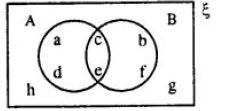
Answer:
Let's first list the elements of each set by looking at the regions in the Venn diagram:
Set \( A \) contains: \( \{a, c, d, e\} \)
Set \( B \) contains: \( \{b, c, e, f\} \)
Universal set \( \xi \) contains all elements: \( \{a, b, c, d, e, f, g, h\} \)
(i) \( A \cup B \):
All elements in \( A \) or \( B \) or both: \( A \cup B = \{a, c, d, e\} \cup \{b, c, e, f\} = \{a, b, c, d, e, f\} \)
(ii) \( A' \cap B \):
Elements not in \( A \) that are in \( B \) (which is exactly \( B - A \)): \( A' = \{b, f, g, h\} \) \( A' \cap B = \{b, f, g, h\} \cap \{b, c, e, f\} = \{b, f\} \)
(iii) \( A - B \):
Elements in \( A \) but not in \( B \): \( A - B = \{a, c, d, e\} - \{b, c, e, f\} = \{a, d\} \)
(iv) \( B - A \):
Elements in \( B \) but not in \( A \): \( B - A = \{b, c, e, f\} - \{a, c, d, e\} = \{b, f\} \)
(v) \( (A \cup B)' \):
Elements in the universal set that are outside both \( A \) and \( B \): \( (A \cup B)' = \{g, h\} \)
In simple words: Find which region of the diagram each letter belongs to. Circle A is on the left, Circle B is on the right, and the intersection is where they overlap.
Exam Tip: Remember that \( A' \cap B \) is another way of writing \( B - A \). These mean the exact same region on a Venn diagram.
Question 2. From the given diagram, find :
(i) A'
(ii) B'
(iii) A' ∪ B'
(iv) (A ∩ B)'
Is A' ∪ B' = (A ∩ B)' ?
Also, verify if A' ∩ B' = (A ∪ B)'.
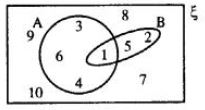 Answer:
By analyzing the Venn diagram, we identify the sets:
Universal set \( \xi = \{1, 2, 3, 4, 5, 6, 7, 8, 9, 10\} \)
Set \( A = \{1, 3, 4, 6\} \)
Set \( B = \{1, 2, 5\} \)
Now we answer each sub-part:
(i) \( A' \):
All elements outside set A: \( A' = \{2, 5, 7, 8, 9, 10\} \)
(ii) \( B' \):
All elements outside set B: \( B' = \{3, 4, 6, 7, 8, 9, 10\} \)
(iii) \( A' \cup B' \):
Combine all unique elements of \( A' \) and \( B' \): \( A' \cup B' = \{2, 3, 4, 5, 6, 7, 8, 9, 10\} \)
(iv) \( (A \cap B)' \):
First find \( A \cap B = \{1\} \).
Now find the complement of \( A \cap B \): \( (A \cap B)' = \{2, 3, 4, 5, 6, 7, 8, 9, 10\} \)
Comparing parts (iii) and (iv):
Since both sets equal \( \{2, 3, 4, 5, 6, 7, 8, 9, 10\} \), we can say: \( A' \cup B' = (A \cap B)' \) is true.
Next, verify \( A' \cap B' = (A \cup B)' \):
First compute \( A' \cap B' \): \( A' \cap B' = \{2, 5, 7, 8, 9, 10\} \cap \{3, 4, 6, 7, 8, 9, 10\} = \{7, 8, 9, 10\} \)
Next compute \( (A \cup B)' \): \( A \cup B = \{1, 2, 3, 4, 5, 6\} \) \( (A \cup B)' = \{7, 8, 9, 10\} \)
Since both calculations result in \( \{7, 8, 9, 10\} \), we verify that: \( A' \cap B' = (A \cup B)' \) is true.
In simple words: Write down all numbers inside the outer box to find the universal set. Then find the complements by choosing the numbers that lie outside the specified circles.
Exam Tip: Double-check that you include elements written outside both circles (like 7, 8, 9, 10) when writing the universal set. Leaving them out is a common source of errors in complement calculations.
Question 3. Use the given diagram to find :
(i) A ∪ (B ∩ C)
(ii) B - (A - C)
(iii) A - B
(iv) A ∩ B'
Is A ∩ B' = A - B ?
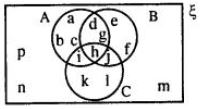
Answer:
By examining the regions of the 3-circle Venn diagram, we identify the sets:
\( A = \{a, b, c, d, g, h, i\} \)
\( B = \{d, e, f, g, h, j\} \)
\( C = \{h, i, j, k, l\} \)
Universal set \( \xi = \{a, b, c, d, e, f, g, h, i, j, k, l, m, n, p\} \)
(i) Find \( A \cup (B \cap C) \):
First find \( B \cap C \): \( B \cap C = \{d, e, f, g, h, j\} \cap \{h, i, j, k, l\} = \{h, j\} \)
Now find the union: \( A \cup (B \cap C) = \{a, b, c, d, g, h, i\} \cup \{h, j\} = \{a, b, c, d, g, h, i, j\} \)
(ii) Find \( B - (A - C) \):
First find \( A - C \): \( A - C = \{a, b, c, d, g, h, i\} - \{h, i, j, k, l\} = \{a, b, c, d, g\} \)
Now find the difference: \( B - (A - C) = \{d, e, f, g, h, j\} - \{a, b, c, d, g\} = \{e, f, h, j\} \)
(iii) Find \( A - B \): \( A - B = \{a, b, c, d, g, h, i\} - \{d, e, f, g, h, j\} = \{a, b, c, i\} \)
(iv) Find \( A \cap B' \):
First find \( B' \): \( B' = \{a, b, c, i, k, l, m, n, p\} \)
Now find the intersection: \( A \cap B' = \{a, b, c, d, g, h, i\} \cap \{a, b, c, i, k, l, m, n, p\} = \{a, b, c, i\} \)
Comparing parts (iii) and (iv):
Since both calculations equal \( \{a, b, c, i\} \), we can confirm: \( A \cap B' = A - B \) is true.
In simple words: This problem uses a three-circle diagram. First list the letters in each circle carefully. Then, complete the subtraction and intersection steps.
Exam Tip: Be methodical when finding elements in a three-set Venn diagram. Ensure you check all three intersecting regions before writing down the contents of each set.
Question 4. Use the given Venn-diagram to find :
(i) B - A
(ii) A
(iii) B'
(iv) A ∩ B
(v) A ∪ B
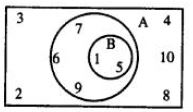
Answer:
By looking at the diagram, we can see that set B is fully inside set A (meaning B is a subset of A):
Set \( B = \{1, 5\} \)
Set \( A = \{1, 5, 6, 7, 9\} \)
Universal set \( \xi = \{1, 2, 3, 4, 5, 6, 7, 8, 9, 10\} \)
(i) \( B - A \):
Since B has no elements that are outside A: \( B - A = \{\} \) (or \( \phi \))
(ii) \( A \): \( A = \{1, 5, 6, 7, 9\} \)
(iii) \( B' \):
All elements outside circle B: \( B' = \{2, 3, 4, 6, 7, 8, 9, 10\} \)
(iv) \( A \cap B \):
Since B is inside A, their intersection is just set B: \( A \cap B = \{1, 5\} \)
(v) \( A \cup B \):
Since B is inside A, their union is just set A: \( A \cup B = \{1, 5, 6, 7, 9\} \)
In simple words: Circle B is completely inside Circle A. This means every element of B is also a part of A, so subtracting A from B leaves you with an empty set.
Exam Tip: When \( B \subseteq A \), remember that \( B - A = \phi \), \( A \cap B = B \), and \( A \cup B = A \). Using these shortcut rules saves time during verification.
Question 5. Draw a Venn-diagram to show the relationship between two overlapping sets A and B. Now shade the region representing :
(i) A ∩ B
(ii) A ∪ B
(iii) B - A
Answer:
For overlapping sets, we draw two intersecting circles. The shaded regions for each part are:
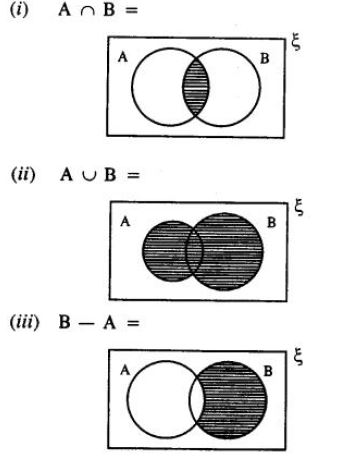
In simple words: Overlapping circles overlap in the middle. We shade the center for intersection, both circles for union, and only the right crescent for B minus A.
Exam Tip: Use a compass to draw clean circles, and use light, parallel shading lines to make the region boundaries clear to the examiner.
Question 6. Draw a Venn-diagram to show the relationship between two sets A and B ; such that A ⊆ B. Now shade the region representing :
(i) A ∪ B
(ii) B' ∩ A
(iii) A ∩ B
(iv) (A ∪ B)'
Answer:
When \( A \subseteq B \), we draw circle A completely inside circle B:
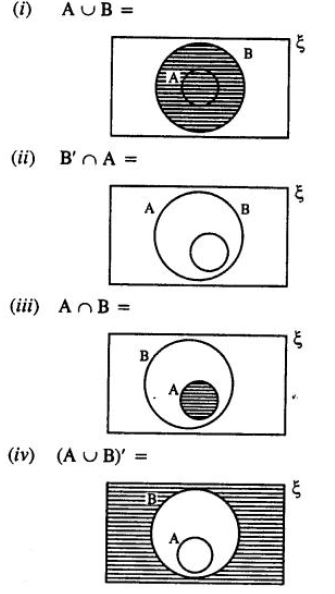
In simple words: When a set is inside another, the smaller one is a subset. We shade accordingly: the outer circle for union, the inner circle for intersection, and the box outside for complement.
Exam Tip: If a set is empty (like \( B' \cap A \)), leave the circles unshaded. Writing a note stating "Null set, hence unshaded" confirms your reasoning to the examiner.
Question 7. Two sets A and B are such that A ∩ B = 𝜙. Draw a Venn-diagram to show the relationship between A and B. Shade the region representing :
(i) A ∪ B
(ii) (A ∪ B)'
(iii) B - A
(iv) B ∩ A'
Answer:
Since \( A \cap B = \phi \), the two sets are disjoint, meaning we draw them as separate circles with no overlap:
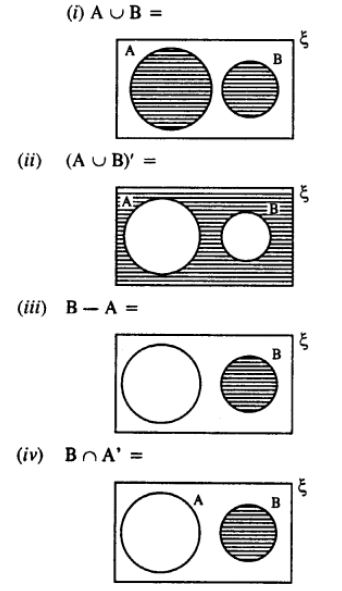
In simple words: When sets have nothing in common, they are disjoint circles. They do not touch. Subtraction of one from the other leaves the circle completely shaded.
Exam Tip: Be sure to recognize that \( B - A \) and \( B \cap A' \) represent the exact same region. For disjoint sets, this region is simply the entire set B.
Question 8. State the sets represented by the shaded portion of following venn-diagrams :
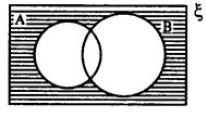
Answer:
By analyzing the shaded regions in the provided diagrams, we find:
(i) The shaded area lies entirely outside both circle A and circle B. This is the complement of their union:
\( (A \cup B)' \)
(ii) The shaded area is only the crescent portion of B that does not overlap with A. This is set B minus set A:
\( B - A \) (or \( B \cap A' \))
(iii) The shaded area covers the entire rectangular box except the crescent portion of B. This is the complement of set \( B - A \):
\( (B - A)' \) (or \( A \cup B' \))
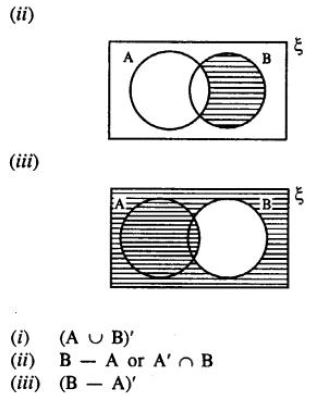
In simple words: Look at what is colored in the drawing. If the color is only outside both circles, it is the complement of their union. If it is only the right side of circle B, it is B minus A. If everything except that right crescent is colored, it is the complement of B minus A.
Exam Tip: To solve these quickly, identify the unshaded white regions first. Writing the expression for the white region and then taking its complement (adding a prime mark) often gives the quickest path to the correct answer.
Question 9. In each of the given diagrams, shade the region which represents the set given underneath the diagram :
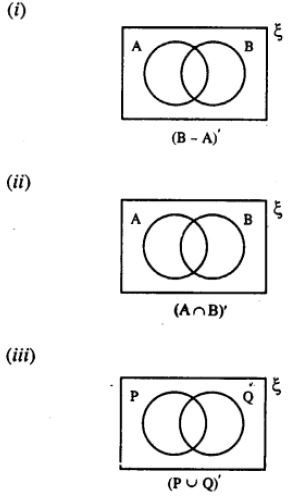
Answer:
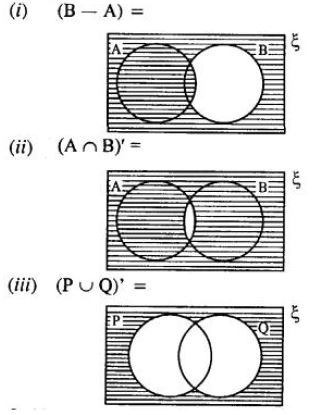
In simple words: Complement means shading everything except the area described by the set inside the brackets.
Exam Tip: When shading complements, first locate the region inside the parentheses and lightly outline it. Then fill in everything else outside that outline.
Question 10. From the given diagram, find :
(i) (A ∪ B)-C
(ii) B-(A ∩ C)
(iii) (B ∩ C) ∪ A
Verify : A-(B ∩ C) = (A - B) ∪ (A - C)
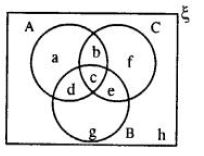
Answer:
First, let's write down the elements of each set based on the regions of the 3-circle Venn diagram:
\( A = \{a, b, c, d\} \)
\( B = \{c, d, e, g\} \)
\( C = \{b, c, e, f\} \)
(i) \( (A \cup B) - C \):
Find \( A \cup B \): \( A \cup B = \{a, b, c, d, e, g\} \)
Now subtract \( C \): \( (A \cup B) - C = \{a, b, c, d, e, g\} - \{b, c, e, f\} = \{a, d, g\} \)
(ii) \( B - (A \cap C) \):
Find \( A \cap C \): \( A \cap C = \{b, c\} \)
Now subtract this intersection from set B: \( B - (A \cap C) = \{c, d, e, g\} - \{b, c\} = \{d, e, g\} \)
(iii) \( (B \cap C) \cup A \):
Find \( B \cap C \): \( B \cap C = \{c, e\} \)
Now find the union with A: \( (B \cap C) \cup A = \{c, e\} \cup \{a, b, c, d\} = \{a, b, c, d, e\} \)
Verification:
Verify \( A - (B \cap C) = (A - B) \cup (A - C) \):
Left Hand Side (LHS):
We know \( B \cap C = \{c, e\} \). \( LHS = A - (B \cap C) = \{a, b, c, d\} - \{c, e\} = \{a, b, d\} \)
Right Hand Side (RHS):
Find \( A - B \): \( A - B = \{a, b, c, d\} - \{c, d, e, g\} = \{a, b\} \)
Find \( A - C \): \( A - C = \{a, b, c, d\} - \{b, c, e, f\} = \{a, d\} \)
Find their union: \( RHS = (A - B) \cup (A - C) = \{a, b\} \cup \{a, d\} = \{a, b, d\} \)
Since \( LHS = RHS = \{a, b, d\} \), the property is verified
In simple words: Write down what lies in each of the three circles by looking closely at the letters in the diagram. Then compute both sides of the last equation to confirm they yield the same result.
Exam Tip: Be meticulous with letter placement. For example, `c` is in the central intersection of all three sets, while `d` is in the intersection of A and B but outside C.
Question 11. Using the given diagram, express the following sets in the terms of A and B.
(i) {a,d}
(ii) {a,d,c,f}
(iii) {a,d,c,f,g,h}
(iv) {a,d,g,h}
(v) {g,h}
Answer:
Let us write down the definitions of the sets from the diagram:
Set \( A \) contains: \( \{a, b, d, e\} \)
Set \( B \) contains: \( \{b, c, e, f\} \)
Universal set \( \xi \) contains: \( \{a, b, c, d, e, f, g, h\} \)
(i) \( \{a, d\} \):
These elements belong to set A but not to set B: \( \{a, d\} = A - B \)
(ii) \( \{a, d, c, f\} \):
These are the elements of \( A \cup B \) excluding the intersection \( A \cap B \): \( \{a, d, c, f\} = (A \cup B) - (A \cap B) \)
Alternatively, it represents the union of the two individual differences: \( (A - B) \cup (B - A) \)
(iii) \( \{a, d, c, f, g, h\} \):
These are all elements of the universal set except the intersection elements \( \{b, e\} \): \( \{a, d, c, f, g, h\} = (A \cap B)' \)
(iv) \( \{a, d, g, h\} \):
These are all elements that lie completely outside set B: \( \{a, d, g, h\} = B' \)
(v) \( \{g, h\} \):
These are the elements that lie completely outside both circle A and circle B: \( \{g, h\} = (A \cup B)' \)
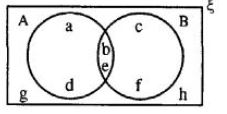
In simple words: Match the list of letters given in the questions to the physical regions of the circles. Use set concepts like intersection, union, subtraction, and complements to describe them.
Exam Tip: Memorize symmetric difference representations. The set of elements belonging to either A or B but not both can be written as \( (A \cup B) - (A \cap B) \), which is a common exam favorite.
Free study material for Mathematics
ICSE Selina Concise Solutions Class 8 Mathematics Chapter 6 Sets
Students can now access the detailed Selina Concise Solutions for Chapter 6 Sets on our portal. These solutions have been carefully prepared as per latest ICSE Class 8 syllabus. Each solution given above has been updated based on the current year pattern to ensure Class 8 students have the most updated Mathematics content.
Master Selina Concise Textbook Questions
Our subject experts have provided detailed explanations for all the questions found in the Selina Concise textbook for Class 8 Mathematics. We have focussed on making the concepts easy for you in Chapter 6 Sets so that students can understand the concepts behind every answer. For all numerical problems and theoretical concepts these solutions will help in strengthening your analytical skill required for the ICSE examinations.
Complete Mathematics Exam Preparation
By using these Selina Concise Class 8 solutions, you can enhance your learning and identify areas that need more attention. We recommend solving the Mathematics Questions from the textbook first and then use our teacher-verified answers. For a proper revision of Chapter 6 Sets, students should also also check our Revision Notes and Sample Papers available on studiestoday.com.
FAQs
You can download the verified Selina Concise solutions for Chapter 6 Sets on StudiesToday.com. Our teachers have prepared answers for Class 8 Mathematics as per 2026-27 ICSE academic session.
Yes, our solutions for Chapter 6 Sets are designed as per new 2026 ICSE standards. 40% competency-based questions required for Class 8, are included to help students understand application-based logic behind every Mathematics answer.
Yes, every exercise in Chapter 6 Sets from the Selina Concise textbook has been solved step-by-step. Class 8 students will learn Mathematics conceots before their ICSE exams.
Yes, follow structured format of these Selina Concise solutions for Chapter 6 Sets to get full 20% internal assessment marks and use Class 8 Mathematics projects and viva preparation as per ICSE 2026 guidelines.