

ICSE Solutions Selina Concise Class 9 Mathematics Chapter 14 Rectilinear Figures have been provided below and is also available in Pdf for free download. The Selina Concise ICSE solutions for Class 9 Mathematics have been prepared as per the latest syllabus and ICSE books and examination pattern suggested in Class 9. Questions given in ICSE Selina Concise book for Class 9 Mathematics are an important part of exams for Class 9 Mathematics and if answered properly can help you to get higher marks. Refer to more Chapter-wise answers for ICSE Class 9 Mathematics and also download more latest study material for all subjects. Chapter 14 Rectilinear Figures is an important topic in Class 9, please refer to answers provided below to help you score better in exams
Selina Concise Chapter 14 Rectilinear Figures Class 9 Mathematics ICSE Solutions
Class 9 Mathematics students should refer to the following ICSE questions with answers for Chapter 14 Rectilinear Figures in Class 9. These ICSE Solutions with answers for Class 9 Mathematics will come in exams and help you to score good marks
Chapter 14 Rectilinear Figures Selina Concise ICSE Solutions Class 9 Mathematics
Exercise 14(A)
Question 1. The sum of the interior angles of a polygon is four times the sum of its exterior angles. Find the number of sides in the polygon.
Answer: The sum of all exterior angles for any convex polygon is a constant \( 360^\circ \). According to the given condition, the sum of the interior angles of this polygon is four times this value: \[ \text{Sum of interior angles} = 4 \times 360^\circ = 1440^\circ \] The formula for the sum of the interior angles of a polygon with \( n \) sides is given by: \[ (2n - 4) \times 90^\circ = 1440^\circ \] Dividing both sides of the equation by \( 90^\circ \): \[ 2n - 4 = 16 \] \[ 2n = 20 \] \[ n = 10 \] Therefore, the polygon has 10 sides.
In simple words: The outer angles of any polygon always add up to \( 360^\circ \). Since the inside angles are four times that, they total \( 1440^\circ \). Using the angle formula, we find the shape has 10 sides.
Exam Tip: Always remember that the sum of the exterior angles of any polygon is always \( 360^\circ \). This constant value helps to quickly find the sum of the interior angles when a relationship is given.
Question 2. The angles of a pentagon are in the ratio 4 : 8 : 6 : 4 : 5. Find each angle of the pentagon.
Answer: Let the five interior angles of the pentagon be represented as \( 4x \), \( 8x \), \( 6x \), \( 4x \), and \( 5x \) respectively. The total sum of the interior angles of a pentagon (\( n = 5 \)) is calculated using the formula: \[ \text{Sum} = (2 \times 5 - 4) \times 90^\circ = 6 \times 90^\circ = 540^\circ \] By summing all the individual angles and setting them equal to \( 540^\circ \), we get: \[ 4x + 8x + 6x + 4x + 5x = 540^\circ \] \[ 27x = 540^\circ \] \[ x = 20^\circ \] Now, we calculate the measure of each angle: - First angle: \( 4 \times 20^\circ = 80^\circ \) - Second angle: \( 8 \times 20^\circ = 160^\circ \) - Third angle: \( 6 \times 20^\circ = 120^\circ \) - Fourth angle: \( 4 \times 20^\circ = 80^\circ \) - Fifth angle: \( 5 \times 20^\circ = 100^\circ \) Thus, the angles of the pentagon are \( 80^\circ \), \( 160^\circ \), \( 120^\circ \), \( 80^\circ \), and \( 100^\circ \).
In simple words: First, find the sum of all angles in a five-sided shape, which is \( 540^\circ \). Adding the parts of the ratio gives \( 27x = 540^\circ \), so \( x = 20^\circ \). Multiply this by each part of the ratio to get the final angles.
Exam Tip: You can easily verify your final calculations by adding all the individual angles together - they must sum to exactly \( 540^\circ \) for a pentagon.
Question 3. One angle of a six-sided polygon is 140° and the other angles are equal. Find the measure of each equal angle.
Answer: Let the measure of each of the remaining five equal angles be represented by \( x \). The total sum of the interior angles of a six-sided polygon (a hexagon, where \( n = 6 \)) is: \[ \text{Sum} = (2 \times 6 - 4) \times 90^\circ = 8 \times 90^\circ = 720^\circ \] Using the given information, we can set up the following equation: \[ 140^\circ + 5x = 720^\circ \] \[ 5x = 720^\circ - 140^\circ \] \[ 5x = 580^\circ \] \[ x = 116^\circ \] Therefore, the measure of each of the five equal angles is \( 116^\circ \).
In simple words: A six-sided shape has inside angles that add up to \( 720^\circ \). Subtracting the known \( 140^\circ \) angle leaves \( 580^\circ \) to be divided equally among the remaining five angles, which gives \( 116^\circ \) each.
Exam Tip: Be careful to subtract the single given angle first before dividing the remainder by the number of equal angles.
Question 4. In a polygon, there are 5 right angles and the remaining angles are equal to 195° each. Find the number of sides in the polygon.
Answer: Let the total number of sides of the polygon be \( n \). There are 5 right angles, which means their combined sum is: \[ 5 \times 90^\circ = 450^\circ \] Since the polygon has \( n \) sides, the remaining number of angles is \( n - 5 \), and each of these measures \( 195^\circ \). The total sum of the interior angles of an \( n \)-sided polygon is given by \( (2n - 4) \times 90^\circ \). Therefore, we can write the equation: \[ 5 \times 90^\circ + (n - 5) \times 195^\circ = (2n - 4) \times 90^\circ \] \[ 450 + 195n - 975 = 180n - 360 \] \[ 195n - 525 = 180n - 360 \] \[ 195n - 180n = 525 - 360 \] \[ 15n = 165 \] \[ n = 11 \] Thus, the polygon has 11 sides.
In simple words: Let \( n \) be the number of sides. We create an equation where the 5 right angles plus the remaining \( (n-5) \) angles of \( 195^\circ \) equal the formula for total angles. Solving this gives 11 sides.
Exam Tip: Ensure proper algebraic expansion of \( 195(n - 5) \) to avoid common sign or multiplication errors during calculations.
Question 5. Three angles of a seven-sided polygon are 132° each and the remaining four angles are equal. Find the value of each equal angle.
Answer: Let \( x \) represent the measure of each of the remaining four equal angles. For a seven-sided polygon (a heptagon, where \( n = 7 \)), the total sum of the interior angles is: \[ \text{Sum} = (2 \times 7 - 4) \times 90^\circ = 10 \times 90^\circ = 900^\circ \] Based on the problem statement, we can write: \[ 3 \times 132^\circ + 4x = 900^\circ \] \[ 396^\circ + 4x = 900^\circ \] \[ 4x = 900^\circ - 396^\circ \] \[ 4x = 504^\circ \] \[ x = 126^\circ \] Hence, the value of each equal angle is \( 126^\circ \).
In simple words: A seven-sided shape's inside angles total \( 900^\circ \). Subtracting the three angles of \( 132^\circ \) each leaves \( 504^\circ \). Dividing this leftover sum by the 4 equal angles gives \( 126^\circ \) each.
Exam Tip: Clearly show the calculation step for the sum of interior angles to secure method marks before solving the linear equation.
Question 6. Two angles of an eight-sided polygon are 142° and 176°. If the remaining angles are equal to each other; find the magnitude of each of the equal angles.
Answer: Let \( x \) be the measure of each of the remaining six equal angles. For an eight-sided polygon (an octagon, where \( n = 8 \)), the sum of all interior angles is: \[ \text{Sum} = (2 \times 8 - 4) \times 90^\circ = 12 \times 90^\circ = 1080^\circ \] We can establish the equation for the sum of all interior angles as: \[ 142^\circ + 176^\circ + 6x = 1080^\circ \] \[ 318^\circ + 6x = 1080^\circ \] \[ 6x = 1080^\circ - 318^\circ \] \[ 6x = 762^\circ \] \[ x = 127^\circ \] Therefore, each of the remaining equal angles measures \( 127^\circ \).
In simple words: An eight-sided shape has inside angles that add up to \( 1080^\circ \). Subtracting the two known angles (\( 142^\circ \) and \( 176^\circ \)) leaves \( 762^\circ \). Dividing this by the remaining 6 angles gives \( 127^\circ \) each.
Exam Tip: Count the number of remaining angles carefully - subtracting the 2 given angles from the total 8 angles leaves exactly 6 equal angles.
Question 7. In a pentagon ABCDE, AB is parallel to DC and ∠A : ∠E : ∠D = 3 : 4 : 5. Find angle E.
Answer: Let the measures of the angles \( A \), \( E \), and \( D \) be represented as \( 3x \), \( 4x \), and \( 5x \) respectively. Since AB is parallel to DC, and BC is a transversal, the consecutive interior angles \( B \) and \( C \) are supplementary: \[ \angle B + \angle C = 180^\circ \] The total sum of the interior angles of a pentagon (\( n = 5 \)) is: \[ \text{Sum} = (2 \times 5 - 4) \times 90^\circ = 6 \times 90^\circ = 540^\circ \] Thus, we can write: \[ \angle A + \angle B + \angle C + \angle D + \angle E = 540^\circ \] Substituting the known values and expressions: \[ 3x + 180^\circ + 5x + 4x = 540^\circ \] \[ 12x + 180^\circ = 540^\circ \] \[ 12x = 360^\circ \] \[ x = 30^\circ \] Now, we calculate the measure of angle E: \[ \angle E = 4 \times 30^\circ = 120^\circ \] Thus, the measure of angle E is \( 120^\circ \).
In simple words: Because two sides of the pentagon are parallel, the angles at \( B \) and \( C \) add up to \( 180^\circ \). Adding this to the other three angles (written as \( 3x \), \( 4x \), and \( 5x \)) gives \( 540^\circ \). Solving for \( x \) gives \( 30^\circ \), which means angle E is \( 120^\circ \).
Exam Tip: When parallel lines are specified, look for supplementary consecutive interior angles to find a direct shortcut relationship.
Question 8. AB, BC and CD are the three consecutive sides of a regular polygon. If ∠BAC = 15°; find:
(i) each interior angle of the polygon,
(ii) each exterior angle of the polygon,
(iii) number of sides of the polygon.
Answer:
(i) Since the polygon is regular, the adjacent sides are equal in length, so \( AB = BC \). In the isosceles triangle ABC, the angles opposite to the equal sides must also be equal: \[ \angle BCA = \angle BAC = 15^\circ \] The sum of angles in triangle ABC is \( 180^\circ \): \[ \angle B + \angle BAC + \angle BCA = 180^\circ \] \[ \angle B + 15^\circ + 15^\circ = 180^\circ \] \[ \angle B + 30^\circ = 180^\circ \] \[ \angle B = 150^\circ \] Since the polygon is regular, all its interior angles are equal. Thus, each interior angle of the polygon measures \( 150^\circ \). (ii) An interior angle and its corresponding exterior angle are supplementary: \[ \text{Each exterior angle} = 180^\circ - 150^\circ = 30^\circ \] (iii) Let \( n \) be the total number of sides of this regular polygon. We know that the sum of all exterior angles is \( 360^\circ \): \[ n \times 30^\circ = 360^\circ \] \[ n = \frac{360^\circ}{30^\circ} = 12 \] So, the number of sides in the polygon is 12.
In simple words: Since the shape is regular, triangle ABC is isosceles with two \( 15^\circ \) angles, which makes the interior corner angle \( B = 150^\circ \). The exterior angle is therefore \( 30^\circ \). Dividing \( 360^\circ \) by \( 30^\circ \) gives 12 sides.
Exam Tip: Drawing a quick sketch of the triangle ABC helps visualize why it is isosceles, which prevents initial conceptual mistakes.
Question 9. The ratio between an exterior angle and an interior angle of a regular polygon is 2 : 3. Find the number of sides in the polygon.
Answer: Let the measure of each exterior angle be \( 2k \) and each interior angle be \( 3k \) respectively. Since the sum of an interior angle and an exterior angle at any vertex of a polygon is always \( 180^\circ \): \[ 2k + 3k = 180^\circ \] \[ 5k = 180^\circ \] \[ k = 36^\circ \] This allows us to find the measure of each exterior angle: \[ \text{Exterior angle} = 2 \times 36^\circ = 72^\circ \] Let \( n \) be the number of sides of the regular polygon. The formula relating the exterior angle to the number of sides is: \[ n = \frac{360^\circ}{\text{Exterior Angle}} \] \[ n = \frac{360^\circ}{72^\circ} = 5 \] Thus, the polygon has 5 sides.
In simple words: Inside and outside angles always add up to \( 180^\circ \). Dividing \( 180^\circ \) by the 5 parts of the ratio gives \( 36^\circ \) per part. The exterior angle is 2 parts, which is \( 72^\circ \). Dividing \( 360^\circ \) by \( 72^\circ \) gives 5 sides.
Exam Tip: Using the exterior angle to find the number of sides is much faster and less prone to calculation errors than using the interior angle formula.
Question 10. The difference between an exterior angle of (n - 1) sided regular polygon and an exterior angle of (n + 2) sided regular polygon is 6°. Find the value of n.
Answer: Let the exterior angle of the regular polygon with \( n - 1 \) sides be \( x \), and the exterior angle of the regular polygon with \( n + 2 \) sides be \( y \). The exterior angle of a regular polygon with \( N \) sides is given by the formula \( \frac{360^\circ}{N} \). Thus, we can write: \[ x = \frac{360^\circ}{n - 1} \] \[ y = \frac{360^\circ}{n + 2} \] According to the given condition, the difference between these exterior angles is \( 6^\circ \): \[ x - y = 6^\circ \] \[ \frac{360^\circ}{n - 1} - \frac{360^\circ}{n + 2} = 6^\circ \] Dividing the entire equation by 6: \[ \frac{60}{n - 1} - \frac{60}{n + 2} = 1 \] Taking a common denominator: \[ 60 \left[ \frac{(n + 2) - (n - 1)}{(n - 1)(n + 2)} \right] = 1 \] \[ 60 \left[ \frac{3}{n^2 + n - 2} \right] = 1 \] \[ 180 = n^2 + n - 2 \] \[ n^2 + n - 182 = 0 \] Factoring the quadratic equation: \[ n^2 + 14n - 13n - 182 = 0 \] \[ n(n + 14) - 13(n + 14) = 0 \] \[ (n - 13)(n + 14) = 0 \] Since the number of sides \( n \) must be a positive integer, we discard the negative root: \[ n = 13 \] So, the value of \( n \) is 13.
In simple words: Write the formulas for the exterior angles of both shapes. Setting their difference to \( 6^\circ \) leads to a quadratic equation. Solving it gives the positive answer \( n = 13 \).
Exam Tip: Since the number of sides can never be negative, always discard the negative value obtained when solving quadratic equations in geometry.
Question 11. Two alternate sides of a regular polygon, when produced, meet at right angle. Find:
(i) the value of each exterior angle of the polygon;
(ii) the number of sides in the polygon.
Answer:
(i) Let the consecutive sides of the regular polygon be AB, BC, CD, etc. When the alternate sides AB and CD are produced, they meet at a point P such that they intersect at a right angle, meaning: \[ \angle P = 90^\circ \] In triangle BPC, the exterior angles at vertices B and C of the polygon are \( \angle PBC \) and \( \angle PCB \) respectively. Since the polygon is regular, all its exterior angles are equal, say, \( x \). Therefore, in triangle BPC: \[ \angle PBC = x \quad \text{and} \quad \angle PCB = x \] By the angle sum property of a triangle: \[ \angle PBC + \angle PCB + \angle P = 180^\circ \] \[ x + x + 90^\circ = 180^\circ \] \[ 2x = 90^\circ \] \[ x = 45^\circ \] Thus, the value of each exterior angle of the polygon is \( 45^\circ \). (ii) Let \( n \) be the number of sides of this regular polygon. The formula for the number of sides is: \[ n = \frac{360^\circ}{\text{Each Exterior Angle}} \] \[ n = \frac{360^\circ}{45^\circ} = 8 \] Therefore, the regular polygon has 8 sides.
In simple words: Extending two alternate sides forms a small right-angled triangle. Because the polygon is regular, the other two angles in this triangle are equal to the exterior angle of the polygon. They must add up to \( 90^\circ \), so each is \( 45^\circ \). This means the shape has 8 sides.
Exam Tip: Visualizing the alternate sides as forming a triangle with two exterior angles of the polygon is key to solving this problem quickly.
Exercise 14(B)
Question 1. State, true or false:
(i) The diagonals of a rectangle bisect each other.
(ii) The diagonals of a quadrilateral bisect each other.
(iii) The diagonals of a parallelogram bisect each other at right angle.
(iv) Each diagonal of a rhombus bisects it.
(v) The quadrilateral, whose four sides are equal, is a square.
(vi) Every rhombus is a parallelogram.
(vii) Every parallelogram is a rhombus.
(viii) Diagonals of a rhombus are equal.
(ix) If two adjacent sides of a parallelogram are equal, it is a rhombus.
(x) If the diagonals of a quadrilateral bisect each other at right angle, the quadrilateral is a square.
Answer:
(i) True. Since a rectangle is a specific type of parallelogram, it inherits all its properties. One of these properties is that the diagonals bisect one another. (ii) False. This is not a universal property for all quadrilaterals. For example, in an irregular quadrilateral, the diagonals can intersect without cutting each other into two equal halves
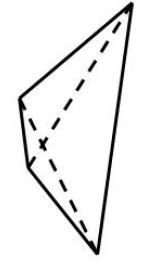
(iii) False. Although the diagonals of a parallelogram always bisect each other, they do not necessarily intersect at a \( 90^\circ \) angle. A basic rectangle serves as a clear counterexample. (iv) True. A rhombus is a type of parallelogram. Since the diagonals of any parallelogram bisect each other, the same holds true for a rhombus. (v) False. A quadrilateral with four equal sides is defined as a rhombus. It only qualifies as a square if its interior angles are also right angles. (vi) True. By definition, a parallelogram is a quadrilateral with opposite sides parallel and equal. Since a rhombus has all four sides equal and its opposite sides are parallel, it is always a parallelogram. (vii) False. A generic parallelogram is not required to have all four sides equal - only its opposite sides must be equal. Therefore, every parallelogram cannot be classified as a rhombus. (viii) False. The diagonals of a rhombus are perpendicular to one another, but they are typically of unequal lengths unless the shape is a square. (ix) True. A parallelogram has opposite sides of equal length. If its adjacent sides are also equal, then all four sides must be equal, which forms a rhombus. (x) False. If a quadrilateral's diagonals bisect each other at a right angle, it is a rhombus. It is not necessarily a square unless all its interior angles are also right angles.
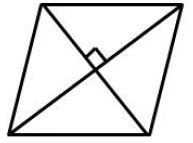
In simple words: These statements test the properties of different shapes. For instance, a rectangle is a parallelogram, but its diagonals do not cross at \( 90^\circ \). A rhombus has equal sides, but it is not a square unless its corners are also \( 90^\circ \).
Exam Tip: Memorize the hierarchy of quadrilaterals (e.g., every square is both a rectangle and a rhombus, but the reverse is not always true) to quickly solve true/false questions.
Question 2. In the figure, given below, AM bisects angle A and DM bisects angle D of parallelogram ABCD. Prove that: ∠AMD = 90°
Answer: In the parallelogram ABCD, consecutive angles are supplementary, so: \[ \angle A + \angle D = 180^\circ \] Dividing the entire equation by 2: \[ \frac{\angle A}{2} + \frac{\angle D}{2} = 90^\circ \] Since AM and DM are the angle bisectors of \( \angle A \) and \( \angle D \) respectively: \[ \angle MAD = \frac{\angle A}{2} \quad \text{and} \quad \angle MDA = \frac{\angle D}{2} \] Thus, we have: \[ \angle MAD + \angle MDA = 90^\circ \] Now, consider triangle ADM. The sum of all interior angles of a triangle is \( 180^\circ \): \[ \angle MAD + \angle MDA + \angle AMD = 180^\circ \] Substituting the sum of the two angles: \[ 90^\circ + \angle AMD = 180^\circ \] \[ \angle AMD = 90^\circ \] Hence proved.
In simple words: In any parallelogram, the two adjacent corner angles on the same side always add up to \( 180^\circ \). Since the lines cut those two corner angles exactly in half, the two half-angles inside the triangle add up to \( 90^\circ \). This leaves exactly \( 90^\circ \) for the third angle at \( M \).
Exam Tip: Whenever you see angle bisectors of consecutive angles in a parallelogram, always use the supplementary angles property to quickly prove a right angle.
Question 3. In the following figure, AE and BC are equal and parallel and the three sides AB, CD and DE are equal to one another. If angle A is 102°, find the angles AEC and BCD.
Answer:
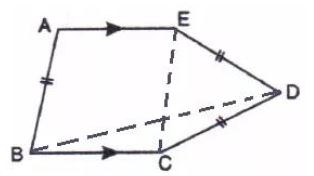
Given that \( AE = BC \) and \( AE \parallel BC \), the quadrilateral AECB is a parallelogram. In a parallelogram, adjacent angles are supplementary: \[ \angle A + \angle B = 180^\circ \] \[ 102^\circ + \angle B = 180^\circ \] \[ \angle B = 78^\circ \] Opposite angles in a parallelogram are equal: \[ \angle AEC = \angle B = 78^\circ \] \[ \angle BEC = \angle A = 102^\circ \] Since AECB is a parallelogram, the opposite sides are equal in length: \[ EC = AB \] We are given that \( AB = CD = DE \). Therefore, we can establish that: \[ EC = CD = DE \] This makes triangle ECD an equilateral triangle. Thus, all interior angles of triangle ECD are \( 60^\circ \): \[ \angle ECD = 60^\circ \] Now, we can find the total measure of angle BCD: \[ \angle BCD = \angle BEC + \angle ECD \] \[ \angle BCD = 102^\circ + 60^\circ = 162^\circ \] Thus, \( \angle AEC = 78^\circ \) and \( \angle BCD = 162^\circ \).
In simple words: Because two opposite sides are equal and parallel, the shape on the left is a parallelogram. This tells us the corner angle at \( E \) is \( 78^\circ \) and the angle at \( C \) inside the parallelogram is \( 102^\circ \). Since the remaining sides are all equal, the right-hand triangle is equilateral with a \( 60^\circ \) angle. Adding these together gives \( 162^\circ \) for angle BCD.
Exam Tip: Clearly identify the equilateral triangle by linking the parallelogram side equality to the given side equalities. This is a crucial step that examiners look for.
Question 4. In a square ABCD, diagonals meet at O. P is a point on BC such that OB=BP. Show that:
(i) ∠POC = 22 ½°
(ii) ∠BDC = 2 ∠POC
(iii) ∠BOP = 3 ∠CPO
Answer:
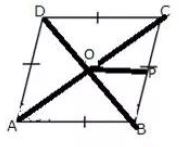
In square ABCD, the diagonals AC and BD bisect each other perpendicularly at point O. Thus, we have: \[ \angle BOC = 90^\circ \] Since the diagonal bisects the corner angles of the square: \[ \angle OBC = 45^\circ \] In triangle OBP, we are given that \( OB = BP \). Therefore, the angles opposite to these sides are equal: \[ \angle BOP = \angle BPO \] The sum of angles in triangle OBP is \( 180^\circ \): \[ \angle OBP + \angle BOP + \angle BPO = 180^\circ \] \[ 45^\circ + 2 \angle BOP = 180^\circ \] \[ 2 \angle BOP = 135^\circ \] \[ \angle BOP = 67.5^\circ \] (i) Since \( \angle BOC = 90^\circ \), we can find \( \angle POC \): \[ \angle POC = \angle BOC - \angle BOP \] \[ \angle POC = 90^\circ - 67.5^\circ = 22.5^\circ = 22\frac{1}{2}^\circ \] Hence proved. (ii) The diagonal BD also bisects \( \angle D \), meaning: \[ \angle BDC = 45^\circ \] Since \( \angle POC = 22.5^\circ \): \[ 2 \angle POC = 2 \times 22.5^\circ = 45^\circ \] Therefore: \[ \angle BDC = 2 \angle POC \] Hence proved. (iii) We have: \[ \angle BOP = 67.5^\circ \] Since \( \angle COP = \angle POC = 22.5^\circ \): \[ 3 \angle COP = 3 \times 22.5^\circ = 67.5^\circ \] Thus, we get: \[ \angle BOP = 3 \angle COP \] Hence proved.
In simple words: Diagonals of a square cross at \( 90^\circ \). Because \( OB = BP \), the triangle \( OBP \) is isosceles with its vertex angle at \( B \) being \( 45^\circ \). This means its other two angles are \( 67.5^\circ \). Subtracting this from \( 90^\circ \) gives \( 22.5^\circ \) for angle POC, which is exactly half of \( 45^\circ \) (angle BDC) and one-third of \( 67.5^\circ \) (angle BOP).
Exam Tip: Clearly state that the diagonals of a square are perpendicular bisectors of each other and bisect the corner angles to write down the \( 90^\circ \) and \( 45^\circ \) angles with confidence.
Question 5. The given figure shows a square ABCD and an equilateral triangle ABP. Calculate:
(i) ∠AOB
(ii) ∠BPC
(iii) ∠PCD
(iv) Reflex ∠APD
Answer:
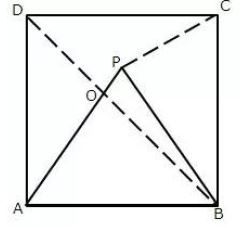
In square ABCD: (i) Since APB is an equilateral triangle: \[ \angle PAB = 60^\circ \] The diagonal BD bisects \( \angle B \): \[ \angle ABD = \angle ABO = 45^\circ \] In triangle AOB, the sum of the angles is \( 180^\circ \): \[ \angle PAB + \angle ABO + \angle AOB = 180^\circ \] \[ 60^\circ + 45^\circ + \angle AOB = 180^\circ \] \[ 105^\circ + \angle AOB = 180^\circ \] \[ \angle AOB = 75^\circ \] (ii) Since ABCD is a square: \[ \angle ABC = 90^\circ \quad \text{and} \quad BC = AB \] Since APB is equilateral: \[ \angle ABP = 60^\circ \quad \text{and} \quad BP = AB \] Thus, we have: \[ BC = BP \] Which means triangle BPC is an isosceles triangle with \( \angle BPC = \angle BCP \). The vertex angle of this triangle is: \[ \angle PBC = \angle ABC - \angle ABP = 90^\circ - 60^\circ = 30^\circ \] In triangle BPC: \[ \angle PBC + \angle BPC + \angle BCP = 180^\circ \] \[ 30^\circ + 2 \angle BPC = 180^\circ \] \[ 2 \angle BPC = 150^\circ \] \[ \angle BPC = 75^\circ \] (iii) We know that: \[ \angle BCD = 90^\circ \] From the above, \( \angle BCP = 75^\circ \). Therefore: \[ \angle PCD = \angle BCD - \angle BCP = 90^\circ - 75^\circ = 15^\circ \] (iv) Since the square and equilateral triangle are symmetric, triangle APD is congruent to triangle BPC. Thus, we have: \[ \angle APD = \angle BPC = 75^\circ \] The sum of angles around point P is \( 360^\circ \): \[ \angle APB + \angle BPC + \angle APD + \angle CPD = 360^\circ \] We know \( \angle APB = 60^\circ \) (equilateral triangle) and \( \angle BPC = \angle APD = 75^\circ \). Therefore: \[ \angle APD + \angle APB + \angle BPC = 75^\circ + 60^\circ + 75^\circ = 210^\circ \] The reflex angle APD is: \[ \text{Reflex } \angle APD = 360^\circ - 135^\circ = 225^\circ \]
In simple words: APB is equilateral, so its angle is \( 60^\circ \). The square's diagonal forms a \( 45^\circ \) angle. In triangle AOB, this leaves \( 75^\circ \) for angle AOB. Triangle BPC is isosceles with a top angle of \( 30^\circ \), so its base angles are \( 75^\circ \). Subtracting \( 75^\circ \) from \( 90^\circ \) leaves \( 15^\circ \) for angle PCD. Finally, the reflex angle is \( 225^\circ \).
Exam Tip: Remember that when an equilateral triangle is constructed on a side of a square, it creates isosceles triangles on the sides, which is the key to finding all remaining angles.
Question 6. In the given figure ABCD is a rhombus with angle A = 67°. If DEC is an equilateral triangle, calculate:
(i) ∠CBE
(ii) ∠DBE
Answer:
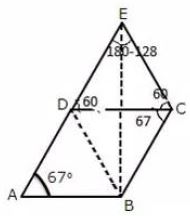
In the rhombus ABCD: The opposite angles are equal: \[ \angle C = \angle A = 67^\circ \] Consecutive angles in a rhombus are supplementary: \[ \angle B + \angle A = 180^\circ \] \[ \angle B = 180^\circ - 67^\circ = 113^\circ \] Since the sides of a rhombus are equal in length, in triangle DBC we have \( DC = CB \), which means \( \angle CDB = \angle CBD \). Using the angle sum property in triangle DBC: \[ \angle CDB + \angle CBD + \angle BCD = 180^\circ \] \[ 2 \angle CBD + 67^\circ = 180^\circ \] \[ 2 \angle CBD = 113^\circ \] \[ \angle CBD = 56.5^\circ \] (i) Now consider triangle DCE, which is an equilateral triangle. Thus, \( EC = CD \) and \( \angle DCE = 60^\circ \). Since \( CD = CB \) (sides of the rhombus), we have: \[ EC = CB \] This means triangle BCE is an isosceles triangle with \( \angle CBE = \angle CEB \). We find the vertex angle \( \angle BCE \): \[ \angle BCE = \angle BCD + \angle DCE = 67^\circ + 60^\circ = 127^\circ \] In triangle BCE: \[ \angle CBE + \angle CEB + \angle BCE = 180^\circ \] \[ 2 \angle CBE + 127^\circ = 180^\circ \] \[ 2 \angle CBE = 53^\circ \] \[ \angle CBE = 26.5^\circ \] (ii) We can find \( \angle DBE \): \[ \angle DBE = \angle CBD - \angle CBE \] \[ \angle DBE = 56.5^\circ - 26.5^\circ = 30^\circ \]
In simple words: Since ABCD is a rhombus, the opposite angle is \( 67^\circ \). Adding the equilateral triangle's angle of \( 60^\circ \) gives \( 127^\circ \) for angle BCE. Triangle BCE has two equal sides, so its other angles are \( 26.5^\circ \). Subtracting this from the half-diagonal angle of \( 56.5^\circ \) leaves exactly \( 30^\circ \) for angle DBE.
Exam Tip: Make sure to add the rhombus angle and the equilateral triangle angle together correctly depending on whether the triangle lies on the outside of the rhombus.
Exercise 14(B)
Question 7. In each of the following figures, ABCD is a parallelogram. Find the values of x and y.
(i) ABCD is a parallelogram with sides AD = 4y, BC = 3x - 3, AB = 6y + 2, and DC = 4x.
(ii) ABCD is a parallelogram with angles \(\angle A = 4x + 20^\circ\), \(\angle B = 7y\), and \(\angle D = 6x + 3y - 8^\circ\).
Answer:
(i) Since ABCD is a parallelogram, its opposite sides must be equal in length.
This gives us two equations: AD = BC and AB = CD.
Using the given expressions, we have:
\(4y = 3x - 3 \implies 3x - 4y = 3\) --- (1)
\(6y + 2 = 4x \implies 4x - 6y = 2\) --- (2)
To solve this system, we can express \(x\) from equation (1) as \(x = \frac{4y + 3}{3}\).
Substituting this value into equation (2) yields:
\(4\left(\frac{4y + 3}{3}\right) - 6y = 2\)
Multiplying the entire equation by 3:
\(16y + 12 - 18y = 6\)
\(-2y = -6 \implies y = 3\)
Now, substitute \(y = 3\) back into equation (1):
\(3x - 4(3) = 3\)
\(3x - 12 = 3\)
\(3x = 15 \implies x = 5\)
Thus, the values are \(x = 5\) and \(y = 3\).
(ii) In the parallelogram ABCD, opposite angles are equal and adjacent angles are supplementary.
Since opposite angles are equal:
\(\angle B = \angle D \implies 7y = 6x + 3y - 8^\circ \implies 4y - 6x = -8^\circ \implies 3x - 2y = 4^\circ\) --- (1)
Adjacent angles are supplementary:
\(\angle A + \angle B = 180^\circ \implies (4x + 20^\circ) + 7y = 180^\circ \implies 4x + 7y = 160^\circ\) --- (2)
From (1), we can write:
\(2y = 3x - 4 \implies y = \frac{3x - 4}{2}\)
Substitute this into equation (2):
\(4x + 7\left(\frac{3x - 4}{2}\right) = 160\)
Multiply the entire equation by 2:
\(8x + 21x - 28 = 320\)
\(29x = 348 \implies x = 12\)
Substitute \(x = 12\) into the expression for \(y\):
\(y = \frac{3(12) - 4}{2} = \frac{32}{2} = 16\)
Hence, we find \(x = 12^\circ\) and \(y = 16^\circ\).
In simple words: In any parallelogram, the opposite sides are always equal, and the opposite angles are equal too. We can set up simple equations using these rules to solve for x and y.
Exam Tip: Remember that adjacent angles in a parallelogram add up to 180 degrees (supplementary), whereas opposite angles are equal. Carefully identify which angles are adjacent and which are opposite to avoid setting up wrong equations.
Question 8. Given that the angles of a quadrilateral are in the ratio 3 : 4 : 5 : 6, show that the quadrilateral is a trapezium.
Answer: Let the four angles of the quadrilateral be represented as \(3x\), \(4x\), \(5x\), and \(6x\).
Since the sum of all interior angles of any quadrilateral is \(360^\circ\), we can write:
\(3x + 4x + 5x + 6x = 360^\circ\)
\(18x = 360^\circ\)
\(\implies x = 20^\circ\)
Now, we calculate the individual angles:
First angle = \(3 \times 20^\circ = 60^\circ\)
Second angle = \(4 \times 20^\circ = 80^\circ\)
Third angle = \(5 \times 20^\circ = 100^\circ\)
Fourth angle = \(6 \times 20^\circ = 120^\circ\)
Notice that the sum of the adjacent interior angles on one side is:
\(60^\circ + 120^\circ = 180^\circ\)
Also, the sum of the other pair of adjacent interior angles is:
\(80^\circ + 100^\circ = 180^\circ\)
Since these consecutive interior angles are supplementary, one pair of opposite sides is parallel. A quadrilateral with exactly one pair of parallel sides is a trapezium. Hence, the given quadrilateral is a trapezium.
In simple words: The angles inside a four-sided shape always add up to 360 degrees. After finding the actual angles, we see that the side-by-side angles on the left and right add up to 180 degrees. This means the top and bottom lines are parallel, which makes the shape a trapezium.
Exam Tip: To prove a quadrilateral is a trapezium, you must show that at least one pair of opposite sides is parallel. This is done by showing that the consecutive interior angles add up to 180 degrees.
Question 9. In a parallelogram ABCD, AB = 20 cm and AD = 12 cm. The bisector of angle A meets DC at E and BC produced at F. Find the length of CF.
Answer: We are given that ABCD is a parallelogram with \(AB = 20\text{ cm}\) and \(AD = 12\text{ cm}\).
Let the angle bisector of \(\angle A\) be the line AF, which intersects DC at E and the extension of BC at F.
Since AB is parallel to DF, the alternate interior angles must be equal:
\(\angle BFA = \angle DAF\)
As AF bisects \(\angle A\), we also have:
\(\angle BAF = \angle DAF\)
This implies:
\(\angle BAF = \angle BFA\)
In triangle ABF, since two base angles are equal, it is an isosceles triangle. Therefore:
\(BF = AB = 20\text{ cm}\)
Since opposite sides of a parallelogram are equal:
\(BC = AD = 12\text{ cm}\)
The total length of BF is the sum of BC and CF:
\(BF = BC + CF\)
Substituting the known values:
\(20 = 12 + CF \implies CF = 8\text{ cm}\)
Therefore, the length of CF is \(8\text{ cm}\).
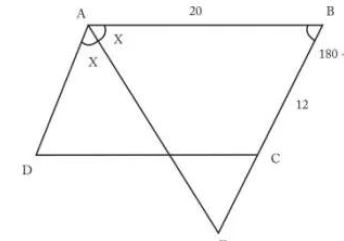
In simple words: Since the line AF cuts angle A in half and the opposite sides of the parallelogram are parallel, triangle ABF has two equal angles. This makes it an isosceles triangle where AB and BF are equal to 20 cm. Since BC is 12 cm, the extra part CF must be 8 cm.
Exam Tip: Whenever an angle bisector in a parallelogram meets a side or its extension, it always creates an isosceles triangle. Identifying this triangle and equating its sides is the key to solving such problems quickly.
Question 10. In a parallelogram ABCD, AP and AQ are perpendiculars from the vertex of obtuse angle A to the sides BC and CD respectively. If the angles x : y = 2 : 1, find all the angles of the parallelogram.
Answer: In the figure, AQCP forms a quadrilateral.
The sum of all interior angles of a quadrilateral is \(360^\circ\). Since AP and AQ are perpendiculars:
\(\angle APC = 90^\circ\) and \(\angle AQC = 90^\circ\).
Let \(\angle PAQ = y\) and \(\angle C = x\). Thus:
\(x + y + 90^\circ + 90^\circ = 360^\circ\)
\(x + y = 180^\circ\)
We are given the ratio:
\(x : y = 2 : 1 \implies x = 2y\)
Substituting \(x = 2y\) into our equation:
\(2y + y = 180^\circ\)
\(3y = 180^\circ \implies y = 60^\circ\)
So, \(x = 2(60^\circ) = 120^\circ\)
Thus, the opposite angles of the parallelogram are equal:
\(\angle C = \angle A = x = 120^\circ\)
The adjacent angles are supplementary:
\(\angle B = \angle D = 180^\circ - x = 180^\circ - 120^\circ = 60^\circ\)
Therefore, the angles of the parallelogram are \(120^\circ\), \(60^\circ\), \(120^\circ\), and \(60^\circ\).
In simple words: By looking at the small four-sided shape AQCP, its angles must add up to 360 degrees. Since two of its angles are 90 degrees, the other two must add up to 180 degrees. Using the given 2:1 ratio, we find the angles are 120 and 60 degrees.
Exam Tip: Always look for smaller geometric figures within a larger diagram. Recognizing that AQCP is a quadrilateral with two right angles allows you to set up the supplementary relationship \(x + y = 180^\circ\) immediately.
Exercise 14(C)
Question 1. E is the midpoint of side AB and F is the midpoint of side DC of parallelogram ABCD. Prove that AEFD is a parallelogram.
Answer: In parallelogram ABCD, opposite sides are parallel and equal:
\(AB \parallel DC\) and \(AB = DC\).
Since E is the midpoint of AB and F is the midpoint of DC:
\(AE = \frac{1}{2}AB\) and \(DF = \frac{1}{2}DC\).
Given \(AB = DC\), we get:
\(AE = DF\)
Since \(AB \parallel DC\), any segments of these lines are also parallel:
\(AE \parallel DF\)
In quadrilateral AEFD, one pair of opposite sides (AE and DF) is both equal and parallel. Therefore, AEFD is a parallelogram.
In simple words: Since the top and bottom sides of a parallelogram are equal and parallel, their halves must also be equal and parallel. This makes the smaller shape, AEFD, a parallelogram as well.
Exam Tip: To prove a quadrilateral is a parallelogram, it is sufficient to show that just one pair of opposite sides is both parallel and equal in length. This is a very common shortcut in geometry proofs.
Question 2. The diagonal BD of a parallelogram ABCD bisects angles B and D. Prove that ABCD is a rhombus.
Answer: Let ABCD be a parallelogram where the diagonal BD bisects both \(\angle B\) and \(\angle D\).
This means:
\(\angle ABD = \angle CBD = \frac{1}{2}\angle ABC\)
\(\angle ADB = \angle CDB = \frac{1}{2}\angle ADC\)
Since opposite angles of a parallelogram are equal:
\(\angle ABC = \angle ADC \implies \frac{1}{2}\angle ABC = \frac{1}{2}\angle ADC\)
Therefore, we have:
\(\angle ABD = \angle ADB\) and \(\angle CBD = \angle CDB\)
In \(\Delta ABD\), since \(\angle ABD = \angle ADB\), the sides opposite to these equal angles must be equal:
\(AB = AD\)
Similarly, in \(\Delta CBD\), we have:
\(CD = BC\)
Since ABCD is a parallelogram, its opposite sides are equal:
\(AB = CD\) and \(AD = BC\)
Combining these results, we get:
\(AB = BC = CD = AD\)
A parallelogram with all four sides equal is a rhombus. Thus, ABCD is a rhombus.
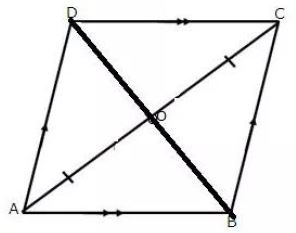
In simple words: Since the diagonal bisects the equal opposite angles of the parallelogram, it creates two isosceles triangles on either side. This proves that all four sides of the parallelogram are equal, making it a rhombus.
Exam Tip: A rhombus is defined as a parallelogram with adjacent sides equal. To prove a shape is a rhombus, first establish that it is a parallelogram, and then prove any two adjacent sides are equal.
Question 3. In a parallelogram ABCD, points E and F are on the diagonal AC such that AE = EF = FC. Prove that DEBF is a parallelogram.
Answer: We are given a parallelogram ABCD with points E and F on the diagonal AC such that \(AE = EF = FC\).
Let us consider \(\Delta ADE\) and \(\Delta CBF\):
1. \(AD = BC\) (Opposite sides of parallelogram ABCD are equal)
2. \(\angle DAE = \angle BCF\) (Alternate interior angles since \(AD \parallel BC\))
3. \(AE = FC\) (Given)
By the Side-Angle-Side (SAS) congruence criterion:
\(\Delta ADE \cong \Delta CBF\)
Thus, by CPCTC:
\(DE = BF\) --- (1)
Next, let us consider \(\Delta ABF\) and \(\Delta CDE\):
1. \(AB = CD\) (Opposite sides of parallelogram ABCD are equal)
2. \(\angle BAF = \angle DCE\) (Alternate interior angles since \(AB \parallel CD\))
3. We know that \(AF = AE + EF\) and \(CE = FC + EF\). Since \(AE = FC\), it follows that \(AF = CE\).
By the Side-Angle-Side (SAS) congruence criterion:
\(\Delta ABF \cong \Delta CDE\)
Thus, by CPCTC:
\(DF = BE\) --- (2)
In quadrilateral DEBF, from equations (1) and (2), both pairs of opposite sides are equal:
\(DE = BF\) and \(DF = BE\)
Since a quadrilateral with both pairs of opposite sides equal is a parallelogram, we conclude that DEBF is a parallelogram.
In simple words: By comparing the triangles on opposite sides of the diagonal, we can prove they are identical (congruent). This shows that the opposite sides of the inner shape, DEBF, are equal to each other, which proves that DEBF is a parallelogram.
Exam Tip: Remember to clearly define the triangles you are comparing and state the congruency rule (like SAS) used to prove them congruent. Showing that opposite sides are equal is a solid way to prove a parallelogram.
Question 4. In the alongside diagram, ABCD is a parallelogram in which AP bisects angle A and BQ bisects angle B. Prove that: (i) AQ = BP, (ii) PQ = CD, (iii) QPCD is a parallelogram.
Answer: Let us examine the triangles \(\Delta AOQ\) and \(\Delta BOP\):
- \(\angle AOQ = \angle BOP\) (Vertically opposite angles)
- \(\angle OAQ = \angle OBP\) (Alternate interior angles as the sides are parallel)
Using these angle relationships, we find \(\Delta AOQ \cong \Delta BOP\) (by AAS congruence).
Thus, we get:
\(AQ = BP\) --- (1)
Now, let us examine \(\Delta QOP\) and \(\Delta AOB\):
- \(\angle AOB = \angle QOP\) (Vertically opposite angles)
- \(\angle OAB = \angle OPQ\) (Alternate interior angles)
This gives \(\Delta QOP \cong \Delta AOB\) (by AAS congruence).
Consequently:
\(PQ = AB\)
Since ABCD is a parallelogram, we know \(AB = CD\). Therefore:
\(PQ = CD\) --- (2)
Finally, let us consider the quadrilateral QPCD:
Since \(AD = BC\) and \(AQ = BP\), the remaining parts must be equal:
\(DQ = CP\)
Also, because \(AD \parallel BC\), we have:
\(DQ \parallel CP\)
With one pair of opposite sides both equal and parallel (\(DQ = CP\) and \(DQ \parallel CP\)), we conclude that QPCD is a parallelogram.
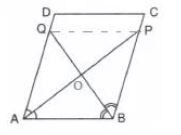
In simple words: By comparing the small triangles inside, we show that the line segments AQ and BP are equal. Subtracting these from the equal outer sides AD and BC leaves us with equal and parallel segments DQ and CP, which proves that QPCD is a parallelogram.
Exam Tip: Be precise when quoting angle properties like "alternate interior angles" or "vertically opposite angles" as these are key reasons examiners look for when awarding marks in congruence proofs.
Question 5. In the given figure, ABCD is a parallelogram. The bisectors of interior angles A and B meet at a point E on the side CD. Prove that AB = 2BC.
Answer: Since ABCD is a parallelogram, the sum of adjacent interior angles is \(180^\circ\):
\(\angle A + \angle B = 180^\circ\)
Let the bisectors of \(\angle A\) and \(\angle B\) meet at E.
In \(\Delta AEB\):
\(\frac{\angle A}{2} + \frac{\angle B}{2} + \angle AEB = 180^\circ\)
Since \(\angle A + \angle B = 180^\circ\), we have:
\(\frac{\angle A}{2} + \frac{\angle B}{2} = 90^\circ\)
Therefore, \(\angle AEB = 90^\circ\).
Let \(\angle E1\) be the angle \(\angle AED\) and \(\angle E2\) be \(\angle BEC\).
Since AE is the bisector of \(\angle A\):
\(\angle DAE = \angle BAE = \frac{\angle A}{2}\)
Since \(AB \parallel CD\), the alternate interior angles are equal:
\(\angle AED = \angle BAE = \frac{\angle A}{2} \implies \angle E1 = \frac{\angle A}{2}\)
In \(\Delta ADE\), since \(\angle DAE = \angle AED = \frac{\angle A}{2}\), it is an isosceles triangle:
\(DE = AD\)
Similarly, BE is the bisector of \(\angle B\):
\(\angle CBE = \angle ABE = \frac{\angle B}{2}\)
By alternate interior angles:
\(\angle BEC = \angle ABE = \frac{\angle B}{2} \implies \angle E2 = \frac{\angle B}{2}\)
In \(\Delta BCE\), since \(\angle CBE = \angle BEC = \frac{\angle B}{2}\), it is also an isosceles triangle:
\(EC = BC\)
Now, the total length of side AB is equal to CD:
\(AB = CD = DE + EC\)
Substituting our previous findings:
\(AB = AD + BC\)
Since \(AD = BC\) (opposite sides of parallelogram ABCD are equal):
\(AB = BC + BC = 2BC\)
Hence proved.
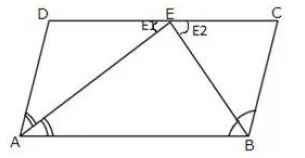
In simple words: The angle bisectors create two isosceles triangles on the sides, which means the top segment DE equals AD, and EC equals BC. Since the opposite sides of a parallelogram are equal, the total length of the top side AB is the sum of these two, which equals twice BC.
Exam Tip: Use alternate interior angles to transition from angle bisectors to proving that a triangle is isosceles. This is a very common technique in parallelogram questions.
Question 6. In a parallelogram ABCD, the bisectors of adjacent angles \(\angle ADC\) and \(\angle BCD\) meet at E, and the bisectors of adjacent angles \(\angle ABC\) and \(\angle BCD\) meet at F. Prove that DE is parallel to BF.
Answer: From the parallelogram ABCD, we have:
\(\angle ADC + \angle BCD = 180^\circ\) (Sum of adjacent interior angles)
Dividing by 2:
\(\frac{\angle ADC}{2} + \frac{\angle BCD}{2} = 90^\circ\)
Since DE and CE are bisectors, this becomes:
\(\angle EDC + \angle ECD = 90^\circ\)
In \(\Delta ECD\), the sum of angles is \(180^\circ\):
\(\angle EDC + \angle ECD + \angle CED = 180^\circ\)
\(90^\circ + \angle CED = 180^\circ \implies \angle CED = 90^\circ\)
Similarly, in \(\Delta BCF\), using the angle bisectors of \(\angle B\) and \(\angle C\):
\(\angle BFC = 90^\circ\)
Now we have:
\(\angle BFC = \angle CED = 90^\circ\)
Since these corresponding angles are equal, the lines DE and BF must be parallel. Hence proved.
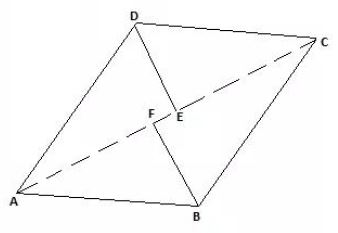
In simple words: Since the adjacent angles of a parallelogram add up to 180 degrees, the sum of their halves is 90 degrees. This makes both of the triangles ECD and BCF right-angled triangles. Since both lines DE and BF make a 90-degree angle with the same transversal, they must be parallel.
Exam Tip: Showing that two lines are perpendicular to the same line (or line segment) is a very powerful and quick way to prove that they are parallel to each other.
Question 7. Prove that the bisectors of the interior angles of a parallelogram form a rectangle.
Answer: Let ABCD be a parallelogram. AE, BF, CG, and DH are the bisectors of the interior angles \(\angle A\), \(\angle B\), \(\angle C\), and \(\angle D\) respectively, which intersect to form quadrilateral LKJI.
Since consecutive interior angles of a parallelogram are supplementary:
\(\angle BAD + \angle ABC = 180^\circ\)
Since AE and BF are the angle bisectors:
\(\angle BAJ = \frac{1}{2}\angle BAD\) and \(\angle ABJ = \frac{1}{2}\angle ABC\)
Therefore, we have:
\(\angle BAJ + \angle ABJ = \frac{1}{2}(\angle BAD + \angle ABC) = \frac{1}{2}(180^\circ) = 90^\circ\)
In \(\Delta ABJ\), the sum of angles is \(180^\circ\):
\(\angle BAJ + \angle ABJ + \angle AJB = 180^\circ\)
\(90^\circ + \angle AJB = 180^\circ \implies \angle AJB = 90^\circ\)
Since \(\angle LKJ\) and \(\angle AJB\) are vertically opposite angles:
\(\angle LKJ = \angle AJB = 90^\circ\)
By following the same method for \(\Delta CDK\), we find:
\(\angle LIK = 90^\circ\)
And for \(\Delta ADH\):
\(\angle IHL = 90^\circ \implies \angle ILJ = 90^\circ\) (vertically opposite)
Since three angles of quadrilateral LKJI are \(90^\circ\), the fourth angle must also be \(90^\circ\) (since the sum of angles is \(360^\circ\)).
A quadrilateral with all four interior angles equal to \(90^\circ\) is a rectangle. Thus, LKJI is a rectangle.
In simple words: The bisectors of any two adjacent angles in a parallelogram always meet at a 90-degree angle. Since this happens at every corner, all four corners of the inner shape LKJI have 90-degree angles, which proves it is a rectangle.
Exam Tip: To prove a shape is a rectangle, show that it is a quadrilateral with at least three right angles. Since the sum of angles is 360 degrees, the fourth angle is automatically 90 degrees.
Question 8. In a parallelogram ABCD, the bisectors of angles A, B, C, and D form a quadrilateral PQRS. Prove that PQRS is a rectangle.
Answer: Let the bisectors of the interior angles \(\angle A\), \(\angle B\), \(\angle C\), and \(\angle D\) of parallelogram ABCD intersect to form quadrilateral PQRS.
Since the sum of adjacent interior angles in a parallelogram is \(180^\circ\):
\(\angle DCB + \angle ABC = 180^\circ\)
Taking half of both angles:
\(\frac{1}{2}\angle DCB + \frac{1}{2}\angle ABC = 90^\circ\)
Let \(\angle 1 = \frac{1}{2}\angle DCB\) and \(\angle 2 = \frac{1}{2}\angle ABC\). Thus:
\(\angle 1 + \angle 2 = 90^\circ\)
In \(\Delta CQB\), the sum of angles is \(180^\circ\):
\(\angle 1 + \angle 2 + \angle CQB = 180^\circ\)
\(90^\circ + \angle CQB = 180^\circ \implies \angle CQB = 90^\circ\)
Since \(\angle RQP\) and \(\angle CQB\) are vertically opposite angles:
\(\angle RQP = \angle CQB = 90^\circ\)
Similarly, by considering the other triangles formed by the bisectors, we can prove that:
\(\angle QSR = \angle RSP = \angle SPQ = 90^\circ\)
Since all four interior angles of quadrilateral PQRS are right angles, PQRS is a rectangle. Hence proved.
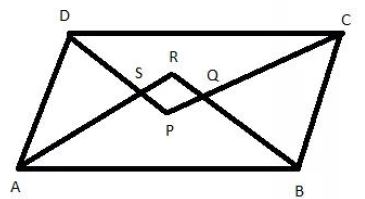
In simple words: The angle bisectors from adjacent corners of a parallelogram meet to form 90-degree angles. This happens at each side of the inner shape PQRS, which means all its corner angles are 90 degrees, making it a rectangle.
Exam Tip: Clearly define each angle using numbers like \(\angle 1\) and \(\angle 2\) in your diagram. This keeps your equations clean and easy for the examiner to follow.
Question 9. In a parallelogram ABCD, the bisector of angle A meets DC at P and AB = 2AD. Prove that: (i) BP bisects angle B, (ii) angle APB = 90°.
Answer: (i) Let \(AD = x\). Since \(AB = 2AD\), we have:
\(AB = 2x\)
Since ABCD is a parallelogram, opposite sides are equal:
\(CD = AB = 2x\) and \(BC = AD = x\)
Since AP bisects \(\angle A\):
\(\angle 1 = \angle 2\)
Since \(AB \parallel CD\), by alternate interior angles:
\(\angle 2 = \angle 5\)
Therefore, \(\angle 1 = \angle 5\).
In \(\Delta ADP\), since \(\angle 1 = \angle 5\), the opposite sides are equal:
\(DP = AD = x\)
Since \(CD = 2x\) and \(CD = DP + PC\):
\(2x = x + PC \implies PC = x\)
Since \(BC = x\) and \(PC = x\), in \(\Delta BPC\) the opposite angles are equal:
\(\angle 6 = \angle 4\)
Since \(AB \parallel CD\), by alternate interior angles:
\(\angle 6 = \angle 3\)
Therefore, \(\angle 3 = \angle 4\).
This means BP bisects \(\angle B\).
(ii) Since the adjacent interior angles of a parallelogram are supplementary:
\(\angle A + \angle B = 180^\circ\)
\(\implies (\angle 1 + \angle 2) + (\angle 3 + \angle 4) = 180^\circ\)
Since \(\angle 1 = \angle 2\) and \(\angle 3 = \angle 4\), we can substitute:
\(2\angle 2 + 2\angle 3 = 180^\circ \implies \angle 2 + \angle 3 = 90^\circ\)
In \(\Delta APB\), the sum of angles is \(180^\circ\):
\(\angle 2 + \angle 3 + \angle APB = 180^\circ\)
\(90^\circ + \angle APB = 180^\circ \implies \angle APB = 90^\circ\)
Hence proved.
In simple words: By using side lengths, we show that triangles ADP and BCP are both isosceles, which means BP must bisect angle B. Since the two adjacent angles A and B add up to 180 degrees, the sum of their halves is 90 degrees, leaving exactly 90 degrees for angle APB.
Exam Tip: When proving a bisecting property, use alternate interior angles to link different parts of the diagram together. Showing that a triangle is isosceles is often the key step.
Question 10. Points M and N are taken on the diagonal AC of a parallelogram ABCD such that AM = CN. Prove that BMDN is a parallelogram.
Answer:
Construction: Connect points B and D, intersecting diagonal AC at O.
Proof: We know that the diagonals of a parallelogram divide each other equally at their intersection.
Since ABCD is a parallelogram, the diagonals AC and BD intersect and bisect each other at O.
This means:
\( OC = OA \)
We are given:
\( AM = CN \)
On subtracting these two relations, we obtain:
\( OA - AM = OC - CN \)
\( \implies OM = ON \)
Additionally, since the diagonals of the larger parallelogram bisect each other:
\( OD = OB \)
In the quadrilateral BMDN, the diagonals BD and MN are such that:
\( OM = ON \) and \( OD = OB \)
Since its diagonals bisect each other, BMDN is a parallelogram.
In simple words: Since the diagonals of the main parallelogram ABCD cut each other in half at O, and the equal segments AM and CN are subtracted, the remaining parts OM and ON are equal. Since the diagonals BD and MN of the inner shape BMDN bisect each other, BMDN must be a parallelogram.
Exam Tip: To prove a quadrilateral is a parallelogram, showing that its diagonals bisect each other is often the quickest method when diagonal relationships are given.
Question 11. In the given figure, ABCD is a parallelogram and P is a point on CD. If AP = BP, prove that AP bisects angle A, BP bisects angle B, and \( \angle DAP + \angle BCP = \angle APB \).
Answer:
In triangles ADP and BCP:
\( AD = BC \) (Since opposite sides of a parallelogram are equal)
\( DP = CP \) (Since P is the midpoint of side CD)
\( \angle D = \angle C \) (Opposite angles of the parallelogram)
\( \implies \Delta ADP \cong \Delta BCP \) (Using Side-Angle-Side congruence)
Thus, by corresponding parts of congruent triangles (CPCT):
\( AP = BP \)
This implies that:
AP bisects \( \angle A \) and BP bisects \( \angle B \).
Now, in triangle APB:
\( AP = PB \)
Therefore, we obtain:
\( \angle APB = \angle DAP + \angle BCP \)
In simple words: By proving that the two side triangles ADP and BCP are congruent, we establish that AP equals BP. This symmetry means the lines AP and BP bisect their respective angles, and the central angle APB is the sum of the two corner angles.
Exam Tip: Be sure to label the congruence criterion (like SAS) clearly when proving triangles are identical, and state that corresponding sides are equal using CPCT.
Question 12. In a square ABCD, AP and DQ are two line segments such that AP = DQ, where P lies on BC and Q lies on AB. Prove that AP and DQ are perpendicular to each other.
Answer:
Let us analyze triangles DAQ and ABP:
\( \angle DAQ = \angle ABP = 90^\circ \) (Each corner angle of a square is a right angle)
\( DQ = AP \) (Given)
\( AD = AB \) (Sides of the square ABCD)
\( \implies \Delta DAQ \cong \Delta ABP \) (By RHS congruence criterion)
By corresponding parts of congruent triangles:
\( \angle PAB = \angle QDA \)
In the right-angled triangle ABP, we have:
\( \angle PAB + \angle APB = 90^\circ \)
Substituting \( \angle PAB = \angle QDA \) into this equation gives:
\( \angle QDA + \angle APB = 90^\circ \)
Now, let us consider triangle AOQ. By the angle sum property of a triangle:
\( \angle QDA + \angle APB + \angle AOD = 180^\circ \)
Substituting the sum of the first two angles:
\( 90^\circ + \angle AOD = 180^\circ \)
\( \implies \angle AOD = 90^\circ \)
This shows that the lines AP and DQ intersect at a right angle.
Hence, AP and DQ are perpendicular to each other.
In simple words: By showing triangles DAQ and ABP are identical, we find that their corresponding angles are equal. Adding these angles together inside the smaller triangle AOQ allows us to prove that the angle of intersection at O is exactly 90 degrees, meaning the lines are perpendicular.
Exam Tip: Remember that in a right-angled triangle, the two acute angles always sum to 90 degrees. Using this relation with congruent triangles is a standard way to prove lines are perpendicular.
Question 13. Given: ABCD is a quadrilateral where AB = AD and CB = CD. Prove that:
(i) AC bisects angle BAD.
(ii) AC is the perpendicular bisector of BD.
Answer:
(i) To prove AC bisects \( \angle BAD \):
In triangles ABC and ADC:
\( AB = AD \) (Given)
\( CB = CD \) (Given)
\( AC = AC \) (Common side)
\( \implies \Delta ABC \cong \Delta ADC \) (By SSS congruence criterion)
Therefore, by corresponding parts of congruent triangles (CPCT):
\( \angle BAC = \angle DAC \)
Hence, the diagonal AC bisects \( \angle BAD \).
(ii) To prove AC is the perpendicular bisector of BD:
Let AC and BD intersect at point O.
In triangles AOB and AOD:
\( AB = AD \) (Given)
\( \angle BAO = \angle DAO \) (Since AC bisects \( \angle BAD \))
\( AO = AO \) (Common side)
\( \implies \Delta AOB \cong \Delta AOD \) (By SAS congruence criterion)
By CPCT, we have:
\( OB = OD \) and \( \angle AOB = \angle AOD \)
Since \( \angle AOB \) and \( \angle AOD \) form a linear pair:
\( \angle AOB + \angle AOD = 180^\circ \)
Since they are equal:
\( \angle AOB = \angle AOD = 90^\circ \)
Thus, AC is perpendicular to BD and divides it into two equal halves.
Hence, AC is the perpendicular bisector of BD.
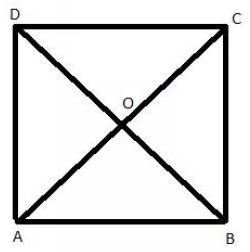
In simple words: First, we show that the top and bottom triangles are congruent to prove AC cuts the corner angle in half. Then, using that angle bisector, we prove the two left triangles are identical, which shows BD is cut in half at a 90-degree angle.
Exam Tip: When proving a line is a perpendicular bisector, you must establish two separate facts: first, that it intersects at a right angle (90 degrees), and second, that it bisects the line segment into two equal segments.
Question 14. In a trapezium ABCD, AB is parallel to DC and AD = BC. Prove that:
(i) \( \angle DAB = \angle CBA \)
(ii) \( \angle ADC = \angle BCD \)
(iii) AC = BD
(iv) OA = OB and OC = OD (where O is the intersection of the diagonals).
Answer:
(i) To prove \( \angle DAB = \angle CBA \):
Draw a line segment CE parallel to AD, meeting AB at E.
Since AD is parallel to CE and AE is parallel to CD, the quadrilateral AECD is a parallelogram.
Therefore, we have:
\( AD = CE \) (Opposite sides of a parallelogram)
But we are given:
\( AD = BC \)
This means:
\( CE = BC \)
In triangle BCE, since the two sides CE and BC are equal, their opposite angles are also equal:
\( \angle CEB = \angle CBE \)
For the parallel lines AD and CE with transversal AE:
\( \angle A + \angle CEB = 180^\circ \) (Co-interior angles)
Also, for the linear pair on line AB:
\( \angle B + \angle CBE = 180^\circ \)
Since \( \angle CEB = \angle CBE \), we can equate these to find:
\( \angle A = \angle B \)
Thus, \( \angle DAB = \angle CBA \).
(ii) To prove \( \angle ADC = \angle BCD \):
Since AB is parallel to CD:
\( \angle DAB + \angle ADC = 180^\circ \) (Co-interior angles)
\( \angle CBA + \angle BCD = 180^\circ \) (Co-interior angles)
Since we proved \( \angle DAB = \angle CBA \) in part (i), it follows that:
\( \angle ADC = \angle BCD \).
(iii) To prove \( AC = BD \):
In triangles ABC and BAD:
\( BC = AD \) (Given)
\( \angle CBA = \angle DAB \) (Proved above)
\( AB = BA \) (Common side)
\( \implies \Delta ABC \cong \Delta BAD \) (By SAS congruence criterion)
By CPCT, we get:
\( AC = BD \).
(iv) To prove \( OA = OB \) and \( OC = OD \):
Since \( \Delta ABC \cong \Delta BAD \), their corresponding angles are equal:
\( \angle CAB = \angle DBA \)
In triangle AOB, since the base angles are equal:
\( OA = OB \)
Since the total lengths of the diagonals are equal (\( AC = BD \)):
\( AC - OA = BD - OB \)
\( \implies OC = OD \).
In simple words: By drawing a line parallel to one of the non-parallel sides, we create a parallelogram and an isosceles triangle to show the base angles of the trapezium are equal. From there, we use triangle congruence to prove the diagonals are equal and intersect symmetrically.
Exam Tip: When dealing with trapezium proofs, drawing an auxiliary line parallel to one of the non-parallel sides is a highly effective construction step that immediately unlocks angle relationships.
Question 15. In a parallelogram ABCD, two points P and Q are taken on diagonal BD such that DP = BQ. Prove that APCQ is a parallelogram.
Answer:
Let us connect the diagonal AC to intersect BD at point O.
In any parallelogram, the two diagonals cut each other in half. Since ABCD is a parallelogram, AC and BD bisect each other at point O.
This gives us:
\( OB = OD \) and \( OA = OC \)
We are given that:
\( BQ = DP \)
Subtracting this from the first diagonal equality:
\( OB - BQ = OD - DP \)
\( \implies OQ = OP \)
Now, let us examine the four-sided figure APCQ. Its diagonals are AC and PQ.
From our calculations, we have:
\( OA = OC \) and \( OP = OQ \)
Since the diagonals AC and PQ bisect each other at O, APCQ must be a parallelogram.
In simple words: Since the diagonals of ABCD bisect each other, O is the exact midpoint of both AC and BD. Since we subtract equal distances BQ and DP from BD, the remaining segments OQ and OP must also be equal. This means the diagonals of APCQ cut each other in half, proving it is a parallelogram.
Exam Tip: Showing that diagonals of a smaller inner shape bisect each other is a very elegant way to prove it is a parallelogram, avoiding the need for multiple triangle congruence proofs.
Question 16. ABCD is a parallelogram. The bisector of \( \angle ADC \) meets the bisector of \( \angle BCD \) at E, and the bisector of \( \angle BCD \) meets the bisector of \( \angle ABC \) at F. If the bisector of \( \angle BCD \) is extended to G, prove that \( \angle CED = 90^\circ \), \( \angle CFG = 90^\circ \), and the lines DE and BG are parallel.
Answer:
In the parallelogram ABCD, the sum of adjacent angles is always \( 180^\circ \). Therefore:
\( \angle ADC + \angle BCD = 180^\circ \)
Dividing by 2, we get:
\( \frac{\angle ADC}{2} + \frac{\angle BCD}{2} = 90^\circ \)
Since DE and CE are the bisectors of \( \angle ADC \) and \( \angle BCD \):
\( \angle EDC + \angle ECD = 90^\circ \)
Now, in triangle CED, the sum of all angles is \( 180^\circ \):
\( \angle EDC + \angle ECD + \angle CED = 180^\circ \)
Substituting \( \angle EDC + \angle ECD = 90^\circ \) into this equation:
\( 90^\circ + \angle CED = 180^\circ \)
\( \implies \angle CED = 90^\circ \)
By applying the same method to triangle BCF with the angle bisectors CF and BF:
\( \angle BFC = 90^\circ \)
Since the angles on a straight line add up to \( 180^\circ \):
\( \angle BFC + \angle CFG = 180^\circ \)
\( \implies \angle CFG = 90^\circ \)
Since \( \angle CFG = \angle CED = 90^\circ \), these corresponding angles are equal, which implies that the line segments DE and BG are parallel.
In simple words: Since any two consecutive angles in a parallelogram add up to 180 degrees, their halves must add up to 90 degrees. This makes the third angle in both triangles CED and BFC equal to 90 degrees, proving that the lines DE and BG are perpendicular to CEF and thus parallel to each other.
Exam Tip: Remember that two lines are parallel if their corresponding angles with a transversal line are equal. Here, both DE and BG make a 90-degree angle with the line CEF, proving they are parallel.
Question 17. In a rectangle ABCD, the diagonals AC and BD intersect at right angles at M. Prove that ABCD is a square.
Answer:
To prove that ABCD is a square, we need to show that all its sides are of equal length and all its angles are right angles.
Since ABCD is given to be a rectangle, we already know:
\( \angle A = \angle B = \angle C = \angle D = 90^\circ \)
Also, the diagonals of a rectangle bisect each other, which gives:
\( MD = BM \) ... (i)
Now, let us compare triangles AMD and AMB:
\( MD = BM \) (From equation (i))
\( \angle AMD = \angle AMB = 90^\circ \) (Given that the diagonals intersect at right angles)
\( AM = AM \) (Common side)
\( \implies \Delta AMD \cong \Delta AMB \) (By SAS congruence criterion)
By corresponding parts of congruent triangles (CPCT), we get:
\( AD = AB \)
Since ABCD is a rectangle, its opposite sides are equal:
\( AD = BC \) and \( AB = CD \)
Combining these facts gives:
\( AB = BC = CD = AD \)
Since all sides are equal and each angle is \( 90^\circ \), ABCD is a square.
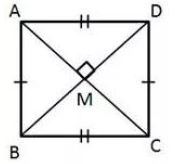
In simple words: Since ABCD is a rectangle, it already has four 90-degree angles. To show it is a square, we just need to prove all sides are equal. By using SAS congruence on two adjacent triangles formed by the perpendicular diagonals, we prove that the adjacent sides are equal, which makes all four sides equal.
Exam Tip: A rectangle is defined as a square if its adjacent sides are equal. Proving adjacent sides are equal using SAS congruence is the standard method for this proof.
Question 18. In the given figure, ABCD and PQRS are two parallelograms. If \( \angle ADC = 120^\circ \) and \( \angle PQR = 70^\circ \), find the value of x.
Answer:
In the parallelogram ABCD, the opposite angles are equal:
\( \angle DAB = \angle BCD \) and \( \angle ABC = \angle ADC = 120^\circ \)
Since the sum of the interior angles of a quadrilateral is \( 360^\circ \):
\( \angle DAB + \angle BCD + \angle ABC + \angle ADC = 360^\circ \)
Substituting the known values:
\( 2\angle BCD + 120^\circ + 120^\circ = 360^\circ \)
\( \implies 2\angle BCD + 240^\circ = 360^\circ \)
\( \implies 2\angle BCD = 120^\circ \)
\( \implies \angle BCD = 60^\circ \)
Therefore, \( \angle MCS = 60^\circ \).
In the second parallelogram PQRS, the opposite angles are also equal:
\( \angle PQR = \angle PSR = 70^\circ \)
Therefore, \( \angle CSM = 70^\circ \).
Now, let us consider triangle CMS. By the angle sum property of a triangle, the sum of all angles is \( 180^\circ \):
\( \angle CMS + \angle CSM + \angle MCS = 180^\circ \)
Substituting \( \angle CMS = x \), \( \angle CSM = 70^\circ \), and \( \angle MCS = 60^\circ \):
\( x + 70^\circ + 60^\circ = 180^\circ \)
\( \implies x + 130^\circ = 180^\circ \)
\( \implies x = 50^\circ \).
In simple words: First, we find the corner angles of the two parallelograms using their angle properties. This gives us two of the angles in the small triangle CMS at the top. Since all three angles in any triangle must add up to 180 degrees, we subtract those two angles from 180 to find that x is 50 degrees.
Exam Tip: Always identify the overlapping triangle in multi-parallelogram problems and find its base angles first using the properties of adjacent and opposite angles of a parallelogram.
Question 19. In the given figure, ABCD is a rhombus in which \( \angle ADC = 56^\circ \), and DCFE is a square. Find the measures of:
(i) \( \angle DAE \completed \)
(ii) \( \angle FEA \)
(iii) \( \angle EAC \)
(iv) \( \angle AEC \)
Answer:
Since ABCD is a rhombus, we have:
\( AD = CD \) and \( \angle ADC = \angle ABC = 56^\circ \)
Since DCFE is a square, we have:
\( ED = CD \) and \( \angle FED = \angle EDC = \angle DCF = \angle CFE = 90^\circ \)
Comparing the two, we find:
\( AD = CD = ED \)
In triangle ADE, since \( AD = ED \), it is an isosceles triangle, so:
\( \angle DAE = \angle AED \) ... (i)
The sum of angles in triangle ADE is:
\( \angle DAE + \angle AED + \angle ADE = 180^\circ \)
Since \( \angle ADE = \angle EDC + \angle ADC = 90^\circ + 56^\circ = 146^\circ \), we substitute this in:
\( 2\angle DAE + 146^\circ = 180^\circ \)
\( \implies 2\angle DAE = 34^\circ \)
\( \implies \angle DAE = 17^\circ \)
Thus:
\( \angle DEA = 17^\circ \) ... (ii)
For the rhombus ABCD, the sum of all angles is \( 360^\circ \):
\( \angle ABC + \angle BCD + \angle ADC + \angle DAB = 360^\circ \)
Since opposite angles of a rhombus are equal:
\( 56^\circ + 56^\circ + 2\angle DAB = 360^\circ \)
\( \implies 2\angle DAB = 248^\circ \)
\( \implies \angle DAB = 124^\circ \)
As the diagonals of a rhombus bisect its corner angles:
\( \angle DAC = \frac{124^\circ}{2} = 62^\circ \)
Therefore, we can find:
\( \angle EAC = \angle DAC - \angle DAE = 62^\circ - 17^\circ = 45^\circ \).
Now, let us calculate \( \angle FEA \):
\( \angle FEA = \angle FED - \angle DEA \)
\( \angle FEA = 90^\circ - 17^\circ = 73^\circ \).
Since the diagonals of a square also bisect its corner angles:
\( \angle CED = \frac{90^\circ}{2} = 45^\circ \)
Therefore, we find:
\( \angle AEC = \angle CED - \angle DEA = 45^\circ - 17^\circ = 28^\circ \).
Hence, the required angles are:
(i) \( \angle DAE = 17^\circ \)
(ii) \( \angle FEA = 73^\circ \)
(iii) \( \angle EAC = 45^\circ \)
(iv) \( \angle AEC = 28^\circ \).
In simple words: By using the equal sides of the square and the rhombus, we form an isosceles triangle ADE to find its angles. Then, by using the angle bisection properties of the diagonals in both shapes, we can subtract the known angles to find each of the target measures.
Exam Tip: Whenever a square and a rhombus share a side, use that shared side to identify isosceles triangles, as their base angles are equal and often key to unlocking the entire angle solution.
ICSE Selina Concise Solutions Class 9 Mathematics Chapter 14 Rectilinear Figures
Students can now access the detailed Selina Concise Solutions for Chapter 14 Rectilinear Figures on our portal. These solutions have been carefully prepared as per latest ICSE Class 9 syllabus. Each solution given above has been updated based on the current year pattern to ensure Class 9 students have the most updated Mathematics content.
Master Selina Concise Textbook Questions
Our subject experts have provided detailed explanations for all the questions found in the Selina Concise textbook for Class 9 Mathematics. We have focussed on making the concepts easy for you in Chapter 14 Rectilinear Figures so that students can understand the concepts behind every answer. For all numerical problems and theoretical concepts these solutions will help in strengthening your analytical skill required for the ICSE examinations.
Complete Mathematics Exam Preparation
By using these Selina Concise Class 9 solutions, you can enhance your learning and identify areas that need more attention. We recommend solving the Mathematics Questions from the textbook first and then use our teacher-verified answers. For a proper revision of Chapter 14 Rectilinear Figures, students should also also check our Revision Notes and Sample Papers available on studiestoday.com.
FAQs
You can download the verified Selina Concise solutions for Chapter 14 Rectilinear Figures on StudiesToday.com. Our teachers have prepared answers for Class 9 Mathematics as per 2026-27 ICSE academic session.
Yes, our solutions for Chapter 14 Rectilinear Figures are designed as per new 2026 ICSE standards. 40% competency-based questions required for Class 9, are included to help students understand application-based logic behind every Mathematics answer.
Yes, every exercise in Chapter 14 Rectilinear Figures from the Selina Concise textbook has been solved step-by-step. Class 9 students will learn Mathematics conceots before their ICSE exams.
Yes, follow structured format of these Selina Concise solutions for Chapter 14 Rectilinear Figures to get full 20% internal assessment marks and use Class 9 Mathematics projects and viva preparation as per ICSE 2026 guidelines.