

Read and download the CBSE Class 9 Constructions Assignment Set 01 for the 2026-27 academic session. We have provided comprehensive Class 9 Mathematics school assignments that have important solved questions and answers for Chapter 11 Constructions. These resources have been carefuly prepared by expert teachers as per the latest NCERT, CBSE, and KVS syllabus guidelines.
Solved Assignment for Class 9 Mathematics Chapter 11 Constructions
Practicing these Class 9 Mathematics problems daily is must to improve your conceptual understanding and score better marks in school examinations. These printable assignments are a perfect assessment tool for Chapter 11 Constructions, covering both basic and advanced level questions to help you get more marks in exams.
Chapter 11 Constructions Class 9 Solved Questions and Answers
Assertion-Reason Type Question
In the following question, a statement of assertion (A) is followed by a statement of reason (R). Mark the correct choice as:
(a) Both assertion (A) and reason (R) are true and reason (R) is the correct explanation of assertion (A).
(b) Both assertion (A) and reason (R) are true but reason (R) is not the correct explanation of assertion (A).
(c) Assertion (A) is true but reason (R) is false.
(d) Assertion (A) is false but reason (R) is true.
Question. Assertion (A): If two tangents AB and AC are drawn from a common point A to a circle of radius 4 cm, then AB = AC.
Reason (R): Tangents drawn from an external point to a circle are equal.
Answer : A
Answer the following:
Question. Is it possible to construct a pair of tangents from point P to circle of radius 5 cm situated at a distance of 4.9 cm from the centre?
Answer : No
Question. Is it possible to construct a pair of tangents from point P lying on circle of radius 4 cm and centre O?
Answer : No
Long Answer Type Questions
Question. Draw a pair of tangents to a circle of radius 5 cm which are inclined to each other at an angle of 60°.
Answer : Steps of construction:
(i) A circle, with centre O and radius 5 cm is drawn.
(ii) As tangents are inclined at 60°.
∴ ∠TOS = 120°.
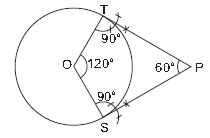
(iii) Two radius OT and OS, inclined at an angle of 120° are drawn.
(iv) Tangents are drawn to the circle at T and S meeting at P.
Then PT and PS are the required tangents
Question. Draw a right triangle ABC in which AB = 6 cm, BC = 8 cm and ∠B = 90°. Draw BD perpendicular from B on AC and draw a circle passing through the points B, C and D. Construct tangents from A to this circle.
Answer : Steps of construction:
(i) Draw a right angle triangle ABC, right angled at B,
AB = 6 cm and BC = 8 cm.
(ii) Draw BD ⊥ AC.
(iii) Draw a circumcircle of DBDC.
(iv) From point A draw a pair of tangents AB and AP.
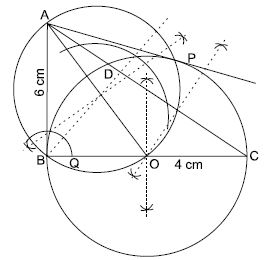
Then AB and AP are the required tangents
Question. Draw two concentric circles of radii 3 cm and 5 cm. Construct a tangent to smaller circle from a point on the larger circle. Also measure its length.
Answer : Steps of construction:
(i) Take point O. Draw two concentric circles of radii 3 cm and 5 cm respectively.
(ii) Locate point P on the circumference of larger circle.
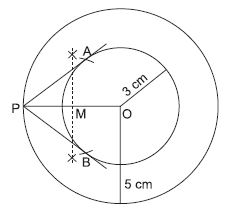
(iii) Join OP and bisect it. Let M be mid-point of OP.
(iv) Taking M as centre and MP as radius, draw an arc intersecting smaller circle at A and B.
(v) Join PA and PB. Thus, PA and PB are required tangents.
Question. Draw a circle of radius 3 cm. Take two points P and Q on one of its extended diameters each at a distance of 7 cm from its centre. Draw tangents to the circle from these two points P and Q.
Answer : Steps of construction:
(i) Join P and O.
(ii) Bisect PO such that M be its mid-point.
(iii) Taking M as centre and MO as radius, draw a circle.
Let it intersects the given circle at A and B.
(iv) Join PA and PB.
Thus, PA and PB are the two required tangents from P.
(v) Now, join O and Q.
(vi) Bisect OQ such that N is its mid-point.
(vii) Taking N as centre and NO as radius, draw a circle.
Let it intersects the given circle at C and D.
(viii) Join QC and QD.
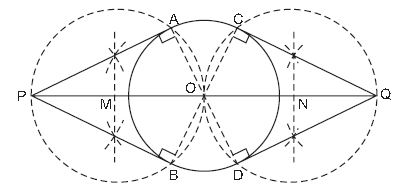
Thus, QC and QD are the required tangents to the given circle.
Question. Draw a line segment AB of length 8 cm. Taking A as centre, draw a circle of radius 4 cm and taking B as centre, draw another circle of radius 3 cm. Construct tangents to each circle from the centre of the other circle.
Answer : Steps of construction:
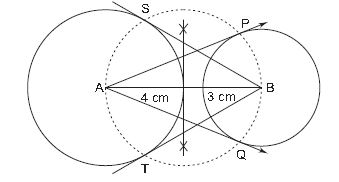
(i) AB = 8 cm is taken.
(ii) With centre A, a circle of radius 4 cm is drawn and with centre B, a circle of radius 3 cm is drawn.
(iii) With AB as diameter, a circle is drawn meeting circle with centre A at S and T respectively and circle with centre B at P and Q respectively.
(iv) Then AP and AQ are tangents from A to circle with centre B and BS and BT are tangents from B to circle with centre A.
Constructions
Short Answer Type questions
Question. Draw an angle of 135° using ruler and compasses only.
Answer: Steps of construction:
1. Draw a straight line PQ and mark a point O on it.
2. Using O as a center and any convenient radius, draw a semicircle that cuts the line PQ at points A and B.
3. Keeping the same radius, place the compass pointer on A and draw an arc to intersect the semicircle at C (representing 60°).
4. From C, draw another arc with the same radius to cut the semicircle at D (representing 120°).
5. Bisect the arc between C and D to find the 90° line. Let this perpendicular ray meet the semicircle at point E.
6. Bisect the angle between ray OE (90°) and ray OB (180°). This gives a ray OF such that \(\angle POF = 135^\circ\).
In simple words: To make 135 degrees, first build a 90-degree angle. Then, split the remaining 90-degree space on the other side in half to add 45 degrees.
Exam Tip: Keep all arc intersections clearly visible. Examiners look for the distinct arc marks of the 60°, 120°, 90°, and final 135° lines.
Question. Draw a line segment of length 8 cm. Bisect it and measure the length of each part.
Answer: Steps of construction:
1. Draw a horizontal line segment AB of length 8 cm using a ruler.
2. Place the compass needle at point A. Adjust the compass width to be slightly more than half of the length of AB (more than 4 cm).
3. Draw arcs both above and below the line segment AB.
4. Without changing the compass width, place the needle at point B and draw arcs that intersect the previous arcs at points C and D.
5. Join points C and D with a straight line. Let this line intersect AB at point M.
6. Point M is the midpoint, which bisects AB. On measuring with a ruler, we find that \(AM = MB = 4\text{ cm}\).
In simple words: To find the exact middle of an 8 cm line, draw crossing arcs from both ends using a compass opened more than halfway. Connecting these crossings gives two equal 4 cm halves.
Exam Tip: Ensure your compass does not slip between drawing the arcs from point A and point B, as equal radius is necessary for a perfect bisector.
Question. Construct an equilateral triangle whose altitude is 4 cm.
Answer: Steps of construction:
1. Draw a straight base line XY of any length.
2. Choose any point D on XY. Construct a perpendicular line to XY at point D.
3. Set the compass to a radius of 4 cm. With D as the center, draw an arc on the perpendicular line to mark point A (the top vertex), making AD = 4 cm.
4. At point A, construct a 30° angle on both the left and right sides of the altitude line AD.
5. Let these two rays meet the base line XY at points B and C.
6. The resulting triangle ABC is the required equilateral triangle.
In simple words: Draw a flat line and a 4 cm vertical line standing on it. From the top of the vertical line, draw two lines pointing down at 30 degrees on each side to complete the triangle.
Exam Tip: Remember that in an equilateral triangle, each angle is 60°. The altitude bisects the top vertex angle, which is why we construct 30° angles on both sides of the vertical line.
Question. Constructed a triangle ABC in which AB = 5.8 cm BC+CA = 8.4 cm and B = 60 degree.
Answer: Steps of construction:
1. Draw the base line segment AB of length 5.8 cm.
2. At point B, construct an angle of 60° using a compass. Let this ray be BX.
3. From the ray BX, cut off a line segment BD of length 8.4 cm (which is equal to BC + CA).
4. Join point A to point D.
5. Construct the perpendicular bisector of the line segment AD. Let it intersect the segment BD at point C.
6. Join point A to point C to complete the triangle ABC.
In simple words: Start by drawing the 5.8 cm bottom side. Draw a 60-degree line from one corner and make it 8.4 cm long. Connect its end to the other bottom corner, split that connection in half with a perpendicular line, and where it crosses the 60-degree line is your third corner.
Exam Tip: When drawing the perpendicular bisector of AD, make sure your compass is set to a radius greater than half of AD to ensure the arcs intersect properly.
Question. Construct a triangle ABC in which BC = 3.4 cm , AB-AC = 1.5 cm and B = 45 .
Answer: Steps of construction:
1. Draw a line segment BC of length 3.4 cm.
2. At point B, construct an angle of 45°. Let this ray be BX.
3. Since AB - AC = 1.5 cm is positive, AB is longer than AC. Cut a line segment BD of length 1.5 cm on ray BX.
4. Join point C to point D.
5. Draw the perpendicular bisector of the segment CD. Let it intersect the ray BX at point A.
6. Join point A to point C. The triangle ABC is the required triangle.
In simple words: Draw the bottom side of 3.4 cm. Draw a 45-degree line from one end and mark a point 1.5 cm along it. Draw a line from that mark to the other base corner, split it in half, and where the splitter hits your 45-degree line is the top corner.
Exam Tip: Since AB is greater than AC, the point D is marked on the ray BX itself (not on the extended ray below B). Always double-check this condition before marking point D.
Question. Construct an equilateral triangle whose altitude is 5 cm.
Answer: Steps of construction:
1. Draw a horizontal line segment XY of any convenient length.
2. Mark a point D on XY and construct a line perpendicular to XY passing through D.
3. Set the compass to a radius of 5 cm. With D as the center, draw an arc cutting the perpendicular line at point A.
4. At point A, construct angles of 30° on both sides of the line AD.
5. Let these rays intersect the line XY at points B and C.
6. Triangle ABC is the required equilateral triangle.
In simple words: Draw a flat base line and a 5 cm vertical line standing straight up from it. From the top of the vertical line, draw two lines heading down at 30 degrees to meet the base line.
Exam Tip: Label all points clearly and show the arcs used to construct both the perpendicular line and the 30° angles.
Question. Construct a triangle ABC in which AB = 5.8 cm , BC + CA = 8.4 cm and B = 45°.
Answer: Steps of construction:
1. Draw the base line segment AB = 5.8 cm.
2. At point B, construct an angle of 45°. Let this ray be BX.
3. From the ray BX, cut off a segment BD of length 8.4 cm (the sum of BC and CA).
4. Join point A to point D.
5. Draw the perpendicular bisector of line segment AD. Let it intersect the segment BD at point C.
6. Join point A to point C. The triangle ABC is the required triangle.
In simple words: Draw a 5.8 cm line at the bottom. Make a 45-degree line from one end and mark a point 8.4 cm up. Connect this mark to the other bottom corner, find the middle of this connection, and draw a line straight out from it to find the final corner.
Exam Tip: Make sure your perpendicular bisector line is drawn with high accuracy using a sharp pencil so that the intersection point C is exactly correct.
Question. Construct a right angled triangle whose base is 5 cm and sum of its hypotenuse and other side is 8 cm.
Answer: Let the base be BC = 5 cm, the right angle be \(\angle B = 90^\circ\), and the sum of the hypotenuse and other side be AB + AC = 8 cm.
Steps of construction:
1. Draw a line segment BC of length 5 cm.
2. At point B, construct a perpendicular line segment (an angle of 90°). Let this ray be BX.
3. Cut off a segment BD = 8 cm from the ray BX.
4. Join point C to point D.
5. Draw the perpendicular bisector of line segment CD. Let it intersect the segment BD at point A.
6. Join point A to point C. The triangle ABC is the required right-angled triangle.
In simple words: Draw a 5 cm bottom line. Draw a line straight up at 90 degrees and make it 8 cm long. Connect the top of this 8 cm line to the bottom right corner, split that diagonal line in half, and where the splitter crosses your vertical line is the triangle's top corner.
Exam Tip: In right-angled triangle constructions where the sum of two sides is given, always set the sum length on the perpendicular line.
Question. Construct a triangle ABC in which BC = 3.4 cm , AB - AC = 1.5 cm and B = 30°.
Answer: Steps of construction:
1. Draw a line segment BC = 3.4 cm.
2. At point B, construct an angle of 30°. Let this ray be BX.
3. Since AB - AC = 1.5 cm is positive, AB is longer than AC. Cut a line segment BD = 1.5 cm along the ray BX.
4. Join point C to point D.
5. Draw the perpendicular bisector of CD. Let it intersect the ray BX at point A.
6. Join point A to point C. The triangle ABC is the required triangle.
In simple words: Draw a 3.4 cm line. Draw a 30-degree line from one end and mark a point 1.5 cm along it. Draw a line from that mark to the other base corner, split it in half, and where the splitter hits your 30-degree line is the top corner.
Exam Tip: Use a ruler to double-check that the measured difference between your constructed sides AB and AC is exactly 1.5 cm to verify your accuracy.
Question. Write the steps of constructions for a triangle ABC whose perimeter and two base angles B and C are given.
Answer: Let the given perimeter be P and the base angles be \(\angle B\) and \(\angle C\).
Steps of Construction:
1. Draw a line segment XY equal to the given perimeter P (so, XY = AB + BC + CA).
2. At point X, construct an angle equal to half of \(\angle B\) (i.e., \(\angle PXY = \frac{1}{2} \angle B\)).
3. At point Y, construct an angle equal to half of \(\angle C\) (i.e., \(\angle QYX = \frac{1}{2} \angle C\)).
4. Let these two rays intersect at a point A.
5. Construct the perpendicular bisector of the line segment AX, and let it intersect the segment XY at point B.
6. Construct the perpendicular bisector of the line segment AY, and let it intersect the segment XY at point C.
7. Join point A to point B, and point A to point C.
8. Triangle ABC is the required triangle.
In simple words: Draw a line as long as the entire perimeter. At the ends, build angles that are half of the given base angles. Where they meet is the top corner. From there, split the side lines in half to find where the other two corners land on the base line.
Exam Tip: This theoretical question is highly scoring. Clearly write out each step in chronological order and state the reason why half-angles are used.
Question. Using ruler and compasses only, construct a triangle ABC from the following data AB+BC+CA = 12 cm B = 45 and C= 60°.
Answer: Steps of construction:
1. Draw a line segment XY of length 12 cm.
2. At point X, construct an angle of 22.5° (which is half of 45°) using a compass. Let this ray be XP.
3. At point Y, construct an angle of 30° (which is half of 60°) using a compass. Let this ray be YQ.
4. Let the rays XP and YQ intersect at point A.
5. Draw the perpendicular bisector of AX, intersecting XY at point B.
6. Draw the perpendicular bisector of AY, intersecting XY at point C.
7. Join AB and AC. Triangle ABC is the required triangle.
In simple words: Draw a 12 cm line. Make a 22.5-degree angle on the left and a 30-degree angle on the right. Where they cross is the top corner. Find the midpoints of the lines going to the top corner, draw perpendicular lines, and connect where they touch the base.
Exam Tip: To construct a 22.5° angle, first construct a 90° angle, bisect it to get 45°, and then bisect the 45° angle.
Most Important Questions
Question. Construct an angle 45° at the initial point of a line segment PQ of length 6 cm.
Answer: Steps of construction:
1. Draw a line segment PQ of length 6 cm.
2. With P as the center and any convenient radius, draw a semicircle cutting PQ at point A.
3. Keeping the same radius, draw an arc from A to get point B (60°), and another from B to get point C (120°).
4. Bisect the angle between B and C to construct a 90° line intersecting the semicircle at point D.
5. Bisect the angle between the 90° ray and the base line segment PQ. This gives the required 45° angle at the initial point P.
In simple words: Draw a 6 cm line. Build a 90-degree angle at the left end, and then split it exactly in half to get 45 degrees.
Exam Tip: Ensure the line segment is drawn to the exact length of 6 cm using a sharp pencil.
Question. Construct an angle 30° at the initial point of a line segment PQ of length 4 cm.
Answer: Steps of construction:
1. Draw a line segment PQ of length 4 cm.
2. With P as the center and any convenient radius, draw a semicircle cutting PQ at point A.
3. With A as the center and the same radius, draw an arc intersecting the semicircle at point B (representing 60°).
4. Bisect the angle APB (60°) by drawing intersecting arcs from points A and B. Let the bisector ray be PR.
5. The angle \(\angle QPR\) is the required 30° angle.
In simple words: Draw a 4 cm line. Draw a 60-degree angle at one end, and then split that angle in half to make 30 degrees.
Exam Tip: Be careful to keep the compass width exactly the same when marking the 60° arc from the base line.
Question. Construct an angle 15° at the initial point of a line segment PQ of length 6 cm.
Answer: Steps of construction:
1. Draw a line segment PQ of length 6 cm.
2. Construct a 60° angle at point P, then bisect it to get 30°.
3. Bisect the 30° angle again to obtain the required 15° angle.
In simple words: Draw a 6 cm line. Make a 60-degree angle, split it in half to get 30 degrees, and split that in half again to get 15 degrees.
Exam Tip: Use a clean, fine-tipped compass to avoid cumulative errors when repeatedly bisecting angles.
Question. Construct an angle 105° at the initial point of a line segment PQ of length 4 cm.
Answer: Steps of construction:
1. Draw a line segment PQ of length 4 cm.
2. At point P, construct a 90° angle and a 120° angle.
3. Bisect the region between the 90° and 120° rays.
4. This adds 15° to 90°, resulting in the required 105° angle.
In simple words: Draw a 4 cm line. Build a 90-degree and a 120-degree line at one end. Draw a line exactly in the middle of these two to get 105 degrees.
Exam Tip: Clearly label the 90° and 120° arcs to show your construction method.
Question. Construct an angle 135° at the initial point of a line segment PQ of length 5 cm.
Answer: Steps of construction:
1. Draw a line segment PQ of length 5 cm. Extend the line segment past point P to the left.
2. At point P, construct a 90° angle.
3. Bisect the angle between the 90° ray and the extended line to the left (which represents 180°).
4. This yields an angle of \(90^\circ + 45^\circ = 135^\circ\).
In simple words: Draw a 5 cm line and extend it backward. Draw a vertical 90-degree line, then split the angle on the backward side in half to get 135 degrees.
Exam Tip: Extending the line segment to the left makes it much easier to find the 180-degree reference point for bisecting.
Question. Construct an angle 22 1/2° at the initial point of a line segment PQ of length 7 cm.
Answer: Steps of construction:
1. Draw a line segment PQ of length 7 cm.
2. At point P, construct a 90° angle.
3. Bisect the 90° angle to get a 45° angle.
4. Bisect the 45° angle to obtain the required \(22 \frac{1}{2}^\circ\) angle.
In simple words: Draw a 7 cm line. Build a 90-degree angle, split it in half to get 45 degrees, and split that in half again to get 22.5 degrees.
Exam Tip: Write \(22 \frac{1}{2}^\circ\) clearly next to your final ray in the diagram.
Question. Construct an angle 75° at the initial point of a line segment PQ of length 5 cm.
Answer: Steps of construction:
1. Draw a line segment PQ of length 5 cm.
2. At point P, construct a 60° angle and a 90° angle.
3. Bisect the angle between the 60° ray and the 90° ray.
4. This adds 15° to 60°, giving the required 75° angle.
In simple words: Draw a 5 cm line. Draw a 60-degree and a 90-degree line from one end. Draw a line exactly in the middle of these two to get 75 degrees.
Exam Tip: Keep your pencil sharp because 75° and 90° construction lines lie very close to each other.
Question. Construct a triangle PQR, in which PQ = 7cm, P = 60° and PR + RQ = 13 cm.
Answer: Steps of construction:
1. Draw the base PQ = 7 cm.
2. At point P, construct an angle of 60°. Let this ray be PX.
3. Cut off a line segment PS equal to 13 cm on PX.
4. Join point Q to point S.
5. Draw the perpendicular bisector of QS, letting it intersect the ray PX at point R.
6. Join point R to point Q to obtain the required triangle PQR.
In simple words: Draw a 7 cm base. Draw a 60-degree line and make it 13 cm long. Connect its end to the other base corner, split that line in half, and where the splitter crosses the 60-degree line is the third corner.
Exam Tip: For a large side sum like 13 cm, make sure your page has enough vertical space before starting the drawing.
Question. Construct a triangle PQR, in which PQ = 6 cm P = 45° and PR + RQ = 10 cm.
Answer: Steps of construction:
1. Draw base PQ = 6 cm.
2. At point P, construct an angle of 45°. Let this ray be PX.
3. Cut off a line segment PS equal to 10 cm on PX.
4. Join point Q to point S.
5. Draw the perpendicular bisector of QS, which intersects PX at point R.
6. Join point R to point Q. Triangle PQR is the required triangle.
In simple words: Draw a 6 cm base. Draw a 45-degree line and make it 10 cm long. Connect its end to the other base corner, split that line in half, and where the splitter crosses the 45-degree line is the third corner.
Exam Tip: Verify the final construction by checking if PR + RQ equals exactly 10 cm.
Question. Construct a triangle PQR, in which PQ = 8 cm, P = 45° and PR – RQ = 3 cm.
Answer: Steps of construction:
1. Draw base PQ = 8 cm.
2. At point P, construct an angle of 45°. Let this ray be PX.
3. Cut off a line segment PS of length 3 cm on PX.
4. Join point Q to point S.
5. Draw the perpendicular bisector of line segment QS. Let it intersect the ray PX at point R.
6. Join point R to point Q. Triangle PQR is the required triangle.
In simple words: Draw an 8 cm base. Draw a 45-degree line and mark a point 3 cm along it. Connect that point to the other base corner, split the connection in half, and where the splitter crosses your 45-degree line is the top corner.
Exam Tip: Since PR - RQ = 3 cm is positive, PR is greater than RQ, meaning the arc of 3 cm must be drawn on the main ray PX, not on its backward extension.
Question. Construct a triangle PQR, in which PQ = 7cm, P = 60° and RQ – PR = 2.5 cm.
Answer: Steps of construction:
1. Draw base PQ = 7 cm.
2. At point P, construct an angle of 60°. Extend the ray PX backward to form ray PX'.
3. Since RQ - PR = 2.5 cm is positive, RQ is greater than PR. Cut a line segment PS of length 2.5 cm on the backward extended ray PX'.
4. Join point Q to point S.
5. Draw the perpendicular bisector of QS, letting it intersect the forward ray PX at point R.
6. Join point R to point Q. Triangle PQR is the required triangle.
In simple words: Draw a 7 cm base. Draw a 60-degree line and extend it backward. Mark a point 2.5 cm on the backward extension. Connect it to the other base corner, split it in half, and where the splitter hits the forward 60-degree line is the top corner.
Exam Tip: Be extremely careful when RQ is greater than PR. The difference segment must be cut on the downward/backward extension of the angle ray.
Question. Construct a triangle PQR, in which PQ = 7cm, P = 30° and PR – RQ = 2 cm.
Answer: Steps of construction:
1. Draw base PQ = 7 cm.
2. At point P, construct an angle of 30°. Let this ray be PX.
3. Since PR - RQ = 2 cm is positive, PR is greater than RQ. Cut a line segment PS of length 2 cm on PX.
4. Join point Q to point S.
5. Draw the perpendicular bisector of QS, which intersects PX at point R.
6. Join point R to point Q. Triangle PQR is the required triangle.
In simple words: Draw a 7 cm base. Draw a 30-degree line and mark a point 2 cm along it. Connect that point to the other base corner, split the connection in half, and where the splitter crosses your 30-degree line is the top corner.
Exam Tip: Make sure to clearly show the arcs for both the 30° angle and the perpendicular bisector.
Question. Construct a similar triangle PQR, in which P = 30° and Q = 60° and PR + RQ + QP = 12 cm.
Answer: Steps of construction:
1. Draw a line segment XY of length 12 cm.
2. At point X, construct an angle of 15° (half of 30°).
3. At point Y, construct an angle of 30° (half of 60°).
4. Let these two rays intersect at point R.
5. Draw the perpendicular bisector of RX, letting it intersect XY at point P.
6. Draw the perpendicular bisector of RY, letting it intersect XY at point Q.
7. Join point R to point P and point R to point Q. Triangle PQR is the required triangle.
In simple words: Draw a 12 cm line. Make a 15-degree angle on the left and a 30-degree angle on the right. Where they cross is the top corner. From there, split the side lines in half to find where the other two corners land on the base line.
Exam Tip: Label the temporary line segment XY clearly so the examiner knows it represents the perimeter.
Question. Construct a triangle PQR, in which P = 45° and Q = 60° and PR + RQ + QP = 9 cm.
Answer: Steps of construction:
1. Draw a line segment XY of length 9 cm.
2. At point X, construct an angle of 22.5° (half of 45°).
3. At point Y, construct an angle of 30° (half of 60°).
4. Let these two rays intersect at point R.
5. Draw the perpendicular bisector of RX, letting it intersect XY at point P.
6. Draw the perpendicular bisector of RY, letting it intersect XY at point Q.
7. Join point R to point P and point R to point Q. Triangle PQR is the required triangle.
In simple words: Draw a 9 cm line. Make a 22.5-degree angle on the left and a 30-degree angle on the right. Where they cross is the top corner. Find the midpoints of the lines going to the top corner, draw perpendicular lines, and connect where they touch the base.
Exam Tip: A common mistake is using the original angles (45° and 60°) at the ends of the perimeter line. Always use half-angles at the ends.
Free study material for Mathematics
CBSE Class 9 Mathematics Chapter 11 Constructions Assignment
Access the latest Chapter 11 Constructions assignments designed as per the current CBSE syllabus for Class 9. We have included all question types, including MCQs, short answer questions, and long-form problems relating to Chapter 11 Constructions. You can easily download these assignments in PDF format for free. Our expert teachers have carefully looked at previous year exam patterns and have made sure that these questions help you prepare properly for your upcoming school tests.
Benefits of solving Assignments for Chapter 11 Constructions
Practicing these Class 9 Mathematics assignments has many advantages for you:
- Better Exam Scores: Regular practice will help you to understand Chapter 11 Constructions properly and you will be able to answer exam questions correctly.
- Latest Exam Pattern: All questions are aligned as per the latest CBSE sample papers and marking schemes.
- Huge Variety of Questions: These Chapter 11 Constructions sets include Case Studies, objective questions, and various descriptive problems with answers.
- Time Management: Solving these Chapter 11 Constructions test papers daily will improve your speed and accuracy.
How to solve Mathematics Chapter 11 Constructions Assignments effectively?
- Read the Chapter First: Start with the NCERT book for Class 9 Mathematics before attempting the assignment.
- Self-Assessment: Try solving the Chapter 11 Constructions questions by yourself and then check the solutions provided by us.
- Use Supporting Material: Refer to our Revision Notes and Class 9 worksheets if you get stuck on any topic.
- Track Mistakes: Maintain a notebook for tricky concepts and revise them using our online MCQ tests.
Best Practices for Class 9 Mathematics Preparation
For the best results, solve one assignment for Chapter 11 Constructions on daily basis. Using a timer while practicing will further improve your problem-solving skills and prepare you for the actual CBSE exam.
FAQs
You can download free PDF assignments for Class 9 Mathematics Chapter 11 Constructions from StudiesToday.com. These practice sheets have been updated for the 2026-27 session covering all concepts from latest NCERT textbook.
Yes, our teachers have given solutions for all questions in the Class 9 Mathematics Chapter 11 Constructions assignments. This will help you to understand step-by-step methodology to get full marks in school tests and exams.
Yes. These assignments are designed as per the latest CBSE syllabus for 2026. We have included huge variety of question formats such as MCQs, Case-study based questions and important diagram-based problems found in Chapter 11 Constructions.
Practicing topicw wise assignments will help Class 9 students understand every sub-topic of Chapter 11 Constructions. Daily practice will improve speed, accuracy and answering competency-based questions.
Yes, all printable assignments for Class 9 Mathematics Chapter 11 Constructions are available for free download in mobile-friendly PDF format.