

Read and download the CBSE Class 12 Physics Current Electricity Assignment Set 02 for the 2026-27 academic session. We have provided comprehensive Class 12 Physics school assignments that have important solved questions and answers for Chapter 3 Current Electricity. These resources have been carefuly prepared by expert teachers as per the latest NCERT, CBSE, and KVS syllabus guidelines.
Solved Assignment for Class 12 Physics Chapter 3 Current Electricity
Practicing these Class 12 Physics problems daily is must to improve your conceptual understanding and score better marks in school examinations. These printable assignments are a perfect assessment tool for Chapter 3 Current Electricity, covering both basic and advanced level questions to help you get more marks in exams.
Chapter 3 Current Electricity Class 12 Solved Questions and Answers

(a) high resistance and high melting point
(b) high resistance and low melting point
(c) low resistance and low melting point
(d) low resistance and high melting point
Answer: B
Question. A carbon resistor of (47 ± 4.7) kW is to be marked with rings of different colours for its identification.
The colour code sequence will be
(a) Violet – Yellow – Orange – Silver
(b) Yellow – Violet – Orange – Silver
(c) Yellow – Green – Violet – Gold
(d) Green – Orange – Violet – Gold
Answer: B
Question. The solids which have the negative temperature coefficient of resistance are
(a) metals
(b) insulators only
(c) semiconductors only
(d) insulators and semiconductors.
Answer: D
Question. Specific resistance of a conductor increases with
(a) increase in temperature
(b) increase in cross-section area
(c) increase in cross-section and decrease in length
(d) decrease in cross-section area.
Answer: A
Question. Copper and silicon is cooled from 300 K to 60 K, the specific resistance
(a) decreases in copper but increases in silicon
(b) increases in copper but decreases in silicon
(c) increases in both
(d) decreases in both.
Answer: A
Question. Which of the following acts as a circuit protection device?
(a) fuse
(b) conductor
(c) inductor
(d) switch
Answer: A
Question. The charge flowing through a resistance R varies with time t as Q = at – bt2, where a and b are positive constants. The total heat produced in R is
(a) a3 R /2b
(b) a3 R /b
(c) a3 R /6b
(d) a3 R / 3b
Answer: C
Question. A wire 50 cm long and 1 mm2 in cross-section carries a current of 4 A when connected to a 2 V battery. The resistivity of the wire is
(a) 4 × 10⁻⁶ W m
(b) 1 × 10⁻⁶ W m
(c) 2 × 10⁻⁷ W m
(d) 5 × 10⁻⁷ W m
Answer: B
Question. A wire of a certain material is stretched slowly by ten percent. Its new resistance and specific resistance become respectively
(a) both remain the same
(b) 1.1 times, 1.1 times
(c) 1.2 times, 1.1 times
(d) 1.21 times, same
Answer: D
Question. The masses of the wires of copper is in the ratio of 1 : 3 : 5 and their lengths are in the ratio of 5 : 3 : 1. The ratio of their electrical resistance is
(a) 1 : 3 : 5
(b) 5 : 3 : 1
(c) 1 : 25 : 125
(d) 125 : 15 : 1
Answer: D
Question. Three resistances each of 4 W are connected to form a triangle. The resistance between any two terminals is
(a) 12 W
(b) 2 W
(c) 6 W
(d) 8/3 W
Answer: D
Question. Two cities are 150 km apart. Electric power is sent from one city to another city through copper wires.
The fall of potential per km is 8 volt and the average resistance per km is 0.5 W. The power loss in the wire is
(a) 19.2 W
(b) 19.2 kW
(c) 19.2 J
(d) 12.2 kW
Answer: B
Question. The resistance of a wire is ‘R’ ohm. If it is melted and stretched to ‘n’ times its original length, its new resistance will be
(a) R /n
(b) n2R
(c) R /n2
(d) nR
Answer: B
Question. The equivalent resistance between A and B is
(a) 8R/5
(b) 5R/8
(c) 3R/8
(d) 7R/8
Answer: B
Question. Determine the current in 2Ω resistor. 
(a) 1 A
(b) 1.5 A
(c) 0.9 A
(d) 0.6 A
Answer: C
Question. Two heating wires of equal length are first connected in series and then in parallel to a constant voltage source.
The rate of heat produced in two cases is (parallel to series)
(a) 1 : 4
(b) 4 : 1
(c) 1 : 2
(d) 2 : 1
Answer: B
Question. The emf developed by a thermocouple is measured with the help of a potentiometer and not by a moving coil millivoltmeter because
(a) the potentiometer is more accurate than the voltmeter
(b) the potentiometer is more sensitive than voltmeter
(c) the potentiometer makes measurement without drawing any current from the thermocouple
(d) measurement using a potentiometer is simpler than with a voltmeter
Answer: C
Question. Who among the following scientists made the statement ?
“Chemical change can produce electricity”.
(a) Galvani
(b) Faraday
(c) Coulomb
(d) Thompson
Answer: A
Question. Two resistances R1 and R2 are made of different materials. The temperature coefficient of the material of R1 is a and that of material of R2 is – β . The resistance of the series combination of R1 and R2 will not change with temperatur if R1/R2 equal to
(a) α/β
(b) α + β/α - β
(c) α2 + β2/2αβ
(d) β/α
Answer: D
Question. A wire of resistance 4 Ω is stretched to twice its original length. The resistance of stretched wire would be
(a) 4 Ω
(b) 8 Ω
(c) 16 Ω
(d) 2 Ω
Answer: C
Question. The belt of an electrostatic generator is 50 cm wide and travels at 30 cm/sec. The belt carries charge into the sphere at a rate corresponding to 10–4 ampere. What is the surface density of charge on the belt.
(a) 6.7 x 10⁻⁵Cm-2 / s
(b) 6.7 x 10⁻⁴Cm-2 / s
(c) 6.7 x 10⁻⁷Cm-2 / s
(d) 6.7 x 10⁻⁸Cm-2 /s
Answer: B
Question. The thermo e.m.f. of a thermocouple is 25mV/ºC at room temperature. A galvanometer of 40 ohm resistance, capable of detecting current as low as 10–5 A, is connected with the thermocouple. The smallest temperature difference that can be detected by this system is
(a) 12ºC
(b) 0ºC
(c) 20ºC
(d) 16ºC
Answer: D
Question. Resistances 1 Ω, 2 W and 3 Ω are connected to form a triangle. If a 1.5 V cell of negligible internal resistance is connected across the 3 Ω resistor, the current flowing through this resistor will be
(a) 0.25 A
(b) 0.5 A
(c) 1.0 A
(d) 1.5 A
Answer: B
Question. In the circuit , the galvanometer G shows zero deflection. If the batteries A and B have negligible internal resistance, the value of the resistor R will be 
(a) 100Ω
(b) 200Ω
(c) 1000Ω
(d) 500Ω
Answer: A
Question. The thermo e.m.f. of a thermocouple is given by E = 2164 t – 6.2 t2. The neutral temperature and a temperature of inversion are
(a) 349, 174.5
(b) 174.5, 349
(c) 349, 698
(d) 698, 349
Answer: B
Question. One junction of a certain thermocouple is at a fixed temperature Tr and the other junction is at a temperature T. The electormotive force for this is expressed by, 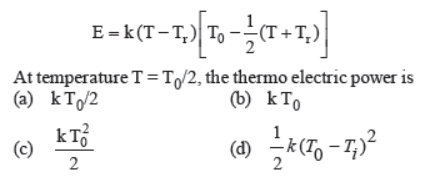
Answer: A
Question. The e.m.f. developed in a thermo-couple is given by E = α T + 1/2 βT2 where T is the temperature of hot junction, cold junction being at 0ºC. The thermo electric power of the couple is 
Answer: B
Question. The thermo e.m.f. E in volts of a certain thermocouple is found to vary with temperature T of hot junction while cold junction is kept at 0ºC
E = 40 T - T2/20
The neutral temperature of the couple is
(a) 100ºC
(b) 200ºC
(c) 400ºC
(d) 800ºC
Answer: C
Question. 2, 4 and 6 S are conductances of three conductors. When they are joined in parallel, their equivalent conductance will be
(a) 12 S
(b) (1/12) S
(c) (12/11) S
(d) (11/12) S
Answer: A
Question. The numerical value of charge on either plate of capacitor C shown in figure is 
(a) CE
(b) CER1/R1+r
(c) CER2/R2+r
(d) CER1/R2+r
Answer: B
Question. If current flowing in a conductor changes by 1% then power consumed will change by
(a) 10%
(b) 2%
(c) 1%
(d) 100%
Answer: B
Question. A fuse wire with a radius of 1 mm blows at 1.5 A. If the fuse wire of the same material should blow at 3.0 A, the radius of the wire must be
(a) 41/3 mm
(b) √2 mm
(c) 0.5 mm
(d) 8.0 mm
Answer: A
Question. A 4 μ F conductor is charged 50 volts and then its plates are joined through a resistance of 1 k W. The heat produced in the resistance is
(a) 0.16 J
(b) 1.28 J
(c) 0.64 J
(d) 0.32 J
Answer: D
Question. Two bulbs of 500 W and 200 W are manufactured to operate on 220 V line. The ratio of heat produced in 500 W and 200 W, in two cases, when firstly they are connected in parallel and secondary in series will be
(a) 5/2 : 2/5
(b) 5/2 : 5/2
(c) 2/5 : 5/2
(d) 2/5 : 2/5
Answer: A
Question. A wire of resistance 20 W is covered with ice and a voltage of 210 V is applied across the wire, then rate of melting the ice is
(a) 0.85 g/s
(b) 1.92 g/s
(c) 6.56 g/s
(d) All of these
Answer: C
Question. Silver and copper voltameters are connected in parallel with a battery of e.m.f 12 V. In 30 minute 1 g of silver and 1.8 g of copper are liberated. The energy supplied by the battery is [ ZAg = 11.2 × 10⁻⁴gc–1; ZCu = 6.6 × 10⁻⁴ gc–1]
(a) 720 J
(b) 2.41 J
(c) 24.12 J
(d) 4.34 × 10⁴ J
Answer: D
Question. Which of the following is not reversible ?
(a) Joule effect
(b) Peltier effect
(c) Seebeck effect
(d) Thomson effect
Answer: A
Question. In the Seebeck series Bi occurs first followed by Cu and Fe among other. The Sb is the last in the series. If ζ1 be the thermo emf at the given temperature difference for Bi – Sb thermocouple and ζ, be that for Cu-Fe thermocouple, which of the following is true?
(a) ζ1 = ζ2
(b) ζ1 < ζ2
(c) ζ1 > ζ2
(d) Data is not sufficient to predict it.
Answer: C
Short Answer Type Questions
Question. Why are constantan and manganin alloys used for making standard resistors?
Answer: These alloys are selected because of their large specific resistance and negligible change in resistance with temperature variations.
In simple words: Standard resistors need to keep their resistance steady. Manganin and constantan are used because their resistance does not change much even when they get warm.
Exam Tip: Always mention both points - high resistivity and low temperature coefficient - to secure full marks.
Question. A carbon resistor has color bands in the sequence Red, Red, Red, and Silver. State the value of its resistance along with its tolerance.
Answer: The resistance value of this component is \( 22 \times 10^2\ \Omega \) with a tolerance level of \( \pm 10\% \).
In simple words: Using the resistor color code where red stands for two, we find a resistance of 2200 ohms. The silver band indicates a ten percent tolerance, meaning the actual resistance can vary by that much.
Exam Tip: Remember the mnemonic sequence 'B B ROY of Great Britain' to easily recall the digit values for carbon resistor colors during exams.
Question. A wire of resistivity \( \rho \) is stretched to three times its initial length. What will be its new resistivity?
Answer: The electrical resistivity of the wire is unaffected and stays identical to its original value.
In simple words: Stretching a wire changes its shape but not the material it is made of. Since resistivity is a property of the material itself, it does not change.
Exam Tip: Resistivity depends only on the nature of the material and temperature, not on its length or thickness.
Question. If the potential difference applied across a conductor is doubled, how will the drift velocity of the free electrons change?
Answer: Because the drift velocity is directly proportional to the applied potential difference, doubling the voltage will cause the drift velocity to also double.
In simple words: When you increase the voltage pushing the electrons, they move faster. Doubling the electric push makes the average speed of the electrons double as well.
Exam Tip: State the relation \( v_d \propto V \) clearly in your answer before drawing your conclusion.
Question. A thick wire of resistance \( 10\ \Omega \) is stretched uniformly until its length becomes three times its original value. Assuming the density of the wire does not change, calculate the resistance of the new wire.
Answer: The initial resistance of the wire is \( R_1 = \rho \frac{l_1}{A_1} \). Multiplying the numerator and denominator by the length \( l \), we express the resistance in terms of volume \( V \): \[ R = \rho \frac{l^2}{A \cdot l} = \rho \frac{l^2}{V} \] Given that the resistivity \( \rho \) and the volume \( V \) remain constant during the stretching process, the resistance is directly proportional to the square of its length: \[ R \propto l^2 \] Since the length is tripled, \( l_2 = 3l_1 \). This gives: \[ \frac{R_2}{R_1} = \left( \frac{l_2}{l_1} \right)^2 = (3)^2 = 9 \] Substituting the value of \( R_1 = 10\ \Omega \): \[ R_2 = 9 \times R_1 = 9 \times 10 = 90\ \Omega \] Thus, the resistance of the stretched wire is \( 90\ \Omega \).
In simple words: When a wire is stretched, it becomes longer and thinner. Because of this, stretching it to three times its length increases its resistance by nine times, making it 90 ohms.
Exam Tip: For any stretching problem where volume remains constant, you can use the shortcut \( R' = n^2 R \) to quickly verify your answer.
Question. You are given a \( 16\ \Omega \) resistor. What length of wire with a resistance per unit length of \( 240\ \Omega\text{ m}^{-1} \) should be connected in parallel with it to obtain an equivalent resistance of \( 12\ \Omega \)?
Answer: Using the formula for two resistors connected in parallel: \[ \frac{1}{R} = \frac{1}{R_1} + \frac{1}{R_2} \] Let \( R_1 = 16\ \Omega \) and the desired equivalent resistance be \( R = 12\ \Omega \). Solving for the resistance of the parallel wire branch \( R_2 \): \[ \frac{1}{R_2} = \frac{1}{R} - \frac{1}{R_1} = \frac{1}{12} - \frac{1}{16} = \frac{4 - 3}{48} = \frac{1}{48}\ \Omega^{-1} \] This yields a required resistance of \( R_2 = 48\ \Omega \) for the parallel wire. Given that the resistance per unit length of the wire is \( 240\ \Omega\text{ m}^{-1} \), we find the length \( l \) of the wire using: \[ l = \frac{R_2}{\text{resistance per unit length}} = \frac{48}{240} = 0.2\text{ m} \] Therefore, the necessary length of the wire is \( 0.2\text{ m} \) (or \( 20\text{ cm} \)).
In simple words: To lower the total resistance to 12 ohms, we connect a 48-ohm wire in parallel. Since each meter of this wire has 240 ohms of resistance, we only need a 0.2-meter long piece.
Exam Tip: Be careful with units - if the answer is in meters, you can also write it as 20 cm for clarity.
Question. Three resistors of resistances \( 3\ \Omega \), \( 6\ \Omega \), and \( 9\ \Omega \) are connected to a battery. In which of these resistors will the power dissipation be maximum when they are connected: (a) in parallel, and (b) in series? Give reasons.
Answer: (a) For a parallel connection, the voltage across each resistor is constant. Under this condition, the power dissipated is inversely proportional to the resistance: \[ P = \frac{V^2}{R} \implies P \propto \frac{1}{R} \] Consequently, the resistor with the smallest resistance, which is the \( 3\ \Omega \) wire, will dissipate the maximum power. (b) For a series connection, the electric current passing through each resistor is constant. Under this condition, the power dissipated is directly proportional to the resistance: \[ P = I^2 R \implies P \propto R \] Therefore, the resistor with the largest resistance, which is the \( 9\ \Omega \) wire, will dissipate the maximum power.
In simple words: In parallel, more current goes through the path of least resistance, so the 3-ohm wire gets the hottest. In series, the same current flows through all wires, so the 9-ohm wire with the highest resistance uses the most power.
Exam Tip: Always state which physical quantity (voltage in parallel, current in series) remains constant before applying the power formula.
Question. A silver wire has a resistance of \( 2.1\ \Omega \) at \( 27.5\text{ }^\circ\text{C} \) and a resistance of \( 2.7\ \Omega \) at \( 100\text{ }^\circ\text{C} \). Determine the temperature coefficient of resistivity of silver.
Answer: Using the formula for the temperature dependence of resistance: \[ R_T = R_0 (1 + \alpha T) \] Taking the ratio of the resistances at \( 100\text{ }^\circ\text{C} \) and \( 27.5\text{ }^\circ\text{C} \): \[ \frac{R_{100}}{R_{27.5}} = \frac{1 + 100\alpha}{1 + 27.5\alpha} \] Substituting the given resistance values: \[ \frac{2.7}{2.1} = \frac{1 + 100\alpha}{1 + 27.5\alpha} \] Simplifying the ratio on the left: \[ \frac{9}{7} = \frac{1 + 100\alpha}{1 + 27.5\alpha} \] Cross-multiplying to solve for \( \alpha \): \[ 9(1 + 27.5\alpha) = 7(1 + 100\alpha) \] \[ 9 + 247.5\alpha = 7 + 700\alpha \] \[ 2 = 452.5\alpha \] \[ \alpha = \frac{2}{452.5} \approx 0.0039\text{ }^\circ\text{C}^{-1} \] Thus, the temperature coefficient of resistivity of silver is \( 0.0039\text{ }^\circ\text{C}^{-1} \).
In simple words: As the silver wire gets hotter, its atoms vibrate more and increase its resistance. By comparing the resistance at two different temperatures, we find that the resistance increases by about 0.39 percent for every degree rise.
Exam Tip: Ensure that the final unit of the temperature coefficient is written as \(\text{}^\circ\text{C}^{-1}\) or \(\text{K}^{-1}\) to prevent any deduction of marks.
Question. What are superconductors? Mention any two of their practical applications.
Answer: Superconductors refer to substances that completely lose their electrical resistance when cooled below a specific critical temperature, which is close to absolute zero (\( 0\text{ K} \)). Two key applications of superconductors are: (a) Fabricating extremely powerful electromagnets. (b) Manufacturing ultra-high-speed computer processors.
In simple words: Superconductors are special materials that allow electricity to flow through them with absolutely zero resistance when made extremely cold. They are used to make incredibly strong magnets and super-fast computers.
Exam Tip: Define superconductivity clearly by referring to the 'critical temperature' below which the electrical resistance drops abruptly to zero.
Question. Two wires of equal length, one made of copper and the other of manganin, have the same resistance. Which of the two wires is thicker? Give reasons.
Answer: The relationship between resistance, resistivity, length, and cross-sectional area is: \[ R = \rho \frac{l}{A} \implies A = \rho \frac{l}{R} \] For wires of the same length \( l \) and resistance \( R \), the cross-sectional area is directly proportional to the resistivity of the material (\( A \propto \rho \)). Since copper has a much lower electrical resistivity than manganin (\( \rho_{\text{copper}} < \rho_{\text{manganin}} \)), the manganin wire must have a larger cross-sectional area, making it thicker.
In simple words: Copper is a much better conductor than manganin, so it does not need to be thick to carry current easily. To have the same resistance, the manganin wire must be made significantly thicker.
Exam Tip: Show the mathematical relation \( A \propto \rho \) when lengths and resistances are kept constant to make your explanation robust.
Question. State the key properties of alloys like constantan and manganin that make them highly suitable for fabricating standard resistors.
Answer: The primary characteristics that make these alloys ideal for standard resistance coils are: (a) A very high value of electrical resistivity. (b) An extremely low temperature coefficient of resistance.
In simple words: These alloys are perfect because they naturally oppose electrical flow quite strongly, and their resistance stays almost perfectly constant even when their temperature changes.
Exam Tip: Briefly explain that a low temperature coefficient ensures the resistor's performance is stable under temperature fluctuations.
Question. A copper wire of resistivity \( \rho \) is stretched to reduce its diameter to half of its previous value. What will be the new resistivity of the wire?
Answer: The electrical resistivity of the wire remains completely unchanged. This is because resistivity is an intrinsic property that depends solely on the nature of the material and its temperature, rather than its physical dimensions.
In simple words: Changing the length or thickness of a wire changes its total resistance, but the resistivity stays the same because it is still made of the exact same copper.
Exam Tip: Do not confuse resistance (which changes with dimensions) with resistivity (which is constant for a given material).
Question. The variation of potential difference \( V \) with length \( l \) for two potentiometers A and B is shown in a graph. Which of the two potentiometers is more sensitive?
Answer: Potentiometer B has greater sensitivity. A smaller potential gradient (potential drop per unit length, \( k = V/l \)) represents a highly sensitive potentiometer. If the graph shows that potentiometer B has a smaller slope (smaller potential drop over the same length), it is more sensitive.
In simple words: A potentiometer is more sensitive when it has a smaller change in voltage per unit length. This allows it to measure tiny differences in voltage much more accurately.
Exam Tip: State that sensitivity is inversely proportional to the potential gradient: \( \text{Sensitivity} \propto \frac{1}{k} \).
Question. If the length of a wire conductor is doubled by stretching it while keeping the potential difference across it constant, by what factor does the drift speed of the electrons change?
Answer: The drift velocity of the electrons is reduced to half of its initial value. The drift velocity is given by the relation: \[ v_d = \frac{e V \tau}{m l} \] When the potential difference \( V \) is kept constant, the drift speed is inversely proportional to the length of the conductor (\( v_d \propto \frac{1}{l} \)). Therefore, doubling the length reduces the drift speed by a factor of two.
In simple words: Making the wire twice as long with the same voltage spread across it weakens the electric field inside. This causes the electrons to drift at only half their original speed.
Exam Tip: Be sure to write the full equation for drift velocity to show why it is inversely proportional to the length when voltage is constant.
Question. If the temperature of a metallic conductor is increased, how does the relaxation time of its free electrons change?
Answer: As the temperature of the metallic conductor rises, the relaxation time of the free electrons decreases.
In simple words: Heating up a metal makes its atoms vibrate faster. This causes the moving electrons to bump into them much more frequently, shortening the quiet time between collisions.
Exam Tip: Remember that a decrease in relaxation time (\( \tau \)) is the fundamental reason why the resistance of a metal increases with temperature.
Question. A heater is connected in series with a \( 60\text{ W} \) bulb across the mains. If the \( 60\text{ W} \) bulb is replaced by a \( 100\text{ W} \) bulb, how will the rate of heat produced by the heater change?
Answer: The rate of heat generated by the heater will increase. A \( 100\text{ W} \) bulb has a lower resistance than a \( 60\text{ W} \) bulb. Since the bulb and the heater are connected in series, replacing the bulb with one of lower resistance reduces the total resistance of the circuit. This increases the electric current flowing through the circuit, thereby increasing the power dissipation (\( P = I^2 R \)) and the rate of heat produced by the heater.
In simple words: A 100-watt bulb lets more electric current pass through the circuit than a 60-watt bulb. Because more current is now flowing through the series loop, the heater gets hotter.
Exam Tip: Clearly show the two-step logic: higher power rating means lower bulb resistance, which leads to a higher overall circuit current.
Question. What will be the change in the resistance of a circular wire when its radius is halved and its length is reduced to one-fourth of its original value?
Answer: The overall electrical resistance of the wire remains completely unchanged. The resistance of a wire is given by: \[ R = \rho \frac{l}{\pi r^2} \] Let the new length be \( l' = \frac{l}{4} \) and the new radius be \( r' = \frac{r}{2} \). The new resistance \( R' \) is: \[ R' = \rho \frac{l'}{\pi (r')^2} = \rho \frac{l/4}{\pi (r/2)^2} = \rho \frac{l/4}{\pi r^2 / 4} = \rho \frac{l}{\pi r^2} = R \] Therefore, the resistance stays exactly the same.
In simple words: Even though we made the wire shorter (which reduces resistance), we also made it thinner (which increases resistance). These two changes balance each other out perfectly, leaving the resistance unchanged.
Exam Tip: Write out the algebraic substitution step-by-step to show that the factors of \( \frac{1}{4} \) in the numerator and denominator cancel out.
Question. Two \( 120\text{ V} \) light bulbs, one rated at \( 25\text{ W} \) and the other at \( 200\text{ W} \), are connected in series across a \( 240\text{ V} \) line. One of the bulbs burns out almost instantaneously. Which bulb burnt out and why?
Answer: The \( 25\text{ W} \) bulb burns out almost instantly. At a rated voltage, the resistance of a bulb is inversely proportional to its power rating (\( R \propto \frac{1}{P} \)). Therefore, the \( 25\text{ W} \) bulb has a significantly higher resistance than the \( 200\text{ W} \) bulb. When connected in series, the same current \( I \) passes through both bulbs. The power dissipated as heat in series is directly proportional to the resistance (\( P_{\text{dissipated}} = I^2 R \)). Since the \( 25\text{ W} \) bulb has the larger resistance, it dissipates much more power, overheats, and burns out.
In simple words: The 25-watt bulb has a much higher resistance. Since they are in series, the same current goes through both, causing the higher-resistance 25-watt bulb to take on too much energy and burn out.
Exam Tip: Be sure to distinguish between the 'rated power' of the bulb (used to find its resistance) and its 'actual power dissipation' in series.
Question. A given copper wire is stretched uniformly until its diameter is reduced to half of its original value. What will be its new resistance compared to its initial value?
Answer: The new resistance of the wire will be \( 16 \) times its original value. Since the volume \( V = A \cdot l \) of the wire remains constant during stretching: \[ R = \rho \frac{l}{A} = \rho \frac{V}{A^2} = \rho \frac{V}{(\pi r^2)^2} = \frac{\rho V}{\pi^2 r^4} \] Thus, the resistance is inversely proportional to the fourth power of the radius (or diameter): \[ R \propto \frac{1}{d^4} \] When the diameter is halved (\( d' = \frac{d}{2} \)), the resistance increases by a factor of: \[ \left( \frac{1}{1/2} \right)^4 = 2^4 = 16 \] Therefore, the new resistance is \( 16 \) times the original value.
In simple words: Stretching a wire to make it half as thick makes it sixteen times longer and harder for current to pass through, boosting its resistance sixteen-fold.
Exam Tip: For stretching problems involving radius or diameter, remember that the resistance scales as \( R \propto \frac{1}{r^4} \) or \( R \propto \frac{1}{d^4} \).
Question. A student has two wires, one of iron and one of copper, of equal length and diameter. He first connects them in series and passes a gradually increasing current. He then connects them in parallel and repeats the process. Which wire will glow first in: (i) series, and (ii) parallel?
Answer: (i) In a series connection, the same current flows through both wires. The rate of heat production is directly proportional to the resistance (\( H = I^2 R t \)). Since the resistivity of iron is higher than that of copper, the iron wire has a greater resistance and produces more heat, making the iron wire glow first. (ii) In a parallel connection, the voltage across both wires is identical. The rate of heat production is inversely proportional to the resistance (\( H = \frac{V^2}{R} t \)). Since copper has lower resistivity and resistance, it draws more current and produces more heat, causing the copper wire to glow first.
In simple words: In series, the higher-resistance iron wire produces more heat and glows first. In parallel, the lower-resistance copper wire draws much more current, causing it to heat up faster and glow first.
Exam Tip: Clearly write down the formulas \( H = I^2 R t \) for series and \( H = \frac{V^2}{R} t \) for parallel to justify your choice.
Question. A cylindrical metallic wire is stretched uniformly to increase its length by \( 5\% \). Calculate the percentage change in its resistance.
Answer: Using the formula for resistance in terms of resistivity, length, and cross-sectional area: \[ R = \rho \frac{l}{A} \] Since the volume \( V = A \cdot l \) remains constant during stretching, we can write: \[ R = \rho \frac{l^2}{V} \implies R \propto l^2 \] Let the initial length be \( l_1 \) and the new length after a \( 5\% \) increase be: \[ l_2 = l_1 + 0.05l_1 = 1.05l_1 \] The ratio of the new resistance \( R_2 \) to the initial resistance \( R_1 \) is: \[ \frac{R_2}{R_1} = \left( \frac{l_2}{l_1} \right)^2 = (1.05)^2 = 1.1025 \] The fractional change in resistance is: \[ \frac{R_2 - R_1}{R_1} = 1.1025 - 1 = 0.1025 \] To find the percentage change: \[ \text{Percentage change} = 0.1025 \times 100\% = 10.25\% \] Thus, the resistance of the wire increases by \( 10.25\% \).
In simple words: Stretching the wire makes it slightly longer and thinner. A 5 percent increase in length leads to a 10.25 percent increase in its electrical resistance.
Exam Tip: When the percentage change is small (less than 5%), the approximation \( \frac{\Delta R}{R} \approx 2 \frac{\Delta l}{l} \) can be used, but for exactly 5%, calculating via the square of 1.05 is required for precision.
Question. A wire of resistance \( 4R \) is bent to form a circle. What is the effective resistance of the wire between the ends of any of its diameters?
Answer: When the wire is bent into a circle, any diameter divides the wire into two semi-circular halves of equal length. Since resistance is directly proportional to length, each half has a resistance of: \[ R_{\text{half}} = \frac{4R}{2} = 2R \] These two halves are connected in parallel across the ends of the diameter. The effective resistance \( R_{\text{eff}} \) of this parallel combination is: \[ R_{\text{eff}} = \frac{R_{\text{half}} \times R_{\text{half}}}{R_{\text{half}} + R_{\text{half}}} = \frac{2R \times 2R}{2R + 2R} = \frac{4R^2}{4R} = R \] Therefore, the effective resistance between the diametrically opposite points is \( R \).
In simple words: The diameter splits the circle into two equal paths, each with half the total resistance (2R). Since current can go through either path, the parallel combination brings the overall resistance down to just R.
Exam Tip: Remember that bending a wire doesn't change its total resistance, but measuring across different points creates parallel paths that you must solve for.
Question. Two wires A and B of the same material and same length have their cross-sectional areas in the ratio \( 1:4 \). Determine the ratio of the heat produced in these wires when they are connected in parallel across a constant voltage source.
Answer: When connected in parallel across a constant voltage source \( V \), the rate of heat produced is: \[ H = \frac{V^2}{R} \implies H \propto \frac{1}{R} \] The resistance of a wire is given by \( R = \rho \frac{l}{A} \). Since the material (resistivity \( \rho \)) and length \( l \) are the same for both wires, we have: \[ R \propto \frac{1}{A} \] Substituting this back into the heat equation: \[ H \propto A \] Therefore, the ratio of heat produced in the two wires is directly proportional to the ratio of their cross-sectional areas: \[ \frac{H_A}{H_B} = \frac{A_A}{A_B} = \frac{1}{4} \] Thus, the ratio of heat produced is \( 1:4 \).
In simple words: The wire with four times the area has one-fourth the resistance, allowing four times as much current to flow. Under the same voltage, this wider wire produces four times more heat.
Exam Tip: Be careful to establish the relationship \( H \propto A \) clearly by showing how resistance relates to area under a constant voltage.
Question. Two light bulbs whose resistances are in the ratio \( 1:2 \) are connected in parallel across a source of constant voltage. What is the ratio of power dissipation in these bulbs?
Answer: For a parallel connection, the potential difference \( V \) across both bulbs is the same. The power dissipated by a resistor is given by: \[ P = \frac{V^2}{R} \] With voltage \( V \) being constant, the power dissipated is inversely proportional to the resistance (\( P \propto \frac{1}{R} \)). Therefore, the ratio of power dissipation in the two bulbs is: \[ \frac{P_1}{P_2} = \frac{R_2}{R_1} = \frac{2}{1} \] Thus, the ratio of power dissipation is \( 2:1 \).
In simple words: Since they are connected in parallel, the bulb with half the resistance draws twice as much current, resulting in twice the power dissipation.
Exam Tip: Double-check whether the bulbs are connected in series or parallel, as a series connection would yield the inverse ratio (\( 1:2 \)).
Question. Three identical resistors are connected in parallel, and the total equivalent resistance of the circuit is found to be \( \frac{R}{3} \). Find the value of each individual resistance.
Answer: Let the resistance of each identical resistor be \( R_{\text{individual}} \). When three identical resistors are connected in parallel, the equivalent resistance \( R_{\text{eq}} \) is given by: \[ \frac{1}{R_{\text{eq}}} = \frac{1}{R_{\text{individual}}} + \frac{1}{R_{\text{individual}}} + \frac{1}{R_{\text{individual}}} = \frac{3}{R_{\text{individual}}} \] Solving for the equivalent resistance: \[ R_{\text{eq}} = \frac{R_{\text{individual}}}{3} \] Given that the total equivalent resistance is \( \frac{R}{3} \): \[ \frac{R_{\text{individual}}}{3} = \frac{R}{3} \implies R_{\text{individual}} = R \] Therefore, the value of each individual resistance is \( R \).
In simple words: When you connect three equal resistors in parallel, the overall resistance is divided by three. If the total is one-third of R, each individual resistor must have a value of R.
Exam Tip: For \( n \) identical resistors in parallel, the equivalent resistance is always \( R_{\text{eq}} = \frac{R}{n} \).
Please click the link below to download CBSE Class 12 Physics Current Electricity Assignment Set B
Free study material for Physics
CBSE Class 12 Physics Chapter 3 Current Electricity Assignment
Access the latest Chapter 3 Current Electricity assignments designed as per the current CBSE syllabus for Class 12. We have included all question types, including MCQs, short answer questions, and long-form problems relating to Chapter 3 Current Electricity. You can easily download these assignments in PDF format for free. Our expert teachers have carefully looked at previous year exam patterns and have made sure that these questions help you prepare properly for your upcoming school tests.
Benefits of solving Assignments for Chapter 3 Current Electricity
Practicing these Class 12 Physics assignments has many advantages for you:
- Better Exam Scores: Regular practice will help you to understand Chapter 3 Current Electricity properly and you will be able to answer exam questions correctly.
- Latest Exam Pattern: All questions are aligned as per the latest CBSE sample papers and marking schemes.
- Huge Variety of Questions: These Chapter 3 Current Electricity sets include Case Studies, objective questions, and various descriptive problems with answers.
- Time Management: Solving these Chapter 3 Current Electricity test papers daily will improve your speed and accuracy.
How to solve Physics Chapter 3 Current Electricity Assignments effectively?
- Read the Chapter First: Start with the NCERT book for Class 12 Physics before attempting the assignment.
- Self-Assessment: Try solving the Chapter 3 Current Electricity questions by yourself and then check the solutions provided by us.
- Use Supporting Material: Refer to our Revision Notes and Class 12 worksheets if you get stuck on any topic.
- Track Mistakes: Maintain a notebook for tricky concepts and revise them using our online MCQ tests.
Best Practices for Class 12 Physics Preparation
For the best results, solve one assignment for Chapter 3 Current Electricity on daily basis. Using a timer while practicing will further improve your problem-solving skills and prepare you for the actual CBSE exam.
FAQs
You can download free PDF assignments for Class 12 Physics Chapter 3 Current Electricity from StudiesToday.com. These practice sheets have been updated for the 2026-27 session covering all concepts from latest NCERT textbook.
Yes, our teachers have given solutions for all questions in the Class 12 Physics Chapter 3 Current Electricity assignments. This will help you to understand step-by-step methodology to get full marks in school tests and exams.
Yes. These assignments are designed as per the latest CBSE syllabus for 2026. We have included huge variety of question formats such as MCQs, Case-study based questions and important diagram-based problems found in Chapter 3 Current Electricity.
Practicing topicw wise assignments will help Class 12 students understand every sub-topic of Chapter 3 Current Electricity. Daily practice will improve speed, accuracy and answering competency-based questions.
Yes, all printable assignments for Class 12 Physics Chapter 3 Current Electricity are available for free download in mobile-friendly PDF format.