

Read and download the CBSE Class 10 Mathematics Applications of Trigonometry Assignment Set 01 for the 2026-27 academic session. We have provided comprehensive Class 10 Mathematics school assignments that have important solved questions and answers for Chapter 9 Some Applications Of Trigonometry. These resources have been carefuly prepared by expert teachers as per the latest NCERT, CBSE, and KVS syllabus guidelines.
Solved Assignment for Class 10 Mathematics Chapter 9 Some Applications Of Trigonometry
Practicing these Class 10 Mathematics problems daily is must to improve your conceptual understanding and score better marks in school examinations. These printable assignments are a perfect assessment tool for Chapter 9 Some Applications Of Trigonometry, covering both basic and advanced level questions to help you get more marks in exams.
Chapter 9 Some Applications Of Trigonometry Class 10 Solved Questions and Answers
Question. The angle of elevation of the Sun when the shadow of a pole h m high is 3 h m long is
(a) 0°
(b) 30°
(c) 45°
(d) 60°
Answer : B
Question. A circus artist is climbing a 20 m long rope, which is tightly stretched and tied from the top of a vertical pole to the ground, then the height of pole, if the angle made by the rope with the ground level is 30°, is
(a) 5 m
(b) 10 m
(c) 15 m
(d) 20 m
Answer : B
Question. A kite is flying at a height of 80 m above the ground. The string attached to the kite is temporarily tied to a point on the ground. The inclination of the string with ground is 60°, then the length of the string is
(a) 62.37 m
(b) 92.37 m
(c) 52.57 m
(d) 72.57 m
Answer : B
Question. From the top of a 60 m high tower, the angle of depression of a point on the ground is 30°. The distance of the point from the foot of tower is
(a) 180 m
(b) 60 3 m
(c) 150 m
(d) 30 3 m
Answer : B
Question. The figure shows the observation of point C from point A. The angle of depression fromA is
(a) 30°
(b) 45°
(c) 60°
(d) 90°
Answer : A
Question. If a pole 6 m high casts a shadow2 3m long on the ground, then the Sun’s elevation is
(a) 60°
(b) 45°
(c) 30°
(d) 90°
Answer : A
Question. If 300 3m high tower makes an angle of elevation at a point on ground which is 300 m away from its foot, then the angle of elevation is
(a) 0°
(b) 30°
(c) 45°
(d) 60°
Answer : D
Question. A ramp for disabled people in a hospital have slope 30°. If the height of the ramp be 1m, then the length of ramp is
(a) 2 m
(b) 0.5 m
(c) 2 3m
(d) 1 m
Answer : A
Question. The angle of depression of the car parked on the road from the top of a 150 m high tower is 30°. The distance of the car from the tower is
(a) 150 m
(b) 75 m
(c) 150√3m
(d) (150/√3)m
Answer : C
Question. The length of a string between a kite and a point on the ground is 85 m. If the string makes an angle θ with the ground level such that tanθ = 15/8 , then the height of kite is
(a) 75 m
(b) 78.05 m
(c) 226 m
(d) None of these
Answer : A
Question. A tower stands near an airport. The angle of elevation θ of the tower from a point on the ground is such that its tangent is 5/12. The height of the tower, if the distance of the observer from the tower is 120 m is
(a) 40 m
(b) 50 m
(c) 60 m
(d) 70 m
Answer : B
Question. The top of two poles of height 20 m and 14 m are connected by a wire. If the wire makes an angle of 30° with the horizontal, then the length of the wire is
(a) 12 m
(b) 10 m
(c) 8 m
(d) 6 m
Answer : A
Question. A ladder, leaning against a wall,makes an angle of 60° with the horizontal. If the foot of the ladder is 9.5m away from the wall. The length of the ladder is
(a) 10 m
(b) 16 m
(c) 18 m
(d) 19 m
Answer : D
Question. From a point on the ground, the angles of elevation of the bottom and the top of a transmission tower fixed at the top of a 20 m high building are 45° and 60° respectively, then the height of the tower is
(a) 14.64 m
(b) 28.64 m
(c) 38.64 m
(d) 19.64 m
Answer : A
Question. An observer, 1.5 m tall is 20.5 m away from a tower 22 m high, then the angle of elevation of the top of the tower from the eye of the observer is
(a) 30°
(b) 45°
(c) 60°
(d) 90°
Answer : B
Question. The angle of elevation of the top of the tower from a point, which is 40 m away from the base of the tower in the horizontal level, is 45°. Find the height of the tower.
(a) 70 m
(b) 60 m
(c) 40 m
(d) 30 m
Answer : C
Question. The angle of elevation of the top of a building 150 m high, from a point on the ground is 45°. The distance of the point from foot of the building is
(a) 120 m
(b) 130 m
(c) 140 m
(d) 150 m
Answer : D
Question. A bridge on a river makes an angle of 45° with its edge. If the length along the bridge from one edge to the other is 150 m, then the width of the river is
(a) 107.75 m
(b) 105 m
(c) 75 m
(d) 106.05 m
Answer : D
Case Based MCQs
A. There are two balcony in a house. First balcony is at a height of 3 m above the ground and other balcony is 6 m vertically above the lower balcony. Ankit and Radha are sitting inside the two balcony at points G and F, respectively. At any instant, the angles of elevation of a Parachute from these balcony are observed to be 60° and 45° as shown below
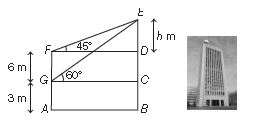
Based on the above information, answer the following questions.
Question. Who is more closer to the Parachute.
(a) Ankit
(b) Radha
(c) Both are at equal distance
(d) Can’t be determined
Answer : B
Question. Value of DF is equal to
(a) (h/√3)m
(b) h√3m
(c) (h/2)
(d) h m
Answer : D
Question. Value of h is
(a) 2
(b) 3(√3 + 1)
(c) 4
(d) 3(√3 − 1)
Answer : B
Question. Height of the Parachute from the ground is
(a) 4 m
(b) 3(4− √3)
(c) 8 m
(d) 3(4 + √3)
Answer : D
Question. If the Parachute is moving towards the building, then both angles of elevation will
(a) remain same
(b) increases
(c) decreases
(d) Can’t be determined
Answer : C
B. A cyclist is climbing through a 20 m long rope which is highly stretched and tied from the top of a vertical pole to the ground as shown below Based on the above information, answer the following questions.
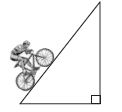
Question. The height of the pole, if angle made by rope with the ground level is 60°, is
(a) 15 m
(b) 10√3 m
(c) (10/√3)m
(d) (15/√2)m
Answer : B
Question. If the angle made by the rope with the ground level is 60°, then the distance between artist and pole at ground level is
(a) (10/√2)m
(b) 10√2m
(c) 10 m
(d) 10√3 m
Answer : C
Question. If the angle made by the rope with the ground level is 45°. The height of the pole is
(a) 2.5 m
(b) 10 m
(c) 7.5 m
(d) 10√2 m
Answer : D
Question. If the angle made by the rope with the ground level is 45° and 3 m rope is broken, then the height of the pole is
(a) (17/√2)m
(b) 7 m
(c) 14 m
(d) 7√2 m
Answer : A
Question. Which mathematical concept is used here?
(a) Similar triangles
(b) Pythagoras theorem
(c) Application of trigonometry
(d) None of the above
Answer : C
Take a Look
Line of Sight
The line segment connecting an observer's eye to the object being viewed is referred to as the line of sight.
Angle of Elevation
When an observer looks up at an object, the angle formed by the line of sight with the horizontal line is called the angle of elevation.
Angle of Depression
When an observer looks down at an object, the angle formed by the line of sight with the horizontal line is called the angle of depression.
LEVEL – 1 (Questions carrying one marks)
Question 1. The height of a tower is 10m. What is the length of its shadow when sun’s altitude is 45°.
Answer: Let \( h = 10\text{ m} \) be the height of the tower and \( s \) be the length of its shadow. The sun's altitude represents the angle of elevation, which is \( 45^\circ \).
Using the trigonometric tangent ratio: \[ \tan(45^\circ) = \frac{\text{Height}}{\text{Shadow}} \] \[ 1 = \frac{10}{s} \]
\( \implies s = 10\text{ m} \)
Therefore, the length of the shadow is 10 m.
In simple words: When the sun is at a 45-degree angle, the height of a vertical object and the length of its shadow are completely equal. So, the shadow of a 10 m tall tower is also exactly 10 m.
Exam Tip: When the angle of elevation of the sun is \( 45^\circ \), the height of the object is always equal to its shadow length. Remembering this allows you to quickly verify your calculations.
Question 2. A ladder 15m long just reaches the top of a vertical wall. If the ladder makes an angle of 60° with the wall. Find the height of the wall.
Answer: Let the length of the ladder (hypotenuse) be \( 15\text{ m} \). The angle made by the ladder with the wall is \( 60^\circ \). Let the height of the vertical wall be \( h \).
In the right-angled triangle formed by the wall, ground, and ladder:
Using the cosine ratio with the angle at the wall: \[ \cos(60^\circ) = \frac{\text{Height of the wall}}{\text{Length of the ladder}} \] \[ \frac{1}{2} = \frac{h}{15} \]
\( \implies h = \frac{15}{2} = 7.5\text{ m} \)
Thus, the height of the wall is 7.5 m.
In simple words: Using the 60-degree angle between the ladder and the wall, the cosine ratio shows that the wall's height is exactly half the length of the ladder. This gives us a height of 7.5 meters.
Exam Tip: Be careful to note where the angle is formed. Since it is made with the wall (at the top), we use the cosine ratio rather than the sine ratio to find the height directly.
Question 3. A pole 6cm high casts a shadow 2\(\sqrt{3}\) m long on the ground, then find the sun’s elevation.
Answer: Let \( \theta \) be the sun's angle of elevation. Treating the unit measurements consistently to compare the heights:
Using the tangent ratio: \[ \tan(\theta) = \frac{\text{Height of the pole}}{\text{Length of the shadow}} \] \[ \tan(\theta) = \frac{6}{2\sqrt{3}} \] \[ \tan(\theta) = \frac{3}{\sqrt{3}} \] \[ \tan(\theta) = \sqrt{3} \]
\( \implies \theta = 60^\circ \)
Therefore, the sun's elevation is \( 60^\circ \).
In simple words: The ratio of height to shadow length simplifies to the square root of 3. In trigonometry, the angle that has a tangent value of square root of 3 is 60 degrees.
Exam Tip: Keeping standard values of trigonometric ratios on your fingertips helps you identify common angles like \( 30^\circ \), \( 45^\circ \), and \( 60^\circ \) instantly.
Question 4. A bridge across a river makes an angle of 45° with the river bank. If the length of the bridge across the river is 150m, then find the width of the river.
Answer: Let the width of the river be represented by \( w \). The bridge acts as the hypotenuse of a right-angled triangle, with a length of \( 150\text{ m} \). The angle of inclination of the bridge with the bank is \( 45^\circ \).
Using the sine ratio: \[ \sin(45^\circ) = \frac{\text{Width of the river}}{\text{Length of the bridge}} \] \[ \frac{1}{\sqrt{2}} = \frac{w}{150} \]
\( \implies w = \frac{150}{\sqrt{2}} \]
\( \implies w = 75\sqrt{2}\text{ m} \)
Thus, the width of the river is \( 75\sqrt{2}\text{ m} \).
In simple words: The bridge spans diagonally across the river, making a triangle. Using the sine of 45 degrees, we find the perpendicular width across the river is 75 multiplied by the square root of 2 meters.
Exam Tip: Always rationalise your denominator by multiplying the numerator and denominator by \( \sqrt{2} \) to present your answer in standard simplified form.
Question 5. A 6m tall tree casts a shadow of length 4m. If at the same time a flagpole casts a shadow 50m in length, then find the length of the flagpole.
Answer: Since both the shadows are cast at the same time of the day, the angle of elevation of the sun is identical. Thus, the ratio of height to shadow length is equal for both objects.
Let \( H \) represent the height of the flagpole.
\[ \frac{\text{Height of the tree}}{\text{Shadow of the tree}} = \frac{\text{Height of the flagpole}}{\text{Shadow of the flagpole}} \] \[ \frac{6}{4} = \frac{H}{50} \]
\( \implies H = \frac{6 \times 50}{4} \]
\( \implies H = \frac{300}{4} = 75\text{ m} \)
Therefore, the height of the flagpole is 75 m.
In simple words: Since the sun shines at the same angle, the proportions of height and shadow are identical. The flagpole's shadow is 12.5 times longer than the tree's shadow, meaning the flagpole is also 12.5 times taller than the tree, which is 75 meters.
Exam Tip: For shadow comparison questions occurring at the identical time, setting up a direct ratio equation saves time as you do not need to calculate the actual angle of the sun.
LEVEL – 2 (Questions carrying 3 marks)
Question 1. A tree breaks due to storm and the broken part bends so that the top of the tree touches the ground making an angle of 30° with the ground. The distance between the foot of the tree to the point where the top touches the ground is 8m. Find the height of the tree.
Answer: Let \( AB \) be the vertical standing part of the tree and \( AC \) be the broken part that has bent down to touch the ground. The total height of the tree is \( AB + AC \). The distance from the base of the tree \( B \) to where the top touches the ground \( C \) is \( BC = 8\text{ m} \). The angle made with the ground is \( \angle ACB = 30^\circ \).
In the right-angled triangle \( ABC \):
Using the tangent ratio: \[ \tan(30^\circ) = \frac{AB}{BC} \] \[ \frac{1}{\sqrt{3}} = \frac{AB}{8} \]
\( \implies AB = \frac{8}{\sqrt{3}}\text{ m} \)
Using the cosine ratio: \[ \cos(30^\circ) = \frac{BC}{AC} \] \[ \frac{\sqrt{3}}{2} = \frac{8}{AC} \]
\( \implies AC = \frac{16}{\sqrt{3}}\text{ m} \)
The original height of the tree is the sum of both parts: \[ \text{Height} = AB + AC = \frac{8}{\sqrt{3}} + \frac{16}{\sqrt{3}} = \frac{24}{\sqrt{3}} \] Multiplying the numerator and denominator by \( \sqrt{3} \): \[ \text{Height} = \frac{24\sqrt{3}}{3} = 8\sqrt{3}\text{ m} \] Therefore, the height of the tree is \( 8\sqrt{3}\text{ m} \).
In simple words: The original tree height is the sum of its standing part and its broken fallen part. By using basic trigonometry on the right triangle formed on the ground, we calculate both lengths and add them up to find the total height of 8 times the square root of 3 meters.
Exam Tip: A common mistake is only calculating the vertical side. Make sure to solve for both the vertical side and the hypotenuse, adding them together to find the complete height of the tree before it broke.
Question 2. A kite is flying at a height of 60m above the ground. The string attached to the kite is temporarily tied to a point on the ground. The inclination of the string to the ground is 60°. Find the length of the string assuming that there is no slack in the string.
Answer: Let \( h = 60\text{ m} \) represent the vertical height of the kite above the ground. Let \( L \) be the length of the string. The angle of inclination of the string with the ground is \( 60^\circ \).
In the right-angled triangle formed by the vertical height, ground, and string:
Using the sine ratio: \[ \sin(60^\circ) = \frac{\text{Height}}{\text{Length of string}} \] \[ \frac{\sqrt{3}}{2} = \frac{60}{L} \]
\( \implies L = \frac{120}{\sqrt{3}} \] Multiplying the numerator and denominator by \( \sqrt{3} \): \[ L = \frac{120\sqrt{3}}{3} = 40\sqrt{3}\text{ m} \] Therefore, the length of the string is \( 40\sqrt{3}\text{ m} \).
In simple words: The height of the kite is the vertical opposite side and the string is the hypotenuse. Using the sine of 60 degrees, we find the hypotenuse equals 40 times the square root of 3 meters.
Exam Tip: Be sure to write the assumption that there is no slack in the string, which mathematically allows us to represent the string as a straight hypotenuse.
Question 3. The angle of elevation of the top of a hill at the foot of the tower is 60° and the angle of elevation of the top of the tower from the foot of the hill is 30°. If the tower is 50m high, find the height of the hill.
Answer: Let \( AB = H \) represent the height of the hill and \( CD = 50\text{ m} \) represent the height of the tower. Let the horizontal ground distance between their bases be \( BD = x \).
In the right-angled triangle \( CDB \) (formed by the tower and the ground): \[ \tan(30^\circ) = \frac{CD}{BD} \] \[ \frac{1}{\sqrt{3}} = \frac{50}{x} \]
\( \implies x = 50\sqrt{3}\text{ m} \)
In the right-angled triangle \( ABD \) (formed by the hill and the ground): \[ \tan(60^\circ) = \frac{AB}{BD} \] \[ \sqrt{3} = \frac{H}{x} \]
\( \implies H = x\sqrt{3} \)
Substituting the value of \( x \): \[ H = (50\sqrt{3})\sqrt{3} \]
\( \implies H = 50 \times 3 = 150\text{ m} \)
Therefore, the height of the hill is 150 m.
In simple words: We first find the distance between their bases using the 50 m high tower and its 30-degree elevation. Then, we use that distance with the hill's 60-degree angle of elevation to find the hill's height is 150 meters.
Exam Tip: Draw the hill noticeably taller than the tower in your diagram. A larger angle of elevation from the foot of the tower (\( 60^\circ \) vs \( 30^\circ \)) indicates that the hill must be significantly taller.
LEVEL – 3 (Questions carrying 4 marks)
Question 1. From the top of a 7m high building, the angle of elevation of the top of a cable tower is 60° and the angle of depression of the foot of the tower is 30°. Find the height of the tower.
Answer: Let \( AB = 7\text{ m} \) represent the building. Let \( CE \) represent the cable tower. Draw a horizontal line \( AD \) from the top of the building \( A \) perpendicular to the tower at point \( D \). Thus, \( DE = AB = 7\text{ m} \), and the horizontal distance is \( AD = BE = x \). Let the top portion of the tower be \( CD = h \).
In the right-angled triangle \( ADE \): \[ \tan(30^\circ) = \frac{DE}{AD} \] \[ \frac{1}{\sqrt{3}} = \frac{7}{x} \]
\( \implies x = 7\sqrt{3}\text{ m} \)
In the right-angled triangle \( ADC \): \[ \tan(60^\circ) = \frac{CD}{AD} \] \[ \sqrt{3} = \frac{h}{x} \]
\( \implies h = x\sqrt{3} \)
Substituting the value of \( x = 7\sqrt{3} \): \[ h = (7\sqrt{3})\sqrt{3} = 21\text{ m} \] The total height of the cable tower is: \[ CE = CD + DE = 21 + 7 = 28\text{ m} \] Therefore, the height of the cable tower is 28 m.
In simple words: The height of the building determines the distance to the tower using a 30-degree angle. With this horizontal distance, the 60-degree angle determines the remaining height of the tower above the building, giving a total height of 28 meters.
Exam Tip: Remember that the angle of depression of the foot of the tower from the top of the building is alternate interior to the angle of elevation of the top of the building from the foot of the tower.
Question 2. The angle of elevation of an aeroplane from a point on the ground is 45°. After flight for 15 seconds the elevation changes to 30°. If the aeroplane is flying at a height of 3000m. Find the speed of the aeroplane.
Answer: Let \( O \) be the point of observation on the ground. Let \( A \) be the initial location of the plane and \( C \) be its location after 15 seconds. The vertical height of the plane is constant at \( 3000\text{ m} \). Let \( AB \) and \( CD \) be the perpendicular heights from \( A \) and \( C \) to the ground, where \( AB = CD = 3000\text{ m} \).
In the right-angled triangle \( OBA \): \[ \tan(45^\circ) = \frac{AB}{OB} \] \[ 1 = \frac{3000}{OB} \]
\( \implies OB = 3000\text{ m} \)
In the right-angled triangle \( ODC \): \[ \tan(30^\circ) = \frac{CD}{OD} \] \[ \frac{1}{\sqrt{3}} = \frac{3000}{OD} \]
\( \implies OD = 3000\sqrt{3}\text{ m} \)
The horizontal distance covered by the plane in 15 seconds is \( BD = OD - OB \): \[ BD = 3000\sqrt{3} - 3000 = 3000(\sqrt{3} - 1)\text{ m} \] Substituting \( \sqrt{3} \approx 1.732 \): \[ BD = 3000(1.732 - 1) = 3000(0.732) = 2196\text{ m} \] The speed of the aeroplane in m/s is: \[ \text{Speed} = \frac{\text{Distance}}{\text{Time}} = \frac{2196}{15} = 146.4\text{ m/s} \] Converting this speed to km/h: \[ \text{Speed} = 146.4 \times \frac{18}{5} = 527.04\text{ km/h} \approx 527.4\text{ km/h} \] Therefore, the speed of the aeroplane is approximately \( 527.4\text{ km/h} \).
In simple words: The distance the plane travels is the difference between its horizontal distance from the observer at both times. Dividing this distance by the time of 15 seconds and converting to kilometers per hour gives a speed of about 527.4 km/h.
Exam Tip: Always make sure to perform the unit conversion from m/s to km/h correctly by multiplying the value by \( \frac{18}{5} \) (or 3.6).
Question 3. The angle of elevation of a cloud from a point h metres above a lake is \(\alpha\) and the angle of depression of its reflection in the lake is \(\beta\). Prove that the height of the cloud is \(\frac{h(\tan\beta + \tan\alpha)}{\tan\beta - \tan\alpha}\) metres.
Answer: Let \( XY \) represent the surface of the lake. Let \( P \) be the point of observation, which is \( h \) metres above the lake, so \( PY = h \). Let \( C \) be the cloud and \( H \) be its height above the lake surface, so \( CY = H \).
Let \( C' \) be the reflection of the cloud in the lake. The reflection is at the same depth below the lake surface as the cloud is high above it, so: \[ C'Y = CY = H \] Draw a horizontal reference line \( PM \) from \( P \) perpendicular to \( CY \), meeting it at point \( M \). This gives \( MY = PY = h \).
The distance of the cloud above the line \( PM \) is: \[ CM = CY - MY = H - h \] The distance of the reflection below the line \( PM \) is: \[ C'M = C'Y + MY = H + h \] In the right-angled triangle \( PMC \): \[ \tan(\alpha) = \frac{CM}{PM} = \frac{H - h}{PM} \]
\( \implies PM = \frac{H - h}{\tan(\alpha)} \quad \text{--- (Equation 1)} \)
In the right-angled triangle \( PMC' \): \[ \tan(\beta) = \frac{C'M}{PM} = \frac{H + h}{PM} \]
\( \implies PM = \frac{H + h}{\tan(\beta)} \quad \text{--- (Equation 2)} \)
Equating Equation 1 and Equation 2: \[ \frac{H - h}{\tan(\alpha)} = \frac{H + h}{\tan(\beta)} \] \[ (H - h)\tan(\beta) = (H + h)\tan(\alpha) \] \[ H\tan(\beta) - h\tan(\beta) = H\tan(\alpha) + h\tan(\alpha) \] \[ H(\tan(\beta) - \tan(\alpha)) = h(\tan(\beta) + \tan(\alpha)) \] \[ H = \frac{h(\tan(\beta) + \tan(\alpha))}{\tan(\beta) - \tan(\alpha)} \] Hence, the height of the cloud is indeed \( \frac{h(\tan\beta + \tan\alpha)}{\tan\beta - \tan\alpha} \) metres. This is proved.
In simple words: The reflection of the cloud is as deep below the water as the cloud is high above it. Expressing the horizontal distance from the observer using both triangles allows us to solve directly for the cloud's height.
Exam Tip: In reflection problems, noting that the depth of the reflection is equivalent to the height of the object above the water surface (\( C'Y = CY \)) is essential for setting up the correct equations.
SELF EVALUATION
Question 1. From the top of a light house, the angles of depression of two ships on opposite sides of it are observed to be \(\alpha\) and \(\beta\). If the height of the light house is h metres and the line joining the ships passes through the foot of the lighthouse, show that the distance between ships is \(\frac{h(\tan\alpha + \tan\beta)}{\tan\alpha \cdot \tan\beta}\) metres.
Answer: Let \( AB = h \) represent the lighthouse. Let \( C \) and \( D \) be the two ships on opposite sides of the lighthouse on the same straight line, so that the foot of the lighthouse \( B \) lies between them. The angles of elevation of the top \( A \) from ships \( C \) and \( D \) are alternate interior angles to the angles of depression, and are thus \( \alpha \) and \( \beta \) respectively.
In the right-angled triangle \( ABC \): \[ \tan(\alpha) = \frac{AB}{BC} = \frac{h}{BC} \]
\( \implies BC = \frac{h}{\tan(\alpha)} \)
In the right-angled triangle \( ABD \): \[ \tan(\beta) = \frac{AB}{BD} = \frac{h}{BD} \]
\( \implies BD = \frac{h}{\tan(\beta)} \)
The total distance between the two ships is \( CD = BC + BD \): \[ CD = \frac{h}{\tan(\alpha)} + \frac{h}{\tan(\beta)} \] Factoring out \( h \): \[ CD = h \left( \frac{1}{\tan(\alpha)} + \frac{1}{\tan(\beta)} \right) \] Taking a common denominator: \[ CD = h \left( \frac{\tan(\beta) + \tan(\alpha)}{\tan(\alpha)\tan(\beta)} \right) = \frac{h(\tan\alpha + \tan\beta)}{\tan\alpha \cdot \tan\beta} \] Hence, the distance between the ships is \( \frac{h(\tan\alpha + \tan\beta)}{\tan\alpha \cdot \tan\beta} \) metres. This is proved.
In simple words: Since the ships are on opposite sides, the total distance is the sum of their individual distances from the lighthouse. Expressing both in terms of tangent ratios and adding them gives the proven result.
Exam Tip: Be mindful of the position of the objects. Since the ships are on opposite sides, we add their distances. If they were on the same side, we would subtract the smaller distance from the larger distance.
Question 2. The angle of elevation of the top of towers from points p and q at distances of a and b respectively from the base and in the same straight line with it are complementary. Prove that the height of the tower is \(\sqrt{ab}\).
Answer: Let \( AB = h \) be the vertical height of the tower. Let \( C \) and \( D \) be the two points on the ground at distances \( a \) and \( b \) respectively from the base of the tower \( B \), so \( BC = a \) and \( BD = b \).
Since the angles of elevation are complementary, if the angle of elevation at \( C \) is \( \theta \), then the angle of elevation at \( D \) is \( 90^\circ - \theta \).
In the right-angled triangle \( ABC \): \[ \tan(\theta) = \frac{AB}{BC} = \frac{h}{a} \quad \text{--- (Equation 1)} \] In the right-angled triangle \( ABD \): \[ \tan(90^\circ - \theta) = \frac{AB}{BD} = \frac{h}{b} \] Using the complementary ratio identity \( \tan(90^\circ - \theta) = \cot(\theta) \): \[ \cot(\theta) = \frac{h}{b} \quad \text{--- (Equation 2)} \] Multiplying Equation 1 and Equation 2: \[ \tan(\theta) \times \cot(\theta) = \frac{h}{a} \times \frac{h}{b} \] Since \( \tan(\theta) \times \cot(\theta) = 1 \): \[ 1 = \frac{h^2}{ab} \]
\( \implies h^2 = ab \)
\( \implies h = \sqrt{ab} \)
Hence, the height of the tower is proven to be \( \sqrt{ab} \).
In simple words: Complementary angles have tangent values that are reciprocals. Multiplying these ratios cancels out the angle entirely, showing that the square of the height equals the product of the two distances.
Exam Tip: Explicitly mention and write down the complementary angle identity \( \tan(90^\circ - \theta) = \cot(\theta) \), as this step is critical to scoring full proof marks.
Question 3. A man standing on the deck of a ship which is 10m above the water level observes the angle of elevation of the top of a hill as 60° and the angle of depression of the base of the hill is 30°. Calculate the distance of the hill from the ship and the height of the hill.
Answer: Let \( AB = 10\text{ m} \) represent the deck of the ship above water level. Let \( CE \) be the vertical hill, with \( E \) at water level. Draw a horizontal line \( AD \) from the observer's position \( A \) perpendicular to the hill at point \( D \). Thus, \( DE = AB = 10\text{ m} \), and the horizontal distance is \( AD = BE = x \).
In the right-angled triangle \( ADE \): \[ \tan(30^\circ) = \frac{DE}{AD} \] \[ \frac{1}{\sqrt{3}} = \frac{10}{x} \]
\( \implies x = 10\sqrt{3}\text{ m} \)
Using \( \sqrt{3} \approx 1.732 \): \[ x \approx 10 \times 1.732 = 17.32\text{ m} \] In the right-angled triangle \( ADC \): \[ \tan(60^\circ) = \frac{CD}{AD} \] \[ \sqrt{3} = \frac{CD}{x} \]
\( \implies CD = x\sqrt{3} \)
Substituting \( x = 10\sqrt{3} \): \[ CD = (10\sqrt{3})\sqrt{3} = 30\text{ m} \] The total height of the hill is: \[ CE = CD + DE = 30 + 10 = 40\text{ m} \] Therefore, the horizontal distance of the hill from the ship is 17.32 m and the height of the hill is 40 m.
In simple words: The deck's height of 10 m combined with the 30-degree depression angle gives us a horizontal distance of 17.32 meters to the hill. Using this distance with the 60-degree elevation angle, the remaining height above the deck is 30 m, totaling a hill height of 40 m.
Exam Tip: Be sure to calculate both values carefully. A common pitfall is forgetting to add the 10 m deck height to the 30 m height above deck level when reporting the total height of the hill.
Question 4. The angle of elevation of the top of the tower as observed from a point on the ground is \(\alpha\) and on moving 'a' m towards the tower, the angle of elevation is \(\beta\). Prove that the height of the tower is \(\frac{a \tan\alpha \cdot \tan\beta}{\tan\beta - \tan\alpha}\).
Answer: Let \( AB = h \) represent the height of the vertical tower. Let \( C \) be the initial position on the ground where the angle of elevation of the top \( A \) is \( \alpha \). Let \( D \) be the second position, which is \( a \) metres closer to the tower, so \( CD = a \). The angle of elevation at \( D \) is \( \beta \).
In the right-angled triangle \( ABC \): \[ \tan(\alpha) = \frac{AB}{BC} = \frac{h}{BC} \]
\( \implies BC = \frac{h}{\tan(\alpha)} \)
In the right-angled triangle \( ABD \): \[ \tan(\beta) = \frac{AB}{BD} = \frac{h}{BD} \]
\( \implies BD = \frac{h}{\tan(\beta)} \)
Since \( BC - BD = CD = a \): \[ \frac{h}{\tan(\alpha)} - \frac{h}{\tan(\beta)} = a \] Factoring out \( h \): \[ h \left( \frac{1}{\tan(\alpha)} - \frac{1}{\tan(\beta)} \right) = a \] \[ h \left( \frac{\tan(\beta) - \tan(\alpha)}{\tan(\alpha)\tan(\beta)} \right) = a \] Rearranging the formula to solve for \( h \): \[ h = \frac{a \tan(\alpha) \tan(\beta)}{\tan(\beta) - \tan(\alpha)} \] Hence, the height of the tower is proven to be \( \frac{a \tan\alpha \cdot \tan\beta}{\tan\beta - \tan\alpha} \).
In simple words: Moving closer to a vertical object increases the angle of elevation. Using both viewpoints to write the ground distances, their subtraction (which equals the distance walked, 'a') yields the final height formula.
Exam Tip: Since you are moving closer to the tower, the angle of elevation increases (\( \beta > \alpha \)), which guarantees that the denominator \( \tan\beta - \tan\alpha \) is positive.
Question 5. A person standing on the bank of a river observes that the angle of elevation of the top of a tree standing on the opposite bank is 60°. When he moves 40m away from the bank, he finds that angle of elevation to be 30°. Find the height of the tree and the width of the river. [use \(\sqrt{3}=1.732\)]
Answer: Let \( AB = h \) be the height of the tree and \( BC = w \) be the width of the river. Let \( D \) be the point \( 40\text{ m} \) further away from the bank on the same line, so \( CD = 40\text{ m} \).
In the right-angled triangle \( ABC \): \[ \tan(60^\circ) = \frac{AB}{BC} = \frac{h}{w} \] \[ \sqrt{3} = \frac{h}{w} \]
\( \implies h = w\sqrt{3} \quad \text{--- (Equation 1)} \)
In the right-angled triangle \( ABD \): \[ \tan(30^\circ) = \frac{AB}{BD} = \frac{h}{w + 40} \] \[ \frac{1}{\sqrt{3}} = \frac{h}{w + 40} \]
\( \implies h = \frac{w + 40}{\sqrt{3}} \quad \text{--- (Equation 2)} \)
Equating Equation 1 and Equation 2: \[ w\sqrt{3} = \frac{w + 40}{\sqrt{3}} \] Multiplying both sides by \( \sqrt{3} \): \[ 3w = w + 40 \] \[ 2w = 40 \]
\( \implies w = 20\text{ m} \)
Substituting \( w = 20\text{ m} \) into Equation 1: \[ h = 20\sqrt{3}\text{ m} \] Using \( \sqrt{3} = 1.732 \): \[ h = 20 \times 1.732 = 34.64\text{ m} \] Therefore, the height of the tree is 34.64 m and the width of the river is 20 m.
In simple words: The 60-degree angle shows the tree's height is the river's width times the square root of 3. Walking 40 meters further away decreases the angle to 30 degrees, which tells us the river is 20 meters wide and the tree height is 34.64 meters.
Exam Tip: Substitute the value \( \sqrt{3} = 1.732 \) in the very final step of calculations to avoid carrying rounded decimal values through intermediate steps.
Free study material for Mathematics
CBSE Class 10 Mathematics Chapter 9 Some Applications Of Trigonometry Assignment
Access the latest Chapter 9 Some Applications Of Trigonometry assignments designed as per the current CBSE syllabus for Class 10. We have included all question types, including MCQs, short answer questions, and long-form problems relating to Chapter 9 Some Applications Of Trigonometry. You can easily download these assignments in PDF format for free. Our expert teachers have carefully looked at previous year exam patterns and have made sure that these questions help you prepare properly for your upcoming school tests.
Benefits of solving Assignments for Chapter 9 Some Applications Of Trigonometry
Practicing these Class 10 Mathematics assignments has many advantages for you:
- Better Exam Scores: Regular practice will help you to understand Chapter 9 Some Applications Of Trigonometry properly and you will be able to answer exam questions correctly.
- Latest Exam Pattern: All questions are aligned as per the latest CBSE sample papers and marking schemes.
- Huge Variety of Questions: These Chapter 9 Some Applications Of Trigonometry sets include Case Studies, objective questions, and various descriptive problems with answers.
- Time Management: Solving these Chapter 9 Some Applications Of Trigonometry test papers daily will improve your speed and accuracy.
How to solve Mathematics Chapter 9 Some Applications Of Trigonometry Assignments effectively?
- Read the Chapter First: Start with the NCERT book for Class 10 Mathematics before attempting the assignment.
- Self-Assessment: Try solving the Chapter 9 Some Applications Of Trigonometry questions by yourself and then check the solutions provided by us.
- Use Supporting Material: Refer to our Revision Notes and Class 10 worksheets if you get stuck on any topic.
- Track Mistakes: Maintain a notebook for tricky concepts and revise them using our online MCQ tests.
Best Practices for Class 10 Mathematics Preparation
For the best results, solve one assignment for Chapter 9 Some Applications Of Trigonometry on daily basis. Using a timer while practicing will further improve your problem-solving skills and prepare you for the actual CBSE exam.
FAQs
You can download free PDF assignments for Class 10 Mathematics Chapter 9 Some Applications Of Trigonometry from StudiesToday.com. These practice sheets have been updated for the 2026-27 session covering all concepts from latest NCERT textbook.
Yes, our teachers have given solutions for all questions in the Class 10 Mathematics Chapter 9 Some Applications Of Trigonometry assignments. This will help you to understand step-by-step methodology to get full marks in school tests and exams.
Yes. These assignments are designed as per the latest CBSE syllabus for 2026. We have included huge variety of question formats such as MCQs, Case-study based questions and important diagram-based problems found in Chapter 9 Some Applications Of Trigonometry.
Practicing topicw wise assignments will help Class 10 students understand every sub-topic of Chapter 9 Some Applications Of Trigonometry. Daily practice will improve speed, accuracy and answering competency-based questions.
Yes, all printable assignments for Class 10 Mathematics Chapter 9 Some Applications Of Trigonometry are available for free download in mobile-friendly PDF format.