

Download the latest CBSE Class 12 Economics Government Budget And The Economy Notes Set 02 in PDF format. These Class 12 Economics revision notes are carefully designed by expert teachers to align with the 2026-27 syllabus. These notes are great daily learning and last minute exam preparation and they simplify complex topics and highlight important definitions for Class 12 students.
Revision Notes for Class 12 Economics Part B Macroeconomics Chapter 5 Government Budget and The Economy
To secure a higher rank, students should use these Class 12 Economics Part B Macroeconomics Chapter 5 Government Budget and The Economy notes for quick learning of important concepts. These exam-oriented summaries focus on difficult topics and high-weightage sections helpful in school tests and final examinations.
Part B Macroeconomics Chapter 5 Government Budget and The Economy Revision Notes for Class 12 Economics
UNIT – 4 Government Budget and the Economy.
Budget : Statement of estimated Govt. Receipts and Expenditure During the Fiscal or financial year.
Main Objectives of Budget
- 1. Reallocation of Resources : Through the budgetary policy, Govt. aim to reallocate resources in accordance with the economic motive i.e Profit maximization and social (public) welfare.
- i.Tax concessions or subsidies: To encourage investment, Government can give tax concession, subsidies etc to the producers. Govt. discourage the production of harmful consumption goods (like liquor, cigarettes etc) through heavy taxes and encourage the use of ‘Khadi Products’ by providing subsidies.
- ii.Directly producing goods and services : There are many Non-profitable economic activities, which are not undertaken by the private sector like, water supply, sanitation law and order, National defence etc.
- 2. Reducing inequalities in Income and Wealth : Government aims to reduce such inequalities of Income and wealth through its budgetary policy. Govt aims to influence distribution of Income by imposing taxes on rich and spending more on the welfare of the poor. It will reduce income of the rich and raise standard of living of the poor, thus reducing inequalities. Eg. : Free LPG Connection to poor.
- 3. Economic Stability : Economic stability means absence of large-scale fluctuation in prices such fluctuations create uncertainties in the economy. Government can exercise control over these fluctuations through Taxes and Expenditure.
Components of Budget
- Revenue Budget :
- Capital Budget :
The components of budget can also be categorizes according to receipts and expenditures.
1. Revenue Receipts
a) Tax revenue b) Non- tax revenue
- Neither creates liabilities of the Government.
- Nor causes any reduction in assets.
Capital Receipts
a) Recovery of loans b) borrowings c) disinvestment
- Either creates liabilities of the Government .
- Or reduces assets of the Government .
Tax Revenue: Tax is a compulsory payment made by people and companies to the Government without reference to any direct benefit in return.
Tax Revenue can be further classified as
(i) Direct Taxes (ii) Indirect Taxes.
Non Tax Revenue: refers to receipts of the Government from all sources other than those of tax receipts. E.g : Interest, profits, Dividends, Fees, Fines and Penalties, Gifts and Grants, Escheats.
Source of Capital Receipts:
1. Borrowings are the funds raised by govt to meet excess expenditure.
2. Recovery of loans.
3. Other Receipts
(i) Disinvestment (ii) Small Savings
Budget Expenditure
Revenue Expenditure: Refers to the expenditure which neither creates any asset Nor causes reduction in any liability of the Government.
E.g : Payment of salaries, pensions, interests, expenditure as administrative services, defence services, health services, grants to state etc.
Capital Expenditure : Refers to the expenditure which either creates an asset or causes a reduction in the liabilities of the government.
Budgetary Deficit are as follows :
1. Revenue Deficit: It refers to excess of Revenue expenditure over revenue receipts during the given fiscal year.
\( R.D = \text{Revenue Expenditure} – \text{Revenue Receipt.} \)
2. Fiscal Deficit : Fiscal Deficit refers to the excess of total expenditure over total receipts (excluding borrowings) during the given fiscal year .
\( \text{Fiscal Deficit} = \text{Total Expenditure} – \text{Total Receipts excluding borrowings.} \)
3. Primary Deficit : Primary Deficit refers to difference between Fiscal Deficit of the Current year and interest payments on the Previous borrowings.
\( \text{Primary Deficit} = \text{Fiscal Deficit} – \text{Interest Payment.} \)
Implications of Fiscal Deficit
i.It leads to inflationary Pressure.
ii.A country has to face debt trap.
iii.It reduces future growth and Development.
Question: Find primary deficit from the following data:
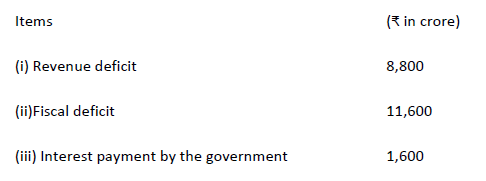
Answer: Primary Deficit= Fiscal deficit – Interest payment by the government
Question: Calculate Revenue Deficit. Fiscal Deficit and Primary Deficit from the following data
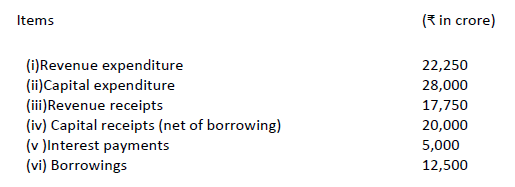
Answer: Revenue Deficit = Revenue expenditure – Revenue receipts
Question: Find borrowing by the government of payment of interest is estimated to be of ₹15,000 crore which is 25 % of primary deficit.
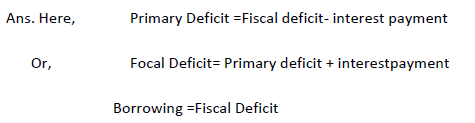
Question: Revenue deficit is estimated to be ₹ 20,000 crore, and borrowing is estimated to be 15,000 crore. expenditure on interest payment is estimated to be 50% of the revenue deficit, find fiscal deficit and primary deficit.
Answer:

Question: Comment on the following statements as true or false, with a reason.
(i) Construction of school-building is a revenue expenditure of the government.
(ii) Gift tax is a capital receipt.
(iii) Dividends on investment made by government is a revenue receipt
Answer: (i) capital expenditure
(ii) revenue receipt.
(iii) revenue receipt
Question: Categories the following government receipts into revenue and capital receipts. Give reasons for your answer.
Answer:
(i) capital receipt
(ii) capital receipt
(iii) revenue receipt.
(iv) revenue receipt
Question: Why should revenue deficit be curbed?
Answer: Revenue deficit often occurs when unproductive expenditure of the government is in excess of the tax and non-tat revenue receipts.
Question: Finance Minister has announced that steps would be taken to rationalize dominate the economy of the nation. What is the economic value of this statement?
Answer: Expenditure on subsidies is mostly unproductive
Question: How the decline in the price of crude oil in the international market helped the government to reduce fiscal deficit?
Answer: It has raised tax revenue of the government. Accordingly, fiscal deficit has reduced.
EVALUATION (VALUE-BASED QUESTIONS)
Question: How can the government impact allocation of resources through its budgetary policy?
Answer: Following observations highlight how the government can impact allocation of resources though its policy:
(a) The government can offer subsidies on such goods like coarse cloth the production of which is essential for poorer sections of the society. So that, the resources are shifted from the production of ‘goods for the rich to the production of goods for the poor’.
(b) The government can grant tax holiday
(c) The government can impact allocation of resources by shifting its own investments from inefficient to efficient units of production.
(d) High taxation can be imposed on such goods ,the production of which is harmful to the society.
(e) The government can make larger budgetary allocations for its ‘Support Price Policy’ in favors of food crops .
Question: Do you approve of disinvestment as a prudent means of financing budgetary deficit?
Answer: Disinvestment occurs when the government chooses to sell its stake in public sector or joint enterprises .To remember-
(i) it should unload shares of only inefficient enterprises.
(ii) Money received through disinvestment should be for productive investment.
Question: How would you distinguish between development and non-development expenditure?
Answer: Development expenditure is related to investment expenditure or productive expenditure.
Non-development expenditure is related to consumption expenditure by the government.
Free study material for Economics
CBSE Class 12 Economics Part B Macroeconomics Chapter 5 Government Budget and The Economy Notes
Students can use these Revision Notes for Part B Macroeconomics Chapter 5 Government Budget and The Economy to quickly understand all the main concepts. This study material has been prepared as per the latest CBSE syllabus for Class 12. Our teachers always suggest that Class 12 students read these notes regularly as they are focused on the most important topics that usually appear in school tests and final exams.
NCERT Based Part B Macroeconomics Chapter 5 Government Budget and The Economy Summary
Our expert team has used the official NCERT book for Class 12 Economics to design these notes. These are the notes that definitely you for your current academic year. After reading the chapter summary, you should also refer to our NCERT solutions for Class 12. Always compare your understanding with our teacher prepared answers as they will help you build a very strong base in Economics.
Part B Macroeconomics Chapter 5 Government Budget and The Economy Complete Revision and Practice
To prepare very well for y our exams, students should also solve the MCQ questions and practice worksheets provided on this page. These extra solved questions will help you to check if you have understood all the concepts of Part B Macroeconomics Chapter 5 Government Budget and The Economy. All study material on studiestoday.com is free and updated according to the latest Economics exam patterns. Using these revision notes daily will help you feel more confident and get better marks in your exams.
FAQs
You can download the teacher prepared revision notes for CBSE Class 12 Economics Government Budget And The Economy Notes Set 02 from StudiesToday.com. These notes are designed as per 2026-27 academic session to help Class 12 students get the best study material for Economics.
Yes, our CBSE Class 12 Economics Government Budget And The Economy Notes Set 02 include 50% competency-based questions with focus on core logic, keyword definitions, and the practical application of Economics principles which is important for getting more marks in 2026 CBSE exams.
Yes, our CBSE Class 12 Economics Government Budget And The Economy Notes Set 02 provide a detailed, topic wise breakdown of the chapter. Fundamental definitions, complex numerical formulas and all topics of CBSE syllabus in Class 12 is covered.
These notes for Economics are organized into bullet points and easy-to-read charts. By using CBSE Class 12 Economics Government Budget And The Economy Notes Set 02, Class 12 students fast revise formulas, key definitions before the exams.
No, all study resources on StudiesToday, including CBSE Class 12 Economics Government Budget And The Economy Notes Set 02, are available for immediate free download. Class 12 Economics study material is available in PDF and can be downloaded on mobile.