

Download the latest CBSE Class 11 Sociology Understanding Social Institutions Notes in PDF format. These Class 11 Sociology revision notes are carefully designed by expert teachers to align with the 2026-27 syllabus. These notes are great daily learning and last minute exam preparation and they simplify complex topics and highlight important definitions for Class 11 students.
Revision Notes for Class 11 Sociology Introducing Sociology Chapter 3 Understanding Social Institutions
To secure a higher rank, students should use these Class 11 Sociology Introducing Sociology Chapter 3 Understanding Social Institutions notes for quick learning of important concepts. These exam-oriented summaries focus on difficult topics and high-weightage sections helpful in school tests and final examinations.
Introducing Sociology Chapter 3 Understanding Social Institutions Revision Notes for Class 11 Sociology
I. Social Institutions
An institution is something that works according to rules/ laws/ custom. Institutions impose constraints on individuals. They also provide opportunities to the individuals. An institution can also be viewed as an end in itself. Indeed people have viewed the family, religion, state or even education as an end in itself.
Macro, Micro Social Institutions
– Macro Social Institutions: State
– Macro Social Institutions: Family
II. Social Institutions: Functionalist View
Social institutions are the complex set of social norms, beliefs, values and role relationship that arise in response to the needs of society. Social institutions exist to satisfy social needs. We find informal institutions (family, religion) and formal social institutions (law, education) in societies.
Social Institutions: Conflict View
All individuals are not placed equally in society. All social institutions will operate in the interest of the dominant sections of society. The dominant social section dominates political and economic institutions. The dominant social section ensures that the ruling class ideas become the ruling ideas of a society.
III. Family
– Family is the basic unit of the society. It is universal social institution. Family (the private sphere) is linked to the economic, political, cultural, educational (the public) spheres.
Family: The Functionalist View
The family performs important tasks, which contribute to society’s basic needs and helps to perpetuate social order. The modern industrial societies function best if women look after the family and men earn the family livelihood. The nuclear family is seen as the unit best equipped to handle the demands of industrial society. In nuclear family the husband adopting the ‘instrumental’ role as breadwinner, and the wife assuming the ‘affective’, emotional role.
Variations in Family Forms
A.M. Shah- In post-independent India the joint family has steadily increased. The contributing factor is the increasing life expectancy in India. Studies have shown that diverse family forms are found in different societies.
(I). Nature of Residence
1. Matrilocal Family
– The newly married couple stays with the woman’s parents.
2. Patrilocal Family
– The couple lives with the man’s parents.
(II). The Authority
1. Matriarchal Family
– Women play a major role in decision-making in the family.
2. Patriarchal Family
– The men exercise authority and dominance.
(III). Heredity/ Lineage
1. Matrilineal Family
– Lineage through mother’s line.
2. Patrilineal Family
– Lineage through father’s line.
IV. The Institution of Marriage
Marriage can be defined as a socially acknowledged and approved sexual union between two adult individuals. Historically marriage has been found to exist in a wide variety of forms in different societies.
Forms of Marriage
Marriage has a large variety of forms. These forms can be identified on the basis of the number of partners and rules governing who can marry whom.
A. The Number of Partners
1. Monogamy
Monogamy restricts the individual to one spouse at a time. Under this system, at any given time a man can have only one wife and a woman can have only one husband. Monogamy is more widely prevalent.
Serial monogamy
In many societies, individuals are permitted to marry again, often on the death of the first spouse or after divorce. But they cannot have more than one spouse at one and the same time.
2. Polygamy
Marriage to more than one mate at one time.
Polygamy: Polygyny, Polyandry
Polygyny
– One husband with two or more wives.
Polyandry
– One wife with two or more husbands.
B. The Matter of Arranging Marriages: Rules and Prescriptions
– Forms of marriage based on rules governing eligibility/ ineligibility of mates is classified as endogamy and exogamy.
1. Endogamy
– Endogamy requires an individual to marry within a culturally defined group of which he or she is already a member, as for example, caste.
2. Exogamy
– Exogamy requires the individual to marry outside of his/her own group.
– In India, village exogamy is practiced in certain parts of north India.
V. Kinship
– Kinship ties are connections between individuals, established either through marriage or through the lines of blood relations (mothers, fathers, siblings, offspring, etc.)
Kinship: Consanguineous, Affinal
1. Consanguineous Kinship
– The kin who are related through blood.
2. Affinal Kinship
– The kin who are related through marriage.
Family of orientation
– The family of birth.
Family of procreation
The family in which a person is married.
VI. Religion
Religion is an institution, which greatly influence human life. Sociological study of religion is different from a religious/ theological study of religion. Religion exists in all known societies, although religious beliefs and practices vary from culture to culture.
Characteristics of Religion
1. Set of symbols, invoking feelings of reverence or awe.
2. Rituals or ceremonies.
3. A community of believers.
Religion is about the sacred realm. Emile Durkheim stated that every society distinguishes the sacred from the profane. It is believed that the sacred realm includes a supernatural force. Religion had a very close relationship with power and politics. Eg.,
Periodically in history there have been religious movements for social change, like various anti-caste movements or movements against gender discrimination. Sociologists are interested in studying the relations between the politics and religion. Classical Sociologist Max Weber talked about the relationship of religion with social and economic behaviour. He argues that Calvinism (a branch of Protestant Christianity) played an influential role in the emergence and growth of capitalism.
VII. Education
Education is a lifelong process. It can be formal and informal. Sociology understands education as a process to communicate or transmit group heritage. The simple societies and complex, modern societies have different systems of education.
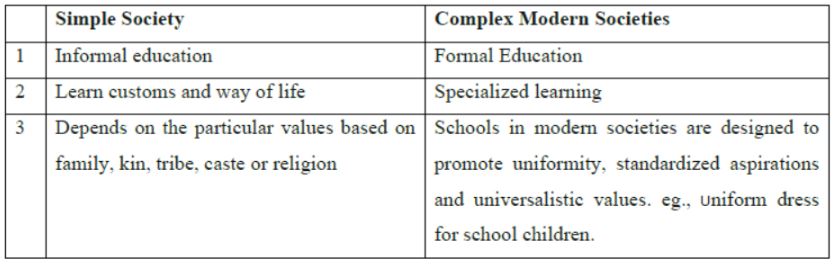
Education: Functionalist View
The functionalist sociologists speak about education on the basis of general social needs and social norms. Education maintains and renews the social structure, transmits and develops culture. Education system plays a major role in the future roles of individual. Education helps to develop individual’s ability and to select the status according to their abilities.
Education: Conflict View
Education functions as a main stratifying agent. The inequality of educational opportunity is also a product of social stratification
CBSE Class 11 Sociology Introducing Sociology Chapter 3 Understanding Social Institutions Notes
Students can use these Revision Notes for Introducing Sociology Chapter 3 Understanding Social Institutions to quickly understand all the main concepts. This study material has been prepared as per the latest CBSE syllabus for Class 11. Our teachers always suggest that Class 11 students read these notes regularly as they are focused on the most important topics that usually appear in school tests and final exams.
NCERT Based Introducing Sociology Chapter 3 Understanding Social Institutions Summary
Our expert team has used the official NCERT book for Class 11 Sociology to design these notes. These are the notes that definitely you for your current academic year. After reading the chapter summary, you should also refer to our NCERT solutions for Class 11. Always compare your understanding with our teacher prepared answers as they will help you build a very strong base in Sociology.
Introducing Sociology Chapter 3 Understanding Social Institutions Complete Revision and Practice
To prepare very well for y our exams, students should also solve the MCQ questions and practice worksheets provided on this page. These extra solved questions will help you to check if you have understood all the concepts of Introducing Sociology Chapter 3 Understanding Social Institutions. All study material on studiestoday.com is free and updated according to the latest Sociology exam patterns. Using these revision notes daily will help you feel more confident and get better marks in your exams.
FAQs
You can download the teacher prepared revision notes for CBSE Class 11 Sociology Understanding Social Institutions Notes from StudiesToday.com. These notes are designed as per 2026-27 academic session to help Class 11 students get the best study material for Sociology.
Yes, our CBSE Class 11 Sociology Understanding Social Institutions Notes include 50% competency-based questions with focus on core logic, keyword definitions, and the practical application of Sociology principles which is important for getting more marks in 2026 CBSE exams.
Yes, our CBSE Class 11 Sociology Understanding Social Institutions Notes provide a detailed, topic wise breakdown of the chapter. Fundamental definitions, complex numerical formulas and all topics of CBSE syllabus in Class 11 is covered.
These notes for Sociology are organized into bullet points and easy-to-read charts. By using CBSE Class 11 Sociology Understanding Social Institutions Notes, Class 11 students fast revise formulas, key definitions before the exams.
No, all study resources on StudiesToday, including CBSE Class 11 Sociology Understanding Social Institutions Notes, are available for immediate free download. Class 11 Sociology study material is available in PDF and can be downloaded on mobile.