

Read DK Goel Solutions Class 11 Accountancy Chapter 10 Accounting for Goods and Service Tax 2026. Students should study DK Goel Solutions Class 11 Accountancy available on Studiestoday.com with solved questions and answers. These chapter-wise answers for Class 11 Accountancy have been prepared by expert teachers. These DK Goel Class 11 Solutions have been designed as per the latest accountancy DK Goel Book for Class 11 and if practiced thoroughly can help you to score good marks in Accounts class tests and examinations.
Class 11 Accounts Chapter 10 Accounting for Goods and Service Tax DK Goel Solutions
DK Goel Solutions for Chapter 10 Accounting for Goods and Service Tax Class 11 Accounts have been provided below based on the latest DK Goel Class 11 book. The answers have been prepared based on the latest 2026 book for the current academic year. DK Goel Solutions Class 11 will help students to improve their concepts and easily solve accountancy questions for Class 11.
Chapter 10 Accounting for Goods and Service Tax DK Goel Class 11 Solutions
Short Answer Question
Question 1.
Solution 1: Goods and services tax (GST) is a tax imposed indirectly on the goods and services supply.
Question 2.
Solution 2: The two central taxes that have merged into GST are:-
(i) Custom duty
(ii) Excise duty
Question 3.
Solution 3: The two central taxes that have merged into GST are:-
(i) VAT
(ii) Purchase Tax
Question 4.
Solution 4: The two advantages of GST are :-
(i) GST reduce the sales without receipts and corruption.
(ii) GST reduce multiple tax evasion.
Question 5.
Solution 5: CGST refers to Central Goods and Services Tax.
Question 6.
Solution 6: SGST refers to State Goods and Services Tax.
Question 7.
Solution 7: IGST refers to Integrated Goods and Services Tax.
Question 8.
Solution 8: CGST refers to Integrated Goods and Service Tax. It is levied on intra-state or within state sales. The CGST is supervised by the central government and administered by the CGST Act. Example: A dealer of Rajasthan sells goods to a dealer of Rajasthan worth Rs. 50,000. Suppose the CGST and SGST rate is 12%. In the case the seller will charge 6% of CGST and 6% of SGST Rs. 3,000 as CGST and Rs. 3,000 as SGST.
Question 9.
Solution 9: IGST refers to Integrated Goods and Service Tax. It is levied on inter-state sales. The IGST is supervised by the IGST act. For Example: A dealer of Rajasthan sells goods to a dealer in Uttar Pradesh worth Rs. 50,000. Suppose the IGST rate is 12%. In the case the seller will charge Rs. 6,000 as IGST.
Practical Question
Question 1.
Solution 1:
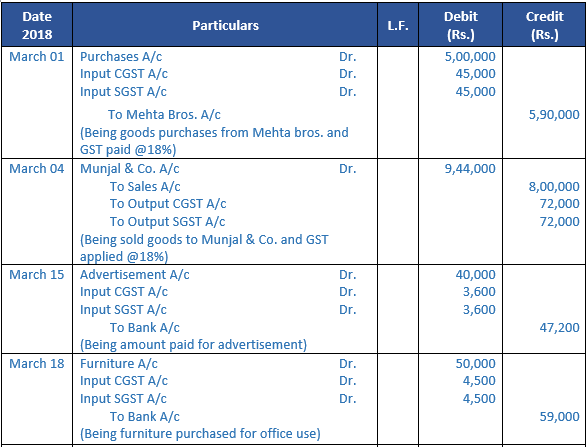
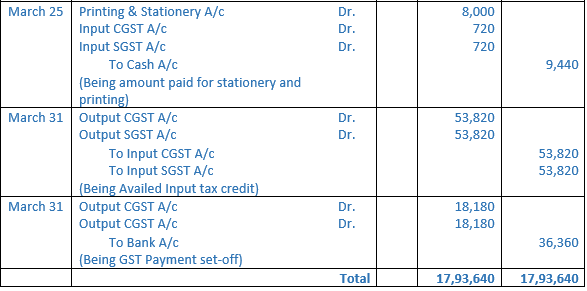
Point of Knowledge:-
The cost of goods will decrease since tax on tax is eliminated in GST regime. In the pre-GST regime, there were many indirect taxes levied by both centre and state. For example, Centre charged excise duty on goods manufactured and State charged VAT on the same goods. This lead to a tax on tax also known as cascading effect of taxes. GST avoid this cascading effect of taxes. GST avoids this casing effect as the tax is calculated only on the value added at each stage of transfer of ownership.
Question 2.
Solution 2 :
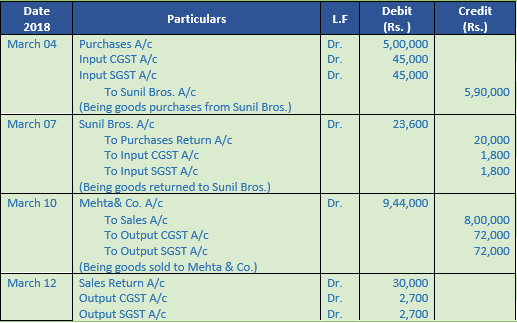
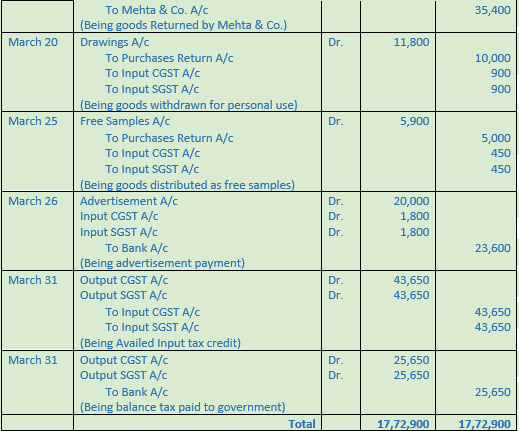
Point of Knowledge:-
GST Rate Structure:- Goods and Service are divided into five slabs for collection of GST:
Essential items including food 0%
Common Use Items 5%
Standard Rate 12%
Maximum Goods and all services Standard Rate 18%
Luxury items and tobacoo 28%
Question 3.
Solution 3:
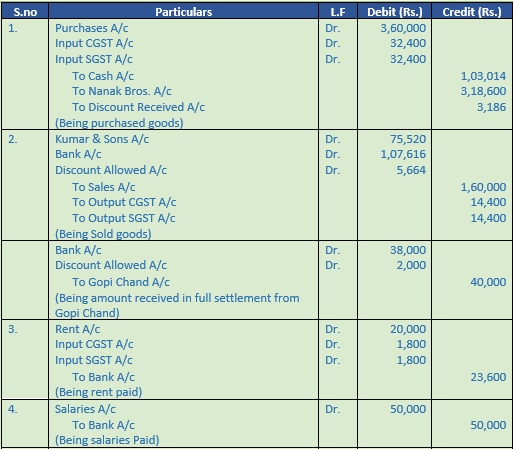

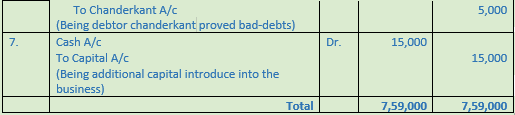
Point of Knowledge:-
CGST refers to Integrated Goods and Service Tax. It is levied on intra-state or within state sales. The CGST is supervised by the central government and administered by the CGST Act. Example: A dealer of Rajasthan sells goods to a dealer of Rajasthan worth Rs. 50,000. Suppose the CGST and SGST rate is 12%. In the case the seller will charge 6% of CGST and 6% of SGST Rs. 3,000 as CGST and Rs. 3,000 as SGST.
Question 4. .
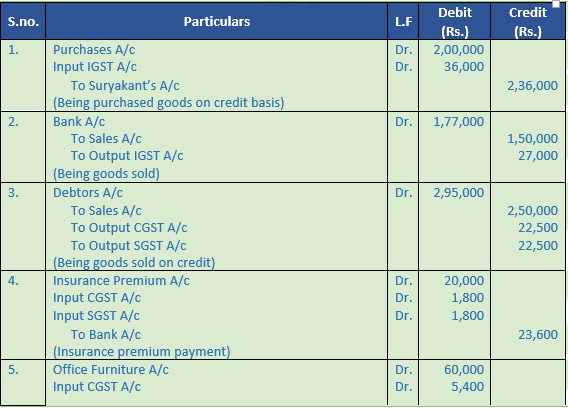
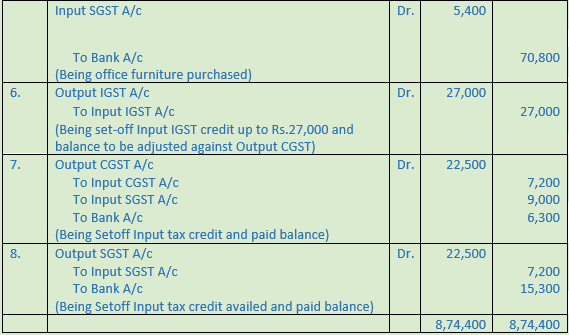
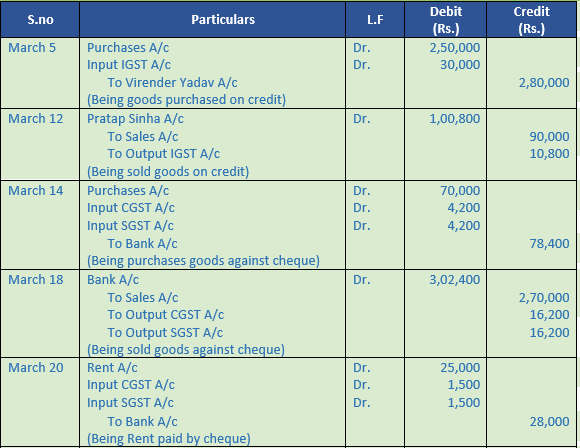
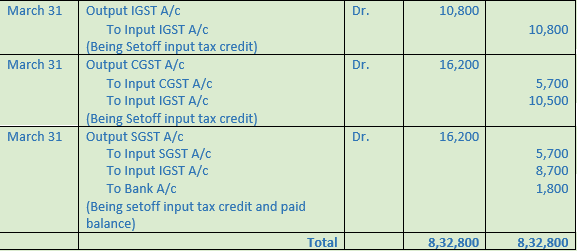
Working Note:-
Calculation of GST
IGST outstanding = Output IGST – Input IGST
= Rs. 27,000 – Rs. 36,000
= (Rs. 9,000)
Output CGST can set-off by both Input CGST and Input IGST
CGST outstanding = Output CGST – Input IGST – Input CGST
= Rs. 22,500 – Rs. 9,000 – Rs. 7,200
= Rs. 6,300
SGST outstanding = Output SGST – Input SGST
= Rs. 22,500 – Rs. 7,200
= Rs. 15,300
Question 5.
Point of Knowledge:-
SGST refers to Integrated Goods and Service Tax. It is levied on intra-state or within state sales. The SGST is supervised by the state government and administered by the SGST Act. Example: A dealer of Rajasthan sells goods to a dealer of Rajasthan worth Rs. 50,000. Suppose the CGST and SGST rate is 12%. In the case the seller will charge 6% of CGST and 6% of SGST Rs. 3,000 as CGST and Rs. 3,000 as SGST.
Question 6.
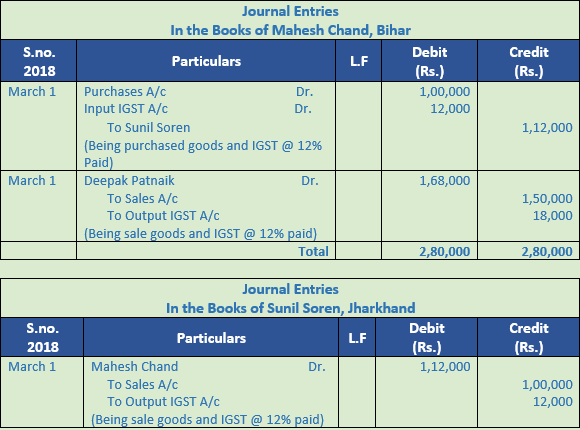
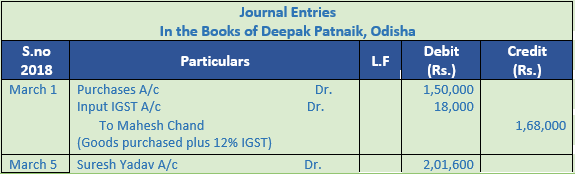
Solution 6:
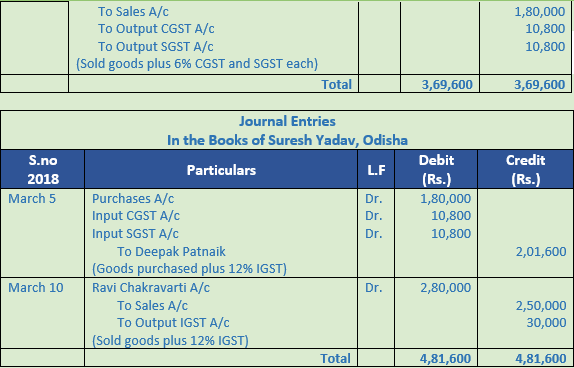
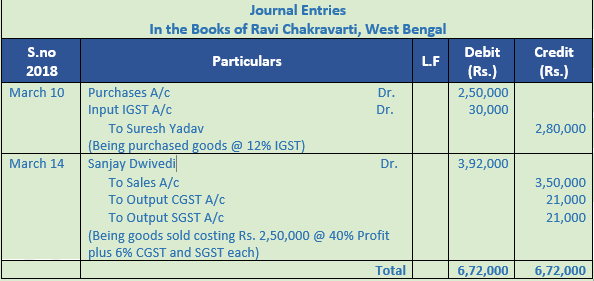
Point of Knowledge:-
GST Rate Structure:- Goods and Service are divided into five slabs for collection of GST:
Essential items including food 0%
Common Use Items 5%
Standard Rate 12%
Maximum Goods and all services Standard Rate 18%
Luxury items and tobacco 28%
Question 7.
Solution 7:
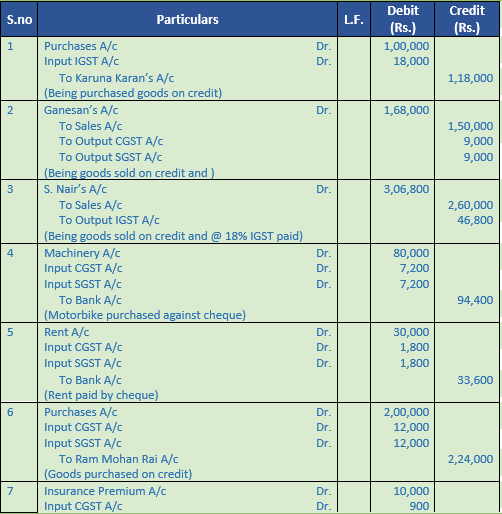
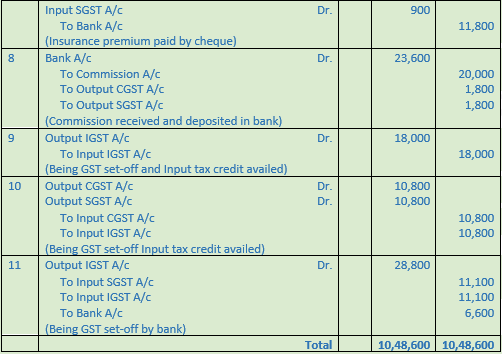
Point of Knowledge:-
IGST refers to Integrated Goods and Service Tax. It is levied on inter-state sales. The IGST is supervised by the IGST act. For Example: A dealer of Rajasthan sells goods to a dealer in Uttar Pradesh worth Rs. 50,000. Suppose the IGST rate is 12%. In the case the seller will charge Rs. 6,000 as IGST.
Question 8.
Solution 8:
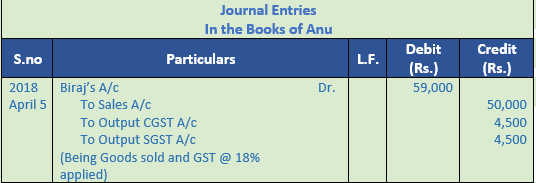
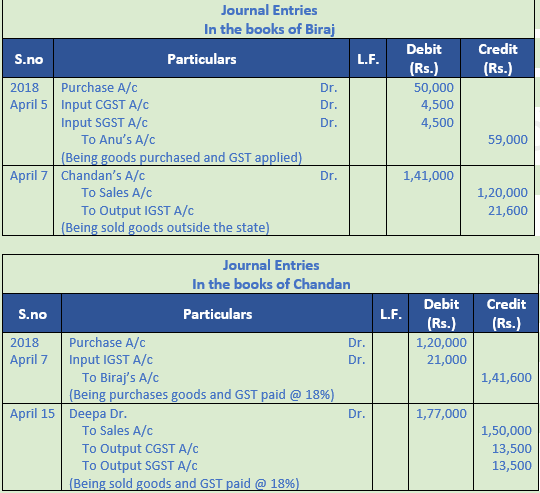
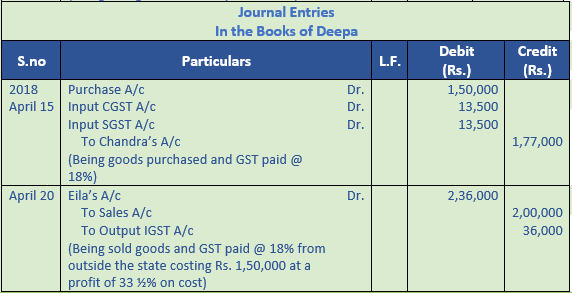
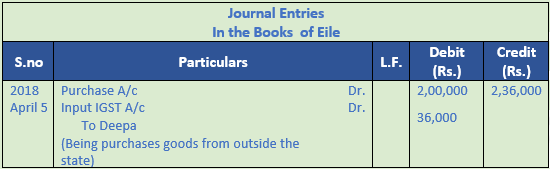
Point of Knowledge:-
GST is paid on purchase of goods and services and it is collected from customers on sale if goods and services. GST Paid (termed as Input GST) is set off against GST Collected (termed as output GST).
Question 9.
Solution 9:
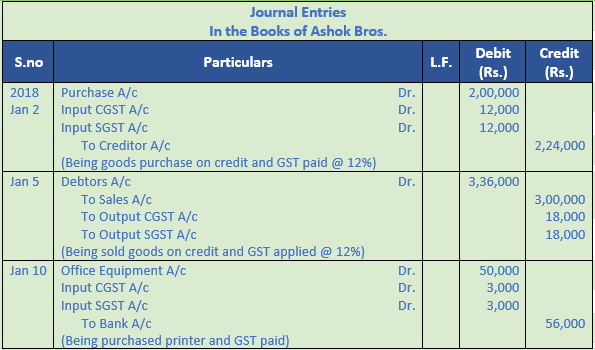
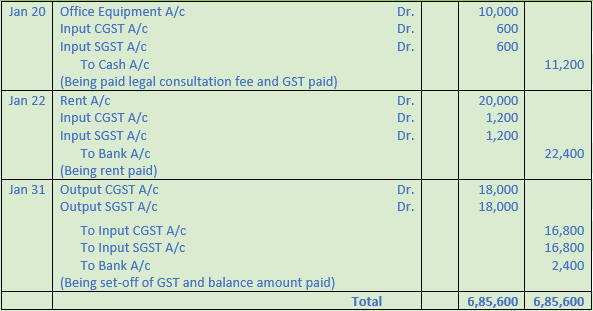
Working Note:-
Calculation of GST Outstanding:-
Output CGST can set-off by both Input CGST and Input IGST
CGST outstanding = Output CGST – Input CGST
= Rs. 18,000 – Rs. 12,000 – Rs. 3,000 – Rs. 600 – Rs. 1,200
= Rs. 18,000 – Rs. 16,800
= Rs. 1,200
Output SGST can set-off by both Input SGST and Input IGST
CGST outstanding = Output SGST – Input SGST
= Rs. 18,000 – Rs. 12,000 – Rs. 3,000 – Rs. 600 – Rs. 1,200
= Rs. 18,000 – Rs. 16,800
= Rs. 1,200
Total Amount paid by bank for GST = Rs. 1,200 + Rs. 1,200 = Rs. 2,400