

ICSE Solutions Frank Brothers Class 9 Mathematics Chapter 18 Rectilinear Figures have been provided below and is also available in Pdf for free download. The Frank Brothers ICSE solutions for Class 9 Mathematics have been prepared as per the latest syllabus and ICSE books and examination pattern suggested in Class 9. Questions given in ICSE Frank Brothers book for Class 9 Mathematics are an important part of exams for Class 9 Mathematics and if answered properly can help you to get higher marks. Refer to more Chapter-wise answers for ICSE Class 9 Mathematics and also download more latest study material for all subjects. Chapter 18 Rectilinear Figures is an important topic in Class 9, please refer to answers provided below to help you score better in exams
Frank Brothers Chapter 18 Rectilinear Figures Class 9 Mathematics ICSE Solutions
Class 9 Mathematics students should refer to the following ICSE questions with answers for Chapter 18 Rectilinear Figures in Class 9. These ICSE Solutions with answers for Class 9 Mathematics will come in exams and help you to score good marks
Chapter 18 Rectilinear Figures Frank Brothers ICSE Solutions Class 9 Mathematics
Question 1. Find the sum of the interior angles of a polygon with the following number of sides:
(i) \( n = 7 \)
(ii) \( n = 12 \)
(iii) \( n = 9 \)
Answer:
To find the total sum of all interior angles of a polygon with \( n \) sides, we use the formula \( (n-2) \times 180^\circ \).
(i) For a polygon with 7 sides:
\( \text{Sum of interior angles} = (7-2) \times 180^\circ \)
\( = 5 \times 180^\circ \)
= \( 900^\circ \)
(ii) For a polygon with 12 sides:
\( \text{Sum of interior angles} = (12-2) \times 180^\circ \)
\( = 10 \times 180^\circ \)
= \( 1800^\circ \)
(iii) For a polygon with 9 sides:
\( \text{Sum of interior angles} = (9-2) \times 180^\circ \)
\( = 7 \times 180^\circ \)
= \( 1260^\circ \)
In simple words: To get the total sum of all the inside angles of any polygon, subtract 2 from its total number of sides and then multiply that result by \( 180^\circ \).
Exam Tip: Remember that \( n \) always represents the number of sides. Double-check your subtraction before multiplying by \( 180^\circ \) to avoid simple arithmetic mistakes.
Question 2. Find the measure of each interior angle of a regular polygon with the following number of sides:
(i) \( n = 6 \)
(ii) \( n = 10 \)
(iii) \( n = 15 \)
Answer:
For a regular polygon with \( n \) sides, the size of each interior angle is determined using the formula \( \frac{(n-2) \times 180^\circ}{n} \).
(i) When \( n = 6 \):
\( \text{Each interior angle} = \frac{(6-2) \times 180^\circ}{6} \)
\( = \frac{4 \times 180^\circ}{6} \)
= \( 120^\circ \)
(ii) When \( n = 10 \):
\( \text{Each interior angle} = \frac{(10-2) \times 180^\circ}{10} \)
\( = \frac{8 \times 180^\circ}{10} \)
= \( 144^\circ \)
(iii) When \( n = 15 \):
\( \text{Each interior angle} = \frac{(15-2) \times 180^\circ}{15} \)
\( = \frac{13 \times 180^\circ}{15} \)
= \( 156^\circ \)
In simple words: If all sides and angles of a shape are equal, find the total sum of all interior angles first, and then divide it by the number of sides to get each individual angle.
Exam Tip: This formula only works for regular polygons where all sides and interior angles are equal. Do not use it for irregular shapes.
Question 3. Find the measure of each exterior angle of a regular polygon with the following number of sides:
(i) \( n = 9 \)
(ii) \( n = 15 \)
(iii) \( n = 18 \)
Answer:
The measure of each exterior angle of a regular polygon with \( n \) sides is determined by dividing \( 360^\circ \) by \( n \).
(i) When \( n = 9 \):
\( \text{Each exterior angle} = \frac{360^\circ}{9} \)
= \( 40^\circ \)
(ii) When \( n = 15 \):
\( \text{Each exterior angle} = \frac{360^\circ}{15} \)
= \( 24^\circ \)
(iii) When \( n = 18 \):
\( \text{Each exterior angle} = \frac{360^\circ}{18} \)
= \( 20^\circ \)
In simple words: The sum of all outside angles of any polygon is always \( 360^\circ \). Dividing \( 360^\circ \) by the number of sides gives the measure of each outer angle.
Exam Tip: Since the sum of exterior angles of any convex polygon is always a constant \( 360^\circ \), this is often the fastest way to solve polygon problems.
Question 4. Find the number of sides in a regular polygon if each of its interior angles is:
(i) \( 120^\circ \)
(ii) \( 140^\circ \)
(iii) \( 135^\circ \)
Answer:
Let \( n \) be the number of sides of the polygon. The formula for each interior angle is \( \frac{(n-2) \times 180^\circ}{n} \).
(i) When each interior angle is \( 120^\circ \):
\( \frac{(n-2) \times 180^\circ}{n} = 120^\circ \)
\( \implies 180^\circ(n-2) = 120^\circ(n) \)
\( \implies 3(n-2) = 2n \)
\( \implies n = 6 \)
(ii) When each interior angle is \( 140^\circ \):
\( \frac{(n-2) \times 180^\circ}{n} = 140^\circ \)
\( \implies 180^\circ(n-2) = 140^\circ(n) \)
\( \implies 9(n-2) = 7n \)
\( \implies n = \frac{18}{2} = 9 \)
(iii) When each interior angle is \( 135^\circ \):
\( \frac{(n-2) \times 180^\circ}{n} = 135^\circ \)
\( \implies 180^\circ(n-2) = 135^\circ(n) \)
\( \implies 4(n-2) = 3n \)
\( \implies n = 8 \)
In simple words: Set up an equation with the interior angle formula and solve for \( n \) to find how many sides the shape has. Alternatively, you can subtract the interior angle from \( 180^\circ \) to find the exterior angle, then divide \( 360^\circ \) by that number.
Exam Tip: Using the exterior angle method, where \( \text{Exterior Angle} = 180^\circ - \text{Interior Angle} \) and \( n = \frac{360^\circ}{\text{Exterior Angle}} \), is a much quicker way to solve this type of problem in exams.
Question 5. Find the number of sides in a regular polygon if each of its exterior angles is:
(i) \( 20^\circ \)
(ii) \( 60^\circ \)
(iii) \( 72^\circ \)
Answer:
Let \( n \) be the number of sides of the polygon. Since each exterior angle is \( \frac{360^\circ}{n} \):
(i) When each exterior angle is \( 20^\circ \):
\( \frac{360^\circ}{n} = 20^\circ \)
\( \implies n = 18 \)
(ii) When each exterior angle is \( 60^\circ \):
\( \frac{360^\circ}{n} = 60^\circ \)
\( \implies n = 6 \)
(iii) When each exterior angle is \( 72^\circ \):
\( \frac{360^\circ}{n} = 72^\circ \)
\( \implies n = 5 \)
In simple words: To find the number of sides, divide \( 360^\circ \) by the size of one exterior angle.
Exam Tip: Remember that the number of sides \( n \) must always be a positive whole number. If you get a fraction, recheck your calculations.
Question 6. The interior angles of a pentagon are \( 100^\circ \), \( 96^\circ \), \( 74^\circ \), \( 2x^\circ \), and \( 3x^\circ \). Find the value of \( x \) and the measures of the two unknown angles.
Answer:
A pentagon is a polygon with 5 sides.
The total sum of its interior angles is:
\( \text{Sum} = (5-2) \times 180^\circ \)
\( = 3 \times 180^\circ = 540^\circ \)
Adding all the given angles together:
\( 100^\circ + 96^\circ + 74^\circ + 2x^\circ + 3x^\circ = 540^\circ \)
\( \implies 5x^\circ + 270^\circ = 540^\circ \)
\( \implies x^\circ = \frac{540^\circ - 270^\circ}{5} = 54^\circ \)
Now we can find the two unknown angles:
The first unknown angle is \( 2x^\circ = 2 \times 54^\circ = 108^\circ \).
The second unknown angle is \( 3x^\circ = 3 \times 54^\circ = 162^\circ \).
In simple words: First, find the total sum of angles for a pentagon, which is \( 540^\circ \). Add the five given expressions together, set them equal to \( 540^\circ \), solve for \( x \), and then use \( x \) to find the actual angles.
Exam Tip: Always state the final measures of the unknown angles separately at the end of your answer, rather than just solving for \( x \), to ensure you get full marks.
Question 7. Three interior angles of a quadrilateral are \( 71^\circ \), \( 110^\circ \), and \( 95^\circ \). Find the measure of the fourth angle.
Answer:
A quadrilateral has 4 sides.
The total sum of its interior angles is:
\( \text{Sum} = (4-2) \times 180^\circ \)
\( = 2 \times 180^\circ = 360^\circ \)
Let the unknown fourth angle be represented by \( x \).
Summing the angles:
\( 71^\circ + 110^\circ + 95^\circ + x = 360^\circ \)
\( \implies x + 276^\circ = 360^\circ \)
\( \implies x = 360^\circ - 276^\circ = 84^\circ \)
Therefore, the fourth angle is \( 84^\circ \).
In simple words: The four angles inside any four-sided shape always add up to \( 360^\circ \). Add the three known angles together and subtract their total from \( 360^\circ \) to find the missing angle.
Exam Tip: Writing down the angle sum property of a quadrilateral (\( 360^\circ \)) clearly in your steps is essential for scoring method marks.
Question 8. The interior angles of a pentagon are in the ratio \( 4:4:6:7:6 \). Find all the angles of the pentagon.
Answer:
A pentagon consists of 5 sides.
The sum of its interior angles is:
\( \text{Sum} = (5-2) \times 180^\circ \)
\( = 3 \times 180^\circ = 540^\circ \)
Let the five interior angles be represented as \( 4x^\circ \), \( 4x^\circ \), \( 6x^\circ \), \( 7x^\circ \), and \( 6x^\circ \).
Summing these angles gives:
\( 4x^\circ + 4x^\circ + 6x^\circ + 7x^\circ + 6x^\circ = 540^\circ \)
\( \implies 27x^\circ = 540^\circ \)
\( \implies x^\circ = 20^\circ \)
Using this value, we can compute each angle:
\( 4x^\circ = 4 \times 20^\circ = 80^\circ \)
\( 4x^\circ = 4 \times 20^\circ = 80^\circ \)
\( 6x^\circ = 6 \times 20^\circ = 120^\circ \)
\( 7x^\circ = 7 \times 20^\circ = 140^\circ \)
\( 6x^\circ = 6 \times 20^\circ = 120^\circ \)
Thus, the five interior angles of the pentagon are \( 80^\circ \), \( 80^\circ \), \( 120^\circ \), \( 140^\circ \), and \( 120^\circ \).
In simple words: Since the angles are in a ratio, multiply each part of the ratio by \( x \) and add them up to equal the total sum of \( 540^\circ \). Solve for \( x \) and substitute it back to find the actual size of each angle.
Exam Tip: Always double-check your final list of angles by adding them up to make sure they equal exactly \( 540^\circ \).
Question 9. The interior angles of a quadrilateral are in the ratio \( 1:4:5:2 \). Find all the interior angles.
Answer:
A quadrilateral has 4 sides.
The sum of its interior angles is:
\( \text{Sum} = (4-2) \times 180^\circ \)
\( = 2 \times 180^\circ = 360^\circ \)
Let the four interior angles be \( x^\circ \), \( 4x^\circ \), \( 5x^\circ \), and \( 2x^\circ \).
Adding these angles together:
\( x^\circ + 4x^\circ + 5x^\circ + 2x^\circ = 360^\circ \)
\( \implies 12x^\circ = 360^\circ \)
\( \implies x^\circ = 30^\circ \)
Now, calculate each of the four angles:
\( x^\circ = 30^\circ \)
\( 4x^\circ = 4 \times 30^\circ = 120^\circ \)
\( 5x^\circ = 5 \times 30^\circ = 150^\circ \)
\( 2x^\circ = 2 \times 30^\circ = 60^\circ \)
So, the interior angles of the quadrilateral are \( 30^\circ \), \( 120^\circ \), \( 150^\circ \), and \( 60^\circ \).
In simple words: Set the sum of the ratio terms equal to \( 360^\circ \), solve for the common factor \( x \), and multiply it by each ratio value to find the angles.
Exam Tip: Keep your final list of angles in the same order as the ratio given in the question to present a clear, structured solution.
Question 10. The interior angles of a pentagon are \( x^\circ \), \( (x-10)^\circ \), \( (x+20)^\circ \), \( (2x-44)^\circ \), and \( (2x-70)^\circ \). Find the value of \( x \) and the measures of all the angles.
Answer:
A pentagon is a 5-sided polygon.
The sum of its interior angles is:
\( \text{Sum} = (5-2) \times 180^\circ \)
\( = 3 \times 180^\circ = 540^\circ \)
Adding all the given angle expressions together:
\( x^\circ + (x-10)^\circ + (x+20)^\circ + (2x-44)^\circ + (2x-70)^\circ = 540^\circ \)
\( \implies 7x^\circ - 104^\circ = 540^\circ \)
\( \implies x^\circ = \frac{540^\circ + 104^\circ}{7} = 92^\circ \)
Substituting \( x = 92 \) into each expression gives the five angles:
\( x^\circ = 92^\circ \)
\( (x-10)^\circ = 92^\circ - 10^\circ = 82^\circ \)
\( (x+20)^\circ = 92^\circ + 20^\circ = 112^\circ \)
\( (2x-44)^\circ = 2(92^\circ) - 44^\circ = 184^\circ - 44^\circ = 140^\circ \)
\( (2x-70)^\circ = 2(92^\circ) - 70^\circ = 184^\circ - 70^\circ = 114^\circ \)
Hence, the interior angles of the pentagon measure \( 92^\circ \), \( 82^\circ \), \( 112^\circ \), \( 140^\circ \), and \( 114^\circ \).
In simple words: Sum all the given algebraic expressions, set them equal to \( 540^\circ \) (the total sum of angles in a pentagon), find \( x \), and then use that value to calculate each individual angle.
Exam Tip: Be very careful when simplifying the negative numbers in the algebraic expression to avoid sign errors before dividing by 7.
Question 11. The interior angles of a hexagon are \( (2x+5)^\circ \), \( (3x-5)^\circ \), \( (x+40)^\circ \), \( (2x+20)^\circ \), \( (2x+25)^\circ \), and \( (2x+35)^\circ \). Find the value of \( x \).
Answer:
A hexagon has 6 sides.
The sum of its interior angles is:
\( \text{Sum} = (6-2) \times 180^\circ \)
\( = 4 \times 180^\circ = 720^\circ \)
We set the sum of all given angle expressions to \( 720^\circ \):
\( (2x+5)^\circ + (3x-5)^\circ + (x+40)^\circ + (2x+20)^\circ + (2x+25)^\circ + (2x+35)^\circ = 720^\circ \)
\( \implies 12x + 120^\circ = 720^\circ \)
\( \implies 12x = 720^\circ - 120^\circ \)
\( \implies 12x = 600^\circ \)
\( \implies x = 50 \)
So, the value of \( x \) is 50.
In simple words: The six angles of a hexagon must add up to \( 720^\circ \). By adding all the expressions together and setting them equal to \( 720^\circ \), we can solve for \( x \).
Exam Tip: Pay close attention to grouping the like terms (the \( x \) variables and constant numbers) carefully to avoid making algebraic errors.
Question 12. One of the angles of a hexagon is \( 140^\circ \) and the remaining five angles are in the ratio \( 4:3:4:5:4 \). Find the measure of the smallest and the largest of these remaining angles.
Answer:
A hexagon is a 6-sided shape.
The total sum of its interior angles is:
\( \text{Sum} = (6-2) \times 180^\circ \)
\( = 4 \times 180^\circ = 720^\circ \)
One of the angles is \( 140^\circ \).
Let the five remaining angles be \( 4x^\circ \), \( 3x^\circ \), \( 4x^\circ \), \( 5x^\circ \), and \( 4x^\circ \).
The sum of all six angles equals \( 720^\circ \):
\( 140^\circ + 4x^\circ + 3x^\circ + 4x^\circ + 5x^\circ + 4x^\circ = 720^\circ \)
\( \implies 20x^\circ + 140^\circ = 720^\circ \)
\( \implies 20x^\circ = 580^\circ \)
\( \implies x^\circ = 29^\circ \)
Now, let's find the smallest and largest of the remaining angles:
The smallest angle is represented by \( 3x^\circ = 3 \times 29^\circ = 87^\circ \).
The largest angle is represented by \( 5x^\circ = 5 \times 29^\circ = 145^\circ \).
In simple words: Subtract the known angle of \( 140^\circ \) from the hexagon's total of \( 720^\circ \). The rest of the angles add up to \( 580^\circ \), which we divide using the given ratio to find the smallest and largest angles.
Exam Tip: Clearly state which ratio term represents the smallest (\( 3x \)) and which represents the largest (\( 5x \)) before calculating their final values.
Question 13. One of the angles of a pentagon is \( 160^\circ \), and the remaining four angles are equal. Find the measure of each equal angle.
Answer:
A pentagon has 5 sides.
The sum of the interior angles of a pentagon is:
\( \text{Sum} = (5-2) \times 180^\circ \)
\( = 3 \times 180^\circ = 540^\circ \)
One angle is \( 160^\circ \). Let each of the four remaining equal angles be \( x^\circ \).
Setting up the equation for the total sum:
\( 160^\circ + x^\circ + x^\circ + x^\circ + x^\circ = 540^\circ \)
\( \implies 160^\circ + 4x^\circ = 540^\circ \)
\( \implies 4x^\circ = 540^\circ - 160^\circ \)
\( \implies 4x^\circ = 380^\circ \)
\( \implies x^\circ = 95^\circ \)
Therefore, each of the equal remaining angles measures \( 95^\circ \).
In simple words: Subtract the single known angle of \( 160^\circ \) from the pentagon's total of \( 540^\circ \). Then, divide the remaining \( 380^\circ \) equally among the four other angles.
Exam Tip: Always state the formula for the sum of interior angles first to ensure you establish the correct total (\( 540^\circ \)) before performing any subtractions.
Question 14. Find the measure of each interior angle of a regular nonagon.
Answer:
A nonagon is a polygon with 9 sides (\( n = 9 \)).
The formula for the measure of each interior angle of a regular polygon is \( \frac{(n-2) \times 180^\circ}{n} \).
Substituting \( n = 9 \) into this formula:
\( \text{Each interior angle} = \frac{(9-2) \times 180^\circ}{9} \)
\( = \frac{7 \times 180^\circ}{9} \)
= \( 140^\circ \)
So, each interior angle of a regular nonagon is \( 140^\circ \).
In simple words: Since a regular nonagon has 9 equal sides and angles, we use the formula with \( n = 9 \) to find that each inside angle is \( 140^\circ \).
Exam Tip: Memorize the names of common polygons (e.g., nonagon for 9 sides, decagon for 10 sides) because exam questions often use these terms instead of giving the number of sides directly.
Question 15. Find the measure of each interior angle of a regular polygon with 20 sides.
Answer:
Here, the number of sides is \( n = 20 \).
The formula for each interior angle of a regular polygon is \( \frac{(n-2) \times 180^\circ}{n} \).
Substituting \( n = 20 \) into the formula:
\( \text{Each interior angle} = \frac{(20-2) \times 180^\circ}{20} \)
\( = \frac{18 \times 180^\circ}{20} \)
= \( 162^\circ \)
Thus, each interior angle is \( 162^\circ \).
In simple words: Plug \( n = 20 \) into the interior angle formula to find the value of one inside angle, which comes out to \( 162^\circ \).
Exam Tip: Simplifying the fraction \( \frac{18 \times 180^\circ}{20} \) by canceling out 20 with 180 first (\( 180 / 20 = 9 \)) makes the multiplication \( 18 \times 9 \) much quicker and less prone to errors.
Question 16A. Is it possible to have a polygon whose sum of interior angles is \( 780^\circ \)?
Answer:
Let the number of sides of the polygon be \( n \).
The sum of interior angles is given by \( (n-2) \times 180^\circ \).
Set this equal to the given sum:
\( (n-2) \times 180^\circ = 780^\circ \)
\( \implies 180^\circ n - 360^\circ = 780^\circ \)
\( \implies 180^\circ n = 1140^\circ \)
\( \implies n = \frac{1140^\circ}{180^\circ} = 6\frac{1}{3} \)
Since the number of sides in any polygon must be a positive whole number (an integer), a polygon cannot have a fractional number of sides.
Therefore, a polygon with a sum of interior angles equal to \( 780^\circ \) is not possible.
In simple words: Solve for the number of sides, \( n \), using the formula. Since we get a fraction (\( 6\frac{1}{3} \)) and a shape cannot have a fraction of a side, such a polygon is impossible.
Exam Tip: To show that a polygon is not possible, always solve for \( n \) and clearly state that \( n \) must be a natural number (or a positive integer) to earn full marks.
Question 16B. Is it possible to have a polygon whose sum of interior angles is equal to 7 right angles?
Answer:
Let \( n \) be the number of sides of the polygon.
The sum of the interior angles is given by \( (n-2) \times 180^\circ \).
We are given that the sum is equal to 7 right angles, which means:
\( \text{Sum} = 7 \times 90^\circ = 630^\circ \)
Setting up the equation:
\( (n-2) \times 180^\circ = 630^\circ \)
\( \implies 180^\circ n - 360^\circ = 630^\circ \)
\( \implies 180^\circ n = 990^\circ \)
\( \implies n = \frac{990^\circ}{180^\circ} = \frac{11}{2} = 5\frac{1}{2} \)
Because the number of sides of a polygon must be a positive whole number, it cannot be a fraction.
Thus, a polygon with a sum of interior angles equal to 7 right angles is not possible.
In simple words: Seven right angles equal \( 630^\circ \). Trying to find the number of sides for this angle sum gives \( 5.5 \), which is impossible since a shape cannot have half a side.
Exam Tip: Remember to convert "right angles" to degrees by multiplying by \( 90^\circ \) before starting your algebraic calculation.
Question 17A. Is it possible to have a polygon whose each interior angle is \( 124^\circ \)?
Answer:
If each interior angle is \( 124^\circ \), then each exterior angle can be calculated as:
\( \text{Each exterior angle} = 180^\circ - 124^\circ = 56^\circ \)
The number of sides of a regular polygon is given by the formula:
\( n = \frac{360^\circ}{\text{Each exterior angle}} \)
Substituting the values:
\( n = \frac{360^\circ}{56^\circ} = 6\frac{3}{7} \)
Since \( 6\frac{3}{7} \) is not a positive whole number, a regular polygon cannot have this number of sides.
Thus, no such regular polygon is possible with an interior angle of \( 124^\circ \).
In simple words: Subtract the interior angle from \( 180^\circ \) to find the exterior angle (\( 56^\circ \)). Since \( 360^\circ \) cannot be divided evenly by \( 56^\circ \), this polygon cannot exist.
Exam Tip: The exterior angle method is the cleanest and fastest way to determine if a given value can be an interior angle of a regular polygon.
Question 17B. Is it possible to have a polygon whose each interior angle is \( 105^\circ \)?
Answer:
If each interior angle is \( 105^\circ \), the corresponding exterior angle is:
\( \text{Each exterior angle} = 180^\circ - 105^\circ = 75^\circ \)
The number of sides of the polygon is calculated as:
\( n = \frac{360^\circ}{\text{Each exterior angle}} = \frac{360^\circ}{75^\circ} = 4\frac{4}{5} \)
Since the resulting value of \( n \) is not a positive integer, a regular polygon with this property cannot exist.
Consequently, it is impossible to have a regular polygon where each interior angle measures \( 105^\circ \).
In simple words: The exterior angle would be \( 75^\circ \). Because \( 360^\circ \) is not perfectly divisible by \( 75^\circ \), a regular polygon with this angle is impossible.
Exam Tip: Always state clearly that the number of sides must be a natural number (positive integer) to complete your proof.
Question 18. In a heptagon, three angles are equal to \( 120^\circ \), and the remaining four angles are equal to each other. Find the measure of each equal angle.
Answer:
A heptagon is a polygon with 7 sides.
The sum of the interior angles of a heptagon is:
\( \text{Sum} = (7-2) \times 180^\circ \)
\( = 5 \times 180^\circ = 900^\circ \)
We are given that three of the angles are each equal to \( 120^\circ \).
The sum of these three angles is:
\( 3 \times 120^\circ = 360^\circ \)
The sum of the remaining four angles is therefore:
\( \text{Sum of remaining angles} = 900^\circ - 360^\circ = 540^\circ \)
Since these four remaining angles are all equal, we can find the measure of each:
\( \text{Measure of each equal angle} = \frac{540^\circ}{4} = 135^\circ \)
Thus, the angles of the heptagon are three of \( 120^\circ \) and four of \( 135^\circ \).
In simple words: Subtract the sum of the three known angles (\( 360^\circ \)) from the heptagon's total of \( 900^\circ \). Divide the remaining \( 540^\circ \) equally among the other four angles to find that each is \( 135^\circ \).
Exam Tip: Be sure to write down the steps for finding the sum of the three known angles and subtracting it from the total to show your clear logical process.
Question 19. In the given figure, \( \text{AB} \parallel \text{ED} \). Find the value of \( x \), and the measures of \( \angle \text{C} \) and \( \angle \text{D} \).
Answer:
Let the shape be a pentagon ABCDE, which has 5 sides.
The sum of all five interior angles of a pentagon is given by:
\( \text{Sum} = (5-2) \times 180^\circ = 3 \times 180^\circ = 540^\circ \)
Since the lines AB and ED are parallel (\( \text{AB} \parallel \text{ED} \)), the consecutive interior angles \( \angle \text{A} \) and \( \angle \text{E} \) are supplementary:
\( \angle \text{A} + \angle \text{E} = 180^\circ \)
The total sum of the five interior angles can be written as:
\( \angle \text{A} + \angle \text{B} + \angle \text{C} + \angle \text{D} + \angle \text{E} = 540^\circ \)
Rearranging these terms:
\( (\angle \text{A} + \angle \text{E}) + \angle \text{B} + \angle \text{C} + \angle \text{D} = 540^\circ \)
Substituting the known values and expressions:
\( 180^\circ + 140^\circ + 2x + 3x = 540^\circ \)
\( \implies 320^\circ + 5x = 540^\circ \)
\( \implies 5x = 540^\circ - 320^\circ \)
\( \implies 5x = 220^\circ \)
\( \implies x = 44 \)
Now we can compute the individual angles \( \angle \text{C} \) and \( \angle \text{D} \):
\( \angle \text{C} = 2x = 2 \times 44^\circ = 88^\circ \)
\( \angle \text{D} = 3x = 3 \times 44^\circ = 132^\circ \)
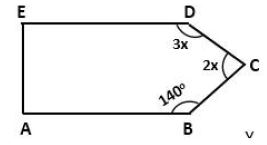
In simple words: Since AB is parallel to ED, the angles at A and E add up to \( 180^\circ \). Adding this to the other angles gives the pentagon's total of \( 540^\circ \), which helps us find \( x = 44 \) and determine the measures of \( \angle \text{C} \) and \( \angle \text{D} \).
Exam Tip: Remember to state the reason why \( \angle \text{A} + \angle \text{E} = 180^\circ \) (consecutive interior angles of parallel lines) as this is a key step that examiners look for.
Question 20. Find the number of sides of a polygon if three of its interior angles are right angles and each of the remaining angles is \( 165^\circ \).
Answer:
Let the total number of sides of the polygon be \( n \).
Since the number of angles is equal to the number of sides, there are \( n \) angles in total.
We are given that 3 of these angles are right angles (\( 90^\circ \) each).
Therefore, the number of remaining angles is \( n - 3 \), and each of these measures \( 165^\circ \).
The sum of all interior angles of an \( n \)-sided polygon is:
\( \text{Sum} = (n-2) \times 180^\circ \)
Setting up the equation for the sum of all angles:
\( 3 \times 90^\circ + (n-3) \times 165^\circ = (n-2) \times 180^\circ \)
\( \implies 270^\circ + 165^\circ n - 495^\circ = 180^\circ n - 360^\circ \)
\( \implies 165^\circ n - 225^\circ = 180^\circ n - 360^\circ \)
\( \implies 180^\circ n - 165^\circ n = 360^\circ - 225^\circ \)
\( \implies 15^\circ n = 135^\circ \)
\( \implies n = 9 \)
Thus, the polygon has 9 sides.
In simple words: Write an expression for the sum of the 3 right angles and the other \( (n-3) \) angles, set it equal to the interior angle sum formula, and solve to find that the polygon has 9 sides.
Exam Tip: Be careful with the algebraic expansion of \( (n-3) \times 165^\circ \) to ensure you don't make a sign error when moving terms across the equals sign.
Question 21. In the given figure, \( \text{AB} \parallel \text{DC} \). If the ratio of the angles \( \angle \text{A} : \angle \text{E} : \angle \text{D} = 1 : 2 : 3 \), find the measure of \( \angle \text{A} \).
Answer:
Let ABCDE be a 5-sided polygon (a pentagon).
The sum of all five interior angles of a pentagon is given by:
\( \text{Sum} = (5-2) \times 180^\circ = 540^\circ \)
Since the lines AB and DC are parallel (\( \text{AB} \parallel \text{DC} \)), the sum of the consecutive interior angles \( \angle \text{B} \) and \( \angle \text{C} \) is:
\( \angle \text{B} + \angle \text{C} = 180^\circ \)
The total sum of the five angles of the pentagon is:
\( \angle \text{A} + \angle \text{B} + \angle \text{C} + \angle \text{D} + \angle \text{E} = 540^\circ \)
Substituting the known relationships and ratio values (\( \angle \text{A} = x \), \( \angle \text{E} = 2x \), and \( \angle \text{D} = 3x \)):
\( x + 180^\circ + 3x + 2x = 540^\circ \)
\( \implies 6x + 180^\circ = 540^\circ \)
\( \implies 6x = 540^\circ - 180^\circ \)
\( \implies 6x = 360^\circ \)
\( \implies x = 60 \)
Therefore, the measure of \( \angle \text{A} \) is \( 60^\circ \).
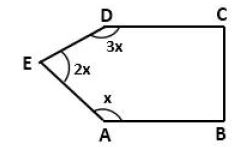
In simple words: Since AB is parallel to DC, the angles at B and C add up to \( 180^\circ \). Adding this to the other angles gives the pentagon's total of \( 540^\circ \), which helps us find \( x = 60 \) and determines that \( \angle \text{A} = 60^\circ \).
Exam Tip: Be sure to write down the reason for the sum of \( \angle \text{B} + \angle \text{C} = 180^\circ \), citing parallel lines, to ensure you receive full credit from the examiner.
Question 22. The difference between the exterior angles of two regular polygons having \( n \) and \( n + 1 \) sides is \( 4^{\circ} \). Find the value of \( n \).
Answer: For any regular polygon with \( n \) sides, each exterior angle measures \( \frac{360^{\circ}}{n} \).
For a polygon with \( n + 1 \) sides, each exterior angle measures \( \frac{360^{\circ}}{n + 1} \).
The difference between these two exterior angles is given as \( 4^{\circ} \).
Therefore, we can set up the equation:
\( \frac{360^{\circ}}{n} - \frac{360^{\circ}}{n + 1} = 4^{\circ} \)
Dividing both sides of the equation by \( 4 \):
\( \frac{90}{n} - \frac{90}{n + 1} = 1 \)
Combining the fractions on the left-hand side:
\( \frac{90(n + 1) - 90n}{n(n + 1)} = 1 \)
Simplifying the numerator:
\( \frac{90n + 90 - 90n}{n(n + 1)} = 1 \)
\( \frac{90}{n^2 + n} = 1 \)
Cross-multiplying yields:
\( 90 = n^2 + n \)
Rearranging this into a standard quadratic equation:
\( n^2 + n - 90 = 0 \)
Factoring the quadratic by splitting the middle term:
\( n^2 + 10n - 9n - 90 = 0 \)
\( n(n + 10) - 9(n + 10) = 0 \)
\( (n + 10)(n - 9) = 0 \)
This gives two possible solutions:
\( n + 10 = 0 \) or \( n - 9 = 0 \)
\( n = -10 \) or \( n = 9 \)
Since the number of sides of a polygon cannot be a negative value, we must reject \( n = -10 \).
Thus, the value of \( n \) is \( 9 \).
In simple words: An outer angle of a regular shape is found by dividing \( 360^{\circ} \) by its number of sides. By comparing the two shapes, we find that only a 9-sided shape fits the given difference of \( 4^{\circ} \).
Exam Tip: Remember that the number of sides \( n \) must always be a positive integer. Always discard any negative values of \( n \) obtained from solving quadratic equations.
Question 23. The ratio of the number of sides of two regular polygons is \( 2 : 3 \) and the ratio of their interior angles is \( 9 : 10 \). Find the number of sides of each polygon.
Answer: Let the number of sides of the two regular polygons be \( 2x \) and \( 3x \) respectively.
The formula for each interior angle of a regular polygon with \( n \) sides is:
\( \text{Interior Angle} = \frac{(n - 2) \times 180^{\circ}}{n} \)
Using this formula, the interior angle of the first polygon with \( 2x \) sides is:
\( \frac{(2x - 2) \times 180^{\circ}}{2x} \)
And the interior angle of the second polygon with \( 3x \) sides is:
\( \frac{(3x - 2) \times 180^{\circ}}{3x} \)
We are given that the ratio of these interior angles is \( 9 : 10 \). Therefore:
\( \frac{\frac{(2x - 2) \times 180^{\circ}}{2x}}{\frac{(3x - 2) \times 180^{\circ}}{3x}} = \frac{9}{10} \)
Simplifying this fraction by multiplying by the reciprocal:
\( \frac{(2x - 2) \times 180^{\circ}}{2x} \times \frac{3x}{(3x - 2) \times 180^{\circ}} = \frac{9}{10} \)
We can cancel out the common terms of \( 180^{\circ} \) and \( x \):
\( \frac{2(x - 1)}{2} \times \frac{3}{3x - 2} = \frac{9}{10} \)
\( \frac{3(x - 1)}{3x - 2} = \frac{9}{10} \)
Dividing both sides of the equation by \( 3 \):
\( \frac{x - 1}{3x - 2} = \frac{3}{10} \)
Now, cross-multiply to solve for \( x \):
\( 10(x - 1) = 3(3x - 2) \)
\( 10x - 10 = 9x - 6 \)
Grouping the \( x \) terms together:
\( 10x - 9x = -6 + 10 \)
\( \implies x = 4 \)
Using this value of \( x \), we can find the number of sides for each polygon:
For the first polygon: \( 2x = 2(4) = 8 \) sides.
For the second polygon: \( 3x = 3(4) = 12 \) sides.
In simple words: We write the formulas for the inside angles of both shapes using their side ratios. By setting up a ratio of these formulas and solving for the unknown, we find the shapes have 8 and 12 sides.
Exam Tip: Simplify the ratio expression carefully by cancelling out common factors like \( 180^{\circ} \) and \( x \) early in the calculation to avoid complex algebraic terms.
Question 24. In the given figure, \( LM \) and \( LK \) are sides of a regular polygon. If \( LM = LK \) and \( \angle LKM = 20^{\circ} \), find the measure of each interior angle and the number of sides of the polygon.
Answer: In triangle \( \Delta LMK \), we have:
\( LM = LK \) (as they are adjacent sides of the same regular polygon)
\( \therefore \angle LMK = \angle LKM = 20^{\circ} \) (since angles opposite to equal sides in a triangle are equal)
The sum of all interior angles in any triangle is \( 180^{\circ} \):
\( \angle LKM + \angle LMK + \angle KLM = 180^{\circ} \)
Substituting the known angle values:
\( 20^{\circ} + 20^{\circ} + \angle KLM = 180^{\circ} \)
\( 40^{\circ} + \angle KLM = 180^{\circ} \)
\( \implies \angle KLM = 140^{\circ} \)
Since \( \angle KLM \) is an interior angle of this regular polygon, each of its interior angles measures \( 140^{\circ} \).
The formula for each interior angle of a regular polygon with \( n \) sides is:
\( \text{Interior Angle} = \frac{(n - 2) \times 180^{\circ}}{n} \)
Setting this equal to \( 140^{\circ} \):
\( \frac{(n - 2) \times 180^{\circ}}{n} = 140^{\circ} \)
\( 180^{\circ}(n - 2) = 140^{\circ}n \)
\( 180n - 360 = 140n \)
\( 180n - 140n = 360 \)
\( 40n = 360 \)
\( \implies n = 9 \)
Thus, the regular polygon has \( 9 \) sides.
In simple words: Since two sides of the triangle are equal, their opposite angles are both \( 20^{\circ} \). This leaves \( 140^{\circ} \) for the main inner corner of the polygon, showing it is a 9-sided shape.
Exam Tip: Use properties of isosceles triangles to quickly find the interior angle of the polygon when a symmetric triangle is formed by two adjacent sides.
Question 25. The ratio of the number of sides of two regular polygons is \( 3 : 4 \) and the ratio of their interior angles is \( 2 : 3 \). Find the number of sides of each polygon.
Answer: Let the number of sides of the two regular polygons be \( 3x \) and \( 4x \) respectively.
The formula for each interior angle of a regular polygon with \( n \) sides is:
\( \text{Interior Angle} = \frac{(n - 2) \times 180^{\circ}}{n} \)
For the first polygon with \( 3x \) sides, the interior angle is:
\( \frac{(3x - 2) \times 180^{\circ}}{3x} \)
For the second polygon with \( 4x \) sides, the interior angle is:
\( \frac{(4x - 2) \times 180^{\circ}}{4x} \)
The ratio of their interior angles is given as \( 2 : 3 \):
\( \frac{\frac{(3x - 2) \times 180^{\circ}}{3x}}{\frac{(4x - 2) \times 180^{\circ}}{4x}} = \frac{2}{3} \)
Simplifying the division by multiplying with the reciprocal:
\( \frac{(3x - 2) \times 180^{\circ}}{3x} \times \frac{4x}{(4x - 2) \times 180^{\circ}} = \frac{2}{3} \)
We cancel the common terms \( 180^{\circ} \) and \( x \):
\( \frac{3x - 2}{3} \times \frac{4}{4x - 2} = \frac{2}{3} \)
\( \frac{4(3x - 2)}{3(4x - 2)} = \frac{2}{3} \)
Multiplying both sides by \( 3 \):
\( \frac{4(3x - 2)}{4x - 2} = 2 \)
Dividing both sides by \( 2 \):
\( \frac{2(3x - 2)}{4x - 2} = 1 \)
\( 2(3x - 2) = 4x - 2 \)
\( 6x - 4 = 4x - 2 \)
Rearranging terms to solve for \( x \):
\( 6x - 4x = 4 - 2 \)
\( 2x = 2 \)
\( \implies x = 1 \)
Therefore, the number of sides of each polygon is:
First polygon: \( 3x = 3(1) = 3 \) sides.
Second polygon: \( 4x = 4(1) = 4 \) sides.
In simple words: We find the inside angles using the ratio of their sides. By dividing these angle formulas and solving the equation, we find that the polygons have 3 and 4 sides.
Exam Tip: Be careful while cross-multiplying and distributing terms. Always simplify common factors in the fraction beforehand to make the calculation straightforward.
Question 26. In a heptagon, three of its angles are \( 132^{\circ} \) each, and the remaining four angles are equal to each other. Find the measure of each of the equal angles.
Answer: A heptagon is a polygon with \( 7 \) sides.
The total sum of all interior angles in a heptagon is:
\( \text{Sum} = (n - 2) \times 180^{\circ} \)
\( = (7 - 2) \times 180^{\circ} \)
\( = 5 \times 180^{\circ} = 900^{\circ} \)
We are given that three of the angles measure \( 132^{\circ} \) each, and the other four angles are equal in measure.
Let each of these four equal angles be \( x^{\circ} \).
Since the sum of all seven angles must equal \( 900^{\circ} \):
\( 132^{\circ} + 132^{\circ} + 132^{\circ} + x^{\circ} + x^{\circ} + x^{\circ} + x^{\circ} = 900^{\circ} \)
\( 396^{\circ} + 4x = 900^{\circ} \)
\( \implies 4x = 900^{\circ} - 396^{\circ} \)
\( 4x = 504^{\circ} \)
\( \implies x = 126^{\circ} \)
Consequently, each of the four equal angles measures \( 126^{\circ} \).
In simple words: All seven angles inside a heptagon must add up to \( 900^{\circ} \). We subtract the three known angles and divide the remaining total by four to get the value of each equal angle.
Exam Tip: Double check your calculation for the sum of the angles first, as any mistake there will affect the entire calculation.
Question 27. An octagon has two angles measuring \( 148^{\circ} \) and \( 152^{\circ} \). If the remaining six angles are equal to each other, find the measure of each equal angle.
Answer: An octagon is a polygon with \( 8 \) sides.
The sum of all interior angles of an octagon is calculated as:
\( \text{Sum} = (n - 2) \times 180^{\circ} \)
\( = (8 - 2) \times 180^{\circ} \)
\( = 6 \times 180^{\circ} = 1080^{\circ} \)
We are given two specific angles: \( 148^{\circ} \) and \( 152^{\circ} \). The other six angles are equal in measure.
Let each of the equal angles be \( x^{\circ} \).
Adding all eight angles together:
\( 148^{\circ} + 152^{\circ} + 6x = 1080^{\circ} \)
\( 300^{\circ} + 6x = 1080^{\circ} \)
\( \implies 6x = 1080^{\circ} - 300^{\circ} \)
\( 6x = 780^{\circ} \)
\( \implies x = 130^{\circ} \)
Therefore, each of the equal angles measures \( 130^{\circ} \).
In simple words: The eight inner corners of an octagon always add up to \( 1080^{\circ} \). By taking away the two known angles and sharing the rest among the six equal angles, we find each is \( 130^{\circ} \).
Exam Tip: Remember that the prefix "octa-" means eight. Be careful to count the remaining angles correctly (8 total sides - 2 given sides = 6 equal angles).
Question 28. Four angles of an octagon are equal, and each of the other four angles is \( 20^{\circ} \) more than each of the equal angles. Find the measure of all the angles of the octagon.
Answer: An octagon has \( 8 \) sides and therefore \( 8 \) interior angles.
First, we calculate the total sum of all interior angles:
\( \text{Sum} = (8 - 2) \times 180^{\circ} = 6 \times 180^{\circ} = 1080^{\circ} \)
We are given that four of its angles are equal. Let each of these equal angles be \( x^{\circ} \).
The remaining four angles are each \( 20^{\circ} \) larger, which can be represented as \( (x + 20)^{\circ} \).
Adding all eight angles together:
\( 4x + 4(x + 20) = 1080 \)
\( 4x + 4x + 80 = 1080 \)
\( 8x + 80 = 1080 \)
\( \implies 8x = 1000 \)
\( \implies x = 125 \)
Thus, the first four equal angles each measure \( 125^{\circ} \).
The other four angles each measure:
\( 125^{\circ} + 20^{\circ} = 145^{\circ} \)
In simple words: An octagon's angles total \( 1080^{\circ} \). We write an equation with four smaller angles and four larger angles to find that they measure \( 125^{\circ} \) and \( 145^{\circ} \).
Exam Tip: Write down the algebraic expression for all 8 angles clearly. Do not forget to multiply the \( +20 \) by 4, as there are four larger angles in total.
Question 29. If the exterior angle of a regular polygon is one-third of its interior angle, find the number of sides of the regular polygon.
Answer: Let the measure of the interior angle of the regular polygon be \( x \).
This means the exterior angle is \( \frac{x}{3} \).
Since the interior and exterior angles at any vertex of a polygon form a linear pair, their sum is \( 180^{\circ} \):
\( x + \frac{x}{3} = 180^{\circ} \)
Combining the terms on the left side:
\( \frac{4x}{3} = 180^{\circ} \)
Multiplying both sides by \( \frac{3}{4} \):
\( x = 180^{\circ} \times \frac{3}{4} = 135^{\circ} \)
Thus, each interior angle of the regular polygon is \( 135^{\circ} \).
Now, we calculate the exterior angle:
\( \text{Exterior Angle} = \frac{135^{\circ}}{3} = 45^{\circ} \)
For any regular polygon, each exterior angle is calculated as \( \frac{360^{\circ}}{n} \), where \( n \) is the number of sides:
\( \frac{360^{\circ}}{n} = 45^{\circ} \)
\( \implies n = \frac{360^{\circ}}{45^{\circ}} \)
\( \implies n = 8 \)
Therefore, the regular polygon has \( 8 \) sides.
In simple words: The inner and outer angles of a polygon always add up to \( 180^{\circ} \). Since the outer angle is a third of the inner angle, we calculate the outer angle as \( 45^{\circ} \), which gives us an 8-sided shape.
Exam Tip: Remember the fundamental rule that the sum of an interior angle and its corresponding exterior angle is always \( 180^{\circ} \) (linear pair).
Question 30. If the interior angle of a regular polygon is twice its exterior angle, find the number of sides of the regular polygon.
Answer: Let the exterior angle of the regular polygon be \( x \).
This means the interior angle is \( 2x \).
Since the interior and exterior angles together form a linear pair, they add up to \( 180^{\circ} \):
\( x + 2x = 180^{\circ} \)
\( 3x = 180^{\circ} \)
\( \implies x = \frac{180^{\circ}}{3} = 60^{\circ} \)
So, each exterior angle is \( 60^{\circ} \).
Using the formula for the exterior angle of a regular polygon with \( n \) sides:
\( \frac{360^{\circ}}{n} = 60^{\circ} \)
\( \implies n = \frac{360^{\circ}}{60^{\circ}} = 6 \)
Hence, the regular polygon has \( 6 \) sides.
In simple words: The inside and outside angles must sum to \( 180^{\circ} \). Since the inside is twice the outside, we find the outside angle is \( 60^{\circ} \). Dividing \( 360^{\circ} \) by \( 60^{\circ} \) tells us the shape has 6 sides.
Exam Tip: Choosing the exterior angle as \( x \) is often easier than choosing the interior angle as \( x \) because it simplifies the final division to find \( n \).
Question 31. The sum of the interior angles of a polygon is \( 6.5 \) times the sum of its exterior angles. Find the number of sides of the polygon.
Answer: The sum of all interior angles of a polygon with \( n \) sides is:
\( \text{Sum of Interior Angles} = (n - 2) \times 180^{\circ} \)
The sum of all exterior angles for any polygon is a constant \( 360^{\circ} \).
We are given that the sum of the interior angles is \( 6.5 \) times the sum of the exterior angles:
\( (n - 2) \times 180^{\circ} = 6.5 \times 360^{\circ} \)
Dividing both sides by \( 180^{\circ} \):
\( n - 2 = 6.5 \times 2 \)
\( n - 2 = 13 \)
\( \implies n = 13 + 2 = 15 \)
Therefore, the polygon has \( 15 \) sides.
In simple words: The sum of all outside angles is always \( 360^{\circ} \). Since the inside angles sum to \( 6.5 \) times this, they must equal \( 2340^{\circ} \), which belongs to a 15-sided shape.
Exam Tip: Remember that the sum of the exterior angles of any polygon is a constant \( 360^{\circ} \), regardless of how many sides it has.
Question 32. The difference between the exterior angles of two regular polygons having \( n - 1 \) and \( n + 2 \) sides is \( 6^{\circ} \). Find the value of \( n \).
Answer: For a regular polygon with \( n - 1 \) sides, each exterior angle is:
\( \frac{360^{\circ}}{n - 1} \)
For a regular polygon with \( n + 2 \) sides, each exterior angle is:
\( \frac{360^{\circ}}{n + 2} \)
We are given that the difference between these two angles is \( 6^{\circ} \):
\( \frac{360^{\circ}}{n - 1} - \frac{360^{\circ}}{n + 2} = 6^{\circ} \)
Factoring out \( 360^{\circ} \) on the left-hand side:
\( 360^{\circ} \left[ \frac{1}{n - 1} - \frac{1}{n + 2} \right] = 6^{\circ} \)
Dividing both sides by \( 6^{\circ} \):
\( 60 \left[ \frac{(n + 2) - (n - 1)}{(n - 1)(n + 2)} \right] = 1 \)
Simplifying the numerator inside the bracket:
\( 60 \left[ \frac{3}{(n - 1)(n + 2)} \right] = 1 \)
\( \frac{180}{n^2 + n - 2} = 1 \)
Cross-multiplying gives:
\( n^2 + n - 2 = 180 \)
Rearranging into standard quadratic form:
\( n^2 + n - 182 = 0 \)
Factoring by splitting the middle term:
\( n^2 + 14n - 13n - 182 = 0 \)
\( n(n + 14) - 13(n + 14) = 0 \)
\( (n + 14)(n - 13) = 0 \)
This gives:
\( n + 14 = 0 \) or \( n - 13 = 0 \)
\( n = -14 \) or \( n = 13 \)
Since the number of sides cannot be negative, we reject the negative value \( n = -14 \).
Thus, the value of \( n \) is \( 13 \).
In simple words: We find the outer angles using the two side numbers. By setting up the difference equation and solving the quadratic equation, we find that \( n \) must be \( 13 \).
Exam Tip: Be careful with signs when simplifying the numerator in the fraction: \( (n + 2) - (n - 1) = n + 2 - n + 1 = 3 \).
Question 33. In the given figure, the sides \( PQ \) and \( SR \) of the pentagon \( PQRST \) are produced to meet at a point \( U \) such that \( \angle U = 90^{\circ} \). If \( \angle P = 100^{\circ} \), the interior angle at \( Q \) is \( 120^{\circ} \), and \( \angle S = \angle T \), find the measure of \( \angle PTS \).
Answer: From the given figure, producing sides \( PQ \) and \( SR \) forms a right-angled triangle at point \( U \):
\( \angle U = 90^{\circ} \)
Given that \( \angle PQR = 120^{\circ} \) and since \( P-Q-U \) is a straight line:
\( \angle UQR = 180^{\circ} - 120^{\circ} = 60^{\circ} \) (linear pair)
In the right-angled triangle \( \Delta UQR \), the sum of angles is \( 180^{\circ} \):
\( \angle URQ = 90^{\circ} - \angle UQR = 90^{\circ} - 60^{\circ} = 30^{\circ} \)
Since \( S-R-U \) also lies on a straight line, we can find the interior angle \( \angle QRS \) of the pentagon:
\( \angle QRS = 180^{\circ} - \angle URQ = 180^{\circ} - 30^{\circ} = 150^{\circ} \) (linear pair)
Let the two equal angles of the pentagon be \( \angle S = \angle T = x \).
The total sum of all five interior angles of the pentagon \( PQRST \) is:
\( \text{Sum} = (5 - 2) \times 180^{\circ} = 540^{\circ} \)
Therefore:
\( \angle P + \angle PQR + \angle QRS + \angle S + \angle T = 540^{\circ} \)
\( 100^{\circ} + 120^{\circ} + 150^{\circ} + x + x = 540^{\circ} \)
\( 370^{\circ} + 2x = 540^{\circ} \)
\( \implies 2x = 540^{\circ} - 370^{\circ} \)
\( 2x = 170^{\circ} \)
\( \implies x = 85^{\circ} \)
Thus, the measure of \( \angle PTS \) is \( 85^{\circ} \).
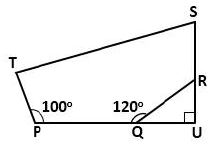
In simple words: By looking at the right triangle on the outside, we find the missing inner angle of the pentagon is \( 150^{\circ} \). Then, using the \( 540^{\circ} \) total sum of the pentagon, we solve for the two equal angles.
Exam Tip: Be sure to write down the reasoning for the linear pairs clearly, as finding the interior angle \( \angle QRS \) is the key intermediate step of this question.
Question 34. In the given hexagon \( JKLMNO \), the side \( JK \) is parallel to \( ON \). If the ratio of the remaining angles is \( \angle K : \angle L : \angle M : \angle N = 6 : 5 : 4 : 3 \), find the value of \( \angle K \) and \( \angle M \).
Answer: Since the sides \( JK \) and \( ON \) are parallel, the sum of consecutive interior angles on the same side of the transversal is \( 180^{\circ} \):
\( \angle J + \angle O = 180^{\circ} \)
We are given the ratio of the other four angles:
\( \angle K : \angle L : \angle M : \angle N = 6 : 5 : 4 : 3 \)
Let these angles be written in terms of a variable \( x \):
\( \angle K = 6x \)
\( \angle L = 5x \)
\( \angle M = 4x \)
\( \angle N = 3x \)
The total sum of all interior angles of a hexagon is:
\( \text{Sum} = (6 - 2) \times 180^{\circ} = 4 \times 180^{\circ} = 720^{\circ} \)
Thus, the sum of all six angles is:
\( (\angle J + \angle O) + \angle K + \angle L + \angle M + \angle N = 720^{\circ} \)
Substituting the known values into this equation:
\( 180^{\circ} + 6x + 5x + 4x + 3x = 720^{\circ} \)
\( 18x + 180^{\circ} = 720^{\circ} \)
\( 18x = 720^{\circ} - 180^{\circ} \)
\( 18x = 540^{\circ} \)
\( \implies x = 30^{\circ} \)
Now, we calculate the required angles using the value of \( x \):
\( \angle K = 6x = 6 \times 30^{\circ} = 180^{\circ} \)
\( \angle M = 4x = 4 \times 30^{\circ} = 120^{\circ} \)
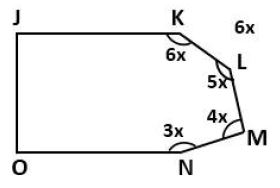
In simple words: Since two sides are parallel, their two inner angles add up to \( 180^{\circ} \). We add the remaining ratio-based angles to find the total sum of \( 720^{\circ} \) for the hexagon, giving us the value of each corner.
Exam Tip: Grouping the parallel-line angles together as \( (\angle J + \angle O) = 180^{\circ} \) simplifies the multi-variable equation immensely and avoids having to find each one individually.
Question 35. In a regular pentagon \( PQRST \), the diagonals \( PR \) and \( QT \) intersect at a point \( N \). Find the measure of \( \angle RQT \) and \( \angle QNP \).
Answer: Each interior angle of a regular pentagon with \( 5 \) sides is calculated as:
\( \text{Each Interior Angle} = \frac{(5 - 2) \times 180^{\circ}}{5} = 3 \times 36^{\circ} = 108^{\circ} \)
Now, in triangle \( \Delta PQT \), we have:
\( PT = PQ \) (as they are equal sides of a regular pentagon)
\( \therefore \angle PQT = \angle PTQ = x \) (since angles opposite to equal sides of a triangle are equal)
The sum of angles in triangle \( \Delta PQT \) is \( 180^{\circ} \):
\( \angle PQT + \angle PTQ + \angle QPT = 180^{\circ} \)
\( x + x + 108^{\circ} = 180^{\circ} \)
\( 2x = 72^{\circ} \)
\( \implies x = 36^{\circ} \)
\( \therefore \angle PQT = \angle PTQ = 36^{\circ} \)
Similarly, by working in triangle \( \Delta PQR \), we can prove that:
\( \angle QPR = \angle QRP = 36^{\circ} \)
Next, we calculate \( \angle RQT \):
\( \angle RQT = \angle RQP - \angle PQT \)
\( = 108^{\circ} - 36^{\circ} = 72^{\circ} \)
Let us now consider triangle \( \Delta QNP \) inside the pentagon:
\( \angle PQN = \angle PQT = 36^{\circ} \)
\( \angle QPN = \angle QPR = 36^{\circ} \)
The sum of interior angles in triangle \( \Delta QNP \) is \( 180^{\circ} \):
\( \angle PQN + \angle QPN + \angle QNP = 180^{\circ} \)
\( 36^{\circ} + 36^{\circ} + \angle QNP = 180^{\circ} \)
\( 72^{\circ} + \angle QNP = 180^{\circ} \)
\( \implies \angle QNP = 108^{\circ} \)
In simple words: Since the pentagon is regular, each corner is \( 108^{\circ} \). Using equal sides, we find small angles of \( 36^{\circ} \) in the outer triangles, which then helps us calculate the required inner angles.
Exam Tip: Identifying that triangles like \( \Delta PQT \) and \( \Delta PQR \) are congruent and isosceles makes calculating the smaller angles straightforward.
Question 36. If the exterior angle of a regular polygon of \( n \) sides is \( \frac{1}{p} \) times its interior angle, show that the number of sides of the polygon is \( 2(p + 1) \).
Answer: We write the general formulas for the interior and exterior angles of an \( n \)-sided regular polygon:
\( \text{Each Interior Angle} = \frac{(n - 2) \times 180^{\circ}}{n} \)
\( \text{Each Exterior Angle} = \frac{360^{\circ}}{n} \)
According to the given condition, the exterior angle is \( \frac{1}{p} \) times the interior angle:
\( \frac{360^{\circ}}{n} = \frac{1}{p} \times \frac{(n - 2) \times 180^{\circ}}{n} \)
Multiplying both sides of the equation by \( n \) to simplify:
\( 360^{\circ} = \frac{1}{p} \times (n - 2) \times 180^{\circ} \)
\( \implies n - 2 = p \times \frac{360^{\circ}}{180^{\circ}} \)
\( n - 2 = 2p \)
\( \implies n = 2p + 2 \)
\( \implies n = 2(p + 1) \)
Hence, it is shown that the number of sides of the regular polygon is \( 2(p + 1) \).
In simple words: By writing down the formulas for both angles and setting up the given relation, we cancel out \( n \) and solve to prove that the sides equal \( 2(p + 1) \).
Exam Tip: Remember to multiply both sides of the equation by the variable \( n \) early on to eliminate fractions and simplify your proof.
Question 37. A regular polygon has an interior angle of \( 162^{\circ} \). Another regular polygon has twice the number of sides as the first polygon. Find the measure of each interior angle of the second polygon.
Answer: For the first regular polygon:
\( \text{Each Interior Angle} = 162^{\circ} \)
Since the interior and exterior angles are supplementary:
\( \text{Each Exterior Angle} = 180^{\circ} - 162^{\circ} = 18^{\circ} \)
The number of sides of this first polygon is:
\( \text{Number of sides} = \frac{360^{\circ}}{18^{\circ}} = 20 \)
For the second regular polygon:
The number of sides is double that of the first polygon:
\( \text{Number of sides} = 2 \times 20 = 40 \)
We calculate its exterior angle:
\( \text{Each Exterior Angle} = \frac{360^{\circ}}{40} = 9^{\circ} \)
Using the linear pair relation, the interior angle of this polygon is:
\( \text{Each Interior Angle} = 180^{\circ} - 9^{\circ} = 171^{\circ} \).
In simple words: The first polygon has \( 20 \) sides because its outer angle is \( 18^{\circ} \). The second polygon has double that, which is \( 40 \) sides, leading to an inner angle of \( 171^{\circ} \).
Exam Tip: Finding the exterior angle first is a much faster and cleaner way to determine both the number of sides and the interior angle of the second polygon.
ICSE Frank Brothers Solutions Class 9 Mathematics Chapter 18 Rectilinear Figures
Students can now access the detailed Frank Brothers Solutions for Chapter 18 Rectilinear Figures on our portal. These solutions have been carefully prepared as per latest ICSE Class 9 syllabus. Each solution given above has been updated based on the current year pattern to ensure Class 9 students have the most updated Mathematics content.
Master Frank Brothers Textbook Questions
Our subject experts have provided detailed explanations for all the questions found in the Frank Brothers textbook for Class 9 Mathematics. We have focussed on making the concepts easy for you in Chapter 18 Rectilinear Figures so that students can understand the concepts behind every answer. For all numerical problems and theoretical concepts these solutions will help in strengthening your analytical skill required for the ICSE examinations.
Complete Mathematics Exam Preparation
By using these Frank Brothers Class 9 solutions, you can enhance your learning and identify areas that need more attention. We recommend solving the Mathematics Questions from the textbook first and then use our teacher-verified answers. For a proper revision of Chapter 18 Rectilinear Figures, students should also also check our Revision Notes and Sample Papers available on studiestoday.com.
FAQs
You can download the verified Frank Brothers solutions for Chapter 18 Rectilinear Figures on StudiesToday.com. Our teachers have prepared answers for Class 9 Mathematics as per 2026-27 ICSE academic session.
Yes, our solutions for Chapter 18 Rectilinear Figures are designed as per new 2026 ICSE standards. 40% competency-based questions required for Class 9, are included to help students understand application-based logic behind every Mathematics answer.
Yes, every exercise in Chapter 18 Rectilinear Figures from the Frank Brothers textbook has been solved step-by-step. Class 9 students will learn Mathematics conceots before their ICSE exams.
Yes, follow structured format of these Frank Brothers solutions for Chapter 18 Rectilinear Figures to get full 20% internal assessment marks and use Class 9 Mathematics projects and viva preparation as per ICSE 2026 guidelines.