

ICSE Solutions Goyal Brothers Class 9 History Civics Chapter 1 The Harappan Civilization have been provided below and is also available in Pdf for free download. The Goyal Brothers ICSE solutions for Class 9 History Civics have been prepared as per the latest syllabus and ICSE books and examination pattern suggested in Class 9. Questions given in ICSE Goyal Brothers book for Class 9 History Civics are an important part of exams for Class 9 History Civics and if answered properly can help you to get higher marks. Refer to more Chapter-wise answers for ICSE Class 9 History Civics and also download more latest study material for all subjects. Chapter 1 The Harappan Civilization is an important topic in Class 9, please refer to answers provided below to help you score better in exams
Goyal Brothers Chapter 1 The Harappan Civilization Class 9 History Civics ICSE Solutions
Class 9 History Civics students should refer to the following ICSE questions with answers for Chapter 1 The Harappan Civilization in Class 9. These ICSE Solutions with answers for Class 9 History Civics will come in exams and help you to score good marks
Chapter 1 The Harappan Civilization Goyal Brothers ICSE Solutions Class 9 History Civics
The Harappan Civilization
Exercises
Question 1. Mention any two sources to reconstruct the Harappan Civilization.
Answer: We can reconstruct the history of the Harappan Civilization through several primary sources:
1. The structural ruins of the twin cities, Mohenjo-daro and Harappa, which highlight their advanced city planning - including the elaborate drainage network, the Great Bath, the central Assembly Hall, and other civic structures.
2. The discovery of numerous clay and stone seals, which offer valuable information regarding the physical appearance, clothing, personal ornaments, and spiritual beliefs of the inhabitants.
In simple words: We can learn about the Harappans from the ruins of their towns, Mohenjo-daro and Harappa, which show great building skills, and from their small seals, which show their dress and religious beliefs.
Exam Tip: Mention both physical ruins (such as the Great Bath) and seals as the two key historical sources of information.
Question 2. Why did the Indus Valley Civilization come to be known as Harappan Civilization?
Answer: The Indus Valley Civilization is often referred to as the Harappan Civilization because Harappa, located in West Punjab, was the first ancient city of this culture to be discovered and excavated by archaeologists.
In simple words: It is called the Harappan Civilization because Harappa was the very first ancient city discovered and dug up by archaeologists.
Exam Tip: State clearly that Harappa was the first type-site discovered, which is why the entire civilization is named after it.
Question 3. Mention any two important centres of the Indus Valley Civilization.
Answer: The major geographical regions and centers of this ancient culture span the northern and western territories of India, extending across modern-day Pakistan.
In simple words: The major centers of this civilization are located in the north and west of India, as well as in Pakistan.
Exam Tip: When asked for centers, mentioning the geographical span of north-western India and Pakistan will satisfy the textbook answer key.
Question 4. What are the evidences which reveal the skill of the Indus people in town-planning?
Answer: The exceptional urban planning skills of the Harappan builders are evident from several structural features:
- Streets: The city was laid out on a grid-pattern, with wide, straight main roads intersecting at perfect right angles. This design divided the urban area into neat square or rectangular blocks, which were further connected by smaller lanes.
- Bricks: Builders used high-quality, kiln-fired bricks to pave the streets. To prevent accidents for heavy carts, the corners of streets were carefully rounded off, and strict rules prohibited houses from encroaching onto public streets.
In simple words: Their streets were wide and straight, crossing each other in neat blocks like a grid. They paved roads with strong baked bricks and had strict rules to keep streets clear of buildings.
Exam Tip: Focus on two key headings: 'Streets' (grid system/right-angle intersections) and 'Bricks' (standardized baked bricks and street preservation).
Question 5. Mention the main evidences to suggest that the Indus Valley people paid great importance to sanitation and health.
Answer: The Harappans maintained an advanced and highly efficient drainage network that highlights their focus on public hygiene and sanitation:
1. Every major street was accompanied by a dedicated, brick-lined drainage channel.
2. Individual household drains were systematically connected to these main public drains, which ran underground beneath the streets.
3. These channels carried wastewater away from residential areas to large brick culverts located on the outskirts of the city.
4. Regular inspection manholes were built along the streets, allowing sanitation workers to easily clear blockages and maintain public health.
In simple words: Every street had a brick-lined drain. Houses were connected to these underground main drains, which had manholes for cleaning and carried waste water far away from the city.
Exam Tip: Describe the underground nature of the drains, the use of brick-lined channels, and the provision of manholes as evidence of their hygiene standards.
Question 6. What are the two different types of buildings that were unearthed at the various Industries ?
Answer: The various archaeological sites have revealed several distinct categories of buildings:
1. Residential dwelling houses for the general public.
2. Large public bathing complexes, such as the Great Bath.
3. Massive storage facilities, such as the Great Granary.
4. Administrative structures, including the Assembly Hall and other public civic buildings.
In simple words: Archaeologists found different buildings like private houses, the Great Bath for rituals, huge granaries for storing food, and large assembly halls.
Exam Tip: You can select any two examples - such as dwelling houses and the Great Granary - to fully answer this question.
Question 7. Mention the evidences which suggest that the Harappan people had trade relations with other countries.
Answer: Significant archaeological evidence indicates that the Harappans maintained extensive international trade networks:
1. They established commercial connections with southern and eastern India, Kashmir, and other parts of Asia, importing metals and semi-precious stones.
2. They engaged in long-distance maritime trade with ancient civilizations like Egypt, Crete, and Mesopotamia.
3. The discovery of Sumerian artifacts within Indus cities confirms active trade relations with Mesopotamia.
4. Trade was conducted over both overland routes and sea channels; this maritime activity is proven by the discovery of a clay seal depicting a mastless ship.
In simple words: The Harappans traded with places like Egypt, Crete, and Mesopotamia. Archaeologists found Sumerian objects in Harappan cities and a clay seal with a drawing of a ship, proving they traded by sea.
Exam Tip: Cite the discovery of Sumerian artifacts in Indus cities and the seal depicting a ship as concrete evidence of overseas trade.
Question 8. Describe the famous sculpture in metal which was found among the ruins of the city of Mohenjo-daro.
Answer: The most celebrated metal artwork recovered from Mohenjo-daro is a bronze figurine of a dancing girl:
1. She is depicted standing in a lively dancing pose with her right hand resting on her hip.
2. She wears several decorative necklaces, and her left arm is fully adorned with bangles carved from ivory or bone.
3. Her hair is elegantly tied back in a neat bun, and her head is tilted slightly backward, reflecting a confident expression.
In simple words: The famous bronze statue is of a dancing girl. She has her hand on her hip, wears necklaces, has her left arm covered in bangles, and has her hair tied in a neat bun.
Exam Tip: Specify that the figurine is made of bronze, mention her posture (hand on hip), and describe her adornments (necklaces and arm bangles) for a high-scoring answer.
Question 9. Give one evidence to show that the Harappan people excelled in the art of sculpture in the following:
(a) In metal (b) In stone (c) In terracotta
Answer: The outstanding artistic skills of Harappan sculptors are proven by several key artifacts:
(a) In Metal: The exquisite bronze figurine of the 'Dancing Girl' highlights their mastery over metal casting.
(b) In Stone: The highly detailed limestone bust of a bearded nobleman and the anatomically accurate red sandstone Male Torso demonstrate their mastery over stone carving.
(c) In Terracotta: The detailed clay figurine of the Mother Goddess, alongside models of bulls, dogs, birds, and human figures, showcases their skill in terracotta clay modeling.
In simple words: For metal, they made a famous bronze dancing girl. For stone, they carved a detailed priest bust and a red male torso. For clay (terracotta), they crafted detailed figures of the Mother Goddess and various animals.
Exam Tip: Clearly link each medium to its famous artifact: bronze for the dancing girl, limestone/sandstone for the priest-king and torso, and clay for the Mother Goddess.
Question 10. What evidence has been found to suggest that the Harappan people were familiar with the art of writing?
Answer: Archaeologists have recovered clear evidence of a Harappan writing system, though it remains undeciphered:
1. The thousands of clay and stone seals found at major sites feature short inscriptions written in a pictographic script.
2. Similar pictographic characters and inscriptions are found engraved on flat copper tablets alongside drawings of animals and human figures.
In simple words: Thousands of seals and copper plates have been found with drawings and a pictographic script, showing that the Harappans knew how to write.
Exam Tip: Mention that their writing was pictographic and was found inscribed on seals and copper tablets.
Question 11. Mention three different kinds of Seals discovered at the various sites of the Harappan Valley Civilization.
Answer: Three distinct types of seals recovered from Harappan archaeological excavations include:
1. Seals depicting realistic animals, such as the humped bull, bison, and elephant.
2. The famous Unicorn seal, featuring a mythical, single-horned creature.
3. The Pashupati Seal, which portrays a three-faced deity identified as an early form of Lord Shiva.
In simple words: Three types of seals found are those showing regular animals like bulls, those showing a mythical unicorn, and the Pashupati seal showing a three-faced god.
Exam Tip: Be sure to list 'Animal Seals', 'Unicorn Seal', and the 'Pashupati Seal' as the three primary types of seals.
Question 12. Mention any two probable causes for the decline and disappearance of the Harappan Civilization.
Answer: Historians suggest several natural causes for the gradual decline of the Harappan Civilization, including:
1. Devastating, repeated flooding of the Indus River.
2. Severe tectonic shifts or earthquakes that altered river courses and destroyed urban centers.
In simple words: Large floods or powerful earthquakes might have destroyed the cities and caused the civilization to disappear.
Exam Tip: Floods, earthquakes, and climate change are the most widely accepted theories for the decline of this culture.
Question 13. Mention any two features to suggest that the Harappan people enjoyed a higher standard of civic amenities than those of Mesopotamia.
Answer: The Harappans enjoyed exceptionally high public living standards compared to contemporary Mesopotamian cities, as shown by several unique features:
1. The presence of monumental public structures like the Great Bath of Mohenjo-daro, designed for public hygiene and rituals.
2. Residential houses equipped with private wells, dedicated bathrooms, and a highly efficient, covered municipal drainage network connected to every home.
In simple words: Unlike other ancient peoples, the Harappans had private bathrooms, their own wells, and an excellent underground drainage system that kept their cities clean.
Exam Tip: Focus on their household water supply systems and the covered, underground municipal drainage network to prove their superior civic planning.
Question 14. What is Civilization?
Answer: A civilization represents an advanced stage of human social and cultural organization. It is characterized by permanent settlements, planned urban centers, the establishment of organized systems of government, active trade networks, and continuous cultural and technological progress.
In simple words: A civilization is an advanced way of living where people build cities, have a government, trade goods, and make continuous progress.
Exam Tip: Include key markers such as urban settlements, organized governance, and trade to write a complete definition.
Question 15. State the probable period of the existence of the Indus Valley Civilization.
Answer: According to early archaeological estimates, the Indus Valley Civilization is believed to have flourished roughly between 3250 and 2750 BC.
In simple words: The Indus Valley Civilization is believed to have existed between 3250 and 2750 BC.
Exam Tip: State this date range (3250 - 2750 BC) as presented in the textbook syllabus, keeping in mind that radiocarbon dating might suggest other ranges.
Question 16. Mention three main occupations of the Indus Valley people.
Answer: The economy of the Harappan people was supported by three primary occupations:
1. Agriculture, which served as the primary source of food.
2. Domestication of livestock and animals.
3. Conducting active domestic and international trade and commerce.
In simple words: The three main jobs were farming (agriculture), raising farm animals, and trading goods.
Exam Tip: List all three: agriculture, animal husbandry, and trade, to secure maximum marks.
Question 17. Mention any two features of the Harappan script.
Answer: Two defining features of the ancient Harappan writing system are:
1. The script is entirely pictographic, utilizing symbols that represent birds, fish, animals, and human figures.
2. Examples of this writing are found engraved on flat copper tablets and stone seals.
In simple words: First, the script is made of drawings (pictographs) instead of letters. Second, it is found carved on stone seals and copper tablets.
Exam Tip: Be sure to mention that the script was 'pictorial' (pictographic) and found on 'seals'.
Question 18. Mention the evidences which suggest that the Harappan people worshiped: (a) The Mother Goddess, (b) The Shiva Pashupati, and (c) The trees and animals.
Answer: Archaeological discoveries offer strong evidence of the religious beliefs of the Harappan people:
(a) Worship of the Mother Goddess: Numerous clay seals and terracotta figurines feature a female deity adorned with complex headdresses and jewelry. Many of these figurines are stained with soot, indicating that devotees burnt incense before them. She was worshiped as the source of life and fertility.
(b) Worship of Shiva Pashupati: A famous stone seal shows a male deity depicted with three faces and a horned crown, seated in a yogic pose on a platform surrounded by wild animals, identified as an early form of Lord Shiva. Additionally, the discovery of numerous polished stone cylinders resembling the Shiva Linga supports this belief.
(c) Worship of Trees and Animals: Various religious seals show that the people practiced animism. They held the Pipal tree sacred and worshipped powerful animals, such as the humped bull, tiger, rhinoceros, and crocodile. Furthermore, carvings showing a deity sheltered by a multi-headed cobra suggest the practice of snake (Naga) worship.
In simple words: They worshipped the Mother Goddess, represented by clay figurines. They worshipped a male god like Lord Shiva, shown on a seal surrounded by animals. They also held trees like the Pipal sacred and worshipped animals like the bull and cobra.
Exam Tip: For this detailed question, answer under three distinct headings: Mother Goddess, Shiva Pashupati, and Nature/Animal Worship, citing specific archaeological finds.
Question 19. What is the evidence to suggest that the Harappan people worshipped trees and animals?
Answer: The main proof of nature worship comes from the designs carved on Harappan seals. Several of these seals depict sacred trees, such as the Pipal, alongside powerful animals like the bull, tiger, and elephant, showing their spiritual significance.
In simple words: Drawings on their clay seals show that they prayed to sacred trees like the Pipal and respected animals like the bull.
Exam Tip: State that the carvings of trees (like the Pipal) and animals on their clay seals serve as the primary evidence.
Question 20. What is meant by the word ‘Mesopotamia’?
Answer: The term 'Mesopotamia' is derived from ancient Greek, translating to the land situated between two rivers (the Tigris and the Euphrates).
In simple words: The word Mesopotamia means the land located between two rivers.
Exam Tip: Define the term literally as 'the land between two rivers' for a complete answer.
Question 21. What evidences are found for us to know about the following: (a) Food of the Indus Valley people. (b) Dress and Ornaments worn by the people.
Answer: Based on archaeological discoveries, we can reconstruct their daily habits:
(a) Food of the Indus Valley People: Their primary diet consisted of cultivated crops like wheat and barley, along with rice, dates, fresh milk, fruits, and vegetables. They also consumed various meats, including beef, mutton, poultry, river fish, turtles, and shellfish.
(b) Dress and Ornaments: Statues and carvings reveal that they wore simple clothing. Men wore a two-piece outfit consisting of a shawl draped over the left shoulder and a lower cloth similar to a dhoti. Women's clothing was similar, often using a short skirt held by a belt. Cotton was the most common fabric, though wool was also used. Both men and women loved wearing jewelry made from gold, silver, copper, and semi-precious stones. They wore necklaces, rings, and arm bands, while women also wore elaborate headdresses, earrings, bangles, bracelets, girdles and anklets.
In simple words: They ate wheat, barley, rice, fruits, and meats like fish and mutton. They wore simple cotton clothes, including dhotis and shawls, and loved wearing jewelry made of gold, silver, and colorful stones.
Exam Tip: Divide your answer into two clear sections: (a) Food (crops and meats) and (b) Dress & Ornaments (dhoti/shawl and metal jewelry).
Question 22. Why did the Indus Valley Civilization come to be known as Harappan Civilization?
Answer: Archaeological digs in north-western India led to the discovery of ancient ruins along the Indus River and its tributaries, starting with Harappa in West Punjab and Mohenjo-daro in Sindh. Since Harappa was the very first site of this culture to be excavated, the entire civilization was named the Harappan Civilization.
In simple words: Because Harappa was the first ancient city discovered and dug up by archaeologists, the entire civilization was named after it.
Exam Tip: Emphasize that 'Harappa' was the first site excavated, which is why historians renamed the civilization.
Structured Questions
Question 1. Harappan Civilization was a highly developed urban civilization. Discuss the significant features of this Civilization with reference to: (a) The Town Planning. (b) The Drainage System. (c) The Dwelling Houses.
Answer: The highly advanced urban nature of the Harappan Civilization is evident from several outstanding features:
(a) The Town Planning: The ruins demonstrate excellent engineering skills. Harappan cities were planned on a grid system, with wide, straight streets intersecting at right angles, dividing the city into neat rectangular blocks. Streets were paved with kiln-fired bricks, and their corners were rounded to allow cart traffic to flow smoothly. Strict municipal rules kept public roads free of any house encroachments.
(b) The Drainage System: The cities featured an underground drainage network. Every street was accompanied by a brick-lined drain. Private household drains connected directly to these covered public street sewers, which carried waste water to large brick culverts outside the city. Removable stone covers or manholes were placed at regular intervals for cleaning.
(c) The Dwelling Houses: Residential homes of various sizes were built on raised brick platforms to protect them from seasonal floods. Constructed using durable baked bricks, these houses featured paved floors and rooms arranged around a central open courtyard. Homes were equipped with private wells, toilets, and bathrooms situated on the street-side, designed with sloping floors to drain waste water directly into the street sewers.
In simple words: Their cities had wide grid-pattern streets and were paved with strong bricks. They had a covered underground drainage system with manholes for cleaning. Houses were built on high platforms to avoid floods, featuring rooms around an open courtyard and private bathrooms.
Exam Tip: Explain each point under its respective heading: grid-pattern streets for Town Planning, covered sewers for Drainage, and central courtyards for Dwelling Houses.
Question 2. The Harappan Civilization reveals the architectural skill of the people; Substantiate this statement by a brief mention of the following: (a) The Great Bath. (b) The Assembly Hall, the Citadel and other Public Buildings.
Answer: The architectural achievements of the Harappan people are proven by their grand public structures:
(a) The Great Bath: This large bathing complex featured an open central courtyard surrounded by pillared corridors and private changing rooms. At the center lay a large pool measuring 12 by 7 meters with a depth of 2.5 meters. Wide steps led down into the water from both ends. The pool was supplied with fresh water from an adjacent well, and used water was cleared through a large exit drain. To prevent leaks, the pool's walls were sealed using tightly fitted baked bricks and waterproof gypsum mortar.
(b) The Assembly Hall, the Citadel, and Other Public Buildings: The western part of the city featured a raised, fortified platform called the Citadel, which housed major administrative and public buildings. This included a large pillared hall with corridors and low stone benches, likely used as an assembly hall or royal court. Other key structures included massive granaries, large marketplaces, and rows of uniform cottages designed to house laborers or soldiers.
In simple words: The Great Bath was a large public pool with steps, private rooms, and walls sealed with waterproof mortar to prevent leaks. The Citadel was a high, fortified area that housed grand assembly halls, palaces, and massive granaries.
Exam Tip: For the Great Bath, remember its measurements (12m x 7m x 2.5m) and the use of gypsum mortar. For public buildings, describe the fortified Citadel and the pillared assembly hall.
Question PQ. Describe the social life of the Harappan people with reference to: (a) Their Diet. (b) Their Dress. (c) Their Ornaments. (d) Sports and Games.
Answer: The daily life and social habits of the Harappan population are described below:
(a) Their Diet: Their staple food consisted of cultivated wheat and barley, supplemented by rice and dates. They also consumed fresh milk, green vegetables, and fruits. For protein, they ate beef, mutton, poultry, turtle, tortoise, and various kinds of river fish.
(b) Their Dress: Men and women dressed in simple, comfortable clothing made of cotton and wool. Men wore a two-piece outfit consisting of an upper shawl draped over the left shoulder and a lower dhoti-like wrap. Women wore a short skirt secured at the waist by a decorative belt or girdle.
(c) Their Ornaments: People across all social classes loved wearing jewelry. Wealthy citizens wore ornaments made of gold, silver, copper, and polished gemstones, while poorer families wore ornaments made of bone, shell, and clay. Common items included necklaces, rings, and armbands, with women also wearing elaborate headdresses, earrings, bangles, bracelets, girdles and anklets.
(d) Their Sports and Games: Dicing was a popular game among the people. Marbles and balls were used for games. The Harappan people were fond of music and dancing. Clay-modelling was popular among children. Crude models of men, women, animals and whistles, rattles and dolls have been found in abundance. People loved hunting and fishing.
In simple words: They ate grains like wheat and barley alongside various meats. They wore simple cotton and wool clothing, and everyone wore jewelry made of metals or beads. For fun, adults played board games and danced, while children played with clay toys.
Exam Tip: Make sure to organize your answer under the four requested headings, providing specific examples for their diet, dress, jewelry, and toys.
Question 3. What do you know about the trade and commercial activities of the Harappan people ?
Answer: The Harappan economy relied heavily on active domestic and foreign trade networks:
1. They established domestic trade connections with southern and eastern India, as well as Kashmir, to source raw materials and precious metals.
2. They engaged in long-distance international trade with Mesopotamian cities, Egypt, and Crete.
3. Goods were transported via land routes using bullock carts, and across seas using merchant ships. This maritime activity is confirmed by seals engraved with drawings of ships and the discovery of a tidal dockyard at Lothal.
In simple words: They traded with other parts of India for metals and gems, and sent ships to trade with distant lands like Mesopotamia and Egypt, using land and sea routes.
Exam Tip: Mention both their domestic trade (with Kashmir and South India) and international maritime trade (with Mesopotamia and Egypt) to write a complete answer.
Question 4. With reference to the art and craft of the Harappan people, explain their achievements in the following fields : (a) The Art of Sculpture. (b) The Art of Carving.
Answer: The artistic skills of the Harappans are highly evident in their sculptures and engravings:
(a) The Art of Sculpture:
Harappan artisans were highly skilled in working with diverse materials, including metals, stone, and clay:
- Metal Sculptures: They used the 'lost-wax' casting method to create beautiful metal figures, with the bronze 'Dancing Girl' being the most famous example.
- Stone Sculptures: They carved highly detailed stone statues, such as the white steatite bust of the 'Priest-King' and the realistic red sandstone Male Torso.
- Terracotta Sculptures: They modeled numerous clay figurines, including the Mother Goddess and various animal toys like bulls, dogs, and monkeys.
(b) The Art of Carving:
The Harappans were master seal-carvers. They engraved square and rectangular steatite seals with remarkable precision, carving realistic figures of animals like the humped bull, bison, elephant, and the mythological unicorn, alongside short pictographic inscriptions.
In simple words: They sculpted beautiful statues using bronze (like the dancing girl), stone (like the priest-king), and clay (like the Mother Goddess). They were also experts at carving detailed animal figures on their square stone seals.
Exam Tip: For part (a), mention all three sculpting mediums: metal, stone, and terracotta. For part (b), focus on their detailed animal carvings on seals.
Question 5. India is well-known for her deep-rooted tradition in arts and crafts. Substantiate this statement by a brief mention of the following: (a) The Harappan Pottery, (b) Harappan art of Spinning. (c) Harappan Metal-craft
Answer: The foundational roots of Indian craftsmanship can be traced directly to the Harappan era:
(a) The Harappan Pottery: Harappan potters were highly skilled in using the wheel to produce a wide variety of clay vessels, including jars, storage pots, and dishes. Everyday kitchenware was kept plain, while special vessels designed to hold valuables were glazed, decorated with black geometric patterns, and painted red. The discovery of large public kilns shows they fired their pottery systematically.
(b) Harappan Art of Spinning: The discovery of numerous clay and porcelain spindle whorls in almost every home proves that spinning cotton and wool was a common household activity. Additionally, the discovery of a large brick dyer's vat shows they were skilled in coloring and dyeing their fabrics.
(c) Harappan Metal-craft: Harappan-era artisans excelled in metallurgy, working with gold, silver, copper, and bronze. Goldsmiths crafted complex jewelry, including necklaces, armbands, earrings, and rings. Metalsmiths were skilled in making alloys like bronze, casting metal figures, and hammering copper sheets to make durable kitchen vessels.
In simple words: They made beautiful painted clay pots on wheels, spun cotton and wool into clothes using household spindles, dyed their fabrics in vats, and used gold, silver, and copper to make beautiful jewelry and sturdy metal pots.
Exam Tip: Discuss each craft under its requested heading: focus on glazed designs for Pottery, spindle whorls and dye vats for Spinning, and bronze alloy casting for Metal-craft.
Question 6. The Seals may be considered as the most valuable finds of the Harappan Civilization. Concentrate on the picture given below and answer the following questions.
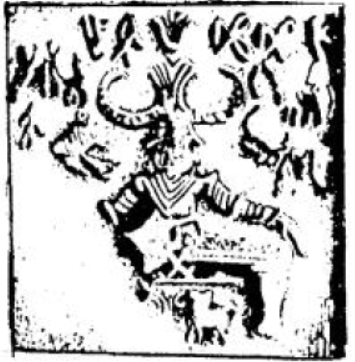
(a) What does this Seal depict? (b) How important are the Seals as sources of information about the Harappan Culture?
Answer: Based on the archaeological study of Harappan seals, we can answer the following:
(a) The seal depicts a three-faced male deity seated in a meditative yogic posture, wearing a horned headdress and surrounded by wild animals.
(b) These seals serve as incredibly important primary sources of historical information because:
1. They reveal details about the physical appearance, hairstyles, clothing, and jewelry worn by the people, as well as the animals they domesticated.
2. They offer key insights into their religious beliefs, such as the worship of Shiva and nature.
3. They provide evidence of trade and commercial transactions.
4. They demonstrate the outstanding artistic and engraving skills of Harappan craftsmen.
5. They preserve examples of their pictographic writing system.
In simple words: The seal shows a three-faced god (Pashupati) sitting in a yoga pose, wearing horns, and surrounded by animals. Seals are important because they teach us about their clothing, jewelry, trade activities, religious beliefs, and writing.
Exam Tip: Identify the deity as Pashupati Shiva and list at least three reasons why seals are valuable, such as revealing writing, trade, and religious practices.
Question PQ. Write a note on the religious beliefs and practices of the Harappan people with reference to: (a) Worship of the Mother Goddess. (b) Worship of Shiva Pashupati. (c) Worship of Trees and Animals.
Answer: The spiritual life and religious rituals of the Harappans can be understood through three major practices:
(a) Worship of the Mother Goddess: The Harappans widely worshipped a female mother deity. Archaeologists have recovered many clay figurines showing her wearing complex headdresses and jewelry. The presence of smoke stains on several of these figurines indicates that people burned incense during prayers, worshiping her as the source of life, fertility, and creation.
(b) Worship of Shiva Pashupati: A prominent male deity is depicted on stone seals as three-faced and wearing a horned crown, seated in a yogic posture surrounded by wild animals, which historians identify as an early form of Lord Shiva. This belief is further supported by the discovery of many polished stone cylinders resembling the Shiva Linga.
(c) Worship of Trees and Animals: The Harappans practiced animism, holding nature sacred. They worshipped the Pipal tree as a symbol of wisdom and treated animals like the humped bull, tiger, rhinoceros, and crocodile with reverence. Discoveries of carvings showing a deity shielded by a multi-headed cobra also point to the practice of snake worship. Many of these animals continue to serve as sacred mounts for Hindu deities today.
In simple words: They worshipped a Mother Goddess using clay figures with incense. They worshipped a male god like Lord Shiva, shown on seals surrounded by animals. They also held trees like the Pipal sacred and worshipped animals like the bull, tiger, and cobra.
Exam Tip: For this comprehensive note, structure your answer under the three requested headings, citing specific artifacts like the clay figurines, the Pashupati seal, and animal carvings.
Additional Questions
Short Answer Questions
Question 1. What is meant by the term, ‘Civilisation’ ?
Answer: A civilization represents a highly advanced stage of human social, cultural, and technological organization. It is characterized by complex economic structures, structured governance, and several defining features, including:
1. The development and growth of planned cities.
2. Producing surplus food to support non-farming populations.
3. A clear division of labor among specialized workers.
4. The creation of a formal writing system.
5. Constructing grand public monuments and buildings.
6. The continuous advancement of science and technology.
In simple words: A civilization is an advanced way of living where people build cities, produce extra food, divide work among specialists, use writing, build grand monuments, and use modern tools.
Exam Tip: List at least three defining features of a civilization - such as cities, a writing system, and division of labor - for a complete answer.
Question 2. Mention any three features that led to the emergence of civilisation.
Answer: Several key features mark the rise of this advanced civilization:
1. Highly skilled urban planning, as shown by the ruins of their systematically designed cities.
2. An advanced, covered drainage network running alongside every city street.
3. Grand public architecture, such as the watertight Great Bath constructed with baked bricks and gypsum mortar.
4. Large-scale grain storage facilities, like the Great Granary, which consisted of two distinct blocks used to store food reserves.
In simple words: Three main features were their organized grid-pattern cities, their covered street drains, and grand public buildings like the Great Bath and the Great Granary.
Exam Tip: You can explain any three features - such as town planning, the drainage system, and the granaries - to show how the civilization emerged.
Question 3. What are known as Bronze Age Civilisations ?
Answer: Ancient societies that developed the technology to mix copper with tin or zinc to produce the stronger alloy bronze are known as Bronze Age Civilizations. Because bronze was harder and more durable than pure copper, it became the primary material for making tools, agricultural equipment, and weapons, driving rapid societal progress.
In simple words: When ancient people learned to mix copper and tin to make a stronger metal called bronze, they used it to make better tools and weapons. These societies are called Bronze Age Civilizations.
Exam Tip: Define bronze as an alloy of copper and tin, and explain that its durability made it central to the development of these early societies.
Question 4. Name two important sources of information on the Harappan Civilisation.
Answer: Our understanding of the Harappan Civilization is based on key archaeological sources:
1. The physical ruins of their planned cities (like Harappa, discovered in 1921, and Mohenjo-daro).
2. The discovery of numerous bronze artifacts, stone seals, and clay figurines, which reveal their technology, trade, and daily life.
In simple words: We learn about them from the ruins of their planned cities like Harappa and from the bronze tools and stone seals they left behind.
Exam Tip: Identify 'urban ruins' and 'engraved seals' as the two primary sources of information.
Question 5. Why did ancient man start using bronze for making tools and weapons ?
Answer: Ancient societies adopted bronze for crafting implements because it is significantly harder and more durable than pure copper. This strength made it far more suitable for producing long-lasting agricultural tools and weapons.
In simple words: They started using bronze because it is much harder and stronger than copper, making it better for tools and weapons.
Exam Tip: Highlight the physical properties of bronze - being harder and more durable than copper - as the main reason for its adoption.
Question 6. By whom was the city of Mohenjo-daro discovered ?
Answer: The ancient city of Mohenjo-daro was discovered in 1922 by the archaeologist R.D. Banerji. While excavating a high mound that he initially believed to be a Buddhist stupa, he uncovered the ruins of this ancient city, whose name translates to 'Mound of the Dead'.
In simple words: Mohenjo-daro was discovered in 1922 by R.D. Banerji while he was digging up a mound he thought was a Buddhist stupa.
Exam Tip: State the year (1922) and the archaeologist's name (R.D. Banerji) clearly, and mention that the name means 'Mound of the Dead'.
Question 7. Who discovered the city of Harappa ?
Answer: The exploration of the ancient site of Harappa was directed by Sir John Marshall, who served as the Director General of the Archaeological Survey of India.
In simple words: Sir John Marshall, who led the Archaeological Survey of India, was responsible for revealing the ruins around the city of Harappa.
Exam Tip: Name Sir John Marshall as the Director General of the Archaeological Survey of India who oversaw the discoveries.
Question 8. Why is the Harappan Civilisation called so ?
Answer: This ancient culture is called the Harappan Civilization because the town of Harappa, located in West Punjab, was the very first archaeological site of this culture to be discovered and excavated in 1921.
In simple words: It is called the Harappan Civilization because Harappa was the first ancient town discovered and dug up in 1921.
Exam Tip: Specify the year 1921 and state that Harappa was the first 'type-site' discovered, which is why the civilization bears its name.
Question 9. State two chief features of residential houses in Mohenjo-daro.
Answer: Two primary characteristics of private homes in Mohenjo-daro are:
1. They were constructed on elevated brick platforms or high mounds to protect them from seasonal floods.
2. They were equipped with private water wells, multiple spacious rooms, and bathrooms with sloping floors connected to covered street sewers.
In simple words: First, they were built on high platforms to stay safe from floods. Second, they had private bathrooms and wells, with drains connected to the street sewers.
Exam Tip: Focus on 'flood protection' (built on high mounds) and 'private sanitation' (bathrooms with covered drains) as the two main features.
Question 10. What types of weights and measures did the Indus people use ?
Answer: The Harappans utilized a highly standardized system of weights and measures:
1. They used carefully carved, cubical weights made of polished stone.
2. Their weight system followed a binary ratio based on the number 16 (where the base unit of 16 was equivalent to roughly 14 grams).
3. Larger weights were multiples of 16 (such as 32, 48, 64, and 128), while smaller weights were fractions of 16.
In simple words: They used square stone weights based on the number 16 (which weighed about 14 grams). Bigger weights were multiples of 16, and smaller ones were fractions of 16.
Exam Tip: Mention that the weights were cubical stone blocks and that their measurement system relied on the binary unit of 16.
Question 11. Name one important public building of Indus Valley Civilisation and its importance.
Answer: One of the most important civic zones was the fortified Citadel:
1. This was a raised, elevated area built on a massive platform of mud-bricks.
2. It was highly significant because it housed all the major public and administrative buildings of the city, including the Great Bath, the Great Granary, the central Assembly Hall, and specialized civic workshops.
In simple words: The Citadel was a high, fortified platform made of mud-bricks. It was important because it held all the main public buildings like the Great Bath and the granaries.
Exam Tip: Define the Citadel as the raised, fortified zone of the city and list the public buildings located on it to show its importance.
Question 12. Name the process by which sculpture in metal was done.
Answer: Harappan-era cities like Mohenjo-daro and Lothal were major centers of metalworking. Artisans used the advanced 'lost-wax' casting technique, using clay molds and wax frames to cast detailed metal statues and jewelry, such as the famous bronze 'Dancing Girl'.
In simple words: They used a clay-mold process called 'lost-wax casting' to pour hot metal and create beautiful statues, like the bronze dancing girl.
Exam Tip: Identify the process as 'lost-wax casting' and cite the bronze dancing girl as the primary example.
Question 13. What do you know about the Indus Script ?
Answer: The Harappan writing system remains undeciphered by modern scholars. Our only examples of this script come from short inscriptions engraved on square stone seals and flat copper tablets. The script is pictographic, featuring symbols shaped like animals, birds, and human figures alongside drawings.
In simple words: The Harappan script has not been solved yet. We only see examples of this pictographic writing on stone seals and copper tablets.
Exam Tip: Emphasize that the script remains undeciphered and is highly pictographic, found mainly on seals and copper tablets.
Question 14. Mention the types of dress worn by the Indus Valley people.
Answer: The clothing habits of the Harappans were simple and suited to the climate:
1. Cotton was the most common fabric used daily, while wealthier citizens wore wool during the winter.
2. Women wore short skirts paired with cloaks and shoulder scarves.
3. Men dressed in a two-piece outfit consisting of a lower dhoti and an upper shawl draped over the left shoulder.
4. The discovery of numerous clay spindles and bronze needles proves that spinning yarn and weaving cloth were common household activities.
In simple words: They wore cotton clothes in summer and wool in winter. Men wore a dhoti and a shawl, while women wore skirts and scarves. Spindle tools found in homes prove they spun their own yarn.
Exam Tip: Mention 'cotton' as the primary fabric, describe the dhoti and shawl for men, and list clay spindles as evidence of weaving.
Question 15. State two features of the trade in the Indus Valley Civilisation.
Answer: Two defining features of Harappan trade and commerce are:
1. Specialized Industrial Centers: Different cities specialized in producing specific goods; for example, Lothal and Harappa were metalworking hubs, while Balakot and Chanhudaro specialized in shell-carving and bead-making.
2. Extensive Trade Networks: They maintained active trade connections with distant lands like Mesopotamia and Persia to exchange hand-crafted goods for raw materials and metals.
In simple words: First, different towns specialized in making specific things, like beads at Chanhudaro and metal at Lothal. Second, they traded these crafts with distant countries like Mesopotamia.
Exam Tip: Focus on the presence of specialized craft centers and their extensive international trade networks.
Question 16. How do we say that the Harappan people had certain religious beliefs ?
Answer: Even though no grand temples have been found, their religious practices are clearly shown by other artifacts:
1. Numerous clay figurines depict a Mother Goddess, showing widespread fertility worship.
2. Engraved seals depict a horned, three-faced deity surrounded by animals, representing an early form of Lord Shiva.
3. Carvings on seals show they worshipped sacred trees and respected animals like the bull and cobra.
In simple words: Although they had no temples, their clay figures of the Mother Goddess and seals showing a three-faced god prove they had strong religious beliefs.
Exam Tip: Cite the clay figurines of the Mother Goddess, the Pashupati seals, and the fire-altars at Kalibangan as key evidence of their faith.
Question 17. How do we know that the Harappans believed in animal worship ?
Answer: We know the Harappans practiced animal worship because realistic and detailed figures of animals are carved on thousands of their stone seals, as well as modeled in clay and stone figurines.
In simple words: We know they worshipped animals because archaeologists found many drawings of animals on their stone seals and small clay toys.
Exam Tip: State that the frequent carving of animals on seals and terracotta figurines is the main evidence of animal worship.
Question 18. Name any three animals worshiped by the Harappans.
Answer: Among the various animals worshipped and depicted on Harappan seals are the humped bull, the elephant, the tiger, and the bison.
In simple words: Three animals they worshipped were the humped bull, the elephant, and the tiger.
Exam Tip: The humped bull, elephant, and tiger are three prominent animals depicted on their seals that you can easily list.
Question 19. State any two causes that led to the decline of the Harappan Civilisation.
Answer: Two primary environmental and natural causes linked to the decline of the Harappan Civilization are:
(a) Deforestation and Climate Change: Huge amounts of timber were cut down to fuel kilns for baking bricks, firing pottery, smelting bronze, and building transport boats. This extensive clearing led to massive deforestation, altering rainfall patterns and causing dry climates.
(b) Tectonic Activity and Flooding: Severe earthquakes likely altered the course of the Indus River, causing either devastating floods that submerged major cities like Mohenjo-daro or cutting off their vital water supply.
In simple words: First, they cut down too many trees to bake bricks and melt metals, causing climate change. Second, powerful earthquakes changed the flow of the Indus River, flooding their cities.
Exam Tip: Explain both 'Deforestation' and 'Earthquakes' for a complete answer.
Question 20. In what two respects is Harappan Civilisation our greatest heritage ?
Answer: The Harappan Civilization left a lasting impact on subsequent Indian culture in two key ways:
1. Artistic and Craft Traditions: Their methods of making wheel-turned painted pottery, firing durable building bricks, and crafting delicate stone beads and metal jewelry have been passed down through generations of Indian artisans.
2. Agricultural Legacy: They were the first people in the world to cultivate cotton, an agricultural practice that was adopted by other ancient civilizations, like Egypt, centuries later.
In simple words: First, their techniques for making baked bricks, painted pottery, and jewelry are still used today. Second, they were the first to grow cotton, which other countries learned from them.
Exam Tip: Highlight their 'craft legacy' and their 'agricultural legacy' (being the pioneers of cotton cultivation).
Question 21. Mention the evidences which suggest that the Harappan people had trade relations with other countries.
Answer: Archaeologists have gathered strong evidence of Harappan trade with distant civilizations:
1. They established trade routes with southern India and Kashmir to source metals and precious stones.
2. They carried on trade with Mesopotamia, Egypt, and Crete.
3. Discoveries of Mesopotamian seals and artifacts within Harappan ruins prove active commercial links.
4. They used both land and sea routes; their sea trade is proven by the discovery of stone seals depicting ships.
In simple words: They traded with Mesopotamia and Egypt, which is proven by Sumerian objects found in Indus towns and seals showing drawings of merchant ships.
Exam Tip: Use the discovery of Sumerian artifacts in Indus cities and seals with ship engravings as your primary arguments.
Question 22. Describe the famous sculpture in metal which was found among the ruins of the city of Mohenjo-daro.
Answer: The most famous metal artwork from Mohenjo-daro is a small bronze statue of a dancing girl. She stands with her right hand resting on her hip in a relaxed pose. She wears detailed necklaces, and her left arm is completely covered in bangles made of bone or ivory. Her hair is neatly tied back in a bun, and her head is tilted back confidently.
In simple words: The bronze statue shows a dancing girl with her hand on her hip, wearing necklaces and a row of bangles on her left arm, with her hair in a bun.
Exam Tip: Describe her metal composition, her dancing pose, and her ornaments.
Question 23. Give one evidence to show that the Harappan people excelled in the art of sculpture in the following:
1. In metal
2. In stone
3. In terracotta
Answer: The artistic skills of Harappan sculptors are proven by several famous masterpieces:
1. In Metal: The famous bronze figurine of the 'Dancing Girl' demonstrates their skill in metal casting.
2. In Stone: The white steatite bust of a bearded priest-king and the red sandstone Male Torso show their skill in stone carving.
3. In Terracotta: The detailed clay figurine of the Mother Goddess, along with models of animals like bulls and dogs, showcases their skill in clay modeling.
In simple words: For metal, they cast a bronze dancing girl. For stone, they carved a detailed priest bust. For terracotta, they modeled detailed clay figures of the Mother Goddess.
Exam Tip: Match each material to its corresponding famous artifact: bronze dancing girl, steatite priest-king, and clay Mother Goddess.
Question 24. What evidence has been found to suggest that the Harappan people were familiar with the art of writing?
Answer: The main proof of their writing system comes from the thousands of stone seals and flat copper tablets discovered in their cities. These artifacts feature short inscriptions written in a pictographic script alongside animal drawings.
In simple words: Archaeologists found thousands of seals and copper plates with pictographic writing on them, showing they knew how to write.
Exam Tip: Point to the pictographic inscriptions carved on stone seals and copper tablets as the main proof of their writing.
Question 25. Mention any two features of the Harappan script.
Answer: Two key characteristics of the Harappan writing system include:
1. The script is entirely pictographic, using signs shaped like birds, fish, and humans instead of alphabetical letters.
2. These pictographic symbols are found engraved on square stone seals and flat copper tablets.
In simple words: First, their writing was made of symbols and drawings rather than letters. Second, these symbols are carved on stone seals and copper tablets.
Exam Tip: Describe the script as 'pictorial' or 'pictographic' and state that it is found on 'seals and copper tablets'.
Question 26. Mention three different kinds of Seals discovered of the various sites of the Harappan Valley Civilization.
Answer: Three prominent types of seals recovered from Harappan archaeological sites are:
1. Animal Seals: Depicting realistic animals like the humped bull, bison, and tiger.
2. The Unicorn Seal: Showing a mythical, single-horned animal.
3. The Pashupati Seal: Portraying a three-faced deity seated in a yogic pose, identified as an early form of Shiva.
In simple words: Three types of seals are those showing realistic animals, those showing a mythical unicorn, and the Pashupati seal showing a three-faced god.
Exam Tip: List all three major types: Animal Seals, Unicorn Seals, and the Pashupati Shiva Seals.
Question 27. Mention the evidences which suggest that the Harappan people worshiped:
(a) The Mother Goddess
(b) The Shiva Pashupati, and
(c) The trees and animals.
Answer: The religious beliefs of the Harappans are documented by several key archaeological finds:
(a) Worship of the Mother Goddess: Numerous soot-stained clay figurines of a female deity wearing elaborate headdresses suggest they burned incense during worship, honoring her as the Goddess of fertility and life.
(b) Worship of Shiva Pashupati: A stone seal depicts a three-faced, horned male deity sitting in a yogic pose surrounded by wild animals, identified as Pashupati. This is supported by the discovery of many stone cylinders resembling the Shiva Linga.
(c) Worship of Trees and Animals: Their seals depict sacred trees like the Pipal and show reverence for animals like the humped bull, rhinoceros, and tiger. Carvings showing a deity with a cobra hood also suggest the practice of snake worship.
In simple words: They worshipped a Mother Goddess using clay figures with incense. They worshipped a male god like Lord Shiva, shown on seals surrounded by animals. They also held trees like the Pipal sacred and worshipped animals like the bull, tiger, and cobra.
Exam Tip: Break your answer down into the three requested headings, citing specific artifacts like the clay figurines, the Pashupati seal, and animal carvings.
Question 28. What is the evidence to suggest that the Harappan people worshiped trees and animals?
Answer: The primary evidence of nature worship comes from the designs carved on Harappan seals. Several of these seals show people worshipping sacred trees, such as the Pipal, alongside powerful animals like the humped bull, tiger, and elephant.
In simple words: Drawings on their clay seals show that they prayed to sacred trees like the Pipal and respected animals like the bull.
Exam Tip: State that the carvings of trees and animals on their clay seals serve as the primary evidence.
Question 29. Mention any two probable causes for the decline and disappearance of the Harappan Civilization.
Answer: The most widely accepted natural causes for the collapse of their cities are:
1. Severe, repeated flooding of the Indus River.
2. Powerful earthquakes that changed river courses and destroyed urban areas.
In simple words: Large floods or powerful earthquakes might have destroyed the cities and caused the civilization to disappear.
Exam Tip: Floods, earthquakes, and climate change are the most widely accepted theories for the decline of this culture.
Question 30. What is meant by the word ‘Mesopotamia’?
Answer: The word 'Mesopotamia' translates literally to the region situated between two rivers (the Tigris and the Euphrates).
In simple words: The word Mesopotamia means the land located between two rivers.
Exam Tip: Define the term literally as 'the land between two rivers' for a complete answer.
Question 31. Mention any two features to suggest that the Harappan people enjoyed a higher standard of civic amentities than those Mesopotamia.
Answer: The Harappans enjoyed exceptionally high public living standards compared to contemporary Mesopotamian cities, as shown by several unique features:
1. The presence of monumental public structures like the Great Bath of Mohenjo-daro, designed for public hygiene and rituals.
2. Residential houses equipped with private wells, dedicated bathrooms, and a highly efficient, covered municipal drainage network connected to every home.
In simple words: Unlike other ancient peoples, the Harappans had private bathrooms, their own wells, and an excellent underground drainage system that kept their cities clean.
Exam Tip: Focus on their household water supply systems and the covered, underground municipal drainage network to prove their superior civic planning.
Question 32. What evidences are found for us to know about the following: (a) Food of the Indus Valley people. (b)Dress and Ornaments worn by the people.
Answer: Based on archaeological discoveries, we can reconstruct their daily habits:
(a) Food of the Indus Valley People: Their primary diet consisted of cultivated crops like wheat and barley, along with rice, dates, fresh milk, fruits, and vegetables. They also consumed various meats, including beef, mutton, poultry, river fish, turtles, and shellfish.
(b) Dress and Ornaments: Statues and carvings reveal that they wore simple clothing. Men wore a two-piece outfit consisting of a shawl draped over the left shoulder and a lower cloth similar to a dhoti. Women's clothing was similar, often using a short skirt held by a belt. Cotton was the most common fabric, though wool was also used. Both men and women loved wearing jewelry made from gold, silver, copper, and semi-precious stones. They wore necklaces, rings, and arm bands, while women also wore elaborate headdresses, earrings, bangles, bracelets, girdles and anklets.
In simple words: They ate wheat, barley, rice, fruits, and meats like fish and mutton. They wore simple cotton clothes, including dhotis and shawls, and loved wearing jewelry made of gold, silver, and colorful stones.
Exam Tip: Divide your answer into two clear sections: Food and Dress & Ornaments.
Question 33. Why did the Indus Valley Civilization come to be known as Harappan Civilization?
Answer: Archaeological digs in north-western India led to the discovery of ancient ruins along the Indus River and its tributaries, starting with Harappa in West Punjab and Mohenjo-daro in Sindh. Since Harappa was the very first site of this culture to be excavated, the entire civilization was named the Harappan Civilization.
In simple words: Because Harappa was the first ancient city discovered and dug up by archaeologists, the entire civilization was named after it.
Exam Tip: Emphasize that 'Harappa' was the first site excavated, which is why historians renamed the civilization.
Structured Questions
Question 1. What is meant by Civilisation ? What are the main traits which mark a civilisation ?
Answer:
(a) Definition and Traits of a Civilization: A civilization represents an advanced stage of human cultural, social, and technological organization. It is characterized by complex economic systems, centralized governance, and several defining features, including:
1. The development and growth of planned cities.
2. Producing surplus food to support non-farming populations.
3. A clear division of labor among specialized workers.
4. The creation of a formal writing system.
5. Constructing grand public monuments and buildings.
6. The continuous advancement of science and technology.
(b) Progress from the Stone Age to Civilization: The period between 4000 and 3000 BC witnessed rapid human progress. Humans developed the skills to manage nature, adopting agriculture, raising livestock, and using more efficient tools. This allowed them to abandon a nomadic life and settle permanently in fertile river valleys. These farming villages grew into towns and eventually into organized cities. The agricultural surplus produced by river valley farming allowed some individuals to specialize in non-farming skills, such as writing, metalworking, building, and seal-making, advancing humanity into the era of urban civilization.
In simple words: A civilization is an advanced way of living marked by cities, extra food, written languages, and specialized jobs. Humans moved from the Stone Age to civilization by starting agriculture, settling in river valleys, and developing new skills like metalworking.
Exam Tip: List the six primary traits of a civilization in part (a), and describe the transition to river-valley agriculture in part (b).
Question 2. With reference to the sources of information about the Harappan Civilisation, describe the significance of each of the following: (a) Great Bath (b) Cemeteries (c) Script
Answer: The significance of these primary sources of information is described below:
(a) The Great Bath: This massive public structure provides vital information about Harappan culture:
1. It shows that their construction and engineering techniques had reached a very high level of skill.
2. The scale of the project suggests the presence of a strong ruling class capable of organizing labor and gathering resources.
3. It was likely used for religious purification and ceremonial bathing, pointing to a long tradition of sacred baths in India. Additionally, its advanced design shows careful planning for water supply and waste disposal.
(b) Cemeteries: Harappan burial grounds help us understand their social structure:
1. The burial practices and grave goods reveal their beliefs about the afterlife and religious customs.
2. Differences in grave goods indicate social classes and economic inequality.
3. Skeletal remains provide information about their health, diet, and whether their deaths resulted from conflicts or natural epidemics.
(c) Script: The Harappan writing system remains undeciphered, but offers key details:
1. It is pictographic, featuring between 375 and 400 unique signs representing birds, fish, and human figures.
2. Examples of the script are found engraved on stone seals, copper tablets, tools, pottery edges, personal jewelry, and even a large public wooden signboard at Dholavira, proving its widespread use.
In simple words: The Great Bath shows excellent building skills and the practice of holy bathing. Cemeteries teach us about their beliefs in life after death and social classes. The pictographic script, found on seals and signboards, proves they used writing in daily life.
Exam Tip: Describe how the Great Bath reflects engineering, cemeteries reveal social classes and beliefs, and the pictographic script is found across diverse everyday items.
Question 3. With reference to Harappan Culture, answer the following questions:
(a) Discuss briefly how the Harappan Civilisation was discovered.
(b) Describing the extent of civilisation, name the chief cities.
Answer:
(a) Discovery of the Civilization: The rediscovery of this lost culture was led by the Archaeological Survey of India (ASI). In 1921, the archaeologist Dayaram Sahni began excavating ruins around Harappa in Punjab. In 1922, R.D. Banerji discovered Mohenjo-daro in Sindh while investigating a mound containing a Buddhist stupa. Following these discoveries, ASI Director-General Sir John Marshall organized large-scale excavations, formally announcing the discovery of this ancient civilization to the world in 1924.
(b) Extent and Chief Cities: The Harappan Civilization was geographically massive, covering a triangular area of about 1,299,600 square kilometers. Its borders stretched from Sutkagendor in Balochistan in the west to Alamgirpur in Uttar Pradesh in the east, and from Manda in Jammu in the north to Bhagatrav on the Narmada River in the south. Its most important urban centers were Harappa, Mohenjo-daro, Kalibangan, Lothal, Chanhudaro, Banawali, and Dholavira.
In simple words: Harappa was discovered by Dayaram Sahni in 1921, and Mohenjo-daro by R.D. Banerji in 1922 under Sir John Marshall's direction. The civilization covered a huge triangular area of over 1.2 million square kilometers, stretching from Jammu to the Narmada River.
Exam Tip: In part (a), include the names of Dayaram Sahni and R.D. Banerji. In part (b), describe the triangular shape of the civilization and name its boundary sites.
Question 4. In respect of the chief features of the Harappan Civilisation, write short notes on each of the followin:
(a) Town planning.
(b) Special features of the houses of the people.
(C).Common elements between Mohanjo-daro and Harappan Civilisations.
Answer:
(a) Town Planning: This is the most outstanding feature of their urban culture. Harappan cities were laid out systematically on a grid pattern, with wide, straight streets intersecting at right angles. This organized setup divided the urban space into neat blocks, separating residential quarters from public administrative zones.
(b) Special Features of the Houses: Harappan homes were designed with a strong focus on utility and hygiene. Houses located at street intersections had their outer corners rounded to allow bullock carts to turn easily. Additionally, sloping household drains emptied waste water directly into the covered municipal sewers along the streets.
(c) Common Elements between Mohenjo-daro and Harappa: The two major twin capitals shared several striking similarities:
1. Both cities were located near the Indus River system (Mohenjo-daro on the right bank of the Indus, and Harappa on the left bank of the Ravi River).
2. Both cities were similar in size, each having an urban circuit of about 5.0 kilometers.
3. They shared identical architectural ground plans, featuring a fortified western Citadel and an eastern Lower Town.
4. Both featured similar administrative systems for managing public water supply, covered drainage systems, and massive granaries.
5. They shared identical advanced civic features, including indoor plumbing, brick-lined drainpipes, and covered sewage channels.
In simple words: Their cities had wide streets crossing in neat blocks. Houses at corners were rounded for easy cart movement, with drains connected to the street sewers. Mohenjo-daro and Harappa were almost identical in size, layout, indoor plumbing, and water supply systems.
Exam Tip: For part (c), list at least three similarities - such as the 5.0 km size circuit, the twin-city layout, and the shared municipal drainage systems.
Question 5. With reference to public buildings of Harappan Civilisation, answer the following questions:
(a) State the importance of Great Bath.
(b) How were the granaries built and what was their importance?
Answer:
(a) Importance of the Great Bath: The Great Bath of Mohenjo-daro was a massive public structure, measuring 108 by 180 feet, with a central pool that measured 39 feet long, 28 feet wide, and 8 feet deep. It featured wide brick steps on the north and south sides to enter the water, which was supplied by a large private well in an adjacent room. The pool was surrounded by open corridors and private changing rooms, with stairways leading to an upper floor likely used by priests. This complex was highly significant as a center for public purification and ritual bathing.
(b) Construction and Importance of the Granaries: The granary at Mohenjo-daro measured 45.71 meters long and 15.23 meters wide. At Harappa, the granary consisted of two parallel rows of six storage blocks, each measuring 15.23 by 6.09 meters, built on a raised platform. Circular brick threshing floors were situated nearby, where grains of wheat and barley have been recovered from cracks in the floor. Nearby rows of small barracks were built to house the laborers. These structures were highly important as centralized grain reserves, used by the state to store food grains for times of crop failure or public emergencies.
In simple words: The Great Bath was a large public pool with steps, changing rooms, and private wells, likely used for holy rituals. The massive granaries, built with brick threshing floors and workers' quarters nearby, were used to store surplus grain for emergencies.
Exam Tip: Describe the architectural details of the Great Bath in part (a), and explain the strategic emergency role of the Granaries in part (b).
Question 6. With reference to art and sculpture of the Indus Valley people answer the following questions:
(a) Mention the three important objects of sculpture made by the Harappans.
(b) How did Indus pottery reflect great variety ?
Answer:
(a) Three Important Sculptures: The Harappans left behind several famous sculptures, including:
1. The 17.5 cm tall limestone bust of a bearded yogi wearing a patterned shawl.
2. The famous bronze figurine of a standing dancing girl.
3. Detailed bronze models of animal-drawn carts.
(b) Variety in Indus Pottery: The potters produced a wide range of vessels on their wheels, demonstrating both utility and artistic skill. They crafted everyday kitchen pots, storage jars, and water vases of various shapes and sizes. Simple pots were kept plain, while special ceremonial vessels were decorated with red glaze and painted with intricate black geometric patterns, leaves, and animal figures.
In simple words: Three famous sculptures are the 17.5 cm limestone yogi bust, the bronze dancing girl, and bronze model carts. Their clay pottery was highly varied, ranging from simple kitchen pots to red-glazed jars painted with beautiful black designs.
Exam Tip: Name the limestone yogi and the bronze dancing girl as two primary sculptures, and describe the painted, glazed designs of their pottery.
Question 7. With reference to the religious belief of the Harappans, state the following :
(a) The sources of information about the religious beliefs of the Harappans.
(b) Their belief in Mother Goddess.
(c) Worship of Nature.
Answer:
(a) Sources of Religious Information: Because they left no temples or written texts we can read, our knowledge comes from archaeological finds, including engraved seals, clay seal impressions, bronze and clay figurines, and burial sites. These artifacts show that their beliefs laid the foundations for many features of later Hinduism.
(b) Belief in the Mother Goddess: The Harappans widely worshipped a Mother Goddess, similar to fertility deities worshipped in the ancient Middle East. They viewed the earth as a Goddess of Fertility, as shown by a seal depicting a plant growing from a female figure, symbolizing life and agriculture.
(c) Worship of Nature: They practiced nature worship, holding natural elements like water, fire, and trees sacred. They considered the Pipal tree holy and worshipped powerful animals, such as the humped bull, tiger, and snake, as shown by carvings on their seals and clay figures.
In simple words: We learn about their religion from stone seals, clay figures, and burial sites. They worshipped a Mother Goddess as a symbol of fertility and held natural elements like the Pipal tree and the humped bull sacred.
Exam Tip: In part (a), identify seals and clay figurines as the primary sources. In part (b), mention the 'Goddess of Fertility' seal, and in part (c), name tree and animal worship.
Question 8. Study the picture of the seal and answer the questions that follow:
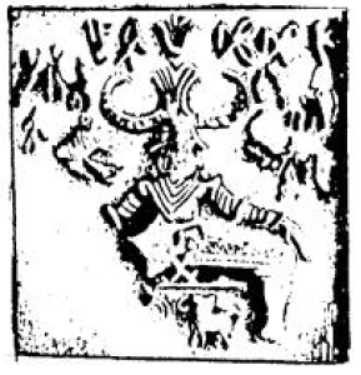
(a) Why were the seals used ?
(b) Of what material were these seals made ?
(c) What do they reveal about the Harappans ?
Answer: Based on the archaeological study of Harappan seals:
(a) Purpose of the Seals: Seals were primarily used as stamps to secure trade goods and authenticate property during commercial transactions. Since they have been found at distant sites across the civilization, they prove active trade. The short pictographic inscriptions carved on them likely represent merchant names or trade messages.
(b) Materials Used: These seals were carved from soft river stone known as steatite, as well as terracotta clay, agate, ivory, and faint.
(c) Insights Revealed: The detailed carvings on the seals reveal their religious and mythological beliefs. They depict the worship of the Mother Goddess, the horned Pashupati, and sacred trees and animals, while demonstrating the outstanding artistic and engraving skills of Harappan craftsmen.
In simple words: Seals were used as stamps for trading goods across the empire. They were made of steatite stone, clay, and agate. They show us their religious beliefs, such as the worship of the Mother Goddess and Pashupati, as well as their writing.
Exam Tip: Clearly state that seals were used to secure trade bundles, made of steatite or terracotta, and are our primary source for Harappan religious iconography.
Question 9. Describe the social life of the Harappan people with reference to: (a) Their Diet. (b) Their Dress (c) Their Ornaments. (d)Their Sports and Games.
Answer: The daily life and social habits of the Harappan population are described below:
(a) Their Diet: Their staple food consisted of cultivated wheat and barley, supplemented by rice and dates. They also consumed fresh milk, green vegetables, and fruits. For protein, they ate beef, mutton, poultry, turtle, tortoise, and various kinds of river fish.
(b) Their Dress: Men and women dressed in simple, comfortable clothing made of cotton and wool. Men wore a two-piece outfit consisting of an upper shawl draped over the left shoulder and a lower dhoti-like wrap. Women wore a short skirt secured at the waist by a decorative belt or girdle.
(c) Their Ornaments: People across all social classes loved wearing jewelry. Wealthy citizens wore ornaments made of gold, silver, copper, and polished gemstones, while poorer families wore ornaments made of bone, shell, and clay. Common items included necklaces, rings, and armbands, with women also wearing elaborate headdresses, earrings, bangles, and anklets.
(d) Their Sports and Games: For entertainment, adults played dice games, rolled marbles, and played with balls. They also enjoyed music, singing, and dancing, and engaged in outdoor activities like hunting and fishing. Children played with clay toys, including model carts, whistles, rattles, and animal figurines.
In simple words: They ate grains like wheat and barley alongside various meats. They wore simple cotton and wool clothing, and everyone wore jewelry made of metals or beads. For fun, adults played board games and danced, while children played with clay toys.
Exam Tip: Make sure to organize your answer under the four requested headings, providing specific examples for their diet, dress, jewelry, and toys.
Question 10. What do you know about the trade and commercial activities of the Harappan people?
Answer: The Harappan economy relied heavily on active domestic and foreign trade networks:
1. They established domestic trade connections with southern and eastern India, as well as Kashmir, to source raw materials and precious metals.
2. They engaged in long-distance international trade with Mesopotamian cities, Egypt, and Crete.
3. Goods were transported via land routes using bullock carts, and across seas using merchant ships. This maritime activity is confirmed by seals engraved with drawings of ships and the discovery of a tidal dockyard at Lothal.
In simple words: They traded with other parts of India for metals and gems, and sent ships to trade with distant lands like Mesopotamia and Egypt, using land and sea routes.
Exam Tip: Mention both their domestic trade and international maritime trade to write a complete answer.
Question 11. With reference to the art and craft of the Harappan people, explain their achievements in the following fields: (a) The Art of Sculpture. (b)The Art of Carving.
Answer: The artistic skills of the Harappans are highly evident in their sculptures and engravings:
(a) The Art of Sculpture: Harappan artisans were highly skilled in working with diverse materials, including metals, stone, and clay:
- Metal Sculptures: They used the 'lost-wax' casting method to create beautiful metal figures, with the bronze 'Dancing Girl' being the most famous example.
- Stone Sculptures: They carved highly detailed stone statues, such as the white steatite bust of the 'Priest-King' and the realistic red sandstone Male Torso.
- Terracotta Sculptures: They modeled numerous clay figurines, including the Mother Goddess and various animal toys like bulls, dogs, and monkeys.
(b) The Art of Carving: The Harappans were master seal-carvers. They engraved square and rectangular steatite seals with remarkable precision, carving realistic figures of animals like the humped bull, bison, elephant, and the mythological unicorn, alongside short pictographic inscriptions.
In simple words: They sculpted beautiful statues using bronze (like the dancing girl), stone (like the priest-king), and clay (like the Mother Goddess). They were also experts at carving detailed animal figures on their square stone seals.
Exam Tip: For part (a), mention all three sculpting mediums: metal, stone, and terracotta. For part (b), focus on their detailed animal carvings on seals.
Question 12. India is well-known for her deep-rooted tradition in arts and crafts. Substantiate this statement by a brief mention of the following: (a) The Harappan Pottery. (b) Harappan art of Spinning. (c) Harappan Metal-craft.
Answer: The foundational roots of Indian craftsmanship can be traced directly to the Harappan era:
(a) The Harappan Pottery: Harappan potters were highly skilled in using the wheel to produce a wide variety of clay vessels, including jars, storage pots, and dishes. Everyday kitchenware was kept plain, while special vessels designed to hold valuables were glazed, decorated with black geometric patterns, and painted red. The discovery of large public kilns shows they fired their pottery systematically.
(b) Harappan Art of Spinning: The discovery of numerous clay and porcelain spindle whorls in almost every home proves that spinning cotton and wool was a common household activity. Additionally, the discovery of a large brick dyer's vat shows they were skilled in coloring and dyeing their fabrics.
(c) Harappan Metal-craft: Harappan-era artisans excelled in metallurgy, working with gold, silver, copper, and bronze. Goldsmiths crafted complex jewelry, including necklaces, armbands, earrings, and rings. Metalsmiths were skilled in making alloys like bronze, casting metal figures, and hammering copper sheets to make durable kitchen vessels.
In simple words: They made beautiful painted clay pots on wheels, spun cotton and wool into clothes using household spindles, dyed their fabrics in vats, and used gold, silver, and copper to make beautiful jewelry and sturdy metal pots.
Exam Tip: Discuss each craft under its requested heading: focus on glazed designs for Pottery, spindle whorls and dye vats for Spinning, and bronze alloy casting for Metal-craft.
Question 13. The Seals may be considered as the most valuable finds of the Harappan Civilization. In this context give (a) Details of the Animals Seals, the Unicorn Seal and the Pashupati-Seal. (b) Reasons why the Seals are important.
Answer: The seals are widely considered to be among the most valuable artifacts of the Harappan Civilization:
(a) Details of the Main Seals: Over 2,000 seals of various shapes and materials have been discovered.
- Animal Seals: Feature highly detailed, realistic engravings of native animals, including the humped bull, water buffalo, elephant, tiger, and antelope.
- The Unicorn Seal: Depicts a mythical single-horned creature facing a stand or altar, which likely held ceremonial or religious significance.
- The Pashupati Seal: Shows a three-faced deity seated in a meditative yogic pose, wearing a horned headdress and surrounded by wild animals. Other seals show similar deities seated on low platforms or with leafy garlands between their horns.
(b) Historical Importance of the Seals: These seals serve as invaluable primary historical sources because:
1. They illustrate the physical features, clothing styles, elaborate hair arrangements, and jewelry of the period, as well as the animals they domesticated.
2. They offer direct evidence of their religious beliefs and mythologies.
3. They confirm the presence of active trade networks, where they were used as corporate stamps on shipping bundles.
4. They display outstanding craftsmanship and engraving skills.
5. They preserve the only surviving examples of their pictographic writing script.
In simple words: Over 2,000 stone seals have been found, depicting animals, mythical unicorns, and the horned Pashupati god. These seals are important because they teach us about Harappan hairstyles, clothing, trade methods, religious beliefs, and writing.
Exam Tip: Describe the three main seal types in part (a), and list at least three historical benefits of studying seals - such as learning about trade, writing, and religion - in part (b).
Free study material for History Civics
ICSE Goyal Brothers Solutions Class 9 History Civics Chapter 1 The Harappan Civilization
Students can now access the detailed Goyal Brothers Solutions for Chapter 1 The Harappan Civilization on our portal. These solutions have been carefully prepared as per latest ICSE Class 9 syllabus. Each solution given above has been updated based on the current year pattern to ensure Class 9 students have the most updated History Civics content.
Master Goyal Brothers Textbook Questions
Our subject experts have provided detailed explanations for all the questions found in the Goyal Brothers textbook for Class 9 History Civics. We have focussed on making the concepts easy for you in Chapter 1 The Harappan Civilization so that students can understand the concepts behind every answer. For all numerical problems and theoretical concepts these solutions will help in strengthening your analytical skill required for the ICSE examinations.
Complete History Civics Exam Preparation
By using these Goyal Brothers Class 9 solutions, you can enhance your learning and identify areas that need more attention. We recommend solving the History Civics Questions from the textbook first and then use our teacher-verified answers. For a proper revision of Chapter 1 The Harappan Civilization, students should also also check our Revision Notes and Sample Papers available on studiestoday.com.
FAQs
You can download the verified Goyal Brothers solutions for Chapter 1 The Harappan Civilization on StudiesToday.com. Our teachers have prepared answers for Class 9 History Civics as per 2026-27 ICSE academic session.
Yes, our solutions for Chapter 1 The Harappan Civilization are designed as per new 2026 ICSE standards. 40% competency-based questions required for Class 9, are included to help students understand application-based logic behind every History Civics answer.
Yes, every exercise in Chapter 1 The Harappan Civilization from the Goyal Brothers textbook has been solved step-by-step. Class 9 students will learn History Civics conceots before their ICSE exams.
Yes, follow structured format of these Goyal Brothers solutions for Chapter 1 The Harappan Civilization to get full 20% internal assessment marks and use Class 9 History Civics projects and viva preparation as per ICSE 2026 guidelines.