

ICSE Solutions Goyal Brothers Class 9 History Civics Chapter 5 The Mauryan Empire have been provided below and is also available in Pdf for free download. The Goyal Brothers ICSE solutions for Class 9 History Civics have been prepared as per the latest syllabus and ICSE books and examination pattern suggested in Class 9. Questions given in ICSE Goyal Brothers book for Class 9 History Civics are an important part of exams for Class 9 History Civics and if answered properly can help you to get higher marks. Refer to more Chapter-wise answers for ICSE Class 9 History Civics and also download more latest study material for all subjects. Chapter 5 The Mauryan Empire is an important topic in Class 9, please refer to answers provided below to help you score better in exams
Goyal Brothers Chapter 5 The Mauryan Empire Class 9 History Civics ICSE Solutions
Class 9 History Civics students should refer to the following ICSE questions with answers for Chapter 5 The Mauryan Empire in Class 9. These ICSE Solutions with answers for Class 9 History Civics will come in exams and help you to score good marks
Chapter 5 The Mauryan Empire Goyal Brothers ICSE Solutions Class 9 History Civics
Question 1. Name any two sources to reconstruct the Age of the Mauryas.
Answer: Written documents such as Megasthenes' Indica and the text Arthashastra serve as literary records. Meanwhile, material remains like Ashoka's Rock Edicts and his stone pillars serve as archaeological evidence.
In simple words: Historians learn about the Mauryas by reading ancient books and looking at old stone pillars and rock carvings.
Exam Tip: Clearly categorize your answer into literary and archaeological headings to secure maximum marks.
Question 2. Who was Kautilya (Chanakya)? Name the famous book written by him.
Answer: Kautilya, also referred to as Chanakya, was an educated scholar from Taxila who subsequently served as an influential minister and diplomat under Emperor Chandragupta Maurya. The renowned book 'Arthashastra' was composed by him.
In simple words: Chanakya was a wise advisor to King Chandragupta Maurya who wrote a very famous book on politics called the 'Arthashastra'.
Exam Tip: Be sure to write both names, Kautilya and Chanakya, and spell 'Arthashastra' correctly to show a thorough understanding.
Question 3. What is a Stupa ? Name one stupa built by Ashoka ?
Answer: A stupa is a half-spherical, solid dome structure built from raw bricks and blocks of stone. The Sanchi stupa is a famous monument constructed by Emperor Ashoka during the third century BCE.
In simple words: A stupa is a dome-shaped stone monument. Ashoka built a very famous one at Sanchi.
Exam Tip: Mentioning the time period (3rd century BC) and the material (bricks and stones) adds precision to your definition of a stupa.
Question 4. Why did Seleucos Nicator invade India?
Answer: As a Greek monarch, Seleucos Nicator led a military campaign into India aiming to reclaim the territories that the Greeks had previously conquered there.
In simple words: A Greek king named Seleucos invaded India to take back lands that the Greeks had lost.
Exam Tip: Keep the answer brief and focus on his main goal, which was reclaiming previous Greek conquests.
Question 5. What do you know about the extent of Chandragupta Maurya’s empire?
Answer: The boundaries of Chandragupta Maurya's kingdom reached Mysore in southern India and went up to Kabul in the northwestern region. It also spanned across the subcontinent, from Saurashtra in the west to Bengal in the east.
In simple words: Chandragupta Maurya ruled a massive empire that covered almost all of India, from Kabul in the west to Bengal in the east, and down to Mysore in the south.
Exam Tip: Remember to name all four geographical directions (North-west: Kabul, South: Mysore, West: Saurashtra, East: Bengal) to get full credit.
Question 6. What change did the Kalinga War bring about in Ashoka’s life?
Answer: Serving as the third and most progressive emperor of the Mauryan line, Ashoka experienced a massive turning point due to the Kalinga War. The terrible bloodshed and loss of life in Kalinga completely altered his militaristic attitude. Pained by the horrifying sights of war, he abandoned violence completely and became a disciple of Lord Buddha.
In simple words: The Kalinga War was so bloody and sad that Emperor Ashoka decided to stop fighting wars forever and decided to follow Buddhism instead.
Exam Tip: Highlight the shift from militarism (Bherighosha) to spiritual conquest (Dhammaghosha) and his adoption of Buddhism.
Question 7. Mention two advantages of the Pan-Indian character of the Mauryan empire.
Answer: The vast, subcontinental nature of the Mauryan state offered several key benefits. First, it put an end to fragmented small kingdoms, leading to a unified administration. Second, a large unified empire allowed the rulers to resist external invasions much more effectively. Furthermore, it encouraged trade with foreign regions, such as Greek and Middle Eastern cities.
In simple words: Having one giant empire stopped small states from fighting each other and made it easier to defend the country from foreign invaders.
Exam Tip: Focus on administrative unity and security against foreign invasions as the primary benefits of a Pan-Indian empire.
Question 8. What does Megasthenes’ Indica tell us about the king’s life?
Answer: According to Megasthenes' Indica, Chandragupta is regarded as India's first historical emperor, who extended his reign within the subcontinent and into adjacent regions. Eventually, he abandoned his royal status and moved to Sravana Belagola in southern India, where he lived and died as an ascetic.
In simple words: Megasthenes wrote that Chandragupta was India's first great emperor. Later, the king gave up his throne and became a monk in South India.
Exam Tip: Be sure to mention Sravana Belagola and his transition from an emperor to an ascetic in your response.
Question 9. What does Kautilya tell us about the duties of the king?
Answer: Kautilya split the daily routine of the sovereign into eight separate portions. He stated that the ruler must focus closely on the welfare of the public, the preservation of social harmony, and defense tasks.
In simple words: Chanakya wrote that a king should divide his day into eight parts and spend his time helping his people, keeping peace, and running the army.
Exam Tip: Mention the division of the king's day into eight parts and focus on the three duties: welfare, social order, and military defense.
Question 10. What does Megasthenes tell us about the City administration?
Answer: Megasthenes noted that municipal governance was split into six committees, each consisting of five members. Every individual committee managed specific responsibilities, including managing trade, conducting population counts, and looking after visiting foreigners.
In simple words: The city was run by six teams of five people. Each team had a special job, like counting the population or helping foreign visitors.
Exam Tip: Remembering the numbers "six boards" and "five members" is crucial for scoring full marks in municipal administration questions.
Question 11. What is the importance of Ashoka’s inscriptions (Stone Edicts)?
Answer: Ashoka's stone proclamations convey a message of affection toward humanity and all living beings. They urged people to live in harmony, emphasizing that military strength is not a real solution to conflicts since it only brings ruin and slaughter.
In simple words: Ashoka's stone carvings taught people to love each other and live in peace, showing that war and fighting only cause sadness.
Exam Tip: Mention how the edicts promoted peaceful coexistence and rejected violence (Ahimsa) as a solution.
Question 12. Mention any two principles of Ashoka’s
Answer: Two main guidelines of Ashoka's Dhamma are:
1. Maintaining an ethical and clean family life.
2. Practicing religious acceptance and respect.
In simple words: Two rules of Ashoka's Dhamma are being good to your family and respecting everyone's beliefs.
Exam Tip: Use terms like 'Purity of Domestic Life' and 'Toleration' while explaining these principles to match the textbook standards.
Structured Questions
Question 1. Describe the sources to reconstruct the Age of the Mauryan with reference to the following: (a) Indica (b) Arthashastra
Answer:
(a) Indica - Megasthenes penned this book to document his observations and experiences during his stay in India. Even though the original version has been lost, excerpts of it are still preserved in the works of later Greek historians like Strabo, Arrian, Diodorus, Plutarch, and Justin.
(b) Arthashastra - Among all written accounts of Mauryan history, this text is the most crucial, compiled by Kautilya, who is also called Vishnugupta or Chanakya. Written in Sanskrit, it features 6000 verses and is categorized into 15 divisions and 180 topics. These chapters cover governance, diplomatic strategies, and administrative guidelines. This valuable manuscript was discovered in 1909.
In simple words: The 'Indica' was written by a Greek visitor to describe India, while the 'Arthashastra' is Chanakya's book on how to run a government.
Exam Tip: Mention the name of the authors (Megasthenes and Chanakya) and the year of discovery of Arthashastra (1909) to score high.
Question 2. What is an Edict ? Mention the significance of Ashokan Edicts, with particular reference to the Rock Edict XIII and the Rummindei Pillar Inscription.
Answer: An edict refers to a formal declaration or decree issued by a ruler. The inscriptions of Ashoka are highly important:
- Rock Edict XIII explains that during the Kalinga conflict, approximately one hundred thousand people perished and one hundred and fifty thousand were captured. The sheer brutality of the war filled Ashoka with immense grief. This edict records, "The Beloved of the Gods, the King considers victory by dhamma to be the foremost victory."
- The Rummindei Pillar inscription marks a sacred spot. It notes: "King, the beloved of the Gods, visited this spot in person and offered worship at this palace, because the Lord Buddha was born here."
In simple words: An edict is an official royal message. One edict explains Ashoka's sadness over the Kalinga War, and another shows that he visited the place where Buddha was born.
Exam Tip: Be sure to keep quotes exact where necessary and specifically connect Rock Edict XIII to Kalinga and Rummindei to Buddha's birthplace.
Question 3. Chandragupta ruled over a vast empire. In this context explain: (a) His main conquests. (b)Details of his victory over Seleucos Nicator.
Answer:
(a) His main conquests: He took over western Punjab and Sindh first. After that, he invaded Magadha, completely overthrowing the Nanda dynasty to take over their wealthy and dominant empire.
(b) Details of his victory over Seleucos Nicator: The areas west of the Indus River were controlled by the Greek ruler Seleucos. He crossed the river in 305 BCE, aiming to take Punjab. However, Mauryan forces marched northwest and completely defeated the Greek armies. Seleucos had to negotiate a peace deal, giving up Herat, Kandahar, and Kabul to Chandragupta. Chandragupta, in exchange, presented him with 500 war elephants. It is recorded that Chandragupta married Seleucos' daughter, Princess Helen. The Greek monarch maintained cordial ties with the Mauryas and sent Megasthenes as an envoy to reside in Pataliputra and document life in India.
In simple words: Chandragupta conquered Punjab and Magadha. He also defeated a Greek king named Seleucos, got new lands and war elephants, and welcomed an ambassador named Megasthenes to his capital.
Exam Tip: Memorize the three territories ceded (Herat, Kandahar, Kabul) and the year 305 BC to secure maximum marks on this question.
Question 4. The administration of a vast imperial state raised intricated problems which were wisely solved by Chandragupta Maurya and Ashoka. In this context explain briefly: (a) Position of the king. (b) Role of the Council of Ministers. (c) Provincial Administration.
Answer:
(a) Position of the king: The sovereign served as the ultimate head of state, holding supreme control over military, judicial, and executive affairs, alongside the authority to make laws.
(b) Role of Council of Ministers: This body, known as the Mantriparishad, was small but highly influential. They sometimes acted as a check on the absolute authority of the monarch. These advisors helped the king choose provincial governors, military generals, treasury officers, chief judges, and other high-ranking officials.
(c) Provincial Administration: Below the emperor were the governors who managed the different provinces. Ashokan inscriptions highlight four main governors positioned at Taxila (North), Ujjain (West), Tosali (East), and Suvarnagiri (South). These governors had their own councils and could appoint subordinate officials. Smaller administrative zones were overseen by officers called Pradesikas.
In simple words: The king was the supreme leader, helped by a small group of wise ministers. The huge empire was divided into provinces, each run by a governor.
Exam Tip: Be prepared to list the four provincial capitals (Taxila, Ujjain, Tosali, Suvarnagiri) and define the term 'Mantriparishad' clearly.
Question 5. What do you know about: (a) Mauryan District Administration. (b) Mauryan City Administration.
Answer:
(a) Mauryan District Administration: Provinces were split into districts for governance. Inscriptions mention three main types of district officers: the Rajukas, the Yuktas, and the Mahamatras. The Rajukas held responsibilities similar to modern-day District Magistrates, maintaining peace and managing public property. The Yuktas functioned as treasury officers, handling revenue collection and accounting. The Mahamatras oversaw specific administrative departments. Ashoka also created the Dhamma Mahamatras to spread moral codes, while the Stri Adhyaksha Mahamatras headed a special wing to protect the welfare of women.
(b) Mauryan City Administration: The Arthashastra mentions the Nagarka, a city superintendent or magistrate who was aided by several officers. The Nagarka was responsible for water supply, road upkeep, public building maintenance, checking defensive walls, and fire prevention. He also managed public crises like floods or epidemics. Megasthenes explains that municipal administration was split into six committees, each with five members. Each committee oversaw a distinct task, such as looking after foreigners, taking censuses, or supervising trade. Together, they maintained public structures, temples, wells, and managed fire safety.
In simple words: Districts were run by officers who collected taxes and kept order, including a special department for women's welfare. Cities were managed by a chief administrator (Nagarka) and six boards of five people each.
Exam Tip: Be sure to distinguish between the district-level 'Rajukas/Yuktas' and the city-level 'Nagarka' and 'Six Boards' to clearly show both levels of administration.
Question 6. Ashoka’s Dhamma was not a narrow religious faith. Its broad objective was to promote harmony and the spirit of common brotherhood amongst people of the realm. In this context explain: (a) Fundamental Principles of Dhamma. (b) Means adopted for the propagation of Dhamma and the spread of Buddhism.
Answer:
(a) Fundamental Principles of Dhamma: The Prakrit term 'Dhamma' matches the Sanskrit word 'Dharma'. It did not mean a specific religion, but rather referred to morality, justice, and social duty. Its core tenets include:
1. Purity of Domestic Life: Ashoka acted as a protective fatherly figure. He viewed his subjects as his own offspring, instructing them "to respect their parents, elders and teachers." Conversely, those of higher status were instructed "to treat their inferiors, including servants, slaves and all living creatures with kindness." Truthfulness was also a key duty.
2. Toleration: Ashoka practiced religious tolerance and secularism. He requested that citizens avoid speaking ill of other faiths and urged that all paths lead to self-restraint and mental purity.
3. Sanctity of Life: He advocated non-violence (Ahimsa) and outlawed animal slaughter for religious sacrifices. He also built hospitals for both humans and animals.
4. True Ceremonial: Ashoka dismissed superficial rituals associated with childbirth, marriages, deaths, or journeys. He declared that the real ceremony involves "kindness to living creatures and Liberality to asceics and Brahmins" and that spreading Dhamma is the greatest service.
(b) The means adopted for the propagation of Dhamma were as follows:
1. Ashoka practiced his own teachings. He halted royal hunting trips and banned animal slaughter in the palace kitchens.
2. Government officers were ordered to instruct the public regarding their moral responsibilities.
3. He established a specialized group of officials called Dhamma Mahamatras to enforce the ethical code and secure public welfare. Emissaries were sent to neighboring countries, including Sri Lanka, Syria, Egypt, and Macedonia, to spread Buddhism and Dhamma.
In simple words: Ashoka's Dhamma was a moral path teaching respect for parents, kindness to animals, and religious peace. He spread it by giving up hunting, appointing moral officers, and sending envoys to other countries.
Exam Tip: Explain both 'Principles of Dhamma' and 'Means of propagation' in clear, structured points to secure full marks.
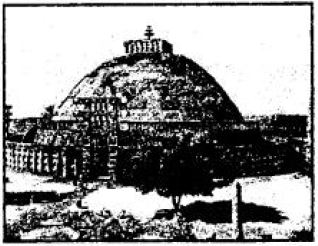
Question 7. Identify the picture given below and answer the following questions (a) When and by whom was the Original Stupa built ? (b) Which Dynasty enlarged it ? (c) Mention two important features of the Stupa. (d) What events are depicted on the panels of the Gateway?
Answer:
(a) The Great Stupa of Sanchi, near Vidisha in Madhya Pradesh, was originally constructed by Emperor Ashoka in the 3rd century BCE to store the sacred relics of Lord Buddha. It was later expanded.
(b) The expansion of the stupa was carried out by the rulers of the Sunga dynasty.
(c) The stupa is built as a half-spherical solid dome from unburnt bricks and stones. It holds profound religious significance as it represents Buddha's spiritual body, housing sacred relics like hair, teeth, or bones inside a box at the bottom of the dome.
(d) The gateways are decorated with exquisite carvings that depict events from Buddha's life and stories from the Jatakas. Buddha is represented symbolically by things like a wheel, a lotus, or an empty throne under a pipal tree.
In simple words: The picture shows the Sanchi Stupa, built by Ashoka and expanded by the Sungas. It is a dome-shaped monument containing Buddha's relics, with gates showing stories from Buddha's life.
Exam Tip: Be sure to state that Buddha was represented symbolically (wheel, lotus, throne) rather than in human form on the gateways, as this is a key artistic detail of early Buddhist art.
Question 8. It is only with Ashoka that we can properly begin the history of the art and architecture of ancient India. In this context explain briefly: (a) Arts and Crafts that flourished during Ashoka’s reign. (b) A few features of the Ashokan Pillars.
Answer:
(a) Arts and Crafts: The Arthashastra notes that several locations specialized in making textiles, such as Kashi (Varanasi), Vanga, Vatsa, and Kalinga. It also includes sections detailing gold mining practices. The southern administrative center was named Suvarnagiri (Gold Mountain), proving that the state extensively mined gold reserves. Ashoka also renovated the royal palace, replacing the traditional wooden architecture with stone structures.
(b) A few features of Ashokan Pillars: These pillars are a set of stone columns located across the northern part of the subcontinent, created and inscribed under Ashoka's orders. The most famous is the Sarnath Pillar, which has a capital of four back-to-back lions representing key moments of Buddha's life. All of these columns are monolithic, carved from a single piece of stone, with each column weighing around 50 tons and topped by a monolithic capital.
In simple words: During Ashoka's time, people made fine cloth, mined gold, and built beautiful stone palaces. Ashoka also set up giant stone pillars made from single blocks of rock, like the famous lion pillar at Sarnath.
Exam Tip: Define 'monolithic' (carved from a single piece of stone) and mention the Sarnath lion capital as it is highly valued by examiners.
Question 9. Ashoka was a promising warrior, but soon after the Kalinga War, he turned into a practicing moralist. In this context explain: (a) Fundamental Principles of Dhamma. (b) True Nature of Dhamma.
Answer:
(a) Fundamental Principles of Dhamma: The word 'Dhamma' stems from Prakrit, mirroring the Sanskrit 'Dharma'. Rather than a formal religion, it comprised values like justice, good morals, duty, and law. Its key aspects are:
- Purity of Domestic Life: Acting as a father figure, Ashoka looked at his subjects as his children, teaching them "to respect their parents, elders and .teachers." At the same time, superiors had "to treat their inferiors, including servants, slaves and all living creatures with kindness." Truthfulness was essential.
- Toleration: Ashoka held an inclusive view of all prevailing faiths. He asked his subjects to avoid criticizing their neighbor's beliefs, emphasizing that every religion aims for inner peace and mental control.
- Sanctity of Life: He promoted non-injury (Ahimsa), instructing that no animals should be slain for rituals. He also developed roads and medical centers for humans and animals.
- True Ceremonial: Ashoka discouraged useless rituals practiced during life events like birth, marriage, death, or travel. He taught that true ceremony means "kindness to living creatures and Liberality to asceics and Brahmins", and that sharing this path is the greatest gift.
(b) True Nature of Dhamma: While Ashoka personally practiced Buddhism, he never forced his creed onto his citizens. Thus, his Dhamma was a universal code of ethics, serving as a common platform for moral living rather than a narrow state religion.
In simple words: Ashoka's Dhamma taught family respect, kindness, and religious tolerance. Although he was a Buddhist, he wanted his Dhamma to be a universal code of kindness for everyone.
Exam Tip: Differentiate between Ashoka's personal religion (Buddhism) and his state policy of Dhamma (a universal moral code) to show a deeper analytical insight.
Short Answer Questions
Question 1. What are our main sources of information on the Mauryan ruie ?
Answer: Key records of the Mauryan era include the proclamations of Ashoka (comprising 14 rock edicts, seven pillar edicts, along with minor rock edicts), the Sanchi Stupa, the Nandangarh pillar, Megasthenes' 'Indica', Kautilya's 'Arthashastra', and Visakhadutta's 'Mudrarakshasa'.
In simple words: We learn about the Mauryas from Ashoka's stone pillars, the Sanchi Stupa, and famous books like 'Indica' and 'Arthashastra'.
Exam Tip: Including 'Mudrarakshasa' alongside 'Indica' and 'Arthashastra' demonstrates high-level knowledge of literary sources.
Question 2. Who wrote Arthashastra ? What is its importance ?
Answer: This treatise was composed by Chanakya, who is also referred to as Vishnugupta. It features 6000 verses categorized into 15 sections and 180 topics, offering critical information on political science, diplomacy, and administrative practices of the time.
In simple words: The book was written by Chanakya. It is important because it explains ancient rules of politics and how to run a country.
Exam Tip: Be sure to mention the statistics: 6000 verses (shlokas), 15 sections, and 180 subjects to secure maximum points.
Question 3. What is the importance of Ashoka’s edicts ?
Answer: These carvings represent the most vital records for studying Mauryan history. They stand as the oldest, most durable, and accurately dated stone inscriptions found in the Indian subcontinent.
In simple words: Ashoka's stone messages are very important because they are the oldest and best-preserved written records in India.
Exam Tip: Highlight the terms 'oldest', 'best-preserved', and 'epigraphic records' to score high marks.
Question 4. What is a stupa ? Name one stupa built by Ashoka.
Answer: A stupa is a solid, dome-shaped mound built using raw bricks and stones. One notable example constructed by Ashoka is the Sanchi stupa, erected around the 3rd century BCE.
In simple words: A stupa is a dome-like stone mound, and the most famous one built by Ashoka is at Sanchi.
Exam Tip: Keep this definition crisp, focusing on its architectural form (semi-spherical dome) and giving the Sanchi example.
Question 5. How did Chandragupta Maurya establish the Mauryan dynasty ?
Answer: Guided by Chanakya, Chandragupta overthrew the Nanda dynasty, annexed Magadha, and set up his capital at Pataliputra (modern-day Patna) in 321 BCE. Prior to this, he had liberated Punjab from Greek forces in 322 BCE. In 306 BCE, he defeated Seleucos, adding Herat, Kabul, Kandahar, and Baluchistan to his empire. He also led campaigns in the south, eventually creating a vast empire stretching from Kabul to Mysore, and from Saurashtra to Bengal.
In simple words: Chandragupta Maurya, with Chanakya's help, defeated the Nanda kings and took over Magadha. He then beat the Greeks to win western lands, making a massive empire across India.
Exam Tip: Mention key years (321 BC, 322 BC, 306 BC) and the role of Chanakya to provide a complete historical explanation.
Question 6. Give a brief account of the political conditions in India under Bindusara.
Answer: Bindusara took over after Chandragupta and governed until 273 BCE. He expanded the empire southward by defeating sixteen chieftains. His reign witnessed a major revolt in Taxila, which involved rivalry between his sons, including Ashoka. He also maintained peaceful and friendly relations with the Hellenic (Greek) world, exchanging embassies and gifts.
In simple words: Bindusara succeeded Chandragupta and conquered many parts of South India. He kept peace with the Greeks but faced a family revolt in Taxila.
Exam Tip: Emphasize his nickname 'Amitraghata' (slayer of enemies) if relevant, or focus on the sixteen conquests and the Hellenic ties mentioned here.
Question 7. What is the importance of Kalinga war in the personal life of Ashoka ?
Answer: The massive loss of life and devastation in the Kalinga war deeply impacted Ashoka. Observing that 150,000 individuals were captured, 100,000 were killed, and many others suffered, he was filled with deep remorse. This prompted him to adopt Buddhism and enforce a ban on taking the lives of both humans and animals.
In simple words: The Kalinga War was so violent and sad that Ashoka changed his ways completely. He stopped all wars, became a Buddhist, and banned animal hunting and violence.
Exam Tip: Use the exact figures (100,000 dead, 150,000 captured) to illustrate the scale of destruction that triggered his transformation.
Question 8. Name the two taxes mentioned in the Edicts of Ashoka.
Answer: The rock and pillar edicts of Ashoka highlight two specific tax collections, known as Bali and Bhaga.
In simple words: The two taxes mentioned in Ashoka's stone carvings are Bali and Bhaga.
Exam Tip: Remembering these precise tax names (Bali and Bhaga) is essential for scoring full marks in quick short-answer questions.
Question 9. Name four important ways in which Buddhism spread under the royal patronage during the Mauryan times.
Answer: Buddhism expanded rapidly during Mauryan times through state-supported methods:
1. The massive expansion of the empire carried the faith beyond the Hindu Kush and across the Bay of Bengal.
2. Under Ashoka's active patronage, Buddhism was spread to many regions of Asia.
3. The emperor dispatched family members, including his son Mahindra and daughter Sanghamitra, to Sri Lanka to establish the religion there.
4. Ashoka issued moral codes on rock edicts and pillars to guide his subjects in Buddhist values.
In simple words: Ashoka helped Buddhism grow by spreading it across his huge empire, carving Buddhist values on rocks, and sending his own children as missionaries to Sri Lanka.
Exam Tip: Be sure to name Ashoka's children (Mahindra and Sanghamitra) and Sri Lanka, as they are crucial details regarding foreign missions.
Question 10. What is meant by Ashoka’s Dhamma ?
Answer: Ashoka's Dhamma represents a collection of moral principles drawn from various spiritual traditions. It was designed as an ethical code, a moral law, or a shared guide of behavior meant to unite people across different faiths.
In simple words: Dhamma was a set of good moral rules created by Ashoka to help people of all religions live together in peace.
Exam Tip: Define Dhamma as a 'moral code' or 'ethical order' rather than a specific religion to display historical accuracy.
Question 11. Give the basic principles of Ashoka’s Dhamma.
Answer: The core guidelines of Ashoka's Dhamma are:
1. Showing respect to elders and loving the youth.
2. Practicing non-violence (Ahimsa).
3. Performing good deeds.
4. Having mutual respect for all religions.
5. Avoiding empty and meaningless rituals.
In simple words: The basic rules of Dhamma are: respect your elders, love younger ones, do not hurt anyone, be good, respect all faiths, and skip pointless rituals.
Exam Tip: Listing these 5 points clearly in a numbered list makes your answer structured and examiner-friendly.
Question 12. What was the impact of Dhamma an Ashoka’s policies?
Answer: The application of Dhamma influenced Ashoka's state policies in several ways:
1. It promoted religious harmony and mutual tolerance across the empire.
2. It urged people to practice ethical and moral values in daily life.
3. It helped reduce criminal activities and lawbreaking.
4. It shifted focus to public welfare by ending expansionist wars and establishing welfare-oriented projects.
In simple words: Dhamma brought peace, stopped wars, reduced crime, and made the government focus on helping people instead of fighting.
Exam Tip: Mention the transition from war to welfare policies (public works like building roads, wells, and hospitals) as a direct impact of Dhamma.
Question 13. What is meant by Pan-Indian character of the Mauryan administration ?
Answer: The Mauryan administration was notable for its vast scope and diverse achievements. It united different territories by overcoming foreign forces in the northwest, replacing the Nandas in the Ganges valley, and extending down to Mysore in the south. Following the Kalinga war, Ashoka focused on advancing Indian economy, art, and cultural systems. It is described as having a Pan-Indian character because its administrative authority covered almost the entire Indian subcontinent.
In simple words: It means the Mauryan government ruled over almost all of India, from the northwest down to the deep south, and worked to improve trade and art everywhere.
Exam Tip: Define 'Pan-Indian' by naming the geographical extent (northwest, Ganges basin, and South India) to demonstrate a complete understanding.
Question 14. How was the district administration organised during Mauryan period ?
Answer: Mauryan provinces were subdivided into smaller districts referred to as Janapadas. The governance of these districts was managed by three primary officials: the Pradeshika, the Rajuka, and the Yukta.
In simple words: Provinces were divided into smaller zones called Janapadas, which were run by three key officers.
Exam Tip: Mention the term 'Janapadas' and name the three key officers (Pradeshika, Rajuka, and Yukta) to get full marks.
II. Structured Questions
Question 1. With reference to the sources of information on the Mauryan Empire, explain briefly the significance of the following:(a) Arthashastra (b) Indica (c) Sanchi Stupa
Answer:
(a) Arthashastra - This is the most crucial literary source for Mauryan history, written by Kautilya (also called Vishnugupta or Chanakya). Composed in Sanskrit, it contains 6000 verses divided into 15 chapters and 180 topics, detailing diplomacy, political theory, and state administration. It was rediscovered in 1909.
(b) Indica - Megasthenes wrote this text to record his impressions of India. While the original manuscript has been lost, fragments survive in the writings of later Greek authors like Strabo, Arrian, Diodorus, Plutarch, and Justin.
(c) Sanchi Stupa - Erected by Ashoka in the 3rd century BCE near Sanchi (about 60 km from Bhopal, Madhya Pradesh), it is 36.58 meters in diameter and 16.46 meters high. The railing pillars stand at 2.784 meters. Under the Sunga dynasty, the wooden railings were upgraded to stone. It features four gates facing the cardinal directions, decorated with carvings of Buddha's life and stories from the Jatakas.
In simple words: The 'Arthashastra' is Chanakya's guide on government; the 'Indica' is a Greek visitor's account of India; and the 'Sanchi Stupa' is a huge dome built by Ashoka to honor Buddha.
Exam Tip: Be precise with the physical dimensions of the Sanchi Stupa (diameter, height) to show outstanding knowledge in structured questions.
Question 2. With reference to Mauryan Empire, answer the following questions: (a) Give a brief account of how Chandragupta established the Mauryan empire. (b) Give a brief account of Kalinga war and its consequences.
Answer:
(a) Chandragupta and his mentor Chanakya teamed up to overthrow the Nanda rulers of Magadha, settling Chanakya's personal grievance against them. Under Chanakya's strategic planning, Chandragupta expelled Greek forces and defeated Seleucos, gaining control of northwestern India. His kingdom spanned from the Ganges basin to Bengal, and also expanded into the southern territories.
(b) The Kalinga War of 261 BCE brought immense destruction, leaving 100,000 dead, 150,000 captured, and many more wounded. This event completely changed Ashoka's life. He stopped hunting, gave up meat, and turned away from royal luxuries, adopting Buddhism as the state religion. He put the prisoners of war to work as farmers, boosting agricultural economy, though the state's military strength eventually declined due to the long peace.
In simple words: Chandragupta and Chanakya defeated the Nandas and Greeks to build the Mauryan Empire. Later, the bloody Kalinga War made Ashoka give up violence, embrace Buddhism, and work for peace.
Exam Tip: Mention the year of the Kalinga War (261 BCE) and describe both the moral and economic consequences (e.g., prisoners becoming cultivators) of the war.
Question 3. With reference to Mauryan administration, answer the following questions: (a) Why is Chandragupta Maurya regarded as the chief architect of the system of administration ? (b) Briefly describe the main features of civil and military administration under Mauryan rule. (c) What is meant by the Pan-Indian character of Mauryan administration ?
Answer:
(a) During the Nanda rule, administration was highly undisciplined due to the poor character of the Nanda king, who also insulted Chanakya. Chanakya swore to overthrow them and trained Chandragupta to become an efficient leader. Guided by Chanakya, Chandragupta founded the Mauryan Empire, bringing order and setting up his main capital at Pataliputra.
(b) The civil administration was split into central and provincial governments, run by the king, governors, and the council of ministers. The military was strong, and Chandragupta maintained a massive army composed of infantry, cavalry, war elephants, and chariots.
(c) The Pan-Indian character of the administration refers to its vast territorial reach, spanning across almost the entire subcontinent from the northwest to Bengal, and stretching down to Mysore in the south.
In simple words: Chandragupta fixed the chaotic Nanda system and created a strong government based in Pataliputra. His system was divided into central and provincial branches, backed by a huge army, and covered almost all of India.
Exam Tip: Define the key elements of both civil (central and provincial) and military (the four wings of the army) structures to provide a comprehensive answer.
Question 4. With reference to Provincial Governments under the Mauryan rule, answer the following questions (a) Name the different provinces and their capitals into which the Mauryan empire was divided. (b) How was the provincial administration run ? (c) What changes were brought about in the Mauryan administration during Ashoka’s reign ?
Answer:
(a) The provinces and their capitals were as follows:
- Magadha: Pataliputra
- Gandhara (N.W. Province): Taxila
- Avanti (Eastern Province): Ujjain
- Southern Province: Swarangiri
- Kalinga: Tosali
(b) The head of a province was usually a royal prince, titled 'Kumar' or 'Aryaputra', who was assisted by governors (Mahamatras). In addition, officers like the Pradeshika (tax collector), Rajuka (revenue officer), and Yukta (treasurer) helped manage provincial duties.
(c) Mauryan administration was heavily centralized. Magadha was connected to other regions through trade and communication networks. Revenue officials had to regularly tour different areas to monitor administration and look after the citizens' well-being. Furthermore, because of linguistic differences, some outer provinces were allowed a degree of self-government.
In simple words: The empire was split into five provinces with capitals like Pataliputra and Taxila. Royal princes ran these provinces with help from tax and treasury officers. Under Ashoka, officials regularly toured the land to make sure everyone was treated well.
Exam Tip: Be sure to name 'Kumar' or 'Aryaputra' as the provincial heads and describe the touring system of revenue officers during Ashoka's reign.
Question 5. With reference to the Mauryan administration write short notes on the following: (a) District Administration (b) Revenue system
Answer:
(a) District Administration: The districts (or Janapadas) were governed by a team of three principal officers: the Pradeshika, the Rajuka, and the Yukta.
(b) Revenue system: The state took a share of agricultural produce, ranging from one-sixth to one-fourth of the harvest. 'Bhaga' was a tax on farming and cattle, while 'Bali' was collected as a religious tribute. Additionally, taxes were collected from businesses, craftsmen, forests, and mines. These funds were used to build roads, canals, irrigation systems, and public hospitals.
In simple words: Districts were managed by three key officers. The government collected tax on crops, shops, and mines, and spent it on building roads, canals, and hospitals.
Exam Tip: Distinguish clearly between 'Bhaga' (agricultural tax) and 'Bali' (religious tribute) to display precise knowledge of the Mauryan tax structure.
Question 6. With reference to the spread of Buddhism under the Mauryas, answer the following questions: (a) What was the Mauryan concept of Universal Empire? (b) Give the important causes for the spread of Buddhism. (c) What was known as ‘Ashoka’s Dhamma’? State its features and principles.
Answer:
(a) What was the Mauryan concept of Universal Empire: This concept linked political expansion with spiritual growth, taking Buddhism past India's borders. This is evident as Buddhism spread to major portions of Asia, such as Burma, Indonesia, Indochina, China, Japan, Mongolia, and Afghanistan.
(b) Give the important causes for the spread of Buddhism: Key reasons for its rapid growth include the appointment of special state officers to preach the faith, royal support from rulers like Ashoka, and carving Buddhist teachings on stone pillars. Ashoka also sent overseas missions, including his own children, to spread the teachings to Burma, Nepal, Egypt, and Syria.
(c) What was known as ‘Ashoka’s Dhamma’? State its features and principles: Ashoka's Dhamma was a moral law and an ethical code based on the common teachings of all major religions. Its main principles include:
1. Respecting elders and showing love to the younger generation.
2. Following non-violence (Ahimsa).
3. Performing good deeds.
4. Respecting all religious traditions.
5. Rejecting meaningless and empty rituals.
In simple words: The Mauryas believed in a great empire united by Buddhism. It spread because of royal support, stone inscriptions, and missionaries. Dhamma was a simple moral code of respect, peace, and goodness.
Exam Tip: Structure this long answer with clear sub-headings (a, b, c) and list the foreign countries where Buddhism spread to show high historical accuracy.
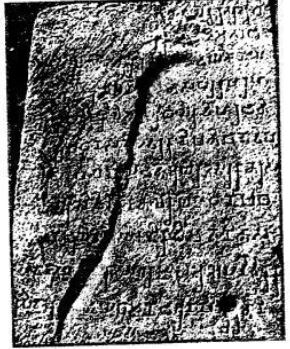
Question 7. Study the Ashokan Edict and answer the following questions:
Question 1. What is an edict ? Where are these edicts inscribed ?
Answer: An edict is an official decree or order issued by a sovereign monarch. Ashoka's edicts, which are vital for understanding Mauryan history, are carved on natural rock surfaces and stone columns across the nation, consisting of 14 major Rock Edicts, seven pillar edicts, and several minor rock inscriptions.
In simple words: An edict is a king's official message. Ashoka carved these messages on rocks and tall stone pillars all over India.
Exam Tip: Mention the locations (rocks and pillars) and the count (14 major, 7 pillar, and minor edicts) to write a detailed answer.
Question 2. What is the significance of edicts as a source of information ?
Answer: These inscriptions provide invaluable details regarding the personal life, policies, and moral ideals of Emperor Ashoka, as well as broader historical information about the administration of the Mauryan Empire.
In simple words: These stone messages are important because they tell us about Ashoka's life, his rules, and how the Mauryas lived.
Exam Tip: Frame your answer around how these inscriptions help historians reconstruct both Ashoka's personal life and the broader Mauryan state.
Question 3. Explain briefly the importance of Ashoka’s edicts, giving example from one of his edicts.
Answer: Ashoka's edicts are highly important because they are the earliest, best-preserved, and most accurately dated written records in India. These carvings on rocks and columns include 14 Major Rock Edicts, seven pillar edicts, and various minor edicts. They provide deep insights into Ashoka's administration and moral beliefs. For example, Rock Edict I is a key inscription that focuses on the protection of animal life and bans sacrifices.
In simple words: Ashoka's carvings are the oldest and most reliable records of his time. For instance, Rock Edict I shows his kindness by calling for the protection of animals.
Exam Tip: Citing a specific example, such as 'Rock Edict I' and its focus on animal protection, makes your answer stand out and scores high marks.
Free study material for History Civics
ICSE Goyal Brothers Solutions Class 9 History Civics Chapter 5 The Mauryan Empire
Students can now access the detailed Goyal Brothers Solutions for Chapter 5 The Mauryan Empire on our portal. These solutions have been carefully prepared as per latest ICSE Class 9 syllabus. Each solution given above has been updated based on the current year pattern to ensure Class 9 students have the most updated History Civics content.
Master Goyal Brothers Textbook Questions
Our subject experts have provided detailed explanations for all the questions found in the Goyal Brothers textbook for Class 9 History Civics. We have focussed on making the concepts easy for you in Chapter 5 The Mauryan Empire so that students can understand the concepts behind every answer. For all numerical problems and theoretical concepts these solutions will help in strengthening your analytical skill required for the ICSE examinations.
Complete History Civics Exam Preparation
By using these Goyal Brothers Class 9 solutions, you can enhance your learning and identify areas that need more attention. We recommend solving the History Civics Questions from the textbook first and then use our teacher-verified answers. For a proper revision of Chapter 5 The Mauryan Empire, students should also also check our Revision Notes and Sample Papers available on studiestoday.com.
FAQs
You can download the verified Goyal Brothers solutions for Chapter 5 The Mauryan Empire on StudiesToday.com. Our teachers have prepared answers for Class 9 History Civics as per 2026-27 ICSE academic session.
Yes, our solutions for Chapter 5 The Mauryan Empire are designed as per new 2026 ICSE standards. 40% competency-based questions required for Class 9, are included to help students understand application-based logic behind every History Civics answer.
Yes, every exercise in Chapter 5 The Mauryan Empire from the Goyal Brothers textbook has been solved step-by-step. Class 9 students will learn History Civics conceots before their ICSE exams.
Yes, follow structured format of these Goyal Brothers solutions for Chapter 5 The Mauryan Empire to get full 20% internal assessment marks and use Class 9 History Civics projects and viva preparation as per ICSE 2026 guidelines.