

ICSE Solutions Goyal Brothers Class 10 Physics Chapter 11 Nuclear Physics have been provided below and is also available in Pdf for free download. The Goyal Brothers ICSE solutions for Class 10 Physics have been prepared as per the latest syllabus and ICSE books and examination pattern suggested in Class 10. Questions given in ICSE Goyal Brothers book for Class 10 Physics are an important part of exams for Class 10 Physics and if answered properly can help you to get higher marks. Refer to more Chapter-wise answers for ICSE Class 10 Physics and also download more latest study material for all subjects. Chapter 11 Nuclear Physics is an important topic in Class 10, please refer to answers provided below to help you score better in exams
Goyal Brothers Chapter 11 Nuclear Physics Class 10 Physics ICSE Solutions
Class 10 Physics students should refer to the following ICSE questions with answers for Chapter 11 Nuclear Physics in Class 10. These ICSE Solutions with answers for Class 10 Physics will come in exams and help you to score good marks
Chapter 11 Nuclear Physics Goyal Brothers ICSE Solutions Class 10 Physics
Exercise-1
Question 1. Give at least two differences between a chemical change and nuclear change.
Answer:
1. In a chemical change, only the outer orbital electrons of the atoms are rearranged, whereas a nuclear change involves alterations within the nucleus of the atom, changing the nucleons.
2. Chemical reactions require relatively low energy, typically on the order of a few eV, while nuclear changes demand massive energy, which is about a million times larger.
3. The overall number and kind of atoms are conserved during chemical processes, whereas in nuclear changes, individual atomic identities change, although the total mass and atomic numbers remain balanced.
In simple words: Chemical changes only rearrange the outer electrons of atoms and use very little energy. Nuclear changes rearrange the core of the atoms, changing the elements themselves and using millions of times more energy.
Exam Tip: Be sure to write the energy difference quantitatively (eV versus MeV or a factor of \( 10^6 \)) to secure full marks on this comparison.
Question 2. State Rutherford and Soddy’s Laws of natural radioactive decay for (1) alpha emission (2) beta emission.
Answer:
(1) Alpha Decay Law: When a radioactive parent nucleus emits an alpha particle (\( \alpha \), which is a helium nucleus \( ^{4}_{2}\text{He} \)), its mass number drops by 4 and its atomic number drops by 2. This shifts the position of the resulting daughter nucleus two places backward in the periodic table relative to the parent nucleus.
\( _{Z}^{A}\text{X} \xrightarrow{-\alpha} \ _{Z-2}^{A-4}\text{Y} + \ _{2}^{4}\text{He} \)
Example: \( _{92}^{238}\text{U} \xrightarrow{-\alpha} \ _{90}^{234}\text{Th} + \ _{2}^{4}\text{He} \)
(2) Beta Decay Law: When a radioactive parent nucleus releases a beta particle (\( \beta^- \)), its mass number remains completely unaffected while its atomic number increases by 1. This places the newly formed daughter nucleus one position ahead in the periodic table compared to the parent. The resulting daughter product is an isobar of the parent.
\( _{Z}^{A}\text{X} \xrightarrow{-\beta} \ _{Z+1}^{A}\text{Y} + \ _{-1}^{0}\text{e} \)
Example: \( _{11}^{24}\text{Na} \xrightarrow{-\beta} \ _{12}^{24}\text{Mg} + \ _{-1}^{0}\text{e} \)
In simple words: Alpha decay reduces the mass number by 4 and atomic number by 2, shifting the element two slots back in the periodic table. Beta decay keeps the mass unchanged but increases the atomic number by 1, shifting the element one slot forward.
Exam Tip: Always write the general nuclear equation alongside your verbal explanation to show a complete understanding of the decay laws.
Question 3. Thorium isotope \( ^{223}_{90}\text{Th} \) undergoes two successive β-decays. Find the mass number and atom C number after the decay. Also represent the above decays in the form of a nuclear equation.
Answer:
When the thorium isotope \( ^{223}_{90}\text{Th} \) undergoes two successive beta-minus (\( \beta^- \)) decays:
1. After the first beta decay, the mass number stays the same (223), but the atomic number increases by 1 to become 91 (forming Actinium, Ac):
\( ^{223}_{90}\text{Th} \xrightarrow{-\beta} \ ^{223}_{91}\text{Ac} + \ _{-1}^{0}\text{e} \)
2. After the second beta decay, the mass number remains 223, and the atomic number increases by another 1, becoming 92 (forming Uranium, U):
\( ^{223}_{91}\text{Ac} \xrightarrow{-\beta} \ ^{223}_{92}\text{U} + \ _{-1}^{0}\text{e} \)
Consequently, after both decays are complete, the final mass number is 223 and the atomic number is 92.
In simple words: Each beta decay increases the atomic number by 1 without changing the mass. After two decays, the mass number is still 223 and the atomic number rises from 90 to 92.
Exam Tip: Remember to update the element symbol (e.g., from Th to Ac and then to U) as the atomic number changes, rather than keeping the same symbol.
Question 4. How is the ionising and penetrating powers of α, β and γ radiations compared with each other ?
Answer:
1. Ionising Power: Heavy, highly charged alpha particles possess the greatest ionising ability. The ionising power of beta particles is about 100 times less than alpha particles, and gamma rays have the lowest ionising power (nearly 10,000 times less than alpha particles). The order is: \(\alpha > \beta > \gamma\).
2. Penetrating Power: Lighter and neutral radiations have higher speeds and greater penetration depths. Alpha particles have very low penetration (only 3 to 8 cm in air). Beta particles can penetrate up to a few meters in air, while gamma rays have the highest penetrating capability, easily passing through hundreds of meters of air or thick metal blocks. The order is: \(\alpha < \beta < \gamma\).
In simple words: Alpha rays are the heaviest and knock electrons off atoms easily (high ionisation) but are easily stopped (low penetration). Gamma rays are light waves that pass through almost anything (high penetration) but rarely affect atoms along the way (low ionisation).
Exam Tip: Remember that ionising power is directly proportional to mass and charge, whereas penetrating power is inversely proportional to mass.
Question 5. When does the nucleus of an atom tend to be radioactive?
Answer:
An atomic nucleus becomes unstable and tends to be radioactive when there is an imbalance in its internal forces. This happens if the nucleus is too large (atomic number exceeds 82), where the strong nuclear attractive force cannot keep pace with the increasing electrostatic repulsive force between the protons. It also occurs in lighter isotopes when there are too many neutrons relative to protons, causing the neutron-to-proton (n/p) ratio to exceed 1.5.
In simple words: A nucleus is radioactive when it has too many protons or neutrons, making its internal forces unbalanced and causing it to spit out particles to become stable.
Exam Tip: Highlighting both the size limit (atomic number > 82) and the neutron-to-proton ratio (n/p > 1.5) provides a complete, high-scoring answer.
Question 6. Radioactive sodium \( ^{24}_{11}\text{Na} \) changes to stable \( ^{24}_{12}\text{Mg} \) Which particle does it eject ?
Answer:
It ejects a beta particle (\( \beta^- \)), represented as \( _{-1}^{0}\text{e} \). This occurs because the mass number of the nucleus remains unchanged at 24, while the atomic number increases by one, from 11 to 12.
In simple words: Since the mass stays at 24 but the atomic number increases from 11 to 12, a beta particle is ejected.
Exam Tip: Always state that when the atomic number increases by one with no change in mass, the emitted particle is a beta particle.
Question 7. A radioactive element \( ^{A}_{Z}\text{X} \) loses two successive β-particles and then an alpha particle, such that the resulting nuclide \( ^{P}_{Q}\text{Y} \) is Calculate the values of P and Q.
Answer:
Let us determine the changes step-by-step:
1. The parent nucleus \( ^{A}_{Z}\text{X} \) emits two beta particles. Each beta decay increases the atomic number by 1 while keeping the mass number constant:
\( ^{A}_{Z}\text{X} \xrightarrow{-2\beta} \ ^{A}_{Z+2}\text{Z} \)
2. Next, this intermediate nucleus \( ^{A}_{Z+2}\text{Z} \) undergoes one alpha decay, which reduces the mass number by 4 and the atomic number by 2:
\( ^{A}_{Z+2}\text{Z} \xrightarrow{-\alpha} \ ^{A-4}_{Z}\text{Y} \)
Comparing this final product with \( ^{P}_{Q}\text{Y} \), we find:
\( P = A - 4 \)
\( Q = Z \)
Therefore, the value of P is \( A - 4 \) and the value of Q is \( Z \).
In simple words: Two beta decays increase the atomic number by 2. Then, one alpha decay decreases the mass number by 4 and atomic number by 2. This leaves the atomic number back at \( Z \) and the mass number at \( A - 4 \).
Exam Tip: Break down multi-step decay sequences into individual equations to ensure you do not make arithmetic mistakes with the atomic and mass numbers.
Question 8. (a) An imaginary radioactive particle \( ^{235}_{92}\text{X} \) decays to form elements \( \text{X}_1, \text{X}_2, \text{X}_3, \text{X}_4, \text{X}_5 \) and \( \text{X}_6 \) by ejecting 2 beta particles, followed by an alpha particle and again 2 beta particles followed by an alpha particle. Represent the above in the form of nuclear equations. What is the mass number of \( \text{X}_6 \) ?
(b) List the isotopes and isobars formed in the above nuclear reactions.
Answer:
(a) Each cycle consisting of 2 beta decays and 1 alpha decay decreases the mass number by 4 while keeping the atomic number constant (since \( +2 - 2 = 0 \) change in atomic number). Let us show the equations for each step:
\( ^{235}_{92}\text{X} \xrightarrow{-2\beta, -\alpha} \ ^{231}_{92}\text{X}_1 \)
\( ^{231}_{92}\text{X}_1 \xrightarrow{-2\beta, -\alpha} \ ^{227}_{92}\text{X}_2 \)
\( ^{227}_{92}\text{X}_2 \xrightarrow{-2\beta, -\alpha} \ ^{223}_{92}\text{X}_3 \)
\( ^{223}_{92}\text{X}_3 \xrightarrow{-2\beta, -\alpha} \ ^{219}_{92}\text{X}_4 \)
\( ^{219}_{92}\text{X}_4 \xrightarrow{-2\beta, -\alpha} \ ^{215}_{92}\text{X}_5 \)
\( ^{215}_{92}\text{X}_5 \xrightarrow{-2\beta, -\alpha} \ ^{211}_{92}\text{X}_6 \)
Thus, the final mass number of \( \text{X}_6 \) is 211.
(b)
Isotopes: The nuclides \( \text{X}, \text{X}_1, \text{X}_2, \text{X}_3, \text{X}_4, \text{X}_5, \text{X}_6 \) are isotopes since they all share the same atomic number of 92 but have different mass numbers.
Isobars: During the intermediate beta emissions, nuclides with identical mass numbers but different atomic numbers are produced, which act as isobars.
In simple words: (a) Every time the nucleus loses two beta particles and one alpha particle, its mass drops by 4 but its atomic number returns to 92. After 6 cycles, the mass number becomes 211. (b) All the main products are isotopes because they have the same atomic number (92).
Exam Tip: Note that whenever a decay sequence results in the original atomic number, the starting and ending elements are isotopes of each other.
Question 9. Give one example of nuclear fission.
Answer:
An example of nuclear fission is the process occurring in a nuclear power plant, where a slow-moving neutron bombards a Uranium-235 nucleus, causing it to split into lighter nuclei like Barium and Krypton, while releasing a vast amount of energy.
In simple words: A nuclear power plant uses the splitting of Uranium-235 atoms to release heat energy and generate electricity.
Exam Tip: Mentioning that the reaction is controlled in a nuclear reactor helps distinguish it from the uncontrolled fission of an atomic bomb.
Question 10. Indicate the missing particle in the following reaction :
\( ^{235}_{92}\text{U} + \ ^{1}_{0}\text{n} \rightarrow \ ^{139}_{56}\text{Ba} + (?) + 3\ ^{1}_{0}\text{n} \)
Answer:
To find the missing particle, we balance both the mass number and atomic number on both sides:
1. Total mass number on the left = \( 235 + 1 = 236 \)
Total mass number on the right = \( 139 + A + 3(1) = 142 + A \)
Equating both sides: \( 142 + A = 236 \implies A = 94 \)
2. Total atomic number on the left = \( 92 + 0 = 92 \)
Total atomic number on the right = \( 56 + Z + 3(0) = 56 + Z \)
Equating both sides: \( 56 + Z = 92 \implies Z = 36 \)
The element with atomic number 36 is Krypton (Kr). Therefore, the missing particle is Krypton-94 (\( ^{94}_{36}\text{Kr} \)).
The complete nuclear equation is:
\( ^{235}_{92}\text{U} + \ ^{1}_{0}\text{n} \rightarrow \ ^{139}_{56}\text{Ba} + \ ^{94}_{36}\text{Kr} + 3\ ^{1}_{0}\text{n} \)
In simple words: By making sure the total mass and charge numbers are equal on both sides of the arrow, we find that the missing element has an atomic number of 36 and a mass of 94, which is Krypton.
Exam Tip: Do not forget to multiply the mass number of the neutrons (1) by their coefficient (3) when calculating the total mass on the product side.
Question 11. Complete the statement given below : Splitting of nucleus into two nearly lighter nuclei is called
Answer:
Splitting of nucleus into two nearly lighter nuclei is called **nuclear fission**.
In simple words: When a heavy atomic nucleus breaks apart into smaller, lighter parts, the process is called nuclear fission.
Exam Tip: Ensure you spell "fission" correctly so it is not confused with "fusion", which is the opposite process.
Question 12. Name the fuel generally used in nuclear reactors.
Answer:
The fuel commonly used in nuclear power reactors is enriched Uranium, specifically the isotope Uranium-235 (\( ^{235}_{92}\text{U} \)).
In simple words: Enriched Uranium-235 is the standard fuel burned in nuclear reactors to make electricity.
Exam Tip: Specifying the mass number (235) rather than just writing "Uranium" shows precise scientific knowledge and earns full marks.
Question 13. Give one example of a controlled and uncontrolled nuclear fission reaction.
Answer:
1. Controlled nuclear fission: This occurs inside a nuclear reactor at a power station, where control rods limit the rate of reaction to safely generate electric power.
2. Uncontrolled nuclear fission: This occurs during the detonation of an atomic bomb, where the reaction grows exponentially in a split second, leading to a massive explosion.
In simple words: Nuclear reactors are examples of controlled fission, while atomic bombs are examples of uncontrolled fission.
Exam Tip: Contrast the speed and use of control rods to explain why one reaction remains safe while the other explodes.
Question 14. Name the isotopes of an element which are used in fusion
Answer:
The isotopes of the element hydrogen commonly used in nuclear fusion are:
1. Protium (\( ^{1}_{1}\text{H} \))
2. Deuterium (\( ^{2}_{1}\text{H} \))
3. Tritium (\( ^{3}_{1}\text{H} \))
In simple words: The three forms of hydrogen - protium, deuterium, and tritium - are used as fuel for nuclear fusion.
Exam Tip: Deuterium and tritium are the most frequently cited fuels because they fuse more easily at lower temperatures than protium.
Question 15. What is meant by nuclear chain reaction ? What happens, if this reaction goes out of control ?
Answer:
A nuclear chain reaction is a self-sustaining sequence of nuclear fissions. When a slow neutron hits a Uranium-235 nucleus, the nucleus splits and releases more neutrons (typically three). These newly freed neutrons then strike adjacent Uranium atoms, causing further fissions and releasing even more neutrons, creating a multiplying effect.
If this reaction goes out of control, it escalates exponentially in a tiny fraction of a second, releasing a colossal amount of energy all at once, which results in a devastating explosion like an atomic bomb.
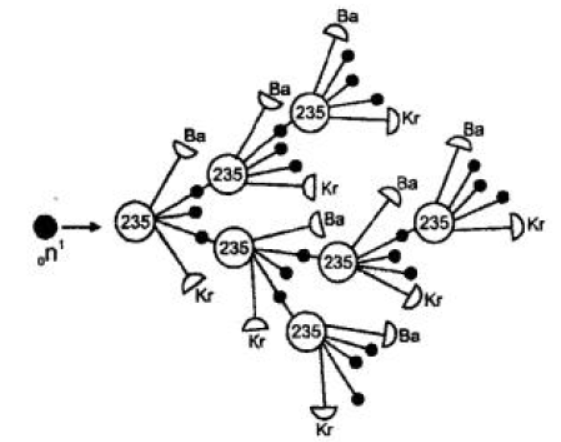
In simple words: A chain reaction is when one splitting atom releases neutrons that split other atoms nearby, keeping the process going. If it gets out of control, it causes a massive explosion.
Exam Tip: Mentioning the role of "neutrons" as the key carriers that propagate the reaction is essential to scoring full marks.
Question 16. The mass numbers of three elements A, B and C are 3, 180 and 235 respectively. Which one is suitable for making atomic bomb?
Answer:
Element C, which has a mass number of 235, is the most suitable for making an atomic bomb. Heavy nuclei like Uranium-235 are highly unstable and can easily undergo nuclear fission when bombarded with neutrons, releasing the tremendous energy needed for an explosion.
In simple words: Element C with a mass of 235 is suitable because heavy atoms split easily and release huge amounts of energy.
Exam Tip: Fission requires heavy nuclei (mass number > 200), whereas fusion requires very light nuclei (mass number < 20).
Question 17(a). Define nuclear fusion.
Answer:
Nuclear fusion is the process in which two or more lighter atomic nuclei (typically with an atomic weight less than 20) merge under extreme temperature and pressure to create a single heavier, more stable nucleus, releasing a massive amount of energy.
In simple words: Nuclear fusion is when small, light nuclei join together to make a larger nucleus, releasing energy.
Exam Tip: Always mention that fusion requires extremely high temperatures and pressures to overcome electrostatic repulsion.
Question 17(b). Which of the two, fission or fusion is a nuclear chain reaction?
Answer:
Nuclear fission is the process that operates as a self-sustaining chain reaction, because each fission event releases neutrons that can trigger subsequent fissions.
In simple words: Nuclear fission is the one that forms a chain reaction, because it releases neutrons that keep the reaction going.
Exam Tip: Fission depends on a neutron chain, while fusion is maintained by high temperature and pressure.
Question 18. Why can nuclear fusion and possible to generate electricity?
Answer:
It is extremely difficult to use nuclear fusion for power generation because initiating the reaction requires a temperature of about \( 10^7\text{ K} \) to \( 10^8\text{ K} \) to overcome the strong electrostatic repulsion between positive nuclei. Currently, we cannot safely contain and sustain such extreme temperatures in a controlled laboratory setting to generate electricity.
In simple words: Fusion needs temperatures as hot as the sun to start, and we don't have containers that can hold something that hot to produce electricity safely.
Exam Tip: Mentioning the challenge of containing high-temperature plasma is a key point that examiners look for.
Question 19. Give any two differences between nuclear fusion and nuclear fission.
Answer:
1. Nuclear fission involves a heavy nucleus splitting into smaller daughter nuclei, whereas nuclear fusion is the combination of light nuclei to form a heavier nucleus.
2. Nuclear fission can be controlled in reactors to produce electricity, while controlled nuclear fusion has not yet been achieved for power generation.
In simple words: Fission splits a heavy atom, while fusion joins light atoms. Fission is used in power plants today, but fusion cannot yet be controlled for electricity.
Exam Tip: Drawing a simple comparison table to show these differences clearly is an excellent presentation strategy.
Question 20. Write nuclear equations for the fusion of (a) 2 deuterium atoms (b) one hydrogen and one tritium atom.
Answer:
The nuclear equations are:
(a) Fusion of 2 deuterium atoms:
\( ^{2}_{1}\text{H} + \ ^{2}_{1}\text{H} \rightarrow \ ^{3}_{1}\text{H} + \ ^{1}_{1}\text{H} + 88.2 \times 10^9\text{ J} \)
(b) Fusion of one deuterium (hydrogen isotope) and one tritium atom:
\( ^{3}_{1}\text{H} + \ ^{2}_{1}\text{H} \rightarrow \ ^{4}_{2}\text{He} + \ ^{1}_{0}\text{n} + 16.96 \times 10^{11}\text{ J} \)
In simple words: These chemical formulas show how hydrogen isotopes fuse together to create helium or heavier hydrogen while releasing massive amounts of energy.
Exam Tip: Memorize these specific energy release values as they are frequently asked in ICSE examinations.
Page 7
Multiple Choice Questions
Question 1. The atoms of same element having same atomic number, but different atomic masses are called :
(a) isotopes
(b) isobars
(c) isotones
(d) both (a) and (b)
Answer: (a) isotopes
In simple words: Isotopes are atoms of the same element that have the identical number of protons but different numbers of neutrons, giving them different weights.
Exam Tip: Remember that "same element" always means they have the identical atomic number, which points directly to isotopes.
Question 2. When an element gives out high energy radiations on its own, the change which takes place is :
(a) physical change
(b) chemical change
(c) nuclear change
(d) none of the options
Answer: (c) nuclear change
In simple words: Radioactivity is a nuclear change because the emission of radiations happens inside the nucleus of the atom.
Exam Tip: Radioactivity is unaffected by chemical or physical conditions, indicating it is strictly a nuclear phenomenon.
Question 3. The atoms of different elements having same mass number, but different atomic numbers are called :
(a) isotopes
(b) isotones
(c) isobars
(d) none of the options
Answer: (c) isobars
In simple words: Isobars are different elements that weigh the exact same because they have the same total mass number.
Exam Tip: A helpful mnemonic is: Iso**bar**s have the same mass (weight is heavy, like a bar), while iso**top**es have the same atomic number (same place in the periodic table).
Question 4. The radiations given out by radioactive elements :
(a) affect photographic plates
(b) ionise the gases
(c) are affected by electrostatic and magnetic fields
(d) all of the options
Answer: (d) all of the options
In simple words: Radioactive emissions have several physical effects: they can expose photographic film, ionise air molecules, and bend inside electric or magnetic fields.
Exam Tip: Reading through all choices is crucial, as multiple correct properties often lead to an "all of the options" answer.
Question 5. A radioactive substances emits :
(a) simultaneously α, β and γ radiations
(b) α-radiations or β-radiations
(c) in the order of α, β and γ particles
(d) X-rays and γ -rays
Answer: (b) α-radiations or β-radiations
In simple words: A single decaying atom will only emit either an alpha or a beta particle at one time, never both at once.
Exam Tip: Gamma rays may accompany either alpha or beta emissions, but alpha and beta are never emitted together in a single decay step.
Question 6. During α-emission :
(a) the mass number and atomic number of an atom decrease by 2 a mu.
(b) the mass number decreases by 4 amu and atomic number decreases by 2 amu.
(c) the mass number remains unchanged, but atomic number decreases by 2 amu.
(d) the mass number decreases by 4 amu and atomic number remains unchanged.
Answer: (b) the mass number decreases by 4 amu and atomic number decreases by 2 amu.
In simple words: When an alpha particle leaves, the atom loses 4 units of mass and 2 units of charge.
Exam Tip: An alpha particle is physically a Helium nucleus (\( ^{4}_{2}\text{He} \)), which explains why the mass drops by 4 and charge drops by 2.
Question 7. During β-emmision :
(a) the mass number remains unchanged, but atomic number increases by 1 amu.
(b) the mass number remains unchanged, but atomic number decreases by 1 amu.
(c) the mass number increases by 1 amu, but atomic number remains same.
(d) the mass number and atomic number decrease by 1 amu.
Answer: (a) the mass number remains unchanged, but atomic number increases by 1 amu.
In simple words: During beta decay, the mass of the atom does not change, but its atomic number goes up by 1.
Exam Tip: Beta emission occurs when a neutron turns into a proton, which increases the positive charge of the nucleus without changing its total mass.
Question 8. During β-emission an electron is ejected from the atom of radioactive substance. The electron is ejected from the:
(a) the outermost orbit of atom
(b) the innermost orbit of atom
(c) the nucleus of the atom
(d) none of the options
Answer: (c) the nucleus of the atom
In simple words: The beta particle electron is created inside and ejected directly from the nucleus, not from the orbits outside the atom.
Exam Tip: Clarifying that beta particles originate from nuclear neutron decay rather than atomic orbits is a common trick tested in exams.
Question 9. Which of the following radiation is most ionising ?
(a) α-particles
(b) β-particles
(c) \(\gamma\)-radiation
(d) X-rays
Answer: (a) α-particles
In simple words: Alpha particles have the largest mass and charge, which makes them highly effective at knocking electrons off other atoms.
Exam Tip: Ionisation depends heavily on the charge and mass of the radiation, making the double-charged alpha particle the strongest ioniser.
Question 10. Which of the following radiation is most penetrating ?
(a) α-particles
(b) β-particles
(c) ϒ -radiation
(d) X-rays
Answer: (c) ϒ -radiation
In simple words: Gamma rays have no mass or charge, which allows them to pass deep through materials without being easily blocked.
Exam Tip: High penetration is associated with neutral electromagnetic waves of high frequency, like gamma rays.
Question 11. Which of the following radiation gets deflected most in electric or magnetic field ?
(a) α-particles
(b) β-particles
(c) ϒ -radiation
(d) X-rays
Answer: (b) β-particles
In simple words: Beta particles are very light electrons, so they are deflected much more easily by electric and magnetic fields than heavy alpha particles.
Exam Tip: Deflection is inversely proportional to mass. Since beta particles are roughly 7300 times lighter than alpha particles, they deflect much more sharply.
Page 9
Questions From ICSE Examination Papers
2003
Question 1. A small cube of lead is embedded in a big cube of aluminium metal It is placed in the path of a powerful radioactive emmision, such that on the opposite side of the cube is placed a fluorescent screen. It is observed that the shadow formed by aluminium metal is lighter than the lead metal. State one reason for the above phenomenon.
Answer:
Aluminium is a relatively light metal with a lower density, so it only blocks alpha and beta particles while allowing highly penetrating gamma-radiations to pass through and light up the screen. This makes its shadow appear lighter. Lead, being extremely dense, acts as an effective shield that absorbs all three types of radiation (alpha, beta, and gamma), leaving a completely dark shadow.
In simple words: Aluminium lets gamma rays pass through, making its shadow faint. Lead blocks all rays completely, creating a very dark shadow.
Exam Tip: Focus your explanation on the difference in density and absorbing power between aluminium and lead regarding gamma rays.
Question 2. (a) Explain why a paint, containing of zinc sulphide and a trace of radium salt, glows in the dark.
(b) An isotope of \( _{92}\text{U}^{238} \) decays into thorium (Th) by the emission to an alpha-particle. The nucleus of thorium then decay into Protactinium (Pa) by the emission of a beta paticle. Write two nuclear equations to illustrate the above changes.
Answer:
(a) Radium is radioactive and continuously emits alpha particles. These high-energy particles strike the zinc sulphide molecules, causing them to fluoresce and emit visible light, which makes the paint glow in the dark.
(b) The two nuclear equations are:
1. Alpha decay of Uranium-238 to Thorium-234:
\( _{92}^{238}\text{U} \xrightarrow{-\alpha} \ _{90}^{234}\text{Th} + \ _{2}^{4}\text{He} \)
2. Beta decay of Thorium-234 to Protactinium-234:
\( _{90}^{234}\text{Th} \xrightarrow{-\beta} \ _{91}^{234}\text{Pa} + \ _{-1}^{0}\text{e} \)
In simple words: (a) Radium shoots out radiation that hits zinc sulphide, making it glow. (b) The formulas show Uranium losing an alpha particle to become Thorium, which then loses a beta particle to become Protactinium.
Exam Tip: Ensure that elements like Protactinium (Pa) and Thorium (Th) are written with their correct atomic numbers (91 and 90) to match the decay equations.
Page 10
2004
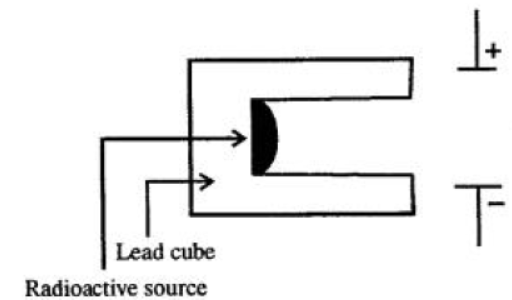
Question 3. (a) The diagram below shows a thick lead cube having a cavity in the middle. In the cavity is placed some radioactive substance. Copy the diagram and trace the paths of α particles,β particles and ϒ radiations as they pass through powerful electric field.
(b) Name the radiations which have the least penetrating power.
Answer:
(a)
(b) Alpha (\( \alpha \)) radiations have the least penetrating power because of their large mass and low velocity.
In simple words: (a) The diagram shows alpha bending slightly towards the negative plate, beta bending sharply towards the positive plate, and neutral gamma going straight. (b) Alpha is the easiest to stop because it is the heaviest.
Exam Tip: In the diagram, make sure the beta path curves more sharply than the alpha path, because beta particles are much lighter and deflect more.
Question 4. Copy and complete the following nuclear equations by filling in the correct values in the blanks
\( _{92}^{238}\text{X} \xrightarrow{-\alpha} \ _{......}^{......}\text{X}_1 \xrightarrow{-\beta} \ _{......}^{......}\text{X}_2 \xrightarrow{-\beta} \ _{......}^{......}\text{X}_3 \)
Answer:
The completed nuclear equation is:
\( _{92}^{238}\text{X} \xrightarrow{-\alpha} \ _{90}^{234}\text{X}_1 \xrightarrow{-\beta} \ _{91}^{234}\text{X}_2 \xrightarrow{-\beta} \ _{92}^{234}\text{X}_3 \)
Explanation:
1. An alpha emission decreases the mass number by 4 and the atomic number by 2. Thus, \( \text{X}_1 \) has a mass number of 234 and an atomic number of 90.
2. The first beta emission increases the atomic number by 1 while keeping the mass number constant. Thus, \( \text{X}_2 \) has an atomic number of 91 and a mass number of 234.
3. The second beta emission further increases the atomic number by 1, leaving the mass number at 234. Thus, \( \text{X}_3 \) has an atomic number of 92 and a mass number of 234.
In simple words: Alpha decay reduces mass by 4 and atomic number by 2. Each subsequent beta decay increases the atomic number by 1 without changing the mass.
Exam Tip: Remember that beta decay does not alter the mass number but increases the atomic number by one.
Page 11
2005
Question 5(a). How many alpha and beta particles are emitted when \( ^{235}_{92}\text{U} \) Uranium nucleus decays to Lead \( ^{206}_{82}\text{Pb} \) ?
Answer:
Assuming the decay is from Uranium-238 (\( ^{238}_{92}\text{U} \)) to Lead-206 (\( ^{206}_{82}\text{Pb} \)):
1. Let the number of alpha particles emitted be \( x \) and beta particles be \( y \).
The overall decay equation is:
\( ^{238}_{92}\text{U} \rightarrow \ ^{206}_{82}\text{Pb} + x(^{4}_{2}\text{He}) + y(^{0}_{-1}\text{e}) \)
2. Conserving mass number:
\( 238 = 206 + 4x + 0y \)
\( 32 = 4x \implies x = 8 \)
So, 8 alpha particles are emitted.
3. Conserving atomic number:
\( 92 = 82 + 2x - y \)
\( 92 = 82 + 2(8) - y \)
\( 92 = 98 - y \implies y = 6 \)
So, 6 beta particles are emitted.
Therefore, 8 alpha particles and 6 beta particles are emitted during this decay process.
In simple words: By comparing the change in mass, we find that 8 alpha particles are released. Then, balancing the atomic charge shows that 6 beta particles must also be emitted.
Exam Tip: Always use the mass number change first to find the number of alpha particles, then use that result to solve for beta particles.
Question 5(b). Mention two important precautions that should be taken while handling radioactive materials.
Answer:
1. Radioactive sources must be stored in thick lead containers surrounded by concrete walls to prevent harmful radiations from escaping.
2. Workers must use long-handled mechanical robotic arms or tongs to handle dangerous radioactive materials from a safe distance.
In simple words: Keep radioactive materials inside thick lead boxes, and always handle them with long robotic tools instead of your hands.
Exam Tip: Other acceptable answers include wearing lead aprons, film badges, and working in well-ventilated rooms.
Question 5(c). State one use of radioisotopes.
Answer:
Radioisotopes are widely used in agriculture to trace the absorption of fertilizers in various plants, helping researchers study plant metabolism and improve crop yields.
In simple words: They are used to track how plants absorb nutrients from fertilizers, which helps grow better food.
Exam Tip: You can also mention medical applications such as Cobalt-60 for cancer treatment or Carbon-14 for radiocarbon dating.
2006
Question 6. A certain radioactive nucleus emits a particle that leaves its mass unchanged but increases its atomic number by 1. Identify the the particle and write its symbols.
Answer:
The emitted particle is a beta particle (\( \beta^- \)). Its chemical symbol is \( _{-1}^{0}\text{e} \).
In simple words: It is a beta particle, which is a fast-moving electron ejected from the nucleus.
Exam Tip: Remember that the beta particle has a mass of 0 and a charge of -1, written as \( _{-1}^{0}\text{e} \).
Question 7. State three properties that are common to and shown by beta rays and cathode rays.
Answer:
1. Both beta rays and cathode rays consist of fast-moving electrons carrying a negative electrical charge.
2. Both are deflected by external electric and magnetic fields in the same direction.
3. Both cause fluorescence when they strike certain materials like zinc sulphide.
In simple words: Both are made of negatively charged electrons, both bend in magnetic or electric fields, and both make certain screens glow.
Exam Tip: Even though they are both electrons, remember their origin differs: beta rays come from the nucleus, while cathode rays originate from the electronic orbits.
Page 12
2007
Question 8. What will an alpha particle change into when it absorbs: (a) One electron ? (b) Two electrons?
Answer:
(a) If an alpha particle (\( ^{4}_{2}\text{He}^{2+} \)) absorbs one electron, it transforms into a singly ionised helium ion (\( \text{He}^+ \)).
(b) If it absorbs two electrons, it becomes a neutral, stable helium atom (\( \text{He} \)).
In simple words: (a) Absorbing one electron makes it a helium ion with a single positive charge. (b) Absorbing two electrons turns it into a normal, neutral helium atom.
Exam Tip: Be sure to specify 'singly ionised helium' for one electron and 'neutral helium atom' for two electrons to get full credit.
Question 9. (a) What happens to the atomic number of an element when it emits: 1. an alpha particle 2. a beta particle. (b) Explain why alpha and beta particles are deflected in an electric or a magnetic field but gamma rays are not deflected in such a field.
Answer:
(a)
1. When an alpha particle is released, the atomic number of the element drops by 2.
2. When a beta particle is released, the atomic number of the element rises by 1.
(b) Alpha and beta particles are electrically charged (alpha is positive and beta is negative), meaning they experience a Lorentz or electrostatic force that bends their path. Gamma rays carry no charge, so they pass through these fields without experiencing any deflecting force.
In simple words: (a) Emitting an alpha particle decreases the atomic number by 2, while beta increases it by 1. (b) Alpha and beta are charged, so they are pushed by electric fields, while neutral gamma rays are untouched.
Exam Tip: Always mention 'charge' as the fundamental reason why deflection occurs or does not occur.
2008
Question 10. (a) What is radioactivity ? (b) Mention any two differences between nuclear energy and chemcial energy.
Answer:
(a) Radioactivity is the spontaneous decay or disintegration of an unstable, heavy atomic nucleus accompanied by the emission of alpha, beta, and gamma radiations.
(b)
1. Nuclear energy is released from within the nucleus of an atom via protons and neutrons, whereas chemical energy is released from the rearrangment of outer-shell orbital electrons.
2. The energy released in nuclear reactions is exceptionally large (e.g., converting 1 kg of mass yields \( 9 \times 10^{16}\text{ J} \)), whereas chemical reactions release very small amounts of energy.
In simple words: (a) Radioactivity is when an unstable nucleus breaks apart on its own and shoots out rays. (b) Nuclear energy comes from the nucleus and is extremely powerful, while chemical energy only involves electrons and produces far less energy.
Exam Tip: Contrast the origin (nucleus vs. outer electrons) and the energy scale to provide a solid answer.
Page 13
Question 11(a). (1) When does the nucleus of an atom become radio active (2) How is the radioactivity of an element affected when it undergoes a chemical change to form a chemical compound ? (3) Name the product of nuclear fission which is utilized to bring about further fission of \( ^{235}_{92}\text{U} \)
Answer:
(1) A nucleus becomes radioactive if its neutron-to-proton ratio (n/p) exceeds 1.5, or when the electrostatic repulsive force between protons overcomes the attractive nuclear force (typically when the atomic number exceeds 82).
(2) Radioactivity is completely unaffected by any chemical changes, since it is a purely nuclear process that does not involve orbital electrons.
(3) Slow-moving neutrons are the fission products utilized to sustain and trigger further fission in Uranium-235.
In simple words: (1) A nucleus becomes radioactive when it has too many neutrons or protons, making it unstable. (2) Chemical reactions do not change radioactivity at all. (3) Slow neutrons are used to keep the fission process going.
Exam Tip: Emphasize that radioactivity is independent of physical and chemical conditions like temperature, pressure, or chemical bonding.
Question 11(b). (1) Mention one use and one harmful effect of radioactivity. (2) Give one source of background radiation.
Answer:
(1) Use: Cobalt-60 radiation is utilized in hospitals to treat cancer by destroying tumor cells.
Harmful Effect: Exposure to radiation can kill healthy living tissues and cause genetic mutations.
(2) One major source of background radiation is cosmic rays originating from outer space.
In simple words: (1) It is useful for killing cancer cells but harmful because it can damage healthy tissues. (2) Cosmic rays from space are a natural source of radiation around us.
Exam Tip: Ensure you clearly label the 'use' and the 'harmful effect' to make your response easy to grade.
2009
Question 12(a). Give two important precautions that should be taken while handling radioactive materials.
Answer:
1. Workers must wear special film badges that monitor their exposure to radiation over time.
2. Radioactive elements should always be stored in thick-walled lead containers with narrow openings to restrict radiation spread.
In simple words: People working with radiation must wear badge monitors, and radioactive materials should be locked inside lead boxes.
Exam Tip: This question is frequently repeated; memorizing at least three solid precautions is highly recommended.
Page 14
Question 12(b). (1) What is the name given to atoms of a substance which have the same atomic number but different mass numbers ? (2) What is the difference in the atomic structures of such atoms ?
Answer:
(1) These atoms are called isotopes.
(2) In terms of atomic structure, they differ solely in the number of neutrons present in their nucleus, while having the same number of protons and electrons.
In simple words: (1) They are called isotopes. (2) They have the exact same number of protons but a different number of neutrons inside.
Exam Tip: Mention both the similarity (protons/electrons) and the difference (neutrons) for a complete explanation.
Question 13. A nucleus \( ^{A}_{Z}\text{X} \) emits an alpha particle followed by ϒemission; thereafter it emits two β particles to form X3. (a) Copy and complete the values of A and Z for X3 : (b) • Out of alpha (α), beta (β ) and gamma (ϒ) radiations – • Which radiation is the most penetrating ? • Which radiations are negatively charged ?
Answer:
(a) The decay sequence is:
\( ^{A}_{Z}\text{X} \xrightarrow{-\alpha} \ ^{A-4}_{Z-2}\text{X}_1 \xrightarrow{-\gamma} \ ^{A-4}_{Z-2}\text{X}_2 \xrightarrow{-2\beta} \ ^{A-4}_{Z}\text{X}_3 \)
Therefore, \( \text{X}_3 \) has a mass number of \( A - 4 \) and an atomic number of \( Z \).
(b)
1. Gamma (\(\gamma\)) radiation is the most penetrating.
2. Beta (\(\beta\)) radiation is negatively charged.
In simple words: (a) Alpha decay reduces mass by 4 and atomic number by 2. Gamma does nothing to these numbers, and two beta decays increase the atomic number back to \( Z \). (b) Gamma is the most penetrating, and beta is negatively charged.
Exam Tip: Remember that gamma emission is just a release of energy; it does not change the mass or atomic number of the nuclide.
Page 15
2010
Question 14. (1) Name the radioactive radiations which have the least penetrating power. (2) Give one use of radioisotopes. (3) What is meant by background radiation ?
Answer:
(1) Alpha (\(\alpha\)) radiations have the lowest penetrating capability.
(2) Radioisotopes like Cobalt-60 are used in medicine to treat cancer by targeting and destroying cancerous tumors.
(3) Background radiation refers to the low-intensity radioactive emissions present everywhere in the environment, even in the absence of any visible radioactive source.
In simple words: (1) Alpha rays are the easiest to stop. (2) They can be used to treat cancer. (3) Background radiation is the natural radiation always around us from space and the earth.
Exam Tip: For background radiation, mentioning its natural sources (cosmic rays and rocks) helps secure maximum marks.
Question 15(a). Complete the following nuclear changes :
\( ^{24}_{11}\text{Na} \rightarrow \ \text{......Mg} + \ ^{0}_{-1}\text{e} \)
Answer:
The completed nuclear changes are:
1. \( ^{238}_{92}\text{U} \rightarrow \ ^{234}_{90}\text{Th} + \ ^{4}_{2}\text{He} + \text{Energy} \)
2. \( ^{24}_{11}\text{Na} \rightarrow \ ^{24}_{12}\text{Mg} + \ ^{0}_{-1}\text{e} \)
In simple words: These completed equations show Uranium undergoing alpha decay to become Thorium, and Sodium undergoing beta decay to become Magnesium.
Exam Tip: In beta decay, make sure the atomic number of the daughter element is increased by exactly one compared to the parent.
Question 15(b). (1) Which radiation produce maximum biological damage? (2)What happens to the atomic number of an element when the radiation named by you in part (i) above, are emitted.
Answer:
(1) Alpha (\(\alpha\)) radiation produces the greatest biological damage internally because it is highly ionising and heavy.
(2) When an alpha particle is emitted, the atomic number of the element decreases by 2.
In simple words: (1) Alpha radiation causes the most biological damage if it enters the body. (2) Emitting it lowers the atomic number of the atom by 2.
Exam Tip: While alpha has the lowest penetrating power externally, it causes the most biological harm if inhaled or ingested due to its high ionisation power.
Page 16
2011
Question 16(a). Fill in the blank with appropriate words During the emission of a beta particle, the Mass number remains the same.
Answer:
During the emission of a beta particle, the **mass** number remains the same.
In simple words: Beta decay does not change the total weight or mass number of the atom.
Exam Tip: Only the atomic number changes in beta decay, while the mass number is conserved.
Question 16(b). A mixture of radioactive substances gives off three types of radiations. 1. Name the radiation which travels with the speed of light. 2. Name the radiation which has the highest ionizing power. 3. When an alpha particle gains two electrons it becomes neutral and becomes an atom of an element which is a rare gas. Name of this rare gas ?
Answer:
1. Gamma (\(\gamma\)) rays travel at the speed of light (\( 3 \times 10^8\text{ m/s} \)).
2. Alpha (\(\alpha\)) particles have the highest ionising power.
3. The rare gas formed is Helium (He).
In simple words: 1. Gamma rays travel as fast as light. 2. Alpha particles ionise other atoms the most. 3. Adding two electrons to an alpha particle creates Helium.
Exam Tip: Helium is a noble (rare) gas with a stable electronic configuration of \( 1s^2 \).
Question 16(c). 1. Define radioactivity. 2.What happens inside a nucleus that causes emission of beta particle ? 3. Express the above change in the form of an equation.
Answer:
1. Radioactivity is the spontaneous self-disintegration of an unstable atomic nucleus, resulting in the emission of alpha, beta, and gamma rays.
2. A beta particle is emitted when an unstable neutron inside the nucleus converts into a proton and an electron. The newly formed proton remains in the nucleus, while the electron is ejected as a beta particle.
3. This nuclear transformation is represented as:
\( ^{1}_{0}\text{n} \rightarrow \ ^{1}_{1}\text{p} + \ ^{0}_{-1}\text{e} \)
In simple words: 1. Radioactivity is when an unstable nucleus breaks apart on its own. 2. It shoots out a beta particle when a neutron inside turns into a proton and an electron. 3. The equation is \( \text{neutron} \rightarrow \text{proton} + \text{electron} \).
Exam Tip: Remember that the emitted beta electron originates from the nucleus itself during neutron decay, not from the outer orbits.
Question 16(d). (1) The nucleus 202 84X emits an alpha particle and forms.The nucleus Y. Represent this change in the form of an equation. (2) What changes will take place in the mass number and atomic number of nucleus Y, if it emits gamma radiations ?
Answer:
(1) The nuclear equation for the alpha decay is:
\( ^{202}_{84}\text{X} \xrightarrow{-\alpha} \ ^{198}_{82}\text{Y} + \ ^{4}_{2}\text{He} \)
(2) If nucleus Y emits gamma radiation, there will be absolutely no change in either its mass number or its atomic number, as gamma emission only releases excess energy.
In simple words: (1) The formula shows X losing an alpha particle to become Y with a mass of 198 and atomic number of 82. (2) Gamma rays carry no mass or charge, so emitting them changes nothing.
Exam Tip: Always write the helium nucleus \( ^{4}_{2}\text{He} \) to represent the alpha particle in equations.
Page 17
2012
Question 17(a). (1) What is the value of the speed of gamma radiations in air or vacuum ? (2) Name any two important sources of background radiation.
Answer:
(1) The speed of gamma radiations in air or vacuum is \( 3 \times 10^8\text{ m/s} \).
(2) Two sources of background radiation are:
(a) Cosmic rays coming from space.
(b) Radioactive minerals (like Uranium, Radon, or Potassium-40) present in rocks and soil.
In simple words: (1) Gamma rays travel at the speed of light, which is 300,000 kilometers per second. (2) Natural radiation comes from cosmic rays in space and radioactive elements in the ground.
Exam Tip: Since gamma rays are electromagnetic waves, their speed is exactly the speed of light.
Question 17(b). A certain nucleus X has a mass number 14 and atomic number 6. The nucleus X changes to 7ϒ14 after the loss of a particle. 1. Name the particle emitted. 2. Represent this change in the form of an equation. 3. A radioactive substance is oxidized. What change would you expect to take place in the nature of its radioactivity? Give a reason for you answer.
Answer:
1. The particle emitted is a beta particle (\( \beta^- \double-check \)).
2. The decay equation is:
\( ^{14}_{6}\text{X} \rightarrow \ ^{14}_{7}\text{Y} + \ ^{0}_{-1}\text{e} \)
3. No change will occur in its radioactivity. Radioactivity is a nuclear phenomenon that occurs deep within the nucleus, whereas chemical processes like oxidation only involve outer orbital electrons and have no effect on nuclear stability.
In simple words: 1. It is a beta particle. 2. The formula shows X turning into Y. 3. Oxidation is a chemical reaction involving outer electrons, so it cannot change what happens inside the nucleus.
Exam Tip: A classic exam question: physical or chemical changes (like heating, freezing, or chemical reactions) never alter the rate of radioactive decay.
Page 18
2013
Question 18. (a) Which of the radioactive radiations – 1. can cause severe genetical disorders. 2. are deflected by an electric field ? (b) A radioactive nucleus undergoes a series of decays according to the sequence If the mass number and atomic number of X are 172 and 69 respectively, what is the mass number and atomic number of X ? (C) (1) What is meant by Radioactivity ? (2) What is meant by nuclear waste ? (3) Suggest one effective way for the safe disposal of nuclear waste.
Answer:
(a)
1. Gamma (\(\gamma\)) radiations can cause severe genetic disorders due to their deep penetration and high energy.
2. Both alpha (\(\alpha\)) and beta (\(\beta\)) radiations are deflected by an electric field.
(b)
Working backwards from \( \text{X}_3 \), which has a mass number of 172 and an atomic number of 69:
1. Since \( \text{X}_2 \xrightarrow{- \alpha} \ ^{172}_{69}\text{X}_3 \), we add 4 to the mass number and 2 to the atomic number:
\( \text{X}_2 = \ ^{176}_{71}\text{X}_2 \)
2. Since \( \text{X}_1 \xrightarrow{- \alpha} \ ^{176}_{71}\text{X}_2 \), we again add 4 to the mass number and 2 to the atomic number:
\( \text{X}_1 = \ ^{180}_{73}\text{X}_1 \)
3. Since \( \text{X} \xrightarrow{- \beta} \ ^{180}_{73}\text{X}_1 \), the mass number remains unchanged, but we subtract 1 from the atomic number:
\( \text{X} = \ ^{180}_{72}\text{X} \)
Therefore, the mass number of X is 180 and its atomic number is 72.
(C)
1. Radioactivity is the spontaneous decay of unstable atomic nuclei, accompanied by the emission of ionizing radiations.
2. Nuclear waste refers to the radioactive byproduct materials left over after generating nuclear energy in power reactors.
3. One safe disposal method is sealing the nuclear waste in thick lead-lined stainless steel containers and burying them in deep underground geological repositories far from human populations.
In simple words: (a) Gamma causes genetic damage, while alpha and beta are deflected by electric fields. (b) Working backwards from the final element, we find that X must have a mass of 180 and an atomic number of 72. (c) Nuclear waste is dangerous leftover material from reactors, which must be buried deep underground in sealed lead containers.
Exam Tip: When solving decay sequences backwards, remember that the reverse of alpha decay adds 4 to mass and 2 to atomic number, while the reverse of beta decay subtracts 1 from atomic number.
2014
Question 19. A nucleus 11Na24 emits a beta particle to change into Magnesium (Mg) 1. Write the symbolic equation of the process. 2. What are numbers 24 and 11 called? 3. What is the general name of 24 11Mg with respect to n Na ?
Answer:
1. The symbolic equation is:
\( ^{24}_{11}\text{Na} \rightarrow \ ^{24}_{12}\text{Mg} + \ ^{0}_{-1}\text{e} \)
2. The number 24 is the mass number, and 11 is the atomic number.
3. They are called isobars, as they share the same mass number (24) but have different atomic numbers (11 and 12).
In simple words: 1. The equation shows Sodium decay. 2. 24 is mass and 11 is atomic number. 3. They are isobars because they have the same total mass but different atomic charges.
Exam Tip: Isobars have the same nucleon count (mass number) but different chemical properties because they are different elements.
Page 19
2015
Question 20(a) .
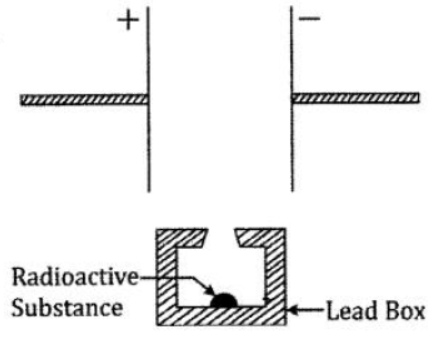
1. Complete the diagram as given below by drawing the deflection of radioactive radiations in an electric filed. 2. State any two precautions to be taken while handling radio – active substances.
Answer:
1.
2. Two safety precautions for handling radioactive materials:
(a) Radioactive elements must be kept in thick-walled lead containers with a very narrow opening to prevent stray radiations.
(b) Personnel must handle dangerous sources using long mechanical tongs and wear lead-lined protective gear like aprons and gloves.
In simple words: 1. The diagram shows beta bending towards the positive plate and alpha bending towards the negative plate, while gamma travels straight. 2. Use thick lead boxes to store them and handle them only with long tongs.
Exam Tip: In exams, always draw the beta radiation with a more pronounced curvature than the alpha path, since beta is much lighter.
Page 20
Question 20(b). An atomic nucleus A is composed of 84 protons and 128 neutrons. 1. The nucleus A emits an alpha particle and is transformed into nucleus B. What is the composition of nucleus B? 2. The nucleus B emits a beta particle and is transformed into nucleus C. What is the composition of nucleus C? 3. Does the composition of nucleus C change if it emits gamma radiations?
Answer:
For nucleus A: atomic number \( Z = 84 \), mass number \( A = 84 + 128 = 212 \).
1. When nucleus A emits an alpha particle (\( ^{4}_{2}\text{He} \)):
- Protons decrease by 2: \( 84 - 2 = 82 \) protons.
- Neutrons decrease by 2: \( 128 - 2 = 126 \) neutrons.
- The composition of nucleus B is 82 protons and 126 neutrons (mass number = 208).
2. When nucleus B emits a beta particle (\( ^{0}_{-1}\text{e} \)):
- A neutron inside converts into a proton.
- Protons increase by 1: \( 82 + 1 = 83 \) protons.
- Neutrons decrease by 1: \( 126 - 1 = 125 \) neutrons.
- The composition of nucleus C is 83 protons and 125 neutrons (mass number = 208).
3. No, the composition of nucleus C does not change if it emits gamma radiations, as gamma emission only releases excess energy from the nucleus.
In simple words: 1. Emitting an alpha particle removes 2 protons and 2 neutrons, leaving B with 82 protons and 126 neutrons. 2. Emitting a beta particle turns one neutron into a proton, leaving C with 83 protons and 125 neutrons. 3. Gamma rays have no mass or charge, so emitting them changes nothing.
Exam Tip: Remember that alpha decay reduces both proton and neutron counts by 2, whereas beta decay increases the proton count by 1 and decreases the neutron count by 1.
Page 21
Question 21. (a) An element zSA decays to SSR222 after emitting 2 alpha particles and 1 beta particle. Find the atomic number and atomic mass of the element S. (b) A radioactive substance is oxidized. Will there be any change in the nature its radioactivity? Give a reason for your answer.
Answer:
(a) Let us write the decay sequence backwards starting from \( _{85}^{222}\text{R} \):
\( _{Z}^{A}\text{S} \xrightarrow{-2\alpha} \ _{Z-4}^{A-8}\text{X} \xrightarrow{-\beta} \ _{Z-3}^{A-8}\text{R} \)
Comparing this with the final product \( _{85}^{222}\text{R} \):
- For mass number: \( A - 8 = 222 \implies A = 230 \)
- For atomic number: \( Z - 3 = 85 \implies Z = 88 \)
Therefore, S has an atomic number of 88 and a mass number of 230.
(b) No, there will be no change in its radioactivity. Radioactivity is a nuclear phenomenon that is entirely independent of any chemical processes (like oxidation) or physical changes, which only affect the outer-shell orbital electrons.
In simple words: (a) Two alpha decays lower the mass by 8 and atomic number by 4, and one beta decay raises the atomic number by 1. Working backwards, S must have atomic number 88 and mass number 230. (b) Chemical changes like oxidation only involve electrons and cannot alter nuclear radioactivity.
Exam Tip: Be careful to apply the decay laws correctly when summing up the total change over multiple emissions.
Question 22. (a) Arrange α,β, and γ rays in ascending order with respect to their 1. Penetrating power. 2. Ionising power. 3. Biological effect. (b) (1) Represent the change in the nucleus of a radioactive element when α β particle is emitted. (2) What is the name given to elements with same mass number and different atomic number. (3) Under which conditions does the nucleus of an atom tend to radioactive ?
Answer:
(a)
1. Penetrating power: \(\alpha < \beta < \gamma\)
2. Ionising power: \(\gamma < \beta < \alpha\)
3. Biological effect: \(\alpha < \beta < \gamma\)
(b)
1. In an unstable nucleus, a neutron converts into a proton by emitting a beta particle. This is represented as:
\( ^{1}_{0}\text{n} \rightarrow \ ^{1}_{1}\text{p} + \ ^{0}_{-1}\text{e} \)
2. Elements with the same mass number but different atomic numbers are called **isobars**.
3. The nucleus of an atom tends to be radioactive when its atomic number exceeds 82, or when there is an imbalance between protons and neutrons inside the nucleus.
In simple words: (a) Gamma has the highest penetration and biological damage, while alpha has the highest ionising power. (b) Beta decay turns a neutron into a proton and shoots out an electron. Elements with the same mass but different charges are isobars, and nuclei become radioactive when they are too large or unstable.
Exam Tip: Pay close attention to whether the question asks for 'ascending' (smallest to largest) or 'descending' order to avoid simple mistakes.
Page 22
Additional Questions
Question 1. Define nucleons, nuclide, neutrino, antineutrino.
Answer:
1. Nucleons: The protons and neutrons that reside inside the nucleus of an atom are collectively referred to as nucleons.
2. Nuclide: A specific type of atom characterized by its atomic number (Z) and mass number (A), represented as \( _{Z}^{A}\text{X} \).
3. Neutrino: A neutral subatomic particle with an extremely small mass emitted during certain radioactive decays.
4. Antineutrino: The antiparticle of the neutrino, also carrying no charge and negligible mass, released during beta decay along with a beta particle.
In simple words: Nucleons are protons and neutrons inside the core. A nuclide is a specific atomic symbol. Neutrinos and antineutrinos are tiny, neutral particles released during decay.
Exam Tip: Remember that the antineutrino is specifically emitted during beta-minus decay to conserve momentum and energy.
Question 2. What are isotopes ? Give one example.
Answer:
Isotopes are atoms of the same chemical element that have the identical atomic number but differ in their mass numbers due to a different count of neutrons.
Example: Hydrogen has three isotopes: Protium (\( ^{1}_{1}\text{H} \ )), Deuterium (\( ^{2}_{1}\text{H} \ )), and Tritium (\( ^{3}_{1}\text{H} \ )).
In simple words: Isotopes are atoms of the same element that weigh different amounts because they have different numbers of neutrons. Hydrogen, deuterium, and tritium are examples.
Exam Tip: Isotopes share identical chemical properties because they have the same electron configuration.
Question 3. What are isobars ? Give one example.
Answer:
Isobars are atoms of different chemical elements that have the same mass number but different atomic numbers.
Example: Sodium (\( ^{23}_{11}\text{Na} \)) and Magnesium (\( ^{23}_{12}\text{Mg} \)) are isobars.
In simple words: Isobars are different elements that weigh the exact same because they have the same total number of nucleons.
Exam Tip: Unlike isotopes, isobars have different chemical properties because they belong to different elements.
Question 4. What is radio-activity ? Name two radioactive substances.
Answer:
Radioactivity is the spontaneous emission of invisible, highly penetrating radiations from the unstable nuclei of certain heavy substances.
Two examples of radioactive substances are Uranium and Radium.
In simple words: Radioactivity is when unstable atoms shoot out invisible rays on their own. Uranium and radium are two examples.
Exam Tip: Always state that radioactivity is a spontaneous and self-induced nuclear process.
Page 23
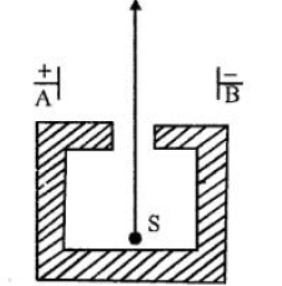
Question 5. Fig. shows a radioactive source S in a thick lead container. The radiations pass through an electric field between the plates A and B. Complete the diagram to show the paths of α, β and γ radiations
Answer:
In simple words: The diagram shows beta particles curving towards the positive plate A, alpha particles curving towards the negative plate B, and gamma rays traveling straight.
Exam Tip: In this drawing, ensure that beta is shown with a much sharper turn than alpha.
Question 6. State the penetrating range of α, β and γ radiations.
Answer:
The distance that these three types of nuclear emissions can travel through matter is given as follows:
1. Alpha (\(\alpha\)) particles have a very limited travel distance, extending only between 2.7 cm and 8.62 cm in standard air.
2. Beta (\(\beta\)) particles can travel further but are stopped by a thin barrier, such as 5 mm of aluminium or 1 mm of lead.
3. Gamma (\(\gamma\)) radiations can penetrate deeply and require a thick, heavy shield of about 30 cm of iron to be absorbed.
In simple words: Alpha rays are stopped after a few centimetres in air. Beta rays travel further but can be blocked by thin metal, while gamma rays are extremely difficult to stop and need thick iron to be blocked.
Exam Tip: Be sure to write the distinct ranges and the specific materials needed to block each type of radiation to get full credit.
Question 7. A radioactive source emits three types of radiations. Name them.
1. Name the radiations which are charged.
2. Name the radiations which are most penetrating.
3. Name the radiations which travel with the speed of light.
Answer:
The three distinct types of emissions from a radioactive source are alpha (\(\alpha\)), beta (\(\beta\)), and gamma (\(\gamma\)) radiations.
1. The charged emissions are the positive alpha (\(\alpha\)) particles and the negative beta (\(\beta\)) particles.
2. Gamma (\(\gamma\)) rays possess the highest penetrating capability.
3. Gamma (\(\gamma\)) rays are electromagnetic waves and travel at the speed of light.
In simple words: Radioactive materials release alpha, beta, and gamma rays. Alpha and beta carry electrical charges, while gamma is a high-energy wave that travels at light speed and penetrates deepest.
Exam Tip: Remember that gamma rays do not carry any electric charge, which explains why they are neutral and have the highest penetrating power.
Question 8. How do infrared and y-rays differ in their : (1) wavelength (2) penetrating power ?
Answer:
(1) Wavelength: Even though both are electromagnetic waves, gamma (\(\gamma\)) rays have an incredibly short wavelength of around \( 10^{-13}\text{ m} \), whereas infrared waves have much longer wavelengths of about \( 10^{-6}\text{ m} \) or more.
(2) Penetrating Power: Gamma (\(\gamma\)) rays possess exceptionally high penetrating power, while infrared waves have almost no penetrating power and are absorbed by thin materials.
In simple words: Gamma rays have tiny wavelengths and can pass through solid walls, whereas infrared rays have much larger wavelengths and are easily stopped by surfaces.
Exam Tip: In electromagnetic spectrum comparisons, remember that shorter wavelengths correlate with higher energy and greater penetrating power.
Question 9. State two similarities and two dissimilarities between the y-rays and X-rays.
Answer:
Similarities:
1. Both gamma (\(\gamma\)) rays and X-rays are electromagnetic waves.
2. Both travel at the speed of light, which is \( 3 \times 10^8\text{ m/s} \) in a vacuum.
Dissimilarities:
1. Gamma (\(\gamma\)) rays have shorter wavelengths than X-rays.
2. Gamma (\(\gamma\)) rays have a greater penetrating capability than X-rays.
In simple words: Gamma rays and X-rays are both light-like waves that travel at the exact same speed. However, gamma rays have shorter wavelengths and can penetrate deeper than X-rays.
Exam Tip: Highlighting their origin (gamma rays come from the nucleus, while X-rays come from atomic electron transitions) is an excellent way to show deeper understanding.
Question 10. Is it possible to detect γ radiation in the way that a and β-particles can be deflected using the electric or magnetic field? Give reasons.
Answer:
No, it is not possible to detect gamma (\(\gamma\)) radiation through deflection in electric or magnetic fields. This is because gamma rays are neutral electromagnetic waves that do not carry any electric charge, and thus experience no deflecting force in these fields.
In simple words: Gamma rays cannot be bent using magnets or electrical plates because they do not have any electrical charge.
Exam Tip: State clearly that only charged particles (like alpha and beta) experience force in electric or magnetic fields, while neutral waves pass straight through.
Question 11. State the penetrating range of α, β and γ radiations.
Answer:
The distance that these three types of nuclear emissions can travel through matter is given as follows:
1. Alpha (\(\alpha\)) particles have a very limited travel distance, extending only between 2.7 cm and 8.62 cm in standard air.
2. Beta (\(\beta\)) particles can travel further but are stopped by a thin barrier, such as 5 mm of aluminium or 1 mm of lead.
3. Gamma (\(\gamma\)) radiations can penetrate deeply and require a thick, heavy shield of about 30 cm of iron to be absorbed.
In simple words: Alpha rays only travel a tiny distance in air. Beta rays can go further but are blocked by thin metal, while gamma rays can go through almost anything and need thick iron to be stopped.
Exam Tip: Use a simple bulleted list to clearly outline the ranges for each radiation type.
Question 12. A mixture of radioactive substance gives off three types of radiations.
1. Name the three types of radiations.
2. Name the type consisting of the same kind of particles as the beam of electrons.
3. One of the radiations is similar to light. Name the radiation.
4. Name the radiations which have the lowest ionising power.
5. Name the radiations which have the lowest penetrating power.
6. Give the charge and mass of particles composing the radiations in (V).
7. Explain why radiations in (V) have the lowest penetrating power.
8. When the particle referred to in (V) becomes neutral, they are found to be the atoms of a rare gas. Name this rare gas and draw a model of its neutral atom.
9. From which part of the atom do these radiations come ?
Answer:
1. The three types of radiations are alpha (\(\alpha\)), beta (\(\beta\)), and gamma (\(\gamma\)) rays.
2. Beta (\(\beta\)) radiation consists of fast-moving electrons, which are the same as an electron beam.
3. Gamma (\(\gamma\)) radiation is an electromagnetic wave similar to light.
4. Gamma (\(\gamma\)) radiation has the lowest ionising power.
5. Alpha (\(\alpha\)) radiation has the lowest penetrating power.
6. The particles composing alpha radiation have a positive charge of \( +2e \) (twice the charge of a proton) and a mass of 4 u (four times the mass of a proton).
7. Alpha particles have the lowest penetrating power because they are highly massive and carry a double positive charge, which causes them to interact strongly and frequently with surrounding atoms, losing their energy quickly.
8. The rare gas formed is Helium (He). The model of its neutral atom is shown below:
9. All these radiations originate from the nucleus of the atom.
In simple words: This question covers the main features of radioactive rays. Alpha has the most mass and lowest penetration, turning into a neutral Helium atom once it gains two electrons. All these rays are shot directly out of the atomic nucleus.
Exam Tip: Remember that the nucleus of a helium atom is identical to an alpha particle, meaning it has 2 protons and 2 neutrons.
Question 13. A radioactive substance emits radiations :
(a) α, β and γ simultaneously .
(b) in the order α, β and γ one by one
(c) at one time α and β and then γ
(d) α and γ or β and γ
Answer: (d) α and γ or β and γ
In simple words: An unstable nucleus can emit either an alpha particle accompanied by gamma rays, or a beta particle accompanied by gamma rays, but never alpha and beta particles at the same time.
Exam Tip: Gamma radiation is simply a release of excess nuclear energy and can occur alongside either particle emission.
Question 14. A radioactive sample is kept at the center of a large evacuated sphere. How safe will it be ?
Answer:
Placing the sample inside an evacuated sphere provides limited safety:
1. Alpha (\(\alpha\)) particles are easily blocked by the walls of the sphere since they have very low penetrating power.
2. Beta (\(\beta\)) particles will travel freely through the vacuum inside the sphere without any air resistance or absorption, but they might be partially stopped depending on the thickness and material of the outer walls.
3. Gamma (\(\gamma\)) rays are highly penetrating and are not absorbed by thin walls or vacuum.
Therefore, to ensure safety, the containment vessel must have thick lead walls to absorb both beta and gamma radiations, and the presence of air inside the container helps absorb beta radiation.
In simple words: A simple hollow sphere with no air inside won't keep you safe. While it stops alpha rays, beta and gamma rays can pass right through unless the walls are made of thick, heavy lead.
Exam Tip: Focus on explaining how vacuum removes air absorption for beta particles and that gamma rays require heavy shielding like lead.
Question 15. Which of the radiations α, β and γ is similar to a beam of electrons?
Answer:
Beta (\(\beta\)) radiation consists of high-energy, fast-moving electrons, making it identical in nature to a beam of electrons.
In simple words: Beta radiation is made of fast-moving electrons, which is the same as an electron beam.
Exam Tip: Note that beta particles originate from the nucleus, while cathode rays or electron beams originate from the atomic orbits.
Question 16. Give the relative ionising power of α, β and γ radiations.
Answer:
The relative ionising powers of alpha, beta, and gamma radiations are in the ratio of \( 10^4 : 10^2 : 1 \). This means alpha particles ionise surrounding gases about 100 times more than beta particles and 10,000 times more than gamma radiations.
In simple words: Alpha particles are the most powerful at ionising gases, followed by beta, with gamma rays being the weakest.
Exam Tip: Memorize the ratio \( 10^4 : 10^2 : 1 \) to write a precise, full-mark answer.
Question 17. A mass of lead is embedded in a block of wood. Radiations from a radioactive source incident on the side of block produce a shadow on a fluorescent screen placed beyond the block. The shadow of wood is faint but the shadow of lead is dark. Give reason for this difference.
Answer:
Wood is a light material with low density that only absorbs the low-penetrating alpha particles. It allows beta and gamma radiations to pass through, creating a faint shadow on the screen. Lead, however, has a very high density and atomic number, enabling it to absorb all three types of radiation (alpha, beta, and gamma). This complete blockage leaves a dark, well-defined shadow.
In simple words: Wood is light and lets most of the radiation pass through, creating only a faint shadow. Lead is extremely heavy and blocks all the rays, casting a dark, clear shadow.
Exam Tip: Explain that the contrast in shadow density on a fluorescent screen is due to differences in density and absorption of beta and gamma radiations.
Question 18. What is meant by nuclear energy ?
Answer:
Nuclear energy is the immense energy bound within the nucleus of an atom. It is released during nuclear reactions (such as fission or fusion) due to a phenomenon called mass defect, where a small amount of mass is converted directly into energy.
In simple words: Nuclear energy is the powerful energy released from the core of an atom when its mass is converted into energy during reactions.
Exam Tip: Always mention "mass defect" and nuclear processes (fission/fusion) to explain where this energy comes from.
Question 19. What is Einstein’s mass-energy relation ?
Answer:
Einstein's mass-energy relation is expressed as:
\( E = mc^2 \)
Where:
- \( E \) is the energy produced,
- \( m \) is the mass converted,
- \( c \) is the speed of light in vacuum (\( 3 \times 10^8\text{ m/s} \)).
In simple words: Einstein's equation shows that mass and energy are two forms of the same thing and can be converted into each other.
Exam Tip: Define each variable clearly after writing the formula to get full credit.
Question 20. Calculate the energy released when a mass of 1 kg is completely converted into energy.
Answer:
Using Einstein's mass-energy equivalence:
\( E = mc^2 \)
Given:
- Mass, \( m = 1\text{ kg} \)
- Speed of light, \( c = 3 \times 10^8\text{ m/s} \)
Substituting these values:
\( E = 1\text{ kg} \times (3 \times 10^8\text{ m/s})^2 \)
\( E = 1 \times 9 \times 10^{16}\text{ J} \)
\( E = 9 \times 10^{16}\text{ J} \)
Thus, the energy released is \( 9 \times 10^{16}\text{ J} \).
In simple words: If you could convert a 1 kilogram object entirely into pure energy, it would release a massive \( 9 \times 10^{16} \) Joules of energy.
Exam Tip: Be sure to include the correct unit (Joules, abbreviated as J) in your final calculation.
Question 21. State the unit in which the mass of nuclear particles is expressed. How is it related to kg ?
Answer:
The mass of atomic and subatomic particles is measured in the unified atomic mass unit, denoted by the symbol \( \text{u} \).
The relationship to kilograms is:
\( 1\text{ u} = 1.6605 \times 10^{-27}\text{ kg} \)
Additionally, \( 1\text{ u} \) of mass is equivalent to \( 931\text{ MeV} \) of energy.
In simple words: Subatomic particles are so tiny that we use a special unit called the unified atomic mass unit (\( \text{u} \)) to weigh them. One unit is equal to an extremely small fraction of a kilogram.
Exam Tip: Know both the relation in kg (\( 1.66 \times 10^{-27}\text{ kg} \)) and in energy (\( 931\text{ MeV} \)) for complete answers.
Question 22. Calculate the energy released in the following fission reaction:
\( ^{235}_{92}\text{U} + \ ^{1}_{0}\text{n} \rightarrow \ ^{141}_{56}\text{Ba} + \ ^{92}_{36}\text{Kr} + 3\ ^{1}_{0}\text{n} \)
Given: \( m(^{235}_{92}\text{U}) = 235.0439\text{ u} \), \( m(^{1}_{0}\text{n}) = 1.0087\text{ u} \), \( m(^{141}_{56}\text{Ba}) = 140.9139\text{ u} \), \( m(^{92}_{36}\text{Kr}) = 91.8973\text{ u} \).
Answer:
To find the energy released, we calculate the mass defect (\( \Delta m \)):
\( \Delta m = \left[ m(^{235}_{92}\text{U}) + m(^{1}_{0}\text{n}) \right] - \left[ m(^{141}_{56}\text{Ba}) + m(^{92}_{36}\text{Kr}) + 3 \times m(^{1}_{0}\text{n}) \right] \)
Substituting the given mass values:
\( \Delta m = \left[ 235.0439 + 1.0087 \right] - \left[ 140.9139 + 91.8973 + 3 \times 1.0087 \right] \)
\( \Delta m = 236.0526 - 235.8373 \)
\( \Delta m = 0.2153\text{ u} \)
Since \( 1\text{ u} = 931\text{ MeV} \), the energy released is:
\( E = 0.2153 \times 931\text{ MeV} = 200.44\text{ MeV} \)
Thus, the energy released in this reaction is \( 200.44\text{ MeV} \).
In simple words: We subtract the total weight of the products from the total starting weight of the reactants to find the missing mass (mass defect), which is 0.2153 u. Multiplying this by 931 tells us that 200.44 MeV of energy is released.
Exam Tip: Make sure to account for all 3 neutrons on the product side of your mass balance equation.
Question 23. Uranium nucleus 23592U decays to lead nucleus 20682 Pb .How many alpha and beta particles are emitted ?
Answer:
Assuming the decay is from Uranium-238 (\( ^{238}_{92}\text{U} \)) to Lead-206 (\( ^{206}_{82}\text{Pb} \)):
1. Let the number of alpha particles emitted be \( x \) and beta particles be \( y \).
The decay is represented as:
\( ^{238}_{92}\text{U} \rightarrow \ ^{206}_{82}\text{Pb} + x(^{4}_{2}\text{He}) + y(^{0}_{-1}\text{e}) \)
2. Comparing mass numbers:
\( 238 = 206 + 4x \implies 4x = 32 \implies x = 8 \) alpha particles.
3. Comparing atomic numbers:
\( 92 = 82 + 2x - y \)
\( 92 = 82 + 2(8) - y \implies y = 82 + 16 - 92 = 6 \) beta particles.
Therefore, 8 alpha particles and 6 beta particles are emitted in this process.
In simple words: The change in mass shows that 8 alpha particles must be released. Balancing the remaining change in atomic number reveals that 6 beta particles are also emitted.
Exam Tip: Solve for the number of alpha particles first using the mass numbers, as beta particles do not affect the total mass.
Question 24. If the loss in mass in fission of a uranium nucleus is 205 u, find the energy released. Take lu = 931 MeV.
Answer:
The energy released from a mass defect is given by:
\( E = \Delta m \times 931\text{ MeV} \)
Given the mass loss (\( \Delta m \)) is \( 0.205\text{ u} \):
\( E = 0.205 \times 931\text{ MeV} \)
\( E = 190.86\text{ MeV} \)
Thus, the energy released is \( 190.86\text{ MeV} \).
In simple words: Multiplying the mass defect of 0.205 u by 931 gives us the total energy released, which is 190.86 MeV.
Exam Tip: Ensure that you always use the exact mass loss value from the calculation (0.205 u) to solve this problem correctly.
Question 25. What is nuclear fission ?
Answer:
Nuclear fission is the nuclear process in which an unstable, heavy nucleus (such as Uranium-235) is split into two lighter nuclei of roughly equal size upon bombardment with a slow-moving neutron, releasing a massive amount of energy and extra neutrons.
In simple words: Nuclear fission is when a large, heavy atom is hit by a slow neutron and breaks apart into smaller, lighter atoms, releasing huge amounts of energy.
Exam Tip: Be sure to mention both the bombarding agent (slow neutron) and the high energy release to provide a complete definition.
Question 26. What is nuclear fusion ?
Answer:
Nuclear fusion is the nuclear process in which two or more lighter atomic nuclei combine to form a single heavier, more stable nucleus. This reaction occurs under extreme temperatures and pressures and releases an enormous amount of energy.
Example equation:
\( ^{2}_{1}\text{H} + \ ^{3}_{1}\text{H} \rightarrow \ ^{4}_{2}\text{He} + \ ^{1}_{0}\text{n} + \text{Energy} \)
In simple words: Nuclear fusion is the opposite of fission; it is when light, small atoms join together at very high temperatures to create a larger atom, releasing massive amounts of energy.
Exam Tip: Note that nuclear fusion is the source of energy for the sun and other stars.
Free study material for Physics
ICSE Goyal Brothers Solutions Class 10 Physics Chapter 11 Nuclear Physics
Students can now access the detailed Goyal Brothers Solutions for Chapter 11 Nuclear Physics on our portal. These solutions have been carefully prepared as per latest ICSE Class 10 syllabus. Each solution given above has been updated based on the current year pattern to ensure Class 10 students have the most updated Physics content.
Master Goyal Brothers Textbook Questions
Our subject experts have provided detailed explanations for all the questions found in the Goyal Brothers textbook for Class 10 Physics. We have focussed on making the concepts easy for you in Chapter 11 Nuclear Physics so that students can understand the concepts behind every answer. For all numerical problems and theoretical concepts these solutions will help in strengthening your analytical skill required for the ICSE examinations.
Complete Physics Exam Preparation
By using these Goyal Brothers Class 10 solutions, you can enhance your learning and identify areas that need more attention. We recommend solving the Physics Questions from the textbook first and then use our teacher-verified answers. For a proper revision of Chapter 11 Nuclear Physics, students should also also check our Revision Notes and Sample Papers available on studiestoday.com.
FAQs
You can download the verified Goyal Brothers solutions for Chapter 11 Nuclear Physics on StudiesToday.com. Our teachers have prepared answers for Class 10 Physics as per 2026-27 ICSE academic session.
Yes, our solutions for Chapter 11 Nuclear Physics are designed as per new 2026 ICSE standards. 40% competency-based questions required for Class 10, are included to help students understand application-based logic behind every Physics answer.
Yes, every exercise in Chapter 11 Nuclear Physics from the Goyal Brothers textbook has been solved step-by-step. Class 10 students will learn Physics conceots before their ICSE exams.
Yes, follow structured format of these Goyal Brothers solutions for Chapter 11 Nuclear Physics to get full 20% internal assessment marks and use Class 10 Physics projects and viva preparation as per ICSE 2026 guidelines.