

ICSE Solutions Goyal Brothers Class 10 Physics Chapter 2 Work Power And Energy have been provided below and is also available in Pdf for free download. The Goyal Brothers ICSE solutions for Class 10 Physics have been prepared as per the latest syllabus and ICSE books and examination pattern suggested in Class 10. Questions given in ICSE Goyal Brothers book for Class 10 Physics are an important part of exams for Class 10 Physics and if answered properly can help you to get higher marks. Refer to more Chapter-wise answers for ICSE Class 10 Physics and also download more latest study material for all subjects. Chapter 2 Work Power And Energy is an important topic in Class 10, please refer to answers provided below to help you score better in exams
Goyal Brothers Chapter 2 Work Power And Energy Class 10 Physics ICSE Solutions
Class 10 Physics students should refer to the following ICSE questions with answers for Chapter 2 Work Power And Energy in Class 10. These ICSE Solutions with answers for Class 10 Physics will come in exams and help you to score good marks
Chapter 2 Work Power And Energy Goyal Brothers ICSE Solutions Class 10 Physics
Work, Power And Energy
Question 1. (a) Define work.
(b) What are the conditions for doing work?
(c) State the mathematical expression for work.
Answer:
(a) Work is defined as the process where an applied force succeeds in moving a body through a certain distance along the line of action of that force. Alternatively, work occurs when a force, or any of its vector components, produces a displacement in the direction in which it acts.
(b) The two essential requirements for work to be performed are:
(1) A force must act on the object.
(2) The object must undergo a displacement.
(c) Mathematically, work is expressed as the product of the force and the displacement in its direction:
\( W = F \times S \)
In simple words: Work is done when you push or pull something and it actually moves in that direction. If there is no movement, or if you do not apply any push or pull, then no work is done.
Exam Tip: Remember that both force and displacement are necessary for work. If either is zero, or if they are perpendicular to each other, the work done is zero.
Question 2. In which case work is done and why?
(a) A man pushing a wall.
(b) A girl climbing a staircase.
(c) A boy swimming in a tank.
(d) A man standing at a place and holding a suitcase in hand.
(e) A lady cooking food.
(f) A porter carrying a load on his head walking along a level road.
(g) A porter carrying a load and climbing upstairs.<
Answer:
(a) No work is done because the wall remains stationary, resulting in zero displacement.
(b) Work is performed since there is a component of the applied force acting in the direction of motion.
(c) Work is done because the boy exerts a force to push the water, which leads to displacement.
(d) No work is done because the man remains at a fixed position, so there is no displacement.
(e) No work is done because the person cooking does not undergo any displacement.
(f) No work is done since the upward supporting force is perpendicular (at an angle of \( 90^\circ \)) to the horizontal path of displacement.
(g) Work is done as a component of the porter's force acts in the same direction as the upward displacement.
In simple words: Work is only done when a force makes something move in the direction of that force. If there is no movement, or if the movement is at right angles to the force (like carrying a load on a flat road), no work is done.
Exam Tip: For conceptual questions, always identify whether displacement is zero or if the angle between force and displacement is \( 90^\circ \). These are the two most common reasons for zero work done.
Question 3. A man climbs a slope and another walks the same distance on a level road. Who does more work and why?
Answer: The individual ascending the slope performs more work. This is because the person walking on a flat road moves perpendicular to gravity, meaning they do no work against the gravitational force. Conversely, climbing a slope requires exerting force against gravity to change altitude.
In simple words: Walking on a flat road does not require any work against gravity because you are not moving up or down. But climbing a hill means you have to lift your body weight upward, so you do work against gravity.
Exam Tip: Remember that gravity acts vertically downwards. Therefore, any horizontal motion involves zero work done against gravity.
Question 4. (a) State the CGS and SI units of work.
(b) How is joule related to erg?
Answer:
(a) The CGS unit for work is the erg (which is \( \text{g cm}^2 \text{s}^{-2} \)), while the SI unit is the joule (expressed as \( \text{kg m}^2 \text{s}^{-2} \)).
(b) The relationship between the two units is given by:
\( 1 \text{ J} = 10^7 \text{ ergs} \)
or
\( 1 \text{ erg} = 10^{-7} \text{ J} \)
In simple words: Work is measured in Joules in the standard system, and in ergs in the smaller CGS system. One Joule is a much larger unit, equal to ten million ergs.
Exam Tip: Be careful with the exponents when converting between Joules and ergs. Always write the units clearly, including their base components like \( \text{kg m}^2\text{s}^{-2} \).
Question 5. Define power. State two mathematical expressions for power.
Answer: Power is defined as the rate at which work is performed.
Two mathematical formulas to represent power are:
(1) \( P = \frac{W}{t} \)
(2) \( P = \frac{F \times S}{t} = F \times v \)
In simple words: Power tells us how fast work is being done. If you do a lot of work in a very short time, you have high power.
Exam Tip: Make sure you know both formulas for power. The relation \( P = F \times v \) (force times velocity) is very useful in solving numerical problems involving moving objects at constant speed.
Question 6. (a) State the absolute unit of power in SI system.
(b) What is horsepower? What is its magnitude in SI unit?
Answer:
(a) The standard absolute unit of power in the SI system is the watt (\( \text{W} \)).
(b) Horsepower is a larger practical unit of power commonly employed in engineering fields. Its value in SI units is:
\( 1 \text{ HP} = 746 \text{ W} \)
In simple words: Power is normally measured in watts. For big machines like car engines, we use horsepower, where one horsepower equals 746 watts.
Exam Tip: Always remember the conversion factor \( 1 \text{ HP} = 746 \text{ W} \), as it is frequently required in efficiency and motor-based physics problems.
Question 7. (a) What is energy? State and define SI unit of energy.
(b) Define potential energy. Give two examples of potential energy.
(c) Define kinetic energy. Give four examples of kinetic energy.
Answer:
(a) Energy is the capacity or ability of a body to do work. Its SI unit is the Joule (\( \text{J} \)), which is defined as the amount of energy spent when a force of one Newton displaces an object by one meter in the direction of the force.
(b) Potential energy is the energy stored in an object due to its position, state, or configuration.
Examples:
1. A wound-up spring of a toy store key holds energy because of its altered shape; as it unwinds, this energy is released to do work.
2. A stone resting at a height possesses potential energy, which can shatter a glass sheet if the stone falls.
(c) Kinetic energy is the energy possessed by an object due to its state of motion.
Examples:
1. A high-speed bullet can penetrate targets due to its substantial kinetic energy despite its small mass.
2. The kinetic energy of flowing river water is utilized to turn water turbines for power generation.
3. A fast-moving truck possesses enough kinetic energy to cause significant damage upon collision.
4. An arrow shot from a bow travels with kinetic energy.
5. Wind or moving air carries kinetic energy that can turn windmills.
In simple words: Energy is the power to get things done. Potential energy is stored energy (like a stretched rubber band), while kinetic energy is the energy of movement (like a flying ball).
Exam Tip: When defining potential energy, remember to mention both "position" and "configuration" to secure full marks.
Question 8. What kind of energy is possessed by a body in the following cases?
(a) A cocked-up spring and an air gun.
(b) A shooting arrow.
(c) A stone lying on the top of a house.
(d) Water stored in the dam.
(e) An electron spinning around the nucleus.
(f) A fish moving in water.
Answer:
(a) Potential energy (due to the deformed or stretched state of the spring).
(b) Kinetic energy (arising from the motion of the flying arrow).
(c) Potential energy (resulting from the stone's elevated position relative to the ground).
(d) Potential energy (stored because of the height of the water behind the dam).
(e) Kinetic energy (possessed by the electron because it is in continuous orbital motion).
(f) Kinetic energy (associated with the active swimming motion of the fish).
In simple words: Anything that is high up or stretched has potential energy. Anything that is moving has kinetic energy.
Exam Tip: In exam questions, look for indicators of motion (like "moving", "shooting", "spinning") to identify kinetic energy, and indicators of height or tension (like "stored", "top of", "stretched") for potential energy.
Question 9. (a) State the law of conservation of energy.
(b) Prove mathematically the law of conservation of energy.
(c) Explain how a freely swinging pendulum obeys the law of conservation of energy.
(d) Name six kinds of energy familiar to you.
Answer:
(a) Law of Conservation of Energy: Energy can neither be created nor destroyed; it can only be transformed from one form into another. The total energy of an isolated system remains constant.
(b) Mathematical Proof:
Consider a body of mass \( m \) held at rest at point A, which is at a height \( h \) above the ground.
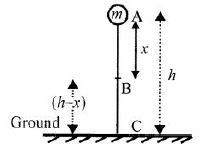
- **At Point A (at rest):**
Potential Energy (\( \text{P.E.} \)) = \( mgh \)
Kinetic Energy (\( \text{K.E.} \)) = \( 0 \)
Total Energy (\( E_A \)) = \( \text{P.E.} + \text{K.E.} = mgh + 0 = mgh \) -- (i)
- **At Point B (during free fall, after covering a distance \( x \)):**
The remaining height above the ground is \( h - x \).
From the third equation of motion: \( v^2 - u^2 = 2gx \)
Since the body started from rest, \( u = 0 \).
\( v^2 = 2gx \)
Therefore:
\( \text{K.E.} = \frac{1}{2}mv^2 = \frac{1}{2}m(2gx) = mgx \)
\( \text{P.E.} = mg(h - x) = mgh - mgx \)
Total Energy (\( E_B \)) = \( \text{P.E.} + \text{K.E.} = (mgh - mgx) + mgx = mgh \) -- (ii)
- **At Point C (just as it touches the ground):**
The height \( h = 0 \).
The velocity \( v \) is given by \( v^2 = u^2 + 2gh \).
Since \( u = 0 \), we have \( v^2 = 2gh \).
Therefore:
\( \text{K.E.} = \frac{1}{2}mv^2 = \frac{1}{2}m(2gh) = mgh \)
\( \text{P.E.} = 0 \)
Total Energy (\( E_C \)) = \( \text{P.E.} + \text{K.E.} = 0 + mgh = mgh \) -- (iii)
Since \( E_A = E_B = E_C = mgh \), the total mechanical energy remains conserved throughout the fall.
(c) **Energy conservation in a swinging pendulum:** - **At extreme positions (B and C):** The bob momentarily stops, so its velocity is zero. Consequently, its \( \text{K.E.} = 0 \), and its energy is entirely in the form of potential energy, \( \text{P.E.} = mgh \) (where \( h \) is the maximum height reached).
- **At the mean position (A):** As the bob moves down from an extreme position to the center, its height decreases to zero, and its speed increases to maximum. Here, its \( \text{P.E.} = 0 \), and its energy is completely converted into kinetic energy, \( \text{K.E.} = mgh \).
- **At intermediate positions:** The energy is a mix of both potential and kinetic energy, but their sum remains constant at \( mgh \). This demonstrates the conservation of energy.
(d) **Six familiar forms of energy:**
1. Wind energy
2. Heat energy
3. Sound energy
4. Solar energy
5. Electrical energy
6. Nuclear energy
In simple words: Energy cannot be made from nothing or destroyed. It can only change its form. For example, when an object falls, its stored potential energy turns into kinetic energy of motion, but the total energy always stays the same.
Exam Tip: When writing the mathematical proof, remember to clearly define the variables \( m \), \( h \), and \( x \), and compute the total energy at all three points (A, B, and C) to show they are equal.
Question 10. State the energy changes taking place in the following cases:
(a) Glowing of a torch bulb
(b) A toy car is wound and then allowed to move on the floor
(c) A truck climbing up a hill
(d) Water in a dam rotates a turbine coupled to a generator
(e) An air gun is loaded and then fired
(f) A piece of magnesium burns in air
(g) Water freezes in the freezing chamber of a fridge
(h) A stone dropped from a cliff
(i) Food eaten by humans
(j) Exposure of photographic film in sunlight
Answer:
(a) Electrical energy of the battery converts into light and heat energy.
(b) Potential energy of the wound spring converts into mechanical (kinetic) energy.
(c) Chemical energy of the fuel converts into heat, kinetic, and potential energy.
(d) Potential energy of water converts into kinetic energy, then into electrical energy.
(e) Potential energy of the compressed spring converts into kinetic energy of the bullet/pellet.
(f) Chemical energy converts into heat and light energy.
(g) Electrical energy converts into mechanical energy (to run the compressor) and subsequently removes heat energy to turn water into ice.
(h) Potential energy of the elevated stone converts into kinetic energy as it falls.
(i) Chemical energy of food converts into heat and mechanical energy.
(j) Light energy converts into chemical energy.
In simple words: Energy is always changing forms - from electricity to light, from stored spring energy to motion, or from fuel to heat and movement.
Exam Tip: In energy conversion questions, always identify the starting form of energy (before the action) and the final forms of energy (resulting from the action).
Question 11. Give one example in each case
(a) when heat energy changes into kinetic energy.
(b) when kinetic energy changes into heat energy.
(c) when sound energy changes into electric energy.
(d) when electric energy changes into sound energy.
(e) when light energy changes into chemical energy.
(f) when chemical energy changes into light energy.
(g) when electric changes into magnetic energy.
(h) when magnetic energy changes into electric energy.
(i) when potential energy changes into electric energy.
(j) when electric energy changes into potential energy.
Answer:
(a) In a steam engine, heat energy generated by coal moves the piston and wheels, transforming into kinetic energy.
(b) Rubbing your palms together rapidly makes them feel warm, converting kinetic energy into heat.
(c) A microphone converts the sound energy of a voice into electrical signals.
(d) A loudspeaker converts incoming electrical energy into sound waves.
(e) During photosynthesis, green plants convert solar light energy into stored chemical energy.
(f) Lighting a matchstick by friction converts chemical energy into light and heat energy.
(g) An electromagnet creates a magnetic field when electric current flows through it, converting electrical energy into magnetic energy.
(h) Moving a magnet through a coil of wire in a generator converts kinetic/magnetic energy into electric current.
(i) Water stored in a reservoir flows down to spin a turbine, converting gravitational potential energy into electrical energy.
(j) An electric motor pump draws water to an overhead tank, converting electrical energy first to kinetic energy and then into gravitational potential energy of the stored water.
In simple words: This shows how different devices and natural processes are basically energy converters, switching energy from one type to another to perform useful tasks.
Exam Tip: Common household items like speakers, microphones, and motors are excellent, easy-to-remember examples of energy converters for exams.
Question 12. Define kilowatt hour and convert it into joules
Answer: A kilowatt-hour (\( \text{kWh} \)) is the amount of electrical energy consumed when an appliance of power rating one kilowatt operates continuously for one hour.
To convert it to joules:
\( 1 \text{ kWh} = 1 \text{ kW} \times 1 \text{ hour} \)
\( 1 \text{ kWh} = 1000 \text{ W} \times 3600 \text{ s} \)
\( 1 \text{ kWh} = 1000 \text{ J/s} \times 3600 \text{ s} \)
\( 1 \text{ kWh} = 3.6 \times 10^6 \text{ J} \)
In simple words: A kilowatt-hour is the unit of electricity used to measure your home's power bill. It is equal to exactly 3.6 million Joules of energy.
Exam Tip: Be careful with the multiplication when converting kilowatt-hour to Joules. Ensure you show all intermediate steps: converting kilowatts to watts and hours to seconds.
Question 13. Define electron volt and express it in joule.
Answer: An electron volt (\( \text{eV} \)) is defined as the work done or kinetic energy gained by an electron when it is accelerated through an electric potential difference of exactly one volt.
Expression in Joules:
\( 1 \text{ eV} = \text{charge on an electron} \times 1\text{ V} \)
\( 1 \text{ eV} = (1.6 \times 10^{-19}\text{ C}) \times 1\text{ V} \)
\( 1 \text{ eV} = 1.6 \times 10^{-19}\text{ J} \)
In simple words: An electron volt is a tiny unit of energy used in atomic physics. It is the energy an electron gets when pushed by a one-volt battery.
Exam Tip: Pay close attention to the negative exponent in \( 1.6 \times 10^{-19} \text{ J} \). Writing a positive exponent by mistake will make the value physically incorrect by a massive margin.
Multiple Choice Questions
Question 1. A boy drags a load ‘L’ along horizontal plane AB by applying a force F. The boy does
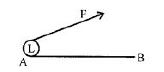
(a) no work
(b) some positive work
(c) negative work
(d) none of the options
Answer: (b) some positive work
In simple words: Since the boy pulls the load forward and slightly upward, a part of his force helps move the load along the ground, so he does positive work.
Exam Tip: When the angle between force and displacement is acute (less than 90 degrees), the work done is always positive.
Question 2. The SI unit of work is joule. It is expressed in terms of mass, length and time as
(a) \( \text{kg m}^2\text{s}^{-3} \)
(b) \( \text{kg m}^2\text{s}^{-2} \)
(c) \( \text{kg}^2 \text{m}^2\text{s}^{-2} \)
(d) \( \text{kg m}\text{s}^{-2} \)
Answer: (b) \( \text{kg m}^2\text{s}^{-2} \)
In simple words: Since work is force multiplied by distance, its basic unit is mass times distance squared divided by time squared.
Exam Tip: Deriving SI base units from formulas (like \( W = F \times S \)) is a reliable way to verify the unit dimensions in multiple-choice questions.
Question 3. The SI unit of power is watt. It is expressed in terms of mass, length and time as:
(a) \( \text{kg m}^2\text{s}^{-3} \)
(b) \( \text{kg m}\text{s}^{-3} \)
(c) \( \text{kg}^2 \text{m}^2\text{s}^{-2} \)
(d) \( \text{kg m}\text{s}^{-2} \)
Answer: (a) \( \text{kg m}^2\text{s}^{-3} \)
In simple words: Power is work divided by time, so its base unit has an extra division by seconds compared to work, making the time exponent -3.
Exam Tip: Remember that Power = Work / Time. Thus, the unit of power is Joule per second, which translates to \( \text{kg m}^2\text{s}^{-3} \).
Question 4. A stone resting on the roof of a building has
(a) potential energy
(b) gravitational energy
(c) kinetic energy
(d) none of the options
Answer: (a) potential energy
In simple words: The stone has stored energy because it is resting high up on the roof, which is potential energy.
Exam Tip: Any object at a height above the ground level possesses potential energy due to its position in Earth's gravitational field.
Question 5. A falling raindrop has:
(a) only kinetic energy
(b) only potential energy
(c) both kinetic and potential energy
(d) none of the options
Answer: (c) both kinetic and potential energy
In simple words: Because the raindrop is falling, it is moving (kinetic energy) and is still above the ground (potential energy).
Exam Tip: Moving objects that are still at a certain height above reference ground level always possess both potential and kinetic energy simultaneously.
Question 6. One horse power is equal to:
(a) 764 W
(b) 746 W
(c) 700 W
(d) 1000 W
Answer: (b) 746 W
In simple words: One horsepower is a set unit value used in engineering that equals exactly 746 Watts of electrical power.
Exam Tip: Memorize this conversion factor as it is critical for solving efficiency and motor-based numerical problems.
Question 7. One electron volt is equal to:
(a) \( 6 \times 10^{-17} \text{ J} \)
(b) \( 6.1 \times 10^{-19} \text{ J} \)
(c) \( 1.6 \times 10^{-19} \text{ J} \)
(d) \( 1.6 \times 10^{-10} \text{ J} \)
Answer: (c) \( 1.6 \times 10^{-19} \text{ J} \)
In simple words: An electron volt is a tiny unit of energy that equals the charge of one electron multiplied by one volt.
Exam Tip: Be careful with the exponents in energy units; the correct value is a very tiny fraction of a Joule (\( 10^{-19} \)).
Question 8. Kilowatt hour is the commercial unit of:
(a) electric power
(b) electric energy
(c) electric force
(d) none of the options
Answer: (b) electric energy
In simple words: The electricity bill we receive counts the commercial unit of electric energy we consume in kilowatt-hours.
Exam Tip: Kilowatt is a unit of power, but when multiplied by hour (time), it represents energy (Power \( \times \) Time). Do not confuse the two.
Question 9. Power is the product of:
(a) force and velocity
(b) force and displacement
(c) force and acceleration
(d) force and time
Answer: (a) force and velocity
In simple words: Power is also calculated by multiplying how hard you push something (force) by how fast it moves (velocity).
Exam Tip: Use the formula \( P = F \times v \) when dealing with questions that provide force and constant velocity directly.
Question 10. An aeroplane is flying at an altitude of 10,000 m at a speed of 300 km/hour. The aeroplane at this height has:
(a) only kinetic energy
(b) only potential energy
(c) both kinetic and potential energy
(d) zero kinetic and potential energy
Answer: (c) both kinetic and potential energy
In simple words: The airplane has kinetic energy because it is flying at high speed, and potential energy because it is high up in the sky.
Exam Tip: Check for both height and motion to determine if an object has mechanical energy in both forms.
Question 11. Kilocalorie is the amount of heat required to raise the temperature of:
(a) one gram of water through 1°C
(b) 1 kg of water through 100°C
(c) one kg of water through 1°C
(d) 1 kg of water through 10°C
Answer: (c) one kg of water through 1°C
In simple words: A kilocalorie is a bigger unit of heat energy, used to raise the temperature of 1 kilogram of water by 1 degree Celsius.
Exam Tip: A regular calorie raises 1 gram of water by 1°C, while a kilocalorie (1000 calories) raises 1 kg (1000 grams) of water by 1°C.
Question 12. When a flash light is switched on the electric energy
(a) directly changes to light energy
(b) first changes to light energy and then to heat energy
(c) first changes to heat energy and then to light energy
(d) none of the options
Answer: (c) first changes to heat energy and then to light energy
In simple words: Electricity heats up the bulb's filament first, and once it gets extremely hot, it starts to glow and produce light.
Exam Tip: Incandescent bulbs work on the heating effect of electric current; heat generation precedes light emission.
Question 13. A pendulum is swinging freely. The bob of pendulum has:
(a) maximum K.E. at its extreme positions
(b) minimum K.E. at its mean position
(c) maximum K.E. at its mean position
(d) both (b) and (c)
Answer: (c) maximum K.E. at its mean position
In simple words: The swinging bob moves fastest when passing through the exact center (mean position), meaning its kinetic energy is highest there.
Exam Tip: The speed is maximum at the lowest (mean) point, which makes kinetic energy maximum, while potential energy is zero at this point.
Question 14. A pendulum is oscillating freely. Its bob has:
(a) only kinetic energy
(b) maximum kinetic energy at extreme position
(c) maximum potential energy at its mean position
(d) a constant energy which is the sum of potential and kinetic energy
Answer: (d) a constant energy which is the sum of potential and kinetic energy
In simple words: Even though the bob keeps trading potential energy for kinetic energy, the total energy (their sum) stays constant throughout.
Exam Tip: According to the law of conservation of mechanical energy, the sum of K.E. and P.E. remains constant at all points of oscillation in the absence of friction.
Question 15. A ball of mass m is dropped from height ‘h ’.
(a) Potential energy of the ball at ground level is mgh.
(b) Potential energy of the ball at height h is mgh.
(c) kinetic energy of the ball at ground level is mgh
(d) both (b) and (c)
Answer: (d) both (b) and (c)
In simple words: When the ball is at the top height, it has all potential energy. When it hits the ground, that same amount of energy has converted completely into motion (kinetic energy).
Exam Tip: During free fall, loss of potential energy equals gain in kinetic energy. P.E. at top height equals K.E. at the bottom.
Numerical Problems on Work, Power & Energy
Practice Problems 1
Question 1. A girl of mass 50 kg climbs a flight of 100 stairs each measuring 0.25 m in height, in 20s. Find (a) force acting on the girl (b) work done by the girl (c) gain in potential energy (d) power in (1) watts (2) Horsepower [Taking g = 10 ms-2, 1 HP = 750 W]
Answer:
Given:
Mass of the girl, \( m = 50 \text{ kg} \)
Acceleration due to gravity, \( g = 10 \text{ ms}^{-2} \)
Number of steps = 100
Height of each step = \( 0.25 \text{ m} \)
Total vertical height climbed, \( h = 100 \times 0.25 \text{ m} = 25 \text{ m} \)
Time taken, \( t = 20 \text{ s} \)
(a) The downward gravitational force acting on the girl is her weight:
\( F = m \times g \)
\( F = 50 \text{ kg} \times 10 \text{ ms}^{-2} = 500 \text{ N} \)
(b) The work done by the girl against gravity is:
\( W = F \times h \)
\( W = 500 \text{ N} \times 25 \text{ m} = 12500 \text{ J} \)
(c) The gain in gravitational potential energy is equal to the work done:
\( \text{Gain in P.E.} = mgh = 50 \times 10 \times 25 = 12500 \text{ J} \)
(d) Power spent:
(1) In Watts:
\( P = \frac{W}{t} = \frac{12500 \text{ J}}{20 \text{ s}} = 625 \text{ W} \)
(2) In Horsepower (using \( 1 \text{ HP} = 750 \text{ W} \) as given in the problem):
\( P = \frac{625}{750} \approx 0.83 \text{ HP} \)
In simple words: The girl weighs 500 Newtons, and she climbs a total height of 25 meters. This means she does 12,500 Joules of work, which is also her gained potential energy. Her power output is 625 Watts, which is about 0.83 horsepower.
Exam Tip: Always find the total height by multiplying the number of steps by the height of a single step before doing further calculations.
Question 2. A load of 220 kg is vertically pulled up by a crane through a vertical height of 16 m in 40 s. Calculate (1) Force acting in the upward direction (2) Total work done (3) Horse power of the engine pulling the rope [Take g = 9.8 ms-2 ; 1 HP = 750 w]
Answer:
Given:
Mass, \( m = 220 \text{ kg} \)
Height, \( h = 16 \text{ m} \)
Time, \( t = 40 \text{ s} \)
\( g = 9.8 \text{ ms}^{-2} \)
\( 1 \text{ HP} = 750 \text{ W} \)
(1) The force required to lift the load vertically upwards is equal to its weight:
\( F = m \times g \)
\( F = 220 \text{ kg} \times 9.8 \text{ ms}^{-2} = 2156 \text{ N} \)
(2) Total work done:
\( W = F \times h \)
\( W = 2156 \text{ N} \times 16 \text{ m} = 34496 \text{ J} \)
(3) Power of the engine:
Power in Watts:
\( P_{\text{watts}} = \frac{W}{t} = \frac{34496 \text{ J}}{40 \text{ s}} = 862.4 \text{ W} \)
Power in Horsepower:
\( P_{\text{HP}} = \frac{862.4}{750} \approx 1.15 \text{ HP} \)
In simple words: The crane lifts a 2156 Newton load up by 16 meters, which takes 34,496 Joules of work. Since it does this in 40 seconds, its power is 862.4 Watts, which is equivalent to 1.15 horsepower.
Exam Tip: Watch out for arithmetic errors in textbook questions. Always double-check your multiplication (like \( 2156 \times 16 \)) to avoid carrying forward a calculation mistake.
Question 1. A work of 1000 J is done on a body in 4 s, such that a displacement of 20 m is caused. Calculate (a) force (b) power
Answer:
We need to determine the force applied and the power generated.
(a) The relationship between work, force, and distance is given by the formula:
\( \text{Force } (F) = \frac{\text{Work done } (W)}{\text{Displacement } (s)} \)
Substituting the values:
\( F = \frac{1000 \text{ J}}{20 \text{ m}} = 50 \text{ N} \)
(b) Power is defined as the rate at which work is performed:
\( \text{Power } (P) = \frac{\text{Work done } (W)}{\text{Time } (t)} \)
Substituting the values:
\( P = \frac{1000 \text{ J}}{4 \text{ s}} = 250 \text{ W} \) (or \( 250 \text{ J s}^{-1} \))
In simple words: We find force by dividing work by displacement, and power by dividing work by time.
Exam Tip: Make sure to write the correct SI units for force (N) and power (W) in your final step to avoid losing marks.
Question 2. What force must be applied to a body through a distance of 10 m, such that it does a work of 4000 J. If the mass of the body is 20 kg, what is the acceleration of the body ?
Answer:
First, we calculate the force by using the work formula:
\( \text{Force } (F) = \frac{\text{Work done}}{\text{Displacement}} \)
Substituting the given numbers:
\( F = \frac{4000 \text{ J}}{10 \text{ m}} = 400 \text{ N} \)
Next, to find the acceleration of the object, we apply Newton's second law:
\( \text{Acceleration } (a) = \frac{\text{Force } (F)}{\text{Mass } (m)} \)
Using the calculated force and the given mass:
\( a = \frac{400 \text{ N}}{20 \text{ kg}} = 20 \text{ m s}^{-2} \)
In simple words: Work is force times distance, so we divide work by distance to get force. Then, we use force equals mass times acceleration to find the acceleration.
Exam Tip: Remember that acceleration is measured in \( \text{m s}^{-2} \). Double-check your arithmetic when dividing force by mass.
Question 3. An engine of power 200 W, operates for 4 s. Find the work done by the engine. If the force developed by the engine is 100 N calculate the maximum displacement caused.
Answer:
Given parameters:
Power \( (P) = 200 \text{ W} \)
Time \( (t) = 4 \text{ s} \)
Force \( (F) = 100 \text{ N} \)
To find the energy or work produced by the engine, we multiply power by duration:
\( \text{Work done } (W) = P \times t \)
\( W = 200 \text{ W} \times 4 \text{ s} = 800 \text{ J} \)
Now, we find the maximum movement or displacement using:
\( \text{Displacement } (s) = \frac{\text{Work done } (W)}{\text{Force } (F)} \)
\( s = \frac{800 \text{ J}}{100 \text{ N}} = 8 \text{ m} \)
In simple words: Power tells us how much work is done every second. Multiplying power by time gives total work. Dividing that total work by force gives the distance moved.
Exam Tip: Keep track of your steps - first find work using power and time, and then use that work value to calculate the distance.
Practice Problems 3
Question 1. Calculate the horse power of the motor of an elevator, which can carry 10 persons of average mass 60 kg through a vertical height of 20 m in 30 s. [Take g = 10 N/ kg]
Answer:
Let us first calculate the collective mass of all 10 passengers:
\( m = 10 \times 60 \text{ kg} = 600 \text{ kg} \)
The gravitational force (weight) acting on this mass is:
\( F = m \times g = 600 \text{ kg} \times 10 \text{ N kg}^{-1} = 6000 \text{ N} \)
The distance moved vertically is \( h = 20 \text{ m} \) over a duration of \( t = 30 \text{ s} \).
We can find the total work completed:
\( \text{Work } (W) = F \times h = 6000 \text{ N} \times 20 \text{ m} = 120000 \text{ J} \)
Next, we compute the power in watts:
\( \text{Power } (P) = \frac{\text{Work done } (W)}{\text{Time } (t)} \)
\( P = \frac{120000 \text{ J}}{30 \text{ s}} = 4000 \text{ W} \)
To express this value in horsepower (HP), using the conversion factor \( 1 \text{ HP} = 750 \text{ W} \):
\( \text{Power in HP} = \frac{4000}{750} = 5.33 \text{ HP} \)
In simple words: First find the total weight of the people. Multiply weight by height to get work, then divide by time to get power in watts. Finally, divide by 750 to convert to horsepower.
Exam Tip: Note the conversion factor for Horsepower used in this specific syllabus (usually 750 W or 746 W). Always check the given constants in your question paper.
Question 2. Calculate the power of an electric pump in horse power, which can lift 2000 m3 of water from a depth of 20 m in 25 minutes. [Take g = 10 ms-2 and 1 m3 of water = 103 kg]
Answer:
First, we find the total mass of the water to be lifted:
Since \( 1 \text{ m}^3 \text{ of water} = 10^3 \text{ kg} \), the mass \( (m) \) of \( 2000 \text{ m}^3 \) is:
\( m = 2000 \times 10^3 \text{ kg} \)
The weight of this water (force of gravity) is:
\( F = m \times g = 2000 \times 10^3 \text{ kg} \times 10 \text{ m s}^{-2} = 2 \times 10^7 \text{ N} \)
The height \( (h) \) to lift the water is \( 20 \text{ m} \).
The time period \( (t) \) is \( 25 \text{ minutes} \), which in seconds is:
\( t = 25 \times 60 \text{ s} = 1500 \text{ s} \)
The total work required is:
\( W = F \times h = 2 \times 10^7 \text{ N} \times 20 \text{ m} = 4 \times 10^8 \text{ J} \)
Now, calculate the power generated in watts:
\( P = \frac{\text{Work done}}{t} = \frac{4 \times 10^8 \text{ J}}{1500 \text{ s}} = \frac{8 \times 10^5}{3} \text{ W} \)
To express the power in horsepower (HP) using the conversion \( 1 \text{ HP} = 750 \text{ W} \):
\( \text{Power in HP} = \frac{8 \times 10^5}{3 \times 750} = \frac{3200}{9} \approx 355.55 \text{ HP} \)
In simple words: Convert the water's volume to mass and find its total weight. Multiply weight by depth to get total work, then divide by the total seconds to get power in watts. Finally, divide by 750 to convert to horsepower.
Exam Tip: Convert the time from minutes to seconds immediately, as using minutes directly in the formula is a very common error.
Question 3. Calculate the height through which a crane can lift a load of 4 t, when its motor of 4 HP operates for 10 s.[Take g = 10 ms-2]
Answer:
Let us identify the given values:
Mass of the load \( (m) = 4 \text{ tonnes} = 4 \times 1000 \text{ kg} = 4000 \text{ kg} \)
Duration of operation \( (t) = 10 \text{ s} \)
Power of the motor \( (P) = 4 \text{ HP} = 4 \times 750 \text{ W} = 3000 \text{ W} \)
Force due to gravity \( (F) = m \times g = 4000 \text{ kg} \times 10 \text{ m s}^{-2} = 40000 \text{ N} \)
Using the power equation:
\( \text{Power } (P) = \frac{\text{Work done } (W)}{\text{Time } (t)} = \frac{F \times h}{t} \)
Substituting our values into the equation:
\( 3000 = \frac{40000 \times h}{10} \)
Simplifying the right side:
\( 3000 = 4000 \times h \)
Solving for height \( (h) \):
\( h = \frac{3000}{4000} = 0.75 \text{ m} \)
In simple words: The power tells us how much energy is spent each second. We use this to find the total energy spent in 10 seconds, and then divide it by the load's weight to find how high it was lifted.
Exam Tip: Remember that "t" in metric stands for tonne, which is equivalent to 1000 kg. Always convert tonnes to kilograms first before calculating force.
Question 4. For how long must an electric motor pump of 2 HP operate, so as to pump 5 m3 of water from a depth of 15 m.[Take g = 10 N/kg, 1 m3 of water = 103 kg]
Answer:
We want to find the required duration \( (t) \).
Given:
Power of the pump \( (P) = 2 \text{ HP} = 2 \times 750 \text{ W} = 1500 \text{ W} \)
Volume of water = \( 5 \text{ m}^3 \)
Mass of water \( (m) = 5 \times 10^3 \text{ kg} = 5000 \text{ kg} \)
Depth \( (h) = 15 \text{ m} \)
Acceleration due to gravity \( (g) = 10 \text{ N kg}^{-1} \)
The formula relating power, time, and gravitational work is:
\( P \times t = m \times g \times h \)
Substituting the values into this equation:
\( 1500 \times t = 5000 \times 10 \times 15 \)
\( 1500 \times t = 750000 \)
Solving for \( t \):
\( t = \frac{750000}{1500} = 500 \text{ s} \)
Converting this time into minutes and seconds:
\( t = 8 \text{ minutes and } 20 \text{ seconds} \)
In simple words: We calculate the work needed to lift the water by multiplying mass, gravity, and depth. Then, we divide this work by the pump's power to find how many seconds it must run.
Exam Tip: Be careful with time conversions; express the final answer in minutes and seconds if the value in seconds is large.
Practice Problems 4
Question 1. An electric pump is 60% efficient and is rated 2 HP. Calculate the maximum amount of water it can lift through a height of 5 m in 40 s. [Take g = 10 ms-2 and 1 HP = 750 W]
Answer:
Given:
Rated Power = \( 2 \text{ HP} = 2 \times 750 \text{ W} = 1500 \text{ W} \)
Efficiency = \( 60\% \)
The active, useful power of the pump is:
\( P_{\text{useful}} = 1500 \text{ W} \times \frac{60}{100} = 900 \text{ W} \)
Time \( (t) = 40 \text{ s} \)
Height \( (h) = 5 \text{ m} \)
Using the relation for useful energy output:
\( P_{\text{useful}} \times t = m \times g \times h \)
Substituting the values:
\( 900 \times 40 = m \times 10 \times 5 \)
\( 36000 = 50 \times m \)
Solving for mass \( (m) \):
\( m = \frac{36000}{50} = 720 \text{ kg} \)
In simple words: The pump only uses 60 percent of its 2 horsepower. We find this useful power first, multiply it by time to get the total useful energy, and divide by gravity and height to get the water's weight and mass.
Exam Tip: When efficiency is less than 100%, always calculate the actual useful power first before setting up your work-energy balance equation.
Question 2. Calculate the time for which a motor pump of 10 HP and efficiency 80% must be switched on, so as to pump 20 m3 of water through a vertical height of 20 m.[Density of water = 1000 kg m3; g = 10 ms-2; 1 HP = 750 W]
Answer:
First, let us calculate the total mass of the water:
\( m = \text{Volume} \times \text{Density} = 20 \text{ m}^3 \times 1000 \text{ kg m}^{-3} = 20000 \text{ kg} \)
The motor's rated power is \( 10 \text{ HP} \). Since \( 1 \text{ HP} = 750 \text{ W} \):
\( \text{Rated Power} = 10 \times 750 = 7500 \text{ W} \)
Applying the efficiency of \( 80\% \), the actual power output is:
\( P_{\text{useful}} = 7500 \text{ W} \times \frac{80}{100} = 6000 \text{ W} \)
Using the relationship between useful power, operating time, and gravitational work:
\( P_{\text{useful}} \times t = m \times g \times h \)
Substituting the values:
\( 6000 \times t = 20000 \text{ kg} \times 10 \text{ m s}^{-2} \times 20 \text{ m} \)
\( 6000 \times t = 4000000 \)
Solving for \( t \):
\( t = \frac{4000000}{6000} = 666.67 \text{ s} \)
In simple words: Convert the water volume to mass, then calculate the work needed to raise it 20 meters. Next, calculate the pump's actual power after accounting for the 80 percent efficiency. Finally, divide the work by this power to get the time in seconds.
Exam Tip: Ensure that you account for both the horsepower-to-watt conversion and the efficiency percentage before solving for the unknown variable.
Question 3. In a hydroelectric power station, 1000 kg of water is allowed to drop a height of 100 m in 1 s. If the conversion of potential energy to electric energy is 60%, calculate the power output. [Take g = 10 ms-2]
Answer:
Given data:
Mass of water falling per second \( (m) = 1000 \text{ kg} \)
Height \( (h) = 100 \text{ m} \)
Time \( (t) = 1 \text{ s} \)
Efficiency of electrical energy conversion = \( 60\% \)
First, find the total rate of potential energy release (input power):
\( P_{\text{input}} = \frac{m \times g \times h}{t} = \frac{1000 \text{ kg} \times 10 \text{ m s}^{-2} \times 100 \text{ m}}{1 \text{ s}} = 10^6 \text{ W} \)
Now, the electrical power output is \( 60\% \) of this input power:
\( P_{\text{output}} = P_{\text{input}} \times \frac{60}{100} \)
\( P_{\text{output}} = 10^6 \text{ W} \times 0.60 = 6 \times 10^5 \text{ W} \) (or \( 600 \text{ kW} \))
In simple words: We first find the potential energy of the falling water each second. Since only 60 percent of this energy becomes electricity, we multiply that power by 0.60 to find the electrical power output.
Exam Tip: Write down the formula for potential energy (\( mgh \)) and apply the efficiency factor directly to get the final output power.
Practice Problems 5
Question 1. A compressed spring is held near a small toy car of mass 0.15 kg. On the release of the spring, the toy car moves forward with a velocity of 10 ms-1. Find the potential energy of the spring.
Answer:
By the law of conservation of energy, the potential energy stored in the compressed spring is fully converted into the kinetic energy of the toy car when released (assuming no energy loss).
Given:
Mass of the car \( (m) = 0.15 \text{ kg} \)
Velocity of the car \( (v) = 10 \text{ m s}^{-1} \)
The kinetic energy \( (\text{K.E.}) \) of the moving car is:
\( \text{K.E.} = \frac{1}{2} m v^2 \)
Substituting the values:
\( \text{K.E.} = \frac{1}{2} \times 0.15 \text{ kg} \times (10 \text{ m s}^{-1})^2 \)
\( \text{K.E.} = \frac{1}{2} \times 0.15 \times 100 = 7.5 \text{ J} \)
Therefore, the potential energy of the spring is:
\( \text{Potential Energy (P.E.)} = 7.5 \text{ J} \)
In simple words: All the energy stored in the spring turns into the car's motion (kinetic energy). So, we calculate the car's kinetic energy using its mass and speed, which gives us the spring's potential energy.
Exam Tip: Clearly state that the potential energy of the spring equals the kinetic energy of the car due to energy conservation.
Question 2. A catapult throws a stone of mass 0.10 kg with a velocity of 30 ms-1. If 25% of the RE. of the elastic band is wasted during transmission, find the magnitude of the potential energy.
Answer:
Let the total potential energy stored in the elastic band of the catapult be \( \text{P.E.} \)
Since \( 25\% \) of this energy is lost during transmission, the remaining fraction converted into the kinetic energy of the stone is:
\( 100\% - 25\% = 75\% \)
Therefore:
\( 75\% \text{ of P.E.} = \text{Kinetic Energy (K.E.) of the stone} \)
The kinetic energy is:
\( \text{K.E.} = \frac{1}{2} m v^2 \)
Given that the mass \( (m) = 0.10 \text{ kg} \) and velocity \( (v) = 30 \text{ m s}^{-1} \):
\( \text{K.E.} = \frac{1}{2} \times 0.10 \text{ kg} \times (30 \text{ m s}^{-1})^2 \)
\( \text{K.E.} = 0.05 \times 900 = 45 \text{ J} \)
Now, set up the energy balance equation:
\( 0.75 \times \text{P.E.} = 45 \text{ J} \)
\( \text{P.E.} = \frac{45}{0.75} = 60 \text{ J} \)
In simple words: Only 75 percent of the elastic band's energy goes into making the stone fly. We calculate the stone's kinetic energy (which is 45 Joules) and find what total starting energy would leave us with 45 Joules after a 25 percent loss.
Exam Tip: Convert percentages to decimals or fractions (such as \( \frac{3}{4} \) for \( 75\% \)) to make the final calculation easier to solve.
Practice Problems 6
Question 1. A body of mass 20 kg is moving with a velocity of 1 ms-1Another body B of mass 1 kg is moving wills a velocity of 20 ms-1. Find the ratio of kinetic energy of A and B.
Answer:
Let body A have mass \( m_1 = 20 \text{ kg} \) and velocity \( v_1 = 1 \text{ m s}^{-1} \).
Let body B have mass \( m_2 = 1 \text{ kg} \) and velocity \( v_2 = 20 \text{ m s}^{-1} \).
The kinetic energy of any object is given by \( \text{K.E.} = \frac{1}{2} m v^2 \).
The ratio of their kinetic energies is:
\( \frac{\text{K.E.}_A}{\text{K.E.}_B} = \frac{\frac{1}{2} m_1 v_1^2}{\frac{1}{2} m_2 v_2^2} \)
Canceling the factor of \( \frac{1}{2} \):
\( \frac{\text{K.E.}_A}{\text{K.E.}_B} = \frac{m_1 v_1^2}{m_2 v_2^2} \)
Substituting the given values:
\( \frac{\text{K.E.}_A}{\text{K.E.}_B} = \frac{20 \times (1)^2}{1 \times (20)^2} \)
\( \frac{\text{K.E.}_A}{\text{K.E.}_B} = \frac{20 \times 1}{1 \times 400} = \frac{20}{400} = \frac{1}{20} \)
Therefore, the ratio is \( 1 : 20 \).
In simple words: We calculate the kinetic energy of both objects. Body A's kinetic energy is 10 Joules, and body B's is 200 Joules. Dividing 10 by 200 gives a ratio of 1 to 20.
Exam Tip: When calculating ratios of kinetic energy, you can cancel out the common constant \( \frac{1}{2} \) immediately before plugging in the values.
Question 2. A bullet of mass 0.2 kg, moving with a velocity of 200 ms-1 , strikes a stationary wooden target of mass 5 kg. If all the energy is transferred to the wooden target, calculate the velocity with which the target towards direction.
Answer:
Let the mass of the bullet be \( m_1 = 0.2 \text{ kg} \) and its velocity be \( v_1 = 200 \text{ m s}^{-1} \).
Let the mass of the wooden target be \( m_2 = 5 \text{ kg} \) and its final velocity be \( v \).
Since all the kinetic energy of the bullet is transferred to the wooden target:
\( \text{Kinetic Energy of bullet} = \text{Kinetic Energy of target} \)
\( \frac{1}{2} m_1 v_1^2 = \frac{1}{2} m_2 v^2 \)
We can simplify this by removing the factor of \( \frac{1}{2} \) from both sides:
\( m_1 v_1^2 = m_2 v^2 \)
Substituting the values:
\( 0.2 \times (200)^2 = 5 \times v^2 \)
\( 0.2 \times 40000 = 5 \times v^2 \)
\( 8000 = 5 \times v^2 \)
Solving for \( v^2 \):
\( v^2 = \frac{8000}{5} = 1600 \)
Taking the square root of both sides:
\( v = \sqrt{1600} = 40 \text{ m s}^{-1} \)
In simple words: The entire kinetic energy of the bullet is given to the target. We find the bullet's kinetic energy and set it equal to the target's kinetic energy formula to calculate the target's new speed.
Exam Tip: Ensure you cancel the \( \frac{1}{2} \) term early in the algebraic step to simplify your manual calculations.
Practice Problems 7
Question 1. A body of mass m has a velocity v. If the mass of the body increases 81 times, but the kinetic energy remains same, calculate the new velocity.
Answer:
Initially, the kinetic energy \( (\text{K.E.}) \) of the object with mass \( m \) and velocity \( v \) is:
\( \text{K.E.} = \frac{1}{2} m v^2 \)
For the second state, let the new mass be \( m_1 = 81m \) and the new velocity be \( v_1 \).
The new kinetic energy \( (\text{K.E.}_1) \) is:
\( \text{K.E.}_1 = \frac{1}{2} m_1 v_1^2 = \frac{1}{2} (81m) v_1^2 \)
According to the problem, the kinetic energy remains unchanged:
\( \text{K.E.}_1 = \text{K.E.} \)
\( \frac{1}{2} (81m) v_1^2 = \frac{1}{2} m v^2 \)
Dividing both sides by \( \frac{1}{2} m \):
\( 81 v_1^2 = v^2 \)
\( v_1^2 = \frac{v^2}{81} \)
Taking the square root of both sides gives:
\( v_1 = \frac{v}{9} \)
Thus, the new velocity is \( \frac{1}{9} \) times the initial velocity.
In simple words: Since kinetic energy depends on both mass and speed squared, if mass is multiplied by 81, the speed squared must be divided by 81 to keep the energy the same. Taking the square root, the speed must be divided by 9.
Exam Tip: When mass increases while kinetic energy remains constant, the velocity must decrease. Express the final velocity clearly in terms of the initial velocity \( v \).
Question 2. A body P has KE energy E. Another body Q, whose mass is 9 times than P, also has kinetic energy E. Calculate the ratio of velocities of P and Q.
Answer:
Let the mass of body P be \( m_P = m \) and its velocity be \( v_P \). Its kinetic energy is:
\( E = \frac{1}{2} m v_P^2 \)
Let the mass of body Q be \( m_Q = 9m \) and its velocity be \( v_Q \). Its kinetic energy is:
\( E = \frac{1}{2} (9m) v_Q^2 \)
Since both bodies have the same kinetic energy \( E \):
\( \frac{1}{2} m v_P^2 = \frac{1}{2} (9m) v_Q^2 \)
Simplifying the expression by dividing both sides by \( \frac{1}{2} m \):
\( v_P^2 = 9 v_Q^2 \)
Taking the square root of both sides:
\( v_P = 3 v_Q \)
This can be written as:
\( \frac{v_P}{v_Q} = \frac{3}{1} \)
Hence, the ratio of the velocities of P and Q is \( v_P : v_Q = 3 : 1 \).
In simple words: Since both objects have the same energy but Q is 9 times heavier, Q must move slower to have the same energy. We find that P moves 3 times faster than Q, so their speed ratio is 3 to 1.
Exam Tip: Pay attention to the order requested in the question (velocities of P and Q means \( v_P : v_Q \), not \( v_Q : v_P \)).
Practice Problems 8
Question 1. (a) Force of gravity acting on the barrel. (Take g - 10 ms-2)
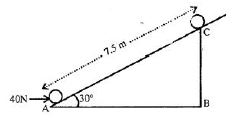
(b) Work done by the force in pulling body along the inclined plane
(c) Work done against the force of gravity.
Answer:
(a) The force of gravity (weight) of the barrel is calculated using the formula:
\( F = m \times g \)
Assuming the mass of the barrel is \( m = 2.5 \text{ kg} \):
\( F = 2.5 \text{ kg} \times 10 \text{ m s}^{-2} = 25 \text{ N} \)
(b) The work completed by the external pulling force along the slope is:
\( W = \text{Force} \times \text{displacement} \)
\( W = 40 \text{ N} \times 7.5 \text{ m} = 300 \text{ J} \)
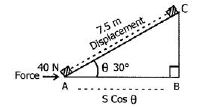
(c) The work completed against gravity is given by:
\( W_{\text{gravity}} = \text{Force of gravity} \times h \)
Here, the height \( h \) is the vertical side \( BC \).
Using trigonometry on the right triangle \( ABC \):
\( \sin 30^\circ = \frac{BC}{AC} = \frac{BC}{7.5} \)
\( BC = 7.5 \times \sin 30^\circ = 7.5 \times 0.5 = 3.75 \text{ m} \)
Therefore, the work done against gravity is:
\( W_{\text{gravity}} = 25 \text{ N} \times 3.75 \text{ m} = 93.75 \text{ J} \)
In simple words: (a) Gravity pulls down with a force equal to the mass times g. (b) To find the work done moving up the slope, multiply the force applied by the slope length. (c) To find the work done against gravity, multiply the object's weight by the vertical height gained.
Exam Tip: Use trigonometric ratios (like sine) to calculate the vertical height from the length of an inclined plane and its angle.
Question 2. Adjacent diagram shows a body of mass 5 kg pulled up an inclined plane by a force of 30 N. (a) Calculate forced by gravity acting on body. (Take g = 10 ms-2) (b) Work done by the force in pulling body along the inclined plane. (c) Work done against the force of gravity.
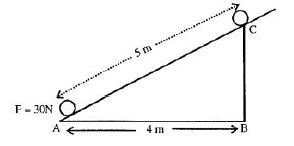
Answer:
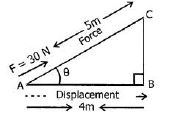
Given parameters:
Mass of body \( (m) = 5 \text{ kg} \)
Pulling force \( (F_{\text{pull}}) = 30 \text{ N} \)
Length of the incline \( (AC) = 5 \text{ m} \)
Base of the incline \( (AB) = 4 \text{ m} \)
(a) The force exerted by gravity on the body is its weight:
\( F = m \times g \)
\( F = 5 \text{ kg} \times 10 \text{ m s}^{-2} = 50 \text{ N} \)
(b) The work performed by the pulling force as the body moves along the incline is:
\( W = F_{\text{pull}} \times AC \)
\( W = 30 \text{ N} \times 5 \text{ m} = 150 \text{ J} \)
(c) The work performed against gravity is given by:
\( W_{\text{gravity}} = m \times g \times BC \)
To find the height \( BC \), we apply the Pythagorean theorem to right-angled triangle \( ABC \):
\( BC = \sqrt{AC^2 - AB^2} \)
\( BC = \sqrt{5^2 - 4^2} = \sqrt{25 - 16} = \sqrt{9} = 3 \text{ m} \)
Now, calculate the work against gravity:
\( W_{\text{gravity}} = 50 \text{ N} \times 3 \text{ m} = 150 \text{ J} \)
In simple words: (a) Find the weight by multiplying mass with gravity. (b) Work is the pulling force times the distance walked along the slope. (c) Work against gravity is weight times the vertical height gained (found using the Pythagorean theorem).
Exam Tip: When base and hypotenuse of a right-angled triangle are given, always use the Pythagorean theorem to calculate the unknown vertical height before solving for potential energy or gravitational work.
Practice Problems 9
Question 1. A scooter develops a power of 1 HP while running at 36 km hr-1. Calculate the force generated by its engine.
Answer:
Given:
Power \( (P) = 1 \text{ HP} = 750 \text{ W} \)
Velocity \( (v) = 36 \text{ km h}^{-1} \)
First, we must convert the speed from kilometers per hour to meters per second:
\( v = 36 \times \frac{5}{18} \text{ m s}^{-1} = 10 \text{ m s}^{-1} \)
The formula connecting power, force, and velocity is:
\( P = F \times v \)
Substituting the values into this formula:
\( 750 = F \times 10 \)
Solving for force \( (F) \):
\( F = \frac{750}{10} = 75 \text{ N} \)
In simple words: First convert the speed from kilometers per hour to meters per second. Since power is force multiplied by speed, we divide the power in watts by the speed to find the engine's force.
Exam Tip: Be ready to convert velocity to SI units (\( \text{m s}^{-1} \)) using the conversion factor \( \frac{5}{18} \) to ensure all values are consistent.
Question 2. The engine of a car develops a power of 5 HP and force 500 N while running a uniform speed S. Calculate the value of S.
Answer:
Let us identify the given variables:
Power of the engine \( (P) = 5 \text{ HP} = 5 \times 750 \text{ W} = 3750 \text{ W} \)
Force applied \( (F) = 500 \text{ N} \)
Uniform speed = \( S \)
We use the equation relating power, force, and velocity:
\( P = F \times S \)
Substituting the values:
\( 3750 = 500 \times S \)
Solving for speed \( (S) \):
\( S = \frac{3750}{500} = 7.5 \text{ m s}^{-1} \)
In simple words: Power is the force multiplied by the speed. To find the speed, we divide the engine's power in watts by the force it exerts.
Exam Tip: Make sure to convert power from HP to Watts before using the \( P = F \times v \) relationship.
Practice Problems 10
Question 1. The heart of a normal person beats 72 times in a minute and does a work of 1 joule per beat. What is power of the heart ?
Answer:
Given:
Beats per minute = 72
Work done in one beat = \( 1 \text{ J} \)
Time period \( (t) = 1 \text{ minute} = 60 \text{ s} \)
First, let us calculate the total work performed in one minute:
\( W = 72 \text{ beats} \times 1 \text{ J beat}^{-1} = 72 \text{ J} \)
Now, compute the power output of the heart:
\( P = \frac{\text{Total work done } (W)}{\text{Time } (t)} \)
\( P = \frac{72 \text{ J}}{60 \text{ s}} = 1.2 \text{ W} \)
In simple words: The heart does 72 Joules of work in 60 seconds. Dividing the total work by the number of seconds gives the heart's power in watts.
Exam Tip: Always use seconds as the unit of time when calculating power to get the answer in Watts.
Question 2. The heart of a deer chased by a tiger beats 200 times in a minute and does a work of 1.4 joules per beat. What is the power of heart ?
Answer:
Given data:
Heart rate = 200 beats per minute
Work per beat = \( 1.4 \text{ J} \)
Time \( (t) = 1 \text{ minute} = 60 \text{ s} \)
First, find the total work completed in one minute:
\( W = 200 \times 1.4 \text{ J} = 280 \text{ J} \)
Now, we find the power exerted by the heart:
\( P = \frac{\text{Total work done}}{\text{Time in seconds}} \)
\( P = \frac{280 \text{ J}}{60 \text{ s}} \approx 4.67 \text{ W} \)
In simple words: The deer's heart does 280 Joules of work in 60 seconds. We divide this total work by 60 to find the power in watts.
Exam Tip: Keep your decimal answers rounded to two decimal places for a neat and standard presentation.
Practice Problems 11
Question 1. A beam of electrons has an energy of 1 joule. How many electrons are in the beam ? [1 eV = 1.6 x 10⁻¹⁹]
Answer:
Let \( n \) be the total number of electrons present in the beam.
Given:
Total energy of the beam = \( 1 \text{ J} \)
Energy of one electron (which is \( 1 \text{ eV} \)) = \( 1.6 \times 10^{-19} \text{ J} \)
To find the number of electrons, we divide the total energy of the beam by the energy of a single electron:
\( n = \frac{\text{Total Energy}}{\text{Energy of one electron}} \)
\( n = \frac{1}{1.6 \times 10^{-19}} \)
\( n = \frac{10}{1.6} \times 10^{18} = 6.25 \times 10^{18} \)
Therefore, there are \( 6.25 \times 10^{18} \) electrons in the beam.
In simple words: We divide the total energy of 1 Joule by the tiny energy of a single electron to find how many electrons are in the beam.
Exam Tip: Remember that dividing by a negative exponent like \( 10^{-19} \) in the denominator is equivalent to multiplying by \( 10^{19} \) in the numerator.
Question 2. An accelerated electron has energy of 9.6 x 10⁻¹⁸ J. Express the energy in electron volts (eV)
Answer:
Given:
Energy of the accelerated electron \( = 9.6 \times 10^{-18} \text{ J} \)
Conversion factor: \( 1 \text{ eV} = 1.6 \times 10^{-19} \text{ J} \)
To express this energy in electron volts, we divide the energy in Joules by the value of one electron volt:
\( \text{Energy in eV} = \frac{9.6 \times 10^{-18} \text{ J}}{1.6 \times 10^{-19} \text{ J eV}^{-1}} \)
\( \text{Energy in eV} = \left(\frac{9.6}{1.6}\right) \times 10^{-18 - (-19)} \)
\( \text{Energy in eV} = 6 \times 10^1 = 60 \text{ eV} \)
In simple words: To convert energy from Joules to electron volts, we divide the energy in Joules by the conversion factor \( 1.6 \times 10^{-19} \).
Exam Tip: Pay attention to exponents when dividing; subtracting a negative exponent in the denominator changes its sign to positive in the numerator.
Practice Problems 12
Question 1. Calculate the kinetic energy of a body of mass 100 g and having a momentum of 20 kg ms-1.
Answer:
Given details:
Mass \( (m) = 100 \text{ g} = \frac{100}{1000} \text{ kg} = 0.1 \text{ kg} \)
Momentum \( (p) = 20 \text{ kg m s}^{-1} \)
Using the definition of momentum:
\( p = m \times v \)
\( 20 = 0.1 \times v \)
\( v = \frac{20}{0.1} = 200 \text{ m s}^{-1} \)
Now, compute the kinetic energy \( (\text{K.E.}) \):
\( \text{K.E.} = \frac{1}{2} m v^2 \)
\( \text{K.E.} = \frac{1}{2} \times 0.1 \text{ kg} \times (200 \text{ m s}^{-1})^2 \)
\( \text{K.E.} = 0.05 \times 40000 = 2000 \text{ J} \)
In simple words: We first convert the mass to kilograms, then use the momentum to find the object's speed. Finally, we use the mass and speed in the kinetic energy formula to find the answer in Joules.
Exam Tip: Always convert mass from grams to kilograms (SI units) at the very beginning of your solution to prevent incorrect orders of magnitude in your final energy value.
Question 2. Calculate the kinetic energy of a body of mass 5 kg momentum 50 kg ms-1
Answer: Given data:
Mass of the body, \( m = 5 \text{ kg} \)
Momentum of the body, \( p = 50 \text{ kg ms}^{-1} \)
We know that momentum is the product of mass and velocity:
\( p = m v \)
\( 50 = 5 \times v \)
\( \implies v = \frac{50}{5} = 10 \text{ ms}^{-1} \)
The kinetic energy is given by the formula:
\( \text{K.E.} = \frac{1}{2} m v^2 \)
\( \text{K.E.} = \frac{1}{2} \times 5 \times 10 \times 10 \)
\( \text{K.E.} = 250 \text{ J} \)
In simple words: If you know how heavy something is and how fast it is moving, you can find its kinetic energy by first finding its speed and then calculating the energy of its motion.
Exam Tip: Make sure to convert momentum to velocity before finding kinetic energy, or use the direct formula \( \text{K.E.} = \frac{p^2}{2m} \) which saves time in multiple-choice questions.
Practice Problems 13
Question 1. A spring is kept compressed by a toy car of mass 100 g. On releasing the pressure the car moves out with a speed of 0.5 ms-1. Calculate the potential energy of the compressed spring.
Answer: Given data:
Mass of the toy car, \( m = 100 \text{ g} = \frac{100}{1000} \text{ kg} = 0.1 \text{ kg} \)
Speed of the car, \( v = 0.5 \text{ ms}^{-1} \)
When the compressed spring is released, its potential energy is fully converted into the kinetic energy of the car.
\( \text{Potential Energy (P.E.)} = \text{Kinetic Energy (K.E.)} \)
\( \text{P.E.} = \frac{1}{2} m v^2 \)
\( \text{P.E.} = \frac{1}{2} \times \left(\frac{100}{1000}\right) \times 0.5 \times 0.5 \)
\( \text{P.E.} = \frac{1}{20} \times \frac{25}{100} = \frac{12.5}{1000} = 0.0125 \text{ J} \)
\( \text{P.E.} = 0.0125 \text{ J} \)
In simple words: When you let go of a squeezed spring, all the stored energy inside it turns into the movement energy of the car.
Exam Tip: Always convert the mass from grams to kilograms by dividing by 1000 before starting any energy calculations to ensure the unit is in Joules.
Question 2. A lead pallet of mass 10 g leaves an air gun with a velocity of 40 ms-1 . What is the magnitude of potential energy stored by its spring?
Answer: Given data:
Mass of the lead pallet, \( m = 10 \text{ g} = \frac{10}{1000} \text{ kg} = \frac{1}{100} \text{ kg} \)
Velocity, \( v = 40 \text{ ms}^{-1} \)
The potential energy stored in the spring of the air gun is equal to the kinetic energy carried by the lead pallet on leaving.
\( \text{P.E.} = \text{K.E.} = \frac{1}{2} m v^2 \)
\( \text{K.E.} = \frac{1}{2} \times \left(\frac{1}{100}\right) \times 40 \times 40 \)
\( \text{K.E.} = 8 \text{ J} \)
\( \implies \text{P.E.} = 8 \text{ J} \)
In simple words: The energy stored in the gun's spring is completely handed over to the bullet as movement energy as soon as it is fired.
Exam Tip: Pay close attention to mass units; grams must be converted to standard SI units (kg) to avoid calculation errors.
Questions from ICSE Examination Papers
2002
Question 1. (a) A machine raises a load of 800 N through a height of 15 m in 5 s. Calculate the power at which the machine works.
(b) State the principle of conservation of energy.
Answer:
(a) Given data:
Load (Force), \( F = 800 \text{ N} \)
Displacement (Height), \( h = 15 \text{ m} \)
Time taken, \( t = 5 \text{ s} \)
Work done is equal to the increase in potential energy:
\( \text{Work Done} = F \times h = 800 \times 15 \)
Power is the rate of doing work:
\( \text{Power (P)} = \frac{\text{Work Done}}{t} = \frac{800 \times 15}{5} \)
\( P = 2400 \text{ W} \)
(b) The law of conservation of energy states: "Energy can neither be created nor destroyed." It can only change from one form to another, and the total energy of an isolated system remains constant.
In simple words: Power tells us how fast a machine does its job. If it lifts a heavy load quickly, it uses a lot of power. Also, energy never disappears; it just changes form.
Exam Tip: State the definition of the principle of conservation of energy clearly in quotes, as examiners look for the exact phrase "neither created nor destroyed."
Question 2. (a) State SI unit of the momentum of a body.
(b) Define : (1) work (2) Power (3) Energy.
(c) How is work related to applied force ?
(d) By what factor does the kinetic energy of a moving body change, when its speed is reduced to one third of the initial velocity ?
(e) What does the unit kilowatt hour measure ?
(f) From the ground floor, a man comes up to the third floor of a building using a staircase. Another person comes up to the same floor, using an elevator. Neglecting friction, compare the work done in two cases.
Answer:
(a) The SI unit of momentum is \( \text{kg ms}^{-1} \).
(b)
1. Work: Work is said to be done when an applied force causes a body to move in the direction of that force.
2. Power: The rate at which work is performed is defined as power.
3. Energy: The overall capacity of a body to perform work is referred to as energy.
(c) Work is directly proportional to the force applied in the direction of displacement, given by the relation:
\( W = F s \cos \theta \)
(d) The initial kinetic energy of the body is:
\( \text{K.E.}_1 = \frac{1}{2} m v^2 \) ... (i)
When the velocity is reduced to one-third, the new speed is \( \frac{v}{3} \).
The new kinetic energy is:
\( \text{K.E.}_2 = \frac{1}{2} m \left(\frac{v}{3}\right)^2 = \frac{1}{9} \left(\frac{1}{2} m v^2\right) \)
Using equation (i):
\( \text{K.E.}_2 = \frac{1}{9} \text{K.E.}_1 \)
Thus, the kinetic energy decreases to \( \frac{1}{9} \text{-th} \) of its original value.
(e) Kilowatt-hour is a unit used to measure the quantity of electrical energy consumed.
(f) Since both individuals travel from the ground floor to the third floor, their vertical displacement is identical. Because the work done against gravity depends only on vertical displacement and is independent of the path taken, the work performed is equal in both cases.
Ratio of work done = 1 : 1
In simple words: Work happens when you push something and it moves. Power is how fast you work, and energy is what lets you do it. If you slow down to a third of your speed, your movement energy drops to one-ninth because energy depends on speed multiplied by itself.
Exam Tip: For comparative questions on kinetic energy, always show the ratio method clearly using subscripts like \( \text{K.E.}_1 \) and \( \text{K.E.}_2 \) to secure full marks.
Question 3. (a) The weights of two bodies are 2.0 N and 2.0 kgf respectively. What is the mass of each body ? (g = 10 ms-2).
(b) If the power of a motor is 40 kW, at what speed can it raise a load of 20,000 N ?
Answer:
(a) For the first body:
Weight, \( W_1 = 2 \text{ N} \)
Using \( W = mg \):
\( m \times 10 = 2 \)
\( \implies m = \frac{2}{10} = 0.2 \text{ kg} \)
For the second body:
Weight, \( W_2 = 2.0 \text{ kgf} \)
Since \( 1 \text{ kgf} = 10 \text{ N} \):
\( 2.0 \text{ kgf} = 2 \times 10 = 20 \text{ N} \)
Using \( W = mg \):
\( m \times 10 = 20 \)
\( \implies m = \frac{20}{10} = 2 \text{ kg} \)
(b) Given data:
Power of the motor, \( P = 40 \text{ kW} = 40 \times 1000 \text{ W} = 40000 \text{ W} \)
Load (Force), \( F = 20000 \text{ N} \)
Power is the product of force and speed:
\( \text{Power} = \text{Force} \times \text{speed} \)
\( 40000 = 20000 \times \text{speed} \)
\( \implies \text{speed} = \frac{40000}{20000} = 2 \text{ ms}^{-1} \)
In simple words: Weight is the pull of gravity on a mass. While 2 Newtons is a very small force, 2 kilogram-force is much stronger because it equals the weight of a full 2 kg mass on Earth.
Exam Tip: Remember that 1 kgf is equal to \( g \) Newtons (typically 10 N if \( g = 10 \text{ ms}^{-2} \)). Write this conversion step explicitly.
2003
Question 4. (a) The weights of two bodies A and B are 5.0 N and 5.0 kgf respectively. What is the mass of each body ?(g = 10 ms-2)
(b) If the power of a motor is 50 kW, at which speed can it raise a load of 25,000 N ?
Answer:
(a) For Body A:
Weight, \( W_A = 5.0 \text{ N} \)
Using \( W = mg \):
\( m_A \times 10 = 5.0 \)
\( \implies m_A = \frac{5.0}{10} = 0.5 \text{ kg} \)
For Body B:
Weight, \( W_B = 5.0 \text{ kgf} \)
Since \( 1 \text{ kgf} = 10 \text{ N} \):
\( W_B = 5 \times 10 = 50 \text{ N} \)
Using \( W = mg \):
\( m_B \times 10 = 50 \)
\( \implies m_B = \frac{50}{10} = 5 \text{ kg} \)
(b) Given data:
Power of the motor, \( P = 50 \text{ kW} = 50 \times 1000 \text{ W} = 50000 \text{ W} \)
Load (Force), \( F = 25000 \text{ N} \)
Power is the product of force and speed:
\( P = F \times v \)
\( 50000 = 25000 \times v \)
\( \implies v = \frac{50000}{25000} = 2 \text{ ms}^{-1} \)
In simple words: A body's weight depends on gravity, but its mass stays the same. To find mass from kilogram-force, the value is already the mass in kg. To find it from Newtons, divide by the gravity value.
Exam Tip: Do not confuse force in Newtons with force in kgf. Always write down the conversion formula \( 1 \text{ kgf} = 10 \text{ N} \) to show your working clearly.
2004
Question 5. (a) What energy changes take place in an oscillating pendulum ?
(b) Two objects A and B have masses in the ratio of 2:1 and are dropped from the same height. Answer the following questions :
1. What is the ratio of velocities of A and B, when they strike the ground ?
2. What is the ratio of forces of A and B, when they strike the ground ?
Answer:
(a) During the oscillation of a pendulum, a continuous conversion between potential energy and kinetic energy occurs:
- At the extreme positions (points A and C), the potential energy is at its maximum while the kinetic energy is zero.
- As the bob moves toward the mean position (point B), potential energy decreases and kinetic energy increases.
- At the mean position (point B), the potential energy is zero and the kinetic energy is at its maximum.
- As the bob swings from the mean position toward the extreme position, kinetic energy decreases while potential energy increases.
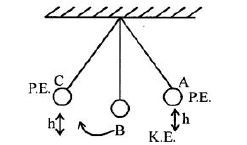
(b)
1. Let the mass of body B be \( m \), so the mass of body A is \( 2m \). Since both are dropped from the same height \( h \), we use the kinematic equation:
\( v^2 - u^2 = 2gh \)
Since they start from rest (\( u = 0 \)):
\( v = \sqrt{2gh} \)
This terminal speed depends only on height and is completely independent of mass. Thus, both bodies reach the ground with the same velocity.
Ratio of velocities = 1 : 1
2. The force acting on each body when hitting the ground is its weight (\( F = mg \)):
Force on A, \( F_A = (2m)g \)
Force on B, \( F_B = mg \)
Ratio of forces = \( \frac{2mg}{mg} = 2 : 1 \)
In simple words: A swinging pendulum constantly swaps height energy for speed energy and back again. When two different weights fall from the same height, they hit the ground at the same speed because gravity pulls them down at the same rate, but the heavier one hits with more force.
Exam Tip: When comparing falling bodies, remember that velocity depends only on height, while impact force depends on mass as well. Label the axes and extreme positions on any pendulum diagram.
Question 6. A ball of mass 0.5 kg is thrown vertically upward with a velocity of 8 m/s. Calculate the maximum potential energy it gains at the highest point.
Answer: Given data:
Mass of the ball, \( m = 0.5 \text{ kg} \)
Initial velocity, \( u = 8 \text{ ms}^{-1} \)
At the highest point, the final velocity \( v = 0 \). Let \( h \) be the maximum height.
Using the kinematic equation:
\( v^2 - u^2 = 2gh \)
\( 0 - 8^2 = -2 \times 10 \times h \) (taking \( g = 10 \text{ ms}^{-2} \))
\( -64 = -20h \)
\( h = \frac{64}{20} = 3.2 \text{ m} \)
Now, the potential energy at height \( h \) is:
\( \text{P.E.} = mgh = 0.5 \times 10 \times 3.2 = 16 \text{ J} \)
(Alternatively, by the law of conservation of energy, the maximum potential energy gained is equal to the initial kinetic energy at the throw: \( \text{P.E.}_{\text{max}} = \frac{1}{2} m u^2 = \frac{1}{2} \times 0.5 \times 8^2 = 16 \text{ J} \))
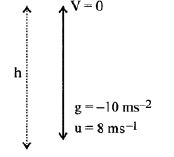
In simple words: When you throw a ball up, its motion energy at the start is completely turned into height energy at its highest point.
Exam Tip: You can solve this quickly using conservation of energy where maximum potential energy equals initial kinetic energy, saving you from calculating the height first.
2005
Question 7. (a) Which physical quantity does the electron volt measure? How is it related to SI unit of this quantity ?
(b) What would be the angle between force and displacement to get the (1) minimum work, (2) maximum work ?
(c) The work done by the heart is 1 J per beat. Calculate the power of the heart, if it beats 72 times a minute.
(d) State the law of conservation of energy.
(e) Name the chief energy transformations that occur :
1. in a loud speaker,
2. in an electric cell.
Answer:
(a) The electron volt (eV) is a unit used to measure energy. Its relation to the SI unit of energy (Joule) is:
\( 1 \text{ eV} = 1.6 \times 10^{-19} \text{ J} \)
(b)
1. To obtain minimum work (which is zero), the angle between force and displacement must be \( 90^\circ \).
2. To obtain maximum work, the angle between force and displacement must be \( 0^\circ \).
(c) Given data:
Work done per heartbeat = \( 1 \text{ J} \)
Number of heartbeats in 1 minute (60 seconds) = 72
Total work done in 60 seconds, \( W = 72 \times 1 \text{ J} = 72 \text{ J} \)
Power of the heart, \( P = \frac{\text{Total Work Done}}{\text{Time}} = \frac{72 \text{ J}}{60 \text{ s}} = 1.2 \text{ W} \)
(d) The law of conservation of energy states that energy cannot be created or destroyed; it can only be converted from one form to another. The total energy of an isolated system remains constant.
(e)
1. In a loudspeaker: Electrical energy is converted into sound energy.
2. In an electric cell: Chemical energy is converted into electrical energy.
In simple words: An electron volt is a tiny unit of energy used in physics. Work is greatest when you push in the same direction something moves, and zero if you push sideways.
Exam Tip: For power calculations involving time, always convert minutes into seconds first. State the angle clearly when discussing work done.
2006
Question 8. State the amount of work done by an object, when it moves in a circular path.
Answer: The work done on an object moving along a circular path is zero. This occurs because the centripetal force acting on the body always points toward the center of the path, which is at a right angle (\( 90^\circ \)) to its instantaneous displacement.
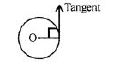
In simple words: When an object goes in a circle, the force pulling it inward is at a right angle to its path, so no actual work is done.
Exam Tip: Draw a simple diagram showing the right angle between the centripetal force and the instantaneous displacement to earn easy marks on conceptual questions.
Question 9. Show that for the free fall of a body, the sum of mechanical energy at any point in its path is constant.
Answer: Consider a body of mass \( m \) initially at rest at a height \( h \) above the ground (Position A).
1. At Position A (at height \( h \)):
Potential Energy, \( \text{P.E.} = mgh \)
Kinetic Energy, \( \text{K.E.} = 0 \) (since velocity \( u = 0 \))
Total Energy, \( E_A = \text{P.E.} + \text{K.E.} = mgh + 0 = mgh \)
2. At Position B (after falling a distance \( x \), at height \( h - x \)):
Potential Energy, \( \text{P.E.} = mg(h - x) \)
To find velocity \( v_1 \) at B, we use \( v_1^2 - u^2 = 2gx \):
\( v_1^2 - 0 = 2gx \)
\( \implies v_1^2 = 2gx \)
Kinetic Energy, \( \text{K.E.} = \frac{1}{2} m v_1^2 = \frac{1}{2} m (2gx) = mgx \)
Total Energy, \( E_B = \text{P.E.} + \text{K.E.} = mg(h - x) + mgx = mgh - mgx + mgx = mgh \)
3. At Position C (just touching the ground, height \( 0 \)):
Potential Energy, \( \text{P.E.} = 0 \)
To find velocity \( v_2 \) at C, we use \( v_2^2 - u^2 = 2gh \):
\( v_2^2 - 0 = 2gh \)
\( \implies v_2^2 = 2gh \)
Kinetic Energy, \( \text{K.E.} = \frac{1}{2} m v_2^2 = \frac{1}{2} m (2gh) = mgh \)
Total Energy, \( E_C = \text{P.E.} + \text{K.E.} = 0 + mgh = mgh \)
Since the total mechanical energy is \( mgh \) at all positions, the mechanical energy of a free-falling body is conserved.
In simple words: As an object falls, it loses height energy but gains speed energy by the exact same amount, so the total energy never changes.
Exam Tip: To prove conservation of energy, choose three distinct points (top, middle, bottom) and algebraically show that the sum of K.E. and P.E. is \( mgh \) at each point.
Question 10. Define newton, in SI unit of force. State its relationship with CGS unit of force.
Answer: One Newton is defined as the magnitude of force that, when acting on a mass of \( 1 \text{ kg} \), produces an acceleration of \( 1 \text{ ms}^{-2} \) in its direction.
The SI unit of force is the Newton (N), and the CGS unit of force is the dyne.
The relationship between them is:
\( 1 \text{ N} = 10^5 \text{ dyne} \)
In simple words: One Newton is the amount of push needed to make a 1 kg object speed up by 1 meter per second every second.
Exam Tip: Write the mathematical relationship \( 1 \text{ N} = 10^5 \text{ dyne} \) clearly, and make sure to specify the units for both mass and acceleration in your definition.
Question 11. Calculate the height through which a body of mass 0.5 kg should be lifted, if the energy spent for doing so is 1.0 joule. [g = 10 m/s2]
Answer: Given data:
Mass, \( m = 0.5 \text{ kg} = \frac{1}{2} \text{ kg} \)
Potential Energy (Energy spent), \( \text{P.E.} = 1.0 \text{ J} \)
Acceleration due to gravity, \( g = 10 \text{ ms}^{-2} \)
Using the formula:
\( \text{P.E.} = mgh \)
\( 1.0 = 0.5 \times 10 \times h \)
\( 1.0 = 5 \times h \)
\( \implies h = \frac{1}{5} = 0.2 \text{ m} \)
In simple words: To lift a half-kilogram weight using 1 Joule of energy, you can only raise it up by 20 centimeters.
Exam Tip: Double-check your decimals when dividing. Write down the primary formula \( \text{P.E.} = mgh \) before substituting the values.
2007
Question 12. Two bodies, A and B, of equal mass are kept at heights 20 m and 30 m respectively. Calculate the ratio of their potential entergies.
Answer: Let the mass of both bodies A and B be \( m \).
Potential Energy of body A, \( \text{P.E.}_A = mgh_1 = mg(20) \)
Potential Energy of body B, \( \text{P.E.}_B = mgh_2 = mg(30) \)
The ratio of their potential energies is:
\( \frac{\text{P.E.}_A}{\text{P.E.}_B} = \frac{mg(20)}{mg(30)} = \frac{20}{30} = 2 : 3 \)
In simple words: Since both objects have the same mass, the ratio of their height energy is exactly the same as the ratio of how high up they are.
Exam Tip: When finding ratios, cancel out common terms like mass (\( m \)) and gravity (\( g \)) early to keep your calculations clean and simple.
Question 13. (a) Define kilowatt hour. How is it related to joule ?
(b) How can the work done be measured when force is applied at an angle to the direction of displacement ?
Answer:
(a) One kilowatt-hour (kWh) is the total electrical energy consumed by an appliance rated at 1 kilowatt operating continuously for a duration of 1 hour.
Relationship with Joule:
\( 1 \text{ kWh} = 1 \text{ kW} \times 1 \text{ hour} \)
\( 1 \text{ kWh} = 1000 \text{ W} \times 3600 \text{ s} \)
\( 1 \text{ kWh} = 1000 \text{ J/s} \times 3600 \text{ s} \)
\( 1 \text{ kWh} = 3.6 \times 10^6 \text{ J} \)
(b) When a force \( F \) acts at an angle \( \theta \) relative to the displacement \( S \), the work done is measured by taking the product of the component of force acting in the direction of displacement and the displacement itself.
Component of force along displacement = \( F \cos \theta \)
Therefore, work done is:
\( W = (F \cos \theta) \times S = F S \cos \theta \)
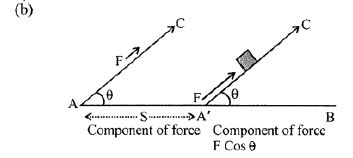
In simple words: A kilowatt-hour is a unit of electrical energy used to measure power bills. If you pull something at an angle, only the portion of your pull that goes in the direction of movement counts as work.
Exam Tip: When showing the derivation of work at an angle, always sketch the vector components to show how \( F \cos \theta \) is obtained.
Question 14. What is the main energy transformation that occurs during
(a) Photosynthesis in green leaves ;
(b) Charging of a battery ?
Answer:
(a) Photosynthesis: Light energy is converted into chemical energy.
(b) Charging of a battery: Electrical energy is converted into chemical energy.
In simple words: Plants turn sunlight into food energy, and chargers turn electricity into stored chemical energy inside a battery.
Exam Tip: Use arrows to clearly show the flow of energy transformations (e.g., Light energy \( \rightarrow \) Chemical energy) to make your answer easy for the examiner to read.
2008
Question 15. (a) When an arrow is shot from a bow, it has kinetic energy in it. Explain briefly from where does it get its kinetic enrgy ?
(b) What energy conversions take place in the following when they are working (1) electric toaster (2) microphone ?
Answer:
(a) When a bow is drawn back, the work done by the muscles of the archer is stored in the deformed bow as elastic potential energy. Upon releasing the string, this stored potential energy is instantly transferred and converted into the kinetic energy of the flying arrow.
(b)
1. Electric toaster: Electrical energy is converted into heat (thermal) energy.
2. Microphone: Sound energy is converted into electrical energy.
In simple words: An arrow flies because your muscles put energy into bending the bow, which then snaps back. Toasters turn electrical energy into heat, while microphones turn sound waves into electrical signals.
Exam Tip: Clearly distinguish between microphones (sound to electrical) and loudspeakers (electrical to sound) as students frequently mix these two up.
Question 16. (a) A stone of mass 64.0 g is thrown vertically upward from the ground with an initial speed of 20.0 m/s. The gravitational potential energy at the ground level is considered to be zero. Apply the principle of conservation of energy and calculate the potential energy at the maximum height attained by the stone, (g - 10 ms-2)
(b) Using the same principle, state what will be the total energy of the body at its half-way point ?
Answer:
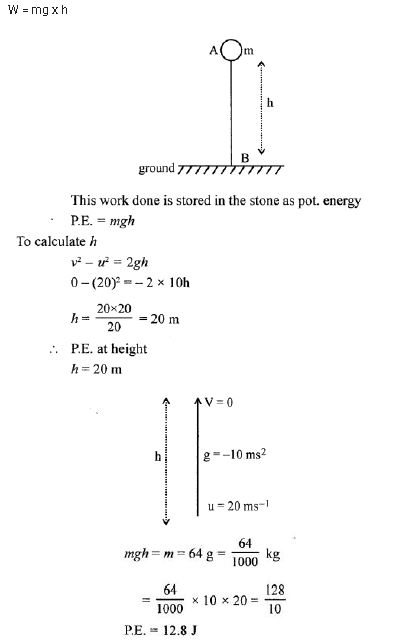
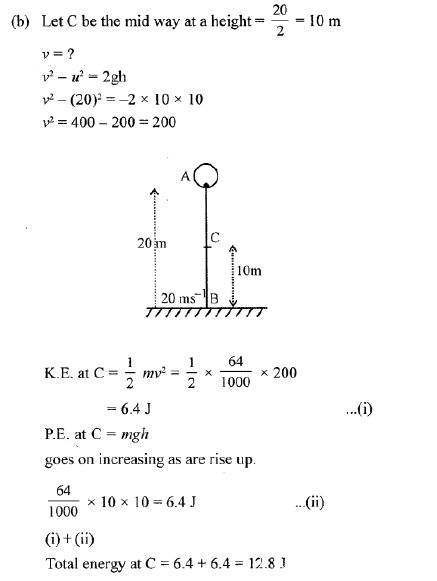
In simple words: The stone's motion energy at the start is converted entirely into height energy at the peak. At the halfway point, it has half motion energy and half height energy, but the total stays the same.
Exam Tip: Remember that total energy is conserved throughout the flight. The total energy at the halfway point is identical to the total energy at the starting point or the highest point.
Question 17. Define ‘joule’, the SI unit of work and establish a relationship between the SI and CGS units of work.
Answer: One Joule is defined as the amount of work done when a force of \( 1 \text{ N} \) displaces an object through a distance of \( 1 \text{ m} \) in the direction of the force.
The SI unit of work is the Joule (J) and the CGS unit of work is the erg.
Relationship:
\( 1 \text{ Joule} = 1 \text{ N} \times 1 \text{ m} \)
Since \( 1 \text{ N} = 10^5 \text{ dyne} \) and \( 1 \text{ m} = 10^2 \text{ cm} \):
\( 1 \text{ J} = 10^5 \text{ dyne} \times 10^2 \text{ cm} = 10^7 \text{ dyne-cm} = 10^7 \text{ erg} \)
\( \implies 1 \text{ J} = 10^7 \text{ ergs} \)
\( \implies 1 \text{ erg} = 10^{-7} \text{ J} \)
In simple words: One Joule is the work done when a force of one Newton moves an object by one meter. This is equal to ten million ergs in the smaller CGS system.
Exam Tip: Show the step-by-step unit conversion from Newtons and meters to dynes and centimeters to get full credit for the derivation.
2009
Question 18(a). What is the SI unit of energy ? How is the electron volt (eV) related to it ?
Answer: The SI unit of energy is the Joule (J).
The relationship between electron volt (eV) and Joule (J) is derived as follows:
\( 1 \text{ eV} = \text{charge on 1 electron} \times 1 \text{ V} \)
\( 1 \text{ eV} = 1.6 \times 10^{-19} \text{ C} \times 1 \text{ V} \)
\( 1 \text{ eV} = 1.6 \times 10^{-19} \text{ J} \)
In simple words: Energy is measured in Joules. A tiny unit of energy called an electron volt is equal to the energy of one electron boosted by one volt.
Exam Tip: Memorize the value of \( 1.6 \times 10^{-19} \text{ J} \) for \( 1 \text{ eV} \) since this constant is frequently used in modern physics numericals.
Question 18(b). State the energy changes that take place in the following when they are in use : (1) a photovoltaic cell. (2) an electromagnet.
Answer:
1. In a solar cell, light energy gets converted into electricity.
2. In an electromagnet, electrical energy gets converted into magnetic energy.
In simple words: A solar cell turns light into electricity, while an electromagnet turns electrical power into magnetic force.
Exam Tip: Make sure to state both the starting and ending forms of energy clearly for each device.
Question 18(c). A body of mass 5 kg is moving with a velocity of 10ms-1. What will be the ratio of its initial kinetic energy and final kinetic energy, if the mass of the body is doubled and its velocity is halved ?
Answer: Let us write down the given values first:
Initial mass \( (m_1) = 5\text{ kg} \)
Initial speed \( (v_1) = 10\text{ ms}^{-1} \)
Now, calculating the initial kinetic energy \( (\text{K.E.}_1) \):
\( \text{K.E.}_1 = \frac{1}{2} m_1 v_1^2 \)
\( \implies \text{K.E.}_1 = \frac{1}{2} \times 5 \times (10)^2 \)
\( \implies \text{K.E.}_1 = \frac{1}{2} \times 5 \times 100 = 250\text{ J} \)
According to the question, the final mass is doubled and the velocity is halved:
New mass \( (m_2) = 2 \times 5 = 10\text{ kg} \)
New speed \( (v_2) = \frac{10}{2} = 5\text{ ms}^{-1} \)
Calculating the final kinetic energy \( (\text{K.E.}_2) \):
\( \text{K.E.}_2 = \frac{1}{2} m_2 v_2^2 \)
\( \implies \text{K.E.}_2 = \frac{1}{2} \times 10 \times (5)^2 \)
\( \implies \text{K.E.}_2 = \frac{1}{2} \times 10 \times 25 = 125\text{ J} \)
Finding the ratio of initial to final kinetic energy:
\( \text{Ratio} = \frac{\text{K.E.}_1}{\text{K.E.}_2} = \frac{250}{125} = 2 : 1 \)
In simple words: When mass is doubled but velocity is cut in half, the initial kinetic energy is twice as large as the final kinetic energy, making the ratio 2:1.
Exam Tip: Remember that kinetic energy is directly proportional to mass but proportional to the square of the velocity, so halving the velocity has a bigger impact than doubling the mass.
Question 19. 6.4 kJ of energy causes a displacement of 64 m in a body in the direction of force in 2.5 seconds. Calculate (1) the force applied (2) power in horse power (HP).(Take 1 HP = 746 W).
Answer: (1) First, let us list the given parameters:
Total energy used \( (E) = 6.4\text{ kJ} = 6400\text{ J} \)
Distance covered \( (S) = 64\text{ m} \)
Time taken \( (t) = 2.5\text{ s} \)
Since the displacement occurs along the line of action of the force, the work done equals the energy spent:
\( \text{Work done } (W) = F \times S \)
\( \implies 6400 = F \times 64 \)
\( \implies F = \frac{6400}{64} = 100\text{ N} \)
Therefore, the applied force is \( 100\text{ N} \).
(2) Next, we calculate the power generated:
\( \text{Power } (P) = \frac{\text{Work Done}}{\text{Time}} \)
\( \implies P = \frac{6400}{2.5} = 2560\text{ W} \)
To convert this power into horsepower (HP):
\( \text{Power in HP} = \frac{2560}{746} \approx 3.43\text{ HP} \)
The power developed is approximately \( 3.43\text{ HP} \).
In simple words: We find the force by dividing work by distance. Then we find power by dividing work by time, and convert watts to horsepower by dividing by 746.
Exam Tip: Always convert energy from kilojoules (kJ) to joules (J) by multiplying by 1000 before starting your calculations.
Question 20. An object of mass ‘m’ is allowed to fall freely from point A as shown in the figure.
Calculate the total mechanical energy of the object at: (1) Point A (2) Point B (3) Point C
(4) State the law which is verified by your calculations in parts (1), (2) and (3).
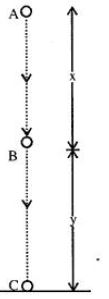
Answer:
(1) **At Point A:**
Let the body be at rest at height \( h \). The kinetic energy \( (\text{K.E.}) \) is zero since the object is stationary:
\( \text{K.E.} = 0 \)
The potential energy \( (\text{P.E.}) \) at this height is:
\( \text{P.E.} = mgh \)
Thus, total mechanical energy at point A is:
\( E_A = \text{K.E.} + \text{P.E.} = 0 + mgh = mgh \) - (i)
(2) **At Point B:**
Suppose the object falls through a vertical distance \( x \) from point A. It is now at a height \( (h - x) \) above the ground level. Using the third equation of motion to find its velocity \( v \) at point B:
\( v^2 - u^2 = 2gs \)
Since the initial velocity \( u = 0 \) and displacement \( s = x \):
\( v^2 - 0 = 2gx \)
\( \implies v^2 = 2gx \)
Now, let us calculate the kinetic energy at point B:
\( \text{K.E.} = \frac{1}{2} m v^2 \)
\( \implies \text{K.E.} = \frac{1}{2} m (2gx) = mgx \)
The potential energy at point B is:
\( \text{P.E.} = mg(h - x) = mgh - mgx \)
Therefore, total mechanical energy at point B is:
\( E_B = \text{K.E.} + \text{P.E.} = mgx + (mgh - mgx) = mgh \) - (ii)
(3) **At Point C:**
When the object just reaches the ground, its height is \( 0 \), meaning its potential energy becomes zero:
\( \text{P.E.} = 0 \)
Let \( V \) be the velocity of the object as it touches the ground. The vertical distance traveled is \( h \). Using the motion equation:
\( V^2 - 0 = 2gh \)
\( \implies V^2 = 2gh \)
Now, calculate the kinetic energy at point C:
\( \text{K.E.} = \frac{1}{2} m V^2 \)
\( \implies \text{K.E.} = \frac{1}{2} m (2gh) = mgh \)
Therefore, total mechanical energy at point C is:
\( E_C = \text{K.E.} + \text{P.E.} = mgh + 0 = mgh \) - (iii)
(4) **Verification:**
Comparing equations (i), (ii), and (iii), we find that:
\( E_A = E_B = E_C = mgh \)
This confirms the **Law of Conservation of Energy**, which states that the total mechanical energy of a freely falling body remains constant at all points along its path, only transforming from potential to kinetic energy.
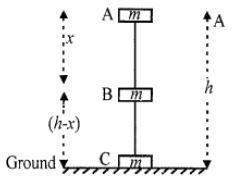
In simple words: As the object falls, its potential energy turns into kinetic energy. However, the total sum of both energies remains exactly mgh at every single point.
Exam Tip: When deriving conservation of energy, write down the three equations of motion clearly to find the velocity at intermediate points, and always define the height relative to the ground.
Question 21. (a) A toy is acted upon by a force. State two conditions under which the work done could be zero.
Answer: Based on the relation \( W = F \times S \times \cos\theta \), the work done by an applied force will be zero under these two conditions:
1. There is no movement or displacement of the object \( (S = 0) \).
2. The force is applied at right angles to the direction of motion, meaning the angle \( \theta = 90^\circ \) (since \( \cos 90^\circ = 0 \)).
In simple words: Work is zero if the object does not move at all, or if the force is pushing sideways (at a 90-degree angle) relative to the direction of movement.
Exam Tip: Write down the general formula for work, \( W = F S \cos\theta \), to support your answer and earn full marks.
Question 21. (b) A spring is kept compressed by a small trolley of mass 0.5 kg lying on a smooth horizontal surface as shown in the figure given below :
When the trolley is released, it is found to move at a speed of 2m s-1.
What potential energy did the spring possess when compressed?
Answer: When the compressed spring is released, all of its stored potential energy is converted entirely into the kinetic energy of the moving trolley.
Given:
Mass of the trolley \( (m) = 0.5\text{ kg} = \frac{1}{2}\text{ kg} \)
Speed of the trolley \( (v) = 2\text{ ms}^{-1} \)
The kinetic energy of the trolley is calculated as:
\( \text{K.E.} = \frac{1}{2} m v^2 \)
\( \implies \text{K.E.} = \frac{1}{2} \times 0.5 \times (2)^2 \)
\( \implies \text{K.E.} = \frac{1}{2} \times 0.5 \times 4 = 1\text{ J} \)
Since the potential energy of the compressed spring equals this kinetic energy, we have:
\( \text{Potential Energy of the spring} = 1\text{ J} \)
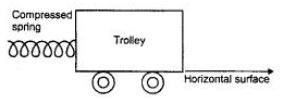
In simple words: The energy stored in the squished spring turns completely into motion energy when let go. Since the moving trolley has 1 Joule of motion energy, the spring must have held 1 Joule of potential energy.
Exam Tip: Clearly state the principle of conservation of energy to explain why the potential energy of the spring equals the kinetic energy of the trolley.
Question 22. A body of mass 50 kg has a momentum of 3000 kg ms-1. Calculate :
1. the kinetic energy of the body.
2. the velocity of the body.
Answer: Given:
Mass of the body \( (m) = 50\text{ kg} \)
Momentum \( (p) = 3000\text{ kg ms}^{-1} \)
1. **To find the Kinetic Energy (K.E.):**
We can use the direct formula connecting kinetic energy and momentum:
\( \text{K.E.} = \frac{p^2}{2m} \)
\( \implies \text{K.E.} = \frac{(3000)^2}{2 \times 50} \)
\( \implies \text{K.E.} = \frac{9,000,000}{100} = 90,000\text{ J} \)
Therefore, the kinetic energy of the body is \( 90,000\text{ J} \) (or \( 90\text{ kJ} \)).
2. **To find the Velocity (v):**
Using the formula for momentum:
\( p = m \times v \)
\( \implies 3000 = 50 \times v \)
\( \implies v = \frac{3000}{50} = 60\text{ ms}^{-1} \)
Therefore, the velocity of the body is \( 60\text{ ms}^{-1} \).
In simple words: We find velocity by dividing the momentum by the mass, which gives 60. Then we use that to find kinetic energy, which works out to 90,000 Joules.
Exam Tip: Using the relation \( \text{K.E.} = \frac{p^2}{2m} \) is a very quick and elegant way to solve part 1 directly without needing to calculate velocity first.
Question 23. (a) A ball of mass 200 g falls a height of 5 m. What will be its kinetic energy when it just reaches the ground ? (g = 9.8 m s-2)
(b) What is energy degradation ?
(c) Draw a diagram to show the energy changes in an oscillating simple pendulum. Indicate in your diagram the total mechanical energy in it remains constant during the oscillation.
Answer:
(a) Given:
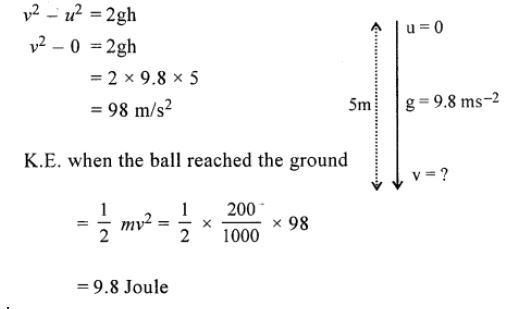
(b)
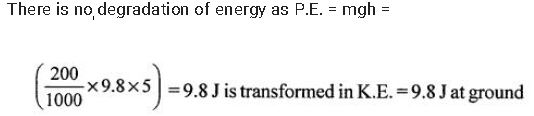
(c) The variation of potential and kinetic energy is as shown. The total energy remains constant.
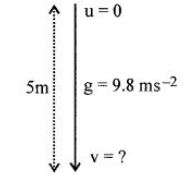
In simple words: A falling ball has 9.8 Joules of kinetic energy at the ground because all of its initial height energy converts to motion energy. In a pendulum, energy keeps sloshing back and forth between height (potential) energy at the ends and motion (kinetic) energy in the middle, but the total sum of energy is always the same.
Exam Tip: When calculating the final kinetic energy of a falling object, you can directly equate it to the initial potential energy \( (mgh) \) if air resistance is neglected, which avoids having to calculate velocity first.
Question 24(a). A ball is placed on a compressed spring. When the spring is released, the ball is observed to fly away.
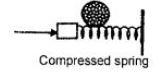
1. What form of energy does the compressed spring possess?
2. Why does the ball fly away ?
Answer:
1. The compressed spring holds **elastic potential energy**.
2. When the spring is released, this stored potential energy is quickly transformed into kinetic energy, which is transferred to the ball, causing it to fly away.
In simple words: The compressed spring holds elastic energy. When you let go, this energy changes into movement energy that pushes the ball away.
Exam Tip: Use the specific term "elastic potential energy" instead of just "potential energy" to be precise.
Question 24(b). (1) State the energy conversion taking place in a solar cell.
(2) Give disadvantage of using a solar cell.
Answer: (1) A solar cell directly converts light energy into electrical energy.
(2) Some primary disadvantages of using solar cells include:
1. They cannot generate electricity during the night or when it is dark.
2. The initial cost of installation is quite high.
3. They have low efficiency, typically converting only around 25% of the incoming light into electricity.
In simple words: Solar cells turn sunlight straight into electricity. Their downsides are that they do not work at night, they are expensive to buy, and they only convert a small fraction of sunlight into power.
Exam Tip: Focus on the lack of power generation at night and low conversion efficiency as highly graded disadvantages.
Question 24(c). A body of mass 0.2 kg falls from a height of 10 m to a height of 6 m above the ground level. Find the loss in potential energy taking place in the body, [g = 10 ms-2]
Answer: Given:
Mass of the body \( (m) = 0.2\text{ kg} \)
Initial height \( (h_1) = 10\text{ m} \)
Final height \( (h_2) = 6\text{ m} \)
Acceleration due to gravity \( (g) = 10\text{ ms}^{-2} \)
The reduction in height \( (\Delta h) \) is:
\( \Delta h = h_1 - h_2 = 10 - 6 = 4\text{ m} \)
Therefore, the loss in potential energy is:
\( \Delta \text{P.E.} = m \times g \times \Delta h \)
\( \implies \Delta \text{P.E.} = 0.2 \times 10 \times 4 = 8\text{ J} \)
The loss in potential energy is \( 8\text{ J} \).
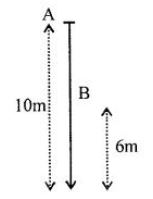
In simple words: The object dropped by 4 meters. By multiplying its mass, gravity, and the 4-meter drop, we find it lost 8 Joules of potential energy.
Exam Tip: Be sure to use the correct unit (Joules) for energy loss and write down the subtraction step clearly.
Question 24(d). A moving body weighing 400 N possesses 500 J of kinetic energy. Calculate the velocity with which the body is moving, (g = 10 ms-2)
Answer: Given:
Weight of the body \( (W) = 400\text{ N} \)
Kinetic Energy \( (\text{K.E.}) = 500\text{ J} \)
Acceleration due to gravity \( (g) = 10\text{ ms}^{-2} \)
First, find the mass \( (m) \) of the body using the weight formula:
\( W = m \times g \)
\( \implies 400 = m \times 10 \)
\( \implies m = \frac{400}{10} = 40\text{ kg} \)
Now, use the kinetic energy formula to calculate velocity \( (v) \):
\( \text{K.E.} = \frac{1}{2} m v^2 \)
\( \implies 500 = \frac{1}{2} \times 40 \times v^2 \)
\( \implies 500 = 20 \times v^2 \)
\( \implies v^2 = \frac{500}{20} = 25 \)
\( \implies v = \sqrt{25} = 5\text{ ms}^{-1} \)
The velocity of the moving body is \( 5\text{ ms}^{-1} \).
In simple words: We find the mass of the body by dividing its weight by gravity, which gives 40 kg. Then, using the kinetic energy formula, we find that the speed is 5 meters per second.
Exam Tip: Pay close attention to the difference between mass and weight. Always divide weight (in N) by gravity to find the mass (in kg) before using kinetic energy equations.
Question 25(a). (a) A force is applied on a body of mass 20 kg moving with a velocity of 40 ms-1. The body attains a velocity of 50ms-1 in 2 seconds. Calculate the work done by the body.
Answer: Given:
Mass \( (m) = 20\text{ kg} \)
Initial velocity \( (u) = 40\text{ ms}^{-1} \)
Final velocity \( (v) = 50\text{ ms}^{-1} \)
Time interval \( (t) = 2\text{ s} \)
Let us find the acceleration \( (a) \) of the body:
\( a = \frac{v - u}{t} = \frac{50 - 40}{2} = 5\text{ ms}^{-2} \)
Now, calculate the distance \( (S) \) covered during this acceleration:
\( S = u t + \frac{1}{2} a t^2 \)
\( \implies S = (40 \times 2) + \left( \frac{1}{2} \times 5 \times 2^2 \right) \)
\( \implies S = 80 + 10 = 90\text{ m} \)
Calculate the force \( (F) \) exerted:
\( F = m \times a = 20 \times 5 = 100\text{ N} \)
Finally, calculate the work done \( (W) \) on the body:
\( W = F \times S = 100 \times 90 = 9000\text{ J} \)
Thus, the work done is \( 9000\text{ J} \).
In simple words: We calculate how fast the object speeds up (acceleration) and how far it travels (90 meters). Then we find the force (100 N) and multiply it by the distance to get a total work done of 9000 Joules.
Exam Tip: You can also verify this answer using the Work-Energy Theorem, where work done equals change in kinetic energy: \( W = \frac{1}{2}m(v^2 - u^2) \).
Question 25(b). A girl of mass 35 kg climbs up from the first floor of a building at a height 4 m above the ground to the third floor at a height 12 m above the ground. What will be the increase in her gravitational potential energy ?(g = 10 ms-2).
Answer: Given:
Mass of the girl \( (m) = 35\text{ kg} \)
Initial height \( (h_1) = 4\text{ m} \)
Final height \( (h_2) = 12\text{ m} \)
Acceleration due to gravity \( (g) = 10\text{ ms}^{-2} \)
The net increase in vertical height \( (h) \) gained by the girl is:
\( h = h_2 - h_1 = 12 - 4 = 8\text{ m} \)
The gain in gravitational potential energy is given by:
\( \Delta \text{P.E.} = mgh \)
\( \implies \Delta \text{P.E.} = 35 \times 10 \times 8 = 2800\text{ J} \)
The increase in her gravitational potential energy is \( 2800\text{ J} \).
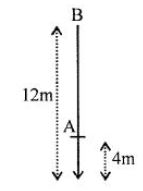
In simple words: The girl went up by 8 meters in total. Multiplying her mass, gravity, and this height difference shows she gained 2800 Joules of height energy.
Exam Tip: Make sure to calculate the difference in heights first to find the net vertical displacement, rather than using the absolute height of the final floor.
Question 25(c). 1. State the Principle of conservation of energy.
2. Name the form of energy which a body may possess even when it is not in motion.
Answer:
1. The principle of conservation of energy states that energy can neither be created nor destroyed; it can only be converted from one form to another.
2. A body can possess **potential energy** (such as gravitational or elastic potential energy) even when it is completely stationary.
In simple words: Energy cannot be made from nothing or destroyed; it can only change its shape. Even when an object is still, it can store height or stretch energy, which is called potential energy.
Exam Tip: Use precise terms like "created", "destroyed", and "transformed" when defining the law of conservation of energy to ensure you hit the standard grading criteria.
Question 26(a). 1. When does a force do work?
2. What is the work done by the moon when it revolves around the earth?
Answer:
1. A force is said to perform work when its application results in the actual movement or displacement of the object in the direction of the force.
2. The work done by the moon as it circles the Earth is zero. This is because the gravitational pull (centripetal force) points toward the center of the orbit, which is perpendicular (at a \( 90^\circ \) angle) to the direction of motion along the tangent of the path. Since \( \cos 90^\circ = 0 \), no work is done.
In simple words: Work is done when a push or pull actually moves an object. The moon does zero work because gravity pulls it sideways (at 90 degrees) to the direction it is traveling.
Exam Tip: When discussing circular orbits, always mention that the angle between the centripetal force and the displacement vector is \( 90^\circ \), which mathematically results in zero work.
Question 26(b). Calculate the change in the Kinetic energy of a moving body if its velocity is reduced to 1/3rd of the initial velocity
Answer: Let the mass of the body be \( m \) and its initial velocity be \( v \).
The initial kinetic energy \( (K_1) \) is:
\( K_1 = \frac{1}{2} m v^2 \)
When the velocity is reduced to one-third, the final velocity is \( \frac{v}{3} \).
The final kinetic energy \( (K_2) \) becomes:
\( K_2 = \frac{1}{2} m \left(\frac{v}{3}\right)^2 \)
\( \implies K_2 = \frac{1}{2} m \left(\frac{v^2}{9}\right) = \frac{1}{9} \left( \frac{1}{2} m v^2 \right) = \frac{1}{9} K_1 \)
Now, we calculate the change (decrease) in kinetic energy \( (\Delta K) \):
\( \Delta K = K_1 - K_2 \)
\( \implies \Delta K = K_1 - \frac{1}{9} K_1 \)
\( \implies \Delta K = K_1 \left( 1 - \frac{1}{9} \right) = \frac{8}{9} K_1 \)
Thus, the kinetic energy decreases by \( \frac{8}{9} \) of its original value.
In simple words: If you slow down to one-third of your speed, your motion energy drops to one-ninth of what it was. This means you lose eight-ninths of your original motion energy.
Exam Tip: Be careful to state whether you are finding the final kinetic energy \( (1/9) \) or the *change* in kinetic energy \( (8/9) \), as exams often ask specifically for the change.
Question 26(c). State the energy changes in the following devices while in use:
1. A loud speaker.
2. A glowing electric bulb.
Answer:
1. In a loudspeaker, **electrical energy** is transformed into **sound energy** (with a small amount of heat energy dissipated).
2. In a glowing electric bulb, **electrical energy** is converted into **light energy** and **heat energy**.
In simple words: A loudspeaker turns electrical signals into sound waves. A lightbulb turns electricity into light and warmth.
Exam Tip: Make sure to list both light and heat for the electric bulb, as standard bulbs always produce both.
Question 26(d). The conversion of part of the energy into an undesirable form is called
Answer: The transformation of a portion of energy into an unwanted or non-useful form is termed as the **dissipation of energy** (or degradation of energy).
In simple words: When some energy gets turned into useless forms like friction or waste heat, it is called energy dissipation.
Exam Tip: "Dissipation" and "degradation" are the key scientific terms used to describe lost or wasted energy.
Question 27(a). A man having a box on his head, climbs up a slope and another man having identical box walks the same distance on a leveled road. Who does more work against the force of gravity and why ?
Answer: The man who walks up the slope does more work against gravity. This is because he experiences vertical displacement, moving upward against the downward gravitational force. Conversely, the man walking on the flat, level road moves horizontally, making his displacement perpendicular (\( 90^\circ \)) to the force of gravity, which results in zero work being done against gravity.
In simple words: The man climbing the hill is actually lifting the box higher, which takes work against gravity. The man on the flat road is moving sideways to gravity, so he does no work against it.
Exam Tip: Always specify that work against gravity is only done when there is vertical displacement in the direction opposite to the gravitational pull.
Question 27(b). A body is thrown vertically upward. Its velocity keeps on decreasing. What happens to its kinetic energy as its velocity becomes zero ?
Answer: As the object travels upward, its kinetic energy is gradually converted into gravitational potential energy. At the highest point where the velocity becomes zero, the kinetic energy is completely converted into potential energy, which reaches its maximum value.
In simple words: When you throw something up, it slows down because its motion energy is turning into height energy. When it stops at the very top, all of its motion energy has turned into potential energy.
Exam Tip: State clearly that at the maximum height, kinetic energy becomes zero while potential energy becomes maximum.
Question 28(a). How is work done by a force measured when the force:
1. is in the direction of displacement?
2. is in an angle to the direction of displacement?
Answer:
1. When the force acts parallel to the displacement \( (\theta = 0^\circ) \), we have \( \cos 0^\circ = 1 \). The work done is at its maximum positive value and is calculated as:
\( W = F \times S \)
2. When the force acts at an angle \( \theta \) relative to the displacement direction, the work done is the product of the component of force along the displacement and the displacement itself:
\( W = F \cos\theta \times S \)
In simple words: If you push in the exact direction of movement, work is just force times distance. If you push at an angle, you have to multiply by the cosine of that angle to find the effective work.
Exam Tip: Write down both mathematical expressions clearly, defining \( F \) as force, \( S \) as displacement, and \( \theta \) as the angle between them.
Question 28(b). State the energy in the following while in use:
1. Burning of a candle.
2. A steam engine.
Answer:
1. **Burning of a candle:** Converts the stored **chemical energy** of the wax into **light energy** and **heat energy**.
2. **A steam engine:** First converts the **chemical energy** of coal into **heat energy** of steam, which is then transformed into **mechanical energy** to drive the engine.
In simple words: A candle turns chemical energy into light and heat. A steam engine turns the energy of burning coal into steam heat, which then turns into movement.
Exam Tip: For multi-step conversions like the steam engine, outlining the full path (chemical - heat - mechanical) shows a deeper understanding.
Question 28(c). (1) A scissor is a_________ multiplier
(2) 1 kWh =________ J.
Answer: (1) A pair of scissors acts as a **speed** (or force) multiplier, depending on the length of the blades relative to the handles. According to the textbook key, it is classified as a **force** multiplier.
(2) \( 1\text{ kWh} = 3.6 \times 10^6\text{ J} \)
*Working for conversion:*
\( 1\text{ kWh} = 1000\text{ W} \times 3600\text{ s} \)
\( \implies 1\text{ kWh} = 3,600,000\text{ J} = 3.6 \times 10^6\text{ J} \)
In simple words: Scissors multiply speed or force depending on how they are shaped. One kilowatt-hour of energy equals exactly 3.6 million Joules.
Exam Tip: Be ready to show the derivation of \( 1\text{ kWh} \) by multiplying \( 1000\text{ W} \) by \( 3600\text{ s} \) to get \( 3.6 \times 10^6\text{ J} \).
Question 28(d). Rajan exerts a force of 150 N in pulling a cart at a constant speed of 10 m/s. Calculate the power exerted.
Answer: Given:
Exerted force \( (F) = 150\text{ N} \)
Constant velocity \( (v) = 10\text{ ms}^{-1} \)
We use the power formula involving force and speed:
\( \text{Power } (P) = F \times v \)
\( \implies P = 150 \times 10 = 1500\text{ W} \)
Thus, the power exerted is \( 1500\text{ W} \) (or \( 1.5\text{ kW} \)).
In simple words: Power can be found by multiplying force and speed. Multiplying 150 Newtons by 10 meters per second gives 1500 Watts of power.
Exam Tip: Always include the correct unit, which is Watts (W) or kilowatts (kW), in your final answer.
Question 29. (a) Name the physical quantity measured in terms of horse power.
(b) A nut is opened by a wrench of length 20 cm. If the least force required is 2N, find the moment of force needed to loosen the nut.
(c) Explain briefly why the work done by a fielder when he takes a catch in a cricket match is negative.
Answer: (a) **Power** is the physical quantity that is measured in horsepower (HP).
(b) Given:
Length of the wrench (effort arm) \( (d) = 20\text{ cm} = 0.2\text{ m} \)
Minimum applied force \( (F) = 2\text{ N} \)
The moment of force is calculated as:
\( \text{Moment of Force} = F \times d \)
\( \implies \text{Moment of Force} = 2 \times 0.2 = 0.4\text{ N m} \)
The required moment of force to loosen the nut is \( 0.4\text{ N m} \).
(c) When a fielder catches a cricket ball, the force exerted by the hands to stop the ball is directed opposite to the ball's motion (displacement). Since the angle \( \theta \) between the force and the displacement is \( 180^\circ \), the work done is negative:
\( W = F \times S \times \cos 180^\circ = -F \times S \)
In simple words: Horse power measures power. To turn a nut, we multiply the force (2 N) by the length of the wrench in meters (0.2 m) to get 0.4 N-m. When catching a ball, the fielder pushes against the ball's movement, making the work negative.
Exam Tip: Convert the length of the wrench from centimeters to meters before calculating the moment of force. Always specify that \( \cos 180^\circ = -1 \) to justify the negative sign of work.
Question 30. A boy weighing 40 kgf climbs up a stair of 30 steps each 20 cm high 4 minutes and a girl weighing 30 kgf does the same in 3 minutes compare
(a) Work done by them
(b) Power developed by them
Answer: First, let us calculate the total height of the stairs:
Number of steps = 30
Height of each step = 20 cm = 0.2 m
Total height \( (h) = 30 \times 0.2\text{ m} = 6\text{ m} \)
Given details:
**For the boy:**
Force (weight) \( (F_b) = 40\text{ kgf} = 400\text{ N} \) (taking \( g = 10\text{ m s}^{-2} \))
Time taken \( (t_b) = 4\text{ minutes} = 4 \times 60 = 240\text{ s} \)
**For the girl:**
Force (weight) \( (F_g) = 30\text{ kgf} = 300\text{ N} \)
Time taken \( (t_g) = 3\text{ minutes} = 3 \times 60 = 180\text{ s} \)
**(a) Comparing the work done:**
Work done by the boy \( (W_b) = F_b \times h = 400\text{ N} \times 6\text{ m} = 2400\text{ J} \)
Work done by the girl \( (W_g) = F_g \times h = 300\text{ N} \times 6\text{ m} = 1800\text{ J} \)
Comparing their work:
\( \frac{W_b}{W_g} = \frac{2400}{1800} = \frac{4}{3} \)
So, the ratio of work done is \( 4 : 3 \).
**(b) Comparing the power developed:**
Power developed by the boy \( (P_b) = \frac{W_b}{t_b} = \frac{2400}{240} = 10\text{ W} \)
Power developed by the girl \( (P_g) = \frac{W_g}{t_g} = \frac{1800}{180} = 10\text{ W} \)
Comparing their power:
\( \frac{P_b}{P_g} = \frac{10}{10} = \frac{1}{1} \)
So, the ratio of power developed is \( 1 : 1 \).
In simple words: The boy does more work because he weighs more, so their work ratio is 4:3. However, because the girl climbed faster, they both generated the exact same amount of power, making the power ratio 1:1.
Exam Tip: When comparing quantities, write down the final ratios in simplified forms (like 4:3 and 1:1) to clearly complete the comparison.
Free study material for Physics
ICSE Goyal Brothers Solutions Class 10 Physics Chapter 2 Work Power And Energy
Students can now access the detailed Goyal Brothers Solutions for Chapter 2 Work Power And Energy on our portal. These solutions have been carefully prepared as per latest ICSE Class 10 syllabus. Each solution given above has been updated based on the current year pattern to ensure Class 10 students have the most updated Physics content.
Master Goyal Brothers Textbook Questions
Our subject experts have provided detailed explanations for all the questions found in the Goyal Brothers textbook for Class 10 Physics. We have focussed on making the concepts easy for you in Chapter 2 Work Power And Energy so that students can understand the concepts behind every answer. For all numerical problems and theoretical concepts these solutions will help in strengthening your analytical skill required for the ICSE examinations.
Complete Physics Exam Preparation
By using these Goyal Brothers Class 10 solutions, you can enhance your learning and identify areas that need more attention. We recommend solving the Physics Questions from the textbook first and then use our teacher-verified answers. For a proper revision of Chapter 2 Work Power And Energy, students should also also check our Revision Notes and Sample Papers available on studiestoday.com.
FAQs
You can download the verified Goyal Brothers solutions for Chapter 2 Work Power And Energy on StudiesToday.com. Our teachers have prepared answers for Class 10 Physics as per 2026-27 ICSE academic session.
Yes, our solutions for Chapter 2 Work Power And Energy are designed as per new 2026 ICSE standards. 40% competency-based questions required for Class 10, are included to help students understand application-based logic behind every Physics answer.
Yes, every exercise in Chapter 2 Work Power And Energy from the Goyal Brothers textbook has been solved step-by-step. Class 10 students will learn Physics conceots before their ICSE exams.
Yes, follow structured format of these Goyal Brothers solutions for Chapter 2 Work Power And Energy to get full 20% internal assessment marks and use Class 10 Physics projects and viva preparation as per ICSE 2026 guidelines.