

Refer to CBSE Class 12 Economics HOTs All Chapters Set 02. We have provided exhaustive High Order Thinking Skills (HOTS) questions and answers for Class 12 Economics All Chapters. Designed for the 2026-27 exam session, these expert-curated analytical questions help students master important concepts and stay aligned with the latest CBSE, NCERT, and KVS curriculum.
All Chapters Class 12 Economics HOTS with Solutions
Practicing Class 12 Economics HOTS Questions is important for scoring high in Economics. Use the detailed answers provided below to improve your problem-solving speed and Class 12 exam readiness.
HOTS Questions and Answers for Class 12 Economics All Chapters
One Mark Questions (1M)
Question 1. What is opportunity cost?
Answer: Opportunity cost means the value of the second-best choice that is given up.
In simple words: It is what you lose when you choose one thing over another.
Exam Tip: Always use the term 'next best alternative' in your answer as it is a key term evaluated by examiners.
Question 2. Define Marginal rate of transformation.
Answer: It represents the quantity of one item that has to be sacrificed to create one extra unit of another item. This concept is also called marginal opportunity cost.
In simple words: It shows how many of one thing you must stop making to make one more of something else.
Exam Tip: Remember that MRT is the slope of the Production Possibility Curve (PPC), which explains its concave shape.
Question 3. Give two examples of Micro economic variables/ studies.
Answer:
a. Demand of a single consumer
b. Savings of a single person
In simple words: Microeconomics looks at small, individual parts of the economy rather than the whole country.
Exam Tip: Always provide examples related to a single unit, consumer, or firm to illustrate microeconomic concepts.
Question 4. Why does an economic problem arise?
Answer: This happens because human desires are endless while the means to satisfy them are scarce.
In simple words: We have too many wants but not enough resources to get everything we want.
Exam Tip: Incorporate the terms 'unlimited wants' and 'scarce resources' to secure full marks.
Question 5. What is meant by inferior goods in economics?
Answer: Inferior products are those items where buying decreases when a buyer's earnings go up.
In simple words: These are cheap goods that you buy less of when you get richer, like local brand items.
Exam Tip: Contrast inferior goods with normal goods to show a deeper understanding of income elasticity.
Question 6. Define budget line.
Answer: A budget line displays all possible pairs of two items that a buyer is able to purchase using their funds at current market rates.
In simple words: It is a line that shows all the different things you can buy with the exact amount of money you have.
Exam Tip: Be sure to mention that the prices of both goods and the consumer's income are assumed to be constant.
Question 7. What is a demand schedule?
Answer: This is a table illustrating the various amounts of a product purchased at multiple price points.
In simple words: It is a chart that lists how much people will buy of something at different prices.
Exam Tip: State clearly that it shows an inverse relationship between price and quantity demanded.
Question 8. Define normal goods.
Answer: Normal items are those products where purchase rates go up as a buyer's earnings increase.
In simple words: These are regular things you buy more of when you have more money, like better clothes.
Exam Tip: Mention that normal goods have a positive income elasticity of demand.
Question 9. Define indifference curve.
Answer: It illustrates different pairings of two products that offer an identical degree of happiness to the buyer.
In simple words: It is a line on a graph showing different choices of two things that make you equally happy.
Exam Tip: Specify that any point along an indifference curve yields the same utility to the consumer.
Question 10. Define price elasticity of demand.
Answer: Price elasticity of demand represents how much the quantity purchased changes when the price fluctuates.
\[ E_d = \frac{\Delta Q}{\Delta P} \times \frac{P}{Q} \]
In simple words: It measures how sensitive customers are to price changes.
Exam Tip: Always include the mathematical formula to get full credit for this definition.
Question 11. Define production function.
Answer: This term describes the technical link connecting raw resources to final goods.
In simple words: It is the mathematical rule that shows how many inputs you need to make a certain amount of output.
Exam Tip: Emphasize that it is a physical or technical relationship, not a monetary one.
Question 12. Define Marginal physical product.
Answer: It means the extra output contributed to the total production by employing an extra unit of input.
In simple words: It is the extra amount of stuff you make when you hire one more worker or add one more machine.
Exam Tip: Note that it is calculated as \( MPP_n = TPP_n - TPP_{n-1} \).
Question 13. Define revenue.
Answer: It means the entire cash earnings received from selling a business's goods.
In simple words: It is all the money a business brings in by selling its products.
Exam Tip: Do not confuse revenue with profit; revenue does not subtract the costs of production.
Question 14. Define marginal revenue.
Answer: It signifies the extra earnings generated by selling one additional unit of output.
In simple words: It is the extra money a business makes from selling just one more item.
Exam Tip: In perfect competition, marginal revenue is equal to price (\( MR = P \)).
Question 15. Why is the ATC greater than AVC
Answer: Average Total Cost exceeds Average Variable Cost because it consists of both Average Variable Cost and Average Fixed Cost.
In simple words: Total cost includes fixed costs (like rent) and variable costs (like materials), so average total cost is always higher than average variable cost.
Exam Tip: You can write the formula \( ATC = AVC + AFC \) to clearly show why ATC must be higher than AVC.
Question 16. Define fixed cost.
Answer: Fixed costs represent expenses that do not change when the level of production varies, such as building rent.
In simple words: These are costs you have to pay even if you make zero products, like rent for your factory.
Exam Tip: Remember that fixed costs are only relevant in the short run; in the long run, all costs are variable.
Question 17. Define equilibrium price.
Answer: Equilibrium price represents the specific market rate where customer demand perfectly balances seller supply.
In simple words: It is the perfect price where the number of items buyers want to buy is exactly the same as the number of items sellers want to sell.
Exam Tip: Highlight that at this price, there is neither a shortage nor a surplus in the market.
Question 18. In which market form the products are differentiated.
Answer: The market structure known as monopolistic competition features differentiated products.
In simple words: Products are slightly different from each other in monopolistic competition, like different brands of soap.
Exam Tip: Product differentiation is a key feature of monopolistic competition that gives firms some control over price.
Question 19. In which market form a firm is a price taker?
Answer: A firm acts as a price taker under perfect competition.
In simple words: In perfect competition, there are so many sellers that no single shop can change the price.
Exam Tip: Under perfect competition, the firm's demand curve is perfectly elastic (horizontal).
Question 20. Why is demand curve under oligopoly indeterminate (uncertain)?
Answer: The demand curve remains uncertain due to intense pricing conflicts among rival firms.
In simple words: In oligopoly, businesses compete so closely and change prices so often that it is hard to predict what customers will buy.
Exam Tip: Mention that the high level of interdependence among a few large sellers is the root cause of this indeterminacy.
Question 21. Define Macro Economics?
Answer: Macroeconomics analyzes the national financial system in its entirety.
In simple words: It is the study of the big picture of the economy, like a whole country's money, instead of just one person.
Exam Tip: Key topics in macroeconomics include national income, inflation, and total employment.
Question 22. What is an Economic Territory?
Answer: This term represents the geographic region of a nation where products, workers, and money can circulate without restrictions.
In simple words: It is the area where people, goods, and money can move around freely within a country.
Exam Tip: Note that economic territory is wider than just geographical boundaries and includes embassies and military bases abroad.
Question 23. Who is a normal resident?
Answer: An individual or organization residing in a nation with their primary economic activities centered there is termed a normal resident.
In simple words: A normal resident is a person or business that lives in a country and does most of their spending and earning there.
Exam Tip: The period of stay should generally be one year or more for an individual to be considered a normal resident.
Question 24. Is transfer income included in national income? Why?
Answer: It is excluded since transfer payments do not correspond to the actual creation of any goods or services.
In simple words: No, because transfer income is just a gift or free money (like pocket money or charity) and doesn't come from producing anything new.
Exam Tip: Examples of transfer income include old-age pensions and scholarships, which are never counted in GDP calculations.
Question 25. What is meant by Cash Reserve Ratio (CRR)?
Answer: This refers to the portion of total deposits that commercial banks must keep as reserves with the central bank.
In simple words: It is the slice of bank deposits that banks must keep safe with the central bank and cannot lend out.
Exam Tip: CRR is a powerful quantitative credit control tool used by the central bank to manage inflation.
Question 26. What is meant by Bank rate?
Answer: This is the interest rate at which the country's central monetary authority provides loans to commercial banks.
In simple words: It is the interest rate that the main bank of the country charges smaller banks when they borrow money.
Exam Tip: An increase in bank rate is used to control inflation by making loans more expensive for consumers.
Question 27. What is meant by double coincidence of wants?
Answer: This occurs when two individuals each possess an item that the other person wants to acquire, allowing for a direct trade.
In simple words: It means you have what I want, and I have what you want, so we can swap directly without money.
Exam Tip: This is a fundamental requirement of the barter system, which makes transactions highly inefficient.
Question 28. What is legal tender money?
Answer: Any currency officially designated by law as an authorized means of trade is defined as legal tender.
In simple words: It is cash that the government says everyone must accept as payment for things by law.
Exam Tip: Legal tender can be limited (coins up to a certain value) or unlimited (currency notes).
Question 29. Define involuntary unemployment.
Answer: Involuntary unemployment describes a state where individuals who are ready and able to work cannot find employment.
In simple words: It is when people want a job and are able to work, but simply cannot find one.
Exam Tip: Make sure to mention 'at the existing wage rate' as it is a crucial element of this economic definition.
Question 30. What is the relationship between MPC and MPS?
Answer: The sum of the marginal propensity to consume and the marginal propensity to save is equal to one.
\( MPC + MPS = 1 \)
In simple words: Every extra rupee you get is either spent or saved, so the two parts always add up to one.
Exam Tip: Always write the equation \( MPC + MPS = 1 \) clearly in your response.
Question 31. What is meant by excess demand (inflationary gap)?
Answer: Excess demand arises when total planned expenditure exceeds total output during full employment conditions.
In simple words: It is when people want to buy more things than the economy can actually make when everyone has a job.
Exam Tip: This gap leads to a rise in general price levels without increasing the physical output of the economy.
Question 32. What is deficient demand (deflationary gap)?
Answer: Deficient demand happens when aggregate spending falls short of total productive capacity at full employment.
In simple words: It is when people do not buy enough stuff, leaving businesses with unsold items even though there are workers ready to make more.
Exam Tip: Deficient demand leads to unemployment and a fall in prices, creating a deflationary spiral.
Question 33. What is meant by autonomous investment?
Answer: This is capital spending that is carried out independently of any expected business profits.
In simple words: It is money spent on projects (usually by the government) that doesn't care about making a profit, like building roads.
Exam Tip: Autonomous investment is represented as a horizontal line parallel to the X-axis on a graph.
Question 34. Define multiplier.
Answer: The investment multiplier represents the proportion of income growth relative to an initial increase in capital spending.
\( k = \frac{\Delta Y}{\Delta I} \)
In simple words: It shows how many times more national income will grow when a business spends some extra money on investment.
Exam Tip: State that the value of the multiplier depends directly on the Marginal Propensity to Consume (\( k = \frac{1}{1-MPC} \)).
Question 35. Define government budget.
Answer: A national budget displays the projected income and planned spending of the state for a single fiscal year.
In simple words: It is the government's plan showing how much money it expects to collect and spend over the next year.
Exam Tip: Always mention that the budget is prepared for a specific financial year (usually April 1 to March 31 in India).
Question 36. Define revenue deficit in government budget.
Answer: A revenue deficit occurs when regular day-to-day government spending exceeds the government's recurring income.
\( \text{Revenue Deficit} = \text{Revenue Expenditure} > \text{Revenue Receipts} \)
In simple words: It is when the government spends more on its everyday running costs than it brings in from taxes and other daily incomes.
Exam Tip: Revenue deficit does not include any capital transactions like building roads or selling assets.
Question 37. What is primary deficit?
Answer: Primary deficit represents the total fiscal deficit after subtracting the interest charges owed on previous borrowings.
\( \text{Primary Deficit} = \text{Fiscal Deficit} - \text{Interest Payments} \)
In simple words: It is the amount the government needs to borrow this year, not counting the interest it has to pay on old loans.
Exam Tip: A zero primary deficit means the government only needs to borrow to pay off interest on old debts.
Question 38. What is fiscal deficit?
Answer: A fiscal deficit occurs when overall state expenditure exceeds total government revenues, not including any loans taken.
\[ \text{Fiscal Deficit} = \text{Total Expenditure} - \text{Total Receipts (excluding borrowings)} \]
In simple words: It is the total amount of extra money the government needs to borrow to cover its spending for the year.
Exam Tip: Remember that the fiscal deficit is equal to the total borrowing requirements of the government.
Question 39. What is meant by foreign exchange rate?
Answer: The foreign exchange rate represents the price of one nation's currency in terms of another country's currency.
In simple words: It is how much of your country's money you need to trade for one unit of another country's money.
Exam Tip: It can be determined by market forces (flexible) or set by the government (fixed).
Question 40. Name the two accounts in the balance of payments
Answer:
a. Current Account: This records the trade of goods, services, and unilateral transfer receipts.
b. Capital Account: This tracks the changes in national ownership of foreign and domestic assets and debts.
In simple words: The current account tracks daily trade and gifts, while the capital account tracks assets, investments, and loans.
Exam Tip: Be sure to list both accounts clearly and describe their distinct functions in international trade.
Question 41. Why a production possibility curve is concave?
Answer: This shape is caused by a rising marginal opportunity cost as production expands.
In simple words: As you make more of one item, you have to give up more and more of the other item, which curves the line.
Exam Tip: Specify that the Marginal Rate of Transformation (MRT) rises because resources are not equally efficient in producing all goods.
Question 42. What is primary deficit?
Answer: Primary deficit equals the total fiscal deficit minus interest costs.
In simple words: It is the current year's budget gap before we add the interest we owe on past debts.
Exam Tip: This question appears twice in the document, which emphasizes its high importance in board exams.
Question 43. What is revenue deficit?
Answer: This occurs when daily operational spending exceeds standard operational revenues.
In simple words: It is when a government's everyday bills are higher than the regular taxes it collects.
Exam Tip: A revenue deficit indicates that the government is dissaving and living beyond its means.
Question 44. A rise in the price of a goods, results in an increase in expenditure on it. Is its demand elastic or inelastic?
Answer: The demand is inelastic because spending moves in the same direction as the price change.
In simple words: It is inelastic because even though the price went up, people still need it so much that they spend more money on it anyway.
Exam Tip: When price and total expenditure move in the same direction, elasticity of demand is less than 1.
Question 45. What is consumption function?
Answer: The functional link between national income and household spending is known as the consumption function.
In simple words: It is a rule that shows how much money families spend based on how much income they earn.
Exam Tip: Write the equation \( C = c + bY \) to demonstrate consumption function components.
Question 46. What is saving function?
Answer: The direct economic connection between national income and aggregate savings is referred to as the saving function.
In simple words: It is a rule that shows how much money people save out of their total earnings.
Exam Tip: The saving function is the counterpart of the consumption function and can be written as \( S = -a + (1-b)Y \).
Question 47. What is Barter system?
Answer: A trade network where products are directly swapped for other products is called a barter system.
In simple words: It is trading items directly for other items without using any paper money or coins.
Exam Tip: Mention that the lack of a common unit of value is a major drawback of this system.
Question 48. Define APC?
Answer: The Average Propensity to Consume (\( APC = \frac{C}{Y} \)) measures total household spending divided by total income.
In simple words: It is the percentage of your total income that you spend instead of saving.
Exam Tip: Note that APC can be greater than 1 at low income levels due to dissaving.
Question 49. Define APS?
Answer: The Average Propensity to Save (\( APS = \frac{S}{Y} \)) represents total savings divided by total national income.
In simple words: It is the fraction of your total earnings that you put away for the future.
Exam Tip: Unlike APC, APS can never be equal to or greater than 1 because savings cannot exceed total income.
Question 50. What is excess demand?
Answer: This happens when aggregate demand exceeds aggregate supply during full employment.
In simple words: It is when people want to buy more goods than the economy is fully capable of producing.
Exam Tip: Understand that excess demand creates an inflationary gap and puts upward pressure on prices.
Question 51. What is deficient demand?
Answer: This occurs when aggregate demand is lower than aggregate supply at the point of full employment.
In simple words: It is when buyers don't want as many goods as factories can make, leading to leftover items and job losses.
Exam Tip: Deficient demand results in a deflationary gap and leads to involuntary unemployment.
Question 52. A rise in the income of the consumer X leads t a fall in the demand for that good by the consumer .What is the good X called?
Answer: This type of product is called an inferior good.
In simple words: An inferior good is something you buy less of when your income increases because you can now afford nicer options.
Exam Tip: Double check the definition of inferior goods to avoid confusing them with normal goods under income changes.
Question 53. When demand for good falls due to rise in its own price. What is the change in demand called?
Answer: This reaction is known as a contraction of demand.
In simple words: When the price of an item goes up and people buy less of it, we call it a contraction of demand.
Exam Tip: A contraction of demand is represented by upward movement along the same demand curve, not a shift of the curve.
Question 54. What happens when demand and supply curve don’t intersect each other?
Answer: This indicates an economically non-viable industry where production cost is too high.
In simple words: It means that the product is too expensive to make, and buyers aren't willing to pay that much, so the business cannot survive.
Exam Tip: In a non-viable industry, the minimum supply price exceeds the maximum demand price at all quantities.
Question 55. What is abnormal profit?
Answer: Abnormal profit refers to any financial gains achieved beyond the baseline level of normal profit.
In simple words: It is extra-high profit that a business makes on top of the basic amount needed to stay open.
Exam Tip: Also known as supernormal profit, this usually occurs when a firm has market power or faces little competition.
Question 56. What is break- even price?
Answer: This is the price level where a firm earns zero supernormal profit, meaning it just covers its total expenses.
In simple words: It is the exact price where a shop just covers all its costs without making any extra money.
Exam Tip: At the break-even price, the price is equal to the minimum average total cost (\( P = min(ATC) \)).
Question 57. What is cartel?
Answer: A cartel is a union of independent businesses that agree to fix production levels and pricing to simulate a monopoly.
In simple words: It is a group of companies that work together like a team to set high prices so they don't have to compete.
Exam Tip: OPEC is a classic real-world example of a cartel that controls oil supplies and prices globally.
Question 58. What are patent rights?
Answer: These are legal protections and exclusive permissions given to a creator to manufacture a specific item or employ a unique method.
In simple words: It is an official government permit that stops other people from copying your invention or product.
Exam Tip: Patents act as a barrier to entry, helping firms maintain monopoly power for a limited time.
Question 59. What are advertising costs/persuasive advertising?
Answer: Advertising costs represent the money spent by a business to convince buyers that their brand is superior to competitors.
In simple words: It is the money a business spends on ads to convince people that their product is the best one to buy.
Exam Tip: Persuasive advertising is heavily used in monopolistic competition to build brand loyalty and differentiate products.
Question 60. What is induced investment?
Answer: This represents capital spending that is directly driven by the goal of earning financial profits.
In simple words: It is investment done by private businesses to make more money when the economy is doing well.
Exam Tip: Induced investment rises when national income increases, meaning it is income-elastic.
Question 61. What is autonomous /public investment?
Answer: This is capital expenditure that is undertaken without any primary expectation of financial return.
In simple words: It is money spent on public facilities like schools and roads without caring about making a profit.
Exam Tip: This type of investment is usually made by the government to improve public welfare.
Question 62. What is linear consumption function?
Answer: A linear consumption function is an equation representing spending based on a fixed marginal propensity to consume.
\( C = \bar{c} + bY \)
Where \( \bar{c} \) = autonomous consumption, and \( b \) = marginal propensity to consume.
In simple words: It is a straight-line rule showing that your spending increases by the same fixed fraction every time your income grows.
Exam Tip: The constant slope of this function is equal to the marginal propensity to consume (\( b \)).
Question 63. What is the relationship between APC and APS?
Answer: The total of average propensity to consume and average propensity to save always equals one.
\( APC + APS = 1 \)
In simple words: Since your entire income is either spent or saved, the fraction spent and the fraction saved must add up to 100%.
Exam Tip: Write the equation \( APC + APS = 1 \) and remember that it holds true at all levels of income.
Question 64. What is the relationship between MPC and MPS?
Answer: The sum of the marginal propensity to consume and the marginal propensity to save is constantly equal to one.
\( MPC + MPS = 1 \)
In simple words: Every single extra rupee you earn is either spent or saved, so those two shares must add up to one.
Exam Tip: Use the formula \( MPS = 1 - MPC \) to find savings behavior from consumption data.
Question 65. What is the relationship between multiplier and MPC?
Answer: The investment multiplier shares a positive and direct relationship with the marginal propensity to consume.
\( k = \frac{1}{1-MPC} \)
In simple words: The more of your extra income you spend rather than save, the more times the money goes around and boosts the economy.
Exam Tip: If MPC is high, the multiplier \( k \) will be larger, leading to a greater expansion of national income.
Question 66. What is multiplier?
Answer: The multiplier is the factor by which an initial change in investment is multiplied to find the final change in national income.
In simple words: It is a number that tells us how much extra national income we get for every rupee we invest.
Exam Tip: Express this as the ratio of change in income to the change in investment: \( k = \frac{\Delta Y}{\Delta I} \).
Question 67. What is fiscal deficit?
Answer: A fiscal deficit occurs when total government spending (revenue plus capital expenditure) exceeds total receipts (revenue plus capital receipts) excluding borrowings.
\( \text{Fiscal Deficit} = \text{Total Expenditure (RE + CE)} - \text{Total Receipts (RR + CR) excluding borrowings} \)
In simple words: It is when the government's total spending is bigger than all the money it collects (without counting the money it borrows).
Exam Tip: Make sure to write out the abbreviations clearly as Revenue Expenditure (RE), Capital Expenditure (CE), Revenue Receipts (RR), and Capital Receipts (CR).
Question 68. What does fiscal deficit in govt. budget mean?
Answer: It represents the total loan and debt requirements that the government must secure to balance its budget.
In simple words: It tells us exactly how much money the government has to borrow from banks or other countries to pay its bills.
Exam Tip: A high fiscal deficit indicates a greater debt burden and potential inflation risks for the country.
Question 69. What is deficit budget?
Answer: A deficit budget arises when the government's total planned expenditures exceed its total estimated receipts.
In simple words: It is a budget plan where the government plans to spend more money than it expects to collect.
Exam Tip: A deficit budget can be used as a fiscal tool to stimulate the economy during a recession.
Question 70. What is surplus budget?
Answer: A surplus budget is achieved when the government's total estimated revenue is greater than its total planned spending.
In simple words: It is a budget plan where the government brings in more money from taxes than it plans to spend.
Exam Tip: A surplus budget is useful for controlling inflation by reducing the amount of money circulating in the economy.
Question 71. Why borrowing treated as capital receipts?
Answer: Loans are classified as capital receipts because they create a financial obligation or liability for the government.
In simple words: Borrowing is a capital receipt because the government has to pay this money back in the future, creating a debt.
Exam Tip: Capital receipts either create a liability or cause a reduction in the assets of the government.
Question 72. Why payment of interest treated as revenue expenditure?
Answer: Interest payments are classified as revenue expenditures because they do not reduce any existing government liabilities.
In simple words: Paying interest is a regular expense because it doesn't pay off the original loan itself, so the debt remains.
Exam Tip: Revenue expenditure neither creates any assets nor reduces any liabilities of the government.
Question 73. What is factor market?
Answer: This market comprises the essential resources for production, specifically land, workers, capital, and enterprise.
In simple words: It is the market where businesses buy or rent the basic things they need to make products, like land, labor, and machinery.
Exam Tip: In the circular flow of income, households supply factors of production to firms in the factor market.
Question 74. Define product market?
Answer: A product market is where completed goods and finished services are bought and sold.
In simple words: It is the regular market where consumers buy finished goods like food, clothes, or haircuts.
Exam Tip: In this market, firms act as sellers and households act as buyers of goods and services.
Question 75. What is the alternative name of micro economics?
Answer: Microeconomics is also known as Price Theory.
In simple words: Another name for microeconomics is price theory, because it studies how prices of individual goods are decided.
Exam Tip: It is called price theory because it focuses on how prices of goods and factors are determined in the market.
Question 76. What is the alternative name of macroeconomics?
Answer: Macroeconomics is alternatively called Income and Employment Theory.
In simple words: Macroeconomics is also called income theory because it studies how a country's total income and jobs are decided.
Exam Tip: It is referred to as income theory because its primary focus is explaining the determination of national income and employment levels.
Question 77. Why is change in stock is considered a part of final expenditure?
Answer: Unsold goods remaining with manufacturers are treated as if the businesses bought them themselves. Consequently, this is classified as producer investment spending.
In simple words: Leftover goods are counted as if the factory bought them from itself to keep in storage, which counts as investing in its own stock.
Exam Tip: Change in stock is calculated as closing stock minus opening stock and is added to gross capital formation.
Question 78. The balance of trade shows a deficit of Rs. 300 crore. The values of exports are Rs. 500 crore. What is the value of imports?
Answer: We know that the Balance of Trade is calculated as Export minus Import. Since there is a trade deficit, the balance is represented as negative:
\( \text{Balance of Trade} = \text{Export} - \text{Import} \)
\( -300 = 500 - \text{Import} \)
\( \implies \text{Import} = 500 + 300 \)
\( \implies \text{Import} = 800 \text{ crore} \)
Thus, the total value of imports is Rs. 800 crore.
In simple words: When a country spends more on buying goods from outside than it earns from selling them, it has a trade deficit. Here, since the gap is Rs. 300 crore and exports are Rs. 500 crore, imports must be Rs. 800 crore.
Exam Tip: Always remember that a deficit in the balance of trade means imports are greater than exports, so the deficit amount is added to exports to find total imports.
Question 79. Why does an economic problem arises?
Answer: This issue occurs because of:
1) Scarcity of resources.
2) Alternative choices for resource usage.
3) Limitless wants along with restricted resources.
In simple words: We have unlimited desires but only a limited amount of resources (like time and money) to satisfy them. Because these resources can also be used in different ways, we must make choices, which creates an economic problem.
Exam Tip: In your answers, always list all three reasons—scarcity, alternative uses, and unlimited wants—as these are the core pillars of any economic issue.
Question 80. Define opportunity cost?
Answer: This refers to the value of the next best alternative that is given up.
In simple words: Opportunity cost is what you have to give up to get something else. For example, if you choose to study instead of watching a movie, the movie is your opportunity cost.
Exam Tip: Be sure to include the word "next best" or "foregone" when defining opportunity cost, as examiners look for this key phrase.
Question 81. What was rightward shift of PPC indicate?
Answer: This represents an increase in available resources or progress in production technology.
In simple words: A shift to the right means the economy can now make more goods because it has gained more resources or better technology.
Exam Tip: State clearly that a rightward shift represents economic growth, either through an increase in resources or advancement in technology.
Question 82. What does leftward shift of PPC indicate?
Answer: This shows the inefficient use or underutilization of resources.
In simple words: A shift to the left means the economy's ability to produce goods has gone down, or resources are not being used fully.
Exam Tip: Remember that a shift of the boundary itself usually means a change in capacity, whereas operating inside the boundary represents underutilization.
Question 83. What is production function?
Answer: The physical relationship linking inputs and outputs for a business is known as the production function.
In simple words: It is a formula that shows how much output (like finished products) a factory can make using a certain amount of inputs (like raw materials and labor).
Exam Tip: Always highlight that the production function represents a purely physical or technological relationship, not a monetary one.
Question 85. What is govt. budget?
Answer: This is an expected statement of receipts and spending by the government during a financial year.
In simple words: A government budget is a planned list of how much money the government expects to collect and how much it plans to spend over the coming year.
Exam Tip: Use key terms like "estimated" (not actual) and "accounting/financial year" to secure full marks.
Question 86. What is fixed exchange rate?
Answer: This refers to an exchange rate that is set and maintained by the authorities.
In simple words: It is a system where the government decides exactly how much their money is worth compared to another country's currency and keeps it at that level.
Exam Tip: State clearly that the government or central bank is the authority that determines and maintains this rate.
Question 87. What is flexible exchange rate?
Answer: This is the exchange rate that is established by market forces of demand and supply of foreign currency.
In simple words: It is an exchange rate that changes constantly based on how many people want to buy or sell a currency in the open market.
Exam Tip: Specify "market forces of demand and supply" as the key driver of flexible rates to gain maximum points.
Question 88. What is foreign exchange rate?
Answer: This is the rate at which the currency of one nation is exchanged for another, which helps in valuing international trade.
In simple words: The foreign exchange rate is simply the price of one country's money in terms of another country's money, showing how much you need to pay to swap currencies.
Exam Tip: Define foreign exchange rate as the price of one currency in terms of another currency to ensure a standard economic definition.
Question 89. What is balance of trade?
Answer: This represents the gap between the value of a nation's physical exports and imports.
In simple words: Balance of trade is the difference between the money a country earns from selling visible goods abroad and the money it spends buying visible goods from other countries.
Exam Tip: Make sure to emphasize that balance of trade only includes visible or physical items (goods), unlike the balance of payments.
Question 90. What is balance of payment?
Answer: This is an organized account of all economic transactions between a nation and the rest of the world over a fiscal year.
In simple words: Balance of payments is a complete record of all money transactions coming into and going out of a country from other parts of the world in a year.
Exam Tip: Do not forget to write "systematic record" and "rest of the world" to make your definition complete.
Question 91. What is "marginal rate of transformation" (Or) "marginal rate of substitution"(or) "marginal opportunity cost".
Answer: This is the ratio of units of one commodity given up to produce an additional unit of another commodity.
In simple words: It shows how many units of one item you must stop making in order to produce exactly one more unit of another item.
Exam Tip: Write the formula \( \text{MRT} = \frac{\Delta Y}{\Delta X} \) to support your verbal definition.
Question 92. Define market supply?
Answer: This is the total quantity of a good that all sellers are willing to offer at a specific price over a certain timeframe.
In simple words: Market supply is the total amount of a product that all the shops and factories together are ready to sell at a certain price.
Exam Tip: Always mention "during a given period of time" as supply is a flow concept.
Question 93. Define marginal cost?
Answer: This is the addition made to the total cost when one extra unit of output is produced.
In simple words: Marginal cost is the extra cost a business has to pay to make just one more item.
Exam Tip: Use the formula \( \text{MC}_n = \text{TC}_n - \text{TC}_{n-1} \) or \( \text{MC} = \frac{\Delta \text{TC}}{\Delta Q} \) to secure full marks.
Question 94. Define marginal revenue?
Answer: This represents the change in total earnings from selling an additional unit of a product.
In simple words: Marginal revenue is the extra money a business brings in when it sells one more item.
Exam Tip: Write \( \text{MR}_n = \text{TR}_n - \text{TR}_{n-1} \) to show your clear understanding of the formula.
Question 95. Which cost may there when output is even zero?
Answer: This is known as fixed cost.
In simple words: Even if a factory produces absolutely nothing, it still has to pay costs like rent, which are called fixed costs.
Exam Tip: Remember that fixed costs (like rent or permanent salaries) remain constant regardless of the production level, even at zero output.
Question 96. Draw unitary elasticity of supply?
Answer: The unitary elasticity of supply is represented by a straight-line supply curve starting from the origin:
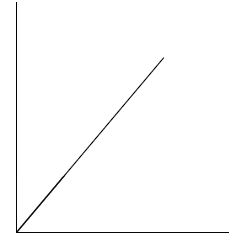
In simple words: When elasticity of supply is unitary (equal to 1), any percentage change in price leads to an equal percentage change in the quantity supplied. The curve starts exactly from the corner (origin).
Exam Tip: Always draw the supply curve passing directly through the origin (point O) to correctly depict unitary elasticity (\( e_s = 1 \)).
Question 97. When there is a surplus in the balance of trade?
Answer: This occurs when the value of exports exceeds the value of imports.
In simple words: A trade surplus happens when a country sells more goods to foreign nations than it buys from them, bringing in more money than it sends out.
Exam Tip: Express this mathematically as \( \text{Exports (X)} > \text{Imports (M)} \) to make your answer precise.
Question 98. When there is a deficit in the balance of trade?
Answer: This happens when the total value of imports is greater than the total value of exports.
In simple words: A trade deficit occurs when a country spends more money buying goods from other countries than it earns from selling its own goods to them.
Exam Tip: Use the inequality \( \text{Imports (M)} > \text{Exports (X)} \) to clearly denote a trade deficit.
Question 99. Define cost?
Answer: This means the total financial spending required to manufacture a specific quantity of a product.
In simple words: Cost is the total amount of money a business has to spend to produce a certain quantity of goods or services.
Exam Tip: Remember that in economics, cost includes both explicit expenditures (actual cash paid) and implicit costs (value of self-owned resources).
Question 100. What induces new firms to enter an industry?
Answer: The presence of abnormal profits encourages new businesses to join an industry.
In simple words: When existing companies in a market are making huge, extra-high profits, it attracts new companies to start selling the same thing.
Exam Tip: Use the precise economic term "abnormal profits" or "supernormal profits" rather than just "high profits" to secure full marks.
Question 101. What happens to equilibrium of a commodity if there is decrease in its demand and increase in its supply?
Answer: This will cause the equilibrium price to fall.
In simple words: If people want to buy less of an item (demand drops) while sellers have more of it to sell (supply rises), the price of that item will naturally go down.
Exam Tip: Under these conditions, the equilibrium price will always fall, but the effect on equilibrium quantity depends on the relative magnitudes of the shifts.
Question 102. What is involuntary unemployment?
Answer: This describes a state where people who are capable and eager to work at current wages cannot find a job.
In simple words: It means someone wants a job and is able to work, but simply cannot find any work available.
Exam Tip: Key elements for this definition are "willing to work", "able to work", and "at the prevailing wage rate".
Question 103. What is voluntary unemployment?
Answer: This refers to a situation where individuals choose not to work at the current market wage, even though job opportunities are available.
In simple words: This is when a person is able to work but chooses not to because they don't like the pay rate being offered.
Exam Tip: Emphasize that work is available but the individual chooses not to accept it due to the existing wage level.
Question 104. Give two sources of not tax revenue?
Answer: Two options include income from public companies, along with fees and fines.
In simple words: These are ways the government earns money without taxing people, such as charging fees for services, fines for breaking rules, or earning profits from state-owned businesses.
Exam Tip: State any two clearly, such as "fees and fines" and "income from public enterprises" for a direct and correct answer.
Question 105. Why entertainment tax is is indirect tax?
Answer: This is because the tax liability can be passed on to the final consumers.
In simple words: It is an indirect tax because the cinema hall or event organizer pays it to the government first, but they collect that money back from you by adding it to the ticket price.
Exam Tip: Explain that the final impact and the immediate burden of the tax fall on different people (shifting of tax burden).
Question 106. What is CRR?
Answer: This is the share of total deposits that commercial banks are required to store with the central bank.
In simple words: CRR (Cash Reserve Ratio) is a rule that says banks must keep a certain percentage of their customers' money safely locked away at the central bank, meaning they cannot lend it out.
Exam Tip: Write out the full form "Cash Reserve Ratio" first, then define it to show complete understanding.
Question 107. What is bank rate?
Answer: This is the interest rate at which the central bank lends money and provides advances to commercial banking institutions.
In simple words: The bank rate is the interest rate that the country's main central bank charges other smaller banks when they need to borrow money.
Exam Tip: Make sure to clarify that this rate is charged by the central bank (e.g., RBI) to commercial banks (e.g., SBI).
Question 108. Define change in demand?
Answer: When a shift in consumer interest happens because of factors besides price, it is termed a change in demand.
In simple words: A change in demand is when people want to buy more or less of something because of factors like their income or trends, even though the price of the item stayed exactly the same.
Exam Tip: Specify that a change in demand causes a shift of the entire demand curve, rather than a movement along it.
Question 109. Define change in quantity demanded?
Answer: When demand alters solely due to a shift in price, it is referred to as a change in the quantity demanded.
In simple words: This is when people buy a different amount of a product purely because its price went up or down, while all other factors stayed the same.
Exam Tip: State that this is represented by a movement along the same demand curve (expansion or contraction).
Question 110. Define utility?
Answer: The capacity of a good to satisfy human wants is known as utility.
In simple words: Utility is the measure of satisfaction or usefulness a person gets from consuming a product or service.
Exam Tip: Use the key term "want-satisfying power of a commodity" which is highly sought after by examiners.
Question 111. Define marginal utility?
Answer: This is the variation in total satisfaction resulting from the consumption of an additional unit of a good.
In simple words: Marginal utility is the extra satisfaction you get from consuming just one more unit of an item (like eating one extra slice of pizza).
Exam Tip: Write the formula \( \text{MU}_n = \text{TU}_n - \text{TU}_{n-1} \) to demonstrate a complete academic response.
Question 112. What is meant by the term "price taker" in the context of a firm?
Answer: This signifies that an individual business cannot influence the market price and must accept the rate set by the entire industry.
In simple words: A price taker is a company that has to accept whatever price the general market has decided for their product, because they are too small to change it themselves.
Exam Tip: Note that firms under perfect competition are price takers, while the industry itself is the price maker.
Question 113. What is the price elasticity of supply of a commodity whose straight line supply curve passes through the origin forming an angle of 45 degree /75 degree?
Answer: The elasticity is unitary, meaning \( e_s = 1 \).
In simple words: No matter what the angle is (like 45 degrees or 75 degrees), if a straight-line supply curve starts exactly at the origin (0,0), its elasticity of supply is always equal to 1.
Exam Tip: Always remember that any straight-line supply curve passing through the origin has unitary elasticity of supply (\( e_s = 1 \)), regardless of its slope.
Question 114. If MPC And MPS are equal, what is the value of multiplier?
Answer: We know that \( \text{MPC} + \text{MPS} = 1 \). If they are equal, then \( \text{MPC} = \text{MPS} = \frac{1}{2} = 0.5 \).
The formula for multiplier \( K \) is:
\( K = \frac{1}{\text{MPS}} \)
\( \implies K = \frac{1}{0.5} \)
\( \implies K = 2 \)
In simple words: Since the sum of MPC and MPS is always 1, if they are equal, both must be 0.5. Since the multiplier formula is 1 divided by MPS, we get 1 divided by 0.5, which equals 2.
Exam Tip: Always state the initial relationship \( \text{MPC} + \text{MPS} = 1 \) before solving to show your step-by-step logic.
Question 115. What is meant by SLR(Statutory liquidity ratio)?
Answer: This is the percentage of total demand and time liabilities that a commercial bank must hold in the form of approved liquid assets.
In simple words: SLR is a rule that forces banks to keep a certain portion of their total deposits in safe and easily sellable assets, like gold or government bonds, instead of lending it all out.
Exam Tip: Approved liquid assets include cash, gold, and unencumbered government securities.
Question 116. What will be the effect of a rise/fall in bank rate on money supply?
Answer: An increase in the bank rate will lower the money supply, whereas a decrease will expand it.
In simple words: If the central bank raises the bank rate, borrowing becomes expensive, which lowers the money supply. If they lower it, borrowing becomes cheaper, which increases the money supply.
Exam Tip: Clearly state the inverse relationship: a rise in bank rate decreases money supply, and a fall in bank rate increases it.
Question 117. If planned savings are greater/smaller than planned investment, what will be its effect on inventories?
Answer: Inventories will rise if planned savings exceed investment, and will decline if planned savings are less than investment.
In simple words: If people save more than what businesses invest, goods will go unsold, causing stock (inventories) to pile up. If they save less, goods will sell quickly, reducing the stock.
Exam Tip: Distinguish clearly: savings > investment leads to unplanned inventory accumulation, while savings < investment leads to unplanned inventory decumulation.
Question 118. Define money?
Answer: A classic definition states that money is whatever performs the functions of money. Alternatively, it is defined as any asset that is universally accepted for exchange while serving as a way to preserve wealth over time.
In simple words: Money is anything that people generally accept to pay for things and can also be saved to buy things in the future.
Exam Tip: Mentioning key functions like "medium of exchange" and "store of value" makes your definition robust and accurate.
Question 119. How is TVC derived from MC?
Answer: Total Variable Cost is obtained by summing up all individual Marginal Costs: \( \text{TVC} = \sum \text{MC} \).
In simple words: If you add up the extra cost of making each individual unit (marginal cost), you will get the total variable cost of making all those units.
Exam Tip: Use the summation symbol: \( \text{TVC} = \sum \text{MC} \) to represent this relationship mathematically.
Question 120. Define revenue of a firm?
Answer: This refers to the total monetary earnings received by a business from selling its products.
In simple words: Revenue is the total money a business brings in when it sells its goods or services to customers.
Exam Tip: Do not confuse revenue with profit; revenue is total sales income, whereas profit is revenue minus costs.
Question 121. What is average cost?
Answer: This is the total cost of production divided by the number of units produced.
In simple words: Average cost is simply how much it costs on average to make just one unit of a product.
Exam Tip: State the formula \( \text{AC} = \frac{\text{TC}}{Q} \) along with your definition.
Question 122. Define tax?
Answer: This is a mandatory contribution paid by individuals and businesses to the public authorities.
In simple words: A tax is a mandatory payment that people and companies must pay to the government to help fund public services.
Exam Tip: Always emphasize the word "compulsory" or "mandatory", as taxpayers cannot expect a direct benefit in return.
Question 123. In which form of market demand curve is more elastic and why?
Answer: The demand curve is highly elastic under monopolistic competition due to the presence of many near substitutes.
In simple words: In a market with many similar brands (like soaps or shampoos), a small price rise will make customers switch to other brands, making the demand highly sensitive to price.
Exam Tip: Specify "monopolistic competition" and contrast it with monopoly, where demand is less elastic due to lack of substitutes.
Question 124. Define production possibility curve (PPC)?
Answer: A Production Possibility Curve depicts the different combinations of two products that an economy can manufacture using its available resources and technology, assuming they are fully and optimally employed.
In simple words: PPC is a curve that shows the maximum amounts of two different goods an economy can produce if it uses all of its available resources and technology perfectly.
Exam Tip: Highlight the two critical assumptions: resources are limited but fully utilized, and technology remains constant.
Question 125. Is import of machinery recorded in current or capital account?
Answer: This is logged in the current account since it represents a transaction involving the purchase of physical goods.
In simple words: Even though machinery is a long-term asset, buying it from abroad is still counted as an import of goods, which is always recorded in the current account of the Balance of Payments.
Exam Tip: Be careful not to classify import of machinery under the capital account; import of any physical good, whether consumption or capital, belongs in the current account.
Question 126. Can GDP can be greater than GNP?
Answer: Indeed, GDP exceeds GNP when Net Factor Income from Abroad (NFIA) is negative.
In simple words: Yes, a country's domestic production (GDP) can be larger than its national income (GNP) if the money sent out of the country to foreigners is more than the money brought in by its citizens from abroad.
Exam Tip: Use the relationship formula \( \text{GNP} = \text{GDP} + \text{NFIA} \). If \( \text{NFIA} < 0 \), then clearly \( \text{GDP} > \text{GNP} \).
Question 127. Can GNP can be greater than GDP?
Answer: Yes, GNP will be larger than GDP when Net Factor Income from Abroad (NFIA) is positive.
In simple words: Yes, national income (GNP) is larger than domestic production (GDP) when citizens earn more from foreign countries than foreign residents earn inside our country.
Exam Tip: Show the relationship: \( \text{GNP} = \text{GDP} + \text{NFIA} \). When \( \text{NFIA} > 0 \), then \( \text{GNP} > \text{GDP} \).
Three or Four Marks Questions (3M/4M)
Question 1. Explain the central problems of an economy
Answer: Every economy faces three primary issues:
a) What to produce?
This relates to deciding which products and services should be manufactured and in what volumes.
b) How to produce?
This concerns selecting the production techniques and methods for creating goods and services.
c) For whom to produce?
This addresses how the created national income and goods are distributed among the population.
In simple words: Every society must solve three big questions: what items to make and in what amounts, how to make them (like using people or machines), and who gets to consume them.
Exam Tip: Make sure to outline all three problems clearly under distinct headings (a, b, and c) as these are the core challenges of any economic system.
Question 2. Explain the problem of How to Produce?
Answer: This challenge focuses on choosing the appropriate methods of production for goods and services. Specifically, it involves deciding whether to use labour-intensive techniques (more workers) or capital-intensive techniques (more machinery), based on the availability and costs of capital and labour within the nation.
In simple words: The "How to Produce" problem is about choosing the best production method. An economy must decide whether to use more human labor (labor-intensive) or more automated machinery (capital-intensive) to make goods.
Exam Tip: Contrast "labour-intensive technique" with "capital-intensive technique" clearly and link the choice to resource availability.
Question 3. Explain Production Possibility curve with the help of diagram?
Answer: A Production Possibility Curve (PPC) represents a graphical boundary displaying different combinations of two commodities that can be manufactured given fixed resources and technology.
For instance, if the economy channels all its available inputs to generate commodity B, it can create 15 units, leaving the output of commodity A at zero. Alternatively, a variety of output combinations between A and B are possible.
To increase the output of commodity B, the economy must cut back on commodity A's production, and vice-versa, because resources are limited.
In simple words: The Production Possibility Curve shows the maximum options a country has to produce two goods. Because resources are limited, producing more of one good means we must produce less of the other.
Exam Tip: When drawing the PPC, ensure that it is concave to the origin, reflecting the principle of increasing marginal opportunity cost.
Question 4. Explain the relationship between Total utility and Marginal utility?
Answer: The connection between Total Utility (TU) and Marginal Utility (MU) can be explained through these points:
a) TU grows at a decreasing rate while MU is falling but remains positive.
b) TU reaches its highest point when MU is exactly zero (this is the point of satiety).
c) When MU turns negative, TU starts to decrease.
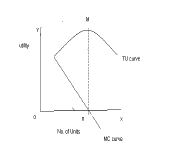
In simple words: As you consume more, your overall satisfaction (Total Utility) goes up, but each extra unit gives you less and less extra satisfaction (Marginal Utility). When you are fully satisfied, the extra utility is zero, and after that, eating more actually makes you unhappy (negative utility).
Exam Tip: Always draw TU and MU graphs vertically aligned so the maximum point of TU aligns perfectly with the zero-crossing point of the MU curve.
Question 5. State the Properties of Indifference Curve?
Answer: The main characteristics of an indifference curve include:
1. Indifference curves always slope downwards from left to right.
2. They are typically convex in shape relative to the origin.
3. Two distinct indifference curves can never intersect one another.
4. An indifference curve placed higher offers greater satisfaction compared to a lower one.
In simple words: An indifference curve shows combinations of two goods that give you equal happiness. These curves always slope down, curve inward towards the corner, never cross each other, and higher curves always represent more happiness.
Exam Tip: Be prepared to explain why indifference curves are convex to the origin—it is due to the diminishing marginal rate of substitution (MRS).
Question 6. State the Law of Diminishing marginal utility?
Answer: According to the Law of Diminishing Marginal Utility, as an individual consumes more successive units of a particular good, the extra satisfaction gained from each additional unit continuously decreases.
This relationship is illustrated in the table below:
| Quantity Consumed | Marginal Utility (Units) |
|---|---|
| 1 | 10 |
| 2 | 8 |
| 3 | 6 |
| 4 | 4 |
| 5 | 2 |
In simple words: The first bite of food gives you the most joy. As you keep eating, each extra bite still feels okay, but it gives you less and less additional satisfaction than the one before.
Exam Tip: When stating this law, mention that it assumes continuous consumption and that the units of the commodity are of standard size.
Question 7. State any three causes of decrease in demand? (Or) Mention any three causes for leftward shift in demand curve
Answer: Three factors that can lead to a drop in demand or a shift of the demand curve to the left include:
a) A decline in the consumer's income level.
b) A drop in the price of competing (substitute) products.
c) An increase in the price of matching (complementary) goods.
In simple words: People buy less of a product (even if its price doesn't change) if their own income goes down, if similar alternative products become cheaper, or if products used alongside it become more expensive.
Exam Tip: Clearly distinguish between a "decrease in demand" (leftward shift due to external factors) and a "contraction in demand" (due to a price increase of the good itself).
Question 8. State any three causes of Increase in demand? (Or) Mention any three causes for rightward shift in demand curve?
Answer: Four common reasons for an expansion in demand or a shift of the demand curve to the right are:
a) An increase in consumer income levels.
b) A rise in the prices of alternative (substitute) products.
c) A decline in the prices of paired (complementary) goods.
d) A positive change in consumer tastes and preferences.
In simple words: People will buy more of a product if they earn more money, if other similar products become more expensive, if items used with it get cheaper, or if the product suddenly becomes more popular.
Exam Tip: Listing any three points will satisfy the question, but mentioning consumer tastes and preferences adds strong value to your answer.
Question 9. At price of Rs. 20 Unit the quantity demanded is 300 units. Its price falls by 10% its quantity demanded rises by 60 units. Calculate price elasticity.
Answer: Given data:
Initial Price \( P = \text{Rs. } 20 \)
Initial Quantity \( Q = 300 \text{ units} \)
Percentage change in Price = \( 10\% \)
Change in Quantity \( \Delta Q = 60 \text{ units} \)
First, let's calculate the percentage change in the quantity demanded:
Percentage change in Quantity Demanded = \( \frac{\Delta Q}{Q} \times 100 \)
\( \implies \frac{60}{300} \times 100 \)
\( \implies 20\% \)
Now, the formula for Price Elasticity of Demand (\( E_d \)) is:
\( E_d = \frac{\text{Percentage change in Quantity Demanded}}{\text{Percentage change in Price}} \)
\( \implies E_d = \frac{20\%}{10\%} \)
\( \implies E_d = 2 \)
Thus, the price elasticity of demand is greater than one (\( E_d > 1 \)), which means it is elastic.
In simple words: The price dropped by 10%, which caused the amount people want to buy to increase by 20%. Since the demand changed twice as much as the price, the elasticity is 2 (which is highly elastic).
Exam Tip: Always write the formula first and state whether the final elasticity is elastic (\( E_d > 1 \)), inelastic (\( E_d < 1 \)), or unitary (\( E_d = 1 \)) to complete your explanation.
Question 10. Draw a straight line demand curve and show on it a point at which a) ed > 1, b) ed < 1, c) ed = 1?
Answer: A straight-line demand curve shows different values of price elasticity at various points using the geometric method. As shown in the diagram:
a) At point C (the upper segment), elasticity is greater than one (\( e_d > 1 \)).
b) At point B (the lower segment), elasticity is less than one (\( e_d < 1 \)).
c) At point A (the exact midpoint), elasticity is equal to one (\( e_d = 1 \)).
In simple words: Along a straight-line demand curve, elasticity changes from top to bottom. It is infinite at the very top, highly elastic in the upper half, exactly 1 in the middle, less than 1 in the lower half, and zero at the very bottom.
Exam Tip: Use the formula for the point/geometric method: \( \text{Elasticity of Demand} = \frac{\text{Lower Segment}}{\text{Upper Segment}} \) to easily justify why the midpoint equals 1.
Question 11. State the law of demand with help of a schedule and diagram?
Answer: The Law of Demand states that there is an inverse or opposite relationship between the price of a product and the amount buyers demand, provided all other influencing factors are kept constant.
Put simply, when the price of a product drops, buyers purchase more of it, and when the price rises, they purchase less.
This can be clearly seen in the following schedule and graphical curve:
| Price | Quantity Demanded |
|---|---|
| 5 | 1 |
| 4 | 2 |
| 3 | 3 |
| 2 | 4 |
| 1 | 5 |
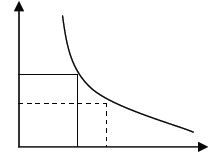
Exam Tip: Do not forget to state the phrase "other factors remaining constant" (ceteris paribus) when explaining the Law of Demand, as it is a crucial assumption.
Question 12. State the relationship between Average Product and Marginal Product?
Answer: The relationship between Marginal Product (MP) and Average Product (AP) is outlined below:
1. As long as MP exceeds AP, AP continues to rise.
2. When MP is equal to AP, AP reaches its maximum value.
3. Once MP falls below AP, AP begins to decline.
In simple words: When the extra output of the next worker is higher than the average, it pulls the average up. When they are equal, the average is at its peak. When the extra output is lower, it drags the average down.
Exam Tip: Remember that MP can become zero or negative, but AP remains positive as long as total production is greater than zero.
Question 13. What are the reasons for diminishing returns to factor?
Answer: The causes behind diminishing returns to a factor include:
A. Over-exploitation of fixed resources: When an increasing number of variable inputs are added to a static, fixed factor, that fixed resource becomes overcrowded and over-utilized.
B. Imperfect substitution of resources: One factor cannot be continuously used as a perfect replacement for another fixed factor indefinitely.
In simple words: If you keep adding more workers to a single machine (which is fixed), the machine gets crowded and less efficient. Also, you cannot just replace machines with workers forever.
Exam Tip: Make sure to describe both points—the over-utilization of fixed inputs and the inability to perfectly swap one factor for another.
Question 14. Distinguish between Fixed cost and variable cost.
Answer: The table below contrasts the main differences between Fixed Cost and Variable Cost:
| Fixed Cost | Variable Cost |
|---|---|
| 1. It will not change with changes in levels of output. | 1. It changes with changes in levels of output. |
| 2. It can never be zero. | 2. It is zero when output is zero. |
| 3. Examples: Salary to Permanent employees, Rent. | 3. Examples: Salaries to Temporary employees, Fuel charges. |
In simple words: Fixed costs are expenses you have to pay even if you produce nothing (like rent). Variable costs are expenses that go up as you make more products (like raw materials).
Exam Tip: Always give clear examples for both cost types to ensure you earn full points in comparison questions.
Question 15. Explain the relationship between Average Variable Cost (AVC) Average Total Cost (ATC) and marginal Cost (MC)?
Answer: The key connections among Marginal Cost (MC), Average Variable Cost (AVC), and Average Total Cost (ATC) are:
1. When MC remains below both AVC and ATC, both average costs continue to fall.
2. The MC curve intersects both the ATC and AVC curves exactly at their respective lowest (minimum) points.
3. When MC rises above AVC and ATC, both average costs begin to increase.
In simple words: When the extra cost (MC) is lower than the averages, it pulls the averages down. When the extra cost is higher, it pulls the averages up. Because of this, MC crosses the other curves at their very lowest points.
Exam Tip: In diagrams, make sure the MC curve crosses the AVC curve first at its minimum point, and then crosses the ATC curve at its minimum point further to the right.
Question 16. Draw TFC, TVC and TC in a single diagram.
Answer: The illustration displays Total Fixed Cost (TFC) as a flat horizontal line, Total Variable Cost (TVC) beginning from the zero point, and Total Cost (TC) starting from where the TFC line meets the vertical axis. In simple words: This graph shows how different costs change as we produce more things. TFC stays flat, TVC goes up as we make more, and TC is just both of them added together.
Exam Tip: Remember that the vertical distance between the TC and TVC curves is always equal to TFC and remains constant throughout.
Question 17. Give the relationship between Total Revenue (TR) and Marginal Revenue (MR)?
Answer:
1. When MR is positive, TR rises but at a declining pace.
2. When MR is null, TR reaches its peak value.
In simple words: As long as you get extra money for each new item sold, your total money goes up. When you get zero extra money for the next item, your total money is at its absolute highest.
Exam Tip: Always highlight that the slope of the TR curve is represented by MR, which helps explain their relationship.
Question 18. When MR is negative, TR starts declining but remains positive
Answer: The graph shown below demonstrates that when Marginal Revenue turns less than zero, Total Revenue starts to drop but stays greater than zero. In simple words: If you lose money on selling more items, your total money starts going down, even though you still have some total money left.
Exam Tip: Draw both curves carefully aligned vertically: the peak of TR must align exactly with the point where MR cuts the horizontal axis.
Question 19. State the law of supply with a help of a schedule and diagram?
Answer: Keeping other factors unchanged, there exists a straight connection between the cost of an item and its volume offered for sale, meaning a larger price leads to a greater supply and the opposite is also true.
| Price | Quantity Supplied |
|---|---|
| 1 | 1 |
| 2 | 2 |
| 3 | 3 |
| 4 | 4 |
| 5 | 5 |
In simple words: The law of supply says that when the price of something goes up, sellers want to sell more of it to make more profit.
Exam Tip: Do not forget to mention "other things being constant" (ceteris paribus) as it is a crucial assumption of this law.
Question 20. As the price of peanut packets increases by 5 % , the quantity supplied of peanut rises by 8 % . What is elasticity of supply?
Answer: \( E_s = \frac{\text{Percentage change in quantity supplied}}{\text{Percentage change in price}} \)
\( \implies E_s = \frac{8\%}{5\%} \)
\( \implies E_s = 1.6 \) (Thus, the supply is highly responsive)
In simple words: We divide the percentage change in supply by the percentage change in price to see how sensitive sellers are. Here, a small price change caused a bigger supply change, meaning the supply is elastic.
Exam Tip: State clearly whether the supply is elastic (\( E_s > 1 \)), inelastic (\( E_s < 1 \)), or unitary (\( E_s = 1 \)) based on your calculated value.
Question 21. What will be the price elasticity of supply at any point on a straight line curve if 1) supply curve intersects ox axis in its negative range 2) supply curve intersects ox axis in its positive range.3)supply curve passes through the origin?
Answer:
1) When the supply line cuts the horizontal axis in its negative area, the price elasticity of supply is greater than one (\( E_s > 1 \)).
2) When the supply line cuts the horizontal axis in its positive area, the price elasticity of supply is less than one (\( E_s < 1 \)).
3) When the supply line goes directly through the starting point (origin), the price elasticity of supply is equal to one (\( E_s = 1 \)).

In simple words: Depending on where the straight supply line starts, we can tell the elasticity. Starting behind the zero point means elastic, starting in front of it means inelastic, and starting exactly at zero means unitary.
Exam Tip: Draw dashed lines to show where the supply curves would extend to the horizontal axis to make your geometric explanation clear.
Question 22. List the three main features of oligopoly?
Answer:
A. A small number of market players
B. Stability in product pricing.
C. Enterprises offer identical or varied goods.
D. Actions of every enterprise depend on rival firms.
In simple words: Oligopoly is a market where only a few big companies compete. Prices don't change often, they sell similar or slightly different things, and every move one company makes affects the others.
Exam Tip: Be sure to mention inter-dependence among firms, as it is the most distinct characteristic of an oligopolistic market structure.
Question 23. State any three features of Monopoly?
Answer:
1. A sole market vendor
2. Lack of near alternatives for the product.
3. Restrictions on the admission of new companies.
4. Chance of charging different prices to different buyers.
In simple words: Monopoly means there is only one seller of a unique product, so new companies cannot enter, and the seller can charge different prices to different people.
Exam Tip: Mention price discrimination as a key feature, which allows a monopolist to maximize profits by charging different rates to different consumer segments.
Question 24. How is equilibrium price determined in perfect competition market?
Answer: Market clearing price is the level where the amount wanted matches the amount offered. It is established at the intersection of the demand and supply lines.
| Price | Quantity Demanded | Quantity Supplied |
|---|---|---|
| 1 | 50 | 10 |
| 2 | 40 | 20 |
| 3 | 30 | 30 |
| 4 | 20 | 40 |
| 5 | 10 | 50 |
In simple words: The balanced price is found where the buyers' wishes perfectly match the sellers' offers. In our table, this happens at a price of 3, where both want to buy and sell exactly 30 units.
Exam Tip: Always highlight the row in the table where Quantity Demanded equals Quantity Supplied to clearly indicate the equilibrium point.
Question 25. Explain the effect of an increase in demand of a commodity on its equilibrium price and quantity?
Answer: An upward rise in demand leads to a rightward movement of the demand curve while keeping the supply curve constant. Consequently, both the market price and volume traded will rise. In simple words: When more people want to buy something but the supply stays the same, the price goes up and sellers also sell a larger total quantity of it.
Exam Tip: Clearly mark the original equilibrium point and the new equilibrium point on your diagram with labels like E1 and E2 to show the shift.
Question 26. What happens to the equilibrium price when increase in demand is equal to increase in supply?
Answer: When demand and supply expand by the same amount, the market price stays constant but the volume sold goes up. In simple words: If the increase in people wanting to buy matches the increase in products available, the price won't change, but a lot more items will be bought and sold.
Exam Tip: Ensure that the horizontal shifts of both the demand and supply curves are drawn with equal width on your graph to show that price stays exactly the same.
Question 27. Difference between Micro and Macro economics
Answer:
| Micro Economics | Macro Economics |
|---|---|
| 1. It focuses on the analysis of singular components of a system. | 1. It covers the examination of the entire financial system. |
| 2. It handles the distribution of assets. | 2. It manages the expansion and progression of assets. |
| 3. It is alternatively termed price theory. | 3. It is alternatively termed income theory. |
In simple words: Microeconomics looks at small, individual pieces of the economy like one person or company. Macroeconomics looks at the giant picture of the whole country, like total jobs or national income.
Exam Tip: A simple table like this is highly effective; always state the alternative names (Price Theory vs. Income Theory) as they carry high weight in evaluation.
Question 28. Explain the circular flow of Income in a two sector model
Answer: Only two areas exist, which are companies and families. Families supply resource services to companies, and companies employ these resource services. Families spend all their earnings on buying goods and services, while companies sell all their products back to families. There are two kinds of arenas operate here: the resource market for inputs of production, and the consumer market for finished products. In simple words: Families give their labor to businesses and get paid wages. Then, families spend all those wages to buy the goods that the businesses made. The money just keeps going in a big circle.
Exam Tip: Clearly differentiate between real flow (goods and services) and money flow (payments) using solid and dashed lines, or by labeling them distinctly.
Question 29. Explain briefly the income approach to measure national income. Under income method to calculate the National Income, following steps have been taken into account:-
Answer: To determine National Income using the income technique, the following measures are followed:
i) Initially, business enterprises that utilize resource services are classified.
ii) Calculate the subsequent resource earnings:
a) Wages and benefits of workers
b) Income from land, capital, and business returns
c) Diverse self-employed earnings. The aggregate of these resource earnings yields Net Domestic Product at Factor Cost (\( NDP_{FC} \)). Combine this with earnings received from overseas to get the total National Income.
In simple words: To find the country's total income, we add up all the wages, rents, interests, profits, and mixed earnings made inside the country, and then add any net money earned from other nations.
Exam Tip: Remember the formula: National Income (\( NNP_{FC} \)) = \( NDP_{FC} \) + Net Factor Income from Abroad (NFIA).
Question 30. Explain the following terms
(a) Business fixed investment
(b) Inventory Investment
(c) Residential construction Investment
(d) Public Investment.
Answer:
a) Business Fixed Investment: - This is the funds used by corporate entities to acquire newly manufactured factories and machinery.
b) Inventory Investment: - This means the net variation in stock levels of completed products, partially finished items, and basic materials.
c) Residential Construction Investment: - This is the expenditure allocated toward constructing residential buildings.
d) Public Investment: - This covers all asset building undertaken by the authorities, including constructing highways, clinics, and educational institutions.
In simple words: Business investment is spending on machinery; inventory investment is tracking changes in unsold stock; residential investment is building homes; and public investment is the government building infrastructure like roads and schools.
Exam Tip: Classify these investments clearly under private or public sectors when explaining aggregate investment in macroeconomic theory.
Question 31. Name the components of aggregate demand (AD). Explain any one of them.
Answer: Below are the elements of AD:
\( AD = C + I + G + (X - M) \)
To simplify, \( AD = C + I \), where 'C' denotes family consumption needs and 'I' represents business capital needs.
In simple words: Aggregate demand is the total spending in the economy. It includes household spending, business investment, government spending, and net exports. In simple models, we just focus on household spending and business investment.
Exam Tip: Make sure to define each letter of the formula: Consumption (C), Investment (I), Government spending (G), and Net Exports (X - M).
Question 32. Distinguish between APC and MPC. The value of which of them can be more than one and when?
Answer: APC represents the mean consumption level of the public, which is calculated as \( APC = \frac{C}{Y} \). MPC represents the extra spending resulting from a rise in earnings, which is \( MPC = \frac{\Delta C}{\Delta Y} \). APC can exceed one when total spending is higher than total earnings.
In simple words: APC is how much of your total income you spend, while MPC is how much of any new, extra income you spend. APC can be bigger than 1 if you are spending more than you earn by using your savings.
Exam Tip: Mention that MPC can never be greater than one because people cannot spend more than the increase in their income, unlike APC which can exceed one.
Question 33. Explain the relationship between MPC and MPS.
Answer: Any addition to earnings is spent or put away as savings. Consequently,
\( \Delta Y = \Delta C + \Delta S \) (Dividing both sides by \( \Delta Y \))
\( \implies \frac{\Delta Y}{\Delta Y} = \frac{\Delta C}{\Delta Y} + \frac{\Delta S}{\Delta Y} \)
\( \implies 1 = MPC + MPS \)
In simple words: Every new dollar you earn is either spent (MPC) or saved (MPS). Because of this, when you add the percentage spent and the percentage saved together, they must always equal exactly 1 (or 100%).
Exam Tip: The sum of MPC and MPS is always unity. You can write the formula as \( MPS = 1 - MPC \) or \( MPC = 1 - MPS \) to show different forms of the relationship.
Question 34. What is consumption function? Explain using suitable diagram.
Answer: It is the systematic association between household spending and net personal income. The horizontal axis indicates earnings and the vertical axis indicates spending. Intersect E indicates equivalence between spending and earnings. This is called the break-even stage. To the left of this spot, spending exceeds earnings, meaning there are negative savings (dissaving). To the right of spot E, there are positive savings. In simple words: The consumption function shows how our spending changes as our income changes. Even with zero income, we still spend a little (using savings), and as we earn more, we spend more, eventually saving some money past the break-even point.
Exam Tip: Always draw the 45-degree line to represent income, and show that the consumption curve starts above the origin because of autonomous consumption.
Question 35. What is Break Even point? Explain with the help of saving function.
Answer: The break-even stage is a juncture where spending matches earnings and savings are exactly zero, as illustrated below. At spot E, savings are equal to null, which is why spot E represents the break-even stage. To the left of this spot, savings are below zero, and to the right of spot E, savings are above zero. In simple words: The break-even point is when you spend exactly what you earn, so you aren't saving any money, but you aren't dipping into old savings either. On a savings graph, this is where the saving line crosses zero.
Exam Tip: Clearly label the negative area of the saving curve as 'Dissaving' to secure full marks.
Question 36. Explain diagrammatically Investment demand as a component of AD.
Answer: The corporate demand for capital spending depends on the cost of borrowing and the expected returns on capital, as shown in the diagram below.
In simple words: Businesses invest more when interest rates are low because it's cheaper to borrow money. As interest rates go up, investing becomes more expensive, so business investment demand goes down.
Exam Tip: Label the curve as Investment Demand (ID) and show the inverse relationship by marking two points \(r_1, I_1\) and \(r_2, I_2\) on the axes.
Question 37. What is inflationary gap? Explain with diagram.
Answer: If aggregate demand exceeds aggregate supply at the maximum employment level, a state of surplus demand occurs. In this condition, the difference between AD and AS is termed the inflationary gap. In simple words: An inflationary gap happens when people want to buy more things than the economy can physically produce at full employment. This extra demand pushes prices up, causing inflation.
Exam Tip: The inflationary gap must be measured strictly at the full employment level of output, not at the actual equilibrium output level.
Question 38. What are impacts of deficient demand or deflationary gap on the level of income, output, employment and prices?
Answer: The national earnings level will drop, and the production level will decrease. Market rates will decline, and the hiring level will shrink.
In simple words: When demand is too low, businesses can't sell their goods. As a result, they cut prices, produce fewer things, earn less money, and lay off workers.
Exam Tip: Summarize these impacts systematically across four headings: Income, Output, Employment, and General Price Level.
Question 39. What will be the impact on income /output and price of excess demand (Inflationary gap)?
Answer: During a state of surplus demand (inflationary gap), there is an upward force on prices, meaning cost levels will rise. Real production and hiring cannot expand because the system has already reached full capacity, so extra resources are unavailable. However, due to the price rise, dollar-value earnings will increase. The system stays at the maximum employment stage but at a higher cost level.
In simple words: Because the economy is already working at its absolute maximum, you cannot make any more actual products or hire more workers. The only thing that happens is that prices rise, which makes nominal income look higher on paper.
Exam Tip: Distinguish clearly between real output (which remains unchanged) and nominal output/income (which rises due to higher prices).
Question 40. Explain the fiscal measures to correct the situation of deficient demand and excess demand.
Answer: Fiscal tools are the administration's budget policies, which consist of tax collection and public spending programs.
Insufficient Demand:
i) Public Spending: The administration will raise its spending. This helps boost AD to bring back the full capacity level.
ii) Taxation: The administration will lower taxes. This helps boost take-home earnings, which causes AD to rise.
Surplus Demand:
i) Public Spending: The administration will cut down its spending, which reduces AD.
ii) Taxation: The administration needs to raise tax rates. This lowers the take-home earnings of families, causing overall demand to drop.
In simple words: Fiscal policy is how the government uses taxes and spending to balance the economy. To fix low demand, they spend more and tax less. To fix high demand (inflation), they spend less and tax more.
Exam Tip: State clearly that fiscal policy is implemented by the government, whereas monetary policy is managed by the central bank.
Question 41. What is monetary policy? What monetary measure can be adopted to control the situation of excess demand?
Answer: This is the strategy implemented by the central banking authority to manage borrowing costs and loan terms. During a state of surplus demand, the subsequent financial actions are taken:
i) Raising the borrowing interest rate.
ii) Lowering the access to loans.
In simple words: Monetary policy is when the central bank controls the money supply and interest rates. To stop high inflation, they raise interest rates and make it harder to get loans so people spend less.
Exam Tip: Use terms like 'dear money policy' to describe the central bank's strategy of raising interest rates during inflation.
Question 42. Distinguish between planned and actual saving and investment.
Answer: A distinction exists between i) intended S and I and ii) realized saving and investment. Intended saving represents what families intend to save, while intended investment is what businesses intend to spend on capital. Since these groups are separate, intended savings and investments do not have to match. However, realized saving and investment construct a bookkeeping equivalence and must always be identical. This occurs because:
\( C + S = Y = C + I \)
\( \implies Y = C + S \)
\( \implies Y = C + I \)
\( \implies S = I \)
In simple words: Planned savings and investments are what people hope to do, and they might not match because different people make those plans. Actual savings and investments must always match at the end of the year because of accounting rules.
Exam Tip: Explain that while planned savings and investments (ex-ante) are equal only at equilibrium, actual savings and investments (ex-post) are always equal by definition.
Question 43. Differentiate between full employment equilibrium and Underemployment equilibrium.
Answer: If the balance between AD and AS occurs at the maximum capacity point, it is termed full employment equilibrium. However, if the balance between AD and AS is reached prior to the maximum capacity point, it is termed underemployment equilibrium.
In simple words: Full employment equilibrium means the economy is balanced when everyone who wants a job has one. Underemployment equilibrium means the economy is stable, but there are still many unemployed people.
Exam Tip: Note that according to Keynesian theory, the economy can remain stable even when resources are not fully utilized, which is underemployment equilibrium.
Question 44. What are drawbacks of barter system?
Answer:
1) Both selling and buying must happen at the same time, which requires a mutual agreement of needs.
2) There is no standard measure of value in a trade-based system, which restricts how much trading can occur.
3) A trade-based system lacks a simple way of preserving wealth.
4) Splitting items for trade is often unfeasible, leaving some requirements unfulfilled.
In simple words: Barter has big issues: you have to find someone who wants what you have and has what you want, there is no set price system, some things can't be divided into smaller pieces, and you can't easily save wealth for the future.
Exam Tip: Ensure you mention 'double coincidence of wants' as it is the most significant obstacle in a barter economy.
Question 45. Explain the Primary functions of money.
Answer: Main roles:
A. Trading Instrument: This means money serves as a go-between for trading products and benefits in market deals.
B. Standard of Value: Money functions as a common metric to express the cost of things using standard accounts.
In simple words: The main jobs of money are to let us buy and sell things easily without trading goods directly, and to give everything a clear price tag so we can compare values.
Exam Tip: The primary functions are the most essential roles that money must perform, and they serve as the foundation for its secondary functions.
Question 46. Explain the Secondary or Subsidiary function:-
Answer:
A. Basis for Future Settlements: Money serves as a tool for delayed payments because its worth stays fairly steady.
B. Wealth Preservation: It is highly practical to save wealth as money since keeping cash does not require significant physical space.
C. Value Transmission: Due to its widespread approval and high ease of conversion, money can be easily moved from one location or party to another.
In simple words: Secondary functions of money let us pay for things later with loans, save our wealth easily without it rotting, and send money to other people or places quickly.
Exam Tip: Remember that secondary functions help resolve the limitations of barter regarding credit, saving, and moving wealth.
Question 47. Write the six agency function of the Commercial Bank.
Answer:
1) Moving money between accounts
2) Gathering incoming money
3) Buying and selling financial shares
4) Gathering corporate dividend earnings
5) Settling utility costs and insurance fees
6) Serving as administrators and custodians of estates.
In simple words: Agency functions are chores banks do on your behalf, like paying your bills, collecting your dividends, moving your money around, and managing investments or wills.
Exam Tip: Clearly explain that banks perform these services on behalf of their customers in exchange for a small fee or commission.
Question 48. How the Bank rates control the credit?
Answer: The bank rate is the interest fee charged by the central bank when lending to retail banks. By increasing this rate, the central bank increases the cost of acquiring funds. This compels retail banks to increase their interest rates for the public. As borrowing rates rise, the desire for loans for business funding and other uses decreases.
In simple words: If the central bank raises interest rates for commercial banks, those banks have to charge normal people more for loans. When loans get expensive, people borrow and spend less money.
Exam Tip: Explain this mechanism as a step-by-step chain reaction: Central Bank Rate Up -> Commercial Bank Rate Up -> Loans Costlier -> Credit Demand Down.
Question 49. Write any three objective of government Budget.
Answer: The goals targeted by the administration through its annual budget are:
i) To promote financial expansion.
ii) To minimize disparities in earnings and assets.
iii) To secure financial steadiness.
In simple words: The government uses the budget to help the economy grow, tax the rich and help the poor to balance wealth, and prevent wild price changes or financial crises.
Exam Tip: For each objective, mention a tool the government uses, such as progressive taxation to reduce inequality and tax concessions to promote growth.
Question 50. Explain the basis of classifying government receipts into revenue receipts & capital receipts.
Answer: Revenue Receipts: These are public inflows that:
i) Do not establish any future debt obligations
ii) Do not lower the existing properties of the administration (e.g., tax collection and fee revenues) Capital Receipts: These are public inflows that:
i) Create a future debt obligation, or
ii) Cause a drop in the properties owned by the administration (e.g., loans taken, earnings from privatization)
In simple words: Revenue receipts are money the government gets that they don't have to pay back and doesn't require them to sell assets (like taxes). Capital receipts are money from borrowing or selling government-owned properties.
Exam Tip: The classification is strictly based on two criteria: impact on liabilities and impact on assets. Ensure both are mentioned for both types of receipts.
Question 51. Distinguish between direct tax and indirect tax
Answer: A direct tax is paid directly by the person it is levied on, whereas an indirect tax is collected from consumers through goods and services. The differences are described in detail in the comparison chart below.
In simple words: Direct tax is money you pay directly from your income to the government. Indirect tax is money you pay when buying things, like a sales tax built into the price.
Exam Tip: The primary distinction lies in whether the tax burden can be shifted to another person.
Question 52. Direct Tax vs Indirect Tax
Answer:
| Direct Tax | Indirect Tax |
|---|---|
| 1. Liability to pay and burden of tax falls on the same person. | 1. Liability to pay and burden of tax falls on different people. |
| 2. Levied on the income and property of individuals. | 2. Levied on goods and services during sale, production, import, and export. |
| 3. Example: Income tax | 3. Example: Sales tax |
In simple words: This table compares direct taxes (which you pay yourself) and indirect taxes (which get added to the price of goods and passed on to you).
Exam Tip: Use clear examples like Income Tax and Sales Tax to highlight the differences in your answers.
Question 53. Define revenue receipts. Write the groups in which they are classified.
Answer: Any inflows that neither establish a debt obligation nor lead to a drop in properties are termed revenue receipts. These receipts are divided into:
1) Tax-based inflows and 2) Non-tax-based inflows.
In simple words: Revenue receipts are the money the government earns that doesn't increase their debt or make them sell anything. They are grouped into taxes and non-tax money (like fines or fees).
Exam Tip: Always list examples of both categories—such as income tax for tax revenue, and administrative fees or fines for non-tax revenue—to secure full marks.
Question 54. Distinguish between Revenue and Capital expenditure.
Answer:
| Revenue Expenditure | Capital Expenditure |
|---|---|
| 1. It does not lead to the building of properties. | 1. It leads to the building of properties. |
| 2. It covers a brief duration and is repetitive in occurrence. | 2. It covers an extended duration and is non-repetitive in occurrence. |
| 3. Example: Funds spent on employee salaries. | 3. Example: Funds spent on buying properties such as real estate or facilities. |
In simple words: Revenue expenditure is everyday spending that doesn't buy permanent things, like paying salaries. Capital expenditure is spending on permanent assets, like buying land or building a factory.
Exam Tip: The distinction rests on whether the spending creates assets or reduces liabilities. Keep this criteria clear in your table.
Question 55. Write a note on plan and non-plan expenditure of the government with example.
Answer: Planned Spending: This denotes the projected funding allocated in the annual budget to execute different schemes and initiatives outlined in the national development plan. This spending is used to fund major public projects across diverse parts of the economy. Non-planned Spending: This represents the projected funding allocated in the annual budget for the daily operations of the administration. Examples include spending on public administrative works, worker salaries, and retirement pensions.
In simple words: Planned spending is money used for specific new development projects and programs. Unplanned spending is the money needed for everyday government running costs, like office expenses, salaries, and pensions.
Exam Tip: Note that the distinction between plan and non-plan expenditure has been officially phased out in recent Indian budgets, but remains a key conceptual topic in economics exams.
Question 56. Distinguish between development and non-developmental Expenditure.
Answer:
| Developmental Expenditure | Non-developmental Expenditure |
|---|---|
| 1. This means spending on programs directly linked to the financial and social advancement of the nation. | 1. This means spending allocated to necessary administrative duties of the administration. |
| 2. It directly aids the national output. | 2. It does not directly aid the national output. |
| 3. Example: Funding spent on learning institutions and medical care. | 3. Example: Funding spent on military protection and basic food assistance. |
In simple words: Developmental spending is money spent on building up the nation, like schools and clinics. Non-developmental spending is money spent on basic running needs like the military, police, and subsidies.
Exam Tip: Use distinct examples for each, such as infrastructure or health for development, and administrative services or defense for non-development.
Question 57. State four main sources of demand for foreign currency
Answer: The four primary causes for needing foreign money are:
1. To buy merchandise and assistance from foreign nations.
2. To dispatch presents to other countries.
3. To acquire corporate investments in a specific country.
4. To trade on the shifting worth of international money.
In simple words: We need foreign money when we want to buy things from other countries, send gifts to relatives abroad, invest in foreign stocks, or gamble on currency value changes.
Exam Tip: Write these points clearly and label them as Imports, Unilateral Transfers, Asset Purchase, and Speculation for maximum marks.
Question 58. State three main source of supply of foreign currencies into the domestic economy.
Answer:
1. Global buyers acquiring domestic items and assistance through trading exports.
2. Global funding entering the country via collaborative business setups or stock market investments.
3. International money entering the system because of money traders and market risk-takers.
In simple words: Foreign money flows into our country when we sell our goods to foreigners, when foreign companies invest in our local businesses, and when currency traders buy our money.
Exam Tip: Link these supply sources directly to the credit side of the Balance of Payments account.
Question 59. Differentiate between balance of payment and balance of trade.
Answer:
| Balance of Trade | Balance of Payments |
|---|---|
| 1) This ledger tracks only physical commodities, specifically the outbound and inbound trade of goods. | 1. This ledger tracks both physical commodities (goods) and non-physical transactions (services). |
| 2) This is a more restricted idea since it represents just a single portion of the broader international ledger. | 2. This is a broader and more comprehensive idea as it tracks every international currency transaction. |
| 3) This ledger can show a shortfall, an excess, or a perfect match. | 3. This overall ledger must always show a net balance. |
In simple words: Balance of trade only looks at physical goods we import and export. Balance of payments is a giant master record of absolutely every single transaction we do with the rest of the world.
Exam Tip: Remember the famous accounting principle: 'Balance of Payments always balances' because it is based on double-entry bookkeeping, whereas Balance of Trade can be unbalanced.
Question 60. Explain the components of capital account
Answer: It documents international transactions that involve a resident of the home country changing their assets with a foreign resident or their liabilities to a foreign resident.
Various forms of capital account transactions:
1) Private Transactions: These are transactions that affect the liabilities and assets of single persons.
2) Official Transactions: Transactions affecting assets and liabilities by the government and its departments.
3) Portfolio Investment: It is the purchase of an asset that does not give the buyer control over the asset.
4) Direct Investment: It is the act of buying an asset and at the same time getting control of it.
The net value of the balance of direct and portfolio investment is named the balance on Capital Account.
In simple words: The capital account shows all transactions where people or governments buy assets (like land or stocks) or take on debts with foreign countries. It includes private business deals, government transactions, and investing in foreign assets.
Exam Tip: Clearly distinguish between portfolio investment and direct investment, as examiners frequently ask about the difference in control.
Question 61. Differentiate between autonomous and accommodating items.
Answer: See the comparison table below.
| Autonomous Items | Accommodating Items |
|---|---|
| 1. Autonomous items mean international economic transactions that happen due to some economic motive such as profit maximization. These deals are independent of the state of the nation's BOP. | 1. This means transactions that take place because of other activity in the BOP, such as government funding. |
| 2. These items are commonly called above the line items in the BOP. | 2. These transactions are called below the line items. |
In simple words: Autonomous items are transactions done for personal profit, like business trades, which do not depend on the balance of payments. Accommodating items are transactions done by the government to fix imbalances in the balance of payments.
Exam Tip: Remember that autonomous transactions are 'above-the-line' because they are done independently, while accommodating transactions are 'below-the-line' because they are done to correct BOP imbalances.
Four Marks Questions (4M)
Question 62. Explain any four precautions to be taken in estimating national income by expenditure method?
Answer: The following steps must be followed while estimating National Income using the expenditure method:
(i) Do not include spending on intermediate goods and services: Intermediate spending is a part of final expenditure, so including it leads to double counting.
(ii) Do not include spending on second-hand goods: Spending on these items was already counted when they were first bought.
(iii) Do not include spending on financial assets: Buying financial assets only leads to a transfer of cash from one person or institution to another.
(iv) Include imputed expenditure on own-account production used for consumption and investment: The estimated value of owner-occupied homes, self-consumed crops of farmers, etc., must be considered while calculating final expenditure.
In simple words: When calculating national income by how much is spent, we must avoid counting things twice (like second-hand goods or raw materials) and only count new, final goods, plus the estimated value of things people produce for themselves.
Exam Tip: Always mention 'double counting' and explain why second-hand goods are excluded to secure full marks in this question.
Question 63. Explain the steps taken in estimating N.I. by product/ value added method?
Answer: The steps to calculate national income using the value-added method are:
(i) Classify all production units: Divide the domestic territory into distinct industrial sectors, namely primary, secondary, and tertiary sectors.
(ii) Estimate the value of output: Calculate this as the sum of sales and change in stock across all three sectors.
(iii) Estimate the value of intermediate consumption: Find the total value of raw materials used across all three sectors.
(iv) Estimate \( \text{GVA}_{\text{mp}} \): Subtract intermediate consumption from the value of output (\( \text{GVA}_{\text{mp}} = \text{Value of output} - \text{Intermediate consumption} \)).
(v) Estimate \( \text{NVA}_{\text{mp}} \): Deduct depreciation from \( \text{GVA}_{\text{mp}} \) (where \( \text{NVA}_{\text{mp}} = \text{NDP}_{\text{mp}} \)).
(vi) Estimate \( \text{NDP}_{\text{fc}} \): Deduct the value of Net Indirect Taxes from \( \text{NDP}_{\text{mp}} \).
(vii) Estimate \( \text{NNP}_{\text{fc}} \): Add Net Factor Income from Abroad (NFIA) to \( \text{NDP}_{\text{fc}} \) to arrive at National Income (\( \text{NNP}_{\text{fc}} \)).
In simple words: To find national income by the value-added method, we group businesses into three main sectors, find the value of what they made minus what they spent on raw materials, subtract depreciation and taxes, and finally add earnings from abroad.
Exam Tip: Be sure to write out each aggregate name clearly (like NNP at factor cost) and show the step-by-step subtraction of depreciation and indirect taxes.
Question 64. Calculate the Gross Domestic Product at market price from the following data.
Answer: Based on the provided data, we can calculate the Gross Domestic Product at market price (\( \text{GDP}_{\text{mp}} \)) as follows:
| S. No. | Items | Amount (Rs. in crores) |
|---|---|---|
| (i) | Consumption of fixed capital | 50 |
| (ii) | Closing stock | 40 |
| (iii) | Private final consumption expenditure | 500 |
| (iv) | Opening stock | 60 |
| (v) | Net factor income from abroad | (-) 35 |
| (vi) | Exports | 25 |
| (vii) | Government final consumption expenditure | 200 |
| (viii) | Imports | 40 |
| (ix) | Net indirect tax | 100 |
| (x) | Net domestic fixed capital formation | 210 |
| (xi) | Change in stock | 90 |
Using the expenditure method formula:
\( \text{GDP}_{\text{mp}} = \text{Private final consumption expenditure (iii)} + \text{Government final consumption expenditure (vii)} + [\text{Net domestic fixed capital formation (x)} + \text{Change in stock (xi)} + \text{Consumption of fixed capital (i)}] + [\text{Exports (vi)} - \text{Imports (viii)}] \)
\( \implies \text{GDP}_{\text{mp}} = 500 + 200 + (210 + 90 + 50) + (25 - 40) \)
\( \implies \text{GDP}_{\text{mp}} = 500 + 200 + 350 + (-15) \)
\( \implies \text{GDP}_{\text{mp}} = \text{Rs. } 1035 \text{ Crores} \)
In simple words: To find the GDP at market price, we add together private spending, government spending, total business investments, and net exports.
Exam Tip: When calculating GDCF from Net Domestic Fixed Capital Formation, do not forget to add both the change in stock and the consumption of fixed capital (depreciation).
Question 65. Write down some of the limitations of using GDP as an index of welfare of a country
Answer: The limitations of utilizing GDP as an indicator of a country's welfare include:
(i) The National Income numbers provide no details about the population, skills, and resources of a nation. Consequently, the actual standard of welfare may remain low.
(ii) A larger National Income could be because of a bigger geographical area or a concentration of specific resources in one single nation.
(iii) National Income fails to account for price levels in a country. Citizens might earn high incomes, but because of high prices, they may still fail to enjoy a high standard of living.
(iv) A high National Income for a nation might result from massive contributions by only a small number of industries.
In simple words: GDP or National Income doesn't truly show how happy or comfortable citizens are, because it ignores price increases, population size, how wealth is distributed, and who is actually making the money.
Exam Tip: For limitations of GDP as a welfare measure, remember key headings like distribution of GDP, non-monetary exchanges, and externalities.
Question 66. Explain any four functions of money. OR Explain briefly any two functions of money.(2006,2007,2009)
Answer: The functions of money can be described as follows:
(i) Medium of exchange: Money helps to make payments for all purchases of goods and services.
(ii) Measure of value: Money serves as a common unit in which the prices of all goods and services are stated.
(iii) Store of value: Wealth can be easily stored in the form of money without losing its worth.
(iv) Standard of deferred payments: Money has made borrowing and lending activities much simpler.
In simple words: Money is used to buy things easily, measure how much items are worth, save our wealth for future use, and make it simple to borrow or lend money.
Exam Tip: Classify these functions into primary (medium of exchange, measure of value) and secondary (store of value, standard of deferred payments) to show a deeper understanding.
Question 67. Explain the process of money creation by commercial banks.(2010) OR How does a commercial bank create money? (2010)
Answer: Commercial banks have the power to generate credit that is many times greater than the deposits they receive. This process of money or credit creation by the banks is determined by:
(a) The size of initial deposits, and
(b) The Legal Reserve Ratio (LRR).
Given the volume of new deposits and the LRR, the total money generated is computed as:
\( \text{Total Money Creation} = \text{Initial Deposit} \times \frac{1}{\text{LRR}} \)
Example: If the LRR is 20% and there is an initial deposit of Rs. 10000, then:
Total money created \( = 10000 \times \frac{1}{20\%} \)
\( \implies \text{Total money created} = \text{Rs. } 50000 \).
In simple words: Banks don't keep all your cash in their vaults; they keep a small percentage (the LRR) and lend out the rest. This lent-out money goes back into other banks, allowing them to lend even more, creating new money in the process.
Exam Tip: Always include the formula for the money multiplier \( \frac{1}{\text{LRR}} \) and use a simple numerical example (like an initial deposit of Rs. 10,000) to secure maximum marks.
Question 68. Explain any four functions of a central bank(2007, 2008, 2009,2010)
Answer: Four key functions of a central bank are:
(i) Issue of currency: The central bank is the only authority allowed to print and issue currency in the nation.
(ii) Banker to the government (both central and state): It handles all the banking operations of the government and also administers the public debt.
(iii) Bankers' bank and supervisor: It holds a portion of the cash reserves of commercial banks, provides them with short-term loans, and offers centralized clearing systems.
(iv) Lender of last resort: The central bank must supply funds to commercial banks whenever they require financial assistance.
In simple words: The central bank is the only bank that prints money. It acts as the bank for both the government and all the other regular banks, stepping in to help commercial banks when they run out of money.
Exam Tip: Briefly explain why the central bank is called the 'lender of last resort'—it prevents banking panics by offering emergency funds.
Question 69. What is bank rate policy? How does it operate as a method of credit control? (2008, 2009,2010)
Answer: Bank rate is the interest rate at which the central bank offers loans to commercial banks. An increase in this bank rate leads to a rise in interest rates on consumer loans. This discourages public borrowers from taking new loans. Consequently, it lowers credit creation. Conversely, reducing the bank rate will produce the opposite outcome.
In simple words: The bank rate is what the central bank charges commercial banks for loans. If this rate goes up, commercial banks also raise interest rates for their customers, which makes borrowing expensive and reduces the amount of money in the economy.
Exam Tip: Clearly link an increase in bank rate to an increase in market interest rates and a reduction in credit creation.
Question 70. What are open market operations? What is its effect on availability of credit? (2008, 2009)
Answer: Open market operations refer to the buying and selling of government securities by the central bank to and from the public and commercial banks. Selling government securities drains the reserves of commercial banks, which subsequently decreases credit availability. Buying back these securities boosts bank reserves, thereby raising their capacity to offer credit.
In simple words: Open market operations are when the central bank buys or sells government bonds. Selling bonds pulls cash out of commercial banks, while buying bonds pumps cash back into banks, allowing them to lend more.
Exam Tip: Remember: Selling securities reduces the cash supply (tight money policy), whereas buying securities increases the cash supply (easy money policy).
Question 71. What is the investment demand function?
Answer: The investment demand function shows the relationship between interest rates and investment demand. An inverse relationship exists between the rate of interest and investment demand. A higher rate of interest leads to a lower level of investment demand. This happens because higher interest rates must match an equally higher marginal efficiency of capital (MEC). MEC begins to fall as the volume of investment increases. Thus, investment demand will expand only when accompanied by a lower MEC and a reduced interest rate.
In simple words: This concept shows that as interest rates go up, businesses invest less money because borrowing is expensive. They only invest more when interest rates are low.
Exam Tip: Always state clearly that there is an inverse relationship between interest rates and investment demand.
Question 72. What is deficient demand in an economy? What is its impact on output, employment and price?
Answer: Deficient demand means the situation where aggregate demand (AD) falls short of aggregate supply (AS) at full employment level in an economy (\( \text{AD} < \text{AS} \)).
Impact on output: Lower rates of investment and employment lead to a decrease in overall output.
Impact on employment: Due to the shortage of demand, the level of investment drops, and consequently, the rate of employment tends to fall.
Impact on price: A drop in prices is the direct and immediate result of deficient demand.
In simple words: Deficient demand is when people are buying fewer goods than the economy can produce at full employment. This lack of buying leads to lower production, fewer jobs, and falling prices.
Exam Tip: Use separate sub-headings for the impact on output, employment, and prices to make your answer structured and easy for the examiner to read.
Question 73. What is fiscal policy? What possible fiscal policy measures can be taken with respect to expenditure and income to correct excess demand and deficient demand in the economy?
Answer: Fiscal policy is the taxation and spending policy of the government designed to manage inflationary or deflationary gaps in the economy.
Fiscal actions to fix high demand: Government spending on infrastructure, welfare projects, and defence should be cut. Spending on welfare benefits and subsidies must be reduced. Taxation should be raised to lower the disposable income of citizens. Deficit financing must be limited to control the money supply. Spending power should be absorbed through higher public loans.
Fiscal actions to fix low demand: Government spending and investments should be boosted. Transfer payments and subsidies must be increased. Taxes should be cut to raise the disposable income of the population. Deficit financing must be increased to raise the cash supply. Public debt should be paid back to boost the buying power of individuals.
In simple words: Fiscal policy is how the government uses its spending and taxes to balance the economy. To cool down high demand, the government spends less and taxes more; to boost low demand, it spends more and taxes less.
Exam Tip: Always divide your answer clearly into measures for correcting excess demand and measures for correcting deficient demand using bullet points or paragraphs.
Question 74. Explain the concept of deflationary gap. Explain any two measures by which a Central Bank can attempt to reduce the gap.
Answer: A deflationary gap represents the shortfall in aggregate demand below the level needed to maintain full-employment equilibrium. The central bank can lower this gap by implementing the following two measures:
Bank rate: The Central Bank should lower the bank rate. A reduction in the bank rate lowers commercial interest rates and makes borrowing cheaper. Consequently, the demand for loans expands and total demand rises.
Open Market Operations: By purchasing government bonds, the Central Bank pumps extra spending power into the financial system, which results in credit expansion. Consequently, total demand increases.
In simple words: A deflationary gap happens when people aren't spending enough to keep everyone employed. The central bank fixes this by lowering interest rates and buying government bonds to put more money into circulation.
Exam Tip: Focus on how the central bank uses these policies to expand the credit supply and stimulate overall economic activity.
Question 75. What is fiscal policy? What possible fiscal policy measures can be taken with respect to expenditure and income to correct excess demand and deficient demand in the economy?
Answer: Fiscal policy represents the government's approach to taxation and public spending in order to manage inflationary or deflationary trends in the economy.
Fiscal actions to address excess demand: Public expenditures on state projects, infrastructure, and defence should be lowered. Government spending on public welfare benefits and financial subsidies should be cut. Taxes must be increased to reduce the spending power of individuals. Deficit financing should be strictly controlled to keep money supply low. The government should also increase public borrowings to absorb excess money.
Fiscal actions to address deficient demand: Public spending and state investments should be increased. Subsidies and welfare payments must be raised. Tax rates should be lowered to increase public disposable income. Deficit financing should be expanded to increase money flow. The government should repay its debts to put more money back into the hands of citizens.
In simple words: Fiscal policy refers to government decisions on taxation and public spending. To lower high demand, the government cuts spending and increases taxes. To fix low demand, it increases spending and cuts taxes.
Exam Tip: Make sure you clearly outline how taxation affects 'disposable income'—increasing taxes lowers disposable income, which reduces aggregate demand.
Question 76. Explain the concept of deflationary gap. Explain any two measures by which a Central Bank can attempt to reduce the gap.
Answer: A deflationary gap refers to the amount by which actual aggregate demand falls short of the level required to achieve full employment equilibrium. The central bank can work to close this gap using these two monetary tools:
Bank rate: The central bank can reduce the bank rate. Lowering this rate makes borrowing cheaper for the public. As a result, the demand for business loans increases, which helps to boost aggregate demand.
Open Market Operations: By buying back government bonds and securities, the central bank adds liquidity to the economy, leading to credit expansion. This extra money supply raises aggregate demand.
In simple words: A deflationary gap occurs when aggregate demand is too low to maintain full employment. The central bank can fix this by lowering interest rates and buying back government securities to increase money in the economy.
Exam Tip: Focus on how these monetary policy tools increase liquidity and credit availability in commercial banks, which in turn boosts overall spending.
Question 77. Define govt. budget. Explain briefly any three of its objectives. (2007, 2008, 2009)
Answer: A government budget is an annual financial statement of the government that displays item-wise estimates of receipts and expenditures during a financial year.
Objectives of the government budget:
(i) Redistribution of income and wealth: The government uses taxation, financial subsidies, and transfer payments to establish a fairer distribution of national income.
(ii) Reallocation of resources: The government aims to direct resources so that both social welfare and economic profit objectives are successfully balanced.
(iii) Economic growth and stability: The government tries to prevent market fluctuations and keep prices stable. The budget also aims to boost the national rate of savings and investment.
In simple words: A government budget is a yearly plan showing how much the government expects to earn and spend. Its main goals are to share wealth more fairly, support public welfare alongside business profits, and keep the economy stable.
Exam Tip: State the definition of the budget clearly, including the terms 'annual financial statement' and 'fiscal year' to get full marks.
Question 78. What is a tax? Explain with the help of suitable examples the basis of classifying taxes into direct and indirect taxes.(2008, 2009, 2010) OR Define a tax. Distinguish between direct taxes and indirect taxes with the help of examples.
Answer: A tax is a legally compulsory fee imposed on individuals and businesses by the government. There are two primary categories of taxes:
(a) Direct taxes: When the legal liability to pay the tax and the actual financial burden fall on the very same person, it is called a direct tax. Examples include income tax, wealth tax, corporate tax, and gift tax.
(b) Indirect taxes: When the legal obligation to pay the tax is on one individual, but the actual financial burden is passed on to other consumers, it is called an indirect tax. Examples include sales tax, excise duty, GST/VAT, and service tax.
In simple words: A tax is a compulsory payment to the government. Direct taxes are paid directly by the person who owes them (like income tax), while indirect taxes are passed on to someone else to pay (like sales tax on shop items).
Exam Tip: The key to distinguishing between direct and indirect taxes is the concept of 'shifting the burden of tax'—direct taxes cannot be shifted, whereas indirect taxes can be shifted.
Question 79. Distinguish between revenue expenditure and capital expenditure with examples.(2007, 2009, 2010)
Answer:
Revenue Expenditure: This refers to any spending that does not lead to the building of physical or financial assets, or a drop in liability. It is paid for using revenue receipts. Examples include spending on salary payments, pensions, and interest on loans taken by the government.
Capital Expenditure: This refers to any spending that leads to the building of an asset or a drop in liability. It is paid for using the capital receipts of the government. Examples include spending on building roads, bridges, canals, and loans given by the central government to state governments.
In simple words: Revenue expenditure is everyday spending that does not build assets or lower debt, like salaries. Capital expenditure is spending that creates long-term assets or lowers debt, like building bridges.
Exam Tip: Always provide clear examples for both types of expenditure to secure full marks. Keep your definitions focused on asset creation and liability reduction.
Question 80. What is meant by fiscal deficit? What are its implications? (2007,2008,2010)
Answer: Fiscal deficit means the excess of total spending over total receipts, except borrowings.
\( \text{Fiscal deficit} = \text{Total spending (Rev. Exp. + Cap. Exp.)} - \text{Total Receipts (Rev. Rec. + Cap. Rec.) excluding borrowings.} \)
Implications:
(i) A high fiscal deficit means a large amount of borrowing where the government takes more loans to pay it back. This raises the liabilities of the government.
(ii) It causes inflationary pressures in the economy.
(iii) It builds a heavy burden of interest payments in the times ahead.
(iv) It raises the reliance of the government on foreign nations.
(v) It blocks the future progress and development chances of the nation.
In simple words: Fiscal deficit is when the government spends more money than it earns, not counting loans. This causes high debt, inflation, and heavy interest burdens for the country later on.
Exam Tip: Do not forget to write down the mathematical formula for fiscal deficit alongside the written definition, as examiners look for this key equation.
Question 81. Explain how foreign exchange rate is determined under flexible exchange rate system. Use diagram.(2007, 2008, 2009)
Answer: Under a flexible exchange rate system, the market-clearing exchange rate is set where the demand for foreign currency matches the supply of foreign currency.
\( \text{Demand for foreign exchange} = \text{Supply of foreign exchange} \)
Foreign exchange is demanded in order to:
(i) Buy goods and services (imports),
(ii) Send gifts and donations,
(iii) Speculate on the worth of foreign currencies,
(iv) Invest in and buy financial assets.
There is an opposite relationship between the exchange rate and the demand for foreign currency.
Supply of foreign currency comes from:
(i) Exporting goods and services,
(ii) Direct foreign investments within the home country,
(iii) Speculative purchases by foreigners in the domestic country,
(iv) Funds sent from abroad.
There is a direct relationship between the foreign exchange rate and the supply of foreign currency.
In simple words: The exchange rate is decided by the forces of demand and supply in the market. When more people want a currency, its price goes up; when more of it is available, its price goes down.
Exam Tip: Always draw the demand and supply curves intersecting to show the equilibrium exchange rate clearly, labeling both axes and the equilibrium point 'E'.
Question 82. Give the meanings of (i) fixed exchange rate, (ii) Flexible exchange rate, (iii) managed floating.
Answer:
(i) Fixed exchange rate system (pegged exchange rate system): This is a setup where the value of a currency is set by the government. This method secures stability in international trade and capital flows.
(ii) Flexible (Floating) exchange rate system: This is a setup where the exchange rate is decided by market forces of demand and supply of the foreign currencies involved. There is zero official control in the foreign currency market.
(iii) Managed floating rate system: This is a setup where the foreign exchange rate is decided by market forces, and the central bank acts as a major player to control the currency during times of sharp rise or fall in value.
In simple words: Fixed rate is set by the government, flexible rate is set by market demand and supply, and managed float is set by the market but controlled by the central bank if it goes too high or too low.
Exam Tip: Use terms like 'pegged exchange rate' for fixed and 'dirty floating' for managed floating to impress the examiner and demonstrate deeper understanding.
Question 83. Distinguish between current account and capital account of balance of payment account. Mention any two transactions of capital account.
Answer: A balance of payments (BOP) statement is a record of all economic exchanges that occur between a country and the rest of the world over a specific timeframe. The BOP statement majorly consists of (i) Current account and (ii) Capital account.
Current account: This is the account that tracks the import and export of products and services, along with one-way transfers.
Capital account: This is the account that tracks capital dealings like foreign investments, borrowings, banking activities, rupee debt services, and other monetary shifts.
Components of the capital account:
(a) Foreign investments
(b) Foreign borrowings
(c) Banking capital and other assets
(d) Monetary shifts
In simple words: The current account records day-to-day trade in goods, services, and gifts. The capital account records long-term financial transactions like foreign investments and loans.
Exam Tip: Ensure you mention at least two specific transactions of the capital account, such as foreign direct investment (FDI) and external borrowings, as requested by the question.
Question 84. Distinguish between visible and invisible items in the BOP. Give one example of each.
Answer:
Visible items: Every kind of physical good that is exported and imported is termed a visible item. They are seen because they are made of physical matter. The logs of these products are kept by the ports. Examples include tea, jute products, and petroleum.
Invisible items: Every kind of service that is provided to or received from other countries is termed an invisible item. They cannot be seen because they do not consist of physical matter. The logs of these services are not kept by the ports. Examples include shipping services, insurance, and banking facilities.
In simple words: Visible items are tangible goods like tea and oil that you can touch and see at ports. Invisible items are services like shipping and banking that cannot be physically seen.
Exam Tip: Use straightforward examples like 'cars' for visible items and 'tourism' or 'banking' for invisible items to keep your answer crystal clear.
Six Marks Questions (6 M)
Question 1. Explain the effect of the following on quantity demanded.
A. Income of the consumer
B. Price of related goods.
Answer:
A) Effect of Consumer Income:
In the case of a normal good: A rise in income causes an increase in the quantity demanded of a normal good, while a drop in income causes a decline in the quantity demanded of a normal good.
In the case of an inferior good: A rise in income causes a decrease in the quantity demanded of an inferior good, and a drop in income causes an increase in the quantity demanded of an inferior good. B) Price of related goods:
a) Substitute goods – When the price of substitute goods rises, they turn more expensive; when the price of substitute goods falls, they turn cheaper. When the cost of one item rises, the consumer will shift to the other item.
b) Complementary goods – When the price of complementary goods drops, it goes along with a rise in their demand. The demand for complementary goods will increase. In the case of complementary goods, the price of one item and the quantity demanded for the other item are opposite to each other. In simple words: When your income goes up, you buy more normal goods and fewer cheap (inferior) goods. For related goods, if the price of a substitute (like tea) rises, you buy more coffee; if the price of a complement (like petrol) rises, you buy fewer cars.
Exam Tip: Clearly distinguish between normal and inferior goods using separate paragraphs, and use real-world examples like tea/coffee or car/petrol to secure maximum marks.
Question 2. State the causes of increase in demand and explain any two of them.
Answer:
The causes of an increase in demand are:
A. Growth in the income of buyers for normal goods
B. Rise in the price of substitute goods.
C. Fall in the price of complementary goods.
D. Positive shifts in the tastes and preferences for the product.
Explanation of two causes:
1. Rise in Consumer Income: An upward shift in consumer income enhances the buying power of the purchaser. At the same price level, they can purchase more products, which causes demand to expand.
2. Rise in the Price of Substitute Goods: When the price of a substitute item rises, the current item is used in place of that substitute item, which causes the demand for the current item to go up.
In simple words: Demand goes up when buyers earn more money, when substitute products become expensive, when complementary products get cheaper, or when people like the product more.
Exam Tip: When explaining the causes, always state which two causes you have selected to elaborate on to help the examiner grade your response efficiently.
Question 3. Define equilibrium price and explain its determination with the help of diagram and schedule.
Answer: Equilibrium price represents the price level where market demand matches market supply. At a rate of Rs. 200, there is shortage of supply (excess demand) since buying interest exceeds market availability. At a rate of Rs. 400, there is a surplus of goods (excess supply) because market availability exceeds buying interest. Thus, market balance is reached at the rate of Rs. 300, where buyers and sellers agree on the same quantity.
Demand and Supply Schedule:
| Price (Rs.) | Demand (units) | Supply (units) |
|---|---|---|
| 100 | 500 | 100 |
| 200 | 400 | 200 |
| 300 | 300 | 300 |
| 400 | 200 | 400 |
| 500 | 100 | 500 |
This can be displayed in the graph below: When there is an excess of demand, intense competition among buyers occurs, causing prices to rise, demand to drop, and supply to increase. These market adjustments persist until the rate reaches Rs. 300, which marks the market balance price. Conversely, when there is an excess of supply, competition among sellers occurs, forcing the rate to fall, which stimulates demand and reduces supply. These adjustments go on until the rate drops back to Rs. 300, which is the stable balance price.
In simple words: The equilibrium price is the price where the amount buyers want to buy is exactly equal to the amount sellers want to sell. If the price is too high, there is extra stuff; if it is too low, there is not enough stuff, so the price naturally moves to Rs. 300.
Exam Tip: Always show how forces of excess demand and excess supply drive the price back to the equilibrium level of Rs. 300.
Question 4. Explain the implication of the following features of monopolistic competition.
A) Differentiated products.
B) Freedom of entry and exit of firms.
Answer:
A) Differentiated products: Goods are made different on the basis of color, design, packaging, scent, shape, brand, etc., and they serve as close substitutes for one another. The effect of this is that because every business is identified by its unique product, it can control the price of its own item to some degree.
B) Freedom of entry and exit: Businesses can easily enter and leave an industry group. If the market is profitable, fresh companies will join, while if they suffer losses, they are free to leave. Consequently, no business can make extraordinary gains in the long term.
In simple words: Product differentiation allows firms to set their own prices to some extent because their products are unique. Freedom of entry and exit ensures that firms only earn normal profits in the long run because new competition will enter if there are high profits.
Exam Tip: Use terms like 'partial control over price' for product differentiation and 'normal profits in the long run' for freedom of entry and exit, as these are key grading criteria.
Question 5. With the help of diagram explain the effect of decrease in demand of a commodity in the equilibrium price and quantity.
Answer: The impact of a decline in demand for a product leads to a reduction in both the market-clearing price and quantity. The demand curve moves leftward, showing the drop in demand (D1D1), with the supply curve (SS) staying constant.
The sequence of events of the drop in demand on the market-clearing price is as follows: This creates surplus supply in the marketplace, which leads to competition among producers, causing the market-clearing price to decline. As the price drops, there is a downward contraction in supply, which leads to a smaller market-clearing quantity.
In simple words: When demand for an item falls, the demand curve shifts left. This causes a surplus of goods, which forces sellers to lower their prices and reduce production, leading to a lower price and quantity.
Exam Tip: When explaining chain effects, list the sequence step-by-step (e.g., Left shift of demand curve -> Excess supply -> Competition among sellers -> Price fall -> Contraction in supply) for maximum clarity.
Question 6. Explain the Law of Variable Proportions with help of schedule and diagram.
Answer:
Law of Variable Proportions: This law states that if a producer continues to add more units of a variable factor (such as Labour) to a fixed factor (like land or Capital), the total output at first grows at an increasing rate, but after a specific point, it grows at a diminishing rate and eventually starts to decline.
This economic law can be analyzed in three distinct phases (I, II, and III):
Total Physical Product (TPP): The total volume of a product made at a specific level of employment of a variable factor (Labour).
Average Physical Product (APP): Obtained by dividing the TPP by the total number of variable inputs utilized.
Marginal Physical Product (MPP): The extra output added to the TPP by employing one more unit of the variable input.
TPP & MPP Relationship:
a) When MPP is positive, TPP rises at an increasing rate (Stage I).
b) When MPP becomes zero, TPP reaches its maximum level (Stage II).
c) When MPP turns negative, TPP begins to fall (Stage III).
APP & MPP Relationship:
a) When APP is rising, MPP is greater than APP (Stage I).
b) When APP is at its highest, APP is equal to MPP (Stage II).
c) When APP is declining, MPP is less than APP (Stage III).
Schedule:
| Labour | 1 | 2 | 3 | 4 | 5 | 6 | 7 | 8 | 9 | 10 |
|---|---|---|---|---|---|---|---|---|---|---|
| TPP (TP) | 3 | 7 | 12 | 16 | 19 | 21 | 22 | 22 | 21 | 19 |
| APP (AP) | 3 | 3.5 | 4 | 4 | 3.8 | 3.5 | 3.14 | 2.75 | 2.33 | 1.9 |
| MPP (MP) | 3 | 4 | 5 | 4 | 3 | 2 | 1 | 0 | -1 | -2 |
Diagram: In simple words: This law shows what happens when you keep adding more workers to a fixed piece of land. At first, production goes up fast, then it starts slowing down, and eventually, adding more workers actually reduces the total output.
Exam Tip: Always label the three stages clearly in both the schedule and the diagram (Stage I: Increasing returns, Stage II: Diminishing returns, Stage III: Negative returns).
Question 7. Explain the consumer’s equilibrium in case two commodities (IC) approach.
Answer: Consumer equilibrium means a state where a buyer allocates their limited income to purchase goods in a manner that yields the greatest possible satisfaction.
Condition of equilibrium:
\( \text{Marginal Utility (MU) in terms of money} = \text{Price} \)
\( \frac{\text{MU of product}}{\text{MU of a Rupee}} = \text{Price} \)
Consumer equilibrium through indifference curve analysis:
Budget line: It represents all possible combinations of two products that a buyer can purchase with their entire income, given the prices of the items.
Indifference curve: A curve showing various combinations of two products that yield the exact same level of satisfaction to the buyer.
Indifference Map: A collection of indifference curves.
Marginal Rate of Substitution (MRS): The rate at which a buyer is ready to trade off one product to acquire an additional unit of another product.
Consumer Equilibrium: Attained at a specific point D where the budget line is tangent to (just touches) the highest possible indifference curve, IC2. At this point:
\( \text{MRS}_{XY} = \frac{P_X}{P_Y} \), which represents the ratio of the prices of the two goods. In simple words: A consumer is in equilibrium when they spend their money to get the absolute highest satisfaction possible. On a graph, this happens at point D where the budget line just touches the indifference curve IC2.
Exam Tip: Always write down the mathematical condition for indifference curve equilibrium: \( \text{MRS}_{XY} = \frac{P_X}{P_Y} \), and explain that the slope of the budget line equals the slope of the indifference curve at the point of tangency.
Question 8. Explain the producer’s equilibrium with the help of MC and MR approach.
Answer: Producer's Equilibrium: A business is said to be in equilibrium when it achieves maximum profits. Profit maximization for a firm means expanding the difference between total revenue and total cost. When the net profits of the firm reach their peak, the business is in equilibrium. A firm reaches this equilibrium position (meaning, it maximizes its profits) at the specific level of output where: i) MR = MC, and ii) MC is rising. Furthermore, MC must be higher than MR at any production level beyond this point.
In a perfectly competitive market, a firm maximizes its profits and reaches equilibrium when the market price matches the marginal cost. In such a competitive market, the marginal revenue and average revenue curves merge and equal the prevailing market price (\( AR = MR = P \)). Thus, a competitive firm's balance is reached at the output level where: i) MR = MC, and ii) MC is on the rise.
\( \text{Total Revenue} = \text{OQ} \times \text{OP} = \text{OPRQ} \)
\( \text{Profit} = \text{OPRQ} - \text{OSRQ} \)
Schedule:
| Units of Commodity | MR | MC |
|---|---|---|
| 1 | 10 | 9 |
| 2 | 9 | 7 |
| 3 | 8 | 6 |
| 4 | 7 | 7 |
| 5 | 6 | 8 |
| 6 | 5 | 9 |
In simple words: A producer is in balance and makes the most profit when Marginal Revenue (MR) equals Marginal Cost (MC), and Marginal Cost is rising. In our table, this happens at 4 units because both MR and MC are 7.
Exam Tip: Do not forget to state both conditions of the MR-MC approach (MR = MC and MC must cut MR from below), as writing only one will cost you valuable marks.
Question 9. Comparison of different forms of Market Structure
Answer:
| Feature | Perfect Competition | Monopoly | Monopolistic Competition |
|---|---|---|---|
| 1. Number of Sellers | A massive number of sellers. No individual seller can alter the price or market supply. | A single business (firm) selling the product. | The number of sellers is moderately large, with each seller holding partial control over price and market supply. |
| 2. Nature of Product | The goods produced are identical. | The item has zero close substitutes. | Products are made different but remain close substitutes. |
| 3. Entry and Exit | Firms can easily enter or leave the industry. | Extreme barriers to entry for new competitors. | Complete freedom to enter and exit the industry. |
| 4. Control over Price | The business is a price taker, not a price maker. | The business is a price maker, not a price taker. | The business is a price maker, though not to an absolute degree. |
| 5. Price Uniformity | Price remains uniform across the market, where Price = MC. | Because of price discrimination, the price is not uniform, where Price > MC. | The business has partial control over pricing due to product differentiation. |
| 6. Other Features | Complete market awareness. | Practices price discrimination. | Incurs high promotional costs. |
| 7. Demand Curve (AR & MR) | The AR and MR curves form a horizontal straight line parallel to the horizontal axis where \( \text{AR} = \text{MR} \). | The AR and MR curves are downward-sloping from left to right and are less price elastic, where \( \text{MR} < \text{AR} \). | The AR and MR curves are downward-sloping and display higher price elasticity, where \( \text{MR} < \text{AR} \). |
In simple words: This table compares three types of markets. Perfect competition has many sellers and identical products; Monopoly has only one seller with unique products; Monopolistic competition has many sellers with slightly different products.
Exam Tip: Always draw or explain the difference in demand curves (perfectly elastic vs less elastic vs more elastic) as it is a highly scored point in market comparison questions.
Question 10. From the following data calculate National Income by (a) Income Method (b) Expenditure method
Answer:
| S.No. | Economic Component | Value (Rs. in Crores) |
|---|---|---|
| 1 | Compensation of Employees | 800 |
| 2 | Private Final Consumption Expenditure | 1200 |
| 3 | Profit | 500 |
| 4 | Rent | 200 |
| 5 | Govt. Final Consumption Expenditure | 800 |
| 6 | Interest | 150 |
| 7 | Net Factor Income from Abroad | 20 |
| 8 | Net Indirect Tax | 190 |
| 9 | Mixed income of Self Employed | 630 |
| 10 | Net Exports | (-) 30 |
| 11 | Net Domestic Capital Formation | 500 |
| 12 | Consumption of Fixed Capital | 150 |
(a) Calculation of National Income (using Income Method):
We sum up the factor incomes paid out within the domestic territory to arrive at \( \text{NDP}_{\text{FC}} \):
\( \text{NDP}_{\text{FC}} = \text{Compensation of Employees} + \text{Profit} + \text{Rent} + \text{Interest} + \text{Mixed Income of Self Employed} \)
\( \text{NDP}_{\text{FC}} = 800 + 500 + 200 + 150 + 630 = \text{Rs. 2280 Crores} \)
Now, to compute National Income (\( \text{NNP}_{\text{FC}} \)), we add the Net Factor Income from Abroad (NFIA):
\( \text{NNP}_{\text{FC}} = \text{NDP}_{\text{FC}} + \text{Net Factor Income from Abroad} \)
\( \text{NNP}_{\text{FC}} = 2280 + 20 = \text{Rs. 2300 Crores} \)
(b) Calculation of National Income (using Expenditure Method):
First, we calculate \( \text{NDP}_{\text{MP}} \) by adding domestic expenditure components:
\( \text{NDP}_{\text{MP}} = \text{Private Final Consumption Expenditure} + \text{Govt. Final Consumption Expenditure} + \text{Net Exports} + \text{Net Domestic Capital Formation} \)
\( \text{NDP}_{\text{MP}} = 1200 + 800 + (-30) + 500 = \text{Rs. 2470 Crores} \)
Next, we add Net Factor Income from Abroad to get \( \text{NNP}_{\text{MP}} \):
\( \text{NNP}_{\text{MP}} = \text{NDP}_{\text{MP}} + \text{Net Factor Income from Abroad} \)
\( \text{NNP}_{\text{MP}} = 2470 + 20 = \text{Rs. 2490 Crores} \)
Finally, we subtract Net Indirect Tax (NIT) to find National Income (\( \text{NNP}_{\text{FC}} \)):
\( \text{NNP}_{\text{FC}} = \text{NNP}_{\text{MP}} - \text{Net Indirect Tax} \)
\( \text{NNP}_{\text{FC}} = 2490 - 190 = \text{Rs. 2300 Crores} \)
In simple words: To find National Income by the Income Method, we add up salaries, profits, rent, interest, self-employed income, and foreign income. By the Expenditure Method, we add consumer spending, government spending, investments, and net exports, then adjust for foreign income and taxes. Both methods give the exact same answer: Rs. 2300 Crores.
Exam Tip: Always double-check that both methods yield the identical final value (Rs. 2300 Crores in this case) to ensure your calculations are perfectly correct.
Question 11. Calculate GDPmp by (a) Product Method and (b) Income Method:
| S.No. | Items | Rs. (Cr.) |
|---|---|---|
| 1 | Intermediate consumption of: a) Primary Sector b) Secondary Sector c) Tertiary Sector | 500 400 300 |
| 2 | Value of Output of: a) Primary Sector b) Secondary Sector c) Tertiary Sector | 1000 900 700 |
| 3 | Rent | 10 |
| 4 | Compensation of Employees | 400 |
| 5 | Mixed income of self employed | 650 |
| 6 | Operating surplus | 300 |
| 7 | Net factor income from abroad | (-) 20 |
| 8 | Interest | 5 |
| 9 | Consuption of fixed capital | 40 |
| 10 | Net indirect tax | 10 |
Answer:
(a) Product Method:
Value of primary sector output = Rs. 1000 Cr
(-) Intermediate consumption of primary sector = Rs. 500 Cr
(+) Value of secondary sector output = Rs. 900 Cr
(-) Intermediate consumption of secondary sector = Rs. 400 Cr
(+) Value of tertiary sector output = Rs. 700 Cr
(-) Intermediate consumption of tertiary sector = Rs. 300 Cr
\( \implies \text{Gross Value Added at Market Price (GDP}_{mp}\text{)} = (1000 - 500) + (900 - 400) + (700 - 300) \)
\( \implies \text{GDP}_{mp} = 500 + 500 + 400 = \text{Rs. 1400 Cr} \)
(b) Income Method:
Employee compensation = Rs. 400 Cr
(+) Mixed income of self-employed = Rs. 650 Cr
(+) Operating surplus of enterprises = Rs. 300 Cr
\( \implies \text{NDP at factor cost (NDP}_{fc}\text{)} = 400 + 650 + 300 = \text{Rs. 1350 Cr} \)
(+) Consumption of fixed capital (Depreciation) = Rs. 40 Cr
\( \implies \text{GDP at factor cost (GDP}_{fc}\text{)} = 1350 + 40 = \text{Rs. 1390 Cr} \)
(+) Net indirect taxes = Rs. 10 Cr
\( \implies \text{GDP at market price (GDP}_{mp}\text{)} = 1390 + 10 = \text{Rs. 1400 Cr} \)
In simple words: To find GDP using the product approach, we subtract raw material costs from total production value across all sectors. Under the income approach, we add up employee pay, mixed earnings, and business profits, then add depreciation and net indirect taxes to reach the market price value.
Exam Tip: Remember that Operating Surplus already includes Rent, Interest, and Profit, so do not add them separately if Operating Surplus is given.
Question 12. In an economy aggregate demand is less than aggregate supply. Is the Economy in equilibrium? If not, explain he changes that will bring the economy in equilibrium.
Answer: No, if aggregate demand falls short of aggregate supply within an economy, it cannot maintain equilibrium. A state of equilibrium is achieved only when aggregate demand matches aggregate supply as illustrated below. As illustrated by the graph, the system reaches stability at point E, where \( AD = AS \). Prior to point E, \( AD > AS \), whereas beyond point E, \( AD < AS \). When total demand is less than total supply, the economy enters a slowdown. Producers find themselves with unsold goods, resulting in an unexpected rise in warehouse stock. To handle this, business owners will cut back on resource usage to lower output. This process drops the national income from ON down to OY, thereby returning the system to equilibrium at point E.
In simple words: When people buy less than what is produced, stores end up with unsold stock. To fix this, factories reduce their production, which lowers overall income until buying and selling are equal again.
Exam Tip: Always draw the 45-degree line representing Aggregate Supply (AS) carefully and label the axes to secure full marks.
Question 13. Explain the equilibrium level of income with the help of savings and investment function. If planned savings exceed planned investment what changes will bring about the equality between them.
Answer: An economy reaches a state of balance when intended savings match intended investment. However, savings and investment choices are typically made by separate groups in society. Consequently, we frequently observe a mismatch between intended savings and intended investment. This implies that if \( S > I \) or \( S < I \), the economy faces instability, as depicted in the graph below. As shown in the figure, at point E, \( S = I \). Before reaching point E, \( S < I \), and past point E, \( S > I \). Both regions represent states of imbalance in the market.
When \( S > I \), families are saving more than businesses wish to invest, meaning both consumer demand and business spending are low. This prompts manufacturers to scale down output, which in turn cuts down on job opportunities. As a result, national income falls from OP to OY, bringing the system back to its balanced state.
In simple words: An economy is balanced when the money people save equals what businesses invest. If people save too much and spend too little, businesses will cut production and jobs, which lowers overall income until savings and investment match again.
Exam Tip: In saving-investment questions, clearly explain that savings are done by households while investments are made by firms, which is why they do not always match.
Question 14. Discuss the fiscal and monetary measures taken by government to correct disequilibrium between AD and AS.
Answer: There are generally two approaches to resolve imbalances between \( AD \) and \( AS \). One approach is carried out directly by the administration, referred to as fiscal policy tools, while the other is executed via the nation's central bank, termed monetary policy tools.
Fiscal policy tools:
1) Taxation: When \( AD > AS \), the market experiences rising prices. To control this inflationary pressure, the government increases tax rates. This shifts purchasing power from the public to the state, lowering aggregate demand until it aligns with supply. Conversely, if \( AD < AS \), a slowdown occurs. To combat this deflationary trend, the government reduces tax rates, leaving households with higher disposable income. This boosts aggregate demand to meet aggregate supply, thereby correcting the imbalance.
2) Public Spending: By adjusting state expenditure, the government regulates the balance between demand and supply. Under inflationary conditions (\( AD > AS \")), the administration scales back its spending projects. This action limits employment options and reduces public buying power, which successfully contracts aggregate demand. If \( AD < AS \), the opposite strategy is implemented to stimulate the economy.
Monetary policy tools:
1) Bank Rate: By adjusting the bank rate, the central bank (RBI) controls how expensive or cheap borrowing becomes. When \( AD > AS \), the RBI raises the bank rate, making loans more expensive. This dampens consumer spending and business investment, lowering aggregate demand. The opposite action is taken when \( AS > AD \).
2) Cash Reserve Ratio (CRR): By modifying the CRR, the RBI alters the volume of loanable funds in the financial sector. When \( AD > AS \), the RBI increases the CRR, restricting credit availability. This results in a drop in overall spending, aligning demand with supply. The opposite occurs during periods of low demand.
3) Open Market Operations (OMO): In times of high demand, the RBI sells government securities to commercial banks. This reduces the banks' capacity to lend money, which lowers total demand and stabilizes the economy. During periods of low demand, the RBI buys back these securities.
In simple words: To balance the economy, the government uses taxes and spending (fiscal policy), while the central bank controls interest rates and credit (monetary policy). They tighten these tools during inflation to cool down spending, and loosen them during recessions to encourage buying.
Exam Tip: Always distinguish between fiscal policy (handled by the government) and monetary policy (handled by the central bank) to avoid confusing their instruments.
Question 15. Will the following be included in the National Income of India ? Give reason for your answer:
1) Salaries paid to non resident Indians working in Indian Embassy in America. No. Because it is part of factor income to Abroad.
2) Profits earned by an Indian bank from its branches abroad. Yes, it is included in the National income of India because it is a part of factor income from abroad.
3) Scholarships given by Govt. of India. No, This will not be included because it is transfer payment.
Answer:
1) Salaries paid to non-resident Indians working in the Indian Embassy in America: No, this is excluded because it is classified as factor income sent abroad.
2) Profits earned by an Indian bank from its branches abroad: Yes, this is included in India's National Income because it constitutes factor income received from abroad.
3) Scholarships given by the Government of India: No, this is excluded from National Income as it represents a unilateral transfer payment.
In simple words: Salaries of non-residents working in our overseas embassies and scholarships are not counted in our national income. However, profits from Indian bank branches operating in other countries are counted.
Exam Tip: Always remember that only factor incomes (earned for productive work) are included in national income, while transfer payments (unearned benefits like scholarships) are excluded.
Question 16. While estimating National Income how will you treat the following? Give reasons for your answer.
1) Imputed rent of self occupied house. - Included in national income because he pays rent to himself and it is counted as a factor payment.
2) Interest received on debentures- Included in national income because it is the part of Interest payment
3) Financial help received by flood victims- Not included because it is transfer payment. Transfers are not a productive activity.
4) Old age pension- Not included in national income because it falls under the category of transfer payment.
Answer:
1) Imputed rent of a self-occupied house: This is included in national income because the owner effectively pays rent to themselves, making it a factor payment.
2) Interest received on debentures: This is included in national income since it is considered a part of factor interest payments for capital.
3) Financial assistance received by flood victims: This is excluded because it is a transfer payment, which does not correspond to any productive output.
4) Old age pension: This is excluded from national income as it is classified as a transfer payment.
In simple words: Estimated rent of your own house and interest from debentures are counted because they involve factor services. Emergency relief funds and pensions are not counted because no goods or services were produced to get them.
Exam Tip: Debentures represent corporate debt used for production, so interest on them is included, unlike interest on public debt or personal loans.
Question 17. What are the precautions is to be taken, while we calculate national income by income method and value added method?
Answer:
Income Method:
- 1. Transfer payments: These must not be included since they do not reflect any actual productive activity.
- 2. Illegal income: Earnings from unlawful activities such as smuggling, black marketing, and gambling are excluded.
- 3. Sale of second-hand goods & capital gains: Money earned from selling pre-owned items or capital gains is excluded from national income.
- 4. Owner-provided services: Free services supplied by the proprietors of production units must be included.
- 5. Windfall gains: Unexpected windfalls, such as winning a lottery, must be excluded.
Value Added Method:
- 1. Intermediate goods: The cost of intermediate materials should be excluded; only the value of finished goods must be counted.
- 2. Self-consumption goods: The value of products kept for personal use must be included.
- 3. Domestic work: Household services are excluded, though services performed by hired domestic workers must be included.
- 4. Second-hand items: Transactions involving second-hand goods are excluded.
- 5. Voluntary service: Unpaid work performed for personal satisfaction or community welfare should be excluded.
In simple words: When calculating national income, make sure to exclude unearned income like gifts, lottery wins, and illegal earnings, as well as intermediate goods and second-hand sales. Always include the value of goods kept for self-use and estimated rent.
Exam Tip: Double-counting is the biggest risk in the value-added method. Always subtract intermediate consumption to find the true value added.
Question 18. Distinguish between
a. Intermediate goods and final goods
b. Net domestic product and Gross national product.
c. Factor income and transfer income
Answer:
a. Intermediate Goods vs Final Goods
| Intermediate Goods | Final Goods |
|---|---|
| 1. They are utilized to produce other goods and services. | 1. They are consumed directly by final users. |
| 2. They are intended for resale, adding value at subsequent stages. | 2. They are not meant for resale, so no value is added. |
| 3. They stay inside the production boundary line. | 3. They exist outside the production boundary line. |
| 4. Their valuation is excluded from national income. | 4. Their valuation is included in national income. |
b. Net Domestic Product vs Gross National Product
| Net Domestic Product (NDP) | Gross National Product (GNP) |
|---|---|
| 1. It represents the total monetary value of finished goods and services. | 1. It refers to the total monetary valuation of final goods and services. |
| 2. Generated inside the geographical boundaries of the nation. | 2. Generated inside the domestic territory plus net factor income from abroad. |
| 3. It excludes net factor income received from abroad. | 3. It includes net factor income received from abroad. |
| 4. It excludes depreciation (consumption of fixed capital). | 4. It includes depreciation. |
c. Factor Income vs Transfer Income
| Factor Income | Transfer Income |
|---|---|
| 1. It is earnings received by providing productive factor services (e.g., wages and salaries). | 1. It is income received without performing any productive service (e.g., gifts, pensions). |
| 2. It is included when estimating national income. | 2. It is excluded when estimating national income. |
In simple words: Intermediate goods are raw materials used to make other things, while final goods are ready for use. NDP measures output inside the country without depreciation, while GNP includes overseas earnings and depreciation. Factor income is earned from work, while transfer income is a gift or handout.
Exam Tip: Always present differences in a clear tabular format with matching points of distinction directly opposite each other.
Question 19. Give an outline of the steps involved in the estimation of National Income with help of Income Method.
Answer:
First Step: Identify all producing units and group them into three main sectors: primary, secondary, and tertiary.
Second Step: Compute Net Domestic Income (\( NDP_{fc} \)) by summing up the following:
1) Employee Compensation
2) Rent and Royalty payments
3) Corporate Profits
4) Interest earnings
5) Mixed Income of the self-employed
Third Step: Estimate National Income (\( NNP_{fc} \)) by adding Net Factor Income from Abroad (NFIA) to Net Domestic Income (\( NDP_{fc} \)).
In simple words: To calculate national income using the income method, first group all businesses by sector. Second, add up all salaries, rents, profits, interest, and self-employed earnings. Finally, add the net money earned from other countries.
Exam Tip: Remember that the sum of factor incomes gives Net Domestic Income (NDP at FC), not National Income. You must add NFIA to get National Income.
Hots and Tips for Solving Numerical Problems in Economics
Tips for Working Sums
- 1. To convert 'National' to 'Domestic', subtract Net Factor Income from Abroad.
- 2. To convert 'Domestic' to 'National', add Net Factor Income from Abroad.
- 3. To convert 'Market Price' to 'Factor Cost', subtract Net Indirect Taxes.
- 4. To convert 'Factor Cost' to 'Market Price', add Net Indirect Taxes.
- 5. Net Factor Income from Abroad is the difference between factor income from abroad and factor income to abroad.
- 6. Net indirect tax is indirect taxes minus subsidies.
- 7. Net Exports is Exports minus Imports.
- 8. Gross Domestic Capital Formation is Gross Domestic Fixed Capital Formation plus Change in Stock.
- 9. Change in stock is 'Closing stock' minus 'Opening stock'.
- 10. To convert 'Gross' to 'Net', subtract depreciation.
- 11. To convert 'Net' to 'Gross', add depreciation.
- 12. Depreciation is otherwise called Capital Consumption or Consumption of Fixed Capital.
- 13. Income Method is otherwise known as Factor Income Method.
- 14. Expenditure Method is otherwise known as Final Expenditure Method.
- 15. Value Added Method is otherwise known as Net Output Method or Production Method.
- 16. Compensation of Employees includes Wages and Salaries (paid in Cash or Kind) and Employers' contribution to social security schemes.
- 17. Operating Surplus is the sum of Rent, Interest, and Profit.
- 18. Profit includes dividend, corporate tax, and corporate savings.
- 19. Corporate saving is otherwise called retained earnings or undistributed profits.
- 20. Personal disposable income is the sum of household savings and household consumption.
(or)
Personal disposable income = Personal savings + Personal consumption.
Free study material for Economics
HOTS for All Chapters Economics Class 12
Students can now practice Higher Order Thinking Skills (HOTS) questions for All Chapters to prepare for their upcoming school exams. This study material follows the latest syllabus for Class 12 Economics released by CBSE. These solved questions will help you to understand about each topic and also answer difficult questions in your Economics test.
NCERT Based Analytical Questions for All Chapters
Our expert teachers have created these Economics HOTS by referring to the official NCERT book for Class 12. These solved exercises are great for students who want to become experts in all important topics of the chapter. After attempting these challenging questions should also check their work with our teacher prepared solutions. For a complete understanding, you can also refer to our NCERT solutions for Class 12 Economics available on our website.
Master Economics for Better Marks
Regular practice of Class 12 HOTS will give you a stronger understanding of all concepts and also help you get more marks in your exams. We have also provided a variety of MCQ questions within these sets to help you easily cover all parts of the chapter. After solving these you should try our online Economics MCQ Test to check your speed. All the study resources on studiestoday.com are free and updated for the current academic year.
FAQs
You can download the teacher-verified PDF for CBSE Class 12 Economics HOTs All Chapters Set 02 from StudiesToday.com. These questions have been prepared for Class 12 Economics to help students learn high-level application and analytical skills required for the 2026-27 exams.
In the 2026 pattern, 50% of the marks are for competency-based questions. Our CBSE Class 12 Economics HOTs All Chapters Set 02 are to apply basic theory to real-world to help Class 12 students to solve case studies and assertion-reasoning questions in Economics.
Unlike direct questions that test memory, CBSE Class 12 Economics HOTs All Chapters Set 02 require out-of-the-box thinking as Class 12 Economics HOTS questions focus on understanding data and identifying logical errors.
After reading all conceots in Economics, practice CBSE Class 12 Economics HOTs All Chapters Set 02 by breaking down the problem into smaller logical steps.
Yes, we provide detailed, step-by-step solutions for CBSE Class 12 Economics HOTs All Chapters Set 02. These solutions highlight the analytical reasoning and logical steps to help students prepare as per CBSE marking scheme.