

Refer to CBSE Class 9 Science HOTs. We have provided exhaustive High Order Thinking Skills (HOTS) questions and answers for Class 9 Science All Chapters. Designed for the 2026-27 exam session, these expert-curated analytical questions help students master important concepts and stay aligned with the latest CBSE, NCERT, and KVS curriculum.
All Chapters Class 9 Science HOTS with Solutions
Practicing Class 9 Science HOTS Questions is important for scoring high in Science. Use the detailed answers provided below to improve your problem-solving speed and Class 9 exam readiness.
HOTS Questions and Answers for Class 9 Science All Chapters
Question. When dilute hydrochloric acid is added to granulated zinc placed in a test tube, the observation made is :
(a) the surface of the metal turns shining
(b) the reaction mixture turns milky
(c) odour of chlorine is observed
(d) a colourless and odourless gas evolves with bubbles
Answer: (d) a colourless and odourless gas evolves with bubbles
Question. Which one of the following set-ups is the most appropriate for the evolution of hydrogen gas and its identification ?
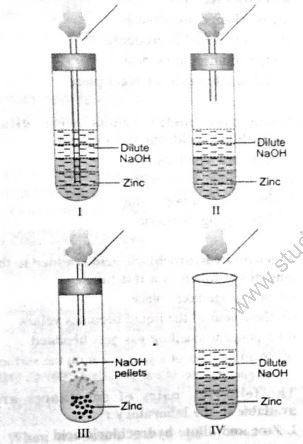
(a) I
(b) II
(c) III
(d) IV
Answer: (b) II
Question. Four set ups as given below were arranged to identify the gas evolved when dilute Hydrochloric acid was added to Zinc granules. The most appropriate set up is :
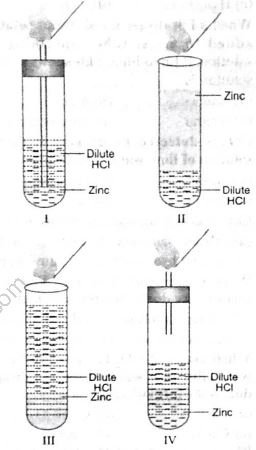
(a) I
(b) II
(c) III
(d) IV
Answer: (d) IV
Question. A drop of colourless liquid was placed on blue litmus paper. The litmus paper turned red. The liquid could be :
(a) dilute Hydrochloric acid
(b) dilute Sodium hydroxide solution
(c) distilled water
(d) Sodium bicarbonate solution
Answer: (a) dilute Hydrochloric acid
Question. To prepare sulphur dioxide in the laboratory, we heat copper turnings with
(a) conc. HCl
(b) conc. \( \text{H}_2\text{SO}_4 \)
(c) conc. \( \text{HNO}_3 \)
(d) dil. \( \text{H}_2\text{SO}_4 \)
Answer: (b) conc. \( \text{H}_2\text{SO}_4 \)
Question. During reaction of copper metal with conc. \( \text{H}_2\text{SO}_4 \), \( \text{H}_2\text{SO}_4 \) is reduced to
(a) \( \text{H}_2\text{O} \)
(b) \( \text{SO}_2 \)
(c) \( \text{SO}_3^{2-} \) ion
(d) \( \text{SO}_3 \)
Answer: (b) \( \text{SO}_2 \)
Question. When copper turnings are heated with conc. \( \text{H}_2\text{SO}_4 \), copper metal is converted into
(a) \( \text{Cu(OH)}_2 \)
(b) \( \text{CuO} \)
(c) \( \text{CuSO}_4 \)
(d) \( \text{CuSO}_3 \)
Answer: (c) \( \text{CuSO}_4 \)
Question. Sulphur dioxide is collected in the laboratory by the
(a) upward displacement of air
(b) downward displacement of air
(c) upward displacement of water
(d) downward displacement of water
Answer: (a) upward displacement of air
Question. \( \text{SO}_2 \) turns
(a) dry blue litmus paper red
(b) moist blue litmus paper red
(c) dry red litmus paper blue
(d) moist red litmus paper blue.
Answer: (b) moist blue litmus paper red
Question. Which of the following gases is highly soluble in water ?
(a) \( \text{SO}_2 \)
(b) \( \text{O}_2 \)
(c) \( \text{H}_2 \)
(d) \( \text{CO}_2 \)
Answer: (a) \( \text{SO}_2 \)
Question. \( \text{SO}_2 \) dissolves in water to form
(a) Sulphuric acid
(b) Sulphurous acid
(c) Sulphite ions
(d) Both (b) and (c).
Answer: (d) Both (b) and (c).
Question. Aqueous solution of \( \text{SO}_2 \) is
(a) acidic
(b) basic
(c) neutral
(d) amphoteric.
Answer: (a) acidic
Question. When \( \text{SO}_2 \) is passed through lime water, white cloudiness is formed. This is due to the formation of
(a) calcium sulphide
(b) calcium sulphite
(c) calcium sulphate
(d) calcium bisulphate.
Answer: (b) calcium sulphite
Question. Which of the following is/are dibasic acids ?
(a) Sulphurous acid
(b) Sulphuric acid
(c) Hydrochloric acid
(d) both (a) and (b).
Answer: (d) both (a) and (b).
Question. The molecular formula of potassium dichromate is
(a) \( \text{K}_2\text{Cr}_2\text{O}_7 \)
(b) \( \text{K}_2\text{CrO}_4 \)
(c) \( \text{KMnO}_4 \)
(d) \( \text{K}_2\text{MnO}_4 \)
Answer: (a) \( \text{K}_2\text{Cr}_2\text{O}_7 \)
Question. The colour of potassium dichromate is
(a) yellow
(b) pink
(c) orange
(d) green.
Answer: (c) orange
Question. A student prepared a gas in the laboratory and passed it through an acidified solution of potassium dichromate. The orange colour of the solution turned green. The gas is
(a) \( \text{CO}_2 \)
(b) \( \text{SO}_2 \)
(c) \( \text{H}_2 \)
(d) \( \text{O}_2 \).
Answer: (b) \( \text{SO}_2 \)
Question. Sulphur dioxide turns acidified potassium dichromate solution green. This means that sulphur dioxide is a
(a) reducing agent
(b) oxidising agent
(c) dehydrating agent
(d) none of the options.
Answer: (a) reducing agent
Question. During the reaction of sulphur dioxide with acidified solution of potassium dichromate, potassium dichromate acts as a/an
(a) reducing agent
(b) oxidising agent
(c) dehydrating agent
(d) none of the options.
Answer: (b) oxidising agent
Question. Acidified potassium dichromate oxidises sulphur dioxide to
(a) sulphur
(b) sulphuric acid
(c) sulphurous acid
(d) sulphite ion.
Answer: (b) sulphuric acid
Question. Sulphur dioxide reduces potassium dichromate solution acidified with dilute sulphuric acid to
(a) chromium (II) sulphate
(b) chromium (IV) sulphate
(c) chromium (III) sulphate
(d) chromium (VI) sulphate.
Answer: (c) chromium (III) sulphate
Question. \( \text{SO}_2 \) acts as a reducing agent only when
(a) it is moist
(b) it is dry
(c) in aqueous solution
(d) Both (a) and (c).
Answer: (d) Both (a) and (c).
Question. When red petals of rose are added to a jar of sulphur dioxide, they become
(a) orange
(b) blue
(c) colourless
(d) black.
Answer: (c) colourless
Question. \( \text{SO}_2 \) bleaches coloured substances by
(a) reduction
(b) removing oxygen from coloured substances
(c) oxidation
(d) Both (a) and (b).
Answer: (d) Both (a) and (b).
Question. \( \text{SO}_2 \) is known to cause air pollution because
(a) it is fairly poisonous and causes inflammation of lungs
(b) it causes acid rain
(c) it damages metal structures, buildings and plants
(d) All of the options.
Answer: (d) All of the options.
Question. Sulphurous acid cannot be found on the laboratory shelf because
(a) being a weak acid it decomposes readily to form \( \text{SO}_2 \) and \( \text{H}_2\text{O} \)
(b) it is extremely corrosive
(c) it emits poisonous fumes
(d) none of the options.
Answer: (a) being a weak acid it decomposes readily to form \( \text{SO}_2 \) and \( \text{H}_2\text{O} \)
Question. A pungent smelling gas which turns lime water milky is
(a) \( \text{CO}_2 \)
(b) \( \text{SO}_2 \)
(c) \( \text{NH}_3 \)
(d) \( \text{H}_2 \).
Answer: (b) \( \text{SO}_2 \)
Question. The pink colour of acidified \( \text{KMnO}_4 \) solution disappears when \( \text{SO}_2 \) is passed through it. Which of the following statements about this reaction is not correct ?
(a) \( \text{SO}_2 \) acts as a reducing agent
(b) \( \text{KMnO}_4 \) acts as an oxidising agent
(c) \( \text{KMnO}_4 \) is reduced to \( \text{MnSO}_4 \)
(d) \( \text{SO}_2 \) acts as a bleaching agent.
Answer: (d) \( \text{SO}_2 \) acts as a bleaching agent.
Question. Which of the following reagents can be used to distinguish sulphurous acid from sulphuric acid ?
(a) Blue litmus solution
(b) Sodium bicarbonate solution
(c) Acidified potassium dichromate solution
(d) Any of the options.
Answer: (c) Acidified potassium dichromate solution
Question. Which of the following gases are responsible for acid rain ?
(a) \( \text{SO}_2 \)
(b) \( \text{NH}_3 \)
(c) \( \text{CO} \)
(d) \( \text{CO}_2 \).
Answer: (a) \( \text{SO}_2 \)
Question. When acidified potassium dichromate solution is added to a jar containing sulphur dioxide gas, the solution becomes ?
(a) colourless
(b) brown
(c) dark orange
(d) green
Answer: (d) green
Question. When a test tube full of \( \text{SO}_2 \) gas is inverted in a trough of water, it is observed that water
(a) rises slowly in the test tube to about 1 cm height
(b) rises slowly in the test tube to about 5 cm height
(c) rushes in the test tube to about 10 cm height
(d) rushes in the test tube and almost completely fills it.
Answer: (d) rushes in the test tube and almost completely fills it.
Question. Sulphur dioxide gas was tested with moist blue litmus and red litmus papers. Sets of observations recorded by four students I, II, III and IV are given below in which the (\( \checkmark \)) indicates a colour change whereas (\( \times \)) indicates no colour change.
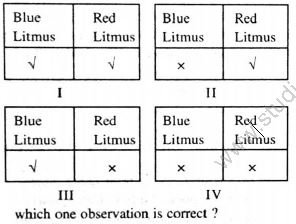
(a) I
(b) II
(c) III
(d) IV
Answer: (c) III
Question. A moist litmus paper is introduced in a gas jar containing a gas. After some time, the paper becomes colourless. The gas present in the jar is
(a) Hydrogen
(b) Carbon dioxide
(c) Sulphur dioxide
(d) Ammonia
Answer: (c) Sulphur dioxide
Question. The description which most approximately suits sulphur dioxide gas is that it is colourless and
(a) insoluble in water
(b) has pungent and suffocating odour
(c) lighter than air
(d) has smell of rotten eggs
Answer: (b) has pungent and suffocating odour
Question. Four gas jars filled with sulphur dioxide gas were inverted into troughs of water by four students and the following observations and inference were reported :
I. Water did not enter the gas jar and sulphur dioxide is insoluble in water.
II. A small amount of water entered the gas jar slowly and sulphur dioxide is sparingly soluble in water.
III. Water rushed into the gas jar and sulphur dioxide is highly soluble in water.
IV. Water did not enter the gas jar and sulphur dioxide is soluble in water.
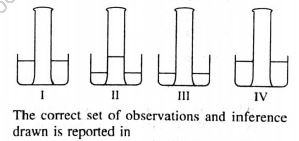
(a) I
(b) II
(c) III
(d) IV
Answer: (c) III
Question. When Sulphur dioxide gas is passed through acidified Potassium dichromate solution, the colour of the solution changes from :
(a) orange to yellow
(b) orange to green
(c) green to orange
(d) yellow to green
Answer: (b) orange to green
Question. Which two equipments would you choose to prepare and collect Sulphur dioxide gas in the laboratory ?
Answer: A flat-bottom flask (or round-bottom flask) fitted with a thistle funnel and a delivery tube, and an empty gas jar for collecting the gas by upward displacement of air.
SOUND AND WAVES
SOUND PROPAGATES AS A WAVE:
• Sound propagates from one place to another in the form of waves, i.e. because of the disturbance of particles of the medium.
• Wave is a phenomenon or disturbance in which energy is transferred from one point to another without any direct contact between the points. So, sound is considered as a wave.
• Particles of medium only vibrate. They do not move from one point to another.

TYPES OF WAVES :
• On the basis of direction of propagation, waves can be divided into two types –- Longitudinal waves n transverse
i) Longitudinal waves are waves in which particles of the medium do to and fro motion in the same direction in which the wave moves. E.g Sound waves
ii) Transverse waves are waves in which particles of the medium do to and fro motion in the direction perpendicular to the direction of movement of wave. E.g light waves.
Q. How to identify types of waves
In a transverse wave, the particles are displaced perpendicular to the direction the wave travels.
Example of transverse waves include vibration on a string and ripples on the surface of water. We can make a horizontal transverse wave by moving the slinky vertically up and down.
• In longitudinal wave the particles are displaced parallel to the direction the wave travels. An example of longitudinal waves is compression moving along a slinky. We can make a horizontal longitudinal wave by pushing and pulling the slinky

• sound waves are longitudinal Sound travels as a longitudinal wave through a material medium.
The particles of sound wave do not move from one place to another. They just oscillate back n forth about their position of rest. The disturbance is carried forward. Hence, sound waves are longitudinal waves.
Longitudinal waves can be shown through a sling key.
Hold one end of the sling key n fix the other end to the wall nail. Now, stretch sling key by pulling the hand, after a while push the stretched sling key towards the wall. You’ll observe that the coils come closer at some regions whereas it moves apart at other regions forming regions of compressions n rarefactions.
COMPRESSION AND RAREFACTION

• Sound travels as successive compressions and rarefactions in the medium. A vibrating object producing a series of compressions (C) and rarefaction (R)
• When a vibrating object moves forward, it pushes and compresses the air in front of it forming a region of high pressure called compression (C). Compressions are the regions of high pressure and density where the particles are crowded and are represented by the upper portion or peak of the curve called crest.
• When the vibrating object moves backward, it forms a region of low pressure called rarefaction (R). Rarefactions are the regions of low pressure and density where the particles are spread out and are represented by the lower portion of the curve called trough or valleys.
Questions based on the above topics:-
Question. What type of wave is sound?
Answer. Sound is a longitudinal wave.
Question. Name the types of a wave.
Answer. Longitudinal wave and Transverse waves.
Question. The peak of upper portion of a wave is _____.
Answer. Crest.
Question. In which type of waves the compression and rarefaction exist ?
Answer. Longitudinal waves.
Question. Define through in a wave.
Answer. The peak(maximum point) of lower curve of a wave is known as through of a wave.
Question. Write any three example of a longitudinal wave?
Answer. sound waves. ultrasound waves. seismic P-waves.
Question. What are the two main parts of a longitudinal wave?
Answer. A compression is where the particles of the medium are closest together, and a rarefaction is where the particles are farthest apart.
Question. How to identify transverse waves?
Answer. In a transverse wave, the particles are displaced perpendicular to the direction the wave travels.
Question. What two factors determine the speed of a transverse wave?
Answer. The speed of a wave is dependant on four factors: wavelength, frequency, medium, and temperature.
Question. What is one complete oscillation?
Answer. The change in density from one maximum value to the minimum value and again to the maximum value makes one complete oscillation.
The red part shows a complete oscillation of a wave in unit time period.

Free study material for Science
HOTS for All Chapters Science Class 9
Students can now practice Higher Order Thinking Skills (HOTS) questions for All Chapters to prepare for their upcoming school exams. This study material follows the latest syllabus for Class 9 Science released by CBSE. These solved questions will help you to understand about each topic and also answer difficult questions in your Science test.
NCERT Based Analytical Questions for All Chapters
Our expert teachers have created these Science HOTS by referring to the official NCERT book for Class 9. These solved exercises are great for students who want to become experts in all important topics of the chapter. After attempting these challenging questions should also check their work with our teacher prepared solutions. For a complete understanding, you can also refer to our NCERT solutions for Class 9 Science available on our website.
Master Science for Better Marks
Regular practice of Class 9 HOTS will give you a stronger understanding of all concepts and also help you get more marks in your exams. We have also provided a variety of MCQ questions within these sets to help you easily cover all parts of the chapter. After solving these you should try our online Science MCQ Test to check your speed. All the study resources on studiestoday.com are free and updated for the current academic year.
FAQs
You can download the teacher-verified PDF for CBSE Class 9 Science HOTs from StudiesToday.com. These questions have been prepared for Class 9 Science to help students learn high-level application and analytical skills required for the 2026-27 exams.
In the 2026 pattern, 50% of the marks are for competency-based questions. Our CBSE Class 9 Science HOTs are to apply basic theory to real-world to help Class 9 students to solve case studies and assertion-reasoning questions in Science.
Unlike direct questions that test memory, CBSE Class 9 Science HOTs require out-of-the-box thinking as Class 9 Science HOTS questions focus on understanding data and identifying logical errors.
After reading all conceots in Science, practice CBSE Class 9 Science HOTs by breaking down the problem into smaller logical steps.
Yes, we provide detailed, step-by-step solutions for CBSE Class 9 Science HOTs. These solutions highlight the analytical reasoning and logical steps to help students prepare as per CBSE marking scheme.