

ICSE Solutions Focus On Class 9 History Civics Chapter 10 The Mughal Empire have been provided below and is also available in Pdf for free download. The Focus On ICSE solutions for Class 9 History Civics have been prepared as per the latest syllabus and ICSE books and examination pattern suggested in Class 9. Questions given in ICSE Focus On book for Class 9 History Civics are an important part of exams for Class 9 History Civics and if answered properly can help you to get higher marks. Refer to more Chapter-wise answers for ICSE Class 9 History Civics and also download more latest study material for all subjects. Chapter 10 The Mughal Empire is an important topic in Class 9, please refer to answers provided below to help you score better in exams
Focus On Chapter 10 The Mughal Empire Class 9 History Civics ICSE Solutions
Class 9 History Civics students should refer to the following ICSE questions with answers for Chapter 10 The Mughal Empire in Class 9. These ICSE Solutions with answers for Class 9 History Civics will come in exams and help you to score good marks
Chapter 10 The Mughal Empire Focus On ICSE Solutions Class 9 History Civics
Exercises
Question 1. Name any two sources to reconstruct the Age of the Mughals.
Answer: Two major books that help us rebuild the history of the Mughals are the Ain-i-Akbari and the Akbarnama.
In simple words: We can learn about the Mughal times from old books like the Ain-i-Akbari and the Akbarnama.
Exam Tip: Highlighting these two famous literary works written during Akbar's reign will help you get full marks.
Question 2. Who wrote Ain-i-Akbari.
Answer: The person who wrote the Ain-i-Akbari was Abul Fazl.
In simple words: Abul Fazl wrote the famous book Ain-i-Akbari.
Exam Tip: Remember to spell the name "Abul Fazl" correctly, as it is a very common exam question.
Question 3. What information does Abul Fazl provide about Akbar’s Admiralty Department ?
Answer: Abul Fazl wrote about the Admiralty Department, which had these main tasks:
1. Making boats and ships.
2. Finding and hiring skilled sailors.
In simple words: Akbar's navy department was responsible for building boats and recruiting good sailors.
Exam Tip: List both of the functions clearly as bullet points or numbered lists to show a structured answer.
Question 4. Name any two monuments that help to reconstruct the history of the Mughals.
Answer: Two famous buildings that help us learn about Mughal history are the Agra Fort and Humayun's Tomb.
In simple words: Old buildings like the Agra Fort and Humayun's Tomb tell us a lot about the Mughal kings.
Exam Tip: Naming prominent architectural wonders like the Taj Mahal, Agra Fort, or Humayun's Tomb is always a safe and correct answer.
Question 5. Name the two magnificent buildings within the Red Fort.
Answer: Inside the Red Fort, the two grand buildings are:
1. Diwan-i-Aam: A large hall where the king met common people.
2. Diwan-i-Khas: A beautifully decorated room that held the Peacock Throne. The king used this room to meet royal princes, officers, and important guests.
In simple words: The two key halls in the Red Fort are Diwan-i-Aam for the public and Diwan-i-Khas for private royal meetings.
Exam Tip: Make sure to explain the difference in purpose between the two halls - "Aam" for public and "Khas" for private audience.
Question 6. Mention any two architectural features of the Jama Masjid at Delhi.
Answer: Two outstanding features of the Jama Masjid are:
1. It is constructed on a high platform that is 9 meters tall and covers a large space. It has three grand entrances with big stairs on the north, south, and east.
2. The main prayer hall has eleven arches, with the middle arch being much taller than the rest of the roof.
In simple words: This mosque stands on a very high platform with grand steps and features a massive prayer hall with eleven arches.
Exam Tip: Be sure to specify measurements like the 9-meter high platform or the 11 arches to score full marks.
Question 7. In whose memory was the Taj Mahal built ?
Answer: Emperor Shah Jahan built the Taj Mahal to remember his dear wife, Mumtaz Mahal.
In simple words: The Taj Mahal was built by Shah Jahan for his wife Mumtaz Mahal.
Exam Tip: State clearly that it was built by Shah Jahan in memory of his beloved queen, Mumtaz Mahal.
Question 8. Whom did Babur defeat at the battlefield of Panipat? What was its consequence?
Answer: In April 1526, Babur defeated Sultan Ibrahim Lodi at Panipat. This win happened because of his great leadership and advanced Turkish weapons. It made Babur the ruler of Delhi. Later, he also defeated Rana Sanga of Mewar at the Battle of Khanua, which gave Babur power over Central India.
In simple words: Babur defeated Ibrahim Lodi at Panipat in 1526. This victory helped him establish the Mughal Empire in India.
Exam Tip: Don't forget to mention both the opponent (Ibrahim Lodi) and the exact year (1526) for the First Battle of Panipat.
Question 9. What was the result of Babur’s encounter with a huge confederacy of Rajputs at Khanua?
Answer: The fight at Khanua ended with a victory for Babur. This success allowed him to take full control of Central India.
In simple words: Babur won the Battle of Khanua against the Rajputs, which gave him control over Central India.
Exam Tip: Mention that the battle of Khanua helped secure Babur's position in Northern and Central India after Panipat.
Question 10. What is the significance of the Second Battle of Panipat (1556)?
Answer: This battle took place in November 1556 between Hemu and the Mughals. The Mughal army defeated Hemu's forces, and Hemu was caught and put to death.
In simple words: In 1556, the Mughals defeated and killed the Afghan leader Hemu at the Second Battle of Panipat.
Exam Tip: Specify the year (1556) and name Hemu to show a clear understanding of this historical event.
Question 11. Name any two Deccan territories included in Akbar’s empire.
Answer: Two areas in the Deccan that became part of Akbar's empire were Ahmadnagar and Bijapur.
In simple words: Akbar added Ahmadnagar and Bijapur in the south to his empire.
Exam Tip: Ahmadnagar, Bijapur, and Golconda are the three key territories - you only need to write any two.
Question 12. What was Akbar’s Mansabdari System ?
Answer: This was a special administrative system created by Akbar. Officers in this system were called mansabdars, and each had a rank or "mansab". These officers held power in both civil and military areas. Their ranks went from 10 up to 5000. Ranks had two parts called "zat" and "sawar". A mansabdar had to keep twenty horses for every ten horsemen under their command.
In simple words: Akbar's Mansabdari system gave officers ranks called mansabs and required them to maintain a set number of soldiers and horses.
Exam Tip: Explaining the terms "zat" (personal rank) and "sawar" (number of cavalrymen) will help you score full marks.
Question 13. Akbar’s Din-I-Ilahi was based on what principles or beliefs ?
Answer: It rested on the belief that there is only one God. It also promoted good qualities like bravery, loyalty, and fairness.
In simple words: Din-i-Ilahi was based on believing in one God and being good, loyal, and fair to others.
Exam Tip: Emphasize the core ideas of "oneness of God" and virtues like justice and courage in your answer.
Question 14. Name any two Departments of Government during the Mughal Age.
Answer: Two major government branches were:
1. The Military Pay and Accounts Department, run by the Mir Bakshi.
2. The Imperial Household Department, managed by the Khan-i-Saman.
In simple words: The military department and the royal household department were two main branches of the Mughal government.
Exam Tip: Be sure to name the officials (like Mir Bakshi or Khan-i-Saman) who headed these departments.
Question 15. Who was at the head of the Finance Department under Mughal rule.
Answer: The Diwan was the chief officer in charge of the finance department.
In simple words: The Diwan was the head of the money and tax department under the Mughals.
Exam Tip: The term "Diwan" is the single key word required to answer this question correctly.
Question 16. Name the master architect who designed the Taj Mahal.
Answer: The main designer of the Taj Mahal was Ustad Isa.
In simple words: Ustad Isa was the chief architect who designed the Taj Mahal.
Exam Tip: Make sure you do not confuse the architect (Ustad Isa) with the emperor who built it (Shah Jahan).
Question 17. Diwan-i-Khas in the Red Fort was used by the Emperor for what purpose ?
Answer: The Diwan-i-Khas was a highly decorated room where the Peacock Throne sat. The ruler used it to hold meetings with royal family members, nobles, and other special guests.
In simple words: The Diwan-i-Khas was a beautiful hall where the king met special guests and kept the Peacock Throne.
Exam Tip: Highlight that this was the "Hall of Private Audience" and mention the presence of the Peacock Throne.
Question 18. Mention any two factors responsible for Humayun’s failure against Sher Shah Suri.
Answer: The two main reasons for Humayun's defeat were:
1. He was not as skilled a soldier or commander as Babur.
2. He could not stick to a steady, long-term plan.
In simple words: Humayun failed because he was a weak military leader and lacked a solid, steady plan.
Exam Tip: Contrast Humayun's skills with those of his father (Babur) to make your explanation stronger.
Question 19. Mention any two revenue reforms instituted by Sher Shah Suri.
Answer: Two tax reforms started by Sher Shah Suri were:
1. He created an organized way to measure farm lands.
2. He calculated the land tax carefully and made sure it was collected strictly.
In simple words: Sher Shah Suri started measuring agricultural land and made sure taxes were collected carefully.
Exam Tip: Sher Shah Suri is famous for his land-measuring system, which later served as a base for Akbar's reforms.
Question 20. What is the significance of Akbar’s Mansabdari system?
Answer: In this system, Akbar chose and hired fit people to be mansabdars. They worked as both army chiefs and civil officers. This setup made it much simpler and smoother to run the massive empire.
In simple words: The Mansabdari system helped Akbar run his vast kingdom smoothly by choosing capable officers for administrative and army roles.
Exam Tip: Mention how the system combined both military and civil duties under a single officer rank.
Question 21. Mention the nature of Akbar’s Din-I-Ilahi.
Answer: Din-i-Ilahi was a new belief system started by Akbar in 1580. It focused on the idea of a single God and taught values like honesty, bravery, and fairness. It also asked members to be loyal to the ruler.
In simple words: Din-i-Ilahi was a simple set of moral rules based on believing in one God and being loyal to the king.
Exam Tip: Focus on describing it as a "moral code" or "ethical system" rather than a strict, dogmatic religion.
Question 22. How did Jahangir deal with the Sikh Guru, Guru Arjun Dev?
Answer: Jahangir ordered the torture and killing of the fifth Sikh Guru, Guru Arjun Dev.
In simple words: Jahangir tortured and executed the Sikh Guru, Guru Arjun Dev.
Exam Tip: This event marked a major turning point in the relationship between the Mughals and the Sikhs, so state it clearly.
Question 23. Why was the title of ‘Shah Jahan’ conferred on Prince Khurram by Jahangir ?
Answer: Prince Khurram married the daughter of Asaf Khan, who was the imperial Khan-i-Saman. Asaf Khan was also the brother of Jahangir's wife, Nur Jahan. Due to these family connections and his military success, Jahangir gave him the title of Shah Jahan.
In simple words: Prince Khurram was named Shah Jahan because of his military wins and strong family ties through marriage.
Exam Tip: Mention the family connections involving Nur Jahan and Asaf Khan to provide a complete answer.
Question 24. Who was Nur Jahan?
Answer: Nur Jahan was the wife of Jahangir. Before marrying the emperor, she was the widow of a Persian noble named Sher Afghan.
In simple words: Nur Jahan was Jahangir's powerful wife, who was previously married to a Persian noble.
Exam Tip: Knowing her original background as the widow of Sher Afghan is a common detail tested in exams.
Question 25. Why did Shah Jahan revolt against his father?
Answer: Nur Jahan had a lot of power over Jahangir and wanted to rule the empire herself. Prince Khurram (Shah Jahan) realized her plans, which led to a big fight between them. In the end, he decided to rebel against Jahangir.
In simple words: Shah Jahan rebelled because he was afraid that Jahangir's wife, Nur Jahan, would take over all power.
Exam Tip: Focus on the conflict of ambition between Nur Jahan and Prince Khurram to explain the revolt clearly.
Question 26. Metnion Shah Jahan’s conquests in the Deccan.
Answer: Shah Jahan expanded his control over the Deccan by taking over Ahmadnagar, Bijapur, and Golconda.
In simple words: In the south, Shah Jahan conquered the kingdoms of Ahmadnagar, Bijapur, and Golconda.
Exam Tip: Memorize the three Deccan sultanates (Ahmadnagar, Bijapur, and Golconda) as they are the standard answers for his campaigns in the south.
Question 27. Where is Humayun’s Tomb located? Mention any two features of the monument.
Answer: Humayun's Tomb is situated in Delhi and was built by his wife, Hamida Banu Begum. Two main features are:
1. It is built on a tall, square-shaped base with arched entries on every side.
2. It has a rounded marble dome that sits on a narrow neck-like base.
In simple words: Humayun's Tomb is in Delhi. It stands on a high platform and has a beautiful white marble dome.
Exam Tip: Note that it was built under the patronage of Hamida Banu Begum, which is a key historical fact.
Structured Questions
Question 1. Akbar had both the time and inclination to look at the administrative problems of the Empire. In this context describe birefly.
(a) His Mansabdari System
(b) His Land Revenue System
Answer:
(a) Mansabdari System:
Akbar started the Mansabdari system to make his army stronger and more organized. Almost all officers, except religious ones like qazis, had to join and keep a certain number of soldiers based on their rank. The emperor chose them directly and paid them in cash instead of giving them land. From their pay, they had to take care of their own needs and also keep a set number of horses, elephants, and transport carts. These officers had to work wherever and however the ruler wanted, serving as both soldiers and city administrators. This high pay and respect helped Akbar get very talented people for his government. The rank was not passed down to children, and the emperor could raise their rank or remove them at any time.
(b) His Land Revenue System:
In the beginning of Akbar's rule, nothing was done to change the tax system. Later, when Todar Mal took charge of the land revenue department, he created a new system. It had three steps:
1. Measuring and checking the land.
2. Grouping land by how well crops could grow on it.
3. Deciding the tax rate to be paid in cash or crops.
Akbar also started the dahsala system, which looked at the average crops and prices from the past ten years. The land tax was set at one-third of this average. This made collection faster since they did not have to calculate taxes every single year. Todar Mal's system helped the government earn money without making the farmers poor. The state also gave loans to farmers in need, which helped farming, trade, and businesses grow.
In simple words: Akbar organized his army using the Mansabdari system, where officers got cash salaries. For taxes, Todar Mal measured lands and set fixed tax rates based on ten-year averages to help farmers.
Exam Tip: Use terms like "Todar Mal," "dahsala system," and "non-hereditary ranks" as these are the exact keywords examiners search for.
Question 2. Akbar was the greatest of all medieval rulers of India. In this context describe: His policy of racial pacification and religious tolerance.
Answer: Akbar wanted to bring peace between different races and religions in his country. He removed the Jizya tax and allowed Hindus, especially Rajput princes, to join his government. He supported Hindu artists and writers and welcomed marriage ties with Rajput families. In 1580, he started a belief system called Din-i-Ilahi, which focused on a single God, values like bravery and honesty, and loyalty to the ruler. This path was never forced on anyone and had very few followers.
In simple words: Akbar united his people by stopping religious taxes, marrying Rajput princesses, and creating a peaceful moral path called Din-i-Ilahi.
Exam Tip: Be sure to write about the abolishment of the Jizya tax and the introduction of Din-i-Ilahi as the prime examples of his tolerance.
Question PQ. Shah Jahan’s reign marks the climax of the Mughal dynasty and empire. In this context explain briefly:
(a) His Conquests.
(b) Magnificence of the Imperial Court and his Architectural. Achievements.
Answer:
(a) His Conquests:
Shah Jahan launched an army campaign against Ahmadnagar in 1632 and took it over. He told the rulers of Bijapur and Golconda to accept his power and traveled to the Deccan to make sure they followed his orders. Golconda accepted his rule in 1636, but he had to use force to make Bijapur submit. In the northwest, he recaptured Kandahar in 1638, but the Shah of Iran took it back in 1649. Three attempts to get it back failed, and Kandahar was lost forever. He also stopped the rebellion of Jujhar Singh, the son of Bir Singh Bundela.
(b) Magnificence of the Imperial Court and his Architectural Achievements:
Shah Jahan set up his royal court to look like the grand courts of Persian rulers. The beautiful Peacock Throne and the Kohinoor diamond made his court look incredibly wealthy. He supported many writers and arts. Beautiful structures like the Taj Mahal in Agra and the Jama Masjid in Delhi show the peak of Mughal building design during his rule. Under his support, arts like painting and music also grew.
In simple words: Shah Jahan conquered kingdoms in the south but lost Kandahar in the north. He built beautiful monuments like the Taj Mahal and created a very rich royal court.
Exam Tip: Highlight the contrast between his successful campaigns in the Deccan and the loss of Kandahar in the northwest.
Question 3. Aurangzeb died forlorn and destitute. In this context, explain briefly:
(a) His dealings with the Sikh
(b) His attempts to suppress rebellion in the Deccan.
Answer:
(a) His dealings with the Sikh Gurus:
Aurangzeb was a very strict Sunni Muslim ruler who tried to force many people to convert to Islam. Kashmiri Hindu priests asked the ninth Sikh Guru, Guru Tegh Bahadur, for help against Aurangzeb's harsh rules. This made Aurangzeb very angry. He arrested the Guru, brought him to Delhi, and told him to choose between converting or dying. When the Guru refused, Aurangzeb had him beheaded in public at Chandni Chowk in Delhi. Today, Gurdwara Sis Ganj Sahib stands there to honor him. Later in 1704, the Mughals attacked Anandpur Fort. Guru Gobind Singh and his warriors fought bravely. His two young sons, Zorawar Singh and Fateh Singh, were captured and walled up alive for refusing to convert. After another major battle at Muktsar where many soldiers died, a permanent rift remained between the Sikhs and the Mughals.
(b) His attempts to suppress rebellion in the Deccan:
After Shivaji, his eldest son Sambhaji ruled the Marathas. Things changed when Aurangzeb's rebel son, Prince Akbar, fled to the Maratha court. Aurangzeb was afraid they would form a large alliance with the Deccan sultanates against him. He traveled to the Deccan in 1681 to crush them. He managed to take over Bijapur in 1686 and Golconda soon after. Sambhaji was captured and killed in 1689. Though the Deccan seemed conquered, the Marathas did not give up. They made Rajaram, Sambhaji's brother, their leader. When the Mughals attacked their capital, Rajaram fled to Jinji. The Mughals caught Sambhaji's wife and young son Shahu. The war went on for decades. When Rajaram died in 1700, his wife Tarabai made her young son Shivaji II the king. Aurangzeb spent his last years moving from one fort to another, losing vast wealth and respect before dying in 1707.
In simple words: Aurangzeb killed Guru Tegh Bahadur and fought long, costly wars against the Marathas in the south, which emptied his treasury and weakened his empire.
Exam Tip: Clearly describe both the execution of Guru Tegh Bahadur and the 25-year-long Deccan campaign as main factors that ruined his empire.
Question 4. Describe the Mughal Administration under the following headlines:
(a) Position of the Monarch
(b) Main Departments of Government
Answer:
(a) Position of the Monarch:
Humayun and Akbar believed that the right to rule was a divine gift from God. The Mughal government was a strong monarchy where the king held absolute power. He controlled the administration, led the military forces, and acted as the chief judge. His decisions and words served as the law.
(b) Main Departments of Government:
The Vizier held the highest rank under the emperor, while the Diwan managed the finance department. The other major branches were:
1. The military office, run by the Mir Bakshi.
2. The household office, managed by the Khan-i-Saman.
3. The court system, under the Chief Qazi.
Other junior officers included the Daroga-i-Topkhana (artillery chief), the Mint master, and the Mir Arz who handled petitions for the king.
In simple words: The Mughal king had absolute power and ruled as a representative of God. He was assisted by key officers like the Vizier, Diwan, and Mir Bakshi.
Exam Tip: Be sure to list the three main departments (military, finance, household) and match them with their respective officials.
Question 5. Describe the Mughal Administration with reference to the following:
(a) The Army and the Navy
(b) Administration of Law and Justice
Answer:
(a) The Army and the Navy:
The military was made of five parts: foot soldiers, horsemen, big guns, a navy, and war elephants. The artillery used large guns to attack forts and smaller ones for quick moves. The naval office built boats, hired sailors, and collected river taxes. The navy also fought sea pirates. In the 1600s, foot soldiers became more important because of new guns. However, the army was less efficient because soldiers were loyal to their direct officers rather than the emperor. The marching army looked like a travelling town with wives, servants, and musicians, which led to a lack of discipline.
(b) Administration of Law and Justice:
The Chief Qazi was the main judge of the empire, and he selected judges for different provinces. Courts were run by Qazis, Muftis (who explained Islamic laws), and Mir-adls (who gave the final decisions). Courts could give fines and physical punishments without asking the ruler, but the death penalty always needed the emperor's final approval. The emperor was the highest court of all.
In simple words: The army was large but suffered from a lack of discipline. The court system was headed by the Chief Qazi, but the emperor held the final judicial power.
Exam Tip: Clearly detail the role of the Chief Qazi, Muftis, and Mir-adls to explain the legal administration accurately.
Question PQ. Give an account of the social developments during the Mughal Age under the following headlines:
(a) Social Structure
(b) Position of Women
Answer:
(a) Social Structure:
Mughal society had three main groups:
1. The royal family and nobles, who lived in extreme wealth, wore expensive clothes, and owned slaves.
2. The middle class, which included traders, artists, musicians, and scholars, who lived comfortably based on their work.
3. The lower class, made up of poor farmers and laborers, who worked hard just to survive. They suffered a lot during famines and faced high taxes towards the end of Shah Jahan's rule.
(b) Position of Women:
Women in Mughal times often faced hard lives due to social evils like child marriage and Sati. Although emperors like Akbar tried to stop child marriage and others tried to ban Sati, these customs continued. Men were also allowed to have multiple wives. Even with these difficulties, some highly talented women like Rani Durgavati, Nur Jahan, Jijabai, and Jahanara took an active part in politics and became famous.
In simple words: Society was split into the super-rich, a comfortable middle class, and very poor laborers. Women faced tough social customs, but some prominent ladies rose to political power.
Exam Tip: When writing about the social structure, clearly separate the rich, middle, and poor classes to present a balanced view.
Question PQ. The Growing harmony between various religious communities was a marked feature of social life during the reigns of rulers from Akbar to Shah Jahan. In this context explain briefly:
(a) Growing harmony between Hindus and Muslims
(b) Growth of the Bhakti Movement and Sufism in the Mughal period.
Answer:
(a) Growing harmony between Hindus and Muslims:
Relations between Hindus and Muslims improved a lot during this era, mostly because of Akbar's open-minded rules. He ended the Jizya tax on non-Muslims and gave government jobs to Hindus. His marriages to Hindu princesses brought Hindu traditions into the royal palace, where festivals like Durga Puja were celebrated. Similarly, wealthy Hindu landowners adopted Mughal clothing, manners, and food. Muslims also joined in celebrating Hindu festivals like Holi and Diwali.
(b) Growth of the Bhakti Movement and Sufism in the Mughal period:
The Bhakti movement continued to expand during the 1600s and 1700s, led by famous saints like Tukaram in Maharashtra and Chaitanya Mahaprabhu in Bengal. Sufism also had a major impact, and Akbar himself was deeply touched by Sufi ideas and Hindu teachings. The Bhakti movement remained highly popular across Rajasthan, Gujarat, and South India, with leaders like Raja Man Singh supporting Vaishnavism.
In simple words: Hindus and Muslims shared traditions, dressed similarly, and celebrated each other's festivals, while spiritual Bhakti and Sufi movements brought people closer.
Exam Tip: Point out the cultural exchange - like Muslims joining Holi and Hindus adopting Mughal dresses - to show growing unity.
Question 6. Study the picture of the Red Ford and answer the following questions:
(a) Where is the Fort located ?
(b) Name the ruler who built it ?
(c) Mention two important buildings within its enclosure
(d) Mention three important features of the Fort
(e) Mention one occasion when the Fort is used by the Government of India
Answer:
(a) The fort is situated in the city of Delhi.
(b) It was constructed by the Mughal ruler Shah Jahan between the years 1639 and 1648.
(c) Two grand structures inside the fort are the public hall called Diwan-i-Aam and the private hall called Diwan-i-Khas.
(d) Three main features are its huge outer walls, its two large entry gates (such as the Lahori Gate), and the highly decorated Diwan-i-Khas which once held the Peacock Throne.
(e) On August 15 every year, the Prime Minister of India hoists the flag and speaks to the country from the fort's walls to celebrate Independence Day.
In simple words: The Red Fort is in Delhi, built by Shah Jahan. It contains famous halls like Diwan-i-Aam and is used on Independence Day for the Prime Minister's speech.
Exam Tip: Ensure you address all five parts (a) through (e) separately with clear, distinct answers to get full credit.
Question 7. Identify the picture given below and answer the following question:
(a) Where is it located ?
(b) By whom was it built ?
(c) Name the architect who designed the monument
(d) Mention two architectural features of the monument.
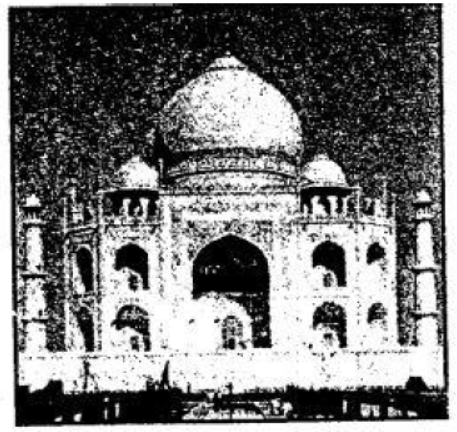
Answer:
(a) The Taj Mahal is situated in Agra.
(b) Emperor Shah Jahan built this monument.
(c) The master designer of the building was Ustad Isa.
(d) Two major features of its design are:
1. It is constructed entirely out of white marble.
2. It features four tall minarets at the corners of its main platform.
In simple words: The Taj Mahal is in Agra, built by Shah Jahan and designed by Ustad Isa. It is made of pure white marble with minarets at the corners.
Exam Tip: Be sure to write the name of the architect (Ustad Isa) correctly, as it is a key architectural detail.
Question 8. The Mughal rulers of India were patrons of learning and scholars. In this context, describe briefly:
(a) The growth of Persian Literature in those times.
(b) The growth of Hindi Literature during the age of the Mughals.
Answer:
(a) The growth of Persian Literature in those times:
Persian writing flourished under the support of the Mughal emperors. Akbar's court welcomed many Persian scholars who came to India. His famous historian Abul Fazl wrote the Ain-i-Akbari, which details Akbar's administrative and tax laws, and the Akbarnama about Akbar's life. Other notable historians of his reign were Nizam-ud-din Ahmad (author of Tabakat-i-Akbari) and Badauni (who wrote Muntakhab-ut-Twarikh). Akbar also supported translating ancient Sanskrit books into Persian. Parts of the Mahabharata were compiled in Persian, while Badauni translated the Ramayana, and Abul Fazl translated the Panchatantra. Faizi, a well-known writer, translated several other classics, and this work continued during Jahangir's rule.
(b) The growth of Hindi Literature during the age of the Mughals:
Hindi literature saw remarkable growth in this era. The great poet Tulsidas wrote Ram Gitawali and his famous masterpiece, Ramcharitmanas, which praises the deeds of Lord Rama. Surdas wrote Sursagar, capturing stories of Lord Krishna's childhood. Many Hindi poets were part of Akbar's court, including Birbal (who received the title 'Kavipriya'), Raja Man Singh, and Raja Bhagwan Das. Abdur Rahim Khan-i-Khanan was a highly famous Hindi poet whose couplets (dohas) are still loved today. Malik Muhammad Jayasi wrote the famous epic Padmawat, while Sundar, the author of Sundar Sringar, was given the title 'Mahakavi Rai' by Shah Jahan.
In simple words: Under royal support, Persian literature saw translations of major Sanskrit works, and Hindi literature reached new heights with books like Ramcharitmanas.
Exam Tip: Mention the names of major literary works like the Ramcharitmanas, Akbarnama, and Ain-i-Akbari along with their authors to impress the examiner.
Question 9. What role did the following factors play in decline and downfall of the Mughal Empire:
(a) Aurangzeb’s policies.
(b) Incompetence of the Later Mughals.
(c) Foreign Invasions.
Answer:
(a) Aurangzeb’s Policies:
Aurangzeb was a strict Sunni Muslim whose simple personal life won him praise as a 'Zinda Pir' (Living Saint) from religious leaders. However, in 1669, he banned the construction of new temples and allowed several old ones to be torn down, targeting famous temples in Mathura and Varanasi. He also brought back the Jizya tax on Hindus. These acts made him lose the trust and help of Hindu rulers, especially the Rajputs, who had been a key support for the Mughal empire.
(b) Incompetence of the Later Mughals:
The emperors who ruled after Aurangzeb were weak and lacked the ability to manage the empire. They lost control of major states like Awadh, Bengal, and the Deccan. Meanwhile, the Marathas, Jats, and Sikhs became very strong. In 1739, Nadir Shah invaded and took away valuable treasures like the Kohinoor and the Peacock Throne, leaving the empire helpless. The final ruler, Bahadur Shah II, acted only as a symbol in the Revolt of 1857, after which he was sent away to Rangoon, where he passed away in 1862.
(c) Foreign Invasions:
Foreign attacks severely weakened the empire. In 1739, Nadir Shah's invasion left Delhi helpless and open to more attacks. Later, Ahmad Shah Abdali led several raids, reaching Delhi by 1757 and taking over Punjab in 1759. He fought the powerful Marathas in the Third Battle of Panipat in 1761 and defeated them. This loss broke Maratha power, hastened the end of the Mughal empire, and helped the Sikhs grow stronger in Punjab while opening the door for British rule in India.
In simple words: The empire fell because of Aurangzeb's strict religious rules, the weakness of later rulers, and devastating foreign invasions by leaders like Nadir Shah and Ahmad Shah Abdali.
Exam Tip: Be sure to write under the three given headings clearly to address the entire structured question systematically.
Question 10. Akbar was tbe greatest of all medieval rulers of India, In this context describe:
(a) His Concern about Law and Justice
Answer:
(a) Law and Justice:
Akbar believed that giving quick justice was a primary duty. The Chief Qazi was his top law officer, who selected honest judges for the provinces. These judges handled all kinds of legal cases. Larger towns had their own judges, while villages used Panchayats to settle fights. The emperor himself was the highest judge and final court of appeal, and criminals were locked up in forts.
In simple words: Akbar wanted quick and fair justice for everyone, with local judges in towns, panchayats in villages, and himself as the highest court.
Exam Tip: Mention the roles of both the provincial Qazis and the village Panchayats to describe the complete legal structure.
Question 11. Describe Aurangzeb’s Administration under the following headlines:
A Setback to the Policy of Religious Toleration Provincial Government
Answer:
(a) A Setback to the Policy of Religious Toleration:
After taking the throne, Aurangzeb stopped the open-minded religious policies of earlier rulers like Akbar, Jahangir, and Shah Jahan. He followed a very conservative version of Islamic law (Sharia). While some records claim he made harsh laws, historians find conflicting accounts. His collection of laws, called the Fatwa-e-Alamgiri, might have been for personal study and not fully put into practice. His costly wars and Shah Jahan's building expenses also made it hard to spend money on cultural and religious projects.
(b) Provincial Government:
Under Aurangzeb, the empire grew to have twenty-one provinces. The chief tax officer (Diwan) of each province was told to watch the governor (Subahdar) closely to prevent them from becoming too powerful.
In simple words: Aurangzeb stopped Akbar's tolerant policies and focused on conservative laws. He ran his twenty-one provinces by having the Diwan keep a close watch on the Governor.
Exam Tip: Mention that there were 21 provinces under Aurangzeb to show precise historical knowledge.
Additional Questions
Short Answer Questions
Question 1. Name two important sources which provide information about the Mughals.
Answer: Two major things that tell us about the Mughals are the book Ain-i-Akbari and the buildings in Fatehpur Sikri.
In simple words: Old books like the Ain-i-Akbari and monuments in Fatehpur Sikri help us learn about Mughal history.
Exam Tip: Mentioning a mix of both a literary source and an architectural monument makes for a well-rounded answer.
Question 2. Name of the author of Ain-i-Akbari.
Answer: Abul Fazl was the person who wrote the Ain-i-Akbari.
In simple words: The Ain-i-Akbari was written by Akbar's minister, Abul Fazl.
Exam Tip: Ensure you do not confuse Abul Fazl with other contemporary writers like Badauni.
Question 3. What was the title of the Mahabharata translated into Persian ?
Answer: When the Mahabharata was translated into Persian, it was named the Razm Namah.
In simple words: The Persian name for the translated Mahabharata was Razm Namah.
Exam Tip: "Razm Namah" literally translates to the "Book of War" - a helpful way to remember it.
Question 4. Who was the architect who designed Humayun’s tomb?
Answer: The tomb was designed by Mirak Mirza Ghiyas, an architect from Persia, and constructed by Indian builders. The building rests on a base that is 8.5 meters high and features arched openings on its sides.
In simple words: A Persian architect named Mirak Mirza Ghiyas designed Humayun's Tomb.
Exam Tip: Mentioning that the architect was Persian (Mirak Mirza Ghiyas) is the key detail to get full marks.
Question 5. Who built the Agra Fort ?
Answer: Emperor Akbar constructed the Agra Fort next to the Yamuna River in Agra between 1565 and 1573.
In simple words: Akbar built the Agra Fort by the Yamuna River.
Exam Tip: Specify the years (1565 - 1573) and the river (Yamuna) to make your answer stand out.
Question 6. Name two buildings located in Fatehpur Sikri.
Answer: Two famous structures in Fatehpur Sikri are the Palace of Jodha Bai and the grand entrance gate called Buland Darwaza.
In simple words: Two popular buildings in Fatehpur Sikri are Jodha Bai's Palace and Buland Darwaza.
Exam Tip: Jodha Bai's Palace, Panch Mahal, and Buland Darwaza are the easiest names to remember for this question.
Question 7. Why did Akbar build Fatehpur Sikri ?
Answer: Akbar built this city to show the strength of his empire, honor the message of God, and exhibit the beauty of Islamic art and faith.
In simple words: Akbar built Fatehpur Sikri to show off his power and honor his religious beliefs.
Exam Tip: Highlight both the political reason (symbolizing power) and the spiritual reason (displaying faith) in your answer.
Question 8. Between whom was the First Battle of Panipat fought ?
Answer: The first battle at Panipat took place between Babur and the ruler Ibrahim Lodi.
In simple words: The First Battle of Panipat was fought between Babur and Ibrahim Lodi.
Exam Tip: Clearly state that the battle was fought between Babur (the Mughal founder) and Ibrahim Lodi (the Delhi Sultan).
Question 9. Who invited Babur to India ? Why ?
Answer: Daulat Khan Lodi, who ruled Punjab, asked Babur to come to India so he could remove Ibrahim Lodi from power.
In simple words: Daulat Khan Lodi invited Babur to India to help overthrow the king, Ibrahim Lodi.
Exam Tip: Name "Daulat Khan Lodi" as the Governor of Punjab to provide a precise answer.
Question 10. Who was defeated by Akbar at the Battle of Haldighati in 1576 ?
Answer: Maharana Pratap was the ruler defeated by Akbar's forces at the Battle of Haldighati in 1576.
In simple words: Maharana Pratap was defeated by Akbar's army at Haldighati in 1576.
Exam Tip: Make sure to mention Maharana Pratap of Mewar as the Rajput opponent of Akbar's forces.
Question 11. Mention any two steps taken by Akbar to promote better understanding between the Hindus and the Muslims.
Answer: Akbar took these two main steps to bring Hindus and Muslims closer:
1. He stopped the Jizya tax on non-Muslims and removed the tax paid by pilgrims visiting holy places like Prayagraj and Varanasi.
2. He gave noble and administrative ranks (mansabs) to talented Hindus, especially Rajput chiefs, based on their skill and through family alliances.
In simple words: Akbar brought Hindus and Muslims together by stopping religious taxes and giving important government jobs to Hindus.
Exam Tip: Mentioning the abolishment of "Jizya" and the "pilgrim tax" is the best way to secure full marks.
Question 12. Name the two taxes abolished by Akbar.
Answer: The two taxes that Akbar ended were Jizya and the tax on religious pilgrims.
In simple words: Akbar stopped the Jizya tax and the pilgrim tax.
Exam Tip: State "Jizya" (or poll tax) and the "pilgrim tax" clearly in your response.
Question 13. Name the Mughal ruler who forbade the evil practice of Sati.
Answer: Aurangzeb was the Mughal emperor who took steps to stop the custom of Sati.
In simple words: Aurangzeb banned the practice of Sati during his rule.
Exam Tip: While Akbar also discouraged it, the textbook source specifically identifies Aurangzeb as the ruler who banned it.
Question 14. What principles did Akbar’s Din-i-llahi promote ?
Answer: This path taught the belief in one single God and valued good qualities like bravery, loyalty, and fairness.
In simple words: Din-i-Ilahi promoted believing in one God and being honest, brave, and loyal.
Exam Tip: Mention the virtues of justice, courage, and loyalty to provide a complete answer.
Question 15. When and for what purpose did Akbar built the Ibadat Khana?
Answer: Akbar constructed the Ibadat Khana in 1575 at Fatehpur Sikri. He used this hall to host scholars from different religions, thinkers, and holy men to talk about spiritual ideas.
In simple words: Akbar built the Ibadat Khana in 1575 to hold religious debates with scholars of different faiths.
Exam Tip: Clearly write both the year (1575) and the purpose (religious discussions with diverse theologians) to score full marks.
Question 16. Name the Mughal ruler whose reign was famous for ‘Chain of Justice’.
Answer: The rule of Jahangir is well-known for his special 'Chain of Justice' system.
In simple words: Jahangir's reign was famous for the Chain of Justice.
Exam Tip: Jahangir is the correct ruler; the chain of justice allowed any aggrieved citizen to ring a bell to seek direct help from the emperor.
Question 17. Name the two important centers of’trade during the Mughal Period.
Answer: Two major cities for trade during this era were Delhi and Lahore.
In simple words: Delhi and Lahore were the main trading cities under the Mughals.
Exam Tip: Delhi and Lahore are the standard urban trade centers mentioned in textbooks for this period.
Question 18. Mention any two measures which indicate Nur Jahan’s important position during Jahangir’s reign.
Answer: Two things that showed Nur Jahan's great power were:
1. She received the high title of 'Padshah Begum'.
2. Her name was printed on coins and included alongside the emperor's signature on official royal orders (farmans).
In simple words: Nur Jahan was given the title Padshah Begum, and her name was put on coins and royal decrees.
Exam Tip: Mentioning the minting of coins in her name and her name on royal farmans is highly critical for this answer.
Question 19. Name the two English, ambassadors who came to Jahangir’s court. Who sent them and for what ?
Answer: Captain William Hawkins and Sir Thomas Roe were the two British envoys who visited Jahangir's court. They were sent by King James I of England to get trade benefits in India.
In simple words: Captain Hawkins and Sir Thomas Roe were sent by King James I of England to get trading rights in India.
Exam Tip: Clearly write both names (Hawkins and Roe) along with the name of the king (James I) who sent them.
Question 20. Between whom was the Third Battle of Panipat fought ? Who emerged victorious in the battle ?
Answer: This battle took place in 1761 between the Marathas and the Afghan ruler Ahmad Shah Abdali. Ahmad Shah Abdali won the fight, defeating the Maratha army.
In simple words: The Third Battle of Panipat was fought in 1761, and Ahmad Shah Abdali defeated the Marathas.
Exam Tip: Specify the year (1761) and name the victor (Ahmad Shah Abdali) clearly in your answer.
Question 21. Name the title given to the heads of the revenue department and the military department respectively in the Mughal Empire.
Answer: The chief of the tax and revenue department was called the Wazir or Diwan-i-Ala, while the military department was led by the Mir Bakshi.
In simple words: The finance head was the Wazir (or Diwan) and the army head was the Mir Bakshi.
Exam Tip: Pair "Diwan" (or Wazir) with revenue, and "Mir Bakshi" with military to avoid swapping them.
Question 22. Who were mansabdars ? How were they paid ?
Answer: A mansabdar was an officer who held a specific rank or 'mansab' within the empire's administration. They formed the ruling elite and were paid through land revenue grants known as jagirs. Most did not live on these lands, but had their servants collect the taxes due to them.
In simple words: Mansabdars were imperial officers paid through land revenue grants called jagirs.
Exam Tip: Be sure to define the term "mansabdar" (rank holder) first, then explain "jagirs" as their mode of payment.
Structured Questions
Question 1(a). With reference to the Mughal Empire, explain briefly the significance of Ain-i-Akbari.
Answer: This work was composed by Abul Fazl, a close advisor and one of the 'Nine Jewels' in Akbar's court. It was a key part of a larger historical project ordered by the emperor. Today, it serves as an invaluable source for understanding the court's rules and lifestyle. The text is split into five volumes:
1. The first volume covers the royal household and palace affairs.
2. The second volume details the imperial servants, along with military and civil posts.
3. The third volume describes the state administration, including court laws and imperial provinces.
4. The fourth volume collects details about Hindu philosophy, sciences, local traditions, and literature.
5. The fifth volume shares Akbar's wise quotes, along with a short life story of the author.
In simple words: The Ain-i-Akbari is a five-part book written by Abul Fazl that provides deep details about Akbar's government, army, and the society of his time.
Exam Tip: Briefly list what each of the five books (or volumes) of the Ain-i-Akbari deals with to draft a high-scoring answer.
Question 1(b). With reference to the Mughal Empire, explain briefly the significance of the monuments at Fatehpur Sikri.
Answer: Fatehpur Sikri was built to show the grandeur of Akbar's empire, reflect his devotion, and display the beauty of Islamic art. Finished in 1578, this city served as the royal court for a short time before a severe lack of water forced them to leave it. Key structures in the city include the Panch Mahal, the magnificent Buland Darwaza, a mosque and tomb for the Sufi saint Salim Chishti, a special house of worship (Ibadat Khana), the assembly halls (Diwan-i-Aam and Diwan-i-Khas), Jodha Bai's palace, and the residence of Birbal.
In simple words: Fatehpur Sikri was Akbar's grand capital city that holds famous buildings like the Buland Darwaza, though it had to be abandoned due to a water shortage.
Exam Tip: Name at least three to four prominent buildings inside Fatehpur Sikri (like Buland Darwaza, Panch Mahal, or Jodha Bai's Palace) to support your answer.
2. With reference to the Mughal rule, state briefly:
Question 2(a). Akbar’s policy towards the Rajputs.
Answer: Akbar's approach relied heavily on building friendly relations with the Rajputs. He married Harkha Bai (known as Jodha Bai), who was the daughter of Raja Bharmal of Amber. He showed great respect to his wives, even building a dedicated temple for Jodha Bai within his palace at Fatehpur Sikri. He also treated Rajput chiefs as equal and valued partners in his administration.
In simple words: Akbar made friends with the Rajputs, married Rajput princesses, and gave them equal power in his government.
Exam Tip: Mention how Rajput rulers were treated as equal partners in the administration to emphasize Akbar's unique political strategy.
Question 2(b). Akbar’s policy of religious tolerance.
Answer: Akbar is well-known for his respect for all faiths. He worked to protect and support different religious groups, ending the Jizya tax and banning the forced conversion of war prisoners to Islam. In 1575, he constructed the Ibadat Khana, a special discussion hall where scholars from various religions met to share their spiritual ideas.
In simple words: Akbar respected all religions, removed special taxes on non-Muslims, and built the Ibadat Khana for interfaith talks.
Exam Tip: Write about both the removal of religious taxes (Jizya) and the creation of the Ibadat Khana as key proofs of his tolerance.
3. With reference to the administrative system in the Mughal Period, answer the following questions:
Question 3(a). What was the position of the monarch ?
Answer: Official court writings state that the authority of Mughal emperors was a divine right given directly by God. They often told a legend about a Mongol queen, Alanqua, who was blessed by a sunbeam. The children she had carried this sacred light, passing it down through generations of rulers.
In simple words: The Mughal king held absolute power, and his rule was believed to be blessed directly by God.
Exam Tip: Use the phrase "divine right" or "centralized autocracy" to describe the unlimited powers of the Mughal monarch.
Question 3(b). Who were the three important ministers ?
Answer: Under Babur and Humayun, a prime minister called the Vakil held broad powers over military and civil matters. Bairam Khan held this post in the early years of Akbar's rule. The financial head was the Wazir or Diwan, who supervised the state's entire budget. The military chief was the Mir Bakshi, who also controlled the intelligence services.
In simple words: The three key ministers were the Vakil (prime minister), the Diwan (finance head), and the Mir Bakshi (military head).
Exam Tip: Clearly state the primary responsibilities of the Diwan (finance) and Mir Bakshi (military) as they are highly valued by examiners.
Question 3(c). How was the provincial government organised ?
Answer: The empire was split into twelve provinces called Subahs, which were further divided into districts (Sarkars) and smaller administrative units (Parganas or Mahals). Each Subah was led by a high-ranking officer called a Subahdar, Sipah Salar, or Nazim. This governor was in charge of law and order, carrying out royal commands, administering justice, and collecting taxes. A provincial Diwan managed financial affairs, working like the central Diwan. Other key officers at the provincial level included the Faujdar, Kotwal, Bakhshi, Sadr Qazi, and Muhtasib.
In simple words: The empire was divided into Subahs, then Sarkars, and then Parganas. Each province was run by a Governor (Subahdar) and a financial head (Diwan).
Exam Tip: Memorize the hierarchy: Subah (Province) - Sarkar (District) - Pargana (Taluka) to write a perfect answer.
4. With reference to Mansabdari system, answer the following questions:
Question 4(a). What was the Mansabdari system
Answer: This was a distinctive administrative setup created by Akbar to manage the Mughal government. Officers in this system, known as mansabdars, held specific ranks (mansabs) and exercised authority over civil and military matters. These ranks ranged from 10 to 5000 for top nobles.
In simple words: The Mansabdari system was Akbar's official ranking system for military and government officers.
Exam Tip: Define the term "mansab" as meaning "position" or "rank" to show a strong conceptual base.
Question 4(b). What was meant by zat and sawar rank ?
Answer: The rank was split into two components: 'Zat' determined the officer's personal standing in the royal court and his basic salary. A higher Zat meant greater prestige and pay. On the other hand, 'Sawar' showed the exact number of horsemen the officer had to maintain, with a requirement of keeping twenty horses for every ten horsemen.
In simple words: Zat was the personal rank and salary of an officer, while Sawar was the number of horsemen they had to maintain.
Exam Tip: Explain the 10:20 ratio (10 cavalrymen to 20 horses) as it is a specific detail that secures full marks.
5. With reference to the social development during the Mughal Age, answer the following question:
Question 5(a). Explain the division of society on the basis of wealth.
Answer: Mughal society had a clear hierarchy, with the emperor at the top, followed by wealthy nobles who enjoyed special privileges. These rich families lived in grand, beautiful houses, wore fine clothes, and spent their time on games and sports. Below them was the middle class, consisting of merchants, scholars, and professionals, who lived moderately. While some coastal traders became very rich, most merchants lived simply. At the bottom were the poor laborers and landless peasants. They struggled to buy basic items like shoes and warm clothing, and faced extreme hardships during famines, while local shopkeepers often hid their wealth to avoid heavy taxes.
In simple words: Society had three classes: very rich nobles, a comfortable middle class of traders and scholars, and very poor peasants who struggled for food and clothes.
Exam Tip: Structure your answer clearly under three sub-headings: Rich/Nobility, Middle Class, and Lower Class.
Question 5(b). Explain briefly any two steps taken by Akbar towards integrating the Hindus and the Muslims.
Answer: Akbar worked hard to bring his Hindu and Muslim subjects together by:
1. Ending unfair religious taxes, such as the Jizya on non-Muslims and the tax on Hindu pilgrims visiting sites like Prayagraj and Varanasi. He also banned the forced conversion of prisoners of war to Islam.
2. Welcoming Hindu leaders and Rajput rajas into the imperial administration, giving them high-ranking jobs (mansabs) based on their ability and forming close family ties.
In simple words: Akbar stopped religious taxes on Hindus and gave high government jobs and respect to Hindu Rajput kings.
Exam Tip: Cite the specific taxes (Jizya and pilgrim tax) to make your explanation historically sound.
Question 5(c). What steps were taken by the Mughal rulers to promote education ?
Answer: The Mughal emperors took several steps to support learning and build schools:
- Akbar changed the school courses to focus more on moral values, math, and practical subjects like farming, geometry, logic, history, and astronomy.
- The government's public works department built schools and colleges. Jahangir also decreed that if a wealthy person died without any heirs, their property would be used to build and support schools.
- Shah Jahan offered financial aid and scholarships to students.
- Girls from wealthy backgrounds received private lessons at home, while middle-class girls attended local schools alongside boys.
In simple words: The Mughals built schools, gave scholarships, updated the syllabus with practical subjects, and supported education for both boys and girls.
Exam Tip: Highlight Akbar's syllabus reforms and Jahangir's unique inheritance law regarding school funding for an outstanding answer.
Free study material for History Civics
ICSE Focus On Solutions Class 9 History Civics Chapter 10 The Mughal Empire
Students can now access the detailed Focus On Solutions for Chapter 10 The Mughal Empire on our portal. These solutions have been carefully prepared as per latest ICSE Class 9 syllabus. Each solution given above has been updated based on the current year pattern to ensure Class 9 students have the most updated History Civics content.
Master Focus On Textbook Questions
Our subject experts have provided detailed explanations for all the questions found in the Focus On textbook for Class 9 History Civics. We have focussed on making the concepts easy for you in Chapter 10 The Mughal Empire so that students can understand the concepts behind every answer. For all numerical problems and theoretical concepts these solutions will help in strengthening your analytical skill required for the ICSE examinations.
Complete History Civics Exam Preparation
By using these Focus On Class 9 solutions, you can enhance your learning and identify areas that need more attention. We recommend solving the History Civics Questions from the textbook first and then use our teacher-verified answers. For a proper revision of Chapter 10 The Mughal Empire, students should also also check our Revision Notes and Sample Papers available on studiestoday.com.
FAQs
You can download the verified Focus On solutions for Chapter 10 The Mughal Empire on StudiesToday.com. Our teachers have prepared answers for Class 9 History Civics as per 2026-27 ICSE academic session.
Yes, our solutions for Chapter 10 The Mughal Empire are designed as per new 2026 ICSE standards. 40% competency-based questions required for Class 9, are included to help students understand application-based logic behind every History Civics answer.
Yes, every exercise in Chapter 10 The Mughal Empire from the Focus On textbook has been solved step-by-step. Class 9 students will learn History Civics conceots before their ICSE exams.
Yes, follow structured format of these Focus On solutions for Chapter 10 The Mughal Empire to get full 20% internal assessment marks and use Class 9 History Civics projects and viva preparation as per ICSE 2026 guidelines.