

Practice BITSAT Chemistry Electrochemistry MCQs provided below. The MCQ Questions for BITSAT Electrochemistry Chemistry with answers and follow the latest BITSAT/ NCERT and KVS patterns. Refer to more Chapter-wise MCQs for BITSAT BITSAT Chemistry and also download more latest study material for all subjects
MCQ for BITSAT Chemistry Electrochemistry
BITSAT Chemistry students should review the 50 questions and answers to strengthen understanding of core concepts in Electrochemistry
Electrochemistry MCQ Questions BITSAT Chemistry with Answers
Question: Stronger is oxidising agent, more is
a) Standard reduction potential of that species
b) The tendency to get it self oxidised
c) The tendency to lose electrons by that species
d) Standard oxidation potential of that species
Answer: Standard reduction potential of that species
Question: Which of the following relation represents correct relation between standard electrode potential and equilibrium constant?


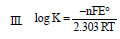
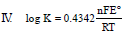
Choose the correct statement(s).
a) I, II and III are correct
b) II and III are correct
c) I, II and IV are correct
d) I and IV are correct
Answer: I, II and IV are correct
Question: E° for the cell,
 at 25°C. The equilibrium constant for the cell reaction
  is of the order of
a) 10–37
b) 1037
c) 10–17
d) 1017
Answer: 1037
Question: Specific conductance of 0.1 M HA is  If
If  the dissociation constant Ka of HA is :
a) 1.0 × 10⁻⁵
b) 2.25 × 10⁻⁴
c) 2.25 × 10⁻⁵
d) 2.25 × 10⁻¹³
Answer: 2.25 × 10⁻⁵
Question: The EMF of the cell Tl/Tl+ (0.001M) || Cu2+ (0.01M) /Cu is 0.83. The cell EMF can be increased by
a) Increasing the concentration of Tl+ ions.
b) Increasing the concentration of Cu2+ ions.
c) Increasing the concentration of Tl + and Cu2+ ions.
d) None of these
Answer: Increasing the concentration of Cu2+ ions.
Question: Electrolysis is carried out in three cells
(A) 1.0 M CuSO4 Pt electrode
(B) 1.0 M CuSO4 copper electrodes
(C) 1.0 M KCl Pt electrodes
If volume of electrolytic solution is maintained constant in each of the cell, which is correct set of pH changes in (A), (B) and (C) cell respectively ?
a) Decrease in all the three
b) Increase in all the three
c) Decrease, constant, increase
d) Increase, constant, increase
Answer: Decrease, constant, increase
Question: The equilibrium constant for the disproportionation reaction  at 25°C (EoCu+ /Cu = 0.52V, EoCu2+ /Cu = 0.16V) is
a) 6×10⁴
b) 6×10⁶
c) 1.2×10⁶
d) 1.2×10⁻⁶
Answer: 1.2×10⁶
Question: The efficiency of fuel cell is given by the expression, η is
a)

b)

c)

d) None of the above
Answer:
Question: The mass of the substance deposited when one Faraday of charge is passed through its solution is equal to
a) Relative equivalent weight
b) Gram equivalent weight
c) Specific equivalent weight
d) None of the above
Answer: Gram equivalent weight
Question: In the cell reaction  E0cell = 0.46 V. By doubling the concentration of Cu2+, E0cell is
a) Doubled
b) Halved
c) Increases but less than double
d) Decreases by a small fraction
Answer: Decreases by a small fraction
Question:  is unstable in solution and undergoes simultaneous oxidation and reduction according to the reaction :

choose correct Eº for above reaction if Eº Cu2+/Cu = 0.34 V and Eº Cu2+/Cu+ = 0.15 V
a) –0.38 V
b) +0.49 V
c) +0.38 V
d) –0.19 V
Answer: +0.38 V
Question: A current of 2.0 A passed for 5 hours through a molten metal salt deposits 22.2 g of metal (At wt. = 177). The oxidation state of the metal in the metal salt is
a) +1
b) +2
c) +3
d) +4
Answer: +3
Question: The electrolytic cells, one containing acidified ferrous chloride and another acidified ferric chloride are connected in series. The ratio of iron deposited at cathodes in the two cells when electricity is passed through the cells will be
a) 3 : 1
b) 2 : 1
c) 1 : 1
d) 3 : 2
Answer: 3 : 2
Question: 1.08 g of pure silver was converted into silver nitrate and its solution was taken in a beaker. It was electrolysed using platinum cathode and silver anode. 0.01 Faraday of electricity was passed using 0.15 volt above the decomposition potential of silver. The silver content of the beaker after the above shall be
a) 0 g
b) 0.108 g
c) 0.108 g
d) 1.08 g
Answer: 0 g
Question: Consider the following Eº values  Under standard conditions the potential for the reaction.
a) 0.91 V
b) 1.40 V
c) 1.68 V
d) 0.63 V
Answer: 0.91 V
Question: The number of coulombs required for the deposition of 108 g of silver is
a) 96500
b) 48250
c) 193000
d) 10000
Answer: 96500
Question: Which of the following will form the cathode with respect to iron anode in an electrolyte cell?
a) Mg
b) Al
c) Cu
d) Zn
Answer: Mg
Question: The conductivity of a saturated solution of BaSO4 is 3.06 × 10⁻⁶ ohm–1 cm–1 and its equivalent conductance is 1.53 ohm–1 cm2 equiv–1. The Ksp for BaSO4 will be
a) 4 × 10–12
b) 2.5 × 10⁻⁹
c) 2.5 × 10⁻¹³
d) 4 × 10⁻⁶
Answer: 4 × 10–12
Question: In a cell that utilises the reaction  addition of H2SO4 to cathode compartment, will
a) Increase the E and shift equilibrium to the right
b) Lower the E and shift equilibrium to the right
c) Lower the E and shift equlibrium to the left
d) Increase the E and shift equilibrium to the left
Answer: Increase the E and shift equilibrium to the right
Question: How long a current of 3 amperes has to be passed through a solution of AgNO3 to coat a metal surface of 80 cm2 and 0.005 mm thick layer. Density of Ag is 10.5 g cm–3.
a) 125.1 seconds
b) 12.5 seconds
c) 155.2 seconds
d) 200 seconds
Answer: 125.1 seconds
Free study material for Chemistry
MCQs for Electrochemistry Chemistry BITSAT
Students can use these MCQs for Electrochemistry to quickly test their knowledge of the chapter. These multiple-choice questions have been designed as per the latest syllabus for BITSAT Chemistry released by BITSAT. Our expert teachers suggest that you should practice daily and solving these objective questions of Electrochemistry to understand the important concepts and better marks in your school tests.
Electrochemistry NCERT Based Objective Questions
Our expert teachers have designed these Chemistry MCQs based on the official NCERT book for BITSAT. We have identified all questions from the most important topics that are always asked in exams. After solving these, please compare your choices with our provided answers. For better understanding of Electrochemistry, you should also refer to our NCERT solutions for BITSAT Chemistry created by our team.
Online Practice and Revision for Electrochemistry Chemistry
To prepare for your exams you should also take the BITSAT Chemistry MCQ Test for this chapter on our website. This will help you improve your speed and accuracy and its also free for you. Regular revision of these Chemistry topics will make you an expert in all important chapters of your course.
FAQs
You can get most exhaustive BITSAT Chemistry Electrochemistry MCQs for free on StudiesToday.com. These MCQs for BITSAT Chemistry are updated for the 2026-27 academic session as per BITSAT examination standards.
Yes, our BITSAT Chemistry Electrochemistry MCQs include the latest type of questions, such as Assertion-Reasoning and Case-based MCQs. 50% of the BITSAT paper is now competency-based.
By solving our BITSAT Chemistry Electrochemistry MCQs, BITSAT students can improve their accuracy and speed which is important as objective questions provide a chance to secure 100% marks in the Chemistry.
Yes, Chemistry MCQs for BITSAT have answer key and brief explanations to help students understand logic behind the correct option as its important for 2026 competency-focused BITSAT exams.
Yes, you can also access online interactive tests for BITSAT Chemistry Electrochemistry MCQs on StudiesToday.com as they provide instant answers and score to help you track your progress in Chemistry.