

Practice BITSAT Chemistry Organic Chemistry Some Basic Principles and Techniques MCQs Set 01 provided below. The MCQ Questions for BITSAT Organic Chemistry Some Basic Principles and Techniques Chemistry with answers and follow the latest BITSAT/ NCERT and KVS patterns. Refer to more Chapter-wise MCQs for BITSAT BITSAT Chemistry and also download more latest study material for all subjects
MCQ for BITSAT Chemistry Organic Chemistry Some Basic Principles and Techniques
BITSAT Chemistry students should review the 50 questions and answers to strengthen understanding of core concepts in Organic Chemistry Some Basic Principles and Techniques
Organic Chemistry Some Basic Principles and Techniques MCQ Questions BITSAT Chemistry with Answers
Question: A compound of molecular formula of C7H16 shows optical isomerism, compound will be
a) 2, 3-Dimethylpentane
b) 2,2-Dimethylbutane
c) 3-Methylhexane
d) None of the above
Answer: 2, 3-Dimethylpentane
Question: Which of the following does not contain Plane of symmetry?
a) Trans-1,3 dichloro cyclohexane
b) Trans-1,2 dichloro cyclohexane
c) Cis-1,2 dichloro cyclohexane
d) Trans-1,3 cyclopentane
Answer: Cis-1,2 dichloro cyclohexane
Question: The correct statement about the compounds A, B, and C
 (A)
(A)
 (B)
(B)
 (C)
(C)
a) A and B are identical
b) A and B are diastereomers
c) A and C are enantiomers
d) A and B are enantiomers
Answer: A and B are enantiomers
Question: Which of the following compounds has all the four types (1°, 2°, 3° and 4°) of carbon atoms?
a) 2, 3, 4-Trimethylpentane
b) neo-Pentane
c) 2, 2, 4-Trimethylpentane
d) None of the three
Answer: 2, 2, 4-Trimethylpentane
Question: Which of the following has two stereoisomers?


a) None of these
b) Only I
c) Only III
d) I and III
Answer: Only I
Question: The anthracene is purified by
a) Crystallisation
b) Filtration
c) Distillation
d) Sublimation
Answer: Sublimation
Question: Which of the following compounds has wrong IUPAC name?
a)

b)

c)
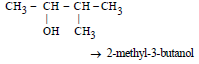
d)
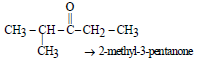
Answer:
Question: Consider the following carbocations


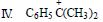
The correct sequence for the stability of these is
a) II < I < III < IV
b) II < III < I < IV
c) III < I < II < IV
d) IV < III < I < II
Answer: II < I < III < IV
Question: Arrangement of (CH3)3 C –, (CH3)2 CH –, CH3 CH2 – when attached to benzyl or an unsaturated group in increasing order of inductive effect is
a) (CH3)3C – < (CH3)2 CH – < CH3 CH2–
b) CH3CH2– < (CH3)2CH – < (CH3)3C –
c) (CH3)2CH – <(CH3)3C – < CH3CH2–
d) (CH3)3C – < CH3CH2 – < (CH3)2CH –
Answer: CH3CH2– < (CH3)2CH – < (CH3)3C –
Question: The most stable carbanion among the following is
a)

b)

c)

d)

Answer:
Question: Among the following four structures I to IV,


it is true that
a) Only I and II are chiral compounds
b) Only III is a chiral compound
c) Only II and IV are chiral compounds
d) All four are chiral compounds
Answer: Only I and II are chiral compounds
Question: The number of enantiomers of the compound
CH3CHBrCHBrCOOH is
a) 0
b) 1
c) 3
d) 4
Answer: 4
Question: he following two compounds are

 are
are
a) Enantiomers
b) Diastereomers
c) Identical
d) Epimers
Answer: Diastereomers
Question: In paper chromatography
a) Mobile phase is liquid and stationary phase is solid
b) Mobile phase is solid and stationary phase is liquid
c) Both phases are liquids
d) Both phases are solids
Answer: Both phases are liquids
Question: In which case the  will attack at the meta position


a) I, II, III
b) II, IV
c) II and III only
d) II only
Answer: I, II, III
Question: Which of the following compound is not chiral?
a) DCH2CH2CH2Cl
b) CH3CHDCH2Cl
c) CH3CHClCH2D
d) CH3CH2CHDCl
Answer: DCH2CH2CH2Cl
Question:
 exhibit which type of isomerism?
a) Position
b) Functional
c) Demotropism
d) Position isomerism
Answer: Functional
Question: The correct nucleophilicity order is
a)

b)

c)

d)

Answer:
Question: In the anion HCOO– the two carbon-oxygen bonds are found to be of equal length. what is the reason for it ?
a) The C = O bond is weaker than the C — O bond
b) The anion HCOO– has two resonating structures
c) The anion is obtained by removal of a proton from the acid molecule
d) Electronic orbitals of carbon atom are hybridised
Answer: The anion HCOO– has two resonating structures
Question: The number of geometrical isomers of CH3CHCH – CH = CH – CHCHCl is
a) 2
b) 4
c) 6
d) 8
Answer: 8
Free study material for Chemistry
MCQs for Organic Chemistry Some Basic Principles and Techniques Chemistry BITSAT
Students can use these MCQs for Organic Chemistry Some Basic Principles and Techniques to quickly test their knowledge of the chapter. These multiple-choice questions have been designed as per the latest syllabus for BITSAT Chemistry released by BITSAT. Our expert teachers suggest that you should practice daily and solving these objective questions of Organic Chemistry Some Basic Principles and Techniques to understand the important concepts and better marks in your school tests.
Organic Chemistry Some Basic Principles and Techniques NCERT Based Objective Questions
Our expert teachers have designed these Chemistry MCQs based on the official NCERT book for BITSAT. We have identified all questions from the most important topics that are always asked in exams. After solving these, please compare your choices with our provided answers. For better understanding of Organic Chemistry Some Basic Principles and Techniques, you should also refer to our NCERT solutions for BITSAT Chemistry created by our team.
Online Practice and Revision for Organic Chemistry Some Basic Principles and Techniques Chemistry
To prepare for your exams you should also take the BITSAT Chemistry MCQ Test for this chapter on our website. This will help you improve your speed and accuracy and its also free for you. Regular revision of these Chemistry topics will make you an expert in all important chapters of your course.
FAQs
You can get most exhaustive BITSAT Chemistry Organic Chemistry Some Basic Principles and Techniques MCQs Set 01 for free on StudiesToday.com. These MCQs for BITSAT Chemistry are updated for the 2026-27 academic session as per BITSAT examination standards.
Yes, our BITSAT Chemistry Organic Chemistry Some Basic Principles and Techniques MCQs Set 01 include the latest type of questions, such as Assertion-Reasoning and Case-based MCQs. 50% of the BITSAT paper is now competency-based.
By solving our BITSAT Chemistry Organic Chemistry Some Basic Principles and Techniques MCQs Set 01, BITSAT students can improve their accuracy and speed which is important as objective questions provide a chance to secure 100% marks in the Chemistry.
Yes, Chemistry MCQs for BITSAT have answer key and brief explanations to help students understand logic behind the correct option as its important for 2026 competency-focused BITSAT exams.
Yes, you can also access online interactive tests for BITSAT Chemistry Organic Chemistry Some Basic Principles and Techniques MCQs Set 01 on StudiesToday.com as they provide instant answers and score to help you track your progress in Chemistry.