

Practice NTSE SAT Physics Heat Temperature and Thermometer MCQs provided below. The MCQ Questions for NTSE SAT Heat Temperature and Thermometer Physics with answers and follow the latest NTSE/ NCERT and KVS patterns. Refer to more Chapter-wise MCQs for NTSE NTSE SAT Physics and also download more latest study material for all subjects
MCQ for NTSE SAT Physics Heat Temperature and Thermometer
NTSE SAT Physics students should review the 50 questions and answers to strengthen understanding of core concepts in Heat Temperature and Thermometer
Heat Temperature and Thermometer MCQ Questions NTSE SAT Physics with Answers
Question: A boy is suffering from fever and doctor said that his body temperature is 105. Then temperature should be expressed in :
- a) °C
- b) °F
- c) K
- d) All of these
Answer: 0F
Question: A manufacture marks the thermometer wrongly. At 00 C it reads - 100 C, at 1000 C it reads 850 C. Then the reading at 500C will be :
- a) 400C
- b) 32.50C
- c) 37.50C
- d) 42.50C
Answer: 37.50C
Question: A graph was plotted between temperature is 0C (taking along x-axis) and temperature in Kelvin (along-y-axis), then which of the curve most correctly represent this behavior :
- a)
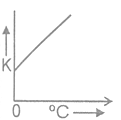
- b)
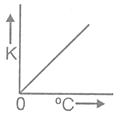
- c)
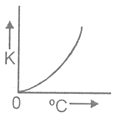
- d)
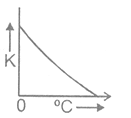
Answer:
Question: A student performs an experiment on ice of 1500 gm at 00C and wants to convert in into water at 00C. The quantity of heat required for the above experiment will be (L - Latent heat of fusion of ice):
- a) 1500 L
- b) 1.5 L
- c) 150 L
- d) 0.15 L
Answer: 1500 L
Question: The surface of water in a lake is just going to freeze. What is the temperature of water at the bottom and at upper surface respectively :
- a) 40C, 00C
- b) Less than 00C, 00C
- c) 00C, 00C
- d) More than 40C, 00C
Answer: 40C, 00C
Question: Normal temperature of human body is nearly :
- a) 300C
- b) 370C
- c) 350C
- d) 450C
Answer: 370C
Question: Mercury is used a thermometric liquid because :
- a) If has low boiling point (B.P.) and high melting point (M.P.)
- b) It has high B.P. and low M.P.
- c) It has low B.P. and low M.P.
- d) It has high B.P. and high M.P.
Answer: It has high B.P. and low M.P.
Question: The value of 50C in 0F and K scale will be respectively :
- a) 41, 279
- b) 278, 41
- c) 41, 278
- d) -23, 278
Answer: 41, 278
Question: At dew point, relative humidity (RH) is :
- a) 10%
- b) 20%
- c) 50%
- d) 100%
Answer: 100%
Question: A temperature difference of 300C in the Fahrenheit scale is :
- a) 540F
- b) 270F
- c) 860F
- d) -540F
Answer: 540F
Question: Which is correct statement _
- a) 1 K rise is equal to 10C rise
- b) 1 K rise is equal to 2730C rise
- c) 1 K fall is equal to 2730C rise
- d) 1 K rise is equal to 1000 C rise
Answer: 1 K rise is equal to 10C rise
Question: Which graph represents correct curve between 0C along y-axis and 0F along x-axis :
- a)
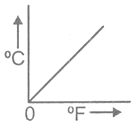
- b)
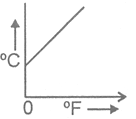
- c)
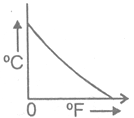
- d)
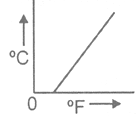
Answer:
Question: Normal temperature of human body is nearly :
- a) 300C
- b) 370C
- c) 350C
- d) 450C
Answer: 370C
Question: A manufacture marks the thermometer wrongly. At 00 C it reads - 100 C, at 1000 C it reads 850 C. Then the reading at 500C will be :
- a) 400C
- b) 32.50C
- c) 37.50C
- d) 42.50C
Answer: 37.50C
Question: A boy is suffering from fever and doctor said that his body temperature is 105. Then temperature should be expressed in :
- a) °C
- b) °F
- c) K
- d) All of these
Answer: 0F
Free study material for Physics
MCQs for Heat Temperature and Thermometer Physics NTSE SAT
Students can use these MCQs for Heat Temperature and Thermometer to quickly test their knowledge of the chapter. These multiple-choice questions have been designed as per the latest syllabus for NTSE SAT Physics released by NTSE. Our expert teachers suggest that you should practice daily and solving these objective questions of Heat Temperature and Thermometer to understand the important concepts and better marks in your school tests.
Heat Temperature and Thermometer NCERT Based Objective Questions
Our expert teachers have designed these Physics MCQs based on the official NCERT book for NTSE SAT. We have identified all questions from the most important topics that are always asked in exams. After solving these, please compare your choices with our provided answers. For better understanding of Heat Temperature and Thermometer, you should also refer to our NCERT solutions for NTSE SAT Physics created by our team.
Online Practice and Revision for Heat Temperature and Thermometer Physics
To prepare for your exams you should also take the NTSE SAT Physics MCQ Test for this chapter on our website. This will help you improve your speed and accuracy and its also free for you. Regular revision of these Physics topics will make you an expert in all important chapters of your course.
FAQs
You can get most exhaustive NTSE SAT Physics Heat Temperature and Thermometer MCQs for free on StudiesToday.com. These MCQs for NTSE SAT Physics are updated for the 2026-27 academic session as per NTSE examination standards.
Yes, our NTSE SAT Physics Heat Temperature and Thermometer MCQs include the latest type of questions, such as Assertion-Reasoning and Case-based MCQs. 50% of the NTSE paper is now competency-based.
By solving our NTSE SAT Physics Heat Temperature and Thermometer MCQs, NTSE SAT students can improve their accuracy and speed which is important as objective questions provide a chance to secure 100% marks in the Physics.
Yes, Physics MCQs for NTSE SAT have answer key and brief explanations to help students understand logic behind the correct option as its important for 2026 competency-focused NTSE exams.
Yes, you can also access online interactive tests for NTSE SAT Physics Heat Temperature and Thermometer MCQs on StudiesToday.com as they provide instant answers and score to help you track your progress in Physics.