

Get the most accurate NCERT Solutions for Class 12 Chemistry Chapter 15 Polymers here. Updated for the 2026-27 academic session, these solutions are based on the latest NCERT textbooks for Class 12 Chemistry. Our expert-created answers for Class 12 Chemistry are available for free download in PDF format.
Detailed Chapter 15 Polymers NCERT Solutions for Class 12 Chemistry
For Class 12 students, solving NCERT textbook questions is the most effective way to build a strong conceptual foundation. Our Class 12 Chemistry solutions follow a detailed, step-by-step approach to ensure you understand the logic behind every answer. Practicing these Chapter 15 Polymers solutions will improve your exam performance.
Class 12 Chemistry Chapter 15 Polymers NCERT Solutions PDF
Question 15.1. Explain the terms polymer and monomer.
Answer: A polymer is a large molecule with a very high molecular weight, typically ranging from \( 10^3 \) to \( 10^7 \text{ u} \). These macromolecules are constructed from smaller, recurring structural pieces that originate from simpler units. Within these large structures, individual units are linked together by robust covalent linkages. They can occur naturally or be manufactured artificially, with common instances being polythene, natural rubber, and nylon 6,6.
Conversely, monomers are uncomplicated, chemically active molecules. They possess the ability to link together in vast quantities via covalent bonds to produce a macromolecular network. Well-known examples include molecules like ethene, styrene, vinyl chloride, and propene.
In simple words: Polymers are giant molecules made by linking many small building blocks called monomers together. Monomers are the simple starting molecules that chain up to form the polymer.
Exam Tip: Always specify the molecular mass range (\( 10^3 - 10^7 \text{ u} \)) and mention covalent bonding when defining polymers to secure full marks.
Question 15.2. What are natural and synthetic polymers? Give two examples of each type.
Answer: Polymers that exist in the natural world, manufactured by living organisms such as plants or animals, are classified as natural polymers. Examples of these substances are starch, proteins, and cellulose.
On the other hand, synthetic polymers are man-made materials produced through chemical synthesis in laboratories or industries. This category includes common plastics like polythene, synthetic fibers like nylon 6,6, and artificial elastomers such as Buna-S.
In simple words: Natural polymers come directly from plants and animals, while synthetic polymers are artificial materials created by humans in factories.
Exam Tip: When providing examples, try to group them clearly under 'Natural' and 'Synthetic' headings, ensuring you list distinct categories like fibers, plastics, or rubbers.
Question 15.3. Distinguish between the terms homopolymer and copolymer and give an example of each.
Answer:
| Homopolymer | Copolymer |
|---|---|
| These substances are created through the polymerization of only one kind of monomer species. This means all repeating segments throughout the chain are identical. An example of this is polythene, which is formed solely from ethene units. | These macromolecular chains are formed by combining two or more distinct kinds of monomeric building blocks. Thus, the chain contains varying structural segments. A classic example is Buna-S, which is synthesized using styrene alongside 1,3-butadiene. |
In simple words: A homopolymer is made from only one type of repeating chemical unit, whereas a copolymer is built from two or more different starting units.
Exam Tip: Use tabular format for distinction questions. Always give a specific, clear example of both types, noting the exact monomers involved.
Question 15.4. How do you explain the functionality of a monomer?
Answer: The term functionality describes the total quantity of reactive linking sites located on a monomer molecule. As an illustration, monomers like propene and ethene are characterized by a functionality of one, while adipic acid and 1,3-butadiene have a functionality of two.
In simple words: Functionality is the number of places on a monomer where it can connect to other monomers to grow a chain.
Exam Tip: Remember to define functionality clearly as the number of active binding sites and provide examples with different values (e.g., 1 or 2).
Question 15.5. Define the term polymerisation.
Answer: Polymerization is the chemical reaction through which small monomer molecules combine to construct high molecular weight macromolecules ranging from \( 10^3 \) to \( 10^7 \text{ u} \). In this reaction, multiple repeating units link together via robust covalent chemical bonds to form a continuous network.
In simple words: Polymerization is the chemical process of linking many small monomer molecules together to make a giant polymer molecule.
Exam Tip: Ensure you state that polymerization involves linking monomers via covalent bonds to form high molecular weight macromolecules.
Question 15.6. Is \( \text{-(NH-CHR-CO)-}_n \), a homopolymer or copolymer?
Answer: The given molecule \( \text{-(NH-CHR-CO)-}_n \) represents a homopolymer. This is because the macromolecular chain is synthesized using only one type of monomeric starting material, which is the amino acid \( \text{NH}_2\text{-CHR-COOH} \).
In simple words: It is a homopolymer because the entire chain is made by repeating just one single kind of starting molecule.
Exam Tip: State the classification clearly first, and then justify it by naming the single starting monomer unit.
Question 15.7. In which classes, the polymers are classified on the basis of molecular forces?
Answer: Depending on the strength and nature of the attractive forces operating between the polymer chains, they are grouped into four categories:
(i) Elastomers
(ii) Fibres
(iii) Thermoplastic polymers
(iv) Thermosetting polymers
In simple words: Polymers are split into four main groups based on how strongly their chains stick to each other: elastomers, fibers, thermoplastics, and thermosets.
Exam Tip: List all four categories in order of increasing strength of intermolecular forces to show a deep understanding of the concept.
Question 15.8. How can you differentiate between addition and condensation polymerisation?
Answer: We can distinguish between these two modes of polymer growth as follows:
Addition Polymerization: This mechanism involves the continuous linking of monomer units containing unsaturated double or triple bonds without the loss of any atoms. A classic illustration is the synthesis of polythene from ethene monomers:
\[ n \text{ CH}_2=\text{CH}_2 \rightarrow \text{-(CH}_2\text{-CH}_2\text{)-}_n \]
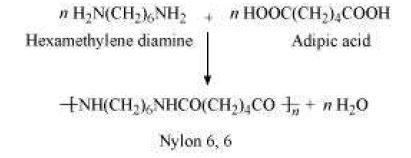
Condensation Polymerization: This process occurs through step-growth reactions between bi-functional or tri-functional monomer units. Each joining step is accompanied by the elimination of a simple byproduct molecule like \( \text{H}_2\text{O} \) or \( \text{HCl} \). For instance, nylon 6,6 is synthesized by reacting hexamethylenediamine with adipic acid:
\[ n \text{ H}_2\text{N(CH}_2\text{)}_6\text{NH}_2 + n \text{ HOOC(CH}_2\text{)}_4\text{COOH} \rightarrow \text{-[NH(CH}_2\text{)}_6\text{NHCO(CH}_2\text{)}_4\text{CO]-}_n + n \text{ H}_2\text{O} \]
In simple words: In addition polymerization, unsaturated monomers chain up directly with no lost parts. In condensation polymerization, monomers join while releasing small molecules like water as a byproduct.
Exam Tip: Always write the chemical equations for polythene and nylon 6,6 when distinguishing these two types of polymerization to ensure full marks.
Question 15.9. Explain the term copolymerisation and give two examples.
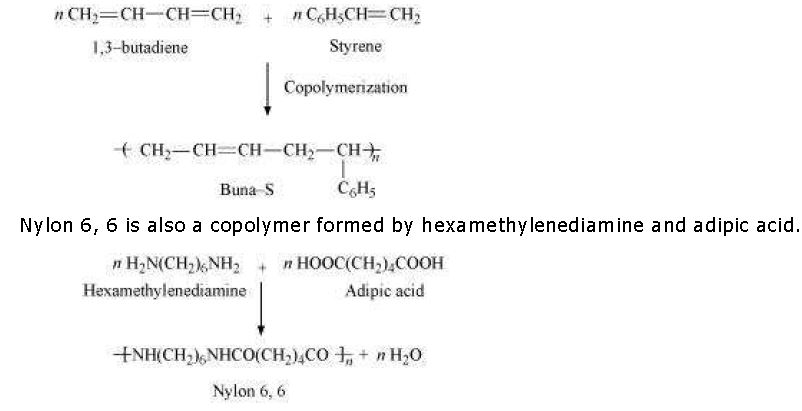
Answer: mers from two or more different monomeric units is called copolymerization. Multiple units of each monomer are present in a copolymer. The process of forming polymer Buna−S from 1, 3-butadiene and styrene is an example of copolymerization
In simple words: Copolymerization is making a polymer chain using a mixture of two or more different kinds of monomer building blocks.
Exam Tip: When explaining copolymerization, clearly state that the starting mixture must contain at least two different monomer types and provide their structures.
Question 15.10. Write the free radical mechanism for the polymerisation of ethene.
Answer: The conversion of ethene to polythene via a free radical pathway is carried out by heating or exposing the monomer to light in the presence of an initiator like benzoyl peroxide. The process occurs through three sequential phases:
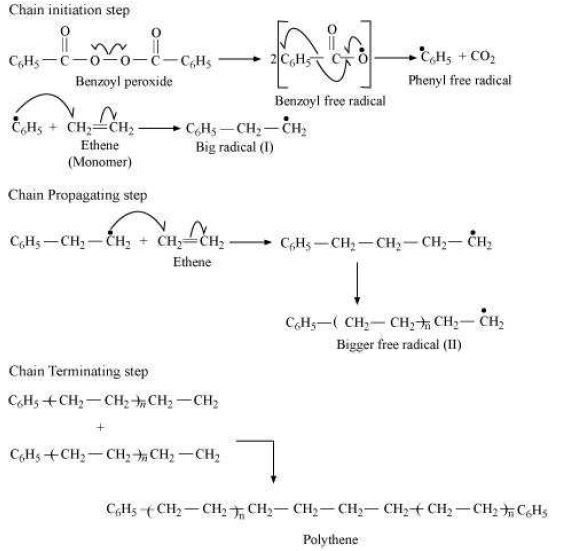
In simple words: The reaction starts when benzoyl peroxide breaks into free radicals, which attach to ethene. These radicals keep adding more ethene molecules to grow a long chain until two active chains meet and join together, stopping the reaction.
Exam Tip: The mechanism must clearly show three distinct steps: initiation, propagation, and termination. Make sure to draw the radical dots on the active carbon atoms.
Question 15.11. Define thermoplastics and thermosetting polymers with two examples of each.
Answer: We define these two polymer classes as follows:
Thermoplastics: These are straight-chain or slightly branched polymers that soften when heated and turn rigid upon cooling. This physical transition is fully reversible, meaning they can be reshaped and recycled multiple times. Common examples include polythene and polystyrene.
Thermosetting Polymers: These materials consist of highly cross-linked or heavily branched networks. During the initial heating and molding stage, they undergo chemical changes that lock them into a rigid structure. Consequently, they cannot be softened, remelted, or reshaped by subsequent heating. Standard examples are bakelite and urea-formaldehyde resins.
In simple words: Thermoplastics can be melted and reshaped repeatedly when heated, while thermosets harden permanently after their first heating and cannot be remelted.
Exam Tip: Highlight that the difference lies in the presence of strong chemical cross-links in thermosets, which prevent them from being reshaped, unlike thermoplastics.
Question 15.12. Write the monomers used for getting the following polymers. (i) Polyvinyl chloride (ii) Teflon (iii) Bakelite
Answer: The starting monomeric units for these macromolecules are:
(i) Polyvinyl chloride (PVC): Vinyl chloride, which has the formula \( \text{CH}_2=\text{CHCl} \).
(ii) Teflon: Tetrafluoroethylene, with the chemical formula \( \text{CF}_2=\text{CF}_2 \).
(iii) Bakelite: A combination of Phenol (\( \text{C}_6\text{H}_5\text{OH} \)) and Formaldehyde (\( \text{HCHO} \)).
In simple words: Polyvinyl chloride is made from vinyl chloride, Teflon is made from tetrafluoroethylene, and Bakelite is made by reacting phenol with formaldehyde.
Exam Tip: Ensure you write both the IUPAC/common name and the chemical formula of each monomer to secure full marks.
Question 15.13. Write the name and structure of one of the common initiators used in free radical addition polymerisation.
Answer: A widely used initiator for free-radical addition polymerization is benzoyl peroxide.
Its structure is represented below:
In simple words: Benzoyl peroxide is a molecule with two benzoyl groups linked by a weak peroxide (oxygen-oxygen) bond that breaks easily to start reactions.
Exam Tip: When drawing benzoyl peroxide, highlight the peroxide linkage (-O-O-) since that is the active site where homolytic cleavage occurs.
Question 15.14. How does the presence of double bonds in rubber molecules influence their structure and reactivity?
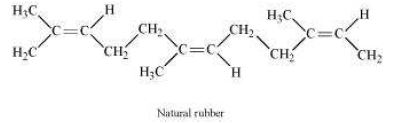
Answer: Natural rubber consists of a linear chain polymer known as cis-polyisoprene, featuring carbon-carbon double bonds situated between the \( \text{C}_2 \) and \( \text{C}_3 \) positions of each repeating isoprene unit. Due to this specific cis-isomerism, the individual polymer chains cannot pack closely together, leading to very weak intermolecular forces of attraction between them. Consequently, the various strands remain in a randomly coiled state, which imparts the characteristic stretchability and elasticity to natural rubber. Furthermore, the presence of these unsaturated double bonds makes the rubber highly reactive, rendering it vulnerable to oxidation and allowing chemical cross-linking during the vulcanization process.
In simple words: The double bonds in rubber have a 'cis' shape that prevents chains from packing tightly, keeping them coiled and stretchy. These double bonds also make the rubber chemically reactive.
Exam Tip: Clearly mention the 'cis-configuration' at the \( \text{C}_2-\text{C}_3 \) double bond, as it is the key factor that determines both the random coiling (elasticity) and reactivity of natural rubber.
Question 15.15. Discuss the main purpose of vulcanisation of rubber.
Answer: While natural rubber has valuable elastic properties, it suffers from several functional drawbacks:
1. Raw rubber remains soft and sticky at room temperature. It softens further at high temperatures (above 335 K) and becomes brittle at colder temperatures (below 283 K).
2. It exhibits a high water-absorption capacity.
3. It possesses poor tensile strength and low wear resistance against abrasion.
4. It dissolves easily in organic, non-polar solvents.
5. It is highly vulnerable to degradation by ozone and other oxidizing agents.
To overcome these limitations, vulcanization is performed. This treatment involves heating raw rubber with sulfur along with suitable additives in the temperature range of 373 K to 415 K. This generates cross-linking sulfur bridges between the polymer chains, dramatically enhancing durability, stiffness, temperature stability, and resistance to chemical attack.
In simple words: Raw rubber is sticky when hot, brittle when cold, weak, and easily damaged. Vulcanization heats it with sulfur to form strong cross-links, making the rubber tough, temperature-stable, and durable.
Exam Tip: List at least three limitations of raw rubber alongside the process conditions of vulcanization (heating with sulfur at 373 K - 415 K) to secure full marks.
Question 15.16. What are the monomeric repeating units of Nylon-6 and Nylon-6, 6?
Answer: The repeating structural components for these two nylons are described below:
Nylon-6: Its monomeric repeating segment is \( \text{-[NH-(CH}_2\text{)}_5\text{-CO]-} \), which is produced from the cyclic monomer known as caprolactam.
Nylon-6,6: Its monomeric repeating segment is \( \text{-[NH-(CH}_2\text{)}_6\text{-NH-CO-(CH}_2\text{)}_4\text{-CO]-} \), synthesized through the condensation of hexamethylenediamine and adipic acid.
In simple words: Nylon-6 is built from caprolactam monomer units, while Nylon-6,6 is built by combining hexamethylenediamine and adipic acid.
Exam Tip: Be careful with the numbers of carbon atoms: Nylon-6 has a single 6-carbon chain, whereas Nylon-6,6 contains two separate 6-carbon segments from its two monomers.
Question 15.17. Write the names and structures of the monomers of the following polymers: (i) Buna-S (ii) Buna-N (iii) Dacron (iv) Neoprene
Answer: The starting monomers and their respective structures are detailed in the table below:
| Polymer | Monomer(s) | Structure of Monomer(s) |
|---|---|---|
| Buna-S | 1,3-Butadiene | \( \text{CH}_2=\text{CH}-\text{CH}=\text{CH}_2 \) |
| Styrene | \( \text{C}_6\text{H}_5-\text{CH}=\text{CH}_2 \) | |
| Buna-N | 1,3-Butadiene | \( \text{CH}_2=\text{CH}-\text{CH}=\text{CH}_2 \) |
| Acrylonitrile | \( \text{CH}_2=\text{CH}-\text{CN} \) | |
| Neoprene | Chloroprene | \( \text{CH}_2=\text{C(Cl)}-\text{CH}=\text{CH}_2 \) |
| Dacron | Ethylene glycol | \( \text{HO}-\text{CH}_2-\text{CH}_2-\text{OH} \) |
| Terephthalic acid | \( \text{p-HOOC}-\text{C}_6\text{H}_4-\text{COOH} \) |
In simple words: Each of these polymers is made from specific monomers. For example, Buna rubbers use butadiene mixed with either styrene or acrylonitrile, neoprene is made of chloroprene, and Dacron is a polyester made from ethylene glycol and terephthalic acid.
Exam Tip: Be precise with double bond locations and substituent positions (such as the chlorine atom in chloroprene or the nitrile group in acrylonitrile).
Question 15.18. Identify the monomer in the following polymeric structures.
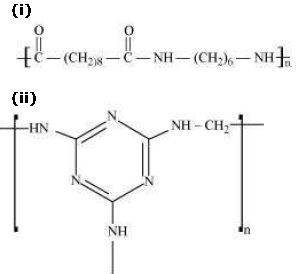
Answer: For the given polymer structures, the constituent monomers are identified as follows:
(i) The monomers corresponding to the polyamide structure are decanedioic acid (sebacic acid), represented as \( \text{HOOC-(CH}_2\text{)}_8\text{-COOH} \), and hexamethylenediamine, represented as \( \text{H}_2\text{N-(CH}_2\text{)}_6\text{-NH}_2 \).
(ii) The monomers for the given resin are Melamine (2,4,6-triamino-1,3,5-triazine) and Formaldehyde (\( \text{HCHO} \)). Their structures are illustrated below:
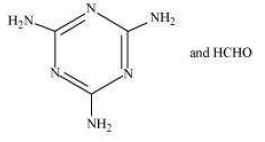
In simple words: Part (i) is made from decanedioic acid and hexamethylenediamine. Part (ii) is Melamine-formaldehyde resin, made from melamine and formaldehyde.
Exam Tip: Identify the amide or ester linkages first to split the polymer chain back into its original dicarboxylic acid and diamine/diol monomers.
Question 15.19. How is dacron obtained from ethylene glycol and terephthalic acid?
Answer: Dacron is produced through the condensation polymerization of ethylene glycol and terephthalic acid. The reaction is carried out at high temperatures (around 420-460 K) in the presence of a zinc acetate-antimony trioxide catalyst, resulting in the elimination of water molecules:
\[ n \text{ HO-CH}_2\text{-CH}_2\text{-OH} + n \text{ p-HOOC-C}_6\text{H}_4\text{-COOH} \rightarrow \text{-[O-CH}_2\text{-CH}_2\text{-O-CO-C}_6\text{H}_4\text{-CO]-}_n + 2n \text{ H}_2\text{O} \]
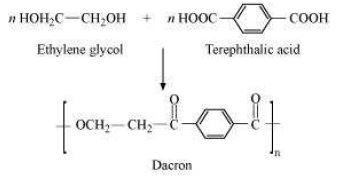
In simple words: Dacron is a polyester made by heating ethylene glycol with terephthalic acid, which causes them to join together into a long chain while releasing water molecules.
Exam Tip: Mention that Dacron is a polyester and write the balanced condensation equation, highlighting the ester linkage (-CO-O-).
Question 15.20. What is a biodegradable polymer? Give an example of a biodegradable aliphatic polyester.
Answer: A biodegradable polymer is a type of macromolecular substance that can be broken down naturally into harmless environmental byproducts through the enzymatic action of microorganisms like bacteria over time. An excellent example of a biodegradable aliphatic polyester is poly-\( \beta \)-hydroxybutyrate-co-\( \beta \)-hydroxyvalerate, commonly abbreviated as PHBV.
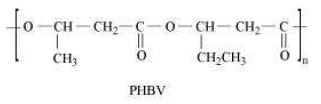
In simple words: A biodegradable polymer is a plastic-like material that bacteria and other microbes can decompose naturally, like PHBV.
Exam Tip: Ensure you write the full expanded name of PHBV (poly-\( \beta \)-hydroxybutyrate-co-\( \beta \)-hydroxyvalerate) to score full marks.
Exercises
Question 15.1. What are polymers?
Answer: Polymers are defined as macromolecules having high molecular masses ranging between \( 10^3 \) and \( 10^7 \text{ u} \). They are built of smaller recurring structural fragments known as monomer units, which are linked together in a continuous chain by strong covalent chemical bonds. Depending on their origin, polymers can be categorized as natural or synthetic. Standard examples include materials like rubber, polythene, and nylon 6,6.
In simple words: Polymers are giant molecules made of many smaller units (monomers) chained together by strong chemical bonds.
Exam Tip: State both the molecular weight range and mention covalent bonds to ensure a complete, high-scoring definition.
Question 15.2. How are polymers classified on the basis of structure?
Answer: Based on their structural arrangement, polymers are grouped into three distinct categories:
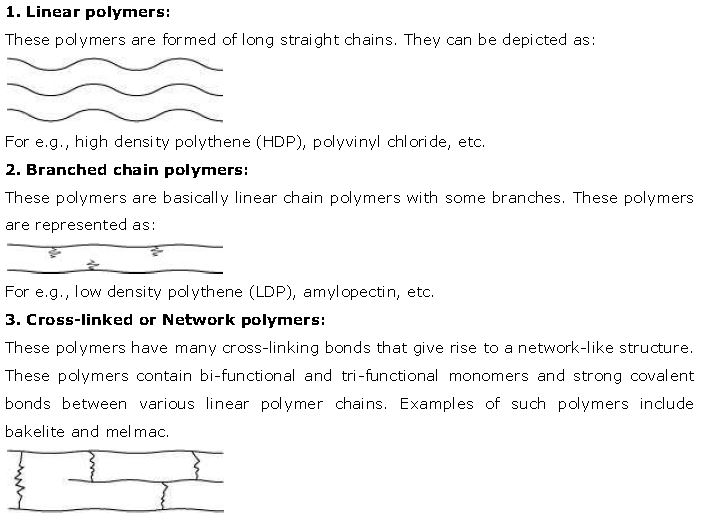
In simple words: Polymers are classified as linear (straight chains), branched (chains with side groups), or cross-linked (chains tied together in a 3D grid).
Exam Tip: Always draw simple schematic diagrams (lines for linear, lines with small branches for branched, and gridded lines for cross-linked) when describing these structures in exams.
Question 15.3. Write the names of monomers of the following polymers:
(i) \( \text{-[NH-(CH}_2\text{)}_6\text{-NH-CO-(CH}_2\text{)}_4\text{-CO]-}_n \)
(ii) \( \text{-[NH-(CH}_2\text{)}_5\text{-CO]-}_n \)
(iii) \( \text{-[CF}_2\text{-CF}_2\text{]-}_n \)
Answer: The names of the monomers corresponding to the given polymers are:
(i) For \( \text{-[NH-(CH}_2\text{)}_6\text{-NH-CO-(CH}_2\text{)}_4\text{-CO]-}_n \): Hexamethylenediamine and adipic acid.
(ii) For \( \text{-[NH-(CH}_2\text{)}_5\text{-CO]-}_n \): Caprolactam.
(iii) For \( \text{-[CF}_2\text{-CF}_2\text{]-}_n \): Tetrafluoroethene.
In simple words: The monomers are: (i) hexamethylenediamine and adipic acid for Nylon-6,6; (ii) caprolactam for Nylon-6; and (iii) tetrafluoroethene for Teflon.
Exam Tip: Double-check the count of carbon atoms in the polymer chains to correctly identify if the monomer is a single cyclic structure like caprolactam or a combination of two.
Question 15.4. Classify the following as addition and condensation polymers: Terylene, Bakelite, Polyvinyl chloride, Polythene.
Answer: The classification of these polymers is as follows:
Addition Polymers:
- Polyvinyl chloride (PVC)
- Polythene
Condensation Polymers:
- Terylene
- Bakelite
In simple words: Polythene and PVC are addition polymers, while Terylene and Bakelite are condensation polymers.
Exam Tip: Remember that addition polymers are formed from unsaturated monomers without loss of byproducts, while condensation polymers eliminate small molecules like water.
Question 15.5. Explain the difference between Buna-N and Buna-S.
Answer: Both are synthetic copolymers of 1,3-butadiene, but they differ in their second monomer component:
- Buna-N: Formed by polymerizing 1,3-butadiene with acrylonitrile (\( \text{CH}_2=\text{CH-CN} \export \)). It has high resistance to oil and solvents.
- Buna-S: Formed by polymerizing 1,3-butadiene with styrene (\( \text{C}_6\text{H}_5\text{-CH}=\text{CH}_2 \)). It is highly durable and commonly used for vehicle tires.
In simple words: Buna-N is made from butadiene and acrylonitrile, whereas Buna-S is made from butadiene and styrene.
Exam Tip: The letters in their names are clues: 'N' stands for nitrile (acrylonitrile), and 'S' stands for styrene.
Question 15.6. Arrange the following polymers in increasing order of their intermolecular forces.
(i) Nylon 6, 6, Buna-S, Polythene.
(ii) Nylon 6, Neoprene, Polyvinyl chloride.
Answer: The strength of attractive intermolecular forces varies across polymer classes: elastomers have the weakest forces, fibers exhibit the strongest forces (such as hydrogen bonding), and thermoplastic plastics lie in between. Therefore, the arrangements in increasing order of their intermolecular forces are:
(i) Buna-S < Polythene < Nylon 6,6 (Elastomer < Plastic < Fiber)
(ii) Neoprene < Polyvinyl chloride < Nylon 6 (Elastomer < Plastic < Fiber)
In simple words: Elastomers (like rubber) have the weakest forces, plastics (like polythene or PVC) have medium forces, and fibers (like nylon) have the strongest forces.
Exam Tip: Classify each polymer first as an elastomer, plastic, or fiber to confidently arrange them in the correct order of strength.
Free study material for Chemistry
NCERT Solutions Class 12 Chemistry Chapter 15 Polymers
Students can now access the NCERT Solutions for Chapter 15 Polymers prepared by teachers on our website. These solutions cover all questions in exercise in your Class 12 Chemistry textbook. Each answer is updated based on the current academic session as per the latest NCERT syllabus.
Detailed Explanations for Chapter 15 Polymers
Our expert teachers have provided step-by-step explanations for all the difficult questions in the Class 12 Chemistry chapter. Along with the final answers, we have also explained the concept behind it to help you build stronger understanding of each topic. This will be really helpful for Class 12 students who want to understand both theoretical and practical questions. By studying these NCERT Questions and Answers your basic concepts will improve a lot.
Benefits of using Chemistry Class 12 Solved Papers
Using our Chemistry solutions regularly students will be able to improve their logical thinking and problem-solving speed. These Class 12 solutions are a guide for self-study and homework assistance. Along with the chapter-wise solutions, you should also refer to our Revision Notes and Sample Papers for Chapter 15 Polymers to get a complete preparation experience.
FAQs
The complete and updated is available for free on StudiesToday.com. These solutions for Class 12 Chemistry are as per latest NCERT curriculum.
Yes, our experts have revised the as per 2026 exam pattern. All textbook exercises have been solved and have added explanation about how the Chemistry concepts are applied in case-study and assertion-reasoning questions.
Toppers recommend using NCERT language because NCERT marking schemes are strictly based on textbook definitions. Our will help students to get full marks in the theory paper.
Yes, we provide bilingual support for Class 12 Chemistry. You can access in both English and Hindi medium.
Yes, you can download the entire in printable PDF format for offline study on any device.