

Access the latest CBSE Class 8 Science Force and Pressure Worksheet Set 02. We have provided free printable Class 8 Science worksheets in PDF format, specifically designed for Chapter 11 Force and Pressure. These practice sets are prepared by expert teachers following the 2025-26 syllabus and exam patterns issued by CBSE, NCERT, and KVS.
Chapter 11 Force and Pressure Science Practice Worksheet for Class 8
Students should use these Class 8 Science chapter-wise worksheets for daily practice to improve their conceptual understanding. This detailed test papers include important questions and solutions for Chapter 11 Force and Pressure, to help you prepare for school tests and final examination. Regular practice of these Class 8 Science questions will help improve your problem-solving speed and exam accuracy for the 2026 session.
Download Class 8 Science Chapter 11 Force and Pressure Worksheet PDF
Force, Friction and Pressure
Force
-
Any action which causes pull, hit or push on a body is called force.
-
Unit of force in SI system is Newton and in CGS system is dyne.
-
One Newton (1N) is equivalent to \( 10^5 \) dyne.
Effects of Force
Many effects of force are as given below:
-
A force can move a stationary body.
-
A force can stop a moving body.
-
A force can change the direction and speed of a moving body.
-
A force can change the shape and size of a body.
Types of Forces
Forces are of two types i.e. Balanced and unbalanced forces.
(i) Balanced Forces
If the net effect of all the forces acting on an object is zero then the forces are called balanced forces.
e.g. In a tug of war (gane) when both the teams apply similar force from both sides, rope does not move either side, i.e. resultant force is zero. Hence, it is a balanced force.
(ii) Unbalanced Forces
If the net effect of all the forces acting on an object is not zero, then these forces are called balanced forces.
e.g. A boy want to relocate refrigerator in his house. He pushes the refrigerator with a small force, the refrigerator does not move due to frictional force acting in a direction opposite to the push. If he pushes the refrigerator harder, then the pushing force becomes bigger than the friction and due to this the refrigerator starts moving in the direction of push. Hence it is an unbalanced force.
Friction
-
If we slide or try to slide a body over a surface, the motion is resisted by a bonding between the body and the surface. This resistance is called friction.
-
The opposite force that comes into play when one body tends to move over the surface of another body but actual motion has yet not started is called static friction.
-
The maximum value of the static frictional force which comes into play when a body just begins to slide over the surface of another body is called limiting frictional force.
-
When a body moves over the other body, then the force of friction acting between two surfaces in contact in relative motion is called kinetic friction.
-
When two bodies actually roll on each other (as in case of ball bearing), the rolling friction comes into play.
-
When two bodies actually slide over each other, sliding friction comes into play.
Density
The density d of a substance is defined as the ratio of its mass to its volume. Its units is \( \text{kg/m}^3 \).
\[ d = \frac{m}{V} \]
Pressure
The force acting perpendicularly on unit area of a surface is called pressure. Its unit is \( \text{N/m}^2 \) or pascal (Pa).
\[ \text{Pressure} = \frac{\text{Force}}{\text{Area}} \Rightarrow p = \frac{F}{A} \]
Some Daily Life Applications of Pressure
-
The handles of bags, suitcases, etc., are made broad, so that less pressure is exerted on the hand.
-
Buildings are provided with broad foundations, so that the pressure exerted on the ground becomes less.
-
Railway tracks are laid on cement or iron sleepers, so that the pressure exerted by train could spread over the larger area and thus pressure decreases.
-
Pins, needles and nails are provided with sharp pointed ends to reduce the area and hence to increase the pressure.
-
Cutting tools have sharp edges to reduce the area, so that with lesser force, more pressure could exerted.
-
Pressure on ground is more when a man is walking than when he is standing because in case of walking, the effective area is less.
-
Depression is much more when a man stands on the cushion than when he lies down on it because in standing case, area is lesser than in case of lying.
-
The tractors have broad tyres, to create less pressure on the ground, so that tyres do not sink into comparatively soft ground in the filed.
Pressure in Fluids
-
All liquids and gases are collectively called fluids.
-
Fluids exerts pressure in all directions.
-
An upward force which acts on an object when it is immersed in a liquid is called buoyant force.
-
It is also called upthrust.
e.g. a piece of cork is held below the surface of water. When we apply a force by our thumb, the cork immediately rises to the surface. This is due to the fact that every liquid exerts an upward force on the objects immersed in it.
Floating or Sinking of Objects in Liquid
There are three conditions of floating and sinking of objects. These are
(i) If the buoyant force or upthrust exerted by the liquid is less than the weight of the object, the object will sink in the liquid.
(ii) If the buoyant force is equal to the weight of the object, the object will float in the liquid.
(iii) If the buoyant force is more than the weight of the object, the object will rise in the liquid and then float.
Atmospheric Pressure
- The air in our atmosphere extends upto 300 km from the surface of the earth as the air has weight.
- The whole atmosphere contains a tremendous amount of weight which in turn exerts a pressure on the surface of the earth and this pressure is known as atmospheric pressure.
- On the surface of the earth, the atmospheric pressure is maximum at the sea level. It is due to reason that the column of air above the earth is largest at sea and the magnitude of atmospheric pressure at the sea level is 101.3 kilopascal which is equal to weight of 10 elephants on each \( 1\text{ m}^2 \) area.
- As we go up from the surface of the earth then the atmospheric pressure goes on decreasing.
It is because the weight of air above us goes on decreasing. So, the atmospheric pressure at the top of a high mountain is much less than at its base.
- A device called barometer is used to measure atmospheric pressure.
Sometimes, the pressure is expressed in terms of millimetre of mercury (mm of Hg), e.g., then atmospheric pressure on the surface of the earth at sea level is 760 mm of Hg (or 0.76 m of Hg).
Multiple Choice Type Question
Question. Force is due to
(a) motion
(b) an interaction
(c) collision
(d) None of the options
Answer: (b) an interaction
Question. The CGS unit of force is
(a) Newton
(b) Pascal
(c) Dyne
(d) Watt
Answer: (c) Dyne
Question. 1 Newton is equivalent to
(a) \( 10^5 \) dyne
(b) 1 kg m/s\(^2\)
(c) Both (a) and (b)
(d) \( 10^3 \) dyne
Answer: (a) \( 10^5 \) dyne
Question. Which of the following is/are the examples of effects of force?
(a) A toy car starts moving when pushed
(b) Shape of dough ball changes when rolled
(c) Falling of leaves or fruits from trees
(d) All of the options
Answer: (d) All of the options
Question. The force applied by the archer to stretch the bow is an example of ............ .
(a) gravitational force
(b) muscular force
(c) frictional force
(d) normal force
Answer: (b) muscular force
Question. Force can change in
(a) length
(b) volume
(c) area
(d) All of the options
Answer: (d) All of the options
Question. Which one of the following force is a contact force?
(a) Force of gravity
(b) Force of friction
(c) Magnetic force
(d) Electrostatic force
Answer: (b) Force of friction
Question. The wear and tear in the machine part is due to
(a) electrostatic force
(b) muscular force
(c) frictional force
(d) gravitational force
Answer: (c) frictional force
Question. If we apply oil on door hinges, the friction will
(a) increase
(b) decrease
(c) disappear altogether
(d) will remain unchanged
Answer: (b) decrease
Question. We slip on muddy road due to
(a) gravitational force
(b) lack of friction
(c) excess of friction
(d) density
Answer: (b) lack of friction
Question. The force required to overcome ........... at the instant an object start moving from ........... is a measure of ........... . On the other hand, the force required to keep the object moving with same speed is a measure of ....... Choose the correct order to fill up the blanks.
(a) friction, rest, static friction, sliding friction
(b) rest, static friction, sliding friction, friction
(c) sliding friction, rest, friction, static friction
(d) friction motion, static friction, sliding friction
Answer: (a) friction, rest, static friction, sliding friction
Question. An atmosphere
(a) is a unit of pressure
(b) is a unit of force
(c) gives us an idea of composition of air
(d) is the height above which there is no air
Answer: (c) gives us an idea of composition of air
Question. Force of 200 N is applied to an object of area \( 4\text{ m}^2 \). The pressure will be
(a) \( 50\text{ Nm}^{-2} \)
(b) \( 30\text{ Nm}^{-2} \)
(c) \( 40\text{ Nm}^{-2} \)
(d) \( 25\text{ Nm}^{-2} \)
Answer: (a) \( 50\text{ Nm}^{-2} \)
Question. The pressure exerted by a liquid ........ with depth.
(a) increases
(b) decreases
(c) remain same
(d) None of the options
Answer: (a) increases
Question. The density of sea water increases as
(a) depth and salinity decrease
(b) depth decreases and salinity increases
(c) depth increases and salinity decreases
(d) depth and salinity increase
Answer: (d) depth and salinity increase
Question. When a ship enters a sea from a river
(a) it rises a little
(b) it sinks a little
(c) it remains at the same level
(d) it rises or sinks depending on the material it is made of
Answer: (a) it rises a little
Question. The standard values of atmospheric pressure is
(a) 78 cm of Hg
(b) 70 mm of Hg
(c) 45 cm of Hg
(d) 76 cm of Hg
Answer: (d) 76 cm of Hg
Question. Inside an aeroplane, flying at a high altitude
(a) the pressure is the same as that outside
(b) normal atmospheric pressure in maintained by the use of air pumps
(c) the pressure inside is less than the pressure outside
(d) normal humidity and partial vacuum are maintained
Answer: (b) normal atmospheric pressure in maintained by the use of air pumps
Question. Atmospheric pressure is measured with a
(a) hydrometer
(b) barometer
(c) hygrometer
(d) altimeter
Answer: (b) barometer
Question. The atmosphere exerts enormous pressure on us. But we do not feel it because
(a) we are used to it
(b) our bones are very strong and can withstand this pressure
(c) the surface area of our head is very small
(d) our blood exerts a pressure slightly more than that of the atmosphere
Answer: (d) our blood exerts a pressure slightly more than that of the atmosphere
Question. The figure shows a cylindrical can with four holes on one side. If water is filled in the can, which figure correctly represents the situation?
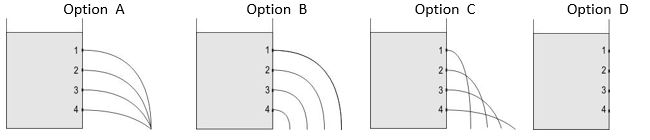
Answer : C
Question. We know that the pressure of water increases with depth. Then, which of the following shows the most possible shape of a dam?
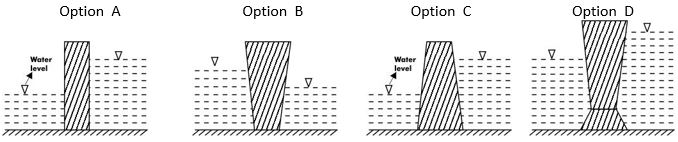
Answer : C
Question. A truck, a car and a cycle have left tracks on the mud. Police are trying to find out the order and direction in which these three vehicles passed. Can you help them?
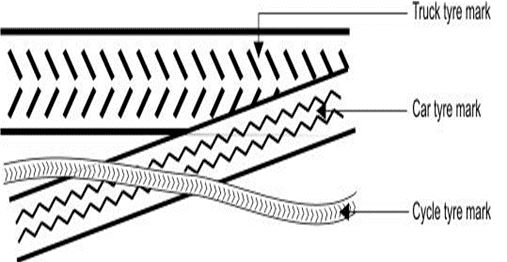
(a) First truck, then car, then cycle - all left to right.
(b) First cycle, then car, then truck - direction not known.
(c) First truck, then car, then cycle - direction not known.
(d) Neither order nor direction can be found.
Answer : C
Question. A special container with tubes P, Q, R, S and T is designed as shown below. Tubes P, Q, R and S have stoppers at the top.
What will happen to the water level in the different tubes if the stoppers in only P, R and S are removed?
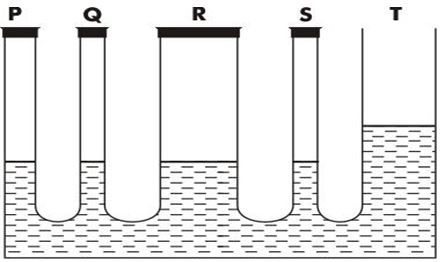
(a) The water level in all the tubes will remain unchanged.
(b) The water level in all the tubes will become the same.
(c) The water level in Q will be lower than the others, which will all be the same.
(d) The water level in Q and S will be at one level; and in P, R and T at a higher level.
Answer : C
Question. Figure 1 below shows a boat as seen from a point above it. Figure 2 is the view of the same boat from the same point 5 seconds later. The oar that pushes the boat forward is like a lever having a Load, Effort and Fulcrum. Which point corresponds to the Fulcrum?
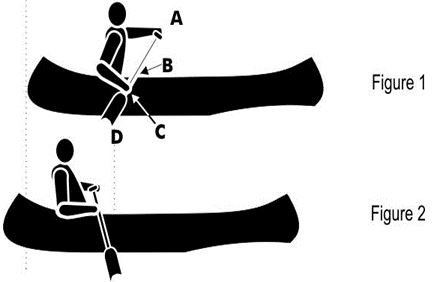
(a) A
(b) B
(c) C
(d) D
Answer : D
Question. F = m x a. Here 'F' is Force, 'm' is mass and 'a' is acceleration. If 'a' is replaced by 'g' which is acceleration due to gravity, then 'F' will be replaced by
(a) Mass
(b) Weight
(c) Pressure
(d) Work done
Answer : B
Question. A ball is released from position S on the surface shown. Which of the following can be the position of the ball when it finally stops?
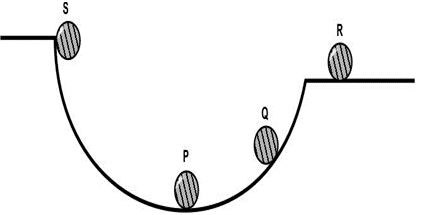
(a) Definitely P
(b) Definitely Q
(c) Definitely R
(d) P or R
Answer : D
Question. Among the following simple machines, which is the odd one out?

Answer : D
Question. Which of the simple machines shown below has the load between the fulcrum and the effort?
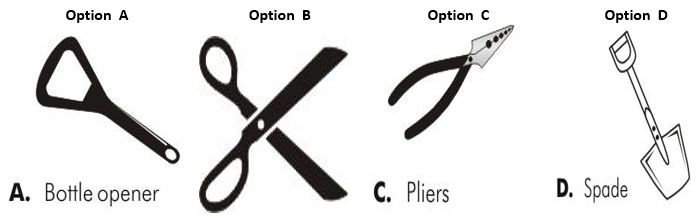
Answer : A
Question. I am travelling in a car, which is moving fast along a straight road. The car comes to a sudden halt. I will
(a) Feel a force pulling me ahead.
(b) Feel a force pushing me back.
(c) Feel a force pushing me to the side.
(d) Not feel any force at all.
Answer : A
Question. The picture here shows a nail being removed from a piece of wood. In which direction should force be applied
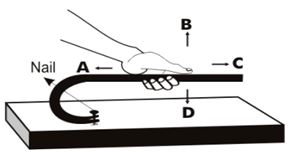
(a) A
(b) B
(c) C
(d) D
Answer : B
Question. What will happen if a solid having the SAME density as the liquid is placed in it?
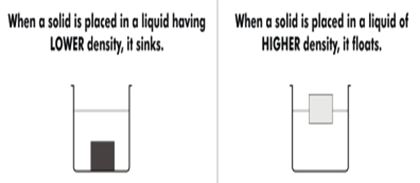
(a) It will sink.
(b) It will float.
(c) It will stay in any position within the liquid.
(d) A solid cannot have the same density as a liquid.
Answer : C
Question. Lorna and Kiran (who weigh the same) went to their school's annual day wearing shoes as shown here. Whose shoes would make a deeper impression in the wet, sandy ground there
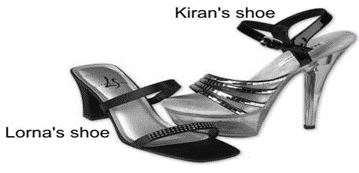
(a) Lorna's shoes would make a deeper impression.
(b) Kiran's shoes would make a deeper impression.
(c) Both shoes will make impressions of the same depth
(d) It depends on who is fatter, so we cannot tell.
Answer : B
Question. The rate of flow of a liquid is sometimes defined as the mass of the liquid flowing per unit time. Which of these could be the units of rate of flow defined this way?
(a) kg/m
(b) kg/s
(c) m/s
(d) M3/s
Answer : B
Question. The diagram below shows a boat floating on water. The arrows show the force of the water on the boat and also the downward weight force If two people get into the boat what will happen to the sizes of these forces?
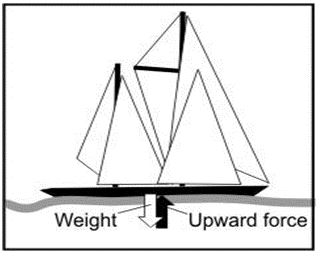
(a) Both the weight and upward force will increase equally.
(b) Both will increase, but the increase in the weight will be more.
(c) The weight increases and the upward force decreases.
(d) Both will increase, but the increase in the upward force will be more.
Answer : A
Questions
Very Short Answer
Q1) What is force of gravity?
Q2) What is atmosphere?
Q3) Define electrostatic force?
Q4) Define pressure?
Q5) Who invented the pump to extract air out of a vessel?
Short Answer
Q6) What do you understand by the gravitational force?
Q7) What is pressure exerted by the liquid?
Q8) Distinguish between gravitational force and electrostatic force?
Q9) Define atmospheric pressure?
Q10) What is pressure exerted by the gas?
Long Answer
Q11) State the difference between friction and gravity?
Q12) Explain about non-contact force?
Q13) Difference between force and pressure?
Q14) Write short note on magnetic force?
Q15) Write short note on atmospheric pressure?
Free study material for Science
Chapter 11 Force and Pressure CBSE Class 8 Science Worksheet
Students can use the Chapter 11 Force and Pressure practice sheet provided above to prepare for their upcoming school tests. This solved questions and answers follow the latest CBSE syllabus for Class 8 Science. You can easily download the PDF format and solve these questions every day to improve your marks. Our expert teachers have made these from the most important topics that are always asked in your exams to help you get more marks in exams.
NCERT Based Questions and Solutions for Chapter 11 Force and Pressure
Our expert team has used the official NCERT book for Class 8 Science to create this practice material for students. After solving the questions our teachers have also suggested to study the NCERT solutions which will help you to understand the best way to solve problems in Science. You can get all this study material for free on studiestoday.com.
Extra Practice for Science
To get the best results in Class 8, students should try the Science MCQ Test for this chapter. We have also provided printable assignments for Class 8 Science on our website. Regular practice will help you feel more confident and get higher marks in CBSE examinations.
FAQs
You can download the teacher-verified PDF for CBSE Class 8 Science Force and Pressure Worksheet Set 02 from StudiesToday.com. These practice sheets for Class 8 Science are designed as per the latest CBSE academic session.
Yes, our CBSE Class 8 Science Force and Pressure Worksheet Set 02 includes a variety of questions like Case-based studies, Assertion-Reasoning, and MCQs as per the 50% competency-based weightage in the latest curriculum for Class 8.
Yes, we have provided detailed solutions for CBSE Class 8 Science Force and Pressure Worksheet Set 02 to help Class 8 and follow the official CBSE marking scheme.
Daily practice with these Science worksheets helps in identifying understanding gaps. It also improves question solving speed and ensures that Class 8 students get more marks in CBSE exams.
All our Class 8 Science practice test papers and worksheets are available for free download in mobile-friendly PDF format. You can access CBSE Class 8 Science Force and Pressure Worksheet Set 02 without any registration.