

Read and download the CBSE Class 12 Mathematics Linear Differential Equations Worksheet Set 02 in PDF format. We have provided exhaustive and printable Class 12 Mathematics worksheets for Chapter 9 Differential Equations, designed by expert teachers. These resources align with the 2026-27 syllabus and examination patterns issued by NCERT, CBSE, and KVS, helping students master all important chapter topics.
Chapter-wise Worksheet for Class 12 Mathematics Chapter 9 Differential Equations
Students of Class 12 should use this Mathematics practice paper to check their understanding of Chapter 9 Differential Equations as it includes essential problems and detailed solutions. Regular self-testing with these will help you achieve higher marks in your school tests and final examinations.
Class 12 Mathematics Chapter 9 Differential Equations Worksheet with Answers
CBSE Class 12 Mathematics Relations And Functions (2). The Relations And Functions questions in the worksheets have been specifically designed by best mathematics teachers so that the students can practice them to clear their Relations And Functions concepts and get better marks in class 12 mathematics tests and examinations. Students can free download these Relations And Functions worksheets in pdf and practice them. This will help them to get better marks in examinations. Also refer to other worksheets for the Relations And Functions chapter and other subjects too. Use them for better understanding of the subjects.
Points to Remember
- Differential Equation: An equation that contains the derivatives of a dependent variable with respect to an independent variable is called a differential equation.
- Order of a Differential Equation: The order of a differential equation is the order of the highest derivative present in the differential equation.
- Degree of a Differential Equation: The degree of a differential equation is the power of the highest order derivative involved, provided the equation is written as a polynomial in terms of its derivatives.
- Formation of a Differential Equation: To form a differential equation from a family of curves, we differentiate the equation of the family as many times as the number of arbitrary constants. Then, we eliminate these constants to obtain the desired differential equation.
- Solution of a Differential Equation:
- Variable Separable Method: For an equation of the form \( \frac{dy}{dx} = f(x, y) \), if we can separate the variables such that \( f(x)\,dx = g(y)\,dy \), then the general solution is obtained by integrating both sides:
\[ \int f(x)\,dx = \int g(y)\,dy + C \] - Homogeneous Differential Equation: A differential equation of the form \( \frac{dy}{dx} = \frac{f(x, y)}{g(x, y)} \), where \( f(x, y) \) and \( g(x, y) \) are homogeneous functions of the same degree in \( x \) and \( y \), can be written as \( \frac{dy}{dx} = F\left(\frac{y}{x}\right) \). To solve this, substitute \( y = vx \), which gives \( \frac{dy}{dx} = v + x\frac{dv}{dx} \), and then solve using the variable separable method.
- Linear Differential Equation: An equation of the form \( \frac{dy}{dx} + Py = Q \), where \( P \) and \( Q \) are constants or functions of \( x \) only, is called a linear differential equation. To solve this:
- Find the Integrating Factor (I.F.): \( \text{I.F.} = e^{\int P\,dx} \)
- The general solution is given by:
\[ y \times (\text{I.F.}) = \int Q \times (\text{I.F.})\,dx + C \]
- Variable Separable Method: For an equation of the form \( \frac{dy}{dx} = f(x, y) \), if we can separate the variables such that \( f(x)\,dx = g(y)\,dy \), then the general solution is obtained by integrating both sides:
Very Short Answer Type Questions (1 Mark)
Question 1. Write the order and degree of the following differential equations.
(i) \( \frac{dy}{dx} + \cos y = 0 \)
(ii) \( \left(\frac{dy}{dx}\right)^2 + 3 \frac{d^2y}{dx^2} = 4 \)
(iii) \( \frac{d^4y}{dx^4} + \sin x = \left(\frac{d^2y}{dx^2}\right)^5 \)
(iv) \( \frac{d^5y}{dx^5} + \log\left(\frac{dy}{dx}\right) = 0 \)
(v) \( \sqrt{1 + \frac{dy}{dx}} = \left(\frac{d^2y}{dx^2}\right)^{1/3} \)
(vi) \( \left[1 + \left(\frac{dy}{dx}\right)^2\right]^{3/2} = k \frac{d^2y}{dx^2} \)
(vii) \( \left(\frac{d^3y}{dx^3}\right)^2 + \left(\frac{d^2y}{dx^2}\right)^3 = \sin x \)
(viii) \( \frac{dy}{dx} + \tan\left(\frac{dy}{dx}\right) = 0 \)
Answer:
(i) Order = 1, Degree = 1
(ii) Order = 2, Degree = 1
(iii) Order = 4, Degree = 1
(iv) Order = 5, Degree is not defined (since the expression is not a polynomial in derivatives due to the logarithmic term).
(v) Squaring and cubing both sides to remove fractional exponents yields \( \left(1 + \frac{dy}{dx}\right)^3 = \left(\frac{d^2y}{dx^2}\right)^2 \). Hence, Order = 2, Degree = 2.
(vi) Squaring both sides to clear the fractional exponent gives \( \left[1 + \left(\frac{dy}{dx}\right)^2\right]^3 = k^2 \left(\frac{d^2y}{dx^2}\right)^2 \). Hence, Order = 2, Degree = 2.
(vii) Order = 3, Degree = 2
(viii) Order = 1, Degree is not defined (since the expression is not a polynomial in derivatives due to the trigonometric term).
In simple words: The order is simply how many times the highest derivative has been taken. The degree is the power of that highest derivative, but it only exists if the derivatives are written in a simple polynomial style with no trig or log operations on them.
Exam Tip: Always clear any fractional exponents or radicals on the derivatives before declaring the degree, and check if any derivative is inside a transcendental function like sine, log, or exponential.
Question 2. Write the general solution of following differential equations.
(i) \( \frac{dy}{dx} = x^5 + x^2 - \frac{2}{x} \)
(ii) \( (e^x + e^{-x})\,dy = (e^x - e^{-x})\,dx \)
(iii) \( \frac{dy}{dx} = x^3 + e^x + x^e \)
(iv) \( \frac{dy}{dx} = 5^{x+y} \)
(v) \( \frac{dy}{dx} = \frac{1 - \cos 2x}{1 + \cos 2y} \)
(vi) \( \frac{dy}{dx} = \frac{1 - 2y}{3x + 1} \)
Answer:
(i) Integrating both sides with respect to \( x \):
\( y = \int \left( x^5 + x^2 - \frac{2}{x} \right) dx \implies y = \frac{x^6}{6} + \frac{x^3}{3} - 2\log|x| + C \)
Note: The key in the textbook contains a minor printing error in the denominator of the second term (\( \frac{x^3}{6} \) instead of \( \frac{x^3}{3} \)).
(ii) Separating variables: \( dy = \frac{e^x - e^{-x}}{e^x + e^{-x}}\,dx \)
Integrating both sides:
\( \int dy = \int \frac{e^x - e^{-x}}{e^x + e^{-x}}\,dx \implies y = \log|e^x + e^{-x}| + C \)
(iii) Integrating both sides:
\( y = \int (x^3 + e^x + x^e)\,dx \implies y = \frac{x^4}{4} + e^x + \frac{x^{e+1}}{e+1} + C \)
(iv) Express \( 5^{x+y} = 5^x \cdot 5^y \). Separating the variables:
\( 5^{-y}\,dy = 5^x\,dx \)
Integrating both sides:
\( \int 5^{-y}\,dy = \int 5^x\,dx \implies -\frac{5^{-y}}{\log 5} = \frac{5^x}{\log 5} + C_1 \implies 5^x + 5^{-y} = C \)
(v) Using trigonometric half-angle identities \( 1 - \cos 2x = 2\sin^2 x \) and \( 1 + \cos 2y = 2\cos^2 y \):
\( \frac{dy}{dx} = \frac{2\sin^2 x}{2\cos^2 y} = \frac{\sin^2 x}{\cos^2 y} \implies \cos^2 y\,dy = \sin^2 x\,dx \)
Expressing as double angles:
\( \left(\frac{1+\cos 2y}{2}\right) dy = \left(\frac{1-\cos 2x}{2}\right) dx \implies (1+\cos 2y) dy = (1-\cos 2x) dx \)
Integrating:
\( y + \frac{\sin 2y}{2} = x - \frac{\sin 2x}{2} + C_1 \implies 2(y-x) + \sin 2y + \sin 2x = C \)
(vi) Separating variables:
\( \frac{1}{1-2y}\,dy = \frac{1}{3x+1}\,dx \)
Integrating both sides:
\( -\frac{1}{2}\log|1-2y| = \frac{1}{3}\log|3x+1| + C_1 \)
Multiplying by -6:
\( 3\log|1-2y| = -2\log|3x+1| + C_2 \implies 2\log|3x+1| + 3\log|1-2y| = C \)
In simple words: To find general solutions, we group \( y \) terms on one side and \( x \) terms on the other, then perform standard integration on both sides.
Exam Tip: Do not forget the constant of integration \( C \) at the end of the steps; leaving it out will cause a deduction of marks.
Question 3. Write integrating factor of the following differential equations
(i) \( \frac{dy}{dx} + y \cos x = \sin x \)
(ii) \( \frac{dy}{dx} + y \sec^2 x = \sec x + \tan x \)
(iii) \( x^2 \frac{dy}{dx} + y = x^4 \)
(iv) \( x \frac{dy}{dx} + y \log x = x + y \)
(v) \( x \frac{dy}{dx} - 3y = x^3 \)
(vi) \( \frac{dy}{dx} + y \tan x = \sec x \)
(vii) \( \frac{dy}{dx} + \frac{1}{1+x^2} y = \sin x \)
Answer:
(i) Comparing with \( \frac{dy}{dx} + Py = Q \), we have \( P = \cos x \).
\( \text{I.F.} = e^{\int \cos x\,dx} = e^{\sin x} \)
(ii) Comparing with \( \frac{dy}{dx} + Py = Q \), we have \( P = \sec^2 x \).
\( \text{I.F.} = e^{\int \sec^2 x\,dx} = e^{\tan x} \)
(iii) Dividing by \( x^2 \) to write in standard form:
\( \frac{dy}{dx} + \frac{1}{x^2}y = x^2 \implies P = \frac{1}{x^2} \).
\( \text{I.F.} = e^{\int x^{-2}\,dx} = e^{-1/x} \)
(iv) Dividing the equation by \( x \):
\( \frac{dy}{dx} + \frac{\log x}{x} y = 1 + \frac{y}{x} \implies P = \frac{\log x}{x} \).
\( \text{I.F.} = e^{\int \frac{\log x}{x}\,dx} = e^{\frac{(\log x)^2}{2}} \)
(v) Dividing the equation by \( x \):
\( \frac{dy}{dx} - \frac{3}{x}y = x^2 \implies P = -\frac{3}{x} \).
\( \text{I.F.} = e^{\int -\frac{3}{x}\,dx} = e^{-3\log x} = x^{-3} = \frac{1}{x^3} \)
(vi) Here, \( P = \tan x \).
\( \text{I.F.} = e^{\int \tan x\,dx} = e^{\log(\sec x)} = \sec x \)
(vii) Here, \( P = \frac{1}{1+x^2} \).
\( \text{I.F.} = e^{\int \frac{1}{1+x^2}\,dx} = e^{\tan^{-1} x} \)
In simple words: The integrating factor helps us convert a linear differential equation into one that is easy to integrate. It is found by taking \( e \) raised to the power of the integral of the coefficient of \( y \).
Exam Tip: Always make sure the coefficient of \( \frac{dy}{dx} \) is \( 1 \) before identifying \( P \), otherwise the integrating factor will be incorrect.
Question 4. Write order of the differential equation of the family of following curves
(i) \( y = Ae^x + Be^{x+c} \)
(ii) \( Ay = Bx^2 \)
(iii) \( (x - a)^2 + (y - b)^2 = 9 \)
(iv) \( Ax + By^2 = Bx^2 - Ay \)
(v) \( \frac{x^2}{a^2} - \frac{y^2}{b^2} = 0 \)
(vi) \( y = a \cos(x + b) \)
(vii) \( y = a + be^{x+c} \)
Answer:
(i) The equation can be rewritten as \( y = Ae^x + Be^c e^x = (A + Be^c)e^x \). Since \( A + Be^c \) is a single independent arbitrary constant, say \( D \), the equation has only 1 independent constant. Hence, the order is 1.
Note: If the term was \( y = Ae^x + Be^x + c = (A+B)e^x + c \), it would have 2 independent constants (\( A+B \) and \( c \)), making the order 2. For \( y = Ae^x + Be^{x+c} \), the order is 1.
(ii) Dividing by \( A \): \( y = \frac{B}{A}x^2 \). Since \( \frac{B}{A} \) is a single arbitrary constant \( C \), there is only 1 independent constant. Hence, the order is 1.
(iii) There are 2 independent arbitrary constants, \( a \) and \( b \). Hence, the order is 2.
(iv) Rearranging terms gives \( A(x + y) = B(x^2 - y^2) \implies x + y = \frac{B}{A}(x^2 - y^2) \). Since \( \frac{B}{A} \) is a single independent constant, the order is 1.
(v) The equation \( \frac{x^2}{a^2} - \frac{y^2}{b^2} = 0 \implies y^2 = \frac{b^2}{a^2} x^2 \implies y = C x \). This contains only 1 independent arbitrary constant \( C \). Hence, the order is 1.
(vi) The equation \( y = a \cos(x + b) \) contains 2 independent arbitrary constants, \( a \) and \( b \). Hence, the order is 2.
(vii) Rewriting gives \( y = a + be^c e^x \). Here, \( be^c \) behaves as a single arbitrary constant, say \( D \), giving \( y = a + D e^x \), which has 2 independent constants (\( a \) and \( D \)). Hence, the order is 2.
In simple words: The order of a differential equation is the same as the number of independent arbitrary constants in the curve's equation. If two constants can be combined into one, we must simplify them first.
Exam Tip: Be sure to reduce the arbitrary constants to the minimum possible number of independent constants before writing down the order.
Short Answer Type Questions (4 Marks)
Question 5.
(i) Show that \( y = e^{m \sin^{-1}x} \) is a solution of \( (1 - x^2)\frac{d^2y}{dx^2} - x \frac{dy}{dx} - m^2y = 0 \).
(ii) Show that \( y = \sin(\sin x) \) is a solution of differential equation \( \frac{d^2y}{dx^2} + (\tan x)\frac{dy}{dx} + y \cos^2 x = 0 \).
(iii) Show that \( y = Ax + \frac{B}{x} \) is a solution of \( x^2 \frac{d^2y}{dx^2} + x \frac{dy}{dx} - y = 0 \).
(iv) Show that \( y = a \cos (\log x) + b \sin (\log x) \) is a solution of \( x^2 \frac{d^2y}{dx^2} + x \frac{dy}{dx} + y = 0 \).
(v) Verify that \( y = \log(x + \sqrt{x^2 + a^2}) \) satisfies the differential equation : \( (a^2 + x^2)\frac{d^2y}{dx^2} + x \frac{dy}{dx} = 0 \).
(vi) Find the differential equation of the family of curves \( y = e^x(A \cos x + B \sin x) \), where A and B are arbitrary constants.
(vii) Find the differential equation of an ellipse with major and minor axes 2a and 2b respectively.
(viii) Form the differential equation representing the family of curves \( (y - b)^2 = 4(x - a) \).
Answer:
(i) Differentiating \( y = e^{m \sin^{-1}x} \) with respect to \( x \):
\( \frac{dy}{dx} = e^{m \sin^{-1} x} \cdot \frac{m}{\sqrt{1 - x^2}} = \frac{my}{\sqrt{1 - x^2}} \)
Squaring both sides:
\( (1 - x^2)\left(\frac{dy}{dx}\right)^2 = m^2 y^2 \)
Differentiating again with respect to \( x \):
\( (1 - x^2) \cdot 2 \frac{dy}{dx} \frac{d^2y}{dx^2} + (-2x)\left(\frac{dy}{dx}\right)^2 = m^2 \cdot 2y \frac{dy}{dx} \)
Dividing by \( 2 \frac{dy}{dx} \):
\( (1 - x^2)\frac{d^2y}{dx^2} - x \frac{dy}{dx} = m^2 y \implies (1 - x^2)\frac{d^2y}{dx^2} - x \frac{dy}{dx} - m^2y = 0 \). Hence proved.
(ii) Differentiating \( y = \sin(\sin x) \):
\( \frac{dy}{dx} = \cos(\sin x) \cdot \cos x \)
Differentiating again:
\( \frac{d^2y}{dx^2} = -\sin(\sin x) \cos^2 x - \cos(\sin x) \sin x = -y \cos^2 x - \left(\frac{1}{\cos x} \frac{dy}{dx}\right) \sin x \)
\( \implies \frac{d^2y}{dx^2} = -y \cos^2 x - \tan x \frac{dy}{dx} \implies \frac{d^2y}{dx^2} + (\tan x)\frac{dy}{dx} + y \cos^2 x = 0 \). Hence proved.
(iii) We have \( y = Ax + Bx^{-1} \).
\( \frac{dy}{dx} = A - Bx^{-2} \)
\( \frac{d^2y}{dx^2} = 2Bx^{-3} \)
Substituting in LHS of the differential equation:
\( x^2(2Bx^{-3}) + x(A - Bx^{-2}) - (Ax + Bx^{-1}) = \frac{2B}{x} + Ax - \frac{B}{x} - Ax - \frac{B}{x} = 0 = \text{RHS} \). Hence proved.
(iv) Differentiating \( y = a \cos (\log x) + b \sin (\log x) \):
\( \frac{dy}{dx} = -\frac{a \sin(\log x)}{x} + \frac{b \cos(\log x)}{x} \implies x \frac{dy}{dx} = -a \sin(\log x) + b \cos(\log x) \)
Differentiating again:
\( x \frac{d^2y}{dx^2} + \frac{dy}{dx} = -\frac{a \cos(\log x)}{x} - \frac{b \sin(\log x)}{x} = -\frac{y}{x} \)
Multiplying by \( x \):
\( x^2 \frac{d^2y}{dx^2} + x \frac{dy}{dx} = -y \implies x^2 \frac{d^2y}{dx^2} + x \frac{dy}{dx} + y = 0 \). Hence proved.
(v) Differentiating \( y = \log(x + \sqrt{x^2 + a^2}) \):
\( \frac{dy}{dx} = \frac{1}{x + \sqrt{x^2 + a^2}} \cdot \left(1 + \frac{x}{\sqrt{x^2 + a^2}}\right) = \frac{1}{\sqrt{x^2 + a^2}} \implies \sqrt{x^2 + a^2} \frac{dy}{dx} = 1 \)
Differentiating again:
\( \sqrt{x^2 + a^2} \frac{d^2y}{dx^2} + \frac{x}{\sqrt{x^2 + a^2}} \frac{dy}{dx} = 0 \)
Multiplying throughout by \( \sqrt{x^2 + a^2} \):
\( (a^2 + x^2)\frac{d^2y}{dx} + x \frac{dy}{dx} = 0 \). Hence verified.
(vi) The equation is \( y = e^x(A \cos x + B \sin x) \).
\( y e^{-x} = A \cos x + B \sin x \)
Differentiating:
\( \frac{dy}{dx} e^{-x} - y e^{-x} = -A \sin x + B \cos x \)
Differentiating again:
\( e^{-x}\left(\frac{d^2y}{dx^2} - \frac{dy}{dx}\right) - e^{-x}\left(\frac{dy}{dx} - y\right) = -(A \cos x + B \sin x) = -y e^{-x} \)
\( \implies \frac{d^2y}{dx^2} - 2\frac{dy}{dx} + y = -y \implies \frac{d^2y}{dx^2} - 2\frac{dy}{dx} + 2y = 0 \).
(vii) The family of ellipses is given by \( \frac{x^2}{a^2} + \frac{y^2}{b^2} = 1 \).
Differentiating:
\( \frac{2x}{a^2} + \frac{2y}{b^2} \frac{dy}{dx} = 0 \implies \frac{y}{x} \frac{dy}{dx} = -\frac{b^2}{a^2} \bk \)
Differentiating again:
\( \frac{d}{dx}\left(\frac{y}{x} \frac{dy}{dx}\right) = 0 \implies \frac{y}{x} \frac{d^2y}{dx^2} + \frac{x \frac{dy}{dx} - y}{x^2} \cdot \frac{dy}{dx} = 0 \)
Multiplying by \( x^2 \):
\( xy \frac{d^2y}{dx^2} + x \left(\frac{dy}{dx}\right)^2 - y \frac{dy}{dx} = 0 \).
(viii) Differentiating \( (y - b)^2 = 4(x - a) \):
\( 2(y - b) \frac{dy}{dx} = 4 \implies (y - b) = \frac{2}{dy/dx} \)
Differentiating again:
\( \left(\frac{dy}{dx}\right)^2 + (y - b) \frac{d^2y}{dx^2} = 0 \)
Substituting \( (y - b) \):
\( \left(\frac{dy}{dx}\right)^2 + \frac{2}{dy/dx} \frac{d^2y}{dx^2} = 0 \implies \left(\frac{dy}{dx}\right)^3 + 2 \frac{d^2y}{dx^2} = 0 \).
In simple words: To verify solutions, we differentiate the given equation to find the first and second derivatives, then substitute them into the differential equation to show that the left-hand side equals the right-hand side. To form a differential equation, we differentiate and eliminate any arbitrary constants.
Exam Tip: For forming differential equations, the number of times you differentiate must equal the number of independent arbitrary constants in the curve's equation.
Question 6. Solve the following differential equations.
(i) \( \frac{dy}{dx} + y \cot x = \sin 2x \)
(ii) \( x \frac{dy}{dx} + 2y = x^2 \log x \)
(iii) \( \frac{dy}{dx} + \frac{1}{x} y = \cos x + \frac{\sin x}{x} \)
(iv) \( \cos^3 x \frac{dy}{dx} + y \cos x = \sin x \)
(v) \( ydx + (x - y^3)dy = 0 \)
(vi) \( ye^y dx = (y^3 + 2xe^y) dy \)
Answer:
(i) Comparing with standard form \( \frac{dy}{dx} + Py = Q \):
\( P = \cot x \bk \), \( Q = \sin 2x = 2\sin x \cos x \)
\( \text{I.F.} = e^{\int \cot x\,dx} = e^{\log(\sin x)} = \sin x \)
The solution is:
\( y \sin x = \int 2\sin^2 x \cos x\,dx + C = \frac{2}{3}\sin^3 x + C \implies y = \frac{2}{3}\sin^2 x + C \csc x \)
(ii) Dividing by \( x \) to write in standard LDE form:
\( \frac{dy}{dx} + \frac{2}{x}y = x \log x \implies P = \frac{2}{x} \), \( Q = x \log x \)
\( \text{I.F.} = e^{\int \frac{2}{x}\,dx} = e^{2\log x} = x^2 \)
The solution is:
\( y x^2 = \int (x \log x) x^2\,dx + C = \int x^3 \log x\,dx + C \)
Integrating by parts:
\( y x^2 = \frac{x^4}{4}\log x - \frac{x^4}{16} + C \implies y = \frac{x^2}{4}\log x - \frac{x^2}{16} + \frac{C}{x^2} \)
(iii) Comparing with standard LDE form:
\( P = \frac{1}{x} \), \( Q = \cos x + \frac{\sin x}{x} \)
\( \text{I.F.} = e^{\int \frac{1}{x}\,dx} = x \)
The solution is:
\( y x = \int x \left(\cos x + \frac{\sin x}{x}\right) dx + C = \int (x \cos x + \sin x) dx + C \)
Since \( \frac{d}{dx}(x \sin x) = x \cos x + \sin x \), we get:
\( y x = x \sin x + C \implies y = \sin x + \frac{C}{x} \bk \)
(iv) Dividing by \( \cos^3 x \):
\( \frac{dy}{dx} + y \sec^2 x = \tan x \sec^2 x \implies P = \sec^2 x \), \( Q = \tan x \sec^2 x \)
\( \text{I.F.} = e^{\int \sec^2 x\,dx} = e^{\tan x} \)
The solution is:
\( y e^{\tan x} = \int e^{\tan x} \tan x \sec^2 x\,dx + C \)
Using substitution \( u = \tan x \):
\( y e^{\tan x} = e^{\tan x}(\tan x - 1) + C \implies y = \tan x - 1 + C e^{-\tan x} \)
(v) Rewriting the equation as LDE in \( x \):
\( y \frac{dx}{dy} + x = y^3 \implies \frac{dx}{dy} + \frac{1}{y} x = y^2 \implies P = \frac{1}{y} \), \( Q = y^2 \)
\( \text{I.F.} = e^{\int \frac{1}{y}\,dy} = y \)
The solution is:
\( x y = \int y^2 \cdot y\,dy + C = \frac{y^4}{4} + C \implies x = \frac{y^3}{4} + \frac{C}{y} \)
(vi) Rewriting the equation as LDE in \( x \):
\( y e^y \frac{dx}{dy} - 2e^y x = y^3 \implies \frac{dx}{dy} - \frac{2}{y} x = y^2 e^{-y} \implies P = -\frac{2}{y} \), \( Q = y^2 e^{-y} \)
\( \text{I.F.} = e^{\int -\frac{2}{y}\,dy} = \frac{1}{y^2} \)
The solution is:
\( \frac{x}{y^2} = \int (y^2 e^{-y}) \frac{1}{y^2}\,dy + C = \int e^{-y}\,dy + C = -e^{-y} + C \implies x = -y^2 e^{-y} + C y^2 \)
In simple words: To solve linear differential equations, we find the integrating factor, multiply it across the equation, and then integrate both sides. If the equation is linear in \( x \), we solve it by treating \( y \) as the independent variable.
Exam Tip: Be ready to switch the variables (solving \( \frac{dx}{dy} + Px = Q \)) if the equation is not linear in \( y \).
Question 7. Solve each of the following differential equations :
(i) \( y - x \frac{dy}{dx} = 2\left(y^2 + \frac{dy}{dx}\right) \)
(ii) \( \cos y\,dx + (1 + 2e^{-x})\sin y\,dy = 0 \)
(iii) \( x\sqrt{1-y^2}\,dy + y\sqrt{1-x^2}\,dx = 0 \)
(iv) \( \sqrt{(1-x^2)(1-y^2)}\,dy + xy\,dx = 0 \)
(v) \( (xy^2 + x)dx + (yx^2 + y)dy = 0; y(0) = 1 \)
(vi) \( \frac{dy}{dx} = y \sin^3 x \cos^3 x + xy e^x \)
(vii) \( \tan x \tan y\,dx + \sec^2 x \sec^2 y\,dy = 0 \)
Answer:
(i) Rearranging the terms to separate variables:
\( y - 2y^2 = (x+2)\frac{dy}{dx} \implies \frac{dx}{x+2} = \frac{dy}{y(1-2y)} \)
Using partial fractions on RHS:
\( \int \frac{dx}{x+2} = \int \left(\frac{1}{y} + \frac{2}{1-2y}\right)\,dy \)
\( \implies \log|x+2| = \log|y| - \log|1-2y| + \log C \)
\( \implies \log|x+2| = \log\left| \frac{Cy}{1-2y} \right| \implies (x+2)(1-2y) = Cy \)
(ii) Separating variables:
\( \frac{dx}{1+2e^{-x}} + \frac{\sin y}{\cos y}\,dy = 0 \implies \frac{e^x}{e^x+2}\,dx + \tan y\,dy = 0 \)
Integrating both sides:
\( \int \frac{e^x}{e^x+2}\,dx + \int \tan y\,dy = C_1 \)
\( \implies \log|e^x+2| + \log|\sec y| = \log C \implies (e^x+2)\sec y = C \)
(iii) Separating variables:
\( \frac{x}{\sqrt{1-x^2}}\,dx + \frac{y}{\sqrt{1-y^2}}\,dy = 0 \)
Integrating both sides:
\( -\sqrt{1-x^2} - \sqrt{1-y^2} = C_1 \implies \sqrt{1-x^2} + \sqrt{1-y^2} = C \)
(iv) Separating variables:
\( \frac{\sqrt{1-y^2}}{y}\,dy + \frac{x}{\sqrt{1-x^2}}\,dx = 0 \)
Integrating both sides (using substitution \( y = \sin\theta \) for the first integral):
\( \log\left| \frac{1-\sqrt{1-y^2}}{y} \right| + \sqrt{1-y^2} - \sqrt{1-x^2} = C \)
(v) Factoring both terms:
\( x(y^2+1)dx + y(x^2+1)dy = 0 \implies \frac{x}{x^2+1}\,dx + \frac{y}{y^2+1}\,dy = 0 \)
Integrating:
\( \frac{1}{2}\log|x^2+1| + \frac{1}{2}\log|y^2+1| = C_1 \implies (x^2+1)(y^2+1) = C \)
Applying \( y(0) = 1 \):
\( (0+1)(1+1) = C \implies C = 2 \). Thus, \( (x^2+1)(y^2+1) = 2 \)
(vi) Separating variables:
\( \frac{1}{y}\,dy = \left( \sin^3 x \cos^3 x + x e^x \right)\,dx \)
Integrating both sides:
\( \log|y| = \int \sin^3 x (1-\sin^2 x)\cos x\,dx + \int xe^x\,dx \)
Using substitution \( u = \sin x \) and integration by parts:
\( \log|y| = \frac{\sin^4 x}{4} - \frac{\sin^6 x}{6} + (x-1)e^x + C \bk \)
(vii) Separating variables:
\( \frac{\tan x}{\sec^2 x}\,dx + \frac{\sec^2 y}{\tan y}\,dy = 0 \implies \sin x \cos x\,dx + \frac{\sec^2 y}{\tan y}\,dy = 0 \)
Integrating:
\( \int \frac{1}{2}\sin 2x\,dx + \int \frac{\sec^2 y}{\tan y}\,dy = C_1 \)
\( \implies -\frac{1}{4}\cos 2x + \log|\tan y| = C \)
In simple words: These equations can be solved by grouping all terms of one variable on one side and integrating. For initial value problems, we use the given coordinate to find the value of the constant \( C \).
Exam Tip: Always look for common algebraic factors first to simplify and check if the variables can be separated directly.
Question 8. Solve the following differential equations :
(i) \( x^2 y\,dx - (x^3 + y^3)\,dy = 0 \)
(ii) \( x^2 \frac{dy}{dx} = x^2 + xy + y^2 \)
(iii) \( (x^2 - y^2)dx + 2xy\,dy = 0, y(1) = 1 \)
(iv) \( \left(y \sin\left(\frac{x}{y}\right)\right) dx = \left(x \sin\left(\frac{x}{y}\right) - y\right) dy \)
(vi) \( \frac{dy}{dx} = \frac{2xy}{x^2 + y^2} \)
(vii) \( \frac{dy}{dx} = e^{x+y} + x^2 e^y \)
(viii) \( \frac{dy}{dx} = \frac{\sqrt{1-y^2}}{\sqrt{1-x^2}} \)
(ix) \( (3xy + y^2)dx + (x^2 + xy)dy = 0 \)
Answer:
(i) The equation is homogeneous. Let \( y = vx \implies \frac{dy}{dx} = v + x \frac{dv}{dx} \):
\( v + x \frac{dv}{dx} = \frac{v}{1+v^3} \implies x \frac{dv}{dx} = -\frac{v^4}{1+v^3} \)
Separating variables:
\( \left( v^{-4} + \frac{1}{v} \right) dv = -\frac{dx}{x} \)
Integrating:
\( -\frac{1}{3v^3} + \log|v| = -\log|x| + C_1 \implies \log|y| - \frac{x^3}{3y^3} = C \)
(ii) Let \( y = vx \implies v + x \frac{dv}{dx} = 1 + v + v^2 \implies x \frac{dv}{dx} = 1 + v^2 \):
\( \int \frac{dv}{1+v^2} = \int \frac{dx}{x} \implies \tan^{-1}v = \log|x| + C \implies \tan^{-1}\left(\frac{y}{x}\right) = \log|x| + C \)
(iii) Let \( y = vx \implies \frac{dy}{dx} = \frac{y^2-x^2}{2xy} \implies v + x\frac{dv}{dx} = \frac{v^2-1}{2v} \):
\( x \frac{dv}{dx} = -\frac{v^2+1}{2v} \implies \int \frac{2v}{v^2+1}\,dv = -\int \frac{dx}{x} \)
\( \log(v^2+1) = -\log|x| + \log C \implies x^2+y^2 = Cx \)
Applying \( y(1) = 1 \): \( 1^2+1^2 = C(1) \implies C = 2 \). Thus, \( x^2+y^2 = 2x \)
(iv) Let \( x = vy \implies \frac{dx}{dy} = v + y\frac{dv}{dy} \):
\( v + y\frac{dv}{dy} = \frac{v \sin v - 1}{\sin v} = v - \csc v \implies y\frac{dv}{dy} = -\csc v \)
\( \int -\sin v\,dv = \int \frac{dy}{y} \implies \cos v = \log|y| + C \implies \cos\left(\frac{x}{y}\right) = \log|y| + C \)
(vi) Let \( y = vx \implies v + x\frac{dv}{dx} = \frac{2v}{1+v^2} \implies x\frac{dv}{dx} = \frac{v(1-v^2)}{1+v^2} \):
\( \int \frac{1+v^2}{v(1-v^2)}\,dv = \int \frac{dx}{x} \implies \int \left( \frac{1}{v} + \frac{1}{1-v} - \frac{1}{1+v} \right) dv = \log|x| + \log C \)
\( \log\left| \frac{v}{1-v^2} \right| = \log|Cx| \implies y = C(x^2-y^2) \)
(vii) Factoring the RHS: \( \frac{dy}{dx} = e^y (e^x + x^2) \). Separating variables:
\( e^{-y}dy = (e^x + x^2)dx \)
Integrating:
\( -e^{-y} = e^x + \frac{x^3}{3} + C_1 \implies e^x + e^{-y} + \frac{x^3}{3} = C \)
(viii) Separating variables:
\( \frac{dy}{\sqrt{1-y^2}} = \frac{dx}{\sqrt{1-x^2}} \)
Integrating:
\( \sin^{-1}y = \sin^{-1}x + C \)
(ix) Let \( y = vx \implies v + x\frac{dv}{dx} = -\frac{3v+v^2}{1+v} \implies x\frac{dv}{dx} = -\frac{2v^2+4v}{1+v} \):
\( \int \frac{1+v}{v(v+2)}\,dv = -2\int \frac{dx}{x} \implies \int \left( \frac{1}{2v} + \frac{1}{2(v+2)} \right) dv = -2\log|x| + \log C \)
\( \log|v(v+2)| = \log\left(\frac{C}{x^4}\right) \implies \frac{y}{x}\left(\frac{y}{x}+2\right) = \frac{C}{x^4} \implies x^2y^2 + 2x^3y = C \)
In simple words: Symmetrical homogeneous equations can be solved by substituting \( y = vx \) (or \( x = vy \)), which helps separate the variables easily.
Exam Tip: For expressions involving functions of \( y/x \), always substitute \( y = vx \) first, whereas for \( x/y \), substitute \( x = vy \).
Question 9.
(i) Form the differential equation of the family of circles touching y-axis at (0, 0).
(ii) Form the differential equation of family of parabolas having vertex at (0, 0) and axis along the (i) positive y-axis (ii) positive x-axis.
(iii) Form differential equation of family of circles passing through origin and whose centre lie on x-axis.
(iv) Form the differential equation of the family of circles in the first quadrant and touching the coordinate axes.
Answer:
(i) The equation of circles touching the y-axis at origin is \( (x-a)^2 + y^2 = a^2 \implies x^2 + y^2 = 2ax \).
Differentiating:
\( 2x + 2y \frac{dy}{dx} = 2a \implies a = x + y \frac{dy}{dx} \).
Substituting \( a \) back:
\( x^2 + y^2 = 2x\left(x + y \frac{dy}{dx}\right) \implies y^2 - x^2 = 2xy \frac{dy}{dx} \).
(ii) (a) For axis along positive y-axis, the equation is \( x^2 = 4ay \).
Differentiating:
\( 2x = 4a \frac{dy}{dx} \implies 4a = \frac{2x}{dy/dx} \).
Substituting back: \( x^2 = y \left( \frac{2x}{dy/dx} \right) \implies x \frac{dy}{dx} - 2y = 0 \).
(b) For axis along positive x-axis, the equation is \( y^2 = 4ax \).
Differentiating:
\( 2y \frac{dy}{dx} = 4a \).
Substituting back: \( y^2 = x \left( 2y \frac{dy}{dx} \right) \implies y - 2x \frac{dy}{dx} = 0 \).
(iii) This family is identical to part (i), so the equation of the circles is \( x^2 + y^2 = 2ax \).
As derived in (i), the differential equation is \( y^2 - x^2 = 2xy \frac{dy}{dx} \).
(iv) The equation of circles touching both axes in the first quadrant is \( (x-a)^2 + (y-a)^2 = a^2 \).
Differentiating:
\( 2(x-a) + 2(y-a)\frac{dy}{dx} = 0 \implies a = \frac{x + y \frac{dy}{dx}}{1 + \frac{dy}{dx}} \).
Substituting \( a \) sign back into \( (x-a)^2 + (y-a)^2 = a^2 \) gives:
\( (x-y)^2 \left[ 1 + \left(\frac{dy}{dx}\right)^2 \right] = \left( x + y \frac{dy}{dx} \right)^2 \).
In simple words: To form the differential equation, we write the equation of the family of curves and differentiate it. Then we eliminate the parameter \( a \) using the original equation and its derivative.
Exam Tip: Ensure that the final differential equation is completely free of any arbitrary constants like \( a \).
Question 10. Show that the differential equation \( \frac{dy}{dx} = \frac{x+2y}{x-2y} \) is homogeneous and solve it.
Answer: Let \( f(x,y) = \frac{x+2y}{x-2y} \).
\( f(\lambda x, \lambda y) = \frac{\lambda x + 2\lambda y}{\lambda x - 2\lambda y} = \frac{\lambda(x+2y)}{\lambda(x-2y)} = f(x,y) \).
Thus, the differential equation is homogeneous of degree 0.
To solve, substitute \( y = vx \implies \frac{dy}{dx} = v + x \frac{dv}{dx} \):
\( v + x\frac{dv}{dx} = \frac{1+2v}{1-2v} \implies x\frac{dv}{dx} = \frac{1+2v-v+2v^2}{1-2v} = \frac{2v^2+v+1}{1-2v} \)
Separating variables:
\( \frac{1-2v}{2v^2+v+1}\,dv = \frac{dx}{x} \)
Integrating both sides:
\( \int \frac{-\frac{1}{2}(4v+1) + \frac{3}{2}}{2v^2+v+1}\,dv = \int \frac{dx}{x} \)
\( \implies -\frac{1}{2}\log|2v^2+v+1| + \frac{3}{\sqrt{7}}\tan^{-1}\left(\frac{4v+1}{\sqrt{7}}\right) = \log|x| + C' \)
Substituting \( v = y/x \):
\( \log|2y^2+xy+x^2| - \frac{6}{\sqrt{7}}\tan^{-1}\left(\frac{4y+x}{\sqrt{7}x}\right) = C \).
In simple words: First we verify that replacing \( x \) and \( y \) with \( \lambda x \) and \( \lambda y \) keeps the equation unchanged. Then we solve it using the standard \( y = vx \) homogeneous substitution.
Exam Tip: Be precise when completing the square for the quadratic trinomial in the denominator; check your coefficients twice.
Question 11. Show that the differential equation : \( (x^2 + 2xy - y^2) dx + (y^2 + 2xy - x^2) dy = 0 \) is homogeneous and solve it.
Answer: Rearranging into standard homogeneous form:
\( \frac{dy}{dx} = -\frac{x^2+2xy-y^2}{y^2+2xy-x^2} \). Since both numerator and denominator are homogeneous of degree 2, the equation is homogeneous.
Substitute \( y = vx \implies \frac{dy}{dx} = v + x\frac{dv}{dx} \):
\( v + x\frac{dv}{dx} = -\frac{1+2v-v^2}{v^2+2v-1} \implies x\frac{dv}{dx} = -\frac{v^3+v^2+v+1}{v^2+2v-1} \)
Separating variables:
\( \frac{v^2+2v-1}{(v+1)(v^2+1)}\,dv = -\frac{dx}{x} \)
Using partial fractions:
\( \frac{v^2+2v-1}{(v+1)(v^2+1)} = -\frac{1}{v+1} + \frac{2v}{v^2+1} \)
Integrating:
\( \int \left( -\frac{1}{v+1} + \frac{2v}{v^2+1} \right) dv = -\int \frac{dx}{x} \)
\( \implies -\log|v+1| + \log(v^2+1) = -\log|x| + \log C \)
\( \implies \log\left| \frac{v^2+1}{v+1} \right| = \log\left| \frac{C}{x} \right| \implies \frac{y^2/x^2+1}{y/x+1} = \frac{C}{x} \)
\( \implies x^2 + y^2 = C(x + y) \).
In simple words: We verify the homogeneous property, substitute \( y = vx \), and use partial fractions to integrate the \( v \) terms easily.
Exam Tip: Be careful during partial fraction decomposition; writing out the step-by-step substitution of values like \( v = -1 \) helps prevent algebraic slip-ups.
Question 12. Solve the following differential equations :
(i) \( \frac{dy}{dx} - 2y = \cos 3x \)
(ii) \( \sin x \frac{dy}{dx} + y \cos x = 2 \sin^2 x \cos x \) if \( y\left(\frac{\pi}{2}\right) = 1 \)
(iii) \( 3e^x \tan y\,dx + (1 - e^x)\sec^2 y\,dy = 0 \)
Answer:
(i) Here, \( P = -2 \bk \), \( Q = \cos 3x \).
\( \text{I.F.} = e^{\int -2\,dx} = e^{-2x} \).
The solution is:
\( y e^{-2x} = \int e^{-2x} \cos 3x\,dx + C \)
Using the standard formula \( \int e^{ax}\cos bx\,dx = \frac{e^{ax}}{a^2+b^2}(a\cos bx + b\sin bx) \):
\( y e^{-2x} = \frac{e^{-2x}}{13}(3\sin 3x - 2\cos 3x) + C \implies y = \frac{1}{13}(3\sin 3x - 2\cos 3x) + C e^{2x} \)
(ii) Dividing by \( \sin x \):
\( \frac{dy}{dx} + y \cot x = 2 \sin x \cos x \implies P = \cot x \), \( Q = 2\sin x \cos x \).
The integrating factor is \( \text{I.F.} = \sin x \).
The solution is:
\( y \sin x = \int 2\sin^2 x \cos x\,dx + C \implies y \sin x = \frac{2}{3}\sin^3 x + C \).
Applying \( y(\pi/2) = 1 \):
\( 1(1) = \frac{2}{3}(1) + C \implies C = \frac{1}{3} \).
Thus, the particular solution is \( y \sin x = \frac{2}{3}\sin^3 x + \frac{1}{3} \implies y = \frac{2}{3}\sin^2 x + \frac{1}{3}\csc x \).
(iii) Separating variables:
\( \frac{3e^x}{1-e^x}\,dx + \frac{\sec^2 y}{\tan y}\,dy = 0 \)
Integrating:
\( -3\log|1-e^x| + \log|\tan y| = \log C \implies \tan y = C (1-e^x)^3 \).
In simple words: This question covers standard linear differential equations and variable separable equations with given boundary conditions to find the particular solutions.
Exam Tip: Be very careful with integration by parts of products like \( e^{ax}\cos bx \); memorizing its direct formula can save valuable time and prevent mistakes in exams.
Question 13. Solve the following differential equations :
(i) \( (x^3 + y^3) dx = (x^2y + xy^2)dy \)
(ii) \( x\,dy - y\,dx = \sqrt{x^2+y^2}\,dx \)
(iii) \( y\left\{ x \cos\left(\frac{y}{x}\right) + y \sin\left(\frac{y}{x}\right) \right\} dx - x \left\{ y \sin\left(\frac{y}{x}\right) - x \cos\left(\frac{y}{x}\right) \right\} dy = 0 \)
(iv) \( x^2 dy + y(x+y)dx = 0 \) given that \( y=1 \) when \( x=1 \).
(v) \( x e^{y/x} - y + x \frac{dy}{dx} = 0 \) if \( y(e) = 0 \)
(vi) \( (x^3 - 3xy^2) dx = (y^3 - 3x^2y) dy \)
(vii) \( \frac{dy}{dx} - \frac{y}{x} + \csc\left(\frac{y}{x}\right) = 0 \) given that \( y = 0 \) when \( x = 1 \).
Answer:
(i) Let \( y = vx \implies v + x \frac{dv}{dx} = \frac{1+v^3}{v+v^2} \implies x \frac{dv}{dx} = \frac{1-v}{v} \):
\( \int \frac{v}{1-v}\,dv = \int \frac{dx}{x} \implies -v - \log|1-v| = \log|x| + C \implies \log|x-y| + \frac{y}{x} = C \)
(ii) Let \( y = vx \implies v + x \frac{dv}{dx} = v + \sqrt{1+v^2} \implies x \frac{dv}{dx} = \sqrt{1+v^2} \):
\( \int \frac{dv}{\sqrt{1+v^2}} = \int \frac{dx}{x} \implies \log|v + \sqrt{1+v^2}| = \log|x| + \log C \)
\( \implies y + \sqrt{x^2+y^2} = C x^2 \)
(iii) Let \( y = vx \implies v + x \frac{dv}{dx} = \frac{v(\cos v + v \sin v)}{v \sin v - \cos v} \implies x \frac{dv}{dx} = \frac{2v \cos v}{v \sin v - \cos v} \):
\( \int \left( \tan v - \frac{1}{v} \right) dv = 2\int \frac{dx}{x} \implies \log\left| \frac{\sec v}{v} \right| = \log|Cx^2| \implies xy \cos\left(\frac{y}{x}\right) = C_1 \)
(iv) Let \( y = vx \implies v + x \frac{dv}{dx} = -v(1+v) \implies x \frac{dv}{dx} = -v(v+2) \):
\( \int \frac{dv}{v(v+2)} = -\int \frac{dx}{x} \implies \frac{1}{2}\log\left| \frac{v}{v+2} \right| = -\log|x| + \log C_1 \implies \frac{y}{y+2x} = \frac{C}{x^2} \)
At \( x=1, y=1 \implies C = \frac{1}{3} \). Thus, \( 3x^2 y = y + 2x \)
(v) Rewriting: \( \frac{dy}{dx} - \frac{y}{x} + e^{y/x} = 0 \). Let \( y = vx \implies v + x \frac{dv}{dx} - v + e^v = 0 \):
\( x \frac{dv}{dx} = -e^v \implies \int -e^{-v}\,dv = \int \frac{dx}{x} \implies e^{-v} = \log|x| + C \)
Applying \( y(e) = 0 \implies v(e) = 0 \implies e^{0} = \log e + C \implies C = 0 \).
Thus, \( e^{-y/x} = \log|x| \implies y = -x \log(\log x) \)
(vi) Let \( y = vx \implies v + x\frac{dv}{dx} = \frac{1-3v^2}{v^3-3v} \implies x\frac{dv}{dx} = \frac{1-v^4}{v(v^2-3)} \):
\( \int \frac{v(v^2-3)}{1-v^4}\,dv = \int \frac{dx}{x} \implies x^2 - y^2 = C(x^2+y^2)^2 \)
(vii) Let \( y = vx \implies v + x\frac{dv}{dx} - v + \csc v = 0 \implies x\frac{dv}{dx} = -\csc v \):
\( \int -\sin v\,dv = \int \frac{dx}{x} \implies \cos v = \log|x| + C \implies \cos\left(\frac{y}{x}\right) = \log|x| + C \)
Applying \( y(1) = 0 \implies C = 1 \). Thus, \( \cos\left(\frac{y}{x}\right) = \log|x| + 1 \).
In simple words: All these differential equations are homogeneous, meaning we simplify and integrate them using substitutions like \( y = vx \) to separate the variables.
Exam Tip: Homogeneous equations always contain terms of the same total degree, which serves as a visual signal for this method.
Question 16. Solve the following differential equations :
(i) \( \cos^2 x \frac{dy}{dx} = \tan x - y \)
(ii) \( x \cos x \frac{dy}{dx} + y(x \sin x + \cos x) = 1 \)
(iii) \( (1 + e^{x/y})dx + e^{x/y}\left(1 - \frac{x}{y}\right)dy = 0 \)
(iv) \( (y - \sin x)dx + \tan x\,dy = 0, y(0) = 0 \)
Answer:
(i) This is identical to Question 6(iv). Dividing by \( \cos^2 x \):
\( \frac{dy}{dx} + y \sec^2 x = \tan x \sec^2 x \)
The solution is \( y = \tan x - 1 + C e^{-\tan x} \).
(ii) Dividing by \( x \cos x \):
\( \frac{dy}{dx} + \left( \tan x + \frac{1}{x} \right)y = \frac{\sec x}{x} \implies P = \tan x + \frac{1}{x} \).
\( \text{I.F.} = e^{\int (\tan x + 1/x)\,dx} = e^{\log(\sec x) + \log x} = x \sec x \).
The solution is:
\( y (x \sec x) = \int \sec^2 x\,dx + C = \tan x + C \implies y = \frac{\sin x + C \cos x}{x} \).
(iii) Since it contains \( x/y \), we solve it as LDE in \( x \) using \( x = vy \implies \frac{dx}{dy} = v + y\frac{dv}{dy} \):
\( v + y\frac{dv}{dy} = -\frac{e^v(1-v)}{1+e^v} \implies y\frac{dv}{dy} = -\frac{v+e^v}{1+e^v} \)
\( \int \frac{1+e^v}{v+e^v}\,dv = -\int \frac{dy}{y} \implies \log|v+e^v| = -\log|y| + \log C \)
\( \implies y(v+e^v) = C \implies x + y e^{x/y} = C \).
(iv) Dividing by \( \tan x \):
\( \frac{dy}{dx} + y \cot x = \cos x \implies P = \cot x \).
\( \text{I.F.} = e^{\int \cot x\,dx} = \sin x \).
The solution is:
\( y \sin x = \int \sin x \cos x\,dx + C = \frac{1}{2}\sin^2 x + C \).
Applying \( y(0) = 0 \implies C = 0 \).
Thus, the particular solution is \( y = \frac{1}{2}\sin x \).
In simple words: These are linear differential equations. We identify \( P \) and \( Q \), compute the integrating factor, and integrate the resulting product equation.
Exam Tip: Recognizing when to solve in terms of \( dx/dy \) instead of \( dy/dx \) is crucial for equations containing \( e^{x/y} \).
Long Answer Type Questions (6 Marks Each)
Question 17. Solve the following differential equations :
(i) \( (x\,dy - y\,dx) y \sin\left(\frac{y}{x}\right) = (y\,dx + x\,dy) x \cos\left(\frac{y}{x}\right) \)
(ii) \( 3e^x \tan y\,dx + (1 - e^x)\sec^2 y\,dy = 0 \) given that \( y = \frac{\pi}{4} \) when \( x = 1 \).
(iii) \( \frac{dy}{dx} + y \cot x = 2x + x^2 \cot x \) given that \( y\left(\frac{\pi}{2}\right) = \frac{\pi^2}{4} \).
Answer:
(i) Rearranging into homogeneous standard form:
\( \left[ xy \sin\left(\frac{y}{x}\right) - x^2 \cos\left(\frac{y}{x}\right) \right] dy = \left[ xy \cos\left(\frac{y}{x}\right) + y^2 \sin\left(\frac{y}{x}\right) \right] dx \)
\( \implies \frac{dy}{dx} = \frac{y\left( x \cos\left(\frac{y}{x}\right) + y \sin\left(\frac{y}{x}\right) \right)}{x\left( y \sin\left(\frac{y}{x}\right) - x \cos\left(\frac{y}{x}\right) \right)} \)
This is homogeneous. Substitute \( y = vx \implies v + x\frac{dv}{dx} = \frac{v(\cos v + v \sin v)}{v \sin v - \cos v} \):
\( x \frac{dv}{dx} = \frac{2v \cos v}{v \sin v - \cos v} \implies \int \left(\tan v - \frac{1}{v}\right) dv = 2\int \frac{dx}{x} \)
\( \implies \log|\sec v| - \log|v| = 2\log|x| + \log C \implies \frac{\sec v}{v} = C x^2 \)
\( \implies xy \cos\left(\frac{y}{x}\right) = C_2 \).
(ii) Separating variables:
\( \frac{3e^x}{1-e^x}\,dx + \frac{\sec^2 y}{\tan y}\,dy = 0 \)
Integrating:
\( -3\log|1-e^x| + \log|\tan y| = \log C \implies \tan y = C(1-e^x)^3 \).
Applying initial condition \( y = \frac{\pi}{4} \) when \( x = 1 \):
\( \tan(\pi/4) = C(1-e)^3 \implies C = \frac{1}{(1-e)^3} \).
Thus, the particular solution is \( \tan y = \left(\frac{1-e^x}{1-e}\right)^3 \).
(iii) Comparing with \( \frac{dy}{dx} + Py = Q \):
\( P = \cot x \bk \), \( Q = 2x + x^2 \cot x \).
\( \text{I.F.} = e^{\int \cot x\,dx} = e^{\log(\sin x)} = \sin x \).
The solution is:
\( y \sin x = \int (2x + x^2 \cot x)\sin x\,dx + C' = \int (2x \sin x + x^2 \cos x)\,dx + C' \)
Since \( \frac{d}{dx}(x^2 \sin x) = x^2 \cos x + 2x \sin x \), we get:
\( y \sin x = x^2 \sin x + C' \implies y = x^2 + C \csc x \).
Applying initial condition \( y = \frac{\pi^2}{4} \) when \( x = \frac{\pi}{2} \):
\( \frac{\pi^2}{4} = \left(\frac{\pi}{2}\right)^2 + C \csc\left(\frac{\pi}{2}\right) \implies \frac{\pi^2}{4} = \frac{\pi^2}{4} + C(1) \implies C = 0 \).
Thus, the particular solution is \( y = x^2 \).
In simple words: These are 6-mark questions combining homogeneous substitutions, variable separation, and linear differential integration techniques with boundary conditions.
Exam Tip: Showing the exact derivative step \( \frac{d}{dx}(x^2 \sin x) = 2x\sin x + x^2\cos x \) clearly in your integration step will make your working look neat and professional.
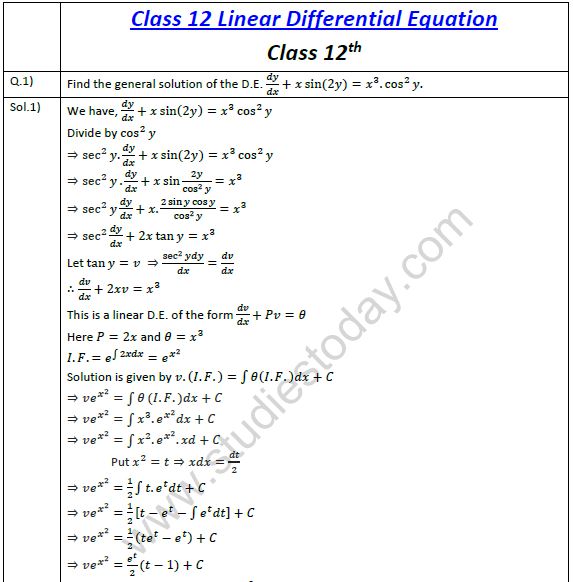
Question. Find the general solution of the D.E. \( \frac{dy}{dx} + x \sin(2y) = x^3 \cdot \cos^2 y \).
Answer: We have, \( \frac{dy}{dx} + x \sin(2y) = x^3 \cos^2 y \)
Divide by \( \cos^2 y \)
\( \implies \sec^2 y \cdot \frac{dy}{dx} + x \frac{\sin(2y)}{\cos^2 y} = x^3 \)
\( \implies \sec^2 y \cdot \frac{dy}{dx} + x \sin \frac{2y}{\cos^2 y} = x^3 \)
\( \implies \sec^2 y \frac{dy}{dx} + x \cdot \frac{2 \sin y \cos y}{\cos^2 y} = x^3 \)
\( \implies \sec^2 y \frac{dy}{dx} + 2x \tan y = x^3 \)
Let \( \tan y = v \implies \sec^2 y \frac{dy}{dx} = \frac{dv}{dx} \)
\( \therefore \frac{dv}{dx} + 2xv = x^3 \)
This is a linear D.E. of the form \( \frac{dv}{dx} + Pv = Q \)
Here \( P = 2x \) and \( Q = x^3 \)
\( I.F. = e^{\int 2x dx} = e^{x^2} \)
Solution is given by \( v \cdot (I.F.) = \int Q(I.F.) dx + C \)
\( \implies v e^{x^2} = \int Q(I.F.)dx + C \)
\( \implies v e^{x^2} = \int x^3 \cdot e^{x^2} dx + C \)
\( \implies v e^{x^2} = \int x^2 \cdot e^{x^2} \cdot x dx + C \)
Put \( x^2 = t \implies xdx = \frac{dt}{2} \)
\( \implies v e^{x^2} = \frac{1}{2} \int t \cdot e^t dt + C \)
\( \implies v e^{x^2} = \frac{1}{2} [t \cdot e^t - \int e^t dt] + C \)
\( \implies v e^{x^2} = \frac{1}{2} (t e^t - e^t) + C \)
\( \implies v e^{x^2} = \frac{e^t}{2} (t - 1) + C \)
Re-pairing \( v \) and \( t \) by \( \tan y \) and \( x^2 \) respectively.
\( \implies \tan y \cdot e^{x^2} = \frac{1}{2} e^{x^2} (x^2 - 1) + C \)
Question. Solve the D.E. \( (x^2 - 1)\frac{dy}{dx} + 2(x + 2)y = 2(x + 1) \)
Answer: Divide by \( (x^2 - 1) \)
\( \frac{dy}{dx} + \frac{2(x+2)}{x^2-1} y = \frac{2(x+1)}{x^2-1} \)
Compare with \( \frac{dy}{dx} + Py = Q \)
We have, \( P = \frac{2(x+2)}{x^2-1} \) and \( Q = \frac{2}{x-1} \)
\( I.F. = e^{\int P dx} = e^{\int \frac{2(x+2)}{x^2-1} dx} \)
Let \( I = \int \frac{2x+4}{x^2-1} dx \)
\( = \int \frac{2x}{x^2-1} dx + 4 \int \frac{1}{x^2-1} dx \)
Put \( x^2 - 1 = t \implies 2xdx = dt \)
\( \implies I = \int \frac{dt}{t} + 4 \times \frac{1}{2} \log \left| \frac{x-1}{x+1} \right| \)
\( I = \log|x^2 - 1| + 2 \log \left| \frac{x-1}{x+1} \right| \)
\( = \log|x^2 - 1| + \log \frac{(x-1)^2}{(x+1)^2} \)
\( = \log \left( \frac{(x-1)^2}{(x+1)^2} (x + 1)(x - 1) \right) \)
\( I = \log \left( \frac{(x-1)^3}{x+1} \right) \)
\( \therefore I.F. = e^{\log\left(\frac{(x-1)^3}{x+1}\right)} \)
\( I.F. = \frac{(x-1)^3}{x+1} \)
New solution is given by \( y \cdot (I.F.) = \int Q (I.F.) dx + C \)
\( \implies y \frac{(x-1)^3}{x+1} = \int \frac{2}{(x-1)} \cdot \frac{(x-1)^3}{(x+1)} dx + C \)
\( \implies y \frac{(x-1)^3}{x+1} = 2 \int \frac{(x-1)^2}{x+1} dx + C \)
\( \implies y \frac{(x-1)^3}{x+1} = 2 \int \frac{x^2-2x+1}{x+1} dx + C \)
\( \implies y \frac{(x-1)^3}{x+1} = 2 \int \left( (x - 3) + \frac{4}{x+1} \right) dx + C \)
\( \implies y \frac{(x-1)^3}{x+1} = 2 \left( \frac{x^2}{2} - 3x + 4 \log|x + 1| \right) + C \)
\( \implies y = \frac{2(x+1)}{(x-1)^3} \left( \frac{x^2}{2} - 3x + 4 \log|x + 1| \right) + C \)
Question. Find the particular solution \( \frac{dy}{dx} - 3y \cot x = \sin(2x) \); \( y = 2 \) when \( x = \frac{\pi}{2} \)
Answer: Compare with \( \frac{dy}{dx} + Py = Q \)
We have, \( P = -3 \cot x \) and \( Q = \sin(2x) \)
\( I.F. = e^{-3 \int \cot x dx} = e^{-3 \log \sin x} \)
\( \implies I.F. = e^{\log(\sin x)^{-3}} = \frac{1}{\sin^3 x} \)
\( \implies I.F. = \frac{1}{\sin^3 x} \)
Solution given by:
\( y \cdot (I.F.) = \int Q (I.F.) dx + C \)
\( \implies y \frac{1}{\sin^3 x} = \int \sin(2x) \cdot \frac{1}{\sin^3 x} dx + C \)
\( \implies \frac{y}{\sin^3 x} = 2 \int \sin x \cdot \cos x \cdot \frac{1}{\sin^3 x} dx + C \)
\( \implies \frac{y}{\sin^3 x} = 2 \int \cot x \cdot \csc x dx + C \)
\( \implies \frac{y}{\sin^3 x} = 2 (-\csc x) + C \)
\( \implies y = -2 \csc x \cdot \sin^3 x + C \sin^3 x \)
\( \implies y = -2 \sin^2 x + C \cdot \sin^3 x \)
Put initial condition \( x = \frac{\pi}{2} \) and \( y = 2 \)
\( \implies 2 = -2 \sin^3 \left( \frac{\pi}{2} \right) + C \cdot \sin^3 \left( \frac{\pi}{2} \right) \)
\( \implies 2 = -2 + C \implies C = 4 \)
\( \therefore \) particular solution is given by:
\( y = -2 \sin^2 x + 4 \sin^3 x \)
Question. Solve the D.E. \( \frac{dy}{dx} + y \tan x = 2x + x^2 \tan x ; y(0) = 1 \)
Answer: Compare with \( \frac{dy}{dx} + Py = Q \)
We have \( P = \tan x , Q = 2x + x^2 \tan x \)
\( I.F. = e^{\int P dx} = e^{\int \tan x dx} = e^{\log(\sec x)} = \sec x \)
Solution is given by \( y(\sec x) = \int(x^2 \tan x + 2x) \sec x dx + C \)
\( \implies y \sec x = \int x^2 \tan x \sec x dx + \int 2x \sec x dx + C \)
\( \implies y \sec x = x^2 \cdot \sec x - 2 \int x \cdot \sec x + 2 \int x \sec x dx + C \)
\( \implies y \sec x = x^2 \sec x + C \)
Put \( y = 1 \) and \( x = 0 \)
\( \implies 1 \cdot \sec(0) = 0 + C \)
\( \implies 1 = C \)
\( \therefore \) solution is given by \( y \sec x = x^2 \sec x + 1 \)
Or \( y = x^2 + \cos x \)
Question. Find one-parameter families of solution curve of the D.E. (or solve the D.E.) \( \sec x \frac{dy}{dx} + y = e^{\sin x} \)
Answer: Divide by \( \sec x \)
\( \frac{dy}{dx} + y \cos x = e^{\sin x} \cdot \cos x \)
Here \( P = \cos x ; Q = e^{\sin x} \cdot \cos x \)
\( I.F. = e^{\int P dx} = e^{\int \cos x dx} = e^{\sin x} \)
Solution is given by \( y(I.F.) = \int Q (I.F.)dx + C \)
\( \implies y e^{\sin x} = \int e^{\sin x} \cdot \cos x \cdot e^{\sin x}dx + C \)
\( \implies y e^{\sin x} = \int e^{2 \sin x} \cdot \cos x dx + C \)
Put \( \sin x = t \implies \cos x dx = dt \)
\( \implies y e^{\sin x} = \int e^{2t} dt + C \)
\( \implies ye^{\sin x} = \frac{1}{2} e^{2t} + C \)
\( \implies ye^{\sin x} = \frac{1}{2} e^{2 \sin x} + C \)
Question. Solve the D.E. \( y dx - (x + 2y^2)dy = 0 \)
Answer: \( y dx = (x + 2y^2)dy \)
\( y \frac{dx}{dy} = x + 2y^2 \)
\( \implies \frac{dx}{dy} - \frac{x}{y} = 2y \)
Comparing with \( \frac{dx}{dy} + Px = Q \)
We have, \( P = -\frac{1}{y}; Q = 2y \)
\( I.F. = e^{\int P dy} = e^{-\int \frac{1}{y} dy} = e^{-\log y} = e^{\log y^{-1}} = \frac{1}{y} \)
\( \therefore I.F. = \frac{1}{y} \)
Solution is given by \( x \cdot (I.F.) = \int Q \cdot (I.F.)dy + c \)
\( \implies x \cdot \frac{1}{y} = \int 2y \left(\frac{1}{y}\right) dy + c \)
\( \implies \frac{x}{y} = 2y + c \)
\( \implies x = 2y^2 + cy \) is the required solution.
Question. Solve \( \left( \frac{e^{-2\sqrt{x}}}{\sqrt{x}} - \frac{y}{\sqrt{x}} \right) \frac{dx}{dy} = 1 \).
Answer: We have \( \frac{dy}{dx} = \frac{e^{-2\sqrt{x}}}{\sqrt{x}} - \frac{y}{\sqrt{x}} \)
\( \implies \frac{dy}{dx} + \frac{y}{\sqrt{x}} = \frac{e^{-2\sqrt{x}}}{\sqrt{x}} \)
Comparing with \( \frac{dy}{dx} + Py = Q \)
Here \( P = \frac{1}{\sqrt{x}} \) and \( Q = \frac{e^{-2\sqrt{x}}}{\sqrt{x}} \)
\( I.F. = e^{\int \frac{1}{\sqrt{x}}} \) and \( Q = \frac{e^{-2\sqrt{x}}}{\sqrt{x}} \)
\( I.F. = e^{\int \frac{1}{\sqrt{x}} dx} \) and \( e^{2\sqrt{x}} \implies I.F. = e^{2\sqrt{x}} \)
Solution is given by \( y \cdot (I.F.) = \int Q (I.F.)dx + c \)
\( \implies y \cdot e^{2\sqrt{x}} = \int \frac{e^{-2\sqrt{x}}}{\sqrt{x}} \cdot e^{2\sqrt{x}}dx + c \)
\( \implies y \cdot e^{2\sqrt{x}} = \int \frac{1}{\sqrt{x}} dx + c \)
\( \implies ye^{2\sqrt{x}} = 2\sqrt{x} + c \)
Question. Solve the initial value problem \( (1 + y^2)dx = (\tan^{-1} y - x)dy; y(0) = 0 \)
Answer: We have \( (1 + y^2)dx = (\tan^{-1} y - x)dy \)
\( \implies \frac{dx}{dy} = \frac{\tan^{-1} y-x}{1+y^2} \)
\( \implies \frac{dx}{dy} = \frac{\tan^{-1} y}{1+y^2} - \frac{x}{1+y^2} \)
\( \implies \frac{dx}{dy} + \frac{x}{1+y^2} = \frac{\tan^{-1} y}{1+y^2} \)
Comparing with \( \frac{dx}{dy} + Px = Q \)
Here \( P = \frac{1}{1+y^2} \) and \( Q = \frac{\tan^{-1} y}{1+y^2} \)
\( I.F. = e^{\int P dy} = e^{\int \frac{1}{1+y^2} dy} \)
\( I.F. = e^{\tan^{-1} y} \)
Solution is given by \( x \cdot (I.F.) = \int Q(I.F.)dy + c \)
\( \implies x \cdot e^{\tan^{-1} y} = \int \frac{\tan^{-1} y}{1+y^2} \cdot e^{\tan^{-1} y}dy + c \)
Put \( \tan^{-1} y = t \implies \frac{1}{1+y^2} dy = dt \)
\( \therefore xe^{\tan^{-1} y} = \int t e^t dt + c \)
\( \implies x e^{\tan^{-1} y} = t e^t - \int 1. e^t dt + c \)
\( \implies xe^{\tan^{-1} y} = t e^t - e^t + c \)
\( \implies xe^{\tan^{-1} y} = e^{\tan^{-1} y} (\tan^{-1} y - 1) + c \)
Put initial condition \( x = 0 \) and \( y = 0 \)
\( \implies 0 = e^0(0 - 1) + c \)
\( \implies 0 = -1 + c \implies c = 1 \)
\( \therefore xe^{\tan^{-1} y} = e^{\tan^{-1} y}(\tan^{-1} y-1) + 1 \)
\( \implies x = (\tan^{-1} y - 1) + e^{-\tan^{-1} y} \)
Question. Find the particular solution of the DE \( \frac{dx}{dy} + x \cot y = 2y + y^2 \cot y ; y(0) = \frac{\pi}{2} \)
Answer: Comparing with \( \frac{dx}{dy} + Px = Q \)
We have \( P = \cot y ; Q = y^2 \cot y \)
\( I.F. = e^{\int \cot y dy} = e^{\log(\sin y)} = \sin y \)
Solution is given by \( x \cdot (I.F.) = \int Q (I.F)dy + c \)
\( \implies x. \sin y = \int(2y + y^2 \cot y) \sin y dy + c \)
\( \implies x. \sin y = \int 2y \sin y dy + \int y^2 \cdot \cos y dy + c \)
\( \implies x. \sin y = 2 \int y \sin y dy + y^2 \sin y - 2 \int y \sin y dy + c \)
\( \implies x. \sin y = y^2 \sin y + c \)
\( \implies 0 = \frac{\pi^2}{4}(1) + c \)
\( \implies c = -\frac{\pi^2}{4} \)
\( \therefore x \sin y = y^2 \sin y - \frac{\pi^2}{4} \) is the required solution.
Question. Solve the DE \( y e^y dx = (y^3 + 2x e^y) dy; y(0) = 1 \).
Answer: Divide by \( dy \)
\( y e^y \frac{dx}{dy} = y^3 + 2x e^y \)
\( \implies \frac{dx}{dy} = \frac{y^3+2xe^y}{ye^y} \)
\( \implies \frac{dx}{dy} = \frac{y^2}{e^y} + \frac{2x}{y} \)
\( \implies \frac{dx}{dy} - \frac{2x}{y} = y^2e^{-y} \)
Comparing with \( \frac{dx}{dy} + Px = Q \)
We have \( P = -\frac{2}{y}; Q = y^2 e^{-y} \)
\( I.F. = e^{-\int \frac{2}{y} dy} = e^{-2 \log y} = e^{\log y^{-2}} = \frac{1}{y^2} \)
\( I.F. = \frac{1}{y^2} \)
Solution is given by:
\( x \cdot (I.F.) = \int Q (I.F.) dy + c \)
\( \implies x \cdot \frac{1}{y^2} = \int y^2 \cdot e^{-y} \cdot \frac{1}{y^2} dy + c \)
\( \implies \frac{x}{y^2} = \int e^{-y} dy + c \)
\( \implies \frac{x}{y^2} = -\frac{1}{e^y} + c \)
Put \( x = 0 \) & \( y = 1 \):
\( \implies \frac{0}{1^2} = -\frac{1}{e^1} + c \implies c = \frac{1}{e} \)
\( \therefore \frac{x}{y^2} = -\frac{1}{e^y} + \frac{1}{e} \)
\( \implies x = y^2(e^{-1} - e^{-y}) \) is the required solution.
Please click the link below to download CBSE Class 12 Mathematics Relations And Functions (2).
Free study material for Mathematics
CBSE Mathematics Class 12 Chapter 9 Differential Equations Worksheet
Students can use the practice questions and answers provided above for Chapter 9 Differential Equations to prepare for their upcoming school tests. This resource is designed by expert teachers as per the latest 2026 syllabus released by CBSE for Class 12. We suggest that Class 12 students solve these questions daily for a strong foundation in Mathematics.
Chapter 9 Differential Equations Solutions & NCERT Alignment
Our expert teachers have referred to the latest NCERT book for Class 12 Mathematics to create these exercises. After solving the questions you should compare your answers with our detailed solutions as they have been designed by expert teachers. You will understand the correct way to write answers for the CBSE exams. You can also see above MCQ questions for Mathematics to cover every important topic in the chapter.
Class 12 Exam Preparation Strategy
Regular practice of this Class 12 Mathematics study material helps you to be familiar with the most regularly asked exam topics. If you find any topic in Chapter 9 Differential Equations difficult then you can refer to our NCERT solutions for Class 12 Mathematics. All revision sheets and printable assignments on studiestoday.com are free and updated to help students get better scores in their school examinations.
FAQs
You can download the latest chapter-wise printable worksheets for Class 12 Mathematics Chapter 9 Differential Equations for free from StudiesToday.com. These have been made as per the latest CBSE curriculum for this academic year.
Yes, Class 12 Mathematics worksheets for Chapter 9 Differential Equations focus on activity-based learning and also competency-style questions. This helps students to apply theoretical knowledge to practical scenarios.
Yes, we have provided solved worksheets for Class 12 Mathematics Chapter 9 Differential Equations to help students verify their answers instantly.
Yes, our Class 12 Mathematics test sheets are mobile-friendly PDFs and can be printed by teachers for classroom.
For Chapter 9 Differential Equations, regular practice with our worksheets will improve question-handling speed and help students understand all technical terms and diagrams.