

Read and download the CBSE Class 12 Economics Producers Behaviour And Supply To Economics Worksheet in PDF format. We have provided exhaustive and printable Class 12 Economics worksheets for Producers Behaviour And Supply Economics, designed by expert teachers. These resources align with the 2026-27 syllabus and examination patterns issued by NCERT, CBSE, and KVS, helping students master all important chapter topics.
Chapter-wise Worksheet for Class 12 Economics Producers Behaviour And Supply Economics
Students of Class 12 should use this Economics practice paper to check their understanding of Producers Behaviour And Supply Economics as it includes essential problems and detailed solutions. Regular self-testing with these will help you achieve higher marks in your school tests and final examinations.
Class 12 Economics Producers Behaviour And Supply Economics Worksheet with Answers
Question. Function showing relationship between input and output is known as ...... .
a) consumption function
b) investment function
c) production function
d) cost function
Answer. C
Question. If the Average Product (AP) of a labour is 30 units of outputs, then find total product of 2 labours.
a) 10 units of output
b) 15 units of output
c) 30 units of output
d) 60 units of output
Answer. D
Question. Average Product (AP) is at its maximum when
a) MP > AP
b) MP < AP
c) MP = AP
d) MP becomes negative
Answer. C
Question. ...... is the variable factor of production.
a) Land
b) Labour
c) Capital
d) Factory
Answer. B
Question. Increasing returns is applicable because of ...... .
a) increased efficiency of variable factor
b) fuller utilisation of fixed factor
c) indivisibility of factors
d) Both (a) and (b)
Answer. D
Question. Under the relationship between TP, MP and AP curves, MP becomes negative when
a) TP increases
b) TP decreases
c) TP remain constant
d) TP becomes zero
Answer. B
Question. If the total product of 5 labours is 50 units of output and total product of 6 labours is 66 units of output, find Average Product (AP) of 6th unit oflabour.
a) 10 units of output
b) 11 units of output
c) 50 units of output
d) 16 units of output
Answer. B
Question. When total product falls, then ...... .
a) average product is equal to zero
b) marginal product is equal to zero
c) marginal product is negative
d) average product continues to rise
Answer. C
Question. Which of the following curve is not ‘U’ shaped?
a) AFC
b) AVC
c) MC
d) AC
Answer. A
Question. What is ‘production’ in economics?
a) Creation/Addition to the value of output
b) Production of foodgrains
c) Creation of services
d) Manufacturing of goods
Answer. A
Question. In the first stage of law of variable proportions, total product increases at an ...... .
a) decreasing rate
b) increasing rate
c) constant rate
d) Both (a) and (b)
Answer. B
Question. In which time period, all factors of production become variable and factors of production change with the change in level of production?
a) Long period
b) Market period
c) Short period
d) All of these
Answer. A
Question. Payment made to outsiders for their goods and services are called ...... .
a) opportunity cost
b) real cost
c) explicit cost
d) implicit cost
Answer. C
Question. Law of variable proportion is valid when ....... .
a) atleast one input is fixed and all other inputs are kept variable
b) all factors are kept constant
c) all inputs are varied in the same proportion
d) None of the above
Answer. A
Question. Cost function explain the relationship between
a) income and expenditure
b) input and output
c) fixed cost and variable cost
d) output and cost of production
Answer. D
Question. Which of the stages is relevant for a firm which aims at maximum economic efficiency in the law of variable proportion?
a) Stage I
b) Stage II
c) Stage III
d) Stage IV
Answer. B
Question. Total revenue generated from sale of output of a firm can be calculated as
a) TR = P × Q
b) TR = AR × Q
c) TR = ∑MR
d) All of these
Answer. D
Question. At the point of inf lexion, the marginal product is ...... .
a) increasing
b) decreasing
c) maximum
d) negative
Answer. C
Question. When average cost curve is rising, then marginal cost ...... .
a) must be decreasing
b) must be constant
c) must be rising
d) Any of these
Answer. C
Question. Average Revenue is equal to ..... .
a) Total Revenue/ Quantity Sold
b) Average Revenue/2
c) Total Revenue/100
d) Average Quantity/Quantity Sold × 2
Answer. A
Question. Area under MC curve is ...... .
a) total cost
b) total fixed cost
c) total variable cost
d) None of these
Answer. C
Question. Short-run supply curve of the firm is ..... .
a) rising portion of MC curve
b) rising portion of MC curve which lies above AVC curve
c) rising portion of MC curve which lies above AFC curve
d) entire MC curve
Answer. B
Question. ...... are not zero at zero level of output.
a) Fixed costs
b) Variable costs
c) Marginal costs
d) Average variable costs
Answer. A
Question. When the firm is producing 3 tonnes of sugar, it receives total revenue of Rs 24. Raising production to 4 tonnes, increases total revenue to Rs 28. Thus, marginal revenue is ...... .
a) Rs 4
b) Rs 8
c) Rs 28
d) Rs 52
Answer. A
Question. As output increases, average fixed cost ...... .
a) remains constant
b) starts falling
c) starts rising
d) None of these
Answer. B
Question. Under imperfect competition, slope of AR is generally ...... of slope of MR.
a) half
b) twice
c) equal
d) one-third
Answer. B
Question. A perfectly competitive firm attains equilibrium at a point where ...... .
a) MR is equal to MC and MC curve intersects MR curve from below
b) MC is equal to MR
c) MC is falling but is equal to AC
d) Both (a) and (b)
Answer. A
Question. If AR is Rs 40 per unit from the sale of 3 goods and it is Rs 30 per unit from the sale of 4 goods. Find the marginal revenue of 4th unit of goods.
a) Rs 10
b) Rs 30
c) Rs 40
d) 0
Answer. D
Question. In the process of production, fixed factors and variable factors are combined in a particular ratio, which gives equilibrium output. What is this ratio called?
a) Factor output ratio
b) Capital output ratio
c) Ideal factor ratio
d) None of these
Answer. C
Question. When MC is greater than MR after producer equilibrium, it means
a) profit of firm
b) producing more will lead to decline in profit
c) no profit no loss
d) firm enjoys economic efficiency
Answer. B
Question. Marginal Revenue (MR) curve is a straight horizontal line in ....... .
a) perfectly competitive market
b) monopolistic competitive market
c) oligopoly market
d) monopoly market
Answer. A
Question. Which of the following statement is true?
a) For a monopoly firm, average revenue can be zero.
b) For a monopoly firm, marginal revenue can be zero or negative.
c) For a monopoly firm, marginal revenue and average revenue are identical.
d) For a monopoly firm, marginal revenue and average revenue are positively sloped.
Answer. B
Question. In monopoly and monopolistic competitions, AR and MR curve are downward sloping because the firms can sell more by
a) increasing the price
b) lowering the price
c) keep in price constant
d) All of the above
Answer. B
Question. When marginal revenue is zero, ...... .
a) total revenue is also zero
b) total revenue is the maximum
c) total revenue is the minimum
d) total revenue starts increasing sharply
Answer. B
Question. In the long-run, a firm in a perfectly competitive market earns ...... .
a) normal profit
b) abnormal profit
c) atleast 15% profit on capital employed
d) None of the above
Answer. A
Question. When total product is 100 units and units of variable factor are 5, average product will be
a) 20
b) 95
c) 105
d) 500
Answer. A
Question. The firm in perfect competition maximises profit by producing at the rate of output where price equals to ...... .
a) revenue cost
b) marginal
c) revenue
d) marginal cost
Answer. D
Question. Average revenue of a monopolist firm is ....... .
a) always more than the marginal revenue
b) always less than the marginal revenue
c) equal to marginal revenue
d) None of the above
Answer. A
Question. ....... is a person who purchase factors of production (inputs) to convert them into outputs.
a) Buyers
b) Consumer
c) Producer
d) Government
Answer. C
Question. A firm break-even point occurs when ...... . At this point, firm is earning zero economic profit or normal profits. The market price passes through the minimum point of AC curve.
a) AR = AC
b) TR = TC
c) AR = AVC
d) Both (a) and (b)
Answer. D
Question. Which of the following is true about shape of marginal product and average product curves?
a) Average product is ‘U’ shaped and marginal product is inverted ‘U’ shaped
b) Marginal product is ‘U’ shaped and average product is inverted ‘U’ shaped
c) Both average product and marginal product are ‘U’ shaped
d) Both average product and marginal product are inverted ‘U’ shaped
Answer. D
Question. In perfect competition,
a) AR = MR
b) AR = P
c) TR is positively sloped straight line from origin
d) All of the above
Answer. D
Question. A seller can sell 5 smart phones at a price of Rs 12,000 each. If he sell 6th unit of mobile, his marginal revenue will be 10,500. The Price/AR of the 6th unit will be
a) Rs 11,000
b) Rs 12,000
c) Rs 11,700
d) Rs 11,750
Answer. D
Question. Which cost curve is parallel to ox-axis? Why?
Answer. Total fixed cost because TFC remain constant at all level of output.
Answer. Diminishing return to a factor
Answer. Marginal product is net addition to total product when one additional unit of variable factor is used.
Answer. AP is a per unit output of a variable factor.
Answer. MP falls but it falls at faster rate than AP
Answer. Those monetary payments by producer on factor and non factor payments is called explicit cost. Which are not owned by himself.
Question. How does fall in total product affects marginal product?
Answer. When total product falls, marginal product becomes negative.
Question. What do you mean by cost?
Answer. Cost is the sum of explicit and implicit cost.
Question. What do you mean by implicit costs?
Answer. Implicit cost is the cost of self owned resources of producer.
Answer. These factors of production which cannot be varied in short period e.g. machine, land.
Question. By which behaviour of marginal product will total product be maximum
Answer. When marginal product of a factor is zero, then total product will be maximum.
Question. Define marginal cost.
Answer. Marginal cost is the net addition to total cost when one additional unit of output is produced.
Question. At what rate average and marginal revenue falls, with fall in per unit price of a good?
Answer. Marginal revenue falls twice the rate of average revenue.
Answer. It is because average fixed cost goes on falling with increase in output.
Question. Define Revenue.
Answer. Revenue is the amount received from sale of output.
Question. What will be the behaviour of Average revenue when total revenue increases at constant rate?
Answer. Average revenue remains constant.
Question. When does the elasticity of supply of commodity called equal to unity?
Answer. When percentage change in price is equal to percentage change in supply.
Question. When does the producer increase the supply of a good at given price, give two reasons.
Answer. Due to change in other factor like improvement in technology, decrease in price of inputs.
Question. What causes an extension in supply?
Answer. Increase in price of a commodity.
Question. What happens to TP when MP is zero?
Answer. TP is maximum.
Question. What happens to MPP when TPP increases at decreasing rate?
Answer. MPP falls but remains positive.
Question. As the variable input is increased by one unit, total output falls. What would you say about of marginal productivity labour?
Answer. Marginal productivity of labour is negative.
Question. Why MC curve is in short run U-shaped?
Answer. MC Curve in short run is U-shaped due to operation of the law of returns to a factor.
Question. Why does fixed cost not influence marginal cost?
Answer. Because marginal cost does not include fixed cost.
Question. When a seller sells his entire output at a fixed price, what will be the shape of AR & MR curves?
Answer. Both AR & MR are equal and coincide with each other on a horizontal line.
Question. Show that average revenue equals price.
Answer. AR = TR / Q = P x Q / Q = P = price
Question. What effect does a cost saving technical progress have on the supply curve?
Answer. Supply curve will shift to the right.
Question. What effect does an increase in excise tax have on the supply curve?
Answer. Supply curve will shift to the left.
Question. What happens to TPP when marginal productivity of variable input is negative?
Answer. TPP falls.
Question. When is TPP maximum in relation to MPP?
Answer. When MPP is zero.
Question. What happens to MPP when TPP is declining?
Answer. MPP declines and remains negative.
Question. Explain the relation between average revenue and marginal revenue when a firm can sell an additional unit or a good by lowering the price.
Answer. 1. AR and MR both decreases.
2. MR decrease at the rate of twice than AR.
3. MR become zero and negative but AR can never be zero.
Question. Explain how does change in price of input affect the supply of a good.
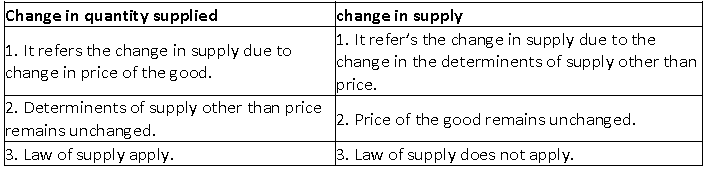
Answer. A. Increase in price of input : increase in price of input is cause of a decrease in the supply of a good because the production cost of a good will increase due to increase in price of input. It will reduced the profit. So producer will decrease the supply of the good.
B. Decrease in price of Input : Decrease in price of input is a cause of increase in supply because when the price of input decrease the production cost of a good also also decreases. Decrease in cost increases the profit margin. It motivate to producer to increase the supply of the good.
Question. Explain how changes in prices of other products influence the supply of a given product.
Answer. The supply of a good is inversly influenced with the change in price of other product which can explain as fallows.
A. Rise in price of other product :– When there is rise in the price of other product the production of these product become more profitable due to unchanged cost in comparison of the production of given produce. As a result the producer will produce more quantity of other product so the supply of given good will decrease.
B. Fall in the price of other product :– When there is fall in the price of other product the production of these product become less profitable due to unchanged cost in comparison of the production of given product. As a result producer will produce less quantity of other product so the factors of production shifted for the production of given good. It cause an increase in supply of given good.
Question. Explain how technological advancement influence the supply of a given product.
Answer. Technological advancement brings a positive impact in the supply of a given product. It reduces per unit cost and increase the productivity of given factors of production. Due to these reasons production of given product becomes more profitable.
Question. What are the factors which give rise to increasing returns to variable factors?
Answer. 1. Fuller utilization of the fixed factors- Generally fixed factors are indivisible and underutilized. With greater application of variable factor these factors are better utilized its MPP tends to rise.
2. Increased efficiency of variable factor- Application of specialization and division of labour among the units of variable factors leads to greater efficiency and increase in MPP.




Revenue Concepts
What is Revenue?
Revenue represents the monetary receipts that a firm earns from selling its goods and services in the market.
Key Concepts of Revenue
- Total Revenue (TR): Calculated as the product of price per unit and total quantity sold: \[ \text{TR} = \text{Price} \times \text{Quantity} \]
- Average Revenue (AR): The revenue earned per unit of output sold, which is equal to price: \[ \text{AR} = \frac{\text{TR}}{\text{Quantity}} \]
- Marginal Revenue (MR): The net change in total revenue resulting from selling one additional unit of output.
- Market Relationships: The relationship between Total Revenue and Marginal Revenue varies between perfectly competitive and non-competitive market structures.
Question 1. Name the payment, which is received from the sale of goods.
Answer: The money received from selling goods is called revenue.
In simple words: The cash a business gets when it sells its products is known as revenue.
Exam Tip: Do not confuse revenue with profit; revenue is total sales receipts, while profit is revenue minus costs.
Question 2. What is revenue?
Answer: Revenue refers to the total amount of money that a business receives from selling its output to customers.
In simple words: Revenue is the total money a company brings in from its sales.
Exam Tip: Be sure to mention that it is the overall receipt before any deductions or expenses are subtracted.
Question 3. Let Q be the quantity of the good produced and therefore sold, by the firm at price P. How much a firm will get revenue?
Answer: The firm will earn a total revenue calculated as the product of the price (\( P \)) and the quantity sold (\( Q \)). Mathematically, it is written as: \[ \text{TR} = P \times Q \]
In simple words: If a firm sells a quantity \( Q \) at a price \( P \), its total revenue is simply \( P \) multiplied by \( Q \).
Exam Tip: Clearly state that this represents the formula for Total Revenue (TR).
Question 4. How will a firm optimize its profit?
Answer: A firm optimizes its profit by producing at the level of output where Marginal Revenue equals Marginal Cost (\( \text{MR} = \text{MC} \)), and where the Marginal Cost curve cuts the Marginal Revenue curve from below.
In simple words: A company makes the most profit when the money it gets from selling one more item is exactly equal to what it costs to make that item, and costs are rising.
Exam Tip: List both conditions of producer's equilibrium (equality and the slope condition) to get full marks.
Question 5. What is the objective of a firm?
Answer: The primary objective of a commercial firm is profit maximization, which means achieving the highest possible difference between its total revenue and total costs.
In simple words: The main goal of a business is to make as much profit as possible.
Exam Tip: State "profit maximization" as the key term since it is the standard economic assumption for firm behavior.
Question 6. Name the revenue, which is per unit of output sold.
Answer: Average Revenue is the term used for the revenue earned per unit of output sold.
In simple words: Average revenue is the amount of money a firm gets for each individual item it sells.
Exam Tip: Remember that Average Revenue is mathematically identical to the price of the product.
Question 7. How does AR differ from the MR?
Answer: Average Revenue (AR) is the revenue earned per unit of output sold, whereas Marginal Revenue (MR) is the additional revenue generated by selling one extra unit of output.
In simple words: Average revenue is the average price of all items sold, while marginal revenue is the specific money made from selling just the very last item.
Exam Tip: Highlight that in a perfectly competitive market, AR and MR are equal, but in a monopoly or monopolistic competition, AR is greater than MR.
Question 8. Define marginal revenue.
Answer: Marginal Revenue is defined as the net increase in total revenue that results from selling one additional unit of a commodity.
In simple words: Marginal revenue is the extra money a business earns when it sells one more unit.
Exam Tip: Express this definition using the formula: \( \text{MR}_n = \text{TR}_n - \text{TR}_{n-1} \).
Question 9. Why is AR always equal to MR for a competitive firm?
Answer: For a perfectly competitive firm, the market price is constant because the firm is a price taker. Since every unit is sold at the exact same price, the revenue from selling an additional unit (MR) is always equal to the average price of all units sold (AR).
In simple words: In a competitive market, a business must sell everything at the same set price. Because the price never changes, the money from selling one more item is always equal to the average price.
Exam Tip: State that a flat, constant price is the key reason why \( \text{AR} = \text{MR} = \text{Price} \).
Question 10. Why MR and AR curves parallel to the X-axis in the competitive market?
Answer: In a perfectly competitive market, a firm can sell any quantity of output at the prevailing market price. Since price remains constant at all levels of output, both AR and MR are constant and equal to the price, resulting in horizontal curves parallel to the X-axis.
In simple words: Because the price of the product does not change no matter how much you sell, the lines for average and marginal revenue stay perfectly flat and horizontal.
Exam Tip: Use the term "perfectly elastic demand" to describe the horizontal AR and MR curves under perfect competition.
Question 11. What is the relationship between Price and MR in the competitive market?
Answer: In a competitive market, Price is always equal to Marginal Revenue (\( P = \text{MR} \)) because the price is constant and does not fall as output increases.
In simple words: In a competitive market, the price of a product is exactly the same as the marginal revenue.
Exam Tip: Remember that \( \text{Price} = \text{AR} = \text{MR} \) is a unique characteristic of perfect competition.
Question 12. What is Total Revenue?
Answer: Total Revenue is the entire sum of money received by a firm from selling a specific quantity of its product.
In simple words: Total revenue is all the money a business makes from its sales before paying any expenses.
Exam Tip: Represent this as \( \text{TR} = P \times Q \) to make your answer complete.
Question 13. Why is TR curve facing a competitive firm a straight line passing through the origin?
Answer: The Total Revenue curve for a competitive firm is a straight, upward-sloping line from the origin because the price is constant. This means that total revenue increases at a constant rate as output increases, and is zero when output is zero.
In simple words: Since the price is always the same, every new sale adds the exact same amount to total revenue. When you sell nothing, you earn nothing, so the line starts at zero and goes straight up.
Exam Tip: Mention that the constant slope of the TR curve is equal to the constant price of the commodity.
Question 14. When TR falls what happens to MR in the non-competitive market?
Answer: In a non-competitive market, when Total Revenue begins to fall, Marginal Revenue becomes negative.
In simple words: If total sales revenue goes down when you sell more, it means the extra revenue from the last item sold is actually negative.
Exam Tip: Remember that when TR is at its maximum, MR is zero, and when TR falls, MR is less than zero.
Question 15. Explain the relationship between TR and MR in the non-competitive market. Use diagram.
Answer: In a non-competitive market (such as monopoly or monopolistic competition), the relationships between TR and MR are:
1. As long as MR is positive, TR increases at a diminishing rate.
2. When MR becomes zero, TR reaches its peak (maximum value).
3. When MR becomes negative, TR starts to decline.
In simple words: As you sell more by lowering prices, your total revenue increases at first. When the extra revenue (marginal revenue) hits zero, total revenue is at its highest point. After that, marginal revenue becomes negative and total revenue starts to drop.
Exam Tip: Drawing the aligned two-panel diagram showing the peak of TR directly above the zero-point of MR is the best way to earn full marks on this question.
Question 16. What is the effect of increasing TR at a decreasing rate upon the marginal revenue?
Answer: When Total Revenue increases at a decreasing rate, Marginal Revenue is positive but continuously declining.
In simple words: If total sales keep going up but by smaller and smaller jumps each time, it means the extra money from each new sale is positive but getting smaller.
Exam Tip: Use this to show that the slope of the TR curve is represented by MR, which means a flattening TR curve corresponds to a falling MR.
Question 17. What is the shape of MR curve in Non-competitive market?
Answer: In a non-competitive market, the Marginal Revenue curve is a downward-sloping straight line or curve that lies below the Average Revenue curve.
In simple words: The marginal revenue curve slopes downward from left to right, meaning it gets lower as more units are sold.
Exam Tip: Mention that because price must be lowered to sell more, the MR curve is always steeper and lower than the AR curve.
Question 18. Complete the following table: -
Answer: Total Revenue (TR) is calculated using the formula: \[ \text{TR} = \text{Price} \times \text{Output} \]
Using this relation, we can calculate the missing fields:
- At Price Rs. 10: Output = \( 100 / 10 = 10 \)
- At Price Rs. 11: TR = \( 11 \times 9 = 99 \)
- At Price Rs. 12: Output = \( 96 / 12 = 8 \)
- At Price Rs. 13: TR = \( 13 \times 7 = 91 \)
- At Price Rs. 14: Output = \( 84 / 14 = 6 \)
- At Price Rs. 15: TR = \( 15 \times 5 = 75 \)
- At Price Rs. 16: Output = \( 64 / 16 = 4 \)
| Price (Rs.) | 10 | 11 | 12 | 13 | 14 | 15 | 16 |
|---|---|---|---|---|---|---|---|
| Output (Units) | 10 | 9 | 8 | 7 | 6 | 5 | 4 |
| TR (Rs.) | 100 | 99 | 96 | 91 | 84 | 75 | 64 |
In simple words: We can find the missing numbers because Total Revenue is always equal to Price multiplied by the quantity of Output.
Exam Tip: For horizontal tables, double check each column using the formula \( \text{TR} = P \times Q \) to make sure everything multiplies correctly.
Producer's Equilibrium Concepts
A producer achieves equilibrium at the level of output that yields maximum economic profit. There are two primary methods to determine this point:
- TR and TC Approach: Equilibrium is reached where the positive difference between Total Revenue (TR) and Total Cost (TC) is maximized, or where both curves have the same slope.
- MR and MC Approach: Equilibrium occurs where Marginal Revenue (MR) equals Marginal Cost (MC), and Marginal Cost is rising (cuts MR from below).
Question 1. What is producer’s equilibrium?
Answer: Producer's equilibrium is a state of balance where a producer outputs a quantity of goods that maximizes their net economic profit.
In simple words: Producer's equilibrium is the sweet spot of production where a business makes the absolute most profit.
Exam Tip: Be sure to use the term "profit maximization" to define the equilibrium state.
Question 2. When a producer is said to be in equilibrium situation?
Answer: A producer is in equilibrium when they have no incentive to increase or decrease production, which happens at the specific output level where profits are maximized.
In simple words: A producer is in equilibrium when changing how much they produce would only lower their profits, so they stay right where they are.
Exam Tip: Emphasize that at equilibrium, the firm's profits are at their absolute peak.
Question 3. Express the difference between TR and TC?
Answer: The difference between Total Revenue and Total Cost represents the total profit (or loss) of the firm. Mathematically, it is expressed as: \[ \text{Profit } (\pi) = \text{TR} - \text{TC} \]
In simple words: Subtracting total cost from total revenue shows how much profit a business has earned.
Exam Tip: Use the Greek letter pi (\( \pi \)) to represent profit in your equations to impress the examiner.
Question 4. What does profit mean?
Answer: Profit is the positive financial gain remaining after all production costs, both explicit and implicit, are subtracted from the total revenue earned by a firm.
In simple words: Profit is the money a company keeps after paying off all its expenses from the money it made selling goods.
Exam Tip: Clearly define profit as \( \text{TR} - \text{TC} \) to ensure a precise economic definition.
Question 5. Where TR=TC or AR=AC express the situation of Profits and Losses. Use suitable diagram.
Answer: When Total Revenue equals Total Cost (\( \text{TR} = \text{TC} \)) or Average Revenue equals Average Cost (\( \text{AR} = \text{AC} \)), the firm is earning normal profits. This point is known as the Break-Even Point, where there is neither an economic profit nor an economic loss.
In simple words: When a firm's total money coming in equals its total costs, it is breaking even. It is not losing money, but it is not making extra profits either.
Exam Tip: Explain that at the break-even point, a firm covers all its opportunity costs, earning what economists call "normal profit".
Question 6. What are Normal profit and Abnormal profit?
Answer:
- Normal Profit: This is the minimum level of profit required to keep a firm operating in its current industry. It occurs when total revenue equals total cost (\( \text{TR} = \text{TC} \)), covering both explicit and implicit costs.
- Abnormal Profit: This refers to any economic profit earned in excess of normal profits, occurring when total revenue is greater than total cost (\( \text{TR} > \text{TC} \)).
In simple words: Normal profit is just enough money to keep the business running and happy. Abnormal profit is the extra, bonus profit made above that minimum level.
Exam Tip: Clarify that in economics, normal profit is considered a part of total cost because it is the opportunity cost of the entrepreneur's effort.
Question 7. What is Break Even Point?
Answer: The Break-Even Point is the level of production where a firm's total revenue equals its total cost, resulting in zero economic profit and zero economic loss.
In simple words: The break-even point is when a company makes exactly as much money as it spends, so it has no loss and no extra profit.
Exam Tip: Use the mathematical expression \( \text{TR} = \text{TC} \) or \( \text{AR} = \text{AC} \) to define this point.
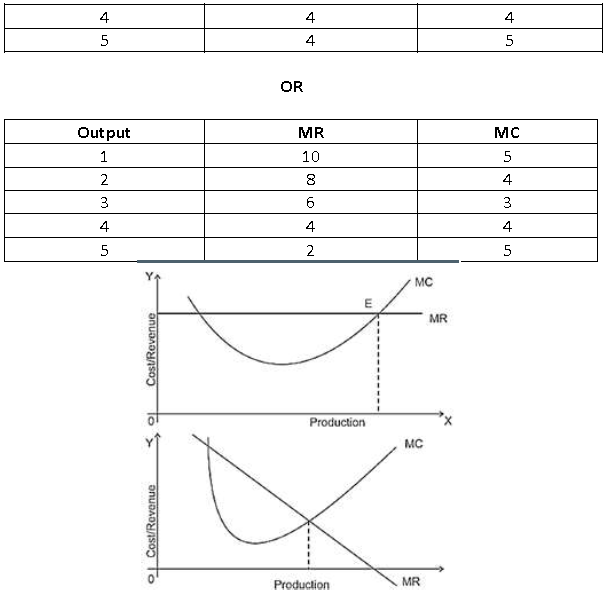
Question 8. Explain the conditions of producer’s equilibrium in case of TR &TC approach and MR &MC approach with the help of diagram.
Answer: 1. Total Revenue (TR) & Total Cost (TC) Approach:
Equilibrium is achieved where the vertical distance between the TR and TC curves is maximized (with TR > TC). At this point, the slope of TR equals the slope of TC.
2. Marginal Revenue (MR) & Marginal Cost (MC) Approach:
A producer is in equilibrium when two conditions are met:
- Marginal Revenue equals Marginal Cost (\( \text{MR} = \text{MC} \)).
- Marginal Cost must cut Marginal Revenue from below (MC must be rising).
In simple words: To find the best amount to produce, a firm can either look for where the gap between total sales and total costs is biggest, or where the cost to make one more item is exactly equal to the revenue from selling it, with costs going up.
Exam Tip: In the MR-MC diagram, point A (where MC cuts MR while falling) is not an equilibrium because the firm can increase profits by producing more. Point E is the true equilibrium.
Question 9. Find out the maximum profit position of a producer by comparing MC &MR on the basis of the following data:-
Answer: To find the maximum profit position (equilibrium), we check the two conditions of the MR-MC approach:
1. \( \text{MR} = \text{MC} \)
2. After this level of output, MC must be greater than MR (\( \text{MC} > \text{MR} \)).
Let's analyze the data:
- At 4 units of output, \( \text{MR} = \text{MC} = \text{Rs. } 7 \). This satisfies the first condition.
- At 5 units of output, \( \text{MC} \) (Rs. 8) is greater than \( \text{MR} \) (Rs. 6). This satisfies the second condition.
Thus, the producer's maximum profit position is at 4 units of output.
| Output (in units) | MR (Rs.) | MC (Rs.) | Marginal Profit (MR - MC) (Rs.) |
|---|---|---|---|
| 1 | 10 | 4 | 6 |
| 2 | 9 | 5 | 4 |
| 3 | 8 | 6 | 2 |
| 4 | 7 | 7 | 0 (Equilibrium) |
| 5 | 6 | 8 | -2 |
In simple words: At 4 units of output, the revenue from selling the last unit (Rs. 7) is exactly equal to the cost of making it (Rs. 7). If the firm produces a 5th unit, it would lose Rs. 2 on that unit, so 4 units is the maximum profit position.
Exam Tip: Always check both conditions of the MR-MC approach when solving numerical tables; do not just stop at \( \text{MR} = \text{MC} \).
Question 10. When does a producer earn maximum profit?
Answer: A producer earns maximum profit at the output level where two conditions are simultaneously satisfied: first, Marginal Revenue equals Marginal Cost (\( \text{MR} = \text{MC} \)); and second, Marginal Cost must be greater than Marginal Revenue for any subsequent unit of output.
In simple words: A producer makes the highest profit when the money made from the last item sold equals what it cost to build it, and making any more items would cost more than they sell for.
Exam Tip: State both conditions clearly in list form to make it easy for the examiner to award full marks.
Question 11. What do you mean by profit maximization of a producer?
Answer: Profit maximization is the process by which a firm determines the price and output level that returns the greatest possible net profit, achieved when the difference between total revenue and total cost is at its widest point.
In simple words: Profit maximization is the goal and action of finding the exact level of production that brings in the most net cash for the business owner.
Exam Tip: Note that profit maximization is the core behavioral assumption for firms in classical microeconomic theory.
Free study material for Economics
CBSE Economics Class 12 Producers Behaviour And Supply Economics Worksheet
Students can use the practice questions and answers provided above for Producers Behaviour And Supply Economics to prepare for their upcoming school tests. This resource is designed by expert teachers as per the latest 2026 syllabus released by CBSE for Class 12. We suggest that Class 12 students solve these questions daily for a strong foundation in Economics.
Producers Behaviour And Supply Economics Solutions & NCERT Alignment
Our expert teachers have referred to the latest NCERT book for Class 12 Economics to create these exercises. After solving the questions you should compare your answers with our detailed solutions as they have been designed by expert teachers. You will understand the correct way to write answers for the CBSE exams. You can also see above MCQ questions for Economics to cover every important topic in the chapter.
Class 12 Exam Preparation Strategy
Regular practice of this Class 12 Economics study material helps you to be familiar with the most regularly asked exam topics. If you find any topic in Producers Behaviour And Supply Economics difficult then you can refer to our NCERT solutions for Class 12 Economics. All revision sheets and printable assignments on studiestoday.com are free and updated to help students get better scores in their school examinations.
FAQs
You can download the latest chapter-wise printable worksheets for Class 12 Economics Producers Behaviour And Supply Economics for free from StudiesToday.com. These have been made as per the latest CBSE curriculum for this academic year.
Yes, Class 12 Economics worksheets for Producers Behaviour And Supply Economics focus on activity-based learning and also competency-style questions. This helps students to apply theoretical knowledge to practical scenarios.
Yes, we have provided solved worksheets for Class 12 Economics Producers Behaviour And Supply Economics to help students verify their answers instantly.
Yes, our Class 12 Economics test sheets are mobile-friendly PDFs and can be printed by teachers for classroom.
For Producers Behaviour And Supply Economics, regular practice with our worksheets will improve question-handling speed and help students understand all technical terms and diagrams.