

Read and download the CBSE Class 12 Mathematics Integration Worksheet Set 01 in PDF format. We have provided exhaustive and printable Class 12 Mathematics worksheets for Chapter 7 Integrals, designed by expert teachers. These resources align with the 2026-27 syllabus and examination patterns issued by NCERT, CBSE, and KVS, helping students master all important chapter topics.
Chapter-wise Worksheet for Class 12 Mathematics Chapter 7 Integrals
Students of Class 12 should use this Mathematics practice paper to check their understanding of Chapter 7 Integrals as it includes essential problems and detailed solutions. Regular self-testing with these will help you achieve higher marks in your school tests and final examinations.
Class 12 Mathematics Chapter 7 Integrals Worksheet with Answers
CBSE Class 12 Mathematics Worksheet - Integrals. CBSE issues sample papers every year for students for class 12 board exams. Students should solve the CBSE issued sample papers to understand the pattern of the question paper which will come in class 12 board exams this year. The sample papers have been provided with marking scheme. It’s always recommended to practice as many CBSE sample papers as possible before the board examinations. Sample papers should be always practiced in examination condition at home or school and the student should show the answers to teachers for checking or compare with the answers provided. Students can download the sample papers in pdf format free and score better marks in examinations. Refer to other links too for latest sample papers.
Points to Remember
- The process of integration acts as the inverse of differentiation.
- If we have \( \frac{d}{dx}[F(x)] = f(x) \), then we can write the relationship as \( \int f(x) \, dx = F(x) + c \).
- These types of integrals are referred to as indefinite integrals, and \( c \) is designated as the constant of integration.
- From a geometric standpoint, an indefinite integral represents a family of curves, where each individual curve can be obtained by shifting any other curve in the family vertically (either upward or downward) along the y-axis.
Standard Formulae
- \[ \int x^n \, dx = \begin{cases} \frac{x^{n+1}}{n+1} + c & \text{if } n \neq -1 \\ \log|x| + c & \text{if } n = -1 \end{cases} \]
- \[ \int (ax + b)^n \, dx = \begin{cases} \frac{(ax + b)^{n+1}}{a(n+1)} + c & \text{if } n \neq -1 \\ \frac{1}{a} \log|ax + b| + c & \text{if } n = -1 \end{cases} \]
- \[ \int \sin x \, dx = -\cos x + c \]
- \[ \int \cos x \, dx = \sin x + c \]
- \[ \int \tan x \, dx = -\log|\cos x| + c = \log|\sec x| + c \]
- \[ \int \cot x \, dx = \log|\sin x| + c \]
- \[ \int \sec^2 x \, dx = \tan x + c \]
- \[ \int \text{cosec}^2 x \, dx = -\cot x + c \]
- \[ \int \sec x \tan x \, dx = \sec x + c \]
- \[ \int \text{cosec} \, x \cot x \, dx = -\text{cosec} \, x + c \]
- \[ \int \sec x \, dx = \log|\sec x + \tan x| + c \]
- \[ \int \text{cosec} \, x \, dx = \log|\text{cosec} \, x - \cot x| + c \]
- \[ \int e^x \, dx = e^x + c \]
- \[ \int a^x \, dx = \frac{a^x}{\log a} + c \]
- \[ \int \frac{1}{\sqrt{1 - x^2}} \, dx = \sin^{-1} x + c, \quad |x| < 1 \]
- \[ \int \frac{1}{1 + x^2} \, dx = \tan^{-1} x + c \]
- \[ \int \frac{1}{x\sqrt{x^2 - 1}} \, dx = \sec^{-1} x + c, \quad |x| > 1 \]
- \[ \int \frac{1}{a^2 - x^2} \, dx = \frac{1}{2a} \log\left|\frac{a + x}{a - x}\right| + c \]
- \[ \int \frac{1}{x^2 - a^2} \, dx = \frac{1}{2a} \log\left|\frac{x - a}{x + a}\right| + c \]
- \[ \int \frac{1}{a^2 + x^2} \, dx = \frac{1}{a} \tan^{-1}\left(\frac{x}{a}\right) + c \]
- \[ \int \frac{1}{\sqrt{a^2 - x^2}} \, dx = \sin^{-1}\left(\frac{x}{a}\right) + c \]
- \[ \int \frac{1}{\sqrt{a^2 + x^2}} \, dx = \log\left|x + \sqrt{a^2 + x^2}\right| + c \]
- \[ \int \frac{1}{\sqrt{x^2 - a^2}} \, dx = \log\left|x + \sqrt{x^2 - a^2}\right| + c \]
- \[ \int \sqrt{a^2 - x^2} \, dx = \frac{x}{2}\sqrt{a^2 - x^2} + \frac{a^2}{2}\sin^{-1}\left(\frac{x}{a}\right) + c \]
- \[ \int \sqrt{a^2 + x^2} \, dx = \frac{x}{2}\sqrt{a^2 + x^2} + \frac{a^2}{2}\log\left|x + \sqrt{a^2 + x^2}\right| + c \]
- \[ \int \sqrt{x^2 - a^2} \, dx = \frac{x}{2}\sqrt{x^2 - a^2} - \frac{a^2}{2}\log\left|x + \sqrt{x^2 - a^2}\right| + c \]
Rules of Integration
- \[ \int k \cdot f(x) \, dx = k \int f(x) \, dx \]
- \[ \int [ k \{ f(x) \pm g(x) \} ] \, dx = k \int f(x) \, dx \pm k \int g(x) \, dx \]
Integration by Substitution
- \[ \int \frac{f'(x)}{f(x)} \, dx = \log|f(x)| + c \]
- \[ \int [f(x)]^n f'(x) \, dx = \frac{[f(x)]^{n+1}}{n+1} + c \]
3. \[ \int \frac{f'(x)}{[f(x)]^n} \, dx = \frac{(f(x))^{-n+1}}{-n+1} + c \]
Integration by Parts
\[ \int f(x) \cdot g(x) \, dx = f(x) \cdot \left[ \int g(x) \, dx \right] - \int \left[ f'(x) \cdot \left[ \int g(x) \, dx \right] \right] \, dx \]
Definite Integrals
\[ \int_a^b f(x) \, dx = F(b) - F(a) \text{, where } F(x) = \int f(x) \, dx \]
Definite Integral as a Limit of Sums
\[ \int_a^b f(x) \, dx = \lim_{h \to 0} h [f(a) + f(a+h) + f(a+2h) + \dots + f(a + (n-1)h)] \] where \( h = \frac{b-a}{n} \) or \[ \int_a^b f(x) \, dx = \lim_{h \to 0} \left[ h \sum_{r=1}^n f(a + rh) \right] \]
Properties of Definite Integral
1. \[ \int_a^b f(x) \, dx = -\int_b^a f(x) \, dx \]
2. \[ \int_a^b f(x) \, dx = \int_a^b f(t) \, dt \]
3. \[ \int_a^b f(x) \, dx = \int_a^c f(x) \, dx + \int_c^b f(x) \, dx \]
4. (i) \[ \int_a^b f(x) \, dx = \int_a^b f(a + b - x) \, dx \] (ii) \[ \int_0^a f(x) \, dx = \int_0^a f(a - x) \, dx \]
5. \[ \int_{-a}^a f(x) \, dx = 0 \text{; if } f(x) \text{ is an odd function.} \]
6. \[ \int_{-a}^a f(x) \, dx = 2\int_0^a f(x) \, dx \text{, if } f(x) \text{ is an even function.} \]
7. \[ \int_0^{2a} f(x) \, dx = \begin{cases} 2\int_0^a f(x) \, dx, & \text{if } f(2a-x)=f(x) \\ 0, & \text{if } f(2a-x)=-f(x) \end{cases} \]
Very Short Answer Type Questions (1 Mark)
Evaluate the following integrals
Question 1. \( \int (\sin^{-1}\sqrt{x} + \cos^{-1}\sqrt{x}) \, dx \)
Answer: \( \frac{\pi}{2} x + c \)
In simple words: Since the sum of \( \sin^{-1}\sqrt{x} \) and \( \cos^{-1}\sqrt{x} \) is always equal to the constant \( \frac{\pi}{2} \), the integral simplifies to integrating a constant, which gives \( \frac{\pi}{2} x \) plus the constant of integration.
Exam Tip: Look out for algebraic and trigonometric identities that can simplify the integrand to a constant before you start integrating.
Question 2. \( \int e^{1-x} \, dx \)
Answer: \( -e^{1-x} + c \)
In simple words: We can solve this by reversing the derivative of \( e^{1-x} \). Since differentiating \( e^{1-x} \) produces a negative sign due to the chain rule, integrating it brings that negative sign to the front.
Exam Tip: When integrating \( e^{f(x)} \) where \( f(x) \) is linear, always remember to divide the result by the derivative of \( f(x) \).
Question 3. \( \int \frac{1}{1 - \sin^2 x} \, dx \)
Answer: \( \tan x + c \)
In simple words: First, we use a basic trigonometry rule to turn the bottom part, \( 1 - \sin^2 x \), into \( \cos^2 x \). This simplifies the problem to integrating \( \sec^2 x \), which we know is \( \tan x \).
Exam Tip: Keep standard trigonometric identities on your fingertips, as converting expressions into secant or tangent forms often makes integration direct.
Question 4. \( \int \left( 8^x + x^8 + \frac{8}{x} + \frac{x}{8} \right) \, dx \)
Answer: \( \frac{8^x}{\log 8} + \frac{x^9}{9} + 8 \log|x| + \frac{x^2}{16} + c \)
In simple words: We integrate each part of the sum one by one using standard integration formulas. For example, the integral of \( 8^x \) uses the exponential rule, while the others use power rules.
Exam Tip: Break down long addition expressions into separate terms to integrate them systematically, ensuring you apply the correct rule for each term.
Question 5. \( \int_{-1}^1 x^{99} \cos^4 x \, dx \)
Answer: \( 0 \)
In simple words: The function inside the integral is odd, meaning its graph is symmetric but has opposite signs on either side of zero. When we integrate an odd function over symmetric limits like \( -1 \) to \( 1 \), the positive and negative halves cancel each other out completely.
Exam Tip: Whenever you see symmetric limits from \( -a \) to \( a \), check if the integrand is odd. If it is, you can write the answer as zero immediately and save valuable time.
Question 6. \( \int \frac{1}{x \log x \log(\log x)} \, dx \)
Answer: \( \log|\log(\log x)| + c \)
In simple words: By setting a new variable \( u = \log(\log x) \), the rest of the expression neatly becomes \( du \). This changes the problem into integrating \( \frac{1}{u} \), which gives \( \log|u| \).
Exam Tip: When an expression contains nested logarithms, substituting the innermost log term often simplifies the derivative of the outer terms and resolves the integral.
Question 7. \( \int_0^{\pi/2} \log\left( \frac{4 + 3\sin x}{4 + 3\cos x} \right) \, dx \)
Answer: \( 0 \)
In simple words: We can use a property of definite integrals that lets us swap \( x \) with \( \pi/2 - x \). This swaps the sine and cosine, making the new integral the negative of the original one, which means the total value must be zero.
Exam Tip: For integrals with limits from \( 0 \) to \( \pi/2 \) involving sines and cosines, using the \( f(a-x) \) substitution property is a very reliable way to find the solution.
Question 8. \( \int (e^{a \log x} + e^{x \log a}) \, dx \)
Answer: \( \frac{x^{a+1}}{a+1} + \frac{a^x}{\log a} + c \)
In simple words: First, we simplify the terms using logarithm rules, which turns them into \( x^a \) and \( a^x \). Then, we integrate \( x^a \) using the power rule and \( a^x \) using the exponential integration rule.
Exam Tip: Always simplify exponential terms with logarithmic exponents using the identity \( e^{\log(f(x))} = f(x) \) before performing any integration.
Question 9. \( \int \frac{\cos 2x + 2\sin^2 x}{\cos^2 x} \, dx \)
Answer: \( \tan x + c \)
In simple words: Using the double-angle identity for \( \cos 2x \), the numerator simplifies to just \( 1 \). This leaves us with \( \frac{1}{\cos^2 x} \), which is \( \sec^2 x \), and its integral is \( \tan x \).
Exam Tip: Double-angle trigonometric identities are extremely helpful for simplifying rational integrands into standard forms.
Question 10. \( \int_{-\pi/2}^{\pi/2} \sin^7 x \, dx \)
Answer: \( 0 \)
In simple words: Since \( \sin(-x) = -\sin x \), raising it to an odd power like \( 7 \) keeps it as an odd function. Integrating any odd function over symmetric limits from \( -a \) to \( a \) always results in zero.
Exam Tip: Look for odd powers of sines or tangents when integrating over symmetric limits to quickly apply the zero-value property.
Question 11. \( \int (x^c + c^x) \, dx \)
Answer: \( \frac{x^{c+1}}{c+1} + \frac{c^x}{\log c} + K \)
In simple words: We integrate \( x^c \) as a variable raised to a constant power and \( c^x \) as a constant raised to a variable power, using their respective standard formulas.
Exam Tip: Be careful to distinguish between the power rule (variable base) and the exponential rule (constant base) when integrating expressions with similar-looking terms.
Question 12. \( \frac{d}{dx}\left[ \int f(x) \, dx \right] \)
Answer: \( f(x) \)
In simple words: Integration and differentiation are opposite operations. Performing one after the other simply brings you back to the original function you started with.
Exam Tip: Remember that the derivative of an indefinite integral is always the integrand itself, as they are inverse processes.
Question 13. \( \int \frac{1}{\sin^2 x \cos^2 x} \, dx \)
Answer: \( \tan x - \cot x + c \)
In simple words: Replacing the \( 1 \) in the numerator with \( \sin^2 x + \cos^2 x \) lets us split the fraction into two simpler terms. These integrate directly to \( \tan x \) and \( -\cot x \).
Exam Tip: Writing \( 1 \) as \( \sin^2 x + \cos^2 x \) is a very useful technique for splitting rational trigonometric integrands.
Question 14. \( \int \frac{1}{\sqrt{x} + \sqrt{x-1}} \, dx \)
Answer: \( \frac{2}{3}x^{3/2} - \frac{2}{3}(x-1)^{3/2} + c \)
In simple words: We rationalize the fraction by multiplying both the top and bottom by \( \sqrt{x} - \sqrt{x-1} \). This leaves a simple expression that we can integrate term-by-term.
Exam Tip: When you have square roots added or subtracted in the denominator, rationalizing is almost always the first step to simplify the integral.
Question 15. \( \int e^{-\log x} \, dx \)
Answer: \( \log|x| + c \)
In simple words: The term \( e^{-\log x} \) simplifies directly to \( \frac{1}{x} \) using logarithm rules. The integral of \( \frac{1}{x} \) is simply the natural logarithm of \( x \).
Exam Tip: Move negative signs or constants inside the logarithm exponent before using the exponential cancellation property.
Question 16. \( \int \frac{e^x}{a^x} \, dx \)
Answer: \( \frac{e^x}{a^x(1 - \log a)} + c \)
In simple words: We can combine the fraction into a single base raised to the power of \( x \). Then, we integrate it using the standard exponential integration rule.
Exam Tip: Combine terms with the same exponent into a single exponential base of the form \( b^x \) to perform a straightforward integration.
Question 17. \( \int 2^x e^x \, dx \)
Answer: \( \frac{2^x e^x}{\log 2 + 1} + c \)
In simple words: We rewrite the product as a single term \( (2e)^x \). Since this is a constant raised to the power of \( x \), its integral is just the term divided by the log of that constant.
Exam Tip: Group products of exponential terms together to simplify the base and make the integration direct.
Question 18. \( \int \frac{x}{\sqrt{x+1}} \, dx \)
Answer: \( \frac{2}{3}(x+1)^{3/2} - 2\sqrt{x+1} + c \)
In simple words: We substitute \( u = x+1 \), which turns the numerator into \( u-1 \). Splitting the fraction allows us to integrate two simple power terms.
Exam Tip: For rational integrals with a square root in the denominator, substituting the expression under the root often simplifies the remaining variables in the numerator.
Question 19. \( \int \frac{x}{(x+1)^2} \, dx \)
Answer: \( \log|x+1| + \frac{1}{x+1} + c \)
In simple words: Adding and subtracting \( 1 \) in the numerator allows us to split the fraction into two simpler parts, which can then be integrated using standard logarithmic and power rules.
Exam Tip: Adding and subtracting a constant in the numerator is a quick way to decompose rational fractions without full partial fraction expansion.
Question 20. \( \int \frac{e^{\sqrt{x}}}{\sqrt{x}} \, dx \)
Answer: \( 2e^{\sqrt{x}} + c \)
In simple words: By substituting \( u = \sqrt{x} \), the \( \frac{1}{\sqrt{x}} \) term in the denominator becomes part of \( du \), leaving a very simple exponential integral to solve.
Exam Tip: Recognizing that the derivative of \( \sqrt{x} \) is in the denominator is the key to identifying this quick substitution.
Question 21. \( \int \cos^2 \alpha \, dx \)
Answer: \( x \cos^2 \alpha + c \)
In simple words: Since \( \alpha \) is a constant, \( \cos^2 \alpha \) is also just a constant number. Integrating any constant with respect to \( x \) simply multiplies that constant by \( x \).
Exam Tip: Always identify which variables are constants with respect to the variable of integration to avoid unnecessarily integrating them.
Question 22. \( \int \frac{1}{x(\cos \alpha + 1)} \, dx \)
Answer: \( \frac{\log|x|}{\cos \alpha + 1} + c \)
In simple words: The term \( \cos \alpha + 1 \) is a constant, so we can pull it outside the integral. This leaves us with just integrating \( \frac{1}{x} \), which gives \( \log|x| \).
Exam Tip: Separate constant expressions in the denominator from the variable term to keep the integration steps straightforward.
Question 23. \( \int \sec x \cdot \log(\sec x + \tan x) \, dx \)
Answer: \( \frac{[\log(\sec x + \tan x)]^2}{2} + c \)
In simple words: The derivative of \( \log(\sec x + \tan x) \) is \( \sec x \). Substituting this entire log expression simplifies the problem to integrating \( u \, du \), which is very easy.
Exam Tip: Look for functions paired with their derivatives in products to quickly apply the substitution method.
Question 24. \( \int \frac{1}{\cos \alpha + x \sin \alpha} \, dx \)
Answer: \( \frac{1}{\sin \alpha} \log|\cos \alpha + x \sin \alpha| + c \)
In simple words: Since the denominator is a linear expression of \( x \), we integrate it as a logarithm and divide by the coefficient of \( x \), which is \( \sin \alpha \).
Exam Tip: Treat constant trigonometric terms like \( \sin \alpha \) and \( \cos \alpha \) as regular numerical coefficients when integrating.
Question 25. \( \int \cot x \cdot \log(\sin x) \, dx \)
Answer: \( \frac{[\log(\sin x)]^2}{2} + c \)
In simple words: Since the derivative of \( \log(\sin x) \) is \( \cot x \), we substitute \( u = \log(\sin x) \), transforming the problem into a simple integral of \( u \, du \).
Exam Tip: Substituting logarithmic trigonometric terms often clears out the remaining trigonometric functions in the integrand.
Question 26. \( \int \left( x - \frac{1}{2} \right)^3 \, dx \)
Answer: \( \frac{1}{4}\left( x - \frac{1}{2} \right)^4 + c \)
In simple words: This is a linear term raised to a power. We integrate it directly using the power rule, just like we would for \( x^3 \).
Exam Tip: You can apply the power rule directly to any linear expression of \( x \) without needing a detailed substitution step.
Question 27. \( \int \frac{1}{x(2 + 3\log x)} \, dx \)
Answer: \( \frac{1}{3}\log|2 + 3\log x| + c \)
In simple words: We substitute \( u = 2 + 3\log x \), which lets the \( \frac{1}{x} \) term in the denominator match up with \( du \). This simplifies the problem to a standard logarithmic integral.
Exam Tip: When a denominator contains a logarithm alongside an \( x \) term, substituting the logarithmic expression is usually the best approach.
Question 28. \( \int \frac{1 - \sin x}{x + \cos x} \, dx \)
Answer: \( \log|x + \cos x| + c \)
In simple words: The numerator is the exact derivative of the denominator. When an integral has this form, its solution is simply the natural logarithm of the denominator.
Exam Tip: Always check if the numerator is the derivative of the denominator, as this allows you to write the logarithmic answer immediately.
Question 29. \( \int \frac{1 - \cos x}{\sin x} \, dx \)
Answer: \( 2 \log|\sec(x/2)| + c \)
In simple words: We simplify the fraction using half-angle trigonometric formulas, which turns the expression into \( \tan(x/2) \). Integrating this gives us the logarithm of secant.
Exam Tip: Half-angle trigonometric simplifications can turn complex rational trigonometric functions into simple, standard integrals.
Question 30. \( \int \frac{x^{e-1} + e^{x-1}}{x^e + e^x} \, dx \)
Answer: \( \frac{1}{e} \log|x^e + e^x| + c \)
In simple words: We substitute the denominator \( u = x^e + e^x \). Its derivative is \( e \) times the numerator, which allows us to convert the problem into a simple logarithmic integral.
Exam Tip: Look for exponential bases like \( e^x \) and power terms like \( x^e \) together, as they often form clean derivative pairs under substitution.
Question 31. \( \int \frac{x+1}{x} (x + \log x) \, dx \)
Answer: \( \frac{(x + \log x)^2}{2} + c \)
In simple words: We substitute \( u = x + \log x \). Since its derivative is \( 1 + \frac{1}{x} \), which is \( \frac{x+1}{x} \), the integral simplifies directly to \( \int u \, du \).
Exam Tip: Factor out and combine fractional terms of \( x \) to find the derivative of logarithmic sums.
Question 32. \( \int \left( \sqrt{ax} - \frac{1}{\sqrt{ax}} \right)^2 \, dx \)
Answer: \( \frac{ax^2}{2} - 2x + \frac{1}{a}\log|x| + c \)
In simple words: First, we expand the squared term using algebraic rules. This gives three separate terms that we can easily integrate one by one.
Exam Tip: Expanding algebraic powers in the integrand is usually much easier than trying to use substitution or parts.
Question 33. \( \int_0^{\pi} |\cos x| \, dx \)
Answer: \( 2 \)
In simple words: Since cosine is positive in the first quadrant and negative in the second, the absolute value keeps it positive by flipping the sign of the second half. We split the integral at \( \pi/2 \) and calculate the two positive halves separately.
Exam Tip: Always split definite integrals of absolute value functions at the points where the expression inside the absolute value changes sign.
Question 34. \( \int_0^2 [x] \, dx \)
Answer: \( 1 \)
In simple words: The greatest integer function breaks the interval into step values: it is \( 0 \) from \( 0 \) to \( 1 \), and \( 1 \) from \( 1 \) to \( 2 \). Adding the area of these steps gives a total of \( 1 \).
Exam Tip: For greatest integer functions, split the definite integral at each integer boundary to integrate constant values over each interval.
Question 35. \( \int_0^{\sqrt{2}} [x^2] \, dx \)
Answer: \( \sqrt{2} - 1 \)
In simple words: The value of \( [x^2] \) is \( 0 \) when \( x^2 < 1 \) (from \( 0 \) to \( 1 \)), and \( 1 \) when \( x^2 \ge 1 \) (from \( 1 \) to \( \sqrt{2} \)). Splitting the integral at \( 1 \) and integrating these constants gives the final result.
Exam Tip: Determine the points where the expression inside the greatest integer bracket becomes an integer to correctly split the integration limits.
Question 36. \( \int_a^b \frac{f(x)}{f(x) + f(a+b-x)} \, dx \)
Answer: \( \frac{b - a}{2} \)
In simple words: Using a standard definite integral property, we can write a second version of the integral by replacing \( x \) with \( a+b-x \). Adding these two versions together simplifies the integrand to \( 1 \), which makes finding the answer very simple.
Exam Tip: This is a classic definite integral property question. Recognizing the symmetric form allows you to write the answer as half of the interval's length.
Question 37. \( \int_{-2}^1 \frac{|x|}{x} \, dx \)
Answer: \( -1 \)
In simple words: The expression is \( -1 \) for negative values of \( x \) and \( 1 \) for positive values. We split the integral at \( 0 \) and compute the areas of the two constant sections.
Exam Tip: Split the integral at zero to handle the sign change of the absolute value function in the numerator.
Question 38. \( \int_{-1}^1 x|x| \, dx \)
Answer: \( 0 \)
In simple words: Since the negative sign of \( x \) changes the sign of the entire term, \( x|x| \) is an odd function. Integrating it over symmetric limits like \( -1 \) to \( 1 \) always gives zero.
Exam Tip: Odd functions integrated over symmetric intervals cancel out completely, so always check for symmetry in definite integration limits.
Question 39. If \( \int_0^a \frac{1}{1 + x^2} \, dx = \frac{\pi}{4} \), then what is value of a.
Answer: \( a = 1 \)
In simple words: Integrating \( \frac{1}{1+x^2} \) gives \( \tan^{-1} x \). Setting the limits from \( 0 \) to \( a \) equal to \( \frac{\pi}{4} \) tells us that \( \tan^{-1} a = \frac{\pi}{4} \), which means \( a \) must be \( 1 \).
Exam Tip: Solve the definite integral in terms of the unknown parameter first, then solve the resulting equation to find its value.
Question 40. \( \int_a^b f(x) \, dx + \int_b^a f(x) \, dx \)
Answer: \( 0 \)
In simple words: Reversing the limits of integration on the second part changes its sign to negative. Adding these two equal but opposite values together results in zero.
Exam Tip: Keep the limit reversal property in mind to simplify sums of definite integrals with swapped boundaries.
Short Answer Type Questions (4 Marks)
Question 41. (i) \( \int \frac{x \text{cosec}(\tan^{-1} x^2)}{1 + x^4} \, dx \)
Answer: \( \frac{1}{2} \log|\text{cosec}(\tan^{-1} x^2) - \cot(\tan^{-1} x^2)| + c \)
In simple words: Substituting \( u = \tan^{-1} x^2 \) simplifies the integral because its derivative matches the remaining parts of the integrand. This leaves us with a standard cosecant integral.
Exam Tip: Look for nested function derivatives when choosing substitution variables, especially with rational polynomial terms in the denominator.
Question 41. (ii) \( \int \frac{\sqrt{x+1} - \sqrt{x-1}}{\sqrt{x+1} + \sqrt{x-1}} \, dx \)
Answer: \( \frac{x^2}{2} - \frac{x}{2}\sqrt{x^2-1} + \frac{1}{2}\log|x + \sqrt{x^2-1}| + c \)
In simple words: Rationalizing the fraction converts a complicated denominator into a simple expression. We then integrate the resulting polynomial and square root terms separately using standard formulas.
Exam Tip: Rationalizing the denominator of square root fractions is a very powerful way to break down complicated algebraic integrals.
Question 41. (iii) \( \int \frac{1}{\sin(x-a)\sin(x-b)} \, dx \)
Answer: \( \frac{1}{\sin(a-b)} \log\left| \frac{\sin(x-a)}{\sin(x-b)} \right| + c \)
In simple words: We multiply and divide by a constant sine term containing \( a-b \) and expand the numerator. This lets us split the fraction into cotangent terms that are easy to integrate.
Exam Tip: Introduce constant trigonometric terms in the numerator to match the differences in the denominator angles.
Question 41. (iv) \( \int \frac{\cos(x+a)}{\cos(x-a)} \, dx \)
Answer: \( x \cos 2a - \sin 2a \log|\sec(x-a)| + c \)
In simple words: We substitute \( u = x-a \) to simplify the denominator. Expanding the numerator using trigonometric addition formulas lets us integrate the term easily.
Exam Tip: Simplifying the denominator by substitution before expanding the numerator is a great way to handle rational trigonometric terms.
Question 41. (v) \( \int \cos x \cos 2x \cos 3x \, dx \)
Answer: \( \frac{1}{4} \left( x + \frac{\sin 2x}{2} + \frac{\sin 4x}{4} + \frac{\sin 6x}{6} \right) + c \)
In simple words: We use trigonometric product-to-sum formulas to transform the product of three cosines into a sum of individual cosine terms, which can then be integrated directly.
Exam Tip: Convert products of sines or cosines into linear sums using product-to-sum identities to make integration simple.
Question 41. (vi) \( \int \cos^5 x \, dx \)
Answer: \( \sin x - \frac{2}{3}\sin^3 x + \frac{1}{5}\sin^5 x + c \)
In simple words: We write the odd power of cosine as \( \cos^4 x \cdot \cos x \) and convert the even part into sines. Substituting \( u = \sin x \) turns the problem into a simple polynomial integral.
Exam Tip: For odd powers of sines or cosines, separate one factor to act as the derivative for substitution, and convert the rest using the identity \( \sin^2 x + \cos^2 x = 1 \).
Question 41. (vii) \( \int \sin^2 x \cos^4 x \, dx \)
Answer: \( \frac{x}{16} - \frac{\sin 4x}{64} + \frac{\sin^3 2x}{48} + c \)
In simple words: We use power-reduction and double-angle formulas to simplify sines and cosines into linear terms and products that can be integrated using basic power rules.
Exam Tip: Reduce high even powers of trigonometric functions systematically using double-angle and half-angle formulas.
Question 41. (viii) \( \int \cot^3 x \text{cosec}^4 x \, dx \)
Answer: \( -\frac{\cot^4 x}{4} - \frac{\cot^6 x}{6} + c \)
In simple words: We group the cosecant terms to find the derivative of cotangent. Substituting \( u = \cot x \) turns the entire expression into a simple polynomial.
Exam Tip: Use the identity \( \text{cosec}^2 x = 1 + \cot^2 x \) to express the remaining even cosecant terms in terms of cotangent.
Question 41. (ix) \( \int \frac{\sin x \cos x}{a^2 \sin^2 x + b^2 \cos^2 x} \, dx \)
Answer: \( \frac{1}{2(a^2 - b^2)} \log|a^2 \sin^2 x + b^2 \cos^2 x| + c \)
In simple words: The numerator is a constant multiple of the derivative of the denominator. Substituting the entire denominator as \( u \) directly simplifies the problem to a logarithmic integral.
Exam Tip: When sines and cosines appear squared in the denominator, substituting the entire denominator is a very robust way to solve the integral.
Question 41. (x) \( \int \frac{1}{\sqrt{\cos^3 x \cos(x+a)}} \, dx \)
Answer: \( -\frac{2\sqrt{\cos a - \tan x \sin a}}{\sin a} + c \)
In simple words: We expand the cosine term under the root and factor out a cosine power to create a secant-squared term on top and a tangent term inside the root. This sets up a perfect substitution.
Exam Tip: Factoring out powers of sines or cosines from square roots is a very effective way to construct tangent-secant derivative pairs.
Question 41. (xi) \( \int \frac{\sin^6 x + \cos^6 x}{\sin^2 x \cos^2 x} \, dx \)
Answer: \( \tan x - \cot x - 3x + c \)
In simple words: We use algebraic identities to simplify the numerator. Splitting the fraction then gives standard terms that integrate directly to tangent and cotangent.
Exam Tip: Master algebraic expansions of the form \( a^3 + b^3 \) for sines and cosines to quickly simplify higher-power trigonometric expressions.
Question 41. (xii) \( \int \frac{\sin x + \cos x}{\sqrt{\sin 2x}} \, dx \)
Answer: \( \sin^{-1}(\sin x - \cos x) + c \)
In simple words: We rewrite \( \sin 2x \) in terms of \( (\sin x - \cos x)^2 \). Substituting \( u = \sin x - \cos x \) turns the problem into a standard inverse sine integral.
Exam Tip: Expressing sines and cosines in the denominator as differences under a square root is a classic trick for integrating trigonometric sums.
Chapter 7
Integrals
Page 68
Question 42. (i) Evaluate: \( \int \frac{x}{x^4 + x^2 + 1} \, dx \)
Answer: \( \frac{1}{\sqrt{3}} \tan^{-1}\left( \frac{2x^2 + 1}{\sqrt{3}} \right) + c \)
In simple words: First, we use substitution by setting \( u = x^2 \). This simplifies our expression into a quadratic form in the denominator, which we can integrate using the standard arctangent formula after completing the square.
Exam Tip: Be sure to make the substitution \( u = x^2 \) early. Completing the square is much easier once the quartic expression has been reduced to a quadratic form.
Question 42. (ii) Evaluate: \( \int \frac{1}{x [6 (\log x)^2 + 7 \log x + 2]} \, dx \)
Answer: \( \log\left| \frac{2\log x + 1}{3\log x + 2} \right| + c \)
In simple words: We start by substituting \( u = \log x \), which clears out the \( \frac{1}{x} \) term. Then, we factor the quadratic equation in the denominator and apply partial fractions to separate the terms for straightforward logarithmic integration.
Exam Tip: Factoring the quadratic denominator into \( (2u + 1)(3u + 2) \) is the most efficient way to set up the partial fraction decomposition.
Question 42. (iii) Evaluate: \( \int \frac{dx}{1 + x - x^2} \)
Answer: \( \frac{1}{\sqrt{5}} \log\left| \frac{\sqrt{5} + 2x - 1}{\sqrt{5} - 2x + 1} \right| + c \)
In simple words: We rewrite the quadratic expression by completing the square, bringing it into the form of \( a^2 - u^2 \). This lets us apply the standard logarithmic integration formula for rational functions.
Exam Tip: Take extra care with signs when completing the square for a quadratic expression that has a negative \( x^2 \) coefficient.
Question 42. (iv) Evaluate: \( \int \frac{1}{\sqrt{9 + 8x - x^2}} \, dx \)
Answer: \( \sin^{-1}\left( \frac{x-4}{5} \right) + c \)
In simple words: By completing the square inside the square root, we rearrange the quadratic term into \( 5^2 - (x-4)^2 \). This matches the standard inverse sine integration formula.
Exam Tip: Expressing the term inside the radical as \( a^2 - (x - h)^2 \) makes it immediately solvable using the standard arcsine formula.
Question 42. (v) Evaluate: \( \int \frac{1}{\sqrt{(x-a)(x-b)}} \, dx \)
Answer: \( \log\left| x - \frac{a+b}{2} + \sqrt{(x-a)(x-b)} \right| + c \)
In simple words: We expand the product inside the square root and complete the square to get \( \left(x - \frac{a+b}{2}\right)^2 - \left(\frac{a-b}{2}\right)^2 \). We can then use the standard logarithmic integration formula for square-root quadratics.
Exam Tip: Keeping the constants \( a \) and \( b \) grouped as \( \frac{a+b}{2} \) and \( \frac{a-b}{2} \) will keep your intermediate algebraic steps clean and manageable.
Question 42. (vi) Evaluate: \( \int \sqrt{\frac{\sin(x-\alpha)}{\sin(x+\alpha)}} \, dx \)
Answer: \( -\cos \alpha \sin^{-1}\left( \frac{\cos x}{\cos \alpha} \right) - \sin \alpha \log\left| \sin x + \sqrt{\sin^2 x - \sin^2 \alpha} \right| + c \)
In simple words: We rationalize the numerator inside the radical to simplify the fraction. Splitting the resulting expression using trigonometric identity expansions helps us integrate both parts.
Exam Tip: This is a challenging integration problem. Rationalizing the numerator inside the square root is the key first step to breaking down the radical.
Question 42. (vii) Evaluate: \( \int \frac{5x-2}{3x^2 + 2x + 1} \, dx \)
Answer: \( \frac{5}{6}\log|3x^2+2x+1| - \frac{11}{3\sqrt{2}} \tan^{-1}\left( \frac{3x+1}{\sqrt{2}} \right) + c \)
In simple words: We split the numerator so that one part is a direct multiple of the derivative of the denominator, and the other part is a constant. This lets us solve the integral using a logarithm and an arctangent.
Exam Tip: Express the linear numerator as \( A \cdot \frac{d}{dx}(\text{denominator}) + B \) to cleanly split the expression into standard logarithmic and arctangent parts.
Question 42. (viii) Evaluate: \( \int \frac{x^2}{x^2 + 6x + 12} \, dx \)
Answer: \( x - 3\log|x^2+6x+12| + 2\sqrt{3}\tan^{-1}\left( \frac{x+3}{\sqrt{3}} \right) + c \)
In simple words: Since the numerator and denominator have the same degree, we perform polynomial division first. This separates a constant \( 1 \) from a rational fraction, which we then integrate using logarithmic and arctangent rules.
Exam Tip: Always perform polynomial division first when the degree of the numerator is greater than or equal to the degree of the denominator.
Question 42. (ix) Evaluate: \( \int \frac{x+2}{\sqrt{4x-x^2}} \, dx \)
Answer: \( -\sqrt{4x-x^2} + 4\sin^{-1}\left( \frac{x-2}{2} \right) + c \)
In simple words: We rewrite the numerator in terms of the derivative of the expression inside the radical plus a constant. This decomposes the integral into a simple power-rule part and a standard inverse sine part.
Exam Tip: Splitting the numerator ensures you avoid messy calculations when integrating functions with square roots of quadratics in the denominator.
Question 42. (x) Evaluate: \( \int x\sqrt{1+x-x^2} \, dx \)
Answer: \( -\frac{1}{3} (1+x-x^2)^{3/2} + \frac{2x-1}{8}\sqrt{1+x-x^2} + \frac{5}{16}\sin^{-1}\left( \frac{2x-1}{\sqrt{5}} \right) + c \)
In simple words: We express \( x \) in terms of the derivative of the quadratic expression under the root. This splits the integral into a direct substitution term and a standard square-root quadratic term, which we can solve by completing the square.
Exam Tip: Use the standard formula for \( \int \sqrt{a^2 - u^2} \, du \) to evaluate the second part of the split integral after completing the square.
Question 42. (xi) Evaluate: \( \int (3x-2)\sqrt{x^2+x+1} \, dx \)
Answer: \( (x^2+x+1)^{3/2} - \frac{7(2x+1)}{8}\sqrt{x^2+x+1} - \frac{21}{16}\log\left| x + \frac{1}{2} + \sqrt{x^2+x+1} \right| + c \)
In simple words: We write the linear part as a combination of the derivative of the quadratic part and a constant. We then solve the first half with simple substitution and the second half using the standard logarithmic integration formula after completing the square.
Exam Tip: Keep your algebraic constants organized during the splitting stage to ensure accuracy in the final logarithmic coefficients.
Question 42. (xii) Evaluate: \( \int \sqrt{\sec x + 1} \, dx \)
Answer: \( 2\sin^{-1}\left(\sqrt{2}\sin\left(\frac{x}{2}\right)\right) + c \)
In simple words: By converting the secant function to cosines and applying half-angle trigonometric identities, we transform the integrand into a form where a simple substitution leads directly to an inverse sine integral.
Exam Tip: Transforming trigonometric integrands into half-angle representations is a highly effective way to uncover standard substitution patterns.
Question 43. (i) Evaluate: \( \int \frac{dx}{x(x^7 + 1)} \)
Answer: \( \frac{1}{7} \log\left| \frac{x^7}{x^7 + 1} \right| + c \)
In simple words: Multiplying the top and bottom by \( x^6 \) creates an \( x^7 \) term in both the numerator's derivative and the denominator. Substituting \( u = x^7 \) then turns this into a very simple partial fraction problem.
Exam Tip: For any integral of the form \( \int \frac{dx}{x(x^n + 1)} \), multiplying the numerator and denominator by \( x^{n-1} \) is a highly reliable technique to set up a clean substitution.
Question 43. (ii) Evaluate: \( \int \frac{\sin x}{(1 + \cos x)(2 + 3\cos x)} \, dx \)
Answer: \( \log\left| \frac{1+\cos x}{2+3\cos x} \right| + c \)
In simple words: Substituting \( u = \cos x \) turns the sine term in the numerator into \( -du \). We then use partial fractions on the remaining linear factors in the denominator to solve the integral as a difference of logarithms.
Exam Tip: Be sure to include the negative sign from the derivative of cosine when substituting \( du = -\sin x \, dx \).
Question 43. (iii) Evaluate: \( \int \frac{\sin\theta\cos\theta}{\cos^2\theta - \cos\theta - 2} \, d\theta \)
Answer: \( -\frac{2}{3}\log|\cos\theta-2| - \frac{1}{3}\log|\cos\theta+1| + c \)
In simple words: We use the substitution \( u = \cos\theta \), which turns the numerator into \( -u \, du \) and quadraticizes the denominator. Factoring and using partial fractions then leads directly to logarithmic terms.
Exam Tip: Factoring the denominator into \( (u - 2)(u + 1) \) allows for a very straightforward partial fraction decomposition.
Question 43. (iv) Evaluate: \( \int \frac{x-1}{(x+1)(x-2)(x+3)} \, dx \)
Answer: \( \frac{1}{3}\log|x+1| + \frac{1}{15}\log|x-2| - \frac{2}{5}\log|x+3| + c \)
In simple words: We decompose the rational integrand into partial fractions of the form \( \frac{A}{x+1} + \frac{B}{x-2} + \frac{C}{x+3} \). Integrating each simplified logarithmic fraction term-by-term yields the final solution.
Exam Tip: Use the cover-up method to find the constants \( A \), \( B \), and \( C \) rapidly and prevent basic sign mistakes during evaluation.
Question 43. (v) Evaluate: \( \int \frac{x^2+x+2}{(x-2)(x-1)} \, dx \)
Answer: \( x + 8\log|x-2| - 4\log|x-1| + c \)
In simple words: Since the numerator and denominator share the same degree, we perform polynomial division first. The remaining proper fraction is decomposed using partial fractions, making integration direct.
Exam Tip: Do not skip long division when the polynomial degree of the numerator matches that of the denominator.
Question 43. (vi) Evaluate: \( \int \frac{(x^2+1)(x^2+2)}{(x^2+3)(x^2+4)} \, dx \)
Answer: \( x + \frac{2}{\sqrt{3}}\tan^{-1}\left(\frac{x}{\sqrt{3}}\right) - 3\tan^{-1}\left(\frac{x}{2}\right) + c \)
In simple words: We substitute \( y = x^2 \) temporarily to decompose the fraction cleanly, then replace \( y \) back with \( x^2 \). Integrating the final terms results in a linear \( x \) term and two inverse tangent functions.
Exam Tip: Substituting \( y = x^2 \) is only for algebraic decomposition - do not replace the differential \( dx \) with \( dy \) during this step.
Question 43. (vii) Evaluate: \( \int \frac{dx}{(2x+1)(x^2+4)} \)
Answer: \( \frac{1}{17} \left[ 2\log|2x+1| - \log(x^2+4) + \frac{1}{2}\tan^{-1}\left(\frac{x}{2}\right) \right] + c \)
In simple words: We split the integrand into linear and quadratic denominators of the form \( \frac{A}{2x+1} + \frac{Bx+C}{x^2+4} \). Working out the coefficients gives a mix of logarithmic and inverse tangent terms.
Exam Tip: Factor out common fractions to keep your final expression neat and match textbook form.
Question 43. (viii) Evaluate: \( \int \frac{dx}{\sin x (1 - 2\cos x)} \)
Answer: \( -\frac{1}{2}\log(1-\cos x) - \frac{1}{6}\log(1+\cos x) + \frac{2}{3}\log|1-2\cos x| + c \)
In simple words: Multiplying the numerator and denominator by \( \sin x \) lets us substitute \( u = \cos x \). This transforms the expression into a rational function that integrates easily using partial fractions.
Exam Tip: Remember the negative sign that comes from the derivative of cosine when substituting \( du = -\sin x \, dx \).
Question 43. (ix) Evaluate: \( \int \frac{\sin x}{\sin 4x} \, dx \)
Answer: \( -\frac{1}{8}\log\left|\frac{1+\sin x}{1-\sin x}\right| + \frac{1}{4\sqrt{2}}\log\left|\frac{1+\sqrt{2}\sin x}{1-\sqrt{2}\sin x}\right| + c \)
In simple words: Expanding \( \sin 4x \) into simpler sine and cosine parts lets us eliminate \( \sin x \). Substituting \( t = \sin x \) then leaves a rational function that simplifies through partial fractions.
Exam Tip: Ensure you are familiar with the double-angle identities to expand \( \sin 4x \) into product forms quickly.
Question 43. (x) Evaluate: \( \int \frac{x^2-1}{x^4+x^2+1} \, dx \)
Answer: \( \frac{1}{2}\log\left|\frac{x^2 - x + 1}{x^2 + x + 1}\right| + c \)
In simple words: We divide the numerator and denominator by \( x^2 \) and express the bottom in terms of \( u = x + \frac{1}{x} \). Using direct substitution leads to a simple logarithmic solution.
Exam Tip: Dividing both parts of a symmetric rational function by \( x^2 \) is a standard technique that makes substitution immediate.
Question 43. (xi) Evaluate: \( \int \sqrt{\tan x} \, dx \)
Answer: \( \frac{1}{\sqrt{2}}\tan^{-1}\left(\frac{\tan x - 1}{\sqrt{2\tan x}}\right) + \frac{1}{2\sqrt{2}}\log\left|\frac{\tan x - \sqrt{2\tan x} + 1}{\tan x + \sqrt{2\tan x} + 1}\right| + c \)
In simple words: Setting \( \tan x = t^2 \) transforms the integral into a rational algebraic function. We then split the numerator and resolve it using inverse tangent and logarithmic forms.
Exam Tip: Memorize this integration process as it is a frequent and classic exam question involving trigonometric substitutions.
Question 43. (xii) Evaluate: \( \int \frac{x^2+9}{x^4+81} \, dx \)
Answer: \( \frac{1}{3\sqrt{2}}\tan^{-1}\left(\frac{x^2-9}{3\sqrt{2}x}\right) + c \)
In simple words: We divide the expression by \( x^2 \) and substitute \( u = x - \frac{9}{x} \). This turns the problem into a standard quadratic sum form that integrates into an inverse tangent function.
Exam Tip: Match the constant in the numerator's division derivative to find the correct expression to substitute for the denominator.
Question 44. (i) Evaluate: \( \int x^5 \sin x^3 \, dx \)
Answer: \( \frac{1}{3} \left( \sin x^3 - x^3\cos x^3 \right) + c \)
In simple words: First, we substitute \( t = x^3 \), which simplifies the integrand. We then use integration by parts on \( t \sin t \) to get the final trigonometric terms.
Exam Tip: Splitting \( x^5 \) as \( x^3 \cdot x^2 \) makes the initial substitution \( t = x^3 \) work perfectly.
Question 44. (ii) Evaluate: \( \int \sec^3 x \, dx \)
Answer: \( \frac{1}{2}\sec x \tan x + \frac{1}{2}\log|\sec x + \tan x| + c \)
In simple words: We split the term into \( \sec x \cdot \sec^2 x \) and solve using integration by parts. This sets up a looping equation that simplifies directly to the solution.
Exam Tip: Be ready to handle looping integrals by grouping the terms on one side of the equation and solving for the original integral.
Question 44. (iii) Evaluate: \( \int e^{ax} \cos(bx+c) \, dx \)
Answer: \( \frac{e^{ax}}{a^2+b^2} [ a\cos(bx+c) + b\sin(bx+c) ] + C \)
In simple words: This is a standard looping exponential-trigonometric product. Applying integration by parts twice yields the general formula directly.
Exam Tip: Use the standard formula to quickly verify your result if you perform the integration by parts steps manually on the exam.
Question 44. (iv) Evaluate: \( \int \sin^{-1}\left(\frac{6x}{1+9x^2}\right) \, dx \)
Answer: \( 2x \tan^{-1}(3x) - \frac{1}{3}\log(1+9x^2) + c \)
In simple words: Substituting \( 3x = \tan\theta \) simplifies the inverse sine term using a double-angle identity. Integrating by parts then finishes the problem.
Exam Tip: Recognize inverse trigonometric patterns like \( \frac{2u}{1+u^2} \) to identify the best tangent substitutions.
Question 44. (v) Evaluate: \( \int \cos\sqrt{x} \, dx \)
Answer: \( 2\sqrt{x}\sin\sqrt{x} + 2\cos\sqrt{x} + c \)
In simple words: Substituting \( t = \sqrt{x} \) removes the radical from the trigonometric input. We then integrate the resulting linear product using integration by parts.
Exam Tip: Remember that \( dx = 2t \, dt \) under this substitution, adding a linear coefficient that requires integration by parts.
Question 44. (vi) Evaluate: \( \int x^3 \tan^{-1} x \, dx \)
Answer: \( \left(\frac{x^4-1}{4}\right)\tan^{-1} x - \frac{x^3}{12} + \frac{x}{4} + c \)
In simple words: Using integration by parts with \( u = \tan^{-1} x \) lets us reduce the expression. Decomposing the remaining polynomial fraction finishes the integration.
Exam Tip: Group your rational terms and perform simple division to integrate \( \frac{x^4}{1+x^2} \) easily.
Question 44. (vii) Evaluate: \( \int e^{2x} \left( \frac{1+\sin 2x}{1+\cos 2x} \right) \, dx \)
Answer: \( \frac{1}{2} e^{2x} \tan x + c \)
In simple words: We rewrite the trigonometric part using half-angle formulas. This brings it into the standard form of \( e^u [f(u) + f'(u)] \), giving a simple exponential solution.
Exam Tip: Match the variable coefficients in the exponential power and the trigonometric terms before applying the \( e^x[f(x)+f'(x)] \) rule.
Question 44. (viii) Evaluate: \( \int e^x \left( \frac{x-1}{2x^2} \right) \, dx \)
Answer: \( \frac{e^x}{2x} + c \)
In simple words: Distributing \( e^x \) shows that one fraction is the derivative of the other. The integral simplifies directly using the standard exponential-derivative identity.
Exam Tip: Decompose fractional terms within exponential products to check for derivative pairs of the form \( f(x) + f'(x) \).
Question 44. (ix) Evaluate: \( \int \sqrt{2ax - x^2} \, dx \)
Answer: \( \frac{x-a}{2}\sqrt{2ax-x^2} + \frac{a^2}{2}\sin^{-1}\left(\frac{x-a}{a}\right) + c \)
In simple words: Completing the square inside the radical turns the term into a standard circular arc form, which integrates directly into algebraic and inverse sine parts.
Exam Tip: Apply the standard formula for \( \sqrt{a^2-u^2} \) integration to complete this evaluation systematically.
Question 44. (x) Evaluate: \( \int e^x \frac{x^2+1}{(x+1)^2} \, dx \)
Answer: \( e^x \left(\frac{x-1}{x+1}\right) + c \)
In simple words: We rewrite the numerator as \( (x^2-1) + 2 \). Splitting the fraction reveals a clean function-derivative pair that integrates directly.
Exam Tip: Adding and subtracting \( 1 \) in the numerator is a great trick to split fractions into simple derivative pairs.
Question 44. (xi) Evaluate: \( \int e^x \left( \frac{2+\sin 2x}{1+\cos 2x} \right) \, dx \)
Answer: \( e^x \tan x + c \)
In simple words: Half-angle formulas simplify the trigonometric term into \( \tan x + \sec^2 x \). Since secant-squared is the derivative of tangent, the integration is direct.
Exam Tip: Always look for half-angle identity simplifications when denominators have terms like \( 1+\cos 2x \).
Question 44. (xii) Evaluate: \( \int \left( \log(\log x) + \frac{1}{(\log x)^2} \right) \, dx \)
Answer: \( x \left( \log(\log x) - \frac{1}{\log x} \right) + c \)
In simple words: Substituting \( t = \log x \) turns the expression into a standard exponential-logarithmic integral. Splitting the terms reveals a direct derivative-based solution.
Exam Tip: Adding and subtracting the term \( \frac{1}{t} \) inside the bracket is the key to splitting this integral into two easy-to-solve derivative pairs.
Page 70
Question 44. (xiii) Evaluate: \( \int (6x+5)\sqrt{6+x-x^2} \, dx \)
Answer: \( -2(6+x-x^2)^{3/2} + 2(2x-1)\sqrt{6+x-x^2} + 25\sin^{-1}\left(\frac{2x-1}{5}\right) + c \)
In simple words: We split the linear coefficient into a multiple of the derivative of the quadratic expression plus a constant. We solve both parts using power-rule substitution and completing the square.
Exam Tip: Keep your coefficients organized during the fraction split to ensure your final arcsine constant is accurate.
Question 44. (xiv) Evaluate: \( \int (x-2)\sqrt{\frac{x+3}{x-3}} \, dx \)
Answer: \( \left( \frac{x}{2} + 1 \right)\sqrt{x^2-9} - \frac{3}{2}\log|x+\sqrt{x^2-9}| + c \)
In simple words: Rationalizing the numerator simplifies the fraction. We then split the integrand into standard radical forms and integrate each term independently.
Exam Tip: Multiplying the numerator and denominator by \( \sqrt{x+3} \) is the fastest way to eliminate the rational radical.
Question 44. (xv) Evaluate: \( \int (2x-5)\sqrt{x^2-4x+3} \, dx \)
Answer: \( \frac{2}{3}(x^2-4x+3)^{3/2} - \frac{x-2}{2}\sqrt{x^2-4x+3} + \frac{1}{2}\log|x-2+\sqrt{x^2-4x+3}| + c \)
In simple words: We rewrite \( 2x-5 \) as \( (2x-4) - 1 \). The first part integrates easily via direct substitution, and the second part is solved by completing the square under the radical.
Exam Tip: Splitting the coefficient so that one part matches the exact derivative of the quadratic term makes this multi-step integral much easier.
Question 44. (xvi) Evaluate: \( \int \sqrt{x^2-4x+8} \, dx \)
Answer: \( \frac{x-2}{2}\sqrt{x^2-4x+8} + 2\log|x-2+\sqrt{x^2-4x+8}| + c \)
In simple words: We complete the square inside the radical to bring it into the form of \( \sqrt{u^2 + a^2} \). We then integrate it directly using the standard formula.
Exam Tip: Be sure to use the correct sign in your standard formula for quadratic square-root sums.
Evaluate the following definite integrals:
Question 45. (i) Evaluate: \( \int_0^{\pi/4} \frac{\sin x + \cos x}{9 + 16\sin 2x} \, dx \)
Answer: \( \frac{1}{20}\log 3 \)
In simple words: We rewrite the denominator in terms of \( u = \sin x - \cos x \). Substituting this variable and updating the integration limits gives a simple rational fraction that integrates to a logarithmic result.
Exam Tip: Be sure to update your integration limits correctly when switching from trigonometric variables to the new substitution variable \( u \).
Question 45. (ii) Evaluate: \( \int_0^{\pi/2} \cos 2x \log(\sin x) \, dx \)
Answer: \( -\frac{pi}{4} \)
In simple words: We use integration by parts, which eliminates the logarithmic term and leaves a basic cosine-squared integral. Evaluating this over the given boundaries yields the final value.
Exam Tip: Use limits to evaluate the boundary terms at \( x \to 0^+ \) carefully, ensuring any indeterminate forms are properly resolved.
Question 45. (iii) Evaluate: \( \int_0^1 x \sqrt{\frac{1-x^2}{1+x^2}} \, dx \)
Answer: \( \frac{\pi}{4} - \frac{1}{2} \)
In simple words: Substituting \( t = x^2 \) simplifies the radical term. Rationalizing the resulting fraction then splits the integral into standard arcsine and square root parts.
Exam Tip: Substituting \( t = x^2 \) first is much easier than trying to use trigonometric substitutions on the quartic expression directly.
Question 45. (iv) Evaluate: \( \int_0^{1/\sqrt{2}} \frac{\sin^{-1} x}{(1-x^2)^{3/2}} \, dx \)
Answer: \( \frac{\pi}{4} - \frac{1}{2}\log 2 \)
In simple words: We substitute \( x = \sin\theta \) to turn the expression into a simple trigonometric product. Integrating by parts then leads to the final numerical result.
Exam Tip: The denominator simplifies neatly to \( \cos^3\theta \) under this substitution, leaving you with a simple \( \theta \sec^2\theta \) term to integrate.
Question 45. (v) Evaluate: \( \int_0^{\pi/2} \frac{\sin 2x}{\sin^4 x + \cos^4 x} \, dx \)
Answer: \( \frac{\pi}{2} \)
In simple words: We rewrite the denominator in terms of double-angle cosines and substitute \( u = \cos 2x \). This changes the expression into a standard inverse tangent form.
Exam Tip: Expressing even powers of sine and cosine in terms of \( \cos 2x \) is a highly effective way to simplify rational trigonometric fractions.
Question 45. (vi) Evaluate: \( \int_1^2 \frac{5x^2}{x^2+4x+3} \, dx \)
Answer: \( 5 + \frac{5}{2}\log\left(\frac{3}{2}\right) - \frac{45}{2}\log\left(\frac{5}{4}\right) \)
In simple words: Since the polynomial degrees are equal, we perform division first, then decompose the remaining fraction using partial fractions to get logarithmic terms.
Exam Tip: Carefully group your log outputs at the boundaries to combine them into simple rational numbers using log properties.
Question 45. (vii) Evaluate: \( \int_0^{\pi/2} \frac{x + \sin x}{1 + \cos x} \, dx \)
Answer: \( \frac{\pi}{2} \)
In simple words: Half-angle simplifications show that the integrand is the exact derivative of \( x \tan(x/2) \). Evaluating this expression over the boundaries yields our final result.
Exam Tip: Recognize that the term simplifies to a classic function-derivative product to avoid performing long integration by parts steps.
Evaluate:
Question 46. (i) Evaluate: \( \int_1^3 \{ |x-1| + |x-2| + |x-3| \} \, dx \)
Answer: \( 5 \)
In simple words: We split the integral at the points where the absolute value terms change signs. Working out the simple linear terms on each interval separately gives the total area.
Exam Tip: Split your integration intervals at the critical points \( x = 1 \), \( 2 \), and \( 3 \) to correctly resolve the absolute value equations.
Question 46. (ii) Evaluate: \( \int_0^\pi \frac{x}{1 + \sin x} \, dx \)
Answer: \( \pi \)
In simple words: Using a symmetric definite integral property lets us eliminate the variable \( x \) from the numerator. Integrating the remaining trigonometric part gives the final constant.
Exam Tip: Use the property \( \int_0^a f(x) \, dx = \int_0^a f(a-x) \, dx \) to eliminate linear \( x \) variables multiplied by trigonometric terms.
Page 71
Question 46. (iii) Evaluate: \( \int_0^{\pi/4} \log(1 + \tan x) \, dx \)
Answer: \( \frac{\pi}{8} \log 2 \)
In simple words: We apply the substitution property \( x \to \pi/4 - x \), which simplifies the logarithmic term. Adding the two versions together leaves a basic constant to integrate.
Exam Tip: This is a standard and highly tested definite integral. Ensure you are familiar with the trigonometric identity for \( \tan(\pi/4 - x) \).
Question 46. (iv) Evaluate: \( \int_0^{\pi/2} \log \sin x \, dx \)
Answer: \( -\frac{\pi}{2} \log 2 \)
In simple words: Combining the log-sine and log-cosine definite integrals creates a double-angle log term, which resolves back into the original integral plus a constant.
Exam Tip: Memorize this standard result as it is frequently used as a building block in more complex definite integral problems.
Question 46. (v) Evaluate: \( \int_0^\pi \frac{x \sin x}{1 + \cos^2 x} \, dx \)
Answer: \( \frac{\pi^2}{4} \)
In simple words: Applying the symmetric substitution property removes the \( x \) term in the numerator. The remaining expression then integrates directly to an inverse tangent form.
Exam Tip: Make sure to reverse the integration limits correctly when substituting \( u = \cos x \).
Question 46. (vi) Evaluate: \( \int_{-2}^2 f(x) \, dx \) where \( f(x) = \begin{cases} 2x - x^3 & \text{when } -2 \le x < -1 \\ x^3 - 3x + 2 & \text{when } -1 \le x < 1 \\ 3x - 2 & \text{when } 1 \le x < 2 \end{cases} \)
Answer: \( \frac{29}{4} \)
In simple words: We split the integral into three parts matching the piecewise boundaries. Integrating the polynomial on each interval separately gives the total value.
Exam Tip: Use the symmetry properties of odd functions on the symmetric interval \( [-1, 1] \) to speed up your calculations.
Question 46. (vii) Evaluate: \( \int_0^{\pi/2} \frac{x \sin x \cos x}{\sin^4 x + \cos^4 x} \, dx \)
Answer: \( \frac{\pi^2}{16} \)
In simple words: We use the symmetric substitution property to eliminate \( x \). Substituting \( u = \sin^2 x \) then transforms the remaining terms into an easy-to-integrate quadratic form.
Exam Tip: Completing the square in the quadratic denominator is the final step to evaluating the remaining rational integral.
Question 46. (viii) Evaluate: \( \int_0^\pi \frac{x}{a^2 \cos^2 x + b^2 \sin^2 x} \, dx \)
Answer: \( \frac{\pi^2}{2ab} \)
In simple words: We apply the symmetric property to remove \( x \) from the numerator. Dividing by cosine-squared and substituting \( u = \tan x \) then yields the final circular form.
Exam Tip: Remember to double the integral and halve the upper limit to \( \pi/2 \) when using symmetry before dividing by cosine.
Evaluate the following integrals:
Question 47. (i) Evaluate: \( \int_{\pi/6}^{\pi/3} \frac{dx}{1 + \sqrt{\tan x}} \)
Answer: \( \frac{\pi}{12} \)
In simple words: Rewriting the tangent in terms of sines and cosines and applying the symmetric property makes the numerator match the denominator, simplifying the integral to a basic constant.
Exam Tip: The sum of the boundaries \( \pi/6 + \pi/3 = \pi/2 \) is the key indicator to use the complementary angle property.
Question 47. (ii) Evaluate: \( \int_0^1 \sin^{-1}\left(\frac{2x}{1+x^2}\right) \, dx \)
Answer: \( \frac{\pi}{2} - \log 2 \)
In simple words: Substituting \( x = \tan\theta \) simplifies the inverse sine term using a double-angle identity. Integrating the resulting linear term by parts completes the evaluation.
Exam Tip: Update your integration boundaries to \( 0 \) and \( \pi/4 \) immediately after performing the tangent substitution.
Question 47. (iii) Evaluate: \( \int_{-1}^1 \log\left(\frac{1 + \sin x}{1 - \sin x}\right) \, dx \)
Answer: \( 0 \)
In simple words: The logarithmic expression is an odd function, meaning its values are symmetric but opposite in sign on either side of zero. Integrating it over symmetric boundaries always results in zero.
Exam Tip: Always test if the integrand is odd when evaluating definite integrals with symmetric limits of the form \( [-a, a] \).
Question 47. (iv) Evaluate: \( \int_0^\pi \frac{e^{\cos x}}{e^{\cos x} + e^{-\cos x}} \, dx \)
Answer: \( \frac{\pi}{2} \)
In simple words: Using the symmetric property swaps the signs of the cosine exponents. Adding the two versions together simplifies the integrand to \( 1 \), making the integral straightforward.
Exam Tip: The identity \( \cos(\pi - x) = -\cos x \) is the crucial step that creates the complementary term in this integral.
Question 47. (v) Evaluate: \( \int_0^\pi \frac{x \tan x}{\sec x \text{ cosec } x} \, dx \)
Answer: \( \frac{\pi^2}{4} \)
In simple words: Simplifying the trigonometric functions reduces the expression to \( x \sin^2 x \). Applying the symmetric property to remove \( x \) makes the integration straightforward.
Exam Tip: Always simplify complex product forms of secant and cosecant into basic sine and cosine terms first.
Question 47. (iv) Evaluate: \( \int_{-a}^a \sqrt{\frac{a-x}{a+x}} \, dx \)
Answer: \( a\pi \)
In simple words: Rationalizing the fraction splits the expression into an even function and an odd function. Integrating them over symmetric boundaries simplifies the calculation.
Exam Tip: Remember that the odd part of the split integral evaluates to zero immediately, saving you from performing unnecessary calculations.
Page 72
Question 48. Evaluate: \( \int_{0}^{1} [2x] \, dx \) where [ ] is greatest integer function.
Answer: \( \frac{1}{2} \)
In simple words: The value of \( [2x] \) is \( 0 \) when \( 0 \le x < \frac{1}{2} \) and \( 1 \) when \( \frac{1}{2} \le x < 1 \). Splitting the definite integral at the boundary point \( x = 1/2 \) allows us to calculate the area of the step function.
Exam Tip: Identify the points where the inside expression of the greatest integer function becomes integers to divide the interval of integration properly.
Question 49. Evaluate: \( \int e^{\log x + \log\sin x} \, dx \)
Answer: \( -x\cos x + \sin x + c \)
In simple words: The exponential and logarithmic terms cancel out to simplify the integrand to \( x \sin x \). We then solve this reduced form using integration by parts.
Exam Tip: Always use the property \( e^{\log f(x)} = f(x) \) to simplify algebraic-trigonometric powers before integrating.
Question 50. Evaluate: \( \int e^{\log(x+1) - \log x} \, dx \)
Answer: \( x + \log|x| + c \)
In simple words: Logarithmic division rules simplify the integrand to \( \frac{x+1}{x} \). Decomposing this into separate terms lets us integrate easily using standard power and log rules.
Exam Tip: Combine subtracted logarithmic terms inside exponents into a single quotient form to quickly cancel the base \( e \).
Question 51. Evaluate: \( \int \frac{\sin x}{\sin 2x} \, dx \)
Answer: \( \frac{1}{2} \log|\sec x + \tan x| + c \)
In simple words: Expanding \( \sin 2x \) into \( 2\sin x\cos x \) allows us to cancel \( \sin x \) from the top and bottom. This leaves us with a standard secant integral.
Exam Tip: Use double-angle formulas to quickly decompose trigonometric denominators and uncover standard forms.
Question 52. Evaluate: \( \int \sin x \sin 2x \, dx \)
Answer: \( \frac{2}{3}\sin^3 x + c \)
In simple words: We rewrite \( \sin 2x \) as \( 2\sin x\cos x \), which changes our expression to \( 2\sin^2 x\cos x \). Substituting \( u = \sin x \) makes the integration straightforward.
Exam Tip: Substituting \( u = \sin x \) is very effective when the integrand contains a single factor of \( \cos x \) acting as the derivative.
Question 53. Evaluate: \( \int_{-\pi/4}^{\pi/4} |\sin x| \, dx \)
Answer: \( 2 - \sqrt{2} \)
In simple words: Since the absolute value of sine is an even function, we can evaluate it as twice the integral from \( 0 \) to \( \pi/4 \), where the expression is positive.
Exam Tip: Exploit the properties of even functions to simplify the limits of integration and speed up definite evaluations.
Question 54. Evaluate: \( \int_{a}^{b} f(x) \, dx + \int_{b}^{a} f(a+b-x) \, dx \)
Answer: \( 0 \)
In simple words: Since reversing the boundaries of an integral changes its sign, the second term is the negative of the first term. This causes the two integrals to cancel out to zero.
Exam Tip: Use the property \( \int_a^b f(x) \, dx = \int_a^b f(a+b-x) \, dx \) alongside limit reversals to simplify algebraic equations of definite integrals.
Question 55. Evaluate: \( \int \frac{1}{\sec x + \tan x} \, dx \)
Answer: \( \log|1+\sin x| + c \)
In simple words: Multiplying the numerator and denominator by \( \sec x - \tan x \) transforms the integrand into \( \sec x - \tan x \). We then integrate both terms directly using standard logarithmic rules.
Exam Tip: The trigonometric identity \( \sec^2 x - \tan^2 x = 1 \) is highly effective for simplifying rational secant-tangent terms.
Question 56. Evaluate: \( \int \frac{\sin^2 x}{1 + \cos x} \, dx \)
Answer: \( x - \sin x + c \)
In simple words: Using the identity \( \sin^2 x = 1 - \cos^2 x \), we can factor the numerator to cancel the denominator, leaving us with a simple expression to integrate term-by-term.
Exam Tip: Factor algebraic expressions like difference of squares inside trigonometric terms to simplify rational denominators.
Question 57. Evaluate: \( \int \frac{1 - \tan x}{1 + \tan x} \, dx \)
Answer: \( \log|\cos x + \sin x| + c \)
In simple words: Converting the expression to sines and cosines gives \( \frac{\cos x - \sin x}{\cos x + \sin x} \). Since the numerator is the exact derivative of the denominator, the result is a direct natural logarithm.
Exam Tip: Recognize that \( \frac{1-\tan x}{1+\tan x} \) is equal to \( \tan(\pi/4 - x) \), which also integrates directly to logarithmic forms.
Question 58. Evaluate: \( \int \frac{a^x + b^x}{c^x} \, dx \)
Answer: \( \frac{(a/c)^x}{\log(a/c)} + \frac{(b/c)^x}{\log(b/c)} + C \)
In simple words: We separate the fraction into two distinct exponential terms sharing the same base power. We then integrate both using the standard exponential rule.
Exam Tip: Group products or quotients of base constants with identical powers into a single exponential base before integrating.
Question 59. (i) Evaluate: \( \int \frac{\sin^{-1}\sqrt{x} - \cos^{-1}\sqrt{x}}{\sin^{-1}\sqrt{x} + \cos^{-1}\sqrt{x}} \, dx, \quad x \in [0, 1] \)
Answer: \( \frac{2(2x-1)}{\pi}\sin^{-1}\sqrt{x} + \frac{2}{\pi}\sqrt{x-x^2} - x + c \)
In simple words: Since \( \sin^{-1}\sqrt{x} + \cos^{-1}\sqrt{x} = \frac{\pi}{2} \), we simplify the integrand to a linear function of \( \sin^{-1}\sqrt{x} \). Integrating this using standard substitution and parts yields the final algebraic-trigonometric solution.
Exam Tip: The constant identity \( \sin^{-1} u + \cos^{-1} u = \pi/2 \) is extremely useful for reducing equations containing both inverse functions.
Question 59. (ii) Evaluate: \( \int \sqrt{\frac{1-\sqrt{x}}{1+\sqrt{x}}} \, dx \)
Answer: \( (\sqrt{x} - 2)\sqrt{1-x} - \sin^{-1}\sqrt{x} + c \)
In simple words: Substituting \( u = \sqrt{x} \) simplifies the rational radical, and then substituting \( u = \sin\theta \) allows us to integrate the remaining terms cleanly using standard trigonometric identities.
Exam Tip: A double substitution of \( x = \cos^2\theta \) can also quickly resolve this radical form on examinations.
Question 59. (iii) Evaluate: \( \int \frac{\sqrt{x^2+1} [ \log(x^2+1) - 2\log x ]}{x^4} \, dx \)
Answer: \( -\frac{1}{3}\left(1 + \frac{1}{x^2}\right)^{3/2} \left[ \log\left(1 + \frac{1}{x^2}\right) - \frac{2}{3} \right] + c \)
In simple words: Grouping the logarithms and factoring out powers of \( x \) converts the integrand into a function of \( 1 + \frac{1}{x^2} \). Substituting this term as our new variable simplifies the integration.
Exam Tip: Factoring out maximum powers of \( x \) from algebraic terms inside fractional exponents often sets up a clean substitution with negative powers of \( x \).
Question 59. (iv) Evaluate: \( \int \frac{x^2}{(x\sin x + \cos x)^2} \, dx \)
Answer: \( \frac{\sin x - x\cos x}{x\sin x + \cos x} + c \)
In simple words: Multiplying the expression by \( \frac{\cos x}{\cos x} \) lets us split the integrand into two parts. Applying integration by parts then resolves the rational denominator directly.
Exam Tip: This is a classic challenge question. Identify the derivative of the expression inside the bracket in the denominator to choose the correct integration by parts terms.
Question 59. (v) Evaluate: \( \int \sin^{-1}\sqrt{\frac{x}{a+x}} \, dx \)
Answer: \( (x+a)\tan^{-1}\sqrt{x/a} - \sqrt{ax} + c \)
In simple words: Substituting \( x = a\tan^2\theta \) simplifies the inverse function to a simple angle \( \theta \). Integrating the remaining terms by parts yields the final algebraic-trigonometric solution.
Exam Tip: Tangent substitutions are highly effective for rational quadratics containing addition constants under a radical.
Question 59. (vi) Evaluate: \( \int_{\pi/6}^{\pi/3} \frac{\sin x + \cos x}{\sqrt{\sin 2x}} \, dx \)
Answer: \( 2\sin^{-1}\left(\frac{\sqrt{3}-1}{2}\right) \)
In simple words: We rewrite \( \sin 2x \) as \( 1 - (\sin x - \cos x)^2 \). Substituting \( u = \sin x - \cos x \) then transforms the definite boundaries into a standard inverse sine integral.
Exam Tip: Be sure to compute and substitute the new limits of integration accurately when performing trigonometric conversions.
Page 73
Question 59. (vii) Evaluate: \( \int_{-\pi/2}^{\pi/2} (\sin|x| - \cos|x|) \, dx \)
Answer: \( 2 - 2\sin(\pi/2) \text{ which equals } 0 \)
In simple words: Since the integrand is an even function, we integrate it over the positive interval from \( 0 \) to \( \pi/2 \) and multiply the result by two, yielding the final numerical value.
Exam Tip: Identify absolute value behaviors around zero to correctly drop the modulus signs over positive limits of integration.
Question 59. (viii) Evaluate: \( \int_{1}^{2} [x^2] \, dx \), where [x] is greatest integer function.
Answer: \( 5 - \sqrt{2} - \sqrt{3} \)
In simple words: The value of \( [x^2] \) changes at \( \sqrt{2} \) and \( \sqrt{3} \). Splitting the definite integral at these boundary values allows us to calculate the area step-by-step.
Exam Tip: Determine the critical points of a greatest integer function by finding where the inside expression equals consecutive integers.
Question 59. (ix) Evaluate: \( \int_{-1}^{3/2} |x\sin \pi x| \, dx \)
Answer: \( \frac{3}{\pi} + \frac{1}{\pi^2} \)
In simple words: The expression \( x \sin \pi x \) is positive on the interval \( [-1, 1] \) and negative on \( [1, 3/2] \). Splitting the integral at \( 1 \) lets us remove the modulus and integrate the parts using integration by parts.
Exam Tip: Evaluate the sign of absolute value products carefully by testing midpoint values on each sub-interval before splitting.
Long Answer Type Questions (6 Marks)
Question 60. (i) Evaluate: \( \int \frac{x^5+4}{x^5-x} \, dx \)
Answer: \( x - 4\log|x| + \frac{5}{4}\log|x-1| + \frac{3}{4}\log|x+1| + \log(x^2+1) - \frac{1}{2}\tan^{-1} x + c \)
In simple words: We perform polynomial division first since the degrees are equal. We then decompose the remaining rational fraction using partial fractions to obtain logarithmic and inverse tangent terms.
Exam Tip: Do not miss any of the factors of \( x^5 - x \), which decomposes into \( x(x-1)(x+1)(x^2+1) \), when setting up your partial fractions.
Question 60. (ii) Evaluate the following integrals: \( \int \frac{dx}{(x - 1)(x^2 + 4)} \)
Answer: \( \frac{1}{5}\log|x-1| - \frac{1}{10}\log(x^2+4) - \frac{1}{10}\tan^{-1}\left(\frac{x}{2}\right) + c \)
In simple words: We decompose the integrand into partial fractions of the form \( \frac{A}{x-1} + \frac{Bx+C}{x^2+4} \). Integrating these parts leads directly to logarithmic and inverse tangent functions.
Exam Tip: Be sure to include both the linear term \( Bx \) and the constant term \( C \) in the numerator of the quadratic partial fraction.
Question 60. (iii) Evaluate the following integrals: \( \int \frac{2x^3}{(x + 1)(x - 3)^2} \, dx \)
Answer: \( 2x - \frac{1}{8}\log|x+1| + \frac{81}{8}\log|x-3| - \frac{27}{2(x-3)} + c \)
In simple words: Since the numerator and denominator have the same degree, we perform polynomial division first. We then apply partial fraction decomposition on the remainder, resulting in logarithmic and rational integrated terms.
Exam Tip: Be careful to set up the repeating linear factor in the denominator as \( \frac{B}{x-3} + \frac{C}{(x-3)^2} \).
Question 60. (iv) Evaluate the following integrals: \( \int \frac{x^4}{x^4 - 16} \, dx \)
Answer: \( x + \log\left|\frac{x-2}{x+2}\right| - 2\tan^{-1}\left(\frac{x}{2}\right) + c \)
In simple words: We write the integrand as \( 1 + \frac{16}{x^4 - 16} \). Decomposing the proper fraction into linear and quadratic parts lets us integrate using logarithmic and inverse tangent formulas.
Exam Tip: Factoring the denominator into \( (x-2)(x+2)(x^2+4) \) is the key first step to setting up the partial fractions.
Question 60. (v) Evaluate the following integrals: \( \int_{0}^{\pi/2} (\sqrt{\tan x} + \sqrt{\cot x}) \, dx \)
Answer: \( \sqrt{2}\pi \)
In simple words: Converting the terms to sines and cosines simplifies the expression to \( \frac{\sin x + \cos x}{\sqrt{\sin x \cos x}} \). Substituting \( u = \sin x - \cos x \) then transforms the definite boundaries into a standard algebraic form.
Exam Tip: Use the substitution \( u = \sin x - \cos x \) whenever the numerator is \( (\sin x + \cos x) \, dx \).
Question 60. (vi) Evaluate the following integrals: \( \int \frac{1}{x^4 + 1} \, dx \)
Answer: \( \frac{1}{2\sqrt{2}}\tan^{-1}\left(\frac{x^2-1}{\sqrt{2}x}\right) - \frac{1}{4\sqrt{2}}\log\left|\frac{x^2 - \sqrt{2}x + 1}{x^2 + \sqrt{2}x + 1}\right| + c \)
In simple words: We split the numerator into \( \frac{1}{2}[(x^2+1) - (x^2-1)] \). Dividing both parts by \( x^2 \) lets us use substitutions that convert the terms into standard arctangent and logarithmic forms.
Exam Tip: This is a classic algebraic manipulation problem. Remember to divide the numerator and denominator by \( x^2 \) to set up the substitution.
Question 60. (vii) Evaluate the following integrals: \( \int_{0}^{\infty} \frac{x \tan^{-1} x}{(1 + x^2)^2} \, dx \)
Answer: \( \frac{\pi}{8} \)
In simple words: Substituting \( x = \tan\theta \) converts the integral into a simple trigonometric product of the form \( \theta \sin 2\theta \). Integrating this expression by parts yields the final numerical value.
Exam Tip: Always update your limits of integration to \( 0 \) and \( \pi/2 \) when using the tangent substitution for an infinite limit.
Question 61. (i) Evaluate the following integrals as limit of sums: \( \int_{2}^{4} (2x + 1) \, dx \)
Answer: \( 14 \)
In simple words: We evaluate the definite integral by defining step-widths \( h = \frac{2}{n} \) and taking the limit of the sum of the function values as \( n \) goes to infinity.
Exam Tip: Write down the general summation formula clearly before substituting your specific function values to earn partial marking credit.
Question 61. (ii) Evaluate the following integrals as limit of sums: \( \int_{0}^{2} (x^2 + 3) \, dx \)
Answer: \( \frac{26}{3} \)
In simple words: Using the step-width \( h = \frac{2}{n} \), we sum the quadratic values from \( 0 \) to \( 2 \). Applying standard sum formulas for linear and quadratic terms yields the exact definite value.
Exam Tip: Ensure you memorize the sum of squares formula \( \sum r^2 = \frac{n(n+1)(2n+1)}{6} \) to solve quadratic limit of sums questions successfully.
Page 74
Question 61. (iii) Evaluate the following integrals as limit of sums: \( \int_{1}^{3} (3x^2 - 2x + 4) \, dx \)
Answer: \( 26 \)
In simple words: With \( a=1, b=3 \) and step-width \( h = \frac{2}{n} \), we express the sum of the polynomial terms and evaluate the limit as \( n \) approaches infinity to find the total area.
Exam Tip: Expand the binomial terms inside the summation carefully to prevent arithmetic mistakes during the final limit calculation.
Question 61. (iv) Evaluate the following integrals as limit of sums: \( \int_{0}^{4} (3x^2 + e^{2x}) \, dx \)
Answer: \( 64 + \frac{e^8 - 1}{2} \)
In simple words: We split the summation into a quadratic algebraic part and a geometric exponential series. Taking the limit of both parts yields the combined sum.
Exam Tip: Use the geometric progression sum formula \( S_n = \frac{a(r^n - 1)}{r - 1} \) to evaluate the exponential limit term.
Question 61. (v) Evaluate the following integrals as limit of sums: \( \int_{2}^{5} (x^2 + 3x) \, dx \)
Answer: \( \frac{141}{2} \)
In simple words: We set up the summation with step-width \( h = \frac{3}{n} \) over the interval \( [2, 5] \). Substituting linear and quadratic sum formulas gives the final exact fractional area.
Exam Tip: Double-check your final answer by calculating the simple definite integral directly in a margin.
Question 62. (i) Evaluate: \( \int_{0}^{1} \cot^{-1}(1 - x + x^2) \, dx \)
Answer: \( \frac{\pi}{2} - \log 2 \)
In simple words: Converting cotangent to tangent lets us rewrite the integrand as \( \tan^{-1} x - \tan^{-1}(x-1) \). Integrating these terms over the interval gives our logarithmic-trigonometric solution.
Exam Tip: Use the symmetric property \( \int_0^a g(x) \, dx = \int_0^a g(a-x) \, dx \) to simplify the subtracted arctangent term easily.
Question 62. (ii) Evaluate: \( \int \frac{dx}{(\sin x - 2\cos x)(2\sin x + \cos x)} \)
Answer: \( \frac{1}{5}\log\left|\frac{\tan x - 2}{2\tan x + 1}\right| + c \)
In simple words: Dividing the top and bottom by \( \cos^2 x \) converts the integrand into tangent and secant functions. Substituting \( u = \tan x \) then simplifies the problem to standard partial fractions.
Exam Tip: Dividing by cosine-squared is a very robust technique for rational trigonometric expressions with squared sine and cosine products in the denominator.
Question 62. (iii) Evaluate: \( \int_{0}^{1} \frac{\log(1 + x)}{1 + x^2} \, dx \)
Answer: \( \frac{\pi}{8} \log 2 \)
In simple words: Substituting \( x = \tan\theta \) transforms the integrand. We then apply the complementary angle property to resolve the logarithmic term directly.
Exam Tip: This is a standard composite substitution question. Be sure to change your definite limits to \( 0 \) and \( \pi/4 \) under the tangent substitution.
Question 62. (iv) Evaluate: \( \int_{0}^{\pi/2} (2\log\sin x - \log\sin 2x) \, dx \)
Answer: \( -\frac{\pi}{2}\log 2 \)
In simple words: Expanding \( \sin 2x \) using double-angle formulas lets us cancel matching logarithmic terms. Integrating the remaining constant term gives the final value.
Exam Tip: The identity \( \int_0^{\pi/2} \log\sin x \, dx = \int_0^{\pi/2} \log\cos x \, dx \) is the crucial cancellation step in this problem.
Question 63. Evaluate: \( \int \frac{1}{\sin x + \sin 2x} \, dx \)
Answer: \( \frac{1}{6}\log(1-\cos x) + \frac{1}{2}\log(1+\cos x) - \frac{2}{3}\log|2\cos x + 1| + c \)
In simple words: Factoring out \( \sin x \) and multiplying the numerator and denominator by sine lets us substitute \( u = \cos x \). We then solve the resulting rational function using partial fractions.
Exam Tip: Ensure you decompose the factored denominator \( (u-1)(u+1)(2u+1) \) carefully to avoid sign mistakes in the final log coefficients.
Question 64. Evaluate: \( \int \frac{(3\sin\theta - 2)\cos\theta}{5 - \cos^2\theta - 4\sin\theta} \, d\theta \)
Answer: \( 3\log|2-\sin\theta| + \frac{4}{2-\sin\theta} + c \)
In simple words: Converting \( \cos^2\theta \) to sines turns the denominator into a perfect square. Substituting \( u = \sin\theta \) then simplifies the expression for a direct algebraic integration.
Exam Tip: Recognizing that the denominator simplifies to \( (\sin\theta - 2)^2 \) makes the algebraic substitution immediate.
Question 65. Evaluate: \( \int \sec^3 x \, dx \)
Answer: \( \frac{1}{2}\sec x \tan x + \frac{1}{2}\log|\sec x + \tan x| + c \)
In simple words: Splitting the integrand into \( \sec x \cdot \sec^2 x \) and using integration by parts creates a loop. Solving for the integral term directly yields the final solution.
Exam Tip: Remember to add the standard integral of secant, which is \( \log|\sec x + \tan x| \), as part of the loop simplification step.
Question 66. Evaluate: \( \int e^{2x} \cos 3x \, dx \)
Answer: \( \frac{e^{2x}}{13} (2\cos 3x + 3\sin 3x) + c \)
In simple words: We apply integration by parts twice to handle this looping exponential product. This leads directly to the standard exponential-trigonometric integration formula.
Exam Tip: Use the standard formula \( \int e^{ax}\cos bx \, dx = \frac{e^{ax}}{a^2+b^2}(a\cos bx + b\sin bx) \) to quickly double-check your algebraic working on the exam.
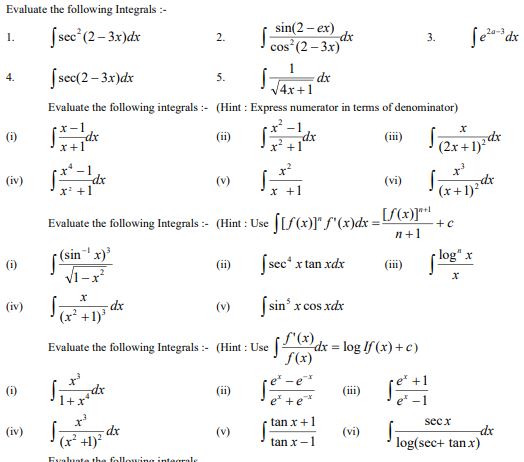
Please click the link below to download full pdf file for CBSE Class 12 Mathematics Worksheet - Integrals.
Free study material for Mathematics
CBSE Mathematics Class 12 Chapter 7 Integrals Worksheet
Students can use the practice questions and answers provided above for Chapter 7 Integrals to prepare for their upcoming school tests. This resource is designed by expert teachers as per the latest 2026 syllabus released by CBSE for Class 12. We suggest that Class 12 students solve these questions daily for a strong foundation in Mathematics.
Chapter 7 Integrals Solutions & NCERT Alignment
Our expert teachers have referred to the latest NCERT book for Class 12 Mathematics to create these exercises. After solving the questions you should compare your answers with our detailed solutions as they have been designed by expert teachers. You will understand the correct way to write answers for the CBSE exams. You can also see above MCQ questions for Mathematics to cover every important topic in the chapter.
Class 12 Exam Preparation Strategy
Regular practice of this Class 12 Mathematics study material helps you to be familiar with the most regularly asked exam topics. If you find any topic in Chapter 7 Integrals difficult then you can refer to our NCERT solutions for Class 12 Mathematics. All revision sheets and printable assignments on studiestoday.com are free and updated to help students get better scores in their school examinations.
FAQs
You can download the latest chapter-wise printable worksheets for Class 12 Mathematics Chapter 7 Integrals for free from StudiesToday.com. These have been made as per the latest CBSE curriculum for this academic year.
Yes, Class 12 Mathematics worksheets for Chapter 7 Integrals focus on activity-based learning and also competency-style questions. This helps students to apply theoretical knowledge to practical scenarios.
Yes, we have provided solved worksheets for Class 12 Mathematics Chapter 7 Integrals to help students verify their answers instantly.
Yes, our Class 12 Mathematics test sheets are mobile-friendly PDFs and can be printed by teachers for classroom.
For Chapter 7 Integrals, regular practice with our worksheets will improve question-handling speed and help students understand all technical terms and diagrams.