

Read and download the CBSE Class 12 Mathematics Linear Programming Worksheet Set 03 in PDF format. We have provided exhaustive and printable Class 12 Mathematics worksheets for Chapter 12 Linear Programming, designed by expert teachers. These resources align with the 2026-27 syllabus and examination patterns issued by NCERT, CBSE, and KVS, helping students master all important chapter topics.
Chapter-wise Worksheet for Class 12 Mathematics Chapter 12 Linear Programming
Students of Class 12 should use this Mathematics practice paper to check their understanding of Chapter 12 Linear Programming as it includes essential problems and detailed solutions. Regular self-testing with these will help you achieve higher marks in your school tests and final examinations.
Class 12 Mathematics Chapter 12 Linear Programming Worksheet with Answers
Solve the following LPP graphically :-
1. Maximize z = 5x + 3y
subject to :-
3x+5y < 15
5x + 27 < 10
x, y > 0
2. Minimize z = 20x + 10y, subject to x + 2y < 40, 3x + y > 30, 4x + 3y > 60 and x, y > 0.
3. Minimize and Maximize z = 5x + 2y subject to -2x – 3y5-6, x – 2y < 2, 3x + 2y < 12, -3x + 2y < 3, x, y > 0
4. Maximize and minimize z = 3x + 5y subject to 3x – 4y + 12 > 0, 2x – y + 2 > 0, 2x + ey + 2 > 0, 0 < x < 4, Y > 2
5. Maximize z = 4x + 3y subject to 3x + 4y < 24, 8x + 6y < 48, x < 5, y < 6, x, y > 0
6. Minimize z = x – 5y + 20 subject to x – y > 0, -x + 2y > 2, x > 3, y < 4, x, y > 0
7. Maximize z = 15x + 10y subject to 3x + 2y < 80, 2x + 3y < 70, x, y > 0
8. Minimize z = 2x + 4y subject to x + y > 8, x + 4y > 12, x > 3, y > 2
9. Maximize z = 1x + 10y subject to x + y < 30000, y < 12000, x > 6000, x > y, x, y >, 0
10. Minimize z = 18 x + 10y subject to 4x + y > 20, 2x + 3y 30, x y, > 0, y > 0
Probability
1. A family has two children. What is the prob. that both the children are boys given that at least one of them is a boy?
2. Ten cards numbered 1 through 10 are placed in a box, mixed up thoroughly and then one card is drawn randomly if it is known that the number in the drawn card is more than. 3. What is the prob. That it is an even number
3. Given that 2 nos. appearing on throwing two dice are different. Find the prob. Of the event the sum of nos. on the dice is 4.
4. A coin is tossed three times, of head occurs on first two tosses find the prob. Of getting on third tos..
5. A die is thrown 3 times, find the prob. that 4 appears on the third toss it is given that 6 & 5 appear resp. on first two tosses.
6. From a pack of 52 cards, 4 are drawn on by one without replacement, find the prob. That all are aces.
7. A bag contains 20 tickets numbered from 1 to 20. Two tickets are drawn without replacement. What is the prob. That first ticket has an even no. and the second an even no.
8. bag contains 5 white, 7 red & 3 black balls. If 3 balls are drawn one by one without replacement. Find prob. that none is red
9. An urn contains 10 black and 5 white balls. Two balls are drawn from the urn one after the other without replacement. What is the prob. That both drawn balls are black?
10. A die is thrown twice the sum of the nos. appearing is observed to be 8. What is conditional prob. That the no. 5 has appeared at least one.
11. A pair of dice is thrown. Find the prob. of getting the sum 8 or more if 4 appears on the first die.
12. A problem in mathematics is given to 3 students whose chances of solving it are ½, 1/3, ¼. What is the prob. That the problem is solved?
13. The odds against a solving certain problem are 4 to 3 and the odds in favour of B solving the some problem are 7 to 5. Find the prob. That the problem will be solved.
14. If A and B are two independent events P(A U B) = 0.60 and P(A) = 0.2 find P(B).
15. A man is known to speak truth 3 out of 4 times. He throws a die and reports that it is a six find prob. That it is actually a six.
16. Three urns contains 6 red, 4 black, 4 red, 6 black, and 6 red, 5 black, balls resp. one of the urns is selected at random and a ball is drawn from it. If the ball drawn lived, find the prob. That it is drawn from the first urn.
17. Three urns contain 6 red, 4 blac, 4 red, 6 black, 5 red, 5 black balls resp. one of the urns is selected at random and a ball is drawn from it. If the ball drawn is red, find the prob. That it is drawn from the first urn.
18. A card from a pack of 52 cards is cost. From the remaining cards of the pack, two cards are drawn and are found to be hearts. Find the prob. of the missing card to be heart.
19. Suppose that 5% of men and 0.25% of women have grey sari. A grey haired person is selected at random.
What is the prob. of this person being male / Assume that there are equal number of males and females.
Page 1
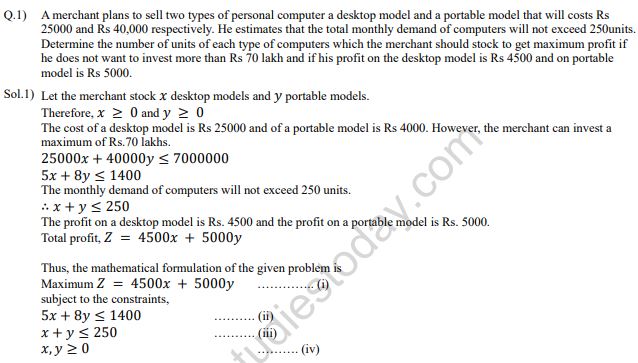
Question 1. A merchant plans to sell two types of personal computer a desktop model and a portable model that will costs Rs. 25000 and Rs. 40,000 respectively. He estimates that the total monthly demand of computers will not exceed 250units. Determine the number of units of each type of computers which the merchant should stock to get maximum profit if he does not want to invest more than Rs. 70 lakh and if his profit on the desktop model is Rs. 4500 and on portable model is Rs. 5000.
Answer: Let us assume the merchant decides to stock \( x \) units of desktop computers and \( y \) units of portable computers.
Since the quantity stocked cannot be negative, we have the non-negativity constraints:
\( x \ge 0 \) and \( y \ge 0 \)
The purchase cost of a desktop model is Rs. 25,000, and a portable model costs Rs. 40,000. Given that the merchant's total investment capacity is Rs. 70 lakhs (Rs. 7,000,000), the cost constraint is:
\( 25000x + 40000y \le 7000000 \)
Simplifying this inequality by dividing both sides by 5000 gives:
\( 5x + 8y \le 1400 \)
The total monthly demand for both computer types is expected not to exceed 250 units:
\( x + y \le 250 \)
The profit earned is Rs. 4,500 per desktop computer and Rs. 5,000 per portable computer. Thus, the total profit function \( Z \) is formulated as:
\( Z = 4500x + 5000y \)
To maximize profit, we set up the Linear Programming Problem (LPP) as follows:
Maximize \( Z = 4500x + 5000y \)
subject to the linear constraints:
\( 5x + 8y \le 1400 \)
\( x + y \le 250 \)
\( x, y \ge 0 \)
We plot these inequalities to identify the feasible region. The corner points of the bounded feasible region are \( O(0, 0) \), \( A(250, 0) \), \( B(200, 50) \), and \( C(0, 175) \):
Let us evaluate the objective function \( Z \) at each corner point:
| Corner Point | Objective Function Value \( Z = 4500x + 5000y \) |
|---|---|
| \( O(0, 0) \) | \( 4500(0) + 5000(0) = 0 \) |
| \( A(250, 0) \) | \( 4500(250) + 5000(0) = 1,125,000 \) |
| \( B(200, 50) \) | \( 4500(200) + 5000(50) = 1,150,000 \) (Maximum) |
| \( C(0, 175) \) | \( 4500(0) + 5000(175) = 875,000 \) |
Comparing these values, the objective function \( Z \) attains its maximum value of Rs. 1,150,000 at the point \( (200, 50) \).
Consequently, to secure the highest possible profit, the merchant needs to stock 200 desktop computers and 50 portable computers, resulting in a maximum profit of Rs. 1,150,000.
In simple words: To make the most money, the merchant needs to find a balance between the total computers they can buy with Rs. 70 lakhs and the maximum storage limit of 250. Buying 200 desktops and 50 portables achieves this.
Exam Tip: Be careful to express the total investment limit in consistent units. Transforming Rs. 70 lakhs into Rs. 7,000,000 before dividing is a common spot for calculation errors.
Page 2
Question 2. Reshma wishes to mix two types of food pond Q in such a way that the vitamin contents of the mixture contain at least 8 units of vitamin A and II units of vitamin B. Food P costs Rs. 60 / kg and food Q costs Rs. 80 / kg. Food P contains 3 units / kg of vitamin A and 5 units / kg of vitamin B while food Q contains 4 units / kg of vitamin A and 2 units / kg of vitamin B. Determine the minimum cost of the mixture.
Answer: Let us formulate the Linear Programming Problem (LPP) based on the given constraints.
Suppose the mixture is made up of \( x \) kg of food P and \( y \) kg of food Q.
Since quantities cannot be negative, we have:
\( x \ge 0 \) and \( y \ge 0 \)
Let us tabulate the nutritional values and costs for both foods:
| Nutrients | Food P (per kg) | Food Q (per kg) | Minimum Requirement |
|---|---|---|---|
| Vitamin A | 3 units | 4 units | At least 8 units |
| Vitamin B | 5 units | 2 units | At least 11 units |
| Cost (per kg) | Rs. 60 | Rs. 80 | - |
The requirement for Vitamin A leads to the following constraint:
\( 3x + 4y \ge 8 \)
Similarly, the requirement for Vitamin B provides the constraint:
\( 5x + 2y \ge 11 \)
The total cost of the mixture, which we aim to minimize, is represented by the objective function \( Z \):
\( Z = 60x + 80y \)
Thus, the complete mathematical LPP formulation is:
Minimize \( Z = 60x + 80y \)
subject to the linear constraints:
\( 3x + 4y \ge 8 \)
\( 5x + 2y \ge 11 \)
\( x, y \ge 0 \)
Next, we find the boundary lines by finding their axes intercepts:
For \( 3x + 4y = 8 \), the intercepts are \( \left(\frac{8}{3}, 0\right) \) and \( (0, 2) \).
For \( 5x + 2y = 11 \), the intercepts are \( \left(\frac{11}{5}, 0\right) \) and \( \left(0, \frac{11}{2}\right) \).
Let us list and evaluate the objective function \( Z \) at each corner point of the unbounded feasible region:
| Corner Point | Value of \( Z = 60x + 80y \) |
|---|---|
| \( \left(0, 5.5\right) \) | \( 60(0) + 80(5.5) = 440 \) |
| \( \left(2, 0.5\right) \) | \( 60(2) + 80(0.5) = 160 \) (Minimum) |
| \( \left(\frac{8}{3}, 0\right) \) | \( 60\left(\frac{8}{3}\right) + 80(0) = 160 \) (Minimum) |
Since the feasible region is unbounded towards the top-right, we must check if there is any other point yielding a lower cost by testing the inequality:
\( 60x + 80y < 160 \implies 3x + 4y < 8 \)
There is no common region between the half-plane \( 3x + 4y < 8 \) and our feasible region. Thus, the minimum value is indeed confirmed as 160.
Since the minimum value occurs at two different corner points, \( \left(\frac{8}{3}, 0\right) \) and \( \left(2, \frac{1}{2}\right) \), the minimum cost of Rs. 160 is achieved at all points on the line segment joining these two coordinates.
In simple words: To find the cheapest way to feed the fish, we calculate the combination of Food P and Food Q that meets the minimum vitamin limits. Any combination on the line segment between (8/3, 0) and (2, 0.5) gives the lowest cost of Rs. 160.
Exam Tip: For unbounded feasible regions, do not forget to test the open half-plane inequality \( ax + by < M \). Simply stating the minimum from the table is not sufficient without proving no other points exist.
Page 3
Question 3. A man owns a field of area 1000 sq. m. He wants to plant fruit trees in it. He has a sum of Rs 1400 to purchase young trees. He has the choice of two types of trees. Type A requires 10 sq. m of ground per tree and costs Rs 20 per tree and type B requires 20 sq m of ground per tree and costs Rs. 25 per tree. When fully grown, type A producer an average of 20 kg of fruit which can be sold at a profit of Rs. 2 per kg and type B producer an average of 40 kg of fruit which can be sold at a profit of Rs 1.50 per kg. How many of each type should be planned to achieve maximum profit? What is the maximum profit ?
Answer: Let us formulate the LPP for the tree planting plan.
Assume \( x \) represents the number of Type A trees planted and \( y \) represents the number of Type B trees planted.
Since we cannot plant a negative number of trees, we have:
\( x \ge 0 \) and \( y \ge 0 \)
Now, let us calculate the costs and revenues to find the objective profit function:
Total purchasing cost of the trees is:
\( \text{Cost} = 20x + 25y \)
Total revenue is determined by the total fruit yield and selling price:
\( \text{Revenue} = (20 \text{ kg} \times \text{Rs. } 2)x + (40 \text{ kg} \times \text{Rs. } 1.5)y = 40x + 60y \)
Therefore, the total net profit function \( Z \) is:
\( Z = \text{Revenue} - \text{Cost} = (40x + 60y) - (20x + 25y) = 20x + 35y \)
We aim to maximize this profit function subject to the physical and investment constraints:
The total cost cannot exceed the purchasing budget of Rs. 1400:
\( 20x + 25y \le 1400 \)
The total planting area cannot exceed the field size of 1000 sq. m:
\( 10x + 20y \le 1000 \)
The resulting LPP is:
Maximize \( Z = 20x + 35y \)
subject to:
\( 20x + 25y \le 1400 \)
\( 10x + 20y \le 1000 \)
\( x, y \ge 0 \)
Solving these inequalities graphically yields a feasible region with corner points at \( (0, 0) \), \( (70, 0) \), \( (20, 40) \), and \( (0, 50) \). Let us evaluate the profit \( Z \) at these coordinates:
| Corner Point | Profit \( Z = 20x + 35y \) |
|---|---|
| \( (0, 0) \) | \( 20(0) + 35(0) = 0 \) |
| \( (70, 0) \) | \( 20(70) + 35(0) = 1400 \) |
| \( (20, 40) \) | \( 20(20) + 35(40) = 1800 \) (Maximum) |
| \( (0, 50) \) | \( 20(0) + 35(50) = 1750 \) |
The maximum profit of Rs. 1800 is achieved when the land owner plants 20 Type A trees and 40 Type B trees.
In simple words: The land owner wants to get the highest total profit from fruit while staying within a Rs. 1400 budget and 1000 square meters of space. Planting 20 Type A trees and 40 Type B trees gives the best result.
Exam Tip: Always make sure your objective function accurately subtracts any initial tree costs from the total fruit revenue to find the true net profit.
Page 4
Question 4. A manufacturing company makes two types of teaching aids A and B of mathematics for class XII. Each type of A require 9 labour hours of fabricating & 1 labour hour for finishing. Each type B requires 12 labour hours for fabricating & 3 labour hrs of finishing. For fabrication & finishing, the maximum labour hours per week are 180 & 30 respectively. The makes a profit of Rs. 80 on each piece of type A & Rs.120 on each piece of type B. How many pieces of type A & type B should be manufactured per week to get a maximum profit? Make it as an LPP & solve graphically. What is the maximum profit per week?
Answer: Let us formulate the Linear Programming Problem to find the ideal manufacturing schedule.
Let \( x \) and \( y \) represent the number of pieces of Type A and Type B teaching aids produced per week, respectively.
Since manufacturing quantities cannot be negative, we have:
\( x \ge 0 \) and \( y \ge 0 \)
The total profit \( Z \) to be maximized is:
\( Z = 80x + 120y \)
The fabrication process is limited to a maximum of 180 hours per week:
\( 9x + 12y \le 180 \implies 3x + 4y \le 60 \)
The finishing process has a maximum capacity of 30 hours per week:
\( x + 3y \le 30 \)
The mathematical LPP formulation is:
Maximize \( Z = 80x + 120y \)
subject to the constraints:
\( 3x + 4y \le 60 \)
\( x + 3y \le 30 \)
\( x, y \ge 0 \)
The corner points of the bounded feasible region OABC are \( O(0, 0) \), \( A(20, 0) \), \( B(12, 6) \), and \( C(0, 10) \):
Let us evaluate the objective function \( Z \) at each corner point:
| Corner Point | Profit \( Z = 80x + 120y \) |
|---|---|
| \( O(0, 0) \) | \( 80(0) + 120(0) = 0 \) |
| \( A(20, 0) \) | \( 80(20) + 120(0) = 1600 \) |
| \( B(12, 6) \) | \( 80(12) + 120(6) = 1680 \) (Maximum) |
| \( C(0, 10) \) | \( 80(0) + 120(10) = 1200 \) |
The maximum weekly profit of Rs. 1680 is obtained when the company manufactures 12 pieces of Type A and 6 pieces of Type B teaching aids.
In simple words: The company wants to make the most profit by balancing labor limits of 180 hours for making the aids and 30 hours for finishing them. Making 12 Type A and 6 Type B items yields the highest profit.
Exam Tip: Be sure to write the simplified version of the inequalities (e.g. dividing \( 9x + 12y \le 180 \) by 3 to get \( 3x + 4y \le 60 \)) to make plotting the lines on graph paper straightforward.
Page 5
Question 5. A diet for a sick person must contain at least 4000 units of vitamins 50 units of mineral and 1400 of calories. Two foods B and A are available at cost of Rs 3 and Rs 4 per unit respectively. If one unit of A contains 200 units of vitamin, 1 unit of mineral and 40 calories one unit of B contains 2 units of minerals 100 units of vitamins and 40 calories. Find what combination of food should be used to have the least cost ?
Answer: Let us formulate the Linear Programming Problem to determine the optimal diet plan.
Let \( x \) and \( y \) represent the number of units of Food A and Food B used in the diet, respectively.
Since we cannot have a negative quantity of food units, we set the non-negativity constraints:
\( x \ge 0 \) and \( y \ge 0 \)
The total cost \( Z \) of the diet is to be minimized:
\( Z = 4x + 3y \)
The minimum requirement for vitamins is 4000 units:
\( 200x + 100y \ge 4000 \implies 2x + y \ge 40 \)
The minimum requirement for minerals is 50 units:
\( x + 2y \ge 50 \)
The minimum requirement for calories is 1400 units:
\( 40x + 40y \ge 1400 \implies x + y \ge 35 \)
The complete LPP formulation is:
Minimize \( Z = 4x + 3y \)
subject to:
\( 2x + y \ge 40 \)
\( x + 2y \ge 50 \)
\( x + y \ge 35 \)
\( x, y \ge 0 \)
Graphing these inequalities gives an unbounded feasible region. The corner points of the region are \( A(0, 40) \), \( P_1(5, 30) \), \( P_2(20, 15) \), and \( B(50, 0) \):
Let us evaluate the cost function \( Z \) at each of these corner points:
| Corner Point | Cost \( Z = 4x + 3y \) |
|---|---|
| \( A(0, 40) \) | \( 4(0) + 3(40) = 120 \) |
| \( P_1(5, 30) \) | \( 4(5) + 3(30) = 110 \) (Minimum) |
| \( P_2(20, 15) \) | \( 4(20) + 3(15) = 125 \) |
| \( B(50, 0) \) | \( 4(50) + 3(0) = 200 \) |
Since the feasible region is unbounded, we must test whether the open half-plane \( 4x + 3y < 110 \) shares any common points with our feasible region. Plotting this inequality shows no intersection with the feasible region.
Thus, the minimum cost of the diet is Rs. 110, achieved when 5 units of Food A and 30 units of Food B are included in the mixture.
In simple words: We find the cheapest combination of Food A and Food B that provides the patient with enough vitamins, minerals, and calories. The cheapest option is using 5 units of Food A and 30 units of Food B.
Exam Tip: Pay special attention to whether the feasible region is bounded or unbounded. Testing the open half-plane for optimal values in unbounded regions is a mandatory step that examiners look for to award full marks.
Page 6
Question 6. A company manufactures two types of novelty souvenirs made of plywood. Souvenirs of type A require 5 minutes each for cutting and 10 minutes each for assembling. Souvenirs of type B require 8 minutes each for cutting and 8 minutes each for assembling. There are 3 hours 20 minutes available for cutting and 4 hours of assembling. The profit is Rs 5 each for type A and Rs 6 each for type B souvenirs. How many souvenirs of each type should the company manufacture in order to maximize the profit?
Answer: Let us formulate the Linear Programming Problem to maximize the manufacturing profit.
Let \( x \) and \( y \) represent the number of Type A and Type B souvenirs produced by the company daily, respectively.
Since production quantities cannot be negative, we have:
\( x \ge 0 \) and \( y \ge 0 \)
Let us summarize the requirements and daily time limits in a table:
| Activity | Type A (minutes) | Type B (minutes) | Total Time Available |
|---|---|---|---|
| Cutting | 5 | 8 | 3 hrs 20 mins = 200 mins |
| Assembling | 10 | 8 | 4 hrs = 240 mins |
| Profit (per unit) | Rs. 5 | Rs. 6 | - |
The cutting constraint is:
\( 5x + 8y \le 200 \)
The assembling constraint is:
\( 10x + 8y \le 240 \implies 5x + 4y \le 120 \)
Our goal is to maximize the objective profit function \( Z \):
\( Z = 5x + 6y \)
Thus, the LPP is formulated as:
Maximize \( Z = 5x + 6y \)
subject to the constraints:
\( 5x + 8y \le 200 \)
\( 5x + 4y \le 120 \)
\( x, y \ge 0 \)
The feasible region is bounded by the corner points \( A(24, 0) \), \( B(8, 20) \), and \( C(0, 25) \) along with the origin \( O(0, 0) \):
Let us calculate the profit \( Z \) at each corner point:
| Corner Point | Profit \( Z = 5x + 6y \) |
|---|---|
| \( O(0, 0) \) | \( 5(0) + 6(0) = 0 \) |
| \( A(24, 0) \) | \( 5(24) + 6(0) = 120 \) |
| \( B(8, 20) \) | \( 5(8) + 6(20) = 160 \) (Maximum) |
| \( C(0, 25) \) | \( 5(0) + 6(25) = 150 \) |
The maximum profit of Rs. 160 is achieved when the company manufactures 8 souvenirs of Type A and 20 souvenirs of Type B.
In simple words: The manufacturer must plan how many souvenirs to make within the daily time limits of 200 minutes for cutting and 240 minutes for assembly. Producing 8 of Type A and 20 of Type B brings the most profit.
Exam Tip: Be sure to convert time limitations given in mixed hours and minutes (like 3 hours 20 minutes) into consistent units (minutes) to construct correct constraints.
Free study material for Mathematics
CBSE Mathematics Class 12 Chapter 12 Linear Programming Worksheet
Students can use the practice questions and answers provided above for Chapter 12 Linear Programming to prepare for their upcoming school tests. This resource is designed by expert teachers as per the latest 2026 syllabus released by CBSE for Class 12. We suggest that Class 12 students solve these questions daily for a strong foundation in Mathematics.
Chapter 12 Linear Programming Solutions & NCERT Alignment
Our expert teachers have referred to the latest NCERT book for Class 12 Mathematics to create these exercises. After solving the questions you should compare your answers with our detailed solutions as they have been designed by expert teachers. You will understand the correct way to write answers for the CBSE exams. You can also see above MCQ questions for Mathematics to cover every important topic in the chapter.
Class 12 Exam Preparation Strategy
Regular practice of this Class 12 Mathematics study material helps you to be familiar with the most regularly asked exam topics. If you find any topic in Chapter 12 Linear Programming difficult then you can refer to our NCERT solutions for Class 12 Mathematics. All revision sheets and printable assignments on studiestoday.com are free and updated to help students get better scores in their school examinations.
FAQs
You can download the latest chapter-wise printable worksheets for Class 12 Mathematics Chapter 12 Linear Programming for free from StudiesToday.com. These have been made as per the latest CBSE curriculum for this academic year.
Yes, Class 12 Mathematics worksheets for Chapter 12 Linear Programming focus on activity-based learning and also competency-style questions. This helps students to apply theoretical knowledge to practical scenarios.
Yes, we have provided solved worksheets for Class 12 Mathematics Chapter 12 Linear Programming to help students verify their answers instantly.
Yes, our Class 12 Mathematics test sheets are mobile-friendly PDFs and can be printed by teachers for classroom.
For Chapter 12 Linear Programming, regular practice with our worksheets will improve question-handling speed and help students understand all technical terms and diagrams.