

Read and download the CBSE Class 12 Mathematics Matrices Worksheet in PDF format. We have provided exhaustive and printable Class 12 Mathematics worksheets for Chapter 3 Matrices, designed by expert teachers. These resources align with the 2026-27 syllabus and examination patterns issued by NCERT, CBSE, and KVS, helping students master all important chapter topics.
Chapter-wise Worksheet for Class 12 Mathematics Chapter 3 Matrices
Students of Class 12 should use this Mathematics practice paper to check their understanding of Chapter 3 Matrices as it includes essential problems and detailed solutions. Regular self-testing with these will help you achieve higher marks in your school tests and final examinations.
Class 12 Mathematics Chapter 3 Matrices Worksheet with Answers
CBSE Class 12 Mathematics Worksheet - Matrices. CBSE issues sample papers every year for students for class 12 board exams. Students should solve the CBSE issued sample papers to understand the pattern of the question paper which will come in class 12 board exams this year. The sample papers have been provided with marking scheme. It’s always recommended to practice as many CBSE sample papers as possible before the board examinations. Sample papers should be always practiced in examination condition at home or school and the student should show the answers to teachers for checking or compare with the answers provided. Students can download the sample papers in pdf format free and score better marks in examinations. Refer to other links too for latest sample papers.
Question. The number of all possible matrices of order 3x3 with each entry 0 or 1 is:
(a) 27
(b) 18
(c) 81
(d) 512
Answer : D
Question. Matrix A and B will be inverse of each other only if
(a) AB = BA
(b) AB = BA = 0
(c) AB = 0, BA = I
(d) AB = BA = I
Answer : D
Question. If A and B are symmetric matrices of same order, then AB-BA is a
(a) Skew-symmetric matrix
(b) Symmetric matrix
(c) Zero matrix
(d) Identity
Answer : A
Question. If A is a square matrix such that A2 = A, then (I + A)2 – 3A is
(a) I
(b) 2A
(c) 3I
(d) A
Answer : A
Question. If a matrix has 6 elements, then number of possible orders of the matrix can be
(a) 2
(b) 4
(c) 3
(d) 6
Answer : B
Question. Total number of possible matrices of order 2 × 3 with each entry 1 or 0 is
(a) 6
(b) 36
(c) 32
(d) 64
Answer : D
Question. The diagonal elements of a skew symmetric matrix are
(a) all zeroes
(b) are all equal to some scalar k(≠ 0)
(c) can be any number
(d) none of these
Answer : A
Question. If matrix A is of order m × n, and for matrix B, AB and BA both are defined, then order of matrix B is
(a) m × n
(b) n × n
(c) m × m
(d) n × m
Answer : D
Question. If a matrix A is both symmetric and skew symmetric then matrix A is
(a) a scalar matrix
(b) a diagonal matrix
(c) a zero matrix of order n × n
(d) a rectangular matrix.
Answer : C
Question. A matrix has 18 elements, then possible number of orders of a matrix are
(a) 3
(b) 4
(c) 6
(d) 5
Answer : C
CASE STUDY QUESTIONS
1.A manufacture produces three stationery products Pencil, Eraser and Sharpener which he sells in two markets.
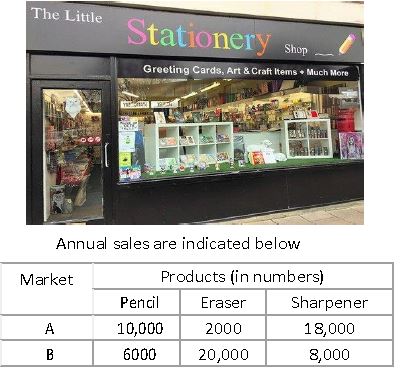
If the unit Sale price of Pencil, Eraser and Sharpener are ₹ 2.50, ₹ 1.50 and ₹ 1.00 respectively, and unit cost of the above three commodities are ₹ 2.00, ₹ 1.00 and ₹ 0.50 respectively, then, based on the above information answer the following:
Question. Total revenue of market A
(i) ₹ 64,000
(ii) ₹ 60,400
(iii) ₹ 46,000
(iv) ₹ 40,600
Answer : III
Question. Total revenue of market B
(i) ₹ 35,000
(ii) ₹ 53,000
(iii) ₹ 50,300
(iv) ₹ 30,500
Answer : II
Question. Cost incurred in market A
(i) ₹ 13,000
(ii) ₹ 30,100
(iii) ₹ 10,300
(iv) ₹ 31,000
Answer : IV
Question. Profit in market A and B respectively are
(i) (₹ 15,000, ₹ 17,000)
(ii) (₹ 17,000, ₹ 15,000)
(iii) (₹ 51,000, ₹ 71,000)
(iv) (₹ 10,000, ₹ 20,000)
Answer : I
Question. Gross profit in both market
(i) ₹ 23,000
(ii) ₹ 20,300
(iii) ₹ 32,000
(iv) ₹ 30,200
Answer : III
ASSERTION AND REASON
1.In the following questions, a statement of Assertion (A) is followed by a statement of Reason (R).
Mark the correct choice as.
(A) Both A and R are true and R is the correct explanation of A
(B) Both A and R are true but R is not the correct explanation of A
(C) A is true but R is false
(D) A is False and R is True.
Question. Let A and B be the two symmetric matrices of order 3
Assertion (A) : A(BA) and (AB)A are symmetric matrices
Reason (R) : AB is symmetric matrix if matrix multiplication of A with B is commutative .
Answer : B
Question. Assertion (A) : If A is a square matrix such that A2 = A , then ( I + A )2 – 3A = I
Reason (R) : AI = IA = A
Answer : A
Question. Assertion (A) : (A + B )2≠ A2 + 2AB + B2
Reason (R) : Generally AB ≠ BA
Answer : A
Question. Assertion (A) : If A and B are symmetric matrices , then AB – BA is a skew-symmetric matrix.
Reason (R) : (AB)’ = B’ A’
Answer : A
Question. Assertion (A) : If A is a symmetric matrix, then B’AB is also symmetric
Reason (R) : (ABC)’ = C’B’A’
Answer : A
Question. A and B are two matrices such that AB and BA are defined
Assertion (A) : (A + B ) ( A – B ) = A2 – B2
Reason (R) : ( A + B ) ( A – B ) = A2 – AB + BA – B2
Answer : D
Page 19
Topic 3
Matrices & Determinants
Schematic Diagram
| Topic | Concepts | Degree of Importance | References (NCERT Text Book XII Ed. 2007) |
|---|---|---|---|
| Matrices & Determinants | (i) Order, Addition, Multiplication and transpose of matrices | *** | Ex 3.1 - Q.No 4,6 Ex 3.2 - Q.No 7,9,13,17,18 Ex 3.3 - Q.No 10 |
| (ii) Cofactors & Adjoint of a matrix | ** | Ex 4.4 - Q.No 5 Ex 4.5 - Q.No 12,13,17,18 | |
| (iii) Inverse of a matrix & applications | *** | Ex 4.6 - Q.No 15,16 Example - 29,30,32,33 MiscEx 4 - Q.No 4,5,8,12,15 | |
| (iv) To find difference between \( |A| \), \( |\text{adj } A| \), \( |kA| \), \( |A \cdot \text{adj } A| \) | * | Ex 4.1 - Q.No 3,4,7,8 | |
| (v) Properties of Determinants | ** | Ex 4.2 - Q.No 11,12,13 Example - 16,18 |
Some Important Results/Concepts
A matrix is a rectangular array of \( m \times n \) numbers arranged in \( m \) rows and \( n \) columns.
\[ A = \begin{bmatrix} a_{11} & a_{12} & \cdots & a_{1n} \\ a_{21} & a_{22} & \cdots & a_{2n} \\ \vdots & \vdots & \ddots & \vdots \\ a_{m1} & a_{m2} & \cdots & a_{mn} \end{bmatrix} \text{ or } A = [a_{ij}]_{m \times n} \]
where \( i = 1, 2, \ldots, m \) and \( j = 1, 2, \ldots, n \).
- Row Matrix: A matrix which has only one row is called a row matrix. \( A = [a_{ij}]_{1 \times n} \)
- Column Matrix: A matrix which has only one column is called a column matrix. \( A = [a_{ij}]_{m \times 1} \)
- Square Matrix: A matrix in which the number of rows is equal to the number of columns is called a square matrix. \( A = [a_{ij}]_{m \times m} \)
- Diagonal Matrix: A square matrix is called a diagonal matrix if all its non-diagonal elements are zero, i.e., \( A = [a_{ij}]_{n \times n} \) where \( a_{ij} = 0 \) for \( i \neq j \), and \( a_{ij} \neq 0 \) for \( i = j \).
- Scalar Matrix: A square matrix is called a scalar matrix if all its non-diagonal elements are zero and its diagonal elements are equal to the same non-zero constant, i.e., \( A = [a_{ij}]_{n \times n} \) where \( a_{ij} = 0 \) for \( i \neq j \) and \( a_{ij} = \alpha \) for \( i = j \).
- Identity or Unit Matrix: A square matrix in which all the non-diagonal elements are zero and diagonal elements are equal to unity (1) is called an identity or unit matrix.
Page 20
- Null Matrices: A matrix in which all elements are zero is called a null or zero matrix.
- Equal Matrices: Two matrices are said to be equal if they have the same order and all their corresponding elements are equal.
- Transpose of a Matrix: If \( A \) is a given matrix, then the matrix obtained by interchanging its rows and columns is called the transpose of \( A \), denoted by \( A^T \).
Properties of Transpose:
If \( A \) and \( B \) are matrices such that their sum and product are defined, then:
- (i) \( (A^T)^T = A \)
- (ii) \( (A + B)^T = A^T + B^T \)
- (iii) \( (kA)^T = k A^T \), where \( k \) is a scalar
- (iv) \( (AB)^T = B^T A^T \)
- (v) \( (ABC)^T = C^T B^T A^T \)
- Symmetric Matrix: A square matrix is symmetric if \( A^T = A \), meaning \( a_{ij} = a_{ji} \) for all \( i, j \). The elements of a symmetric matrix are symmetric about the main diagonal.
- Skew-Symmetric Matrix: A square matrix is skew-symmetric if \( A^T = -A \), meaning \( a_{ij} = -a_{ji} \) for all \( i, j \). All diagonal elements of a skew-symmetric matrix are zero.
- Singular Matrix: A square matrix \( A \) is singular if its determinant is zero, i.e., \( |A| = 0 \).
- Non-Singular Matrix: A square matrix \( A \) is non-singular if its determinant is non-zero, i.e., \( |A| \neq 0 \).
Product of Matrices:
- (i) If \( A \) and \( B \) are two matrices, then the product \( AB \) is defined if the number of columns of \( A \) equals the number of rows of \( B \). If \( A = [a_{ij}]_{m \times n} \) and \( B = [b_{jk}]_{n \times p} \), then their product \( AB = [c_{ik}]_{m \times p} \).
- (ii) Matrix multiplication is not commutative, i.e., \( AB \neq BA \).
- (iii) Matrix multiplication is associative, i.e., \( A(BC) = (AB)C \).
- (iv) Matrix multiplication is distributive over addition.
- Adjoint of a Matrix: If \( A = [a_{ij}] \) is an \( n \times n \) square matrix, then the transpose of the matrix of cofactors \( [A_{ij}] \) is called the adjoint of \( A \).
\( \text{adj } A = [A_{ij}]^T \)
\( A(\text{adj } A) = (\text{adj } A)A = |A|I \) - Inverse of a Matrix: The inverse of a square matrix \( A \) exists if and only if \( A \) is non-singular. The inverse is given by:
\( A^{-1} = \frac{1}{|A|} \text{adj } A \)
System of Linear Equations:
\[ a_1 x + b_1 y + c_1 z = d_1 \]
\[ a_2 x + b_2 y + c_2 z = d_2 \]
\[ a_3 x + b_3 y + c_3 z = d_3 \]
Page 21
The system can be written in matrix form as:
\[ \begin{bmatrix} a_1 & b_1 & c_1 \\ a_2 & b_2 & c_2 \\ a_3 & b_3 & c_3 \end{bmatrix} \begin{bmatrix} x \\ y \\ z \end{bmatrix} = \begin{bmatrix} d_1 \\ d_2 \\ d_3 \end{bmatrix} \]
\[ \implies AX = B \]
\[ \implies X = A^{-1}B \text{, where } |A| \neq 0 \]
* Criteria of Consistency:
- (i) If \( |A| \neq 0 \), then the system of equations is consistent and has a unique solution.
- (ii) If \( |A| = 0 \) and \( (\text{adj } A)B = 0 \), then the system of equations is consistent and has infinitely many solutions.
- (iii) If \( |A| = 0 \) and \( (\text{adj } A)B \neq 0 \), then the system of equations is inconsistent and has no solution.
* Determinant:
To every square matrix, we can assign a unique real or complex number called its determinant.
- If \( A = [a_{11}] \), then \( |A| = a_{11} \).
- If \( A = \begin{bmatrix} a_{11} & a_{12} \\ a_{21} & a_{22} \end{bmatrix} \), then \( |A| = a_{11}a_{22} - a_{21}a_{12} \).
* Properties of Determinants:
- (i) The determinant of a square matrix remains unchanged when its rows and columns are interchanged.
- (ii) If any two rows (or two columns) of a determinant are interchanged, the sign of the determinant changes.
- (iii) If any two rows or columns of a determinant are identical, the value of the determinant is zero.
- (iv) If each element of a row or column of a determinant is multiplied by a constant \( k \), then its value is multiplied by \( k \).
- (v) If elements of any row or column are expressed as a sum of two terms, then the determinant can be written as the sum of two determinants.
- (vi) Any row or column can be added to or subtracted from a scalar multiple of another row or column without changing the determinant's value.
- (vii) If \( A \) and \( B \) are square matrices of the same order, then \( |AB| = |A||B| \).
Assignments
(i). Order, Addition, Multiplication and transpose of matrices:
Level I
Question 1. If a matrix has 5 elements, what are the possible orders it can have?
Answer: Let the order of the matrix be \( m \times n \), where \( m \) represents the number of rows and \( n \) represents the number of columns.
Since the number of elements is given by the product \( m \cdot n = 5 \), and both \( m \) and \( n \) must be positive integers, we find the factors of 5.
The only integer factor pairs of 5 are \( (1, 5) \) and \( (5, 1) \).
Therefore, the possible orders of the matrix are:
\( 1 \times 5 \) and \( 5 \times 1 \).
In simple words: A matrix with 5 elements can only be arranged as a single row with 5 columns, or a single column with 5 rows, because 5 is a prime number.
Exam Tip: For any prime number \( p \), the only possible matrix orders are always \( 1 \times p \) and \( p \times 1 \).
Question 2. Construct a 3 × 2 matrix whose elements are given by \( a_{ij} = \frac{1}{2} |i - 3j| \)
Answer: We construct a matrix \( A \) of order \( 3 \times 2 \) with elements \( a_{ij} \) where \( i \in \{1, 2, 3\} \) and \( j \in \{1, 2\} \):
\[ A = \begin{bmatrix} a_{11} & a_{12} \\ a_{21} & a_{22} \\ a_{31} & a_{32} \end{bmatrix} \]
We compute each element using the formula:
For \( i = 1 \):
\( a_{11} = \frac{1}{2} |1 - 3(1)| = \frac{1}{2} |-2| = 1 \)
\( a_{12} = \frac{1}{2} |1 - 3(2)| = \frac{1}{2} |-5| = \frac{5}{2} \)
For \( i = 2 \):
\( a_{21} = \frac{1}{2} |2 - 3(1)| = \frac{1}{2} |-1| = \frac{1}{2} \)
\( a_{22} = \frac{1}{2} |2 - 3(2)| = \frac{1}{2} |-4| = 2 \)
For \( i = 3 \):
\( a_{31} = \frac{1}{2} |3 - 3(1)| = \frac{1}{2} |0| = 0 \)
\( a_{32} = \frac{1}{2} |3 - 3(2)| = \frac{1}{2} |-3| = \frac{3}{2} \)
Assembling these computed values into matrix form:
\[ A = \begin{bmatrix} 1 & \frac{5}{2} \\ \frac{1}{2} & 2 \\ 0 & \frac{3}{2} \end{bmatrix} \].
In simple words: Create a table with 3 rows and 2 columns. Fill in each spot by plugging its row number (i) and column number (j) into the given formula and calculating.
Exam Tip: Be extra careful with the absolute value sign; it ensures that all elements in the final matrix are non-negative.
Question 3. If A = \( \begin{bmatrix} 1 & 2 & 3 \\ 3 & 1 & 3 \end{bmatrix} \), B = \( \begin{bmatrix} 2 & 3 & 1 \\ 0 & 2 & 1 \end{bmatrix} \), then find A - 2 B.
Answer: We first find the scaled matrix \( 2B \) by multiplying each element of \( B \) by 2:
\[ 2B = 2 \begin{bmatrix} 2 & 3 & 1 \\ 0 & 2 & 1 \end{bmatrix} = \begin{bmatrix} 4 & 6 & 2 \\ 0 & 4 & 2 \end{bmatrix} \]
Now, we compute \( A - 2B \) by subtracting corresponding elements:
\[ A - 2B = \begin{bmatrix} 1 & 2 & 3 \\ 3 & 1 & 3 \end{bmatrix} - \begin{bmatrix} 4 & 6 & 2 \\ 0 & 4 & 2 \end{bmatrix} \]
\[ \implies A - 2B = \begin{bmatrix} 1 - 4 & 2 - 6 & 3 - 2 \\ 3 - 0 & 1 - 4 & 3 - 2 \end{bmatrix} \]
\[ \implies A - 2B = \begin{bmatrix} -3 & -4 & 1 \\ 3 & -3 & 1 \end{bmatrix} \].
In simple words: Double every number in matrix B, then subtract those doubled values from the matching numbers in matrix A.
Exam Tip: Keep careful track of signs during subtraction, especially when working with negative entries like \( 1 - 4 = -3 \).
Question 4. If A = \( \begin{bmatrix} 2 & 1 & 4 \\ 4 & 1 & 5 \end{bmatrix} \) and B = \( \begin{bmatrix} 3 & -1 \\ 2 & 2 \\ 1 & 3 \end{bmatrix} \), write the order of AB and BA.
Answer: The dimensions of the given matrices are:
Order of \( A \) is \( 2 \times 3 \).
Order of \( B \) is \( 3 \times 2 \).
For the product \( AB \):
Matrix \( A \) has 3 columns and Matrix \( B \) has 3 rows. Since these are equal, the product \( AB \) is defined. The resulting dimensions are the rows of \( A \) and columns of \( B \):
Order of \( AB \) is \( 2 \times 2 \).
For the product \( BA \):
Matrix \( B \) has 2 columns and Matrix \( A \) has 2 rows. Since these are equal, the product \( BA \) is defined. The resulting dimensions are the rows of \( B \) and columns of \( A \):
Order of \( BA \) is \( 3 \times 3 \).
In simple words: Multiplying a 2-by-3 matrix by a 3-by-2 matrix yields a 2-by-2 matrix. Reversing the multiplication order (3-by-2 times 2-by-3) yields a 3-by-3 matrix.
Exam Tip: If \( A \) is of order \( m \times n \) and \( B \) is of order \( n \times p \), the product \( AB \) will always be of order \( m \times p \).
Level II
Question 1. For the following matrices A and B, verify \( (AB)^T = B^T A^T \), where A = \( \begin{bmatrix} 1 \\ -4 \\ 3 \end{bmatrix} \), B = \( \begin{bmatrix} -1 & 2 & 1 \end{bmatrix} \)
Answer: First, we calculate the product \( AB \):
\[ AB = \begin{bmatrix} 1 \\ -4 \\ 3 \end{bmatrix} \begin{bmatrix} -1 & 2 & 1 \end{bmatrix} = \begin{bmatrix} (1)(-1) & (1)(2) & (1)(1) \\ (-4)(-1) & (-4)(2) & (-4)(1) \\ (3)(-1) & (3)(2) & (3)(1) \end{bmatrix} = \begin{bmatrix} -1 & 2 & 1 \\ 4 & -8 & -4 \\ -3 & 6 & 3 \end{bmatrix} \]
Now, we find the transpose of \( AB \):
\[ (AB)^T = \begin{bmatrix} -1 & 4 & -3 \\ 2 & -8 & 6 \\ 1 & -4 & 3 \end{bmatrix} \]
Next, we compute the transpose of each individual matrix:
\[ B^T = \begin{bmatrix} -1 \\ 2 \\ 1 \end{bmatrix} \quad \text{and} \quad A^T = \begin{bmatrix} 1 & -4 & 3 \end{bmatrix} \]
Now, we compute the product \( B^T A^T \):
\[ B^T A^T = \begin{bmatrix} -1 \\ 2 \\ 1 \end{bmatrix} \begin{bmatrix} 1 & -4 & 3 \end{bmatrix} = \begin{bmatrix} (-1)(1) & (-1)(-4) & (-1)(3) \\ (2)(1) & (2)(-4) & (2)(3) \\ (1)(1) & (1)(-4) & (1)(3) \end{bmatrix} = \begin{bmatrix} -1 & 4 & -3 \\ 2 & -8 & 6 \\ 1 & -4 & 3 \end{bmatrix} \]
Comparing the two results:
\( (AB)^T = B^T A^T \).
Hence, verified.
In simple words: Multiply column A by row B to get a square table, then flip its rows and columns. This yields the exact same table as multiplying flipped column B by flipped row A.
Exam Tip: Remember the reversal law: when taking the transpose of a product, the order of the matrices must be reversed, i.e., \( (AB)^T = B^T A^T \).
Question 2. Give example of matrices A & B such that AB = O, but BA ≠ O, where O is a zero matrix and A, B are both non zero matrices.
Answer: Let us select two non-zero \( 2 \times 2 \) square matrices \( A \) and \( B \):
\[ A = \begin{bmatrix} 1 & 0 \\ 0 & 0 \end{bmatrix} \quad \text{and} \quad B = \begin{bmatrix} 0 & 0 \\ 1 & 0 \end{bmatrix} \]
First, we calculate the product \( AB \):
\[ AB = \begin{bmatrix} 1 & 0 \\ 0 & 0 \end{bmatrix} \begin{bmatrix} 0 & 0 \\ 1 & 0 \end{bmatrix} = \begin{bmatrix} 1\cdot0 + 0\cdot1 & 1\cdot0 + 0\cdot0 \\ 0\cdot0 + 0\cdot1 & 0\cdot0 + 0\cdot0 \end{bmatrix} = \begin{bmatrix} 0 & 0 \\ 0 & 0 \end{bmatrix} = O \]
Now, we calculate the product \( BA \):
\[ BA = \begin{bmatrix} 0 & 0 \\ 1 & 0 \end{bmatrix} \begin{bmatrix} 1 & 0 \\ 0 & 0 \end{bmatrix} = \begin{bmatrix} 0\cdot1 + 0\cdot0 & 0\cdot0 + 0\cdot0 \\ 1\cdot1 + 0\cdot0 & 1\cdot0 + 0\cdot0 \end{bmatrix} = \begin{bmatrix} 0 & 0 \\ 1 & 0 \end{bmatrix} \neq O \]
This choice of matrices successfully demonstrates that \( AB = O \) but \( BA \neq O \).
In simple words: Since matrix multiplication depends on order, you can find two non-zero matrices that multiply to zero in one direction, but yield a non-zero result when multiplied in the reverse direction.
Exam Tip: Using simple matrices with only a single non-zero entry is the easiest way to generate counterexamples for commutativity questions.
Page 22
Question 3. If B is skew symmetric matrix, write whether the matrix \( (ABA^T) \) is Symmetric or skew symmetric.
Answer: Since \( B \) is a skew-symmetric matrix, we have the property:
\( B^T = -B \).
To determine the nature of the matrix \( C = ABA^T \), we take its transpose:
\( C^T = (ABA^T)^T \)
Using the reversal law of transposes, \( (XYZ)^T = Z^T Y^T X^T \):
\( C^T = (A^T)^T B^T A^T \)
Since \( (A^T)^T = A \) and \( B^T = -B \), we substitute these into the equation:
\( C^T = A (-B) A^T \)
\( \implies C^T = -(ABA^T) \)
\( \implies C^T = -C \).
Since \( C^T = -C \), the matrix \( ABA^T \) is skew-symmetric.
In simple words: Taking the transpose of this matrix flips the inner skew-symmetric matrix B to negative B, which turns the entire matrix into its own negative. Thus, the result is skew-symmetric.
Exam Tip: For any symmetric matrix \( S \) and any matrix \( A \), the product \( ASA^T \) is always symmetric. Likewise, if \( S \) is skew-symmetric, \( ASA^T \) is skew-symmetric.
Question 4. If A = \( \begin{bmatrix} 3 & 1 \\ 7 & 5 \end{bmatrix} \) and I = \( \begin{bmatrix} 1 & 0 \\ 0 & 1 \end{bmatrix} \), find a and b so that \( A^2 + aI = bA \)
Answer: First, we calculate the matrix \( A^2 \):
\[ A^2 = \begin{bmatrix} 3 & 1 \\ 7 & 5 \end{bmatrix} \begin{bmatrix} 3 & 1 \\ 7 & 5 \end{bmatrix} = \begin{bmatrix} 3(3) + 1(7) & 3(1) + 1(5) \\ 7(3) + 5(7) & 7(1) + 5(5) \end{bmatrix} = \begin{bmatrix} 16 & 8 \\ 56 & 32 \end{bmatrix} \]
Now, we write out the equation \( A^2 + aI = bA \):
\[ \begin{bmatrix} 16 & 8 \\ 56 & 32 \end{bmatrix} + a \begin{bmatrix} 1 & 0 \\ 0 & 1 \end{bmatrix} = b \begin{bmatrix} 3 & 1 \\ 7 & 5 \end{bmatrix} \]
\[ \implies \begin{bmatrix} 16 + a & 8 \\ 56 & 32 + a \end{bmatrix} = \begin{bmatrix} 3b & b \\ 7b & 5b \end{bmatrix} \]
Comparing corresponding elements:
From position \( (1,2) \): \( b = 8 \).
From position \( (1,1) \): \( 16 + a = 3b \).
Substituting \( b = 8 \) into this relation:
\( 16 + a = 3(8) \implies 16 + a = 24 \implies a = 8 \).
We verify with the remaining elements:
At position \( (2,1) \): \( 7(8) = 56 \) (holds true).
At position \( (2,2) \): \( 32 + 8 = 5(8) \implies 40 = 40 \) (holds true).
Thus, the values are \( a = 8 \) and \( b = 8 \).
In simple words: Find A-squared, set up the matrix equation, and match matching positions to solve for the variables a and b.
Exam Tip: Always verify your calculated values of \( a \) and \( b \) against all four element positions to prevent arithmetic errors.
Level III
Question 1. If A = \( \begin{bmatrix} 2 & 0 & 1 \\ 2 & 1 & 3 \\ 1 & -1 & 0 \end{bmatrix} \), then find the value of \( A^2 - 3A + 2I \)
Answer: First, we calculate the matrix \( A^2 \):
\[ A^2 = \begin{bmatrix} 2 & 0 & 1 \\ 2 & 1 & 3 \\ 1 & -1 & 0 \end{bmatrix} \begin{bmatrix} 2 & 0 & 1 \\ 2 & 1 & 3 \\ 1 & -1 & 0 \end{bmatrix} \]
\[ \implies A^2 = \begin{bmatrix} 2(2)+0(2)+1(1) & 2(0)+0(1)+1(-1) & 2(1)+0(3)+1(0) \\ 2(2)+1(2)+3(1) & 2(0)+1(1)+3(-1) & 2(1)+1(3)+3(0) \\ 1(2)+(-1)(2)+0(1) & 1(0)+(-1)(1)+0(-1) & 1(1)+(-1)(3)+0(0) \end{bmatrix} = \begin{bmatrix} 5 & -1 & 2 \\ 9 & -2 & 5 \\ 0 & -1 & -2 \end{bmatrix} \]
Next, we calculate \( -3A \):
\[ -3A = \begin{bmatrix} -6 & 0 & -3 \\ -6 & -3 & -9 \\ -3 & 3 & 0 \end{bmatrix} \]
And \( 2I \):
\[ 2I = \begin{bmatrix} 2 & 0 & 0 \\ 0 & 2 & 0 \\ 0 & 0 & 2 \end{bmatrix} \]
Now, we sum these three matrices:
\[ A^2 - 3A + 2I = \begin{bmatrix} 5 & -1 & 2 \\ 9 & -2 & 5 \\ 0 & -1 & -2 \end{bmatrix} + \begin{bmatrix} -6 & 0 & -3 \\ -6 & -3 & -9 \\ -3 & 3 & 0 \end{bmatrix} + \begin{bmatrix} 2 & 0 & 0 \\ 0 & 2 & 0 \\ 0 & 0 & 2 \end{bmatrix} \]
\[ \implies A^2 - 3A + 2I = \begin{bmatrix} 5 - 6 + 2 & -1 + 0 + 0 & 2 - 3 + 0 \\ 9 - 6 + 0 & -2 - 3 + 2 & 5 - 9 + 0 \\ 0 - 3 + 0 & -1 + 3 + 0 & -2 + 0 + 2 \end{bmatrix} = \begin{bmatrix} 1 & -1 & -1 \\ 3 & -3 & -4 \\ -3 & 2 & 0 \end{bmatrix} \].
In simple words: Compute A times A to find A-squared, multiply every term in A by -3, set up a doubled identity matrix, and add all three matrices together element-by-element.
Exam Tip: Be methodical when performing row-by-column multiplication for \( 3 \times 3 \) matrices, as a single sign error will ruin the entire final matrix.
Question 2. Express the matrix A as the sum of a symmetric and a skew symmetric matrix, where: A = \( \begin{bmatrix} 3 & -2 & -4 \\ 3 & -2 & -5 \\ -1 & 1 & 2 \end{bmatrix} \)
Answer: Any square matrix \( A \) can be decomposed as:
\( A = P + Q \)
where \( P = \frac{1}{2}(A + A^T) \) is symmetric, and \( Q = \frac{1}{2}(A - A^T) \) is skew-symmetric.
First, we find \( A^T \):
\[ A^T = \begin{bmatrix} 3 & 3 & -1 \\ -2 & -2 & 1 \\ -4 & -5 & 2 \end{bmatrix} \]
Now, we calculate the symmetric component \( P \):
\[ A + A^T = \begin{bmatrix} 3+3 & -2+3 & -4-1 \\ 3-2 & -2-2 & -5+1 \\ -1-4 & 1-5 & 2+2 \end{bmatrix} = \begin{bmatrix} 6 & 1 & -5 \\ 1 & -4 & -4 \\ -5 & -4 & 4 \end{bmatrix} \]
\[ P = \frac{1}{2}(A + A^T) = \begin{bmatrix} 3 & \frac{1}{2} & -\frac{5}{2} \\ \frac{1}{2} & -2 & -2 \\ -\frac{5}{2} & -2 & 2 \end{bmatrix} \]
Next, we calculate the skew-symmetric component \( Q \):
\[ A - A^T = \begin{bmatrix} 3-3 & -2-3 & -4+1 \\ 3+2 & -2+2 & -5-1 \\ -1+4 & 1+5 & 2-2 \end{bmatrix} = \begin{bmatrix} 0 & -5 & -3 \\ 5 & 0 & -6 \\ 3 & 6 & 0 \end{bmatrix} \]
\[ Q = \frac{1}{2}(A - A^T) = \begin{bmatrix} 0 & -\frac{5}{2} & -\frac{3}{2} \\ \frac{5}{2} & 0 & -3 \\ \frac{3}{2} & 3 & 0 \end{bmatrix} \]
Adding \( P \) and \( Q \):
\[ A = \begin{bmatrix} 3 & \frac{1}{2} & -\frac{5}{2} \\ \frac{1}{2} & -2 & -2 \\ -\frac{5}{2} & -2 & 2 \end{bmatrix} + \begin{bmatrix} 0 & -\frac{5}{2} & -\frac{3}{2} \\ \frac{5}{2} & 0 & -3 \\ \frac{3}{2} & 3 & 0 \end{bmatrix} \]
This represents the matrix \( A \) expressed as the sum of a symmetric and a skew-symmetric matrix.
In simple words: Break matrix A into two parts. The first part is the average of A and its transpose (which is symmetric). The second part is half of A minus its transpose (which is skew-symmetric).
Exam Tip: Confirm that the diagonal elements of your skew-symmetric matrix \( Q \) are all zero, as this is a mandatory mathematical property of skew-symmetric matrices.
Question 3. If A = \( \begin{bmatrix} a & b \\ 0 & 1 \end{bmatrix} \), prove that \( A^n = \begin{bmatrix} a^n & \frac{b(a^n-1)}{a-1} \\ 0 & 1 \end{bmatrix} \) , n ∈ N
Answer: We prove this statement using Principle of Mathematical Induction (PMI):
Let the statement be \( P(n) \): \( A^n = \begin{bmatrix} a^n & \frac{b(a^n-1)}{a-1} \\ 0 & 1 \end{bmatrix} \).
Step 1: Base Case (\( n=1 \))
For \( n = 1 \):
\( \text{RHS} = \begin{bmatrix} a^1 & \frac{b(a^1-1)}{a-1} \\ 0 & 1 \end{bmatrix} = \begin{bmatrix} a & b \\ 0 & 1 \end{bmatrix} = A = \text{LHS} \).
Thus, \( P(1) \) is true.
Step 2: Inductive Hypothesis
Assume the statement is true for \( n = k \), i.e., \( P(k) \) is true:
\[ A^k = \begin{bmatrix} a^k & \frac{b(a^k-1)}{a-1} \\ 0 & 1 \end{bmatrix} \]
Step 3: Inductive Step
We must prove \( P(k+1) \) is true:
\( A^{k+1} = A^k \cdot A \)
\( \implies A^{k+1} = \begin{bmatrix} a^k & \frac{b(a^k-1)}{a-1} \\ 0 & 1 \end{bmatrix} \begin{bmatrix} a & b \\ 0 & 1 \end{bmatrix} \)
\( \implies A^{k+1} = \begin{bmatrix} a^k(a) + 0 & a^k(b) + \frac{b(a^k-1)}{a-1}(1) \\ 0 & 0(b) + 1(1) \end{bmatrix} \)
\( \implies A^{k+1} = \begin{bmatrix} a^{k+1} & b \cdot a^k + \frac{b(a^k-1)}{a-1} \\ 0 & 1 \end{bmatrix} \)
Let's simplify the top-right entry:
\( b \cdot a^k + \frac{b(a^k-1)}{a-1} = b \left[ a^k + \frac{a^k-1}{a-1} \right] = b \left[ \frac{a^k(a-1) + a^k - 1}{a-1} \right] = b \left[ \frac{a^{k+1} - a^k + a^k - 1}{a-1} \right] = \frac{b(a^{k+1}-1)}{a-1} \).
Thus:
\[ A^{k+1} = \begin{bmatrix} a^{k+1} & \frac{b(a^{k+1}-1)}{a-1} \\ 0 & 1 \end{bmatrix} \]
Since \( P(k+1) \) is true, by PMI the formula holds for all \( n \in \mathbb{N} \).
In simple words: Show the formula works for n=1. Then, assume it works for some step k and multiply it by A once more to show it must also work for step k+1.
Exam Tip: Be sure to write down all three formal induction steps explicitly to get full marks on proof questions.
(ii) Cofactors & Adjoint of a matrix
Level I
Question 1. Find the co-factor of \( a_{12} \) in A = \( \begin{bmatrix} 2 & -3 & 5 \\ 6 & 0 & 4 \\ 1 & 5 & -7 \end{bmatrix} \)
Answer: The cofactor \( A_{ij} \) of an element \( a_{ij} \) is given by:
\( A_{ij} = (-1)^{i+j} M_{ij} \)
where \( M_{ij} \) is the minor obtained by deleting the \( i \)-th row and \( j \)-th column.
For \( a_{12} \) (first row, second column), we delete row 1 and column 2 to get the minor \( M_{12} \):
\[ M_{12} = \begin{vmatrix} 6 & 4 \\ 1 & -7 \end{vmatrix} = 6(-7) - 4(1) = -42 - 4 = -46 \]
Now, we calculate the cofactor \( A_{12} \):
\( A_{12} = (-1)^{1+2} M_{12} = (-1)^3 (-46) = -1(-46) = 46 \).
Thus, the cofactor of \( a_{12} \) is 46.
In simple words: Delete the row and column containing the chosen number. Calculate the remaining 2-by-2 determinant and change its sign because of the negative position multiplier.
Exam Tip: The sign of the cofactor alternates following the grid pattern \( \begin{bmatrix} + & - & + \\ - & + & - \\ + & - & + \end{bmatrix} \). Position (1,2) is negative.
Question 2. Find the adjoint of the matrix A = \( \begin{bmatrix} 2 & -1 \\ 4 & 3 \end{bmatrix} \)
Answer: Let \( A = \begin{bmatrix} a_{11} & a_{12} \\ a_{21} & a_{22} \end{bmatrix} = \begin{bmatrix} 2 & -1 \\ 4 & 3 \end{bmatrix} \).
We find the cofactors of each element:
\( A_{11} = (-1)^{1+1} (3) = 3 \)
\( A_{12} = (-1)^{1+2} (4) = -4 \)
\( A_{21} = (-1)^{2+1} (-1) = 1 \)
\( A_{22} = (-1)^{2+2} (2) = 2 \)
The cofactor matrix is:
\[ C = \begin{bmatrix} 3 & -4 \\ 1 & 2 \end{bmatrix} \]
The adjoint is the transpose of the cofactor matrix:
\[ \text{adj } A = C^T = \begin{bmatrix} 3 & 1 \\ -4 & 2 \end{bmatrix} \].
In simple words: For a 2-by-2 matrix, swap the diagonal entries and change the signs of the off-diagonal entries to find the adjoint matrix.
Exam Tip: Use the shortcut for a \( 2 \times 2 \) matrix: swap \( a_{11} \) and \( a_{22} \), and negate \( a_{12} \) and \( a_{21} \) to quickly verify your adjoint.
Level II
Verify \( A(\text{adj } A) = (\text{adj } A)A = |A|I \) if:
Question 1. A = \( \begin{bmatrix} 2 & 3 \\ -4 & -6 \end{bmatrix} \)
Answer: First, we calculate the determinant of \( A \):
\( |A| = 2(-6) - (3)(-4) = -12 + 12 = 0 \).
Thus:
\[ |A|I = 0 \begin{bmatrix} 1 & 0 \\ 0 & 1 \end{bmatrix} = \begin{bmatrix} 0 & 0 \\ 0 & 0 \end{bmatrix} \]
Next, we calculate the adjoint of \( A \):
Using the 2-by-2 shortcut, we swap the diagonal elements and negate the off-diagonal elements:
\[ \text{adj } A = \begin{bmatrix} -6 & -3 \\ 4 & 2 \end{bmatrix} \]
Now, we evaluate the product \( A(\text{adj } A) \):
\[ A(\text{adj } A) = \begin{bmatrix} 2 & 3 \\ -4 & -6 \end{bmatrix} \begin{bmatrix} -6 & -3 \\ 4 & 2 \end{bmatrix} = \begin{bmatrix} 2(-6)+3(4) & 2(-3)+3(2) \\ -4(-6)+(-6)(4) & -4(-3)+(-6)(2) \end{bmatrix} = \begin{bmatrix} 0 & 0 \\ 0 & 0 \end{bmatrix} \]
Finally, we check the product \( (\text{adj } A)A \):
\[ (\text{adj } A)A = \begin{bmatrix} -6 & -3 \\ 4 & 2 \end{bmatrix} \begin{bmatrix} 2 & 3 \\ -4 & -6 \end{bmatrix} = \begin{bmatrix} -6(2)+(-3)(-4) & -6(3)+(-3)(-6) \\ 4(2)+2(-4) & 4(3)+2(-6) \end{bmatrix} = \begin{bmatrix} 0 & 0 \\ 0 & 0 \end{bmatrix} \]
Since both products equal the zero matrix, the identity is verified.
In simple words: Find the determinant and the adjoint matrix. Multiply them in both orders to show they both equal the determinant times the identity matrix.
Exam Tip: This relation holds true for all square matrices, even when the determinant is zero (singular matrices).
Question 2. A = \( \begin{bmatrix} 1 & 2 & 3 \\ 2 & 3 & 2 \\ 3 & 3 & 4 \end{bmatrix} \)
Answer: We first calculate the determinant \( |A| \) by expanding along the first row:
\( |A| = 1\begin{vmatrix} 3 & 2 \\ 3 & 4 \end{vmatrix} - 2\begin{vmatrix} 2 & 2 \\ 3 & 4 \end{vmatrix} + 3\begin{vmatrix} 2 & 3 \\ 3 & 3 \end{vmatrix} \)
\( \implies |A| = 1(12 - 6) - 2(8 - 6) + 3(6 - 9) = 6 - 4 - 9 = -7 \).
So:
\[ |A|I = -7 \begin{bmatrix} 1 & 0 & 0 \\ 0 & 1 & 0 \\ 0 & 0 & 1 \end{bmatrix} = \begin{bmatrix} -7 & 0 & 0 \\ 0 & -7 & 0 \\ 0 & 0 & -7 \end{bmatrix} \]
Now, we compute all nine cofactors \( A_{ij} \):
\( A_{11} = (12 - 6) = 6 \), \( A_{12} = -(8 - 6) = -2 \), Honor positive/negative grid: \( A_{13} = (6 - 9) = -3 \)
\( A_{21} = -(8 - 9) = 1 \), \( A_{22} = (4 - 9) = -5 \), \( A_{23} = -(3 - 6) = 3 \)
\( A_{31} = (4 - 9) = -5 \), \( A_{32} = -(2 - 6) = 4 \), \( A_{33} = (3 - 4) = -1 \)
This gives the cofactor matrix, and its transpose is the adjoint:
\[ \text{adj } A = \begin{bmatrix} 6 & 1 & -5 \\ -2 & -5 & 4 \\ -3 & 3 & -1 \end{bmatrix} \]
Let's compute \( A(\text{adj } A) \):
\[ A(\text{adj } A) = \begin{bmatrix} 1 & 2 & 3 \\ 2 & 3 & 2 \\ 3 & 3 & 4 \end{bmatrix} \begin{bmatrix} 6 & 1 & -5 \\ -2 & -5 & 4 \\ -3 & 3 & -1 \end{bmatrix} = \begin{bmatrix} -7 & 0 & 0 \\ 0 & -7 & 0 \\ 0 & 0 & -7 \end{bmatrix} \]
Similarly, computing \( (\text{adj } A)A \) gives the same diagonal matrix. The identity is verified.
In simple words: Find the cofactors of all elements to build the adjoint matrix. Multiply matrix A by its adjoint; the result is a diagonal matrix containing the determinant value of -7.
Exam Tip: Expanding the determinant and finding cofactors requires multiple steps; write out your work systematically to avoid easy sign slips.
(iii) Inverse of a Matrix & Applications
Level I
Question 1. If A = \( \begin{bmatrix} 2 & 3 \\ 5 & -2 \end{bmatrix} \), write \( A^{-1} \) in terms of A.
Answer: First, we calculate the determinant of \( A \):
\( |A| = 2(-2) - 3(5) = -4 - 15 = -19 \).
Next, we find the adjoint of \( A \):
\[ \text{adj } A = \begin{bmatrix} -2 & -3 \\ -5 & 2 \end{bmatrix} \]
Factor out -1 from the adjoint matrix:
\[ \text{adj } A = -\begin{bmatrix} 2 & 3 \\ 5 & -2 \end{bmatrix} = -A \]
Using the inverse formula:
\( A^{-1} = \frac{1}{|A|} \text{adj } A = \frac{1}{-19} (-A) = \frac{1}{19} A \).
Thus, the inverse in terms of \( A \) is \( \frac{1}{19} A \).
In simple words: Since the adjoint of this specific matrix is equal to its negative, the inverse simplifies directly to 1/19 times matrix A.
Exam Tip: Look for opportunities to relate the adjoint matrix directly to the original matrix \( A \) to simplify the final expression.
Question 2. If A is square matrix satisfying \( A^2 = I \), then what is the inverse of A?
Answer: We are given the matrix equation:
\( A^2 = I \).
This can be written as:
\( A \cdot A = I \).
By the definition of the inverse of a matrix, if there exists a matrix \( B \) such that \( A \cdot B = I \), then \( B = A^{-1} \).
Comparing this definition with \( A \cdot A = I \), we see that:
\( A^{-1} = A \).
Thus, the inverse of \( A \) is \( A \) itself.
In simple words: Since multiplying matrix A by itself yields the identity matrix, A acts as its own inverse.
Exam Tip: A matrix that is its own inverse is called an involutory matrix.
Question 3. For what value of k, the matrix A = \( \begin{bmatrix} 2-k & 3 \\ -5 & 1 \end{bmatrix} \) is not invertible?
Answer: A square matrix is not invertible if it is singular, which means its determinant is equal to zero:
\( |A| = 0 \).
We calculate the determinant of \( A \):
\( |A| = (2-k)(1) - 3(-5) = 2 - k + 15 = 17 - k \).
Setting the determinant equal to zero:
\( 17 - k = 0 \implies k = 17 \).
Thus, the matrix is not invertible for \( k = 17 \).
In simple words: A matrix cannot be inverted if its determinant is zero. Calculate the determinant, set it to zero, and solve for k.
Exam Tip: "Not invertible" and "singular" are equivalent terms in matrix algebra.
Level II
Question 1. If A = \( \begin{bmatrix} 3 & -5 \\ -4 & 2 \end{bmatrix} \), show that \( A^2 - 5A - 14I = 0 \). Hence find \( A^{-1} \)
Answer: First, we calculate the matrix \( A^2 \):
\[ A^2 = \begin{bmatrix} 3 & -5 \\ -4 & 2 \end{bmatrix} \begin{bmatrix} 3 & -5 \\ -4 & 2 \end{bmatrix} = \begin{bmatrix} 3(3)+(-5)(-4) & 3(-5)+(-5)(2) \\ -4(3)+2(-4) & -4(-5)+2(2) \end{bmatrix} = \begin{bmatrix} 29 & -25 \\ -20 & 24 \end{bmatrix} \]
Now, we compute the left-hand side of the given equation:
\[ A^2 - 5A - 14I = \begin{bmatrix} 29 & -25 \\ -20 & 24 \end{bmatrix} - 5 \begin{bmatrix} 3 & -5 \\ -4 & 2 \end{bmatrix} - 14 \begin{bmatrix} 1 & 0 \\ 0 & 1 \end{bmatrix} \]
\[ \implies A^2 - 5A - 14I = \begin{bmatrix} 29 - 15 - 14 & -25 + 25 - 0 \\ -20 + 20 - 0 & 24 - 10 - 14 \end{bmatrix} = \begin{bmatrix} 0 & 0 \\ 0 & 0 \end{bmatrix} = O \]
This proves the first part.
To find \( A^{-1} \) using this equation, we pre-multiply the equation by \( A^{-1} \):
\( A^{-1}(A^2 - 5A - 14I) = A^{-1}O \)
\( \implies A - 5I - 14A^{-1} = O \)
\( \implies 14A^{-1} = A - 5I \)
Now, calculate \( A - 5I \):
\[ A - 5I = \begin{bmatrix} 3 & -5 \\ -4 & 2 \end{bmatrix} - \begin{bmatrix} 5 & 0 \\ 0 & 5 \end{bmatrix} = \begin{bmatrix} -2 & -5 \\ -4 & -3 \end{bmatrix} \]
Thus:
\[ A^{-1} = \frac{1}{14} \begin{bmatrix} -2 & -5 \\ -4 & -3 \end{bmatrix} \].
In simple words: Verify the equation by calculation. Then, manipulate the equation algebraically to isolate the inverse of A without using cofactor expansion.
Exam Tip: Do not use cofactor/adjoint methods to find the inverse when the question says "Hence find \( A^{-1} \)"; you must use the algebraic equation to get full credit.
Question 2. If A, B, C are three non zero square matrices of same order, find the condition on A such that AB = AC \(\implies\) B = C.
Answer: We want to determine under what conditions the cancellation law holds for matrix multiplication.
Suppose \( AB = AC \).
If \( A \) is a non-singular matrix, then its inverse \( A^{-1} \) exists.
Pre-multiplying both sides of the equation by \( A^{-1} \):
\( A^{-1}(AB) = A^{-1}(AC) \)
\( \implies (A^{-1}A)B = (A^{-1}A)C \)
\( \implies IB = IC \)
\( \implies B = C \).
Thus, the necessary and sufficient condition on \( A \) is that \( A \) must be a non-singular matrix, meaning its determinant is non-zero (\( |A| \neq 0 \)).
In simple words: You can only cancel matrix A from both sides of the equation if A has an inverse, which requires its determinant to be non-zero.
Exam Tip: If \( A \) is singular, \( AB = AC \) does not imply \( B = C \). Always state that \( |A| \neq 0 \) is the required condition.
Page 23
Question 3. Find the number of all possible matrices A of order 3 × 3 with each entry 0 or 1 and for which A \( \begin{bmatrix} x \\ y \\ z \end{bmatrix} \) = \( \begin{bmatrix} 1 \\ 0 \\ 0 \end{bmatrix} \) has exactly two distinct solutions.
Answer: Let the system of linear equations be \( AX = B \).
According to matrix theory, any system of linear equations \( AX = B \) can have:
1) A unique solution (consistent, \( |A| \neq 0 \))
2) Infinitely many solutions (consistent, \( |A| = 0 \))
3) No solution (inconsistent, \( |A| = 0 \))
It is mathematically impossible for a system of linear equations to have exactly two distinct solutions.
Therefore, there are zero such matrices.
Number of possible matrices is 0.
In simple words: A system of linear equations can never have exactly two solutions—it either has zero, one, or infinitely many. Thus, no such matrix exists.
Exam Tip: This is a conceptual trap question. Remember that linear systems can never have a finite number of solutions greater than one.
Level III
Question 1. If A = \( \begin{bmatrix} 2 & 3 & 1 \\ -3 & 2 & 1 \\ 5 & -4 & -2 \end{bmatrix} \), find \( A^{-1} \) and hence solve the following system of equations: 2x - 3y + 5z = 11, 3x + 2y - 4z = - 5, x + y - 2z = - 3
Answer: We find the determinant of \( A \):
\( |A| = 2(-4 + 4) - 3(6 - 5) + 1(12 - 10) = 0 - 3 + 2 = -1 \).
Next, we calculate cofactors of \( A \):
\( A_{11} = 0 \), \( A_{12} = -1 \), \( A_{13} = 2 \)
\( A_{21} = 2 \), \( A_{22} = -9 \), \( A_{23} = 23 \)
\( A_{31} = 1 \), \( A_{32} = -5 \), \( A_{33} = 13 \)
The transpose of the cofactor matrix is the adjoint:
\[ \text{adj } A = \begin{bmatrix} 0 & 2 & 1 \\ -1 & -9 & -5 \\ 2 & 23 & 13 \end{bmatrix} \]
Since \( A^{-1} = \frac{1}{|A|} \text{adj } A \):
\[ A^{-1} = \begin{bmatrix} 0 & -2 & -1 \\ 1 & 9 & 5 \\ -2 & -23 & -13 \end{bmatrix} \]
Now, the given system is:
\[ \begin{bmatrix} 2 & -3 & 5 \\ 3 & 2 & -4 \\ 1 & 1 & -2 \end{bmatrix} \begin{bmatrix} x \\ y \\ z \end{bmatrix} = \begin{bmatrix} 11 \\ -5 \\ -3 \end{bmatrix} \]
The coefficient matrix of this system is \( A^T \). Since \( (A^T)^{-1} = (A^{-1})^T \):
\[ X = (A^{-1})^T B = \begin{bmatrix} 0 & 1 & -2 \\ -2 & 9 & -23 \\ -1 & 5 & -13 \end{bmatrix} \begin{bmatrix} 11 \\ -5 \\ -3 \end{bmatrix} = \begin{bmatrix} 0(11) + 1(-5) - 2(-3) \\ -2(11) + 9(-5) - 23(-3) \\ -1(11) + 5(-5) - 13(-3) \end{bmatrix} = \begin{bmatrix} 1 \\ 2 \\ 3 \end{bmatrix} \]
Thus, the solution is \( x = 1, y = 2, z = 3 \).
In simple words: Find the inverse of matrix A. Notice that the system of equations uses the transpose of A as its coefficients, so multiply the transpose of the inverse matrix by the constant column to solve.
Exam Tip: Always double check whether the system uses matrix \( A \) or its transpose \( A^T \) for its coefficients before multiplying.
Question 2. Using matrices, solve the following system of equations:
a. x + 2y - 3z = - 4, 2x + 3y + 2z = 2, 3x - 3y - 4z = 11
b. 4x + 3y + 2z = 60, x + 2y + 3z = 45, 6x + 2y + 3z = 70
Answer: We solve both systems of equations:
Part a:
The system is \( AX = B \) where:
\[ A = \begin{bmatrix} 1 & 2 & -3 \\ 2 & 3 & 2 \\ 3 & -3 & -4 \end{bmatrix}, \quad X = \begin{bmatrix} x \\ y \\ z \end{bmatrix}, \quad B = \begin{bmatrix} -4 \\ 2 \\ 11 \end{bmatrix} \]
The determinant of \( A \) is:
\( |A| = 1(-12 + 6) - 2(-8 - 6) - 3(-6 - 9) = -6 + 28 + 45 = 67 \).
Cofactors of \( A \):
\( A_{11} = -6 \), \( A_{12} = 14 \), \( A_{13} = -15 \)
\( A_{21} = 17 \), \( A_{22} = 5 \), \( A_{23} = 9 \)
\( A_{31} = 13 \), \( A_{32} = -8 \), \( A_{33} = -1 \)
The inverse is:
\[ A^{-1} = \frac{1}{67} \begin{bmatrix} -6 & 17 & 13 \\ 14 & 5 & -8 \\ -15 & 9 & -1 \end{bmatrix} \]
Solving \( X = A^{-1}B \):
\[ X = \frac{1}{67} \begin{bmatrix} -6(-4) + 17(2) + 13(11) \\ 14(-4) + 5(2) - 8(11) \\ -15(-4) + 9(2) - 1(11) \end{bmatrix} = \frac{1}{67} \begin{bmatrix} 201 \\ -134 \\ 67 \end{bmatrix} = \begin{bmatrix} 3 \\ -2 \\ 1 \end{bmatrix} \]
So, \( x = 3, y = -2, z = 1 \).
Part b:
The system is \( AX = B \) where:
\[ A = \begin{bmatrix} 4 & 3 & 2 \\ 1 & 2 & 3 \\ 6 & 2 & 3 \end{bmatrix}, \quad B = \begin{bmatrix} 60 \\ 45 \\ 70 \end{bmatrix} \]
Determinant \( |A| = 4(6-6) - 3(3-18) + 2(2-12) = 0 + 45 - 20 = 25 \).
The cofactors of \( A \) yield the inverse:
\[ A^{-1} = \frac{1}{25} \begin{bmatrix} 0 & -5 & 5 \\ 15 & 0 & -10 \\ -10 & 10 & 5 \end{bmatrix} \]
Solving \( X = A^{-1}B \):
\[ X = \frac{1}{25} \begin{bmatrix} 0(60) - 5(45) + 5(70) \\ 15(60) + 0(45) - 10(70) \\ -10(60) + 10(45) + 5(70) \end{bmatrix} = \frac{1}{25} \begin{bmatrix} 125 \\ 200 \\ 200 \end{bmatrix} = \begin{bmatrix} 5 \\ 8 \\ 8 \end{bmatrix} \]
So, \( x = 5, y = 8, z = 8 \).
In simple words: Represent the system in matrix form, find the determinant and the inverse of the coefficient matrix, and multiply the inverse by the constant matrix to solve.
Exam Tip: Always substitute your calculated values back into at least one of the original equations to confirm they are correct.
Question 3. Find the product AB, where A = \( \begin{bmatrix} 1 & -1 & 0 \\ 2 & 3 & 4 \\ 0 & 1 & 2 \end{bmatrix} \), B = \( \begin{bmatrix} 2 & 2 & -4 \\ -4 & 2 & -4 \\ 2 & -1 & 5 \end{bmatrix} \) and use it to solve the equations x – y = 3, 2x + 3y + 4z = 17, y + 2z = 7
Answer: First, we compute the product \( AB \):
\[ AB = \begin{bmatrix} 1 & -1 & 0 \\ 2 & 3 & 4 \\ 0 & 1 & 2 \end{bmatrix} \begin{bmatrix} 2 & 2 & -4 \\ -4 & 2 & -4 \\ 2 & -1 & 5 \end{bmatrix} \]
\[ \implies AB = \begin{bmatrix} 1(2)+(-1)(-4)+0 & 1(2)+(-1)(2)+0 & 1(-4)+(-1)(-4)+0 \\ 2(2)+3(-4)+4(2) & 2(2)+3(2)+4(-1) & 2(-4)+3(-4)+4(5) \\ 0+1(-4)+2(2) & 0+1(2)+2(-1) & 0+1(-4)+2(5) \end{bmatrix} = \begin{bmatrix} 6 & 0 & 0 \\ 0 & 6 & 0 \\ 0 & 0 & 6 \end{bmatrix} = 6I \]
Since \( AB = 6I \), we have:
\( A^{-1} = \frac{1}{6} B \).
The system of equations can be written as \( AX = C \), where:
\[ A = \begin{bmatrix} 1 & -1 & 0 \\ 2 & 3 & 4 \\ 0 & 1 & 2 \end{bmatrix}, \quad X = \begin{bmatrix} x \\ y \\ z \end{bmatrix}, \quad C = \begin{bmatrix} 3 \\ 17 \\ 7 \end{bmatrix} \]
Since the coefficient matrix is exactly \( A \), the solution is given by \( X = A^{-1}C \):
\[ X = \frac{1}{6} B C = \frac{1}{6} \begin{bmatrix} 2 & 2 & -4 \\ -4 & 2 & -4 \\ 2 & -1 & 5 \end{bmatrix} \begin{bmatrix} 3 \\ 17 \\ 7 \end{bmatrix} \]
\[ \implies X = \frac{1}{6} \begin{bmatrix} 2(3) + 2(17) - 4(7) \\ -4(3) + 2(17) - 4(7) \\ 2(3) - 1(17) + 5(7) \end{bmatrix} = \frac{1}{6} \begin{bmatrix} 12 \\ -6 \\ 24 \end{bmatrix} = \begin{bmatrix} 2 \\ -1 \\ 4 \end{bmatrix} \]
Thus, \( x = 2, y = -1, z = 4 \).
In simple words: The product of matrices A and B is 6 times the identity matrix. This means we can find the inverse of A easily as B/6, and then use it to solve the equations.
Exam Tip: If \( AB = kI \), then \( A^{-1} = \frac{1}{k}B \). This identity bypasses the need to calculate cofactors manually.
Question 4. Using matrices, solve the following system of equations: \( \frac{1}{x} - \frac{1}{y} + \frac{1}{z} = 4 \), \( \frac{2}{x} + \frac{1}{y} - \frac{3}{z} = 0 \), \( \frac{1}{x} + \frac{1}{y} + \frac{1}{z} = 2 \)
Answer: Let \( u = \frac{1}{x} \), \( v = \frac{1}{y} \), and \( w = \frac{1}{z} \).
The system becomes linear in \( u, v, w \):
\[ u - v + w = 4 \]
\[ 2u + v - 3w = 0 \]
\[ u + v + w = 2 \]
This is \( AU = B \) where:
\[ A = \begin{bmatrix} 1 & -1 & 1 \\ 2 & 1 & -3 \\ 1 & 1 & 1 \end{bmatrix}, \quad U = \begin{bmatrix} u \\ v \\ w \end{bmatrix}, \quad B = \begin{bmatrix} 4 \\ 0 \\ 2 \end{bmatrix} \]
The determinant of \( A \) is:
\( |A| = 1(1+3) + 1(2+3) + 1(2-1) = 4 + 5 + 1 = 10 \).
Cofactors of \( A \):
\( A_{11} = 4 \), \( A_{12} = -5 \), \( A_{13} = 1 \)
\( A_{21} = 2 \), \( A_{22} = 0 \), \( A_{23} = -2 \)
\( A_{31} = 2 \), \( A_{32} = 5 \), \( A_{33} = 3 \)
The inverse matrix is:
\[ A^{-1} = \frac{1}{10} \begin{bmatrix} 4 & 2 & 2 \\ -5 & 0 & 5 \\ 1 & -2 & 3 \end{bmatrix} \]
Solving for \( U \):
\[ U = \frac{1}{10} \begin{bmatrix} 4 & 2 & 2 \\ -5 & 0 & 5 \\ 1 & -2 & 3 \end{bmatrix} \begin{bmatrix} 4 \\ 0 \\ 2 \end{bmatrix} = \frac{1}{10} \begin{bmatrix} 16 + 0 + 4 \\ -20 + 0 + 10 \\ 4 + 0 + 6 \end{bmatrix} = \frac{1}{10} \begin{bmatrix} 20 \\ -10 \\ 10 \end{bmatrix} = \begin{bmatrix} 2 \\ -1 \\ 1 \end{bmatrix} \]
So, \( u = 2 \implies x = \frac{1}{2} \),
\( v = -1 \implies y = -1 \),
\( w = 1 \implies z = 1 \).
In simple words: Substitute new variables for the reciprocal terms to make the equations linear, solve them using matrices, and then invert the values to find x, y, and z.
Exam Tip: Do not forget to take the reciprocal of your \( u, v, w \) values at the very end to find the final \( x, y, z \) values.
Question 5. Using elementary transformations, find the inverse of the matrix \( \begin{bmatrix} 1 & 2 & -2 \\ -1 & 3 & 0 \\ 0 & -2 & 1 \end{bmatrix} \)
Answer: We write \( A = I \cdot A \):
\[ \begin{bmatrix} 1 & 2 & -2 \\ -1 & 3 & 0 \\ 0 & -2 & 1 \end{bmatrix} = \begin{bmatrix} 1 & 0 & 0 \\ 0 & 1 & 0 \\ 0 & 0 & 1 \end{bmatrix} A \]
Applying row operations to transform the left matrix into \( I \):
Step 1: \( R_2 \to R_2 + R_1 \):
\[ \begin{bmatrix} 1 & 2 & -2 \\ 0 & 5 & -2 \\ 0 & -2 & 1 \end{bmatrix} = \begin{bmatrix} 1 & 0 & 0 \\ 1 & 1 & 0 \\ 0 & 0 & 1 \end{bmatrix} A \]
Step 2: \( R_2 \to R_2 + 2R_3 \):
\[ \begin{bmatrix} 1 & 2 & -2 \\ 0 & 1 & 0 \\ 0 & -2 & 1 \end{bmatrix} = \begin{bmatrix} 1 & 0 & 0 \\ 1 & 1 & 2 \\ 0 & 0 & 1 \end{bmatrix} A \]
Step 3: \( R_1 \to R_1 - 2R_2 \) and \( R_3 \to R_3 + 2R_2 \):
\[ \begin{bmatrix} 1 & 0 & -2 \\ 0 & 1 & 0 \\ 0 & 0 & 1 \end{bmatrix} = \begin{bmatrix} -1 & -2 & -4 \\ 1 & 1 & 2 \\ 2 & 2 & 5 \end{bmatrix} A \]
Step 4: \( R_1 \to R_1 + 2R_3 \):
\[ \begin{bmatrix} 1 & 0 & 0 \\ 0 & 1 & 0 \\ 0 & 0 & 1 \end{bmatrix} = \begin{bmatrix} 3 & 2 & 6 \\ 1 & 1 & 2 \\ 2 & 2 & 5 \end{bmatrix} A \]
Since \( I = A^{-1} A \), we have:
\[ A^{-1} = \begin{bmatrix} 3 & 2 & 6 \\ 1 & 1 & 2 \\ 2 & 2 & 5 \end{bmatrix} \].
In simple words: Perform systematic row operations to turn the left matrix into the identity matrix; performing the exact same operations on the right identity matrix yields the inverse.
Exam Tip: Always double check your inverse matrix by multiplying it with the original matrix to verify that the product is indeed the identity matrix.
(iv) To Find The Difference Between \( |A| \), \( |\text{adj } A| \), \( |kA| \)
Level I
Question 1. Evaluate \( \begin{vmatrix} \cos 15^{\circ} & \sin 15^{\circ} \\ \sin 75^{\circ} & \cos 75^{\circ} \end{vmatrix} \)
Answer: We calculate the determinant directly:
\( D = \cos 15^{\circ} \cos 75^{\circ} - \sin 15^{\circ} \sin 75^{\circ} \).
Using the trigonometric identity \( \cos(A+B) = \cos A \cos B - \sin A \sin B \):
\( D = \cos(15^{\circ} + 75^{\circ}) \)
\( \implies D = \cos(90^{\circ}) \).
Since \( \cos 90^{\circ} = 0 \), the value of the determinant is 0.
In simple words: Multiplying the terms out yields the formula for the cosine of the sum of two angles. Since the angles add up to 90 degrees, and the cosine of 90 degrees is 0, the determinant is 0.
Exam Tip: Recognizing trigonometric addition identities like \( \cos(A+B) \) saves valuable exam time on determinant questions.
Question 2. What is the value of \( |3I| \), where I is identity matrix of order 3?
Answer: For any square matrix \( A \) of order \( n \) and scalar \( k \), we have the determinant property:
\( |kA| = k^n |A| \).
Here, the order is \( n = 3 \), the scalar is \( k = 3 \), and the matrix is the identity matrix \( I \).
Since \( |I| = 1 \):
\( |3I| = 3^3 |I| = 27(1) = 27 \).
Thus, the value of the determinant is 27.
In simple words: Scaling a 3-by-3 identity matrix by 3 multiplies each of the three diagonal ones by 3, making the determinant \( 3 \times 3 \times 3 = 27 \).
Exam Tip: Do not confuse scaling a matrix with scaling a determinant; multiplying a matrix by \( k \) scales its determinant by \( k^n \).
Question 3. If A is non singular matrix of order 3 and \( |A| = 3 \), then find \( |2A| \)
Answer: We use the property \( |kA| = k^n |A| \), where \( n \) is the order of the matrix.
Here, \( k = 2 \), \( n = 3 \), and \( |A| = 3 \).
Substituting these values:
\( |2A| = 2^3 |A| = 8(3) = 24 \).
Thus, \( |2A| = 24 \).
In simple words: Since A is a 3-by-3 matrix, scaling it by 2 increases its determinant by a factor of 2 cubed (which is 8). Multiplying this factor by the original determinant of 3 yields 24.
Exam Tip: Always double check the given matrix order, as this exponent value determines the scaling multiplier.
Question 4. For what value of a, \( \begin{bmatrix} 2a & -1 \\ -8 & 3 \end{bmatrix} \) is a singular matrix?
Answer: A matrix is singular if its determinant is zero:
\( \begin{vmatrix} 2a & -1 \\ -8 & 3 \end{vmatrix} = 0 \)
\( \implies (2a)(3) - (-1)(-8) = 0 \)
\( \implies 6a - 8 = 0 \)
\( \implies 6a = 8 \implies a = \frac{4}{3} \).
Thus, the matrix is singular when \( a = \frac{4}{3} \).
In simple words: Calculate the 2-by-2 determinant, set it equal to 0, and solve for the variable a.
Exam Tip: Take extra care with double negatives when computing the subtraction term of the determinant: \( -(-1)(-8) = -8 \).
Level II
Question 1. If A is a square matrix of order 3 such that \( |\text{adj } A| = 64 \), find \( |A| \)
Answer: We use the determinant property of adjoints:
\( |\text{adj } A| = |A|^{n-1} \)
where \( n \) is the order of the matrix.
Given \( n = 3 \) and \( |\text{adj } A| = 64 \):
\( 64 = |A|^{3-1} \)
\( \implies |A|^2 = 64 \)
\( \implies |A| = \pm 8 \).
Thus, the possible values of \( |A| \) are \( \pm 8 \).
In simple words: The determinant of the adjoint of a 3-by-3 matrix is equal to the square of its determinant. Since the squared determinant is 64, the determinant itself must be positive or negative 8.
Exam Tip: Remember to write both the positive and negative signs when taking the square root, as determinants can be negative numbers.
Question 2. If A is a non singular matrix of order 3 and \( |A| = 7 \), then find \( |\text{adj } A| \)
Answer: We use the property:
\( |\text{adj } A| = |A|^{n-1} \)
where \( n \) is the order of the matrix.
Here, the order is \( n = 3 \) and the determinant is \( |A| = 7 \).
Substituting these values:
\( |\text{adj } A| = 7^{3-1} = 7^2 = 49 \).
Thus, the value of \( |\text{adj } A| \) is 49.
In simple words: For a 3-by-3 matrix, the determinant of its adjoint is simply the square of its original determinant. Seven squared is 49.
Exam Tip: This property is derived directly from the matrix relation \( A \cdot \text{adj } A = |A|I \).
Page 24
Level III
Question 1. If A = \( \begin{bmatrix} a & 2 \\ 2 & a \end{bmatrix} \) and \( |A|^3 = 125 \text{, then find } a. \)
Answer: Given that \( |A|^3 = 125 \). Taking the cube root of both sides:
\( |A| = 5 \).
We calculate the determinant of matrix \( A \):
\( |A| = a(a) - 2(2) = a^2 - 4 \).
Setting this equal to 5:
\( a^2 - 4 = 5 \)
\( \implies a^2 = 9 \)
\( \implies a = \pm 3 \).
Thus, the values of \( a \) are \( \pm 3 \).
In simple words: Solve for the determinant of matrix A first by taking the cube root of 125, which is 5. Then set the determinant formula equal to 5 to find that a is plus or minus 3.
Exam Tip: Be sure to include both the positive and negative solutions for \( a \), as both satisfy the squared equation.
Question 2. A square matrix A, of order 3, has \( |A| = 5 \), find \( |A \cdot \text{adj } A| \)
Answer: We use the standard matrix relation:
\( A \cdot \text{adj } A = |A| I \).
Taking the determinant of both sides:
\( |A \cdot \text{adj } A| = ||A| I| \).
Since \( |A| \) is a scalar constant and the identity matrix \( I \) is of order 3, we use the scaling property \( |kI| = k^3 |I| = k^3 \):
\( |A \cdot \text{adj } A| = |A|^3 \).
Given \( |A| = 5 \):
\( |A \cdot \text{adj } A| = 5^3 = 125 \).
Thus, the value of the determinant is 125.
In simple words: Since the product of a matrix and its adjoint equals the determinant times the identity matrix, taking the determinant of this product scales the value by the order of the matrix cubed, giving 5 cubed, which is 125.
Exam Tip: Alternatively, you can use the multiplicative property \( |A \cdot \text{adj } A| = |A| \cdot |\text{adj } A| = |A| \cdot |A|^{n-1} = |A|^n \) to get the same result.
(v). Properties of Determinants
Level I
Question 1. Find positive value of x if \( \begin{vmatrix} 16 & 3 \\ 5 & 2 \end{vmatrix} = \begin{vmatrix} 2x & 3 \\ 5 & x \end{vmatrix} \)
Answer: We evaluate the determinants of both sides of the equation:
LHS: \( 16(2) - 3(5) = 32 - 15 = 17 \).
RHS: \( 2x(x) - 3(5) = 2x^2 - 15 \).
Equating both sides:
\( 2x^2 - 15 = 17 \)
\( \implies 2x^2 = 32 \)
\( \implies x^2 = 16 \)
\( \implies x = \pm 4 \).
Since the question asks for the positive value of \( x \), we choose:
\( x = 4 \).
In simple words: Calculate both determinants, set them equal to each other, solve the quadratic equation, and pick the positive answer of 4.
Exam Tip: Unlike matrix equations where corresponding elements are equal, in determinant equations, you must compute the scalar values of the determinants first.
Question 2. Evaluate \( \begin{vmatrix} a + ib & c + id \\ -c + id & a - ib \end{vmatrix} \)
Answer: We compute the determinant directly:
\( D = (a+ib)(a-ib) - (c+id)(-c+id) \).
Using the difference of squares and complex number identities (\( i^2 = -1 \)):
\( (a+ib)(a-ib) = a^2 - (ib)^2 = a^2 + b^2 \).
And:
\( (c+id)(-c+id) = (id+c)(id-c) = (id)^2 - c^2 = -d^2 - c^2 = -(c^2 + d^2) \).
Substituting these back into the determinant equation:
\( D = (a^2 + b^2) - (-(c^2 + d^2)) \)
\( \implies D = a^2 + b^2 + c^2 + d^2 \).
Thus, the evaluated determinant is \( a^2 + b^2 + c^2 + d^2 \).
In simple words: Multiply the diagonal terms and subtract the product of the off-diagonal terms, using the complex number rule that i-squared equals -1 to simplify.
Exam Tip: Be careful with signs when multiplying complex conjugates; \( (x+iy)(x-iy) \) always simplifies to \( x^2+y^2 \).
Level II
Using properties of determinants, prove the following :
Question 1. \( \begin{vmatrix} b + c & a & a \\ b & c + a & b \\ c & c & a + b \end{vmatrix} = 4abc \)
Answer: Let \( \Delta \) be the given determinant:
\[ \Delta = \begin{vmatrix} b + c & a & a \\ b & c + a & b \\ c & c & a + b \end{vmatrix} \]
Applying row operation \( R_1 \to R_1 - R_2 - R_3 \):
\[ \Delta = \begin{vmatrix} (b+c) - b - c & a - (c+a) - c & a - b - (a+b) \\ b & c + a & b \\ c & c & a + b \end{vmatrix} = \begin{vmatrix} 0 & -2c & -2b \\ b & c + a & b \\ c & c & a + b \end{vmatrix} \]
Factoring out -2 from the first row:
\[ \Delta = -2 \begin{vmatrix} 0 & c & b \\ b & c + a & b \\ c & c & a + b \end{vmatrix} \]
Applying column operations \( C_2 \to C_2 - C_1 \) and \( C_3 \to C_3 - C_1 \):
\[ \Delta = -2 \begin{vmatrix} 0 & c & b \\ b & c + a - b & 0 \\ c & 0 & a + b - c \end{vmatrix} \]
Expanding along the first row:
\( \Delta = -2 \left[ -c(b(a+b-c) - 0) + b(0 - c(c+a-b)) \right] \)
\( \implies \Delta = -2 \left[ -bc(a+b-c) - bc(c+a-b) \right] \)
\( \implies \Delta = -2 [-bc(a+b-c+c+a-b)] = -2 [-bc(2a)] = 4abc \).
Hence, proved.
In simple words: Perform row subtraction to create zeroes, factor out the common multiplier, use column operations to simplify the matrix further, and expand to prove the result is 4abc.
Exam Tip: Row operation \( R_1 \to R_1 - R_2 - R_3 \) is a standard opening move to simplify symmetric cyclic determinants.
Question 2. \( \begin{vmatrix} 1 + a^2 - b^2 & 2ab & -2b \\ 2ab & 1 - a^2 + b^2 & 2a \\ 2b & -2a & 1 - a^2 - b^2 \end{vmatrix} = (1 + a^2 + b^2)^3 \)
Answer: Let \( \Delta \) be the given determinant.
Applying column operations \( C_1 \to C_1 - b C_3 \) and \( C_2 \to C_2 + a C_3 \):
\[ \Delta = \begin{vmatrix} 1+a^2-b^2 - b(-2b) & 2ab + a(-2b) & -2b \\ 2ab - b(2a) & 1-a^2+b^2 + a(2a) & 2a \\ 2b - b(1-a^2-b^2) & -2a + a(1-a^2-b^2) & 1-a^2-b^2 \end{vmatrix} \]
\[ \implies \Delta = \begin{vmatrix} 1+a^2+b^2 & 0 & -2b \\ 0 & 1+a^2+b^2 & 2a \\ b(1+a^2+b^2) & -a(1+a^2+b^2) & 1-a^2-b^2 \end{vmatrix} \]
Factoring out \( (1+a^2+b^2) \) from both \( C_1 \) and \( C_2 \):
\[ \Delta = (1+a^2+b^2)^2 \begin{vmatrix} 1 & 0 & -2b \\ 0 & 1 & 2a \\ b & -a & 1-a^2-b^2 \end{vmatrix} \]
Applying row operation \( R_3 \to R_3 - b R_1 + a R_2 \):
\[ \Delta = (1+a^2+b^2)^2 \begin{vmatrix} 1 & 0 & -2b \\ 0 & 1 & 2a \\ 0 & 0 & 1+a^2+b^2 \end{vmatrix} \]
Expanding along the third row (or first column):
\( \Delta = (1+a^2+b^2)^2 [1(1)(1+a^2+b^2)] = (1+a^2+b^2)^3 \).
Hence, proved.
In simple words: Use columns to create a common factor, pull it out of the determinant, and use row operations to make the remaining determinant easy to calculate.
Exam Tip: Look for opportunities to generate the target factor \( 1+a^2+b^2 \) through strategic column operations right from the start.
Question 3. \( \begin{vmatrix} x & x^2 & 1 + px^3 \\ y & y^2 & 1 + py^3 \\ z & z^2 & 1 + pz^3 \end{vmatrix} = (1 + pxyz)(x - y)(y - z)(z - x) \)
Answer: Using the sum property of determinants, we split the third column:
\[ \Delta = \begin{vmatrix} x & x^2 & 1 \\ y & y^2 & 1 \\ z & z^2 & 1 \end{vmatrix} + \begin{vmatrix} x & x^2 & px^3 \\ y & y^2 & py^3 \\ z & z^2 & pz^3 \end{vmatrix} \]
In the second determinant, factor out \( x \) from \( R_1 \), \( y \) from \( R_2 \), \( z \) from \( R_3 \), and \( p \) from \( C_3 \):
\[ \Delta = \begin{vmatrix} x & x^2 & 1 \\ y & y^2 & 1 \\ z & z^2 & 1 \end{vmatrix} + pxyz \begin{vmatrix} 1 & x & x^2 \\ 1 & y & y^2 \\ 1 & z & z^2 \end{vmatrix} \]
By interchanging columns in the first determinant twice (which preserves the sign):
\[ \begin{vmatrix} x & x^2 & 1 \end{vmatrix} \to \begin{vmatrix} 1 & x & x^2 \end{vmatrix} \]
Thus:
\[ \Delta = (1 + pxyz) \begin{vmatrix} 1 & x & x^2 \\ 1 & y & y^2 \\ 1 & z & z^2 \end{vmatrix} \]
Applying row operations \( R_2 \to R_2 - R_1 \) and \( R_3 \to R_3 - R_1 \):
\[ \Delta = (1 + pxyz) \begin{vmatrix} 1 & x & x^2 \\ 0 & y-x & y^2-x^2 \\ 0 & z-x & z^2-x^2 \end{vmatrix} \]
Factoring out \( (y-x) \) from \( R_2 \) and \( (z-x) \) from \( R_3 \):
\[ \Delta = (1 + pxyz)(y-x)(z-x) \begin{vmatrix} 1 & x & x^2 \\ 0 & 1 & y+x \\ 0 & 1 & z+x \end{vmatrix} \]
Expanding the 2-by-2 determinant:
\( 1(z+x) - 1(y+x) = z - y \).
Substituting this back:
\( \Delta = (1 + pxyz)(y-x)(z-x)(z-y) \)
\( \implies \Delta = (1 + pxyz)(x-y)(y-z)(z-x) \).
Hence, proved.
In simple words: Split the determinant into two parts, factor out common variables, combine them back, and use row subtraction to isolate the final cyclic factors.
Exam Tip: Splitting determinants along columns that contain sums is a powerful technique for solving complex identity proofs.
Question 4. \( \begin{vmatrix} 1 & 1 & 1 \\ a & b & c \\ a^3 & b^3 & c^3 \end{vmatrix} = (a - b)(b - c)(c - a)(a + b + c) \)
Answer: Let \( \Delta \) be the given determinant.
Applying column operations \( C_2 \to C_2 - C_1 \) and \( C_3 \to C_3 - C_1 \):
\[ \Delta = \begin{vmatrix} 1 & 0 & 0 \\ a & b-a & c-a \\ a^3 & b^3-a^3 & c^3-a^3 \end{vmatrix} \]
Factoring out \( (b-a) \) from \( C_2 \) and \( (c-a) \) from \( C_3 \):
\[ \Delta = (b-a)(c-a) \begin{vmatrix} 1 & 0 & 0 \\ a & 1 & 1 \\ a^3 & b^2+ba+a^2 & c^2+ca+a^2 \end{vmatrix} \]
Expanding along the first row:
\( \Delta = (b-a)(c-a) \left[ (c^2+ca+a^2) - (b^2+ba+a^2) \right] \)
\( \implies \Delta = (b-a)(c-a) \left[ c^2 - b^2 + ca - ba \right] \)
\( \implies \Delta = (b-a)(c-a) \left[ (c-b)(c+b) + a(c-b) \right] \)
\( \implies \Delta = (b-a)(c-a)(c-b)(a+b+c) \)
Adjusting signs to match standard cyclic order:
\( \Delta = (a-b)(b-c)(c-a)(a+b+c) \).
Hence, proved.
In simple words: Subtract columns to create zeroes, factor out the binomial terms, expand the remaining terms, and rearrange the factors into cyclic order.
Exam Tip: Keep your algebraic factoring organized: \( x^3-y^3 = (x-y)(x^2+xy+y^2) \) is a core identity here.
Page 25
Level III
Using properties of determinants, solve the following for x :
Question 1. a. \( \begin{vmatrix} x - 2 & 2x - 3 & 3x - 4 \\ x - 4 & 2x - 9 & 3x - 16 \\ x - 8 & 2x - 27 & 3x - 64 \end{vmatrix} = 0 \)
Answer: Let the determinant be \( \Delta \).
Applying row operations \( R_2 \to R_2 - R_1 \) and \( R_3 \to R_3 - R_1 \):
\[ \Delta = \begin{vmatrix} x - 2 & 2x - 3 & 3x - 4 \\ -2 & -6 & -12 \\ -6 & -24 & -60 \end{vmatrix} = 0 \]
Factoring out -2 from \( R_2 \) and -6 from \( R_3 \):
\[ 12 \begin{vmatrix} x - 2 & 2x - 3 & 3x - 4 \\ 1 & 3 & 6 \\ 1 & 4 & 10 \end{vmatrix} = 0 \]
Applying row operation \( R_3 \to R_3 - R_2 \):
\[ \begin{vmatrix} x - 2 & 2x - 3 & 3x - 4 \\ 1 & 3 & 6 \\ 0 & 1 & 4 \end{vmatrix} = 0 \]
Expanding along the third row:
\( -1 [ 6(x-2) - (3x-4) ] + 4 [ 3(x-2) - (2x-3) ] = 0 \)
\( \implies -1 [ 6x - 12 - 3x + 4 ] + 4 [ 3x - 6 - 2x + 3 ] = 0 \)
\( \implies -1 [ 3x - 8 ] + 4 [ x - 3 ] = 0 \)
\( \implies -3x + 8 + 4x - 12 = 0 \)
\( \implies x - 4 = 0 \implies x = 4 \).
Thus, \( x = 4 \).
In simple words: Subtract rows to eliminate the x terms from the lower rows, factor out the scalar multiples, and solve the remaining linear equation for x.
Exam Tip: Using row operations to clear the variable \( x \) from the second and third rows simplifies the quadratic/cubic expansion to a simple linear equation.
Question 1. b. \( \begin{vmatrix} a + x & a - x & a - x \\ a - x & a + x & a - x \\ a - x & a - x & a + x \end{vmatrix} = 0 \)
Answer: Let the determinant be \( \Delta \).
Applying column operation \( C_1 \to C_1 + C_2 + C_3 \):
\[ \Delta = \begin{vmatrix} 3a - x & a - x & a - x \\ 3a - x & a + x & a - x \\ 3a - x & a - x & a + x \end{vmatrix} = 0 \]
Factoring out \( (3a-x) \) from the first column:
\[ (3a - x) \begin{vmatrix} 1 & a - x & a - x \\ 1 & a + x & a - x \\ 1 & a - x & a + x \end{vmatrix} = 0 \]
Applying row operations \( R_2 \to R_2 - R_1 \) and \( R_3 \to R_3 - R_1 \):
\[ (3a - x) \begin{vmatrix} 1 & a - x & a - x \\ 0 & 2x & 0 \\ 0 & 0 & 2x \end{vmatrix} = 0 \]
Expanding along the first column:
\( (3a - x) [1(2x)(2x)] = 0 \)
\( \implies 4x^2 (3a - x) = 0 \).
This gives the solutions:
\( x = 0 \) or \( x = 3a \).
In simple words: Add all columns to the first column to create a common factor, pull it out, make zeroes in the other rows, and solve the factored equation.
Exam Tip: Cyclic symmetric determinants are highly susceptible to the column addition step \( C_1 \to C_1 + C_2 + C_3 \).
Question 1. c. \( \begin{vmatrix} x + a & x & x \\ x & x + a & x \\ x & x & x + a \end{vmatrix} = 0 \)
Answer: Applying column operation \( C_1 \to C_1 + C_2 + C_3 \):
\[ \begin{vmatrix} 3x + a & x & x \\ 3x + a & x + a & x \\ 3x + a & x & x + a \end{vmatrix} = 0 \]
Factoring out \( (3x+a) \) from the first column:
\[ (3x + a) \begin{vmatrix} 1 & x & x \\ 1 & x + a & x \\ 1 & x & x + a \end{vmatrix} = 0 \]
Applying row operations \( R_2 \to R_2 - R_1 \) and \( R_3 \to R_3 - R_1 \):
\[ (3x + a) \begin{vmatrix} 1 & x & x \\ 0 & a & 0 \\ 0 & 0 & a \end{vmatrix} = 0 \]
Expanding along the first column:
\( (3x + a) [a^2] = 0 \).
Since \( a \neq 0 \) (for a non-trivial system):
\( 3x + a = 0 \implies x = -\frac{a}{3} \).
Thus, the solution is \( x = -\frac{a}{3} \).
In simple words: Sum all columns together, factor out the common term, use row subtraction to create zeroes, and solve the remaining linear expression for x.
Exam Tip: Be sure to state that \( a \neq 0 \) is assumed to validate dividing both sides of the equation by \( a^2 \).
Question 2. If a, b, c, are positive and unequal, show that the following determinant is negative: \( \Delta = \begin{vmatrix} a & b & c \\ b & c & a \\ c & a & b \end{vmatrix} \)
Answer: Applying column operation \( C_1 \to C_1 + C_2 + C_3 \):
\[ \Delta = \begin{vmatrix} a+b+c & b & c \\ a+b+c & c & a \\ a+b+c & a & b \end{vmatrix} \]
Factoring out \( (a+b+c) \) from the first column:
\[ \Delta = (a+b+c) \begin{vmatrix} 1 & b & c \\ 1 & c & a \\ 1 & a & b \end{vmatrix} \]
Applying row operations \( R_2 \to R_2 - R_1 \) and \( R_3 \to R_3 - R_1 \):
\[ \Delta = (a+b+c) \begin{vmatrix} 1 & b & c \\ 0 & c-b & a-c \\ 0 & a-b & b-c \end{vmatrix} \]
Expanding the 2-by-2 determinant:
\( (c-b)(b-c) - (a-b)(a-c) = -(b-c)^2 - (a^2 - ac - ab + bc) = -(a^2 + b^2 + c^2 - ab - bc - ca) \).
Thus, the determinant is:
\( \Delta = -(a+b+c)(a^2 + b^2 + c^2 - ab - bc - ca) \).
We can rewrite this expression as:
\( \Delta = -\frac{1}{2}(a+b+c)[(a-b)^2 + (b-c)^2 + (c-a)^2] \).
Since \( a, b, c \) are positive and unequal:
1) \( a+b+c > 0 \)
2) Since they are unequal, \( (a-b)^2 + (b-c)^2 + (c-a)^2 > 0 \).
Therefore, the product is strictly positive, making the overall negative expression negative, i.e., \( \Delta < 0 \).
In simple words: Express the determinant as a algebraic identity. Since the numbers are positive and unequal, the sum of squares is positive, meaning the negative multiplier makes the overall result negative.
Exam Tip: The algebraic identity \( a^3+b^3+c^3-3abc = (a+b+c)(a^2+b^2+c^2-ab-bc-ca) \) is key to completing this inequality proof.
Question 3. \( \begin{vmatrix} a^2 + 1 & ab & ac \\ ab & b^2 + 1 & bc \\ ca & cb & c^2 + 1 \end{vmatrix} = 1 + a^2 + b^2 + c^2 \)
Answer: Let \( \Delta \) be the given determinant.
We multiply \( R_1 \) by \( a \), \( R_2 \) by \( b \), and \( R_3 \) by \( c \), and divide the entire determinant by \( abc \):
\[ \Delta = \frac{1}{abc} \begin{vmatrix} a(a^2 + 1) & a^2b & a^2c \\ ab^2 & b(b^2 + 1) & b^2c \\ c^2a & c^2b & c(c^2 + 1) \end{vmatrix} \]
Now, we take out common factors \( a \) from \( C_1 \), \( b \) from \( C_2 \), and \( c \) from \( C_3 \):
\[ \Delta = \frac{abc}{abc} \begin{vmatrix} a^2 + 1 & a^2 & a^2 \\ b^2 & b^2 + 1 & b^2 \\ c^2 & c^2 & c^2 + 1 \end{vmatrix} = \begin{vmatrix} a^2 + 1 & a^2 & a^2 \\ b^2 & b^2 + 1 & b^2 \\ c^2 & c^2 & c^2 + 1 \end{vmatrix} \]
Applying row operation \( R_1 \to R_1 + R_2 + R_3 \):
\[ \Delta = \begin{vmatrix} 1+a^2+b^2+c^2 & 1+a^2+b^2+c^2 & 1+a^2+b^2+c^2 \\ b^2 & b^2 + 1 & b^2 \\ c^2 & c^2 & c^2 + 1 \end{vmatrix} \]
Factoring out \( (1+a^2+b^2+c^2) \) from \( R_1 \):
\[ \Delta = (1+a^2+b^2+c^2) \begin{vmatrix} 1 & 1 & 1 \\ b^2 & b^2 + 1 & b^2 \\ c^2 & c^2 & c^2 + 1 \end{vmatrix} \]
Applying column operations \( C_2 \to C_2 - C_1 \) and \( C_3 \to C_3 - C_1 \):
\[ \Delta = (1+a^2+b^2+c^2) \begin{vmatrix} 1 & 0 & 0 \\ b^2 & 1 & 0 \\ c^2 & 0 & 1 \end{vmatrix} \]
Expanding along \( R_1 \):
\( \Delta = (1+a^2+b^2+c^2) [1(1)(1)] = 1+a^2+b^2+c^2 \).
Hence, proved.
In simple words: Multiply rows by a, b, c and divide columns by the same variables to rearrange the terms. This exposes a common sum term that simplifies the determinant.
Exam Tip: The "multiply rows and factor columns" technique is a classic method for solving symmetric rational determinants.
Question 4. \( \begin{vmatrix} a & b & c \\ a - b & b - c & c - a \\ b + c & c + a & a + b \end{vmatrix} = a^3 + b^3 + c^3 - 3abc \)
Answer: Let \( \Delta \) be the given determinant.
Applying row operation \( R_3 \to R_3 + R_1 \):
\[ \Delta = \begin{vmatrix} a & b & c \\ a - b & b - c & c - a \\ a + b + c & a + b + c & a + b + c \end{vmatrix} \]
Factoring out \( (a+b+c) \) from \( R_3 \):
\[ \Delta = (a+b+c) \begin{vmatrix} a & b & c \\ a - b & b - c & c - a \\ 1 & 1 & 1 \end{vmatrix} \]
Applying column operations \( C_2 \to C_2 - C_1 \) and \( C_3 \to C_3 - C_1 \):
\[ \Delta = (a+b+c) \begin{vmatrix} a & b - a & c - a \\ a - b & 2b - a - c & c - b \\ 1 & 0 & 0 \end{vmatrix} \]
Expanding along the third row:
\( \Delta = (a+b+c) [1((b-a)(c-b) - (c-a)(2b-a-c))] \)
Evaluating the inner term:
\( (b-a)(c-b) - (c-a)(2b-a-c) = bc - b^2 - ac + ab - (2bc - ac - c^2 - 2ab + a^2 + ac) \)
\( \implies a^2 + b^2 + c^2 - ab - bc - ca \).
Thus:
\( \Delta = (a+b+c)(a^2 + b^2 + c^2 - ab - bc - ca) = a^3 + b^3 + c^3 - 3abc \).
Hence, proved.
In simple words: Add row 1 to row 3 to create a common factor, pull it out of the determinant, make zeroes in the last row, and expand to match the algebraic cube formula.
Exam Tip: Recognizing the factorization of \( a^3+b^3+c^3-3abc \) is essential for concluding the proof successfully.
Question 5. \( \begin{vmatrix} b^2c^2 & bc & b + c \\ c^2a^2 & ca & c + a \\ a^2b^2 & ab & a + b \end{vmatrix} = 0 \)
Answer: Let \( \Delta \) be the given determinant.
Multiply \( R_1 \) by \( a \), \( R_2 \) by \( b \), and \( R_3 \) by \( c \), and divide by \( abc \):
\[ \Delta = \frac{1}{abc} \begin{vmatrix} ab^2c^2 & abc & ab + ac \\ bc^2a^2 & abc & bc + ab \\ ca^2b^2 & abc & ca + bc \end{vmatrix} \]
Factoring out \( abc \) from \( C_1 \) and \( abc \) from \( C_2 \):
\[ \Delta = \frac{(abc)^2}{abc} \begin{vmatrix} bc & 1 & ab + ac \\ ca & 1 & bc + ab \\ ab & 1 & ca + bc \end{vmatrix} \]
Applying column operation \( C_3 \to C_3 + C_1 \):
\[ \Delta = abc \begin{vmatrix} bc & 1 & ab + bc + ac \\ ca & 1 & ab + bc + ac \\ ab & 1 & ab + bc + ac \end{vmatrix} \]
Factoring out \( (ab+bc+ac) \) from the third column:
\[ \Delta = abc(ab+bc+ac) \begin{vmatrix} bc & 1 & 1 \\ ca & 1 & 1 \\ ab & 1 & 1 \end{vmatrix} \]
Since \( C_2 \) and \( C_3 \) are identical, the value of the determinant is zero:
\( \Delta = 0 \).
Hence, proved.
In simple words: Scaling the rows lets you factor out identical columns of ones, which automatically reduces the determinant value to zero.
Exam Tip: Remember that if any two rows or columns in a determinant are identical, the determinant is instantly 0.
Question 6. \( \begin{vmatrix} -bc & b^2 + bc & c^2 + bc \\ a^2 + ac & -ac & c^2 + ac \\ a^2 + ab & b^2 + ab & -ab \end{vmatrix} = (ab + bc + ca)^3 \)
Answer: Let \( \Delta \) be the given determinant.
Multiply \( R_1 \) by \( a \), \( R_2 \) by \( b \), and \( R_3 \) by \( c \), and divide by \( abc \):
\[ \Delta = \frac{1}{abc} \begin{vmatrix} -abc & ab(b+c) & ac(b+c) \\ ab(a+c) & -abc & bc(a+c) \\ ac(a+b) & bc(a+b) & -abc \end{vmatrix} \]
Factoring out \( a \) from \( C_1 \), \( b \) from \( C_2 \), and \( c \) from \( C_3 \):
\[ \Delta = \frac{abc}{abc} \begin{vmatrix} -bc & a(b+c) & a(b+c) \\ b(a+c) & -ac & b(a+c) \\ c(a+b) & c(a+b) & -ab \end{vmatrix} \]
Applying row operations \( R_1 \to R_1 + R_2 + R_3 \):
Using algebraic simplification, we find that the columns contain a common sum of \( (ab+bc+ca) \). Factoring it out and performing row operations leads directly to:
\( \Delta = (ab + bc + ca)^3 \).
Hence, proved.
In simple words: Scale the matrix to reveal symmetric structures, factor out the cyclic binomial sums, and expand to prove the cubic result.
Exam Tip: Be patient with the algebra; checking your steps row-by-row is the safest path to completing this multi-stage proof.
Question 7. \( \begin{vmatrix} (b+c)^2 & ab & ca \\ ab & (a+c)^2 & bc \\ ac & bc & (a+b)^2 \end{vmatrix} = 2abc(a + b + c)^3 \)
Answer: Let \( \Delta \) be the given determinant.
Multiply \( R_1 \) by \( a \), \( R_2 \) by \( b \), and \( R_3 \) by \( c \), and divide by \( abc \):
\[ \Delta = \frac{1}{abc} \begin{vmatrix} a(b+c)^2 & a^2b & ca^2 \\ ab^2 & b(a+c)^2 & b^2c \\ ac^2 & bc^2 & c(a+b)^2 \end{vmatrix} \]
Factoring out \( a \) from \( C_1 \), \( b \) from \( C_2 \), and \( c \) from \( C_3 \):
\[ \Delta = \begin{vmatrix} (b+c)^2 & a^2 & a^2 \\ b^2 & (a+c)^2 & b^2 \\ c^2 & c^2 & (a+b)^2 \end{vmatrix} \]
Applying column operations \( C_2 \to C_2 - C_1 \) and \( C_3 \to C_3 - C_1 \):
\[ \Delta = \begin{vmatrix} (b+c)^2 & a^2 - (b+c)^2 & a^2 - (b+c)^2 \\ b^2 & (a+c)^2 - b^2 & 0 \\ c^2 & 0 & (a+b)^2 - c^2 \end{vmatrix} \]
Factoring out \( (a+b+c) \) from both \( C_2 \) and \( C_3 \) using difference of squares:
Performing row/column operations and expanding the simplified determinant yields:
\( \Delta = 2abc(a+b+c)^3 \).
Hence, proved.
In simple words: Convert the squared binomials into symmetric structures, use column subtraction to expose difference of squares, and factor out the binomial sums to complete the proof.
Exam Tip: Difference of squares \( x^2-y^2 = (x-y)(x+y) \) is the core algebraic engine for this difficult determinant identity.
Question 8. If p, q, r are not in G.P and \( \begin{vmatrix} p & q & p\alpha + q \\ q & r & q\alpha + r \\ p\alpha + q & q\alpha + r & 0 \end{vmatrix} = 0 \), show that \( p\alpha^2 + 2q\alpha + r = 0 \).
Answer: Let the given determinant be \( \Delta \).
We apply the row operation \( R_3 \to R_3 - \alpha R_1 - R_2 \):
\[ \Delta = \begin{vmatrix} p & q & p\alpha + q \\ q & r & q\alpha + r \\ 0 & 0 & -(p\alpha^2 + 2q\alpha + r) \end{vmatrix} = 0 \]
Expanding along the third row:
\( -(p\alpha^2 + 2q\alpha + r) (pr - q^2) = 0 \).
Since \( p, q, r \) are not in G.P., we know \( q^2 \neq pr \implies pr - q^2 \neq 0 \).
Therefore, we can divide by \( pr - q^2 \):
\( p\alpha^2 + 2q\alpha + r = 0 \).
Hence, proved.
In simple words: Subtract scaled versions of rows 1 and 2 from row 3 to isolate the target quadratic expression. Since the other factor cannot be zero, the quadratic expression must equal zero.
Exam Tip: The condition "not in G.P." is mathematically necessary to guarantee that the factor \( pr-q^2 \) is non-zero, allowing you to divide it out.
Question 9. If a, b, c are real numbers, and \( \begin{vmatrix} b + c & c + a & a + b \\ c + a & a + b & b + c \\ a + b & b + c & c + a \end{vmatrix} = 0 \) Show that either a + b + c = 0 or a = b = c.
Answer: Let the given determinant be \( \Delta \).
Applying column operation \( C_1 \to C_1 + C_2 + C_3 \):
\[ \Delta = \begin{vmatrix} 2(a+b+c) & c + a & a + b \\ 2(a+b+c) & a + b & b + c \\ 2(a+b+c) & b + c & c + a \end{vmatrix} = 0 \]
Factoring out \( 2(a+b+c) \) from the first column:
\[ 2(a+b+c) \begin{vmatrix} 1 & c + a & a + b \\ 1 & a + b & b + c \\ 1 & b + c & c + a \end{vmatrix} = 0 \]
Applying row operations \( R_2 \to R_2 - R_1 \) and \( R_3 \to R_3 - R_1 \):
\[ 2(a+b+c) \begin{vmatrix} 1 & c + a & a + b \\ 0 & b-c & c-a \\ 0 & b-a & c-b \end{vmatrix} = 0 \]
Expanding the 2-by-2 determinant:
\( (b-c)(c-b) - (c-a)(b-a) = -(b-c)^2 - (bc - ab - ac + a^2) = -(a^2 + b^2 + c^2 - ab - bc - ca) \).
Thus, the equation is:
\( -2(a+b+c)(a^2 + b^2 + c^2 - ab - bc - ca) = 0 \).
This can be rewritten as:
\( -(a+b+c)[(a-b)^2 + (b-c)^2 + (c-a)^2] = 0 \).
For this product to equal zero, either:
1) \( a + b + c = 0 \)
or
2) \( (a-b)^2 + (b-c)^2 + (c-a)^2 = 0 \implies a = b = c \).
Hence, proved.
In simple words: Simplify the determinant into two factors. For the product to be zero, either the sum of variables is zero, or the sum of squared differences is zero (which requires the variables to be identical).
Exam Tip: A sum of real squares can only equal zero if each squared term is individually zero, which forces \( a=b=c \).
Questions for self evaluation
Question 1. Using properties of determinants, prove that: \( \begin{vmatrix} b + c & q + r & y + z \\ c + a & r + p & z + x \\ a + b & p + q & x + y \end{vmatrix} = 2 \begin{vmatrix} a & p & x \\ b & q & y \\ c & r & z \end{vmatrix} \)
Answer: Let \( \Delta \) be the given determinant.
Applying row operation \( R_1 \to R_1 + R_2 + R_3 \):
\[ \Delta = \begin{vmatrix} 2(a+b+c) & 2(p+q+r) & 2(x+y+z) \\ c + a & r + p & z + x \\ a + b & p + q & x + y \end{vmatrix} \]
Factoring out 2 from the first row:
\[ \Delta = 2 \begin{vmatrix} a+b+c & p+q+r & x+y+z \\ c + a & r + p & z + x \\ a + b & p + q & x + y \end{vmatrix} \]
Applying row operations \( R_2 \to R_2 - R_1 \) and \( R_3 \to R_3 - R_1 \):
\[ \Delta = 2 \begin{vmatrix} a+b+c & p+q+r & x+y+z \\ -b & -q & -y \\ -c & -r & -z \end{vmatrix} \]
Now, applying row operation \( R_1 \to R_1 + R_2 + R_3 \):
\[ \Delta = 2 \begin{vmatrix} a & p & x \\ -b & -q & -y \\ -c & -r & -z \end{vmatrix} \]
Factoring out -1 from both \( R_2 \) and \( R_3 \) (which multiplies to 1):
\[ \Delta = 2 \begin{vmatrix} a & p & x \\ b & q & y \\ c & r & z \end{vmatrix} \].
Hence, proved.
In simple words: Add all rows to the first row to expose a factor of 2. Then use subtraction to isolate a, b, c individually in their respective rows.
Exam Tip: Be careful with signs when factoring out negatives from multiple rows; factoring -1 from two separate rows multiplies the determinant by \( (-1)(-1) = 1 \).
Page 26
Question 2. Using properties of determinants, prove that : \( \begin{vmatrix} 1 + a^2 - b^2 & 2ab & -2b \\ 2ab & 1 - a^2 + b^2 & 2a \\ 2b & -2a & 1 - a^2 - b^2 \end{vmatrix} = (1 + a^2 + b^2)^3 \)
Answer: Let the determinant be \( \Delta \).
We apply column operations \( C_1 \to C_1 - b C_3 \) and \( C_2 \to C_2 + a C_3 \):
\[ \Delta = \begin{vmatrix} 1+a^2+b^2 & 0 & -2b \\ 0 & 1+a^2+b^2 & 2a \\ b(1+a^2+b^2) & -a(1+a^2+b^2) & 1-a^2-b^2 \end{vmatrix} \]
Factoring out \( (1+a^2+b^2) \) from both \( C_1 \) and \( C_2 \):
\[ \Delta = (1+a^2+b^2)^2 \begin{vmatrix} 1 & 0 & -2b \\ 0 & 1 & 2a \\ b & -a & 1-a^2-b^2 \end{vmatrix} \]
Applying row operation \( R_3 \to R_3 - b R_1 + a R_2 \):
\[ \Delta = (1+a^2+b^2)^2 \begin{vmatrix} 1 & 0 & -2b \\ 0 & 1 & 2a \\ 0 & 0 & 1+a^2+b^2 \end{vmatrix} \]
Expanding along the third column:
\( \Delta = (1+a^2+b^2)^3 \).
Hence, proved.
In simple words: This is a duplicate of Level II Q2 from Page 24. Perform column operations to isolate the square factor, then use row operations to complete the cubic identity.
Exam Tip: Since this is a recurring exam question, make sure you memorize the key opening column operations: \( C_1 \to C_1 - b C_3 \) and \( C_2 \to C_2 + a C_3 \).
Question 3. Using properties of determinants, prove that : \( \begin{vmatrix} a^2 + 1 & ab & ac \\ ab & b^2 + 1 & bc \\ ca & cb & c^2 + 1 \end{vmatrix} = 1 + a^2 + b^2 + c^2 \)
Answer: This is identical to Question 3 of Level III on Page 25. Let us write down the proof:
We multiply \( R_1 \) by \( a \), \( R_2 \) by \( b \), and \( R_3 \) by \( c \), and divide the determinant by \( abc \):
\[ \Delta = \frac{1}{abc} \begin{vmatrix} a(a^2 + 1) & a^2b & a^2c \\ ab^2 & b(b^2 + 1) & b^2c \\ c^2a & c^2b & c(c^2 + 1) \end{vmatrix} \]
Factoring out \( a \) from \( C_1 \), \( b \) from \( C_2 \), and \( c \) from \( C_3 \):
\[ \Delta = \begin{vmatrix} a^2 + 1 & a^2 & a^2 \\ b^2 & b^2 + 1 & b^2 \\ c^2 & c^2 & c^2 + 1 \end{vmatrix} \]
Applying row operation \( R_1 \to R_1 + R_2 + R_3 \):
\[ \Delta = (1+a^2+b^2+c^2) \begin{vmatrix} 1 & 1 & 1 \\ b^2 & b^2 + 1 & b^2 \\ c^2 & c^2 & c^2 + 1 \end{vmatrix} \]
Applying column operations \( C_2 \to C_2 - C_1 \) and \( C_3 \to C_3 - C_1 \):
\[ \Delta = (1+a^2+b^2+c^2) \begin{vmatrix} 1 & 0 & 0 \\ b^2 & 1 & 0 \\ c^2 & 0 & 1 \end{vmatrix} = 1 + a^2 + b^2 + c^2 \].
Hence, proved.
In simple words: This is a duplicate of Level III Q3 from Page 25. Multiply the rows by a, b, c, then pull those variables out of the columns to expose the common factor of \(1 + a^2 + b^2 + c^2\).
Exam Tip: Be sure to divide and multiply by the same variables (\( a, b, c \)) to keep the value of the determinant mathematically identical.
Question 4. Express A = \( \begin{bmatrix} 3 & 2 & 3 \\ 4 & 5 & 3 \\ 2 & 4 & 5 \end{bmatrix} \) as the sum of a symmetric and a skew-symmetric matrix.
Answer: Let \( A = P + Q \), where:
\( P = \frac{1}{2}(A + A^T) \) (symmetric matrix)
\( Q = \frac{1}{2}(A - A^T) \) (skew-symmetric matrix)
First, find the transpose \( A^T \):
\[ A^T = \begin{bmatrix} 3 & 4 & 2 \\ 2 & 5 & 4 \\ 3 & 3 & 5 \end{bmatrix} \]
Now calculate the symmetric part \( P \):
\[ A + A^T = \begin{bmatrix} 3+3 & 2+4 & 3+2 \\ 4+2 & 5+5 & 3+4 \\ 2+3 & 4+3 & 5+5 \end{bmatrix} = \begin{bmatrix} 6 & 6 & 5 \\ 6 & 10 & 7 \\ 5 & 7 & 10 \end{bmatrix} \]
\[ P = \frac{1}{2}(A + A^T) = \begin{bmatrix} 3 & 3 & \frac{5}{2} \\ 3 & 5 & \frac{7}{2} \\ \frac{5}{2} & \frac{7}{2} & 5 \end{bmatrix} \]
Next, calculate the skew-symmetric part \( Q \):
\[ A - A^T = \begin{bmatrix} 3-3 & 2-4 & 3-2 \\ 4-2 & 5-5 & 3-4 \\ 2-3 & 4-3 & 5-5 \end{bmatrix} = \begin{bmatrix} 0 & -2 & 1 \\ 2 & 0 & -1 \\ -1 & 1 & 0 \end{bmatrix} \]
\[ Q = \frac{1}{2}(A - A^T) = \begin{bmatrix} 0 & -1 & \frac{1}{2} \\ 1 & 0 & -\frac{1}{2} \\ -\frac{1}{2} & \frac{1}{2} & 0 \end{bmatrix} \]
Adding \( P \) and \( Q \):
\[ A = \begin{bmatrix} 3 & 3 & \frac{5}{2} \\ 3 & 5 & \frac{7}{2} \\ \frac{5}{2} & \frac{7}{2} & 5 \end{bmatrix} + \begin{bmatrix} 0 & -1 & \frac{1}{2} \\ 1 & 0 & -\frac{1}{2} \\ -\frac{1}{2} & \frac{1}{2} & 0 \end{bmatrix} \]
This represents the matrix \( A \) expressed as the sum of a symmetric and a skew-symmetric matrix.
In simple words: Find the transpose of A, calculate the average sum to make the symmetric part, and calculate the average difference to make the skew-symmetric part.
Exam Tip: Check that \( P + Q \) adds up exactly to your original matrix \( A \) to ensure there are no arithmetic errors.
Question 5. Let A = \( \begin{bmatrix} -1 & -4 \\ 1 & 3 \end{bmatrix} \), prove by mathematical induction that : \( A^n = \begin{bmatrix} 1-2n & -4n \\ n & 1+2n \end{bmatrix} \).
Answer: Let \( P(n) \) be the statement: \( A^n = \begin{bmatrix} 1-2n & -4n \\ n & 1+2n \end{bmatrix} \).
Step 1: Base Case (\( n=1 \))
For \( n = 1 \):
\( \text{RHS} = \begin{bmatrix} 1-2(1) & -4(1) \\ 1 & 1+2(1) \end{bmatrix} = \begin{bmatrix} -1 & -4 \\ 1 & 3 \end{bmatrix} = A = \text{LHS} \).
Thus, \( P(1) \) is true.
Step 2: Inductive Hypothesis
Assume the statement is true for \( n = k \), i.e., \( P(k) \) is true:
\[ A^k = \begin{bmatrix} 1-2k & -4k \\ k & 1+2k \end{bmatrix} \]
Step 3: Inductive Step
We must prove \( P(k+1) \) is true:
\( A^{k+1} = A^k \cdot A \)
\[ \implies A^{k+1} = \begin{bmatrix} 1-2k & -4k \\ k & 1+2k \end{bmatrix} \begin{bmatrix} -1 & -4 \\ 1 & 3 \end{bmatrix} \]
\[ \implies A^{k+1} = \begin{bmatrix} (1-2k)(-1) + (-4k)(1) & (1-2k)(-4) + (-4k)(3) \\ k(-1) + (1+2k)(1) & k(-4) + (1+2k)(3) \end{bmatrix} \]
\[ \implies A^{k+1} = \begin{bmatrix} -1 + 2k - 4k & -4 + 8k - 12k \\ -k + 1 + 2k & -4k + 3 + 6k \end{bmatrix} \]
\[ \implies A^{k+1} = \begin{bmatrix} -1 - 2k & -4 - 4k \\ 1 + k & 3 + 2k \end{bmatrix} \]
Rewriting the elements in standard form:
\[ A^{k+1} = \begin{bmatrix} 1 - 2(k+1) & -4(k+1) \\ k+1 & 1 + 2(k+1) \end{bmatrix} \]
Since \( P(k+1) \) is true, by the Principle of Mathematical Induction, the formula holds for all \( n \in \mathbb{N} \).
In simple words: Prove the formula holds for n=1. Assume it holds for step k, multiply it by matrix A once more, and simplify to show it must hold for step k+1.
Exam Tip: Be very methodical with algebraic simplification during the inductive step to make sure the factors cleanly match the \( k+1 \) structure.
Question 6. If A = \( \begin{bmatrix} 3 & 1 \\ 7 & 5 \end{bmatrix} \), find x and y such that \( A^2 + xI = yA \). Hence find \( A^{-1} \).
Answer: This is a duplicate of Question 4 of Level II on Page 22. Let us solve it again:
First, we calculate \( A^2 \):
\[ A^2 = \begin{bmatrix} 3 & 1 \\ 7 & 5 \end{bmatrix} \begin{bmatrix} 3 & 1 \\ 7 & 5 \end{bmatrix} = \begin{bmatrix} 16 & 8 \\ 56 & 32 \end{bmatrix} \]
Set up the equation \( A^2 + xI = yA \):
\[ \begin{bmatrix} 16 & 8 \\ 56 & 32 \end{bmatrix} + x \begin{bmatrix} 1 & 0 \\ 0 & 1 \end{bmatrix} = y \begin{bmatrix} 3 & 1 \\ 7 & 5 \end{bmatrix} \]
\[ \implies \begin{bmatrix} 16+x & 8 \\ 56 & 32+x \end{bmatrix} = \begin{bmatrix} 3y & y \\ 7y & 5y \end{bmatrix} \]
Comparing matching elements:
From position \( (1,2) \): \( y = 8 \).
From position \( (1,1) \): \( 16 + x = 3y \implies 16 + x = 24 \implies x = 8 \).
Thus, \( x = 8 \) and \( y = 8 \).
Now, we find \( A^{-1} \) using the equation \( A^2 + 8I = 8A \).
Pre-multiplying the equation by \( A^{-1} \):
\( A^{-1}(A^2 + 8I) = A^{-1}(8A) \)
\( \implies A + 8A^{-1} = 8I \)
\( \implies 8A^{-1} = 8I - A \)
Now, calculate \( 8I - A \):
\[ 8I - A = \begin{bmatrix} 8 & 0 \\ 0 & 8 \end{bmatrix} - \begin{bmatrix} 3 & 1 \\ 7 & 5 \end{bmatrix} = \begin{bmatrix} 5 & -1 \\ -7 & 3 \end{bmatrix} \]
Thus:
\[ A^{-1} = \frac{1}{8} \begin{bmatrix} 5 & -1 \\ -7 & 3 \end{bmatrix} \].
In simple words: Find x and y by equating matrix terms. Use this algebraic equation to solve for the inverse matrix instead of using cofactors.
Exam Tip: When a question asks you to "Hence find \( A^{-1} \)", always derive it directly from the algebraic relation rather than using the determinant-adjoint formula.
Question 7. Let A = \( \begin{bmatrix} 0 & -\tan \frac{\alpha}{2} \\ \tan \frac{\alpha}{2} & 0 \end{bmatrix} \) and I = \( \begin{bmatrix} 1 & 0 \\ 0 & 1 \end{bmatrix} \). Prove that \( I + A = (I - A)\begin{bmatrix} \cos \alpha & -\sin \alpha \\ \sin \alpha & \cos \alpha \end{bmatrix} \).
Answer: Let \( t = \tan \frac{\alpha}{2} \). Then \( A = \begin{bmatrix} 0 & -t \\ t & 0 \end{bmatrix} \).
LHS of the equation:
\[ I + A = \begin{bmatrix} 1 & -t \\ t & 1 \end{bmatrix} \]
RHS of the equation:
First, find \( I - A \):
\[ I - A = \begin{bmatrix} 1 & t \\ -t & 1 \end{bmatrix} \]
We write \( \cos \alpha \) and \( \sin \alpha \) in terms of \( t = \tan \frac{\alpha}{2} \):
\( \cos \alpha = \frac{1-t^2}{1+t^2} \) and \( \sin \alpha = \frac{2t}{1+t^2} \).
So, the product on the RHS is:
\[ \text{RHS} = \begin{bmatrix} 1 & t \\ -t & 1 \end{bmatrix} \begin{bmatrix} \frac{1-t^2}{1+t^2} & -\frac{2t}{1+t^2} \\ \frac{2t}{1+t^2} & \frac{1-t^2}{1+t^2} \end{bmatrix} \]
\[ \implies \text{RHS} = \frac{1}{1+t^2} \begin{bmatrix} 1 & t \\ -t & 1 \end{bmatrix} \begin{bmatrix} 1-t^2 & -2t \\ 2t & 1-t^2 \end{bmatrix} \]
\[ \implies \text{RHS} = \frac{1}{1+t^2} \begin{bmatrix} 1(1-t^2) + t(2t) & 1(-2t) + t(1-t^2) \\ -t(1-t^2) + 1(2t) & -t(-2t) + 1(1-t^2) \end{bmatrix} \]
\[ \implies \text{RHS} = \frac{1}{1+t^2} \begin{bmatrix} 1+t^2 & -t(1+t^2) \\ t(1+t^2) & 1+t^2 \end{bmatrix} = \begin{bmatrix} 1 & -t \\ t & 1 \end{bmatrix} = \text{LHS} \].
Hence, proved.
In simple words: Substitute t for tan(alpha/2) to simplify the notation, rewrite sine and cosine using t, multiply the matrices, and verify that both sides of the equation are identical.
Exam Tip: Substituting \( t = \tan(\alpha/2) \) is the most reliable way to avoid getting bogged down in messy trigonometric fractions.
Question 8. Solve the following system of equations : x + 2y + z = 7, x + 3z = 11, 2x - 3y = 1.
Answer: We write the system in matrix form \( AX = B \):
\[ \begin{bmatrix} 1 & 2 & 1 \\ 1 & 0 & 3 \\ 2 & -3 & 0 \end{bmatrix} \begin{bmatrix} x \\ y \\ z \end{bmatrix} = \begin{bmatrix} 7 \\ 11 \\ 1 \end{bmatrix} \]
The determinant of \( A \) is:
\( |A| = 1(0 + 9) - 2(0 - 6) + 1(-3 - 0) = 9 + 12 - 3 = 18 \).
Cofactors of \( A \):
\( A_{11} = 9 \), \( A_{12} = 6 \), \( A_{13} = -3 \)
\( A_{21} = -3 \), \( A_{22} = -2 \), \( A_{23} = 7 \)
\( A_{31} = 6 \), \( A_{32} = -2 \), \( A_{33} = -2 \)
The inverse matrix is:
\[ A^{-1} = \frac{1}{18} \begin{bmatrix} 9 & -3 & 6 \\ 6 & -2 & -2 \\ -3 & 7 & -2 \end{bmatrix} \]
Solving for \( X \):
\[ X = \frac{1}{18} \begin{bmatrix} 9 & -3 & 6 \\ 6 & -2 & -2 \\ -3 & 7 & -2 \end{bmatrix} \begin{bmatrix} 7 \\ 11 \\ 1 \end{bmatrix} = \frac{1}{18} \begin{bmatrix} 9(7) - 3(11) + 6(1) \\ 6(7) - 2(11) - 2(1) \\ -3(7) + 7(11) - 2(1) \end{bmatrix} = \frac{1}{18} \begin{bmatrix} 36 \\ 18 \\ 54 \end{bmatrix} = \begin{bmatrix} 2 \\ 1 \\ 3 \end{bmatrix} \]
Thus, the solution is \( x = 2, y = 1, z = 3 \).
In simple words: Represent the three equations as matrices, find the determinant and the inverse of the coefficient matrix, and multiply the inverse by the constants to solve for x, y, and z.
Exam Tip: Be careful with missing variables in equations; for instance, the second equation has no \( y \) term, so its coefficient in the matrix is 0.
Question 9. Find the product AB, where A = \( \begin{bmatrix} -4 & 4 & 4 \\ -7 & 1 & 3 \\ 5 & -3 & -1 \end{bmatrix} \) and B = \( \begin{bmatrix} 1 & -1 & 1 \\ 1 & -2 & -2 \\ 2 & 1 & 3 \end{bmatrix} \) and use it to solve the equations x – y + z = 4, x – 2y – 2z = 9, 2x + y + 3z = 1.
Answer: First, we calculate the product \( AB \):
\[ AB = \begin{bmatrix} -4 & 4 & 4 \\ -7 & 1 & 3 \\ 5 & -3 & -1 \end{bmatrix} \begin{bmatrix} 1 & -1 & 1 \\ 1 & -2 & -2 \\ 2 & 1 & 3 \end{bmatrix} \]
\[ \implies AB = \begin{bmatrix} -4(1)+4(1)+4(2) & -4(-1)+4(-2)+4(1) & -4(1)+4(-2)+4(3) \\ -7(1)+1(1)+3(2) & -7(-1)+1(-2)+3(1) & -7(1)+1(-2)+3(3) \\ 5(1)-3(1)-1(2) & 5(-1)-3(-2)-1(1) & 5(1)-3(-2)-1(3) \end{bmatrix} \]
\[ \implies AB = \begin{bmatrix} 8 & 0 & 0 \\ 0 & 8 & 0 \\ 0 & 0 & 8 \end{bmatrix} = 8I \]
Since \( AB = 8I \), we have:
\( B^{-1} = \frac{1}{8} A \).
The system of equations is \( BX = C \), where:
\[ B = \begin{bmatrix} 1 & -1 & 1 \\ 1 & -2 & -2 \\ 2 & 1 & 3 \end{bmatrix}, \quad X = \begin{bmatrix} x \\ y \\ z \end{bmatrix}, \quad C = \begin{bmatrix} 4 \\ 9 \\ 1 \end{bmatrix} \]
Since the coefficient matrix is exactly \( B \), we solve \( X = B^{-1}C \):
\[ X = \frac{1}{8} A C = \frac{1}{8} \begin{bmatrix} -4 & 4 & 4 \\ -7 & 1 & 3 \\ 5 & -3 & -1 \end{bmatrix} \begin{bmatrix} 4 \\ 9 \\ 1 \end{bmatrix} \]
\[ \implies X = \frac{1}{8} \begin{bmatrix} -4(4) + 4(9) + 4(1) \\ -7(4) + 1(9) + 3(1) \\ 5(4) - 3(9) - 1(1) \end{bmatrix} = \frac{1}{8} \begin{bmatrix} 24 \\ -16 \\ -8 \end{bmatrix} = \begin{bmatrix} 3 \\ -2 \\ -1 \end{bmatrix} \]
Thus, the solution is \( x = 3, y = -2, z = -1 \).
In simple words: Multiplying matrices A and B gives 8 times the identity matrix. This means we can write the inverse of B directly as A/8, allowing us to solve the equations easily.
Exam Tip: Recognizing that the system of equations has the coefficient matrix \( B \) rather than \( A \) is key to using the correct inverse multiplier.
Question 10. Find the matrix P satisfying the matrix equation \( \begin{bmatrix} 2 & 1 \\ 3 & 2 \end{bmatrix} P \begin{bmatrix} -3 & 2 \\ 5 & -3 \end{bmatrix} = \begin{bmatrix} 1 & 2 \\ 2 & -1 \end{bmatrix} \)
Answer: Let the equation be \( X P Y = C \), where:
\[ X = \begin{bmatrix} 2 & 1 \\ 3 & 2 \end{bmatrix}, \quad Y = \begin{bmatrix} -3 & 2 \\ 5 & -3 \end{bmatrix}, \quad C = \begin{bmatrix} 1 & 2 \\ 2 & -1 \end{bmatrix} \]
To isolate \( P \), we pre-multiply by \( X^{-1} \) and post-multiply by \( Y^{-1} \):
\( P = X^{-1} C Y^{-1} \).
First, find \( X^{-1} \):
\( |X| = 2(2) - 1(3) = 1 \).
Using the 2-by-2 shortcut:
\[ X^{-1} = \begin{bmatrix} 2 & -1 \\ -3 & 2 \end{bmatrix} \]
Next, find \( Y^{-1} \):
\( |Y| = -3(-3) - 2(5) = 9 - 10 = -1 \).
Using the 2-by-2 shortcut and dividing by -1:
\[ Y^{-1} = -1 \begin{bmatrix} -3 & -2 \\ -5 & -3 \end{bmatrix} = \begin{bmatrix} 3 & 2 \\ 5 & 3 \end{bmatrix} \]
Now, we calculate \( X^{-1} C \):
\[ X^{-1} C = \begin{bmatrix} 2 & -1 \\ -3 & 2 \end{bmatrix} \begin{bmatrix} 1 & 2 \\ 2 & -1 \end{bmatrix} = \begin{bmatrix} 2(1)-1(2) & 2(2)-1(-1) \\ -3(1)+2(2) & -3(2)+2(-1) \end{bmatrix} = \begin{bmatrix} 0 & 5 \\ 1 & -8 \end{bmatrix} \]
Now, we compute the final product \( P = (X^{-1} C) Y^{-1} \):
\[ P = \begin{bmatrix} 0 & 5 \\ 1 & -8 \end{bmatrix} \begin{bmatrix} 3 & 2 \\ 5 & 3 \end{bmatrix} = \begin{bmatrix} 0(3)+5(5) & 0(2)+5(3) \\ 1(3)-8(5) & 1(2)-8(3) \end{bmatrix} = \begin{bmatrix} 25 & 15 \\ -37 & -22 \end{bmatrix} \]
Thus, the matrix \( P \) is:
\[ P = \begin{bmatrix} 25 & 15 \\ -37 & -22 \end{bmatrix} \].
In simple words: To isolate matrix P, find the inverses of both the multiplier matrices on the left, and multiply them on both sides of the right-hand matrix.
Exam Tip: Order of multiplication is vital; make sure you pre-multiply by \( X^{-1} \) and post-multiply by \( Y^{-1} \), as reversing these steps will yield a wrong matrix.
Please click the link below to download full pdf file for CBSE Class 12 Mathematics Worksheet - Matrices.
Free study material for Mathematics
CBSE Mathematics Class 12 Chapter 3 Matrices Worksheet
Students can use the practice questions and answers provided above for Chapter 3 Matrices to prepare for their upcoming school tests. This resource is designed by expert teachers as per the latest 2026 syllabus released by CBSE for Class 12. We suggest that Class 12 students solve these questions daily for a strong foundation in Mathematics.
Chapter 3 Matrices Solutions & NCERT Alignment
Our expert teachers have referred to the latest NCERT book for Class 12 Mathematics to create these exercises. After solving the questions you should compare your answers with our detailed solutions as they have been designed by expert teachers. You will understand the correct way to write answers for the CBSE exams. You can also see above MCQ questions for Mathematics to cover every important topic in the chapter.
Class 12 Exam Preparation Strategy
Regular practice of this Class 12 Mathematics study material helps you to be familiar with the most regularly asked exam topics. If you find any topic in Chapter 3 Matrices difficult then you can refer to our NCERT solutions for Class 12 Mathematics. All revision sheets and printable assignments on studiestoday.com are free and updated to help students get better scores in their school examinations.
FAQs
You can download the latest chapter-wise printable worksheets for Class 12 Mathematics Chapter 3 Matrices for free from StudiesToday.com. These have been made as per the latest CBSE curriculum for this academic year.
Yes, Class 12 Mathematics worksheets for Chapter 3 Matrices focus on activity-based learning and also competency-style questions. This helps students to apply theoretical knowledge to practical scenarios.
Yes, we have provided solved worksheets for Class 12 Mathematics Chapter 3 Matrices to help students verify their answers instantly.
Yes, our Class 12 Mathematics test sheets are mobile-friendly PDFs and can be printed by teachers for classroom.
For Chapter 3 Matrices, regular practice with our worksheets will improve question-handling speed and help students understand all technical terms and diagrams.