

Read and download the CBSE Class 12 Physics Magnetism and Matter Boards Questions Worksheet in PDF format. We have provided exhaustive and printable Class 12 Physics worksheets for Chapter 5 Magnetism and Matter, designed by expert teachers. These resources align with the 2026-27 syllabus and examination patterns issued by NCERT, CBSE, and KVS, helping students master all important chapter topics.
Chapter-wise Worksheet for Class 12 Physics Chapter 5 Magnetism and Matter
Students of Class 12 should use this Physics practice paper to check their understanding of Chapter 5 Magnetism and Matter as it includes essential problems and detailed solutions. Regular self-testing with these will help you achieve higher marks in your school tests and final examinations.
Class 12 Physics Chapter 5 Magnetism and Matter Worksheet with Answers
Important Questions for NCERT Class 12 Physics Magnetism And Matter
Question. A frog can be levitated in a magnetic field produced by a current in a vertical solenoid placed below the frog. This is possible because the body of the frog behaves as :
(a) paramagnetic
(b) diamagnetic
(c) ferromagnetic
(d) antiferromagnetic
Answer : C
Question. Domain formation is the necessary feature of :
(a) ferromagnetism
(b) diamagnetism
(c) paramagnetism
(d) all of these
Answer : A
Question. The best material for the core of a transformer is
(a) mild steel
(b) stainless steel
(c) soft iron
(d) hard steel
Answer : C
Question. What happens, when a magnetic substance is heated ?
(a) It loses its magnetism
(b) It becomes a strong magnet
(c) Does not effect the magnetism
(d) Either (b) and (c)
Answer : A
Question. The magnetic susceptibility is negative for
(a) ferromagnetic material only
(b) paramagnetic and ferromagnetic materials
(c) diamagnetic material only
(d) paramagnetic material only
Answer : C
Question. There are four light-weight-rod samples A, B, C, D separately suspended by threads. A bar magnet is slowly brought near each sample and the following observations are noted
(i) A is feebly repelled
(ii) B is feebly attracted
(iii) C is strongly attracted
(iv) D remains unaffected
Which one of the following is true?
(a) B is of a paramagnetic material
(b) C is of a diamagnetic material
(c) D is of a ferromagnetic material
(d) A is of a non-magnetic material
Answer : A
Question. Liquid oxygen remains suspended between two pole forces of a magnet because it is :
(a) diamagnetic
(b) paramagnetic
(c) ferromagnetic
(d) antiferromagnetic
Answer : B
Question. The magnetic susceptibility of an ideal diamagnetic substance is
(a) –1
(b) 0
(c) +1
(d) ¥
Answer : A
Question. A magnet makes 40 oscillation per minute at a place having magnetic intensity of 0.1 × 10⁻⁵ tesla. At another place it takes 2.5 sec to complete one oscillation. The value of earth's horizontal field at that place is
(a) 0.76 × 10⁻⁶ tesla
(b) 0.18 × 10⁻⁶ tesla
(c) 0.09 × 10⁻⁶ tesla
(d) 0.36 × 10⁻⁶ tesla
Answer : D
Question. Curie temperature is the temperature above which
(a) a ferromagnetic material becomes paramagnetic
(b) a paramagnetic material becomes diamagnetic
(c) a ferromagnetic material becomes diamagnetic
(d) a paramagnetic material becomes ferromagnetic
Answer : A
Question. For protecting a sensitive equipment from the external magnetic field, it should be
(a) surrounded with fine copper sheet
(b) placed inside an iron can
(c) wrapped with insulation around it when passing current through it
(d) placed inside an aluminium can
Answer : B
Question Electromagnets are made of soft iron because soft iron has
(a) low retentivity and high coercive force
(b) high retentivity and high coercive force
(c) low retentivity and low coercive force
(d) high retentivity and low coercive force
Answer : C
Question. The materials suitable for making electromagnets should have
(a) high retentivity and low coercivity
(b) low retentivity and low coercivity
(c) high retentivity and high coercivity
(d) low retentivity and high coercivity
Answer : B
Question. Magnetic lines of force due to a bar magnet do not intersect because
(a) a point always has a single net magnetic field
(b) the lines have similar charges and so repel each other
(c) the lines always diverge from a single force
(d) the lines need magnetic lenses to be made to interest
Answer : A
Question. A 250-turn rectangular coil of length 2.1 cm and width 1.25 cm carries a current of 85 mA and subjected to a magnetic field of strength 0.85 T. Work done for rotating the coil by 180° against the torque is
(a) 4.55 mJ
(b) 2.3 mJ
(c) 1.15 mJ
(d) 9.1 mJ
Answer : D
Question. A bar magnet is hung by a thin cotton thread in a uniform horizontal magnetic field and is in equilibrium state. The energy required to rotate it by 60° is W. Now the torque required to keep the magnet in this new position is
(a) W/√3
(b) √3W
(c) √3W /2
(d) 2W /√3
Answer : B
Question. Which one of the following are used to express intensity of magnetic field in vacuum ?
(a) oersted
(b) tesla
(c) gauss
(d) none of these
Answer : A
Question. A bar magnet of magnetic moment M is placed at right angles to a magnetic induction B. If a force F is experienced by each pole of the magnet, the length of the magnet will be
(a) MB/F
(b) BF/M
(c) MF/B
(d) F/MB
Answer : A
Question. A magnetic needle suspended parallel to a magnetic field requires 3 J of work to turn it through 60°.
The torque needed to maintain the needle in this position will be
(a) 2√3J
(b) 3 J
(c) √3 J
(d) 3 /2 J
Answer : B
Question. The north pole of a magnet is brought near a metallic ring. Then the direction of the induced current in the ring will be:
(a) Towards north
(b) Towards south
(c) Anticlockwise
(d) Clockwise
Answer : C
Question Angle of dip is 90° at:
(a) Equator
(b) Middle point
(c) Poles
(d) None of these
Answer : C
Question. A short bar magnet of magnetic moment 0.4 J T–1 is placed in a uniform magnetic field of 0.16 T. The magnet is in stable equilibrium when the potential energy is
(a) 0.064 J
(b) –0.064 J
(c) zero
(d) –0.082 J
Answer : B
Question. A vibration magnetometer placed in magnetic meridian has a small bar magnet. The magnet executes oscillations with a time period of 2 sec in earth’s horizontal magnetic field of 24 microtesla. When a horizontal field of 18 microtesla is produced opposite to the earth’s field by placing a current carrying wire, the new time period of magnet will be
(a) 1 s
(b) 2 s
(c) 3 s
(d) 4 s
Answer : D
Question. A closely wound solenoid of 2000 turns and area of cross-section 1.5 × 10⁻⁴ m2 carries a current of 2.0 A. It is suspended through its centre and perpendicular to its length, allowing it to turn in a horizontal plane in a uniform magnetic field 5 × 10⁻² tesla making an angle of 30° with the axis of the solenoid.
The torque on the solenoid will be
(a) 3 × 10⁻³ N m
(b) 1.5 × 10⁻³ N m
(c) 1.5 × 10⁻² N m
(d) 3 × 10⁻² N m
Answer : C
Question. A bar magnet having a magnetic moment of 2 × 10⁴ J T–1 is free to rotate in a horizontal plane. A horizontal magnetic field B = 6 × 10⁻⁴ T exists in the space. The work done in taking the magnet slowly from a direction parallel to the field to a direction 60° from the field is
(a) 12 J
(b) 6 J
(c) 2 J
(d) 0.6 J
Answer : B
Question. A magnet 10 cm long and having a pole strength 2 amp m is deflected through 30° from the magnetic meridian. The horizontal component of earth’s induction is 0.32´10-4 tesla then the value of deflecting couple is:
(a) 32 ´10-7Nm
(b) 16 ´10-7Nm
(c) 64 ´10-7Nm
(d) 48 ´10-7Nm
Answer : A
Question. Which one of the following statement is not correct about the magnetic field ?
(a) Inside the magnet the lines go from north pole to south pole of the magnet
(b) Tangents to the magnetic lines give the direction of the magnetic field
(c) The magnetic lines form a closed loop
(d) Magnetic lines of force do not cut each other
Answer : A
Question. A bar magnet of magnetic moment M is cut into two parts of equal length. The magnetic moment of each part will be
(a) M
(b) 2M
(c) zero
(d) 0.5M
Answer : D
Question. The work done in turning a magnet of magnetic moment M by an angle of 90° from the meridian, is n times the corresponding work done to turn it through an angle of 60°. The value of n is given by
(a) 1/2
(b) 1/4
(c) 2
(d) 1
Answer : C
Question. At a point A on the earth’s surface the angle of dip,d = +25°. At a point B on the earth’s surface the angle of dip, d = –25°. We can interpret that
(a) A and B are both located in the southern hemisphere.
(b) A and B are both located in the northern hemisphere.
(c) A is located in the southern hemisphere and B is located in the northern hemisphere.
(d) A is located in the northern hemisphere and B is located in the southern hemisphere.
Answer : D
Question. If q1 and q2 be the apparent angles of dip observed in two vertical planes at right angles to each other, then the true angle of dip q is given by
(a) tan2Θ = tan2Θ1 + tan2Θ2
(b) cot2Θ = cot2Θ1 – cot2Θ2
(c) tan2Θ = tan2Θ1 – tan2Θ2
(d) cot2Θ = cot2Θ1 + cot2Θ2
Answer : D
Question. A compass needle which is allowed to move in a horizontal plane is taken to a geomagnetic pole. It
(a) will become rigid showing no movement
(b) will stay in any position
(c) will stay in north-south direction only
(d) will stay in east-west direction only
Answer : B
Question. Tangent galvanometer is used to measure
(a) potential difference
(b) current
(c) resistance
(d) charge.
Answer : B
Question. At a temperatur of 30°C, the susceptibility of a ferromagnetic material is found to be c . Its susceptibility at 333°C is
(a) c
(b) 0.5 c
(c) 2c
(d) 11.1c
Answer : B
Question. A thin diamagnetic rod is placed vertically between the poles of an electromagnet. When the current in the electromagnet is switched on, then the diamagnetic rod is pushed up, out of the horizontal magnetic field. Hence the rod gains gravitational potential energy.The work required to do this comes from
(a) the current source (b) the magnetic field
(c) the lattice structure of the material of the rod
(d) the induced electric field due to the changing magnetic field
Answer : A
Question. The magnetic moment of a diamagnetic atom is
(a) much greater than one
(b) 1
(c) between zero and one
(d) equal to zero
Answer : D
Question. If a diamagnetic substance is brought near the north or the south pole of a bar magnet, it is
(a) repelled by the north pole and attracted by the south pole
(b) attracted by the north pole and repelled by the south pole
(c) attracted by both the poles
(d) repelled by both the poles
Answer : D
Question. If the magnetic dipole moment of an atom of diamagnetic material, paramagnetic material and ferromagnetic material are denoted by md, mp and mf respectively, then
(a) md = 0 and mp ≠ 0
(b) md ≠ 0 and mp = 0
(c) mp = 0 and mf ≠ 0
(d) md ≠ 0 and mf ≠ 0.
Answer : A
Question. A diamagnetic material in a magnetic field moves
(a) from stronger to the weaker parts of the field
(b) from weaker to the stronger parts of the field
(c) perpendicular to the field
(d) in none of the above directions
Answer : A
Question. According to Curie’s law, the magnetic susceptibility of a substance at an absolute temperature T is proportional to
(a) 1/T
(b) T
(c) 1/T2
(d) T2
Answer : A
Question. Two points A and B are situated at a distance x and 2x respectively from the nearer pole of a magnet 2 cm long. The ratio of magnetic field at A and B is
(a) 4 : 1 exactly
(b) 4 : 1 approximately
(c) 8 : 1 approximately
(d) 1 : 1 approximately
Answer : C
Question. An iron rod of susceptibility 599 is subjected to a magnetising field of 1200 A m–1. The permeability of the material of the rod is (m0 = 4p × 10–7 T m A–1)
(a) 2.4p × 10–4 T m A–1
(b) 8.0 × 10⁻⁵ T m A–1
(c) 2.4p × 10–5 T m A–1
(d) 2.4p × 10–7 T m A–1
Answer : A
Question. A bar magnet is oscillating in the Earth’s magnetic field with a period T. What happens to its period and motion if its mass is quadrupled ?
(a) Motion remains simple harmonic with time period = T/2
(b) Motion remains S.H.M with time period = 2T
(c) Motion remains S.H.M with time period = 4T
(d) Motion remains S.H.M and period remains nearly constant
Answer : B
Question. Two bar magnets having same geometry with magnetic moments M and 2M, are firstly placed in such a way that their similar poles are in same side then its time period of oscillation is T1. Now the polarity of one of the magnet is reversed then time period of oscillation is T2, then
(a) T1 < T2
(b) T1 = T2
(c) T1 > T2
(d) T2 = ∞
Answer : A
Question. Nickel shows ferromagnetic property at room temperature. If the temperature is increased beyond Curie temperature, then it will show
(a) anti ferromagnetism
(b) no magnetic property
(c) diamagnetism
(d) paramagnetism.
Answer : D
Question. Curie temperature above which
(a) paramagnetic material becomes ferromagnetic material
(b) ferromagnetic material becomes diamagnetic material
(c) ferromagnetic material becomes paramagnetic material
(d) paramagnetic material becomes diamagnetic material
Answer : C
Question. Among which the magnetic susceptibility does not depend on the temperature?
(a) Diamagnetism
(b) Paramagnetism
(c) Ferromagnetism
(d) Ferrite.
Answer : A
Question. Among which the magnetic susceptibility does not depend on the temperature?
(a) Diamagnetism
(b) Paramagnetism
(c) Ferromagnetism
(d) Ferrite.
Answer A
Question. Curie temperature above which
(a) paramagnetic material becomes ferromagnetic material
(b) ferromagnetic material becomes diamagnetic material
(c) ferromagnetic material becomes paramagnetic material
(d) paramagnetic material becomes diamagnetic material
Answer C
Question. A closely wound solenoid of 2000 turns and area of cross-section 1.5 × 10⁻⁴ m2 carries a current of 2.0 A.
It is suspended through its centre and perpendicular to its length, allowing it to turn in a horizontal plane in a uniform magnetic field 5 × 10⁻² tesla making an angle of 30° with the axis of the solenoid.
The torque on the solenoid will be
(a) 3 × 10⁻³ N m
(b) 1.5 × 10⁻³ N m
(c) 1.5 × 10⁻² N m
(d) 3 × 10⁻² N m
Answer C
Question. Nickel shows ferromagnetic property at room temperature. If the temperature is increased beyond Curie temperature, then it will show
(a) anti ferromagnetism
(b) no magnetic property
(c) diamagnetism
(d) paramagnetism.
Answer D
Chapter-5: Magnetism and Matter
This chapter covers the magnetic properties of loops, magnetic dipole moments of orbiting electrons, axial and transverse magnetic field intensities of bar magnets, torques on dipoles, solenoids as equivalent bar magnets, field lines, terrestrial magnetism elements, and classification of substances into diamagnetic, paramagnetic, and ferromagnetic categories.
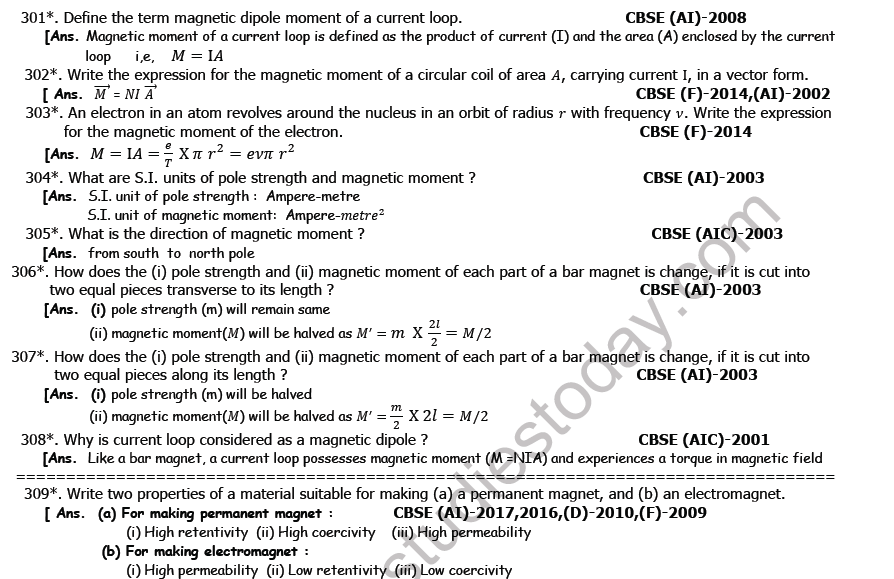
Question 301*. Define the term magnetic dipole moment of a current loop.
Answer: The magnetic dipole moment of any current-carrying loop is defined as the product of the electrical current flowing through it and the surface area bounded by the loop.
Mathematically: \[ M = I A \] For a coil consisting of \( N \) turns, it is expressed as: \[ M = N I A \]
In simple words: The magnetic strength of a loop is simply calculated by multiplying the current by the area of the loop.
Exam Tip: Always state the mathematical expression \( M = I A \) alongside the verbal definition to score full marks.
Question 302*. Write the expression for the magnetic moment of a circular coil of area A, carrying current I, in a vector form.
Answer: In vector form, the magnetic dipole moment of a coil having \( N \) turns is expressed as: \[ \vec{M} = N I \vec{A} \] where the direction of the area vector \( \vec{A} \) is determined using the right-hand thumb rule.
In simple words: The vector magnetic moment is the current times the area vector, showing that it has a specific direction pointing perpendicular to the loop's surface.
Exam Tip: Do not forget to put vector arrows on both \( \vec{M} \) and \( \vec{A} \) when writing the vector form.
Question 303*. An electron in an atom revolves around the nucleus in an orbit of radius r with frequency v. Write the expression for the magnetic moment of the electron.
Answer: The magnetic dipole moment \( M \) associated with a revolving orbital electron is: \[ M = I A = \left(\frac{e}{T}\right) \pi r^2 \] Since the time period \( T = \frac{1}{\nu} \) where \( \nu \) is the frequency of revolution: \[ M = e \nu \pi r^2 \] Alternatively, in terms of linear orbital speed \( v \), where \( \nu = \frac{v}{2\pi r} \): \[ M = e \left(\frac{v}{2\pi r}\right) \pi r^2 = \frac{e v r}{2} \]
In simple words: A revolving electron is like a tiny current loop. Its magnetic moment can be written using either its orbital frequency or its linear speed.
Exam Tip: Mention both forms of the formula (using frequency \( \nu \) and linear velocity \( v \)) to ensure full credit.
Question 304*. What are S.I. units of pole strength and magnetic moment ?
Answer: The SI units are defined as:
* The SI unit of magnetic pole strength is Ampere-meter (\( \text{A}\cdot\text{m} \)).
* The SI unit of magnetic dipole moment is Ampere-meter squared (\( \text{A}\cdot\text{m}^2 \)) or Joule per Tesla (\( \text{J/T} \)).
In simple words: Pole strength is measured in Ampere-meters, while magnetic dipole moment is measured in Ampere-meters squared.
Exam Tip: Avoid writing the unit names with incorrect capitalization; always use lowercase for units (ampere-meter).
Question 305*. What is the direction of magnetic moment ?
Answer: The direction of the magnetic dipole moment vector points from the magnetic south pole to the magnetic north pole of the magnet.
In simple words: Inside a magnet, the magnetic moment vector always points straight from South to North.
Exam Tip: Remember that while external magnetic field lines go North-to-South, the internal magnetic dipole moment points South-to-North.
Question 306*. How does the (i) pole strength and (ii) magnetic moment of each part of a bar magnet is change, if it is cut into two equal pieces transverse to its length ?
Answer: When a bar magnet is cut transverse to its length:
(i) **Pole Strength:** The pole strength \( m \) of each part remains completely unchanged because the cross-sectional area of the poles has not been altered.
(ii) **Magnetic Moment:** The magnetic moment \( M' \) of each piece becomes half of the original value because the length of each new piece is halved: \[ M' = m \times \frac{l}{2} = \frac{M}{2} \]
In simple words: Cutting a magnet across its width cuts its length in half, so its magnetic strength is halved, but the individual pole strengths remain the same.
Exam Tip: Show the simple mathematical relation \( M' = m \times (2l/2) \) to explain why the magnetic moment is exactly halved.
Question 307*. How does the (i) pole strength and (ii) magnetic moment of each part of a bar magnet is change, if it is cut into two equal pieces along its length ?
Answer: When a bar magnet is cut along its length:
(i) **Pole Strength:** The pole strength \( m' \) of each piece is halved because the cross-sectional area of each pole is cut in half: \[ m' = \frac{m}{2} \] (ii) **Magnetic Moment:** The magnetic moment \( M' \) is also halved since the pole strength of each piece is halved while the length remains unchanged: \[ M' = \left(\frac{m}{2}\right) \times 2l = \frac{M}{2} \]
In simple words: Slicing a magnet lengthwise cuts its pole area in half, so both the pole strength and the overall magnetic moment are halved.
Exam Tip: Highlight that cutting lengthwise reduces the cross-sectional area, which directly scales down the pole strength.
Question 308*. Why is current loop considered as a magnetic dipole ?
Answer: A current loop is viewed as a magnetic dipole because it exhibits all the essential properties of a physical dipole. Specifically, it possesses a magnetic dipole moment \( M = N I A \) and experiences a deflecting torque when placed in an external magnetic field, aligning itself in the field's direction just like a bar magnet.
In simple words: A loop with current running through it acts exactly like a tiny bar magnet, generating its own magnetic field and twisting when placed near other magnets.
Exam Tip: Mention the torque-alignment behavior in an external magnetic field to make your explanation physically complete.
Question 309*. Write two properties of a material suitable for making (a) a permanent magnet, and (b) an electromagnet.
Answer: The suitable properties are listed below:
**(a) For making a permanent magnet:**
1. **High Retentivity:** The material must retain strong magnetic properties even after the magnetizing field is removed.
2. **High Coercivity:** It must resist demagnetization from external magnetic fields or temperature changes.
**(b) For making an electromagnet:**
1. **High Permeability:** It should easily conduct and concentrate magnetic flux lines to create strong magnetic fields.
2. **Low Retentivity and Low Coercivity:** It should lose its magnetization quickly when the electric current is switched off.
In simple words: Permanent magnets need to hold onto their magnetism strongly (high retentivity and coercivity). Electromagnets need to turn on and off easily, meaning they must magnetize quickly but lose it instantly when the power goes off (low retentivity and coercivity).
Exam Tip: Use a neat tabular layout or numbered lists to clearly separate the properties of both types of magnets.
Question 310*. Mention the two characteristic properties of a material suitable for making core of a transformer.
Answer: The materials used to manufacture the core of a transformer should have:
1. **High Permeability:** To maximize flux linkage between the primary and secondary windings.
2. **Low Coercivity / Low Retentivity:** To minimize energy losses due to hysteresis during rapid alternating magnetization cycles.
In simple words: The core of a transformer needs to guide magnetic fields easily (high permeability) and change magnetic directions without wasting energy as heat (low coercivity).
Exam Tip: "High permeability" and "low hysteresis loss" are key terms that examiners specifically search for when grading this topic.
Question 311*. What are permanent magnets ? Give one example.
Answer: Permanent magnets are materials that can retain their magnetic characteristics at ambient room temperature over exceptionally long durations of time.
* **Example:** Steel magnets used inside audio speakers.
In simple words: Permanent magnets are materials that stay magnetic for a very long time without needing any electrical current to maintain their field.
Exam Tip: Always state a practical, real-world example like "alnico" or "steel magnets in speakers" to earn full marks.
Question 312*. Which material is used in making permanent magnets and why ?
Answer: Materials like steel or the alloy alnico are preferred for manufacturing permanent magnets. This is because they exhibit high retentivity (retaining strong magnetism) and high coercivity (resisting demagnetization).
In simple words: We use steel or alnico because they are very good at holding onto their magnetic field and won't get demagnetized easily.
Exam Tip: Mentioning the specific alloy "Alnico" (composed of Aluminum, Nickel, and Cobalt) is highly regarded by examiners.
Question 313*. Why do we prefer to use the alloy alnico for making permanent magnets ?
Answer: Alnico is preferred for permanent magnets because it exhibits excellent magnetic stability, characterized by exceptionally high magnetic coercivity and high retentivity.
In simple words: Alnico holds onto its magnetic strength very well and is highly resistant to losing its magnetism.
Exam Tip: Clearly state both "high coercivity" and "high retentivity" as they are the primary physical properties required.
Question 314*. Which material is used to make electromagnet and why ?
Answer: Soft iron is used to construct electromagnets because it possesses high magnetic permeability (making it easy to magnetize) along with low coercivity and low retentivity (allowing it to lose its magnetism quickly when current is turned off). This also keeps hysteresis energy losses minimal.
In simple words: Soft iron is perfect for electromagnets because it gets strongly magnetic very quickly when current flows, but loses its magnetism almost instantly when the power is cut.
Exam Tip: Emphasize "low coercivity" and "high permeability" as they allow rapid magnetization and demagnetization.
Question 315*. Why is soft iron preferred for making the core of a transformer ? OR Why is the core of an electromagnet made of ferromagnetic materials ?
Answer: Soft iron, which is a ferromagnetic material, is highly preferred because it has high magnetic permeability, which strongly concentrates the magnetic field lines. Additionally, its low retentivity and low coercivity ensure very low hysteresis energy loss during alternating magnetization cycles.
In simple words: Soft iron is used because it easily guides magnetic lines and changes magnetic direction back and forth without wasting energy as heat.
Exam Tip: If the question clarifies "ferromagnetic," explain how their high permeability concentrates magnetic flux.
Question 316*. Which material is used for making the core of a moving coil galvanometer and why ?
Answer: Soft iron is used for the core of a moving coil galvanometer because its high magnetic permeability concentrates the magnetic field lines, making the field radial and strong. Its low coercivity and low hysteresis loss ensure accurate pointer responses without lag.
In simple words: Soft iron concentrates the magnetic field lines, making the galvanometer highly sensitive and responsive.
Exam Tip: In a galvanometer, soft iron also plays a critical role in making the magnetic field radial, which is a great point to add for extra marks.
Question 317*. Name the three elements of Earth’s magnetic field.
Answer: The three characteristic elements that completely define the Earth's magnetic field at any given location are:
1. **Magnetic Declination (\( \theta \)):** The angle between the geographic meridian and the magnetic meridian.
2. **Angle of Dip or Magnetic Inclination (\( \delta \)):** The angle made by the Earth's total magnetic field vector with the horizontal direction.
3. **Horizontal Component of the Earth's Magnetic Field (\( B_H \Delta \)):** The component of the Earth's magnetic field along the horizontal direction.
In simple words: To describe Earth's magnetic field at any spot, you need three angles/values: the geographic offset (declination), the tilt of the field lines (dip), and how strong the horizontal push is.
Exam Tip: Be sure to list all three elements along with their standard symbols (\( \theta \Delta \), \( \delta \Delta \), and \( B_H \Delta \)).
Question 318* What is the angle of dip at equator ?
Answer: The angle of dip \( \delta \) at the magnetic equator is exactly \( 0^\circ \).
In simple words: At the equator, Earth's magnetic field lines lie completely flat and horizontal, so the tilt angle is zero.
Exam Tip: Write the answer as both "zero" and "\( 0^\circ \)" to make it mathematically explicit.
Question 319*. What is the angle of dip at magnetic poles ?
Answer: At the magnetic poles, the angle of dip \( \delta \) is exactly \( 90^\circ \).
In simple words: At the magnetic poles, Earth's magnetic field points straight down into the ground, making a 90-degree angle with the surface.
Exam Tip: Remember that the magnetic compass needle points vertically down at the magnetic poles.
Question 320*. How does angle of dip varies from equator to poles ?
Answer: As one travels from the magnetic equator towards either of the magnetic poles, the angle of dip increases continuously from \( 0^\circ \) (at the equator) up to \( 90^\circ \) (at the poles).
In simple words: The magnetic field lines tilt more and more as you travel from the equator to the poles, starting at 0 degrees and reaching a vertical 90 degrees.
Exam Tip: Mention the start value (\( 0^\circ \)) and end value (\( 90^\circ \)) explicitly to describe the variation clearly.
Question 321*. Where on the surface of Earth is the angle of dip zero ?
Answer: On the Earth's surface, the angle of dip is zero along the magnetic equator.
In simple words: The angle of dip is zero at the magnetic equator.
Exam Tip: Specify "magnetic equator" to differentiate it from the geographic equator.
Question 322*. Where on the surface of Earth is the angle of dip 90^0 ?
Answer: The angle of dip reaches \( 90^\circ \) at the magnetic poles of the Earth.
In simple words: The angle of dip is 90 degrees at the magnetic poles.
Exam Tip: Just like the equator, using the term "magnetic poles" is geographically more accurate than geographic poles.
Question 323*. Where on the Earth’s surface is the value of angle of dip (i) minim um (ii) maximum ?
Answer: The values are distributed as:
(i) **Minimum value:** At the magnetic equator, where the angle of dip is \( \delta = 0^\circ \).
(ii) **Maximum value:** At the magnetic poles, where the angle of dip is \( \delta = 90^\circ \).
In simple words: The angle of dip is smallest (0 degrees) at the equator and largest (90 degrees) at the poles.
Exam Tip: List both values alongside their corresponding locations to make your answer complete.
Question 324*. Where on the surface of Earth is the vertical component of Earth’ s magnetic field zero ?
Answer: The vertical component of the Earth's magnetic field is zero at the magnetic equator.
**Reason:** At the magnetic equator, the angle of dip is \( \delta = 0^\circ \). The vertical component \( B_V \) is: \[ B_V = B \sin\delta \] \[ B_V = B \sin(0^\circ) = 0 \]
In simple words: Since the magnetic field lines lie completely flat at the equator, there is no vertical tilt, making the vertical magnetic component zero.
Exam Tip: Always show the formula \( B_V = B \sin\delta \) to back up your conceptual answer.
Question 325*. What will be the value of the horizontal component of the Earth’s magnetic field at the Earth’s geometric pole ?
Answer: The horizontal component of the Earth's magnetic field is zero at the magnetic poles.
**Reason:** At the magnetic poles, the angle of dip is \( \delta = 90^\circ \). The horizontal component \( B_H \) is: \[ B_H = B \cos\delta \] \[ B_H = B \cos(90^\circ) = 0 \]
In simple words: At the poles, the magnetic field points straight down, leaving no horizontal push at all.
Exam Tip: Mention the cosine relation \( B_H = B \cos\delta \) to show mathematically why the horizontal component vanishes.
Question 326*. A small magnet is pivoted to move freely in the magnetic meridian. At what place on the surface of the earth will the magnet be vertical ?
Answer: The pivoted magnet will orient itself completely vertically at the magnetic poles of the Earth.
In simple words: At the magnetic poles, a free-swinging magnet points straight down because the field lines go straight into the ground.
Exam Tip: The term "magnetic meridian" means the plane in which Earth's field lies; mentioning that the field is entirely vertical here is crucial.
Question 327*. A magnetic needle, free to rotate in a vertical plane, orients itself vertically at a certain place on the earth. What are the values of (i) angle of dip at this place, and (ii) horizontal component of earth’s magnetic field
Answer: If the needle aligns vertically:
(i) **Angle of Dip (\( \delta \)):** The angle of dip at this location is exactly \( 90^\circ \) (which corresponds to the magnetic poles).
(ii) **Horizontal Component (\( B_H \)):** \[ B_H = B \cos\delta = B \cos(90^\circ) = 0 \] The horizontal component is zero.
In simple words: When a needle points straight down, the dip is 90 degrees and there is no horizontal magnetic field.
Exam Tip: Break your answer into clear (i) and (ii) labels to match the sub-parts of the question.
Question 328* The horizontal component of earth’s magnetic field at a place is B and the angle of dip is 60^0. What is the value of vertical component of earth’s magnetic field at equator ?
Answer: The vertical component of the Earth's magnetic field at the equator is exactly zero.
**Reason:** Regardless of the field at other locations, at the magnetic equator, the angle of dip is always \( \delta = 0^\circ \). Therefore: \[ B_V = B \sin\delta = B \sin(0^\circ) = 0 \]
In simple words: At the equator, the magnetic field is completely horizontal, so the vertical part is always zero.
Exam Tip: Do not get confused by the values of \( B \) and \( 60^\circ \) given for the "place" - they are distractors; the question asks for the vertical component specifically *at the equator*.
Question 329*. What is the angle of dip at a place where the horizontal and vertical components of the earth’s magnetic field are equal ?
Answer: Let \( B_H \) and \( B_V \) be the horizontal and vertical components of Earth's magnetic field. Since they are equal:
\( B_V = B_H \)
The angle of dip \( \delta \) is defined by: \[ \tan\delta = \frac{B_V}{B_H} \] Substituting \( B_V = B_H \): \[ \tan\delta = 1 \implies \delta = 45^\circ \] Thus, the angle of dip is \( 45^\circ \).
In simple words: When the vertical and horizontal parts of the magnetic field are identical, the field tilts at exactly 45 degrees.
Exam Tip: Writing down the key formula \( \tan\delta = \frac{B_V}{B_H} \) is essential to secure full marks.
Question 330*. Horizontal component of earth’s magnetic field at a place is \sqrt{3} times the vertical component. What is the value of angle of dip at this place ?
Answer: Given that:
\( B_H = \sqrt{3} B_V \)
The relationship for the angle of dip \( \delta \) is: \[ \tan\delta = \frac{B_V}{B_H} \] Substituting \( B_H = \sqrt{3} B_V \): \[ \tan\delta = \frac{B_V}{\sqrt{3} B_V} = \frac{1}{\sqrt{3}} \] This gives:
\( \delta = 30^\circ \) Thus, the angle of dip is \( 30^\circ \).
In simple words: If the horizontal component is larger by a factor of root three, the field lies flatter, yielding an angle of dip of 30 degrees.
Exam Tip: Be careful not to invert the ratio; remember that \( \tan\delta = \frac{B_V}{B_H} \), not \( \frac{B_H}{B_V} \).
Question 331*. The vertical component of earth’s magnetic field at a place is \sqrt{3} times the horizontal component. What is the value of angle of dip at this place ?
Answer: Given that:
\( B_V = \sqrt{3} B_H \)
The angle of dip \( \delta \) is defined by: \[ \tan\delta = \frac{B_V}{B_H} \] Substituting \( B_V = \sqrt{3} B_H \): \[ \tan\delta = \frac{\sqrt{3} B_H}{B_H} = \sqrt{3} \] This gives:
\( \delta = 60^\circ \) Thus, the angle of dip is \( 60^\circ \).
In simple words: When the vertical field is stronger by a factor of root three, the field tilts more steeply, giving a dip of 60 degrees.
Exam Tip: Double check your trigonometric values; \( \tan(60^\circ) = \sqrt{3} \) and \( \tan(30^\circ) = 1/\sqrt{3} \).
Question 332*. At a place the horizontal component of magnetic field is B and angle of dip is 60^0. What is the value of horizontal component of the Earth’s magnetic field at equator ?
Answer: **Case 1 (At the given place):**
Let the total magnetic field of the Earth be \( B_e \). We are given:
Horizontal component, \( B_H = B \)
Angle of dip, \( \delta = 60^\circ \)
Using the relationship \( B_H = B_e \cos\delta \): \[ B = B_e \cos(60^\circ) \] \[ B = B_e \left(\frac{1}{2}\right) \implies B_e = 2B \]
**Case 2 (At the magnetic equator):**
At the equator, the angle of dip is \( \delta = 0^\circ \). Therefore, the horizontal component \( B_{H,\text{equator}} \) is: \[ B_{H,\text{equator}} = B_e \cos(0^\circ) \] \[ B_{H,\text{equator}} = 2B \times 1 = 2B \] Thus, the horizontal component at the equator is \( 2B \).
In simple words: Using the 60-degree dip, we find the total magnetic field is \( 2B \). Since the field is completely horizontal at the equator, the horizontal component there is simply the full value, \( 2B \).
Exam Tip: Break this multi-step problem into two logical cases (Case 1 and Case 2) to clearly demonstrate your method to the examiner.
Question 333*. Which of the following substances are diamagnetic ? Bi, Al, Na, Cu, Ca and Ni
Answer: Among the listed elements, Bismuth (\( \text{Bi} \)) and Copper (\( \text{Cu} \)) are the diamagnetic substances.
In simple words: Bismuth and Copper are diamagnetic materials, meaning they are weakly repelled by magnets.
Exam Tip: Memorize the common examples of diamagnetic (Bi, Cu, water), paramagnetic (Al, Na, Ca), and ferromagnetic (Ni, Fe, Co) substances.
Question 334*. Which of the following substances are paramagnetic ? Bi, Al, Cu, Ca Pb and Ni
Answer: From the given choices, Aluminum (\( \text{Al} \)) and Calcium (\( \text{Ca} \)) are paramagnetic substances.
In simple words: Aluminum and Calcium are paramagnetic, which means they are very weakly attracted to magnetic fields.
Exam Tip: Paramagnetic materials have small positive susceptibilities, whereas diamagnetic materials have small negative susceptibilities.
Question 335*. Define the term intensity of magnetization.
Answer: The intensity of magnetization (\( I \) or \( M \)) is defined as the net magnetic dipole moment developed per unit volume of a magnetic material when it is placed inside an external magnetizing field. \[ I = \frac{M}{V} \]
In simple words: It is a measure of how strongly a material becomes magnetized, calculated by dividing the total magnetic moment by the volume of the material.
Exam Tip: Mention the formula \( I = \frac{M}{V} \) and state its SI unit (Ampere per meter, \( \text{A/m} \)) to write an excellent answer.
Question 336*. Define the term magnetic susceptibility.
Answer: Magnetic susceptibility (\( \chi_m \)) is defined as the ratio of the intensity of magnetization (\( I \)) induced inside a material to the strength of the external magnetizing field intensity (\( H \)): \[ \chi_m = \frac{I}{H} \]
In simple words: It measures how easily a substance gets magnetized when exposed to an external magnetic field.
Exam Tip: Note that magnetic susceptibility is a dimensionless physical quantity (it has no units) since it is a ratio of two identical-unit quantities.
Question 337*. What do you mean by the statement that “Susceptibility of Iron is more than that of copper” ?
Answer: This statement indicates that iron can be magnetized much more easily and strongly than copper when both are subjected to the same external magnetizing field.
In simple words: Iron responds much more strongly and easily to magnetic fields than copper.
Exam Tip: Use the phrase "easily magnetized" as it is the core physical meaning of high magnetic susceptibility.
Question 338*. Why do magnetic lines of force prefer to pass through ferromagnetic materials (e.g., Iron ) than through air ?
Answer: Ferromagnetic materials (such as iron) possess exceptionally high magnetic permeability and susceptibility compared to air. As a result, they offer very low magnetic reluctance, causing magnetic field lines to gather and concentrate through them.
In simple words: Ferromagnetic materials conduct magnetic fields much better than air, so magnetic lines squeeze together to pass through them.
Exam Tip: Introduce the term "magnetic permeability (\( \mu \Delta \))" to explain why magnetic lines are concentrated inside the material.
Question 339*. What happens when a diamagnetic substance is placed in a varying magnetic field ?
Answer: When a diamagnetic material is placed in a non-uniform (varying) magnetic field, it experiences a weak repulsive force that causes it to move from the stronger regions of the field towards the weaker regions.
In simple words: Diamagnetic materials are repelled by magnets, so they naturally drift from strong magnetic areas to weaker ones.
Exam Tip: Mention "stronger to weaker parts" specifically, as this characterizes diamagnetic behavior under non-uniform fields.
Question 340*. What is the characteristic property of a diamagnetic material ?
Answer: The defining characteristic of a diamagnetic material is that, when placed inside an external magnetic field, it develops a weak magnetization in a direction strictly opposite to that of the applied field.
In simple words: When near a magnet, diamagnetic materials develop a tiny magnetic field that pushes against the magnet.
Exam Tip: Use the phrase "magnetized in the opposite direction" to clearly specify this unique characteristic.
Question 341*. What is Curie point ?
Answer: The Curie point (or Curie temperature) is the critical temperature threshold above which a ferromagnetic material loses its strong ferromagnetic behavior and transitions into a paramagnetic material.
In simple words: It is the temperature at which a strong magnet (like iron) loses its permanent magnetic properties and becomes a weak magnet.
Exam Tip: Clearly state the transition: "ferromagnetic to paramagnetic" to get full marks.
Question 342*. State Curie law.
Answer: According to Curie's Law, the magnetic susceptibility (\( \chi_m \)) of a paramagnetic substance is inversely proportional to its absolute thermodynamic temperature (\( T \)): \[ \chi_m = \frac{C}{T} \] where \( C \) is a constant known as the Curie constant.
In simple words: As a paramagnetic material gets hotter, its magnetic responsiveness weakens.
Exam Tip: Always write the mathematical formula \( \chi_m = \frac{C}{T} \) and define what \( C \) and \( T \) represent.
Question 343*. The permeability of a magnetic material is 0.9983. Name the type of magnetic material it represents.
Answer: Since the relative magnetic permeability \( \mu_r \) is less than 1 (\( \mu_r < 1 \)), the given material is classified as **diamagnetic**.
In simple words: Because the permeability value is slightly less than 1, it represents a diamagnetic material.
Exam Tip: State the condition \( \mu_r < 1 \) clearly to justify why the material is diamagnetic.
Question 344*. The susceptibility of a magnetic material is -4.2 X 10^-6. Name the type of magnetic material it represents.
Answer: Since the magnetic susceptibility (\( \chi_m \)) of the material is negative (\( \chi_m < 0 \)), it represents a **diamagnetic** substance.
In simple words: A negative susceptibility value always points to a diamagnetic material.
Exam Tip: Remember that only diamagnetic materials have negative susceptibility.
Question 345*. The susceptibility of a magnetic material is 1.9 X 10^-5. Name the type of magnetic material it represents.
Answer: Because the magnetic susceptibility (\( \chi_m \)) is small and positive (\( \chi_m > 0 \)), the material is classified as **paramagnetic**.
In simple words: A small positive susceptibility means the material is paramagnetic.
Exam Tip: Clearly distinguish between small positive (paramagnetic) and very large positive (ferromagnetic) susceptibility.
Question 346*. How does the intensity of magnetization of a paramagnetic material vary with increasing applied magnetic field ?
Answer: The magnetization behavior varies depending on field strength:
1. For weak to moderate external fields, the intensity of magnetization \( I \) increases linearly with the applied magnetic field \( B \) (\( I \propto B \)).
2. Under very strong magnetic fields, all atomic dipoles align completely, causing the magnetization to reach saturation and become independent of further increases in \( B \).
In simple words: At first, stronger magnets make the material more magnetic. But eventually, it reaches a limit (saturation) where turning up the magnetic field doesn't make it any stronger.
Exam Tip: Mention the "saturation" state specifically, as it is a crucial milestone in magnetization curves.
Question 347*. How does the intensity of magnetization of a paramagnetic sample vary with temperature ?
Answer: The intensity of magnetization \( I \) of a paramagnetic sample decreases as the absolute temperature increases: \[ I \propto \frac{1}{T} \] **Reason:** As temperature rises, thermal agitation increases, which disrupts and randomizes the alignment of the individual atomic magnetic dipoles.
In simple words: Heat makes atoms vibrate and jiggle, which messes up their alignment and weakens the material's magnetization.
Exam Tip: Mention "thermal agitation" as the primary reason for disrupting the alignment of the magnetic dipoles.
Question 348*. Why does the magnetization of a paramagnetic sample increase on cooling ?
Answer: Magnetization increases on cooling because the intensity of magnetization \( I \) is inversely proportional to absolute temperature (\( I \propto \frac{1}{T} \)).
**Reason:** Cooling lowers the thermal kinetic energy of the atoms, reducing random thermal vibrations and allowing the magnetic field to align the atomic dipoles more easily.
In simple words: Cooling slows down the atomic vibrations, making it easier for the magnetic field to keep the tiny atomic magnets neatly aligned.
Exam Tip: Show the mathematical relation \( I \propto \frac{1}{T} \) to explain the inverse temperature relationship.
Question 349*. How does the magnetization of a diamagnetic material change on cooling ?
Answer: There is no change in magnetization. This is because the magnetic properties of a diamagnetic material are completely independent of temperature.
In simple words: Cooling has absolutely no effect on diamagnetic materials because their magnetism does not depend on temperature.
Exam Tip: Contrast this with paramagnetic/ferromagnetic materials, which are highly temperature-dependent.
Question 350*. Why is diamagnetism independent of temperature ?
Answer: Diamagnetism is independent of temperature because it is caused by the electromagnetic induction of orbital electron currents when an external field is applied. This induced magnetic dipole moment depends on atomic structures rather than the random thermal motion of atoms.
In simple words: Diamagnetism is a basic atomic response that opposes the field, and it isn't affected by how fast the atoms are jiggling due to heat.
Exam Tip: Explain that since it's an orbital electronic effect, it does not rely on thermal dipole alignment.
Question 351*. State Gauss’s law in magnetism. How is it different from Gauss’s law in electrostatics and why ?
Answer: **Gauss's Law in Magnetism:**
The total, net magnetic flux passing through any closed surface is always zero: \[ \oint \vec{B} \cdot \vec{ds} = 0 \]
**Comparison with Gauss's Law in Electrostatics:**
Gauss's law in electrostatics states that the net electric flux through any closed surface is \( \frac{1}{\varepsilon_0} \) times the total net charge enclosed: \[ \oint \vec{E} \cdot \vec{ds} = \frac{q}{\varepsilon_0} \]
**Why they are different:**
While isolated electric charges (monopoles) can exist in nature, isolated magnetic poles (magnetic monopoles) do not exist. Magnetic poles always occur in equal and opposite pairs (North and South). Thus, any closed surface enclosing a magnet will always contain equal and opposite poles, making the net enclosed magnetic charge zero.
In simple words: For electric fields, you can have a single charge inside a box, creating a net flux. But for magnets, poles always come in North-South pairs, so any flux going out of a box must come back in, making the total flux zero.
Exam Tip: Use the phrase "non-existence of magnetic monopoles" to summarize why the magnetic flux is always zero.
Question 352*. Draw the magnetic field lines distinguishing between diamagnetic and paramagnetic materials. Give a simple explanation to account for the difference in the magnetic behaviour of these materials.
Answer: **Explanation of Behavior:**
1. **Diamagnetic Materials:** When placed in an external magnetic field, the atoms develop a weak induced magnetic dipole moment that opposes the applied field. Because the material magnetizes in opposition, it repels the field lines, causing them to bend outwards and be expelled from the material.
2. **Paramagnetic Materials:** When exposed to an external field, the pre-existing atomic magnetic dipoles align themselves in the direction of the field, creating a weak magnetization parallel to the field. This causes the material to attract magnetic field lines, drawing them inside.
In simple words: Diamagnetic materials push magnetic fields away, so the field lines curve around them. Paramagnetic materials pull magnetic fields in, drawing the lines closer together inside the material.
Exam Tip: Draw the field lines clearly: make sure they curve outwards around the diamagnetic sphere and curve inwards through the paramagnetic sphere.
Question 353*. In what way is the behaviour of a diamagnetic material different from that of a paramagnetic, when kept in an external magnetic field.
Answer: We can compare their behaviors when placed in an external magnetic field:
| Diamagnetic Materials | Paramagnetic Materials |
|---|---|
| 1. It is weakly repelled by a magnetic field. | 1. It is weakly attracted by a magnetic field. |
| 2. In a non-uniform field, it moves from stronger regions to weaker regions. | 2. In a non-uniform field, it moves from weaker regions to stronger regions. |
| 3. A suspended rod of this material aligns itself perpendicular to the direction of the magnetic field. | 3. A suspended rod of this material aligns itself parallel along the direction of the magnetic field. |
In simple words: Diamagnetic materials are repelled by magnets, move to weaker fields, and align perpendicular. Paramagnetic materials are attracted, move to stronger fields, and align parallel to the field lines.
Exam Tip: Presenting these behavioral differences in a structured comparison table is highly recommended to earn maximum marks.
Question 354*. The Earth’s magnetic field at the Equator is approximately 0.4 G. Estimate the Earth’s magnetic dipole moment. (Given : Radius of the Earth = 6400 km)
Answer: Given parameters:
Magnetic field at the Equator (acting as a transverse point of the Earth's dipole), \( B = 0.4\text{ G} = 0.4 \times 10^{-4}\text{ T} \)
Radius of the Earth, \( R = 6400\text{ km} = 6.4 \times 10^6\text{ m} \)
The magnetic field on the equatorial line of a magnetic dipole is: \[ B = \frac{\mu_0}{4\pi} \frac{M}{R^3} = 10^{-7} \times \frac{M}{R^3} \] Rearranging the formula to calculate the magnetic dipole moment \( M \): \[ M = \frac{B \times R^3}{10^{-7}} \] Substituting the given values: \[ M = \frac{(0.4 \times 10^{-4}) \times (6.4 \times 10^6)^3}{10^{-7}} \] \[ M = \frac{0.4 \times 10^{-4} \times 2.62 \times 10^{20}}{10^{-7}} \] \[ M \approx 1.1 \times 10^{23}\text{ A}\cdot\text{m}^2 \] Thus, the estimated magnetic dipole moment of the Earth is \( 1.1 \times 10^{23}\text{ A}\cdot\text{m}^2 \).
In simple words: Using Earth's equatorial magnetic field and its radius, we calculate that Earth acts like a massive magnet with a dipole moment of \( 1.1 \times 10^{23} \) Ampere-meters squared.
Exam Tip: Don't forget that 1 Gauss (G) equals \( 10^{-4} \) Tesla (T) and 1 kilometer (km) equals \( 10^3 \) meters (m) to avoid calculation errors.
Question 355* An observer to the left of a solenoid of N turns each of cross section area A observes that a steady current I in it flows in the clockwise direction. Depict the magnetic field lines due to the solenoid specifying its polarity and show that it acts as a bar magnet of magnetic moment M = NIA.
Answer: Since the current flows in a clockwise direction as viewed from the left, according to the clock face rule, this left face of the solenoid behaves as a **South pole (S)**. Consequently, the opposite right face behaves as a **North pole (N)**.
The magnetic field lines inside the solenoid run from the South to the North pole and emerge from the North pole to loop back to the South pole outside, exactly mimicking the field pattern of a bar magnet.
**Deriving the Magnetic Moment (\( M \)):**
A solenoid can be modeled as a stack of \( N \) individual circular current loops, each carrying a current \( I \) and enclosing an area \( A \). Each individual loop acts as a microscopic magnetic dipole with a dipole moment \( m \): \[ m = I A \] Since all these loops are aligned coaxially in the same direction, their magnetic moments add up constructively. Therefore, the net magnetic dipole moment \( M \) of the solenoid is: \[ M = N \cdot m = N I A \] This proves that the solenoid acts like a bar magnet with an equivalent magnetic dipole moment of \( M = N I A \).
In simple words: Since the current flows clockwise on the left, that end becomes a South pole and the right end becomes a North pole. Each of the N wire loops acts as a tiny dipole, and their individual strengths add up to give a net magnetic moment of NIA.
Exam Tip: Use the "clock rule" to explain how the clockwise current direction corresponds to a South pole to secure conceptual marks.
Please click the link below to download pdf file of Class 12 Physics Magnetism and Matter Boards Questions
Free study material for Physics
CBSE Physics Class 12 Chapter 5 Magnetism and Matter Worksheet
Students can use the practice questions and answers provided above for Chapter 5 Magnetism and Matter to prepare for their upcoming school tests. This resource is designed by expert teachers as per the latest 2026 syllabus released by CBSE for Class 12. We suggest that Class 12 students solve these questions daily for a strong foundation in Physics.
Chapter 5 Magnetism and Matter Solutions & NCERT Alignment
Our expert teachers have referred to the latest NCERT book for Class 12 Physics to create these exercises. After solving the questions you should compare your answers with our detailed solutions as they have been designed by expert teachers. You will understand the correct way to write answers for the CBSE exams. You can also see above MCQ questions for Physics to cover every important topic in the chapter.
Class 12 Exam Preparation Strategy
Regular practice of this Class 12 Physics study material helps you to be familiar with the most regularly asked exam topics. If you find any topic in Chapter 5 Magnetism and Matter difficult then you can refer to our NCERT solutions for Class 12 Physics. All revision sheets and printable assignments on studiestoday.com are free and updated to help students get better scores in their school examinations.
FAQs
You can download the latest chapter-wise printable worksheets for Class 12 Physics Chapter 5 Magnetism and Matter for free from StudiesToday.com. These have been made as per the latest CBSE curriculum for this academic year.
Yes, Class 12 Physics worksheets for Chapter 5 Magnetism and Matter focus on activity-based learning and also competency-style questions. This helps students to apply theoretical knowledge to practical scenarios.
Yes, we have provided solved worksheets for Class 12 Physics Chapter 5 Magnetism and Matter to help students verify their answers instantly.
Yes, our Class 12 Physics test sheets are mobile-friendly PDFs and can be printed by teachers for classroom.
For Chapter 5 Magnetism and Matter, regular practice with our worksheets will improve question-handling speed and help students understand all technical terms and diagrams.