

ICSE Solutions Selina Concise Class 9 History Civics Chapter 1 The Harappan Civilization have been provided below and is also available in Pdf for free download. The Selina Concise ICSE solutions for Class 9 History Civics have been prepared as per the latest syllabus and ICSE books and examination pattern suggested in Class 9. Questions given in ICSE Selina Concise book for Class 9 History Civics are an important part of exams for Class 9 History Civics and if answered properly can help you to get higher marks. Refer to more Chapter-wise answers for ICSE Class 9 History Civics and also download more latest study material for all subjects. Chapter 1 The Harappan Civilization is an important topic in Class 9, please refer to answers provided below to help you score better in exams
Selina Concise Chapter 1 The Harappan Civilization Class 9 History Civics ICSE Solutions
Class 9 History Civics students should refer to the following ICSE questions with answers for Chapter 1 The Harappan Civilization in Class 9. These ICSE Solutions with answers for Class 9 History Civics will come in exams and help you to score good marks
Chapter 1 The Harappan Civilization Selina Concise ICSE Solutions Class 9 History Civics
Question 1. Mention any two sources to reconstruct the Harappan Civilization.
Answer: 1. The ruins of Mohenjo-daro and Harappa show their amazing skills in designing cities, including their sewage networks, large public pools, assembly spaces, and other civic structures.
2. Artistic clay and metal seals tell us about how these people looked, what clothes and jewelry they wore, and what they believed in.
In simple words: We learn about the ancient Harappans by looking at their ruined cities and the small engraved seals they left behind.
Exam Tip: When writing about archaeological sources, remember to mention both physical structures like the Great Bath and portable artifacts like seals to get full marks.
Question 2. Why did the Indus Valley Civilization come to be known as Harappan Civilization?
Answer: This ancient culture received its name because its first traces and major prehistoric urban centers, like Harappa in West Punjab and Mohenjo-daro in Sindh, were discovered there.
In simple words: It is called the Harappan civilization because Harappa was the very first city that archaeologists dug up.
Exam Tip: Clearly state that Harappa was the first site excavated, which is why the entire civilization is named after it.
Question 3. Mention any two important centres of the Indus Valley Civilization.
Answer: The northern and western territories of India, as well as modern-day Pakistan, contain major sites of this culture.
In simple words: The main sites of this civilization are found in parts of western India and Pakistan today.
Exam Tip: Make sure to mention both India and Pakistan when discussing the geographic range of this ancient civilization.
Question 4. What are the evidences which reveal the skill of the Indus people in town-planning?
Answer: Streets: Wide, straight roads crossed each other at ninety-degree angles, partitioning the town into orderly square or rectangular sections, which were linked by smaller alleys.
Bricks: The roadways were paved using durable, kiln-baked bricks. Road corners were curved to help traffic, and residents were forbidden from building beyond their property lines onto public paths.
In simple words: The cities were built in neat grids with wide streets crossing at right angles and paved with strong baked bricks.
Exam Tip: To describe town planning, focus on two main headings - Streets and Bricks - and mention grid layouts and the use of kiln-burnt bricks.
Question 5. Mention the main evidences to suggest that the Indus Valley people paid great importance to sanitation and health.
Answer: Every town was designed with a highly sophisticated waste-water network. Covered channels made of bricks ran along each road, and household wastewater flowed directly into buried primary sewers. These main channels emptied into substantial brick-lined reservoirs outside the town borders, and maintenance openings were installed for regular cleaning. Having such a structured sewer system everywhere clearly demonstrates that cleanliness and public health were major priorities for the society.
In simple words: They had covered drains along the streets connected to main underground sewers with manholes for easy cleaning.
Exam Tip: Mention key features like brick-lined street drains, connection of house drains to main underground lines, and the presence of manholes to show their focus on sanitation.
Question 6. What are the two different types of buildings that were unearthed at the various Industries ?
Answer: Here are the various categories of structures discovered across the archaeological locations (you may choose any two):
1. Residential quarters and homes.
2. The large communal bathing structure.
3. The massive storage facility for crops.
4. Civic meeting chambers and general communal structures.
In simple words: Archaeologists found different kinds of buildings, including family homes, public baths, crop storages, and large meeting halls.
Exam Tip: Make sure to list at least two of the four major types of buildings discovered - such as dwelling houses and the Great Bath - to score full marks.
Question 7. Mention the evidences which suggest that the Harappan people had trade relations with other countries.
Answer: The ancient Harappan population maintained active business ties with southern and eastern India, Kashmir, and several Asian nations. They brought in foreign metals, rare gems, and other goods. Their commercial networks extended to far-off regions like Egypt and Crete. Discoveries of Sumerian artifacts at these archaeological sites confirm active exchange between these cultures. Goods were transported using both land routes and sea lanes, and a discovered seal depicting a ship without masts points to the frequent use of maritime routes.
In simple words: The Harappans traded by land and sea with faraway places like Mesopotamia and Egypt, importing metals and precious stones.
Exam Tip: Mention key pieces of evidence like Sumerian artifacts found in Harappan ruins and the seal showing a ship to prove international maritime trade.
Question 8. Describe the famous sculpture in metal which was found among the ruins of the city of Mohenjo-daro.
Answer: The premier metallic artifact recovered is a small bronze statuette of a dancing female standing with one hand placed on her waist in a performance pose. The figurine wears necklaces, and her entire left arm is adorned with bangles crafted from bone or ivory. Her hair is tied neatly into a circular knot at the back, while her head leans back slightly.
In simple words: They found a famous bronze statue of a dancing girl. She has bangles all over her left arm, a necklace, and her hair is tied in a bun.
Exam Tip: When describing the dancing girl statue, remember to detail three main things: her posture (hand on hip), her accessories (bangles and necklaces), and her hairstyle (bun).
Question 9. Give one evidence to show that the Harappan people excelled in the art of sculpture in the following: (a) In metal (b) In stone (c) In terracotta
Answer: The high level of artistic skill possessed by these ancient people across different mediums is illustrated below:
(a) Metal: The famous bronze statuette depicting a female dancer.
(b) Stone: Two remarkable carvings, consisting of a male torso made of reddish sandstone and a bust representing a priest-king or nobleman.
(c) Terracotta: Baked clay images representing the Mother Goddess, as well as small clay figures of bulls, domestic dogs, sheep, avians, and human figures.
In simple words: They made amazing sculptures like the bronze dancing girl, the stone priest-king, and clay figures of animals and the Mother Goddess.
Exam Tip: Memorize one specific example for each medium: bronze dancing girl for metal, priest-king or male torso for stone, and the Mother Goddess for terracotta.
Question 10. What evidence has been found to suggest that the Harappan people were familiar with the art of writing?
Answer: Numerous clay and stone seals unearthed at major settlements feature a system of symbol-based or pictorial scripts. These same types of written symbols have also been discovered etched onto flat copper plates along with depictions of humans and wild beasts.
In simple words: They wrote using picture symbols carved into clay seals and flat copper plates.
Exam Tip: Mention that the script was pictorial and was found carved on both seals and copper plates to support the fact that they knew how to write.
Question 11. Mention three different kinds of Seals discovered at the various sites of the Harappan Valley Civilization.
Answer: Three distinct types of seals uncovered at these locations include:
1. Seals depicting various beasts.
2. The single-horned mythical creature (Unicorn) seal.
3. The Lord of Beasts (Shiva Pashupati) seal.
In simple words: They found different kinds of seals, like ones with animal drawings, a mythical one-horned animal, and one showing a god sitting with animals.
Exam Tip: Learn the three main types of seals: animal seals, unicorn seals, and Pashupati (Shiva) seals, as they are very common in exams.
Question 12. Mention any two probable causes for the decline and disappearance of the Harappan Civilization.
Answer: Severe flooding or powerful tectonic shifts are believed to have triggered the collapse and ruin of these urban areas.
In simple words: The cities might have been ruined by massive floods or strong earthquakes.
Exam Tip: Natural disasters like major floods or earthquakes are the most widely accepted reasons for the end of this civilization.
Question 13. Mention any two features to suggest that the Harappan people enjoyed a higher standard of civic amenities than those of Mesopotamia.
Answer: The urban populations of the Indus Valley had far superior public facilities compared to contemporary Mesopotamian cities. This is proven by grand structures like Mohenjo-daro's communal bathing pool, along with private residences featuring dedicated fresh water access, private washrooms, and highly efficient wastewater channels. These features support the view that "the masses enjoyed a degree of comfort and luxury unknown in other parts of the civilized world."
In simple words: Harappans had better amenities than Mesopotamians, with private bathrooms, clean well water, and advanced street sewers in almost every home.
Exam Tip: To show they had better public facilities, point out their advanced drainage network and private bathing areas, which were rare in Mesopotamia.
Question 14. What is Civilization?
Answer: A civilization represents an advanced phase of human society marked by permanent geographic settlements, urban planning, structured systems of governance, expanding commercial and trading networks, and an ongoing ability to grow and progress.
In simple words: A civilization is an advanced way of living with planned cities, a working government, trade, and continuous progress.
Exam Tip: Be sure to include key elements like organized government, trade, and city-building when defining a civilization.
Question 15. State the probable period of the existence of the Indus Valley Civilization.
Answer: This ancient culture is believed to have existed roughly from 3250 B.C. to 2750 B.C.
In simple words: The Indus Valley Civilization lived a very long time ago, from around 3250 B.C. to 2750 B.C.
Exam Tip: Write the exact time frame (3250 B.C. to 2750 B.C.) to secure full marks on timeline questions.
Question 16. Mention three main occupations of the Indus Valley people.
Answer: 1. Farming and cultivating crops.
2. Raising and taming livestock.
3. Conducting business and merchant trade.
In simple words: The main jobs of the people were farming, keeping farm animals, and buying and selling goods.
Exam Tip: Agriculture was their primary livelihood, so list it first along with animal rearing and trade.
Question 17. Mention any two features of the Harappan script.
Answer: Two key traits of this writing system include:
1. It used picture-like symbols or drawings instead of letters.
2. It was commonly carved onto stone seals and flat copper plaques.
In simple words: The script was made of drawings and was carved on stone seals and copper plates.
Exam Tip: Highlight that the writing was 'pictorial' and identify the materials, like seals and copper plates, where it was found.
Question 18. Mention the evidences which suggest that the Harappan people worshiped: (a) The Mother Goddess, (b) The Shiva Pashupati, and (c) The trees and animals.
Answer: We can infer their spiritual practices and veneration of different gods from several discoveries:
(a) Mother Goddess: Many clay statues and seals display a female divinity. These representations show her with minimal clothing, wearing complex hair ornaments and jewelry. Traces of soot on some statues suggest they offered burning incense. They likely venerated this deity as the ultimate creator and symbol of feminine power.
(b) Shiva Pashupati: An outstanding seal depicts a male deity believed to be an early form of Shiva. He is shown with three faces, wearing a horned helmet, and sitting in a meditative yoga pose on a raised seat surrounded by wild beasts. Furthermore, the recovery of many rounded stone cylinders resembling the Shiva Linga points to his widespread worship.
(c) Trees and Animals: Artistic patterns on several seals show they reverenced nature. The Pipal tree was held sacred as a symbol of divine knowledge. They also worshipped beasts such as bulls, rhinos, tigers, and crocodiles. Seals showing a deity with a cobra canopy over its head accompanied by devotees indicate snake-worship was common.
In simple words: They worshipped a female Mother Goddess with clay figures, a horned male god (Pashupati) on seals, and trees and animals like the Pipal tree and bulls.
Exam Tip: To answer this question fully, write clear sub-points for the Mother Goddess (clay statues with soot), Shiva Pashupati (three-faced horned seal), and nature worship (Pipal tree and animals).
Question 19. What is the evidence to suggest that the Harappan people worshipped trees and animals?
Answer: Engraved seals offer deep insights into their culture and spiritual customs. Specifically, the depictions carved onto multiple sacred seals demonstrate their worship of plants and wild animals.
In simple words: Many seals have designs of trees and animals, which shows they worshipped nature.
Exam Tip: Mention that seals are the primary evidence for nature worship, featuring carvings of plants and various beasts.
Question 20. What is meant by the word ‘Mesopotamia’?
Answer: The term 'Mesopotamia' translates to the land situated between two rivers.
In simple words: The name Mesopotamia means a place located between two rivers.
Exam Tip: Clearly define Mesopotamia as the land between two rivers (which are the Tigris and Euphrates).
Question 21. What evidences are found for us to know about the following: (a) Food of the Indus Valley people. (b) Dress and Ornaments worn by the people.
Answer: The following discoveries shed light on their daily lives:
(a) Diet: Their primary food sources were cultivated grains like barley and wheat. They also ate rice, dates, milk, fresh greens, and seasonal fruits. Their non-vegetarian diet included beef, mutton, birds, tortoises, turtles, freshwater fish, and shellfish.
(b) Clothing and Jewelry: Carved sculptures reveal they wore plain attire. Men typically wore two garments: a shawl draped over the left shoulder and under the right arm, paired with a lower wrap similar to a dhoti. Women wore similar simple clothing, using a loincloth secured with a sash. Cotton was common, and wool was also used. Both genders loved wearing jewelry. Craftspeople made ornaments from gold, silver, copper, and precious gems. Common jewelry items included neckbands, rings, and arm bands. Women also wore decorative headwear, ear studs, bracelets, bangles, sashes, and anklets.
In simple words: They ate grains, dates, milk, fish, and meat. They wore simple wrapped clothes and many ornaments made of gold, silver, or copper.
Exam Tip: To describe daily life, separate your answer clearly into Diet (wheat, barley, meat, fish) and Dress/Ornaments (two-piece wraps, metal ornaments).
Question 22. Why did the Indus Valley Civilization come to be known as Harappan Civilization?
Answer: Archaeological digs in north-western parts of India uncovered the prehistoric remains of Harappa in West Punjab and Mohenjo-daro in Sindh. Since the earliest discovered sites were situated near the Indus River and its branches, it was initially called the Indus Valley Civilization. However, because Harappa was the pioneer site excavated, it is officially designated as the Harappan Civilization.
In simple words: Archaeologists dug up the first sites near the Indus River and Punjab. They named it after Harappa because it was the first city discovered.
Exam Tip: Mention that the earliest excavations took place near the Indus River, and the entire civilization is named after the first-discovered site, Harappa.
Structured Questions
Question 1. Harappan Civilization was a highly developed urban civilization. Discuss the significant features of this Civilization with reference to: (a) The Town Planning. (b) The Drainage System. (c) The Dwelling Houses.
Answer: The key elements of this highly advanced urban culture are detailed under the specified sections below:
(a) Town Planning: Archaeological remains indicate that the inhabitants had an urban lifestyle and designed their settlements with great expertise. Straight, broad primary roads ran in grid patterns, crossing at ninety-degree angles to segment towns into square or rectangular sectors. These sectors were further divided by narrow lanes. Kiln-baked bricks paved the streets, which had rounded corners to facilitate heavy cart traffic. Buildings were strictly kept within property lines to avoid blocking the roads.
(b) Drainage Network: Settlements possessed an exceptionally advanced sewage setup. Covered drains lined with brick ran beside every road. Household water channels fed directly into buried main sewers that ran out to large brick reservoirs on the margins of the town. Maintenance hatches were regularly spaced for routine clearance.
(c) Residential Buildings: Homes were built on both sides of the roads. These residences varied in scale and were erected on elevated earth mounds to shield them from high waters during floods. The walls were constructed using durable baked bricks, and the flooring was paved. Rooms were typically arranged around a central open-air courtyard, a core layout style. Homes featured private wells and washrooms with sloped floors that drained water through covered pipes leading directly to public street sewers.
In simple words: Harappan cities were planned in neat grids with paved streets, covered drainage pipes, and houses built of strong baked bricks around open courtyards.
Exam Tip: For structured questions, keep the three parts (Town Planning, Drainage, Dwelling Houses) distinct and highlight grid systems, covered sewers, and courtyard house designs.
Question 2. The Harappan Civilization reveals the architectural skill of the people; Substantiate this statement by a brief mention of the following: (a) The Great Bath. (b) The Assembly Hall, the Citadel and other Public Buildings.
Answer: The advanced engineering and architectural expertise of the population are highlighted by these examples:
(a) The Great Bath: This structure featured an open central courtyard surrounded by colonnaded walkways on all four sides. Flanking three sides of these walkways were several chambers and galleries. The center held a massive rectangular pool, measuring approximately 12 by 7 meters with a depth of 2.5 meters. Steps on both ends descended into the water. Fresh water was drawn from an adjacent well, and when emptied, the used water was directed into a large street sewer. Its walls were kept completely leakproof using specialized bricks sealed with gypsum cement.
(b) Assembly Hall, Citadel, and Civic Structures: The city featured large-scale structures used for governance and royal residence. A grand hall supported by stone pillars with wide corridors and benches likely served as a council chamber where leaders managed administrative tasks. The elevated Citadel area probably housed the governing elite. Other notable civic spaces included a large marketplace and rows of dwellings described as "marshaled like a military cantonment" to show their orderly design.
In simple words: The Great Bath was a big waterproof pool with steps and rooms, while the Citadel and Assembly Hall were large public buildings used by rulers.
Exam Tip: Mention specific measurements for the Great Bath (12 x 7 meters, 2.5 meters deep) and specify how they made it watertight using gypsum mortar to get high marks.
Question PQ. Describe the social life of the Harappan people with reference to: (a) Their Diet. (b) Their Dress. (c) Their Ornaments. (d) Sports and Games.
Answer: The societal customs and daily life of the Harappan civilization can be understood through these aspects:
(a) Diet: Their basic food consisted of cultivated grains like barley and wheat, along with rice, dates, fresh milk, green vegetables, and seasonal fruits. For meat, they ate mutton, beef, fowl, river fish, tortoises, and turtles.
(b) Attire: Their clothing was very straightforward. Men wore a two-piece ensemble: an upper shawl draped across the left shoulder and passing under the right arm, and a lower wrap similar to a dhoti. Women wore a simple waist-cloth held in place by a sash. Cotton and wool were the primary textiles.
(c) Ornaments: Jewelry was popular among all social classes. Craftspeople made ornaments using precious metals like gold, silver, and copper, as well as colorful gems. Both genders wore neckbands, armlets, and rings. Women also wore decorative headbands, earrings, bracelets, bangles, waist belts, and anklets.
(d) Leisure and Recreation: Dice games, marbles, and ball games were very popular. The citizens enjoyed performing arts like music and dance. Children played with clay toys; archaeologists found many tiny clay figures of people, animals, whistles, rattles, and dolls. For food and sport, they also engaged in hunting and fishing.
In simple words: They wore simple cotton wraps, ate grains and meats, wore metal jewelry, and played board games, music, and with clay toys.
Exam Tip: To answer this multi-part question, make sure you address all four components (Diet, Dress, Ornaments, Sports) with separate sub-headings.
Question 3. What do you know about the trade and commercial activities of the Harappan people ?
Answer: The merchant class maintained extensive commercial networks with southern and eastern parts of India, Kashmir, and other Asian regions. They imported rare gemstones and luxury goods from these areas. They also engaged in trade with distant civilizations like Egypt and Crete. Transportation of goods occurred via overland trails as well as maritime paths, and seals depicting a ship without masts confirm the extensive use of oceanic trade routes.
In simple words: They had a huge trade network, selling and buying things by land and sea with other parts of India, Egypt, and Crete.
Exam Tip: Mention that trade happened both by land and sea, and cite the mastless ship seal as evidence of maritime commerce.
Question 4. With reference to the art and craft of the Harappan people, explain their achievements in the following fields : (a) The Art of Sculpture. (b) The Art of Carving.
Answer: The incredible artistic and craft traditions of this culture are shown in these areas:
(a) The Art of Sculpture: The artisans possessed high skill in sculpting. They were expert metalworkers who utilized gold, silver, copper, and bronze, and they also worked masterfully with rare stones. Using these materials, they created various statues and figurines. The famous bronze dancer is a notable masterpiece of their metalwork. Their stone carvings are equally spectacular, shown by the bust of a priest-king and a detailed male torso carved from red sandstone. They also made terracotta figures, such as the famous Mother Goddess, along with clay animals like bulls, dogs, sheep, and birds.
(b) The Art of Carving: They were masters of fine relief carving, especially on small seals. They carved highly detailed animal figures with superb realism, including bulls, buffaloes, bisons, elephants, and mythical single-horned beasts (unicorns).
In simple words: They were great at carving detailed animal shapes on stone seals and making bronze, stone, and clay statues of people and animals.
Exam Tip: To answer this question fully, talk about sculpture (bronze dancing girl, priest-king, terracotta figures) and carving (animal engravings on seals) separately.
Question 5. India is well-known for her deep-rooted tradition in arts and crafts. Substantiate this statement by a brief mention of the following: (a) The Harappan Pottery, (b) Harappan art of Spinning. (c) Harappan Metal-craft
Answer: The foundation of Indian craftsmanship traces back to these early achievements:
(a) The Harappan Pottery: Their potters possessed remarkable talent, utilizing wheels to shape clay vessels of various designs and dimensions. They created diverse jars, bowls, and vases. Regular-use clayware was left undecorated, whereas special containers meant for storing valuable items were glazed and colorful. Excavations of ancient baking kilns show they fired clay with precise control.
(b) Spinning: The abundance of thread-spinning devices found inside residences confirms that processing wool and cotton was a widespread domestic activity. These spinning implements were crafted from terracotta or fine ceramic. The discovery of a dyer's basin demonstrates they also knew how to color their clothes.
(c) Metalworking: Artisans worked confidently with precious and base metals including gold, silver, and copper. Metalworkers possessed advanced skills in making jewelry, drilling precise holes in orange carnelian beads, casting metallic shapes, and blending alloys. Their deep artistic taste is visible in gold necklaces, arm bands, bangles, sashes, and silver bracelets. Craftsmen also smelted bronze to produce high-quality vessels, and hammered copper sheets to form containers.
In simple words: They made beautiful pottery on wheels, spun cotton and wool into clothes, dyed fabrics, and crafted high-quality metal tools and gold jewelry.
Exam Tip: Mention specific crafts - like potter's wheel creations, terracotta spindles for textile making, and bronze casting - to highlight their technical skill.
Question 6. The Seals may be considered as the most valuable finds of the Harappan Civilization. Concentrate on the picture given below and answer the following questions. (a) What does this Seal depict? (b) How important are the Seals as sources of information about the Harappan Culture?
Answer: (a) Depiction: The image represents a divinity with three faces sitting in a meditative posture, adorned with a horned crown and surrounded by various wild beasts.
(b) Historical Value: These seals are major historical records for studying their society:
1. The engravings illustrate the anatomical features, clothing choices, hair arrangements, and ornaments of the people, as well as the fauna present during that era.
2. They offer clues about their spiritual practices and mythologies.
3. They provide clear evidence of their trade and maritime activities.
4. They display the exceptional talent of ancient carvers and craftspeople.
5. They preserve the written symbols and characters used in that period.
In simple words: The seal shows a three-faced god surrounded by animals. Seals help us understand how the people dressed, what they believed, and how they traded.
Exam Tip: Identify this seal as the 'Pashupati Seal' and list at least three distinct points about why seals are important sources of history.
Question PQ. Write a note on the religious beliefs and practices of the Harappan people with reference to: (a) Worship of the Mother Goddess. (b) Worship of Shiva Pashupati. (c) Worship of Trees and Animals.
Answer: The religious traditions and devotional practices of the society can be outlined as follows:
(a) Worship of the Mother Goddess: The population paid high devotion to a female divinity. Excavations have brought to light many baked clay statues and seals representing her. These female forms are represented with minimal clothing, adorned in decorative hairpieces and necklaces. Soot marks on several of these clay statues point to the burning of aromatic incense during rituals. The populace likely revered this goddess as the ultimate origin of cosmic feminine energy and life.
(b) Worship of Shiva Pashupati: A notable male deity depicted on a prominent seal is recognized as an early form of Lord Shiva. This representation features three faces, a horned headdress, and shows him sitting in a cross-legged yoga stance on a pedestal surrounded by wild beasts. He is referred to as Trimukha, Mahayogi, and Pashupati. Additionally, many cylindrical and conical stone objects resembling the Shiva-Linga provide strong evidence of Shiva worship.
(c) Worship of Trees and Animals: Several seals carry patterns indicating beliefs in animism, where elements of nature are worshipped. They treated the Pipal tree as sacred, viewing it as an emblem of understanding and wisdom. They also held animals such as the humped bull, rhinoceros, tiger, and crocodile in high regard. Representations of a deity shielded by a multi-headed cobra hood with worshipers nearby show that snake worship (Naga-worship) was also active. Interestingly, many of these beasts continue to serve as sacred mounts for Hindu gods today, such as Shiva's bull, Durga's lion, Brahma's ram, Indra's elephant, and Gauri's boar.
In simple words: They worshipped the Mother Goddess with clay figures, a three-faced horned god (Shiva) surrounded by animals, and trees like the Pipal and animals like bulls and cobras.
Exam Tip: Clearly link each deity with its archaeological proof: the Mother Goddess with smoke-stained terracotta figurines, Shiva Pashupati with the horned seal, and animal worship with modern Hindu traditions.
Additional Questions
Short Answer Questions
Question 1. What is meant by the term, ‘Civilisation’ ?
Answer: A civilisation is a highly developed phase of human culture and society. It is characterized by the implementation of advanced tools and intricate commercial structures. Several defining attributes signal the arrival of a civilisation:
1. The growth and planning of urban areas.
2. The generation of extra food supplies.
3. Specialization and distribution of work tasks.
4. The creation of a structured writing format.
5. Large-scale public architecture and monuments.
6. The refinement of industrial skills and technological tools.
In simple words: A civilization is when humans live in planned cities, grow plenty of food, use advanced technology, and write things down.
Exam Tip: Define civilization by mentioning both cultural and technical development, and list at least three main characteristics such as cities, writing, and public buildings.
Question 2. Mention any three features that led to the emergence of civilisation.
Answer:
1. Remains of settlements show that the population was mostly urban and possessed exceptional city-planning skills.
2. The towns stood out due to their highly advanced sewage systems, featuring brick-paved waste channels running along every road.
3. The excavation of the Great Bath revealed a large public pool filled with clean water from a nearby source, with walls sealed with specialized bricks and gypsum plaster to remain waterproof.
4. The massive grain storehouse was split into two separate structures divided by a central passage, containing six spacious rooms each for preserving harvested food crops.
In simple words: Civilization emerged due to well-designed cities, street drains, the Great Bath, and large granaries for food storage.
Exam Tip: Although the question asks for three features, the source lists four; providing any three features clearly will ensure full marks.
Question 3. What are known as Bronze Age Civilisations ?
Answer: Humans discovered how to blend copper with metals like tin or zinc to create a stronger compound called Bronze. This alloy was stronger and more flexible than pure copper, making it ideal for crafting sturdy tools and defense weapons. Due to the critical role this metal played in the advancement of these societies, they are collectively referred to as Bronze Age Civilisations.
In simple words: Bronze is made by mixing copper with tin or zinc. Civilizations that relied on this strong metal to make tools are called Bronze Age Civilizations.
Exam Tip: Explain what bronze is (copper mixed with tin/zinc) and why it was better than copper (harder, more durable) to explain the term.
Question 4. Name two important sources of information on the Harappan Civilisation.
Answer: We know about this ancient culture through the remains found at the first site excavated in 1921 at Harappa, located in West Punjab, Pakistan. Additionally, the discovery of numerous bronze artifacts dating to around 2500 B.C. serves as a key source of information. These metal items and skills highlight the technological progress made by the society, which is why it is classified as a Bronze Age Civilisation.
In simple words: Two main sources of information are the ruins found at Harappa in 1921 and the ancient bronze tools dug up by archaeologists.
Exam Tip: Mention the discovery of Harappa in 1921 and the discovery of bronze artifacts as the primary sources of historical evidence.
Question 5. Why did ancient man start using bronze for making tools and weapons ?
Answer: Early humans began using this alloy for their implements and weaponry because it was much tougher and more malleable than pure copper. This made it far more practical and reliable for crafting durable gear.
In simple words: People used bronze because it was harder and stronger than copper, making better tools and weapons.
Exam Tip: Focus on the physical properties of bronze, specifically that it is harder and more ductile than copper.
Question 6. By whom was the city of Mohenjo-daro discovered ?
Answer: The ruins of Mohenjo-daro were uncovered in 1922 by R.D. Banerji while he was digging up a hill that he initially mistook for a Buddhist stupa. This site received its name, which translates to the 'mound of the dead.'
In simple words: R.D. Banerji found Mohenjo-daro in 1922 while looking for a Buddhist monument. Its name means 'mound of the dead.'
Exam Tip: Remember to write the year (1922), the archaeologist's name (R.D. Banerji), and the literal meaning of the city's name ('mound of the dead') to get full marks.
Question 7. Who discovered the city of Harappa ?
Answer: During the administration of Lord Curzon in 1901, Sir John Marshall served as the Director General of the Archaeological Survey of India and played a key role in bringing the ancient ruins surrounding Harappa to light.
In simple words: Sir John Marshall, who led the Archaeological Survey of India, helped discover the civilization of Harappa starting around 1901.
Exam Tip: Mention Sir John Marshall as the Director General of the Archaeological Survey of India and the historical timeline around 1901.
Question 8. Why is the Harappan Civilisation called so ?
Answer: This culture bears its name because its pioneer archaeological site was discovered in 1921 at the present-day location of Harappa, which lies in West Punjab, Pakistan.
In simple words: It is named the Harappan Civilization because the first site excavated was Harappa in Pakistan in 1921.
Exam Tip: Explain that the civilization was named after its 'type site' (the first place discovered), which was Harappa in 1921.
Question 9. State two chief features of residential houses in Mohenjo-daro.
Answer:
1. Homes were built on elevated earth platforms to shield them from seasonal floodwaters.
2. The buildings featured large living spaces, private water wells, and dedicated washing areas connected to covered waste channels.
In simple words: Houses in Mohenjo-daro were built on high ground to stay safe from floods and had big rooms, private wells, and indoor bathrooms with covered drains.
Exam Tip: State the two main features clearly: flood protection (built on high mounds) and internal amenities (spacious rooms, wells, bathrooms, covered drains).
Question 10. What types of weights and measures did the Indus people use ?
Answer: The ancient Harappans measured things using cubical-shaped stone weights. They used a system where 16 served as the foundational unit, which corresponds to 14 grams in present-day metrics. For bigger measurements, they multiplied this base number - resulting in values such as 32, 48, 64, or 128 - whereas lighter items were measured using fractional parts of 16.
In simple words: The people of the Indus Valley used cube-shaped stones to weigh items. Their basic weight unit was 16, which is about 14 grams today, and they used multiples or fractions of this unit for other weights.
Exam Tip: Remember the weight system's binary and decimal multiples - specifically that 16 was the base unit, roughly equal to 14 modern grams.
Question 11. Name one important public building of Indus Valley Civilisation and its importance.
Answer: The Citadel was a prominent elevated sector found in these ancient towns. Constructed on elevated mud-brick foundations, this high ground housed crucial community structures. Key structures such as the spacious public bath, storage areas for grain, gathering halls, and artisan spaces were situated here.
In simple words: The Citadel was a raised part of the city built on mud bricks. It was highly important because it held key public structures like the Great Bath, meeting halls, and workshops.
Exam Tip: Clearly define the Citadel as the elevated mud-brick platform of the city and list the public structures located there, such as the Great Bath.
Question 12. Name the process by which sculpture in metal was done.
Answer: Major urban locations such as Harappa, Lothal, and Mohenjo-daro functioned as prominent hubs for metalworking. Artisans crafted metallic figurines and ornaments, such as the famous dancing girl, by shaping them within clay molds. This lost-wax or metal-casting technique utilized mud frames to give shape to their artwork.
In simple words: Artisans in cities like Harappa and Mohenjo-daro used clay molds to cast metal. This allowed them to make beautiful statues, like the famous bronze dancing girl, and various ornaments.
Exam Tip: Mention that Mohenjo-daro and Lothal were key metalworking centers, and cite the bronze dancing girl as a prime example of their skill.
Question 13. What do you know about the Indus Script ?
Answer: Researchers have not yet succeeded in reading or translating the writing of the Indus people. Consequently, our primary knowledge comes from engraved copper plates and stamp seals. These items feature a form of picture-based symbols alongside carvings representing human beings and wild creatures.
In simple words: No one has been able to read the Indus writing yet. We only know about it from picture-like signs carved on seals and copper tablets that also show people and animals.
Exam Tip: Emphasize that the Indus script is still undeciphered and is known to us primarily through pictographic engravings on seals and copper plates.
Question 14. Mention the types of dress worn by the Indus Valley people.
Answer: Cotton textiles were the standard choice of apparel for the majority of the population, while wealthier citizens donned wool during colder months. Typically, female attire consisted of skirts, shawls, and headscarves, whereas male attire generally comprised a lower garment resembling a dhoti and an upper throw or wrap. The discovery of ancient needles and spindle-whorls indicates that the craft of textile-making was highly popular.
In simple words: Most people wore cotton garments, but the wealthy used wool in winter. Women wore skirts and scarves, while men wore dhotis and shawls, with discoveries of needles showing they spun their own thread.
Exam Tip: Detail both male and female clothing separately, and mention the discovery of needles to prove the practice of spinning.
Question 15. State two features of the trade in the Indus Valley Civilisation.
Answer: The sophisticated lifestyle and complex societal organization of the Harappans point to a highly active commercial network. First, different settlements specialized in specific industries - for example, Balakot and Chanhudaro excelled in creating items from shells and crafting bangles. Second, major urban centers like Harappa, Lothal, and Mohenjo-daro served as crucial hubs for processing and trading metals.
In simple words: The civilization had a busy trade system where different towns made special items. For example, some cities focused on metalwork, while others specialized in shell jewelry and bangles.
Exam Tip: Focus on regional specialization in trade - name Chanhudaro for bead/shell work and Lothal/Mohenjo-daro for metallurgy.
Question 16. How do we say that the Harappan people had certain religious beliefs ?
Answer: Even though archaeological digs have not uncovered structures like temples, save for ceremonial hearths found at Kalibangan, other findings strongly point to a rich spiritual life. Numerous clay statuettes and stone seals indicate early traditions connected to modern belief systems, including devotion to a female creator deity, a horned god resembling Shiva, along with reverence for specific flora and fauna.
In simple words: Even though we have not found temples, we know they had religious beliefs because their clay figures and seals show they worshiped a Mother Goddess, a Shiva-like god, holy trees, and animals.
Exam Tip: Since no temples were discovered, base your answer on seals and figurines to explain their religious beliefs, specifically mentioning the fire altars at Kalibangan.
Question 17. How do we know that the Harappans believed in animal worship ?
Answer: Evidence of animal reverence is widely present in their material culture. This devotional practice is clearly shown by the frequent depiction of various beasts on their clay seals, stone sculptures, and terracotta toys.
In simple words: We know they worshiped animals because many different creatures are carved on their seals and made into clay and stone figures.
Exam Tip: Use physical evidence like clay seals and terracotta figurines of bulls and other beasts to support the theory of animal worship.
Question 18. Name any three animals worshiped by the Harappans.
Answer: Among the sacred creatures revered in this ancient culture were the humped bull, the wild bison, and the elephant.
In simple words: The Indus Valley people worshiped several animals, including the humped bull, elephant, and bison.
Exam Tip: Memorize three distinct animals, such as the humped bull, elephant, and bison, to write quick, high-scoring answers.
Question 19. State any two causes that led to the decline of the Harappan Civilisation.
Answer:
(a) Loss of Forest Cover: To support their advanced industries, the population consumed massive amounts of timber. Wood was burned to smelt bronze, bake clay bricks, and fire pottery, and it was also used to construct boats and household furniture. This heavy consumption cleared out forests, which altered the regional climate.
(b) Tectonic Shifts: Severe earthquakes altered the flow of the main river system, which triggered massive floods that overwhelmed and ruined the areas surrounding Mohenjo-daro.
In simple words: Two major reasons for their downfall were: first, cutting down too many trees for fuel and building which ruined the climate, and second, earthquakes that changed the river's path and flooded their cities.
Exam Tip: Group the causes of decline into two clear, distinct headings - like Deforestation (due to baking bricks and smelting) and Tectonic Shifts/Earthquakes.
Question 20. In what two respects is Harappan Civilisation our greatest heritage ?
Answer: This ancient culture laid a lasting foundation that deeply influenced future generations. First, many of their craft techniques, such as the methods for creating oven-baked bricks, fine pottery, beads, and metal jewelry, were passed down through history. Second, they pioneered the farming of cotton, an agricultural skill that was only embraced by other great cultures, like the Egyptians, hundreds of years later.
In simple words: They gave us a lasting legacy by teaching future cultures how to make fired bricks, pottery, and jewelry, and they were the first in the world to grow cotton.
Exam Tip: Highlight cotton cultivation (later adopted by Egypt) and craft traditions like baked-brick building as their biggest lasting legacies.
Question 21. Mention the evidences which suggest that the Harappan people had trade relations with other countries.
Answer: There is strong evidence showing the Harappans maintained wide-ranging trade networks both within Asia and with distant lands. They imported precious gemstones and essential metals from places like southern India, Kashmir, and neighboring Asian regions. They also exchanged goods with faraway places like Crete and Egypt. Furthermore, researchers discovered items made in Sumer within the ruins of Indus cities, confirming active mutual trade. These goods traveled over land roads as well as maritime paths, a fact supported by the discovery of a stamp seal illustrating a ship.
In simple words: We know they traded with other countries because we found items from Sumer in their cities, and they imported metals and gems from other regions. Also, a seal showing a ship proves they traveled by sea to places like Egypt.
Exam Tip: To prove international trade, list imported items (gemstones/metals) and foreign origins (Sumerian artifacts) along with the seal showing a ship.
Question 22. Describe the famous sculpture in metal which was found among the ruins of the city of. Mohenjo-daro.
Answer: The finest metallic artwork recovered is a small bronze statuette of a young dancer standing in a graceful pose with one hand resting on her waist. She wears delicate neck ornaments, and her left arm is adorned from top to bottom with bangles crafted out of bone or ivory. Additionally, her hair is styled elegantly in a neat coil at the back, and she is depicted with her face tilted slightly upward.
In simple words: The most famous metal piece is a bronze statue of a dancing girl. She stands with her hand on her hip, wears neck rings, has her left arm full of bangles made of bone or ivory, and has her hair tied in a bun.
Exam Tip: Note the specific posture (right hand on hip, left arm covered in bangles of ivory/bone) and hair styled in a bun to get full description marks.
Question 23. Give one evidence to show that the Harappan people excelled in the art of sculpture in the following:
1. In metal
2. In stone
3. In terracotta
Answer: Excellent skill in these distinct mediums is demonstrated by the following archaeological finds:
(a) Metallic work: The delicate casting of the bronze dancer figurine.
(b) Stone craft: Exceptional carvings like the bust of a bearded priest-king and a male body torso carved from red sandstone.
(c) Terracotta sculpture: Hand-modeled clay statuettes of the Mother Goddess, as well as playthings and models representing animals like bulls, sheep, and dogs.
In simple words: They made beautiful statues in three ways: a bronze dancing girl (metal), a bearded priest and a red stone torso (stone), and the Mother Goddess alongside various animal toys (terracotta/clay).
Exam Tip: Provide one clear, iconic example for each category - bronze dancing girl (metal), bearded priest (stone), and Mother Goddess (terracotta).
Question 24. What evidence has been found to suggest that the Harappan people were familiar with the art of writing?
Answer: The discovery of numerous flat stamp seals at sites like Harappa and Mohenjo-daro reveals they used a picture-based script. These graphic characters are also found carved into metallic tablets made of copper, alongside images representing animals and human figures.
In simple words: We know they could write because they carved symbols into their seals and copper plates. These symbols look like small pictures of things, humans, and animals.
Exam Tip: Mention that writing is primarily proven by pictographic characters engraved on flat stamp seals and copper tablets.
Question 25. Mention any two features of the Harappan script.
Answer: Two distinct characteristics of this writing system are:
1. It utilized pictographic symbols rather than alphabetic letters.
2. It was commonly inscribed on square clay stamp seals as well as copper plates.
In simple words: First, their writing used picture-like drawings instead of letters. Second, they wrote these symbols on clay seals and small metal sheets.
Exam Tip: State clearly that the script is pictorial and remains undeciphered, found engraved on seals and copper sheets.
Question 26. Mention three different kinds of Seals discovered of the various sites of the Harappan Valley Civilization.
Answer: Three prominent types of seals retrieved from these archaeological locations include:
1. Seals decorated with realistic animal depictions.
2. The famous seals portraying a mythical one-horned creature.
3. The sacred seal depicting a three-headed deity representing Pashupati Shiva.
In simple words: Archaeologists found three main types of seals: ones with normal animals, ones with a mythical one-horned beast, and ones showing a god sitting with animals around him.
Exam Tip: Name the three prominent seal types - Animal, Unicorn, and Pashupati - to ensure full marks on classification questions.
Question 27. Mention the evidences which suggest that the Harappan people worshiped (a) The Mother Goddess (b) The Shiva Pashupati, and (c) The trees and animals.
Answer: We can deduce their spiritual customs from several key archaeological findings:
(a) Devotion to a female creator: Many clay statuettes depict a semi-clothed female figure adorned with intricate jewelry and grand tiaras. Several of these figures show dark carbon stains, indicating that believers burned incense in front of them to honor the ultimate source of life.
(b) Devotion to a male deity: A famous clay seal shows a three-faced figure wearing a horned crown, seated cross-legged in a meditative pose on a low platform, surrounded by wild beasts. Additionally, numerous cylindrical and cone-shaped stones resembling traditional sacred pillars indicate they paid homage to a divine male force.
(c) Devotion to nature: Seals featuring trees and beasts show a close bond with nature. The Pipal tree was held in high regard as a source of sacred knowledge. They also held creatures like bulls, tigers, rhinos, and crocodiles in high esteem, while carvings showing figures flanked by cobras show they practiced snake-worship as well.
In simple words: First, they had clay statues of a Mother Goddess that had smoke marks from burnt incense. Second, they had seals of a three-faced god surrounded by animals and found stone pillars. Third, they carved holy trees like the Pipal and animals like bulls and cobras on their seals.
Exam Tip: Divide your answer into distinct sub-sections (a, b, and c) as asked, referencing smoke-stained figures for the Mother Goddess and yogic posture for Pashupati.
Question 28. What is the evidence to suggest that the Harappan people worshiped trees and animals?
Answer: Their engraved seals serve as an important window into their spiritual lives. The specific patterns, drawings, and wildlife symbols carved on these stamp objects clearly show that they paid divine respect to plants and beasts.
In simple words: The designs on many of their stone seals show drawings of trees and various animals, proving these were holy to them.
Exam Tip: Briefly state that animal and plant designs on clay and stone seals are our primary evidence of nature worship.
Question 29. Mention any two probable causes for the decline and disappearance of the Harappan Civilization.
Answer: The collapse and eventual abandonment of their settlements may have been triggered by catastrophic river floods or powerful tectonic earthquakes.
In simple words: Large, destructive floods or powerful earthquakes are believed to have ruined their cities and caused the people to leave.
Exam Tip: Mention natural disasters like flooding or severe earthquakes as the primary, highly-probable theories for the civilization's end.
Question 30. What is meant by the word ‘Mesopotamia’?
Answer: The term "Mesopotamia" translates to the geographic zone situated between a pair of rivers.
In simple words: The name "Mesopotamia" literally means the land that lies between two rivers.
Exam Tip: Remember that "Mesopotamia" is a Greek word meaning "the land between rivers" (Tigris and Euphrates).
Question 31. Mention any two features to suggest that the Harappan people enjoyed a higher standard of civic amentities than those Mesopotamia.
Answer: The residents of the Indus Valley experienced a quality of public facilities that surpassed that of contemporary Mesopotamia. This is evidenced by two major features: first, the construction of the monumental Great Bath at Mohenjo-daro, and second, the presence of individual private baths, independent water wells, and a highly sophisticated closed sewer network in regular homes, which offered unprecedented daily convenience.
In simple words: Their cities had much better planning than Mesopotamia because normal houses had their own bathrooms, clean wells, and excellent drain systems, plus they had the public Great Bath.
Exam Tip: Contrast Harappa's planned public drains and private indoor bathrooms with contemporary Mesopotamian cities to demonstrate superior civic amenities.
Question 32. What evidences are found for us to know about the following: (a) Food of the Indus Valley people. (b) Dress and Ornaments worn by the people.
Answer: The following archaeological remnants shed light on their daily lifestyle:
(a) Dietary habits: Their main food source consisted of farmed wheat and barley. They also consumed items like rice, sweet dates, dairy products, fresh greens, and wild fruits. Additionally, they ate proteins including beef, mutton, birds, turtles, and fish caught from the rivers.
(b) Clothing and jewelry: Statues show they dressed simply in two-piece outfits. Men draped a shawl over their left shoulder and wore a lower sheet similar to a dhoti. Women wore a simple skirt held by a waist belt. They primarily used cotton, and occasionally wool. Both genders adored jewelry made from silver, gold, copper, and beads, wearing necklaces, rings, and armbands, while women also wore earrings, anklets, and bangles.
In simple words: For food, they grew wheat and barley, ate fruits, dates, milk, and many kinds of meat and fish. For clothes, they wore simple cotton or wool dhotis and shawls, and both men and women loved wearing gold, silver, and beaded jewelry like necklaces and bracelets.
Exam Tip: For food, list both agricultural grains (wheat/barley) and animal proteins. For dress, detail the two-piece garments and wide variety of metal ornaments.
Question 33. Why did the Indus Valley Civilization come to be known as Harappan Civilization?
Answer: Initial archaeological digs in northwestern parts of the subcontinent uncovered ancient ruined cities in Punjab and Sindh. Since Harappa was the very first major settlement to be excavated, historians named the entire culture after this key type-site.
In simple words: It is called the Harappan Civilization because Harappa was the very first city that archaeologists dug up and discovered.
Exam Tip: Explain the naming convention in archaeology: a civilization is named after the first site discovered and excavated, which was Harappa.
II. Structured Questions: With reference to the emergence of civilisation, answer the following questions:
Question 1(a). What is meant by Civilisation ? What are the main traits which mark a civilisation ?
Answer: A civilization represents a highly advanced phase of human cultural and social growth. It is characterized by the implementation of sophisticated tools and intricate trade connections. Several key traits define a true civilization, which include:
1. The growth and rise of urban centers
2. The production of extra food supplies
3. The specialization of different jobs and tasks
4. The creation of a written communication system
5. The construction of grand communal structures
6. The advancement of scientific and technical skills.
In simple words: A civilization is a highly developed way of life where people use advanced tools, live in cities, divide work among different jobs, grow extra food, and use writing.
Exam Tip: List at least four of the major traits of civilization, such as division of labor, system of writing, and evolution of cities.
Question 1(b). Explain briefly man’s progress from the stone age to that of civilisation
Answer: Between 4000 and 3000 BC, humanity experienced immense development. People gained deep knowledge on how to manage natural elements for their benefit. They took up farming, fabricated superior implements, and established permanent settlements near fertile river basins. Consequently, small scattered agricultural villages gradually grew into bustling towns and cities. The river valleys offered rich soil that supported large populations and yielded abundant food. This extra food meant that not everyone had to farm; some individuals could focus on other crafts. These specialists developed new capabilities like writing, smelting metals and creating alloys, stamping seals, and building monumental structures, which successfully propelled humanity into a civilized era.
In simple words: Around 4000 to 3000 BC, humans learned how to farm and settle down near rivers. Farming gave them extra food, allowing some people to stop farming and become experts in writing, metalworking, and building.
Exam Tip: Trace the progression chronologically: mastering agriculture led to settled river life, which produced surplus food, enabling specialized crafts and urbanization.
Question 2. With reference to the sources of information about the Harappan Civilisation, describe the significance of each of the following: (a) Great Bath (b) Cemeteries (c) Script
Answer:
(a) The Great Bath: This huge public pool at Mohenjo-daro provides vital clues about the community's way of life and skills:
1. It demonstrates that engineering and bricklaying methods had reached a very high standard of quality.
2. The sheer scale of the pool suggests a powerful governing group existed that could organize manual laborers and collect the resources needed for such public works.
3. Many experts believe it served ceremonial or sacred bathing purposes. Furthermore, its advanced design shows careful planning for filling the pool with clean water and draining away waste.
(b) Cemeteries: Graveyards offer direct insights into how the Harappans treated their deceased. The items buried alongside the dead help us understand their spiritual convictions, social status, wealth level, and even if they perished due to natural disasters or conflicts.
(c) Script: Their written language is pictographic, meaning the characters are small drawings of animals, fish, and people. It features between 375 and 400 unique symbols, which have been discovered on stamp seals, metal implements, pottery rims, tablets, personal jewelry, and even a large display board.
In simple words: The Great Bath shows their amazing building skills and religious bathing rituals. Cemeteries tell us about their beliefs, wealth, and how they died. Their script has nearly 400 picture-like symbols showing they had a system of writing.
Exam Tip: Dedicate a short paragraph to each source (Great Bath, Cemeteries, and Script) and explain exactly what archaeological evidence each one reveals.
Question 3(a). With reference to Harappan Culture, answer the following questions: (a) Discuss briefly how the Harappan Civilisation was discovered.
Answer: At the start of the 20th century under Lord Curzon, the Archaeological Survey of India (ASI) led by Sir John Marshall began uncovering this ancient culture. In the year 1921, an ASI archaeologist named Dayaram Sahni initiated excavations at the Harappa site in Punjab. Shortly after in 1922, R.D. Banerjee discovered the buried remains of Mohenjo-daro beneath a Buddhist mound. These key findings prompted Sir John Marshall to launch massive excavations across the region.
In simple words: Under the guidance of Sir John Marshall, Dayaram Sahni began digging up Harappa in 1921, and R.D. Banerjee found Mohenjo-daro in 1922, which led to the discovery of this great civilization.
Exam Tip: Memorize key dates and archaeologists: Sir John Marshall (1901), Dayaram Sahni (1921), and R.D. Banerjee (1922).
Question 3(b). Describing the extent of civilisation, name the chief cities.
Answer: The geographic spread of the Harappan culture forms a large triangle covering roughly 1,299,600 square kilometers. It stretches from the westernmost point at Sutkagendor in Baluchistan to Alamgirpur along the Ganga-Yamuna river basin in the east, and from Manda in the northern Jammu area down to Bhagatrav near the southern Narmada estuary.
In simple words: The civilization was spread over a huge triangular area of nearly 1.3 million square kilometers, stretching from Jammu in the north to the Narmada river in the south, and from Balistan in the west to Alamgirpur in the east.
Exam Tip: Describe the borders clearly - Sutkagendor (West), Alamgirpur (East), Manda (North), and Bhagatrav (South) - to outline the triangular boundary.
Question 4(a). In respect of the chief features of the Harappan Civilisation, write short notes on each of the followin (a) Town planning.
Answer: Urban Organization: The systematic design of their cities is arguably their most impressive achievement. Settlements were constructed using a grid-iron pattern, featuring straight, perpendicular streets, distinct urban sectors, organized housing layouts, and spacious main roads.
In simple words: Their town planning was amazing. They built their cities like a neat grid, with straight streets crossing each other, organized houses, and wide main roads.
Exam Tip: Focus on the "grid pattern" and "straight streets crossing at right angles" as the hallmark of Harappan town planning.
Question 4(b). Special features of the houses of the people.
Answer: Home Architecture: Buildings located at street intersections had intentionally curved corners to let loaded carts navigate turns easily. Furthermore, private home drainage pipes connected directly into the public sewers on the street to carry away dirty water.
In simple words: Houses at street corners had rounded edges so carts wouldn't get stuck, and each house had a drain that poured dirty water directly into the covered street drains.
Exam Tip: Explain the smart features like curved street corners for cart traffic and the connection of private home drains to covered street sewers.
Question 4(c). Common elements between Mohanjo-daro and Harappan Civilisations.
Answer: Shared characteristics between these two premier cities include:
1. Both settlements developed along the Indus River basin, with Mohenjo-daro situated on the right bank and Harappa on the left.
2. Both cities shared a perimeter of approximately 5.0 kilometers.
3. Their fundamental architectural and structural blueprints were virtually identical.
4. Both places employed similar systems for managing fresh water, storing surplus grain, and handling municipal waste.
5. They shared highly advanced engineering details, such as indoor sanitary systems and brick-lined sewer lines.
In simple words: Both cities lay on the banks of the Indus, were about 5 km in size, used the same layout, and shared advanced systems like indoor toilets, brick drains, and food storehouses.
Exam Tip: Focus on shared elements like identical city layouts, standard dimensions (5 km circuit), and advanced plumbing/drainage systems.
Question 5(a). With reference to public buildings of Harappan Civilisation, answer the following questions: (a) State the importance of Great Bath.
Answer: The Great Bath: This stands as one of Mohenjo-daro's largest public structures, measuring 108 by 180 feet. The inner pool itself is 39 feet long, 28 feet wide, and 8 feet deep, featuring double sets of steps leading down from the north and south. Water was fed into the pool from a well located in a nearby room. Surrounded by pillared verandas, private chambers, and a staircase rising to a higher level, these spaces likely served priests or were used for changing clothes before performing sacred bathing rituals.
In simple words: The Great Bath was a large public pool measuring 108 by 180 feet. It had steps on both sides, water from a nearby well, and rooms around it for changing clothes or for priests performing rituals.
Exam Tip: Use specific measurements (108x180 feet outer, 39x28 feet pool) and details of the well-water supply and adjacent changing rooms.
Question 5(b). How were the granaries built and what was their importance?
Answer: Granary Structures: In Mohenjo-daro, these massive storehouses measured 45.71 meters long by 15.23 meters wide. At the Harappa site, archaeologists found twelve smaller storehouses arranged in two neat rows of six, each measuring 15.23 by 6.09 meters. Next to these buildings were flat platforms used for threshing harvested grain, as remnants of wheat and barley were recovered from the cracks in the floor. Nearby quarters were also built to house the manual laborers.
In simple words: Granaries were huge grain storehouses. In Harappa, there were twelve of them next to circular floors where workers threshed grain like wheat and barley, with nearby housing for the laborers.
Exam Tip: Differentiate the granary structures: Mohenjo-daro had one large facility, whereas Harappa had twelve smaller units built near threshing floors.
Question 6(a). With reference to art and sculpture of the Indus Valley people answer the following questions: (a) Mention the three important objects of sculpture made by the Harappans.
Answer: A variety of carvings have been uncovered; among them, the limestone bust of a meditating yogi draped in an ornamental shawl is highly famous. Other exceptional creations include the bronze figurine of a young dancer, and small-scale models of animals and wheeled carts.
In simple words: Three key sculptures they made are the stone statue of a bearded yogi wearing a shawl, the famous bronze dancing girl, and small metal toy carts.
Exam Tip: Name the three main objects - the limestone yogi, the bronze dancing girl, and the clay toy carts - to satisfy this direct question.
Question 6(b). How did Indus pottery reflect great variety ?
Answer: The pottery of the Indus Valley shows incredible diversity. Craftsmen used potter's wheels to create utensils of many shapes and sizes, such as jars, bowls, and vases. They produced simple, plain vessels for daily household cooking and storage, alongside beautifully glazed, painted, and decorated pottery reserved for storing precious items.
In simple words: Their pottery was very diverse because they made everything from plain everyday plates and pots to fancy, painted, and glazed vases on a potter's wheel.
Exam Tip: Discuss how potters used wheels to make both plain, everyday vessels and glazed, painted luxury jars.
Question 7(a). With reference to the religious belief of the Harappans, state the following : (a) The sources of information about the religious beliefs of the Harappans.
Answer: Our knowledge of their spiritual practices is gathered primarily from excavated stamp seals, clay seal impressions, bronze and terracotta statuettes, and burial grounds. Evaluating these artifacts shows that many elements of Harappan faith laid the groundwork for subsequent Hindu traditions.
In simple words: We learn about their religion from buried objects, clay figurines, stone seals, and graves. These objects show they practiced early forms of beliefs seen in Hinduism today.
Exam Tip: Identify seals, figurines, and graves as the primary non-literary sources that help reconstruct Harappan religious beliefs.
Question 7(b). Their belief in Mother Goddess.
Answer: The Harappans prayed to a female creator deity, similar to ancient fertility goddesses worshiped across Europe and the Middle East. They viewed the land as a maternal provider, which is proven by a seal depicting a plant emerging from a female figure's torso, symbolizing the Earth Goddess.
In simple words: They worshiped a Mother Goddess of fertility. They saw the Earth as a motherly figure, shown on a seal where a plant grows out of a woman's body.
Exam Tip: Describe the depiction of the Earth as a goddess of fertility, showing a plant growing from a female form.
Question 7(c). Worship of Nature.
Answer: They held a deep respect for natural forces, praying to elements such as water, fire, and trees. Additionally, showing reverence to animals was a central part of their rituals, as shown by the numerous carvings of beasts on clay toys, stone figures, and stamp seals.
In simple words: They worshiped nature's elements like fire, water, and trees, and they also treated several animals as holy.
Exam Tip: Mention the reverence for Pipal trees, fire altars, and naga (snake) worship depicted on seals.
Question 8(a). Study the picture of the seal and answer the questions that follow:
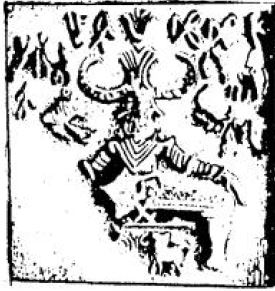
(a) Why were the seals used ?
Answer: These items played an essential role in commerce across the extensive territory of the civilization, as they have been unearthed at many different trade sites. They also carried brief written notes or symbols that likely served as signatures or messages, which scholars still cannot read.
In simple words: Seals were used to stamp trade goods sent to different cities. They also had short messages carved on them that we still cannot understand.
Exam Tip: Explain that seals served as commercial stamps to secure cargo and identify ownership during long-distance trade.
Question 8(b). Of what material were these seals made ?
Answer: The seals were typically crafted using materials such as baked clay (terracotta), soft soapstone (steatite), and semi-precious agate stones.
In simple words: The seals were carved out of materials like soft soapstone, terracotta clay, and agate.
Exam Tip: Mention at least three materials: steatite (soapstone), terracotta, and agate.
Question 8(c). What do they reveal about the Harappans ?
Answer: These artifacts offer deep insights into their spiritual and mythological world. The engravings illustrate their devotion to figures like the Mother Goddess and Lord Pashupati, along with their holy regard for specific trees and animals.
In simple words: The seals show us what they believed in, including their worship of the Mother Goddess, a horned god, and holy trees and animals.
Exam Tip: Highlight that carvings of Pashupati, the Mother Goddess, and animals are key windows into their mythology.
Question 9. Describe the social life of the Harappan people with reference to: (a) Their Diet. (b) Their Dress (c) Their Ornaments. (d)Their Sports and Games.
Answer:
(a) Diet: Their primary food consisted of farmed wheat and barley. They also enjoyed rice, sweet dates, dairy products, fresh vegetables, and fruits. For meat, they consumed beef, mutton, poultry, river fish, and turtles.
(b) Attire: Most citizens wore simple clothing made of cotton or winter wool. Men draped a shawl over the left shoulder and tucked it under the right arm, paired with a lower dhoti-like wrap. Women wore a short skirt fastened by a waistband.
(c) Jewelry: People of all social classes, rich or poor, loved wearing ornaments. Artisans crafted beautiful pieces using gold, silver, copper, and precious stones. Common items for both genders included necklaces, rings, and armbands, while women additionally wore earrings, bangles, anklets, and headbands.
(d) Recreation: Playing with dice, rolling marbles, and throwing balls were very common pastimes. They enjoyed singing, playing music, and dancing. Children played with clay toys, whistles, rattles, and small dolls. Adults also enjoyed outdoor activities like hunting and fishing.
In simple words: They ate grains, fruits, vegetables, and meat or fish. They wore simple cotton or wool dhotis and shawls. Everyone wore jewelry made of metals and beads, and they enjoyed games like dice, toys for children, and dancing or hunting.
Exam Tip: Organize your answer under the four requested headings (Diet, Dress, Ornaments, Sports) to help the examiner grade your paper easily.
Question 10. What do you know about the trade and commercial activities of the Harappan people?
Answer: The Harappans maintained widespread business networks across southern and eastern regions of India, Kashmir, and other Asian territories. They brought in precious gemstones and metals from abroad and conducted trade with Egypt and Crete. Merchants moved goods via overland caravans as well as sea lanes, with ship drawings on seals indicating a busy maritime trade.
In simple words: They had an active trading system, importing gems and metals from other parts of India and Asia. They also traded by land and sea with Egypt and Crete.
Exam Tip: Emphasize both regional (within the subcontinent) and international (Egypt, Crete, Mesopotamia) commercial networks.
Question 11. With reference to the art and craft of the Harappan people, explain their achievements in the following fields: (a) The Art of Sculpture. (b)The Art of Carving.
Answer:
(a) Sculpture: They were exceptionally skilled at sculpting. They understood how to work with gold, silver, copper, and bronze, and possessed deep knowledge of precious stones to create diverse figurines. The famous bronze dancing girl is a masterclass in metal casting. Their stone works, such as the bearded nobleman's bust and the red stone male torso, show immense talent. They also excelled in clay modeling, producing exquisite terracotta figures of the Mother Goddess along with toys resembling birds, dogs, sheep, and bulls.
(b) Carving: Indus artisans reached incredible levels of skill in carving flat surfaces. Their engravings of beasts on square seals are highly detailed and lifelike. They beautifully depicted creatures like the bull, elephant, bison, and the mythical one-horned unicorn.
In simple words: They excelled in making statues from metal, stone, and clay, like the bronze dancing girl and terracotta Mother Goddess. They were also masters at carving highly detailed animal figures onto stamp seals.
Exam Tip: Break down your answer into sculpture (metal/stone/clay) and carving (finely detailed seals) to show comprehensive art history knowledge.
Question 12. India is well-known for her deep-rooted tradition in arts and crafts. Substantiate this statement by a brief mention of the following: (a) The Harappan Pottery. (b) Harappan art of Spinning. (c) Harappan Metal-craft.
Answer:
(a) Pottery: Their pottery skills were exceptional. Using a wheel, potters crafted vessels of diverse shapes and sizes, including large jars and elegant vases. Plain pottery served daily cooking needs, while glazed, colorful, and painted vessels were used for keeping precious items. Excavated baking kilns show they fired clay with great control.
(b) Spinning: The discovery of numerous spindle-whorls inside homes shows that spinning cotton and wool was a widespread household activity. These tools were made from porcelain or clay. Additionally, finding a dyer's container suggests they dyed their clothing in various colors.
(c) Metalworking: Artisans had mastered working with gold, silver, copper, and bronze. Skilled smiths created jewelry, drilled fine carnelian beads, cast figurines, and mixed alloys. Women wore gorgeous metal jewelry like necklaces, bracelets, armlets, and earrings, while metal sheets were beaten to make durable copper vessels.
In simple words: First, they made various painted and plain pots using a potter's wheel. Second, they spun cotton and wool at home and dyed their clothes. Third, they made beautiful jewelry and utensils from gold, silver, copper, and bronze.
Exam Tip: Use the three headings (Pottery, Spinning, Metal-craft) and mention specific discoveries like dyer's vats and carnelian beads.
Question 13. The Seals may be considered as the most valuable finds of the Harappan Civilization. In this context give (a) Details of the Animals Seals, the Unicorn Seal and the Pashupati Seal. (b) Reasons why the Seals are important.
Answer:
(a) Seal Varieties: Excavations have uncovered over 2,000 square or rectangular seals made of ivory, terracotta, or soapstone. Many feature exquisite carvings of creatures like elephants, tigers, buffaloes, and bulls, with the humped-bull being particularly detailed. The Unicorn seals show a mythical one-horned animal facing a sacred vessel, likely used in worship. The famous Pashupati seal depicts a three-faced male god wearing a horned crown, sitting in a yoga pose and surrounded by wild beasts, with later discoveries showing similar figures crowned with flowers.
(b) Significance: These seals are highly valuable because they reveal the hairstyles, clothing, and jewelry worn by the people. They tell us which animals they domesticated and provide clues about their religious practices, trade networks, artistic talents, and early writing system.
In simple words: Over 2,000 square soapstone or clay seals have been found, showing animals like the humped-bull, a mythical unicorn, and a Shiva-like god. These seals are important because they show their clothes, hairstyles, religion, trade, and script.
Exam Tip: Discuss the artistic excellence of the humped-bull and unicorn seals, and explain how seals served as primary sources of social and religious history.
Free study material for History Civics
ICSE Selina Concise Solutions Class 9 History Civics Chapter 1 The Harappan Civilization
Students can now access the detailed Selina Concise Solutions for Chapter 1 The Harappan Civilization on our portal. These solutions have been carefully prepared as per latest ICSE Class 9 syllabus. Each solution given above has been updated based on the current year pattern to ensure Class 9 students have the most updated History Civics content.
Master Selina Concise Textbook Questions
Our subject experts have provided detailed explanations for all the questions found in the Selina Concise textbook for Class 9 History Civics. We have focussed on making the concepts easy for you in Chapter 1 The Harappan Civilization so that students can understand the concepts behind every answer. For all numerical problems and theoretical concepts these solutions will help in strengthening your analytical skill required for the ICSE examinations.
Complete History Civics Exam Preparation
By using these Selina Concise Class 9 solutions, you can enhance your learning and identify areas that need more attention. We recommend solving the History Civics Questions from the textbook first and then use our teacher-verified answers. For a proper revision of Chapter 1 The Harappan Civilization, students should also also check our Revision Notes and Sample Papers available on studiestoday.com.
FAQs
You can download the verified Selina Concise solutions for Chapter 1 The Harappan Civilization on StudiesToday.com. Our teachers have prepared answers for Class 9 History Civics as per 2026-27 ICSE academic session.
Yes, our solutions for Chapter 1 The Harappan Civilization are designed as per new 2026 ICSE standards. 40% competency-based questions required for Class 9, are included to help students understand application-based logic behind every History Civics answer.
Yes, every exercise in Chapter 1 The Harappan Civilization from the Selina Concise textbook has been solved step-by-step. Class 9 students will learn History Civics conceots before their ICSE exams.
Yes, follow structured format of these Selina Concise solutions for Chapter 1 The Harappan Civilization to get full 20% internal assessment marks and use Class 9 History Civics projects and viva preparation as per ICSE 2026 guidelines.