

ICSE Solutions Selina Concise Class 9 History Civics Chapter 10 The Mughal Empire have been provided below and is also available in Pdf for free download. The Selina Concise ICSE solutions for Class 9 History Civics have been prepared as per the latest syllabus and ICSE books and examination pattern suggested in Class 9. Questions given in ICSE Selina Concise book for Class 9 History Civics are an important part of exams for Class 9 History Civics and if answered properly can help you to get higher marks. Refer to more Chapter-wise answers for ICSE Class 9 History Civics and also download more latest study material for all subjects. Chapter 10 The Mughal Empire is an important topic in Class 9, please refer to answers provided below to help you score better in exams
Selina Concise Chapter 10 The Mughal Empire Class 9 History Civics ICSE Solutions
Class 9 History Civics students should refer to the following ICSE questions with answers for Chapter 10 The Mughal Empire in Class 9. These ICSE Solutions with answers for Class 9 History Civics will come in exams and help you to score good marks
Chapter 10 The Mughal Empire Selina Concise ICSE Solutions Class 9 History Civics
Question 1. Name any two sources to reconstruct the Age of the Mughals.
Answer: Two primary historical records from this period are the Ain-i-Akbari and the Akbarnama.
In simple words: We can learn about the Mughal era from books like the Ain-i-Akbari and the Akbarnama.
Exam Tip: Mentioning these two key literary works will ensure you get full marks for source-based questions on the Mughals.
Question 2. Who wrote Ain-i-Akbari.
Answer: Abul Fazal is the writer who composed the Ain-i-Akbari.
In simple words: Abul Fazal wrote the famous book Ain-i-Akbari.
Exam Tip: Always spell the name of the author, Abul Fazal, correctly to avoid losing marks.
Question 3. What information does Abul Fazl provide about Akbar’s Admiralty Department ?
Answer: According to the accounts of Abul Fazl, the Admiralty Department was responsible for:
1. Constructing various watercraft and vessels.
2. Hiring experienced and capable sailors.
In simple words: This department had two main jobs: making boats and finding good sailors to run them.
Exam Tip: State the two main functions clearly in a numbered list as given in the textbook.
Question 4. Name any two monuments that help to reconstruct the history of the Mughals.
Answer: Valuable architectural structures that aid in studying this era include Humayun's Tomb and the Agra Fort.
In simple words: Buildings like Agra Fort and Humayun's Tomb help us study Mughal history.
Exam Tip: Examples of monuments are highly scoring; ensure you name prominent ones like Agra Fort or Taj Mahal.
Question 5. Name the two magnificent buildings within the Red Fort.
Answer:
1. Diwan-i-Aam: This served as a hall for public audiences and gatherings.
2. Diwan-i-Khas: A richly decorated chamber where the Peacock Throne was housed. The monarch utilized this space to hold private meetings with royal princes, high-ranking nobles, and other eminent guests.
In simple words: The Red Fort has the Diwan-i-Aam for meeting regular people and the Diwan-i-Khas for meeting special guests like princes.
Exam Tip: Be sure to distinguish between 'Aam' (public) and 'Khas' (private/special) when describing these halls.
Question 6. Mention any two architectural features of the Jama Masjid at Delhi.
Answer:
1. The mosque stands on a raised platform that is roughly 9 meters tall with an area of 1170 square meters. It features three grand entryways, reached by large staircases on the northern, southern, and eastern sides, with the grandest eastern entrance originally set aside for the rulers.
2. It features two beautiful minarets on its north and south sides, which stand nearly 40 meters tall. Each of these minarets is split into three levels with extending balconies.
In simple words: This huge mosque is built on a high platform and has beautiful tall towers called minarets on its sides.
Exam Tip: When asked for two features, select the easiest ones to remember, such as the high platform, gateways, or the minarets.
Question 7. In whose memory was the Taj Mahal built ?
Answer: This monument was constructed by Emperor Shah Jahan to honor his dear wife, Queen Mumtaz Mahal.
In simple words: Shah Jahan built the Taj Mahal to remember his beloved wife, Mumtaz Mahal.
Exam Tip: Note that it was built as a memorial for Mumtaz Mahal, which is the key historical fact.
Question 8. Whom did Babur defeat at the battlefield of Panipat? What was its consequence?
Answer: In April 1526, Babur triumphed over Sultan Ibrahim Lodi during the historic battle at Panipat. This success was driven by his excellent military command and the advanced firearms he obtained from Turkey, establishing him as the ruler of India. Following this, he faced a powerful challenge from Rana Sanga of Mewar, who united the Rajput clans. However, Babur's subsequent triumph at Khanua secured his dominance over central India.
In simple words: Babur beat Ibrahim Lodi at Panipat in 1526 using better weapons and clever plans, making him the ruler of India. Later, he also beat the Rajputs to control central India.
Exam Tip: Remember to state both the direct opponent defeated (Ibrahim Lodi) and the long-term impact of establishing Mughal rule.
Question 9. What was the result of Babur’s encounter with a huge confederacy of Rajputs at Khanua?
Answer: The clash at Khanua ended in a decisive win for Babur against the alliance of Rajput forces. This triumph allowed the Mughal ruler to gain absolute authority over the central regions of India.
In simple words: Babur won the battle at Khanua against the Rajput alliance, which helped him take full control of central India.
Exam Tip: The Battle of Khanua is significant because it consolidated Mughal authority by breaking the power of the Rajput confederacy.
Question 10. What is the significance of the Second Battle of Panipat (1556)?
Answer: Occurring in November 1556, this clash pitted the Mughal forces against Hemu, who was related to Sher Shah Suri. The encounter ended with the defeat of the Afghan forces, and Hemu himself was caught and executed, securing the Mughal throne.
In simple words: In this battle, the Mughals defeated the Afghan army led by Hemu. Hemu was captured and killed, which helped the Mughals keep their power.
Exam Tip: Highlight that this battle marked the end of the Afghan threat to Akbar's newly restored empire.
Question 11. Name any two Deccan territories included in Akbar’s empire.
Answer: Two southern regions annexed into Akbar's realm were Ahmadnagar and Bijapur.
In simple words: Ahmadnagar and Bijapur were two territories in the south that became part of Akbar's empire.
Exam Tip: Knowing at least two Deccan kingdoms (like Ahmadnagar, Bijapur, or Golconda) is essential for mapping the expansion of Akbar's empire.
Question 12. What was Akbar’s Mansabdari System ?
Answer: This administrative framework, created by Akbar, served as a cornerstone of the Mughal governance model. The officers, known as mansabdars, held specific official grades or ranks ("mansabs") that defined their standing. These officers possessed significant administrative and military authority, with ranks spanning from 10 to 5000 for elite members. Their designations were split into two components: 'zat', indicating personal status, and 'sawar', indicating the required cavalry force. Additionally, for every group of ten soldiers, a mansabdar was required to keep twenty horses.
In simple words: Akbar created a system where officers called mansabdars were given ranks. These ranks showed how much power they had and how many horse-soldiers they had to bring to help the king.
Exam Tip: Clearly define the terms 'zat' (personal rank/salary) and 'sawar' (number of horsemen to maintain) as these are key terms examiners look for.
Question 13. Akbar’s Din-I-Ilahi was based on what principles or beliefs ?
Answer: This belief system rested on the concept of a single divine power, emphasizing moral values such as bravery, faithfulness, and fairness.
In simple words: It taught that there is only one God and that people should be brave, loyal, and fair to others.
Exam Tip: Focus on the ethical and moral values of Din-i-Ilahi rather than treating it as a complex theological system.
Question 14. Name any two Departments of Government during the Mughal Age.
Answer: Two key administrative branches of the Mughal state were:
1. The Military Pay and Accounts Office, which was supervised by the Mir Bakshi.
2. The Imperial Household Department, run under the authority of the Khan-i-Saman.
In simple words: Two departments were the military office run by the Mir Bakshi and the royal household office run by the Khan-i-Saman.
Exam Tip: When naming the departments, always mention the titles of the officials in charge (like Mir Bakshi or Khan-i-Saman) to score full marks.
Question 15. Who was at the head of the Finance Department under Mughal rule.
Answer: The official who directed the financial affairs of the empire was known as the Diwan.
In simple words: The Diwan was the chief officer in charge of all the money and taxes in the Mughal government.
Exam Tip: The term 'Diwan' is highly specific to Mughal revenue and finance administration; make sure to memorize it.
Question 16. Name the master architect who designed the Taj Mahal.
Answer: The primary designer responsible for the architectural plan of the Taj Mahal was Ustad Isa.
In simple words: Ustad Isa was the main architect who planned and designed the Taj Mahal.
Exam Tip: Be sure to spell "Ustad Isa" correctly as it is a specific proper name.
Question 17. Diwan-i-Khas in the Red Fort was used by the Emperor for what purpose ?
Answer: This highly decorated chamber was the site of the magnificent Peacock Throne. The ruler used this hall to host private meetings and grant audiences to royal family members, senior nobles, and visiting VIPs.
In simple words: This was a beautifully decorated hall where the king kept his Peacock Throne and met with royal family members and important leaders.
Exam Tip: Contrast the private nature of the Diwan-i-Khas with the public assemblies held in the Diwan-i-Aam.
Question 18. Mention any two factors responsible for Humayun’s failure against Sher Shah Suri.
Answer: The setbacks Humayun faced in his conflict with Sher Shah Suri can be attributed to:
1. His shortcomings as a military leader and strategist compared to the capabilities of his father, Babur.
2. A lack of determination and consistency in executing his long-term political and military strategies.
In simple words: Humayun was not as strong a military leader as his father, and he could not stick to a steady plan of action.
Exam Tip: Focus on Humayun's personal and strategic weaknesses relative to the highly organized administration of Sher Shah Suri.
Question 19. Mention any two revenue reforms instituted by Sher Shah Suri.
Answer: Among the financial and taxation policies introduced by Sher Shah Suri were:
1. Creating an organized and standardized system for measuring agricultural fields.
2. Carefully calculating the taxation rates on crops and ensuring a strict collection process.
In simple words: Sher Shah Suri made sure agricultural land was measured properly and that taxes were calculated and collected carefully.
Exam Tip: Measuring land (using the 'Sikandari gaz') and systematizing tax collections are classic reforms associated with Sher Shah Suri's reign.
Question 20. What is the significance of Akbar’s Mansabdari system?
Answer: This administrative method allowed Akbar to select qualified individuals directly as mansabdars. Because these appointees reported straight to the monarch and handled both civil governance and military leadership, the system streamlined the management of a massive empire, making it far more efficient.
In simple words: This system let the king choose good leaders directly to manage the army and run the towns, making the large empire easier to control.
Exam Tip: Emphasize the dual role of mansabdars as both military commanders and civil administrators to highlight the system's significance.
Question 21. Mention the nature of Akbar’s Din-I-Ilahi.
Answer: Introduced by the ruler in 1580, this ethical path focused on the belief in a single deity. It required followers to practice integrity, bravery, and fairness, while also pledging absolute devotion to the monarch.
In simple words: It was a moral group started in 1580 that believed in one God, promoted virtues like justice and courage, and required loyalty to Akbar.
Exam Tip: Note that Din-i-Ilahi was more of an ethical code of conduct than a rigid religious system, which was key to its tolerant nature.
Question 22. How did Jahangir deal with the Sikh Guru, Guru Arjun Dev?
Answer: Emperor Jahangir ordered the imprisonment, torture, and eventual execution of the fifth Sikh Guru, Guru Arjan Dev.
In simple words: Jahangir had the Sikh leader, Guru Arjan Dev, tortured and put to death.
Exam Tip: Mentioning the historical consequence of this event (the growing friction between Mughals and Sikhs) adds value to your answer.
Question 23. Why was the title of ‘Shah Jahan’ conferred on Prince Khurram by Jahangir ?
Answer: The honorific title, meaning 'Ruler of the World', was bestowed upon Prince Khurram following his marriage to the daughter of Asaf Khan. Asaf Khan served as the imperial household minister (Khan-i-Saman) and was the sibling of Jahangir's influential wife, Nur Jahan. This close alliance with the powerful palace faction led to the prince receiving the title.
In simple words: Prince Khurram married the daughter of Asaf Khan, who was a high official and the brother of Jahangir's powerful wife, Nur Jahan. This marriage and alliance earned him the title of Shah Jahan.
Exam Tip: Highlight the matrimonial alliance and the political influence of Nur Jahan's family (the Junta) as the reason behind this title.
Question 24. Who was Nur Jahan?
Answer: Originally the widow of a Persian noble named Sher Afghan, she later married Emperor Jahangir and became an exceptionally powerful empress.
In simple words: Nur Jahan was married to a Persian noble named Sher Afghan before she married Emperor Jahangir and became the queen.
Exam Tip: Mentioning her background and her subsequent rise to immense political power in the Mughal court helps paint a complete picture.
Question 25. Why did Shah Jahan revolt against his father?
Answer: The rebellion was triggered by the immense political sway that Nur Jahan held over Emperor Jahangir. Fearing her ambitions to secure her own power and sideline him in the succession, Shah Jahan developed deep suspicions. This rivalry led to a severe falling-out, prompting him to launch a rebellion against his father's rule.
In simple words: Shah Jahan rebelled because his father was heavily influenced by Queen Nur Jahan. Shah Jahan feared her political ambitions would leave him without power, causing a major disagreement.
Exam Tip: Emphasize the rivalry between Shah Jahan and Nur Jahan over royal succession as the main cause of the rebellion.
Question 26. Metnion Shah Jahan’s conquests in the Deccan.
Answer: During his campaigns in the southern region, Shah Jahan successfully brought Ahmadnagar, Bijapur, and Golconda under Mughal control.
In simple words: In the south, Shah Jahan won control over Ahmadnagar, Bijapur, and Golconda.
Exam Tip: Memorize these three key kingdoms of the Deccan to easily answer questions about Shah Jahan's southern campaigns.
Question 27. Where is Humayun’s Tomb located? Mention any two features of the monument.
Answer: The tomb of Humayun is situated in Delhi, built following the directions of his widow, Hamida Banu Begum. Two notable design elements of this structure are:
1. The tomb is built on an elevated square terrace with large arches on all sides, with each arch leading into a specific chamber.
2. It features a rounded marble dome with soft curves that sits on a distinct, narrow base.
In simple words: Humayun's Tomb is in Delhi. It is built on a high square platform and has a beautiful round marble dome on top.
Exam Tip: Mention both the location (Delhi) and distinct architectural elements like the high platform and double dome to secure full marks.
Structured Questions
Question 1. Akbar had both the time and inclination to look at the administrative problems of the Empire. In this context describe birefly.
(a) His Mansabdari System
(b) His Land Revenue System
Answer:
(a) Mansabdari System:
To streamline and coordinate the military and administrative machinery, Akbar launched the Mansabdari framework. Nearly all state officials, excluding judicial and religious heads, were integrated into this framework and tasked with maintaining a specific number of soldiers based on their designated rank. These officers were appointed directly by the ruler and received salaries in cash rather than land allotments. Apart from covering personal costs, each officer had to use their salary to maintain a set number of horses, elephants, transport animals, and carts. They were bound to serve in any role or location as commanded by the monarch, performing both civilian administrative duties and military leadership. This structure allowed Akbar to attract highly talented individuals by offering generous pay and high societal status. Furthermore, this rank was not inheritable, and the ruler retained the authority to promote or remove any officer.
(b) His Land Revenue System:
Initially, no major changes were made to the existing agricultural tax system under Akbar's early rule. The situation changed when Todar Mal took charge of the revenue department as Diwan-i-Ashraf. He formulated a structured method that involved:
1. Conducting a detailed survey and measuring agricultural fields.
2. Categorizing land depending on how fertile and productive it was.
3. Setting specific tax rates that farmers could pay in either cash or agricultural produce.
Additionally, Akbar introduced the 'dahsala' system, which involved calculating the average crop yields and market prices over the preceding ten years. The state's tax share was set at one-third of this ten-year average yield. This reform removed the need for annual tax assessments, making the collection process much faster. Ultimately, Todar Mal's system successfully filled the royal treasury while protecting the livelihoods of the farmers, who could even get government loans during hard times, leading to a boost in farming, trade, and manufacturing.
In simple words: (a) Akbar organized his army and officers using ranks called mansabs. Officers had to bring soldiers and horses when needed, were paid in cash, and could be promoted or fired by the king. (b) Todar Mal measured the land and set fair taxes based on a ten-year average of crop prices and yields. This made tax collection simple and helped agriculture grow.
Exam Tip: For long-answer questions on Mughal administration, clearly separate the military (Mansabdari) and land tax (Todar Mal/Dahsala) reforms using appropriate headings.
Question 2. Akbar was the greatest of all medieval rulers of India. In this context describe: His policy of racial pacification and religious tolerance.
Answer: To establish social harmony across his diverse empire, Akbar pursued a path of religious and ethnic reconciliation. He did away with the discriminatory 'Jizya' tax on non-Muslims and made imperial government positions accessible to Hindus, particularly Rajput leaders. He supported Hindu intellectuals, scholars, and artists, and encouraged marriage alliances with influential Rajput households. In 1580, Akbar introduced the Din-i-Ilahi, an ethical philosophy centered on the oneness of God. It encouraged followers to practice virtues like bravery, purity, and fairness, alongside loyalty to the crown. Although this path attracted very few adherents and was never forced upon anyone, it highlighted Akbar's tolerant approach.
In simple words: Akbar stopped taxes on non-Muslims, gave Hindus important jobs in his government, and created a moral system called Din-i-Ilahi to unite people of different faiths.
Exam Tip: Discussing the abolition of Jizya and matrimonial alliances with Rajputs is crucial when detailing Akbar's religious tolerance.
Question PQ. Shah Jahan’s reign marks the climax of the Mughal dynasty and empire. In this context explain briefly:
(a) His Conquests.
(b) Magnificence of the Imperial Court and his Architectural. Achievements.
Answer:
(a) His Conquests:
In 1632, Shah Jahan initiated a major military push against Ahmadnagar, which resulted in its annexation. He then demanded that the Deccan states of Bijapur and Golconda accept Mughal supremacy. To enforce this, the Emperor personally traveled to the south. While the ruler of Golconda agreed to Mughal dominance by 1636, military intervention was required to make Bijapur submit. In the north-west, where the empire had experienced setbacks after Akbar's death, Shah Jahan managed to reclaim Kandahar in 1638. However, this success was temporary, as the Shah of Persia recaptured the region in 1649, and subsequent Mughal attempts to win it back failed. Additionally, the Emperor successfully crushed a local rebellion led by Jujhar Singh, the son of Bir Singh Bundela.
(b) Magnificence of the Imperial Court and his Architectural Achievements:
The Emperor designed his royal court in the grand style of ancient Persian rulers, enhanced by the addition of the legendary Kohinoor diamond and the precious Peacock Throne. Shah Jahan was a dedicated supporter of scholars, writers, and artists. His reign saw the creation of brilliant architectural marvels, such as the Taj Mahal in Agra and the Jama Masjid in Delhi. Creative fields like music and painting also flourished under his generous support.
In simple words: (a) Shah Jahan added Ahmadnagar to his empire, made Deccan kingdoms submit, and briefly took Kandahar before losing it back to Persia. (b) He lived in a grand court with the Peacock Throne, built the Taj Mahal and Jama Masjid, and supported arts and music.
Exam Tip: Highlight both Shah Jahan's territorial expansions (especially in the Deccan) and his contributions to world heritage architecture like the Taj Mahal.
Question 3. Aurangzeb died forlorn and destitute. In this context, explain briefly:
(a) His dealings with the Sikh
(b) His attempts to suppress rebellion in the Deccan.
Answer:
(a) His dealings with the Sikh Gurus:
Aurangzeb maintained an orthodox religious policy, actively seeking to convert non-Muslim populations to Islam. When Kashmiri pandits approached the ninth Sikh leader, Guru Tegh Bahadur, at Anandpur Sahib to ask for protection against these forced conversions, Aurangzeb was deeply angered by this assistance. He captured the Guru and brought him to Delhi, demanding that he either convert to Islam or be executed. When Guru Tegh Bahadur refused to change his faith, he was publicly executed at Chandni Chowk, where Gurudwara Sis Ganj stands today. The conflict intensified in 1704 when Mughal forces attacked Anandpur, leading to a fierce battle with Sikh fighters led by Guru Gobind Singh. The Guru's young sons, Zorawar Singh and Fateh Singh, were captured and executed by being walled up alive after they refused to convert. This bitter hostility culminated in the Battle of Muktsar, leaving a legacy of lasting conflict between the Sikhs and the Mughal state.
(b) His attempts to suppress rebellion in the Deccan:
Following the passing of Shivaji, his eldest son Shambhaji took leadership of the Marathas. The situation grew complex when Aurangzeb's rebellious son, Prince Akbar, sought refuge at the Maratha court. Concerned that the Marathas, the rebel prince, and the southern kingdoms of Bijapur and Golconda would unite against him, Aurangzeb moved south in 1681. While he successfully annexed Bijapur in 1686 and Golconda shortly after, and even captured and executed Shambhaji in 1689, he could not completely defeat the Marathas. They crowned Shambhaji's brother, Raja Ram, and continued their resistance from forts like Jinji, despite the capture of Shambhaji's wife and young son, Sahu. Following Raja Ram's death in 1700, his widow Tara Bai championed the Maratha cause on behalf of her young son. Aurangzeb spent his final years unsuccessfully moving from one siege to another, and after a quarter-century of exhausting campaigns in the Deccan, he passed away in 1707, having drained his treasury and damaged his imperial reputation.
In simple words: (a) Aurangzeb executed Guru Tegh Bahadur for protecting Kashmiri Hindus and later executed Guru Gobind Singh's young sons, causing a permanent conflict with the Sikhs. (b) He spent 25 years fighting in the south to defeat the Marathas and southern kingdoms, which eventually exhausted his army, money, and health before his death in 1707.
Exam Tip: Detail both the religious confrontation in the north (Sikhs) and the exhausting military struggle in the south (Deccan Ulcer) to show why Aurangzeb died destitute.
Question 4. Describe the Mughal Administration under the following headlines:
(a) Position of the Monarch
(b) Main Departments of Government
Answer:
(a) Position of the Monarch:
Mughal rulers like Humayun and Akbar viewed kingship as a divine gift, describing royalty as a light sent from God. The administration was a centralized monarchy where the emperor held absolute power. The ruler served as the chief of administration, the supreme military commander, and the final source of justice, with his declarations carrying the force of law.
(b) Main Departments of Government:
While the Vizier occupied the most prestigious office right beneath the monarch, the national treasury and financial matters were managed by the Diwan. The administration was divided into several key departments:
1. The military pay and accounts, overseen by the Mir Bakshi.
2. The royal household affairs, managed by the Khan-i-Saman.
3. The administration of justice, directed by the Chief Qazi. Additional administrative officers of junior rank included:
1. The Daroga-i-Topkhana, who directed the artillery division.
2. The Superintendent of the Mint.
3. The Mir Arz, who presented petitions and requests to the monarch.
In simple words: (a) The king had absolute power, was seen as chosen by God, and controlled the military, laws, and courts. (b) Below him, the Vizier was the highest officer, the Diwan ran finance, and other officials managed the army, royal household, and courts.
Exam Tip: Clearly outline the absolute powers of the Emperor in section (a), and list the distinct departments with their specific officers in section (b).
Question 5. Describe the Mughal Administration with reference to the following:
(a) The Army and the Navy
(b) Administration of Law and Justice
Answer:
(a) The Army and the Navy:
The military forces of the Mughal Empire consisted of five main divisions:
1. Foot soldiers (infantry)
2. Horse soldiers (cavalry)
3. Heavy and light artillery
4. Sea and river forces (navy)
5. Trained elephants for combat The artillery was divided into heavy weapons for capturing forts and lighter, mobile guns. The Admiralty looked after boat construction, hiring skilled sailors, and gathering river tolls. Over time, the introduction of the flintlock gun made the infantry a highly effective force. However, the army suffered from structural issues; soldiers often pledged loyalty to their immediate commanders rather than the emperor. Additionally, campaigns resembled a traveling town, accompanied by family quarters, servants, and musicians, which introduced luxury and undermined discipline.
(b) Administration of Law and Justice:
The Chief Qazi presided as the highest judicial authority in the empire and was responsible for selecting judges for various provinces. Court cases were handled by a team consisting of Qazis, Muftis, and Mir-adls. In this setup, Muftis explained Islamic legal principles, while the Mir-adls drafted and delivered the verdicts. Judges could issue heavy penalties and physical punishments without consulting the ruler, but any death sentence required the emperor's direct approval. Ultimately, the emperor remained the highest court of appeal.
In simple words: (a) The army had infantry, cavalry, artillery, elephants, and a navy. However, soldiers were often more loyal to their direct officers than the king, and bringing families and servants on campaigns weakened discipline. (b) The Chief Qazi headed the courts, with Muftis explaining the law and Mir-adls giving verdicts, though only the Emperor could approve a death sentence.
Exam Tip: For the army, mention the five main branches and why lack of discipline was a weakness. For justice, name the roles of Qazis, Muftis, and Mir-adls.
Question PQ. Give an account of the social developments during the Mughal Age under the following headlines:
(a) Social Structure
(b) Position of Women
Answer:
(a) Social Structure:
Mughal society was broadly divided into three distinct social tiers:
1. Royal family members and aristocrats (nobles)
2. The middle-income group
3. The working class, consisting of peasants and laborers The wealthy nobility enjoyed a life of immense luxury, wearing fine silk and precious gems, decorating their homes with exquisite carpets, dining on fine food, and living in grand palaces. It was common for this upper class to own and trade slaves. The middle tier - comprising traders, business owners, artists, musicians, scholars, and religious figures - maintained a lifestyle appropriate to their work. In contrast, the lowest tier of landless farmworkers and laborers faced a harsh, subsistence-level existence. During the later years of Shah Jahan's reign, farmers faced severe exploitation by tax officers, and they suffered the most during periods of drought and famine.
(b) Position of Women:
Generally, women faced difficult social conditions during this era. Practices like child marriage were widespread, and though Akbar tried to prevent early marriages, these efforts had little impact. Having multiple wives (polygamy) was common, and the practice of Sati persisted in Hindu communities despite various imperial decrees against it. Despite these social hurdles, several exceptional women achieved great prominence in politics and society, including Rani Durgavati, Chand Sultana, Nur Jahan, Jijabai, and Jahanara.
In simple words: (a) Society had three classes: rich nobles who lived in luxury, a middle class of merchants and artists, and a poor working class of peasants who faced hard times. (b) Most women faced tough lives with practices like child marriage and Sati, though some exceptional women became powerful leaders.
Exam Tip: Describe the contrast between the luxurious life of the nobles and the struggles of the peasantry to show the economic divide.
Question PQ. The Growing harmony between various religious communities was a marked feature of social life during the reigns of rulers from Akbar to Shah Jahan. In this context explain briefly:
(a) Growing harmony between Hindus and Muslims
(b) Growth of the Bhakti Movement and Sufism in the Mughal period.
Answer:
(a) Growing harmony between Hindus and Muslims:
A notable aspect of this period was the increasing cultural blending between the Hindu and Muslim communities. Akbar's open-minded and inclusive policies did much to bring the two groups together. By removing the 'Jizya' tax on non-Muslims and inviting Hindu Rajput leaders into the administrative ranks, he fostered mutual respect. His marriages to Hindu princesses brought traditional rituals into the imperial household, allowing festivals like Durga Puja to be observed in the court. Simultaneously, wealthy Hindu landholders adopted Mughal customs, styles of dress, and cuisine, while upper-class Muslims regularly joined their Hindu neighbors in celebrating festivals like Holi and Diwali.
(b) Growth of the Bhakti Movement and Sufism in the Mughal period:
The Bhakti and Sufi movements expanded and gained widespread popularity during the 17th and 18th centuries. Prominent spiritual figures, such as Saint Tukaram in Maharashtra, drew large followings. Sufism had a major impact on the culture, with Akbar himself being deeply influenced by Sufi mysticism and Hindu saintly teachings. In eastern regions like Bengal and Orissa, the teachings of Shri Chaitanya Mahaprabhu remained influential, while the Bhakti tradition maintained its hold in Rajasthan, Gujarat, and southern India. Additionally, noblemen like Raja Man Singh of Amber actively supported and patronized Vaishnavism.
In simple words: (a) Hindus and Muslims lived in harmony as Akbar stopped discriminatory taxes, shared cultural customs, and celebrated each other's festivals like Diwali and Durga Puja. (b) Spiritual movements like Sufism and Bhakti grew popular, led by saints like Tukaram and Chaitanya, encouraging love and devotion across the region.
Exam Tip: Mention the mutual exchange of customs (such as food, dress, and festivals) as evidence of cultural synthesis during this era.
Question 6. Study the picture of the Red Ford and answer the following questions:
(a) Where is the Fort located ?
(b) Name the ruler who built it ?
(c) Mention two important buildings within its enclosure
(d) Mention three important features of the Fort
(e) Mention one occasion when the Fort is used by the Government of India
Answer:
(a) The monument is situated in Delhi.
(b) It was constructed by the Mughal ruler Shah Jahan between 1639 and 1648.
(c) Key structures inside the complex include the Diwan-i-Aam (public audience hall) and the Diwan-i-Khas (private audience hall).
(d) The fort is enclosed by towering defensive walls featuring two primary entry points. The Lahori Gate, facing west, served ceremonial functions, while the other was reserved for private entry. Additionally, it houses the richly decorated Diwan-i-Khas, which once held the Peacock Throne.
(e) Each year on August 15th, the Prime Minister of India gives a national address from the fort's walls to mark Independence Day.
In simple words: (a) The Red Fort is in Delhi. (b) It was built by Emperor Shah Jahan. (c) Inside, you can find the Diwan-i-Aam and Diwan-i-Khas. (d) It has huge walls with two main gates, and holds beautiful rooms. (e) The Prime Minister speaks from here every year on Independence Day.
Exam Tip: When answering picture-based questions, make sure to read all parts (a to e) carefully and provide short, precise answers for each.
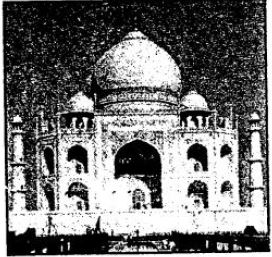
Question 7. Identify the picture given below and answer the following question:
(a) Where is it located ?
(b) By whom was it built ?
(c) Name the architect who designed the monument
(d) Mention two architectural features of the monument.
Answer:
(a) The Taj Mahal is situated in the city of Agra.
(b) This structure was built under the orders of Emperor Shah Jahan.
(c) The master designer behind this monument was Ustad Isa.
(d)
1. The monument is constructed using high-quality white marble.
2. It is built upon an elevated platform with decorative dome-like structures (cupolas) at every corner.
3. It has four tall towers (minarets) standing at each corner of the terrace.
In simple words: (a) The Taj Mahal is in Agra. (b) It was built by Shah Jahan. (c) It was designed by Ustad Isa. (d) It is made of white marble, sits on a high platform, and has four minarets at the corners.
Exam Tip: For picture-based questions, ensure you can identify key Mughal monuments like the Taj Mahal, Red Fort, and their respective architectural highlights.
Question 8. The Mughal rulers of India were patrons of learning and scholars. In this context, describe briefly:
(a) The growth of Persian Literature in those times.
(b) The growth of Hindi Literature during the age of the Mughals.
Answer: (a) During the rule of the Mughal emperors, the Persian tongue advanced significantly. Many scholars of Persian moved to India and found a place in the court of Akbar. A highly famous historian from his court was Abul Fazal, the creator of the Ain-i-Akbari, which outlines the judicial and financial systems of the empire. He also composed the Akbarnama, which describes Akbar's personal life and the wider Mughal dynasty. Other notable historical writers of this period include Nizam-ud-din Ahmad, who penned Tabakat-i-Akbari, and Badauni, the author of Muntakhab-ut-Twarikh. The emperor also promoted translating literary pieces from Sanskrit into Persian. Parts of the Mahabharata were compiled into a Persian book after translation, while Badauni translated the epic Ramayana. Additionally, Abul Fazal translated the Panchatantra, and the celebrated scholar Faizi rendered several other classic Hindu works into Persian. This tradition of translating works from Sanskrit to Persian remained active during Jahangir's reign.
(b) Tulsidas, a prominent devotional poet focused on Lord Rama, composed the Ram Gitawali and the highly celebrated Ram Charitmanas, which praises Rama's life and stands as a classic of Hindi literature. Another famous figure, Surdas, wrote the Sursagar, capturing stories from the youth of Lord Krishna. Akbar's encouragement of Hindi writing drew several talented poets to his court. Several of Akbar's courtiers, including Birbal, Raja Man Singh, and Raja Bhagwan Das, were highly recognized for their Hindi poetry. Birbal was even given the title of 'Kavipriya' by Akbar for his poetic skill. The most outstanding Hindi poet in Akbar's court was Abdur Rahim Khan-i-Khanan, whose short couplets (dohas) are still widely read and admired today. Additionally, Malik Muhammad Jayasi wrote the famous epic poem Padmawat, and during Shah Jahan's reign, the writer Sundar received the title 'Mahakavi Rai' for his work Sundar Sringar.
In simple words: Mughal kings loved art and books. They helped scholars translate Sanskrit books into Persian and supported famous Hindi poets like Tulsidas and Rahim.
Exam Tip: When writing about literature, remember to pair the author's name directly with their famous work (like Abul Fazal with Ain-i-Akbari and Tulsidas with Ram Charitmanas) to secure maximum marks.
Question 9. What role did the following factors play in decline and downfall of the Mughal Empire:
(a) Aurangzeb’s policies.
(b) Incompetence of the Later Mughals.
(c) Foreign Invasions.
Answer: Several factors led to the weakening and eventual collapse of the Mughal rule:
(a) Aurangzeb's Policies: Aurangzeb followed a very strict Sunni Muslim lifestyle. His simple living and piety earned him the title of 'Zinda Pir' or Living Saint from the religious clergy. However, in 1669, he banned the construction of new temples and allowed several older ones to be demolished, with the shrines at Varanasi and Mathura being major targets. He also brought back the Jizyah tax on non-Muslims. These actions alienated his Hindu subjects, especially the Rajputs, who had previously served as strong supporters of the empire.
(b) Incompetence of the Later Mughals: The rulers who succeeded Aurangzeb were weak and lacked the ability to run the vast administration. They allowed state affairs to decline without taking proper control. Due to their weakness, regions like Bengal, Awadh, and the Deccan broke away from central control. At the same time, regional powers like the Sikhs, Marathas, and Jats grew stronger. In 1739, the Persian ruler Nadir Shah invaded and looted Delhi, taking away invaluable treasures like the Peacock Throne and the Kohinoor diamond. This devastating blow shattered the empire's remaining strength. Finally, the last ruler, Bahadur Shah II, acted as a nominal leader during the Revolt of 1857, after which he was exiled to Rangoon by the British, where he passed away in 1862.
(c) Foreign Invasions: Nadir Shah's invasion in 1739 exposed the deep vulnerabilities of the shrinking Mughal realm to further foreign attacks. Soon after, Ahmad Shah Abdali launched multiple invasions, reaching Delhi by 1757 and taking control of Punjab by 1759. This brought him into direct conflict with the Marathas, who were trying to establish their own rule. In 1761, Abdali defeated the Marathas at the Third Battle of Panipat. This clash shattered Maratha aspirations, accelerated the breakup of the Mughal dynasty, and opened the door for the rise of Sikh power in Punjab and the expansion of British rule across India.
In simple words: The Mughal Empire fell because of Aurangzeb's harsh policies, the weakness of his successors who lost control of their lands, and heavy attacks from foreign invaders like Nadir Shah and Ahmad Shah Abdali.
Exam Tip: Be sure to structure your response into the three specified headings: Aurangzeb's policies, incompetence of later rulers, and foreign invasions, as examiners look for organized, structured answers.
Question 10. Akbar was tbe greatest of all medieval rulers of India, In this context describe:
(a) His Concern about Law and Justice
Answer: Akbar viewed the quick delivery of justice as one of his most vital responsibilities. The main judicial authority in the empire was the Chief Qazi, who appointed provincial Qazis known for their fairness and honesty. These judges handled both civil and criminal matters, with larger cities having their own local Qazis. At the village level, local disputes were resolved by the Panchayat system. The highest authority above all regional and state courts was the Emperor himself, acting as the ultimate source of justice and the highest court of appeal. Those who were imprisoned were confined within forts.
In simple words: Akbar wanted justice to be served quickly. He had judges for cities and provinces, let villages use Panchayats, and acted as the final judge himself.
Exam Tip: Highlight the role of Qazis and the village Panchayat to demonstrate a complete understanding of Akbar's hierarchical judicial system.
Question 11. Describe Aurangzeb’s Administration under the following headlines: A Setback to the Policy of Religious Toleration Provincial Government
Answer: (a) A Setback to the Policy of Religious Toleration: Shortly after taking the throne, Aurangzeb turned away from the tolerant religious approaches of earlier rulers. While Akbar, Jahangir, and Shah Jahan had maintained relatively liberal views compared to the dynasty's founder, Aurangzeb's exact stance is more complex. His strict devotion to Sharia (Islamic law) and orthodox Islam is clear, but the precise impact of his policies remains debated. There are conflicting historical records regarding some of his sweeping decrees; for instance, the Fatwa-e-Alamgiri (a compilation of Islamic law) may have been created purely for personal guidance rather than public enforcement. Some historians argue its limited use was due to internal flaws, while others believe it was meant only for his own practice. It is also likely that the financial strain from wars of succession and ongoing battles, added to Shah Jahan's heavy building expenses, left no funds for cultural activities.
(b) Provincial Government: By Aurangzeb's reign, the total number of provinces had increased to twenty-one. To keep regional power balanced, the provincial Revenue Chief, or Diwan, kept a close eye on the Governor, or Subahdar, preventing any single official from gaining too much authority.
In simple words: Aurangzeb reversed the religiously tolerant policies of earlier kings and focused on orthodox Islamic laws. His empire grew to have twenty-one provinces, with a system where the governor and the tax officer watched over each other to balance power.
Exam Tip: Mention the name of the legal digest 'Fatwa-e-Alamgiri' and the number 'twenty-one' for the provinces to show precise factual knowledge.
Additional Questions
Short Answer Questions
Question 1. Name two important sources which provide information about the Mughals.
Answer: Two primary historical sources that offer insights into the Mughal era are the literary work Ain-i-Akbari and the historical monuments located at Fatehpur Sikri.
In simple words: We can learn about the Mughals from the book Ain-i-Akbari and the old buildings at Fatehpur Sikri.
Exam Tip: Memorize 'Ain-i-Akbari' and 'Fatehpur Sikri' as they are the most frequently asked source-based questions for this chapter.
Question 2. Name of the author of Ain-i-Akbari.
Answer: The renowned book Ain-i-Akbari was written by Abul Fazal.
In simple words: Abul Fazal wrote the book Ain-i-Akbari.
Exam Tip: Spelling historical names correctly, such as 'Abul Fazal', is essential for scoring full marks in one-word answers.
Question 3. What was the title of the Mahabharata translated into Persian ?
Answer: The Persian translation of the epic Mahabharata was titled the Razm Namah.
In simple words: When the Mahabharata was translated into Persian, it was named Razm Namah.
Exam Tip: Remember that 'Razm Namah' literally translates to 'Book of War', which is the Persian name given to the Mahabharata.
Question 4. Who was the architect who designed Humayun’s tomb?
Answer: The structural layout of Humayun's tomb was created by a Persian architect named Mirak Mirza Ghiyas, though the construction was completed by Indian craftsmen and builders. The central structure is raised on an 8.5-meter-high terrace and features arched openings along its sides.
In simple words: A Persian designer named Mirak Mirza Ghiyas designed Humayun's tomb, which was built on a high platform by Indian workers.
Exam Tip: Note that while Mirak Mirza Ghiyas designed the tomb, it was executed by Indian craftsmen. Highlighting this blend of Persian and Indian skill earns extra credit.
Question 5. Who built the Agra Fort ?
Answer: Akbar constructed the Agra Fort alongside the Yamuna River in Agra between the years 1565 and 1573.
In simple words: Akbar built the Agra Fort near the Yamuna River over several years in the late 1500s.
Exam Tip: Always state both the river (Yamuna) and the founder (Akbar) when asked about the construction details of the Agra Fort.
Question 6. Name two buildings located in Fatehpur Sikri.
Answer: Two major structures situated in Fatehpur Sikri are:
1. The residential palace of Akbar's Rajput queen, Jodha Bai.
2. The grand gateway known as the Buland Darwaza.
In simple words: Two famous structures in Fatehpur Sikri are the Palace of Jodha Bai and the Buland Darwaza.
Exam Tip: Buland Darwaza and Jodha Bai's Palace are two distinct, easy-to-remember structures of Fatehpur Sikri that are highly favored by examiners.
Question 7. Why did Akbar build Fatehpur Sikri ?
Answer: Akbar established Fatehpur Sikri to show the strength of his rule, convey spiritual messages to his people, and highlight the beauty and achievements of Islamic culture.
In simple words: Akbar built the city of Fatehpur Sikri to show off his empire's power and honor his religious beliefs.
Exam Tip: Focus on key terms like 'imperial power' and 'symbol of faith' when explaining the purpose behind building Fatehpur Sikri.
Question 8. Between whom was the First Battle of Panipat fought ?
Answer: The First Battle of Panipat took place between the forces of Babur and Ibrahim Lodi.
In simple words: The First Battle of Panipat was a fight between Babur and Ibrahim Lodi.
Exam Tip: Ensure you clearly distinguish between the First, Second, and Third Battles of Panipat, as mixing up the opponents is a common student error.
Question 9. Who invited Babur to India ? Why ?
Answer: The ruler of Punjab, Daulat Khan Lodi, sent an invitation to Babur to come to India so he could help overthrow Ibrahim Lodi from power.
In simple words: Daulat Khan Lodi, who ruled Punjab, asked Babur to come to India to remove Ibrahim Lodi from the throne.
Exam Tip: Mention Daulat Khan Lodi's specific motive - wanting to overthrow Ibrahim Lodi - to provide a complete and high-scoring answer.
Question 10. Who was defeated by Akbar at the Battle of Haldighati in 1576 ?
Answer: In the Battle of Haldighati fought in 1576, Akbar's forces overcame Maharana Pratap.
In simple words: Maharana Pratap lost to Akbar's army in the Battle of Haldighati in 1576.
Exam Tip: Always associate the Battle of Haldighati with Maharana Pratap and the year 1576 to ensure complete historical accuracy.
Question 11. Mention any two steps taken by Akbar to promote better understanding between the Hindus and the Muslims.
Answer: Akbar took the following steps to encourage harmony between Hindu and Muslim communities:
1. He removed the Jizyah tax that had been placed on non-Muslims, along with the tax charged to pilgrims visiting sacred sites like Prayag and Varanasi.
2. He appointed several Hindu leaders, especially Rajput rulers with whom he formed marriage alliances, to noble positions. He also granted official ranks (mansabs) based purely on skill and ability.
In simple words: Akbar helped Hindus and Muslims get along by removing taxes on non-Muslims and giving high government jobs to Hindu leaders.
Exam Tip: Clearly listing both religious reforms (like abolishing Jizyah) and political integration (like enrolling Hindu nobles) shows a well-rounded understanding.
Question 12. Name the two taxes abolished by Akbar.
Answer: The two specific taxes that Akbar ended were the Jizyah and the tax on religious pilgrims.
In simple words: Akbar stopped the Jizyah tax and the pilgrim tax.
Exam Tip: Keep these two specific taxes - Jizyah and pilgrim tax - on your quick-revision list as they are standard exam questions.
Question 13. Name the Mughal ruler who forbade the evil practice of Sati.
Answer: Aurangzeb was the specific Mughal emperor who banned the practice of Sati.
In simple words: Emperor Aurangzeb made a law to stop the practice of Sati.
Exam Tip: Do not confuse Akbar's social reforms with Aurangzeb's specific ban on Sati; attribution of historical acts must be precise.
Question 14. What principles did Akbar’s Din-i-Ilahi promote ?
Answer: This belief system centered around the concept of a single supreme deity, while highlighting moral values such as bravery, faithfulness, and fairness.
In simple words: Akbar's religion, Din-i-Ilahi, taught that there is only one God and encouraged people to be brave, loyal, and fair.
Exam Tip: Use terms like 'oneness of God' and moral virtues to describe Akbar's Din-i-Ilahi accurately.
Question 15. When and for what purpose did Akbar built the Ibadat Khana?
Answer: Constructed in 1575 within Fatehpur Sikri, the Ibadat Khana was created as a place where Akbar could bring together religious thinkers, mystics, and scholars of various faiths to debate and discuss spiritual topics.
In simple words: Akbar built the Ibadat Khana in 1575 so he could talk about religion and spiritual ideas with wise people from different faiths.
Exam Tip: Remember the year 1575 and specify that the Ibadat Khana was a house of debate for theologians of *all* major religions, not just Islam.
Question 16. Name the Mughal ruler whose reign was famous for ‘Chain of Justice’.
Answer: The reign of Jahangir is well-known for the installation of the 'Chain of Justice'.
In simple words: Emperor Jahangir is famous for setting up the 'Chain of Justice' for his subjects.
Exam Tip: Pair Jahangir's name directly with the 'Chain of Justice' (Zanjir-i-Adl) for quick points in matching or single-sentence questions.
Question 17. Name the two important centers of’trade during the Mughal Period.
Answer: Two major hubs of commerce in the Mughal era were Lahore and Delhi.
In simple words: Lahore and Delhi were two very busy trading cities during Mughal times.
Exam Tip: Lahore and Delhi are the primary inland trade centers of the Mughal era, so list them first before any coastal ports.
Question 18. Mention any two measures which indicate Nur Jahan’s important position during Jahangir’s reign.
Answer: Two key indicators of Nur Jahan's immense influence and power are:
1. She was elevated to the prestigious rank of 'Padshah Begum'.
2. Her name was minted on royal coins and was included alongside the emperor's signature on all official decrees (farmans).
In simple words: Nur Jahan had so much power that she was named 'Padshah Begum' and her name was put on royal coins and official documents.
Exam Tip: Mentioning that coins were struck in Nur Jahan's name is a critical piece of evidence demonstrating her unparalleled political status.
Question 19. Name the two English, ambassadors who came to Jahangir’s court. Who sent them and for what ?
Answer: The two English representatives who visited Jahangir's court were Captain Hawkins and Sir Thomas Roe. Sent by King James I of England, their goal was to secure beneficial trading rights and privileges within India.
In simple words: Captain Hawkins and Sir Thomas Roe were sent by King James I of England to ask the Mughal emperor for trading rights.
Exam Tip: Clearly link Captain Hawkins and Sir Thomas Roe to King James I to show the exact source of their diplomatic mission.
Question 20. Between whom was the Third Battle of Panipat fought ? Who emerged victorious in the battle ?
Answer: Fought in 1761, the Third Battle of Panipat took place between the Marathas and Ahmad Shah Abdali, with Abdali's forces securing a victory over the Marathas.
In simple words: The Third Battle of Panipat in 1761 was fought between the Marathas and Ahmad Shah Abdali, who won the battle.
Exam Tip: The year 1761 and the name Ahmad Shah Abdali are the essential keywords examiners look for when grading this question.
Question 21. Name the title given to the heads of the revenue department and the military department respectively in the Mughal Empire.
Answer: In the Mughal administration, the chief of finance and revenue was the wazir, also referred to as the diwan or diwan-i-ala, whereas the commander of the military division was known as the mir bakhshi.
In simple words: The finance head was called the diwan, and the military head was called the mir bakhshi.
Exam Tip: Do not swap these roles; the Diwan handles revenue/finance, while the Mir Bakhshi handles military administration.
Question 22. Who were mansabdars ? How were they paid ?
Answer: A mansabdar was an individual holding an official rank or position (known as a mansab) within the administrative and military hierarchy of the Mughal Empire. These officers made up the ruling elite and were compensated through land revenue grants called jagirs. Rather than living on or managing these lands directly, they simply collected the generated revenue through their agents.
In simple words: Mansabdars were royal officers who held a specific rank. Instead of cash, they were paid with the taxes collected from assigned lands called jagirs.
Exam Tip: Clearly explain the distinction between a mansabdar's rank (mansab) and their revenue assignment (jagir) to gain full marks.
Structured Questions
1. With reference to the Mughal Empire, explain briefly the significance of the following:
Question 1(a). Ain-i-Akbari.
Answer: Composed by Akbar's chief minister and close advisor Abul Fazal, this text formed a portion of a larger historical documentation project ordered by the emperor. Today, it serves as a highly valuable record detailing the administrative structure and cultural life during Akbar's rule. The volume is split into five distinct sections:
- The opening book focuses on the royal household and palace life.
- The second section describes the emperor's military, civil services, and court attendants.
- The third book outlines the empire's administrative laws, including judicial rules and regional divisions.
- The fourth part covers Hindu philosophy, sciences, social customs, and literature.
- The concluding section lists Akbar's personal words of wisdom and includes a biographical sketch of the author and his lineage.
In simple words: The Ain-i-Akbari, written by Abul Fazal, is a five-part book that explains Akbar's palace, his army, government rules, Indian culture, and Akbar's wise sayings.
Exam Tip: Briefly list what each of the five books of the Ain-i-Akbari covers to demonstrate depth of preparation.
Question 1(b). Monuments at Fatehpur Sikri.
Answer: Akbar constructed Fatehpur Sikri to showcase the strength of his realm, reflect spiritual teachings, and honor Islamic artistic traditions. Finished in 1578, the city housed a majestic palace complex where the royal court met for a short time before a severe water shortage forced everyone to leave. The site is famous for several magnificent buildings, such as the Panch Mahal, the massive Buland Darwaza gateway, a mosque and tomb honoring the Sufi saint Salim Chishti, a prayer space for Akbar's Din-i-Ilahi, the Diwan-i-Aam and Diwan-i-Khas for audiences, the residence of Jodha Bai, and Birbal's house.
In simple words: Akbar built the city of Fatehpur Sikri to show his power and faith, but it was soon abandoned because of a lack of water. It has beautiful buildings like the Buland Darwaza and Jodha Bai's palace.
Exam Tip: Mentioning the water crisis that led to Fatehpur Sikri's abandonment is an excellent detail that adds value to your answer.
2. With reference to the Mughal rule, state briefly:
Question 2(a). Akbar’s policy towards the Rajputs.
Answer: A key element of Akbar's strategy was building strong, friendly alliances with the Rajputs. He entered into marriage alliances, marrying Harkha Bai (Jodha Bai), the daughter of Raja Bharmal of Amber. Akbar treated his Rajput wives with great honor, even constructing a dedicated place of worship for Jodha Bai in Fatehpur Sikri. Under his rule, Rajput chiefs were treated as equal and influential partners in running the Mughal administration.
In simple words: Akbar made friends with Rajput rulers, married Rajput princesses, respected their religious customs, and gave them important roles in his government.
Exam Tip: Use the marriage of Akbar to Jodha Bai (Harkha Bai) as a prime example of his political and matrimonial alliance policy with Rajputs.
Question 2(b). Akbar’s policy of religious tolerance.
Answer: Akbar is highly celebrated for his approach of religious harmony and acceptance. He showed deep respect to all faiths and treated every religious community fairly. To support this, he did away with the discriminatory Jizyah tax and banned the practice of forcing captured prisoners of war to convert to Islam. Furthermore, in 1575, he established the 'Ibadat Khana' (House of Worship) where scholars from various religions could gather to share and debate their beliefs.
In simple words: Akbar respected all religions. He stopped taxes on non-Muslims, banned forced conversions, and built the Ibadat Khana so people of different faiths could talk together.
Exam Tip: For religious tolerance, always mention the removal of Jizyah and the creation of Ibadat Khana as core supporting evidence.
3. With reference to the administrative system in the Mughal Period, answer the following questions:
Question 3(a). What was the position of the monarch ?
Answer: Mughal court records frequently present the emperor as a ruler whose authority was granted directly by divine power. To emphasize this, they often shared the legend of Alanqua, a Mongol queen who was said to have been blessed by a beam of sunlight while in her tent. According to this story, her children inherited this sacred light, which was then handed down through the generations of rulers.
In simple words: The Mughal kings believed their power to rule came directly from God, like a special divine light passed down through their families.
Exam Tip: The myth of the Mongol queen Alanqua receiving the divine ray is a high-level detail that will distinguish your paper from others.
Question 3(b). Who were the three important ministers ?
Answer: Under the early rulers Babur and Humayun, the leading minister was the Vakil, who held extensive authority over military and administrative affairs, a role filled by Bairam Khan during the start of Akbar's reign. The financial affairs were handled by the Wazir, also called the Diwan or Diwan-i-ala, who oversaw the state's budget and revenue. The military department was directed by the Mir Bakhshi, who also supervised the intelligence networks of the empire.
In simple words: The three main ministers were the Vakil (prime minister), the Diwan (finance head), and the Mir Bakhshi (military and intelligence head).
Exam Tip: Be precise with the titles: Vakil (Prime Minister), Diwan (Revenue), and Mir Bakhshi (Military).
Question 3(c). How was the provincial government organised ?
Answer: The administrative territory of the empire was divided into twelve provinces called subahs, which were further split into districts called sarkars, and then into smaller areas known as parganas or mahals. A high-ranking mansabdar served as the governor (subahdar, sipah salar, or nazim) of each subah, managing law enforcement, implementing imperial orders, and overseeing tax collection. Working alongside him was the provincial diwan, who handled financial matters in a way similar to the central finance minister. Other essential local officers included the faujdar, kotwal, bakhshi, sadr, qazi, and muhtasib.
In simple words: The empire was divided into provinces, districts, and villages. Each province had a governor to keep peace and a diwan to handle money, helped by other local officers.
Exam Tip: Practice drawing the administrative chain: Empire -> Subah (Province) -> Sarkar (District) -> Pargana (Tehsil) to visualize and remember the hierarchy easily.
4. With reference to Mansabdari system, answer the following questions:
Question 4(a). What was the Mansabdari system
Answer: Akbar introduced the unique Mansabdari system as a core administrative and military framework. In this system, every officer received a specific rank called a mansab, designating their standing in the court. Ranks for nobles ranged from 10 to 5,000, determining their pay and military responsibilities. This rating was split into two categories: 'zat', indicating personal status, and 'sawar', indicating the number of cavalrymen they had to supply. For every ten cavalry soldiers, an officer was expected to keep twenty horses.
In simple words: The Mansabdari system was a way Akbar ranked his officers. Each rank came with a certain pay and required the officer to maintain a set number of soldiers and horses.
Exam Tip: Mention the ratio of 10 cavalrymen to 20 horses as it shows precise quantitative detail about military requirements under this system.
Question 4(b). What was meant by zat and sawar rank ?
Answer: The 'zat' value determined an officer's personal rank, court prestige, and salary, with higher values representing greater status. The 'sawar' value specified the exact number of horse riders and troops the officer was required to keep in active service. To ensure mobility, each officer had to maintain twenty horses for every ten cavalrymen in their command.
In simple words: 'Zat' was an officer's personal rank and salary level, while 'sawar' showed how many horse soldiers they had to keep for the army.
Exam Tip: Define 'Zat' as personal status/salary and 'Sawar' as military troop obligations to keep your distinctions absolutely clear.
5. With reference to the social development during the Mughal Age, answer the following question:
Question 5(a). Explain the division of society on the basis of wealth.
Answer: Under the Mughals, society was organized in a clear pyramid hierarchy, with the Emperor at the very top. Just below the monarch were the wealthy nobles, who held special titles, lived in massive decorated mansions, and enjoyed expensive sports and games. Underneath them was the middle class, consisting of professionals and traders who lived comfortably but modestly. While most merchants lived simply, some along the western coast acquired great wealth through maritime trade and lived very comfortably. At the bottom of society were the common laborers and peasants, whose lives were quite difficult. They often lacked adequate clothing, struggled to afford basic shoes, and suffered deeply during periods of drought and famine, though they usually had basic food in normal years.
In simple words: Mughal society had three classes: the very rich nobles who lived in luxury, the middle-class traders who lived comfortably, and the poor laborers who struggled to buy basic clothes and shoes.
Exam Tip: Clearly delineate the three economic classes - nobles, middle class (including merchants), and the lower labor class - to structure your essay-style response.
Question 5(b). Explain briefly any two steps taken by Akbar towards integrating the Hindus and the Muslims.
Answer: To foster national unity and harmony between Hindu and Muslim communities, Akbar implemented several key reforms:
1. He canceled the Jizyah tax on non-Muslim subjects, stopped charging taxes at sacred bathing sites like Varanasi and Pragyar, and banned the forced conversion of prisoners of war.
2. He brought many Hindu leaders into the ruling class, establishing marriage ties with several Rajput families and awarding high administrative ranks (mansabs) based on merit.
In simple words: Akbar helped Hindus and Muslims live together peacefully by ending unfair taxes and offering important government jobs to Hindu leaders.
Exam Tip: Listing specific acts like abolishing Jizyah and admitting Hindu chiefs into high mansabs directly addresses the integration policies of Akbar.
Question 5(c). What steps were taken by the Mughal rulers to promote education ?
Answer: The Mughal rulers supported learning and implemented various educational reforms:
- Akbar updated the school curriculum to include practical and secular subjects like math, farming, astronomy, geometry, history, and logic alongside moral studies.
- The public works department (Shuhra-i-am) was tasked with building schools and colleges across the realm.
- Jahangir issued a decree stating that the wealth of rich citizens who died without heirs should be utilized to build and fund educational centers.
- Shah Jahan provided monetary grants and scholarships to help students with their studies.
- Education for young women was also present; wealthy girls studied at home with private tutors, while middle-class girls attended primary schools alongside boys.
In simple words: Mughal rulers built schools, updated what students learned, and provided funds and scholarships to help children, including girls, get an education.
Exam Tip: Be sure to include both the expansion of secular subjects in the curriculum and the provisions for female education to secure full marks.
Free study material for History Civics
ICSE Selina Concise Solutions Class 9 History Civics Chapter 10 The Mughal Empire
Students can now access the detailed Selina Concise Solutions for Chapter 10 The Mughal Empire on our portal. These solutions have been carefully prepared as per latest ICSE Class 9 syllabus. Each solution given above has been updated based on the current year pattern to ensure Class 9 students have the most updated History Civics content.
Master Selina Concise Textbook Questions
Our subject experts have provided detailed explanations for all the questions found in the Selina Concise textbook for Class 9 History Civics. We have focussed on making the concepts easy for you in Chapter 10 The Mughal Empire so that students can understand the concepts behind every answer. For all numerical problems and theoretical concepts these solutions will help in strengthening your analytical skill required for the ICSE examinations.
Complete History Civics Exam Preparation
By using these Selina Concise Class 9 solutions, you can enhance your learning and identify areas that need more attention. We recommend solving the History Civics Questions from the textbook first and then use our teacher-verified answers. For a proper revision of Chapter 10 The Mughal Empire, students should also also check our Revision Notes and Sample Papers available on studiestoday.com.
FAQs
You can download the verified Selina Concise solutions for Chapter 10 The Mughal Empire on StudiesToday.com. Our teachers have prepared answers for Class 9 History Civics as per 2026-27 ICSE academic session.
Yes, our solutions for Chapter 10 The Mughal Empire are designed as per new 2026 ICSE standards. 40% competency-based questions required for Class 9, are included to help students understand application-based logic behind every History Civics answer.
Yes, every exercise in Chapter 10 The Mughal Empire from the Selina Concise textbook has been solved step-by-step. Class 9 students will learn History Civics conceots before their ICSE exams.
Yes, follow structured format of these Selina Concise solutions for Chapter 10 The Mughal Empire to get full 20% internal assessment marks and use Class 9 History Civics projects and viva preparation as per ICSE 2026 guidelines.