

ICSE Solutions Selina Concise Class 9 History Civics Chapter 5 The Mauryan Empire have been provided below and is also available in Pdf for free download. The Selina Concise ICSE solutions for Class 9 History Civics have been prepared as per the latest syllabus and ICSE books and examination pattern suggested in Class 9. Questions given in ICSE Selina Concise book for Class 9 History Civics are an important part of exams for Class 9 History Civics and if answered properly can help you to get higher marks. Refer to more Chapter-wise answers for ICSE Class 9 History Civics and also download more latest study material for all subjects. Chapter 5 The Mauryan Empire is an important topic in Class 9, please refer to answers provided below to help you score better in exams
Selina Concise Chapter 5 The Mauryan Empire Class 9 History Civics ICSE Solutions
Class 9 History Civics students should refer to the following ICSE questions with answers for Chapter 5 The Mauryan Empire in Class 9. These ICSE Solutions with answers for Class 9 History Civics will come in exams and help you to score good marks
Chapter 5 The Mauryan Empire Selina Concise ICSE Solutions Class 9 History Civics
The Mauryan Empire
Exercises
Question 1. Name any two sources to reconstruct the Age of the Mauryas.
Answer: Written books: Indica by Megasthenes, and the Arthashastra. Ruins and monuments: The stone carvings and pillars built by King Ashoka.
In simple words: We learn about the Mauryas from books and old stone pillars.
Exam Tip: Mention one book and one stone pillar or carving to get full marks easily.
Question 2. Who was Kautilya (Chanakya)? Name the famous book written by him.
Answer: Kautilya was a highly educated wise man from Taxila. Later, he worked as an important adviser to King Chandragupta Maurya. He wrote the famous book called Arthashastra.
In simple words: Kautilya was a smart adviser to the king who wrote a book about running a country.
Exam Tip: Always spell "Kautilya" and "Arthashastra" correctly as examiners check these key terms.
Question 3. What is a Stupa ? Name one stupa built by Ashoka ?
Answer: A stupa is a round, dome-shaped building. It is made of stones and bricks that were not baked in fire. King Ashoka built the famous Sanchi stupa in the third century BC.
In simple words: A stupa is a dome-shaped monument. Ashoka built the Sanchi stupa.
Exam Tip: Remember that the Sanchi stupa is the most famous example to write in your test.
Question 4. Why did Seleucos Nicator invade India?
Answer: Seleucos Nicator was a ruler from Greece. He came to fight in India because he wanted to win back the lands that the Greeks had lost.
In simple words: A Greek king attacked India to get back lands that Greeks used to rule.
Exam Tip: Mention that Seleucos was Greek and wanted to regain lost territories.
Question 5. What do you know about the extent of Chandragupta Maurya’s empire?
Answer: His kingdom was very large. It reached Mysore in the south and Kabul in the north-west. From west to east, it spread from Saurashtra all the way to Bengal.
In simple words: His huge empire reached from Afghanistan to Bengal and down to South India.
Exam Tip: Name at least two regions or directions (like North-West and South) to show the empire's size.
Question 6. What change did the Kalinga War bring about in Ashoka’s life?
Answer: Ashoka was a highly wise and famous king of this family. The battle of Kalinga changed his life completely. He saw so much blood and death that it broke his heart. He decided to throw away his weapons and follow the peaceful path of Lord Buddha.
In simple words: The Kalinga war made Ashoka very sad because of the deaths. He gave up fighting and became a Buddhist.
Exam Tip: Make sure to state that he gave up war completely and adopted Buddhism.
Question 7. Mention two advantages of the Pan-Indian character of the Mauryan empire.
Answer: The Mauryan Empire ruled over almost the whole country. This big size had several benefits. First, small fighting states disappeared. Second, it helped the kings stop attacks from outside countries. Third, it made trading with nearby lands, like Greece and the Middle East, much easier.
In simple words: A large empire stopped small wars and made trade with other countries easier.
Exam Tip: Write any two clear benefits, such as defense against foreign attacks and better business with outer cities.
Question 8. What does Megasthenes’ Indica tell us about the king’s life?
Answer: This book says that Chandragupta was the very first historical king of India. He made his kingdom much bigger, even past the borders. Later in life, he gave up being a king. He went to a quiet place called Sravana Belagola in the south and lived a simple holy life until he died.
In simple words: The book tells us that Chandragupta was India's first great king who later gave up his throne to live simply.
Exam Tip: Mention his transition from a powerful king to a monk who died at Sravana Belagola.
Question 9. What does Kautilya tell us about the duties of the king?
Answer: Kautilya split the daily routine of the king into eight different blocks. The ruler had to work hard to keep people happy, maintain peace in society, and manage the army.
In simple words: The king's day was split into eight parts to help him take care of his people and army.
Exam Tip: Mention the division of the day into eight parts and the focus on the welfare of the people.
Question 10. What does Megasthenes tell us about the City administration?
Answer: Megasthenes wrote that six different committees of five members managed the city. Every group had a special job. For example, some looked after trade, some counted the population, and others took care of visitors from other lands.
In simple words: Six groups of five people managed the city by looking after things like trade and safety.
Exam Tip: Use the key phrase "six boards of five members each" to score full marks.
Question 11. What is the importance of Ashoka’s inscriptions (Stone Edicts)?
Answer: These stone writings share a message of kindness to all people and animals. They tell everyone to live in harmony. The edicts show that power and war do not solve problems, because they only bring death and sadness.
In simple words: Ashoka's stone messages tell us to live in peace and be kind to all living things.
Exam Tip: Mention that these writings promoted peaceful living and rejected war.
Question 12. Mention any two principles of Ashoka’s
Answer: Two key ideas of his Dhamma are:
1. Clean and honest home life.
2. Respecting other people's beliefs.
In simple words: Ashoka's Dhamma taught people to be good at home and respect others.
Exam Tip: Write down these two points clearly - purity of home life and tolerance for other views.
Structured Questions
Question 1. Describe the sources to reconstruct the Age of the Mauryan with reference to the following: (a) Indica (b) Arthashastra
Answer: (a) Indica - Megasthenes wrote down everything he saw and heard during his visit to India. Although his original book was lost, small parts of it were copied by other Greek writers like Strabo and Arrian.
(b) Arthashastra - This is the most valuable book about the Mauryan times. It was written in Sanskrit by Kautilya, who is also called Chanakya or Vishnugupta. The book has 6,000 verses divided into 15 parts. It explains rules for government, talks, and how to run a state.
In simple words: The Indica tells us what a Greek visitor saw in India. The Arthashastra is a book of rules for ruling a kingdom.
Exam Tip: Mention the authors Megasthenes and Kautilya to get full marks on this question.
Question 2. What is an Edict ? Mention the significance of Ashokan Edicts, with particular reference to the Rock Edict XIII and the Rummindei Pillar Inscription.
Answer: An edict is a public order given by a ruler. Ashoka's stone carvings are important because they tell us about his thoughts and choices. The Thirteenth Rock Edict shows that the Kalinga War caused huge pain, with many thousands of lives lost and people captured. This war made Ashoka feel very sorry, so he declared that winning people's hearts through Dhamma is the best kind of win. Another carving on the Rummindei Pillar shows that the king went to the birthplace of Lord Buddha to pay his respects.
In simple words: An edict is a king's command. These stones show that Ashoka stopped war after Kalinga and visited Buddha's birthplace.
Exam Tip: Make sure to link Rock Edict 13 to the Kalinga war and Rummindei to Buddha's birthplace.
Question 3. Chandragupta ruled over a vast empire. In this context explain: (a) His main conquests. (b)Details of his victory over Seleucos Nicator.
Answer: (a) His main conquests - He won over West Punjab and the Sindh region. After that, he defeated the Nanda rulers to take over the wealthy kingdom of Magadha.
(b) Victory over Seleucos Nicator - Seleucos was a Greek ruler who crossed the Indus River in 305 BC to take land. The Mauryan army marched quickly and defeated him. Seleucos had to give away land like Kabul and Herat to get peace. In return, Chandragupta gave him 500 war elephants. The Greek ruler also sent Megasthenes as a friendly visitor to live in the capital city.
In simple words: Chandragupta took over Punjab and Magadha. He also defeated a Greek king and got new land from him.
Exam Tip: Remember that Chandragupta gifted 500 elephants to Seleucos and married his daughter to keep the peace.
Question 4. The administration of a vast imperial state raised intricated problems which were wisely solved by Chadragupta Maurya and Ashoka. In this context explain briefly: (a) Position of the king. (b) Role of the Council of Ministers. (c) Provincial Administration.
Answer: (a) Position of the king - The king held the highest power. He made the laws and led the army and the courts.
(b) Role of the Council of Ministers - This was a small but powerful group of helpers. They advised the king and helped him choose officers like state governors and army chiefs.
(c) Provincial Administration - The large empire was split into provinces led by governors. Important centers were at Taxila, Ujjain, Tosali, and Suvarnagiri. Smaller areas were run by officers known as Pradesikas.
In simple words: The king had ultimate power but was helped by a small council and local governors in different provinces.
Exam Tip: Memorize the names of the four provinces (Taxila, Ujjain, Tosali, and Suvarnagiri) to get full points.
Question 5. What do you know about: (a) Mauryan District Administration. (b) Mauryan City Administration.
Answer: (a) Mauryan District Administration - Provinces were split into districts. Three main officers ran them: Rajukas, Yuktas, and Mahamatras. Rajukas worked like today's district heads to keep order and handle land. Yuktas kept records of money and collected taxes. Mahamatras ran special groups. For example, Dhamma Mahamatras spread peace, while another special group looked after women.
(b) Mauryan City Administration - An officer named the Nagarka led the city. He kept the roads clean, checked water supplies, and handled emergencies like fires and floods. Also, Megasthenes wrote that six groups of five members managed city rules, trade, and visitors.
In simple words: Districts were run by officers who collected taxes and kept order. Cities were managed by a chief officer and six special groups.
Exam Tip: Clearly distinguish between the roles of Rajukas (law/order) and Yuktas (money/accounts).
Question 6. Ashoka’s Dhamma was not a narrow religious faith. Its broad objective was to promote harmony and the spirit of common brotherhood amongst people of the realm. In this context explain: (a) Fundamental Principles of Dhamma. (b) Means adopted for the propagation of Dhamma and the spread of Buddhism.
Answer: (a) Fundamental Principles of Dhamma - Dhamma was not a religion. It meant living a good, moral life. The main rules were:
1. Good home life - People should respect parents and teachers. Leaders must treat workers and animals with care. Everyone should speak the truth.
2. Respect for others - Ashoka wanted everyone to respect other faiths and never speak badly of them.
3. Saving life - People were told not to kill animals. Ashoka built roads and hospitals for both humans and beasts.
4. True rituals - He disliked empty rituals for weddings or births. Instead, he said the best custom is being kind and generous to others.
(b) Ways to spread Dhamma:
1. Ashoka acted first. He stopped hunting and reduced meat-eating in his own palace.
2. Officers traveled to teach the rules to the public.
3. He made a new group of helpers called Dhamma Mahamatras to guide people and sent teachers to other countries like Sri Lanka and Egypt.
In simple words: Dhamma taught people to be honest, respect others, and protect animals. Ashoka sent teachers to other countries to spread these ideas.
Exam Tip: Make sure to list "Dhamma Mahamatras" as the special officers created to spread these teachings.
Question 7. Identify the picture given below and answer the following questions
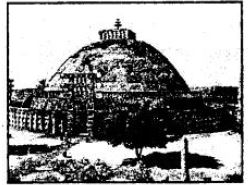
(a) When and by whom was the Original Stupa built ?
(b) Which Dynasty enlarged it ?
(c) Mention two important features of the Stupa.
(d) What events are depicted on the panels of the Gateway?
Answer: The image shows the Great Stupa at Sanchi.
(a) It was built in the third century BC by King Ashoka to hold the holy remains of Buddha.
(b) The Sunga rulers enlarged the structure later.
(c) It is a round dome made of bricks and stones. Inside, a small box at the bottom holds holy remains like hair or bones.
(d) The gateways show stories from the life of Buddha and the Jataka stories. Buddha is shown through symbols, like a wheel, a lotus, or a tree.
In simple words: This is the Sanchi Stupa built by Ashoka. It holds holy relics and has gateways showing stories from Buddha's life.
Exam Tip: Remember that the Sunga dynasty enlarged the stupa, and Buddha was shown using symbols rather than human figures.
Question 8. It is only with Ashoka that we can properly begin the history of the art and architecture of ancient India. In this context explain briefly: (a) Arts and Crafts that flourished during Ashoka’s reign. (b) A few features of the Ashokan Pillars.
Answer: (a) Arts and Crafts - Many places became famous for cloth making, like Varanasi and Kalinga. People also mined for gold in the south at Suvarnagiri. Ashoka started using strong stone to build his palace instead of wood.
(b) Features of the Pillars - These tall stone pillars are found across North India. The most famous one is at Sarnath, showing four lions sitting back-to-back. Each pillar is carved from a single huge piece of rock and weighs around 50 tons.
In simple words: Under Ashoka, people made great cloth, mined gold, and built giant stone pillars from single rocks.
Exam Tip: Use the word "monolithic" to describe the pillars, meaning they were made from a single block of stone.
Question 9. Ashoka was a promising warrior, but soon after the Kalinga War, he turned into a practicing moralist. In this context explain: (a) Fundamental Principles of Dhamma. (b) True Nature of Dhamma.
Answer: (a) Fundamental Principles of Dhamma - Dhamma means living with morality, justice, and duty. Its core rules are:
- Good family life: Respect elders and teachers, be kind to helpers, and always tell the truth.
- Toleration: Respect other religions and do not speak ill of their beliefs.
- Saving life: Do not harm animals. Work to build roads and hospitals for all.
- True customs: Avoid useless ceremonies. The best ceremony is to be kind and give to others.
(b) True Nature of Dhamma - Although Ashoka followed Buddhism, he did not force his views on anyone. His Dhamma was a set of simple, moral rules meant for everyone in the world.
In simple words: Dhamma was not a forced religion, but a set of moral rules about peace, honesty, and kindness.
Exam Tip: Explain that Dhamma was universal and focused on ethical behavior rather than strict religious rituals.
Additional Questions
Short Answer Questions
Question 1. What are our main sources of information on the Mauryan ruie ?
Answer: The main ways we learn about them are from Ashoka's stone edicts, the Sanchi Stupa, and the Nandangarh pillar. We also get facts from books like Megasthenes' Indica, Chanakya's Arthashastra, and Visakhadutta's Mudrarakshasa.
In simple words: We know about the Mauryas from stone pillars, stupas, and old books.
Exam Tip: Mention both written sources (like Indica) and physical sources (like Ashoka's edicts) to get full marks.
Question 2. Who wrote Arthashastra ? What is its importance ?
Answer: Chanakya wrote this famous book. It holds 6,000 verses split into 15 parts. It is highly valued because it shows how the Mauryas ruled their land and dealt with other kingdoms.
In simple words: Chanakya wrote the book, which explains how to run a government.
Exam Tip: Write both names (Chanakya and Vishnugupta) to show complete knowledge of the author.
Question 3. What is the importance of Ashoka’s edicts ?
Answer: These carvings are the best way to study Mauryan history. They are the oldest and most clearly dated stone records ever found in India.
In simple words: They are the oldest written records in India and give us exact facts about that time.
Exam Tip: Focus on the fact that these are the oldest and best-preserved written records in India.
Question 4. What is a stupa ? Name one stupa built by Ashoka.
Answer: A stupa is a solid, round dome made from unbaked bricks and rocks. Ashoka built the well-known Sanchi stupa during the third century BC.
In simple words: A stupa is a dome-shaped monument. Sanchi stupa is a famous one built by Ashoka.
Exam Tip: This is a common question, so make sure to memorize the description of a stupa.
Question 5. How did Chandragupta Maurya establish the Mauryan dynasty ?
Answer: With help from Chanakya, Chandragupta defeated the Nanda rulers and took Magadha in 321 BC, making Pataliputra his capital. Before that, he took over Punjab in 322 BC. Later, in 306 BC, he defeated Seleucus and won land in the north-west, like Kabul and Herat, eventually spreading his power down south.
In simple words: Chandragupta used help from Chanakya to defeat local rulers and Greeks, building a massive empire.
Exam Tip: State the key roles of Chanakya's advice and the defeat of the Nanda dynasty.
Question 6. Give a brief account of the political conditions in India under Bindusara.
Answer: Bindusara ruled after Chandragupta until 273 BC. He defeated sixteen local kings to win land in the south. During his rule, a rebellion broke out in Taxila. He also kept good ties with Greece and got many gifts.
In simple words: Bindusara expanded the empire south, dealt with a revolt in Taxila, and kept good ties with Greece.
Exam Tip: Mention that Bindusara maintained friendly relations with the Greek world and defeated sixteen rulers.
Question 7. What is the importance of Kalinga war in the personal life of Ashoka ?
Answer: The terrible loss of life in the war made him very sad. Over a hundred thousand people died, and many were captured. Because of this, he became a Buddhist and stopped all killing of humans and animals.
In simple words: The violence of the war made Ashoka sad, so he turned to Buddhism and stopped all killing.
Exam Tip: Note the dramatic change from war to non-violence (Ahimsa) as the key outcome.
Question 8. Name the two taxes mentioned in the Edicts of Ashoka.
Answer: The two taxes listed in his stone orders are Bali and Bhaga.
In simple words: The two taxes were called Bali and Bhaga.
Exam Tip: Memorize the exact names "Bali" and "Bhaga" as they are frequently asked in short questions.
Question 9. Name four important ways in which Buddhism spread under the royal patronage during the Mauryan times.
Answer: The vast span of the Mauryan territory along with the vision of a global empire helped carry Buddhism past the Hindukush range and well beyond the Bay of Bengal. Under Emperor Ashoka's influential state support, the religion spread across much of Asia despite regional conflicts. The monarch dedicated personal effort to establish this faith, sending his son Mahindra and daughter Sanghmitra to Sri Lanka for missionary work.
In simple words: Buddhism spread far because the Mauryan empire was very big and the king supported it. Ashoka even sent his own son and daughter to Sri Lanka to teach people about Buddhism.
Exam Tip: Remember to mention the geographical boundaries (Hindukush, Bay of Bengal) and Ashoka's children (Mahindra and Sanghmitra) to secure full marks.
Question 10. What is meant by Ashoka’s Dhamma ?
Answer: Ashoka's Dhamma drew from the shared moral teachings of different world religions. People view it as an ethical guide, a mutual code of behavior, or a moral framework that serves as a shared foundation for all faiths.
In simple words: Dhamma is a collection of good rules for living a moral life. It is not a new religion, but a set of moral ideas that all religions agree on.
Exam Tip: Clearly define Dhamma as a moral code of conduct rather than a new religion to show the examiner you understand the core concept.
Question 11. Give the basic principles of Ashoka’s Dhamma.
Answer: The core teachings include the following guidelines:
1. Showing reverence to older people and showing affection to the youth.
2. Practicing non-violence (Ahimsa).
3. Performing righteous actions.
4. Honoring all religious belief systems.
5. Giving up useless ceremonies.
In simple words: Dhamma teaches us to respect our elders, be kind to everyone, live peacefully, respect all faiths, and avoid doing useless rituals.
Exam Tip: Listing at least four principles clearly with bullet points is the easiest way to score complete marks for this standard direct question.
Question 12. What was the impact of Dhamma an Ashoka’s policies?
Answer: The positive outcomes of implementing Dhamma on state administration were:
1. Harmony and mutual acceptance among different faiths.
2. Integrating ethical standards into daily living.
3. A significant drop in criminal activities.
4. Focus on citizen welfare by halting military conflicts and promoting constructive programs.
In simple words: Dhamma made the kingdom peaceful by stopping wars, bringing different religions together, reducing crimes, and helping the king focus on helping his people.
Exam Tip: Focus on terms like "religious tolerance" and "public welfare" to align with the official marking scheme.
Question 13. What is meant by Pan-Indian character of the Mauryan administration ?
Answer: The administration of the Mauryas stood out for its broad, diverse accomplishments. They overcame foreign adversaries under Alexander and Seleucus in the northwest, defeated the Nandas in the Ganges valley, and subdued southern rulers in Mysore. Following the Kalinga conflict, Ashoka fostered advancements in Indian economics, art, and cultural life. Because this empire spanned and effectively governed such a vast portion of the subcontinent, it is described as having a Pan-Indian nature.
In simple words: A Pan-Indian administration means that the Mauryan government ruled over almost the whole country of India, from the far north down to the south.
Exam Tip: The key to explaining "Pan-Indian" is highlighting the vast geographical coverage of the administration from N.W. India down to Mysore.
Question 14. How was the district administration organised during Mauryan period ?
Answer: Every province was split into smaller administrative units known as Janapadas. A team of officers comprising the Pradeshika, the Rajuka, and the Yukta managed these districts.
In simple words: The Mauryan empire was divided into districts called Janapadas. These districts were managed by specific government officers who collected taxes and looked after the people.
Exam Tip: Memorize the three key officer titles - Pradeshika, Rajuka, and Yukta - as spelling them correctly guarantees full marks.
II. Structured Questions
Question 1. With reference to the sources of information on the Mauryan Empire, explain briefly the significance of the following:(a) Arthashastra (b) Indica (c) Sanchi Stupa
Answer:
(a) Arthashastra - Among the various written documents about Mauryan history, this text remains highly vital. Composed in Sanskrit by Kautilya (who also went by Chanakya and Vishnugupta), it features 6,000 verses. The work is organized into 15 main parts and covers 180 separate topics. These pages detail statecraft, administrative methods, diplomatic strategies, and other civic affairs. Scholars recovered this manuscript in the year 1909.
(b) Indica - This volume was compiled by Megasthenes to record his observations and experiences while residing in India. Although his original text is no longer intact, several excerpts have been preserved within the works of subsequent Greek historians such as Strabo, Diodorus, Arrian, Plutarch, and Justin.
(c) Sanchi Stupa - Erected near Bhopal in Madhya Pradesh, roughly 60 kilometers away, this monument was established by Ashoka during the third century BC. It features a width of 36.58 meters and stands 16.46 meters tall, with its balustrade pillars reaching a height of 2.784 meters. In the Sunga era, stone balustrades replaced the earlier timber railings. The structure includes four monumental portals facing the cardinal directions, decorated with scenes showing Buddha's life journey and various Jataka legends.
In simple words: The Arthashastra is a book on politics and rules, the Indica is a book of travel memories by a Greek visitor, and the Sanchi Stupa is a giant stone dome built by Ashoka to honor Buddha.
Exam Tip: For a three-part question like this, structure your answer with bold headings for (a), (b), and (c) to make it highly readable for the assessor.
Question 2. With reference to Mauryan Empire, answer the following questions:
(a) Give a brief account of how Chandragupta established the Mauryan empire.
(b) Give a brief account of Kalinga war and its consequences.
Answer:
(a) Working in partnership, Chandragupta and Chanakya managed to overthrow the Nanda dynasty in Magadha, settling the score for the insults they had faced. With Chanakya's expert strategies, Chandragupta overcame the forces of Alexander and Seleucus, bringing the northwestern territories of India under his control. He then expanded this vast domain from the Ganges valley all the way to Bengal, eventually pushing the imperial borders deep into the southern region.
(b) Fought in 261 BC, the Kalinga conflict left over 100,000 soldiers dead, 150,000 captured, and countless others wounded. These tragic sights deeply altered Ashoka's outlook on life. Consequently, he gave up hunting, stopped consuming meat, and left his life of luxury behind. He adopted and declared Buddhism as the official state creed. Captives from the war were resettled as farmers, which helped boost the nation's agricultural economy, though the army's combat readiness eventually declined.
In simple words: Chandragupta defeated the Nanda kings and Greek forces to build a massive empire. Later, his grandson Ashoka fought a bloody war in Kalinga, which made him feel so sad that he gave up violence and accepted Buddhism.
Exam Tip: Do not forget to state the year of the Kalinga war (261 BC) and the specific figures (100,000 dead, 150,000 captured) to demonstrate precise historical knowledge.
Question 3. With reference to Mauryan administration, answer the following questions:
(a) Why is Chandragupta Maurya regarded as the chief architect of the system of administration ?
(b) Briefly describe the main features of civil and military administration under Mauryan rule.
(c) What is meant by the Pan-Indian character of Mauryan administration ?
Answer:
(a) During the Nanda rule, the kingdom suffered from poor discipline because of the weak character of the ruler. This monarch also insulted Chanakya, prompting the sage to swear an oath to destroy the dynasty. Chanakya trained and guided Chandragupta to become an exceptionally capable leader. Consequently, Chandragupta founded the Mauryan state, which grew to encompass a massive portion of India, governed from its capital city at Pataliputra.
(b) The administrative machinery was split into central and provincial layers, staffed by a council of ministers and regional governors. To secure his borders, Chandragupta kept a massive standing army made up of foot soldiers, horsemen, war elephants, and battle chariots.
(c) The term Pan-Indian indicates that the authority of the Mauryan state stretched across almost the entire subcontinent, reaching from the northwestern frontiers across to Bengal, and extending far south to the Mysore territory.
In simple words: Chandragupta was the founder who organized the government and created a huge army. His empire stretched across almost all of India, which is why it is called Pan-Indian.
Exam Tip: Ensure you mention Chanakya's guidance under part (a) and list the components of the army (infantry, cavalry, elephants, chariots) under part (b).
Question 4. With reference to Provincial Governments under the Mauryan rule, answer the following questions
(a) Name the different provinces and their capitals into which the Mauryan empire was divided.
(b) How was the provincial administration run ?
(c) What changes were brought about in the Mauryan administration during Ashoka’s reign ?
Answer:
(a) The administrative divisions of the Mauryan Empire and their respective head stations are listed below:
| Province | Capital |
|---|---|
| Magadha | Pataliputra |
| Gandhara (N.W. Province) | Taxila |
| Avanti (Eastern Province) | Ujjain |
| Southern Province | Swarangiri |
| Kalinga | Tosali |
(b) A royal prince known as a 'Kumar' or 'Aryaputra' was appointed to lead each province. They received support from regional governors (Mahamatras). Additionally, other key officials like the Pradeshika (responsible for collecting taxes), the Rajuka (handling land revenue), and the Yukta (managing the treasury) assisted in the daily administrative tasks.
(c) The Mauryan political structure was intensely centralized. The core region of Magadha maintained active trade connections and commercial ties with its outer territories. Officials in charge of revenue were required to travel throughout their designated zones to inspect local conditions and check on the public's welfare. Due to communication and dialect barriers in some border areas, certain outlying regions were permitted a degree of local self-governance.
In simple words: The empire had five provinces, each run by a royal prince and supported by helper officers. While the capital had strong control, some faraway regions were allowed to govern themselves.
Exam Tip: Presenting the provinces and capitals in a neat table format instead of a paragraph will show superior structuring and score maximum marks.
Question 5. With reference to the Mauryan administration write short notes on the following:
(a) District Administration (b) Revenue system
Answer:
(a) At the district level, the administrative units known as Janapadas were managed by a group of key officers, namely the Pradeshika, the Rajuka, and the Yukta.
(b) The state collected between one-sixth and one-fourth of the total farm output as tax. The agricultural levy was known as 'Bhaga', while 'Bali' served as a religious offering or tribute. Additional revenues collected from marketplaces, working professionals, timberlands, and mining operations went toward building roads, funding irrigation networks, establishing medical clinics, and meeting other public state costs.
In simple words: Districts were managed by special officers like the Rajuka and Yukta. The government collected up to a quarter of farm crops as tax to build roads, canals, and hospitals.
Exam Tip: When writing about the revenue system, define the terms "Bhaga" (agricultural share) and "Bali" (religious tribute) clearly.
Question 6. With reference to the spread of Buddhism under the Mauryas, answer the following questions:
(a) What was the Mauryan concept of Universal Empire?
(b) Give the important causes for the spread of Buddhism.
(c) What was known as ‘Ashoka’s Dhamma’? State its features and principles.
Answer:
(a) The Mauryan idea of a global realm involved expanding the boundaries of the empire alongside the message of Buddhism, extending the faith far outside India's borders. This is evident from how Buddhism took root across vast stretches of Asia, including Burma, Indochina, Indonesia, China, Mongolia, Japan, and Afghanistan.
(b) Key factors that helped Buddhism spread included appointing dedicated workers to propagate the faith, and receiving royal backing from emperors like Chandragupta and Ashoka. Additionally, rulers set up numerous stone pillars and rock-cut edicts to display core moral values. Ashoka also sent overseas delegations, including his son and daughter, to spread these ideas in places like Nepal, Burma, Egypt, and Syria.
(c) Ashoka's Dhamma combined the shared, harmonious truths of different major world systems. Scholars describe it as a universal moral law, a shared code of daily behavior, or an ethical framework that unites people of all faiths.
Its primary rules and moral concepts are:
1. Caring for the young while honoring and obeying elders.
2. Strictly practicing non-injury to all living things (Ahimsa).
3. Living a life of good deeds and positive actions.
4. Showing deep reverence for all religious faiths.
5. Avoiding pointless customs and ceremonies.
In simple words: The Mauryan kings wanted their empire and Buddhism to spread together across Asia. They did this by sending royal family members to other countries and carving moral rules on rocks.
Exam Tip: For part (b), remember to list foreign nations like Burma, Nepal, Egypt, and Syria where Buddhist missions were sent.
Question 7. Study the Ashokan Edict and answer the following questions
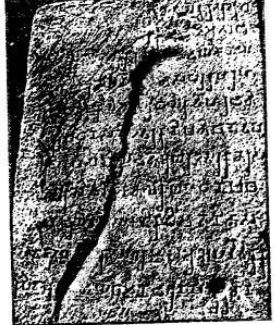
(i). What is an edict ? Where are these edicts inscribed ?
Answer: An edict refers to an official declaration or decree proclaimed by a ruling sovereign. The historical proclamations of Ashoka serve as the primary foundational resource for studying Mauryan history. These records were carved directly onto rock faces and stone pillars across his domain, containing 14 major Rock Edicts, seven distinct pillar inscriptions, alongside multiple smaller rock carvings.
In simple words: An edict is an official order from a king. Ashoka carved these orders on big rocks and stone pillars all over India.
Exam Tip: Define "edict" as a decree by a sovereign ruler and list "rocks" and "pillars" as the two main surfaces where they were inscribed.
(ii). What is the significance of edicts as a source of information ?
Answer: These stone carvings offer valuable perspectives on the personal life and moral standards of Ashoka, while also providing crucial details regarding the broader history of the Mauryan dynasty.
In simple words: These carved stones are important because they tell us exactly what Ashoka believed in and how he ruled his kingdom.
Exam Tip: Highlight how these edicts provide primary, authentic, and first-hand historical information about the Mauryan period.
(iii). Explain briefly the importance of Ashoka’s edicts, giving example from one of his edicts.
Answer: The various inscriptions of Ashoka stand as the most valuable documentary evidence for reconstructing Mauryan times. Representing some of India's earliest, best-preserved, and most accurately dated historical records, these decrees were carved onto stone slabs and pillars throughout the empire, comprising 14 principal Rock Edicts, seven pillar carvings, and several minor rock inscriptions. These writings provide deep clarity on Ashoka's personal values and policies, as well as general administrative patterns of the era. For instance, Rock Edict-I serves as a key example, containing instructions directed at the preservation and safeguarding of animal life.
In simple words: Ashoka's edicts are the oldest written records in India. For example, his very first rock edict tells people to protect and care for animals.
Exam Tip: Always provide a concrete example like Rock Edict-I (animal protection) when asked to illustrate the practical application of Ashoka's laws.
Free study material for History Civics
ICSE Selina Concise Solutions Class 9 History Civics Chapter 5 The Mauryan Empire
Students can now access the detailed Selina Concise Solutions for Chapter 5 The Mauryan Empire on our portal. These solutions have been carefully prepared as per latest ICSE Class 9 syllabus. Each solution given above has been updated based on the current year pattern to ensure Class 9 students have the most updated History Civics content.
Master Selina Concise Textbook Questions
Our subject experts have provided detailed explanations for all the questions found in the Selina Concise textbook for Class 9 History Civics. We have focussed on making the concepts easy for you in Chapter 5 The Mauryan Empire so that students can understand the concepts behind every answer. For all numerical problems and theoretical concepts these solutions will help in strengthening your analytical skill required for the ICSE examinations.
Complete History Civics Exam Preparation
By using these Selina Concise Class 9 solutions, you can enhance your learning and identify areas that need more attention. We recommend solving the History Civics Questions from the textbook first and then use our teacher-verified answers. For a proper revision of Chapter 5 The Mauryan Empire, students should also also check our Revision Notes and Sample Papers available on studiestoday.com.
FAQs
You can download the verified Selina Concise solutions for Chapter 5 The Mauryan Empire on StudiesToday.com. Our teachers have prepared answers for Class 9 History Civics as per 2026-27 ICSE academic session.
Yes, our solutions for Chapter 5 The Mauryan Empire are designed as per new 2026 ICSE standards. 40% competency-based questions required for Class 9, are included to help students understand application-based logic behind every History Civics answer.
Yes, every exercise in Chapter 5 The Mauryan Empire from the Selina Concise textbook has been solved step-by-step. Class 9 students will learn History Civics conceots before their ICSE exams.
Yes, follow structured format of these Selina Concise solutions for Chapter 5 The Mauryan Empire to get full 20% internal assessment marks and use Class 9 History Civics projects and viva preparation as per ICSE 2026 guidelines.