

ICSE Solutions Selina Concise Class 9 History Civics Chapter 8 South India and the Cholas have been provided below and is also available in Pdf for free download. The Selina Concise ICSE solutions for Class 9 History Civics have been prepared as per the latest syllabus and ICSE books and examination pattern suggested in Class 9. Questions given in ICSE Selina Concise book for Class 9 History Civics are an important part of exams for Class 9 History Civics and if answered properly can help you to get higher marks. Refer to more Chapter-wise answers for ICSE Class 9 History Civics and also download more latest study material for all subjects. Chapter 8 South India and the Cholas is an important topic in Class 9, please refer to answers provided below to help you score better in exams
Selina Concise Chapter 8 South India and the Cholas Class 9 History Civics ICSE Solutions
Class 9 History Civics students should refer to the following ICSE questions with answers for Chapter 8 South India and the Cholas in Class 9. These ICSE Solutions with answers for Class 9 History Civics will come in exams and help you to score good marks
Chapter 8 South India and the Cholas Selina Concise ICSE Solutions Class 9 History Civics
Question 1. Mention two ways in which Inscriptions may be used for reconstructing the history of the Imperial Cholas.
Answer: Historical records from Chola-era inscriptions offer valuable details:
1. They explain the workings of the royal administration and government.
2. They document donations and land grants presented to religious shrines and priests.
3. They describe how holy structures were built and when sacred idols were installed.
4. Writing engraved on temple structures functioned as official registries, preserving transactions like property sales, mortgages, and land-right transfers.
5. They keep a permanent record of resolutions and consensus made on local community matters.
In simple words: Inscriptions are like ancient diaries carved on stone. They tell us how the Chola kings ruled, who gave gifts to temples, and how people bought or sold land.
Exam Tip: When writing about inscriptions, highlight their role in administrative history and recording land deals. Memorizing at least two distinct points will help secure full marks.
Question 2. Name one of the masterpieces of the temples built, by the Chola king Rajaraja I. Mention one architectural feature of the temple.
Answer: The ruler built the magnificent Brihadeswara Temple, which is alternatively called the Rajarajeshwar Temple, located in Thanjavur. A key design element of this monument is its interconnected layout, combining a pillared portico, a grand hall for assemblies, and a dedicated pavilion for Nandi.
In simple words: King Rajaraja I built the famous Brihadeswara Temple in Thanjavur. This temple is special because its main parts, like the pillared entryway and the large gathering hall, are all joined together.
Exam Tip: Always mention both names of the temple - Brihadeswara and Rajarajeshwar - and its location, Thanjavur, to demonstrate thorough knowledge to the examiner.
Question 3. Under whose rule, the Cholas rose to imperial greatness towards the end of the 10th century AD?
Answer: The dynasty achieved empire-wide prominence near the close of the tenth century AD under Rajaraja I, who was the son of Sundara Chola.
In simple words: The Chola empire became extremely powerful and large at the end of the 10th century when Rajaraja I became the king.
Exam Tip: Remember that Rajaraja I was the son of Sundara Chola, as linking family lineages shows a deeper understanding of the royal family tree.
Question 4. Mention any two victories won by Cholas under Rajaraja I.
Answer: The conquest and integration of Kalinga along with the Maldives.
In simple words: King Rajaraja I expanded his empire by conquering Kalinga and the Maldives islands.
Exam Tip: When listing military conquests, ensure you name Kalinga and the Maldives as these were major naval and land achievements of Rajaraja I.
Question 5. Who among the Chola kings adopted the title of ‘Gangaikonda’? Name the city commemorating the event.
Answer: The designation 'Gangaikonda' was assumed by Rajendra I. To celebrate this milestone, the urban center named Gangaikonda-Cholapuram (also known as Gangakundrapuram) was established.
In simple words: King Rajendra I took the title 'Gangaikonda' and built a new capital city called Gangaikonda-Cholapuram to celebrate his victory.
Exam Tip: Make sure you can spell 'Gangaikonda-Cholapuram' correctly, as examiners pay close attention to the spelling of historical cities.
Question 6. What names were given to the following territorial divisions of the Chola kingdom: (a) Province, and (b) the District?
Answer: In the Chola administrative system, these regions were designated as:
(a) Provinces were referred to as Mandalams.
(b) Districts were known as Nadus (which were subdivisions of larger regions called Valanadus).
In simple words: The Chola kingdom divided its lands into provinces called Mandalams, and smaller districts called Nadus.
Exam Tip: Remember that Mandalams were the largest administrative units under the king, which were further divided into Valanadus and Nadus.
Question 7. What was the method of electing members of the village assembly under the Cholas?
Answer: The selection of council representatives relied on a unique system: slips containing the names of various nominees were placed and shuffled inside an earthenware vessel. A young boy would then pull these slips out individually, and a local priest would proclaim the selected individuals.
In simple words: To choose village leaders, people wrote candidates' names on slips of paper and put them in a pot. A young boy drew the names out one by one, and the priest read them aloud.
Exam Tip: This democratic lottery process is often called the 'pot-ticket' or 'Kudavolai' system - keeping this term in mind will impress the examiner.
Question 8. Mention any two duties assigned to a village assembly under the Cholas.
Answer: The local village councils were responsible for several tasks, including:
1. Managing and distributing water resources.
2. Overseeing the educational needs of local youth.
In simple words: The village assembly had to make sure farms got enough water and that children went to school.
Exam Tip: When writing about village duties, focus on water management (irrigation) and education, as these demonstrate the self-sufficient nature of Chola villages.
Question 9. Give one evidence to suggest that the Brihadeswara Temple is a repository of every branch of art.
Answer: This is demonstrated by several artistic features of the complex:
1. The architectural layout integrates a dedicated Nandi pavilion, a columned porch, and a central gathering hall.
2. Originally designed with three levels, the great hall's highest level featured an uncovered deck decorated with a line of Nandi statues along the borders.
3. Guardian sculptures, known as dwarapalas, stand watch at the multiple exterior entryways, much like the main gateway.
4. Exquisite handwriting style is visible across the abundant carvings written in both Tamil and Sanskrit.
5. The complex also features a striking temple dedicated to Brihannayaki, the goddess consort. Ultimately, the monument serves as a treasure trove of creative disciplines incorporating fine stonework, design, sketching, jewelry creation, performing arts, and choral arrangements.
In simple words: The Brihadeswara Temple is not just a place of worship, but a giant museum of art. It features magnificent stone carvings, beautiful writing, painting, and spaces for dance and music.
Exam Tip: To show how the temple represents 'every branch of art', list various forms like calligraphy, sculptures (dwarapalas), and architecture to give a complete picture.
Structured Questions
Question 1. With the accession of Rajaraja I (985-1014 AD) began the most glorious epoch of the Cholas. In this context, explain briefly:
(a) His Conquests.
(b) His activities as a Great Builder and a Ruler.
Answer: (a) Rajaraja overcame the Chera forces and subsequently took control of Madurai, capturing Amarbhujanga, the Pandyan monarch. He added Kalinga to his domain and launched successful military campaigns against the Western Chalukyas. Furthermore, he crossed over to Sri Lanka, seizing its northern territories, and took the Maldives near the end of his rule. Through these campaigns, Rajaraja established his supremacy over nearly all of modern Tamil Nadu, regions of Karnataka, neighboring territories, Sri Lanka, and various other islands.
(b) Beyond military success, Rajaraja I was an efficient administrator, an outstanding architect, and a supporter of literary and artistic works. A signature trait of his governance was the growth of local self-ruling bodies in villages. He commissioned the iconic Brihadeswara Temple (alternatively called the Rajarajeshwar Temple) in Thanjavur, and also supported the construction of shrines dedicated to Vishnu. Although he was a devoted follower of Shiva, he respected other faiths, which is demonstrated by his donation of village lands to support the Buddhist Vihara located at Nagapattinam on the Malay Peninsula.
In simple words: King Rajaraja I was a legendary ruler who conquered many lands, including Sri Lanka and the Maldives. He also built the great Brihadeswara Temple and supported local village councils.
Exam Tip: To get high marks on questions about Rajaraja I, split your answer clearly into military victories (like conquering Sri Lanka and Cheras) and administrative or building achievements (like the Thanjavur temple).
Question 2. King Rajendra I (1014-1044 AD) raised the Chola empire to the pinnacle of glory. In this context explain:
(a) His main Conquests.
(b) His attainments as a Great Builder.
Answer: (a) Main Conquests: Around 1017 AD, Rajendra I brought the entirety of Sri Lanka under Chola control. He structured the lands of Pandya, Kerala, and Sri Lanka as standard provinces within his realm. His military forces advanced northward, reaching all the way to the Ganga River valley. He defeated the rulers of Orissa and parts of East Bengal. In honor of this achievement, he took the name Gangaikonda and established a fresh capital city named Gangaikonda-Cholapuram. Furthermore, in 1025 AD, he sent out a powerful maritime fleet to conquer the Southeast Asian lands of Java and Sumatra, which were ruled by the Shailendra dynasty.
(b) Achievements as a Builder: Rajendra I developed a massive man-made reservoir close to his newly built capital, featuring protective banks spanning over 25 kilometers. This lake was fed by the waters of the Vellar and Kolerun rivers. Additionally, he built a magnificent temple in Gangaikonda-Cholapuram, which houses a monumental granite Shiva lingam that stands out for its impressive size.
In simple words: King Rajendra I conquered all of Sri Lanka and led his army to the Ganga River. He built a new capital city, a massive artificial lake for water, and a grand temple.
Exam Tip: Key terms to include for Rajendra I are 'Ganga Valley expedition', 'Gangaikonda-Cholapuram', and his unique 'naval expedition' to Southeast Asia (Java and Sumatra).
Question 3. Under Cholas, the ruler was the pivot on which turned the whole machinery of the state, but actual administration was not highly centralised. In this context, explain briefly.
(a) The position of the Chola Monarch.
(b) Functioning of the autonomous rural institutions (Gram Sabhas).
Answer: (a) The Chola King's Role: The sovereign acted as the central point around which the entire governance system operated. Royal crowns were bestowed during highly festive coronation ceremonies. The ruler's prestige and authority were amplified by massive imperial wealth, extensive palace complexes, and a magnificent royal court. Any oral commands issued by the king had to be documented in written form prior to being shared with administrative officers.
(b) Operations of the Local Gram Sabhas: These independent village assemblies held comprehensive power over regional matters. They handled local dispute resolution and justice, excluding major criminal offences. They organized water distribution and managed public assets like local shrines and learning centers. Additionally, they possessed the right to sell or bestow land for spiritual use. Financial ledgers were kept with great precision, and anyone found guilty of stealing or fraud faced strict punishment. To manage daily business, the assembly appointed specialized sub-committees to focus on specific needs like irrigation tanks, parks, shrines, judicial matters, and general administration.
In simple words: Even though the Chola king was the supreme leader, villages were mostly self-governing. Local assemblies ran their own schools, managed their own water, and decided on minor local court cases.
Exam Tip: Clearly explain that the Chola administration was a mix of a strong central monarch and highly independent village bodies (Gram Sabhas) to show a complete grasp of this dual governance style.
Question 4. Study the picture of the Brihadeswara Temple and answer the following questions:
(a) Name the place where the Temple is located.
(b) When and by whom was the Temple built?
(c) To which Deity was the temple dedicated?
(d) Mention outstanding features of the Temple
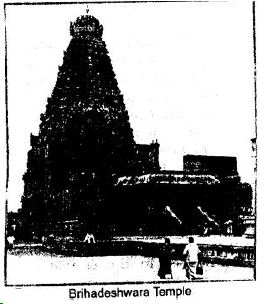
Answer: (a) The monument is situated in the city of Thanjavur.
(b) It was constructed around 1000 AD by the prominent Chola monarch, Rajaraja the Great.
(c) This sacred structure is dedicated to Lord Shiva.
(d) The temple structure includes an interconnected layout of an assembly hall, a column-supported portico, and a dedicated Nandi pavilion, all placed at the center of a large courtyard surrounded by walls. Its giant tower rises 57 meters high in a pyramidal form, spanning thirteen tiers. The top of this tower is crowned with a single massive stone block measuring 8.6 meters in height and weighing approximately 80 tons. Inside, the temple walls are adorned with intricate frescoes and stunning stone carvings.
In simple words: The Brihadeswara Temple is in Thanjavur, built by Rajaraja I around 1000 AD for Lord Shiva. It has a huge 57-meter pyramidal tower topped with a single 80-ton stone.
Exam Tip: Be prepared to identify this temple from its visual representation, and memorize the key measurements - such as the 57-meter tower height and the 80-ton single stone crown.
Question 5. Discuss people’s social life under Imperial Cholas with reference to:
(a) Caste System (b) Religion (c) Literature and Cultural Activities
Answer: (a) Social Hierarchy and Caste: A rigid class system was deeply entrenched across South India. Alongside the influential Brahmins, wealthy traders rose as a dominant social class due to their financial prosperity. Conversely, the living conditions of the marginalized communities were miserable; they faced discrimination, being barred from using public drinking wells and forbidden from accessing sacred temples.
(b) Religious Environment: While Chola rulers were predominantly devotees of Shiva, they maintained a policy of religious harmony and did not discriminate against other beliefs or sects.
(c) Intellectual and Artistic Endeavors: The Chola rule is widely recognized as the peak period for Tamil writing. During the ninth century, Kamban rendered the classic Sanskrit epic into Tamil, giving rise to the 'Kamban Ramayana'. While Kamban focused on the initial chapters, the concluding portions were translated by Ottakuttan. In the twelfth century, the celebrated poet Pugalendi composed the 'Nalavenda', narrating the legendary romance of Nala and Damayanti. Scholars of Buddhist and Jain faiths also enriched the literary landscape; the Jain academic Amrit Sagar composed an authoritative guide on poetry writing, while Buddhamitra, a Buddhist intellectual, authored a grammatical work titled 'Rasolium'.
In simple words: Under the Cholas, the caste system was strict, with lower castes suffering from unfair rules. Kings worshipped Shiva but respected other religions, and Tamil literature flourished with books like the Kamban Ramayana.
Exam Tip: When discussing social life, make sure to address all three sub-parts (Caste, Religion, and Literature) separately, and list major literary works like the Kamban Ramayana and Nalavenda.
Question 6. Write a brief note on the development of Tamil Literature under the Cholas.
Answer: The growth of writing, design, and art during this era greatly elevated the cultural impact of Chola governance, which introduced significant advancements across these sectors. This timeframe became a defining milestone for Tamil letters, backed by royal patronages and incentives granted to local authors and intellectuals. While early Sangam traditions highlighted personal and societal themes like romance, warfare, statecraft, and commerce, the resurgence of Chola power in the mid-ninth century vastly expanded artistic and literary awareness. A unified empire brought stability and safety across South India, allowing citizens to engage with diverse cultures. Tamil thrived as the primary language of daily life. The most celebrated masterpiece of this era is the 'Kamban Ramayana', created by the poet Kamban under King Kulottunga III. This work stands as a monumental epic in Tamil history, serving as a unique creative masterpiece rather than a direct translation of Valmiki's Sanskrit original.
In simple words: The Chola period was a golden age for Tamil writing. Kings sponsored writers, and the famous 'Kamban Ramayana' was written as a unique, creative masterpiece in the common language.
Exam Tip: Highlight that the Kamban Ramayana was an independent masterpiece, not just a translation of Valmiki's work, as this distinction is highly valued by examiners.
Additional Questions
Short Answer Questions
Question 1. Mention the significance of inscriptions for providing information about the Cholas.
Answer: Inscriptions are crucial historical sources for understanding Chola history due to the following reasons:
1. They offer clear insights into Chola administrative procedures.
2. They preserve details about land endowments and donations made to priests and temples.
3. They document when temples were built or when specific deities were consecrated.
4. Wall engravings on shrines acted as public registries, logging land trades, mortgages, and village property transfers.
5. They maintain official records of public resolutions and community consensus.
In simple words: Inscriptions are like carved records. They help us understand Chola laws, donations to temples, and how local land deals were registered.
Exam Tip: For short-answer questions, presenting your points in a neat numbered list is a great way to ensure the examiner sees every piece of evidence clearly.
Question 2. Who established the rule of the Cholas ?
Answer: The Chola monarch Vijayalaya (who ruled from 846 to 871 AD) founded the Chola kingdom in the Tamil territory, designating Thanjavur (Tanjore) as his capital city around the mid-ninth century.
In simple words: A ruler named Vijayalaya started Chola rule in the middle of the 9th century, making Thanjavur his capital.
Exam Tip: Always mention the founder's name, Vijayalaya, his capital city, Thanjavur (Tanjore), and the century (9th century AD) to secure full marks.
Question 3. Why did Rajaraja undertake a naval expedition against Ceylon and Maldives ?
Answer: As an outstanding military commander, Rajaraja I (who ruled from 985 to 1012 AD) launched campaigns against the Chera and Pandya states, as well as portions of Mysore. Because this zone was highly active with Arab merchant fleets, Rajaraja conducted maritime operations targeting Sri Lanka (Ceylon) and the Maldives to consolidate and safeguard his control over the southern Indian coastline.
In simple words: Rajaraja wanted to control the busy trade routes used by Arab merchants along the coast. To do this, he sent his navy to conquer Ceylon and the Maldives.
Exam Tip: Make sure to explain the trade aspect - specifically mentioning 'Arabian traders' and the 'coast of South India' - as the economic motive is key here.
Question 4. Name any three great rulers of the Chola dynasty.
Answer: Three prominent emperors of the Chola Empire include:
1. Rajaraja I (who ruled from 985 to 1012 AD)
2. Rajendra Chola I (who ruled from 1012 to 1044 AD)
3. Rajadhiraja Chola (who ruled from 1044 to 1052 AD)
In simple words: Three of the greatest Chola kings were Rajaraja I, Rajendra Chola, and Rajadhiraja Chola.
Exam Tip: Writing down the dates of their reigns next to the kings' names shows absolute precision and will help you get maximum points.
Question 5. Give any two achievements of Rajendra Chola.
Answer: 1. He overcame Mahipala, the ruler of Bengal, and subsequently assumed the honorific 'Gangaikonda'.
2. Utilizing a powerful maritime fleet, he defeated the Shrivijaya monarch, resolving trade obstructions faced by Indian traders due to Shrivijaya business rivals.
In simple words: Rajendra Chola defeated the king of Bengal to earn the title 'Gangaikonda'. He also used his navy to defeat the Shrivijaya kingdom, helping protect Indian merchants.
Exam Tip: Include the specific name 'Mahipala' for his Bengal victory and the kingdom name 'Shrivijaya' for his naval success to make your answer highly factual.
Question 6. Name the new capital built by Rajendra Chola.
Answer: The newly established capital city was named Gangaikonda-Cholapuram.
In simple words: The brand new capital city built by Rajendra Chola was called Gangaikonda-Cholapuram.
Exam Tip: This city's name literally translates to 'The town of the Chola who conquered the Ganga'. Mentioning this meaning adds extra value to your answer.
Question 7. Why did the Cholas build a strong naval fleet ?
Answer: The empire assembled a robust maritime force to maintain strict oversight over commerce between Arab merchants and Indian traders operating along the southern coastal zone.
In simple words: The Cholas built a strong navy to control the ocean trade between Arab merchants and local Indian traders.
Exam Tip: Acknowledge the role of the navy in securing sea trade routes rather than just military conquest, as trade control was vital to Chola wealth.
Question 8. What made the Chola administration strong and effective?
Answer: The administration of the Cholas was exceptionally structured and productive, centered entirely on the monarch. Their governance featured a central authority, provincial units, and local self-governing councils. These local bodies consisted of 'ur' (representing standard villages), 'sabha' (representing Brahmin communities), and 'nagaram' (representing business merchants). This decentralized and balanced distribution of power made their system robust and highly efficient.
In simple words: The Chola government was strong because it was well organized. It shared power between the king, the provinces, and local assemblies for villagers, priests, and merchants.
Exam Tip: Make sure to mention the three specific local assemblies - 'ur', 'sabha', and 'nagaram' - as these are crucial keywords that graders search for.
Question 9. Name the two languages promoted by the Cholas.
Answer: The two primary tongues supported by the Chola rulers were Tamil and Sanskrit. Renowned writers and playwrights composed dramatic works and poetry in Tamil, and the compilations of these Tamil authors were gathered into an eleven-volume collection called the 'Tirumurais'.
In simple words: The Cholas encouraged the use of Sanskrit and Tamil. They compiled famous Tamil poems and plays into an eleven-volume book called 'Tirumurais'.
Exam Tip: Remember to name 'Tirumurais' as the eleven-volume collection of Tamil literature, as this is a high-yield fact for short answer questions.
Question 10. Name any two features of temple built by the Cholas.
Answer: Key characteristics of temples constructed under the Cholas include giant towers known as vimanas and expansive, open courtyards. The majority of these structures were executed in the traditional Dravidian architectural style.
In simple words: Chola temples are famous for their giant towers, called vimanas, huge open courtyards, and their South Indian Dravidian style.
Exam Tip: Always use the term 'Dravidian style' and 'vimana' when describing the architecture of Chola temples to score full marks.
Question 11. Which is the best example of Chola temples ?
Answer: The most outstanding representation of Chola temple design is the Brihadeswara Temple, dedicated to Lord Shiva, located at Thanjavur.
In simple words: The finest example of a Chola temple is the Brihadeswara Temple (for Lord Shiva) in Thanjavur.
Exam Tip: Mention that the Brihadeswara Temple is dedicated to Lord Shiva, as clarifying the deity demonstrates comprehensive historical understanding.
Question 12. What is known as the ‘gopuram’ ?
Answer: The term 'gopuram' refers to the monumental gateway structure at the entry point of a temple complex.
In simple words: A gopuram is the grand gateway at the entrance of a South Indian temple.
Exam Tip: Be brief but accurate - define 'gopuram' as the 'entrance gateway' of the temple to quickly secure full marks.
Question 13. To what use was the temple put during the Chola period?
Answer: During the Chola era, the temple functioned as the focal point of community life. Public financial donations funded the upkeep and beautification of these structures. Additionally, some temple administrations engaged in both domestic and international trade. These institutions offered employment to numerous citizens, supplied essential provisions like meals, garments, housing, and schools, and even sponsored healthcare facilities and local hospitals.
In simple words: Temples were not just for prayers; they were centers of life. They gave people jobs, offered schools and food, helped with trade, and even ran hospitals.
Exam Tip: When describing the role of temples, emphasize that they served social, economic (trade and employment), and educational purposes, rather than just spiritual ones.
Question 14. Name one important literary source that gives information about the Cholas. Name the author of this text and the ruler, whose exploits its describes.
Answer: A key historical text of the Chola period is the 'Kalingattuparani'. Formulated as a battle hymn by Jayankondar, who served as the royal poet under Kulottunga I, it glorifies the triumph of King Kulottunga Chola I against the ruler of Kalinga, Anantavarman Chodaganga, during their territorial conflict. The narrative centers around Kulottunga Chola I as its primary protagonist.
In simple words: The book 'Kalingattuparani' was written by the poet Jayankondar. It is a war song about King Kulottunga Chola I winning a war against the King of Kalinga.
Exam Tip: Be sure to remember three parts: the book 'Kalingattuparani', the author 'Jayankondar', and the hero 'Kulottunga Chola I' to ensure you get full credit.
Question 15. Name the last ruler of the Cholas.
Answer: The final major emperor recognized in the Chola lineage was Rajadhiraja Chola, who reigned from 1044 to 1052 AD.
In simple words: The last highly powerful king of the Cholas was Rajadhiraja Chola.
Exam Tip: Make sure to specify Rajadhiraja Chola along with his dates (1044-1052 AD) to show precise factual knowledge.
Question 16. Who finally defeated the Cholas ?
Answer: The Chola empire was eventually overcome by the Chalukya forces during the historic Battle of Koppam in 1052 AD.
In simple words: The Cholas were finally defeated by the Chalukyas at the Battle of Koppam in 1052 AD.
Exam Tip: Remember to name both the opponent (Chalukyas) and the location of the battle (Koppam) to receive full marks for this question.
Question 17. Give an example of sculpture during the Chola period.
Answer: The artisans of this dynasty were highly skilled in crafting divine figures out of bronze and stone. A premier example is the bronze representation of Lord Shiva depicted as 'Nataraja', the Lord of Dance, which is celebrated as a magnificent artistic achievement.
In simple words: The Cholas made beautiful bronze statues. The most famous one is of Lord Shiva dancing, known as the 'Nataraja'.
Exam Tip: Mentioning the bronze 'Nataraja' (Shiva as the cosmic dancer) is the absolute best example to write down for Chola-era sculptures.
Question 18. Who wrote the Tamil Ramayana ?
Answer: The author of the Tamil version of the Ramayana was the poet Kamban.
In simple words: The Tamil Ramayana was written by a poet named Kamban.
Exam Tip: This is a straightforward one-word answer, but writing it as a full sentence with the poet's name ('Kamban') ensures a professional presentation.
Question 1. With reference to the sources of information about the Cholas, give the significance of the following:
(a) Chola Inscriptions.
(b) Brihadeshwara Temple.
Answer: (a) Chola Inscriptions: These records are highly significant for several reasons:
1. They reveal details about Chola state administration. For instance, the famous Uttaramerur inscription outlines the local village governing system, tax structures, and agricultural revenue systems.
2. They document charitable endowments and land grants given to temples and priests. Engravings on copper plates preserve official decrees gifting whole villages, specific plots of land, or distinct privileges to people or groups. Key examples include the Leyden grant (kept in Holland's Leyden Museum) issued by Parantaka Chola, as well as the records from Parakesari Uttama Chola.
3. They describe the founding of shrines or the consecration of newly created idols.
4. They act as archives for crucial public resolutions and legal choices. These comprise royal decrees concerning taxes, resolutions passed by local assemblies, and legal verdicts passed against criminals for offenses like theft or murder.
5. Wall carvings on shrines functioned as public registries, keeping a secure log of property sales, mortgages, and various land-right transfers within local communities.
(b) Brihadeswara Temple: This grand monument stands as an architectural triumph of South Indian heritage and an exquisite symbol of Tamil craftsmanship. Designated as a UNESCO World Heritage Site, it is a premier example of Dravidian design. The temple features a towering vimana (spire) capped by a colossal monolithic stone dome. From foundation to pinnacle, the immense structure is adorned with elaborate sculptures and artistic details, and the inner sanctum houses a massive Shiva lingam sculpted out of a single rock.
In simple words: Inscriptions tell us how the Cholas collected taxes and ran their villages. The Brihadeswara Temple is a world-famous monument that shows their incredible talent in building and stone carving.
Exam Tip: Be sure to cite the 'Uttaramerur inscription' as an example for village administration and name the 'Brihadeswara Temple' as a UNESCO World Heritage Site.
Question 2. With reference to the Chola period explain the following”
(a) Taxes imposed by the Cholas.
(b) Administration of the Kingdom,
(c) The three types of village assemblies.
Answer: (a) Taxation and Royal Revenue: The state's income was primarily generated through levies on land holdings, agricultural yields, and commercial trade transactions. A portion of these funds was reserved for the monarch's expenses, while the remaining share was reinvested into public infrastructure projects.
(b) Government Structure: The governing system was exceptionally structured and split into central ministries, provincial districts, and self-governing local bodies to maximize efficiency and administrative coordination.
(c) Types of Village Councils: Local governance relied on three distinct kinds of assemblies:
1. 'ur' - a general assembly representing common village inhabitants.
2. 'sabha' - an exclusive assembly of Brahmin residents.
3. 'nagaram' - a specialized assembly formed by local traders and merchants.
In simple words: The Cholas got their money from land and trade taxes, spending it on public projects. They divided government into central, provincial, and three local levels: for commoners (ur), priests (sabha), and traders (nagaram).
Exam Tip: Make sure to clearly outline the difference between 'ur' (commoners), 'sabha' (priests), and 'nagaram' (merchants), as explaining these distinctions guarantees full marks.
Question 3. With reference to the Chola Administration, write short notes on:
(a) The King, the chief administrator
(b) Local Self-Government
Answer: (a) The King's Administrative Role: The monarch served as the absolute center of governance, supported by an advisory council of ministers. To directly monitor societal issues and understand public concerns, the king frequently traveled across his territories on inspection tours.
(b) Regional Self-Governance: The Cholas excelled in decentralized management by placing strong trust in local autonomy. Rather than royal officers running every town, the inhabitants themselves managed village affairs directly. These communities set up three kinds of assemblies, which were the ur, sabha, and nagaram. Detailed descriptions of how these local councils were organized have been found preserved in extensive temple wall inscriptions.
In simple words: The King led the empire and toured his lands to meet people. Meanwhile, villages ran themselves using local councils without much royal interference.
Exam Tip: To show deep knowledge, mention that the details of village administration (like how ur and sabha were run) were written on temple walls, making temples ancient administrative archives.
Question 4. Study the picture of the Brihadeshwara Temple and answer the following questions:
(a) W'ho built this temple ?
(b) To which deity is the temple dedicated ?
(c) Mention two special features of this temple.
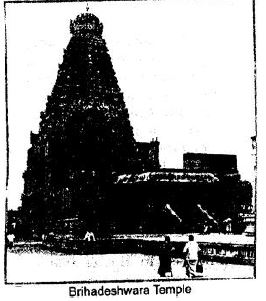
Answer: (a) This temple in Thanjavur was commissioned by the Chola ruler, Rajaraja I.
(b) The shrine is consecrated in honor of Lord Shiva.
(c) Two notable design traits are:
1. The primary building features an imposing vimana (spire) made up of thirteen tiers, standing at a total height of 190 feet.
2. The peak of this tower is adorned with a gigantic monolithic stone dome measuring 25 feet high and weighing roughly 80 tons.
In simple words: The temple was built by King Rajaraja I for Lord Shiva. Its massive 190-foot tower has thirteen levels and is topped by a single 80-ton stone block.
Exam Tip: Remember to specify that the tower has 13 storeys (tiers) and stands 190 feet high, as these precise measurements show high accuracy.
Question 5. With reference to the South Indian temples answer the following questions:
(a) The role of the temple as an employer.
(b)The role of the temple as a landlord.
(c) The role of the temple as centres of learning.
Answer: (a) As an Employment Provider: Shrines served as major job centers, offering livelihoods to many people across diverse occupations. Temple administrations looked after their workers' well-being by distributing food, garments, and living spaces, alongside organizing educational opportunities and setting up medical clinics.
(b) As a Landholder: Because temples possessed extensive agricultural estates, the temple administrations functioned as prominent regional landlords.
(c) As Educational and Community Hubs: People from diverse backgrounds gathered inside temple complexes to debate regional challenges and exchange perspectives. This continuous interaction fostered a culture of mutual learning, deepening the community's understanding of social organization and societal advancement.
In simple words: Temples were the center of life. They hired many workers and took care of them, owned huge lands, and served as meeting places where people learned from each other.
Exam Tip: To answer this question well, explain how the temple acted as a social institution that helped with jobs, land development, and public discussions.
Question 6. With reference to Chola literature, write on the following:
(a) Kalingattuparani
(b) Religious and secular literature.
Answer: (a) Kalingattuparani: Composed in the twelfth century, this celebrated war ballad was authored by Jayankondar, the court poet of Kulottunga I. It is considered a compelling historical composition in Tamil literature, honoring Kulottunga Chola I's triumph over the Kalinga sovereign, Anantavarman Chodaganga, during their military conflict. The text provides highly detailed, vivid depictions of the battlefield and charts the marching route used by the Chola forces. It is widely acclaimed as a literary classic due to its elegant phrasing and grand stylistic prose.
(b) Devotional and Non-Devotional Texts: Spiritual writings of the era featured the Tamil Ramayana along with legends adapted from the classic epics Mahabharata and Ramayana. On the other hand, non-religious compositions were represented by detailed grammatical treatises compiled by scholars like Buddhamitra and Rawankashi.
In simple words: The Kalingattuparani is a famous 12th-century war song about King Kulottunga's victory. Chola books included holy epics like the Tamil Ramayana and also grammar guides.
Exam Tip: Differentiate clearly between religious books (like Kamban's Ramayana) and secular books (like grammar guides by Buddhamitra) to show a well-rounded understanding of literature.
Free study material for History Civics
ICSE Selina Concise Solutions Class 9 History Civics Chapter 8 South India and the Cholas
Students can now access the detailed Selina Concise Solutions for Chapter 8 South India and the Cholas on our portal. These solutions have been carefully prepared as per latest ICSE Class 9 syllabus. Each solution given above has been updated based on the current year pattern to ensure Class 9 students have the most updated History Civics content.
Master Selina Concise Textbook Questions
Our subject experts have provided detailed explanations for all the questions found in the Selina Concise textbook for Class 9 History Civics. We have focussed on making the concepts easy for you in Chapter 8 South India and the Cholas so that students can understand the concepts behind every answer. For all numerical problems and theoretical concepts these solutions will help in strengthening your analytical skill required for the ICSE examinations.
Complete History Civics Exam Preparation
By using these Selina Concise Class 9 solutions, you can enhance your learning and identify areas that need more attention. We recommend solving the History Civics Questions from the textbook first and then use our teacher-verified answers. For a proper revision of Chapter 8 South India and the Cholas, students should also also check our Revision Notes and Sample Papers available on studiestoday.com.
FAQs
You can download the verified Selina Concise solutions for Chapter 8 South India and the Cholas on StudiesToday.com. Our teachers have prepared answers for Class 9 History Civics as per 2026-27 ICSE academic session.
Yes, our solutions for Chapter 8 South India and the Cholas are designed as per new 2026 ICSE standards. 40% competency-based questions required for Class 9, are included to help students understand application-based logic behind every History Civics answer.
Yes, every exercise in Chapter 8 South India and the Cholas from the Selina Concise textbook has been solved step-by-step. Class 9 students will learn History Civics conceots before their ICSE exams.
Yes, follow structured format of these Selina Concise solutions for Chapter 8 South India and the Cholas to get full 20% internal assessment marks and use Class 9 History Civics projects and viva preparation as per ICSE 2026 guidelines.