

ICSE Solutions Selina Concise Class 7 Mathematics Chapter 16 Pythagoras Theorem have been provided below and is also available in Pdf for free download. The Selina Concise ICSE solutions for Class 7 Mathematics have been prepared as per the latest syllabus and ICSE books and examination pattern suggested in Class 7. Questions given in ICSE Selina Concise book for Class 7 Mathematics are an important part of exams for Class 7 Mathematics and if answered properly can help you to get higher marks. Refer to more Chapter-wise answers for ICSE Class 7 Mathematics and also download more latest study material for all subjects. Chapter 16 Pythagoras Theorem is an important topic in Class 7, please refer to answers provided below to help you score better in exams
Selina Concise Chapter 16 Pythagoras Theorem Class 7 Mathematics ICSE Solutions
Class 7 Mathematics students should refer to the following ICSE questions with answers for Chapter 16 Pythagoras Theorem in Class 7. These ICSE Solutions with answers for Class 7 Mathematics will come in exams and help you to score good marks
Chapter 16 Pythagoras Theorem Selina Concise ICSE Solutions Class 7 Mathematics
Question 1. Triangle ABC is right-angled at vertex A. Calculate the length of BC, if AB = 18 cm and AC = 24 cm.
Answer: We are given a right-angled triangle \( \Delta ABC \) where the right angle is situated at vertex \( A \). The side lengths are given as \( AB = 18 \text{ cm} \) and \( AC = 24 \text{ cm} \). Our objective is to determine the length of the hypotenuse \( BC \).
By applying the Pythagoras Theorem:
\( BC^2 = AB^2 + AC^2 \)
Substituting the given lengths into the equation:
\( BC^2 = 18^2 + 24^2 \)
\( BC^2 = 324 + 576 \)
\( BC^2 = 900 \)
\( BC = \sqrt{900} = 30 \text{ cm} \)
Consequently, the length of \( BC \) is \( 30 \text{ cm} \).
In simple words: To find the longest side of a right-angled triangle, square the other two sides, add them together, and then find the square root of that sum.
Exam Tip: Always state the formula clearly before substituting the values to ensure you secure step-by-step marks.
Question 2. Triangle XYZ is right-angled at vertex Z. Calculate the length of YZ, if XY = 13 cm and XZ = 12 cm.
Answer: We have a right-angled triangle \( \Delta XYZ \) with the right angle at vertex \( Z \). The lengths of the sides are \( XY = 13 \text{ cm} \) (which is the hypotenuse) and \( XZ = 12 \text{ cm} \). We need to determine the length of the side \( YZ \).
According to the Pythagoras Theorem:
\( XY^2 = XZ^2 + YZ^2 \)
Substituting the known values:
\( 13^2 = 12^2 + YZ^2 \)
\( 169 = 144 + YZ^2 \)
\( YZ^2 = 169 - 144 \)
\( YZ^2 = 25 \)
\( YZ = \sqrt{25} = 5 \text{ cm} \)
Thus, the length of side \( YZ \) is \( 5 \text{ cm} \).
In simple words: When you know the longest side and one of the other sides, square them both, subtract the smaller square from the larger one, and take the square root of the result.
Exam Tip: Be careful to identify which side is the hypotenuse (the side opposite to the right angle) so you do not accidentally add the squares instead of subtracting.
Question 3. Triangle PQR is right-angled at vertex R. Calculate the length of PR, if: PQ = 34 cm and QR = 33.6 cm.
Answer: We are given a right-angled triangle \( \Delta PQR \) with the right angle at vertex \( R \). The side measurements are \( PQ = 34 \text{ cm} \) (the hypotenuse) and \( QR = 33.6 \text{ cm} \). We are required to find the length of the side \( PR \).
By utilizing the Pythagoras Theorem:
\( PR^2 + QR^2 = PQ^2 \)
Substituting the given dimensions:
\( PR^2 + (33.6)^2 = 34^2 \)
\( PR^2 + 1128.96 = 1156 \)
\( PR^2 = 1156 - 1128.96 \)
\( PR^2 = 27.04 \)
\( PR = \sqrt{27.04} = 5.2 \text{ cm} \)
Therefore, the length of \( PR \) is \( 5.2 \text{ cm} \).
In simple words: Square the longest side and subtract the square of the other known side. Take the square root of this value to find the length of the missing side.
Exam Tip: Pay close attention to calculations involving decimal squares to avoid simple computational errors.
Question 4. The sides of a certain triangle are given below. Find, which of them is right-triangle
(i) 16 cm, 20 cm and 12 cm
(ii) 6 m, 9 m and 13 m
Answer:
(i) The given sides are 16 cm, 20 cm, and 12 cm. For these sides to form a right-angled triangle, the square of the longest side must equal the sum of the squares of the other two sides.
Longest side = 20 cm
\( 20^2 = 400 \)
Sum of the squares of the remaining sides:
\( 16^2 + 12^2 = 256 + 144 = 400 \)
Since the square of the longest side equals the sum of the squares of the other two sides (\( 400 = 400 \)), these side lengths form a right-angled triangle.
(ii) The given sides are 6 m, 9 m, and 13 m. The longest side is 13 m.
Square of the longest side:
\( 13^2 = 169 \)
Sum of the squares of the remaining sides:
\( 6^2 + 9^2 = 36 + 81 = 117 \)
Since the square of the longest side does not equal the sum of the squares of the other two sides (\( 169 \neq 117 \)), these side lengths do not form a right-angled triangle.
In simple words: To check if three numbers can be the sides of a right-angled triangle, square the largest number. If it is equal to the other two squared numbers added together, it is a right-angled triangle.
Exam Tip: Remember to always identify the longest side first and treat it as the hypotenuse before applying the Converse of Pythagoras Theorem.
Question 5. In the given figure, angle BAC = 90°, AC = 400 m and AB = 300 m. Find the length of BC.
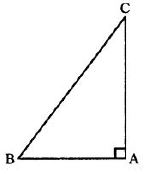
Answer: In the provided figure, \( \Delta ABC \) is right-angled at vertex \( A \). The side lengths are \( AC = 400 \text{ m} \) and \( AB = 300 \text{ m} \). We are required to find the length of the side \( BC \).
By applying the Pythagoras Theorem:
\( BC^2 = AB^2 + AC^2 \)
Substituting the given lengths:
\( BC^2 = 300^2 + 400^2 \)
\( BC^2 = 90000 + 160000 \)
\( BC^2 = 250000 \)
\( BC = \sqrt{250000} = 500 \text{ m} \)
Therefore, the length of \( BC \) is \( 500 \text{ m} \).
In simple words: Square both the given perpendicular sides, add those squares together, and find the square root of the total to get the length of the diagonal side.
Exam Tip: Be vigilant about the units (meters in this question) and ensure you state the final result with the correct unit of measurement.
Question 6. In the given figure, angle ACP = ∠BDP = 90°, AC = 12 m, BD = 9 m and PA= PB = 15 m. Find:
(i) CP
(ii) PD
(iii) CD
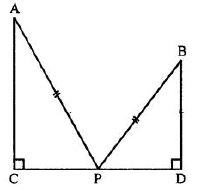
Answer:
(i) In the right-angled triangle \( \Delta ACP \), the right angle is at vertex \( C \). Applying the Pythagoras Theorem:
\( AP^2 = AC^2 + CP^2 \)
Given that \( AP = 15 \text{ m} \) and \( AC = 12 \text{ m} \):
\( 15^2 = 12^2 + CP^2 \)
\( 225 = 144 + CP^2 \)
\( CP^2 = 225 - 144 \)
\( CP^2 = 81 \)
\( CP = \sqrt{81} = 9 \text{ m} \)
(ii) In the right-angled triangle \( \Delta BPD \), the right angle is at vertex \( D \). Applying the Pythagoras Theorem:
\( PB^2 = BD^2 + PD^2 \)
Given that \( PB = 15 \text{ m} \) and \( BD = 9 \text{ m} \):
\( 15^2 = 9^2 + PD^2 \)
\( 225 = 81 + PD^2 \)
\( PD^2 = 225 - 81 \)
\( PD^2 = 144 \)
\( PD = \sqrt{144} = 12 \text{ m} \)
(iii) The total segment length \( CD \) is the sum of \( CP \) and \( PD \):
\( CD = CP + PD \)
\( CD = 9 \text{ m} + 12 \text{ m} = 21 \text{ m} \)
In simple words: Solve for the base of each right-angled triangle separately using the Pythagoras formula. Then, add the two base segments together to find the entire length of the ground line.
Exam Tip: Break complex figures down into simple, separate triangles and show individual step-by-step calculations for each sub-part.
Question 7. In triangle PQR, angle Q = 90°, find :
(i) PR, if PQ = 8 cm and QR = 6 cm
(ii) PQ, if PR = 34 cm and QR = 30 cm
Answer:
(i) In \( \Delta PQR \), the right angle is situated at \( Q \). The given side lengths are \( PQ = 8 \text{ cm} \) and \( QR = 6 \text{ cm} \).
Applying the Pythagoras Theorem to find the hypotenuse \( PR \):
\( PR^2 = PQ^2 + QR^2 \)
\( PR^2 = 8^2 + 6^2 \)
\( PR^2 = 64 + 36 \)
\( PR^2 = 100 \)
\( PR = \sqrt{100} = 10 \text{ cm} \)
(ii) In \( \Delta PQR \), the right angle is at \( Q \). Here, \( PR = 34 \text{ cm} \) (which is the hypotenuse) and \( QR = 30 \text{ cm} \).
Applying the Pythagoras Theorem to find the side \( PQ \):
\( PR^2 = PQ^2 + QR^2 \)
\( 34^2 = PQ^2 + 30^2 \)
\( 1156 = PQ^2 + 900 \)
\( PQ^2 = 1156 - 900 \)
\( PQ^2 = 256 \)
\( PQ = \sqrt{256} = 16 \text{ cm} \)
In simple words: Using the Pythagoras relationship, you can find any missing side of a right-angled triangle as long as you have the lengths of the other two sides.
Exam Tip: Be mindful of when to apply addition (when finding the hypotenuse) and subtraction (when finding one of the other two sides) in the Pythagoras Theorem.
Question 8. Show that the triangle ABC is a right-angled triangle; if: AB = 9 cm, BC = 40 cm and AC = 41 cm
Answer: We are given the side lengths of \( \Delta ABC \) as \( AB = 9 \text{ cm} \), \( BC = 40 \text{ cm} \), and \( AC = 41 \text{ cm} \). To prove that this triangle has a right angle, we must verify if the Pythagorean relation is satisfied (i.e., whether the square of the longest side equals the sum of the squares of the other two sides).
The longest side is \( AC = 41 \text{ cm} \).
Square of the longest side:
\( AC^2 = 41^2 = 1681 \)
Sum of the squares of the remaining two sides:
\( AB^2 + BC^2 = 9^2 + 40^2 \)
\( AB^2 + BC^2 = 81 + 1600 = 1681 \)
Since the square of the longest side is exactly equal to the sum of the squares of the other two sides (\( AC^2 = AB^2 + BC^2 \)), the converse of the Pythagoras Theorem holds true. Therefore, \( \Delta ABC \) is a right-angled triangle.
In simple words: Squaring the longest side gives 1681. Squaring the other two sides and adding them also gives 1681. Since both results are the same, the sides form a right-angled triangle.
Exam Tip: State the Converse of Pythagoras Theorem clearly in your conclusion to justify your answer fully.
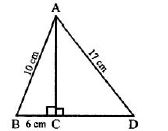
Question 9. In the given figure, angle ACB = 90° = angle ACD. If AB = 10 m, BC = 6 cm and AD = 17 cm, find :
(i) AC
(ii) CD
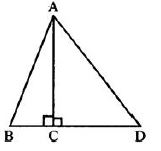
Answer: Note that all dimensions should be in consistent units of centimeters (\( \text{cm} \)).
(i) In the right-angled triangle \( \Delta ABC \), the right angle is situated at \( C \). Applying the Pythagoras Theorem:
\( AB^2 = AC^2 + BC^2 \)
Substituting \( AB = 10 \text{ cm} \) and \( BC = 6 \text{ cm} \):
\( 10^2 = AC^2 + 6^2 \)
\( 100 = AC^2 + 36 \)
\( AC^2 = 100 - 36 \)
\( AC^2 = 64 \)
\( AC = \sqrt{64} = 8 \text{ cm} \)
(ii) Now, consider the right-angled triangle \( \Delta ACD \) where the right angle is also at \( C \). Applying the Pythagoras Theorem:
\( AD^2 = AC^2 + CD^2 \)
Given \( AD = 17 \text{ cm} \) and using our calculated value \( AC^2 = 64 \):
\( 17^2 = 64 + CD^2 \)
\( 289 = 64 + CD^2 \)
\( CD^2 = 289 - 64 \)
\( CD^2 = 225 \)
\( CD = \sqrt{225} = 15 \text{ cm} \)
In simple words: First, find the height of the vertical line shared between both triangles. Then use that height in the second triangle's formula to solve for its base.
Exam Tip: Since both right triangles share the altitude \( AC \), finding its length correctly is critical to solving both parts of this question.
Question 10. In the given figure, angle ADB = 90°, AC = AB = 26 cm and BD = DC. If the length of AD = 24 cm; find the length of BC.
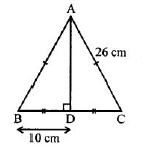
Answer: We are given \( \Delta ABC \), with \( AD \) perpendicular to \( BC \), so \( \angle ADB = \angle ADC = 90^\circ \). The side measurements are \( AB = AC = 26 \text{ cm} \) and \( AD = 24 \text{ cm} \). We are also given that \( BD = DC \).
Let us analyze the right-angled triangle \( \Delta ADC \):
\( AC^2 = AD^2 + DC^2 \)
Substituting the given lengths:
\( 26^2 = 24^2 + DC^2 \)
\( 676 = 576 + DC^2 \)
\( DC^2 = 676 - 576 \)
\( DC^2 = 100 \)
\( DC = \sqrt{100} = 10 \text{ cm} \)
Given that \( BD = DC \), we have:
\( BD = 10 \text{ cm} \)
Now, the full length of the base \( BC \) is:
\( BC = BD + DC \)
\( BC = 10 \text{ cm} + 10 \text{ cm} = 20 \text{ cm} \)
In simple words: Find half of the base length using one of the right-angled triangles. Since both halves are equal, simply double that length to find the total base length.
Exam Tip: Since \( AB = AC \) (isosceles triangle), the altitude \( AD \) bisects the base \( BC \). Stating this property shows a strong understanding of geometric theorems.
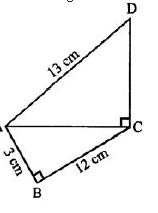
Question 11. In the given figure, AD = 13 cm, BC = 12 cm, AB = 3 cm and angle ACD = angle ABC = 90°. Find the length of DC.
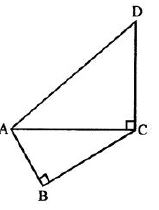
Answer:
(i) First, consider the right-angled triangle \( \Delta ABC \), where \( \angle ABC = 90^\circ \). Applying the Pythagoras Theorem:
\( AC^2 = AB^2 + BC^2 \)
Given \( AB = 3 \text{ cm} \) and \( BC = 12 \text{ cm} \):
\( AC^2 = 3^2 + 12^2 \)
\( AC^2 = 9 + 144 \)
\( AC^2 = 153 \)
Therefore, \( AC = \sqrt{153} \text{ cm} \).
(ii) Next, consider the right-angled triangle \( \Delta ACD \), where \( \angle ACD = 90^\circ \). Applying the Pythagoras Theorem:
\( AD^2 = AC^2 + DC^2 \)
Given \( AD = 13 \text{ cm} \) and \( AC^2 = 153 \):
\( 13^2 = 153 + DC^2 \)
\( 169 = 153 + DC^2 \)
\( DC^2 = 169 - 153 \)
\( DC^2 = 16 \)
\( DC = \sqrt{16} = 4 \text{ cm} \).
In simple words: Work out the square of the diagonal line of the bottom triangle first. Then, use that squared value in the top triangle's equation to find the length of the vertical side.
Exam Tip: Keeping \( AC^2 = 153 \) instead of taking its decimal root simplifies the calculation in the next step and prevents rounding issues.
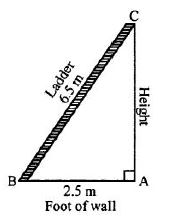
Question 12. A ladder, 6.5 m long, rests against a vertical wall. Ifthe foot of the ladcler is 2.5 m from the foot of the wall, find upto how much height does the ladder reach?
Answer: Let \( AC \) represent the vertical height the ladder reaches on the wall, and \( AB \) represent the horizontal distance from the wall to the foot of the ladder. The ladder itself forms the hypotenuse \( BC \). We have \( BC = 6.5 \text{ m} \) and \( AB = 2.5 \text{ m} \).
Applying the Pythagoras Theorem:
\( BC^2 = AB^2 + AC^2 \)
Substituting the given lengths:
\( (6.5)^2 = (2.5)^2 + AC^2 \)
\( 42.25 = 6.25 + AC^2 \)
\( AC^2 = 42.25 - 6.25 \)
\( AC^2 = 36 \)
\( AC = \sqrt{36} = 6 \text{ m} \)
Consequently, the height reached by the ladder on the wall is \( 6 \text{ m} \).
In simple words: The ladder, ground, and wall form a right triangle. Square the ladder length, subtract the square of the distance from the wall, and find the square root of the result to get the height.
Exam Tip: Drawing a quick diagram representing the wall, ground, and ladder will prevent confusion regarding which values to assign as the legs and hypotenuse.
Question 13. A boy first goes 5 m due north and then 12 m due east. Find the distance between the initial and the final position of the boy.
Answer: Let the starting position of the boy be \( C \). Going \( 5 \text{ m} \) north brings him to point \( A \), and turning \( 12 \text{ m} \) east brings him to his final position \( B \). The straight-line distance between his initial position \( C \) and final position \( B \) represents the hypotenuse \( BC \) of the right-angled triangle \( \Delta CAB \).
According to the Pythagoras Theorem:
\( BC^2 = AC^2 + AB^2 \)
Substituting the distances:
\( BC^2 = 5^2 + 12^2 \)
\( BC^2 = 25 + 144 \)
\( BC^2 = 169 \)
\( BC = \sqrt{169} = 13 \text{ m} \)
Therefore, the straight-line distance between the boy's initial and final position is \( 13 \text{ m} \).
In simple words: Moving north and then east makes a perfect corner (right angle). The shortest direct path between the start and end is the hypotenuse, which you calculate using the Pythagoras Theorem.
Exam Tip: Directions (North, South, East, West) are always perpendicular to each other, so any turn from North to East creates a \( 90^\circ \) angle.
Question 14. Use the information given in the figure to find the length AD.
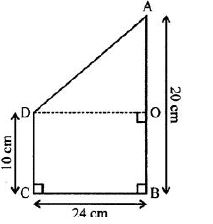
Answer: From the given figure, we observe that \( AB = 20 \text{ cm} \), \( BC = 24 \text{ cm} \), and \( CD = 10 \text{ cm} \). We can construct a horizontal line \( DO \) parallel to \( CB \), meeting the vertical side \( AB \) at point \( O \).
This creates a rectangle \( DOBC \), where:
\( OD = BC = 24 \text{ cm} \)
\( OB = CD = 10 \text{ cm} \)
Now, we find the segment \( AO \):
\( AO = AB - OB \)
\( AO = 20 \text{ cm} - 10 \text{ cm} = 10 \text{ cm} \)
In the right-angled triangle \( \Delta AOD \), with the right angle at \( O \), we apply the Pythagoras Theorem:
\( AD^2 = AO^2 + OD^2 \)
Substituting the known lengths:
\( AD^2 = 10^2 + 24^2 \)
\( AD^2 = 100 + 576 \)
\( AD^2 = 676 \)
\( AD = \sqrt{676} = 26 \text{ cm} \)
Thus, the length of \( AD \) is \( 26 \text{ cm} \).
In simple words: Break the shape down into a rectangle and a right-angled triangle. Work out the unknown sides of the triangle using the rectangle's sides, then use the Pythagoras Theorem to find the diagonal.
Exam Tip: When faced with complex figures, drawing a parallel line can often help split the composite shape into a simpler rectangle and a right-angled triangle.
Free study material for Mathematics
ICSE Selina Concise Solutions Class 7 Mathematics Chapter 16 Pythagoras Theorem
Students can now access the detailed Selina Concise Solutions for Chapter 16 Pythagoras Theorem on our portal. These solutions have been carefully prepared as per latest ICSE Class 7 syllabus. Each solution given above has been updated based on the current year pattern to ensure Class 7 students have the most updated Mathematics content.
Master Selina Concise Textbook Questions
Our subject experts have provided detailed explanations for all the questions found in the Selina Concise textbook for Class 7 Mathematics. We have focussed on making the concepts easy for you in Chapter 16 Pythagoras Theorem so that students can understand the concepts behind every answer. For all numerical problems and theoretical concepts these solutions will help in strengthening your analytical skill required for the ICSE examinations.
Complete Mathematics Exam Preparation
By using these Selina Concise Class 7 solutions, you can enhance your learning and identify areas that need more attention. We recommend solving the Mathematics Questions from the textbook first and then use our teacher-verified answers. For a proper revision of Chapter 16 Pythagoras Theorem, students should also also check our Revision Notes and Sample Papers available on studiestoday.com.
FAQs
You can download the verified Selina Concise solutions for Chapter 16 Pythagoras Theorem on StudiesToday.com. Our teachers have prepared answers for Class 7 Mathematics as per 2026-27 ICSE academic session.
Yes, our solutions for Chapter 16 Pythagoras Theorem are designed as per new 2026 ICSE standards. 40% competency-based questions required for Class 7, are included to help students understand application-based logic behind every Mathematics answer.
Yes, every exercise in Chapter 16 Pythagoras Theorem from the Selina Concise textbook has been solved step-by-step. Class 7 students will learn Mathematics conceots before their ICSE exams.
Yes, follow structured format of these Selina Concise solutions for Chapter 16 Pythagoras Theorem to get full 20% internal assessment marks and use Class 7 Mathematics projects and viva preparation as per ICSE 2026 guidelines.