

ICSE Solutions Selina Concise Class 8 Mathematics Chapter 17 Special Types of Quadrilaterals have been provided below and is also available in Pdf for free download. The Selina Concise ICSE solutions for Class 8 Mathematics have been prepared as per the latest syllabus and ICSE books and examination pattern suggested in Class 8. Questions given in ICSE Selina Concise book for Class 8 Mathematics are an important part of exams for Class 8 Mathematics and if answered properly can help you to get higher marks. Refer to more Chapter-wise answers for ICSE Class 8 Mathematics and also download more latest study material for all subjects. Chapter 17 Special Types of Quadrilaterals is an important topic in Class 8, please refer to answers provided below to help you score better in exams
Selina Concise Chapter 17 Special Types of Quadrilaterals Class 8 Mathematics ICSE Solutions
Class 8 Mathematics students should refer to the following ICSE questions with answers for Chapter 17 Special Types of Quadrilaterals in Class 8. These ICSE Solutions with answers for Class 8 Mathematics will come in exams and help you to score good marks
Chapter 17 Special Types of Quadrilaterals Selina Concise ICSE Solutions Class 8 Mathematics
Question 1. In parallelogram ABCD, \( \angle A \) = 3 times \( \angle B \). Find all the angles of the parallelogram. In the same parallelogram, if AB = 5x - 7 and CD = 3x + 1 ; find the length of CD.
Answer:
Let the measure of \( \angle B \) be \( x \).
Since \( \angle A \) is three times \( \angle B \), we have \( \angle A = 3x \).
In a parallelogram, adjacent angles are supplementary because the opposite sides are parallel (\( AD \parallel BC \)).
Therefore, \( \angle A + \angle B = 180^\circ \).
Substituting the values:
\( 3x + x = 180^\circ \)
\( \implies 4x = 180^\circ \)
\( \implies x = 45^\circ \)
So, \( \angle B = 45^\circ \).
This gives:
\( \angle A = 3 \times 45^\circ = 135^\circ \).
Since opposite angles of a parallelogram are equal, we get:
\( \angle C = \angle A = 135^\circ \) and \( \angle D = \angle B = 45^\circ \).
For the sides:
Since opposite sides of a parallelogram are equal in length, we have:
\( AB = CD \)
Given that \( AB = 5x - 7 \) and \( CD = 3x + 1 \):
\( 5x - 7 = 3x + 1 \)
\( \implies 5x - 3x = 1 + 7 \)
\( \implies 2x = 8 \)
\( \implies x = 4 \)
Now, substitute \( x = 4 \) to find the length of \( CD \):
\( CD = 3(4) + 1 = 12 + 1 = 13 \).
Hence, the angles of the parallelogram are \( 135^\circ \), \( 45^\circ \), \( 135^\circ \), and \( 45^\circ \), and the length of \( CD \) is \( 13 \).
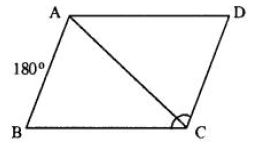
In simple words: Adjacent angles of a parallelogram add up to 180 degrees, which helps us find all four angles. Also, because opposite sides are equal, we can set the given expressions equal to solve for the unknown side.
Exam Tip: Remember that adjacent angles in any parallelogram are supplementary (sum to 180 degrees), whereas opposite angles are equal. When equating opposite sides, solve for the variable first before substituting it back to find the actual length.
Question 2. In parallelogram PQRS, \( \angle Q \) = \( (4x - 5)^\circ \) and \( \angle S \) = \( (3x + 10)^\circ \). Calculate : \( \angle Q \) and \( \angle R \).
Answer:
In parallelogram PQRS, \( \angle Q \) and \( \angle S \) are opposite angles.
Since opposite angles of a parallelogram are equal:
\( \angle Q = \angle S \)
\( 4x - 5 = 3x + 10 \)
\( \implies 4x - 3x = 10 + 5 \)
\( \implies x = 15 \)
Now, substitute \( x = 15 \) to find the measure of \( \angle Q \):
\( \angle Q = 4(15) - 5 = 60 - 5 = 55^\circ \).
Since consecutive (adjacent) angles in a parallelogram are supplementary:
\( \angle Q + \angle R = 180^\circ \)
\( 55^\circ + \angle R = 180^\circ \)
\( \implies \angle R = 180^\circ - 55^\circ = 125^\circ \).
Therefore, \( \angle Q = 55^\circ \) and \( \angle R = 125^\circ \).
In simple words: In a parallelogram, angles opposite to each other are equal, which allows us to find the value of x. Once we have the value of x, we can find one angle and then subtract it from 180 degrees to get the adjacent angle.
Exam Tip: Always state the geometric properties you are using, such as "opposite angles of a parallelogram are equal" or "consecutive angles are supplementary". This helps you secure full step-by-step marks in exams.
Question 3. In rhombus ABCD ;
(i) if \( \angle A \) = \( 74^\circ \) ; find \( \angle B \) and \( \angle C \).
(ii) if AD = 7.5 cm ; find BC and CD.
Answer:
(i) A rhombus is a special type of parallelogram, so its adjacent sides are parallel, which means \( AD \parallel BC \).
Since consecutive interior angles are supplementary, we have:
\( \angle A + \angle B = 180^\circ \)
Given \( \angle A = 74^\circ \):
\( 74^\circ + \angle B = 180^\circ \)
\( \implies \angle B = 180^\circ - 74^\circ = 106^\circ \).
Additionally, opposite angles in a rhombus are equal:
\( \angle C = \angle A = 74^\circ \).
Thus, \( \angle B = 106^\circ \) and \( \angle C = 74^\circ \).
(ii) Since all four sides of a rhombus are equal in length:
\( BC = CD = AD \)
Since we are given \( AD = 7.5\text{ cm} \):
\( BC = 7.5\text{ cm} \) and \( CD = 7.5\text{ cm} \).
In simple words: A rhombus has equal sides, so if one side is 7.5 cm, all other sides are also 7.5 cm. Its angles behave like a parallelogram's, where opposite angles are equal and adjacent angles add up to 180 degrees.
Exam Tip: Remember that a rhombus is defined by having all four sides equal, while its angle properties are identical to those of a parallelogram. Keep these two distinct properties in mind to solve such questions quickly.
Question 4. In square PQRS :
(i) if PQ = 3x - 7 and QR = x + 3 ; find PS
(ii) if PR = 5x and QS = 9x - 8. Find QS
Answer:
(i) In a square, all four sides are of equal length.
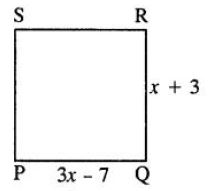
Thus, we have:
\( PQ = QR \)
Substitute the given algebraic expressions:
\( 3x - 7 = x + 3 \)
\( \implies 3x - x = 3 + 7 \)
\( \implies 2x = 10 \)
\( \implies x = 5 \)
Since all sides are equal, \( PS \) is equal to \( PQ \):
\( PS = PQ = 3x - 7 \)
Substitute \( x = 5 \):
\( PS = 3(5) - 7 = 15 - 7 = 8 \).
(ii) In any square, the diagonals are equal in length.
Therefore:
\( PR = QS \)
Substitute the given expressions:
\( 5x = 9x - 8 \)
\( \implies 5x - 9x = -8 \)
\( \implies -4x = -8 \)
\( \implies x = 2 \)
Now, find the length of \( QS \):
\( QS = 9x - 8 \)
Substitute \( x = 2 \):
\( QS = 9(2) - 8 = 18 - 8 = 10 \).
In simple words: For the first part, because a square has four equal sides, we set the two side equations equal to each other to solve for x. For the second part, since the two diagonals of a square are always equal, we set the diagonal equations equal to find the value of x.
Exam Tip: Always remember that all sides of a square are equal, and both of its diagonals are also equal. Equating these corresponding parts allows you to form simple linear equations to find any missing lengths.
Question 5. ABCD is a rectangle, if \( \angle BPC \) = \( 124^\circ \)
Calculate : (i) \( \angle BAP \) (ii) \( \angle ADP \)
Answer:
Since ABCD is a rectangle, its diagonals are equal in length and bisect each other.
This means that \( PB = PC \).
In triangle BPC, since \( PB = PC \), the angles opposite these sides are equal:
Let \( \angle PBC = \angle PCB = x \).
The sum of angles in triangle BPC is \( 180^\circ \):
\( \angle BPC + \angle PBC + \angle PCB = 180^\circ \)
Substitute \( \angle BPC = 124^\circ \):
\( 124^\circ + x + x = 180^\circ \)
\( \implies 2x = 180^\circ - 124^\circ \)
\( \implies 2x = 56^\circ \)
\( \implies x = 28^\circ \)
Thus, \( \angle PBC = 28^\circ \).
Since the opposite sides of a rectangle are parallel (\( AD \parallel BC \)), the transversal \( BD \) creates alternate interior angles that are equal:
\( \angle ADP = \angle PBC = 28^\circ \).
This gives the answer for part (ii): \( \angle ADP = 28^\circ \).
Now, to find \( \angle BAP \):
The angles \( \angle APB \) and \( \angle BPC \) form a linear pair along the diagonal AC:
\( \angle APB + \angle BPC = 180^\circ \)
\( \angle APB + 124^\circ = 180^\circ \)
\( \implies \angle APB = 180^\circ - 124^\circ = 56^\circ \).
Since the diagonals of a rectangle bisect each other and are equal, we also have \( PA = PB \).
Therefore, in triangle APB, the angles opposite to the equal sides are equal:
\( \angle BAP = \angle ABP \)
The sum of angles in triangle APB is \( 180^\circ \):
\( \angle APB + \angle BAP + \angle ABP = 180^\circ \)
\( 56^\circ + 2\angle BAP = 180^\circ \)
\( \implies 2\angle BAP = 180^\circ - 56^\circ \)
\( \implies 2\angle BAP = 124^\circ \)
\( \implies \angle BAP = 62^\circ \).
This gives the answer for part (i): \( \angle BAP = 62^\circ \).
In simple words: Because the diagonals of a rectangle are equal and split each other in half, they form smaller isosceles triangles inside. By using the properties of these triangles (like angles adding up to 180 degrees and equal sides having equal opposite angles), we can determine the unknown angle measures.
Exam Tip: Always remember that diagonals of a rectangle bisect each other and are equal, which splits them into four segments of equal length (\( PA = PB = PC = PD \)). Recognizing the resulting isosceles triangles is the key to solving angle problems in rectangles.
Question 6. ABCD is a rhombus. If \( \angle BAC \) = \( 38^\circ \), find :
(i) \( \angle ACB \)
(ii) \( \angle DAC \)
(iii) \( \angle ADC \).
Answer:
(i) In rhombus ABCD, all sides are equal, so \( AB = BC \).
In triangle ABC, since two sides are equal, the angles opposite to them are also equal:
\( \angle ACB = \angle BAC \)
Given that \( \angle BAC = 38^\circ \):
\( \angle ACB = 38^\circ \).
(ii) Since the opposite sides of a rhombus are parallel (\( AD \parallel BC \)), the diagonal AC acts as a transversal.
This makes the alternate interior angles equal:
\( \angle DAC = \angle ACB \)
Since we found \( \angle ACB = 38^\circ \):
\( \angle DAC = 38^\circ \).
(iii) The sum of angles in triangle ABC is \( 180^\circ \):
\( \angle ABC + \angle BAC + \angle ACB = 180^\circ \)
\( \angle ABC + 38^\circ + 38^\circ = 180^\circ \)
\( \implies \angle ABC + 76^\circ = 180^\circ \)
\( \implies \angle ABC = 180^\circ - 76^\circ = 104^\circ \).
Since opposite angles of a rhombus are equal:
\( \angle ADC = \angle ABC = 104^\circ \).
Therefore, we have:
(i) \( \angle ACB = 38^\circ \)
(ii) \( \angle DAC = 38^\circ \)
(iii) \( \angle ADC = 104^\circ \).
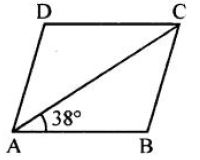
In simple words: Since a rhombus has equal sides, the triangle formed by the diagonal is isosceles, meaning its base angles are equal. We can find the remaining angles by using the properties of parallel lines and the fact that opposite angles of a rhombus are equal.
Exam Tip: Remember that the diagonals of a rhombus bisect its angles. Therefore, \( \angle BAC \) will always be equal to \( \angle DAC \), which can save you time when verifying your calculations on exams.
Question 7. ABCD is a rhombus. If \( \angle BCA \) = \( 35^\circ \). find \( \angle ADC \).
Answer:
In rhombus ABCD, the opposite sides are parallel, so \( AD \parallel BC \).
The diagonal AC acts as a transversal, which makes the alternate interior angles equal:
\( \angle DAC = \angle BCA \)
Given \( \angle BCA = 35^\circ \):
\( \angle DAC = 35^\circ \).
Since ABCD is a rhombus, we have \( AD = CD \).
In triangle DAC, because the two sides AD and CD are equal, their opposite angles are also equal:
\( \angle ACD = \angle DAC = 35^\circ \).
In triangle DAC, the sum of all interior angles is \( 180^\circ \):
\( \angle DAC + \angle ACD + \angle ADC = 180^\circ \)
Substitute the known values:
\( 35^\circ + 35^\circ + \angle ADC = 180^\circ \)
\( \implies 70^\circ + \angle ADC = 180^\circ \)
\( \implies \angle ADC = 180^\circ - 70^\circ = 110^\circ \).
Thus, the measure of \( \angle ADC \) is \( 110^\circ \).
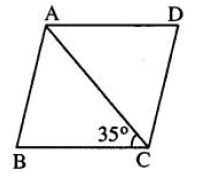
In simple words: Using parallel lines, we find that the diagonal splits the rhombus into two identical isosceles triangles. By knowing one angle is 35 degrees, we can find the other equal angle in the triangle and subtract their sum from 180 degrees to get the final angle.
Exam Tip: A rhombus diagonal is always an angle bisector and forms isosceles triangles with the adjacent sides. This means \( \angle DAC = \angle ACD \), making it easy to find the vertex angle of the triangle using the triangle angle sum property.
Question 8. PQRS is a parallelogram whose diagonals intersect at M. If \( \angle PMS \) = \( 54^\circ \), \( \angle QSR \) = \( 25^\circ \) and \( \angle SQR \) = \( 30^\circ \) ; find :
(i) \( \angle RPS \)
(ii) \( \angle PRS \)
(iii) \( \angle PSR \).
Answer:
Since PQRS is a parallelogram, the opposite sides are parallel, so \( QR \parallel PS \).
Using the diagonal QS as a transversal, the alternate interior angles are equal:
\( \angle PSQ = \angle SQR \)
Given that \( \angle SQR = 30^\circ \):
\( \angle PSQ = 30^\circ \).
In triangle SMP:
The sum of angles in a triangle is \( 180^\circ \):
\( \angle PMS + \angle PSM + \angle MPS = 180^\circ \)
Since \( \angle PSM \) is the same as \( \angle PSQ \), we substitute the known values:
\( 54^\circ + 30^\circ + \angle RPS = 180^\circ \)
\( \implies 84^\circ + \angle RPS = 180^\circ \)
\( \implies \angle RPS = 180^\circ - 84^\circ = 96^\circ \).
This gives the answer for part (i): \( \angle RPS = 96^\circ \).
In triangle SMR:
The exterior angle \( \angle PMS \) is equal to the sum of the two opposite interior angles (\( \angle MSR \) and \( \angle MRS \)):
\( \angle PMS = \angle MSR + \angle MRS \)
Substitute \( \angle PMS = 54^\circ \) and \( \angle MSR = \angle QSR = 25^\circ \):
\( 54^\circ = 25^\circ + \angle PRS \)
\( \implies \angle PRS = 54^\circ - 25^\circ = 29^\circ \).
This gives the answer for part (ii): \( \angle PRS = 29^\circ \).
To find \( \angle PSR \):
The angle \( \angle PSR \) is the sum of the adjacent angles \( \angle PSQ \) and \( \angle QSR \):
\( \angle PSR = \angle PSQ + \angle QSR \)
Substitute the values:
\( \angle PSR = 30^\circ + 25^\circ = 55^\circ \).
This gives the answer for part (iii): \( \angle PSR = 55^\circ \).
In simple words: Since opposite sides are parallel, the diagonal creates equal alternate angles. We then use triangle properties, like the sum of angles adding to 180 degrees and the exterior angle theorem, to find the remaining angle measures step-by-step.
Exam Tip: Using the exterior angle theorem of a triangle can significantly shorten your calculations for diagonal intersection problems. Keep in mind that alternate interior angles are always equal when working with parallelograms.
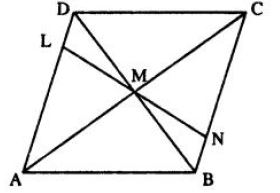
Question 9. Given : Parallelogram ABCD in which diagonals AC and BD intersect at M. Prove : M is mid-point of LN.
Answer:
Proof:
In parallelogram ABCD, the diagonals AC and BD intersect at M.
Since the diagonals of a parallelogram bisect each other, we have:
\( MD = MB \).
Since \( AD \parallel BC \) (opposite sides of a parallelogram are parallel), and BD acts as a transversal line:
The alternate interior angles are equal:
\( \angle LDM = \angle NBM \) (which is \( \angle ADB = \angle DBN \)).
Furthermore, the angles at the intersection M are vertically opposite:
\( \angle DML = \angle BMN \).
Now, let's consider the two triangles \( \Delta DML \) and \( \Delta BMN \):
1. \( \angle LDM = \angle NBM \) (proved above)
2. \( MD = MB \) (proved above)
3. \( \angle DML = \angle BMN \) (vertically opposite angles)
By the Angle-Side-Angle (A.S.A.) congruence criterion:
\( \Delta DML \cong \Delta BMN \).
Since the two triangles are congruent, their corresponding parts are equal (C.P.C.T.):
\( LM = MN \).
This proves that M is the midpoint of the line segment LN.
Hence proved.
In simple words: By showing that the two small triangles on opposite sides of the intersection are congruent using the ASA rule, we prove that the segments of the line passing through the midpoint are of equal length.
Exam Tip: When proving line segments equal, look for a pair of triangles that contain those segments and use standard congruence criteria like A.S.A. to show they are congruent. This is a very common method for geometric proofs.
Question 10. In an Isosceles-trapezium, show that the opposite angles are supplementary.
Answer:
Proof:
Let ABCD be an isosceles trapezium where the non-parallel sides are equal, so \( AD = BC \), and the parallel bases are \( AB \parallel CD \).
Since the base \( AB \) is parallel to \( CD \), the consecutive interior angles on the same side of the transversal AD are supplementary:
\( \angle A + \angle D = 180^\circ \).
In an isosceles trapezium, the base angles are equal. Therefore, we have:
\( \angle A = \angle B \) and \( \angle C = \angle D \).
Substituting \( \angle B \) for \( \angle A \) in our first equation:
\( \angle B + \angle D = 180^\circ \).
Similarly, substituting \( \angle C \) for \( \angle D \):
\( \angle A + \angle C = 180^\circ \).
This proves that both pairs of opposite angles in an isosceles trapezium are supplementary (their sum is \( 180^\circ \)).
Hence proved.
In simple words: Since the top and bottom sides of a trapezium are parallel, the adjacent side angles add up to 180 degrees. Because it is isosceles, the angles at the bottom are equal to each other, which means the opposite angles also add up to 180 degrees.
Exam Tip: Always state clearly that the base angles of an isosceles trapezium are equal (\( \angle A = \angle B \) and \( \angle C = \angle D \)). This property, combined with the co-interior angles property of parallel lines, makes proving this theorem very straightforward.
Question 11. ABCD is a parallelogram. What kind of quadrilateral is it if :
(i) AC = BD and AC is perpendicular to BD?
(ii) AC is perpendicular to BD but is not equal to it ?
(iii) AC = BD but AC is not perpendicular to BD ?
Answer:
(i) In a parallelogram, if the diagonals are equal in length and intersect at right angles (perpendicular to each other), the shape is a square.
(ii) In a parallelogram, if the diagonals intersect at right angles (perpendicular) but are not equal in length, the shape is a rhombus.
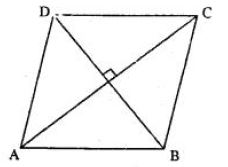
(iii) In a parallelogram, if the diagonals are equal in length but do not intersect at right angles, the shape is a rectangle.
In simple words: This question explores how the properties of a parallelogram's diagonals determine its specific shape: equal and perpendicular diagonals make a square, unequal but perpendicular diagonals make a rhombus, and equal but non-perpendicular diagonals make a rectangle.
Exam Tip: Memorize the diagonal properties of special quadrilaterals: a rectangle has equal diagonals, a rhombus has perpendicular diagonals, and a square has diagonals that are both equal and perpendicular. This is a very frequent multiple-choice or short-answer topic.
Question 12. Prove that the diagonals of a parallelogram bisect each other.
Answer:
Proof:
Let ABCD be a parallelogram with diagonals AC and BD intersecting at point O.
To prove that the diagonals bisect each other, we need to show:
\( OA = OC \) and \( OB = OD \).
Since ABCD is a parallelogram, the opposite sides are parallel:
\( AB \parallel CD \).
Using AC as a transversal line between the parallel lines AB and CD, the alternate interior angles are equal:
\( \angle 1 = \angle 2 \) (where \( \angle 1 = \angle OCD \) and \( \angle 2 = \angle OAB \)).
Using BD as a transversal line between the parallel lines AB and CD, the alternate interior angles are also equal:
\( \angle 3 = \angle 4 \) (where \( \angle 3 = \angle ODC \) and \( \angle 4 = \angle OBA \)).
Also, because opposite sides of a parallelogram are equal in length:
\( AB = CD \).
Now, let's consider the triangles \( \Delta COD \) and \( \Delta AOB \):
1. \( \angle 1 = \angle 2 \) (Alternate angles)
2. \( CD = AB \) (Opposite sides of the parallelogram)
3. \( \angle 3 = \angle 4 \) (Alternate angles)
By the Angle-Side-Angle (A.S.A.) congruence criterion:
\( \Delta COD \cong \Delta AOB \).
Since the two triangles are congruent, their corresponding parts must be equal (C.P.C.T.):
\( OA = OC \) and \( OB = OD \).
Therefore, the diagonals AC and BD bisect each other at point O.
Hence proved.
In simple words: To prove the diagonals split each other in half, we show that the two opposite triangles formed by the diagonals are congruent using the ASA rule. This congruence means their corresponding side segments must be equal in length.
Exam Tip: Be sure to clearly define which angles correspond to each other when setting up alternate interior angles. Properly labeling \( \angle 1, \angle 2, \angle 3, \text{ and } \angle 4 \) on your diagram makes your proof clear and easy for the examiner to read.
Question 13. If the diagonals of a parallelogram are of equal lengths, the parallelogram is a rectangle. Prove it.
Answer:
Given: Parallelogram ABCD where AC = BD.
To Prove: ABCD is a rectangle.
Proof: Let us analyze triangles ABC and ABD.
The side AB is shared by both triangles:
\( AB = AB \) (Common side)
We are given that the diagonals are equal:
\( AC = BD \) (Given)
Also, opposite sides of a parallelogram are equal, which gives:
\( BC = AD \) (Opposite sides of a parallelogram are equal)
By the Side-Side-Side (S.S.S.) congruence rule, we establish that:
\( \Delta ABC \cong \Delta ABD \)
This congruence tells us that the corresponding angles are equal:
\( \angle A = \angle B \) (By c.p.c.t.)
Since AD is parallel to BC, the interior angles on the same side of the transversal sum up to 180 degrees:
\( \angle A + \angle B = 180^\circ \) (Co-interior angles)
Since these two angles are equal, we can substitute \( \angle B \) with \( \angle A \):
\( 2\angle A = 180^\circ \)
\( \implies \angle A = \angle B = 90^\circ \)
In a similar manner, we can show that:
\( \angle D = \angle C = 90^\circ \)
A parallelogram where each interior angle measures 90 degrees is a rectangle. Consequently, ABCD is a rectangle.
In simple words: If a four-sided shape with parallel opposite sides has diagonals that are the same length, we can show that all its corners are right angles. This proves that the shape is a rectangle.
Exam Tip: Remember to use the S.S.S. congruence rule to show the equality of adjacent interior angles, and then apply the property of co-interior angles to prove they are 90 degrees.
Question 14. In parallelogram ABCD, E is the mid-point of AD and F is the mid-point of BC. Prove that BFDE is a parallelogram.
Answer:
Given: A parallelogram ABCD where E represents the midpoint of AD and F represents the midpoint of BC.
To Prove: BFDE forms a parallelogram.
Proof: Since E is the midpoint of side AD, we can write:
\( DE = \frac{1}{2} AD \)
Similarly, since F is the midpoint of side BC, we have:
\( BF = \frac{1}{2} BC \)
In the parallelogram ABCD, the opposite sides are equal, so:
\( AD = BC \)
Taking half of these equal sides gives:
\( DE = BF \)
Furthermore, because the opposite sides of a parallelogram are parallel, we know that:
\( AD \parallel BC \)
This directly implies that the segments on these lines are also parallel:
\( DE \parallel BF \)
Since the quadrilateral BFDE has one pair of opposite sides (DE and BF) that are both equal and parallel, BFDE must be a parallelogram.
In simple words: Since E and F cut the two equal and parallel sides of the big parallelogram exactly in half, the remaining pieces DE and BF are still equal and parallel. When a four-sided shape has one pair of opposite sides that are equal and parallel, it is a parallelogram.
Exam Tip: To prove a quadrilateral is a parallelogram, it is often easiest to show that one pair of opposite sides is both equal and parallel, rather than proving it for both pairs.
Question 15. In parallelogram ABCD, E is the mid-point of side AB and CE bisects angle BCD. Prove that :
(i) AE = AD,
(ii) DE bisects and ∠ADC and
(iii) Angle DEC is a right angle.
Answer:
Given: A parallelogram ABCD where E is the midpoint of AB, and CE is the bisector of \(\angle BCD\).
To Prove:
(i) AE = AD
(ii) DE bisects \(\angle ADC\)
(iii) Angle DEC is a right angle.
Const.: Join the points D and E.
Proof:
(i) Since AB is parallel to CD and CE is a transversal line:
\( \angle 1 = \angle 3 \) (Alternate interior angles) .... (i)
But we are given that CE bisects \(\angle BCD\), so:
\( \angle 1 = \angle 2 \) .... (ii)
Comparing equations (i) and (ii), we get:
\( \angle 2 = \angle 3 \)
In triangle BCE, since the base angles are equal, the opposite sides must be equal:
\( BC = BE \)
Since ABCD is a parallelogram, its opposite sides are equal, giving:
\( BC = AD \)
Also, E is the midpoint of side AB, which means:
\( BE = AE \)
Equating these relations, we get:
\( AD = AE \)
(ii) In triangle ADE, since \( AD = AE \), the angles opposite to these equal sides are also equal:
\( \angle 4 = \angle 5 \)
Since AB is parallel to CD, the alternate interior angles must be equal:
\( \angle 5 = \angle 6 \)
From these two relations, we conclude that:
\( \angle 4 = \angle 6 \)
This shows that the line DE bisects \(\angle ADC\).
(iii) Since AD is parallel to BC, the sum of consecutive interior angles is 180 degrees:
\( \angle D + \angle C = 180^\circ \)
Since DE and CE are the angle bisectors of \(\angle D\) and \(\angle C\), we can substitute \(\angle D = 2\angle 6\) and \(\angle C = 2\angle 1\):
\( 2\angle 6 + 2\angle 1 = 180^\circ \)
Dividing the entire equation by 2, we obtain:
\( \angle 6 + \angle 1 = 90^\circ \)
Now, consider triangle DEC. The sum of all interior angles of a triangle is 180 degrees:
\( \angle DEC + \angle 6 + \angle 1 = 180^\circ \)
Substituting \(\angle 6 + \angle 1 = 90^\circ\) into this equation:
\( \angle DEC + 90^\circ = 180^\circ \)
\( \implies \angle DEC = 180^\circ - 90^\circ = 90^\circ \)
Hence proved.
In simple words: Since CE is a bisector and the opposite sides are parallel, we find that triangle BCE has two equal angles and is therefore isosceles. This makes side BC equal to BE, and since AB is twice BE and AD is equal to BC, AD must equal AE. We then use a similar angle-tracking method with DE to show it bisects angle D, and since the adjacent corners of a parallelogram always add up to 180 degrees, their halves in triangle DEC must add up to 90 degrees, leaving exactly 90 degrees for angle DEC.
Exam Tip: Be sure to clearly define each labeled angle (1 through 6) in your proof so the examiner can easily follow your logic without confusion.
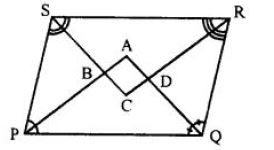
Question 16. In the following diagram, the bisectors of interior angles of the parallelogram PQRS enclose a quadrilateral ABCD. Show that: (i) ∠PSB + ∠SPB = 90° (ii) ∠PBS = 90° (iii) ∠ABC = 90° (iv) ∠ADC = 90° (v) ∠A = 90° (vi) ABCD is a rectangle. Thus, the bisectors of the angles of a parallelogram enclose a rectangle.
Answer:
Given: In a parallelogram PQRS, the angle bisectors of consecutive interior angles intersect to enclose a quadrilateral ABCD.
To Prove:
(i) \(\angle PSB + \angle SPB = 90^\circ\)
(ii) \(\angle PBS = 90^\circ\)
(iii) \(\angle ABC = 90^\circ\)
(iv) \(\angle ADC = 90^\circ\)
(v) \(\angle A = 90^\circ\)
(vi) ABCD is a rectangle
Proof:
In the parallelogram PQRS, the opposite sides PS and QR are parallel:
\( PS \parallel QR \)
The sum of consecutive interior angles of a parallelogram is 180 degrees, so:
\( \angle P + \angle S = 180^\circ \)
(i) Since PB and SB are the angle bisectors of \(\angle P\) and \(\angle S\):
\( \angle SPB + \angle PSB = \frac{1}{2} \angle P + \frac{1}{2} \angle S \)
\( \implies \angle SPB + \angle PSB = \frac{1}{2} (\angle P + \angle S) = \frac{1}{2} \times 180^\circ = 90^\circ \)
This proves the first part.
(ii) Now, in triangle PSB, the sum of all angles is 180 degrees:
\( \angle PBS + \angle PSB + \angle SPB = 180^\circ \)
Substituting the sum from part (i):
\( \angle PBS + 90^\circ = 180^\circ \)
\( \implies \angle PBS = 180^\circ - 90^\circ = 90^\circ \)
(iii) Since \(\angle ABC\) and \(\angle PBS\) are vertically opposite angles, they must be equal:
\( \angle ABC = \angle PBS = 90^\circ \)
(iv) By applying the same logic to the other side, we can also show that:
\( \angle ADC = 90^\circ \)
(v) Similarly, since \( PQ \parallel SR \) and consecutive angles \( \angle P + \angle Q = 180^\circ \):
\( \angle APQ + \angle AQP = \frac{1}{2} \times 180^\circ = 90^\circ \)
In triangle APQ, the angle sum property gives:
\( \angle A + \angle APQ + \angle AQP = 180^\circ \)
\( \implies \angle A + 90^\circ = 180^\circ \)
\( \implies \angle A = 90^\circ \)
(vi) Since we can also show \(\angle C = 90^\circ\) in the same manner, all four interior angles of the quadrilateral ABCD are right angles:
\( \angle A = \angle B = \angle C = \angle D = 90^\circ \)
A quadrilateral with all four interior angles equal to 90 degrees is a rectangle. Thus, ABCD is a rectangle.
In simple words: The corner angles of a parallelogram next to each other always add up to 180 degrees. Since the lines cut these corners exactly in half, their halves must add up to 90 degrees. This creates right angles inside the triangles, which makes all four corners of the inner shape 90 degrees, proving it is a rectangle.
Exam Tip: Remember to use the term "vertically opposite angles" to link the angles of the outer triangles to the interior angles of the inner quadrilateral.
Question 17. In parallelogram ABCD, X and Y are midpoints of opposite sides AB and DC respectively. Prove that: (i) AX = YC (ii) AX is parallel to YC (iii) AXCY is a parallelogram.
Answer:
Given: A parallelogram ABCD where X and Y are the midpoints of sides AB and DC, respectively.
To Prove:
(i) AX = YC
(ii) AX is parallel to YC
(iii) AXCY is a parallelogram
Proof:
Since ABCD is a parallelogram, its opposite sides AB and CD are equal and parallel:
\( AB = CD \) and \( AB \parallel CD \)
(i) Since X is the midpoint of side AB and Y is the midpoint of side CD:
\( AX = \frac{1}{2} AB \)
\( YC = \frac{1}{2} CD \)
Since \( AB = CD \), their halves must also be equal:
\( AX = YC \)
(ii) Since the line segment AB is parallel to CD, any parts of these lines must also be parallel:
\( AX \parallel YC \)
(iii) In quadrilateral AXCY, we have established that a pair of opposite sides (AX and YC) are both equal and parallel:
\( AX = YC \) and \( AX \parallel YC \)
Therefore, AXCY is a parallelogram.
In simple words: Since the entire top and bottom sides of the parallelogram are equal and parallel, cutting them both in half leaves segments AX and YC that are still equal and parallel. This automatically means the inner shape AXCY is also a parallelogram.
Exam Tip: Be sure to write the exact property used to conclude the final step - "A quadrilateral is a parallelogram if a pair of opposite sides is both equal and parallel."
Question 18. The given figure shows parallelogram ABCD. Points M and N lie in diagonal BD such that DM = BN. Prove that: (i) ∆DMC = ∆BNA and so CM = AN (ii) ∆AMD = ∆CNB and so AM CN (iii) ANCM is a parallelogram.
Answer:
Given: A parallelogram ABCD where M and N are points on the diagonal BD such that DM = BN.
To Prove:
(i) \( \Delta DMC \cong \Delta BNA \) and consequently \( CM = AN \)
(ii) \( \Delta AMD \cong \Delta CNB \) and consequently \( AM = CN \)
(iii) ANCM is a parallelogram
Proof:
(i) Let us consider triangles DMC and BNA.
Since ABCD is a parallelogram, its opposite sides AB and CD are equal:
\( CD = AB \)
We are given that:
\( DM = BN \)
Since CD is parallel to AB and BD is a transversal, the alternate interior angles must be equal:
\( \angle CDM = \angle ABN \)
By the Side-Angle-Side (S.A.S.) congruence criterion, we get:
\( \Delta DMC \cong \Delta BNA \)
By corresponding parts of congruent triangles (c.p.c.t.):
\( CM = AN \)
(ii) Now, consider triangles AMD and CNB.
The opposite sides AD and BC of parallelogram ABCD are equal:
\( AD = BC \)
We are given that:
\( DM = BN \)
Since AD is parallel to BC and BD is a transversal, the alternate interior angles are equal:
\( \angle ADM = \angle CBN \)
By the S.A.S. congruence criterion:
\( \Delta AMD \cong \Delta CNB \)
By c.p.c.t.:
\( AM = CN \)
(iii) In the quadrilateral ANCM, we have shown that:
\( CM = AN \) and \( AM = CN \)
Since both pairs of opposite sides in quadrilateral ANCM are equal, ANCM must be a parallelogram.
In simple words: By comparing the triangles on opposite sides of the diagonal, we can show they are identical in size and shape. This tells us that the opposite sides of the inner quadrilateral ANCM are equal, which proves that the inner shape is also a parallelogram.
Exam Tip: Be sure to write the full term "corresponding parts of congruent triangles (c.p.c.t.)" to justify why CM = AN and AM = CN after proving congruence.
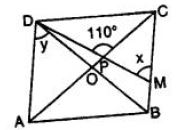
Question 19. The given figure shows a rhombus ABCD in which angle BCD = 80°. Find angles x and y.
Answer:
Given: A rhombus ABCD with \(\angle BCD = 80^\circ\). The diagonals AC and BD intersect at O, and a line segment DM intersects AC at P. The angle \(\angle CPD = 110^\circ\) and M lies on BC.
To Find: The values of angles x and y.
Solution:
In the rhombus ABCD, we know that the diagonals intersect at right angles (90 degrees) and also bisect the interior angles.
We are given:
\( \angle BCD = 80^\circ \)
Since the opposite angles of a rhombus are equal, we have:
\( \angle BAD = \angle BCD = 80^\circ \)
The sum of adjacent interior angles in a rhombus is 180 degrees, which gives:
\( \angle ABC = \angle ADC = 180^\circ - 80^\circ = 100^\circ \)
Since the diagonals bisect the vertex angles, the angle \(\angle OCB\) is half of \(\angle BCD\):
\( \angle OCB = \frac{80^\circ}{2} = 40^\circ \)
Now, let us focus on triangle PCM. In this triangle, \(\angle CPD\) serves as an exterior angle at vertex P because D, P, and M lie on a straight line.
By the exterior angle theorem, the exterior angle of a triangle is equal to the sum of its two opposite interior angles:
\( \text{Ext. } \angle CPD = \angle OCB + \angle PMC \)
Substituting the given and calculated values into this equation:
\( 110^\circ = 40^\circ + x \)
\( \implies x = 110^\circ - 40^\circ = 70^\circ \)
Next, the angle y is the same as \(\angle ADO\). Since the diagonal BD bisects \(\angle ADC\):
\( y = \angle ADO = \frac{1}{2} \angle ADC = \frac{1}{2} \times 100^\circ = 50^\circ \)
Thus, we find that \(x = 70^\circ\) and \(y = 50^\circ\).
In simple words: First, we find that half of the 80-degree angle at C is 40 degrees. In triangle PCM, the outside angle of 110 degrees is the sum of the inside angles, 40 and x, which gives x as 70 degrees. Finally, since the adjacent angle at D is 100 degrees, the diagonal cuts it exactly in half to give y as 50 degrees.
Exam Tip: State the exterior angle theorem clearly as "the exterior angle of a triangle is equal to the sum of the two interior opposite angles" to earn full marks for that step.
Question 20. Use the information given in the alongside diagram to find the value of x, y and z.
Answer:
Given: A parallelogram ABCD where the diagonal AC is drawn, and the side lengths and angles are given in terms of variables x, y, and z.
To Find: The values of x, y, and z.
Solution:
In a parallelogram, opposite sides have equal lengths:
\( CD = AB \)
Using the expressions provided for the sides:
\( 3x + 14 = 2x + 25 \)
Solving for x:
\( 3x - 2x = 25 - 14 \)
\( \implies x = 11 \)
So, the value of \(x\) is 11 cm.
Next, since \( AB \parallel CD \) and the diagonal AC is a transversal, the alternate interior angles must be equal:
\( \angle DCA = \angle CAB \)
Substituting the given angle values:
\( y + 9 = 24 \)
\( \implies y = 24 - 9 = 15 \)
So, the value of \(y\) is \(15^\circ\).
Now, let us calculate the full angle \(\angle DAB\):
\( \angle DAB = (3y + 5)^\circ + 24^\circ \)
Using the value of \(y = 15\):
\( \angle DAB = (3 \times 15 + 5)^\circ + 24^\circ \)
\( \angle DAB = (45 + 5)^\circ + 24^\circ = 50^\circ + 24^\circ = 74^\circ \)
In a parallelogram, the adjacent angles are supplementary (their sum is 180 degrees):
\( \angle DAB + \angle ABC = 180^\circ \)
Since \(\angle ABC = z\):
\( 74^\circ + z = 180^\circ \)
\( \implies z = 180^\circ - 74^\circ = 106^\circ \)
Thus, we get \(x = 11\), \(y = 15^\circ\), and \(z = 106^\circ\).
In simple words: Since opposite sides of a parallelogram are equal, we set the top and bottom expressions equal to find x is 11. Alternate angles along the diagonal AC are equal, which tells us y is 15. Finally, because the adjacent angles of the parallelogram add up to 180 degrees, we find z is 106 degrees.
Exam Tip: Be careful when summing the parts of \(\angle DAB\) - make sure you substitute the value of y first before adding \(24^\circ\).
Question 21. The following figure is a rectangle in which x : y = 3 : 7; find the values of x and y.
Answer:
Given: A rectangle ABCD with a ratio \(x : y = 3 : 7\) of the acute angles in right-angled triangle BCE.
To Find: The values of x and y.
Solution:
Since ABCD is a rectangle, the corner angle at B is a right angle:
\( \angle B = 90^\circ \)
In triangle BCE, the sum of all angles must be 180 degrees:
\( \angle B + x + y = 180^\circ \)
\( \implies 90^\circ + x + y = 180^\circ \)
\( \implies x + y = 90^\circ \)
We are given the ratio of x to y as:
\( x : y = 3 : 7 \)
The sum of the ratio parts is:
\( 3 + 7 = 10 \)
We can find x and y by distributing \(90^\circ\) across this ratio:
\( x = \frac{3}{10} \times 90^\circ = 27^\circ \)
\( y = \frac{7}{10} \times 90^\circ = 63^\circ \)
Therefore, the values are \(x = 27^\circ\) and \(y = 63^\circ\).
In simple words: Since a rectangle's corner is a 90-degree angle, the other two angles in the right-angled triangle must add up to 90 degrees. We use the 3 to 7 ratio to divide 90 degrees into 10 equal parts, giving us 27 degrees for x and 63 degrees for y.
Exam Tip: Always state why \(\angle B = 90^\circ\) (due to properties of a rectangle) before setting the sum of the acute angles to \(90^\circ\).
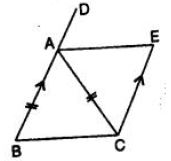
Question 22. In the given figure, AB // EC, AB = AC and AE bisects ∠DAC. Prove that: (i) ∠EAC = ∠ACB (ii) ABCE is a parallelogram.
Answer:
Given: A triangle ABC where AB = AC, and side BA is extended to D. AE is the bisector of exterior angle \(\angle DAC\). It is also given that \(AB \parallel EC\).
To Prove:
(i) \(\angle EAC = \angle ACB\)
(ii) ABCE is a parallelogram
Proof:
(i) In triangle ABC, we are given that:
\( AB = AC \)
Since angles opposite to equal sides are equal:
\( \angle ABC = \angle ACB \)
The exterior angle of a triangle is equal to the sum of its two opposite interior angles:
\( \angle DAC = \angle ABC + \angle ACB \)
Using the equality of \(\angle ABC\) and \(\angle ACB\):
\( \angle DAC = 2\angle ACB \) .... (i)
Since AE is the angle bisector of \(\angle DAC\):
\( \angle DAC = 2\angle EAC \) .... (ii)
From equations (i) and (ii), we can equate the right-hand sides:
\( 2\angle EAC = 2\angle ACB \)
Dividing by 2, we obtain:
\( \angle EAC = \angle ACB \)
This completes the proof for the first part.
(ii) For the lines AE and BC with transversal AC, the alternate interior angles are equal:
\( \angle EAC = \angle ACB \)
This means that these two lines are parallel:
\( AE \parallel BC \)
We are also given that:
\( AB \parallel EC \)
Since both pairs of opposite sides in quadrilateral ABCE are parallel (\(AE \parallel BC\) and \(AB \parallel EC\)), ABCE is a parallelogram.
In simple words: Since triangle ABC has two equal sides, its base angles are equal. The outside angle at A is the sum of these two base angles. Since the line AE cuts this outside angle exactly in half, each half is equal to one of the base angles. Since alternate angles are equal, AE is parallel to BC, which makes the shape a parallelogram.
Exam Tip: Be sure to state the Exterior Angle Theorem clearly in part (i) as it is the key connection needed to relate the angles at the vertex to the base angles of the triangle.
Free study material for Mathematics
ICSE Selina Concise Solutions Class 8 Mathematics Chapter 17 Special Types of Quadrilaterals
Students can now access the detailed Selina Concise Solutions for Chapter 17 Special Types of Quadrilaterals on our portal. These solutions have been carefully prepared as per latest ICSE Class 8 syllabus. Each solution given above has been updated based on the current year pattern to ensure Class 8 students have the most updated Mathematics content.
Master Selina Concise Textbook Questions
Our subject experts have provided detailed explanations for all the questions found in the Selina Concise textbook for Class 8 Mathematics. We have focussed on making the concepts easy for you in Chapter 17 Special Types of Quadrilaterals so that students can understand the concepts behind every answer. For all numerical problems and theoretical concepts these solutions will help in strengthening your analytical skill required for the ICSE examinations.
Complete Mathematics Exam Preparation
By using these Selina Concise Class 8 solutions, you can enhance your learning and identify areas that need more attention. We recommend solving the Mathematics Questions from the textbook first and then use our teacher-verified answers. For a proper revision of Chapter 17 Special Types of Quadrilaterals, students should also also check our Revision Notes and Sample Papers available on studiestoday.com.
FAQs
You can download the verified Selina Concise solutions for Chapter 17 Special Types of Quadrilaterals on StudiesToday.com. Our teachers have prepared answers for Class 8 Mathematics as per 2026-27 ICSE academic session.
Yes, our solutions for Chapter 17 Special Types of Quadrilaterals are designed as per new 2026 ICSE standards. 40% competency-based questions required for Class 8, are included to help students understand application-based logic behind every Mathematics answer.
Yes, every exercise in Chapter 17 Special Types of Quadrilaterals from the Selina Concise textbook has been solved step-by-step. Class 8 students will learn Mathematics conceots before their ICSE exams.
Yes, follow structured format of these Selina Concise solutions for Chapter 17 Special Types of Quadrilaterals to get full 20% internal assessment marks and use Class 8 Mathematics projects and viva preparation as per ICSE 2026 guidelines.