

ICSE Solutions Selina Concise Class 9 Mathematics Chapter 11 Inequalities have been provided below and is also available in Pdf for free download. The Selina Concise ICSE solutions for Class 9 Mathematics have been prepared as per the latest syllabus and ICSE books and examination pattern suggested in Class 9. Questions given in ICSE Selina Concise book for Class 9 Mathematics are an important part of exams for Class 9 Mathematics and if answered properly can help you to get higher marks. Refer to more Chapter-wise answers for ICSE Class 9 Mathematics and also download more latest study material for all subjects. Chapter 11 Inequalities is an important topic in Class 9, please refer to answers provided below to help you score better in exams
Selina Concise Chapter 11 Inequalities Class 9 Mathematics ICSE Solutions
Class 9 Mathematics students should refer to the following ICSE questions with answers for Chapter 11 Inequalities in Class 9. These ICSE Solutions with answers for Class 9 Mathematics will come in exams and help you to score good marks
Chapter 11 Inequalities Selina Concise ICSE Solutions Class 9 Mathematics
Question 1. In \(\Delta ABC\), \(AB = AC\) and \(\angle B = 70^\circ\). If \(BCD\) is a straight line and \(\angle D = 40^\circ\) in \(\Delta ACD\), show that \(AB > CD\).
Answer: We are given that in \(\Delta ABC\), the sides \(AB\) and \(AC\) are equal. Since angles opposite to equal sides of a triangle are equal:
\(\angle ACB = \angle B\)
Since \(\angle B = 70^\circ\), we have:
\(\angle ACB = 70^\circ\) - (i)
As \(BCD\) is a straight line, the angles form a linear pair:
\(\angle ACB + \angle ACD = 180^\circ\)
Substituting the value from (i):
\(70^\circ + \angle ACD = 180^\circ\)
\(\implies \angle ACD = 110^\circ\) - (ii)
Now, considering \(\Delta ACD\), the sum of all interior angles is \(180^\circ\):
\(\angle CAD + \angle ACD + \angle D = 180^\circ\)
Using the value from (ii):
\(\angle CAD + 110^\circ + \angle D = 180^\circ\)
\(\implies \angle CAD + \angle D = 70^\circ\)
We are given that \(\angle D = 40^\circ\).
\(\implies \angle CAD + 40^\circ = 70^\circ\)
\(\implies \angle CAD = 30^\circ\) - (iii)
In \(\Delta ACD\), comparing the angle measures:
\(\angle ACD = 110^\circ\), \(\angle CAD = 30^\circ\), and \(\angle D = 40^\circ\).
Since \(\angle D > \angle CAD\) (\(40^\circ > 30^\circ\)), the side opposite to the larger angle must be longer:
\(\implies AC > CD\)
Since it is given that \(AB = AC\), we can substitute \(AB\) for \(AC\):
\(\implies AB > CD\)
In simple words: Since two sides of the first triangle are equal, their opposite angles are both \(70^\circ\). This helps us find the angles of the second triangle, showing that one angle is larger than another, which proves the opposite side is longer.
Exam Tip: Remember that in any triangle, the side opposite to a larger angle is always longer than the side opposite to a smaller angle. Always establish the angle measurements first before comparing sides.
Question 2. In \(\Delta PQR\), \(QR = PR\) and \(\angle P = 36^\circ\). Find the longest side of the triangle.
Answer: In the triangle \(PQR\), we are given that:
\(QR = PR\)
The angles opposite to equal sides of a triangle are equal:
\(\therefore \angle P = \angle Q\)
Since \(\angle P = 36^\circ\), it follows that:
\(\implies \angle Q = 36^\circ\)
Now, the sum of all angles in \(\Delta PQR\) is \(180^\circ\):
\(\angle P + \angle Q + \angle R = 180^\circ\)
Substitute the known angle measures:
\(36^\circ + 36^\circ + \angle R = 180^\circ\)
\(\implies \angle R + 72^\circ = 180^\circ\)
\(\implies \angle R = 108^\circ\)
Comparing the three angles of the triangle:
\(\angle R = 108^\circ\), \(\angle P = 36^\circ\), and \(\angle Q = 36^\circ\).
Clearly, \(\angle R\) is the largest angle. Since the longest side of a triangle is opposite to its largest angle, the side \(PQ\) is the largest side.
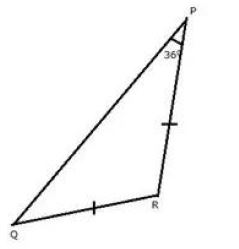
In simple words: Since two sides of the triangle are equal, their opposite angles are both \(36^\circ\). This leaves \(108^\circ\) for the third angle, making it the largest angle, so the side opposite to it is the longest side.
Exam Tip: In any triangle, identify the largest angle first because the longest side of the triangle lies directly opposite to it.
Question 3. The lengths of two sides of a triangle are 13 cm and 8 cm. If the length of the third side is between \(a\) cm and \(b\) cm, find the values of \(a\) and \(b\).
Answer: According to the triangle inequality theorem, the sum of any two sides of a triangle must exceed the length of the third side.
Thus, the third side must be less than the sum of the two given sides:
\(\text{Third side} < 13 + 8 = 21\text{ cm}\)
Similarly, the length of the third side must be greater than the difference between the other two sides:
\(\text{Third side} > 13 - 8 = 5\text{ cm}\)
Therefore, the length of the third side must lie between \(5\text{ cm}\) and \(21\text{ cm}\).
By comparing this with the range between \(a\text{ cm}\) and \(b\text{ cm}\):
\(a = 5\text{ cm}\) and \(b = 21\text{ cm}\).
In simple words: A triangle's third side must be shorter than the sum of the other two sides, but longer than their difference. So, it has to be between \(5\text{ cm}\) and \(21\text{ cm}\).
Exam Tip: Remember that the third side \(x\) of a triangle with sides \(y\) and \(z\) (where \(y > z\)) always satisfies the inequality \((y - z) < x < (y + z)\). State both conditions clearly to secure full marks.
Question 4(i). In the given figure, \(AB = AC\), \(\angle ACB = 67^\circ\), and \(\angle ADC = 33^\circ\). Arrange the side lengths \(BC\), \(AC\), and \(CD\) in ascending order.
Answer: In the triangle \(ABC\), we are given that:
\(AB = AC\)
Because angles opposite to equal sides of a triangle are equal:
\(\angle ABC = \angle ACB\)
Since \(\angle ACB = 67^\circ\), we have:
\(\angle ABC = \angle ACB = 67^\circ\)
Using the angle sum property of \(\Delta ABC\), the total sum of angles is \(180^\circ\):
\(\angle BAC = 180^\circ - \angle ABC - \angle ACB\)
\(\implies \angle BAC = 180^\circ - 67^\circ - 67^\circ = 46^\circ\)
Since \(\angle BAC < \angle ABC\) (\(46^\circ < 67^\circ\)), the sides opposite these angles must satisfy:
\(BC < AC\) - (1)
Next, because \(BCD\) is a straight line, \(\angle ACB\) and \(\angle ACD\) form a linear pair:
\(\angle ACD = 180^\circ - \angle ACB\)
\(\implies \angle ACD = 180^\circ - 67^\circ = 113^\circ\)
Now, let's analyze \(\Delta ACD\). The sum of angles is \(180^\circ\):
\(\angle CAD = 180^\circ - \angle ACD - \angle ADC\)
\(\implies \angle CAD = 180^\circ - 113^\circ - 33^\circ = 34^\circ\)
Comparing the angles in \(\Delta ACD\):
Since \(\angle ADC < \angle CAD\) (\(33^\circ < 34^\circ\)), we have:
\(\implies AC < CD\) - (2)
Combining our inequalities (1) and (2):
\(BC < AC < CD\)
In simple words: First, we find the angles in both triangles. Since larger angles have longer sides opposite to them, we can compare the sides of each triangle and order them from shortest to longest as \(BC < AC < CD\).
Exam Tip: Clearly state the theorem "side opposite to the greater angle is longer" whenever you compare side lengths. Showing your step-by-step angle calculations is essential to get full marks.
Question 4(ii). In the given figure, in \(\Delta ABC\), \(\angle BAC = 47^\circ\) and \(\angle ABC = 73^\circ\). In \(\Delta ACD\), \(\angle CAD = 31^\circ\). Arrange the lengths of \(BC\), \(AC\), and \(CD\) in ascending order.
Answer: In \(\Delta ABC\), we are given that:
\(\angle BAC = 47^\circ\) and \(\angle ABC = 73^\circ\)
Comparing these two angles, we have:
\(\angle BAC < \angle ABC\) (since \(47^\circ < 73^\circ\))
Since the side opposite to a smaller angle is shorter:
\(\implies BC < AC\) - (1)
Next, let's find the third angle of \(\Delta ABC\), \(\angle ACB\), using the angle sum property:
\(\angle ACB = 180^\circ - \angle ABC - \angle BAC\)
\(\implies \angle ACB = 180^\circ - 73^\circ - 47^\circ\)
\(\implies \angle ACB = 60^\circ\)
The angles \(\angle ACB\) and \(\angle ACD\) lie on a straight line, forming a linear pair:
\(\angle ACD = 180^\circ - \angle ACB\)
\(\implies \angle ACD = 180^\circ - 60^\circ = 120^\circ\)
Now, we consider \(\Delta ACD\). The sum of angles in this triangle is \(180^\circ\):
\(\angle ADC = 180^\circ - \angle ACD - \angle CAD\)
\(\implies \angle ADC = 180^\circ - 120^\circ - 31^\circ\)
\(\implies \angle ADC = 29^\circ\)
Now, comparing the angles in \(\Delta ACD\):
\(\angle ADC < \angle CAD\) (since \(29^\circ < 31^\circ\))
Since the side opposite to a smaller angle is shorter:
\(\implies AC < CD\) - (2)
Combining the inequalities from (1) and (2) gives:
\(BC < AC < CD\)
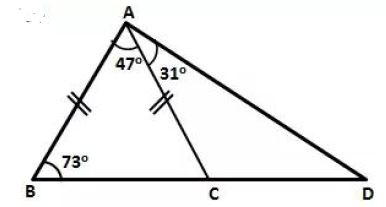
In simple words: By using the sum of angles in a triangle and the straight-line angle rule, we find the missing angles. Comparing these angles shows us that \(BC\) is shorter than \(AC\), which is shorter than \(CD\).
Exam Tip: Be careful with diagrams that have misleading markings (like ticks showing equal sides when they are not). Always trust the given mathematical values over the visual markings in the figure.
Question 5. In the given figure, the sides \(BA\) and \(CB\) of \(\Delta ABC\) are produced to \(D\) and \(E\) respectively such that \(\angle DAB = 137^\circ\) and \(\angle ABE = 106^\circ\). The bisectors of \(\angle B\) and \(\angle C\) meet at \(O\). Arrange the segments \(BC\), \(OC\), and \(OB\) in descending order of their lengths.
Answer: First, we find the interior angles of \(\Delta ABC\).
Since \(DAC\) is a straight line, \(\angle BAC\) and \(\angle BAD\) form a linear pair:
\(\angle BAC = 180^\circ - \angle BAD = 180^\circ - 137^\circ = 43^\circ\)
Similarly, since \(EBC\) is a straight line, \(\angle ABC\) and \(\angle ABE\) form a linear pair:
\(\angle ABC = 180^\circ - \angle ABE = 180^\circ - 106^\circ = 74^\circ\)
Using the angle sum property for \(\Delta ABC\), we get:
\(\angle ACB = 180^\circ - \angle BAC - \angle ABC\)
\(\implies \angle ACB = 180^\circ - 43^\circ - 74^\circ = 63^\circ\)
We are given that \(OB\) is the angle bisector of \(\angle ABC\):
\(\angle ABC = 2 \angle OBC\)
\(\implies 74^\circ = 2 \angle OBC\)
\(\implies \angle OBC = 37^\circ\)
Similarly, \(OC\) is the angle bisector of \(\angle ACB\):
\(\angle ACB = 2 \angle OCB\)
\(\implies 63^\circ = 2 \angle OCB\)
\(\implies \angle OCB = 31.5^\circ\)
Now, let's find the third angle of \(\Delta BOC\) using the angle sum property:
\(\angle BOC = 180^\circ - \angle OBC - \angle OCB\)
\(\implies \angle BOC = 180^\circ - 37^\circ - 31.5^\circ\)
\(\implies \angle BOC = 111.5^\circ\)
Comparing the angles inside \(\Delta BOC\), we observe:
\(\angle BOC > \angle OBC > \angle OCB\) (since \(111.5^\circ > 37^\circ > 31.5^\circ\))
By the triangle inequality theorem, the side opposite to a larger angle is longer:
\(\implies BC > OC > OB\)
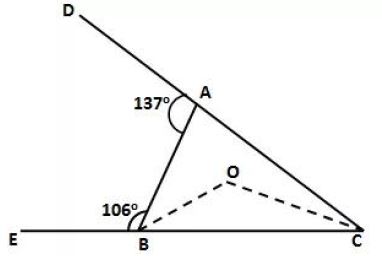
In simple words: We find the inner angles of the main triangle first. Then, since the lines meet at the center to cut the base angles in half, we find the angles of the smaller triangle at the bottom. Comparing these angles gives us the order of the sides as \(BC > OC > OB\).
Exam Tip: When dealing with angle bisectors, always remember to divide the main angle by 2 to get the base angles of the interior triangle. Make sure to cite the angle sum property of triangles.
Question 6. In the given figure, \(D\) is a point on side \(BC\) of \(\Delta ABC\) such that \(AD > AC\). Prove that \(AB > AC\).
Answer: We are given that:
\(AD > AC\)
In \(\Delta ADC\), since the angle opposite to the longer side is greater:
\(\implies \angle C > \angle ADC\) - (1)
For \(\Delta ABD\), the angle \(\angle ADC\) is an exterior angle at vertex \(D\).
By the exterior angle theorem, the exterior angle of a triangle is greater than either of its interior opposite angles:
\(\implies \angle ADC > \angle B\) - (2)
Combining the relations from (1) and (2):
\(\angle C > \angle ADC > \angle B\)
Thus, we can conclude:
\(\implies \angle C > \angle B\)
In \(\Delta ABC\), since the side opposite to the larger angle is longer:
\(\implies AB > AC\)
Hence proved.
In simple words: Since \(AD\) is longer than \(AC\), the angle opposite \(AD\) is larger than the angle opposite \(AC\). Also, since the outer angle of the left triangle is always larger than its opposite inner angle, we find that the main angle \(C\) is larger than \(B\), which proves \(AB\) is longer than \(AC\).
Exam Tip: In proofs involving inequalities, using the exterior angle theorem is a very powerful step to compare angles belonging to different triangles. Always state this theorem clearly in your steps.
Question 7. In the given figure, \(O\) is any point inside \(\Delta ABC\). Prove that \(OB + OC < AB + AC\).
Answer: **Construction:** Extend segment \(BO\) to intersect \(AC\) at a point \(T\).
In \(\Delta ABT\), using the property that the sum of any two sides of a triangle is greater than the third side:
\(AB + AT > BT\)
Since \(BT = BO + OT\), we can write:
\(\implies AB + AT > BO + OT\) - (1)
Next, in \(\Delta OCT\), using the same triangle inequality property:
\(OT + TC > OC\) - (2)
Let's add inequality (1) and inequality (2) together:
\(AB + AT + OT + TC > BO + OT + OC\)
Subtracting \(OT\) from both sides of the inequality gives:
\(\implies AB + AT + TC > BO + OC\)
Since \(AT + TC = AC\), we have:
\(\implies AB + AC > OB + OC\)
This can be rewritten as:
\(\implies OB + OC < AB + AC\)
Hence proved.
In simple words: We draw a line from \(B\) through \(O\) to reach the other side at \(T\). By applying the rule that any two sides of a triangle added together are longer than the third side to two different smaller triangles, we can combine and simplify the equations to prove the result.
Exam Tip: This construction of extending \(BO\) to \(T\) on \(AC\) is the standard way to prove this inequality. Practice this specific construction as it frequently appears in examinations.
Question 8. In \(\Delta ABC\), \(AD \perp BC\) and \(CE \perp AB\). \(AD\) and \(CE\) intersect at \(F\). If \(\angle B = 65^\circ\) and \(\angle BAC = 60^\circ\), prove that:
(i) \(CF > AF\)
(ii) \(DC > DF\)
Answer: Let's first find the angles in \(\Delta BEC\):
Since \(CE \perp AB\), we have \(\angle BEC = 90^\circ\).
In \(\Delta BEC\), the sum of angles is \(180^\circ\):
\(\angle B + \angle BEC + \angle BCE = 180^\circ\)
Using the given value \(\angle B = 65^\circ\):
\(65^\circ + 90^\circ + \angle BCE = 180^\circ\)
\(\implies 155^\circ + \angle BCE = 180^\circ\)
\(\implies \angle BCE = 25^\circ\)
Since \(F\) lies on the line segment \(CE\) and \(D\) lies on the line segment \(BC\), we can write:
\(\angle DCF = \angle BCE = 25^\circ\) - (i)
Now, let's find the angles in \(\Delta CDF\):
Since \(AD \perp BC\), we have \(\angle FDC = 90^\circ\).
The sum of angles in \(\Delta CDF\) is \(180^\circ\):
\(\angle DCF + \angle FDC + \angle CFD = 180^\circ\)
Using the value from (i):
\(25^\circ + 90^\circ + \angle CFD = 180^\circ\)
\(\implies 115^\circ + \angle CFD = 180^\circ\)
\(\implies \angle CFD = 65^\circ\) - (ii)
Since \(AFD\) is a straight line, \(\angle AFC\) and \(\angle CFD\) form a linear pair:
\(\angle AFC + \angle CFD = 180^\circ\)
Using the value from (ii):
\(\angle AFC + 65^\circ = 180^\circ\)
\(\implies \angle AFC = 115^\circ\) - (iii)
Next, let's analyze \(\Delta ACE\):
Since \(CE \perp AB\), we have \(\angle CEA = 90^\circ\).
The sum of angles in \(\Delta ACE\) is \(180^\circ\):
\(\angle ACE + \angle CEA + \angle BAC = 180^\circ\)
Using the given value \(\angle BAC = 60^\circ\):
\(\angle ACE + 90^\circ + 60^\circ = 180^\circ\)
\(\implies \angle ACE + 150^\circ = 180^\circ\)
\(\implies \angle ACE = 30^\circ\)
Since \(F\) is on \(CE\), we have:
\(\angle ACF = \angle ACE = 30^\circ\) - (iv)
Now, let's analyze \(\Delta AFC\):
The sum of angles in \(\Delta AFC\) is \(180^\circ\):
\(\angle AFC + \angle ACF + \angle FAC = 180^\circ\)
Using the values from (iii) and (iv):
\(115^\circ + 30^\circ + \angle FAC = 180^\circ\)
\(\implies 145^\circ + \angle FAC = 180^\circ\)
\(\implies \angle FAC = 35^\circ\) - (v)
Now we can prove the two inequalities:
(i) In \(\Delta AFC\):
From (iv) and (v), we have \(\angle FAC = 35^\circ\) and \(\angle ACF = 30^\circ\).
Since \(\angle FAC > \angle ACF\):
\(\implies CF > AF\) (because the side opposite to a larger angle is longer)
(ii) In \(\Delta CDF\):
From (i) and (ii), we have \(\angle DCF = 25^\circ\) and \(\angle CFD = 65^\circ\).
Since \(\angle CFD > \angle DCF\):
\(\implies DC > DF\) (because the side opposite to a larger angle is longer)
In simple words: By using the properties of right triangles and straight lines, we calculate the exact measures of the angles inside the triangles \(AFC\) and \(CDF\). Comparing these angles allows us to prove that the opposite sides follow the required inequalities.
Exam Tip: In complex geometry questions with multiple triangles, clearly label each triangle you are working in (e.g., "In \(\Delta AFC\)") before writing your angle sum or side inequality statements. This keeps your proof structured and examiner-friendly.
Question 9. In the given figure, \(BCD\) is a straight line. In \(\Delta ABC\), \(\angle ACB = 74^\circ\) and \(AC = CD\). If \(\angle BAD = 110^\circ\), prove that \(BC > CD\).
Answer: We are given that:
\(\angle ACB = 74^\circ\) - (i)
Since \(BCD\) is a straight line, \(\angle ACB\) and \(\angle ACD\) form a linear pair:
\(\angle ACB + \angle ACD = 180^\circ\)
Using our given value:
\(74^\circ + \angle ACD = 180^\circ\)
\(\implies \angle ACD = 106^\circ\) - (ii)
Now, let's analyze \(\Delta ACD\). We are given that \(AC = CD\).
Since the angles opposite to equal sides are equal:
\(\angle ADC = \angle CAD\)
Using the angle sum property in \(\Delta ACD\):
\(\angle ACD + \angle ADC + \angle CAD = 180^\circ\)
Using the values from above:
\(106^\circ + 2 \angle CAD = 180^\circ\)
\(\implies 2 \angle CAD = 74^\circ\)
\(\implies \angle CAD = 37^\circ = \angle ADC\) - (iii)
We are given that \(\angle BAD = 110^\circ\).
From the figure, we see that:
\(\angle BAC + \angle CAD = \angle BAD\)
\(\implies \angle BAC + 37^\circ = 110^\circ\)
\(\implies \angle BAC = 73^\circ\) - (iv)
Now, let's work in \(\Delta ABC\). The sum of angles is \(180^\circ\):
\(\angle B + \angle BAC + \angle ACB = 180^\circ\)
Substitute the values from (i) and (iv):
\(\angle B + 73^\circ + 74^\circ = 180^\circ\)
\(\implies \angle B + 147^\circ = 180^\circ\)
\(\implies \angle B = 33^\circ\) - (v)
Comparing the angles in \(\Delta ABC\):
Since \(\angle BAC = 73^\circ\) and \(\angle B = 33^\circ\), we have:
\(\angle BAC > \angle B\)
Since the side opposite to the larger angle is longer:
\(\implies BC > AC\)
But we are given that \(AC = CD\), so we can substitute \(CD\) for \(AC\):
\(\implies BC > CD\)
Hence proved.
In simple words: By using linear pairs and the properties of an isosceles triangle, we find the angles of both triangles. Then, comparing the angles of the main triangle shows us that one side is larger than another, which directly proves \(BC > CD\).
Exam Tip: When substituting one side for an equal side (such as replacing \(AC\) with \(CD\)), clearly write "[Given AC = CD]" next to your substitution step to show the examiner your logical progression.
Question 10. In \(\Delta ABC\), \(AD \perp BC\). Prove that:
(i) \(AB > BD\)
(ii) \(AC > CD\)
(iii) \(AB + AC > BC\)
Answer: (i) We are given that \(AD \perp BC\), so \(\angle ADC = 90^\circ\).
Since \(BDC\) is a straight line, \(\angle ADC\) and \(\angle ADB\) form a linear pair:
\(\angle ADC + \angle ADB = 180^\circ\)
\(\implies 90^\circ + \angle ADB = 180^\circ\)
\(\implies \angle ADB = 90^\circ\) - (i)
Now, let's consider the right-angled triangle \(\Delta ADB\):
The sum of the other two angles must be \(90^\circ\):
\(\angle B + \angle BAD = 90^\circ\)
Since the sum of two positive angles is \(90^\circ\), each angle must be less than \(90^\circ\) (meaning both are acute angles).
Since \(\angle ADB = 90^\circ\) is the largest angle in \(\Delta ADB\), the side opposite to it (hypotenuse) must be the longest side:
\(\implies AB > BD\) - (ii)
(ii) Now, let's consider the right-angled triangle \(\Delta ADC\):
Since \(\angle ADC = 90^\circ\), the sum of the other two angles is \(90^\circ\):
\(\angle C + \angle DAC = 90^\circ\)
This means both \(\angle C\) and \(\angle DAC\) are acute angles (less than \(90^\circ\)).
Since \(\angle ADC = 90^\circ\) is the largest angle in \(\Delta ADC\), the side opposite to it (hypotenuse) must be the longest side:
\(\implies AC > CD\) - (iii)
(iii) Let's add the inequalities (ii) and (iii) together:
\(AB + AC > BD + CD\)
From the figure, since \(D\) lies on \(BC\), we have \(BD + CD = BC\):
\(\implies AB + AC > BC\)
Hence proved.
In simple words: Because \(AD\) is perpendicular to the base, it splits the shape into two right-angled triangles. In any right-angled triangle, the hypotenuse is always the longest side, so \(AB > BD\) and \(AC > CD\). Adding these two inequalities proves that the sum of the outer sides is greater than the base.
Exam Tip: This question provides a fundamental proof of the triangle inequality theorem (\(AB + AC > BC\)). Always start by establishing that the hypotenuse of a right-angled triangle is greater than any of its other sides.
Question 11. In a quadrilateral \(ABCD\), prove that:
(i) \(AB + BC + CD > DA\)
(ii) \(AB + BC + CD + DA > 2AC\)
(iii) \(AB + BC + CD + DA > 2BD\)
Answer: **Construction:** Draw diagonals \(AC\) and \(BD\) of the quadrilateral \(ABCD\).
(i) In \(\Delta ABC\), by the triangle inequality theorem (the sum of any two sides of a triangle is greater than the third side):
\(AB + BC > AC\) - (1)
In \(\Delta ACD\), by the same theorem:
\(AC + CD > DA\) - (2)
Adding inequalities (1) and (2) together:
\(AB + BC + AC + CD > AC + DA\)
Subtracting \(AC\) from both sides:
\(\implies AB + BC + CD > DA\)
(ii) In \(\Delta ABC\), we have:
\(AB + BC > AC\) - (1)
In \(\Delta ACD\), by the triangle inequality theorem:
\(CD + DA > AC\) - (3)
Adding inequalities (1) and (3) together:
\(AB + BC + CD + DA > AC + AC\)
\(\implies AB + BC + CD + DA > 2AC\)
(iii) In \(\Delta ABD\), by the triangle inequality theorem:
\(AB + DA > BD\) - (4)
In \(\Delta BCD\), by the triangle inequality theorem:
\(BC + CD > BD\) - (5)
Adding inequalities (4) and (5) together:
\(AB + DA + BC + CD > BD + BD\)
\(\implies AB + BC + CD + DA > 2BD\)
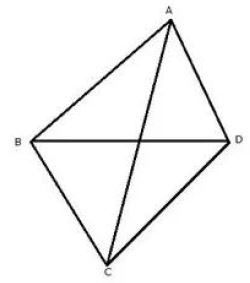
In simple words: By using the rule that any two sides of a triangle are longer than the third side, we can write down inequalities for various triangles formed by the diagonals. Combining these inequalities through addition and simplification gives us each of the three proofs.
Exam Tip: For multi-part proofs involving quadrilaterals and diagonals, identify which triangles contain the required sides and diagonals. Writing the basic triangle inequality for those specific triangles is always the key first step.
Question 12. In the given figure, \( \Delta ABC \) is an equilateral triangle and \( P \) is any point on side \( AC \). Prove that:
(i) \( BP > PA \)
(ii) \( BP > PC \)
Answer:
(i) Since \( \Delta ABC \) is equilateral, all of its sides are equal in length: \( AB = BC = CA \) Because of this, all three of its angles are equal as well: \( \angle A = \angle B = \angle C \) Since the sum of angles in a triangle is \( 180^\circ \), each angle is: \( \angle A = \angle B = \angle C = \frac{180^\circ}{3} = 60^\circ \) Now, in \( \Delta ABP \): The angle \( \angle A = 60^\circ \). The angle \( \angle ABP \) is only a part of the total angle \( \angle B \), which means: \( \angle ABP < 60^\circ \) Comparing these two angles, we get: \( \angle A > \angle ABP \) We know that in a triangle, the side opposite to the larger angle is longer:
\( \implies BP > PA \) (ii) Similarly, in \( \Delta BPC \): We have the angle \( \angle C = 60^\circ \). The angle \( \angle CBP \) is only a part of the total angle \( \angle B \), so: \( \angle CBP < 60^\circ \) Comparing these, we get: \( \angle C > \angle CBP \) Since the side opposite to the greater angle is longer:
\( \implies BP > PC \)
In simple words: Each corner of the equilateral triangle is 60 degrees. Since the line drawn inside splits the corner at B into smaller angles, the full corner angles at A and C are larger than those split parts. Because a larger angle always faces a longer side, the line BP is longer than both PA and PC.
Exam Tip: Always remember to state the geometric theorem clearly: "The side opposite to the greater angle in a triangle is longer." Mentioning this theorem is vital for securing full credit.
Question 13. In the given figure, \( P \) is any point inside \( \Delta ABC \). Prove that \( \angle BPC > \angle BAC \).
Answer:
Let us designate the measure of \( \angle PBC \) as \( x \), and \( \angle PCB \) as \( y \). By the angle sum property of \( \Delta BPC \): \( \angle BPC = 180^\circ - (x + y) \) --- (i) Now, let the remaining parts of the angles at \( B \) and \( C \) be \( \angle ABP = a \) and \( \angle ACP = b \) respectively. Using the angle sum property for the main triangle \( \Delta ABC \), we can write: \( \angle BAC = 180^\circ - (x + a) - (y + b) \) Rearranging the terms: \( \angle BAC = 180^\circ - (x + y) - (a + b) \) Substituting the expression from equation (i): \( \angle BAC = \angle BPC - (a + b) \) This equation can be rewritten as: \( \angle BPC = \angle BAC + (a + b) \) Since \( a \) and \( b \) are positive, adding them to \( \angle BAC \) yields a larger angle:
\( \implies \angle BPC > \angle BAC \)
In simple words: The inner angle BPC equals the top angle BAC plus the two small corner parts. Because we have to add positive numbers to BAC to get BPC, the inner angle must be larger than the top angle.
Exam Tip: Using simple variables like \(a, b, x,\) and \(y\) to represent split angles makes the algebraic equations much easier to handle and prevents notation mistakes.
Question 14. In the given figure, \( D \) is a point on the side \( BC \) of \( \Delta ABC \). If \( AB = AC \), prove that:
(i) \( AC > AD \)
(ii) \( AB > AD \)
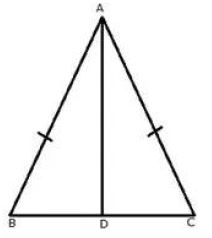
Answer:
Recall that an exterior angle of a triangle is always greater than each of its interior opposite angles. In \( \Delta ABD \), the angle \( \angle ADC \) is an exterior angle. Thus: \( \angle ADC > \angle B \) --- (i) For the isosceles triangle \( \Delta ABC \), we are given: \( AB = AC \) Since angles opposite to equal sides are equal: \( \angle B = \angle C \) --- (ii) Combining (i) and (ii), we can substitute \( \angle C \) in place of \( \angle B \): \( \angle ADC > \angle C \) (i) Now, in \( \Delta ADC \): Since \( \angle ADC > \angle C \), and the side opposite to a greater angle is longer, we have:
\( \implies AC > AD \) --- (iii) (ii) In \( \Delta ABC \), we are given that \( AB = AC \). Using the inequality established in (iii):
\( \implies AB > AD \)
In simple words: The exterior angle ADC is always larger than angle B. Since B equals C in this isosceles triangle, ADC is also larger than C. Therefore, the side AC (opposite ADC) is longer than AD (opposite C), meaning both AB and AC are longer than AD.
Exam Tip: Always remember to cite the "exterior angle inequality theorem" when initiating a comparison between an exterior angle and an interior opposite angle.
Question 15. In the given figure, \( AB = AD \) and \( AO \) is the bisector of \( \angle A \). If \( E \) is a point on the line \( AO \) produced, prove that:
(i) \( BE = DE \)
(ii) \( \angle ABD > \angle C \)
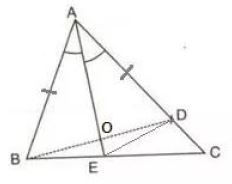
Answer:
Construction: Join \( E \) to \( D \). In \( \Delta AOB \) and \( \Delta AOD \): \( AB = AD \) [Given] \( AO = AO \) [Common side] \( \angle BAO = \angle DAO \) [Since \( AO \) is the angle bisector of \( \angle A \)] Thus, by the SAS congruence criterion: \( \Delta AOB \cong \Delta AOD \) From CPCT (Corresponding Parts of Congruent Triangles), we get: \( BO = OD \) --- (i) \( \angle AOB = \angle AOD \) --- (ii) \( \angle ABO = \angle ADO \), which implies \( \angle ABD = \angle ADB \) --- (iii) Now, consider the vertically opposite angles: \( \angle AOB = \angle DOE \) \( \angle AOD = \angle BOE \) Since \( \angle AOB = \angle AOD \) from (ii), we have: \( \angle BOE = \angle DOE \) --- (iv) (i) In \( \Delta BOE \) and \( \Delta DOE \): \( BO = OD \) [From (i)] \( OE = OE \) [Common side] \( \angle BOE = \angle DOE \) [From (iv)] Therefore, by SAS congruence: \( \Delta BOE \cong \Delta DOE \) By CPCT, we conclude:
\( BE = DE \) (ii) In \( \Delta BCD \): The angle \( \angle ADB \) is an exterior angle. \( \angle ADB = \angle C + \angle CBD \) [Exterior angle equals the sum of opposite interior angles] This implies: \( \angle ADB > \angle C \) Using the relation \( \angle ABD = \angle ADB \) from (iii), we get:
\( \implies \angle ABD > \angle C \)
In simple words: First, we prove the two upper triangles are identical, which makes BO equal to OD and the bottom angles equal. Next, we show the two lower triangles are also identical, meaning BE equals DE. Finally, since ADB is an outside angle for triangle BCD, it is larger than C, which proves ABD is also larger than C.
Exam Tip: Clearly dividing your proof into parts using "CPCT" and Vertically Opposite Angles helps the examiner trace your logic step-by-step.
Question 16. In \( \Delta ABC \), \( AB > AC \). The bisectors of the exterior angles at \( B \) and \( C \) meet at point \( P \). Prove that \( PC > PB \).
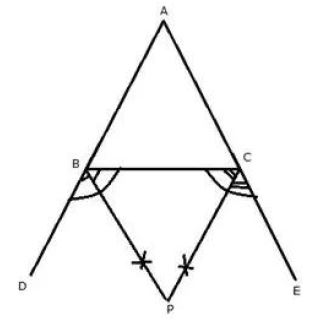
Answer:
In \( \Delta ABC \), we are given: \( AB > AC \) Since the angle opposite to the longer side is greater: \( \angle ACB > \angle ABC \), or we can write: \( \angle ABC < \angle ACB \) Taking the supplement of both angles, the inequality reverses: \( 180^\circ - \angle ABC > 180^\circ - \angle ACB \) Dividing both sides by 2: \( \frac{180^\circ - \angle ABC}{2} > \frac{180^\circ - \angle ACB}{2} \) \( 90^\circ - \frac{1}{2} \angle ABC > 90^\circ - \frac{1}{2} \angle ACB \) Since \( BP \) is the bisector of exterior angle \( \angle CBD \), and \( CP \) is the bisector of exterior angle \( \angle BCE \), the half-angles are represented as: \( \angle CBP = \frac{180^\circ - \angle ABC}{2} \) \( \angle BCP = \frac{180^\circ - \angle ACB}{2} \) Substituting these into our inequality gives: \( \angle CBP > \angle BCP \) Now, in \( \Delta BCP \), the side opposite to the greater angle is longer:
\( \implies PC > PB \)
In simple words: Since AB is longer than AC, the angle opposite AB is larger than the angle opposite AC. When we look at their exterior angles, the inequality flips, making the exterior angle at B larger than at C. Halving these exterior angles preserves this inequality, meaning the inner angle CBP is larger than BCP. Thus, side PC opposite CBP must be longer than side PB opposite BCP.
Exam Tip: Be careful with the inequality sign when taking supplements (subtracting from \(180^\circ\)). The inequality sign must always reverse.
Question 17. In \( \Delta ABC \), \( AB \) is the longest side and \( BC \) is the shortest side. If \( x^*, y^*, \) and \( z^* \) are the exterior angles at vertices \( A, B, \) and \( C \) respectively, prove that \( z^* < y^* < x^* \).
Answer:
Since \( AB \) is the longest side and \( BC \) is the shortest side in \( \Delta ABC \), we can write the side lengths in order as: \( AB > AC > BC \) Using the property that a longer side faces a larger angle, we get: \( \angle ACB > \angle ABC > \angle BAC \) Let the interior angles at \( A, B, C \) be \( \angle BAC, \angle ABC, \angle ACB \). Their corresponding exterior angles are: \( x^* = 180^\circ - \angle BAC \) \( y^* = 180^\circ - \angle ABC \) \( z^* = 180^\circ - \angle ACB \) Substituting the interior angles into the inequality: \( 180^\circ - z^* > 180^\circ - y^* > 180^\circ - x^* \) Subtracting \( 180^\circ \) from all parts: \( -z^* > -y^* > -x^* \) Multiplying by \(-1\) reverses the inequality signs:
\( \implies z^* < y^* < x^* \)
In simple words: Since AB is the longest side and BC is the shortest, the interior angles are ordered as C being the largest and A being the smallest. Since exterior angles are just 180 minus the interior angles, the largest interior angle gives the smallest exterior angle, and the smallest interior angle gives the largest exterior angle.
Exam Tip: Clearly define the relations between interior and exterior angles (e.g., \(x^* = 180^\circ - A\)) to make the algebraic transitions easy for the grader to follow.
Question 18. In a quadrilateral \( ABCD \), \( AB \) is the longest side and \( CD \) is the shortest side. Prove that:
(i) \( \angle C > \angle A \)
(ii) \( \angle D > \angle B \)
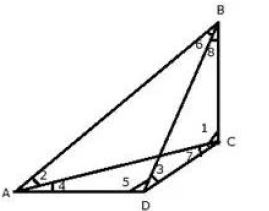
Answer:
In the quadrilateral \( ABCD \), we are given that \( AB \) is the longest side and \( CD \) is the shortest side. Join \( AC \) and \( BD \). Let the angles be numbered as shown in the figure. (i) In \( \Delta ABC \): Since \( AB \) is the longest side, we have: \( AB > BC \) Therefore, the angle opposite to \( AB \) is greater than the angle opposite to \( BC \): \( \angle 1 > \angle 2 \) --- (a) In \( \Delta ADC \): Since \( CD \) is the shortest side, we have: \( AD > CD \) Therefore, the angle opposite to \( AD \) is greater than the angle opposite to \( CD \): \( \angle 7 > \angle 4 \) --- (b) Adding inequalities (a) and (b): \( \angle 1 + \angle 7 > \angle 2 + \angle 4 \) From the figure, \( \angle C = \angle 1 + \angle 7 \) and \( \angle A = \angle 2 + \angle 4 \).
\( \implies \angle C > \angle A \) (ii) In \( \Delta ABD \): Since \( AB \) is the longest side: \( AB > AD \) Thus, the angle opposite to \( AB \) is greater than the angle opposite to \( AD \): \( \angle 5 > \angle 6 \) --- (c) In \( \Delta BCD \): Since \( CD \) is the shortest side: \( BC > CD \) Thus, the angle opposite to \( BC \) is greater than the angle opposite to \( CD \): \( \angle 3 > \angle 8 \) --- (d) Adding inequalities (c) and (d): \( \angle 5 + \angle 3 > \angle 6 + \angle 8 \) From the figure, \( \angle D = \angle 5 + \angle 3 \) and \( \angle B = \angle 6 + \angle 8 \).
\( \implies \angle D > \angle B \)
In simple words: By drawing diagonals, we split the quadrilateral into triangles. Because AB is the longest side and CD is the shortest, we can set up inequalities for each triangle. Adding these inequalities together proves that the opposite corner angles C and D are larger than A and B.
Exam Tip: Clearly numbering the split angles as \(1, 2, 3 \dots 8\) on your diagram makes the proof extremely neat and easy to follow.
Question 19. Let \( x, y, \) and \( z \) be the exterior angles of \( \Delta ABC \) at vertices \( A, B, \) and \( C \) respectively.
(i) If \( AB > AC > BC \), show that \( z < y < x \).
(ii) If \( y > x > z \), show that \( AB > BC > AC \).
Answer:
(i) We are given that \( AB > AC \). Thus, the angles opposite these sides satisfy: \( \angle ACB > \angle ABC \) Using the relation between interior and exterior angles, we can write: \( 180^\circ - z > 180^\circ - y \) \( -z > -y \) \( \implies z < y \) --- (1) Also, we are given \( AC > BC \). The angles opposite these sides satisfy: \( \angle ABC > \angle BAC \) Substituting the exterior angles: \( 180^\circ - y > 180^\circ - x \) \( -y > -x \) \( \implies y < x \) --- (2) Combining equations (1) and (2) yields:
\( \implies z < y < x \) (ii) We are given the relation between the exterior angles: \( y > x > z \) First, taking \( y > x \): Substituting the interior angle equivalents: \( 180^\circ - \angle ABC > 180^\circ - \angle BAC \) Subtracting \( 180^\circ \) from both sides: \( -\angle ABC > -\angle BAC \) Multiplying by \(-1\) reverses the inequality: \( \angle ABC < \angle BAC \) Since a smaller angle faces a shorter side: \( \implies AC < BC \) --- (3) Next, taking \( x > z \): Substituting the interior angle equivalents: \( 180^\circ - \angle BAC > 180^\circ - \angle ACB \) Subtracting \( 180^\circ \) from both sides: \( -\angle BAC > -\angle ACB \) Multiplying by \(-1\) reverses the inequality: \( \angle BAC < \angle ACB \) Since a smaller angle faces a shorter side: \( \implies BC < AB \) --- (4) Combining equations (3) and (4) gives: \( AC < BC < AB \) Writing this in descending order:
\( \implies AB > BC > AC \)
In simple words: Exterior angles and interior angles behave in opposite ways. A longer side means a larger interior angle, which translates to a smaller exterior angle. Conversely, a larger exterior angle corresponds to a smaller interior angle, which faces a shorter side.
Exam Tip: In multi-part proofs like this, make sure to keep your variables clear. Remember that whenever you multiply or divide an inequality by a negative number, you must reverse the inequality sign.
Question 20. Prove the following geometric inequalities:
(i) In a right-angled triangle, the hypotenuse is the longest side.
(ii) In a triangle \( ABC \) with \( \angle ACB = 108^\circ \), prove that \( AB \) is the longest side.
Answer:
(i) Let \( \Delta ABC \) be a right-angled triangle where \( \angle B = 90^\circ \). Using the angle sum property of triangles: \( \angle A + \angle B + \angle C = 180^\circ \) \( \angle A + \angle C + 90^\circ = 180^\circ \) \( \angle A + \angle C = 90^\circ \) Since the sum of \( \angle A \) and \( \angle C \) is \( 90^\circ \), both of these angles must be acute: \( \angle A < 90^\circ \) and \( \angle C < 90^\circ \) Comparing these with the right angle \( \angle B \): Since \( \angle B > \angle A \), the side opposite \( \angle B \) must be longer than the side opposite \( \angle A \): \( AC > BC \) Similarly, since \( \angle B > \angle C \): \( AC > AB \) Thus, the hypotenuse \( AC \) is longer than both of the other sides, making it the longest side of the right-angled triangle. (ii) In \( \Delta ABC \), we are given: \( \angle ACB = 108^\circ \) By the angle sum property: \( \angle A + \angle B + \angle ACB = 180^\circ \) \( \angle A + \angle B + 108^\circ = 180^\circ \) \( \angle A + \angle B = 72^\circ \) Since the sum of \( \angle A \) and \( \angle B \) is \( 72^\circ \), each of these angles must be less than \( 72^\circ \): \( \angle A < 72^\circ \) and \( \angle B < 72^\circ \) Comparing these with our given obtuse angle \( \angle ACB \): Since \( \angle ACB > \angle A \), we have: \( AB > BC \) Similarly, since \( \angle ACB > \angle B \): \( AB > AC \) Therefore, \( AB \) is longer than both \( BC \) and \( AC \), proving that \( AB \) is the longest side of this triangle.
In simple words: (i) Since a right angle is 90 degrees, the other two angles must add up to 90, making them smaller than the right angle. Since the largest angle faces the longest side, the hypotenuse is the longest side. (ii) Similarly, an angle of 108 degrees is obtuse, so the other two angles must add up to 72, which makes them both smaller than 108. The side opposite 108 degrees must therefore be the longest.
Exam Tip: To prove a side is the longest, show that its opposite angle is the largest by proving all other angles in the triangle are strictly smaller.
Question 21. In \( \Delta ABC \), \( D \) is any point on side \( BC \). Prove that \( AB + BC + AC > 2AD \).
Answer:
By the triangle inequality theorem, the sum of any two sides of a triangle must be greater than its third side. In \( \Delta ABD \): \( AB + BD > AD \) --- (i) In \( \Delta ACD \): \( AC + DC > AD \) --- (ii) Adding the two inequalities (i) and (ii): \( AB + BD + AC + DC > 2AD \) Rearranging the terms on the left side: \( AB + (BD + DC) + AC > 2AD \) Since \( D \) lies on the segment \( BC \), we have \( BD + DC = BC \). Substituting this into the inequality:
\( \implies AB + BC + AC > 2AD \)
In simple words: In any triangle, adding two sides together is always more than the third side. By applying this to the two smaller triangles split by line AD, and adding their equations, we find that the total perimeter of the large triangle is greater than twice the length of AD.
Exam Tip: This standard proof is a classic application of the triangle inequality theorem. Grouping \(BD\) and \(DC\) to form \(BC\) is the critical step to finalize the proof.
Question 22. In \( \Delta ABC \), \( AD \) is the bisector of \( \angle A \). If \( AC > AB \), prove that \( \angle ADC > \angle ADB \).
Answer:
In \( \Delta ADC \), the angle \( \angle ADB \) is an exterior angle at vertex \( D \). By the exterior angle theorem: \( \angle ADB = \angle 1 + \angle C \) --- (i) In \( \Delta ADB \), the angle \( \angle ADC \) is an exterior angle at vertex \( D \). By the exterior angle theorem: \( \angle ADC = \angle 2 + \angle B \) --- (ii) We are given that: \( AC > AB \) Since the side opposite to the greater angle is longer, the angle opposite \( AC \) must be larger than the angle opposite \( AB \): \( \angle B > \angle C \) Since \( AD \) is the angle bisector of \( \angle A \): \( \angle 2 = \angle 1 \) Adding these equal angles to both sides of the angle inequality: \( \angle 2 + \angle B > \angle 1 + \angle C \) --- (iii) Comparing equations (i), (ii), and (iii):
\( \implies \angle ADC > \angle ADB \)
In simple words: Because AC is longer than AB, angle B is larger than angle C. Since AD splits the top angle equally, we add equal angle parts to B and C. Thus, the sum at the B side remains larger than at the C side. By the exterior angle rule, these sums are exactly the outer angles, proving ADC is larger than ADB.
Exam Tip: Write down the exterior angle theorem as a formula for both triangles. Aligning the variables side-by-side makes the final inequality comparison clear.
Question 23. In the given figure, \( \Delta ABC \) is an isosceles triangle with \( AB = AC \). \( F \) is the midpoint of \( BC \), and \( D \) is a point on \( BF \). \( E \) is a point on \( BC \) produced. Prove that \( AC > AD \) and \( AE > AC \).
Answer:
In an isosceles triangle, the line segment from the vertex to the midpoint of the base is perpendicular to the base. Thus, \( AF \perp BC \) at point \( F \). By applying Pythagoras' theorem in the right-angled triangle \( \Delta AFB \): \( AB^2 = AF^2 + BF^2 \) --- (i) Applying Pythagoras' theorem in the right-angled triangle \( \Delta AFD \): \( AD^2 = AF^2 + DF^2 \) --- (ii) Since \( \Delta ABC \) is an isosceles triangle with \( AB = AC \), we can substitute \( AC \) in place of \( AB \) in (i): \( AC^2 = AF^2 + BF^2 \) --- (iii) Subtracting (ii) from (iii): \( AC^2 - AD^2 = (AF^2 + BF^2) - (AF^2 + DF^2) \) \( AC^2 - AD^2 = BF^2 - DF^2 \) Since \( D \) lies on \( BF \), we have \( BF > DF \). Thus: \( BF^2 - DF^2 > 0 \) This means: \( AC^2 - AD^2 > 0 \) \( AC^2 > AD^2 \)
\( \implies AC > AD \) Using a similar logical approach for point \( E \) which lies on the base \( BC \) produced: \( AE^2 = AF^2 + EF^2 \) Since \( E \) is on \( BC \) produced, \( EF > BF \). Thus: \( AE^2 - AC^2 = EF^2 - BF^2 > 0 \) \( AE^2 > AC^2 \)
\( \implies AE > AC \)
In simple words: By using the Pythagorean theorem with the height AF, we can compare the lengths squared. Since the base distance BF is longer than DF, the hypotenuse AC must be longer than AD. Similarly, since the extended base distance EF is longer than BF, the outer line AE must be longer than AC.
Exam Tip: Applying the Pythagorean theorem is a very elegant way to solve segment-length comparison proofs in isosceles triangles. Remember to write down the subtraction steps clearly.
Question 24. In \( \Delta ABC \), \( D \) is a point on side \( AC \). If \( E \) is a point on \( BD \) such that \( CE = DE \), prove that \( AD + AB > BC \).
Answer:
Recall that the sum of any two sides of a triangle is strictly greater than its third side. In \( \Delta CEB \): \( CE + EB > BC \) We are given that \( CE = DE \). Substituting this in: \( DE + EB > BC \) Since \( E \) is a point on the line segment \( DB \), we have \( DE + EB = DB \). Thus: \( DB > BC \) --- (i) Now, in \( \Delta ADB \): Applying the triangle inequality theorem again: \( AD + AB > BD \) Using the relation \( BD > BC \) established in (i):
\( \implies AD + AB > BC \)
In simple words: In triangle CEB, the sum of CE and EB is greater than BC. Because CE is equal to DE, we can replace CE with DE, showing that the full line DB is longer than BC. Finally, in triangle ADB, the sum of AD and AB is greater than DB, which makes it greater than BC as well.
Exam Tip: Clearly identifying the intermediate segment \(DB\) and applying the substitution \(CE = DE\) are the key steps to unlocking this proof.
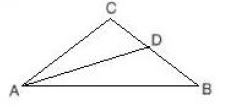
Question 25. In the given figure, \( D \) is any point on the side \( BC \) of \( \Delta ABC \). If \( AB > AC \), prove that \( AB > AD \).
Answer:
We are given that: \( AB > AC \) In \( \Delta ABC \), since the angle opposite the longer side is greater: \( \angle C > \angle B \) --- (i) Now, in \( \Delta ADC \), the angle \( \angle ADB \) is an exterior angle. The exterior angle of a triangle is equal to the sum of its two interior opposite angles: \( \angle ADB = \angle DAC + \angle C \) This means: \( \angle ADB > \angle C \) Using the inequality from (i) (\( \angle C > \angle B \)): \( \angle ADB > \angle C > \angle B \) This simplifies to: \( \angle ADB > \angle B \) In \( \Delta ABD \), since the side opposite the larger angle is longer:
\( \implies AB > AD \)
In simple words: Since AB is longer than AC, angle C is larger than angle B. Also, the outer angle ADB is larger than the inner angle C. Therefore, ADB is larger than B. In triangle ABD, because angle ADB is larger than angle B, the side opposite it (AB) must be longer than the side opposite B (AD).
Exam Tip: Using the transitive property of inequality (if \(P > Q\) and \(Q > R\), then \(P > R\)) is a very powerful way to connect the exterior angle with the base angles.
ICSE Selina Concise Solutions Class 9 Mathematics Chapter 11 Inequalities
Students can now access the detailed Selina Concise Solutions for Chapter 11 Inequalities on our portal. These solutions have been carefully prepared as per latest ICSE Class 9 syllabus. Each solution given above has been updated based on the current year pattern to ensure Class 9 students have the most updated Mathematics content.
Master Selina Concise Textbook Questions
Our subject experts have provided detailed explanations for all the questions found in the Selina Concise textbook for Class 9 Mathematics. We have focussed on making the concepts easy for you in Chapter 11 Inequalities so that students can understand the concepts behind every answer. For all numerical problems and theoretical concepts these solutions will help in strengthening your analytical skill required for the ICSE examinations.
Complete Mathematics Exam Preparation
By using these Selina Concise Class 9 solutions, you can enhance your learning and identify areas that need more attention. We recommend solving the Mathematics Questions from the textbook first and then use our teacher-verified answers. For a proper revision of Chapter 11 Inequalities, students should also also check our Revision Notes and Sample Papers available on studiestoday.com.
FAQs
You can download the verified Selina Concise solutions for Chapter 11 Inequalities on StudiesToday.com. Our teachers have prepared answers for Class 9 Mathematics as per 2026-27 ICSE academic session.
Yes, our solutions for Chapter 11 Inequalities are designed as per new 2026 ICSE standards. 40% competency-based questions required for Class 9, are included to help students understand application-based logic behind every Mathematics answer.
Yes, every exercise in Chapter 11 Inequalities from the Selina Concise textbook has been solved step-by-step. Class 9 students will learn Mathematics conceots before their ICSE exams.
Yes, follow structured format of these Selina Concise solutions for Chapter 11 Inequalities to get full 20% internal assessment marks and use Class 9 Mathematics projects and viva preparation as per ICSE 2026 guidelines.