

ICSE Solutions Selina Concise Class 9 Mathematics Chapter 16 Area Theorems Proof And Use have been provided below and is also available in Pdf for free download. The Selina Concise ICSE solutions for Class 9 Mathematics have been prepared as per the latest syllabus and ICSE books and examination pattern suggested in Class 9. Questions given in ICSE Selina Concise book for Class 9 Mathematics are an important part of exams for Class 9 Mathematics and if answered properly can help you to get higher marks. Refer to more Chapter-wise answers for ICSE Class 9 Mathematics and also download more latest study material for all subjects. Chapter 16 Area Theorems Proof And Use is an important topic in Class 9, please refer to answers provided below to help you score better in exams
Selina Concise Chapter 16 Area Theorems Proof And Use Class 9 Mathematics ICSE Solutions
Class 9 Mathematics students should refer to the following ICSE questions with answers for Chapter 16 Area Theorems Proof And Use in Class 9. These ICSE Solutions with answers for Class 9 Mathematics will come in exams and help you to score good marks
Chapter 16 Area Theorems Proof And Use Selina Concise ICSE Solutions Class 9 Mathematics
Exercise 16(A)
Question 1. In the given figure, triangle ADE and parallelogram ABED are on the same base AB and between the same parallels DE || AB. If the area of triangle ADE is 60 cm², find: (i) Area of parallelogram ABED, (ii) Area of parallelogram ABCF, (iii) Area of triangle ABE.
Answer:
(i) Since the triangle \(ADE\) and the parallelogram \(ABED\) are situated on the identical base \(AB\) and lie between the same parallel lines \(DE \parallel AB\), the area of the triangle is exactly half that of the parallelogram.
Therefore, \(\text{Area of parallelogram } ABED = 2 \times \text{Area}(\Delta ADE) = 2 \times 60\text{ cm}^2 = 120\text{ cm}^2\).
(ii) Parallelograms that stand on the same base and lie between the same parallel lines must be equal in area.
Thus, \(\text{Area of parallelogram } ABCF = \text{Area of parallelogram } ABED = 120\text{ cm}^2\).
(iii) Triangles sharing the same base and situated between the same parallel lines have equal areas.
Hence, \(\text{Area of triangle } ABE = \text{Area of triangle } ADE = 60\text{ cm}^2\).
In simple words: A triangle has half the area of a parallelogram if they share a base and lie between the same parallel lines. Parallelograms on the same base and between the same parallels have identical areas.
Exam Tip: Remember to always state the complete geometric theorem you are using to justify your area calculations to secure full marks.
Question 2. ABDC and ABEF are two parallelograms on the same base AB. Prove that CDEF is a parallelogram and its area is equal to the sum of the areas of ABDC and ABEF.
Answer: From the given figure, we have \(CD \parallel AB\) and \(AB \parallel FE\), which directly implies \(CD \parallel FE\). Since \(FC\) is also parallel to \(DE\), the quadrilateral \(CDEF\) has both pairs of opposite sides parallel. This proves that \(CDEF\) is a parallelogram.
The area of any parallelogram sharing the same base and lying between the same parallels is equal. Since \(CDEF\) is formed by joining the bases, its total area is the sum of the areas of the individual parallelograms.
Therefore, \(\text{Area}(CDEF) = \text{Area}(ABDC) + \text{Area}(ABEF)\).
Hence Proved.
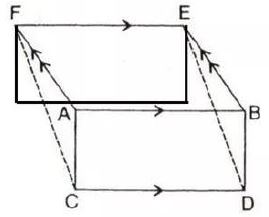
In simple words: Since the top and bottom lines are parallel and the side lines are parallel, CDEF is a parallelogram. Its area is equal to the areas of the two smaller parallelograms combined.
Exam Tip: Clearly show that the opposite sides are parallel before stating that the quadrilateral is a parallelogram.
Question 3. In a parallelogram PQRS, L and M are points on PQ and SR respectively such that LM || PS. O is the midpoint of LM. Prove that: (i) \(2 \times \text{Area}(\Delta POS) = \text{Area}(PMLS)\), (ii) \(\text{Area}(\Delta POS) + \text{Area}(\Delta QOR) = \frac{1}{2} \text{Area}(PQRS)\), (iii) \(\text{Area}(\Delta POS) + \text{Area}(\Delta QOR) = \text{Area}(\Delta POQ) + \text{Area}(\Delta SOR)\).
Answer:
(i) Since \(\Delta POS\) and the parallelogram \(PMLS\) share the base \(PS\) and lie between the same parallel lines \(SP \parallel LM\), we use the theorem that the area of a parallelogram is twice the area of a triangle having the same base and parallels.
Therefore, \(2 \times \text{Area}(\Delta POS) = \text{Area}(PMLS)\). Hence Proved.
(ii) Consider the sum \(\text{Area}(\Delta POS) + \text{Area}(\Delta QOR)\).
Since \(LM \parallel PS\) and \(PS \parallel RQ\), we know \(LM \parallel RQ\).
Because \(\Delta POS\) is on base \(PS\) and between parallel lines \(PS\) and \(LM\), we get:
\(\text{Area}(\Delta POS) = \frac{1}{2} \text{Area}(PMLS)\).
Similarly, because \(\Delta QOR\) lies on base \(QR\) and between parallel lines \(LM\) and \(RQ\), we get:
\(\text{Area}(\Delta QOR) = \frac{1}{2} \text{Area}(LMQR)\).
Adding these two gives:
\(\text{Area}(\Delta POS) + \text{Area}(\Delta QOR) = \frac{1}{2} [\text{Area}(PMLS) + \text{Area}(LMQR)] = \frac{1}{2} \text{Area}(PQRS)\). Hence Proved.
(iii) In any parallelogram, diagonals bisect each other, so \(OS = OQ\).
In \(\Delta PQS\), since \(OS = OQ\), \(OP\) is the median, which divides the triangle into two equal areas:
\(\text{Area}(\Delta POS) = \text{Area}(\Delta POQ)\) ... (1)
Similarly, \(OR\) is the median of \(\Delta QRS\), so:
\(\text{Area}(\Delta QOR) = \text{Area}(\Delta SOR)\) ... (2)
By adding (1) and (2), we obtain:
\(\text{Area}(\Delta POS) + \text{Area}(\Delta QOR) = \text{Area}(\Delta POQ) + \text{Area}(\Delta SOR)\). Hence Proved.
In simple words: A triangle's area is half of the surrounding parallelogram's area when they share a base. Medians split triangles into two parts of equal size.
Exam Tip: When proving area relations, first break down the larger figure into smaller parallelograms using the parallel lines given in the question.
Question 4. ABCD is a parallelogram. P and Q are any points on the sides AB and BC respectively. Prove that: (i) \(\text{Area}(\Delta CPD) = \text{Area}(\Delta AQD)\), (ii) \(\text{Area}(\Delta AQD) = \text{Area}(\Delta ACD) = \text{Area}(\Delta PDC) = \text{Area}(\Delta BDC) = \text{Area}(\Delta ABC) = \text{Area}(\Delta APD) + \text{Area}(\Delta BPC)\).
Answer:
(i) Triangles sharing the same base and situated between the same parallel lines have equal areas.
Therefore, \(\text{Area}(\Delta CPD) = \text{Area}(\Delta BCD)\) ... (1)
Since the diagonal of a parallelogram bisects its total area into two equal halves, we have:
\(\text{Area}(\Delta BCD) = \frac{1}{2} \text{Area}(ABCD)\) ... (2)
Combining equations (1) and (2) gives:
\(\text{Area}(\Delta CPD) = \frac{1}{2} \text{Area}(ABCD)\) ... (3)
By a similar logic for triangle \(AQD\):
\(\text{Area}(\Delta AQD) = \text{Area}(\Delta ABD) = \frac{1}{2} \text{Area}(ABCD)\) ... (4)
From equations (3) and (4), we conclude that:
\(\text{Area}(\Delta CPD) = \text{Area}(\Delta AQD)\). Hence Proved.
(ii) Because triangles on the identical base and between the same parallel lines possess equal areas, we can write:
\(\text{Area}(\Delta AQD) = \text{Area}(\Delta ACD) = \text{Area}(\Delta PDC) = \text{Area}(\Delta BDC) = \text{Area}(\Delta ABC)\).
Since the diagonal divides the parallelogram in half, this area is also equal to the sum of the remaining parts: \(\text{Area}(\Delta APD) + \text{Area}(\Delta BPC)\). Hence Proved.
In simple words: Since both triangles CPD and AQD have bases on the sides of the parallelogram and vertices on the opposite parallel sides, their areas are both equal to half of the total parallelogram's area.
Exam Tip: Relate the area of each triangle to half the area of the main parallelogram to easily show they are equal to each other.
Question 5. In the given figure, ABCD is a parallelogram of area 48 cm². E is a point such that triangle BEC and parallelogram ABCD are on the same base BC and between the same parallels BC || AD. (i) Find the area of triangle BEC. (ii) If the parallelogram ABCD is divided into two equal parallelograms ANMD and BNMC, show that their areas are equal to the area of triangle BEC.
Answer:
(i) Since triangle \(BEC\) and parallelogram \(ABCD\) share the base \(BC\) and lie between parallel lines \(BC \parallel AD\), the area of the triangle is half that of the parallelogram:
\(\text{Area}(\Delta BEC) = \frac{1}{2} \times \text{Area}(ABCD) = \frac{1}{2} \times 48 = 24\text{ cm}^2\).
(ii) We are given that the parallelograms \(ANMD\) and \(BNMC\) are equal in area and make up the whole parallelogram \(ABCD\):
\(\text{Area}(ANMD) = \text{Area}(BNMC) = \frac{1}{2} \text{Area}(ABCD)\).
Since \(\text{Area}(\Delta BEC) = \frac{1}{2} \text{Area}(ABCD)\), we can substitute to get:
\(\text{Area}(ANMD) = \text{Area}(BNMC) = \text{Area}(\Delta BEC)\).
This shows that both smaller parallelograms have areas equal to the area of triangle \(BEC\).
In simple words: The triangle's area is exactly half of the parallelogram's area because they share a base and parallel lines. Since the parallelogram is split into two equal halves, each half is equal to the triangle.
Exam Tip: State the relation between a triangle and a parallelogram on the same base clearly before performing the numerical division.
Question 6. In the given figure, DB || CE. Prove that the area of quadrilateral ABCD is equal to the area of triangle ADE.
Answer: Since \(\Delta DCB\) and \(\Delta DEB\) lie on the same base \(DB\) and between the same parallel lines \(DB \parallel CE\), we have:
\(\text{Area}(\Delta DCB) = \text{Area}(\Delta DEB)\).
Now, let us add the area of \(\Delta ADB\) to both sides of this equation:
\(\text{Area}(\Delta DCB) + \text{Area}(\Delta ADB) = \text{Area}(\Delta DEB) + \text{Area}(\Delta ADB)\).
This simplifies to:
\(\text{Area}(ABCD) = \text{Area}(\Delta ADE)\).
Hence Proved.
In simple words: The two triangles sharing the base DB have equal areas. Adding the same triangle ADB to both of them turns one into the quadrilateral ABCD and the other into the triangle ADE, keeping their areas equal.
Exam Tip: Identify the common triangle that can be added to both equal-area triangles to obtain the desired final figures.
Question 7. ABCD is a parallelogram. P is any point on CD and Q is a point on BC produced. Prove that: (i) \(\text{Ar}(\Delta APB) + \text{Ar}(\Delta ADQ) = \text{Ar}(ABCD)\), (ii) \(\text{Ar}(\Delta BCP) = \text{Ar}(\Delta DPQ)\).
Answer:
(i) Triangle \(APB\) and parallelogram \(ABCD\) are on the identical base \(AB\) and lie between parallels \(AB \parallel CD\).
\(\therefore \text{Ar}(\Delta APB) = \frac{1}{2} \text{Ar}(ABCD)\) ... (1)
Similarly, triangle \(ADQ\) and parallelogram \(ABCD\) lie on the base \(AD\) and between parallels \(AD \parallel BQ\).
\(\therefore \text{Ar}(\Delta ADQ) = \frac{1}{2} \text{Ar}(ABCD)\) ... (2)
By adding (1) and (2), we get:
\(\text{Ar}(\Delta APB) + \text{Ar}(\Delta ADQ) = \text{Ar}(ABCD)\). Hence Proved.
(ii) From the above equation, we can rewrite it using the components of the figures:
\(\text{Ar}(\text{quad } ADQB) - \text{Ar}(\Delta BPQ) = \text{Ar}(ABCD)\).
Since \(\text{Ar}(\text{quad } ADQB) - \text{Ar}(\Delta BPQ) = \text{Ar}(\text{quad } ADQB) - \text{Ar}(\Delta DCQ)\), we have:
\(\text{Ar}(\Delta BPQ) = \text{Ar}(\Delta DCQ)\).
Subtracting \(\text{Ar}(\Delta PCQ)\) from both sides:
\(\text{Ar}(\Delta BPQ) - \text{Ar}(\Delta PCQ) = \text{Ar}(\Delta DCQ) - \text{Ar}(\Delta PCQ)\), which simplifies to:
\(\text{Ar}(\Delta BCP) = \text{Ar}(\Delta DPQ)\). Hence Proved.
In simple words: Both triangles APB and ADQ are half the size of the parallelogram, so adding them together equals the whole parallelogram. Subtracting common overlapping regions shows that the remaining triangles have equal areas.
Exam Tip: Be careful with subtracting common regions; write out each step of subtraction clearly to avoid sign or label errors.
Question 8. In the given figure, ABCDE is a pentagon. A line through E parallel to DA meets BA produced at G, and a line through C parallel to DB meets AB produced at F. Prove that \(\text{Ar}(\Delta GDF) = \text{Ar}(\text{pentagon } ABCDE)\).
Answer: Since triangle \(EDG\) and \(EGA\) lie on the identical base \(EG\) and between the parallel lines \(EG \parallel DA\), we have:
\(\text{Ar}(\Delta EDG) = \text{Ar}(\Delta EGA)\).
Subtracting the common area \(\text{Ar}(\Delta EOG)\) from both sides, we get:
\(\text{Ar}(\Delta EOD) = \text{Ar}(\Delta GOA)\) ... (1)
By applying the same logic on the other side:
\(\text{Ar}(\Delta DPC) = \text{Ar}(\Delta BPF)\) ... (2)
Now, we calculate the total area of triangle \(GDF\):
\(\text{Ar}(\Delta GDF) = \text{Ar}(\Delta GOA) + \text{Ar}(\Delta BPF) + \text{Ar}(\text{pentagon } ABPDO)\).
Substituting equations (1) and (2) into this sum:
\(\text{Ar}(\Delta GDF) = \text{Ar}(\Delta EOD) + \text{Ar}(\Delta DPC) + \text{Ar}(\text{pentagon } ABPDO)\).
This combination exactly recomposes the pentagon:
\(\text{Ar}(\Delta GDF) = \text{Ar}(\text{pentagon } ABCDE)\).
Hence Proved.
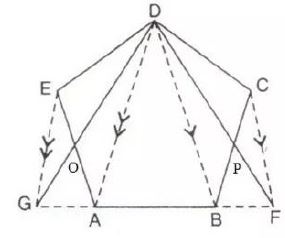
In simple words: By using parallel lines, we show that the outer triangles added to the base are equal in area to the top corner pieces of the pentagon. Adding them up gives the same total area.
Exam Tip: Label the intersection points like O and P clearly on your diagram to make the multi-step area addition easy to follow.
Question 9. In the given figure, AP || BC and BP || CQ. Prove that \(\text{Ar}(\Delta ABC) = \text{Ar}(\Delta BQP)\).
Answer: Let us join the points \(P\) and \(C\).
Since \(\Delta ABC\) and \(\Delta BPC\) stand on the identical base \(BC\) and lie between parallel lines \(AP \parallel BC\):
\(\text{Ar}(\Delta ABC) = \text{Ar}(\Delta BPC)\) ... (1)
Next, because \(\Delta BPC\) and \(\Delta BQP\) are on the same base \(BP\) and lie between parallel lines \(BP \parallel CQ\):
\(\text{Ar}(\Delta BPC) = \text{Ar}(\Delta BQP)\) ... (2)
Combining equations (1) and (2) directly gives:
\(\text{Ar}(\Delta ABC) = \text{Ar}(\Delta BQP)\).
Hence Proved.
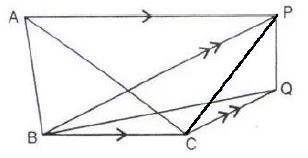
In simple words: By linking P and C, we create an intermediate triangle BPC. Since BPC equals both ABC and BQP due to parallel lines, ABC must equal BQP.
Exam Tip: Draw the auxiliary line segment PC as a dashed line to clearly identify the intermediate triangle used in the proof.
Question 10. On the sides AB and AC of a right-angled triangle ABC, squares ABDE and ACFG are drawn externally. If AR is the perpendicular from A to BC, meeting BC at R and HF is drawn... Prove that: (i) \(\Delta EAC \cong \Delta BAF\), (ii) \(\text{Area}(ABDE) = \text{Area}(\text{rectangle } ARHF)\).
Answer:
(i) Let us express the angles:
\(\angle EAC = \angle EAB + \angle BAC \implies \angle EAC = 90^\circ + \angle BAC\) ... (1)
\(\angle BAF = \angle FAC + \angle BAC \implies \angle BAF = 90^\circ + \angle BAC\) ... (2)
Comparing (1) and (2) gives \(\angle EAC = \angle BAF\).
Now, in \(\Delta EAC\) and \(\Delta BAF\):
\(EA = AB\) (sides of square \(ABDE\))
\(\angle EAC = \angle BAF\) (proved above)
\(AC = AF\) (sides of square \(ACFG\))
Therefore, by SAS congruence criteria, \(\Delta EAC \cong \Delta BAF\).
(ii) For the right triangle \(ABC\), we have:
\(AC^2 = AB^2 + BC^2 \implies AB^2 = AC^2 - BC^2\)
Substituting values using Pythagoras theorem on the segments:
\(AB^2 = (AR + RC)^2 - (BR^2 + RC^2)\)
Expanding this expression:
\(AB^2 = AR^2 + 2AR \times RC + RC^2 - BR^2 - RC^2\)
Using Pythagoras theorem in \(\Delta ABR\), we substitute \(BR^2 = AB^2 - AR^2\):
\(AB^2 = AR^2 + 2AR \times RC - (AB^2 - AR^2)\)
\(2AB^2 = 2AR^2 + 2AR \times RC \implies AB^2 = AR(AR + RC) = AR \times AC\).
Since \(AC = AF\), we get \(AB^2 = AR \times AF\).
Since \(AB^2\) is the area of square \(ABDE\) and \(AR \times AF\) is the area of rectangle \(ARHF\), we get:
\(\text{Area}(ABDE) = \text{Area}(\text{rectangle } ARHF)\).
Hence Proved.
In simple words: First, we use congruent triangles to show a connection between the square on one side and a rectangle. Then, using Pythagoras theorem, we mathematically confirm their areas are identical.
Exam Tip: Be precise when expanding algebraic identities in geometry proofs; ensure you group terms carefully to substitute right-triangle values.
Question 11. In \(\Delta ABC\), D and E are the midpoints of AB and AC respectively. CD and BE intersect at O. Prove that: (i) \(\text{Area}(\Delta ADC) = \text{Area}(\Delta AEB)\), (ii) \(\text{Area}(\Delta DOB) = \text{Area}(\Delta COE)\).
Answer:
(i) In \(\Delta ABC\), since D is the midpoint of AB and E is the midpoint of AC, we have:
\(\frac{AD}{AB} = \frac{AE}{AC} = \frac{1}{2}\).
This implies that \(DE \parallel BC\).
The area of a triangle on the same base is half the area of the entire triangle:
\(\text{Area}(\Delta ADC) = \frac{1}{2} \text{Area}(\Delta ABC)\) and \(\text{Area}(\Delta AEB) = \frac{1}{2} \text{Area}(\Delta ABC)\).
Therefore, \(\text{Area}(\Delta ADC) = \text{Area}(\Delta AEB)\). Hence Proved.
(ii) Since triangles on the same base and between the same parallels have equal areas, we have:
\(\text{Area}(\Delta DBC) = \text{Area}(\Delta BCE)\).
Splitting these triangles into their component parts:
\(\text{Area}(\Delta DOB) + \text{Area}(\Delta BOC) = \text{Area}(\Delta BOC) + \text{Area}(\Delta COE)\).
Subtracting the common term \(\text{Area}(\Delta BOC)\) from both sides gives:
\(\text{Area}(\Delta DOB) = \text{Area}(\Delta COE)\).
Hence Proved.
In simple words: Midpoints make parallel lines, which helps us show that the larger triangles are equal in size. Subtracting the shared bottom corner leaves the two small opposite side triangles equal.
Exam Tip: Remember that midpoint connections in triangles always produce a line parallel to the third side, which is key for finding equal-area triangles.
Question 12. In the given figure, EBC is a triangle with area 480 cm² and ABCD is a parallelogram on the same base BC and between same parallels BC || AD. If BC = 30 cm, find: (i) Area of parallelogram ABCD, (ii) Area of parallelogram BCFE on the same base BC and between same parallels, (iii) Altitude of \(\Delta ACD\), (iv) Area of \(\Delta ECF\).
Answer:
(i) Since \(\Delta EBC\) and the parallelogram \(ABCD\) lie on the identical base \(BC\) and between the same parallels \(BC \parallel AD\), we have:
\(\text{Area}(\Delta EBC) = \frac{1}{2} \text{Area}(ABCD)\).
\(\text{Area}(ABCD) = 2 \times \text{Area}(\Delta EBC) = 2 \times 480\text{ cm}^2 = 960\text{ cm}^2\).
(ii) Parallelograms on the identical base and between the same parallel lines are equal in area.
Therefore, \(\text{Area}(BCFE) = \text{Area}(ABCD) = 960\text{ cm}^2\).
(iii) Since the diagonal of a parallelogram bisects its area, we have:
\(\text{Area}(\Delta ACD) = \frac{1}{2} \text{Area}(ABCD) = 480\text{ cm}^2\).
Using the triangle area formula:
\(480 = \frac{1}{2} \times 30 \times \text{Altitude} \implies \text{Altitude} = \frac{480}{15} = 32\text{ cm}\).
(iv) Since a triangle is half the area of a parallelogram on the identical base and parallels:
\(\text{Area}(\Delta ECF) = \frac{1}{2} \text{Area}(CBEF) = \frac{1}{2} \times 960 = 480\text{ cm}^2\).
In simple words: The parallelogram is twice the size of the triangle. Any other parallelogram on the same base has the same area. We find the height using the basic area formula, and other triangles on this base are also half the size of the parallelogram.
Exam Tip: Be careful to use the correct base value when calculating the altitude; here, the base BC is given as 30 cm.
Question 13. D is the midpoint of AB. A line parallel to BC is drawn through D to meet AC at E. C is joined to D. Prove that the area of parallelogram BDEC is equal to the area of \(\Delta ABC\).
Answer: Since \(D\) is the midpoint of \(AB\), we have \(AD = DB\). Given \(EC = DB\), it follows that \(EC = AD\).
The vertically opposite angles are equal, so \(\angle BFC = \angle AFD\).
Since \(ED \parallel CB\) and the transversal \(AC\) intersects them, the alternate interior angles are equal:
\(\angle ECF = \angle FAD\).
Using these conditions, we establish congruence:
\(\Delta EFC \cong \Delta AFD\).
By adding the area of the quadrilateral \(CBDF\) to both sides of this congruence relation:
\(\text{Area}(BDEC) = \text{Area}(\Delta ABC)\).
Hence Proved.
In simple words: We prove the small outer triangle is congruent to the inside corner triangle. Adding the main quadrilateral piece to both proves that the parallelogram and triangle have equal areas.
Exam Tip: Identify alternate interior angles accurately by locating the transversal line crossing the parallel lines.
Question 14. In a parallelogram PQRS, AC is parallel to PS and BD is parallel to PQ. Prove that \(\text{Area}(PQRS) = 2 \times \text{Area}(ABCD)\).
Answer: In the parallelogram \(PQRS\), we are given \(AC \parallel PS \parallel QR\) and \(PQ \parallel BD \parallel SR\). This makes \(AQRC\) and \(APSC\) parallelograms.
Since \(\Delta ABC\) and the parallelogram \(AQRC\) are on the identical base \(AC\) and between the same parallels:
\(\text{Ar}(\Delta ABC) = \frac{1}{2} \text{Ar}(AQRC)\) ... (1)
Similarly, for the other side:
\(\text{Ar}(\Delta ADC) = \frac{1}{2} \text{Ar}(APSC)\) ... (2)
By adding equations (1) and (2):
\(\text{Ar}(\Delta ABC) + \text{Ar}(\Delta ADC) = \frac{1}{2} [\text{Ar}(AQRC) + \text{Ar}(APSC)]\).
This simplifies to:
\(\text{Area}(ABCD) = \frac{1}{2} \text{Area}(PQRS) \implies \text{Area}(PQRS) = 2 \times \text{Area}(ABCD)\).
Hence Proved.
In simple words: We split the main parallelogram into two smaller ones. Each half of the central quadrilateral is exactly half of these smaller parallelograms, making the whole inner shape half of the outer shape.
Exam Tip: Split the composite figure along the parallel line AC to simplify the proof into two independent halves.
Question 15. ABCD is a trapezium with AB || CD. A line parallel to diagonal AC cuts AB at M and BC at N. Prove that \(\text{Area}(\Delta ADM) = \text{Area}(\Delta CAN)\).
Answer: Let us join \(C\) to \(M\).
Triangles on the same base and between the same parallel lines are equal in area.
Therefore, \(\text{Area}(\Delta AMD) = \text{Area}(\Delta AMC)\) ... (1)
Now, in the quadrilateral \(AMNC\), since \(MN \parallel AC\), \(\Delta ACM\) and \(\Delta CAN\) lie on the identical base \(AC\) and between parallel lines \(MN \parallel AC\).
Thus, \(\text{Area}(\Delta ACM) = \text{Area}(\Delta CAN)\) ... (2)
From equations (1) and (2), we conclude:
\(\text{Area}(\Delta ADM) = \text{Area}(\Delta CAN)\).
Hence Proved.
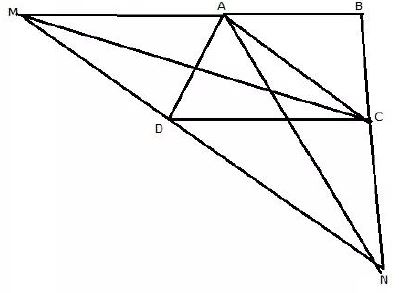
In simple words: Joining C and M creates a middle triangle AMC. We show that ADM has the same area as AMC, which in turn has the same area as CAN, making ADM equal to CAN.
Exam Tip: Be sure to cite the parallel lines \(AB \parallel CD\) first to prove the first step of the triangle area equality.
Question 16. In quadrilateral ABED, AD || BE, and in quadrilateral BEFC, BE || CF. Prove that \(\text{Area}(\Delta AEC) = \text{Area}(\Delta DBF)\).
Answer: We know that triangles sharing a base and lying between parallel lines have equal areas.
In quadrilateral \(ABED\), since \(AD \parallel BE\), taking \(BE\) as the base gives:
\(\text{Area}(\Delta ABE) = \text{Area}(\Delta BDE)\) ... (1)
Similarly, in quadrilateral \(BEFC\), since \(BE \parallel CF\), taking \(BC\) (or \(BE\)) as the base gives:
\(\text{Area}(\Delta BEC) = \text{Area}(\Delta BEF)\) ... (2)
Adding equations (1) and (2) together yields:
\(\text{Area}(\Delta ABE) + \text{Area}(\Delta BEC) = \text{Area}(\Delta BEF) + \text{Area}(\Delta BDE)\).
This combines to:
\(\text{Area}(\Delta AEC) = \text{Area}(\Delta DBF)\).
Hence Proved.
In simple words: By using the common base BE, we show that the two left-hand triangles match the two right-hand triangles in area. Adding them together gives the final proof.
Exam Tip: The key to this proof is using the shared base BE for both parallel pairs; state this common base clearly in your steps.
Question 17. ABCD is a parallelogram. X is any point on BC produced. Prove that \(\text{Area}(\Delta ABX) = \text{Area}(\text{quadrilateral } ACXD)\).
Answer: For the parallelogram \(ABCD\), the diagonal \(AC\) bisects its area:
\(\text{Area}(\Delta ABC) = \text{Area}(\Delta ACD)\).
Let us express the area of \(\Delta ABX\):
\(\text{Area}(\Delta ABX) = \text{Area}(\Delta ABC) + \text{Area}(\Delta ACX)\).
Since triangles on the same base and between the same parallels have equal areas, we have:
\(\text{Area}(\Delta ACX) = \text{Area}(\Delta CXD)\).
Substituting these equal areas into the equation:
\(\text{Area}(\Delta ABX) = \text{Area}(\Delta ACD) + \text{Area}(\Delta CXD) = \text{Area}(\text{quadrilateral } ACXD)\).
Hence Proved.
In simple words: We split the large triangle ABX into two parts. By replacing each part with an equal-area counterpart from the quadrilateral, we show the total areas are equal.
Exam Tip: Write down the area addition steps explicitly to show how the components match the quadrilateral parts.
Question 18. ABCD and ARQP are two parallelograms such that they have a common vertex A and the vertices B, C, D, R, Q, P lie in a way that allows a common base line. Prove that \(\text{Area}(ABCD) = \text{Area}(ARQP)\).
Answer: Let us connect \(B\) to \(R\) and \(P\) to \(R\).
A parallelogram has twice the area of a triangle if they lie on the identical base and between the same parallels.
For parallelogram \(ABCD\) on base \(AB\) with parallels \(AB \parallel DC\):
\(\text{Area}(ABCD) = 2 \times \text{Area}(\Delta ABR)\) ... (1)
Triangles on the same base and between the same parallel lines have equal areas.
Since \(\Delta ABR\) and \(\Delta APR\) are on base \(AR\) with parallels \(AR \parallel QP\):
\(\text{Area}(\Delta ABR) = \text{Area}(\Delta APR)\) ... (2)
Substituting (2) into (1):
\(\text{Area}(ABCD) = 2 \times \text{Area}(\Delta APR)\) ... (3)
Also, triangle \(APR\) and parallelogram \(ARQP\) share the base \(AR\) and lie between parallels \(AR \parallel QP\):
\(\text{Area}(\Delta APR) = \frac{1}{2} \text{Area}(ARQP)\) ... (4)
Substituting (4) into (3) yields:
\(\text{Area}(ABCD) = 2 \times \frac{1}{2} \text{Area}(ARQP) \implies \text{Area}(ABCD) = \text{Area}(ARQP)\).
Hence Proved.
In simple words: We use an intermediate triangle ABR to link both parallelograms. Since both parallelograms are twice the size of this triangle, they must be equal to each other.
Exam Tip: When dealing with two different parallelograms, always search for a shared triangle that can act as a bridge between them.
Exercise 16(B)
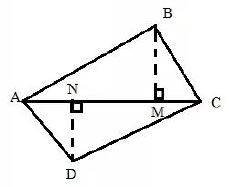
Question 1. Prove that: (i) A diagonal of a parallelogram divides it into two triangles of equal area. (ii) If AD is a median of \(\Delta ABC\), then \(\frac{\text{Area}(\Delta ABD)}{\text{Area}(\Delta ADC)} = \frac{BD}{DC}\). (iii) If BM and DN are perpendiculars from B and D to the diagonal AC of a quadrilateral ABCD, then \(\frac{\text{Area}(\Delta ABC)}{\text{Area}(\Delta ADC)} = \frac{BM}{DN}\).
Answer:
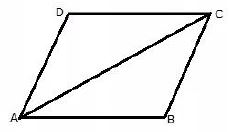
(i) Let \(ABCD\) be a parallelogram. Consider \(\Delta ABC\) and \(\Delta ADC\):
\(AB = CD\) (Opposite sides of parallelogram)
\(AD = BC\) (Opposite sides of parallelogram)
\(AD = AD\) (Common side)
By Side-Side-Side (SSS) congruence criterion, \(\Delta ABC \cong \Delta ADC\).
Since congruent triangles have identical areas, we get \(\text{Area}(\Delta ABC) = \text{Area}(\Delta ADC)\). Hence Proved.
(ii) Let \(AP \perp BC\).
\(\text{Area}(\Delta ABD) = \frac{1}{2} \times BD \times AP\)
\(\text{Area}(\Delta ADC) = \frac{1}{2} \times DC \times AP\)
Dividing these two equations gives:
\(\frac{\text{Area}(\Delta ABD)}{\text{Area}(\Delta ADC)} = \frac{\frac{1}{2} \times BD \times AP}{\frac{1}{2} \times DC \times AP} = \frac{BD}{DC}\). Hence Proved.
(iii) Consider the quadrilateral \(ABCD\) with diagonal \(AC\).
\(\text{Area}(\Delta ABC) = \frac{1}{2} \times AC \times BM\)
\(\text{Area}(\Delta ADC) = \frac{1}{2} \times AC \times DN\)
Dividing these two equations gives:
\(\frac{\text{Area}(\Delta ABC)}{\text{Area}(\Delta ADC)} = \frac{\frac{1}{2} \times AC \times BM}{\frac{1}{2} \times AC \times DN} = \frac{BM}{DN}\). Hence Proved.
In simple words: SSS congruence shows the diagonal cuts a parallelogram in half. For triangles sharing a base or height, their area ratio is simply the ratio of their respective heights or bases.
Exam Tip: Use the standard area formula \(\frac{1}{2} \times \text{base} \times \text{height}\) to cancel out the common terms and easily prove ratio relationships.
Question 2. AD is a median of \(\Delta ABC\) and E is any point on AD. Prove that \(\text{Area}(\Delta ABE) = \text{Area}(\Delta ACE)\).
Answer: Since \(AD\) is the median of \(\Delta ABC\), it bisects the triangle into two equal areas:
\(\text{Area}(\Delta ABD) = \text{Area}(\Delta ACD)\) ... (1)
Similarly, \(ED\) is the median of the smaller triangle \(\Delta EBC\):
\(\text{Area}(\Delta EBD) = \text{Area}(\Delta ECD)\) ... (2)
Subtracting equation (2) from equation (1):
\(\text{Area}(\Delta ABD) - \text{Area}(\Delta EBD) = \text{Area}(\Delta ACD) - \text{Area}(\Delta ECD)\).
This simplifies to:
\(\text{Area}(\Delta ABE) = \text{Area}(\Delta ACE)\).
Hence Proved.
In simple words: The main median splits the whole triangle into two equal halves. The smaller median also splits the bottom triangle into two equal halves. Subtracting the bottom halves leaves the top side triangles equal.
Exam Tip: This subtraction technique is a standard way to prove area equality; memorize this pattern for median-based problems.
Question 3. In \(\Delta ABC\), AD is a median and E is the midpoint of AD. Prove that \(\text{Area}(\Delta BED) = \frac{1}{4} \text{Area}(\Delta ABC)\).
Answer: Since \(AD\) is the median of \(\Delta ABC\), it divides the triangle into two equal areas:
\(\text{Area}(\Delta ABD) = \text{Area}(\Delta ACD) = \frac{1}{2} \text{Area}(\Delta ABC)\) ... (1)
In \(\Delta ABD\), \(E\) is the midpoint of \(AD\), making \(BE\) the median of this triangle. Thus:
\(\text{Area}(\Delta BED) = \text{Area}(\Delta ABE) = \frac{1}{2} \text{Area}(\Delta ABD)\) ... (2)
Substituting (1) into (2):
\(\text{Area}(\Delta BED) = \frac{1}{2} \times \left[\frac{1}{2} \text{Area}(\Delta ABC)\right] = \frac{1}{4} \text{Area}(\Delta ABC)\).
Hence Proved.
In simple words: The first median cuts the triangle in half. The second median cuts that half in half again, which makes it exactly one-quarter of the original size.
Exam Tip: Clearly show each step of fractional reduction (from \(\frac{1}{2}\) to \(\frac{1}{4}\)) to keep your logical flow solid.
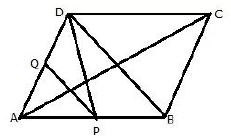
Question 4. ABCD is a parallelogram. P is the midpoint of AB and Q is the midpoint of AD. Prove that \(\text{Area}(\Delta APQ) = \frac{1}{8} \text{Area}(\text{parallelogram } ABCD)\).
Answer: Let us connect \(PD\) and \(BD\).
Since \(BD\) is the diagonal of the parallelogram \(ABCD\), it divides the parallelogram into two equal parts:
\(\text{Area}(\Delta ABD) = \frac{1}{2} \text{Area}(ABCD)\) ... (1)
Since \(DP\) is the median of \(\Delta ABD\), it divides it into two equal areas:
\(\text{Area}(\Delta APD) = \frac{1}{2} \text{Area}(\Delta ABD) = \frac{1}{2} \times \left[\frac{1}{2} \text{Area}(ABCD)\right] = \frac{1}{4} \text{Area}(ABCD)\) ... (2)
In \(\Delta APD\), \(Q\) is the midpoint of \(AD\), meaning \(PQ\) is the median of \(\Delta APD\). Thus:
\(\text{Area}(\Delta APQ) = \frac{1}{2} \text{Area}(\Delta APD) = \frac{1}{2} \times \left[\frac{1}{4} \text{Area}(ABCD)\right] = \frac{1}{8} \text{Area}(ABCD)\).
Hence Proved.
In simple words: The diagonal splits the parallelogram in half. Midpoints act as medians, successively halving the area: first to 1/4, and then to 1/8 of the total parallelogram area.
Exam Tip: Clearly draw the auxiliary diagonal BD to show how the parallelogram is first halved into triangle ABD.
Exercise 16(B)
Question 5. The base BC of triangle ABC is divided at D so that BD = \(\frac{1}{2}\) DC. Prove that area of \(\Delta\)ABD = \(\frac{1}{3}\) of the area of \(\Delta\)ABC.
Answer: Within triangle \(ABC\), we have:
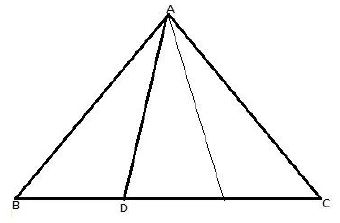
\(BD = \frac{1}{2} DC \implies \frac{BD}{DC} = \frac{1}{2}\)
Since these triangles share a common vertex \(A\) and their bases \(BD\) and \(DC\) lie along the same line, the ratio of their areas is equal to the ratio of their bases:
\(\text{Area}(\Delta ABD) : \text{Area}(\Delta ADC) = 1 : 2\)
The total area of triangle \(ABC\) is the sum of these two smaller triangles:
\(\text{Area}(\Delta ABD) + \text{Area}(\Delta ADC) = \text{Area}(\Delta ABC)\)
By substituting \(\text{Area}(\Delta ADC) = 2 \times \text{Area}(\Delta ABD)\) into the equation, we get:
\(\text{Area}(\Delta ABD) + 2 \times \text{Area}(\Delta ABD) = \text{Area}(\Delta ABC)\)
\(\implies 3 \times \text{Area}(\Delta ABD) = \text{Area}(\Delta ABC)\)
\(\implies \text{Area}(\Delta ABD) = \frac{1}{3} \text{Area}(\Delta ABC)\)
Hence Proved.
In simple words: Since the base BD is half of DC, the area of triangle ABD is half the area of triangle ADC. Adding them together shows that the smaller triangle makes up exactly one-third of the entire triangle's area.
Exam Tip: Remember to write down the theorem stating that triangles sharing a common vertex and having bases on the same line have areas in the ratio of their bases. This is the key reason examiners look for.
Question 6. In a parallelogram ABCD, point P lies in DC such that DP : PC = 3 : 2. If area of triangle DPB = 30 sq. cm, find the area of the parallelogram ABCD.
Answer: When two triangles share the same vertex and have their bases on a single line, the ratio of their areas equals the ratio of their bases. Thus, we have:
\(\frac{\text{Area}(\Delta DPB)}{\text{Area}(\Delta PCB)} = \frac{DP}{PC} = \frac{3}{2}\)
Let the variable \(x\) represent the area of triangle \(PCB\). Setting up the proportion:
\(\frac{30}{x} = \frac{3}{2}\)
\(\implies x = \frac{30 \times 2}{3} = 20\text{ sq. cm}\)
Consequently, the area of triangle \(PCB\) is \(20\text{ sq. cm}\).
Looking at the provided illustration:
\(\text{Area}(\Delta CDB) = \text{Area}(\Delta DPB) + \text{Area}(\Delta CPB) = 30 + 20 = 50\text{ sq. cm}\)
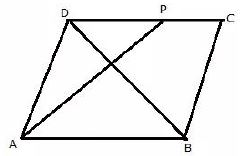
Since a diagonal divides a parallelogram into two triangles of equal area:
\(\text{Area}(\text{||gm } ABCD) = 2 \times \text{Area}(\Delta CDB) = 2 \times 50 = 100\text{ sq. cm}\).
In simple words: First, find the area of the other small triangle PBC using the given base ratio. Add both small triangles to get the area of half the parallelogram, then double it to find the total area.
Exam Tip: Double-check your ratio calculations. A common error is swapping the numerator and denominator, which leads to an incorrect area for the second triangle.
Question 7. ABCD is a parallelogram in which BC is produced to E such that CE = BC and AE intersects CD at F. If area of triangle DFB = 30 \(\text{cm}^2\), find the area of the parallelogram ABCD.
Answer: Given that \(BC = CE\).
In parallelogram \(ABCD\), the opposite sides are equal, so \(BC = AD\).
This implies \(AD = CE\).
Now, in triangles \(ADF\) and \(ECF\):
\(AD = CE\)
\(\angle ADF = \angle ECF\) (Alternate interior angles)
\(\angle DAF = \angle CEF\) (Alternate interior angles)
Therefore, \(\Delta ADF \cong \Delta ECF\) by the ASA congruence criterion.
This gives:
\(\text{Area}(\Delta ADF) = \text{Area}(\Delta ECF) \quad ...(1)\)
In triangle \(FBE\), \(FC\) is a median because \(C\) is the midpoint of \(BE\) (since \(BC = CE\)).
Since a median divides a triangle into two triangles of equal area:
\(\text{Area}(\Delta BCF) = \text{Area}(\Delta ECF) \quad ...(2)\)
From equations (1) and (2), we get:
\(\text{Area}(\Delta ADF) = \text{Area}(\Delta BCF) \quad ...(3)\)
Furthermore, triangles \(ADF\) and \(BDF\) share the same base \(DF\) and lie between the same parallel lines \(DF\) and \(AB\).
Thus, their areas are equal:
\(\text{Area}(\Delta BDF) = \text{Area}(\Delta ADF) \quad ...(4)\)
Combining equations (3) and (4):
\(\text{Area}(\Delta BDF) = \text{Area}(\Delta BCF) = 30\text{ cm}^2\)
So, the area of triangle \(BCD\) is:
\(\text{Area}(\Delta BCD) = \text{Area}(\Delta BDF) + \text{Area}(\Delta BCF) = 30 + 30 = 60\text{ cm}^2\)
Since a diagonal divides a parallelogram into two triangles of equal area:
\(\text{Area}(\text{||gm } ABCD) = 2 \times \text{Area}(\Delta BCD) = 2 \times 60 = 120\text{ cm}^2\).
In simple words: Show that the two triangles ADF and ECF are congruent, which means they have the same area. Since FC is a median, triangle BCF also has this same area. Therefore, the diagonal splits the parallelogram into triangles of 60 square centimeters, making the entire parallelogram 120 square centimeters.
Exam Tip: Make sure to clearly state each theorem you use, such as the median area theorem and the parallel lines theorem, as this is required for full credit in proofs.
Question 8. The following figure shows a triangle ABC in which P, Q and R are mid-points of sides AB, BC and CA respectively. S is the mid-point of PQ. Prove that: area(\(\Delta\)ABC) = 8 \(\times\) area(\(\Delta\)QSB).
Answer: In triangle \(ABC\), since \(R\) and \(Q\) are the midpoints of \(AC\) and \(BC\), by the mid-point theorem we have:
\(RQ \parallel AB \implies RQ \parallel PB\)
Since \(AP = PB\) and triangles on the same base and between the same parallels have equal areas, we have:
\(\text{area}(\Delta PBQ) = \text{area}(\Delta APR) \quad ...(i)\)
Similarly, because \(P\) and \(R\) are the midpoints of \(AB\) and \(AC\), we have:
\(PR \parallel BC \implies PR \parallel BQ\)
This makes the quadrilateral \(PBRQ\) a parallelogram.
Since a diagonal of a parallelogram divides it into two triangles of equal area:
\(\text{area}(\Delta PBQ) = \text{area}(\Delta PQR) \quad ...(ii)\)
From equations (i) and (ii), we get:
\(\text{area}(\Delta PQR) = \text{area}(\Delta PBQ) = \text{area}(\Delta APR) \quad ...(iii)\)
Using the same logic with midpoints \(P\) and \(Q\), we find \(PQ \parallel AC \implies PQ \parallel RC\), which makes \(PQCR\) a parallelogram.
This gives:
\(\text{area}(\Delta RQC) = \text{area}(\Delta PQR) \quad ...(iv)\)
From equations (iii) and (iv):
\(\text{area}(\Delta PQR) = \text{area}(\Delta PBQ) = \text{area}(\Delta RQC) = \text{area}(\Delta APR)\)
Therefore, each of these four triangles has exactly one-fourth of the total area:
\(\text{area}(\Delta PBQ) = \frac{1}{4} \text{area}(\Delta ABC) \quad ...(v)\)
Now, in triangle \(PBQ\), \(S\) is given as the midpoint of \(PQ\), which means \(BS\) is the median.
Thus, the median divides the triangle into two equal areas:
\(\text{area}(\Delta QSB) = \frac{1}{2} \text{area}(\Delta PBQ)\)
Substituting the value from equation (v) into this relation:
\(\text{area}(\Delta QSB) = \frac{1}{2} \times \left(\frac{1}{4} \text{area}(\Delta ABC)\right)\)
\(\implies \text{area}(\Delta QSB) = \frac{1}{8} \text{area}(\Delta ABC)\)
\(\implies \text{area}(\Delta ABC) = 8 \times \text{area}(\Delta QSB)\)
Hence Proved.
In simple words: The midpoints divide the main triangle into four equal smaller triangles. Since S is the midpoint of PQ, the line BS cuts one of these smaller triangles exactly in half, making its area one-eighth of the total triangle.
Exam Tip: Be sure to prove that the mid-points split the triangle into four triangles of equal area first, as this is the fundamental step of this proof.
Exercise 16(C)
Question 1. In the given figure, the diagonals AC and BD intersect at point O. If OB = OD and AB || DC, prove that:
(i) Area(\(\Delta\)DOC) = Area(\(\Delta\)AOB)
(ii) Area(\(\Delta\)DCB) = Area(\(\Delta\)ACB)
(iii) ABCD is a parallelogram.
Answer: (i) Triangles \(DOC\) and \(BOC\) share a common vertex \(C\) and their bases lie on the same line \(BD\).
Since their bases are equal (\(DO = BO\)), the ratio of their areas is equal to the ratio of their bases:
\(\frac{\text{Area}(\Delta DOC)}{\text{Area}(\Delta BOC)} = \frac{DO}{BO} = 1 \implies \text{Area}(\Delta DOC) = \text{Area}(\Delta BOC) \quad ...(1)\)
Similarly, for triangles \(DOA\) and \(BOA\) with vertex \(A\) and bases on line \(BD\):
\(\frac{\text{Area}(\Delta DOA)}{\text{Area}(\Delta BOA)} = \frac{DO}{BO} = 1 \implies \text{Area}(\Delta DOA) = \text{Area}(\Delta BOA) \quad ...(2)\)
Since triangles \(ACD\) and \(BCD\) lie on the common base \(CD\) and are between the same parallel lines \(AB\) and \(CD\), their areas are equal:
\(\text{Area}(\Delta ACD) = \text{Area}(\Delta BCD)\)
\(\implies \text{Area}(\Delta DOA) + \text{Area}(\Delta DOC) = \text{Area}(\Delta DOC) + \text{Area}(\Delta BOC)\)
Subtracting \(\text{Area}(\Delta DOC)\) from both sides gives:
\(\text{Area}(\Delta DOA) = \text{Area}(\Delta BOC) \quad ...(3)\)
From equations (1), (2), and (3), we get:
\(\text{Area}(\Delta DOC) = \text{Area}(\Delta AOB)\)
Hence Proved.
(ii) From the results in part (i), we can write:
\(\text{Area}(\Delta DCB) = \text{Area}(\Delta DOC) + \text{Area}(\Delta BOC)\)
Substitute \(\text{Area}(\Delta DOC) = \text{Area}(\Delta AOB)\):
\(\text{Area}(\Delta DCB) = \text{Area}(\Delta AOB) + \text{Area}(\Delta BOC) = \text{Area}(\Delta ACB)\)
Therefore, \(\text{Area}(\Delta DCB) = \text{Area}(\Delta ACB)\).
Hence Proved.
(iii) Since triangles \(DCB\) and \(ACB\) have equal areas and share a common base \(AB\), they must lie between the same parallel lines.
This indicates that \(AD \parallel BC\).
Since it is already given that \(AB \parallel DC\), both pairs of opposite sides are parallel.
Thus, \(ABCD\) is a parallelogram.
Hence Proved.
In simple words: Since the diagonals bisect each other, we can show that the areas of the opposite triangles are equal. Having equal triangle areas on a common base proves that the other set of opposite sides is also parallel, which makes the quadrilateral a parallelogram.
Exam Tip: When proving a shape is a parallelogram, always show that both pairs of opposite sides are parallel using the equal-area triangles on a common base theorem.
Question 2. The given figure shows a parallelogram ABCD with area 324 sq. cm. P is a point in AB such that AP : PB = 1 : 2. Find:
(i) the area of \(\Delta\)APD.
(ii) the ratio OP : OD.
Answer: (i) We know that the area of a triangle is half the area of a parallelogram if they lie on the same base and between the same parallel lines.
Therefore, we have:
\(\text{Area}(\Delta ABD) = \frac{1}{2} \times \text{Area}(\text{||gm } ABCD) = \frac{324}{2} = 162\text{ sq. cm}\)
From the figure, it is clear that:
\(\text{Area}(\Delta ABD) = \text{Area}(\Delta APD) + \text{Area}(\Delta BPD)\)
Since triangles \(APD\) and \(BPD\) share a common vertex \(D\) and their bases lie on the same line \(AB\), their areas are in the ratio of their bases:
\(\frac{\text{Area}(\Delta APD)}{\text{Area}(\Delta BPD)} = \frac{AP}{PB} = \frac{1}{2} \implies \text{Area}(\Delta BPD) = 2 \times \text{Area}(\Delta APD)\)
Substituting this back into the sum:
\(162 = \text{Area}(\Delta APD) + 2 \times \text{Area}(\Delta APD)\)
\(\implies 162 = 3 \times \text{Area}(\Delta APD)\)
\(\implies \text{Area}(\Delta APD) = \frac{162}{3} = 54\text{ sq. cm}\).
(ii) Let us consider triangles \(AOP\) and \(COD\):
\(\angle AOP = \angle COD\) (Vertically opposite angles)
\(\angle CDO = \angle APO\) (Alternate interior angles, since \(AB \parallel CD\) and \(DP\) is the transversal)
By the Angle-Angle (AA) similarity criterion, we have:
\(\Delta AOP \sim \Delta COD\)
Since corresponding sides of similar triangles are proportional:
\(\frac{OP}{OD} = \frac{AP}{CD}\)
Since opposite sides of a parallelogram are equal, \(CD = AB\).
Also, \(AB = AP + PB = AP + 2AP = 3AP\).
Therefore:
\(\frac{OP}{OD} = \frac{AP}{AB} = \frac{AP}{3AP} = \frac{1}{3}\)
Thus, the ratio \(OP : OD = 1 : 3\).
In simple words: First, find the area of triangle ABD which is exactly half of the parallelogram's area. Since AP is one-third of AB, triangle APD gets one-third of that half-area. In the second part, use similar triangles to show that the ratio of the diagonal segments matches the ratio of AP to CD.
Exam Tip: When using similar triangles, make sure to pair the vertices correctly (e.g., \(\Delta AOP \sim \Delta COD\)) to write the correct ratio of corresponding sides.
Question 3. In \(\Delta\)ABC, E and F are mid-points of sides AB and AC respectively. If BF and CE intersect each other at point O, prove that the \(\Delta\)OBC and quadrilateral AEOF are equal in area.
Answer: Since \(E\) and \(F\) are the midpoints of sides \(AB\) and \(AC\) in triangle \(ABC\), by the mid-point theorem we have:
\(EF \parallel BC\)
Triangles \(BEF\) and \(CEF\) lie on the common base \(EF\) and are between the same parallel lines \(EF\) and \(BC\).
Therefore, their areas are equal:
\(\text{Area}(\Delta BEF) = \text{Area}(\Delta CEF)\)
Subtracting \(\text{Area}(\Delta EOF)\) from both sides:
\(\text{Area}(\Delta BEF) - \text{Area}(\Delta EOF) = \text{Area}(\Delta CEF) - \text{Area}(\Delta EOF)\)
\(\implies \text{Area}(\Delta BOE) = \text{Area}(\Delta COF) \quad ...(1)\)
Now, since \(F\) is the midpoint of \(AC\), \(BF\) is a median of triangle \(ABC\).
Since a median divides a triangle into two triangles of equal area:
\(\text{Area}(\Delta ABF) = \text{Area}(\Delta CBF)\)
Subtracting \(\text{Area}(\Delta BOE)\) from both sides:
\(\text{Area}(\Delta ABF) - \text{Area}(\Delta BOE) = \text{Area}(\Delta CBF) - \text{Area}(\Delta BOE)\)
Using the relation in equation (1), we can replace \(\text{Area}(\Delta BOE)\) with \(\text{Area}(\Delta COF)\) on the right side:
\(\text{Area}(\Delta ABF) - \text{Area}(\Delta BOE) = \text{Area}(\Delta CBF) - \text{Area}(\Delta COF)\)
This simplifies to:
\(\text{Area}(\text{quad. } AEOF) = \text{Area}(\Delta OBC)\)
Hence Proved.
In simple words: Since the line EF is parallel to BC, the triangles BEF and CEF have the same area. Subtracting the shared top triangle EOF shows that the two opposite wings BOE and COF are equal in area. Since median BF splits the triangle in half, subtracting one wing from one half and the other wing from the other half leaves us with equal remaining areas.
Exam Tip: Be very careful when subtracting areas from both sides. Writing down the intermediate step where you substitute equal areas is crucial for getting full marks.
Question 4. In parallelogram ABCD, P is mid-point of AB. CP and BD intersect each other at point O. If area of \(\Delta\)POB = 40 \(\text{cm}^2\), find:
(i) OP : OC
(ii) Areas of \(\Delta\)BOC and \(\Delta\)PBC
(iii) Areas of \(\Delta\)ABC and parallelogram ABCD.
Answer: (i) Let us join \(AC\) and analyze triangles \(POB\) and \(COD\):
\(\angle POB = \angle DOC\) (Vertically opposite angles)
\(\angle OPB = \angle ODC\) (Alternate interior angles, since \(AB \parallel CD\) and \(CP\) and \(BD\) are transversals)
Therefore, by the Angle-Angle similarity criterion:
\(\Delta POB \sim \Delta COD\)
Since the corresponding sides of similar triangles are in proportion:
\(\frac{BP}{CD} = \frac{OP}{OC} = \frac{OB}{OD}\)
Since \(P\) is the midpoint of \(AB\), we have \(AB = 2BP\).
Also, because opposite sides of a parallelogram are equal, \(CD = AB = 2BP\).
Thus:
\(\frac{BP}{CD} = \frac{BP}{2BP} = \frac{1}{2}\)
This gives:
\(\frac{OP}{OC} = \frac{1}{2} \implies OP : OC = 1 : 2\).
(ii) Triangles \(POB\) and \(BOC\) share a common vertex \(B\) and their bases lie on the same straight line \(PC\).
Therefore, the ratio of their areas equals the ratio of their bases:
\(\frac{\text{Area}(\Delta POB)}{\text{Area}(\Delta BOC)} = \frac{OP}{OC}\)
Using the ratio found in part (i):
\(\frac{40}{\text{Area}(\Delta BOC)} = \frac{1}{2} \implies \text{Area}(\Delta BOC) = 80\text{ cm}^2\)
From the figure, the area of triangle \(PBC\) is:
\(\text{Area}(\Delta PBC) = \text{Area}(\Delta POB) + \text{Area}(\Delta BOC) = 40 + 80 = 120\text{ cm}^2\).
(iii) Since \(P\) is the midpoint of \(AB\), \(CP\) is the median of triangle \(ABC\).
Since a median divides a triangle into two triangles of equal area:
\(\text{Area}(\Delta ABC) = 2 \times \text{Area}(\Delta PBC) = 2 \times 120 = 240\text{ cm}^2\)
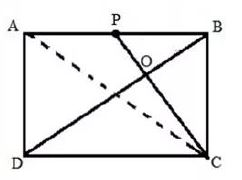
We know that the area of a triangle is half the area of a parallelogram if they share the same base and lie between the same parallel lines:
\(\text{Area}(\Delta ABC) = \frac{1}{2} \times \text{Area}(\text{||gm } ABCD)\)
\(\implies \text{Area}(\text{||gm } ABCD) = 2 \times \text{Area}(\Delta ABC) = 2 \times 240 = 480\text{ cm}^2\).
In simple words: First, use similar triangles to find the base ratio of 1:2. This ratio helps us find that triangle BOC is twice the area of POB, which is 80. Adding them gives 120 for PBC, which we double to get the triangle ABC (240) and double again to get the full parallelogram (480).
Exam Tip: Remember that CP is a median because P is the midpoint of AB. Highlighting this fact is essential for justifying why the area of ABC is double the area of PBC.
Question 5. The medians of a triangle ABC intersect each other at point G. If one of its medians is AD, prove that:
(i) Area(\(\Delta\)ABD) = 3 \(\times\) Area(\(\Delta\)BGD)
(ii) Area(\(\Delta\)ACD) = 3 \(\times\) Area(\(\Delta\)CGD)
(iii) Area(\(\Delta\)BGC) = \(\frac{1}{3}\) \(\times\) Area(\(\Delta\)ABC)
Answer: (i) The medians of a triangle intersect at the centroid \(G\), which divides each median in the ratio \(2 : 1\).
Therefore, for the median \(AD\), we have:
\(AG : GD = 2 : 1\)
Since the segment \(BG\) divides the triangle \(ABD\) in the ratio \(2 : 1\), the areas of triangles \(AGB\) and \(BGD\) are in the same ratio:
\(\frac{\text{Area}(\Delta AGB)}{\text{Area}(\Delta BGD)} = \frac{2}{1} \implies \text{Area}(\Delta AGB) = 2 \times \text{Area}(\Delta BGD)\)
From the figure, it is clear that:
\(\text{Area}(\Delta ABD) = \text{Area}(\Delta AGB) + \text{Area}(\Delta BGD)\)
Substituting the value of \(\text{Area}(\Delta AGB)\) into the equation:
\(\text{Area}(\Delta ABD) = 2 \times \text{Area}(\Delta BGD) + \text{Area}(\Delta BGD) = 3 \times \text{Area}(\Delta BGD) \quad ...(1)\)
Hence Proved.
(ii) Similarly, the segment \(CG\) divides the triangle \(ACD\). Since \(AG : GD = 2 : 1\), the ratio of their areas is:
\(\frac{\text{Area}(\Delta AGC)}{\text{Area}(\Delta CGD)} = \frac{2}{1} \implies \text{Area}(\Delta AGC) = 2 \times \text{Area}(\Delta CGD)\)
From the figure:
\(\text{Area}(\Delta ACD) = \text{Area}(\Delta AGC) + \text{Area}(\Delta CGD)\)
Substituting the value of \(\text{Area}(\Delta AGC)\):
\(\text{Area}(\Delta ACD) = 2 \times \text{Area}(\Delta CGD) + \text{Area}(\Delta CGD) = 3 \times \text{Area}(\Delta CGD) \quad ...(2)\)
Hence Proved.
(iii) Adding equations (1) and (2) together, we get:
\(\text{Area}(\Delta ABD) + \text{Area}(\Delta ACD) = 3 \times \text{Area}(\Delta BGD) + 3 \times \text{Area}(\Delta CGD)\)
Since \(AD\) is a median, it splits triangle \(ABC\) into two equal parts:
\(\text{Area}(\Delta ABC) = 3 \times \left[\text{Area}(\Delta BGD) + \text{Area}(\Delta CGD)\right]\)
\(\implies \text{Area}(\Delta ABC) = 3 \times \text{Area}(\Delta BGC)\)
\(\implies \text{Area}(\Delta BGC) = \frac{1}{3} \times \text{Area}(\Delta ABC)\)
Hence Proved.
In simple words: The centroid G divides the median AD in a 2:1 ratio, which means the upper triangle AGB has twice the area of the lower triangle BGD. Combining them shows that half the main triangle is exactly three times the small corner triangle, proving that the central triangle BGC is one-third of the total area.
Exam Tip: Always state that the centroid divides the medians in the ratio of 2:1 as the starting point of your proof to score full marks.
Question 6. The perimeter of a triangle ABC is 37 cm and the ratio between the lengths of its altitudes is 6 : 5 : 4. Find the lengths of its sides.
Answer: Let us denote the sides of triangle \(ABC\) as \(x\text{ cm}\), \(y\text{ cm}\), and \((37 - x - y)\text{ cm}\).
Also, let the corresponding altitudes be \(6a\text{ cm}\), \(5a\text{ cm}\), and \(4a\text{ cm}\).
We know the formula for the area of a triangle:
\(\text{Area} = \frac{1}{2} \times \text{base} \times \text{altitude}\)
Using the three different bases and their altitudes, the area remains constant:
\(\frac{1}{2} \times x \times 6a = \frac{1}{2} \times y \times 5a = \frac{1}{2} \times (37 - x - y) \times 4a\)
Dividing by \(\frac{1}{2}a\), we simplify this to:
\(6x = 5y = 4(37 - x - y)\)
This gives us two independent equations:
\(6x = 5y \implies y = \frac{6}{5}x \quad ...(1)\)
and
\(6x = 148 - 4x - 4y \implies 10x + 4y = 148 \quad ...(2)\)
Substituting equation (1) into equation (2):
\(10x + 4\left(\frac{6}{5}x\right) = 148\)
\(\implies 10x + \frac{24}{5}x = 148\)
\(\implies \frac{74}{5}x = 148\)
\(\implies x = \frac{148 \times 5}{74} = 10\text{ cm}\)
Using this value of \(x\) in equation (1):
\(y = \frac{6}{5} \times 10 = 12\text{ cm}\)
The third side is:
\(37 - x - y = 37 - 10 - 12 = 15\text{ cm}\)
Therefore, the lengths of the sides of the triangle are \(10\text{ cm}\), \(12\text{ cm}\), and \(15\text{ cm}\).
In simple words: Since the area of a triangle is the same no matter which side you use as the base, the product of each side and its altitude must be equal. This lets us set up system equations to solve for the individual side lengths.
Exam Tip: Be careful with the algebraic substitution. Solving the ratio equation first to express y in terms of x makes the calculation straightforward and less prone to errors.
Question 7. In parallelogram ABCD, E is the mid-point of side AB and DE meets diagonal AC at point F. If area of \(\Delta\)ADF is 60 \(\text{cm}^2\), find:
(i) Show that DF : FE = 2 : 1.
(ii) the area of \(\Delta\)ADE.
(iii) the area of \(\Delta\)ADB.
(iv) the area of parallelogram ABCD.
Answer: (i) Let us consider triangles \(AFE\) and \(DFC\):
\(\angle AFE = \angle DFC\) (Vertically opposite angles)
\(\angle FAE = \angle FCD\) (Alternate interior angles, since \(AB \parallel DC\) and \(AC\) is the transversal)
Therefore, by the Angle-Angle similarity criterion:
\(\Delta AFE \sim \Delta DFC\)
Since corresponding sides are proportional:
\(\frac{DF}{FE} = \frac{DC}{AE}\)
Since \(E\) is the midpoint of \(AB\), we have \(AB = 2AE\).
Also, opposite sides of a parallelogram are equal, so \(DC = AB = 2AE\).
Substituting this gives:
\(\frac{DF}{FE} = \frac{2AE}{AE} = \frac{2}{1} \implies DF : FE = 2 : 1\).
(ii) Since \(DF : FE = 2 : 1\), the ratio of the areas of triangles \(ADF\) and \(AFE\) (which share vertex \(A\) and have bases along \(DE\)) is:
\(\frac{\text{Area}(\Delta ADF)}{\text{Area}(\Delta AFE)} = \frac{DF}{FE} = \frac{2}{1}\)
Given that \(\text{Area}(\Delta ADF) = 60\text{ cm}^2\):
\(\frac{60}{\text{Area}(\Delta AFE)} = 2 \implies \text{Area}(\Delta AFE) = 30\text{ cm}^2\)
From the figure:
\(\text{Area}(\Delta ADE) = \text{Area}(\Delta ADF) + \text{Area}(\Delta AFE) = 60 + 30 = 90\text{ cm}^2\).
(iii) Since \(E\) is the midpoint of \(AB\), \(DE\) is a median of triangle \(ADB\).
Since a median divides a triangle into two triangles of equal area:
\(\text{Area}(\Delta ADB) = 2 \times \text{Area}(\Delta ADE) = 2 \times 90 = 180\text{ cm}^2\).
(iv) The diagonal \(BD\) of parallelogram \(ABCD\) divides it into two triangles of equal area:
\(\text{Area}(\text{||gm } ABCD) = 2 \times \text{Area}(\Delta ADB) = 2 \times 180 = 360\text{ cm}^2\).
In simple words: First, use similar triangles to show that DF is twice as long as FE. This ratio means the area of ADF is twice that of AFE, giving 30 for AFE and 90 for the combined triangle ADE. Since E is the midpoint, double this area to get triangle ADB (180), and double again to find the full parallelogram's area (360).
Exam Tip: Be careful with the numbering of the subparts in the question. Ensure each part's answer is clearly labeled to make it easy for the examiner to award full marks.
Question 8. In the given figure, BD is parallel to CA, E is the mid-point of CA and BD = \(\frac{1}{2}\) CA. Prove that: area(\(\Delta\)ABC) = 2 \(\times\) area(\(\Delta\)DBC).
Answer: Since \(E\) is the midpoint of \(CA\), we have \(CE = \frac{1}{2} CA\).
We are given that \(BD = \frac{1}{2} CA \implies BD = CE\).
Also, \(BD \parallel CA \implies BD \parallel CE\).
Since the opposite sides are both equal and parallel, the quadrilateral \(BCED\) is a parallelogram.
Triangles \(DBC\) and \(EBC\) lie on the common base \(BC\) and are between the same parallel lines \(BC\) and \(DE\).
Therefore, their areas are equal:
\(\text{area}(\Delta DBC) = \text{area}(\Delta EBC) \quad ...(1)\)
In triangle \(ABC\), since \(E\) is the midpoint of \(AC\), \(BE\) is a median.
Thus:
\(\text{area}(\Delta EBC) = \frac{1}{2} \text{area}(\Delta ABC) \quad ...(2)\)
Combining equations (1) and (2), we get:
\(\text{area}(\Delta DBC) = \frac{1}{2} \text{area}(\Delta ABC)\)
\(\implies \text{area}(\Delta ABC) = 2 \times \text{area}(\Delta DBC)\)
Hence Proved.
In simple words: Since BD is parallel and equal to CE, BCED is a parallelogram. This means triangles DBC and EBC have the same area because they share the same base and are between the same parallel lines. Since BE is a median, EBC is half of ABC, which means DBC is also half of ABC.
Exam Tip: Explicitly state that a quadrilateral with one pair of opposite sides equal and parallel is a parallelogram. This is a critical step in the proof.
Question 9. In the following figure, OAB is a triangle and AB || DC. If the area of \(\Delta\)CAD = 140 \(\text{cm}^2\) and the area of \(\Delta\)ODC = 172 \(\text{cm}^2\), find:
(i) the area of \(\Delta\)DBC.
(ii) the area of \(\Delta\)OAC.
(iii) the area of \(\Delta\)ODB.
Answer: (i) Triangles \(DBC\) and \(CAD\) share the common base \(CD\) and lie between the same parallel lines \(AB\) and \(CD\).
Therefore, their areas are equal:
\(\text{Area of } \Delta DBC = \text{Area of } \Delta CAD = 140\text{ cm}^2\).
(ii) From the figure, we can express the area of triangle \(OAC\) as:
\(\text{Area of } \Delta OAC = \text{Area of } \Delta CAD + \text{Area of } \Delta ODC\)
\(\implies \text{Area of } \Delta OAC = 140 + 172 = 312\text{ cm}^2\).
(iii) From the figure, we can express the area of triangle \(ODB\) as:
\(\text{Area of } \Delta ODB = \text{Area of } \Delta DBC + \text{Area of } \Delta ODC\)
\(\implies \text{Area of } \Delta ODB = 140 + 172 = 312\text{ cm}^2\).
In simple words: Since AB is parallel to DC, triangles DBC and CAD have the same area of 140. Adding the area of the shared triangle ODC (172) to both gives the areas of the larger triangles OAC and ODB, which are both 312.
Exam Tip: Be sure to cite the theorem that triangles on the same base and between the same parallels have equal areas when stating that \(\text{Area}(\Delta DBC) = \text{Area}(\Delta CAD)\).
ICSE Selina Concise Solutions Class 9 Mathematics Chapter 16 Area Theorems Proof And Use
Students can now access the detailed Selina Concise Solutions for Chapter 16 Area Theorems Proof And Use on our portal. These solutions have been carefully prepared as per latest ICSE Class 9 syllabus. Each solution given above has been updated based on the current year pattern to ensure Class 9 students have the most updated Mathematics content.
Master Selina Concise Textbook Questions
Our subject experts have provided detailed explanations for all the questions found in the Selina Concise textbook for Class 9 Mathematics. We have focussed on making the concepts easy for you in Chapter 16 Area Theorems Proof And Use so that students can understand the concepts behind every answer. For all numerical problems and theoretical concepts these solutions will help in strengthening your analytical skill required for the ICSE examinations.
Complete Mathematics Exam Preparation
By using these Selina Concise Class 9 solutions, you can enhance your learning and identify areas that need more attention. We recommend solving the Mathematics Questions from the textbook first and then use our teacher-verified answers. For a proper revision of Chapter 16 Area Theorems Proof And Use, students should also also check our Revision Notes and Sample Papers available on studiestoday.com.
FAQs
You can download the verified Selina Concise solutions for Chapter 16 Area Theorems Proof And Use on StudiesToday.com. Our teachers have prepared answers for Class 9 Mathematics as per 2026-27 ICSE academic session.
Yes, our solutions for Chapter 16 Area Theorems Proof And Use are designed as per new 2026 ICSE standards. 40% competency-based questions required for Class 9, are included to help students understand application-based logic behind every Mathematics answer.
Yes, every exercise in Chapter 16 Area Theorems Proof And Use from the Selina Concise textbook has been solved step-by-step. Class 9 students will learn Mathematics conceots before their ICSE exams.
Yes, follow structured format of these Selina Concise solutions for Chapter 16 Area Theorems Proof And Use to get full 20% internal assessment marks and use Class 9 Mathematics projects and viva preparation as per ICSE 2026 guidelines.