

ICSE Solutions Selina Concise Class 9 Mathematics Chapter 21 Solids Surface Area And Volume Of 3 D Solids have been provided below and is also available in Pdf for free download. The Selina Concise ICSE solutions for Class 9 Mathematics have been prepared as per the latest syllabus and ICSE books and examination pattern suggested in Class 9. Questions given in ICSE Selina Concise book for Class 9 Mathematics are an important part of exams for Class 9 Mathematics and if answered properly can help you to get higher marks. Refer to more Chapter-wise answers for ICSE Class 9 Mathematics and also download more latest study material for all subjects. Chapter 21 Solids Surface Area And Volume Of 3 D Solids is an important topic in Class 9, please refer to answers provided below to help you score better in exams
Selina Concise Chapter 21 Solids Surface Area And Volume Of 3 D Solids Class 9 Mathematics ICSE Solutions
Class 9 Mathematics students should refer to the following ICSE questions with answers for Chapter 21 Solids Surface Area And Volume Of 3 D Solids in Class 9. These ICSE Solutions with answers for Class 9 Mathematics will come in exams and help you to score good marks
Chapter 21 Solids Surface Area And Volume Of 3 D Solids Selina Concise ICSE Solutions Class 9 Mathematics
Exercise 21(A)
Question 1. The length, breadth and height of a rectangular solid are in the ratio 5 : 4 : 2. If its total surface area is 1216 cm\( ^2 \), find the length, the breadth and the height of the solid.
Answer: Let the length, breadth, and height of the rectangular solid be represented as \( 5x \), \( 4x \), and \( 2x \) respectively.
Given that the total surface area = \( 1216 \text{ cm}^2 \).
Using the formula for the total surface area of a cuboid:
\( 2(lb + bh + hl) = 1216 \)
\( \implies 2(5x \cdot 4x + 4x \cdot 2x + 2x \cdot 5x) = 1216 \)
\( \implies 2(20x^2 + 8x^2 + 10x^2) = 1216 \)
\( \implies 2(38x^2) = 1216 \)
\( \implies 76x^2 = 1216 \)
\( \implies x^2 = \frac{1216}{76} \)
\( \implies x^2 = 16 \)
\( \implies x = 4 \)
Hence, the dimensions of the rectangular solid are:
Length = \( 5 \times 4 = 20 \text{ cm} \)
Breadth = \( 4 \times 4 = 16 \text{ cm} \)
Height = \( 2 \times 4 = 8 \text{ cm} \)
In simple words: Write the dimensions using a multiplier \( x \). Use the formula for surface area to solve for \( x \), then multiply it back to find the actual measurements of the block.
Exam Tip: Be sure to write the formula for total surface area clearly before substituting values, as formula writing carries step marks.
Question 2. The volume of a cube is 729 cm\( ^3 \). Find its total surface area.
Answer: Let \( a \) represent the side length of the cube.
The volume of a cube is given by \( a^3 \).
Therefore, we have:
\( a^3 = 729 \)
\( \implies a = \sqrt[3]{729} \)
\( \implies a = 9 \text{ cm} \)
Now, the total surface area of the cube is calculated as:
Total Surface Area = \( 6a^2 \)
\( \implies 6 \times 9^2 \)
\( \implies 6 \times 81 \)
\( \implies 486 \text{ cm}^2 \)
In simple words: Find the side length of the cube first by taking the cube root of its volume. Use this side length to calculate the total area of the six square faces.
Exam Tip: Remember that surface area is measured in square units (like \( \text{cm}^2 \)), whereas volume is in cubic units (like \( \text{cm}^3 \)). Keep your units consistent.
Question 3. The dimensions of a Cinema Hall are 100 m, 60 m and 15 m. How many persons can sit in the hall, if each requires 150 m\( ^3 \) of air?
Answer: We begin by calculating the total capacity of the hall:
Volume of the cinema hall = \( 100 \text{ m} \times 60 \text{ m} \times 15 \text{ m} = 90000 \text{ m}^3 \)
Given that one person requires \( 150 \text{ m}^3 \) of air:
Number of persons that can sit in the hall = \( \frac{\text{Total Volume of Hall}}{\text{Air required per person}} \)
\( \implies \frac{90000}{150} = 600 \text{ persons} \)
So, 600 persons can sit in the hall.
In simple words: Calculate the total space inside the cinema hall by multiplying its three dimensions. Then, divide this total space by the space needed for one person to find the maximum seating.
Exam Tip: Always state the unit of volume as \( \text{m}^3 \) or cubic meters before performing the division step.
Question 4. 75 persons can sleep in a room 25 m by 9.6 m. If each person requires 16 m\( ^3 \) of air, find the height of the room.
Answer: Let the height of the room be represented by \( h \) meters.
The volume of air required by one person is \( 16 \text{ m}^3 \).
Thus, the total volume of air required for 75 persons is:
Total Volume = \( 75 \times 16 = 1200 \text{ m}^3 \)
Since the volume of the room is given by \( \text{Length} \times \text{Breadth} \times \text{Height} \):
\( 25 \times 9.6 \times h = 1200 \)
\( \implies 240 \times h = 1200 \)
\( \implies h = \frac{1200}{240} \)
\( \implies h = 5 \text{ m} \)
Hence, the height of the room is \( 5 \text{ m} \).
In simple words: Find the total space required by multiplying the number of people by the air space each person needs. Then, divide this total volume by the base area (length times width) of the room to find its height.
Exam Tip: Define the height as a variable (like \( h \)) at the beginning of your steps to show systematic working.
Question 5. The edges of three cubes of metal are 3 cm, 4 cm and 5 cm. They are melted and formed into a single cube. Find the edge of the new cube.
Answer: When the three small cubes are melted down to form a single larger cube, the total volume of the new cube equals the sum of the volumes of the three smaller cubes.
Volume of the new single cube = \( 3^3 + 4^3 + 5^3 \text{ cm}^3 \)
\( \implies 27 + 64 + 125 = 216 \text{ cm}^3 \)
Let \( a \) represent the side length of the newly formed cube.
The volume of this new cube is given by:
\( a^3 = 216 \)
\( \implies a^3 = 6^3 \)
\( \implies a = 6 \text{ cm} \)
Therefore, the edge of the new cube is \( 6 \text{ cm} \).
In simple words: Add the volumes of the three small cubes together to find the volume of the single large cube. Finding the cube root of this combined volume gives the edge of the new cube.
Exam Tip: Recall that the volume of a solid remains constant when it is melted and reshaped into another solid form.
Question 6. Three cubes, whose edges are x cm, 8 cm and 10 cm respectively, are melted and recasted into a single cube of edge 12 cm. Find 'x'.
Answer: The sum of the volumes of the three original cubes is equal to the volume of the single recast cube:
Volume of the three original cubes = \( x^3 + 8^3 + 10^3 \text{ cm}^3 \)
\( \implies x^3 + 512 + 1000 = x^3 + 1512 \text{ cm}^3 \)
The edge of the single recast cube is \( 12 \text{ cm} \).
So, its volume is:
Volume = \( 12^3 = 1728 \text{ cm}^3 \)
Now, equating the volumes:
\( x^3 + 1512 = 1728 \)
\( \implies x^3 = 1728 - 1512 \)
\( \implies x^3 = 216 \)
\( \implies x^3 = 6^3 \)
\( \implies x = 6 \text{ cm} \)
Hence, the value of \( x \) is \( 6 \text{ cm} \).
In simple words: The sum of the volumes of the three small cubes must equal the volume of the single large cube. Use this equation to isolate \( x^3 \) and find its cube root.
Exam Tip: Knowing standard cube values, like \( 8^3 = 512 \) and \( 12^3 = 1728 \), helps you work faster and avoid arithmetic mistakes.
Question 7. Three equal cubes are placed adjacently in a row. Find the ratio of the total surface area of the resulting cuboid to that of the sum of the total surface areas of the three cubes.
Answer: Let the side length of each of the three identical cubes be represented as \( a \) units.
The total surface area of a single cube = \( 6a^2 \)
The combined surface area of three independent cubes = \( 3 \times 6a^2 = 18a^2 \)
When three cubes are placed side-by-side in a row, they form a cuboid with:
Length = \( 3a \)
Breadth = \( a \)
Height = \( a \)
The total surface area of this newly formed cuboid is:
Total Surface Area = \( 2(lb + bh + hl) \)
\( \implies 2(3a \cdot a + a \cdot a + a \cdot 3a) \)
\( \implies 2(3a^2 + a^2 + 3a^2) \)
\( \implies 2(7a^2) = 14a^2 \)
Now, we calculate the required ratio:
Ratio = \( \frac{\text{Surface Area of Cuboid}}{\text{Combined Surface Area of 3 separate cubes}} \)
\( \implies \frac{14a^2}{18a^2} = \frac{7}{9} \)
So, the ratio is \( 7 : 9 \).
In simple words: Separately, the three cubes have 18 faces altogether. When joined in a row, four faces are hidden inside, leaving 14 exposed faces. This gives a ratio of 14 to 18, which simplifies to 7:9.
Exam Tip: Be careful not to simply add the surface areas of the three cubes, as the faces that touch are hidden inside the cuboid.
Question 8. The cost of papering the four walls of a room at 75 paise per square metre is Rs. 240. The height of the room is 5 metres. Find the length and the breadth of the room, if they are in the ratio 5 : 3.
Answer: Let the length and breadth of the room be \( 5x \) and \( 3x \) respectively.
The cost of papering the four walls at Rs. 0.75 per \( \text{m}^2 \) is Rs. 240.
The total wall area is calculated as:
Area of 4 walls = \( \frac{\text{Total Cost}}{\text{Rate per } \text{m}^2} \)
\( \implies \text{Area} = \frac{240}{0.75} = \frac{24000}{75} = 320 \text{ m}^2 \)
The formula for the area of four walls is:
Area = \( 2 \times \text{Height} \times (\text{Length} + \text{Breadth}) \)
Given height = \( 5 \text{ m} \):
\( 320 = 2 \times 5 \times (5x + 3x) \)
\( \implies 320 = 10 \times 8x \)
\( \implies 320 = 80x \)
\( \implies x = \frac{320}{80} \)
\( \implies x = 4 \)
Now, calculate the dimensions of the room:
Length = \( 5 \times 4 = 20 \text{ m} \)
Breadth = \( 3 \times 4 = 12 \text{ m} \)
In simple words: Divide the total papering cost by the rate per square meter to find the total wall area. Then use the formula for the area of four walls to solve for the common multiplier and find the length and width.
Exam Tip: Convert paise to Rupees (75 paise = Rs. 0.75) before starting your calculations to keep units consistent.
Question 9. The area of a playground is 3650 m\( ^2 \). Find the cost of covering it with gravel 1.2 cm deep, if the gravel costs Rs. 6.40 per cubic metre.
Answer: The area of the playground is \( 3650 \text{ m}^2 \).
The depth of the gravel is \( 1.2 \text{ cm} \). We convert this thickness to meters:
Depth = \( \frac{1.2}{100} = 0.012 \text{ m} \)
Now, calculate the total volume of gravel required:
Volume = \( \text{Area} \times \text{Depth} \)
\( \implies 3650 \times 0.012 = 43.8 \text{ m}^3 \)
Given that the gravel costs Rs. 6.40 per cubic meter:
Total Cost = \( 43.8 \times \text{Rs. } 6.40 = \text{Rs. } 280.32 \)
In simple words: Convert the gravel thickness from centimeters to meters. Multiply the playground's area by this depth to get the total volume of gravel, and then multiply by the cost per cubic meter.
Exam Tip: Always make sure that all measurements (area and depth) are in the same unit system before multiplying them to find volume.
Question 10. A square plate of side 'x' cm is 8 mm thick. If its volume is 2880 cm\( ^3 \); find the value of x.
Answer: First, convert the thickness from millimeters to centimeters:
Thickness = \( \frac{8}{10} \text{ cm} = 0.8 \text{ cm} \)
Since the plate is square with a side length of \( x \text{ cm} \), its base area is \( x^2 \text{ cm}^2 \).
The volume of the plate is given by:
Volume = \( \text{Base Area} \times \text{Thickness} \)
\( \implies 2880 = x^2 \times \frac{8}{10} \)
\( \implies 2880 \times \frac{10}{8} = x^2 \)
\( \implies x^2 = 360 \times 10 \)
\( \implies x^2 = 3600 \)
\( \implies x = \sqrt{3600} \)
\( \implies x = 60 \text{ cm} \)
Hence, the value of \( x \) is \( 60 \text{ cm} \).
In simple words: Convert the thickness of the plate to centimeters. Since the base is square, set up an equation where volume equals base area times thickness, and solve for \( x \).
Exam Tip: Be careful with unit conversions: 8 mm must be written as 0.8 cm to align with the volume in cubic centimeters.
Question 11. The external dimensions of a closed wooden box are 27 cm, 19 cm and 11 cm. If the thickness of the wood in the box is 1.5 cm; find:
(i) Volume of the wood in the box;
(ii) The cost of the box, if wood costs Rs. 1.20 per cm\( ^3 \);
(iii) Number of 4 cm cubes that could be placed into the box.
Answer: The external dimensions are \( 27 \text{ cm} \), \( 19 \text{ cm} \), and \( 11 \text{ cm} \).
External Volume of the box = \( 27 \times 19 \times 11 = 5643 \text{ cm}^3 \)
The thickness of the wood is \( 1.5 \text{ cm} \). Since the box is closed, we find the internal dimensions by subtracting twice the thickness from each external dimension:
Internal Length = \( 27 - 2(1.5) = 24 \text{ cm} \)
Internal Breadth = \( 19 - 2(1.5) = 16 \text{ cm} \)
Internal Height = \( 11 - 2(1.5) = 8 \text{ cm} \)
The inner empty space volume is:
Internal Volume = \( 24 \times 16 \times 8 = 3072 \text{ cm}^3 \)
(i) The volume of the wood is the difference between the outer volume and inner volume:
Volume of wood = \( 5643 - 3072 = 2571 \text{ cm}^3 \)
(ii) The rate of wood is Rs. 1.20 per \( \text{cm}^3 \).
Total cost of the wood = \( 2571 \times \text{Rs. } 1.20 = \text{Rs. } 3085.20 \)
(iii) The volume of a single small cube with an edge of \( 4 \text{ cm} \) is:
Volume of one cube = \( 4^3 = 64 \text{ cm}^3 \)
The maximum number of such cubes that can be placed in the box is:
Number of cubes = \( \frac{\text{Internal Volume of Box}}{\text{Volume of one cube}} \)
\( \implies \text{Number of cubes} = \frac{3072}{64} = 48 \)
In simple words: Find the outer and inner volumes. Subtracting them tells us how much wood was used, which we multiply by the rate to find the cost. Divide the inner volume by the size of a small cube to find how many cubes can fit inside.
Exam Tip: Remember to deduct twice the wall thickness from each outer measurement to find the internal dimensions for closed boxes.
Question 12. A tank 20 m long, 12 m wide and 8 m deep is to be made of iron sheet. If it is open at the top, determine the cost of iron-sheet, at the rate of Rs. 12.50 per metre, if the sheet is 2.5 m wide.
Answer: Since the tank is open at the top, its surface area consists of the four walls and the base:
Total surface area of the open tank = \( \text{Area of four walls} + \text{Area of base} \)
\( \implies \text{Area} = 2(l + b)h + lb \)
\( \implies \text{Area} = 2(20 + 12) \times 8 + 20 \times 12 \)
\( \implies \text{Area} = 2(32) \times 8 + 240 \)
\( \implies \text{Area} = 512 + 240 = 752 \text{ m}^2 \)
The sheet of iron has a width of \( 2.5 \text{ m} \).
Let \( L \) be the length of the sheet needed:
\( L \times 2.5 = 752 \)
\( \implies L = \frac{752}{2.5} = 300.8 \text{ m} \)
The rate of sheet is Rs. 12.50 per meter.
Total Cost = \( 300.8 \times \text{Rs. } 12.50 = \text{Rs. } 3760 \)
In simple words: Add the area of the bottom floor and the four walls to find the total iron area. Divide this by the sheet's width to get the required sheet length, then multiply by the price per meter.
Exam Tip: For open-topped vessels, be careful not to include the top area in your calculations.
Question 13. A closed rectangular box is made of wood of 1.5 cm thickness. The exterior length and breadth are respectively 78 cm and 19 cm, and the capacity of the box is 15 cubic decimeters. Calculate the exterior height of the box.
Answer: Let the exterior height of the box be \( h \text{ cm} \).
The thickness of the wood is \( 1.5 \text{ cm} \).
Since it is a closed box, we subtract twice the thickness to find the inner dimensions:
Internal Length = \( 78 - 2(1.5) = 75 \text{ cm} \)
Internal Breadth = \( 19 - 2(1.5) = 16 \text{ cm} \)
Internal Height = \( h - 2(1.5) = (h - 3) \text{ cm} \)
The inner capacity of the box is given as \( 15 \text{ dm}^3 \).
Convert this volume to cubic centimeters:
Since \( 1 \text{ dm} = 10 \text{ cm} \implies 1 \text{ dm}^3 = 1000 \text{ cm}^3 \)
Volume = \( 15 \times 1000 = 15000 \text{ cm}^3 \)
The formula for internal volume is:
\( 75 \times 16 \times (h - 3) = 15000 \)
\( \implies 1200 \times (h - 3) = 15000 \)
\( \implies h - 3 = \frac{15000}{1200} \)
\( \implies h - 3 = 12.5 \)
\( \implies h = 12.5 + 3 = 15.5 \text{ cm} \)
Hence, the exterior height of the box is \( 15.5 \text{ cm} \).
In simple words: Convert the volume to cubic centimeters by multiplying by 1000. Deduct the thickness of the wood twice from length and width to find the inner base area. Divide the volume by this area to get the inner height, then add the thickness twice to get the outer height.
Exam Tip: Be sure to write the unit conversion \( 1 \text{ dm}^3 = 1000 \text{ cm}^3 \) clearly so that examiners can easily follow your steps.
Question 14. The square on the diagonal of a cube has an area of 1875 sq. cm. Calculate:
(i) The side of the cube.
(ii) The total surface area of the cube.
Answer: Let \( a \) be the side of the cube in centimeters.
The length of the diagonal of a cube is given by \( a\sqrt{3} \).
The area of the square on this diagonal is \( (a\sqrt{3})^2 = 3a^2 \).
(i) According to the problem:
\( 3a^2 = 1875 \)
\( \implies a^2 = \frac{1875}{3} \)
\( \implies a^2 = 625 \)
\( \implies a = \sqrt{625} \)
\( \implies a = 25 \text{ cm} \)
Hence, the side of the cube is \( 25 \text{ cm} \).
(ii) The total surface area of the cube is:
Total Surface Area = \( 6a^2 \)
\( \implies 6 \times (25)^2 \)
\( \implies 6 \times 625 = 3750 \text{ cm}^2 \)
In simple words: The diagonal of a cube squared is equal to three times its side squared. Set up an equation with this to solve for the side length, and then use it to find the total surface area of all six sides.
Exam Tip: Recognizing that the square of the diagonal is \( 3a^2 \) helps avoid unnecessary steps involving square roots during exams.
Question 15. A hollow square-shaped tube open at both ends is made of iron. The internal square is of 5 cm side and the length of the tube is 8 cm. There are 192 cm\( ^3 \) of iron in this tube. Find its thickness.
Answer: Let the wall thickness of the iron tube be \( x \text{ cm} \).
The side length of the inner square is \( 5 \text{ cm} \).
The side length of the outer square is:
\( (5 + 2x) \text{ cm} \)
The length of the tube is \( 8 \text{ cm} \).
The volume of iron used is the difference between the outer and inner volumes:
\( \text{External Volume} - \text{Internal Volume} = 192 \)
\( \implies (5 + 2x)^2 \times 8 - (5^2 \times 8) = 192 \)
\( \implies 8(25 + 20x + 4x^2) - 200 = 192 \)
\( \implies 200 + 160x + 32x^2 - 200 = 192 \)
\( \implies 32x^2 + 160x - 192 = 0 \)
Divide the equation by 32:
\( x^2 + 5x - 6 = 0 \)
Factoring the quadratic equation:
\( x^2 + 6x - x - 6 = 0 \)
\( \implies x(x + 6) - 1(x + 6) = 0 \)
\( \implies (x - 1)(x + 6) = 0 \)
This gives:
\( x = 1 \) or \( x = -6 \)
Since thickness must be a positive value, we reject \( x = -6 \).
Hence, the thickness of the tube is \( 1 \text{ cm} \).
In simple words: The volume of metal is the difference between the outer and inner box volumes. Express the outer side length with an unknown thickness \( x \), set up a quadratic equation, and solve for \( x \), throwing away the negative answer.
Exam Tip: When choosing between positive and negative values from a quadratic equation, always state why the negative value is discarded.
Question 16. Four identical cubes are joined end to end to form a cuboid. If the total surface area of the resulting cuboid is 648 cm\( ^2 \), find the length of edge of each cube. Also, find the ratio between the surface area of the resulting cuboid and the surface area of a cube.
Answer: Let the side of each cube be \( l \text{ cm} \).
When four cubes are placed end to end, they form a cuboid with dimensions:
Length = \( 4l \)
Breadth = \( l \)
Height = \( l \)
The total surface area of this cuboid is given as \( 648 \text{ cm}^2 \).
Using the total surface area formula for a cuboid:
\( 2(lb + bh + hl) = 648 \)
\( \implies 2(4l \cdot l + l \cdot l + l \cdot 4l) = 648 \)
\( \implies 2(4l^2 + l^2 + 4l^2) = 648 \)
\( \implies 2(9l^2) = 648 \)
\( \implies 18l^2 = 648 \)
\( \implies l^2 = \frac{648}{18} \)
\( \implies l^2 = 36 \)
\( \implies l = 6 \text{ cm} \)
Thus, the edge of each cube is \( 6 \text{ cm} \).
Now, the surface area of a single cube is:
Surface Area of one cube = \( 6l^2 = 6 \times 6^2 = 216 \text{ cm}^2 \)
To find the ratio of the cuboid's surface area to the cube's surface area:
Ratio = \( \frac{\text{Surface Area of cuboid}}{\text{Surface Area of one cube}} \)
\( \implies \text{Ratio} = \frac{648}{216} = \frac{3}{1} \)
So, the ratio is \( 3 : 1 \).
In simple words: When four cubes are lined up, they form a cuboid. Set up the surface area equation using the combined dimensions to find that the side of one cube is 6. Then divide the total area of the combined shape by the area of a single cube to find the ratio.
Exam Tip: Be sure to write the final ratio in its simplest integer form, such as \( 3 : 1 \), rather than as a fraction.
Exercise 21(B)
Question 1. The following figure shows a solid of uniform cross-section. Find the volume of the solid. All measurements are in centimetres. Assume that all angles in the figures are right angles.
Answer: The solid can be split into two separate cuboids of dimensions:
First cuboid: \( 9 \text{ cm} \times 4 \text{ cm} \times 3 \text{ cm} \)
Second cuboid: \( 6 \text{ cm} \times 4 \text{ cm} \times 3 \text{ cm} \)
We calculate the volume of each portion:
Volume of first cuboid = \( 9 \times 4 \times 3 = 108 \text{ cm}^3 \)
Volume of second cuboid = \( 6 \times 4 \times 3 = 72 \text{ cm}^3 \)
The total volume of the solid is the sum of these volumes:
Total Volume = \( 108 + 72 = 180 \text{ cm}^3 \)
In simple words: Split the complex solid into two simpler rectangular boxes. Find the volume of each box and add them together to get the total volume.
Exam Tip: Dividing a complex shape into simpler rectangular parts is a reliable method to find the volume of compound figures.
Question 2. A swimming pool is 40 m long and 15 m wide. Its shallow and deep ends are 1.5 m and 3 m deep respectively. If the bottom of the pool slopes uniformly, find the amount of water in litres required to fill the pool.
Answer: The side profile of the pool forms a trapezium-shaped cross-section.
The parallel sides represent the shallow and deep end depths:
\( a = 1.5 \text{ m} \), \( b = 3 \text{ m} \)
The distance between these parallel sides is the pool length:
\( h = 40 \text{ m} \)
First, find the area of this cross-section:
Area of cross-section = \( \frac{1}{2} \times (a + b) \times h \)
\( \implies \text{Area} = \frac{1}{2} \times (1.5 + 3) \times 40 \)
\( \implies \text{Area} = 20 \times 4.5 = 90 \text{ m}^2 \)
The width of the pool is \( 15 \text{ m} \). The volume is found by multiplying this cross-sectional area by the pool's width:
Volume = \( \text{Cross-sectional Area} \times \text{Width} \)
\( \implies \text{Volume} = 90 \text{ m}^2 \times 15 \text{ m} = 1350 \text{ m}^3 \)
To convert the volume to liters (since \( 1 \text{ m}^3 = 1000 \text{ litres} \)):
Volume in Liters = \( 1350 \times 1000 = 1,350,000 \text{ litres} \)
In simple words: The side profile of the pool is a trapezium. Calculate the area of this side, multiply it by the width of the pool to find the volume in cubic meters, and then multiply by 1000 to get the capacity in liters.
Exam Tip: Always make sure to write the conversion factor \( 1 \text{ m}^3 = 1000 \text{ litres} \) clearly in your step-by-step working.
Question 3. The cross-section of a tunnel perpendicular to its length is a trapezium ABCD as shown in the following figure; also given that: AM = BN; AB = 7 m; CD = 5 m. The height of the tunnel is 2.4 m. The tunnel is 40 m long. Calculate:
(i) The cost of painting the internal surface of the tunnel (excluding the floor) at the rate of Rs. 5 per m\( ^2 \).
(ii) The cost of paving the floor at the rate of Rs. 18 per m\( ^2 \).
Answer: Given the parallel sides of the trapezium-shaped cross-section:
\( AB = 7 \text{ m} \) and \( CD = 5 \text{ m} \)
Height \( DM = 2.4 \text{ m} \)
Since \( AM = BN \):
\( AM = \frac{AB - CD}{2} = \frac{7 - 5}{2} = 1 \text{ m} \)
In the right-angled triangle \( ADM \), using Pythagoras' theorem:
\( AD^2 = AM^2 + DM^2 \)
\( \implies AD^2 = 1^2 + (2.4)^2 \)
\( \implies AD^2 = 1 + 5.76 = 6.76 \)
\( \implies AD = \sqrt{6.76} = 2.6 \text{ m} \)
By symmetry, the other slant side is also:
\( BC = 2.6 \text{ m} \)
(i) First, calculate the perimeter of the cross-section of the tunnel:
Perimeter = \( AB + BC + CD + DA \)
\( \implies \text{Perimeter} = 7 + 2.6 + 5 + 2.6 = 17.2 \text{ m} \)
The total surface area of all four sides of the tunnel is:
Total Area = \( \text{Perimeter} \times \text{Length} \)
\( \implies \text{Total Area} = 17.2 \times 40 = 688 \text{ m}^2 \)
The area of the floor is:
Floor Area = \( AB \times \text{Length} = 7 \times 40 = 280 \text{ m}^2 \)
Thus, the internal surface area excluding the floor is:
Internal Area = \( 688 - 280 = 408 \text{ m}^2 \)
Given the painting rate is Rs. 5 per \( \text{m}^2 \):
Total Painting Cost = \( 408 \times \text{Rs. } 5 = \text{Rs. } 2040 \)
(ii) The rate of paving the floor is Rs. 18 per \( \text{m}^2 \).
Using the floor area of \( 280 \text{ m}^2 \):
Total Paving Cost = \( 280 \times \text{Rs. } 18 = \text{Rs. } 5040 \)
In simple words: Find the length of the slant walls of the tunnel using Pythagoras' theorem. Calculate the total area of the walls and ceiling by subtracting the floor's area from the total area. Multiply each area by its rate to get the costs.
Exam Tip: Be sure to keep the cost of painting (which excludes the floor) separate from the cost of paving (which is only for the floor).
Question 4. Water is discharged from a pipe of cross-section area 3.2 cm\( ^2 \) at the speed of 5 m/s. Calculate the volume of water discharged:
(i) In cm\( ^3 \) per sec.
(ii) In litres per minute.
Answer: Given data:
Cross-section area of the pipe = \( 3.2 \text{ cm}^2 \)
Speed of water flow = \( 5 \text{ m/s} \)
(i) First, convert the speed of water from m/s to cm/s:
\( 5 \text{ m/s} = 5 \times 100 \text{ cm/s} = 500 \text{ cm/s} \)
The volume of water discharged per second is:
Volume per second = \( \text{Cross-section Area} \times \text{Speed} \)
\( \implies 3.2 \text{ cm}^2 \times 500 \text{ cm/s} = 1600 \text{ cm}^3\text{/s} \)
(ii) To find the volume discharged per minute:
Volume per minute = \( 1600 \text{ cm}^3 \times 60 \text{ seconds} = 96000 \text{ cm}^3 \)
Convert this volume to liters, using \( 1000 \text{ cm}^3 = 1 \text{ litre} \):
Volume in Liters = \( \frac{96000}{1000} = 96 \text{ litres} \)
In simple words: Convert the speed to cm/s and multiply it by the opening area of the pipe to find the flow per second. Multiply this by 60 for the flow per minute, then divide by 1000 to convert to liters.
Exam Tip: Always verify that your velocity and area are in compatible units (e.g., cm/s and \( \text{cm}^2 \)) before multiplying.
Question 5. A hose-pipe of cross-section area 2 cm\( ^2 \) delivers 1500 litres of water in 5 minutes. What is the speed of water in m/s through the pipe?
Answer: Given data:
Cross-section area = \( 2 \text{ cm}^2 \)
Volume of water = \( 1500 \text{ litres} \)
Time taken = \( 5 \text{ minutes} \)
Convert the volume to cubic centimeters:
Volume = \( 1500 \times 1000 = 1,500,000 \text{ cm}^3 \)
Convert the time to seconds:
Time = \( 5 \times 60 = 300 \text{ seconds} \)
Now, calculate the rate of water flow per second:
Flow rate = \( \frac{1500000}{300} = 5000 \text{ cm}^3\text{/s} \)
Using the formula for flow rate:
Flow rate = \( \text{Cross-section Area} \times \text{Speed} \)
\( \implies 5000 = 2 \times \text{Speed} \)
\( \implies \text{Speed} = \frac{5000}{2} = 2500 \text{ cm/s} \)
Convert this speed to m/s:
Speed = \( \frac{2500}{100} = 25 \text{ m/s} \)
In simple words: Find the rate of water flowing per second by converting liters to cubic centimeters and minutes to seconds. Divide this rate by the area of the pipe to get the speed in cm/s, then divide by 100 to get m/s.
Exam Tip: Be careful with unit divisions: dividing cm/s by 100 converts the rate directly to m/s, which is the standard unit requested.
Question 6. The cross-section of a piece of metal 4 m in length is shown below. Calculate:
(i) The area of the cross-section;
(ii) The volume of the piece of metal in cubic centimeters.
If 1 cubic centimeter of the metal weighs 6.6 g, calculate the weight of the piece of metal to the nearest kg.
Answer: We can split the given cross-section into a rectangle \( abce \) and a triangle \( def \).
The dimensions of the rectangular part are:
Length = \( 12 \text{ cm} \), Width = \( 10 \text{ cm} \)
The dimensions of the triangular part are:
Base = \( 16 - 10 = 6 \text{ cm} \)
Height = \( 12 - 7.5 = 4.5 \text{ cm} \)
(i) Calculate the area of each section:
Area of rectangle = \( 12 \times 10 = 120 \text{ cm}^2 \)
Area of triangle = \( \frac{1}{2} \times \text{Base} \times \text{Height} = \frac{1}{2} \times 6 \times 4.5 = 13.5 \text{ cm}^2 \)
Total cross-sectional area = \( 120 + 13.5 = 133.5 \text{ cm}^2 \)
(ii) The length of the metal piece is \( 4 \text{ m} = 400 \text{ cm} \).
The volume of the piece of metal is:
Volume = \( \text{Cross-sectional Area} \times \text{Length} \)
\( \implies \text{Volume} = 133.5 \times 400 = 53400 \text{ cm}^3 \)
Given that \( 1 \text{ cm}^3 \) of metal weighs \( 6.6 \text{ g} \):
Total Weight = \( 53400 \times 6.6 = 352440 \text{ g} \)
Convert the weight to kilograms:
Weight in kg = \( \frac{352440}{1000} = 352.44 \text{ kg} \)
Rounding to the nearest whole kilogram:
Weight = \( 352 \text{ kg} \)
In simple words: Divide the complex end face of the metal into a rectangle and a triangle to find the total face area. Multiply this by the length of the piece (converted to cm) to find the volume, then calculate the total weight using the density and round it to the nearest kg.
Exam Tip: Be sure to convert the length of the metal block into centimeters to maintain uniform units throughout the calculation.
Question 7. A rectangular tank measures \( 80\text{ cm} \times 60\text{ cm} \times 60\text{ cm} \). Water flows into the tank through a pipe with a cross-sectional area of \( 1.5\text{ cm}^2 \) at a speed of \( 3.2\text{ m/s} \). Find the time required to completely fill the empty tank.
Answer:
Calculate the capacity (volume) of the rectangular tank:
\( \text{Volume} = 80\text{ cm} \times 60\text{ cm} \times 60\text{ cm} = 288000\text{ cm}^3 \)
We know that:
\( 1\text{ liter} = 1000\text{ cm}^3 \)
Find the volume of water entering the tank each second:
\( \text{Rate of flow per second} = 1.5\text{ cm}^2 \times 3.2\text{ m/s} = 1.5\text{ cm}^2 \times \frac{3.2 \times 100\text{ cm}}{\text{s}} = 480\text{ cm}^3/\text{s} \)
Calculate the volume of water flowing in one minute:
\( \text{Rate of flow per minute} = 480 \times 60 = 28800\text{ cm}^3 \)
Calculate the total time required to fill the tank:
\( \text{Time taken} = \frac{288000}{28800}\text{ minutes} = 10\text{ minutes} \)
In simple words: Find the total capacity of the tank first, then find out how much water flows in every minute. Divide the total capacity by the water flow per minute to get the time needed.
Exam Tip: Pay close attention to units. Convert the speed from metres per second to centimetres per second before multiplying by the area to ensure the units are consistent.
Question 8. An open metal container is made from a rectangular metal sheet of dimensions \( 32\text{ cm} \) by \( 26\text{ cm} \) by cutting off a square of side \( 3\text{ cm} \) from each of its four corners and folding up the flaps. Find the volume of the container so formed.
Answer:
Length of the sheet = \( 32\text{ cm} \)
Width of the sheet = \( 26\text{ cm} \)
Size of each square to be cut = \( 3\text{ cm} \)
Inner length of the base = \( 32 - 2 \times 3 = 26\text{ cm} \)
Inner width of the base = \( 26 - 2 \times 3 = 20\text{ cm} \)
When the flaps are folded up to make an open container, the dimensions will be:
\( \text{Length } (l) = 26\text{ cm} \)
\( \text{Breadth } (b) = 20\text{ cm} \)
\( \text{Height } (h) = 3\text{ cm} \)
Volume of this container:
\( \text{Volume} = l \times b \times h = 26\text{ cm} \times 20\text{ cm} \times 3\text{ cm} = 1560\text{ cm}^3 \)
In simple words: Cutting out corners reduces both the length and width of the base sheet by twice the corner's side length. The corner side length becomes the height of the folded container.
Exam Tip: Remember that cutting squares from four corners reduces both length and breadth of the sheet by \( 2 \times \text{side of the square} \), not just \( 1 \times \text{side} \).
Question 9. A swimming pool is \( 18\text{ m} \) long and \( 8\text{ m} \) wide. Its depth at the shallow end is \( 1.2\text{ m} \) and at the deep end is \( 2\text{ m} \). Find the capacity of the swimming pool.
Answer:
Length of the swimming pool = \( 18\text{ m} \)
Breadth of the swimming pool = \( 8\text{ m} \)
Depth at the shallow side = \( 1.2\text{ m} \)
Depth at the deep side = \( 2\text{ m} \)
Since the longitudinal cross-section of the pool forms a trapezoid, the volume of the pool is given by:
\( \text{Volume} = \text{Length} \times \text{Breadth} \times \text{Average Depth} \)
\( \text{Volume} = 18\text{ m} \times 8\text{ m} \times \left(\frac{2 + 1.2}{2}\right)\text{ m} \)
\( \text{Volume} = \frac{18 \times 8 \times 3.2}{2}\text{ m}^3 = 230.4\text{ m}^3 \)
In simple words: To find the volume of a pool with changing depth, use the average of the shallow and deep depths as the height in your calculation.
Exam Tip: Treating the pool as a trapezoidal prism simplifies the calculation. Use the formula for the area of a trapezoid multiplied by the width of the pool.
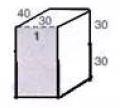
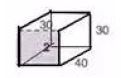
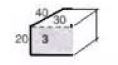
Question 10. Three rectangular boxes of the following dimensions are placed together to form a single solid structure:
Box 1: \( 60 \text{ cm} \times 40 \text{ cm} \times 30 \text{ cm} \)
Box 2: \( 40 \text{ cm} \times 30 \text{ cm} \times 30 \text{ cm} \)
Box 3: \( 40 \text{ cm} \times 30 \text{ cm} \times 20 \text{ cm} \)
If each box is open at the bottom, find the total volume and total outer surface area of this combined structure.
Answer:
For Box 1:
The dimensions are \( 60 \text{ cm} \), \( 40 \text{ cm} \), and \( 30 \text{ cm} \).
The volume of this first box is calculated as:
\( \text{Volume}_1 = 60 \times 40 \times 30 = 72000 \text{ cm}^3 \)
Since this box does not have a bottom, its surface area is:
\( \text{Surface Area}_1 = 40 \times 40 + 40 \times 30 + 40 \times 30 + 2 \times (60 \times 30) = 1600 + 1200 + 1200 + 3600 = 7600 \text{ cm}^2 \)
For Box 2:
The dimensions are \( 40 \text{ cm} \), \( 30 \text{ cm} \), and \( 30 \text{ cm} \).
The volume of this second box is:
\( \text{Volume}_2 = 40 \times 30 \times 30 = 36000 \text{ cm}^3 \)
Excluding the bottom surface, the area is:
\( \text{Surface Area}_2 = 40 \times 30 + 40 \times 30 + 2 \times (30 \times 30) = 1200 + 1200 + 1800 = 4200 \text{ cm}^2 \)
For Box 3:
The dimensions are \( 40 \text{ cm} \), \( 30 \text{ cm} \), and \( 20 \text{ cm} \).
The volume of this third box is:
\( \text{Volume}_3 = 40 \times 30 \times 20 = 24000 \text{ cm}^3 \)
Excluding the bottom surface, the area is:
\( \text{Surface Area}_3 = 40 \times 30 + 40 \times 20 + 2 \times (30 \times 20) = 1200 + 800 + 1200 = 3200 \text{ cm}^2 \)
Total Combined Volume:
\( \text{Total Volume} = \text{Volume}_1 + \text{Volume}_2 + \text{Volume}_3 = 72000 + 36000 + 24000 = 132000 \text{ cm}^3 \)
Total Outer Surface Area:
\( \text{Total Surface Area} = \text{Surface Area}_1 + \text{Surface Area}_2 + \text{Surface Area}_3 = 7600 + 4200 + 3200 = 15000 \text{ cm}^2 \)
In simple words: Calculate the volume and bottomless surface area of each box individually, then add them together to find the total volume and total outer surface area.
Exam Tip: When a shape is described as open at the bottom, subtract the area of that bottom face (\( l \times b \)) from your total surface area calculations for each component box.
Exercise 21(C)
Question 1. The perimeter of one face of a cube is \( 32\text{ cm} \). Find its total surface area and its volume.
Answer:
Let the length of each edge of the cube be represented by \( a \).
The perimeter of a single square face is given by:
\( \text{Perimeter} = 4a = 32\text{ cm} \)
\implies a = \frac{32}{4} = 8\text{ cm}
Now, we calculate the total surface area:
\( \text{Total Surface Area} = 6a^2 = 6 \times 8^2 = 6 \times 64 = 384\text{ cm}^2 \)
Next, we find the volume of the cube:
\( \text{Volume} = a^3 = 8^3 = 512\text{ cm}^3 \)
In simple words: Since a cube's face is a square, dividing its perimeter by 4 gives you the side length. Use this side length to find both the surface area and volume.
Exam Tip: Be sure to write the correct units: area is always in square centimetres (\( \text{cm}^2 \)) and volume is in cubic centimetres (\( \text{cm}^3 \)).
Question 2. An auditorium is \( 40\text{ m} \times 30\text{ m} \times 12\text{ m} \). If each student requires \( 1.2\text{ m}^2 \) of floor space, find:
(i) The maximum number of students that can sit in the auditorium.
(ii) The volume of air available for each student.
Answer:
The dimensions of the auditorium are \( 40\text{ m} \times 30\text{ m} \times 12\text{ m} \).
(i) Let's find the total floor area:
\( \text{Floor Area} = 40 \times 30\text{ m}^2 \)
Given that one student needs \( 1.2\text{ m}^2 \) of floor space, the capacity is:
\( \text{Maximum number of students} = \frac{40 \times 30}{1.2} = 1000\text{ students} \)
(ii) Now, we determine the total volume of the auditorium:
\( \text{Total Volume} = 40 \times 30 \times 12\text{ m}^3 \)
This is the total air capacity. To find the volume of air available per student, we divide this by the number of students:
\( \text{Air per student} = \frac{40 \times 30 \times 12}{1000} = 14.4\text{ m}^3 \)
In simple words: Divide the total floor area by the space required per student to find the maximum seating. Then, divide the total volume of the room by that number of students to find the air share for each.
Exam Tip: Floor area requirement depends only on the length and width of the auditorium, while the air volume calculation utilizes all three dimensions of the room.
Question 3. The length of the longest rod that can be placed inside a box of length \( 12\text{ cm} \) and height \( 9\text{ cm} \) is \( 17\text{ cm} \). Find the width of the box.
Answer:
The length of the longest rod matches the diagonal of the cuboidal box.
Let the unknown width be \( x \). The formula for the diagonal of a cuboid is:
\( \text{Diagonal} = \sqrt{l^2 + w^2 + h^2} \)
Here, we have:
\( 17 = \sqrt{12^2 + x^2 + 9^2} \)
Squaring both sides of the equation gives:
\( 17^2 = 12^2 + x^2 + 9^2 \)
\( 289 = 144 + x^2 + 81 \)
\( x^2 = 289 - 144 - 81 \)
\( x^2 = 64 \)
\implies x = 8\text{ cm}
Therefore, the width of the box is \( 8\text{ cm} \).
In simple words: The longest straight line in a box is its diagonal. We use the 3D Pythagoras theorem to find the missing dimension.
Exam Tip: Remember the diagonal formula for a cuboid is \( \sqrt{l^2 + w^2 + h^2} \). Squaring both sides of the equation first simplifies the algebra.
Question 4. A rectangular box has dimensions \( 30\text{ cm} \times 24\text{ cm} \times 15\text{ cm} \). Find the maximum number of cubes that can be packed inside the box if the edge of each cube is:
(i) \( 3\text{ cm} \)
(ii) \( 4\text{ cm} \)
(iii) \( 5\text{ cm} \)
Answer:
We need to find how many cubes of a given side length can fit along the length, width, and height of the box. Since we cannot place fractional parts of a cube, we must round down to the nearest whole number for each dimension.
(i) For a cube with side \( 3\text{ cm} \):
Along length: \( \frac{30}{3} = 10 \)
Along width: \( \frac{24}{3} = 8 \)
Along height: \( \frac{15}{3} = 5 \)
Total cubes: \( 10 \times 8 \times 5 = 400 \)
(ii) For a cube with side \( 4\text{ cm} \):
Along length: \( \frac{30}{4} = 7.5 \implies 7 \)
Along width: \( \frac{24}{4} = 6 \)
Along height: \( \frac{15}{4} = 3.75 \implies 3 \)
Total cubes: \( 7 \times 6 \times 3 = 126 \)
(iii) For a cube with side \( 5\text{ cm} \):
Along length: \( \frac{30}{5} = 6 \)
Along width: \( \frac{24}{5} = 4.8 \implies 4 \)
Along height: \( \frac{15}{5} = 3 \)
Total cubes: \( 6 \times 4 \times 3 = 72 \)
In simple words: Do not just divide the total volumes. You must check how many full cubes fit along each edge of the box and then multiply those three counts together.
Exam Tip: A common mistake is to divide the volume of the box by the volume of a cube. This only works if the dimensions are perfect multiples. Otherwise, you must find the floor values for each side as shown.
Question 5. Four cubic tanks, each of side \( 6\text{ m} \), are dug out in a field measuring \( 112\text{ m} \) by \( 62\text{ m} \). The excavated earth is evenly spread over the remaining part of the field. Find the rise in the level of the field.
Answer:
The volume of the dug-out earth is equal to the volume of the four cubic tanks:
\( \text{Volume of excavated earth} = 4 \times 6^3 = 4 \times 216 = 864\text{ m}^3 \)
The total area of the field is \( 112\text{ m} \times 62\text{ m} \).
The area occupied by the four square tops of the cubic tanks is:
\( \text{Area of tanks} = 4 \times 6^2 = 4 \times 36 = 144\text{ m}^2 \)
Therefore, the remaining area of the field where the earth is to be spread is:
\( \text{Remaining Area} = (112 \times 62) - (4 \times 6^2) = 6944 - 144 = 6800\text{ m}^2 \)
To find the rise in the level of the ground:
\( \text{Rise in level} = \frac{\text{Volume of excavated earth}}{\text{Remaining Area}} \)
\( \text{Rise in level} = \frac{864}{6800}\text{ m} \approx 0.127\text{ m} = 12.7\text{ cm} \)
In simple words: Find the volume of soil dug out from the four cube holes. Divide this volume by the area of the field that isn't covered by the holes to find out how much the land rises.
Exam Tip: Remember to subtract the top area of the four dug-out holes from the total field area to find the accurate area of the remaining field where the earth is spread.
Question 6. If the edge of a cube is increased by \( 3\text{ cm} \), its volume increases by \( 2457\text{ cm}^3 \). Find the side length of the original cube. Also, if the side length of this cube is decreased by 20%, find the decrease in its volume.
Answer:
Let the side of the original cube be \( a \).
When the side is increased by \( 3\text{ cm} \), the new side length becomes \( a + 3 \).
The relationship between their volumes is:
\( (a+3)^3 = a^3 + 2457 \)
\implies a^3 + 9a^2 + 27a + 27 = a^3 + 2457
\implies 9a^2 + 27a - 2430 = 0
Dividing the entire quadratic equation by 9:
\implies a^2 + 3a - 270 = 0
Factorizing by splitting the middle term:
\implies a^2 + 18a - 15a - 270 = 0
\implies a(a+18) - 15(a+18) = 0
\implies (a-15)(a+18) = 0
This gives:
\( a = 15 \text{ or } a = -18 \)
Since a length cannot be negative, we have:
\( a = 15\text{ cm} \)
The volume of this cube is:
\( \text{Volume} = 15^3 = 3375\text{ cm}^3 \)
If the original side of \( 15\text{ cm} \) is reduced by 20%:
\( \text{New Side } (a_{\text{new}}) = 15 \times \left(1 - \frac{20}{100}\right) = 15 \times \frac{4}{5} = 12\text{ cm} \)
The volume of the reduced cube is:
\( \text{New Volume} = 12^3 = 1728\text{ cm}^3 \)
Thus, the decrease in volume is:
\( \text{Decrease in Volume} = 3375 - 1728 = 1647\text{ cm}^3 \)
In simple words: Write an equation using the volume formula for both sides. Solve the quadratic equation to find the original side. Then, calculate 80% of this side to find the new, smaller volume, and subtract it from the old volume.
Exam Tip: Pay close attention to factoring. A negative value for side length must be discarded with a clear reason given to the examiner.
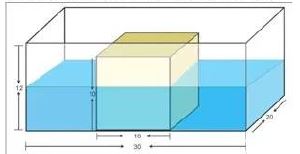
Question 7. A rectangular tank of dimensions \( 30\text{ cm} \times 20\text{ cm} \times 12\text{ cm} \) contains water to a height of \( 6\text{ cm} \). A metal cube of side \( 10\text{ cm} \) is placed in the tank.
(i) Find the new water level in the tank.
(ii) Find the volume of water (in litres) that must be added to the tank so that the metal cube is just completely submerged.
Answer:
Dimensions of the rectangular tank are \( 30\text{ cm} \times 20\text{ cm} \times 12\text{ cm} \).
The side of the solid metal cube is \( 10\text{ cm} \).
\( \text{Volume of the cube} = 10^3 = 1000\text{ cm}^3 \)
The original water height is \( 6\text{ cm} \).
When the cube is placed on the bottom of the tank, the submerged height of the cube is equal to the water depth, which is \( 6\text{ cm} \).
\( \text{Submerged volume of the cube} = 10\text{ cm} \times 10\text{ cm} \times 6\text{ cm} = 600\text{ cm}^3 \)
This submerged part of the cube displaces water, causing the water level to rise.
The total base area of the water level in the tank is:
\( \text{Total Area} = 30\text{ cm} \times 20\text{ cm} = 600\text{ cm}^2 \)
Since the cube occupies a base area of \( 10\text{ cm} \times 10\text{ cm} = 100\text{ cm}^2 \), the remaining area available for the displaced water is:
\( \text{Free Surface Area} = 600\text{ cm}^2 - 100\text{ cm}^2 = 500\text{ cm}^2 \)
Let the increase in the water level be \( h \).
\( 500 \times h = 600 \)
\implies h = \frac{600}{500} = 1.2\text{ cm}
(i) The new height of the water level is:
\( \text{New Level} = 6 + 1.2 = 7.2\text{ cm} \)
(ii) To just submerge the metal cube, the water level must reach the height of the cube, which is \( 10\text{ cm} \).
The required further rise in the water level is:
\( \text{Remaining Height} = 10 - 7.2 = 2.8\text{ cm} \)
The volume of water to be added is:
\( \text{Volume of added water} = 2.8\text{ cm} \times 500\text{ cm}^2 = 1400\text{ cm}^3 \)
Since \( 1000\text{ cm}^3 = 1\text{ litre} \), we convert this volume:
\( \text{Required volume of water in litres} = \frac{1400}{1000} = 1.4\text{ litres} \)
In simple words: When the cube is placed inside, it takes up space, which pushes the water level up by 1.2 cm. To submerge it completely, the water needs to rise by another 2.8 cm, which requires adding 1.4 litres of water.
Exam Tip: Be careful to subtract the base area of the cube from the base area of the tank to find the effective base area over which the water rises.
Question 8. A solid cuboid of dimensions \( 72\text{ cm} \times 30\text{ cm} \times 75\text{ cm} \) is melted and cast into identical small cubes, each of edge \( 6\text{ cm} \). Find:
(i) The number of cubes formed.
(ii) The total cost of polishing all the surfaces of all the cubes at the rate of Rs. 150 per square metre.
Answer:
The dimensions of the large solid cuboid are \( 72\text{ cm} \times 30\text{ cm} \times 75\text{ cm} \).
(i) Let's find the volume of the cuboid:
\( \text{Volume of cuboid} = 72 \times 30 \times 75 = 162000\text{ cm}^3 \)
Each small cube has a side length of \( 6\text{ cm} \).
\( \text{Volume of one small cube} = 6^3 = 216\text{ cm}^3 \)
Now, we calculate the total number of cubes that can be made:
\( \text{Number of cubes} = \frac{162000}{216} = 750 \)
(ii) Next, we calculate the surface area of a single cube:
\( \text{Surface Area of one cube} = 6 \times 6^2 = 216\text{ cm}^2 \)
The total surface area of all 750 cubes is:
\( \text{Total Surface Area} = 750 \times 216 = 162000\text{ cm}^2 \)
Convert this total surface area to square metres:
\( \text{Total Surface Area in } \text{m}^2 = \frac{162000}{10000} = 16.2\text{ m}^2 \)
The cost of polishing the surfaces is Rs. 150 per square metre:
\( \text{Total Cost of polishing} = 150 \times 16.2 = \text{Rs. } 2430 \)
In simple words: Divide the volume of the large cuboid by the volume of one small cube to find the total number of cubes. Then, find the total surface area of all these cubes combined, convert it to square metres, and multiply by the cost per square metre.
Exam Tip: Remember that when converting square centimetres (\( \text{cm}^2 \)) to square metres (\( \text{m}^2 \)), you must divide by \( 10000 \) (since \( 1\text{ m}^2 = 100\text{ cm} \times 100\text{ cm} \)).
Question 9. The dimensions of a car's petrol tank are \( 50\text{ cm} \times 32\text{ cm} \times 24\text{ cm} \). If the car runs an average of \( 15\text{ km} \) per litre of petrol, find the maximum distance the car can cover with a full tank of petrol.
Answer:
The physical dimensions of the petrol tank are \( 50\text{ cm} \times 32\text{ cm} \times 24\text{ cm} \).
First, we determine the volume capacity of the tank:
\( \text{Volume} = 50 \times 32 \times 24 = 38400\text{ cm}^3 \)
Since \( 1000\text{ cm}^3 = 1\text{ litre} \), we convert the capacity into litres:
\( \text{Capacity in litres} = \frac{38400}{1000} = 38.4\text{ litres} \)
The car travels an average distance of \( 15\text{ km} \) per litre of fuel.
The maximum distance the car can cover on a full tank is:
\( \text{Distance} = 38.4 \times 15 = 576\text{ km} \)
In simple words: Find the volume of the tank in cubic centimetres and convert it to litres by dividing by 1000. Multiply the total litres by the fuel efficiency (km per litre) to find the final range.
Exam Tip: Keep the conversion factor \( 1\text{ litre} = 1000\text{ cm}^3 \) in mind to transition smoothly from volume measurements to liquid capacities.
Question 10. The dimensions of a rectangular box are in the ratio \( 4:2:3 \). The difference between the cost of covering the box with paper at the rate of Rs. 13.50 per square metre and Rs. 12 per square metre is Rs. 1,248. Find the dimensions of the rectangular box.
Answer:
Let the dimensions of the rectangular box be \( 4x \), \( 2x \), and \( 3x \).
The total surface area of this cuboid is:
\( \text{Total Surface Area} = 2(lb + bh + lh) \)
\( \text{Total Surface Area} = 2[(4x \times 2x) + (2x \times 3x) + (4x \times 3x)] \)
\( \text{Total Surface Area} = 2(8x^2 + 6x^2 + 12x^2) = 2(26x^2) = 52x^2\text{ m}^2 \)
The rates for paper covering are Rs. 13.50 and Rs. 12 per square metre.
The difference in cost is:
\( \text{Cost Difference} = 52x^2 \times (13.50 - 12) = 1248 \)
\( 52x^2 \times 1.5 = 1248 \)
\( 78x^2 = 1248 \)
\( x^2 = \frac{1248}{78} \)
\( x^2 = 16 \)
\implies x = 4 \text{ (taking the positive root since dimensions must be positive)}
Thus, the dimensions of the rectangular box are:
\( \text{Length} = 4 \times 4 = 16\text{ m} \)
\( \text{Breadth} = 2 \times 4 = 8\text{ m} \)
\( \text{Height} = 3 \times 4 = 12\text{ m} \)
In simple words: Write the surface area in terms of an unknown variable x, then multiply the difference in rates by this area expression to set up an equation. Solve for x to find the actual length, width, and height.
Exam Tip: Be careful with the ratio order. Always state the final dimensions clearly at the end of the solution rather than just solving for \( x \).
ICSE Selina Concise Solutions Class 9 Mathematics Chapter 21 Solids Surface Area And Volume Of 3 D Solids
Students can now access the detailed Selina Concise Solutions for Chapter 21 Solids Surface Area And Volume Of 3 D Solids on our portal. These solutions have been carefully prepared as per latest ICSE Class 9 syllabus. Each solution given above has been updated based on the current year pattern to ensure Class 9 students have the most updated Mathematics content.
Master Selina Concise Textbook Questions
Our subject experts have provided detailed explanations for all the questions found in the Selina Concise textbook for Class 9 Mathematics. We have focussed on making the concepts easy for you in Chapter 21 Solids Surface Area And Volume Of 3 D Solids so that students can understand the concepts behind every answer. For all numerical problems and theoretical concepts these solutions will help in strengthening your analytical skill required for the ICSE examinations.
Complete Mathematics Exam Preparation
By using these Selina Concise Class 9 solutions, you can enhance your learning and identify areas that need more attention. We recommend solving the Mathematics Questions from the textbook first and then use our teacher-verified answers. For a proper revision of Chapter 21 Solids Surface Area And Volume Of 3 D Solids, students should also also check our Revision Notes and Sample Papers available on studiestoday.com.
FAQs
You can download the verified Selina Concise solutions for Chapter 21 Solids Surface Area And Volume Of 3 D Solids on StudiesToday.com. Our teachers have prepared answers for Class 9 Mathematics as per 2026-27 ICSE academic session.
Yes, our solutions for Chapter 21 Solids Surface Area And Volume Of 3 D Solids are designed as per new 2026 ICSE standards. 40% competency-based questions required for Class 9, are included to help students understand application-based logic behind every Mathematics answer.
Yes, every exercise in Chapter 21 Solids Surface Area And Volume Of 3 D Solids from the Selina Concise textbook has been solved step-by-step. Class 9 students will learn Mathematics conceots before their ICSE exams.
Yes, follow structured format of these Selina Concise solutions for Chapter 21 Solids Surface Area And Volume Of 3 D Solids to get full 20% internal assessment marks and use Class 9 Mathematics projects and viva preparation as per ICSE 2026 guidelines.