

ICSE Solutions Goyal Brothers Class 7 History Civics Chapter 8 Akbar The Great have been provided below and is also available in Pdf for free download. The Goyal Brothers ICSE solutions for Class 7 History Civics have been prepared as per the latest syllabus and ICSE books and examination pattern suggested in Class 7. Questions given in ICSE Goyal Brothers book for Class 7 History Civics are an important part of exams for Class 7 History Civics and if answered properly can help you to get higher marks. Refer to more Chapter-wise answers for ICSE Class 7 History Civics and also download more latest study material for all subjects. Chapter 8 Akbar The Great is an important topic in Class 7, please refer to answers provided below to help you score better in exams
Goyal Brothers Chapter 8 Akbar The Great Class 7 History Civics ICSE Solutions
Class 7 History Civics students should refer to the following ICSE questions with answers for Chapter 8 Akbar The Great in Class 7. These ICSE Solutions with answers for Class 7 History Civics will come in exams and help you to score good marks
Chapter 8 Akbar The Great Goyal Brothers ICSE Solutions Class 7 History Civics
Akbar the Great
Important Words
- Jauhar: Self-immolation or burning of queens and female royals of the Rajput kingdoms when facing defeat at the hands of an enemy.
- Wazir (or Diwan): Head of the revenue department.
- Mir Bakshi: Head of the military department and paymaster of all mansabdars.
- Chief Sadr (or Qazi): Chief judge.
- Mir Saman: Supervisor of the royal household.
- Vakil: Prime minister, whose position was reduced to an advisory, ceremonial head during Akbar's reign.
- Diwan-i-Khas: Private hall where Akbar held regular meetings with his senior officers.
- Diwan-i-Aam: Common audience hall where Akbar would receive petitions, listen to problems, and solve many cases.
- Subas: Provinces into which Akbar's empire was divided, each governed by a subedar.
- Mansab: Office or rank of dignity. A mansabdar was the holder of this rank in the administration.
- Todar Mal's Bandobast: Land revenue system introduced by Raja Todar Mal, who was one of the nine gems in Akbar's court.
- Pilgrim Tax: Tax imposed on Hindus visiting places of pilgrimage.
- Sulh-i-Kul: Universal peace and harmony.
- Din-i-Ilahi: New religious order introduced by Akbar, which was a combination of major religions - Islam, Hinduism, Jainism, and Christianity.
I. Fill in the blanks:
1. Bairam Khan was the guardian of Akbar.
2. Akbar adopted a liberal religious policy.
3. In the year 1576 Akbar defeated Rana Pratap in the Battle of Haldighati.
4. Buland darwaza was built to celebrate Akbar’s victory over Gujarat.
II. Match Column A with Columb B:
| Column A | Column B (Correct Match) |
|---|---|
| 1. Bairam Khan | (d) guardian of Akbar |
| 2. Abul Fazl | (e) author of Akbarnama |
| 3. Todar Mal | (b) incharge of the revenue department |
| 4. Tansen | (c) musician of Akbar's court |
| 5. Din-i-Ilahi | (a) religious faith started by Akbar |
III. State whether the following statements are True or False:
1. Bairam Khan was a faithful general, who served both Humayun and Akbar loyally.
Answer: True
2. Raja Todar Mai was the Revenue Minister of Akbar.
Answer: True
3. Akbar allowed religious freedom to the Rajputs only.
Answer: False
4. Akbar reimposed Jazia on the non-Muslim subjects.
Answer: False
IV. Answer the following questions briefly:
Question 1. When and between whom was the Second Battle of Panipat fought? What were its results?
Answer: The Second Battle of Panipat was fought in 1556 between the Mughal forces under Akbar and Hemu, the military general of the Afghan ruler Adil Shah Suri. The battle resulted in the complete defeat and death of Hemu. This decisive victory crushed the Afghan bid for power, re-established Mughal control over Delhi, and firmly consolidated Akbar's empire.
In simple words: The Second Battle of Panipat was fought in 1556 between Akbar's army and Hemu. Hemu was defeated and killed, which crushed the Afghan power and secured the Mughal throne.
Exam Tip: Specify the year (1556) and the key combatants (Akbar and Hemu), and note that the main result was the destruction of the Afghan threat.
Question 2. Write briefly about the following : (a) Akbar’s northern conquests (b) Akbar’s southern conquests.
Answer: (a) Akbar's Northern Conquests:
Following his victory at Panipat, Akbar expanded his northern territories to establish a stable and integrated empire:
1. Malwa (1561): Annexed by a force led by Adham Khan.
2. Garh Katanga (1564): Conquered by Asaf Khan's forces, defeating Rani Durgavati.
3. Rajasthan Campaigns (1568-1573): Captured the strategic fort of Chittor in 1568, followed by Kalinjar (1569), Ranthambore, and Gujarat (1573). By 1570, most Rajput rulers accepted his suzerainty.
4. Haldighati (1576): Defeated Rana Pratap of Mewar, though the Rana refused to submit and waged guerrilla warfare.
5. Bengal (1576): Defeated and executed Daud Khan, bringing Bengal under direct imperial control.
6. Northwest Frontiers: Annexed Kabul (1581), Kashmir (1586), Sindh (1591), and Balochistan (1595), securing the northwest borders of the empire.
7. Odisha (1592): Formally integrated into the Mughal administrative system.
(b) Akbar's Southern conquests:
Between 1598 and 1601, Akbar turned his attention to the south:
1. Ahmadnagar (1600): Captured after a prolonged defense led by Chand Bibi, who was ultimately killed by her own disgruntled soldiers.
2. Khandesh (1601): Secured the highly fortified citadel of Asirgarh.
As a result of these campaigns, Akbar annexed three new southern provinces: Berar, Ahmadnagar, and Khandesh.
In simple words: In the north, Akbar conquered Malwa, Chittor, Gujarat, Bengal, and secured the northwest borders by annexing Kabul, Kashmir, and Sindh. In the south, he annexed the Deccan provinces of Berar, Ahmadnagar, and Khandesh, capturing the strong fort of Asirgarh in 1601.
Exam Tip: For part (a), focus on key northern expansions like Gujarat and Kashmir. For part (b), mention the capture of Ahmadnagar (1600) and the fort of Asirgarh (1601).
Question 3. What was the extent of Akbar’s kingdom? How was administration carried out during Akbar’s time? Explain with reference to the Central and Provincial administration.
Answer: Extent of Akbar's Empire:
Akbar's territories spanned from Bengal in the east to Afghanistan in the west, and from the Himalayas in the north to the Godavari River in the south. He divided this vast land into fifteen administrative provinces: Kabul, Lahore, Multan, Delhi, Agra, Allahabad, Awadh, Gujarat, Ajmer, Malwa, Bihar, Bengal, Khandesh, Berar, and Ahmadnagar. His administration was structured into Central and Provincial branches.
Central Administration:
The Emperor held absolute power but was assisted by several key ministers:
1. Wazir (Dewan): Supervised the empire's financial and revenue affairs.
2. Mir Bakshi: Managed military organization, army administration, and salaries for all mansabdars.
3. The Qazi: Served as the chief judicial authority below the Emperor.
4. Chief Sadr: Acted as the supervisor of the royal household and handled religious grants and charities.
5. Vakil: Served as the head of the imperial advisory board.
Provincial Administration:
Each of the fifteen provinces was divided into districts, which were further subdivided into sub-districts containing several villages. Each province was governed by a Subedar who exercised full military and civilian authority. The Subedar worked alongside provincial officers, including the Diwan (finance), Bakshi (military pay), Qazi (justice), and Kotwal (police chief).
In simple words: Akbar's empire stretched from Bengal to Afghanistan and from the Himalayas to the Godavari River, split into 15 provinces. The Central administration was run by key officers like the Wazir (finance) and Mir Bakshi (military), while each province was governed by a Subedar with full military and civil powers.
Exam Tip: Name the core divisions of his empire: Subas, Sarkars, and Parganas for a complete answer.
Question 4. What were the main sources of revenue for the Mughal government? How did Akbar improve the collection of revenue?
Answer: The primary source of revenue for the Mughal state was land tax. To reform and systematically improve tax collection, Akbar's Finance Minister, Raja Todar Mal, introduced the famous land revenue system known as "Todar Mal's Bandobast":
1. Standardized Measurement: He introduced a standardized measuring rod, using a bamboo jarib joined by iron rings, replacing the older, inaccurate hemp ropes to measure land precisely.
2. Soil Classification: Agricultural lands were divided into four groups based on their cultivation frequency, and further graded into good, average, or poor quality.
3. Tax Assessment: The government calculated the average crop yields and market prices over the previous ten years. The state's tax share was set at one-third of this ten-year average, which farmers could pay in cash or in kind.
4. Emergency Relief: If crops failed due to environmental disasters like floods or droughts, the state provided tax cuts or complete remissions, and offered loans to buy seeds and tools.
In simple words: The main source of revenue was land tax. Under Todar Mal's system, land was surveyed precisely using a bamboo rod, grouped into classes based on fertility, and taxed fairly at one-third of the average ten-year crop yield, with tax cuts allowed during famines.
Exam Tip: Focus on the four key reforms: precise land measurement with the bamboo jarib, classification of soil, tax set at one-third of the ten-year average, and emergency tax relief.
Question 5. What do you think about Akbar’s attempts to bring about religious, cultural and social unification in his empire?
Answer: Akbar implemented several progressive steps to build a unified, secular state and promote social harmony among his diverse subjects:
1. Stopping Unfair Taxes: He abolished the Jizya tax on non-Muslims and the pilgrim tax, removing the economic burden on Hindus visiting holy sites.
2. Religious Freedom: He granted his subjects complete freedom of worship, allowing Hindus to build temples and celebrate their festivals. His Hindu wives were also permitted to celebrate festivals like Holi and Diwali inside the royal palace.
3. Merit-Based Appointments: He appointed talented Hindu leaders to top administrative and military posts, including Raja Todar Mal, Birbal, and Raja Bhagwan Das.
4. Marital and Cultural Alliances: He formed matrimonial alliances with prominent Rajput families, ensuring his queens had complete freedom to practice their faith.
5. Universal Land Grants: He issued land grants and financial support to spiritual leaders and institutions of all religions without bias.
In simple words: Akbar tried to unite India by treating all religions equally. He stopped unfair taxes like Jizya, allowed Hindus to build temples and celebrate festivals openly, hired talented Hindus like Birbal for high positions, and married Rajput princesses while granting them full religious freedom.
Exam Tip: Clearly state his major initiatives, such as the abolition of Jizya and pilgrim taxes, and his merit-based integration of Rajput nobles into the administration.
Question 6. What do you understand by the term Din-i-Ilahi? Write a brief note on it.
Answer: Din-i-Ilahi was a new spiritual and ethical order introduced by Emperor Akbar in 1582. It was designed as an ethical code of conduct rather than a formal, dogmatic religion:
1. Basic Features: It focused on the belief in one Supreme God and positioned the emperor as God's representative on earth. It had no sacred books, no professional priestly class, no built temples, and no complex rituals.
2. Core Principles: It promoted virtues such as courage, moral purity, and justice, while demanding complete loyalty to the Emperor.
3. Main Goal: The primary objective of Din-i-Ilahi was to establish a shared moral framework acceptable to Hindus, Muslims, and other communities alike, thereby fostering universal brotherhood, tolerance, and national unity.
In simple words: Din-i-Ilahi was a moral path introduced by Akbar that focused on belief in one God and good behavior. It was not a rigid religion, as it had no holy books, temples, or priests, and aimed to unite Hindus and Muslims in peace.
Exam Tip: Define Din-i-Ilahi as a moral code of conduct rather than a rigid religion, noting the absence of temples, priests, and sacred books.
Question 7. Do you think architecture flourished during Akbar’s reign? Give reasons for your answer.
Answer: Architecture experienced a golden age under Akbar's rule, transforming from Persian-inspired designs into a unique indigenous style:
1. Early Phase: His early projects, such as Humayun's Tomb, were heavily influenced by traditional Persian architecture.
2. Synthesis of Styles: Over time, Akbar's builders incorporated native Indian elements, taking inspiration from the palaces of Rajput rulers to create a distinct Indo-Islamic style.
3. Fatehpur Sikri: Akbar's new capital city, built entirely of red sandstone, stands as a prime example of this blended style. Often called a 'dream in stone', it houses several spectacular monuments, including the Diwan-i-Khas, the five-tiered Panch Mahal, Jodha Bai's Palace, and the colossal Buland Darwaza.
In simple words: Architecture flourished under Akbar as he blended Persian designs with traditional Indian styles. His new capital, Fatehpur Sikri, is a masterpiece of red sandstone containing beautiful buildings like Jodha Bai's Palace and the Buland Darwaza gateway.
Exam Tip: Discuss the transition from Persian styles to the Indian-influenced red sandstone buildings of his new capital, Fatehpur Sikri.
V. Give reasons why.
Question 1. Land was classified and measured before revenue was fixed.
Answer: Land was surveyed and classified prior to setting tax rates to ensure a fair and predictable revenue system for both the state and the cultivators:
1. Precision in Measurement: Akbar introduced the bamboo jarib with iron rings to measure land accurately, replacing the older, inaccurate hemp ropes that stretched and caused errors.
2. Fair Classification: Tax was decided based on actual crop yields. Land was grouped into four classes depending on how often it was farmed, and further graded into good, average, or poor quality.
3. Fair Taxation: By calculating the average yield and prices over the previous ten years, the state fixed its tax share at a fair rate of one-third of the average harvest, protecting farmers from arbitrary tax increases.
In simple words: Land was measured and classified to make sure taxes were fair. Akbar used a precise bamboo rod to measure land, grouped it by soil fertility, and calculated taxes based on a ten-year average crop yield.
Exam Tip: Explain that precise land measurement and soil classification ensured that taxes were calculated fairly based on actual crop yields.
Question 2. Akbar followed a liberal policy towards the Rajputs.
Answer: Akbar realized that to build and sustain a stable empire in India, he needed the support and military cooperation of the powerful Rajput clans. To achieve this, he adopted a policy of partnership and conciliation:
1. Mutual Respect: He treated Rajput chiefs as equals, winning their respect and loyalty.
2. Strategic Marriages: He married Rajput princesses to cement strong family and political ties with prominent clans.
3. Administrative Partnerships: He appointed talented Rajput leaders to high-ranking administrative and military posts in his court, including Raja Todar Mal and Birbal.
4. Repeal of Taxes: He abolished the Jizya and the pilgrim tax, which had long been resented by Hindus.
5. Regional Autonomy: Rather than annexing their kingdoms, he allowed Rajput rulers to retain internal control over their states, provided they accepted him as their supreme overlord. This policy secured their loyalty, making the Rajputs the military backbone of his empire.
In simple words: Akbar knew he needed the support of the brave Rajputs to secure his empire. He won them over by treating them as equals, hiring them for top government jobs, abolishing the Jizya tax, and allowing them to rule their own kingdoms under his suzerainty.
Exam Tip: Focus on how his policy of conciliation - such as the abolition of Jizya, respect for autonomy, and marital alliances - converted rivals into loyal military partners.
Question 3. Akbar is referred to as ‘Akbar the Great’.
Answer: Akbar is remembered as "Akbar the Great" due to his outstanding achievements as a conqueror, administrator, and reformist:
1. Vast Expansion: He successfully expanded the borders of the Mughal Empire to nearly twice its original size.
2. Religious Tolerance: He pioneered policies of religious tolerance, abolishing discriminatory taxes like the Jizya and the pilgrim tax to promote equality among all faiths.
3. Administrative Reforms: He introduced efficient administrative and land revenue systems that were so effective they were later adopted by the British.
4. Public Welfare: Rather than acting as a foreign conqueror, he focused on the welfare of his subjects, speaking out against discrimination and promoting social harmony.
In simple words: He is called 'Akbar the Great' because he expanded his empire massively, treated all religions with respect, stopped unfair taxes like Jizya, and introduced highly efficient administrative systems that helped his subjects prosper.
Exam Tip: Discuss his major reforms across different fields: territorial expansion, religious toleration, and his highly efficient administrative structures.
VI. Picture study:
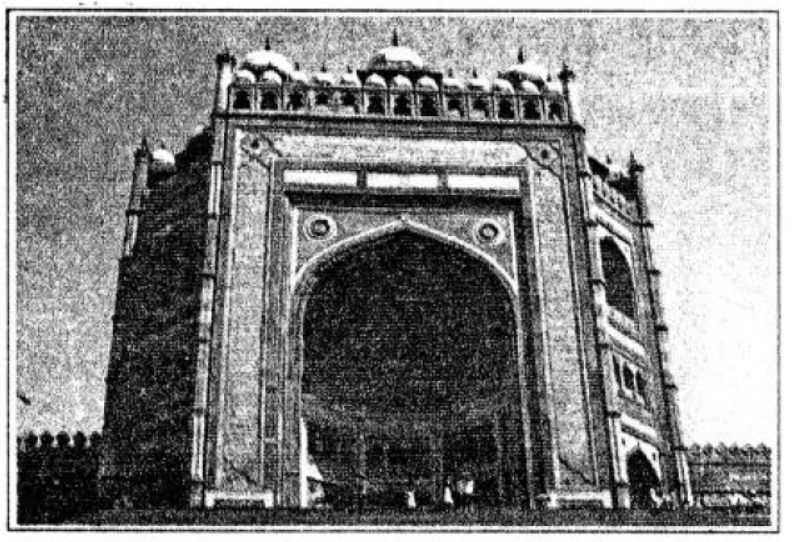
Question 1. Name this building.
Answer: The photograph depicts the Buland Darwaza.
In simple words: The building shown in the picture is the Buland Darwaza.
Exam Tip: Identify the building as the Buland Darwaza, the grand gateway of Fatehpur Sikri.
Question 2. Where is it located?
Answer: This monument is located in Fatehpur Sikri, near Agra.
In simple words: It is located in the historical city of Fatehpur Sikri.
Exam Tip: State 'Fatehpur Sikri' as the correct location of this grand gateway.
Question 3. Why and when was it built?
Answer: The gateway was constructed to celebrate and commemorate Akbar's successful military campaign and conquest of Gujarat.
In simple words: It was built to celebrate Akbar's victory and conquest of Gujarat.
Exam Tip: Identify the 'conquest of Gujarat' as the specific military victory celebrated by this monument.
Question 4. Name the emperor who got it built. Write about his religious policies.
Answer: Emperor Akbar commissioned the construction of the Buland Darwaza. His highly progressive religious policies included the following measures:
1. Repeal of Discriminatory Taxes: He abolished the Jizya tax and the pilgrim tax that had been levied on non-Muslim subjects.
2. Support for Temples: He granted freedom of worship, allowed Hindus to build temples, and even provided financial grants to construct them.
3. Ban on Forced Conversions: He strictly banned the practice of forcing war prisoners to convert to Islam.
4. Cultural Exchanges: He established a translation bureau to translate classical Hindu scriptures and epics into Persian to foster mutual understanding.
In simple words: Emperor Akbar built the gateway. His religious policies focused on equality: he abolished the Jizya and pilgrim taxes, allowed and funded the building of Hindu temples, ended forced conversions, and translated Hindu scriptures into Persian.
Exam Tip: State 'Akbar' as the builder, and list at least three of his tolerant religious policies for a complete answer.
Additional Questions
EXERCISES
A. Fill in the blanks:
1. In the Second Battle of Panipat which took place in November 1556, the Mughal army under the leadership of Bairam Khan defeated General Hemu.
2. Akbar held regular meetings with his senior officers in the Diwan-i-Khas and he met his subjects in the Diwan-i-Aam.
3. The Mughal empire was divided into fifteen provinces and subas which were further subdivided into districts or Sarkars.
4. The land revenue system introduced by Akbar was known as the Toda Mal’s Bandobast system.
5. The minimum age of marriage was raised to fourteen years for girls and sixteen years for boys.
6. Two great poets patronized by Akbar were Faizi and Raja Birbal.
B. Match the following:
| Column A | Column B (Correct Match) |
|---|---|
| 1. Abul Fazl | (d) Akbarnama |
| 2. Faizi | (c) Persian poet laureate |
| 3. Tansen | (a) Hindustani music |
| 4. Birbal | (e) Akbar's constant companion |
| 5. Raja Man Singh | (b) military commander |
C. Choose the correct answer:
Question 1. Who is the nominal head of the government of India?
(a) 13 years old
(b) 15 years old
(c) 17 years old
(d) None of the options
Answer: (a) 13 years old
In simple words: Following the sudden death of his father Humayun, Akbar was proclaimed emperor at the very young age of 13.
Exam Tip: Remember that Akbar ascended the throne as a minor at the age of 13, under Bairam Khan's guardianship.
Question 2. Which Rajput ruler was defeated by the Mughal forces in the Battle of Haldighati?
(a) Rana Udai Singh
(b) Jai Mal
(c) Rana Pratap Singh
(d) None of the options
Answer: (c) Rana Pratap Singh
In simple words: Rana Pratap Singh of Mewar was defeated by Akbar's forces at the famous Battle of Haldighati in 1576.
Exam Tip: Match the 1576 Battle of Haldighati with Rana Pratap of Mewar.
Question 3. In 1575 CE, Akbar built the Ibadat Khana in his new capital for discussions on:
(a) politics
(b) religious matters
(c) warfare
(d) None of the options
Answer: (b) religious matters
In simple words: Akbar built the Ibadat Khana in his new capital in 1575 to hold peaceful discussions on religious matters with scholars of different faiths.
Exam Tip: State the purpose of the Ibadat Khana: hosting discussions on diverse religious and spiritual philosophies.
Question 4. Akbar founded a new religious order which he called:
(a) Din-i-Ilahi
(b) Mahzar
(c) Sulh-i-kul
(d) None of the options
Answer: (a) Din-i-Ilahi
In simple words: Akbar established a new spiritual path called Din-i-Ilahi, which combined the moral teachings of various major religions.
Exam Tip: Define Din-i-Ilahi as the ethical-religious order introduced by Akbar to unite his subjects.
Question 5. The official court language used in Akbar’s court was:
(a) Turkish
(b) Persian
(c) Sanskrit
(d) None of the options
Answer: (b) Persian
In simple words: Although the Mughals originated from Central Asia, Persian was adopted as the official administrative and court language under Akbar.
Exam Tip: State 'Persian' as the primary language used for Mughal court administration.
D. State whether the following are true or false:
1. Option 1: True/False
Answer: False (Correct statement: Akbar assumed absolute power and authority at the age of 18, ending Bairam Khan's regency.)
2. Option 2: True/False
Answer: True
3. Option 3: True/False
Answer: True
4. Option 4: True/False
Answer: False (Correct statement: Din-i-Ilahi was introduced by Akbar but gained very few followers and was never adopted by all people.)
5. Option 5: True/False
Answer: True
E. Answer the following questions in one or two words/ sentences:
Question 1. What role did Bairam Khan play when Akbar ascended the throne?
Answer: When Akbar ascended the throne as a minor, Bairam Khan acted as his guardian and regent, managing all administrative and military affairs of the state on his behalf.
In simple words: Bairam Khan served as Akbar's guardian and regent, running the government and leading the army because Akbar was still a child.
Exam Tip: Identify Bairam Khan as Akbar's 'regent' or 'guardian' who managed the state during his minority.
Question 2. What is the significance of the Second Battle of Panipat (1556 ce)?
Answer: The Second Battle of Panipat (1556) was highly significant because the Mughal army under Bairam Khan defeated Hemu, the powerful Afghan general who had captured Delhi. This victory permanently crushed the Afghan threat to the Mughal throne, securing Akbar's position as the ruler of India.
In simple words: The battle was important because Akbar's army defeated Hemu, ending the Afghan threat and making Akbar's position as emperor secure.
Exam Tip: Emphasize that the victory crushed the Afghan bid for Delhi and secured Akbar's crown.
Question 3. Why did Akbar embark on a policy of conquest and annexation?
Answer: Akbar pursued aggressive military campaigns and annexations to establish a unified central authority, with the ultimate goal of bringing the entire Indian subcontinent under direct Mughal administration.
In simple words: Akbar led wars and annexed territories because he wanted to unite and rule the entire country under his central authority.
Exam Tip: State his primary goal: establishing a unified, centralized empire across the entire subcontinent.
Question 4. Why did Akbar follow a policy of friendship with the Rajput?
Answer: Akbar realized that his capital cities of Delhi and Agra would never be secure as long as the powerful Rajput chiefs remained hostile. Furthermore, he recognized that winning the friendship and military alliance of the Rajputs would be crucial in building and expanding a stable empire.
In simple words: He befriended the Rajputs because he knew Delhi and Agra would never be safe from attacks otherwise, and their military support was crucial to build a strong empire.
Exam Tip: Highlight both strategic motives: securing his capitals and gaining a powerful military ally to expand his empire.
Question 5. Why is the memory of Rana Pratap Singh still honoured in Rajasthan?
Answer: Rana Pratap is deeply honored in Rajasthan because he spent his entire life fighting to defend Mewar's independence, refusing to submit to the Mughals despite facing overwhelming odds.
In simple words: He is honored because he chose a life of struggle and hardship to defend his kingdom's independence, refusing to surrender to Akbar's forces.
Exam Tip: Mention his absolute commitment to defending Mewar's independence and his refusal to accept Mughal suzerainty.
Question 6. What do you understand by the term ‘mansab’?
Answer: The word 'mansab' originates from Arabic, translating to an official office, position, or rank within the administrative and military hierarchy of the Mughal state.
In simple words: A mansab was an official rank or grade given to officers in the Mughal government.
Exam Tip: Define 'mansab' literally as 'office' or 'rank' that decided an officer's salary and status.
Question 7. Who had the power to appoint and dismiss the mansabdars?
Answer: The absolute authority to appoint, promote, transfer, or dismiss all mansabdars lay solely in the hands of the Mughal Emperor.
In simple words: Only the Mughal Emperor had the power to hire, promote, or fire mansabdars.
Exam Tip: Emphasize that the system was highly centralized, with the Emperor holding the sole power over appointments and dismissals.
Question 8. Mention any one tax abolished by Akbar as a part of his policy of religious tolerance.
Answer: To promote equality among different faiths, Akbar abolished the Jizya and the pilgrim tax.
In simple words: As part of his religious reforms, Akbar abolished the Jizya tax and the pilgrim tax on Hindus.
Exam Tip: The Jizya tax or the pilgrim tax are excellent examples to list.
Question 9. What power did Akbar gain through the Mahzar?
Answer: By issuing the Mahzar declaration in 1579, Akbar gained the ultimate authority to choose between different, conflicting interpretations of Islamic law, reducing the political influence of orthodox religious clerics.
In simple words: The Mahzar declaration gave Akbar the power to choose the best interpretation of Islamic law if there was a disagreement among religious scholars.
Exam Tip: Explain that the Mahzar made Akbar the ultimate arbitrator in religious matters, elevating his authority over the orthodox ulemas.
Question 10. Why did Akbar encourage the study of secular subjects?
Answer: Akbar introduced practical and secular subjects - such as Mathematics, Agriculture, Logic, History, and Astronomy - into the school curriculum to expand the scientific knowledge of his subjects and foster a culture of religious harmony and rational thinking.
In simple words: Akbar promoted practical subjects like math, history, and astronomy to give people useful knowledge and help different communities understand each other better.
Exam Tip: List specific subjects and state his goals: expanding scientific knowledge and promoting harmony.
F. Answer the following questions briefly:
Question 1. Why was Akbar’s position unstable and insecure when he ascended the throne of Delhi?
Answer: When Akbar ascended the throne as a 13-year-old minor, his political position was highly vulnerable and insecure due to several major challenges:
1. Surrounded by Rivals: The infant Mughal state was surrounded by aggressive regional powers.
2. Afghan Threat: Adil Shah, a nephew of the former ruler Sher Shah Suri, was actively organizing forces to capture Delhi and re-establish Afghan rule in northern India.
3. Rajput Opposition: Powerful Rajput clans were waiting for a suitable opportunity to drive the Mughals out of their territories and reclaim their independence.
In simple words: Akbar was only 13 years old when he became king, and his empire was surrounded by enemies. The Afghans under Adil Shah were marching to capture Delhi, while powerful Rajput kings were waiting for a chance to drive the Mughals out of India.
Exam Tip: Highlight his young age, the major threat from the Afghan ruler Adil Shah, and the hostility of the Rajput kingdoms.
Question 2. Rana Udai Singh of Mewar rejected Akbar’s offer of friendship and refused to submit to him. In this context, discuss: (a) Subjugation of Rana Udai Singh (b) Conflict with Rana Pratap Singh
Answer: (a) Subjugation of Rana Udai Singh:
The Rana of Mewar was regarded as the premier leader of the Rajput clans. When he rejected Akbar's proposals for peace and marriage alliances, Akbar led his army to lay siege to Mewar's capital, Chittor, in 1567. Udai Singh withdrew to the safety of the Aravalli hills, leaving the defense of Chittor's massive fort under the command of Jai Mal. After a prolonged four-month siege, the fort's defenses collapsed when Jai Mal was killed. Following traditional custom, the Rajput women performed Jauhar, and the remaining warriors launched a final, desperate attack, dying on the battlefield. The fall of Chittor was followed by the surrender of Ranthambore, and by 1570, most Rajput states accepted Akbar's suzerainty.
(b) Conflict with Rana Pratap Singh:
Despite losing their capital, the rulers of Mewar refused to surrender, rallying behind Udai Singh's brave son, Rana Pratap. Following Udai Singh's death, Rana Pratap continued their resistance from their new capital, Udaipur. In 1576, he organized an army and faced the Mughal forces, led by Raja Man Singh of Amber, at the historic Battle of Haldighati. Although the outnumbered Rajputs were defeated, Rana Pratap escaped to the mountain fortresses, launching a highly effective guerrilla campaign. He successfully recovered much of Mewar before his death, though Chittor remained under Mughal control.
In simple words: Udai Singh refused to submit to Akbar, prompting a four-month siege of Chittor in 1567. After its commander was killed, the women performed Jauhar and the warriors died fighting. Udai Singh's son, Rana Pratap, continued the resistance, fighting the Mughals at the Battle of Haldighati in 1576. Although defeated, he fled to the hills and successfully won back most of Mewar through guerrilla warfare.
Exam Tip: In part (a), describe the siege of Chittor and the roles of Jai Mal and Jauhar. In part (b), focus on the 1576 Battle of Haldighati and Rana Pratap's guerrilla campaign.
Question 3. Discuss the power and position of the emperor in the central administration.
Answer: Under the Mughal administrative system, the Emperor held absolute and centralized authority:
1. Ultimate Power: The Emperor was the supreme head of the state. His verbal decrees carried the force of law, and his decisions on all military, administrative, political, and judicial matters were final and absolute. He also served as the commander-in-chief of the military forces and the highest court of appeal.
2. Administrative Control: Although assisted by a Council of Ministers, the Emperor held the exclusive power to appoint, promote, transfer, or dismiss any state official, including military generals. The efficiency of this highly centralized government depended entirely on the Emperor's personal capability and wisdom in selecting competent ministers.
In simple words: The Emperor had absolute power over all military, political, and judicial decisions, and his word was law. While ministers assisted him, he held the exclusive right to hire, promote, or fire all government officers.
Exam Tip: Explain that the Emperor was the ultimate source of all authority, serving as the supreme commander, chief legislator, and final judge.
Question 4. Who assisted the emperor in the administration of the empire? What were their responsibilities and functions?
Answer: The Emperor was assisted by a dedicated team of ministers to manage the affairs of the state:
1. Wazir: Directed the financial and land revenue departments, supervising all income and expenditures of the empire.
2. Mir Bakshi: Led the military administration, maintained troop records, and supervised the payment of salaries for all mansabdars.
3. The Qazi: Served as the supreme judicial authority or chief judge below the Emperor.
4. Chief Sadr: Acted as the supervisor of the royal household and handled religious grants and charities.
5. Vakil: Headed the imperial advisory board, offering guidance on important political decisions.
In simple words: The Emperor was assisted by five major ministers: the Wazir managed state finances, the Mir Bakshi ran the military, the Qazi acted as the chief judge, the Chief Sadr supervised the royal household, and the Vakil headed the advisory board.
Exam Tip: List all five key ministers and their respective departments for a complete answer.
Question 5. Explain any five main features of the mansabdari system introduced by Akbar.
Answer: The Mansabdari system was a unique administrative and military grading system established by Akbar:
1. Grading by Rank: Every state official was assigned a specific rank or grade, called a mansab, which ranged from a minimum of 10 to a maximum of 7,000 for top-tier nobles and princes.
2. Non-Hereditary Nature: The mansab was not hereditary. Upon the officer's death, their rank was canceled, and their land assignment returned to the state.
3. Mode of Payment: Mansabdars were paid salaries according to their rank, usually through land revenue assignments called jagirs, though some received cash salaries.
4. Dual Responsibility: Officers had to perform both military and civilian administrative duties as directed by the Emperor.
5. Military Obligation: Every mansabdar was required to maintain a specific number of armed cavalrymen and horses, and bring them to assist the imperial army during wars.
In simple words: The system graded all officers into ranks called mansabs. It was not hereditary, so ranks could not be passed to children. Officers were paid through land revenues, performed both civilian and military jobs, and had to maintain a set number of soldiers and horses.
Exam Tip: List five clear points: ranking by mansabs, non-hereditary nature, payment through jagirs, dual civil-military duties, and the obligation to maintain troops.
Question 6. What measures did Akbar adopt to reorganize and strengthen the army?
Answer: Akbar introduced several key reforms to modernize and strengthen his military forces:
1. Implementation of the Mansabdari System: All officers were assigned military ranks ranging from 10 to 7,000, determining their salary and troop obligations. Ranks above 5,000 were reserved strictly for the royal family.
2. Strict Imperial Control: The Emperor maintained direct control over the system, personally appointing, promoting, or dismissing all mansabdars based on merit.
3. Non-Hereditary Ranks: Ranks were not hereditary. Upon a mansabdar's death, their land assignment reverted to the crown, preventing the rise of powerful, independent regional lords.
4. Prevention of Corruption: Akbar introduced the practice of branding war horses and keeping detailed descriptive rolls of all soldiers to prevent officers from cheating the state.
5. Strong Standing Army: Alongside troop contributions from mansabdars, Akbar maintained a well-trained standing army. This included specialized divisions of royal bodyguards, palace guards, war elephants, and an advanced, organized artillery department.
In simple words: Akbar strengthened his army by grading officers under the Mansabdari system, keeping the direct power to hire and fire them, and ensuring ranks were not passed down to children. He also stopped corruption by branding horses, and built a powerful standing army with specialized artillery and elephant units.
Exam Tip: Discuss his structural reforms, anti-corruption measures, and the development of his standing army.
Question 7. Explain the important features of the land revenue system introduced by Todar Mai.
Answer: The land revenue system designed by Raja Todar Mal, known as 'Todar Mal's Bandobast' (or the Dahsala system), featured several key reforms:
1. Precise Land Measurement: He introduced a standardized measuring rod, using a bamboo jarib joined by iron rings. This replaced the older hemp ropes, which stretched and caused inaccurate measurements.
2. Classification of Soil: Agricultural lands were divided into four categories based on how often they were farmed, and further graded into good, average, or poor quality to ensure fair tax rates.
3. Average Yield Assessment: The tax was calculated based on the average crop yields and market prices over the previous ten years. The state's share was set at one-third of this ten-year average, which farmers could pay in cash or in kind.
4. Support for Peasants: Revenue officers were strictly instructed to treat cultivators with respect.
5. State Loans: The government offered low-interest, easy-installment loans to help struggling farmers buy seeds, tools, and livestock.
6. Disaster Relief: If crops were destroyed by natural disasters like floods or droughts, the state provided tax cuts or complete remissions.
In simple words: Todar Mal's system introduced precise land measurement using a bamboo rod, classified soils based on fertility, and calculated taxes fairly at one-third of the ten-year average crop yield. It also supported farmers with low-interest loans and tax cuts during droughts or floods.
Exam Tip: Focus on the key pillars: precise land measurement with the jarib, soil classification, tax set at one-third of the ten-year average, and agricultural loans.
Question 8. What policies did Akbar follow to transform the Islamic state into a secular one and unite the diverse races in the country into a single nation based on equality?
Answer: To build a unified, secular state and promote social harmony among his diverse subjects, Akbar introduced several key reforms:
1. Repealing Discriminatory Taxes: He abolished the Jizya tax on non-Muslims and the pilgrim tax on Hindus, removing the economic burden on non-Muslim subjects.
2. Religious Freedom: He granted his subjects complete freedom of worship, allowing Hindus to build temples and celebrate their festivals. His Hindu wives were also permitted to celebrate festivals like Holi and Diwali inside the royal palace.
3. Merit-Based Appointments: He appointed talented Hindu leaders to top administrative and military posts, including Raja Todar Mal, Birbal, and Raja Bhagwan Das.
4. Marital and Cultural Alliances: He formed matrimonial alliances with prominent Rajput families, ensuring his queens had complete freedom to practice their faith.
5. Universal Land Grants: He issued land grants and financial support to spiritual leaders and temples of all religions without bias.
In simple words: Akbar tried to unite India by treating all religions equally. He stopped unfair taxes like Jizya, allowed Hindus to build temples and celebrate festivals openly, hired talented Hindus like Birbal for high positions, and married Rajput princesses while granting them full religious freedom.
Exam Tip: Clearly state his major initiatives, such as the abolition of Jizya and pilgrim taxes, and his merit-based integration of Rajput nobles into the administration.
Question 9. Briefly explain the features and objectives of the Din- i-Ilahi?
Answer: Din-i-Ilahi was a new spiritual and ethical order introduced by Emperor Akbar in 1582. It was designed as an ethical code of conduct rather than a formal, dogmatic religion:
1. Basic Features: It focused on the belief in one Supreme God and positioned the emperor as God's representative on earth. It had no sacred books, no professional priestly class, no built temples, and no complex rituals.
2. Core Principles: It promoted virtues such as courage, moral purity, and justice, while demanding complete loyalty to the Emperor.
3. Main Goal: The primary objective of Din-i-Ilahi was to establish a shared moral framework acceptable to Hindus, Muslims, and other communities alike, thereby fostering universal brotherhood, tolerance, and national unity.
In simple words: Din-i-Ilahi was a moral path introduced by Akbar that focused on belief in one God and good behavior. It was not a rigid religion, as it had no holy books, temples, or priests, and aimed to unite Hindus and Muslims in peace.
Exam Tip: Define Din-i-Ilahi as a moral code of conduct rather than a rigid religion, noting the absence of temples, priests, and sacred books.
Question 10. Mention the important features of Akbar’s Rajput policy. Why did he adopt this policy and what were its results?
Answer: Akbar realized that to build and sustain a stable empire in India, he needed the support and military cooperation of the powerful Rajput clans. To achieve this, he adopted a policy of partnership and conciliation:
1. Mutual Respect: He treated Rajput chiefs as equals, winning their respect and loyalty.
2. Strategic Marriages: He married Rajput princesses to cement strong family and political ties with prominent clans.
3. Administrative Partnerships: He appointed talented Rajput leaders to high-ranking administrative and military posts in his court, including Raja Todar Mal and Birbal.
4. Repeal of Taxes: He abolished the Jizya and the pilgrim tax, which had long been resented by Hindus.
5. Regional Autonomy: Rather than annexing their kingdoms, he allowed Rajput rulers to retain internal control over their states, provided they accepted him as their supreme overlord.
The result of adopting this policy was that Akbar won the loyalty and support of the Rajputs, who became the military backbone of his empire.
In simple words: Akbar knew he needed the support of the brave Rajputs to secure his empire. He won them over by treating them as equals, hiring them for top government jobs, abolishing the Jizya tax, and allowing them to rule their own kingdoms under his suzerainty.
Exam Tip: Focus on how his policy of conciliation - such as the abolition of Jizya, respect for autonomy, and marital alliances - converted rivals into loyal military partners.
Question 11. Mention any two important social reforms introduced by Akbar?
Answer: Akbar introduced several progressive social reforms to eliminate harmful practices from Indian society:
1. Outlawing Sati: He banned the custom of Sati and legalized the remarriage of widows.
2. Regulating Child Marriage: He discouraged child marriage, raising the legal minimum age of marriage to fourteen years for girls and sixteen years for boys.
In simple words: Two major social reforms introduced by Akbar were banning the practice of Sati (while legalizing widow remarriage) and raising the minimum age of marriage to 14 for girls and 16 for boys to stop child marriage.
Exam Tip: List 'banning the practice of Sati' and 'raising the minimum age of marriage' as his two primary social reforms.
Question 12. Give an account of Akbar’s cultural achievements with reference to: (a) Literature (b) Architecture
Answer: Akbar's reign witnessed outstanding cultural achievements in literature and architecture:
(a) Literature:
Persian was the official court language, and Akbar's court historian, Abul Fazl, wrote the 'Akbarnama', an invaluable historical record in Persian. Akbar also patronized Hindi literature, appointing Birbal as the 'Kavi Raj' (poet laureate). Additionally, the celebrated poet Tulsidas composed the famous epic 'Ramcharitmanas' during this era.
(b) Architecture:
Mughal architecture transitioned from Persian-influenced designs (like Humayun's Tomb) to a blended Indo-Islamic style that incorporated traditional Rajput designs. Akbar's new capital, Fatehpur Sikri, built of red sandstone, stands as a prime example. Known as a 'dream in stone', it houses beautiful buildings like the Diwan-i-Khas, the Panch Mahal, Jodha Bai's Palace, and the colossal Buland Darwaza.
In simple words: In literature, Abul Fazl wrote the famous Akbarnama, and the poet Tulsidas wrote the Ramcharitmanas. In architecture, Akbar blended Persian and Indian styles to build Fatehpur Sikri, featuring monuments like the Buland Darwaza.
Exam Tip: For part (a), mention Abul Fazl's 'Akbarnama' and Tulsidas's 'Ramcharitmanas'. For part (b), focus on how Fatehpur Sikri blended Persian and Rajput styles.
G. Picture study:
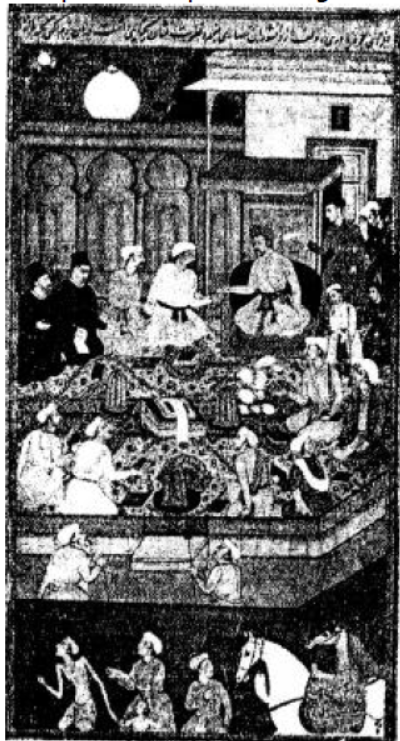
Question 1. Identify the emperor.
Answer: The illustration depicts the Mughal Emperor Akbar.
In simple words: The emperor shown in the picture is Akbar.
Exam Tip: Identify the emperor as Akbar, famous for hosting inter-faith debates.
Question 2. Which religious communities participated in the discussions?
Answer: The discussions included scholars from diverse religious communities, including Muslim clerics, Hindu philosophers, Buddhist and Jain monks, Parsi priests, and Jesuit Christian missionaries.
In simple words: Scholars from different religions, including Hinduism, Islam, Buddhism, Jainism, Zoroastrianism, and Christianity, participated in these discussions.
Exam Tip: List at least three religious groups - such as Hindus, Muslims, and Jesuits - to show the diverse nature of these assemblies.
Question 3. Why did the emperor organize these assemblies?
Answer: Akbar organized these inter-faith assemblies to understand the core principles and spiritual teachings of different religions, aiming to find common ground and promote religious harmony across his diverse empire.
In simple words: He organized these meetings to understand the teachings of different religions and promote peace and harmony among his subjects.
Exam Tip: Explain that his goal was to understand different religious philosophies to promote mutual tolerance and harmony.
Free study material for History Civics
ICSE Goyal Brothers Solutions Class 7 History Civics Chapter 8 Akbar The Great
Students can now access the detailed Goyal Brothers Solutions for Chapter 8 Akbar The Great on our portal. These solutions have been carefully prepared as per latest ICSE Class 7 syllabus. Each solution given above has been updated based on the current year pattern to ensure Class 7 students have the most updated History Civics content.
Master Goyal Brothers Textbook Questions
Our subject experts have provided detailed explanations for all the questions found in the Goyal Brothers textbook for Class 7 History Civics. We have focussed on making the concepts easy for you in Chapter 8 Akbar The Great so that students can understand the concepts behind every answer. For all numerical problems and theoretical concepts these solutions will help in strengthening your analytical skill required for the ICSE examinations.
Complete History Civics Exam Preparation
By using these Goyal Brothers Class 7 solutions, you can enhance your learning and identify areas that need more attention. We recommend solving the History Civics Questions from the textbook first and then use our teacher-verified answers. For a proper revision of Chapter 8 Akbar The Great, students should also also check our Revision Notes and Sample Papers available on studiestoday.com.
FAQs
You can download the verified Goyal Brothers solutions for Chapter 8 Akbar The Great on StudiesToday.com. Our teachers have prepared answers for Class 7 History Civics as per 2026-27 ICSE academic session.
Yes, our solutions for Chapter 8 Akbar The Great are designed as per new 2026 ICSE standards. 40% competency-based questions required for Class 7, are included to help students understand application-based logic behind every History Civics answer.
Yes, every exercise in Chapter 8 Akbar The Great from the Goyal Brothers textbook has been solved step-by-step. Class 7 students will learn History Civics conceots before their ICSE exams.
Yes, follow structured format of these Goyal Brothers solutions for Chapter 8 Akbar The Great to get full 20% internal assessment marks and use Class 7 History Civics projects and viva preparation as per ICSE 2026 guidelines.