

ICSE Solutions Goyal Brothers Class 7 History Civics Chapter 9 Jahangir Shah Jahan And Aurangzeb have been provided below and is also available in Pdf for free download. The Goyal Brothers ICSE solutions for Class 7 History Civics have been prepared as per the latest syllabus and ICSE books and examination pattern suggested in Class 7. Questions given in ICSE Goyal Brothers book for Class 7 History Civics are an important part of exams for Class 7 History Civics and if answered properly can help you to get higher marks. Refer to more Chapter-wise answers for ICSE Class 7 History Civics and also download more latest study material for all subjects. Chapter 9 Jahangir Shah Jahan And Aurangzeb is an important topic in Class 7, please refer to answers provided below to help you score better in exams
Goyal Brothers Chapter 9 Jahangir Shah Jahan And Aurangzeb Class 7 History Civics ICSE Solutions
Class 7 History Civics students should refer to the following ICSE questions with answers for Chapter 9 Jahangir Shah Jahan And Aurangzeb in Class 7. These ICSE Solutions with answers for Class 7 History Civics will come in exams and help you to score good marks
Chapter 9 Jahangir Shah Jahan And Aurangzeb Goyal Brothers ICSE Solutions Class 7 History Civics
Important Words
- Chain of Justice: A famous gold chain set up by Emperor Jahangir. It had 60 bells and was stretched from his palace to the banks of the Yamuna River. This allowed any citizen to ring the bells and ask the Emperor for justice.
- Engineer King: A title given to Emperor Shah Jahan because he built so many beautiful monuments and supported art and architecture during his rule.
- Shahjahanabad: A new capital city constructed by Shah Jahan. Today, this historic area is called Old Delhi.
Time To Learn
I. Fill in the blanks:
Question 1. Taj Mahal, a symbol of love, shows a variety of __________ influences.
Answer: cultural.
In simple words: The Taj Mahal, which is a symbol of love, was built using ideas from different cultures.
Exam Tip: The Taj Mahal is a perfect example of how different architectural styles from Persian, Islamic, and Indian traditions came together.
Question 2. Jahangir installed a __________ for the seekers of justice.
Answer: chain of justice.
In simple words: Jahangir put up a special chain that people could pull if they wanted justice.
Exam Tip: It was made of gold and had 60 bells to allow any person to request a direct trial with the Emperor.
Question 3. The treaty of Purandhar was signed between Mughals and Rajput ruler __________.
Answer: Jai Singh.
In simple words: The treaty of Purandhar was signed between the Mughals and the Rajput ruler Jai Singh.
Exam Tip: Jai Singh acted as the general representing the Mughal Emperor Aurangzeb in this treaty with Shivaji.
Question 4. The original name of Nur Jahan was __________.
Answer: Mehrunnisa.
In simple words: Before she was named Nur Jahan, her actual name was Mehrunnisa.
Exam Tip: Be sure to spell 'Mehrunnisa' correctly to ensure full marks on this question.
Question 5. Bijapur was annexed in __________.
Answer: AD 1686.
In simple words: The kingdom of Bijapur was captured and added to the Mughal Empire in 1686.
Exam Tip: Memorize the year 1686 for Bijapur, which was a major conquest during Aurangzeb's Deccan campaigns.
Question 6. Aurangzeb reimposed Jazia and __________.
Answer: pilgrimage tax.
In simple words: Aurangzeb brought back the Jazia tax and the tax on visiting religious places.
Exam Tip: Reversing Akbar's policy of toleration, Aurangzeb reimposed these taxes on his non-Muslim subjects.
Question 7. Guru Tegh Bahadur, ninth Sikh guru, was executed on __________ order.
Answer: Aurangzeb's.
In simple words: The ninth Sikh Guru, Tegh Bahadur, was put to death on the orders of Emperor Aurangzeb.
Exam Tip: The execution of Guru Tegh Bahadur in Delhi remains a key historical event that fueled Sikh resistance.
Question 8. The Sikhs were organised into a military force called the __________.
Answer: Khalsa.
In simple words: The Sikhs were gathered into a strong warrior group named the Khalsa.
Exam Tip: The Khalsa was established by the tenth Sikh Guru, Guru Gobind Singh, in 1699.
Question II. Match Column A with Column B:
| Column A | Column B |
|---|---|
| 1. Jahangir's son | (a) 1707 |
| 2. Guru Arjan Dev | (b) was the ruler of Marwar. |
| 3. Red Fort | (c) was martyred at Delhi. |
| 4. Nur Jahan | (d) Shah Jahan |
| 5. Death of Aurangzeb | (e) was the ambitious queen of Jahangir. |
| 6. Guru Tegh Bahadur | (f) Khusrau revolted during the first year of his reign. |
| 7. Ajit Singh | (g) the fifth Sikh guru, was tortured to death by Jahangir. |
Answer:
1. Jahangir's son - (f) Khusrau revolted during the first year of his reign.
2. Guru Arjan Dev - (g) the fifth Sikh guru, was tortured to death by Jahangir.
3. Red Fort - (d) Shah Jahan.
4. Nur Jahan - (e) was the ambitious queen of Jahangir.
5. Death of Aurangzeb - (a) 1707.
6. Guru Tegh Bahadur - (c) was martyred at Delhi.
7. Ajit Singh - (b) was the ruler of Marwar.
In simple words: This list matches Mughal rulers, their family members, and Sikh Gurus with key historical events and dates.
Exam Tip: Be sure to match the death of Aurangzeb with 1707, as it marks the beginning of the decline of the Mughal Empire.
III. State whether the following statements are True or False:
Question 1. Jahangir left the administration in the hands of his queen,Nur Jahan.
Answer: True.
In simple words: Yes, Jahangir let his intelligent queen, Nur Jahan, run the government.
Exam Tip: Nur Jahan became the virtual ruler of the empire, and coins were even issued in her name.
Question 2. Nur Jahan’s influence was good and lasting for theMughal Empire.
Answer: False.
In simple words: This is false because her influence created groups and power struggles, which did not help the empire in the long run.
Exam Tip: Nur Jahan's ambition and favoritism toward her own relatives created deep rifts in the Mughal court.
Question 3. Shah Jahan had to fight for the throne.
Answer: True.
In simple words: Yes, Shah Jahan had to struggle against his brothers to become the Emperor.
Exam Tip: This power struggle was common in Mughal history, where there was no clear law of succession.
Question 4. Shah Jahan married Mumtaz Mahal, in whose memory the built the Taj.
Answer: True.
In simple words: Yes, Shah Jahan built the Taj Mahal to remember his beloved wife, Mumtaz Mahal.
Exam Tip: The Taj Mahal was built in Agra using pure white marble over a period of 20 years.
Question 5. Shah Jahan died in AD 1666, as a captive in the fort of Agra.
Answer: True.
In simple words: Yes, Shah Jahan was kept in prison in Agra Fort by his son Aurangzeb, where he passed away in 1666.
Exam Tip: Shah Jahan spent his final years looking at the Taj Mahal from his room in Agra Fort.
Question 6. Aurangzeb had friendly relation with the Rajputs and theMarathas.
Answer: False.
In simple words: This is false because Aurangzeb's strict rules made the Rajputs and Marathas his enemies.
Exam Tip: Aurangzeb's policies led to long, draining wars with both the Rajputs and the Marathas.
Question 7. The Sikhs were hostile to the Mughal Emperor after the execution of the ninth Sikh guru.
Answer: True.
In simple words: Yes, the Sikhs became major enemies of the Mughals after Guru Tegh Bahadur was executed.
Exam Tip: This event led the tenth Guru, Guru Gobind Singh, to form the Khalsa to fight the Mughals.
Question 8. Aurangzeb died in 1707 in the Red Fort at Delhi.
Answer: False.
In simple words: This is false because Aurangzeb actually died in Ahmednagar in the Deccan, not in Delhi.
Exam Tip: Aurangzeb spent his last 25 years fighting in the Deccan, where he ultimately passed away.
Question 9. Aurangzeb reimposed Jazia.
Answer: True.
In simple words: Yes, Aurangzeb brought back the Jazia tax on non-Muslims.
Exam Tip: Re-introducing Jazia alienated many of his subjects and caused widespread anger.
IV. Answer the following questions briefly:
Question 1. Jahangir is sometimes called a mixture of opposites. Discuss.
Answer: Jahangir had a character with both good and very bad sides. At times, he could be extremely cruel and give out very harsh punishments for minor crimes. Because of these contrasting traits, historians often describe him as a mixture of opposites.
In simple words: Jahangir was kind at times but also very cruel, giving harsh punishments for small mistakes. That is why historians call him a mixture of opposites.
Exam Tip: Mention his dual nature - his love for art and justice contrasted with his extreme cruelty - to write a complete answer.
Question 2. How did Jahangir deal with the European traders? Name two travellers who visited Jahangir’s court.
Answer: Jahangir kept friendly ties with European traders. He gave several trade benefits to the Portuguese. Two famous English travellers, Captain William Hawkins and Sir Thomas Roe, visited his court to get trade permissions.
In simple words: Jahangir was friendly with European traders and gave them tax benefits. Captain Hawkins and Sir Thomas Roe both visited his court.
Exam Tip: Be sure to name both Captain William Hawkins and Sir Thomas Roe, as they are crucial figures in early Indo-British trade history.
Question 3. The age of Shah Jahan is the Golden Age of Mughal rule. Do you agree? Give reasons for your answer.
Answer: Yes, Shah Jahan's reign is rightly called the Golden Age of the Mughal Empire. Here are the reasons:
1. His reign was peaceful and free from outside threats. He focused on keeping order, allowing trade to grow and bring immense wealth to the treasury.
2. He did many helpful works for public welfare. He built roads, canals, bridges, and rest houses (sarais), and also helped his subjects during famines and plagues.
3. His deep love for art and beauty led to a Golden Age of Mughal Architecture. He built magnificent structures, including the world-famous Taj Mahal in Agra.
In simple words: Yes, Shah Jahan's rule was a Golden Age because the country was peaceful and wealthy. He built public roads and canals, helped during disasters, and constructed famous monuments like the Taj Mahal.
Exam Tip: Be sure to divide your answer into three distinct points: Peace & Wealth, Public Welfare, and Architecture.
Question 4. Describe the religious policy of Aurangzeb. What were its results?
Answer: Aurangzeb's religious policy focused on two main goals:
1. Spreading the rules of Islam and making sure citizens followed them.
2. Implementing strict measures against non-Muslims.
This orthodox policy reversed Akbar's policy of religious toleration, which weakened the foundations of the Mughal Empire. It sparked many wars and rebellions across the nation, including conflicts with:
1. The Jats.
2. The Satnamis.
3. The Sikhs.
4. The Rajputs.
5. The Marathas.
These continuous wars ruined the country's economy, weakened the administration, and destroyed the peace of the empire. This ultimately led to the decline of the Mughal Empire.
In simple words: Aurangzeb tried to force Islamic rules and taxed non-Muslims. This ended Akbar's policy of tolerance and started wars with Sikhs, Rajputs, and Marathas, which eventually destroyed the empire.
Exam Tip: Explain the direct link between Aurangzeb's reversal of Akbar's religious tolerance and the subsequent rebellions that weakened the empire.
Question 5. Who were the Sikhs? How did they emerge as a political power?
Answer: The Sikhs were a community organized into a military brotherhood called the Khalsa. After the execution of the ninth Guru, Guru Tegh Bahadur, on Aurangzeb's orders, open wars broke out between the Sikhs and the Mughals. Both Aurangzeb and his successors faced constant trouble from this group. After his death, weak Mughal emperors could not check their rising power, allowing the Sikhs to emerge as a strong political force.
In simple words: The Sikhs were a community that formed a warrior group called the Khalsa. When the Mughals executed their ninth Guru, they fought back and gradually grew into a strong political power.
Exam Tip: Mention the execution of Guru Tegh Bahadur and the role of the Khalsa as the turning points for Sikh political rise.
Question 6. Briefly describe aurangzeb’s clash with : (a) the Rajputs, (b) the Marathas, (c) the Sikhs.
Answer:
(a) Clash with the Rajputs:
Aurangzeb treated the Rajput rulers poorly. He kept prominent leaders like Raja Jai Singh and Raja Jaswant Singh away from his court in Delhi. Although Jai Singh was a highly loyal general, Aurangzeb suspected and insulted him after Shivaji escaped from Agra.
(b) Clash with the Marathas:
Wars broke out between the Mughals and the Marathas as both sides fought for control and victory in the Deccan, particularly over the conquest of Bijapur.
(c) Clash with the Sikhs:
Ties between the Sikhs and Mughals had been bad since Jahangir executed Guru Arjan Dev for helping his rebel son. This hostility grew much worse under Aurangzeb. The tenth Guru, Guru Gobind Singh, continued his father's struggle and organized open military campaigns against the Mughals.
In simple words: Aurangzeb insulted loyal Rajput generals like Jai Singh, fought the Marathas over land in the Deccan, and clashed with the Sikhs after executing their Gurus, turning all three groups into his enemies.
Exam Tip: Be sure to keep your answers separate under (a), (b), and (c) to address each of the three conflicts clearly.
Question 7. Why do you think Aurangzeb reimposed some taxes?
Answer: Aurangzeb brought back the Jazia and pilgrimage taxes on non-Muslims as part of his strict and orthodox religious views.
In simple words: Aurangzeb brought back these taxes because of his strict and old-fashioned religious views.
Exam Tip: Explain that these taxes reversed Akbar's secular policies and alienated his non-Muslim subjects.
Question 8. Explain the factors responsible for the decline of the Mughal empire.
Answer: The main factors that led to the decline of the Mughal Empire were:
1. Aurangzeb's strict policies: His orthodox religious views led him to bring back the Jazia and pilgrimage taxes. This angered many communities like the Jats, Sikhs, and Marathas, turning them into enemies.
2. Aurangzeb's Deccan campaigns: Capturing Bijapur and Golconda made the empire too large to manage easily. Furthermore, because Aurangzeb spent nearly 25 years fighting in the Deccan, he ignored the north, which allowed the Marathas to grow stronger.
3. Incompetent successors: Rulers after Aurangzeb were weak and could not stop rebellions or control the wealthy nobles. As a result, governors of wealthy states like Bengal, Awadh, and the Deccan broke away and became independent.
4. An empty treasury: Running a giant army and fighting continuous wars in the Deccan drained the empire's wealth. After Aurangzeb died in 1707, the treasury was empty, and later rulers could not even pay their soldiers.
In simple words: The empire fell because of Aurangzeb's harsh taxes, his long and expensive wars in the Deccan, weak rulers who could not stop rebellions, and an empty treasury that could not pay the army.
Exam Tip: Memorize the four key headings: Faulty Policies, Deccan Campaigns, Weak Successors, and Empty Treasury.
V. Write a short note on
Question 1. Aurangzeb’s Deccan Campaigns
Answer: Aurangzeb wanted to defeat the rising power of the Marathas in the Deccan. The Marathas were brave and strong, and they refused to accept Mughal control. Since the Deccan region was very large and wealthy, Aurangzeb wanted to capture it and bring it under his direct rule.
In simple words: Aurangzeb went to the Deccan to defeat the brave Marathas and take control of this very large and wealthy region.
Exam Tip: Explain that these campaigns kept him away from the north for 25 years, causing administrative neglect in Delhi.
Question 2. Abdali’s invasion on India
Answer: Ahmad Shah Abdali attacked India many times between 1747 and 1767. In 1761, he heavily defeated the Marathas during the Third Battle of Panipat. After this massive defeat, the Marathas could never recover their old power.
In simple words: Ahmad Shah Abdali invaded India many times and defeated the Marathas in 1761 at the Third Battle of Panipat, ending their power.
Exam Tip: Note the year 1761 and the name of the battle (Third Battle of Panipat) as they are critical facts.
Additional Questions
(Jahangir, Shah Jahan and Aurangzeb)
Fill in the blanks:
Question 1. Nur Jahan became the __________ ruler of the Mughal empire.
Answer: virtual.
In simple words: Nur Jahan became the actual power running the entire Mughal Empire.
Exam Tip: Focus on the word 'virtual' to describe her massive power behind the throne.
Question 2. During the final years of Jahangir’s reign, there was a power struggle between __________ and __________.
Answer: Nur Jahan and Shah Jahan.
In simple words: Near the end of Jahangir's rule, a big fight for power broke out between Nur Jahan and Shah Jahan.
Exam Tip: Nur Jahan wanted her son-in-law to succeed, while Shah Jahan wanted the throne for himself.
Question 3. Shah Jahan’s reign is often referred to as the __________ of the Mughal empire.
Answer: Golden Age.
In simple words: Shah Jahan's rule is widely called the Golden Age of the Mughal Empire.
Exam Tip: It is called the Golden Age because of its peace, immense wealth, and magnificent architecture.
Question 4. Aurangzeb spent the first half of his reign in the __________ and the second half in the __________.
Answer: North and the Deccan.
In simple words: Aurangzeb lived in northern India during the first half of his rule, and spent the second half fighting in the south.
Exam Tip: Remember these two distinct geographical phases: North first, and then the Deccan.
Question 5. Aurangzeb spent the last __________ years of his reign fighting against the __________ and the Sultanates of __________ and Golconda.
Answer: twenty-six, Marathas, Bijapur.
In simple words: Aurangzeb spent his last 26 years fighting the Marathas and the southern kingdoms of Bijapur and Golconda.
Exam Tip: Memorize the numbers and names: twenty-six years, Marathas, and Bijapur.
B. Match the following:
Question. Match the following:
| Column A | Column B |
|---|---|
| 1. Salim | (a) son of Jahangir |
| 2. Khusrau | (b) wife of Shah Jahan |
| 3. Nur Jahan | (c) red sandstone |
| 4. Taj Mahal | (d) son of Akbar |
| 5. Mumtaz Mahal | (e) wife of Jahangir |
| 6. Red Fort | (f) white marble |
Answer:
1. Salim - (d) son of Akbar.
2. Khusrau - (a) son of Jahangir.
3. Nur Jahan - (e) wife of Jahangir.
4. Taj Mahal - (f) white marble.
5. Mumtaz Mahal - (b) wife of Shah Jahan.
6. Red Fort - (c) red sandstone.
In simple words: This list matches key members of the Mughal royal family and major historical monuments with their correct details.
Exam Tip: Remember that 'Salim' was the childhood name of Emperor Jahangir, who was Akbar's son.
C. Choose the correct answer:
Question 1. Whose strong foundations meant that Jahangir did not face any major problems in maintaining the empire?
(a) Akbar
(b) Babur
(c) Humayun
(d) None of the options
Answer: (a) Akbar
In simple words: The strong government system set up by Akbar made it very easy for Jahangir to run the empire.
Exam Tip: Akbar's strong administrative foundations provided a stable empire that his successors could easily maintain.
Question 2. Which magnificent structure did Shah Jahan build in memory of his wife Mumtaz Mahal?
(a) Agra Fort
(b) Taj Mahal
(c) Red Fort
(d) None of the options
Answer: (b) Taj Mahal
In simple words: Shah Jahan constructed the Taj Mahal to honor and remember his wife Mumtaz Mahal.
Exam Tip: This monument is located in Agra and is celebrated as a masterpiece of white marble architecture.
Question 3. Which new city did Shah Jahan build?
(a) Fatehpur Sikri
(b) Daulatabad
(c) Shahjahanabad
(d) None of the options
Answer: (c) Shahjahanabad
In simple words: Shah Jahan built a new capital city named Shahjahanabad, which is today called Old Delhi.
Exam Tip: Shahjahanabad served as the capital of the empire and is today recognized as Old Delhi.
Question 4. Aurangzeb's reign can be roughly divided into how many periods?
(a) four
(b) three
(c) two
(d) None of the options
Answer: (c) two
In simple words: Aurangzeb's reign is divided into two parts: his time in the North and his time in the Deccan.
Exam Tip: The two halves represent his focus on northern administration first, followed by his military campaigns in the Deccan.
Question 5. One of the most serious challenges faced by Aurangzeb came from which group in the Deccan?
(a) Sikhs
(b) Marathas
(c) Rajputs
(d) None of the options
Answer: (b) Marathas
In simple words: The strongest challenge Aurangzeb faced in the south came from the Marathas.
Exam Tip: The Marathas, under Shivaji and his successors, waged constant guerrilla warfare that drained Mughal resources.
D. State whether the following are true or false:
Question 1. Jahangir defeated the Rana of Mewar.
Answer: True.
In simple words: Yes, Jahangir successfully defeated the Rana of Mewar, who then agreed to be loyal to him.
Exam Tip: This victory established Mughal supremacy in Rajputana and fulfilled a goal that Akbar had left unfinished.
Question 2. Jahangir is said to have installed a chain of justice.
Answer: True.
In simple words: Yes, Jahangir set up a gold chain of justice with bells for any citizen to ring.
Exam Tip: This gold chain stretched from his palace in Agra to the banks of the river Yamuna.
Question 3. The Peacock Throne was taken to Persia by Nadir Shah.
Answer: True.
In simple words: Yes, the famous golden Peacock Throne was captured and taken away to Persia by Nadir Shah in 1739.
Exam Tip: The plunder of Delhi and the theft of the Peacock Throne in 1739 severely weakened the prestige of the later Mughals.
Question 4. The Jama Masjid is said to be the most perfect of Jahangir’s buildings.
Answer: False.
In simple words: This is false because the Jama Masjid was built by Emperor Shah Jahan, not Jahangir.
Exam Tip: The Jama Masjid of Delhi is one of the largest and most magnificent mosques built by Shah Jahan.
E. Answer the following questions in one or two words/ sentences:
Question 1. Why did Jahangir not face any major problems in maintaining his large empire?
Answer: Jahangir ruled smoothly because of the extremely strong administrative and political systems built by his father, Akbar.
In simple words: Jahangir did not have major troubles because Akbar had left him a highly stable and strong empire.
Exam Tip: Akbar's efficient system of government provided a stable structure that his successors could easily manage.
Question 2. Name Jahangir’s son who rebelled against him.
Answer: Jahangir's eldest son, Prince Khusrau, rebelled against him.
In simple words: Prince Khusrau, who was Jahangir's oldest son, rebelled against him.
Exam Tip: Remember to write the full name 'Prince Khusrau' clearly.
Question 3. Why is Shah Jahan known as the Engineer King?
Answer: Shah Jahan is called the Engineer King because of his immense contributions to architecture. He built beautiful monuments that remain famous today, such as the white marble Taj Mahal in Agra, the Moti Masjid inside Agra Fort, and the grand Jama Masjid in Delhi.
In simple words: Shah Jahan is called the Engineer King because he constructed so many famous and beautiful monuments, like the Taj Mahal and Jama Masjid.
Exam Tip: Always list key monuments like the Taj Mahal, Moti Masjid, and Jama Masjid as examples to support your answer.
Question 4. Which fort did Shah Jahan build in the new city of Shahjahanabad?
Answer: He constructed the famous Red Fort in Shahjahanabad.
In simple words: Shah Jahan built the Red Fort in his new city.
Exam Tip: This building is also known as Lal Qila and is constructed entirely of red sandstone.
Question 5. Who succeeded Shah Jahan as the Mughal emperor?
Answer: His third son, Aurangzeb, took the throne after him.
In simple words: Aurangzeb, who was Shah Jahan's third son, became the next Emperor.
Exam Tip: Aurangzeb succeeded him after winning a fierce war of succession against his brothers.
Question 6. State any one major cause of the decline of the Mughal empire.
Answer: One major cause was the heavy spending on military campaigns and grand building projects, which completely emptied the royal treasury.
In simple words: The empire became weak because the rulers spent too much money on wars and building grand monuments, leaving the treasury empty.
Exam Tip: Pointing out this financial drain is highly important for any essay on the fall of the Mughals.
Question 7. What was the nature of Aurangzeb’s Rajput policy in the early years of his reign?
Answer: In his early years, Aurangzeb continued Akbar's policy of keeping friendly ties with the Rajputs. He gave them high military ranks (mansabs) and tried to win their trust.
In simple words: At first, Aurangzeb followed Akbar's friendly policy by giving Rajput leaders high ranks and trying to win their support.
Exam Tip: Note that his policy changed completely in later years, leading to hostile relations and rebellions.
Question 8. What were the objectives of Aurangzeb’s Deccan policy?
Answer: Aurangzeb wanted to defeat the rising power of the brave Marathas, who refused to accept his control. Since the southern states were vast and wealthy, he also wanted to conquer them to bring the entire region under his direct rule.
In simple words: Aurangzeb's goals were to defeat the brave Marathas and capture the large, wealthy kingdoms in southern India.
Exam Tip: State both goals: crushing the Maratha power and annexing the wealthy Sultanates of Bijapur and Golconda.
Question 9. Why did the annexation of Bijapur and Golconda prove harmful for the Mughal empire?
Answer: Capturing these states made the Mughal Empire too large and difficult to manage. It also brought the Mughals into direct, hostile contact with the Marathas.
In simple words: It made the empire too big to run easily and brought the Mughals into direct, daily fights with the Marathas.
Exam Tip: Point out both factors: the administrative burden of a vast empire, and the direct conflict with the Maratha forces.
F. Answer the following questions briefly:
Question 1. Jahangir fulfilled Akbar’s unrealized imperial dreams by conquering Mewar. Explain.
Answer: Jahangir sent a military campaign against Rana Amar Singh of Mewar, who had refused to accept Mughal rule. After being defeated, the Rana pledged his loyalty to Jahangir, who treated him with great respect. Jahangir allowed the Rana to keep his lands and appointed his son, Karan, as an officer in the Mughal army. This victory established Mughal supremacy in Rajputana and ended the last major Rajput resistance.
In simple words: Jahangir defeated the Rana of Mewar but treated him with great respect, letting him keep his lands and hiring his son as a general. This finally established Mughal rule in Mewar.
Exam Tip: Emphasize Jahangir's respectful and diplomatic treatment of the Rana, which helped secure Rajput loyalty.
Question 2. To what extent were Jahangir’s Deccan campaigns successful?
Answer: Jahangir sent a campaign under Prince Khurram, who successfully captured the fort of Ahmadnagar. For this win, he was given the title of Shah Jahan. However, the fighting continued, and by the end of Jahangir's rule, Ahmadnagar won back its freedom and remained independent.
In simple words: Prince Khurram won a victory in Ahmadnagar, but by the end of Jahangir's reign, the state declared its independence again. Thus, the campaigns had only temporary success.
Exam Tip: Explain that while Prince Khurram won a prestigious title, the victory was temporary as Ahmadnagar ultimately broke away.
Question 3. What qualities did Nur Jahan possess to make her worthy of her name?
Answer: Nur Jahan's name means "Light of the World," which matched her great qualities. She was beautiful, highly educated, intelligent, and cultured. She excelled as a poet and a designer of fabrics and jewelry. She was also brave and courageous, helping the Emperor make important government decisions.
In simple words: Nur Jahan was intelligent, beautiful, and artistic. She was a good designer and also very brave, helping the Emperor make decisions.
Exam Tip: Be sure to highlight both her cultural talents (poetry, fashion design) and her political courage.
Question 4. Nur Jahan was very ambitious and eventually became the power behind the throne. Explain.|
Answer: Nur Jahan was highly ambitious and quickly became the actual power behind the throne. Jahangir consulted her on all state affairs and eventually left the entire administration in her hands. While Jahangir spent his time indulging in wine and opium, coins were printed with both of their names. Nur Jahan used her massive influence to appoint her father and brother to top government posts. She also arranged the marriage of her niece, Mumtaz Mahal, to Prince Khurram.
In simple words: Nur Jahan became the real ruler of the empire because Jahangir left the administration in her hands. She printed her name on coins and gave top government jobs to her family members.
Exam Tip: Mention key details like joint coins and the appointment of her relatives to show how she controlled the administration.
Question 5. Shah Jahan’s reign was an age of splendour and cultural brilliance. In this context, discuss:
(a) Taj Mahal
(b) Red Fort
Answer:
(a) Taj Mahal:
This masterpiece took over 20 years to build and cost nearly one crore rupees. Constructed from pure white marble, it features beautiful decorations of semi-precious stones and detailed screens. The octagonal monument is topped by a large dome and has four tall minarets, all surrounded by gardens.
(b) Red Fort:
Built of red sandstone, this fort holds several beautiful structures inside its walls. The most grand room is the Diwan-i-Khas, which has a silver ceiling and marble walls decorated with gold and semi-precious stones.
In simple words: The Taj Mahal was built in Agra using white marble and semi-precious stones. The Red Fort was made of red sandstone, with beautiful halls like the Diwan-i-Khas inside it.
Exam Tip: Be sure to keep the answers separate under (a) and (b) as given in the question format.
Question 6. Why did Aurangzeb’s Deccan campaign against the Marathas prove to be a ruinous misadventure? What were the long-term consequences of this campaign?
Answer: His campaign in the Deccan was a huge mistake that showed a lack of political wisdom. Since Aurangzeb was highly suspicious and did not trust his sons or generals, he interfered in every department. His strict religious policies also made him highly unpopular. He spent 25 years in the Deccan fighting the Marathas, which completely drained the empire's wealth and neglected the north. By the time he died, his treasury was empty and his army was exhausted. This campaign ultimately broke the power of the Mughals, causing the vast empire to shrink to just a few miles around Delhi.
In simple words: Aurangzeb spent 25 years in the Deccan trying to defeat the Marathas. This wasted the empire's wealth, neglected northern administration, and ultimately broke the power of the Mughals.
Exam Tip: Point out both the financial drain on the treasury and the political neglect of the north as the key long-term consequences.
Question 7. Why did Aurangzeb fail as a ruler?
Answer: Though Aurangzeb had good personal qualities, he failed as a ruler. Unlike Akbar, he was unable to follow a policy of religious tolerance. He made enemies of the Rajputs, Sikhs, and Marathas. His highly suspicious nature alienated his own generals and officials, and his biased policies made him very unpopular among his subjects.
In simple words: Aurangzeb failed because he was too suspicious and lacked religious tolerance. This turned groups like the Sikhs, Rajputs, and Marathas into his enemies.
Exam Tip: Mention his suspicious nature and his lack of religious tolerance as the main reasons for his failure.
Question 8. Briefly explain the negative aspects of Shah Jahan’s reign that eventually led to the decline of the Mughal empire.
Answer: While Shah Jahan continued Akbar's policy of friendship and tolerance, his reign had some major negative aspects:
1. His military campaigns to Central Asia and expensive building projects emptied the royal treasury.
2. He increased taxes on farmers and peasants to raise money.
3. According to Bernier, many rural villages were ruined, which severely damaged agriculture and the empire's economy.
4. The failure of his military campaigns showed that the Mughal army was losing its strength.
5. The government administration grew larger, but corruption also increased.
In simple words: The bad sides of Shah Jahan's reign were the empty treasury caused by expensive buildings and wars, heavy taxes on poor farmers that ruined villages, and growing corruption in the government.
Exam Tip: Be sure to write at least four negative aspects, highlighting the empty treasury, heavier taxes, agricultural decline, and army weakness.
G. Picture study
This is a picture of a 17th century-CE monument, built in red sandstone by a Mughal emperor.
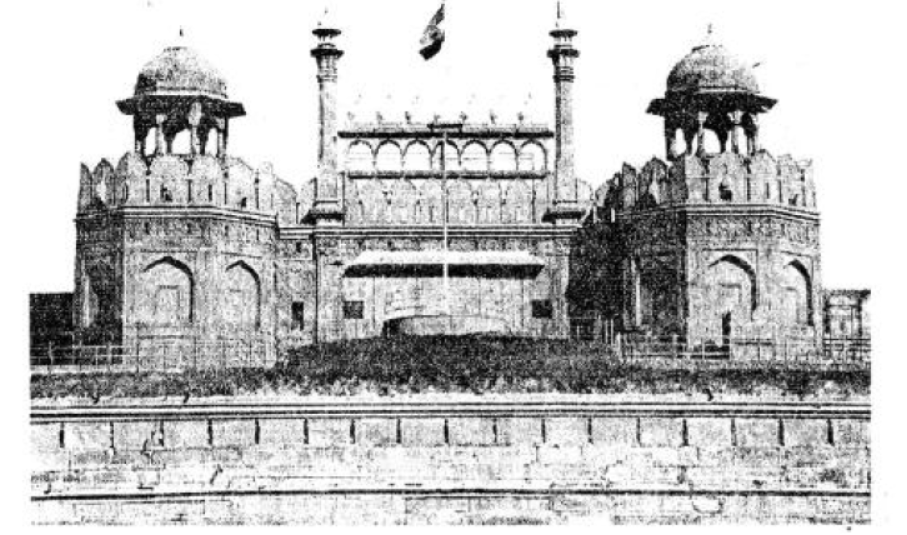
Question 1. Identify the monument.
Answer: This monument is the Red Fort.
In simple words: The picture shows the Red Fort.
Exam Tip: This fort is also known as Lal Qila and is located in Old Delhi.
Question 2. Where is it located?
Answer: It is located in Old Delhi.
In simple words: It is in Old Delhi.
Exam Tip: It served as the palace fort of the new capital city, Shahjahanabad.
Question 3. Who built this monuments?
Answer: This monument was built by Emperor Shah Jahan.
In simple words: Shah Jahan built this monument.
Exam Tip: Shah Jahan built it when he shifted his capital from Agra to Delhi.
Question 4. Name two important buildings inside this monument.
Answer: Two major structures inside the fort are:
(a) The Diwan-i-Khas (Hall of Private Audience).
(b) The Diwan-i-Aam (Hall of Public Audience).
In simple words: Two important buildings inside the Red Fort are the Diwan-i-Khas and the Diwan-i-Aam.
Exam Tip: Remember both of these halls as they represent the administrative and courtly life of the Mughals.
Question 5. Mention its important features.
Answer: The main features of these structures are:
- The Diwan-i-Khas is highly magnificent, featuring a ceiling made of silver and marble walls decorated with gold and semi-precious stones.
- The Diwan-i-Aam held Shah Jahan's famous golden Peacock Throne. This throne stood under a canopy with twelve emerald pillars, each decorated with gem-studded peacocks. It took seven years to build but was taken to Persia by Nadir Shah in 1739.
In simple words: The Diwan-i-Khas has a silver ceiling and marble walls decorated with gold. The Diwan-i-Aam held the famous golden Peacock Throne, which was later taken to Persia in 1739.
Exam Tip: Be sure to describe the silver ceiling of the Diwan-i-Khas and the emerald pillars of the Peacock Throne in the Diwan-i-Aam.
Free study material for History Civics
ICSE Goyal Brothers Solutions Class 7 History Civics Chapter 9 Jahangir Shah Jahan And Aurangzeb
Students can now access the detailed Goyal Brothers Solutions for Chapter 9 Jahangir Shah Jahan And Aurangzeb on our portal. These solutions have been carefully prepared as per latest ICSE Class 7 syllabus. Each solution given above has been updated based on the current year pattern to ensure Class 7 students have the most updated History Civics content.
Master Goyal Brothers Textbook Questions
Our subject experts have provided detailed explanations for all the questions found in the Goyal Brothers textbook for Class 7 History Civics. We have focussed on making the concepts easy for you in Chapter 9 Jahangir Shah Jahan And Aurangzeb so that students can understand the concepts behind every answer. For all numerical problems and theoretical concepts these solutions will help in strengthening your analytical skill required for the ICSE examinations.
Complete History Civics Exam Preparation
By using these Goyal Brothers Class 7 solutions, you can enhance your learning and identify areas that need more attention. We recommend solving the History Civics Questions from the textbook first and then use our teacher-verified answers. For a proper revision of Chapter 9 Jahangir Shah Jahan And Aurangzeb, students should also also check our Revision Notes and Sample Papers available on studiestoday.com.
FAQs
You can download the verified Goyal Brothers solutions for Chapter 9 Jahangir Shah Jahan And Aurangzeb on StudiesToday.com. Our teachers have prepared answers for Class 7 History Civics as per 2026-27 ICSE academic session.
Yes, our solutions for Chapter 9 Jahangir Shah Jahan And Aurangzeb are designed as per new 2026 ICSE standards. 40% competency-based questions required for Class 7, are included to help students understand application-based logic behind every History Civics answer.
Yes, every exercise in Chapter 9 Jahangir Shah Jahan And Aurangzeb from the Goyal Brothers textbook has been solved step-by-step. Class 7 students will learn History Civics conceots before their ICSE exams.
Yes, follow structured format of these Goyal Brothers solutions for Chapter 9 Jahangir Shah Jahan And Aurangzeb to get full 20% internal assessment marks and use Class 7 History Civics projects and viva preparation as per ICSE 2026 guidelines.