

ICSE Solutions Voyage Class 7 Geography Chapter 17 Australia Climate Natural Vegetation Wildlife Forest And Minerals have been provided below and is also available in Pdf for free download. The Voyage ICSE solutions for Class 7 Geography have been prepared as per the latest syllabus and ICSE books and examination pattern suggested in Class 7. Questions given in ICSE Voyage book for Class 7 Geography are an important part of exams for Class 7 Geography and if answered properly can help you to get higher marks. Refer to more Chapter-wise answers for ICSE Class 7 Geography and also download more latest study material for all subjects. Chapter 17 Australia Climate Natural Vegetation Wildlife Forest And Minerals is an important topic in Class 7, please refer to answers provided below to help you score better in exams
Voyage Chapter 17 Australia Climate Natural Vegetation Wildlife Forest And Minerals Class 7 Geography ICSE Solutions
Class 7 Geography students should refer to the following ICSE questions with answers for Chapter 17 Australia Climate Natural Vegetation Wildlife Forest And Minerals in Class 7. These ICSE Solutions with answers for Class 7 Geography will come in exams and help you to score good marks
Chapter 17 Australia Climate Natural Vegetation Wildlife Forest And Minerals Voyage ICSE Solutions Class 7 Geography
DISCUSS
Question. Discuss the roie of the Eastern Highlands in the climate of Australia.
Answer: The Eastern Highlands block the wet, rain-bearing winds from moving inland. Because of this barrier, most of Western Australia becomes a very dry desert.
In simple words: These mountains stop rain clouds from reaching the west, making most of Western Australia a dry desert.
Exam Tip: Remember that the Eastern Highlands act as a giant wall. They stop wet winds from crossing to the west side.
THINK AND ANSWER
Question. Why do we not find marsupials like kangaroo and wombat in other parts of the world ?
Answer: These unique animals live only in Australia because this land broke away from other continents about 200 million years ago. After that, the animals here grew and changed in their own special way, far apart from the rest of the world.
In simple words: Australia split off from other lands a very long time ago. This let its animals grow differently from animals in other places.
Exam Tip: Mention the timeline of 200 million years ago and the concept of geographical isolation to score full marks.
EXERCISES
Question A. Match the columns
Answer: Based on the textbook exercises, the correct matches are:
* acacia - (v) wattle
* joey - (iii) baby kangaroo
* death adder - (i) dangerous reptile
* echidna - (ii) monotreme
* kookaburra - (iv) laughing jackass
In simple words: This exercise matches Australian plants and animals with their common names or groups, like matching a joey to a baby kangaroo.
Exam Tip: Learn unique Australian terms, such as wattle for acacia and monotreme for egg-laying mammals like the echidna.
B. Identify who I am.
Question 1. i am an animal that lives entirely on the juicy leaves of the gum tree.
Answer: Koala
In simple words: The koala is a cute tree-climbing animal.
Exam Tip: Koalas eat only eucalyptus leaves, which are also called gum leaves.
Question 2. I am a wild dog found in Australia.
Answer: Dingo
In simple words: A dingo is a type of wild dog.
Exam Tip: The dingo is Australia's famous native wild dog.
Question 3. I am a mammal that lays eggs.
Answer: Platypus
In simple words: The platypus is a rare mammal that lays eggs.
Exam Tip: Platypus is a monotreme, which means an egg-laying mammal.
Question 4. I am a big Australian bird but I cannot fly.
Answer: Emu
In simple words: The emu is a huge bird that runs fast but cannot fly.
Exam Tip: The emu is one of the largest flightless birds in the world.
Question 5. I have a beautiful fan-tail and I can mimic very well.
Answer: Cassowary
In simple words: The cassowary is a large, colorful bird.
Exam Tip: Though lyrebirds are famous for mimicry, the textbook specifies cassowary here, so use that in your exam.
Question 6. I am a male bird who likes to attract female birds by building intricate and decorative nests.
Answer: Bower
In simple words: This bird builds beautiful, decorated nests to find a partner.
Exam Tip: The bowerbird uses colorful items like flowers and plastic to decorate its nest.
Question 7. I am popularly called the ‘laughing jackass’.
Answer: Kookaburra
In simple words: The kookaburra is a bird whose call sounds like human laughter.
Exam Tip: Remember that 'laughing jackass' is another name for the kookaburra.
C. Answer the following questions in brief.
Question 1. Name the winds that bring rainfall to Australia.
Answer: Three main winds bring rain to Australia. The South-East Trade Winds blow from the sea and bring lots of rain to the eastern coast. The Westerlies bring rain during winter to the south-west and south-east areas. Finally, the north-west monsoon winds bring rain to the northern part of the land.
In simple words: Different winds bring rain to different parts of Australia, like the South-East Trade Winds on the east coast.
Exam Tip: Learn the names of all three winds: South-East Trade Winds, Westerlies, and North-West Monsoons.
Question 2. What is the name of the temperate grassland in Australia?
Answer: These grasslands in Australia are known as the Downs.
In simple words: The grassy areas in Australia are called the Downs.
Exam Tip: The term 'Downs' is a key geographical name for Australia's temperate grasslands.
Question 3. What kind of natural vegetation can be seen in the desert regions of Australia ?
Answer: The plants that grow in these dry areas include cactus, spiky spinifex grass, and acacia. People in Australia often call the acacia tree 'wattle'.
In simple words: Only tough plants like cactus, spinifex grass, and acacia can grow in the dry Australian desert.
Exam Tip: Remember to mention 'wattle' as the local name for the acacia tree.
Question 4. Why is the wildlife of Australia considered unique in comparison to other countries ?
Answer: Australia has very unusual animals because it split off from other major landmasses about 200 million years ago. This long isolation allowed its animal life to grow in a completely different way compared to other places. Many of these animals are marsupials - mammals that carry their tiny babies in a pouch on their bellies.
In simple words: Because Australia has been on its own for millions of years, its animals grew differently. Many are marsupials that have pouches for their babies.
Exam Tip: Always explain that marsupials are mammals with pouches to carry their young.
Question 5. The platypus is considered a strange animal. Why ?
Answer: The platypus is a very odd creature because it lays eggs but still feeds its babies with milk. It is a furry animal that lives in water, has a flat beak like a duck, and has sharp, toxic spikes on its back legs.
In simple words: The platypus is weird because it is a furry water mammal that lays eggs like a bird and has a duck-like beak.
Exam Tip: A platypus is unique because it is an egg-laying mammal (monotreme) with duck-like features.
D. Answer the following questions in one or two paragraphs.
Question 1. Name the factors that influence the climate of Australia. Elaborate any two.
Answer: Many things shape the climate of Australia. These include its location on Earth, the shape of the land, the way mountain ranges run, the wind patterns, and how far places are from the ocean.
Here is an explanation of two key factors:
* **Location:** The top part of Australia is in the tropics, making it warm or hot throughout the year. The southern part lies below the Tropic of Capricorn, which means it has warm summers and cool winters.
* **Land Features:** The east coast gets lots of rain from ocean winds. However, as you move west, the rain drops quickly. This is because the Eastern Highlands act as a wall that blocks the wet winds from moving inland.
In simple words: Australia's weather is shaped by where it is, its winds, and its mountains. The north is hot, while the south has warm summers and cool winters.
Exam Tip: To get full marks, list all the factors first, then choose two (like Location and Land Features) to describe in detail.
Question 2. The Western Plateau region of Australia is mainly a desert. Why ?
Answer: The Eastern Highlands run along the east coast and catch most of the rain-bearing winds. As a result, the rain decreases as you go west, away from the sea. This leaves the middle and western parts of Australia very hot and dry, turning them into a desert.
In simple words: Mountains on the east coast block rain clouds from moving west, leaving the western plateau hot, dry, and desert-like.
Exam Tip: Explain that the rain decreases as you move westward because of the mountain barrier on the east coast.
Question 3. Briefly describe the climate and vegetation of the south-eastern and south-western coasts of Australia.
Answer: The climate and plant life on these coasts are shaped by the mountains and the sea. The eastern hills receive heavy rains, but the land gets much drier as you travel west.
The south-eastern and south-western coastal areas get their rain during winter from the Westerlies. This winter season lasts from April to September. These wet areas are home to temperate forests, which also grow in Tasmania. The most common tree here is the eucalyptus, or gum tree, with more than 900 types across Australia. This special tree keeps its leaves all year, but its bark sheds in strips to reveal a smooth, light-colored trunk.
In simple words: These coasts get winter rain from the Westerlies, helping dense eucalyptus forests grow. These trees keep their green leaves but shed their bark.
Exam Tip: Mention that the south-eastern and south-western coasts have a Mediterranean-like climate with winter rains and eucalyptus forests.
Question 4. What are marsupials ? Describe any one marsupial.
Answer: Marsupials are a special group of mammals. They carry their tiny, developing babies inside a pocket or pouch on their bellies. This pouch has milk glands to feed the young. Australia has around 150 different types of these animals. They range from huge kangaroos that grow taller than two meters to tiny bandicoots. Other famous examples include the koala, wombat, and wallaby.
For example, the kangaroo is a famous marsupial. It uses its strong back legs to hop and keeps its baby joey safe inside its belly pouch.
In simple words: Marsupials are mammals with a pouch on their belly to carry and feed their babies. Kangaroos and koalas are good examples.
Exam Tip: Define marsupials by their key feature: a stomach pouch with mammary glands to nurse their offspring.
Question 5. What are monotremes ? Give examples.
Answer: The platypus and the echidna are the only living monotremes on Earth. This means they are mammals that lay eggs instead of giving birth to live babies, but they still feed their young with milk. The platypus lives in water, has soft fur, a duck-like beak, and toxic spurs on its back legs. The echidna is a land animal that is covered in sharp spines, which is why it is often called the spiny anteater.
In simple words: Monotremes are rare mammals that lay eggs but still feed their babies with milk. The platypus and echidna are the only examples.
Exam Tip: Remember that monotremes are defined as egg-laying mammals. The platypus and echidna are the only two living examples.
E. Map Work
Question 1. Describe the vegetation of region C.
Answer: Temperate Grassland
In simple words: The plant life here is mostly grassy plains with few trees.
Exam Tip: Region C on the Australian map corresponds to the temperate grasslands, also called the Downs.
Question 2. What are the most outsanding characteristics of the climate of region B ?
Answer: Tropical Monsoon
In simple words: This area has a very hot, wet tropical monsoon climate.
Exam Tip: Region B in northern Australia experiences distinct wet and dry seasons due to monsoon winds.
Question 3. On the map, draw the South-East Trade Winds with red
Answer: We can show these winds by drawing red arrows on the map.
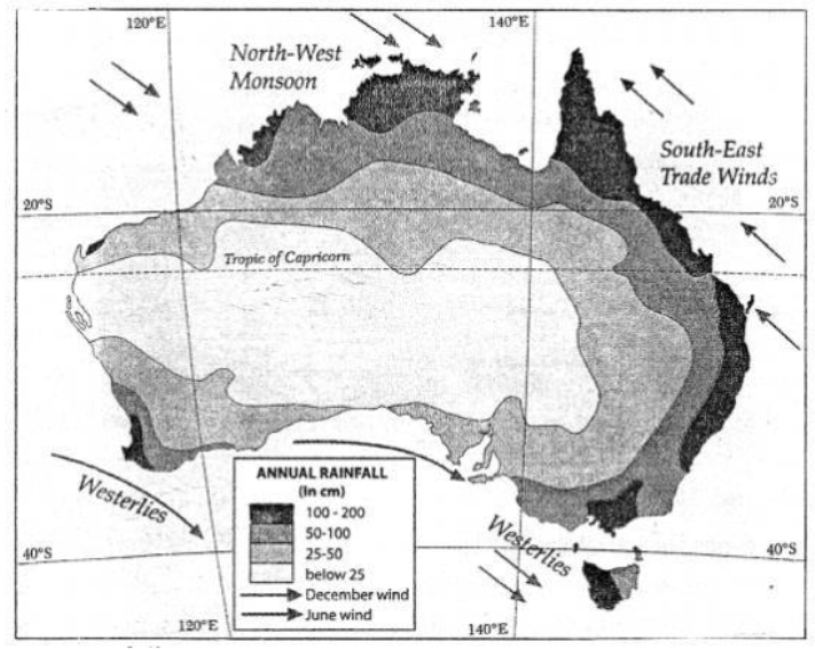
In simple words: Draw red arrows to show which way the winds blow.
Exam Tip: The South-East Trade Winds blow from the ocean toward the eastern coast of Australia.
Question 4. By what name are the temperate grasslands known in the Murray-Darling Basin ? Write the name in the appropriate place on the map.
Answer: In this basin, the grasslands are known as the Downs.
In simple words: These grasslands are called the Downs.
Exam Tip: The Murray-Darling Basin contains the famous agricultural grasslands known as the Downs.
F. Picture Study
This is a photograph of an eucalyptus tree, a common tree found in Australia. There are over 900 species of this tree in Australia.
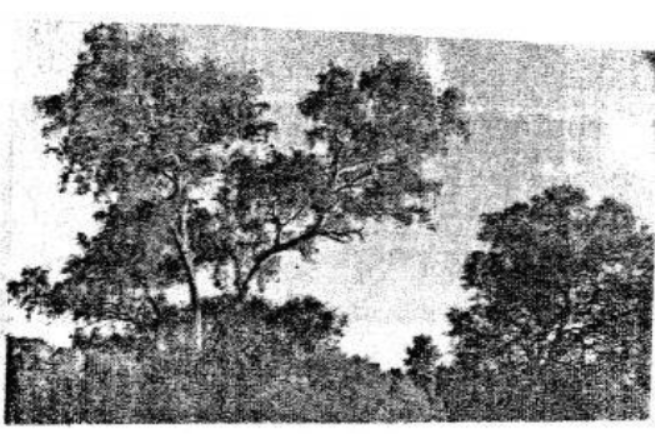
Question 1. What is the local name of this tree?
Answer: Eucalypt
In simple words: It is locally called the eucalypt or gum tree.
Exam Tip: The eucalyptus is the most common native tree in Australia.
Question 2. Which animal survivies by eating the leaves of this tree?
Answer: The koala is the famous animal that eats these leaves. This small, tree-climbing mammal grows to about 76 centimeters tall and eats only the fresh, juicy leaves of the eucalyptus tree.
In simple words: The koala lives in these trees and eats only their juicy leaves.
Exam Tip: Koalas are arboreal (tree-dwelling) marsupials that rely solely on eucalyptus leaves for food and water.
Free study material for Geography
ICSE Voyage Solutions Class 7 Geography Chapter 17 Australia Climate Natural Vegetation Wildlife Forest And Minerals
Students can now access the detailed Voyage Solutions for Chapter 17 Australia Climate Natural Vegetation Wildlife Forest And Minerals on our portal. These solutions have been carefully prepared as per latest ICSE Class 7 syllabus. Each solution given above has been updated based on the current year pattern to ensure Class 7 students have the most updated Geography content.
Master Voyage Textbook Questions
Our subject experts have provided detailed explanations for all the questions found in the Voyage textbook for Class 7 Geography. We have focussed on making the concepts easy for you in Chapter 17 Australia Climate Natural Vegetation Wildlife Forest And Minerals so that students can understand the concepts behind every answer. For all numerical problems and theoretical concepts these solutions will help in strengthening your analytical skill required for the ICSE examinations.
Complete Geography Exam Preparation
By using these Voyage Class 7 solutions, you can enhance your learning and identify areas that need more attention. We recommend solving the Geography Questions from the textbook first and then use our teacher-verified answers. For a proper revision of Chapter 17 Australia Climate Natural Vegetation Wildlife Forest And Minerals, students should also also check our Revision Notes and Sample Papers available on studiestoday.com.
FAQs
You can download the verified Voyage solutions for Chapter 17 Australia Climate Natural Vegetation Wildlife Forest And Minerals on StudiesToday.com. Our teachers have prepared answers for Class 7 Geography as per 2026-27 ICSE academic session.
Yes, our solutions for Chapter 17 Australia Climate Natural Vegetation Wildlife Forest And Minerals are designed as per new 2026 ICSE standards. 40% competency-based questions required for Class 7, are included to help students understand application-based logic behind every Geography answer.
Yes, every exercise in Chapter 17 Australia Climate Natural Vegetation Wildlife Forest And Minerals from the Voyage textbook has been solved step-by-step. Class 7 students will learn Geography conceots before their ICSE exams.
Yes, follow structured format of these Voyage solutions for Chapter 17 Australia Climate Natural Vegetation Wildlife Forest And Minerals to get full 20% internal assessment marks and use Class 7 Geography projects and viva preparation as per ICSE 2026 guidelines.