

ICSE Solutions Voyage Class 7 Geography Chapter 5 Study Of Weather have been provided below and is also available in Pdf for free download. The Voyage ICSE solutions for Class 7 Geography have been prepared as per the latest syllabus and ICSE books and examination pattern suggested in Class 7. Questions given in ICSE Voyage book for Class 7 Geography are an important part of exams for Class 7 Geography and if answered properly can help you to get higher marks. Refer to more Chapter-wise answers for ICSE Class 7 Geography and also download more latest study material for all subjects. Chapter 5 Study Of Weather is an important topic in Class 7, please refer to answers provided below to help you score better in exams
Voyage Chapter 5 Study Of Weather Class 7 Geography ICSE Solutions
Class 7 Geography students should refer to the following ICSE questions with answers for Chapter 5 Study Of Weather in Class 7. These ICSE Solutions with answers for Class 7 Geography will come in exams and help you to score good marks
Chapter 5 Study Of Weather Voyage ICSE Solutions Class 7 Geography
Values and Life Skills
Question. What would be the right thing to do if you see a pet locked inside a car on a hot day ?
Answer: It is never safe to leave pets inside a closed car. When the weather is hot, this can quickly become fatal. Very high temperatures inside the vehicle can damage their organs permanently or even kill them. We must all work together to keep animals safe and prevent these tragic deaths.
In simple words: Never leave pets in a parked car. The heat inside can harm them very quickly and even cause death.
Exam Tip: When writing about animal safety, focus on the quick rise in car temperature and its fatal effects.
Exercises
A. Write true or false. Correct the false statements.
Question 1. A rise in temperature causes more condensation while a fall in temperature results in evaporation.
Answer: This statement is false. The correct fact is that an increase in temperature leads to higher evaporation, whereas a temperature drop causes condensation.
In simple words: Warm temperatures turn water into vapor (evaporation), while cold temperatures turn vapor back into liquid (condensation).
Exam Tip: Remember that heating causes evaporation and cooling leads to condensation.
Question 2. ‘4 o’clock showers’ are caused by cyclonic rainfall.
Answer: False. The correct statement is that convection currents, rather than cyclones, cause the '4 o'clock showers'.
In simple words: The heavy afternoon rains near the equator are caused by rising warm air currents, not cyclones.
Exam Tip: In tropical areas, daily convectional heating leads to regular afternoon rainfall.
Question 3. Heavy rainfall occurs on the leeward or rain shadow side of a highland.
Answer: False. The correct fact is that the leeward or rain shadow side of a highland receives very little rainfall.
In simple words: The leeward side of a mountain stays dry because the clouds lose most of their water on the other side.
Exam Tip: Always associate the windward side with high rainfall and the leeward side with dry conditions.
Question 4. The direction of wind blowing on the surface of the earth is affected by the Coriolis force.
Answer: True. The Coriolis force plays a key role in changing the direction of wind blowing across the Earth's surface.
In simple words: This statement is true. The rotation of the Earth curves the path of the blowing winds.
Exam Tip: Remember that the Coriolis force deflects winds to the right in the Northern Hemisphere and to the left in the Southern Hemisphere.
Question 5. Cyclones and anticyclones are examples of variable winds.
Answer: True. Cyclones and anticyclones are classified as variable winds since they do not blow in a constant direction.
In simple words: This statement is correct. These wind systems change their direction and are not permanent.
Exam Tip: Variable winds do not blow in a fixed direction all year round, unlike planetary winds.
B. Fill in the blanks.
Question 1. The temperature of a place depends upon its latitude, altitude, distance from the sea, ocean currents, winds, cloud cover and slope and aspect.
Answer: The temperature of any location is decided by several factors, which are: latitude, altitude, distance from the sea, winds, cloud cover, and its slope and aspect.
In simple words: Many things like how high a place is, how close it is to the ocean, and the local winds decide its temperature.
Exam Tip: Make sure to memorize all these factors, as they are crucial for explaining climate variations.
Question 2. Pressure difference causes horizontal movement of air called wind and vertical movement of air called current.
Answer: The horizontal flow of air caused by pressure gaps is known as wind, while the vertical movement is called an air current.
In simple words: Air moving sideways is wind, and air moving up or down is an air current.
Exam Tip: Do not confuse wind with current; wind is always horizontal, and current is vertical.
Question 3. Humidity refers to the amount of moisture or water vapour present in the air.
Answer: The term humidity represents the quantity of moisture or water vapour that is held in the atmosphere.
In simple words: Humidity is just a measure of how much water vapor is in the air.
Exam Tip: High humidity makes the weather feel sticky and warm because sweat does not evaporate easily.
Question 4. Planetary winds are also called permanent or prevailing winds.
Answer: Winds that blow globally are also referred to as permanent or prevailing winds.
In simple words: Planetary winds blow all year in the same direction, so they are called permanent winds.
Exam Tip: Planetary, permanent, and prevailing are different names for the same major wind systems.
Question 5. The amount of cloud cover in the sky is expressed in discs (shaded in different proportions).
Answer: We measure how much of the sky is covered by clouds using circular discs (shaded in different proportions).
In simple words: Scientists use small shaded circles to show how cloudy the sky is on a map.
Exam Tip: Cloud cover is usually measured in oktas (eighths) and represented using shaded circles.
C. Answer the following questions in brief.
Question 1. What are the elements that determine weather and climate?
Answer: The factors that control both weather and climate are identical. These key elements consist of temperature, atmospheric pressure, air moisture, precipitation, the speed and direction of wind, cloudiness, and sunlight.
In simple words: Weather and climate are decided by the same factors like temperature, rain, wind, and how sunny it is.
Exam Tip: Be sure to list at least five elements like temperature, pressure, wind, humidity, and rainfall to get full marks.
Question 2. Name the factors that determine the temperature at a place.
Answer: The temperature of any given region is influenced by factors such as its latitude, height above sea level, how near it is to the ocean, ocean currents, wind patterns, the amount of clouds, and the slope and direction of the land.
In simple words: How warm or cold a place is depends on things like its height, winds, clouds, and closeness to the sea.
Exam Tip: Use terms like 'altitude' for height above sea level and 'aspect' for the slope's direction.
Question 3. How do the following elements influence the weather of a place :
1. temperature
2. pressure?
Answer:
1. Temperature: When the temperature rises, the air heats up, expands, and ascends. This results in a drop in atmospheric pressure over that area. When the temperature drops, the air cools, contracts, and sinks. This causes the air pressure to go up. Therefore, higher temperatures bring lower pressure, which explains why equatorial regions generally have low air pressure.
2. Pressure: Atmospheric pressure is the weight of the air pressing down on the Earth's surface. There is a strong link between temperature and pressure, where high heat creates low pressure and cold conditions create high pressure. This difference in pressure forces air to move sideways as wind and up or down as currents, which circulates air through the atmosphere.
In simple words: Hot air rises and creates low pressure, while cold air sinks and creates high pressure. This pressure difference makes the wind blow.
Exam Tip: Remember the inverse relationship: high temperature means low pressure, and low temperature means high pressure.
Question 4. Name the various forms of precipitation.
Answer: Precipitation can fall in several different forms, which include rain, light drizzle, snow, sleet, and hail.
In simple words: Precipitation is water falling from the sky, and it can be rain, snow, drizzle, sleet, or hail.
Exam Tip: Name all five common forms of precipitation - rain, drizzle, snow, sleet, and hail - to secure full marks.
Question 5. How is cloud cover shown on a weather map? Give examples.
Answer: On meteorology maps, cloud cover is depicted using circular discs that are divided into eighths (also known as oktas). These circular symbols are shaded in different proportions to show how much of the sky is covered by clouds.
In simple words: Weather maps use small circles shaded in different amounts to show how much of the sky is cloudy.
Exam Tip: Mention 'oktas' or 'eighths' and 'shaded discs' when describing how cloud cover is mapped.
D. Answer the following questions in one or two paragraph’s.
Question 1. How is weather different from climate?
Answer: Although weather and climate are related, they describe different things. Weather refers to the short-term atmospheric conditions of a small, specific area, typically observed over a single day. On the other hand, climate represents the average weather patterns of a much larger region recorded over a long span of time, usually around 35 years.
In simple words: Weather is what is happening outside right now, while climate is the average weather over many years.
Exam Tip: Highlight the key differences: weather is for a short time and small area, while climate is the long-term average (usually 35 years) over a large region.
Question 2. What is condensation? Explain these different forms of condensation: fog, mist, and dew.
Answer: Condensation is the process where water vapor in the atmosphere cools and turns back into liquid water droplets or ice crystals. This is the opposite of evaporation. Evaporation occurs when the air is dry, whereas condensation can only happen once the air becomes fully saturated.
- Fog and mist are created during the night when the air close to the ground cools below its dew point. Fog is thicker than mist and can make it hard to see, which is why it can be dangerous.
- Dew forms during cold winter nights when temperatures drop very low, but remain above the freezing point of 0°C.
In simple words: Condensation is water vapor turning back into liquid. Fog and mist are clouds on the ground, and dew is the water droplets that form on grass in the morning.
Exam Tip: Ensure you distinguish between fog and mist by mentioning density and visibility, and state that dew forms above 0°C.
Question 3. What do you understand by the term ‘4 o’clock showers’?
Answer: In regions near the equator, the intense heat causes rapid evaporation. The warm air expands, becomes light, and rises rapidly as convection currents. As this air ascends to higher altitudes, it expands further and cools down. This cooling triggers rapid condensation, resulting in heavy, daily rainstorms. Since these stormy downpours are usually accompanied by thunder and lightning and happen around 4:00 PM, they are commonly called the '4 o'clock showers'.
In simple words: Near the equator, the hot sun makes air rise all day. By 4:00 PM, this air cools, forms thick clouds, and pours heavy rain with thunder.
Exam Tip: Explain the convective process: high evaporation, rising air currents, cooling, and condensation leading to daily afternoon downpours.
Question 4. What are planetary winds? Give a brief description of the Westerlies in the northern hemisphere.
Answer: Planetary winds, also known as permanent or prevailing winds, blow continuously throughout the year in specific zones of the globe. The Westerlies are a type of planetary wind that blow in the middle latitudes, between 30° and 60° latitude. They blow from the high-pressure horse latitudes towards the colder polar regions. Due to the Coriolis effect, these winds bend and blow from the southwest in the Northern Hemisphere.
In simple words: Planetary winds blow all year in the same areas. Westerlies blow in the middle of the earth from the southwest in our hemisphere.
Exam Tip: Mention that planetary winds blow year-round and specify the exact latitudes (30° to 60°) and direction (South Westerlies) of the Westerlies in the Northern Hemisphere.
Question 5. What are local winds? Give a few examples.
Answer: Local winds are winds that blow for a short duration over a relatively small geographic area. Some of these winds are warm, such as the Loo, Simoom, and Chinook. Others are cold winds, with examples including the Bora, Mistral, Buran, and Pampero.
In simple words: Local winds blow only for a short time in small areas. They can be warm like the Loo, or cold like the Mistral.
Exam Tip: Provide examples of both warm local winds (like Loo or Chinook) and cold local winds (like Mistral or Bora) to write a complete answer.
E. With the help of your atlas,encylopaedias, and the Internet, find out about the climate of these places.
Question. With the help of your atlas,encylopaedias, and the Internet, find out about the climate of these places.
1. Mumbai
2. Delhi
3. Kolkata
4. London
5. New York
6. Sydney
Answer:
1. Mumbai: Mumbai has a tropical wet and dry climate. It experiences high humidity throughout the year, hot summers, and very heavy rainfall during the monsoon season from June to September.
2. Delhi: Delhi experiences an overlapping humid subtropical and hot semi-arid climate. It has extremely hot summers, a brief but heavy monsoon season, and cold, dry winters.
3. Kolkata: Kolkata has a tropical wet-and-dry climate. The city has warm, humid summers, a strong wet season brought by the monsoons, and mild, dry winters.
4. London: London has a temperate oceanic climate. It experiences mild summers, cool winters, and regular but generally light rainfall throughout the year.
5. New York: New York has a humid subtropical climate. It experiences hot, humid summers and cold, snowy winters with rainfall distributed evenly throughout the year.
6. Sydney: Sydney has a humid subtropical climate. It features warm summers, mild winters, and moderate rainfall spread across the year, with no distinct dry season.
In simple words: Different cities have very different climates. Mumbai and Kolkata are warm and wet, Delhi has extreme seasons, London is mild and rainy, New York has snowy winters, and Sydney is mostly warm and pleasant.
Exam Tip: Understand the difference between tropical wet-dry climates (like Mumbai) and temperate oceanic climates (like London) for your exams.
F. In your notebook, draw neat, labelled, coloured sketches of the three different types of rainfall. Alongside each diagram, briefly describe in your own words, how each type of rainfall occurs.
Question. In your notebook, draw neat, labelled, coloured sketches of the three different types of rainfall. Alongside each diagram, briefly describe in your own words, how each type of rainfall occurs.
Answer:
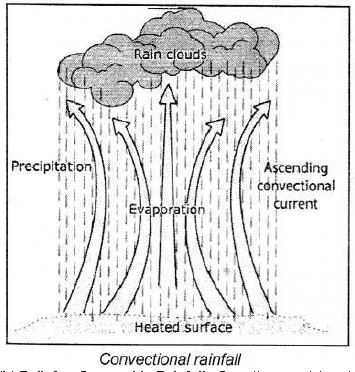
(a) Convectional Rainfall: Near the equator, strong sunlight causes high levels of evaporation. The heated air expands, grows light, and rises as warm convection currents. As this air ascends, it cools down and condenses, producing intense rainstorms often accompanied by thunder and lightning. Since this frequently occurs around late afternoon, it is known as the four o'clock showers.
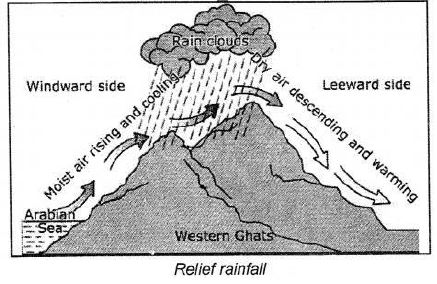
(b) Relief or Orographic Rainfall: This happens when winds carrying heavy moisture are blocked by a physical obstacle like a mountain range. The air is forced to climb up the windward slope, where it expands and cools. This cooling leads to cloud formation and heavy rain on this side, leaving the other (leeward) side dry as a rain shadow.
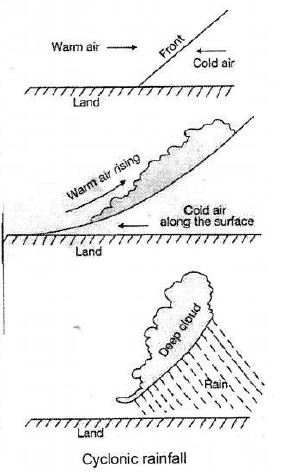
(c) Cyclonic or Frontal Rainfall: This rainfall occurs when two different air masses - one warm and one cold - meet, creating a boundary called a front. The heavier, denser cold air stays near the ground, forcing the lighter, warm air to rise over it. As the warm air climbs, it cools, condenses, and forms deep clouds that bring steady rain.
In simple words: Rain happens in three main ways: when hot air rises (convectional), when wind hits a mountain (relief), or when warm and cold air meet (cyclonic).
Exam Tip: Be ready to draw all three types of rainfall, making sure to label key features like the windward/leeward sides, convection currents, or fronts.
G. Picture study
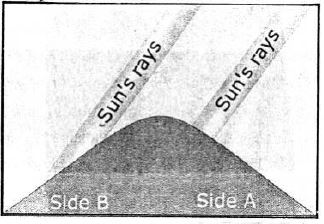
Question 1. The diagram alongside illustrates one of the factors that affect temperature. What is it ?
Answer: This diagram shows 'Aspect', which is the direction a slope faces compared to the rays of the sun. In the Northern Hemisphere, slopes facing south get direct sunlight, making them warmer, while slopes facing north are cooler. In the Southern Hemisphere, this is reversed, so north-facing slopes receive more sunlight than south-facing ones.
In simple words: Aspect is the direction a mountain slope faces. Slopes that face the sun directly are warmer than those in the shade.
Exam Tip: Aspect is a key factor affecting temperature; always mention how it differs between the Northern and Southern Hemispheres.
Question 2. Which side of the mountain is likely to have houses and be covered with trees ?
Answer: Side B is the mountain slope that is more likely to support forest growth and be chosen for building houses.
In simple words: Side B is the slope where you will find more homes and trees.
Exam Tip: Be careful to read the diagram and write Side B as the answer for tree coverage and housing, as specified in the text.
Free study material for Geography
ICSE Voyage Solutions Class 7 Geography Chapter 5 Study Of Weather
Students can now access the detailed Voyage Solutions for Chapter 5 Study Of Weather on our portal. These solutions have been carefully prepared as per latest ICSE Class 7 syllabus. Each solution given above has been updated based on the current year pattern to ensure Class 7 students have the most updated Geography content.
Master Voyage Textbook Questions
Our subject experts have provided detailed explanations for all the questions found in the Voyage textbook for Class 7 Geography. We have focussed on making the concepts easy for you in Chapter 5 Study Of Weather so that students can understand the concepts behind every answer. For all numerical problems and theoretical concepts these solutions will help in strengthening your analytical skill required for the ICSE examinations.
Complete Geography Exam Preparation
By using these Voyage Class 7 solutions, you can enhance your learning and identify areas that need more attention. We recommend solving the Geography Questions from the textbook first and then use our teacher-verified answers. For a proper revision of Chapter 5 Study Of Weather, students should also also check our Revision Notes and Sample Papers available on studiestoday.com.
FAQs
You can download the verified Voyage solutions for Chapter 5 Study Of Weather on StudiesToday.com. Our teachers have prepared answers for Class 7 Geography as per 2026-27 ICSE academic session.
Yes, our solutions for Chapter 5 Study Of Weather are designed as per new 2026 ICSE standards. 40% competency-based questions required for Class 7, are included to help students understand application-based logic behind every Geography answer.
Yes, every exercise in Chapter 5 Study Of Weather from the Voyage textbook has been solved step-by-step. Class 7 students will learn Geography conceots before their ICSE exams.
Yes, follow structured format of these Voyage solutions for Chapter 5 Study Of Weather to get full 20% internal assessment marks and use Class 7 Geography projects and viva preparation as per ICSE 2026 guidelines.